1989 Mercedes-Benz 560SL convertible

560SLs were a notable presence in the January 2014 auctions at Scottsdale and Kissimmee, so I decided to finally post this short entry on the last of third-generation SLs.

“Engineered like no other car in the world”

The 1989 Mercedes-Benz 560SL marked the end of the R107 generation that had begun way back in 1972 with the 450SL. There had been a moderate restyling for 1986, but the basic bones were definitely aged.

Motive power was provided by a Bosch fuel injected 227 bhp 5.5 liter/338 ci V8 connected to a four-speed automatic transmission. Mileage wasn’t exactly great for the 3,700-pound car—the ratings of the day were 14 city mpg/17 highway (adding a $1,300 gas guzzler tax to every vehicle), by today’s standards that would be 12 city/16 highway. With the 22.5-gallon gas tank, 560SL owners could expect a range of between 280 and 315 miles with a 10% fuel reserve. 0-60 did come in about 7 seconds, but the 560SL was closer to a muscle car than to a sports car.

Philips light bulb advertisement featuring 1989 Mercedes-Benz 560SL
Philips light bulb advertisement featuring the 1989 Mercedes-Benz 560SL

The base price for 1989 was $64,230 (about $172,400 in today’s dollars). For your money, you got a plethora of standard equipment. Standard exterior and mechanical features included power assisted steering, anti-lock braking system, and power assisted four wheel disc brakes, and light alloy wheels. Inside, leather upholstery, a driver’s side air bag, cruise control, automatic climate control, central locking, electrically operated windows, an electronic AM and FM stereo radio with cassette player, and (of course) a first aid kit were included. About 8,300 buyers took home this last of the line example.

The View From 2025

There is decent club support for the 560SL, as there is for almost all Mercedes-Benz’s. 560SLs maintain a substantial presence in the Hemming’s Motor News classifieds, on eBay Motors, and on Bring a Trailer. As I updated this blog post in August 2025, there were 83 available on Hemmings, including 22 of the 1989 models. According to Hagerty’s valuation tools, all the money for a 1989 560SL in #1/Concours condition is an astounding $153,000, while a more normal #3/Good condition car goes for $24,400.

Make mine Astral Silver Metallic, please.

Other Mercedes-Benz models I have written about included the 1980 450SL convertible, the 1981 380 SEL sedan, the 1985 380SL convertible, the 1985 300SD coupe, and the 1986 560SEC coupe.

Last updated August 2025.

Eighties Vehicles at the 2014 Barrett-Jackson Scottsdale

As always, the January auction at Barrett-Jackson Scottsdale provided much interesting fodder for commentary. I’ll stay away from the “Salon Collection” and concentrate on the 1980s cars (and a few trucks) that sold and add some of my opinions.

Tuesday:

  • 1981 green two-tone Cadillac Seville sedan—$1,000 hammer price.
  • 1984 Light Briar Metallic Oldsmobile Toronado coupe with 32,000 miles—$6,200
  • 1987 green Toyota custom pickup truck—$2,500
  • 1987 Copper Chevrolet Corvette coupe—$5,750
  • 1980 black Mercedes-Benz 450SLC coupe—$9,500
  • 1989 Signal Red Jaguar XJ-S convertible (the real convertible, not the earlier targa convertible)—$6,200
  • 1986 white Mercedes-Benz 560SL convertible—$17,500
  • 1986 black Mercedes-Benz 560SEL sedan—$7,500
  • 1987 black Buick Grand National coupe with 15,000 miles—at $23,000 the first car in this auction to meet my criteria for serious 1980s collectability of original cars: selling for equal to or above its original list price. I’ll mark these cars in bold green.
  • 1987 black Buick Grand National coupe—$25,000
  • 1987 Bright White Buick Regal Turbo coupe with T-tops and 39,000 miles—$18,500
  • 1987 black Buick Grand National coupe (was somebody dumping Grand Nationals at Scottsdale?)—$18,500
  • 1989 white Pontiac Firebird Trans Am 20th Anniversary Edition hatchback coupe with 10,000 miles—$28,500
  • 1988 red Ferrari Mondial convertible (always the 80s Ferrari stepchild)—$29,000
  • 1985 Chevrolet Camaro very custom coupe—$8,000

Wednesday:

  • 1986 Dark Chestnut Metallic Oldsmobile Cutlass coupe—$5,200
  • 1988 silver Mercedes-Benz 560SL convertible—$11,500
  • 1984 Bright Red Chevrolet Corvette coupe—$10,000
  • 1988 gray Mercedes-Benz 560SL convertible —$12,000
  • 1981 Beige/Dark Bronze Chevrolet Corvette coupe—$13,000
  • 1987 white Chevrolet Monte Carlo SS aero coupe with 11,000 miles—$17,600
  • 1988 Dark Red Metallic Chevrolet Corvette coupe with 10,000 miles—$12,500
  • 1988 red Ford Mustang Saleen coupe—$24,500
  • 1985 white Chevrolet Camaro IROC-Z Live Aid coupe—$29,000
  • 1988 beige Lincoln Continental limousine with 16,000 miles—$16,000
  • 1982 Toyota custom pickup truck—$4,200

Thursday:

  • 1987 black Alfa Romeo Veloce convertible—$12,000
  • 1981 Charcoal Chevrolet Camaro Z/28 coupe (really nice late second generation F-cars are beginning to come on—this one sold for $5,000 more than Hagerty’s “all the money” price)—$30,000
  • 1982 gray Ferrari 400i coupe (maybe all 2+2 Ferraris get killed on the market)—$24,000
  • 1981 red Porsche 911 custom coupe—$36,000
  • 1980 black Mercedes-Benz 380SL very custom (it has an LS2) convertible—$30,000
  • 1989 white Pontiac Firebird Trans Am 20th Anniversary Edition hatchback coupe with 7,000 miles—$27,000
  • 1989 white Pontiac Firebird Trans Am 20th Anniversary Edition hatchback coupe with 677 miles—$25,000
  • 1982 Dune Beige Toyota Land Cruiser FJ-40 SUV—$29,000
  • 1982 red Pontiac Firebird Trans Am custom with a Gale Banks 611 bhp twin turbo V8 (the Car and Driver 200 mph cover car for those that remember). I think this was a huge bargain at $23,000.
  • 1982 blue Toyota Land Cruiser FJ-40 SUV—$45,000
  • 1989 Rosso Corsa Ferrari 328 GTS targa—$59,000
  • 1981 black Pontiac Firebird Trans Am coupe—$35,000

Friday:

  • 1986 red Mercedes-Benz 560SL convertible with 9,000 miles—$20,000
  • 1980 Georgian Silver Rolls-Royce Corniche convertible with 16,000 miles (Dean Martin/Dennis Farina owned; did this add much to the price?)—$57,000

Saturday:

  • 1987 black Buick GNX coupe with 11 miles (the top 1980s sale—it doesn’t seem like the GNX is a “Lost Car“—almost exactly at Hagerty’s #1 condition money)—$95,000
  • 1986 black Ferrari Testarossa convertible conversion by Straman, driven by Michael Jackson in a Pepsi commercial. This drew just a little over Hagerty’s #1 condition for a “normal” 1986 Ferrari Testarossa coupe.—$67,000

Sunday:

  • 1986 red Chevrolet El Camino custom—$17,000
  • 1987 Pearl White Porsche Gemballa Cyrrus custom convertible—$43,000
  • 1985 red Mercedes-Benz 380SL convertible—$10,000

Looks like a lot of Mercedes-Benz SLs, turbo Buicks, and 20th Anniversary Trans Ams. What do you think of this year’s results?

Not So Lost Cars of the 1980s

The always interesting Hemmings Daily blog runs a regular feature titled as Lost Cars of the 1980s. Usually, it talks about at least somewhat unloved cars like the Cadillac Cimarron. This week, one of the cars written about was the 1987 Buick GNX. Many comments on the blog post mentioned that the GNX wasn’t really lost—that it was much loved and that the prices were holding up just fine, thank you.

This particular post got me thinking. What are the “not lost” cars of the 1980s? I started a list of cars that retain significant portions of their original value and interest (in alphabetical order with years listed where it matters):

What do you think? I’ve got many of what I think are the marginal “not lost” cars: any C4 Corvette, the Fiero GT, the IROC-Z, and the 944 Turbo. What cars am I missing?

1980 AMC Eagle station wagon

This post was one of the first I wrote for this blog. Substantially revised and updated, it’s now also about twice as long.

“The Eagle has landed … on all fours!”

Essentially (and brilliantly) an AMC Concord with 4-wheel drive, the 1980 Eagle was available in all of the Concord’s body styles, so buyers had a choice between the 2-door sedan, the 4-door sedan, and the 4-door station wagon. The Eagle had a 3-inch taller ride height than the Concord and came with a stone/gravel deflector under the front bumper and 3-inch wide fender flares.

The Eagle came standard with AMC’s 110 bhp 4.2 liter/258 ci inline six with a two-barrel carburetor. A three-speed automatic was the only transmission available to help move the a vehicle with a 3,740-pound curb weight. Car and Driver recorded a 0-60 time of 13.2 seconds. Fuel economy ratings were 16 city/19 highway by the day’s standards. With a 22-gallon gas tank, an Eagle owner could expect a range of 285 to 310 miles with a 10% fuel reserve.

Station wagon page from the 1980 AMC Eagle brochure

The AMC Eagle station wagon’s base price was $7,549—about $32,600 in 2025 dollars or a little over what a 2025 Dodge Hornet GT AWD goes for. Standard exterior and mechanical equipment included pinstriping, power assisted recirculating ball steering, power front disk/rear drum brakes, and P195/75R15 glass belted radial white sidewall tires on 15-inch pressed steel wheels with styled wheel covers. Inside, individual reclining front seats in Sport vinyl, a folding rear seatback, cargo area carpeting and skid strips, and an electronic digital quartz clock were included.

Moving to the Limited trim level (an extra $400 or so) added individual reclining front seats in Chelsea leather or St. Lauren deep plush fabric, a Luxury woodgrain tilt steering wheel, power door locks, an AM radio, and a lockable cargo area storage compartment. The Limited also included Light Group, Visibility Group, Convenience Group, and Protection Group.

One Package, Individual Options, & Production Numbers

Only available with the 2-door sedan and the station wagon, the Sport Package ($299) included high beam halogen headlamps, Sport fog lamps, dual black remote mirrors, and P195/75R15 Goodyear Tiempo steel belted radial black sidewall tires. Inside, Durham Plaid fabric seat trim and a leather-wrapped steering wheel were added. Body pinstriping was deleted, and AMC blacked out everything they could think of—the bumpers (adding nerf strips), the grill, the windshield, the door frames, the lower body moldings (adding 4×4 graphics), the B pillar, the rear liftgate, and the rear taillamp assembly.

Individual options included tinted glass for all windows ($63), air conditioning ($513), cruise control, an electric rear window defroster ($89), and power windows combined with power door locks ($289). Wagon-specific options included woodgrain bodyside panels, a roof rack ($90), and a rear window wiper/washer. An AM/FM multiplex stereo radio was $236.

The Eagle was a significant hit for AMC in 1980, selling over 46,000 units, with the station wagon configuration selling about 56% of that total. AMC would sell them through the 1988 model year for a total of almost 200,000 built.

The View From 2025

AMC Eagles show up with some consistency in the Hemmings Motor News classifieds, on eBay Motors, and on Bring a Trailer. As I update this blog entry in October 2025, there are no 1980 Eagles, but there is a White 1984 station wagon with 141,000 miles for sale on Hemmings, asking $11,900.

Make mine Russet Metallic, please.

Other AMC/Jeep products I have written about include the 1982 Jeep CJ-8 Scrambler pickup truck, the 1983 Jeep Wagoneer Limited SUV, and the 1983 Renault Alliance sedan.

Last updated October 2025

Happy Holidays For 2013!

Happy holidays for 2013!

This has been an interesting few months for me as I try to kick off this blog. Some things I’ve found:

  1. Merely doing this blog has made me a lot more aware of other good and interesting work on eighties cars being done by other folks. In particular, Curbside Classics and the Hemmings Daily blog often have very interesting 1980s related material, though they often have a different viewpoint than I do.
  2. It’s hard to come up with regular content that I feel is worth posting. As I write this, there are twenty draft posts in various stages of completion, but still found wanting in some way. Maybe there’s not enough visual appeal, maybe I don’t feel like I’m saying anything distinctive, maybe there just isn’t enough content to make a real post.
  3. I still haven’t found a WordPress look I’m happy with. My favorite so far is the 2014 theme, but it’s not quite what I’m looking for.
  4. I am looking to get a little more serious about this blog in the new year. I’m considering other contributors and I’m going to do some things to increase visibility. We’ll see what happens …

Again, happy holidays!

1984 Honda Civic CRX hatchback coupe

“Are you using the right car for your gasoline?”

Even for the 1980s, the 1984 Honda Civic CRX two-seater was absolutely tiny, with a length of a little over 12 feet and a weight of around 1,800 pounds. The CRX debuted as a new model included with the introduction of the all-new third generation Civic line.

There were two engine choices for the CRX in 1984. The CRX got a 1.3 liter/82 ci inline four with a three-barrel carburetor and all of 60 bhp—but this got you 46 city/52 highway by the standards of the day (still 38/47 by today’s standards). It also got you a 0-60 time of about 12 seconds.

Moving up to the 1.5 got you the EW1 76 bhp 1.5 liter/91 ci inline four with a three-barrel carburetor—enough to reduce the 0-60 time to just over 10 seconds and still get 32 city/38 highway by the eighties standards (28/35 by the current standard). A five-speed manual was standard with both engines, but you could get a three-speed automatic with the 1.5—though I’m not at all sure why you’d want one.

All CRXs included a front air dam, a rear spoiler, tinted glass, a front stabilizer bar, rack and pinion steering, power-assisted front disc/rear drum brakes, and 165/70R-13 steel-belted radial tires on 13-inch wheels. Inside, reclining front bucket seats, a 3-spoke Sport steering wheel, and a tachometer were included.

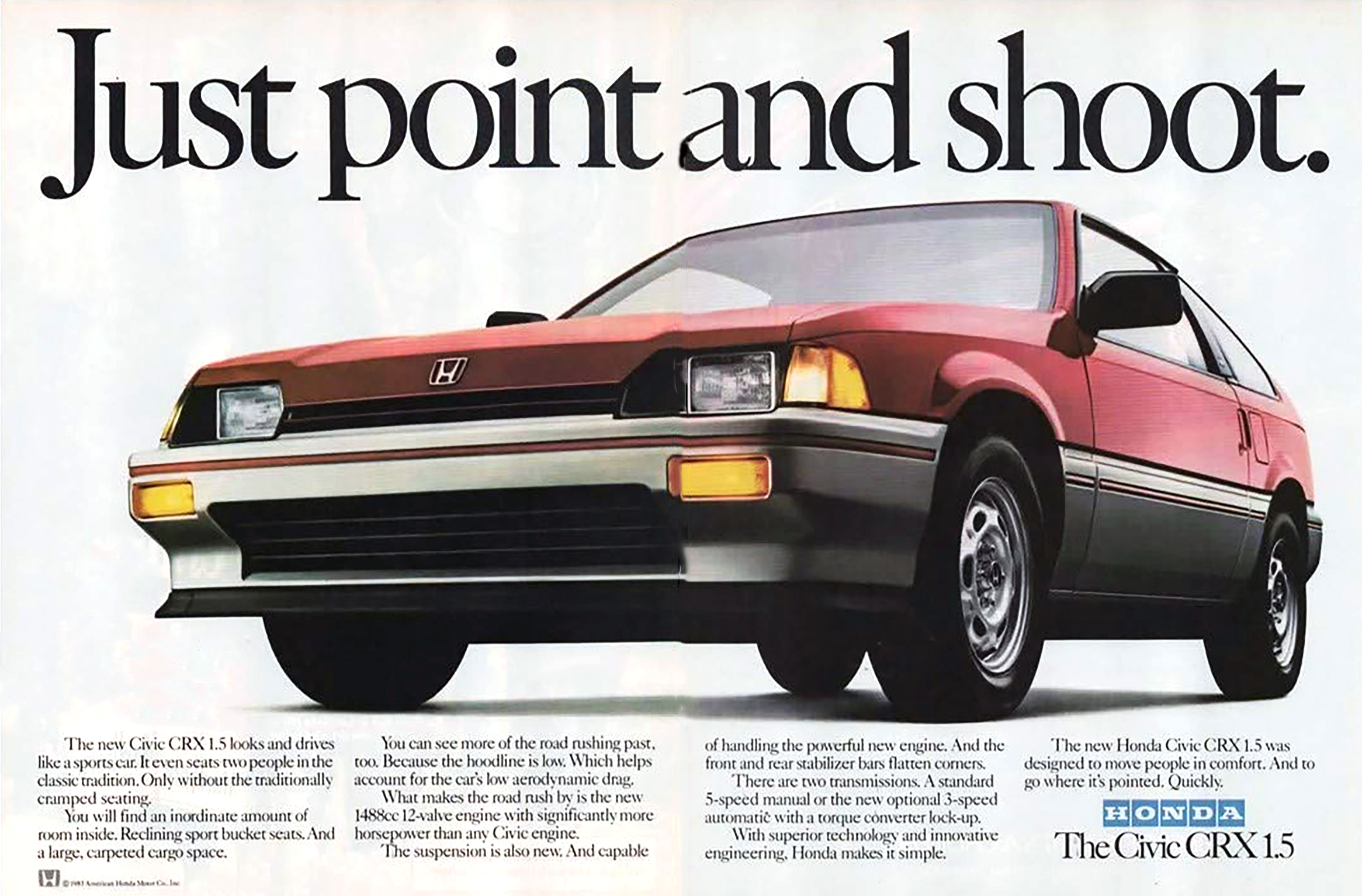
1984 Honda Civic CRX print advertisement
1984 Honda Civic CRX 1.5 print advertisement

The 1.5 added halogen headlights, dual remote-control outside mirrors, a sport suspension, a rear stabilizer bar, vented front disc brakes, and Michelin 175/70R-13 steel-belted radial tires (a size still somewhat available) on wider wheels. Inside, a quartz digital clock was added.

Options & Production Numbers

Past the engine and transmission choices, California emissions, and the three initial factory colors, the CRX had no factory options. Dealer installed options included air conditioning, aluminum alloy wheels, and a selection of radios.

The first generation CRX found its markets and sold quite well, with over 48,000 in 1984 and a total of 218,000 over four years. In 1985, the fuel injected 91 bhp Si would come along—but that is a topic for another blog post.

The View From 2025

I see early CRX’s occasionally, but they’ve become rarer and rarer on the roads in the northeast. I have yet to see one at an auto show, but I’d love to. First-generation CRX’s are sometimes available in the Hemmings Motor News classifieds, on eBay Motors, and at online auctions such as Bring a Trailer that cater to the eighties car market.

Make my 1984 CRX a 1.5 in Baltic Blue (with the standard metallic gray lower rocker panels), please.

Other Hondas I have written about include the 1983 Civic S hatchback coupe, the 1984 Civic DX hatchback coupe, the 1985 Civic CRX Si hatchback coupe, the 1986 Accord sedan, the 1986 Prelude Si coupe, and the 1988 Civic sedan.

Last updated June 2025.

1985 Chevrolet Camaro IROC-Z hatchback coupe

“Make the earth move.”

In 1985, Chevrolet kicked the third-generation Camaro up a notch (or more) with the release of the IROC-Z, inspired by the International Race Of Champions race series. The IROC-Z was an option package (B4Z) for the Z28 and cost $659 in addition to the Z28‘s $11,281 base price.

Front cover of the 1985 Chevrolet Camaro brochure

Suspension upgrades specific to the IROC-Z included Delco/Bilstein shock absorbers for the rear wheels and 16-inch wheels all around with Goodyear Eagle GT P245/50VR16 tires—large for the day and a size still readily available.

The IROC-Z also included louvered hood inserts and more aggressive ground effects and spoilers than the Z28. Finally, it was lowered half an inch compared to the Z28.

Three engines were available in 1985 for the IROC-Z, all sized at 5.0 liter/305 ci: standard was the LG4 carburetted motor at 155 bhp. The optional engines available depended on transmission—if you chose the five-speed manual, you could get the High Output carburetted L69 with 190 bhp ($680 and not available on the garden variety Z28) while if you went with the four-speed automatic ($425), you could choose the Tuned Port Injection LB9 at 215 bhp ($695).

Performance with the LB9 was impressive—Motor Trend recorded a 0-60 time of 6.9 seconds. If you cared (and I think most of the target market did not), mileage wasn’t great: the EPA ratings of the day were 16 city/22 highway for the LG4, 15/24 for the L69, and 16/22 for the LB9. With a 16.1-gallon gas tank, the proud new owner of an IROC-Z could expect a range of 250 to 275 miles with a 10% fuel reserve.

Standard equipment on all versions of the Z28 included Sport mirrors, rack and pinion steering, power front disk/rear drum brakes, reclining front bucket seats, a folding rear seat, and an AM radio with dual front speakers.

Options & Production Numbers

Options included four-wheel disk brakes ($179), Custom cloth front bucket seats ($359), a six-way power driver’s seat ($225), air conditioning ($750), Comfortilt steering wheel ($115), power door lock system ($130), power windows ($195), electronic speed control with resume speed ($175), and a rear window wiper and washer ($125). A range of stereos was offered up to an electronically tuned AM/FM stereo radio with seek and scan, a cassette tape player, a clock, and a graphic equalizer ($469).

Chevrolet sold 21,177 IROC-Z versions out of 68,199 Z28s in the 1985 model year, marking an impressive debut. One year later, the IROC-Z would account for 56% of Z28 sales, and in 1988, Chevrolet would phase out the Z28 in favor of the IROC-Z.

The View From 2025

According to Hagerty’s valuation tools, all the money for a 1985 IROC-Z with the top-of-the-line TPI motor and t-tops in #1/Concours condition is $52,500, with a far more normal #3/Good condition version going for $20,200. IROC-Zs regularly appear in the Hemming’s Motor News classifieds, on eBay Motors, and at online auctions such as Bring a Trailer that cater to the eighties car market. As I update this blog entry in June 2025, there’s a Yellow 1985 IROC-Z with 66,000 miles for sale on Hemmings, asking $29,500.

Please make mine Red, with the optional and expensive when new ($846) t-tops. I know they often leak, but I like the look.

Other third-generation Camaro hatchback coupes I have written about include the 1982 Z28 Indy 500 Commemorative Edition, the 1984 Sport Coupe, and the 1986 Berlinetta. I have yet to write about any of the 1987 through 1989 Camaro convertibles.

Last updated June 2025.

1986 Porsche 944 Turbo hatchback coupe

This post was one of the first I wrote for this blog, and definitely the first on a Porsche. Substantially revised and updated, it’s now also almost 80% lengthier.

“Keeping Up with a Porsche 944 Has Just Gone from Difficult to Impossible”

Porsche released its Turbo version of the 944 for the 1986 model year, marking yet another step in the evolution from the original 95 bhp (!) 924 “nearly a Volkswagen” design, which dated from 1976.

The 944 Turbo featured a turbocharged and intercooled version of the standard 944’s 2.5 liter/151 ci inlin-four that produced 217 bhp. New forged pistons were included, along with a strengthened gearbox and standard external oil coolers for both the engine and transmission.

Despite some major turbo lag, performance was quite good for the mid-1980s: Car and Driver managed to get a 0-60 time of 6.1 seconds and a top speed of 157 mph, though they noted that the base price of almost $30,000 might freeze out some previous 944 customers.

Looks weren’t sharply different from the “civilian” 944, which stayed in production. The nose was somewhat simplified with an integrated front bumper, and the rear had a fairing fitted to clean up the appearance of some underside components. Wheels resembling those on the “big brother” 928 were fitted. The result looked quite good in commercials.

1986 Porsche 944 Turbo print advertisement

Standard exterior and mechanical equipment on the 944 Turbo included fog lights, all around tinted glass, front and rear stabilizer bars, and power steering. Tires were 205/55VR-16 in the front and 225/50VR-16 for the rear, both mounted to 16-inch pressure cast wheels (both tire sizes are still readily available). Inside, a leatherette interior with cloth inlays, a driver seat with electric height adjustment, a 4-spoke leather-covered steering wheel, automatic full climate control, and power windows were included.

Options & Production Numbers

Options included a limited slip differential ($625), 16-inch forged alloy wheels ($516), a central locking system ($263), and a Blaupunkt Monterey digital cassette radio ($657).

The 944 Turbo sold well in 1986—Porsche sold 7,513 in the United States. 1986 would turn out to be the best year for the 944 Turbo—by 1991 the 968 would take over.

The View From 2025

There is excellent club support for the 944 Turbo, as there is for all Porsches. According to Hagerty’s valuation tools, all the money for a 1986 944 Turbo in #1/Concours condition is $70,000, with a more normal #3/Good condition car going for $22,000. I’m seeing 944s at judged car shows, and they maintain a reasonable presence in the Hemmings Motor News classifieds, on eBay Motors, and on Bring a Trailer.

Make mine Guards Red, please.

Other eighties Porsches I have written about include the 1980 911 SC coupe, the 1980 924 hatchback coupe, the 1982 924 Turbo hatchback coupe, the 1982 928 hatchback coupe, the 1985 911 Carrera Cabriolet, the 1986 911 Turbo coupe, the 1987 911 3.2 Carrera coupe, and the 1988 944 hatchback coupe.

Last updated August 2025.

1984 Nissan/Datsun 300 ZX hatchback coupe

“Every move you make, every turn that you make confirms you are in the most technologically advanced Z car ever made.”

This Nissan/Datsun 300 ZX is not the generation with most of the glamor—that 300ZX was the one that followed in the 1990s. For 1984, Nissan moved from the inline 6 of the 280-ZX to a 3.0 liter/181 ci V6 with fuel injection, available either naturally aspirated (160 bhp) or turbocharged (200 bhp). The styling was completely and controversially revised for the first time in the history of the Z car—a massive revision akin to that of the Chevrolet Corvette for the same year.

Car and Driver recorded a 0-60 time of 7.3 seconds in a Turbo with the four-speed automatic. Fuel economy with the same powertrain was 19 city/28 highway by the day’s standards (15/20 by 2025 measures). With an 18.5-gallon gas tank, 300 ZX Turbo owner could expect a range of 295 to 390 miles with a 10% fuel reserve.

1984 Nissan 300 ZX advertisement

Standard exterior and mechanical equipment on the well-equipped $15,800 300 ZX (about $50,700 in 2025 dollars or almost what a 2026 Nissan Z Performance starts at) included blue tinted glass windows, a fully automated motorized antenna, pop-up halogen headlights, ventilated four-wheel power disc brakes, power rack-and-pinion steering, and P215/60R15 tires (a size still readily available) on 15-inch alloy wheels. Inside, an eight-way manually adjustable driver’s seat, power windows, tilt steering column with memory, air conditioning, and a 40-watt AM/FM stereo with electronic digital display, scan tuning, a cassette deck with Dolby noise reduction, and four speakers were standard.

At $18,200, the 300 ZX Turbo added three-way adjustable shock absorbers, headlight washers, an oil temperature gauge, and a turbo boost gauge—in addition to the turbo engine itself. The Turbo also had different wheels, tires, and final drive ratios.

Packages, Options, & Production Numbers

The 300 ZX to have in 1984 was undoubtedly the 50th Anniversary Edition (released to celebrate Nissan’s half-century) which was an absolutely loaded turbocharged model with a Light Pewter Metallic and Thunder Black color scheme. All Anniversary Editions came equipped with flared front and rear fenders, Bodysonic bass speakers in the seats (individually adjustable for driver and passenger from the console), a T-bar sun roof with removable mirrored glass panels and fitted storage pockets, black leather bucket seats, and Pirelli P7 225/50VR16 low-profile tires (a specific tire still available) on 16-inch aluminum alloy wheels. Other equipment included a digital dash with MPG and compass readouts and steering wheel controls for the cruise control and the radio. Nissan even included a fitted car cover.

The only option available on the Anniversary Edition was the choice of a five-speed manual transmission or a four-speed automatic transmission. 5,148 out of the 75,351 (!) 1984 300ZXs produced for the US market were Anniversary Editions at a non-trivial list price of $26,000 (about $83,400 in 2025 dollars).

“Normal” 300 ZX coupes had few individual options beyond a T-bar sun roof with removable glass panels and fitted storage pockets. The Leather Package included leather bucket seats (natch!), an eight-way adjustable power driver’s seat with six power functions, an electronic instrument display, a leather-wrapped two-spoke steering wheel, and an 80-watt AM/FM stereo with electronic digital display, automatic program search display, memory presets, an auto-reverse cassette deck with Dolby noise reduction and metal tape compatibility, and eight speakers.

The View From 2025

According to Hagerty’s valuation tools, a base 1984 300 ZX in #1/Concours condition is $35,700, with a far more typical #3/Good car going for $9,600. Values for the Anniversary Edition are well more—about $58,600 for the very best. 300 ZXs make regular appearances in the Hemmings Motor News classifieds, on eBay Motors, and on Bring a Trailer, though you sometimes have to be careful to check under both Datsun and Nissan. As I update this blog post in December 2025, there’s a 50th Anniversary Edition with 55,000 miles for sale in Hemmings, asking $37,000.

Make mine Wine Metallic, please. Dark Green Metallic tempted me, but it’s believed that only one 300 ZX was painted in that color.

Other Datsuns and Nissans I’ve written about include the 1980 200-SX coupe, the 1980 280-ZX hatchback coupe, the 1981 810 Maxima sedan, and the 1989 Maxima sedan.

Last updated December 2025.

Save

Save

1988 BMW 750iL sedan

“Enter into a new world.”

BMW’s M70 V12, courtesy of Sv650k4 from the Wikimedia Commons.

After a year in production with just the straight 6, the second generation of BMW’s top-of-the-line 7-series sedan got a V12 option in 1988. This engine, designated M70 and BMW’s first production V12, used Bosch Motronic M fuel injection and made a fairly effortless 296 bhp from its 5.0 liter/304 ci size.

The late eighties were back when BMW’s number and letter designations still meant something, so the breakout of the 7-series with the V12 was this:

7 – series
50 – 5.0 liters
i – fuel injected
L – long wheelbase

1988 BMW 750iL advertisement

The 750iL’s eye-popping base price was $69,000—about $193,300 in 2025 dollars, and 55% more than a 2026 760i xDrive sedan goes for. For all that money, the purchaser got almost every piece of equipment BMW could put in the car. Exterior and mechanical features included a ZF four-speed automatic, four-wheel anti-lock disc brakes, traction control, ZF’s Servotronic power steering, a self-leveling rear suspension, and Pirelli P600B 225/60VR-15 tires (a size still somewhat available) on 15-inch wheels. Inside, a driver’s side airbag, a trip computer, dual-zone air conditioning, and leather seats were all standard.

Options, Performance, & Period Reviews

Beyond this, there were a few options available; one was a limited-slip differential. In addition, the buyer of a 750iL was paying the dreaded $1,850 gas guzzler tax—the original EPA estimate was 12 city/17 highway (the modern equivalent would be 11 city/16 highway). With a capacious 27-gallon fuel tank, a 750iL owner could expect a range of 330 to 350 miles with a 10% fuel reserve.

I remember being in one of these cars when it was new, and I felt that it accelerated like a Learjet: weighing in at about 4,235 pounds, it still could do 0-60 mph in about 7.5 seconds and hit 155 mph—respectable sports car numbers in the late 1980s. At the time, Car and Driver called it “the sedan of choice when money is no object.”

The View From 2025

Like many BMWs, the 750iL does attract collector interest, and there is support from BMW car clubs. Maintenance costs can be daunting, and Hagerty does not track the 750iL—perhaps because they rarely trade hands. 750iLs do occasionally appear for sale in the Hemming’s Motor News classifieds, on eBay Motors, and on Bring A Trailer.

Make mine Salmon Silver, please, though Diamond Black also has its attractions.

I have also written about the 1982 733i sedan. Other BMWs I have written about include the 1983 633CSi coupe, the 1984 325e coupe, the 1985 535i sedan, the 1987 L6 coupe, the 1987 M6 coupe, and the 1988 M3 coupe.

Last updated August 2025.