“A dramatic step forward …”
Along with its Thunderbird sister, Mercury’s Cougar personal luxury coupe was all new for 1989. The Thunderbird/Cougar program was code-named MN12 and cost about $1.4 billion to develop—an astounding amount of money at the time for an effort that would only be seen in two cars (the Lincoln Mark VIII’s FN10 platform was at least closely-related).
Mercury offered two versions of the Cougar, which were sharply separated by both their target market and their powertrains. The powertrain of the Cougar LS‘ (“luxury, style and a unique level of comfort”) was an Essex 140 bhp 3.8 liter/232 ci V6 with electronic sequential multi-port fuel injection paired with an automatic overdrive transmission. The powertrain of the Cougar XR7 (“comfort just got a shot of adrenaline”) was an Essex 210 bhp 3.8 liter/232 ci V6 with a supercharger, an intercooler, and electronic sequential multi-port fuel injection paired with a five-speed manual transmission. The automatic overdrive transmission was an option for the XR7.
| Essex V6 | Essex Supercharged V6 | Essex Supercharged V6 | |
|---|---|---|---|
| Transmission | 4-speed Automatic Overdrive | 5-speed Manual | 4-speed Automatic Overdrive |
| 0-60 mph (approximate) | 10.7 seconds | 7.5 seconds | 7.7 seconds |
| Fuel mileage (1989 standards) | 19 city/27 highway | 17 city/24 highway | 17 city/23 highway |
| Range (10% fuel reserve) | 360 to 390 miles | 320 to 350 miles | 310 to 340 miles |
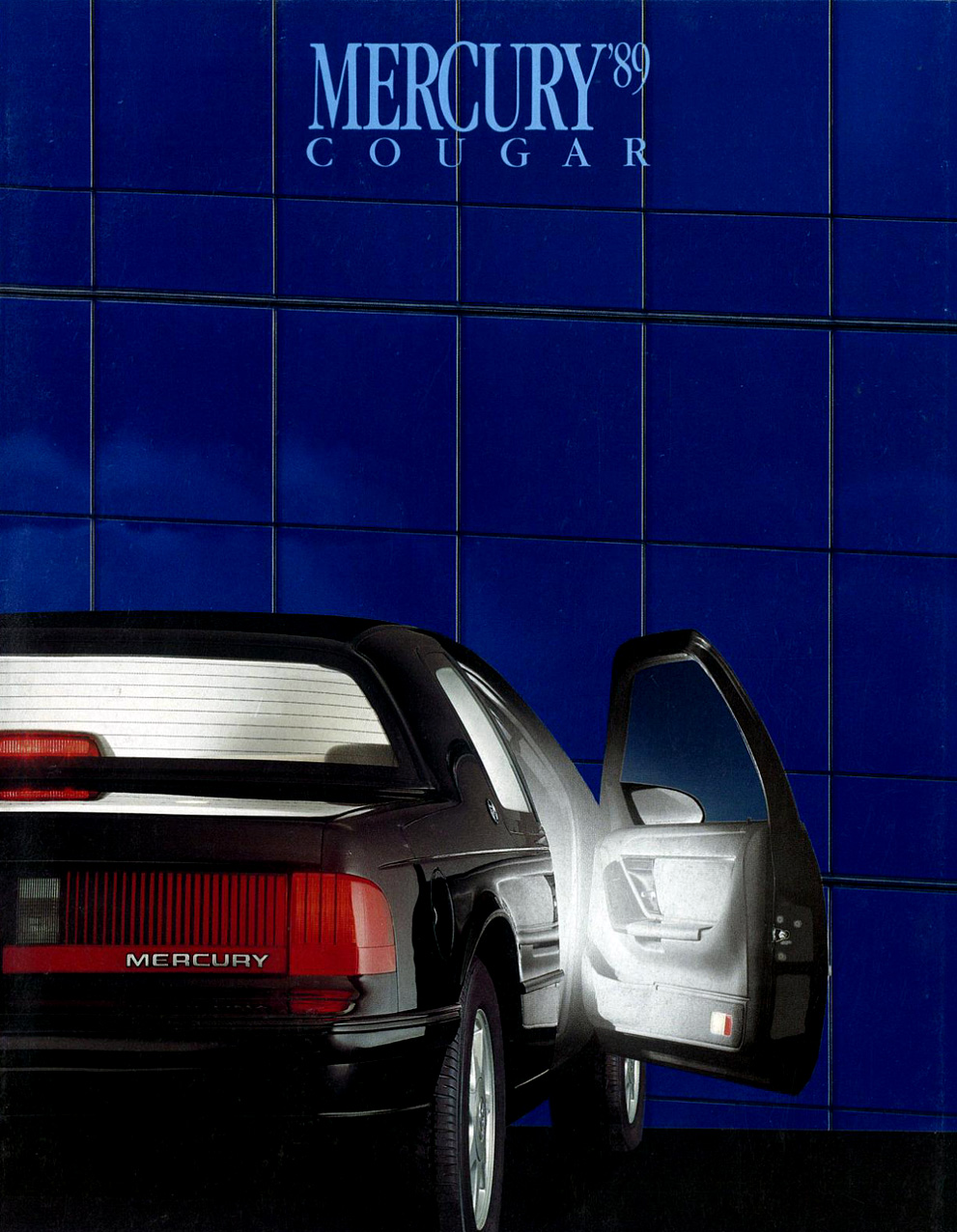
The Cougar LS‘s base price was $14,612. Standard exterior and mechanical equipment included low profile halogen headlamps, dual power mirrors, tinted glass, electronic speed-sensitive variable-rate power rack-and-pinion steering, and P205/70R15 black sidewall all-season steel-belted radial tires on 15-inch wheels with Luxury wheel covers. Inside, cloth front reclining bucket seats, a center console, power windows, air conditioning, and an electronic AM/FM stereo radio with four speakers and a digital clock were included.
The sporty XR7 ($19,823) added four-wheel disc anti-lock brakes and P225/60VR16 black sidewall performance steel-belted radial tires on 16-inch cast aluminum wheels. Inside, articulated Sport seats with power lumbar and power side bolsters and a Sport steering wheel were included.
Preferred Equipment Packages, Individual Options, & Production Numbers
The 1989 Cougar LS was available with three Preferred Equipment Packages:
- 261A included a tilt steering wheel, fingertip speed control, an electric rear window defroster, and power lock group
- 262A included everything in 261A and added P215/70R15 black sidewall tires on 15-inch aluminum wheels, a six-way power driver’s seat, a leather-wrapped steering wheel, front carpet floor mats, Luxury light group, and an electronic AM/FM stereo cassette radio
- 263A included everything in 262A and added a power antenna, keyless entry, Luxury lamp group, and a diagnostic maintenance monitor. The stereo was upgraded to a “high level” electronic AM/FM stereo cassette radio, and both front seats got six-way power adjusters
The 1989 Cougar XR7 was available with two Preferred Equipment Packages:
- 265A included a six-way power driver’s seat, a tilt steering wheel, fingertip speed control, an electric rear window defroster, power lock group, and an electronic AM/FM stereo cassette radio
- 266A ($2,363) included everything in 265A and added a power antenna, keyless entry, front carpet floor mats, Luxury light group, and Luxury lamp group. The stereo was upgraded to a “high level” electronic AM/FM stereo cassette radio, and both front seats got six-way power adjusters
Individual options available for both versions of the Cougar included a power slide/tilt moonroof with sunshade ($741) and leather seating surfaces ($489). Two upmarket stereo options were available—a Ford JBL audio system ($488) that hoped to compete with the Delco/GM Bose and a compact digital disc player ($491). Only the XR7 offered a split fold-down rear seat ($133).
Mercury sold 97,246 Cougars in the 1989 model year, with the vast majority being the LS—only 5% of Cougars were XR7s. 44% of those few XR7s came with a manual transmission.
The View From 2026
These Cougars sometimes appear for sale in the Hemmings Motor News classifieds, on eBay Motors, and on Bring a Trailer. Bring a Trailer has sold 21 eighth-generation Cougars in the last five years—every one of them an XR7.
Make mine Currant Red Clearcoat Metallic, please.
Other Cougars I have written about in this blog include the 1980 XR-7 coupe and the 1988 XR-7 coupe. I’ve also written about five of the closely related Thunderbirds—the 1980 coupe, the 1982 coupe, the 1983 Turbo Coupe, the 1987 standard coupe, and the 1989 coupe.