
1980 Ford Fiesta hatchback coupe

In late 2021, Bring a Trailer featured a 1980 Ford Fiesta with unknown mileage selling at no reserve—it went for $7,200.

Ford’s first-generation Fiesta was in its final year of availability in the United States, soon to be replaced by the Escort. Because of this, the 1980 Fiesta had only minor trim and detail changes.

The Fiesta’s standard powertrain was a transverse-mounted 66 bhp 1.6 liter/98 ci inline four with a two-barrel carburetor paired with a four-speed manual. Ford’s full-line brochure stated that Fiesta acceleration was “exhilarating.” In reality, 0-60 mph took between 11 and 12 seconds in a car with a shipping weight of 1,726 pounds. The EPA rated fuel economy at an impressive 26 city/38 highway by the day’s standards. With a 10-gallon gas tank, a Fiesta owner could expect a range of 260 to 290 miles with a 10% fuel reserve.

Classified by the EPA as a subcompact, the Fiesta was a small car even in 1980, and is tiny by modern standards. With a 90-inch wheelbase and a 147.1-inch length, it gives up 8 inches of wheelbase and over 5 inches of length to a modern MINI Cooper. In 1980 brochures, Ford used the old trick of putting the car in the foreground and putting models at some indeterminate distance in the background.
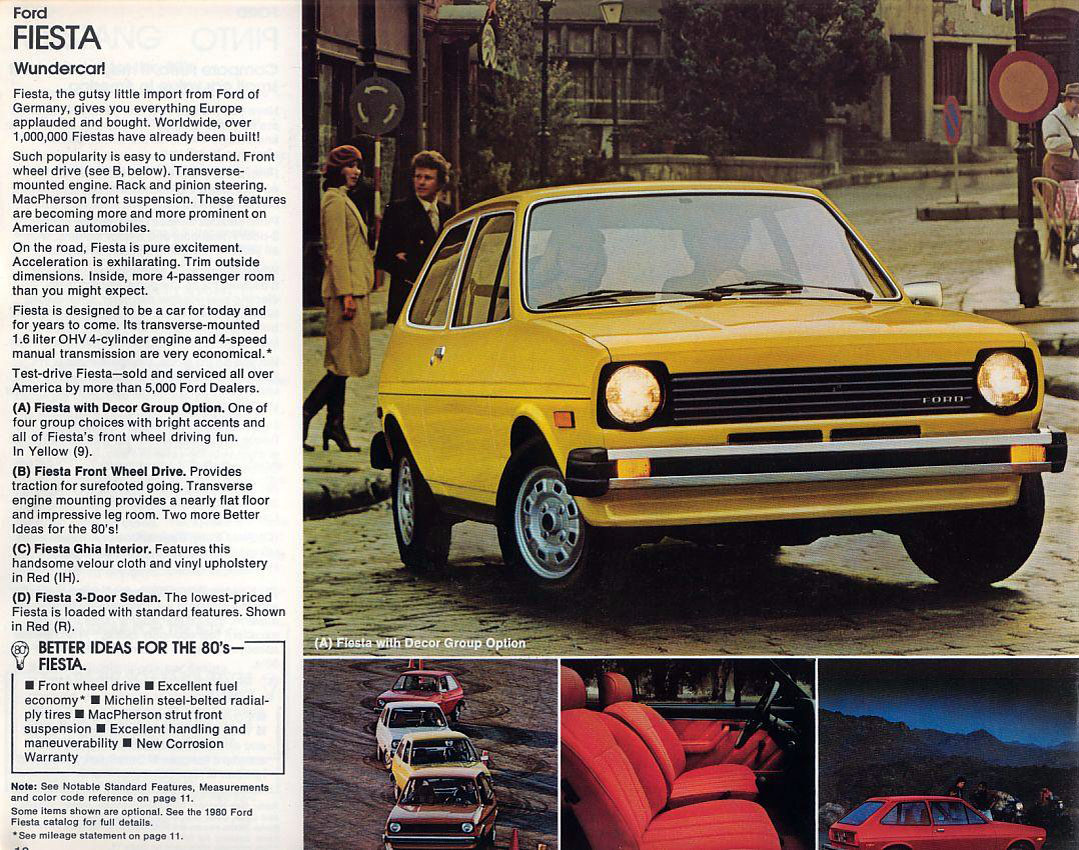
Fiesta page from the 1980 Ford brochure

Standard equipment for the $5,032 Fiesta (about $21,400 in today’s dollars) included front wheel drive, a MacPherson strut front suspension, rack and pinion steering, front disc brakes, and Michelin 155-12 steel-belted radial tires on 12-inch argent road wheels. Inside, the Fiesta included all-vinyl high back front bucket seats, a fold-down rear seat, and color-keyed passenger compartment carpeting.

Options & Production Numbers

Options included a manually-operated flip-up open-air sunroof ($219), tinted glass ($55), an electric rear window defroster ($96), white sidewall tires ($70), air conditioning ($475 and not available in European versions), and an AM/FM stereo radio ($183). Decor Group and a Ghia interior which included velour and cloth upholstery were also available.

1980 Fiesta sales were off 11% from 1979, but Ford still moved 68,841.

The View From 2025

I haven’t seen a first-generation Fiesta on the streets for many years, and they are rarely seen on eBay Motors or in the Hemmings Motor News classifieds. Apparently, Bring A Trailer auctions one of these Fiestas about once a year.

Make mine Venetian Red, please.

Last updated April 2025.
My Eighties Car Departs

In the spring of 2021, I had a major medical issue that involved lower back surgery. Close followers of this blog might have noticed the paucity of posts between late January and late May.

When I returned home from not one but two hospitals, one of the first things that came to mind was what to do with my 1985 Chevrolet Corvette coupe. With its hard-riding Z51 sport suspension and challenging entry/exit, this car is not for someone who has had back surgery—and I don’t believe in keeping cars around that we don’t drive.

After thinking about it for a while, I decided to auction my Corvette on Bring a Trailer at no reserve—there was nothing that would want me to keep the car. I chose Bring a Trailer in part because I wanted to reach a wide audience: I figured that my 1985’s Light Blue Metallic color was a love it or hate it deal, and I wanted potential bidders to be able to self-sort.

I filled out the vehicle submission form, and the next step was to get the car photographed. Bring a Trailer‘s assigned professional came out in mid-July on what must have been the hottest day of the summer. He took many both accurate and complimentary photos of the car.

In late August, the auction began. Like most Bring a Trailer auctions, it ran for slightly over a week. I was eager not to misrepresent the car but equally interested in putting its best face forward. This desire meant that I spent a lot of time in the comments section.

The 1985 leaves

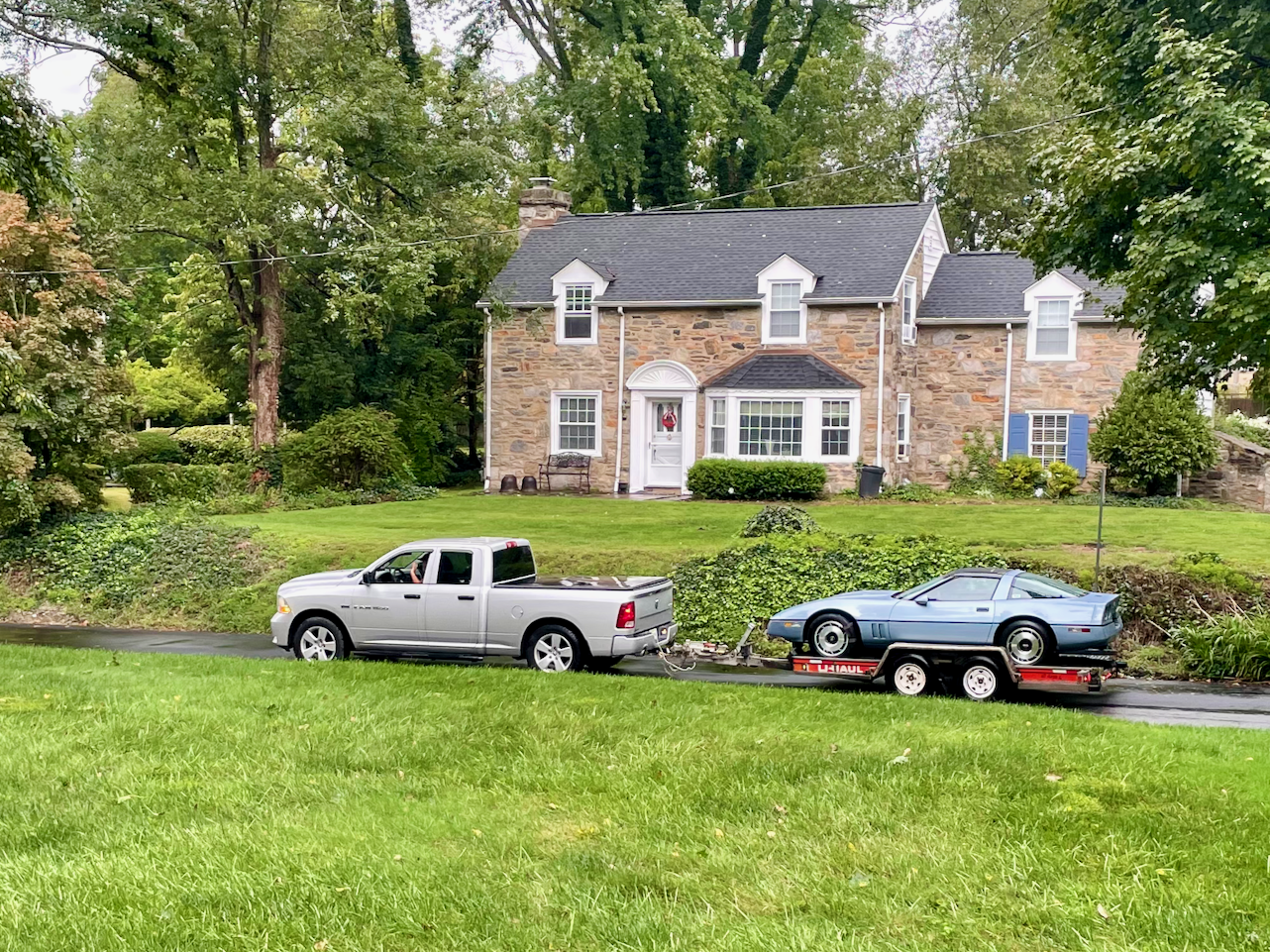
Three days after the auction ended, the winning buyer sent one of his employees out to pick up the car. He loaded the car onto an open trailer (very on-brand for the purchase venue) in the light rain. A few minutes later, he drove away, and my life with a 1985 Corvette ended.

I was sad to see the Corvette go, but not unhappy. My view is that the car owed us nothing—we enjoyed it for seventeen years and it was our ticket to many interesting experiences. I hope the new owner has as much fun with this C4 as we did.

1987 BMW M6 coupe

At the 2021 Mecum Indy, a Cinnabar Red 1987 BMW M6 coupe with tan leather front bucket seats sold for $50,000. That compelled me to write this blog post, but that price would be somewhat of a steal now.

“For the zealots.”

For the 1987 model year, BMW finally brought the European M635CSi (available since 1983) to North America, but rebadged it as the M6. This rebadging meant that the “civilian” 6-series (previously the 633CSi) was redesignated as the L6. Specific M6 details included front and rear M badging, a larger front air dam and rear spoiler, and matching color side mirrors.

The M6’s engine was the S38B35 256 bhp 3.5 liter/211 ci inline six with Bosch Motronic fuel injection. With an 18.5-gallon gas tank, the fuel economy rating of 10 city/19 highway mpg (9/17 by today’s measures) meant a short range of between 220 and 240 miles with a 10% fuel reserve. Car and Driver recorded a 0-60 time of 6.1 seconds.

The M6’s base price was $58,970—about $173,900 in today’s dollars, and about 23% more than a 2025 M8 Gran Coupe starts at. Standard exterior and mechanical equipment included metallic paint, halogen headlights, speed-related power steering, four-wheel power anti-lock disc brakes, and Michelin TRX 240/45VR-415 tires (still available!) on 7.7-by-16.3-inch BBS alloy wheels.

1987 BMW M advertisement

Inside the very well-equipped M6, BMW paired leather reclining front bucket seats with memory with leather rear bucket seats. Other interior accouterments included front and rear air conditioning, power heated side mirrors, power door locks, a three-spoke leather-covered steering wheel, a trip computer, and a digital clock. Audio entertainment was provided by a BMW Sound System with an AM/FM stereo radio, a cassette player, eight speakers, and a power antenna.

Production Numbers & Period Reviews

The 1987 M6 had no factory options—buyers chose the exterior and interior colors, and that was it.

BMW produced a total of 1,767 M6 coupes for North America between September 1986 and September 1988. Reviews were excellent, with the only complaints being the eye-watering price and the fuel mileage (“drinks gas like a fiend”). Car and Driver stated that the M6 was “one of those wild, wonderful cars that throw the scales of automotive justice totally off balance.”

The View From 2025

Like many BMWs, the M6 attracts collector interest, and there is series-specific club support along with that of the bigger BMW car clubs. According to Hagerty’s valuation tools, all the money for a 1987 M6 in #1/Concours condition is $120,000, with a far more normal #3/Good condition version going for $41,700.

M6s are often available in the Hemmings Motor News classifieds, on eBay Motors, and on Bring a Trailer. As I update this post in February 2026, a Black 1987 M6 with silver grey leather front bucket seats and an indicated 13,000 miles is for sale on Hemmings, asking $120,000.

Make mine Silver, please—I think.

Other BMWs I have written about include the 1982 733i sedan, the 1983 320i coupe, the 1983 633CSi coupe, the 1984 325e coupe, the 1985 535i sedan, the 1987 L6 coupe, the 1988 M3 coupe, and the 1988 750iL sedan.

Last updated February 2026.

1982 Chevrolet Camaro Z28 Indy 500 Commemorative Edition hatchback coupe

Every May, the Indianapolis 500 race is a “tentpole” event in the international racing schedule. Since 1911, there have been designated pace cars, with replica versions often sold. A 1982 Chevrolet Camaro Z28 Indy 500 Commemorative Edition with 2,630 miles sold for a $35,000 hammer price at the 2021 Mecum Indy. Are these distinctive and good-looking (I think) cars finally attracting significant interest?

“Even its shadow boasts performance”

The 1982 Chevrolet Camaro could reasonably be described as all-new. This moniker applied to the “pleasing and exciting” exterior, the interior, much of the chassis, and most of the engines. Road & Track stated that the new Camaro was “keenly anticipated.”

The Z28‘s standard powertrain was the LG4 145 bhp 5.0 liter/305 ci V8 with a four-barrel carburetor paired with a four-speed manual transmission. An optional LU5 Cross-Fire 5.0 liter/305 ci V8 with throttle-body fuel injection and 165 bhp set the buyer back $450 and required the $72 three-speed automatic transmission. 0-60 took just under 10 seconds with the base V8 and the four-speed manual, and shortened to 9 seconds with the top-of-the-line Cross-Fire motor and the automatic.

The Z28 had a base price of $9,700—about $33,600 in 2025 dollars. Standard exterior and mechanical equipment on all 1982 Z28s included a front air dam, “ground effect” lower body extensions, a rear spoiler, body-color dual Sport mirrors, power front disc/rear drum brakes, and 215/65R-15 tires (a size still readily available) on 15 x 7 inch 5-spoke aluminum wheels. Inside, every 1982 Z28 came with full instrumentation, an electric quartz analog clock, courtesy lamps, and a leather-wrapped steering wheel.

1982 Camaro Commerative Edition flyer
1982 Camaro Z28 Indy 500 Commemorative Edition flier

Standard equipment specific to the $10,999.26 (yes, that was really the price) Z28 Indy 500 Commemorative Edition included Silver Metallic/Blue two-tone accent paint, red accents on the wheels, specific commemorative edition decals, Custom interior trim, and blue Custom cloth bucket L/S Conteur (Chevrolet’s spelling) front seats.

Options, Production Numbers, & Period Reviews

Among the many options available for the Camaro Z28 were tinted glass ($88), removable glass roof panels ($790!), power windows ($165), a power door lock system ($106), an electric rear window defogger ($125), automatic speed control ($155), air conditioning ($675), a Comfortilt steering wheel ($95), and a host of radios ($111 to $390).

Chevrolet sold 6,360 Indy 500 Commemorative Edition cars in 1982, in addition to 63,563 “normal” Z28s. However, the most popular Camaro was actually the base Sport Coupe, which moved 78,761 units. The somewhat more luxurious Berlinetta sold another 39,744 copies.

Reviews of the new Camaro were decent. Road & Track liked the Z28‘s exterior and the handling, but bemoaned the interior packaging and the fuel mileage (EPA rated at 17 mpg but rarely attaining that in real life). Car and Driver famously accused the Z28 of being “Emily Post polite” but later retracted the remark.

The View From 2025

Third-generation Camaros attract plenty of collector interest, and there is substantial club support. According to Hagerty’s valuation tools, a 1982 Camaro Z28 hatchback coupe with the Cross-Fire motor in #1/Concours condition is $42,000, with a far more normal #3/Good condition version going for $13,500. 1982 Camaro Commemorative Editions are often available in the Hemmings Motor News classifieds, on eBay Motors, and at online (Bring a Trailer) and in-person auctions. As I update this blog entry in October 2025, a Commemorative Edition with the Cross-Fire, an automatic, and 40,000 miles is for sale on Hemmings, asking $20,000.

Other Camaros I have written about include the 1980 Rally Sport coupe, the 1980 Z28 coupe, the 1985 IROC-Z hatchback coupe, and the 1986 Berlinetta hatchback coupe. Pontiac Firebird Trans Ams with blog entries here include the 1981 coupe, the 1982 hatchback coupe, the 1984 15th Anniversary Edition hatchback coupe, the 1985 hatchback coupe, and the 1989 20th Anniversary Turbo hatchback coupe.

Last updated October 2025.

1984 Honda Civic DX hatchback coupe

The 1984 model year brought the third generation Honda Civic, which was available in hatchback coupe, notchback sedan, and wagon versions—along with the CRX, of course. The topic of this post is the hatchback coupe in the upscale DX trim. With its Kammback design, Honda’s new hatchback brought unprecedented style to the compact car segment.

The Civic’s standard powertrain was a 60 bhp 1.3 liter/82 ci inline four with a CVCC three-barrel carburetor and a four-speed manual. However, the DX received a more powerful EW 76 bhp 1.5 liter/91 ci inline four with three valves per cylinder and a CVCC three-barrel carburetor along with a five-speed manual. DX purchasers could also choose an automatic. In a DX with the manual transmission, 0-60 came in about 11 seconds—more than competitive in class in 1984.

With its standard manual transmission, fuel economy ratings for the DX were an excellent 35 city/45 highway by the standards of the day and a still respectable 27/32 by today’s standards. Despite the small 11.9-gallon fuel tank, a new DX owner could expect a range of from 315 to 425 miles with a 10% fuel reserve.

1984 Honda Civic Hatchback advertisement

At the beginning of the model year, the base Civic hatchback coupe went for $5,242—about $13,500 in 2020 dollars. Standard mechanical equipment on every Civic hatchback included front-wheel-drive, rack and pinion steering, and 155/80R13 steel-belted radial tires (a size still available thanks to Kumho) on 13-inch wheels. Inside, every Civic hatchback included a day/night rearview mirror and reclining front bucket seats.

The $6,292 DX—about $16,200 in today’s dollars and almost exactly what a base 2020 Honda Fit hatchback sedan goes for—added the aforementioned engine and transmission upgrades. It also included tinted glass, a rear window defroster, and reclining rear seatbacks.

There were few factory options beyond the automatic transmission, but many accessories listed in the brochure. Air conditioning was a dealer-installed option for the Civic—and would be so well into the 1990s.

Overall, the 1984 Civic sold very well—at 184,846, it set a new sales record for Honda. Third-generation Civics rarely show up for sale in the Hemmings Motor News classifieds but have more of a presence on eBay Motors—though most are either highly modified or with substantial miles.

Make mine Claret Red Metallic, please.

Other Hondas I have written about include the 1983 Civic S hatchback coupe, the 1984 CRX hatchback coupe, the 1985 CRX Si hatchback coupe, the 1986 Accord sedan, and the 1988 Civic sedan.

1980 Chrysler Cordoba coupe

I’m not sure I’ve ever seen a 1980 Cordoba—can that be true?

“A singular tradition.”

Chrysler’s Cordoba personal luxury was heavily revised for 1980, moving from the first-generation’s somewhat baroque styling to a more angular design. There was also a change in platform, with the Cordoba now based on the 1979 LeBaron coupe.

For the first time, the Cordoba’s base engine was a six—a 90 bhp 3.7 liter/225 ci version of the famous inline Slant Six with a one-barrel carburetor. Power options included a 5.2 liter/318 ci V8 with either a two-barrel carburetor (120 bhp/$230) or a four-barrel carburetor (155 bhp/$291) and a 185 bhp 5.9 liter/360 ci V8 with a four-barrel carburetor (which required the $192 Sport Handling package option package and less than 100 buyers paid $545 for). The 5.2 liter with the four-barrel carburetor was only for California and high-altitude sale. Chrysler paired all engines with a TorqueFlite automatic transmission.

With the Slant Six, the Cordoba was brutally slow even by 1980 standards—0-60 came in 17 second range with a top speed of 90 mph. Performance was notably better with the two 5.2 liter V8s and might even be described as spritely with the rare 5.9 liter engine. None of the powerplants yielded good fuel economy as they dragged around a 3,300-pound plus car with a three-speed automatic. The best was the Slant Six, rated at 17 mpg city, with the 5.9 liter getting a mere 13 mpg. With an 18-gallon fuel tank, Cordoba buyers could expect a range of between 210 and 275 miles with a 10% fuel reserve.

The 1980 Cordoba’s base price was $6,978—about $29,600 in 2025 dollars. Standard exterior and mechanical equipment on the Cordoba included tinted glass, power steering, power front disk/rear drum brakes, and P195/75R15 white sidewall tires on 15-inch wheels with Deluxe wheel covers. Inside, a heater and defroster, coat hooks, a cigarette lighter, and an AM radio were included. Standard upholstery was a cloth-and-vinyl split-back bench seat with a folding center armrest.

For a little less money than the standard Cordoba, Chrysler offered the LS ($6,745). It deleted the sill molding and carpeted trunk and changed the tires to black sidewall. The LS was upholstered with a cloth-and-vinyl bench seat.

Heading upmarket, the $7,248 Cordoba Crown added a padded Landau vinyl roof and Premier wheel covers. Inside, the Crown was upholstered with cloth-and-vinyl 60/40 seats with a folding center armrest and a passenger-side seatback recliner.

Corinthian Edition pages from the 1980 Cordoba brochure

Only available for the Cordoba Crown, the $1,818 Corinthian Edition package included chrome remote side mirrors and P205/75R15 “wider” whitewall tires on 15-inch wheels with wire wheel covers. Two colors were available—Black Walnut Metallic or a Designer’s Cream over Designer’s Beige paint treatment. Inside, deep cut-pile carpeting and a leather-wrapped tilt steering wheel were included. Of course, the package included leather/vinyl 60/40 seats and Corinthian Edition identification.

Options & Production Numbers

Individual exterior and mechanical options included an electric glass sunroof ($787) and forged aluminum road wheels ($334). Inside, air conditioning ($623), automatic speed control ($116), power windows ($148), and power door locks ($96) were available. The top-of-the-line radio was an AM/FM stereo with a CB transceiver and four speakers ($383), though the Cordoba’s brochure hyped the new $240 AM/FM stereo with cassette player and Dolby noise reduction. A final option was an extra cost 5/50 protection plan.

Cordoba sales dropped by about 37% to 46,406 in 1980, but I’m not willing to blame this entirely on the new design—very little was going right for the Chrysler division in 1980. The Cordoba’s percentage of overall Chrysler division sales actually increased in 1980—but Oldsmobile sold four times as many Cutlass Supreme coupes. Chrysler continued to make the Cordoba through the 1983 model year, with sales dropping each year. Its putative replacement for 1984 was the far different front-wheel-drive Laser XE hatchback coupe.

The View From 2025

Hagerty does not track values for any Cordoba, but they do occasionally show up in the Hemmings Motor News classifieds and on eBay Motors (no eighties Cordoba has yet made it to Bring a Trailer). As I update this post in April 2025, Hemmings is listing an Impact Red 1981 LS with white vinyl bucket seats and 28,000 miles for sale, asking $20,000.

Make mine Crimson Red Metallic, please.

Other rear-wheel-drive Chrysler products I have written about include the 1980 Plymouth Volaré station wagon, the 1981 Chrysler New Yorker sedan, and the 1983 Imperial coupe.

Last updated April 2025.

1983 BMW 633CSi coupe

A neighbor of mine owned a BMW 633CSi for many years. I think all 6-series coupes from the seventies and eighties are good-looking, but this one was exceptionally attractive, with a dark blue exterior and a tan interior.

“A conspicuous exception”

For the 1983 model year, BMW changed the platform of the 6-series coupe in North America. This substantial update—the first since the introduction of the series in 1977—resulted in changes to the exterior styling, the engine, the chassis, the suspension, the electronics, and the interior. These changes still left the 633CSi both very recognizable to and quite comfortable for its intended market.

BMW updated the 633CSi’s engine to the M30 181 bhp 3.2 liter/196 ci inline six with Bosch Motronic fuel injection. This engine was available with a standard wide-ratio five-speed manual or an optional automatic. With an 18.5-gallon gas tank, the fuel economy rating of 19 city/29 highway mpg meant a range of 360 and 400 miles with a 10% fuel reserve. 0-60 mph came in about 8.5 seconds—competitive performance for a luxury coupe in 1983.

The updated front suspension featured double-linked struts, making the big coupe less likely to dip under hard braking. The new rear axle assembly added a top-mounted link to the trailing arm layout of the E28 528i. BMW replaced the ventilated rear disc brakes seen in previous years with solid ones in a token bid at simplicity.

1983 BMW 633CSi advertisement

The 633CSi’s base price was $39,210—about $127,400 in today’s dollars, and about 39% more than a base 2025 840i coupe goes for. Notably, this price was still less than its putative German competition; a 1983 Mercedes-Benz 380SEC was almost $15,000 more. Standard exterior and mechanical equipment included quad headlights with halogen high beams, power steering, four-wheel power disc brakes, and 205/70R14 tires (a size still readily available) on 14 x 6.5 inch light-alloy wheels. Inside the 633CSi, BMW paired leather reclining front bucket seats with leather rear bucket seats. Other interior accouterments included air conditioning, power heated side mirrors, power door locks, a three-spoke leather-covered steering wheel, and a digital clock.

The View From 2025

BMW would build the 6-series coupes through the 1989 model year. Like many BMWs, the 633CSi attracts collector interest, and there is series-specific club support along with that of the bigger BMW car clubs. According to Hagerty’s valuation tools, all the money for a 1983 633CSi in #1/Concours condition is $52,400, with a more normal #3/Good condition car going for $17,500. 633CSi’s are often available in the Hemmings Motor News classifieds and on eBay Motors, and they also show up at auction—both online (Bring a Trailer) and in person.

Make mine Lapis Blue, please.

Other BMWs I have written about include the 1984 325e coupe, the 1987 L6 coupe, the 1987 M6 coupe, the 1988 M3 coupe, and the 1988 750iL sedan.

Last updated March 2025.

1982 Ford EXP hatchback coupe

“Two-seat excitement in a world class coupe.”

Ford’s EXP two-seat coupe was new for the 1982 model year and introduced early in April 1981. Ford’s first two-seat car since the 1957 Thunderbird, the EXP was designed for a far different purpose. Built on the same platform as the Ford Escort/Mercury Lynx twins and closely related to the Mercury LN7, the EXP was marketed as a car for buyers who wanted an efficient and decently equipped vehicle somewhat sportier than the Escort.

The design language of the EXP resembled that of the contemporary Fox-body Mustang. However, front-wheel-drive and a different platform made the proportions different, which some observers saw as ungainly (or worse). I remember thinking that it was different-looking, but not unattractive.

Ford’s new two-seater was a small car—a length of 170.3 inches makes the EXP more than half a foot shorter than the 2020 Honda Civic coupe. However, the EXP’s length was almost seven inches longer than an Escort hatchback coupe, while its height was over 2.5 inches shorter. Because Ford made the EXP reasonably well-equipped, its weight was about 125 pounds greater than the spare base Escort.

The EXP’s standard powertrain was a CVH 70 bhp 1.6 liter/98 ci inline four with a Motorcraft 740 two-barrel carburetor paired with a four-speed manual. An automatic transmission was optional for $411. EPA fuel economy ratings with the manual were 29 city/46 highway by the day’s standards. With an 11.3-gallon gas tank, an EXP owner could expect a range of 345 to 380 miles with a 10% fuel reserve.

What the EXP wasn’t was anything approaching quick. Figures are hard to find, but the EXP’s 0-60 time was likely about 14.5 seconds. Late in the extended 1982 model year, an HO version of the same engine became available, with 80 bhp. It likely dropped the EXP’s 0-60 time by more than a second, but in this case, HO did not mean fast.

1982 Ford EXP brochure cover

Standard exterior and mechanical equipment on the $7,387 EXP (about $25,200 in today’s dollars) included halogen headlamps, front-wheel-drive, a four-wheel independent suspension, rack and pinion steering, power front disc/rear drum brakes, and P165/80R13 tires (a size now hard to find) on 13-inch Sport styled steel wheels with trim rings. Inside, a Sport steering wheel, reclining high-back front bucket seats, a console, a tachometer, an electronic digital clock, and an AM radio with dual front speakers were included.

Packages, Options, & Production Numbers

The optional TR Performance Suspension Package included special handling tuned suspension components (a thicker stabilizer bar, stiffer shocks, and stiffer springs) and P165/70R 365 Michelin TRX tires (still available!) on a choice of either TR Sport aluminum wheels ($405) or Sport steel wheels ($204).

Exterior and mechanical options included tinted glass (initially $82 but standard later in the model year), a flip-up open air roof ($276), power steering ($190), and cast aluminum wheels ($232). Inside, options included an air conditioner ($611), fingertip speed control ($151), leather/vinyl reclining low back bucket seats ($138), and a few different stereo choices.

First-year sales of the EXP were decent: 98,258 in a model year that extended from April 1981 through September 1982. Following 1982, sales dropped precipitously—only 19,697 for 1983, 23,016 for 1984, 26,462 for 1985, 30,978 for 1986, and 25,888 for the EXP’s final year in 1987.

The View From 2025

I have not seen an EXP on the road in over fifteen years. EXPs rarely show up for sale in the Hemmings Motor News classifieds and on eBay Motors—in fact, they seem to have virtually vanished. Because Bring a Trailer is … Bring a Trailer, they have sold one EXP.

Make mine Bright Red, please.

I have previously written about the 1981 Escort hatchback coupe and the 1987 Mercury Lynx XR3 hatchback coupe. Perhaps someday I shall write about the short-lived Mercury LN7.

Last updated March 2025.

1985 Chevrolet K5 Blazer SUV

“Finding the back country is up to you.”

For 1985, Chevrolet’s K5 Blazer SUV gained a new grille and the availability of a color-keyed top, but not many other changes.

The Blazer’s standard powertrain for everywhere but California was the LE9 160 bhp 5.0 liter/305 ci V8 with a four-barrel carburetor mated to a four-speed manual. Mileage was rated at 14 city/17 highway by the day’s standards (12/16 by today’s measures). With a 25-gallon gas tank, a Blazer owner could expect a range of 315 to 350 miles with a 10% fuel reserve. The heavy (4,846 pound) Blazer was not quick—0-60 took about 12.5 seconds.

Optional power included a $2,730 LH6 130 bhp 6.2 liter/379 ci diesel V8, which came with a four-speed automatic with overdrive. The diesel came bundled with many other features, including an engine block heater, a heavy-duty radiator, an engine oil cooler, and a dual exhaust system. Mileage for the diesel was rated at 17 city/21 highway.

1985 Chevrolet Blazer brochure cover

Designated as the Custom Deluxe, the base 1985 Blazer’s price was $11,223—about $34,100 in today’s dollars. Standard exterior equipment included a removable fiberglass top and Soft-Ray tinted glass. Mechanical equipment included variable-ratio power steering, power front disc/rear drum brakes, and P215/75R15 tires (a size still readily available) on 15 x 6 inch white painted wheels with bright metal hub caps. Inside, vinyl high back bucket seats and a heater were standard—the base Blazer was relatively spare inside.

Trim, Options, & Production Numbers

The $1,015 Silverado trim required Custom cloth or Custom vinyl seats and included Silverado nameplates inside and out, the Deluxe Front Appearance package, the Deluxe Molding package, bright body side moldings, dual horns, a color-keyed console, a cigarette lighter, an interior headliner, and a Custom steering wheel. The least expensive Blazer Silverado was about $37,200 in today’s dollars—almost exactly what a 2025 Blazer 2LT goes for.

Individual exterior and mechanical options included deep tinted glass ($194), halogen hi-beam headlamps ($17), a 31-gallon fuel tank ($43), and 15 x 7 cast aluminum wheels ($299). Inside, all-weather air conditioning ($740), electronic speed control ($195), power side windows ($190), a power tailgate window ($43), and power door locks ($135) were all available. Upholstery options included Custom vinyl high back bucket seats, Custom cloth high back bucket seats (available only with the Silverado trim), a second row bench seat ($369), and a Comfortilt steering wheel ($115). Seven different audio options were available, ranging from an AM radio ($112) up to an AM/FM stereo radio with a cassette player, electronic tune seek and scan, and a graphic equalizer ($594).

1985 ended up being the Blazer’s best sales year in the eighties, with 40,011 exiting dealer lots—up almost 2% over 1984’s total. This performance helped Chevrolet gain the lead in 1985 sales among manufacturers of light-duty trucks.

The View From 2025

Along with other eighties SUVS, Blazers are attracting significant collector interest. According to Hagerty’s valuation tools, all the money for a 1985 K5 Blazer Silverado in #1/Concours condition is $48,700, with a far more normal #3/Good condition version going for $23,900. Blazers are often available in the Hemmings Motor News classifieds, on eBay Motors, and on Bring a Trailer. As I write this post, a Midnight Blue 1985 Blazer with a Midnight Blue top and blue cloth front bucket seats is for sale on Hemmings, asking $47,500.

Make mine Midnight Blue, please.

Other 1985 Chevrolets I have written about include the Camaro IROC-Z hatchback coupe, the Caprice Classic station wagon, the Celebrity Eurosport coupe, the Citation II hatchback sedan, the C20 Suburban Silverado SUV, and the S-10 pickup truck. It seems I write about a lot of Chevys.

Last updated April 2025.

1986 Lincoln Mark VII coupe

Back when I lived in Bryn Mawr, PA, a Silver Blue Lincoln Mark VII sat on a driveway about three blocks from my house. The sporty LSC version attracts most of the attention with these cars—it has previously attracted mine. However, this post is about the “base” coupe.

“The most completely equipped car sold in America”

Lincoln dropped the Continental sub-marque name from the Mark series in 1986. That was probably the biggest news in the Mark VII’s third year, but there were other enhancements and changes. The standard V8 gained 10 bhp, while the LSC got a 60 bhp bump. Lincoln added the newly required high-mount rear stop lamp, and both anti-lock brakes and keyless entry became standard across the line. Inside, power front seat recliners and the Premium Sound System were newly standard. The Versace Designer Series was no more, but the Bill Blass Designer Series continued.

The base Mark’s only available powertrain was a Windsor 150 bhp 4.9 liter/302 ci V8 with fuel injection mated with a four-speed automatic with overdrive. 0-60 came in about 10.5 seconds in a car with a curb weight approaching 3,700 pounds. Fuel economy was respectable: 18 city/26 highway by the day’s standards (16/24 by 2025 measures). With a 22.1-gallon gas tank, a Mark VII owner could expect a range of 400 to 435 miles with a 10% fuel reserve.

1986 Lincoln Mark VII brochure pages
Pages from the 1986 Lincoln Mark VII brochure

The Mark VII’s base price was $22,399 for 1986—approximately $65,900 in today’s dollars, or about what a 2025 Lincoln Aviator Reserve mid-size SUV goes for. Standard exterior and mechanical equipment included flush-mounted aerodynamic halogen headlamps, tinted glass on all windows, a power antenna, power-assisted rack-and-pinion steering, an Electronic Air Suspension with automatic level control, and P215/75R15 white sidewall tires (a size still readily available) on 15-inch cast-aluminum road wheels. Inside, every Mark VII included fingertip speed control, interval windshield wipers with speed controls, Electronic Automatic Climate Control, cloth six-way power seats, and an AM/FM stereo cassette radio with four speakers.

Options & Production Numbers

The well-equipped Mark VII offered relatively few options for 1986. Items buyers could choose included a power glass moonroof ($1,319), a Traction-Lok differential ($165), strange-looking geometric cast-aluminum wheels ($298), wire-spoke aluminum wheels ($693), and leather seating surfaces ($551).

1986 was a solid year for Lincoln’s big coupe. Sales increased by 9% over the previous year, and Car and Driver chose the LSC variant as one of their 10Best. All of this happened while sales of the newly downsized Buick Riviera, Cadillac Eldorado, and Oldsmobile Toronado collapsed.

The View From 2025

Mark VIIs do attract collector interest, and there is model-specific club support along with the bigger Lincoln car clubs. According to Hagerty’s valuation tools, all the money for a 1986 Mark VII in #1/Concours condition is $35,900, with a far more normal #3/Good condition version going for $9,200. These Marks are often available in the Hemmings Motor News classifieds, on eBay Motors, and on Bring a Trailer, and they sometimes show up at in-person auctions. As I update this post in April 2025, a Dark Shadow Blue Clearcoat Metallic 1988 Mark VII Bill Blass Edition with shadow blue leather seats and 53,000 miles is for sale on Hemmings, asking $33,000.

Make mine the extra-cost ($268) Flemish Blue Glamour Clearcoat Metallic, please. What a name!

Other Lincolns I have written about include the 1980 Continental Mark VI coupe, the 1984 Continental Mark VII LSC coupe, and the 1987 Lincoln Continental sedan.

Last updated April 2025.