1985 Volvo 240 station wagon

When I was growing up in the Philadelphia suburbs in the mid-eighties, Volvo 240 station wagons were everywhere. They were respected, but not appreciated. Now, they’re becoming collector cars, and I see them infrequently.

“… a car whose quality you can both see and feel.”

For 1985, Volvo’s 240 sedan and station wagon gained a revised “low friction” engine with slightly increased horsepower. Otherwise, there were few changes to a design that had been in production since the 1975 model year.

The 240’s standard powertrain was a B230F 114 bhp 2.3 liter/141 ci inline four with fuel injection paired to a four-speed manual. A four-speed automatic with overdrive was optional. 0-60 mph likely took a little over 12 seconds with either transmission. With the manual transmission, mileage in the 3,042-pound car was rated at 23 city/28 highway by the day’s standards (20/26 by today’s standards). With a 15.9-gallon gas tank, 240 drivers could expect 330 to 365 miles of range with a 10% fuel reserve.
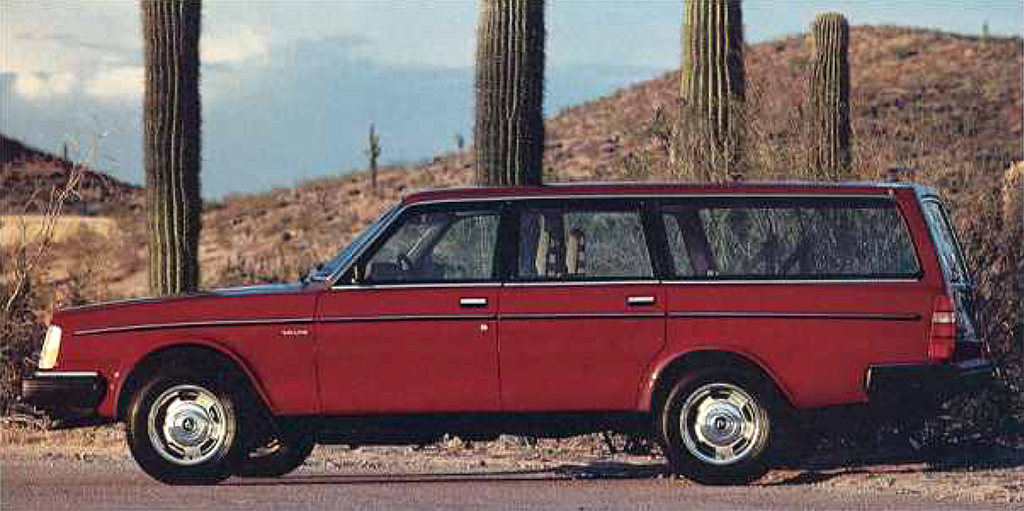
Volvo 240 DL station wagon photo from the 1985 Volvo brochure

By 1985, the 240 was no longer as spare as it had been a few years before. Standard exterior and mechanical equipment for the $14,690 240 DL station wagon (about $45,300 in today’s dollars) included tinted windows, a front spoiler, power-assisted rack-and-pinion steering, power-assisted disc brakes, and 195/75R14 tires on 14-inch wheels. Inside, a rear window wiper/washer, power door locks, cargo tie-down rings, and air conditioning were included. Trim and upholstery features included adjustable front bucket seats with integrated head rests and lumbar support and full interior carpeting.

Moving up to GL added an engine compartment light, power windows, an intermittent setting for the rear window wiper/washer, a small diameter steering wheel (I’m not sure why this was notable or a positive), and a heated driver’s seat.

Volvo 240s had few individual factory options—you chose the trim level and the color, and that was about it. They continued to sell in decent numbers—the 1985 240 station wagon moved about 68,000 units worldwide.

The View from 2025

All vintage Volvos have strong club support, and there is definite collector interest in what 240 owners call “bricks”—enough for Hagerty to offer a buyer’s guide. According to Hagerty’s valuation tools, all the money for a 1985 Volvo 240 GL station wagon in #1/Concours condition is $52,300, with a far more normal #3/Good condition version going for $13,800. 240 station wagons are often available in the Hemmings Motor News classifieds, on eBay Motors, and at online auctions such as Bring a Trailer that cater to the eighties car market.

Make mine Dark Red, please.

Other Volvos that have been covered in Eighties Cars include the 1985 740 Turbo station wagon and the 1987 780 coupe.

Last updated November 2025.

1984 Chevrolet Camaro Sport Coupe

In early 2022, Bring a Trailer featured a 1984 Chevrolet Camaro Sport Coupe that was generally original except for the wheels and tires. It sold for $8,000.

“Looks. Performance. Price.”

For 1984, the Chevrolet Camaro Sport Coupe had relatively few changes. A four-speed automatic became the only automatic available (1983 Camaros had three-speed and four-speed automatic options). Steel-belted radial tires were newly standard on all Camaros, and all manual transmission vehicles received a hydraulic clutch.

The standard powertrain for the Sport Coupe continued to be the LQ9Iron Duke” 92 bhp 2.5 liter inline four with fuel injection, paired with a four-speed manual transmission. Optional engines were two: the LC1 107 bhp 2.8 liter V6 with a two-barrel carburetor ($250) and the LG4 150 bhp 5.0 liter V8 with a four-barrel carburetor ($550). A five-speed manual ($125) and a four-speed automatic ($525) were optional.

With the standard powertrain, the Sport Coupe was all show, no go. 0-60 tests of four-cylinder F-cars are rare to nonexistent, but reasonable estimates are in the high 14 to high 15 second range. For all that trouble, mileage wasn’t that impressive: 24 city/36 highway by the day’s standards. With a 15.5-gallon gas tank, a four-cylinder Sport Coupe owner could expect a range of 340 to 375 miles with a 10% fuel reserve.

The hot setup for the Sport Coupe, such as it was, was the LG4 V8 paired with the four-speed automatic (five-speed manuals with V8s were Z28-only in 1984). For a total of $1,075, this combination changed the car’s character, with the 0-60 time dropping by almost four seconds compared to the base four. These changes did not mean that a V8 Sport Coupe would see anything but the taillights of a Z28 with the 190 bhp “H.O.” V8. Fuel economy ratings with the V8 also dropped significantly to 18 city/29 highway, but a slightly larger 16.1-gallon fuel tank reduced the range penalty—a V8 Sport Coupe owner could expect a 280 to 305 mile range.

Perhaps the most engaging Sport Coupe—but certainly not the fastest—was the LC1 V6/five-speed manual combination. At $375 over the base car, it was about a second faster from 0-60 mph. Fuel economy ratings of 20 city/31 highway along with a 16.1-gallon fuel tank meant a 330 to 330 mile fuel range.

Sport Coupe pages from the 1984 Camaro brochure

Standard exterior and mechanical equipment for the $8,097 Sport Coupe (about $26,000 in today’s dollars) included dual black side mirrors, fast-ratio power steering, power front disc/rear drum brakes, and P195/75R14 radial tires (a size still reasonably available) on 14-inch body-colored wheels with hubcaps. Inside, reclining front vinyl bucket seats, a floor console, and an AM radio were included.

Options & Production Numbers

Options were many and included body color Sport mirrors ($139), a rear deck spoiler ($69), tinted glass ($110), removable glass roof panels ($850), and four-wheel power disc brakes ($179 and V8-only). Inside, buyers could add a gage package with a tachometer ($149), Deluxe luggage compartment trim ($164 and including a locking rear compartment storage cover), Custom cloth bucket seats ($359 and including quiet sound group), and air conditioning ($730).

Six different optional radios were available, with the top-of-the-line being an electronically tuned AM/FM stereo radio with seek and scan, cassette tape, clock, and graphic equalizer ($493). A well-equipped Sport Coupe could easily sticker for substantially more than a base Berlinetta or Z28.

The 1984 Sport Coupe sold quite well—Chevrolet moved 127,292 units, making it about 49% of overall Camaro sales. 1984 would be the peak for Sport Coupe sales in the 1980s, and it isn’t obvious why.

The View From 2025

Third-generation Camaros have substantial forum support and they attract collector interest. According to Hagerty’s valuation tools, a 1984 Camaro Sport Coupe with the V8 in #1/Concours condition is $21,400, with a far more normal #3/Good condition version going for $7,000. V6 versions get a 30% deduction, while four-cylinder cars go for half price. These Camaros are often available in the Hemmings Motor News classifieds, on eBay Motors, and at online auctions such as Bring a Trailer that cater to the eighties car market.

Make mine Charcoal Metallic, please.

Other third-generation Camaro hatchback coupes I have written about include the 1982 Z28 Indy 500 Commemorative Edition, the 1985 IROC-Z, and the 1986 Berlinetta. I have yet to write about any of the 1987 through 1989 Camaro convertibles.

Last updated October 2025.

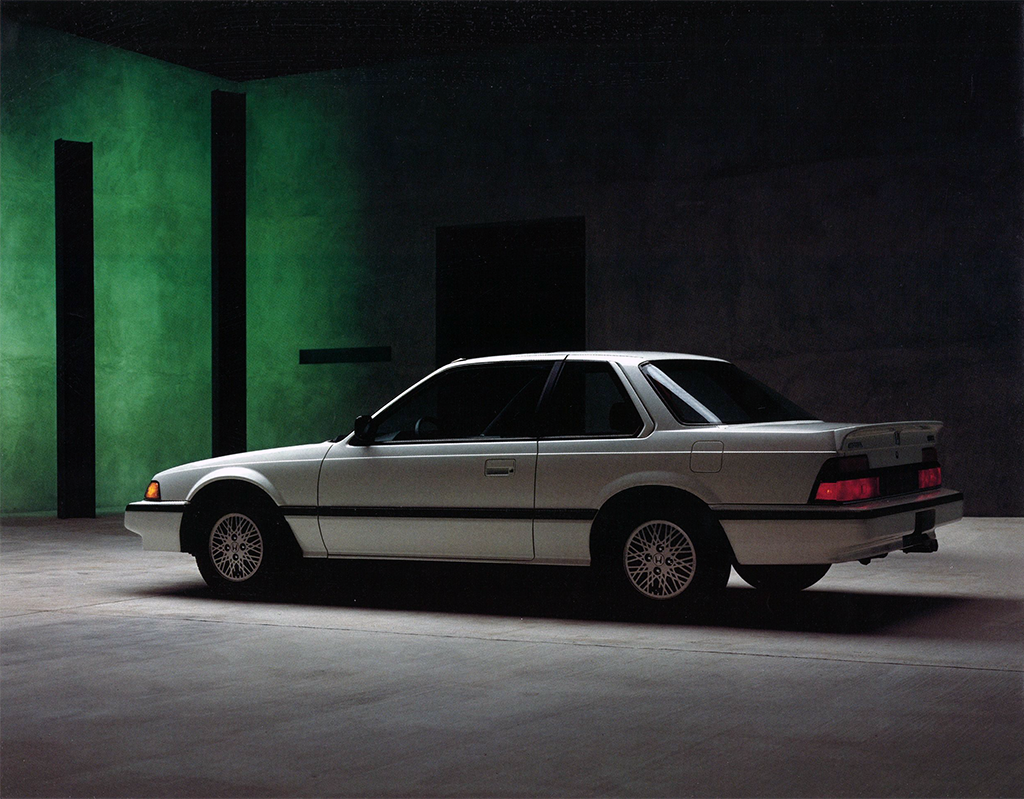
1986 Honda Prelude Si coupe

In February 2022, a 1986 Honda Prelude Si sold on Bring a Trailer for $7,500. This appearance made me wonder why I hadn’t yet written about any Prelude.

“We are lots of fun.”

1986 brought few changes to Honda’s Prelude sports coupe, which continued in both base and Si versions. A visual distinction from 1985 was the high-mounted brake lamp, along with a few more exterior color choices.

The Si‘s salient feature was its engine—the B20A 110 bhp 2.0 liter/120 ci inline four with three valves per cylinder and fuel injection. Making ten more horsepower than the base Prelude meant that it was about half a second faster to get from 0-60 mph—spritely but not fast at a little over 9 seconds.

A five-speed manual transmission was standard, with a four-speed automatic optional. Fuel economy was respectable at 25 city/30 highway by the day’s standards with the manual transmission (22/28 by modern measures). As might be expected, the automatic dropped ratings by 8% in the city and 3% on the highway. With a 15.8-gallon fuel tank, a Prelude Si‘s proud new owner could expect a range of 335 to 390 miles with a 10% fuel reserve.

Prelude Si photo from the 1986 Honda full-line brochure

By 1986 standards, the $12,955 Prelude Si—about $38,700 in today’s dollars or about what a 2026 Prelude is expected to go for—came well-equipped. Standard exterior and mechanical equipment included a power moonroof (a Prelude trademark), power windows, power mirrors, power disc brakes, and Michelin 185/75R13 steel-belted radial tires (a size still somewhat available) on Custom 13-inch alloy wheels. Inside, air conditioning, cruise control, a leather-wrapped steering wheel, and cloth front bucket seats were included. The stereo featured electronic quartz tuning, an autoreverse cassette player, a seven-band graphic equalizer, and four speakers.

These second-generation Preludes were a revelation when introduced for the 1983 model year, replacing the somewhat ungainly first-generation coupes that had been introduced in the late 1970s. They come from a period when Honda styling seemingly could do no wrong—Road & Track called the second-generation Preludes “handsome, satisfying, exciting.”

The View From 2025

Second-generation Preludes attract collector interest, and there is some online forum support. They are sometimes available in the Hemmings Motor News classifieds, on eBay Motors, and at online auctions such as Bring a Trailer that cater to the eighties car market.

Make mine Sonic Blue Metallic, please.

Other Hondas I have written about include the 1981 Prelude Sport Coupe, the 1983 Civic S hatchback coupe, the 1984 Civic DX hatchback coupe, the 1984 Civic CRX hatchback coupe, the 1985 Civic CRX Si hatchback coupe, the 1986 Accord sedan, and the 1988 Civic sedan.

Last updated October 2025.

1986 Hyundai Excel hatchback coupe

“The good-looking car at the great-looking price.”

Hyundai was new to the United States in 1986, and the first product they sold was the Excel, available in hatchback coupe, hatchback sedan, and sedan versions.

The Excel L‘s standard powertrain was a 4G15 68 bhp 1.5 liter/90 ci inline four with a carburetor paired with a four-speed manual. The GL and GLS upmarket trims included a five-speed manual and had a three-speed automatic available as an option. Whichever transmission was chosen, the Excel was not exactly fast: Car and Driver reported a 0-60 time of just over 16 seconds.

Fuel economy by 1986 standards was 28 city/31 highway with the four-speed manual—24/28 by current measures. Predictably, the five-speed manual was better on the highway than the three-speed automatic. With a 10.6-gallon fuel tank on all but the GLS/automatic combination, Excel owners could expect a range of between 235 to 300 miles with a 10% fuel reserve.

Designed by Giorgetto Giugiaro, the Excel’s styling was pleasing, if somewhat anonymous. At the time, some Hyundai executives were concerned that it looked a little too much like the concurrent Izuzu I-Mark/Chevrolet Spectrum—also designed by Giugiaro.

1986 Hyundai Excel advertisement

With a base price of $4,995 (about $14,700 in today’s dollars), the Excel L was the second cheapest car for sale in the United States—the Yugo GV was, of course, the most affordable. One of Hyundai’s strategies was to differentiate with standard equipment compared to the economy car competition. Thus, standard exterior and mechanical equipment included halogen headlamps, an electric rear window defroster, front-wheel drive, rack-and-pinion steering, power front disc/rear drum brakes, and name-brand Goodyear Corsa P155/80R13 all-season tires (a size still available) on 13-inch styled steel wheels. Inside, a lockable glove box, a color-keyed dash, vinyl reclining front bucket seats, and split fold-down rear seats were included.

Moving up to the $5,895 GL added tinted glass, styled steel wheels with hub covers and wheel trim rings, a remote hatch release, dual remote control rearview mirrors, an analog quartz clock, a full center console, cloth/vinyl front bucket seats, and Luxury door trim with cloth inserts.

The top-of-the-line $6,395 GLS included full wheel covers, thicker carpeting, a color-keyed Luxury steering wheel, cloth front bucket seats with driver’s side height and lumbar adjustment, and a Panasonic ETR AM/FM stereo cassette deck with auto-reverse and two speakers.

Options & Production Numbers

Individual options were few—a power sliding sunroof, Goodyear Corsa P175/70R13 all-season tires on aluminum alloy wheels, air conditioning, and a Panasonic ETR AM/FM stereo cassette deck with auto-reverse, Dolby noise reduction, and four speakers. Initial reviews of the Excel were decent and initial sales were quite strong, with 168,882 sold in the 1986 model year.

The View From 2025

The view of the Excel from today is not so kind. The Excel turned out to be notably less reliable than the Yugo and also had significant rust problems—even compared to other mid-1980s economy cars. Hyundai now barely acknowledges the Excel, though it occasionally gets mentioned in press releases. I haven’t seen a first-generation Excel in many years.

Make mine Medium Red Metallic, please.

This post is my first Hyundai article, but one of many on vanished vehicles.

Last updated April 2025.

1980 Pontiac Grand Prix SJ coupe

Bring a Trailer offered an almost unique 1979 Grand Prix for auction in early 2022. It had a four-speed manual transmission—quite rare in 1979 and no longer available in 1980. With only 858 miles on the odometer, this Grand Prix sold for $35,000.

… carries Grand Prix sportiness to the max

1980 was the final year for the SJ designation on Pontiac’s Grand Prix. Of course, the SJ designation had been around for a long time—and not just for Pontiac. Duesenberg had used SJ in the early 1930s to describe the supercharged versions of their spectacular cars. By 1969, Pontiac had started (shamelessly—no surprise) using SJ for the top-of-the-line version of second generation of their Grand Prix coupe. By 1980, SJ indicated something like “moderately sporty.”

The 1980 Grand Prix returned to a vertical bar grille and featured new taillight lenses with “GP” logos. A three-speed automatic transmission became standard equipment on all Grand Prix models, and the two-barrel 4.9 liter/301 ci Pontiac V8 was replaced by a new 4.3 liter/265 ci V8 rated at 125 hp.

The SJ‘s powertrain choices were slightly loftier. The standard non-California powertrain was a W72 170 bhp 4.9 liter/301 ci V8 with a four-barrel carburetor mated with a three-speed automatic transmission. California cars swapped in the LG4 150 bhp 5.0 liter/305 ci V8 with a four-barrel carburetor. 0-60 came in a little under 10 seconds in a car with a 3,291-pound curb weight—spritely for a personal luxury coupe in 1980. EPA fuel economy ratings for the non-California cars were 17 city/25 highway by the day’s standards. With an 18.1-gallon gas tank, an SJ‘s owner could expect a range of 310 to 340 miles with a 10% fuel reserve.

With a base price of $6,219, standard exterior and mechanical equipment on all Grand Prix’s included dual rectangular headlamps, power steering, power front disc/rear drum brakes, and P195/75R14 tires (a size still readily available) on 14-inch wheels with hubcaps. Interior features included door pull straps, an inside hood release, and an electric quartz clock.

Grand Prix SJ page from the 1980 Pontiac brochure

For $7,295 (about $31,400 in 2025 dollars), the SJ added Custom finned wheel covers, body-color Sport mirrors, wide rocker panel moldings with extensions, accent stripes, and, of course, SJ identification to the exterior. Inside, SJ buyers got rally gages with clock and trip odometer, Lamp Group, and added acoustical insulation. SJ trim and upholstery included a Custom Sport steering wheel, a simulated brushed aluminum instrument panel, a Custom stitched-appearance instrument panel pad, Custom pedal trim plates, and SJ-specific front vinyl bucket seats.

Options & Production Numbers

Options were many—exterior options included two-tone paint in two different styles, cornering lamps, Soft Ray glass, a removable hatch roof, and a power sunroof (either glass or metal). Air conditioning (Custom or climate control), power door locks, and power windows were among the available interior options. Trim and upholstery options included Viscount leather front bucket seats with vinyl bolsters, a power driver’s seat, a tilt steering wheel, and a litter container.

Audio options included dual rear extended range speakers, two power antenna options, and six different stereo radios, including two 8-track tape choices, one cassette tape choice, one CB radio choice, and an ETR radio choice. A buyer looking to make their SJ as sporting as possible would have ordered 205/75R14 tires (which included the Rally Handling Package), Rally II wheels, and rally gages with an instrument panel tachometer (which required either the digital clock or the ETR radio).

Though the Grand Prix sold pretty well overall, the SJ did not—only 7,087 left dealer lots in the 1980 model year. This total meant that the SJ was a mere 6% of Grand Prix sales and hints strongly at why it was gone for the 1981 model year, with the new Grand Prix submodel being the Brougham. Pontiac would use the SJ designation on the sportiest versions of the compact Phoenix until the end of the 1984 model year.

The View From 2025

Grand Prix’s of this generation are not generally considered collector cars—Hagerty does not track any Grand Prix newer than 1977. These cars are sometimes available in the Hemmings Motor News classifieds and on eBay Motors. As we have seen, these Grand Prix’s also show up at auction.

Make mine Bordeaux Red, please.

Other Grand Prix models I have written about include the 1987 coupe and the 1988 coupe. I seem to like Pontiacs—I have covered eighteen other models over the last twelve years.

Last updated December 2025.

1981 Volkswagen Scirocco S hatchback coupe

I’ve liked the styling of the first-generation Scirocco since it was new. It was, of course, designed by one of the all-time masters.

“For the most discriminating and demanding sports car enthusiasts”

1981 was the final model year for the first-generation Scirocco, which was first available in North America in 1975. Though the Scirocco used the same platform as the Golf, it was actually released about six months before the Golf.

With its basic form penned by Giorgetto Giugiaro—who seemed to have a hand in nearly every 1970s Volkswagen design—the Scirocco debuted at the 1973 Geneva Motor Show. Like the Karmann Ghia that it putatively replaced, the Scirocco was assembled by Karmann.

Classified as sub-compact by the EPA, the Scirocco was not a large car—its 155.7-inch length is more than a foot shorter than the current Golf GTI. For 1981, the configuration of the Scirocco sold in North America moved to a slightly large 1.7 liter engine, transitioned the standard transmission from a four-speed manual to a five-speed manual, and offered a new Scirocco S package.

The Scirocco’s standard powertrain was the EA827 74 bhp 1.7 liter/105 ci inline four with fuel injection mated with a five-speed manual. A three-speed automatic was optional. With a curb weight of 1,892 pounds, 0-60 came in a little over 11 seconds. Fuel economy was rated at 25 city/40 highway by the day’s standards. With a 10.6-gallon gas tank, a Scirocco owner could expect a range of 280 to 310 miles with a 10% fuel reserve.

Scirocco S pages from the 1981 brochure

Standard mechanical features on the $8,495 Scirocco (about $32,000 in today’s dollars or almost exactly what a 2025 Golf GTI goes for) included front-wheel-drive, rack-and-pinion steering, power-assisted front disc/rear drum brakes, and 175/70SR13 steel-belted radial tires (a size still readily available) on 13-inch wheels. Inside, a tachometer, a trip odometer, and front bucket seats were standard.

Packages & Options

A new package for 1981 was the S, which included black trim, a red VW radiator badge and belt-line moulding, a larger front spoiler, light alloy wheels, and specially designed striped cloth sport seats. The S package was available in three of the eight standard Scirocco colors and cost $520.

Options for the Scirocco were few—a sunroof, a rear window wiper/washer, the aforementioned three-speed automatic transmission, and air conditioning.

The View From 2025

First-generation Sciroccos attract collector interest, and there is club support. They are sometimes available in the Hemmings Motor News classifieds, on eBay Motors, and at online auctions such as Bring a Trailer that cater to the eighties car market.

Make mine Cirrus Gray Metallic, please.

Other Volkswagens I have written about include the 1981 Dasher station wagon, the 1983 Rabbit GTI hatchback coupe, and the 1985 Cabriolet.

Last updated April 2025.

1984 Mercury Grand Marquis Colony Park LS station wagon

At Mecum Kansas City 2021, a Light Desert Tan Mercury Grand Marquis Colony Park LS station wagon with bodyside and tailgate rosewood woodtone appliques sold for $8,500. For Boxing Day 2021, here’s a big American station wagon.

“luxurious working cars”

For 1984, Mercury’s Grand Marquis Colony Park station wagon was little changed. The Colony Park name had been around since 1957 as a signifier of Mercury’s top-of-the-line station wagon.

The Colony Park’s only powertrain—indeed the only powertrain available for any Grand Marquis—was a Windsor 140 bhp 4.9 liter/302ci V8 with fuel injection paired with a four-speed automatic. Fuel economy was 17 city/27 highway by 1984 standards (14/20 by current measures). With an 18.5-gallon fuel tank, a Colony Park owner could expect a range of between 285 and 365 miles with a 10% fuel reserve.

The Colony Park was a large car, with a 114.1-inch wheelbase and 218-inch length. It had changed little since 1979, when Ford downsized its full-size cars to the Panther platform. Changes over the next five years were mostly confined to trim and color variations, along with powertrain changes.

Colony Park pages from the 1984 Grand Marquis brochure

Standard exterior and mechanical equipment on the $11,816 Grand Marquis Colony Park (about $32,500 in today’s dollars or about what a base 2022 Ford Explorer goes for) included the distinctive “bodyside and tailgate rosewood woodtone applique,” a three-way tailgate, a power tailgate window, power steering, power front disc/rear drum brakes, and P215/75R14 white sidewall tires (a size still available thanks to Hankook) on 14-inch wheels with Deluxe wheel covers. Inside, reclining Twin Comfort Lounge front seats in vinyl, a fold-down rear seatback, and AM/FM stereo radio with two rear speakers were included.

At $12,437, the Colony Park LS added tinted glass, Luxury cloth seat trim for the Twin Comfort Lounge front seats, seatback map pockets, and 18-ounce color-keyed cut-pile carpeting.

Packages, Options, and Production Numbers

Packages available for the Colony Park included Convenience Group, Lock Group, Light Group, and the Trailer Towing Package.

Since there were no Lincoln station wagons, the Colony Park LS was the top-of-the-line wagon available from Ford Motor Company in the mid-1980s. Despite all the luxury Mercury implied the Colony Park LS had, it still didn’t include standard air conditioning, though the take rate on the two air conditioning options—one manual ($743) and one automatic ($809)—must have been high.

Other options available included “glamour” paint ($77), a luggage rack ($104), a Traction-Lok axle ($95), fingertip speed control ($176), a leather-wrapped steering wheel ($59), a tilt steering wheel ($110) and the Premium Sound System. Optional P205/75R15 tires ($17/$178 if puncture sealant) required the optional turbine spoke cast aluminum wheels ($361). A well-equipped Colony Park could easily get to $14,600—not that many thousand dollars from Lincoln money.

Mercury sold 17,421 Colony Park wagons in 1984, but the split for the base versus the LS versions is unknown.

Make mine Medium Canyon Red Metallic, please.

Two other Panther-based cars I have written about are the 1980 Lincoln Continental Mark VII coupe and the 1983 Mercury Grand Marquis sedan.

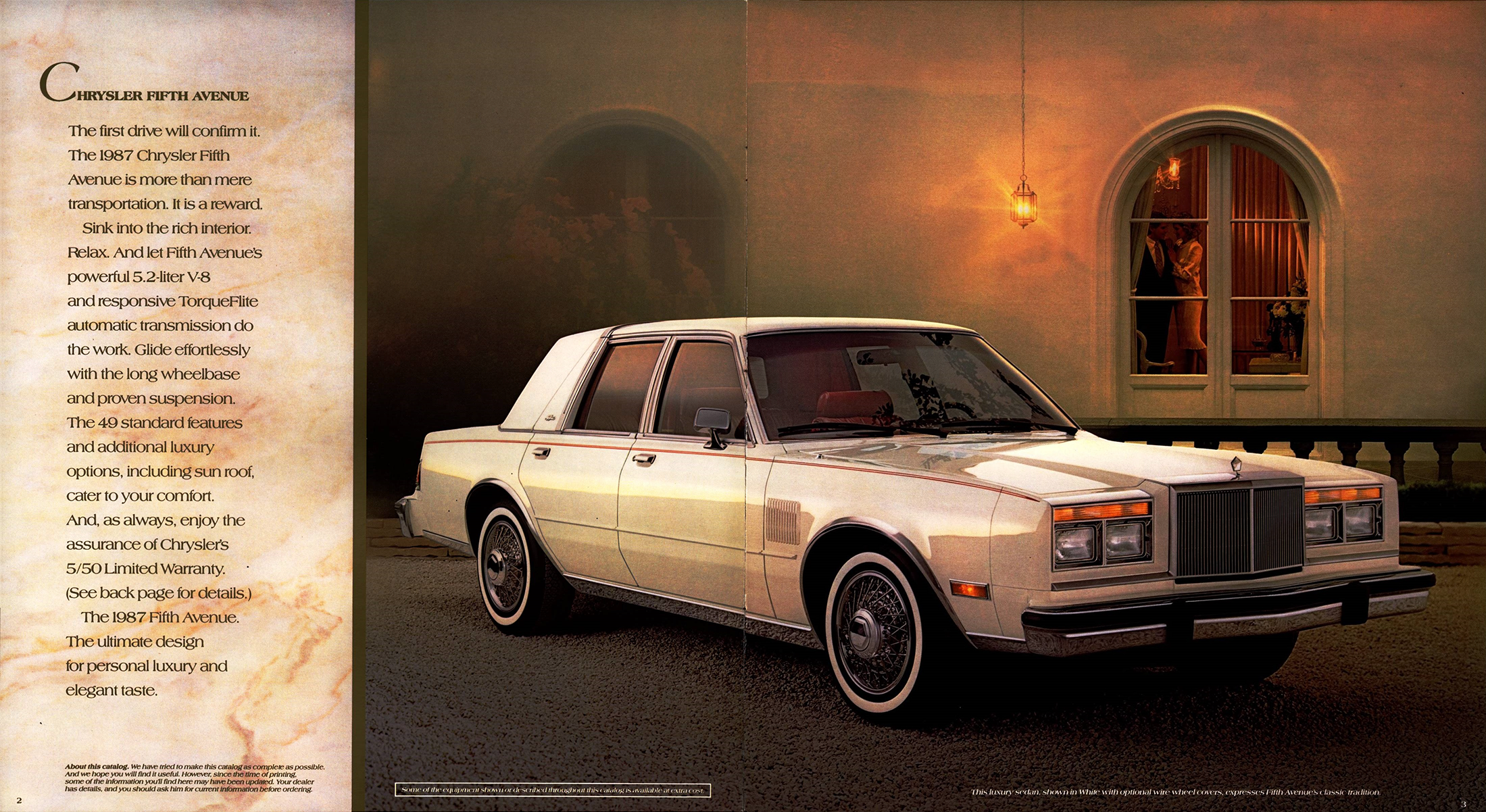
1987 Chrysler Fifth Avenue sedan

Up until a few years ago, I still occasionally saw M-body Fifth Avenues on the road. They were always well-kept, but also actually being driven. Now, they seem gone.

“Fifth Avenue remembers what fine car buyers demand!”

Little changed for 1987, Chrysler’s rear-wheel-drive Fifth Avenue sedan did receive an updated steering wheel. Otherwise, things continued along virtually the same as they had been since the M-body Chrysler went from the New Yorker Fifth Avenue name to the Fifth Avenue name in 1984.

The only powertrain available was an LA 140 bhp 5.2 liter/318 ci V8 with a Carter two-barrel carburetor paired with a TorqueFlite three-speed automatic transmission—the slant six had departed from the M-body after 1983. 0-60 came in about 12 seconds in a car with a 3,741-pound curb weight. Mileage ratings were 16 city/21 highway by 1987 standards—which equals 15 city/20 highway today. With an 18-gallon gas tank, a Fifth Avenue owner could expect a range of 285 to 300 miles with a 10% fuel reserve.

Pages from the 1987 Chrysler Fifth Avenue brochure

Standard exterior features on the $15,422 Fifth Avenue (about $41,700 in today’s dollars) included a color-keyed padded vinyl Landau roof and tinted glass on all windows. Mechanical features included power front disc/rear drum brakes, power-assisted steering, and P205/75R15 tires (a size still readily available) on 15-inch wheels with Premium wheel covers. Inside, an air conditioning/heater with automatic temperature control, power windows, a Luxury two-spoke steering wheel, and an AM radio were included.

Packages, Individual Options, & Production Numbers

The Luxury Equipment Discount Package added hood stripes, electroluminescent opera lights, and wire wheel covers with locks. Inside, the same package added automatic speed control, a tilt steering column, Deluxe intermittent windshield washers/wipers, a power deck lid release, and an AM stereo/FM stereo radio with the Premium speaker system and a power antenna. Added upholstery features with the package included a Corinthian (of course) leather 60/40 front seat with vinyl trim, dual front power seats, and a Luxury leather-wrapped two-spoke steering wheel. This substantial package cost $2,113 when ordered with the Ultimate Sound audio system and $2,251 if ordered without Chrysler’s top-of-the-line stereo. Either way, it added 14% to 15% to the Fifth Avenue’s base price.

A Two-Tone Paint Package ($485) was also available. This package included (natch!) two-tone paint with a choice of three colors matched with Radiant Silver, a special padded vinyl Landau roof with electroluminescent opera lights, and cast aluminum 15-inch wheels.

Individual options included a power glass sun roof ($1,076) and a left power seat ($240). A range of three optional car stereos topped out with the $609 Ultimate Sound system, which included an AM stereo/FM stereo radio, a cassette tape player with automatic reverse and Dynamic Noise Reduction (DNR), a five-band graphic equalizer, and a joystick balance/fader control. Many individual options cost less when ordered with the Luxury Equipment Discount Package.

Chrysler sold 70,579 Fifth Avenues in 1987, making it the single most popular Chrysler model, though all the various LeBaron models combined were good for far more sales. With tooling that had long since been paid for, all the M-body cars (the Dodge Diplomat and Plymouth Gran Fury were also in production) were probably good for Chrysler’s profits.

The View From 2025

These cars were the last of the old Chryslers, with a platform dating back to 1977 and some engineering elements that were far older. When rear-wheel-drive returned to big Chryslers in 2005, it was based on a Mercedes-Benz E-class platform. Earlier this year, I blogged about Chrysler Corporation’s Transition To Front-Wheel-Drive.

Though they are far from collector cars, Fifth Avenues of this generation are sometimes available in the Hemmings Motor News classifieds, on eBay Motors, and on Bring a Trailer. They also occasionally show up at in-person auctions.

Make mine Crimson Red, please.

Other rear-wheel-drive Chrysler products I have written about include the 1980 Chrysler Cordoba coupe, the 1980 Plymouth Volaré station wagon, the 1981 Chrysler New Yorker sedan, the 1983 Chrysler Cordoba coupe, the 1983 Imperial coupe, and the 1989 Dodge Diplomat sedan.

Last updated December 2025.

1989 Bentley Turbo R sedan

“The quintessential power trip.”

Bentley’s Turbo R sedan debuted in 1985 but didn’t make it to the US until the 1989 model year. The Turbo R followed the Mulsanne Turbo, which debuted in 1982 and marked the first genuinely sporting Bentley in decades. Bentley stated that the R stood for “roadholding,” and the Turbo R had a completely revised suspension, with different dampers and stiffer anti-roll bars.

The Turbo R’s 6.75 liter/412 ci V8 had an estimated 335 bhp—for decades, Bentley didn’t state actual horsepower. The big V8 featured Bosch MK-Motronic fuel injection, a Garrett AiResearch turbocharger, and an intercooler. The transmission was GM’s Turbo Hydramatic THM-400. Considering that the Turbo R had a curb weight of 5,313 pounds, the 0-60 time of a little under 7 seconds was notable. Fuel economy was less impressive: a 9 city/12 highway rating by the day’s standards meant that the Turbo R was a recipient of the dreaded gas guzzler tax. Despite a sizeable 28.6-gallon gas tank filled with premium gasoline, the proud new owner of Turbo R could only expect a range of about 270 miles with a 10% fuel reserve.

1989 Bentley Turbo R advertisement

Standard exterior and mechanical equipment on the $165,000 Turbo R (about $438,000 in today’s dollars) included power rack and pinion steering, four-wheel anti-lock disc brakes, and 255/65VR15 tires (a size still available thanks to Avon) on 15-inch aluminum-alloy wheels. The traditional Connolly leather seats, burled walnut veneer dash, and lambswool carpeting seen in many Bentleys were present inside. More prosaic standard equipment included air conditioning, cruise control, power seats, power mirrors, and power windows. Bentley built 929 Turbo Rs for the 1989 model year, making it an unqualified success.

The View From 2025

Like all Bentleys, the Turbo R attracts collector interest and substantial club support. Perhaps driven by maintenance costs that are substantial if the car has not been rigorously maintained, values are not as high as one might think. According to Hagerty’s valuation tools, all the money for a 1989 Turbo R in #1/Concours condition is $26,000, with a far more normal #3/Good condition version going for $13,500.

Turbo R’s are often available in the Hemmings Motor News classifieds, and they sometimes show up at online (Bring a Trailer) and in-person auctions. As I update this post in March 2025, a Dark Oyster Metallic 1989 Turbo R with red leather front bucket seats and 66,000 miles is for sale on Hemmings for $44,500.

After over eight years, this post is the first on a Bentley in Eighties Cars. There will be others—I definitely expect to get to the aforementioned Mulsanne Turbo at some point.

Make mine British Racing Green, please.

Last updated March 2025.

1986 Pontiac Firebird SE hatchback coupe

“Comfort and function define every Firebird interior.”

For 1986, Pontiac offered three versions of its sporty Firebird—the base car, the SE, and the Trans Am. The SE was intended to be the most comfortable of the three versions (Pontiac stated that it possessed “a subtle sophistication”), and its $11,995 base price (about $35,300 in today’s dollars) slotted between the $9,279 base coupe and the $12,395 Trans Am.

The SE‘s standard engine was the 135 bhp LB8 2.8 liter V6 with fuel injection, while its only optional engine was the $400 155 bhp LG4 5.0 liter/305 ci v8 with a four-barrel carburetor (only Trans Ams could get fancier V8s). Both engines came standard with a five-speed manual and were offered with an optional four-speed automatic ($465). The V8 with the manual was the quickest (0-60 mph in about 9 seconds) and the fastest (top speed of about 131 mph) SE. EPA gas mileage ratings were 17 city/26 highway with the standard powertrain (15/24 by today’s standards). Interestingly, the V8 wasn’t significantly worse at 16 city/26 highway with the manual or at 17 city/25 highway with the automatic. With a relatively small 15.5-gallon gas tank, SE owners could expect a range of between 265 and 320 miles with a 10% fuel reserve.

1986 base and SE Firebird versions from the Pontiac full-line brochure

Standard exterior and mechanical equipment on all Firebirds included concealed rectangular quartz halogen headlamps, Sport mirrors, power steering, power front disc/rear drum brakes, and P215/65R15 tires on 15-inch wheels. Inside, a full-length console, reclining front bucket seats, cut pile carpeting, and a Delco-GM AM radio were standard.

Additional standard equipment on the SE included hood air louvers, black body side moldings, and 15-inch diamond spoke aluminum wheels. Inside, the Formula steering wheel, shift knob, and parking brake were all leather-wrapped. Luxury Trim Group included Custom front bucket seats, a Deluxe split folding rear seat, and Deluxe door trim. An interior roof console included sub-woofer controls if the subwoofer six-speaker system was ordered.

Options & Production Numbers

Optional exterior and mechanical equipment included a body color rear deck spoiler ($70), a hatch roof with removable glass panels, and power four wheel disc brakes ($179 and requiring the limited slip differential). Inside, Custom air conditioning (which required Soft Ray glass), power door locks, power windows, a six-way power driver’s seat, a tilt steering wheel, and five different radios were available. A loaded SE moved from comfortable to relatively luxurious by mid-1980s standards.

Like its Camaro Berlinetta cousin, the SE did not sell well—it was only 2% of overall Firebird sales in 1986.

The View From 2025

According to Hagerty‘s valuation tools, a 1986 Firebird SE with the V8 and the manual in #1/Concours condition is $15,900, with a far more normal #3/Good condition version going for $5,700. Mid-1980s Trans Ams are always available in the Hemmings Motor News classifieds, on eBay Motors, and on Bring a Trailer, but SEs rarely make an appearance—as I update this post in April 2025, there are no third-generation Firebird SEs for sale on either eBay or Hemmings. I have not seen an SE in over 20 years.

Make mine Midnight Blue over Silver, please.

Other Firebird versions I have written about include the 1981 Trans Am coupe, the 1982 Trans Am hatchback coupe, the 1984 Trans Am 15th Anniversary Edition hatchback coupe, the 1985 Trans Am hatchback coupe, and the 1989 20th Anniversary Turbo Trans Am hatchback coupe. I should probably cover a Formula and a GTA at some point.

Last updated April 2025.