1984 Oldsmobile Ninety-Eight Regency coupe

At the 2023 Mecum Indy, a white Oldsmobile Ninety-Eight Regency coupe with an indicated 6,100 miles sold for $20,000.

1984 would end up being the final year for the rear-wheel-drive Oldsmobile Ninety-Eight—1985 would move the Ninety-Eight to the front-wheel-drive C-body. There were few changes for 1984: the 4.1 liter V6 was dropped (making the 5.0 liter V8 standard), there was a new grille with a crosshatch pattern, and the vertical taillamps now had Oldsmobile emblems in their lenses. Changes in options included different body side mouldings and new wire wheel cover designs.

The Ninety-Eight Regency‘s standard powertrain was the LV2 140 bhp 5.0 liter/307 ci V8 with a four-barrel carburetor mated to a four-speed automatic. Optional everywhere but in California was the LF9 105 bhp 5.7 liter/350 ci diesel V8 ($700). The Ninety-Eight coupe was not quick—with the standard powertrain, 0-60 took about 13.5 seconds in a car with a 3,915-pound curb weight. The diesel was about six seconds slower to 60 mph. Mileage with the gas V8 wasn’t horrible: 17 city/29 highway by the day’s standards (14/21 by today’s measures). With a large 25.1-gallon fuel tank, a Ninety-Eight Regency coupe owner could expect a range of 400 to 465 miles with a 10% fuel reserve.

Coupe page from the 1984 Regency brochure

Standard exterior and mechanical equipment on the $13,974 Ninety-Eight Regency coupe (about $44,900 in 2025 dollars) included Soft-Ray tinted glass, rear fender skirts, sail panel opera lamps, power front disc brakes, power steering, and P215/75R15 steel-belted radial-ply white-stripe tires (a size still readily available) mounted on 15-inch wheels with Bright Deluxe wheel discs. Inside, all Regency coupes included power side windows, power door locks, Four-Season air conditioning, an electric rear window defroster, a digital quartz clock, front and rear centre armrests, and an AM-FM stereo radio with two rear speakers.

Options & Production Numbers

Exterior and mechanical options included an electric sliding glass Astroroof ($1,195), an automatic leveling system, an engine block heater, and puncture-sealing tires. Inside, Custom leather trims in seating surfaces, electronic cruise control with resume and acceleration features ($175), Tempmatic air conditioning ($55), and automatic power door locks were all available. Options that date this car included a front seat litter container and an ETR AM/FM Stereo with seek and scan, digital display clock, cassette tape player, and a 40-channel CB.

Oldsmobile sold 7,855 Ninety-Eight Regency coupes in the 1984 model year, marking the fewest coupes sold in the 10th generation. Though large American coupes in general were fading away, 1985’s all-new front-wheel-drive Ninety-Eight would still offer coupe versions. Despite being all-new, the coupes wouldn’t sell much better in 1985 and would be gone after the end of the 1987 model year.

The View From 2025

There is some collector interest in these cars, though Hagerty does not track their values. Ninety-Eights of this era are often available in the Hemmings Motor News classifieds and at online auctions such as Bring a Trailer that cater to the eighties car market.

Make mine Autumn Maple Firemist, please.

Stunningly, this is the first rear-wheel-drive C-body I have written about, though I have written about the re-designated D-body 1986 Cadillac Fleetwood Brougham sedan. I probably should write about the Electra and the de Ville at some point.

Last updated October 2025.

1985 Oldsmobile Cutlass Supreme coupe

It was Thanksgiving Day in the United States a few years ago. I dropped off my parents in the late morning and temporarily headed home. On the way, I spotted a mid-1980s Cutlass Supreme coupe driving in the other direction. It looked unmodified in its original Light Chestnut Metallic.

“When a champion performs, it has a style all its own.”

For 1985, Oldsmobile’s Cutlass Supreme coupe gained a new grille. Little else changed, though the sporty 4-4-2 package replaced the Hurst/Olds package that had been available in the 1983 and 1984 model years.

The Cutlass Supreme’s standard engine remained the LD5 110 bhp 3.8 liter/231 ci V6 with a Rochester M2ME two-barrel carburetor. The optional engines were the LV2 140 bhp 5.0 liter/307 ci V8 with a Rochester M4ME four-barrel carburetor ($490) and the LF9 105 bhp 5.7 liter/350 ci diesel V8 ($490). A three-speed automatic transmission was standard, while a four-speed automatic was available with the gasoline V8. Mid-eighties Cutlass Supremes were stylish but relatively slow—the best-case V8 and the four-speed automatic yielded a 0-60 time of about 13 seconds. Mileage with the V8 was 17 city/24 highway by the day’s standards (15/22 by today’s standards); with an 18.1-gallon fuel tank, a Cutlass Supreme owner could expect a range of about 300 to 330 miles with a 10% fuel reserve.

Cover of 1985 Oldsmobile Cutlass Supreme brochure

The base Cutlass Supreme coupe was $9,797—about $29,700 in 2025 dollars. Standard equipment included power steering, power front disc brakes, and P195/70R14 blackwall tires (a size still readily available) on 14-inch wheels with Deluxe bright wheel discs. Interior equipment included a Custom front bench seat in either cloth or vinyl, Deluxe seat belts, a Deluxe steering wheel, and an AM pushbutton radio with dual front speakers and a fixed mast antenna.

At $10,486, the Cutlass Supreme Brougham added a velour divided front bench seat with individual controls, Convenience Group, and (of course) specific Brougham ornamentation.

Options & Production Numbers

Options included a power Astroroof with sliding glass roof panel ($925), a full padded vinyl roof ($245), Four-Season air conditioning ($750), power windows ($195), and cruise control ($175).

The Cutlass Supreme coupe remained one of Oldsmobile’s sales stars, though numbers did not match the halcyon days back in the seventies and early eighties. Lansing sold 75,045 of the base coupes, along with another 58,868 of the Brougham coupes.

The View From 2025

A few folks are collecting these cars, but they aren’t common at shows. You do see eighties Cutlass Supremes for sale in the Hemming’s Motor News classifieds, on eBay Motors, and at online auctions such as Bring a Trailer that cater to the eighties car market, though non-Hurst/Olds or 4-4-2 versions are relatively rare. As I was updating this blog entry in March 2025, there was a Light Teal Blue Metallic 1985 Cutlass Supreme Brougham coupe with blue cloth seats, a 5.0 liter/307 ci V8 with a four-barrel carburetor, and 75,000 miles listed on Hemming‘s for $19,500.

Make mine Dark Teal Blue Metallic, please.

As of early 2025, the most viewed post overall on Eighties Cars is one on the 1981 Oldsmobile Cutlass Supreme coupe that I wrote back in 2015. Other rear-wheel-drive G-platform (designated A-platform before 1982) cars I have written about include the 1984 Buick Regal Grand National coupe, the 1983 Chevrolet Malibu sedan, the 1981 Chevrolet Monte Carlo Sport Coupe, the 1983 Chevrolet Monte Carlo SS Sport Coupe, the 1980 Pontiac Grand Am coupe, and the 1987 Pontiac Grand Prix coupe. I’m shocked I haven’t yet written about Oldsmobile’s Hurst/Olds or 4-4-2 variants.

Last updated March 2025.

1984 Buick Skyhawk coupe

“Take flight.”

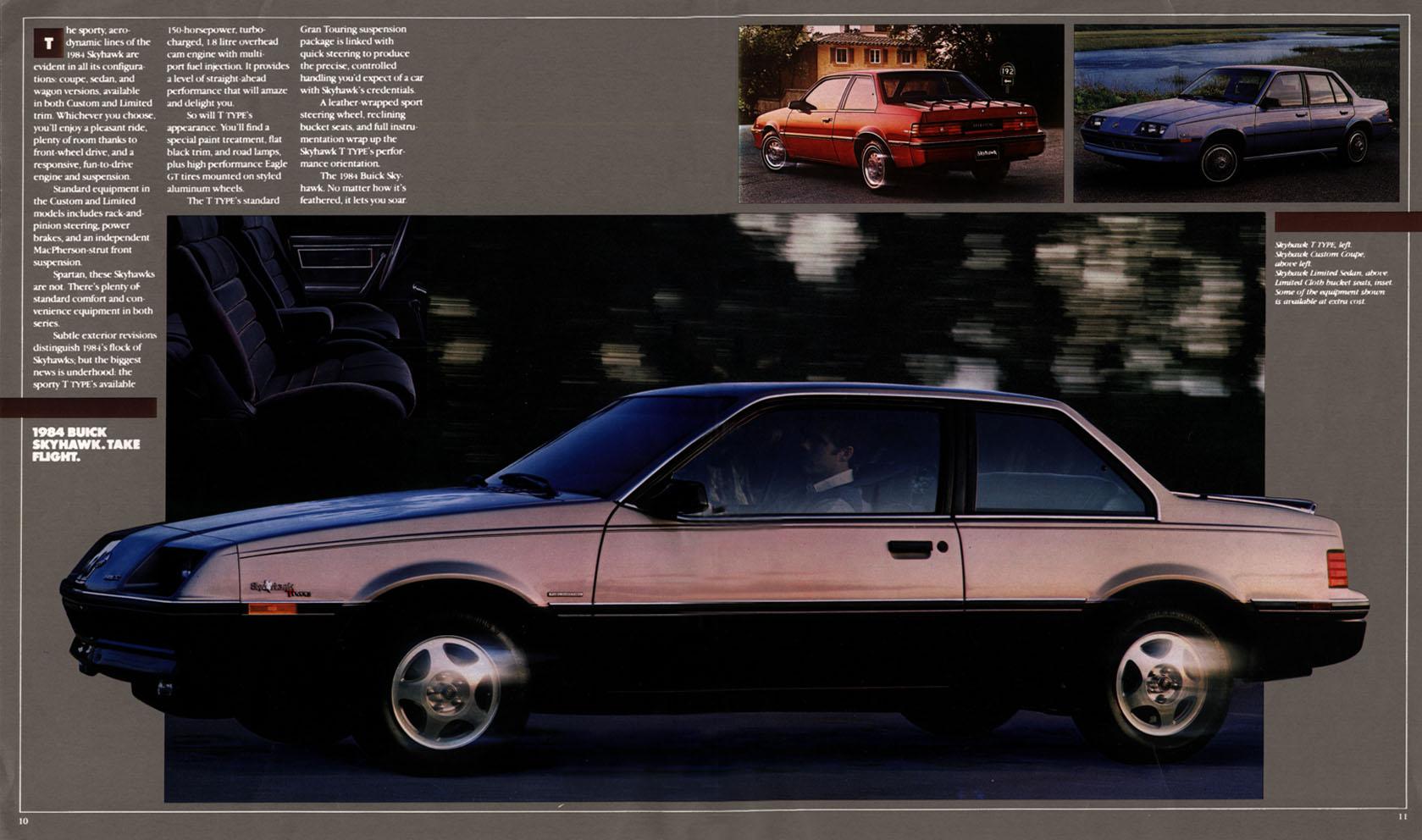
1984 was the third year for the Skyhawk, Buick’s version of the J-car, and it was little changed, except for the mid-year release of a turbocharged engine. New options included a factory stereo with a graphic equalizer.

The Skyhawk’s standard powertrain was an LQ5 86 bhp 2.0 liter/121 ci inline four with throttle-body fuel injection paired with a four-speed manual. An LH8 84 bhp 1.8 liter inline four with throttle-body fuel injection was $50, but required an upgrade to a five-speed manual ($75). Both engines were available with a three-speed automatic ($395). An LA5 turbocharged version of the 1.8 liter engine with 150 bhp was only available with the T TYPE coupe.

Performance wasn’t exactly scintillating with the two non turbocharged engines, but Skyhawk coupe’s relatively low 2,316-pound weight did help. 0-60 times with the 1.8 liter/five-speed combination were likely in the 12 second range. Fuel economy with the same powertrain was rated at 29 city/46 highway by the day’s standards—today’s measures give a far less impressive 23/33. With a 13.5-gallon gas tank, a Skyhawk owner could expect a range of 340 to 455 miles with a 10% fuel reserve.

Two Skyhawk pages from the 1984 Buick brochure
Skyhawk pages from the 1984 Buick brochure

Standard exterior and mechanical equipment on the $7,133 base Skyhawk coupe (designated as Custom) included manual rack-and-pinion steering, power front disc/rear drum brakes, and P175/80R13 blackwall tires on 13-inch wheels with Deluxe wheel covers. Inside, full carpeting, reclining front bucket seats, a full-length operating console, a Custom steering wheel, and an AM radio were included.

Moving up to the $7,641 Limited (about $24,100 in 2025 dollars and slightly less than a 2025 Buick Encore GX SUV costs) added dual horns, an acoustic package, a Limited steering wheel, and instrument gauges, along with cloth-covered seats and door panels.

Options & Production Numbers

Exterior and mechanical options for the Skyhawk coupe included tinted glass ($95), tungsten-halogen headlamps ($22), and styled aluminum wheels ($229). Inside, Electronic Touch Climate Control air conditioning ($780), manual air conditioning ($630), power windows ($185), and a series of stereo choices ranging up to an electronic tuning AM/FM stereo radio with cassette tape and graphic equalizer ($505) were all available.

1984 marked the Skyhawk’s peak sales year, with Buick producing 75,760 coupes, 45,648 sedans, and 13,668 station wagons. Buick made them through the 1989 model year, by which time sales numbers had dropped to a mere fraction of those in 1984.

The View From 2025

I haven’t seen a second-generation Skyhawk in person in many years. Still, they are sometimes available in the Hemmings Motor News classifieds and at online auctions such as Bring a Trailer that cater to the eighties car market. When I first published this blog entry in September 2022, Hemmings had a 1986 White Skyhawk T-Type hatchback with gray lower accents, silver/black cloth bucket seats, and 10,000 miles for sale for $16,000.

Make mine Silver Metallic, please.

Other J platform cars I have covered in this blog include the 1982 Cadillac Cimarron sedan, the 1988 Cadillac Cimarron sedan, the 1986 Chevrolet Cavalier Z24 coupe, the 1985 Oldsmobile Firenza ES sedan, and the 1984 Pontiac 2000 Sunbird S/E hatchback coupe.

Last updated March 2025.

1987 BMW L6 coupe

I like to think that I was pretty aware of automotive model lines in the eighties. Somehow, I completely missed the BMW L6 coupe until 2022.

“Contempt for Compromise”

For 1987 only, BMW bifurcated the 6-series coupe line into two distinct versions: the sporting M6 and the luxury-oriented L6.

The L6’s only powertrain was the M30B34 182 bhp 3.4 liter/209 ci inline six with fuel injection paired with a four-speed automatic. 0-60 came in a little over 9 seconds in a car with a 3,490-pound curb weight. Fuel economy was rated at 16 city/21 highway by the day’s standards (15 city/20 highway by modern measures). With an 18.5-gallon gas tank, an L6’s proud new owner could expect a range of between 290 and 310 miles with a 10% fuel reserve.

1987 BMW L6 and M6 advertisement

The $49,500 L6 came well-equipped—a good thing, as that is approximately $145,400 in 2025 dollars, which is substantially more than a loaded 2025 840i XDrive coupe costs. Exterior and mechanical features included a sunroof, power steering, four wheel disc brakes, and 220/55-390 Michelin TRX tires (available from Coker Tire) on 390 mm aluminum wheels. Inside, automatic air conditioning, cruise control, power leather seats, power windows, and power mirrors were included. Distinctive features included a rear center console with individual climate controls, a leather headliner, and a unique leather dash that was notorious for peeling and warping due to the heat from the windshield. 

Options & Production Numbers

With all that standard equipment, few options were available. A limited slip differential was $390.

The L6 did not sell very well in its single year—BMW moved 1,217. For comparison, the M6 sold 1,767 in the same year.

The View From 2025

Many vintage BMWs have strong forum support, and there is definite collector interest in the 6-series coupes. L6 coupes are sometimes available in the Hemmings Motor News classifieds, on eBay Motors, and at online auctions such as Bring a Trailer which cater to the eighties car market.

Make mine Salmon Silver Metallic, please.

BMW models I have written about other than the 1987 L6 and M6 include the 1982 733i sedan, the 1983 320i coupe, the 1983 633CSi coupe, the 1984 325e coupe, the 1988 M3 coupe, and the 1988 750iL sedan.

Last updated October 2025.

1988 Buick Reatta coupe

Buick made things more than a bit confusing for some of its higher-end coupe buyers in the middle of the 1988 model year by introducing the two-seater Reatta. For the first time since its introduction in 1963, the Riviera was definitively no longer the top of the two-door Buick line—with a base price of $25,000, the Reatta’s barrier to entry was almost 16% higher.

“Beauty with purpose.”

Designed to be a sporty car, but with no delusions of being a sports car, Buick targeted the Reatta at a perceived niche in the two-seater market for a luxury coupe at a substantially lower price than the high-end luxury convertibles of the day. As Buick general manager Edward Mertz said in January 1988, it was “priced many thousands of dollars less than luxury and sports cars at the top end of the market.” The Reatta was not nearly as expensive as the Cadillac Allanté convertible (which had a base price of $56,533 in 1988) or the Mercedes-Benz 560SL convertible ($61,130 in that same year) but could claim to be nearly as comfortable. Compared to the Cadillac and (especially) the Mercedes, the Reatta lacked refinement and prestige—both important to potential buyers.

Despite being based on the same E-platform as the Riviera, the Reatta’s exterior styling was distinctive, even if some of the proportions looked a little off to some. However, many parts of its interior were familiar to Riviera buyers—indeed, Buick benchmarked the Reatta’s two seats to the Riviera’s driver and front passenger experience. Because of this, the Reatta’s Electronic Control Center was essentially the same as the Riviera’s, and the Reatta’s optional driver’s seat closely resembled the one in the Riviera T Type.

The Reatta’s sole powertrain was a 3800 165 bhp 3.8 liter/231 ci V6 with fuel injection paired with a four-speed automatic. Car and Driver tested a 1988 Reatta, and recorded a 0-60 mph time of 9.1 seconds in a vehicle with a 3,380-pound curb weight. Mileage was respectable—19 city/29 highway by the day’s standards (17/26 by today’s measures). With an 18.2-gallon gas tank, a Reatta owner could expect a range of 355 to 390 miles with a 10% fuel reserve—enough to take those road trips that Buick was convinced the Reatta would be primarily used for.

1988 Buick Reatta brochure cover

Standard exterior and mechanical equipment on the Reatta included Soft-Ray tinted glass, fast-ratio power steering, an independent four-wheel Gran Touring suspension, four-wheel anti-lock disk brakes, and P215/65R15 Goodyear Eagle GT+4 tires (a size still readily available) on 15-inch wheels. Inside, power windows, electric door locks, six-way power seats, and Electronic Touch Climate Control air conditioning were included. The standard and only audio system was an ETR AM stereo-FM stereo radio with seek and scan, a cassette tape player with auto reverse, search/repeat, a graphic equalizer, a clock, eight Concert Sound speakers, and an automatic power antenna.

Options & Production Numbers

Buick’s new coupe came loaded, with only two options in its introductory year: an electric sliding steel sunroof ($895) and a 16-way adjustable leather and suede driver’s seat ($680).

First-year sales of the Reatta were decent for a new two-seat coupe without that all-important pre-existing audience that many of its competitors had—Buick moved 4,708 of them in about nine months.

The View From 2025

There is collector interest in the Reatta, including club support. According to Hagerty‘s valuation tools, a 1988 Buick Reatta coupe in #1/Concours condition is $22,700, with a far more normal #3/Good condition version going for $4,200.

Reatta coupes are often available in the Hemmings Motor News classifieds, at online auctions such as Bring a Trailer that cater to the eighties car market, and at in-person auctions such as Barrett-Jackson and Mecum.

Make mine Claret Red Metallic, please.

Other Buick coupes I have written about include the 1980 Rivera S TYPE, the 1983 Skylark T TYPE, the 1984 Regal Grand National, the 1984 Riviera T TYPE, the 1985 Somerset Regal, the 1987 GNX, and the 1987 LeSabre T Type. I seem to find Buick coupes interesting.

Last updated August 2025.

1985 Dodge Shelby Charger hatchback coupe

At Mecum Kissimmee 2022, a Dodge Shelby Charger sold for $12,000.

“32% nastier.”

For 1985, the Dodge Shelby Charger gained an upgraded engine. Gone was the 107 bhp naturally aspirated inline four, replaced with a Turbo I 146 bhp 2.2 liter/135 ci inline four with fuel injection and (natch) a turbocharger. Dodge added a power bulge to the hood to clear the turbocharger, and, of course, there were new Turbo badges. Inside, the high back front bucket seats were notably improved. This combination of changes yielded a substantially improved Shelby Charger over what was initially released in the middle of the 1983 model year.

Shelby Charger pages from the 1985 Dodge Performance brochure

With the aid of a 2,456-pound curb weight, 0-60 mph came in a little under 8 seconds—sprightly for a reasonably priced sport coupe in 1985. Fuel economy ratings were 19 city/29 highway by the day’s standards (17/26 by today’s measures). With a 13-gallon gas tank, the owner of a Shelby Charger could expect a range of 250 to 280 miles with a 10% fuel reserve.

Standard exterior and mechanical equipment on the $9,553 Shelby Charger included tinted glass, halogen headlamps, a rear spoiler, rack and pinion steering, power front disc/rear drum brakes, and P205/50VR15 Goodyear Eagle tires (a size still readily available) with 15-inch cast aluminum wheels. Inside, a Rallye cluster with a tachometer and trip odometer, a front console, a power liftgate release, a Sport steering wheel, and the aforementioned high back front bucket seats were included.

Options & Production Numbers

Options included a removable glass sunroof ($315), a rear window defroster ($132), a rear cargo area tonneau cover ($69), air conditioning ($643), and two upmarket stereos. A $779 Sun/Sound/Shade Discount Package included the sunroof, an AM/FM Premium stereo with cassette, and black rear deck window louvers.

Dodge produced 7,709 Shelby Chargers for the 1985 model year, making that year the second-highest production of the five years the model was available. After 1987, the front-wheel-drive Charger would be gone, replaced by the Shadow.

The View From 2025

Shelby Chargers have their followers as a part of Dodge’s storied high-performance history. They are sometimes available in the Hemmings Motor News classifieds, on eBay Motors, and at online auctions such as Bring a Trailer that cater to the eighties car market. As I update this blog post in April 2025, there’s a Burgundy/Silver 1987 Shelby Charger with a gray interior and 51,000 miles for sale on Hemmings, asking $12,400.

Make mine Santa Fe Blue Metallic, please. That also gets me the silver stripe.

I have also written about the 1985 Omni GLH hatchback sedan.

Last updated April 2025.

1983 Mazda 626 coupe

“A concept crystallized.”

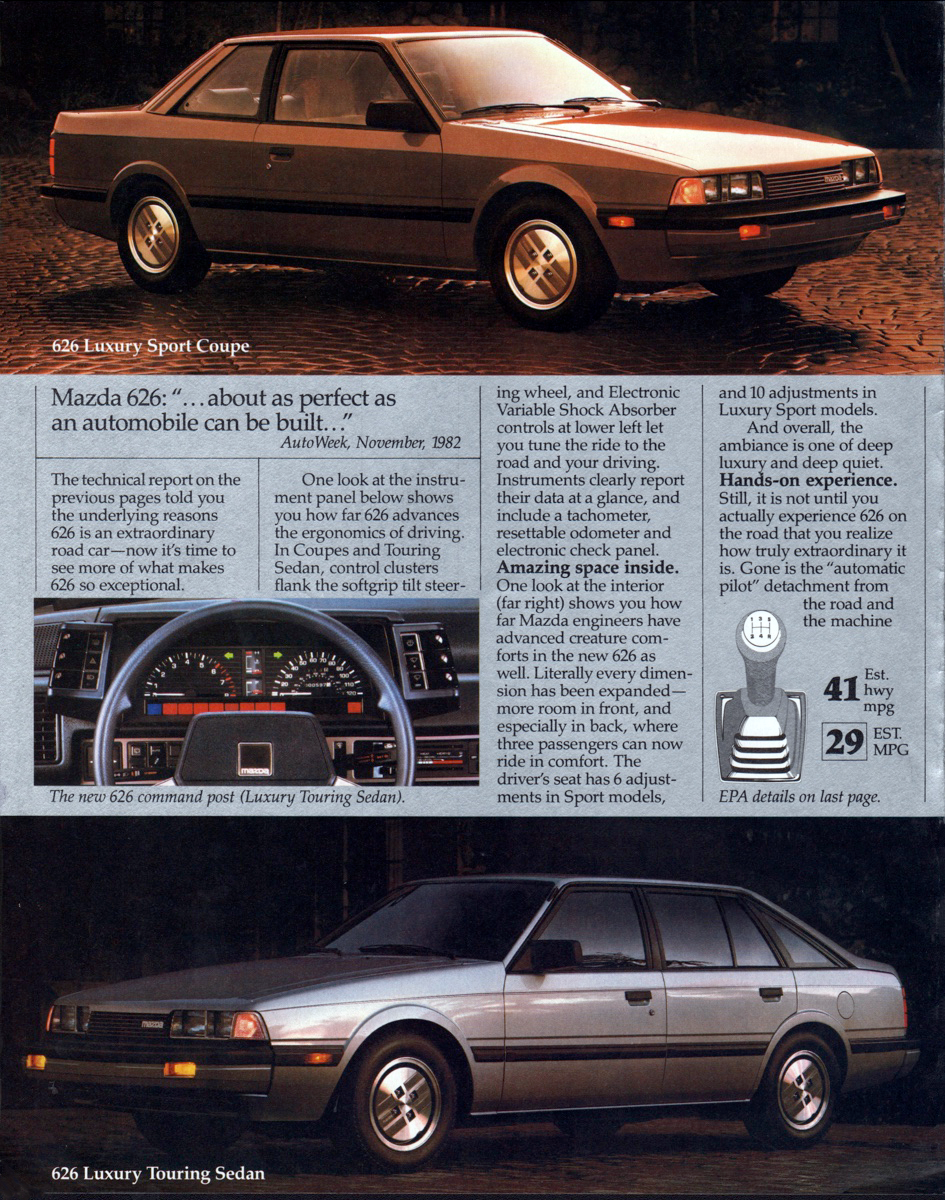
For 1983, Mazda’s 626 coupe, sedan, and liftback were all new as they switched from rear-wheel-drive to front-wheel-drive. Styling was also more aerodynamic, with the coupe receiving a 0.34 Cd. Finally, almost every interior dimension was expanded.

The 626’s standard powertrain was the FE 83 bhp 2.0 liter/121 ci inline four with a two-barrel carburetor paired with a five-speed manual. 0-60 mph took about 12.5 seconds in a car with a 2,545-pound curb weight. EPA fuel economy ratings were 29 city/41 highway by the day’s standards. With a 15.8-gallon fuel tank, a new 626 coupe owner could expect an impressive range of 405 to 450 miles with a 10% fuel reserve.

626 page from the 1983 Mazda brochure

Standard equipment on the $9,295 626 DL coupe (about $30,100 in today’s dollars or about what a 2025 Mazda3 2.5 S Carbon Edition sedan goes for) included rack-and-pinion steering, vacuum-assisted front disc/rear drum brakes, and 185/70R-14 tires (a size still available) on 14 x 5.5 inch wheels. Inside, electric window lifts, electric adjustable mirrors, cruise control, and an AM/FM stereo cassette were included.

The LX coupe added power steering, cruise control, and the trick Electronic Variable Shock Absorber (EVSA) suspension.

Options & Period Reviews

Options included 15 x 6 inch cast alloy wheels with uprated 195/60R-15 tires (a combination that yielded class-leading skid pad results and is still readily available), an electric sunroof ($430), and air conditioning ($650).

The third-generation 626 got a very good reception from the automotive press, with Road & Track stating that it was “an impressive update” that had been “delivered as promised.” AutoWeek gave Mazda a splash quote they used in advertisements—”about as perfect as an automobile can be built.”

The View From 2025

The third-generation Mazda 626 was once quite common (at least in the Philadelphia suburbs), but I haven’t seen one in over a decade. This era of 626 is sometimes available in the Hemmings Motor News classifieds, on eBay Motors, and at online auctions such as Bring a Trailer that cater to the eighties car market.

Make mine Silhouette Blue Metallic, please.

The only other Mazda I have written about is the 1985 RX7 GSL-SE hatchback coupe. I’ve got to get to a GLC at some point.

Last updated March 2025.

1983 Jaguar XJ6 sedan

When I was growing up, I was aware of more prestigious sedans than the Jaguar XJ6. However, none were as gorgeous.

“… the best Jaguar ever built.”

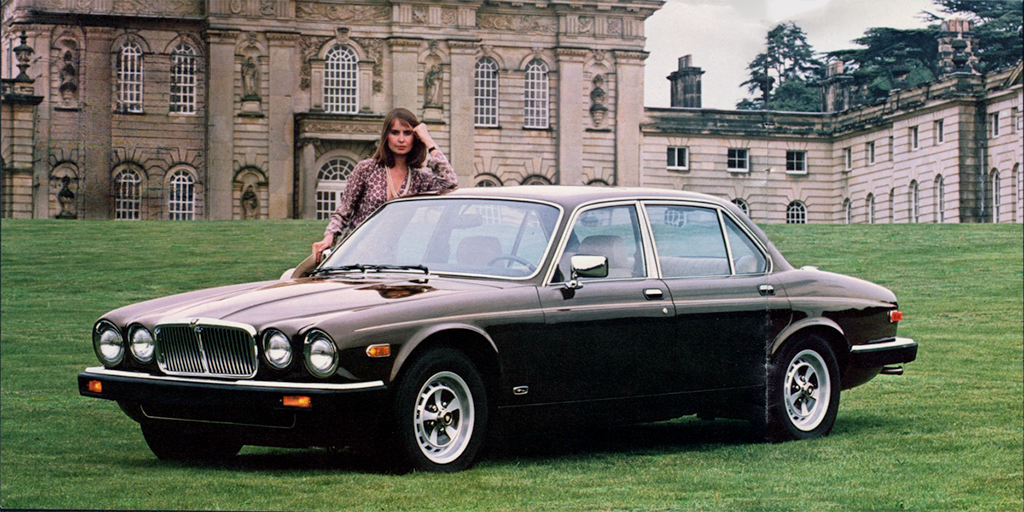
For 1983, Jaguar’s XJ6 sedan received a new center console, a thicker steering wheel rim, and newly standard Pirelli tires. Other than that, there were few changes to the Pininfarina-designed Series III version of the XJ6 that had been introduced in 1980.

The only powertrain available in North America was an XK 176 bhp 4.2 liter/258 ci inline six with fuel injection mated with a three-speed automatic transmission. 0-60 mph came in a little under 11 seconds in a sedan with a curb weight of 4,065 pounds. Fuel economy was rated at 17 city/24 highway. With both 12-gallon gas tanks full, an XJ6 owner could expect a range of 360 to 395 miles with a 10% fuel reserve.

XJ6 brochure pages from the 1983 Jaguar brochure

The XJ6’s base price was $30,500—about $100,800 in today’s dollars. Standard mechanical equipment included a four wheel independent suspension, power rack and pinion steering, four wheel power disc brakes, and Pirelli P5 205/70VR15 tires (a size still available thanks to Vredestein) on 15-inch wheels. Inside, a power sunroof, centrally controlled door locks, power side mirrors, cruise control, and leather front bucket seats were included.

Packages & Period Reviews

The $33,500 Vanden Plas version of the XJ6 kicked things up a notch, adding special metallic paint colors, upgraded seats, individual swivel based reading lamps for the rear passengers, and burled walnut in the dashboard, the console, and the door panels. Jaguar described the Vanden Plas as “frankly opulent.”

By 1983, Jaguar’s quality overall had sharply improved under the management of chairman John Egan (knighted in 1986), so purchasing an XJ6 was a relatively safe decision. The Series III XJ6 was well-liked—Car and Driver pronounced it as “one of the Western World’s more delightful mechanical manifestations.” However, it was not particularly large inside—the EPA classified it as a subcompact car.

The View From 2025

According to Hagerty’s valuation tools, all the money for a 1983 Jaguar XJ6 sedan in #1/Concours condition is $39,500, with a far more normal #3/Good condition version going for $8,300. A Vanden Plas is believed to be worth about 2% more—far less than the cost it added back in 1983.

All vintage Jaguars have strong forum support, and there is definite collector interest in the XJ sedans. Eighties XJ6s are often available in the Hemmings Motor News classifieds, on eBay Motors, and at online auctions such as Bring a Trailer that cater to the eighties car market.

Make mine Racing Green, please. Can there be any doubt?

The other eighties Jaguars I have written about are the 1982 XJ-S H.E. coupe and the 1989 XJ-S convertible.

Last updated October 2025.

1983 Chevrolet Monte Carlo SS Sport Coupe

A 1983 Chevrolet Monte Carlo SS with 156 miles sold on Bring a Trailer for $32,000 in early 2021.

“Chevy SS tradition comes alive …”

In the middle of the 1983 model year, Chevrolet announced the Monte Carlo SS. Designated RPO Z65, the SS was designed to help Chevrolet compete better in NASCAR on Sundays—and sell more Monte Carlos on Mondays. There were only two exterior color choices—White and Medium Dark Royal Blue. The changes in the front end and the addition of a rear spoiler cut the drag coefficient by 15% compared to the “civilian” Sport Coupe, making it a respectable 0.375, though not quite the Ford Thunderbird coupe‘s 0.35 Cd.

Aside from the exterior looks, the powertrain was the star—an L69 “H.O.” 175 bhp 5.0 liter/305 ci V8 with a four-barrel carburetor paired with a three-speed automatic transmission. Period road tests resulted in 0-60 mph times of about 8 seconds—about as quick as the Monte’s Buick Regal T-Type and Oldsmobile Cutlass Calais Hurst/Olds platform-mates in the same year. Fuel economy was rated at 17 city/25 highway by the day’s standards (14 city/18 highway by 2025 measures). With an 18.1-gallon gas tank, the enthused new owner of a Monte Carlo SS could expect a range of 260 to 340 miles with a 10% fuel reserve.

1983 Chevrolet Monte Carlo SS flyer

The Monte Carlo SS had a base price of $10,249—about $34,900 in today’s dollars. Standard exterior and mechanical equipment included Sport mirrors, a rear spoiler, a dual outlet exhaust system, power steering, the F41 sport suspension, power front disc/rear drum brakes, and Goodyear Eagle GT P215/65R15 white letter tires (a size still readily available) on 15 x 7 inch stamped steel wheels. Inside, the SS was less differentiated, but it did get a gage package with a tachometer. The standard seat was a blue cloth bench seat with white vinyl inserts and matching door trim.

Options, Period Reviews, & Production Numbers

Many of the standard Sport Coupe’s options were also available for the SS. Exterior examples included tinted glass ($105), hi-beam halogen headlamps ($10), and twin remote Sport mirrors ($60). Inside, options included an intermittent windshield wiper system ($49), an electric rear window defogger ($135), power windows ($180), an electric power door lock system ($120), a power trunk opener ($40), automatic speed control with resume speed ($170), a Comfortilt steering wheel ($105), and air conditioning ($725).

A blue cloth 55/45 seat with white vinyl inserts was available for an extra $133, but no bucket seats were available for the 1983 Monte Carlo. A series of four radios were available, with an AM/FM stereo radio with stereo cassette tape and four speakers ($298) being the top of the line. A fixed mast black antenna was an SS-only option and was included with all radios.

The sportier Monte Carlo was generally received in the press, though many scribes noted the lack of a console, bucket seats, Positraction, and a four-speed automatic—all issues Chevrolet promised to fix. Motor Trend‘s title was “Mid-American GT Revival,” and much of the coverage agreed.

Along with the late introduction, there were production problems in 1983, so the first year total for the fourth-generation Monte Carlo SS was only 4,714. SS sales would hit their stride in the following year, with Chevrolet moving 24,050 out the door.

The View From 2025

These Monte Carlos have enthusiastic forum support, and there is definite collector interest. According to Hagerty’s valuation tools, a 1983 Chevrolet Monte Carlo SS Sport Coupe in #1/Concours condition is $33,300, with a far more normal #3/Good condition version going for $16,400. Monte Carlos SS coupes are often available in the Hemmings Motor News classifieds, on eBay Motors, and at online auctions such as Bring a Trailer that cater to the eighties car market. As I update this blog entry in August 2025, there’s a White 1983 Monte Carlo SS Sport Coupe with 53,000 miles for sale on Hemmings, asking 29,000.

Make mine Medium Dark Royal Blue, please.

I’ve written about one other Monte Carlo—the 1981 Sport Coupe. Other sporty G-platform cars I have written about include the 1980 Pontiac Grand Prix SJ coupe and the 1982 Buick Regal Grand National coupe.

Last updated August 2025.

1980 Toyota Corolla Tercel Liftback

“… a price that belies its good looks.”

1980 was the first year that Toyota sold the Corolla Tercel in the United States. Despite its name, the front-wheel-drive Tercel was not related in any meaningful way to the rear-wheel-drive Corolla. Still, Toyota evidently figured that adding the Corolla name would make buyers more confident in their purchasing decision. The Tercel was available as a 2-Door Sedan and a 3-Door Liftback (a four-door sedan would arrive one year later).

The Corolla Tercel Liftback was a small and light car, with a 160-inch length (about 22 inches shorter than a 2025 Corolla) and a curb weight of 2,030 pounds. The Liftback’s standard powertrain combined a 60 bhp 1.5 liter/99 ci inline four paired to a five-speed manual (a three-speed automatic was optional). Unusually for a front-wheel-drive car, the Tercel’s engine was longitudinally placed, which Toyota claimed resulted in easier serviceability.

Road & Track clocked a 0-60 time of 14.8 seconds in a loaded Tercel Liftback SR-5. As might be expected with a 99 cubic inch engine and a five-speed, fuel economy was impressive—33 city/43 highway by the day’s standards. With an 11.9-gallon fuel tank, a Tercel driver could expect a range of 330 to 365 miles with a 10% fuel reserve.

Corolla Tercel Liftback pages from the 1980 Corolla brochure

At $4,848 (about $20,500 in today’s dollars or a little less than a 2025 Corolla LE sedan goes for), the Corolla Tercel Liftback Deluxe had more standard equipment than the 2-Door Sedan, which was the loss leader at $4,198. Standard exterior and mechanical equipment included body side moldings, front-wheel-drive, rack-and-pinion steering, power-assisted front disc/rear drum brakes, and 145SR13 steel-belted radial ply whitewall tires on 13-inch wheels. Inside, vinyl reclining hi-back front bucket seats, a split-back fold-down rear seat, brushed nap wall-to-wall carpeting, an electric rear window defogger, and a day/night rear view mirror were included.

Packages & Options

The $600 SR-5 package required the five-speed manual and added black accents, “brazen” side striping, and 165/70SR13 steel-belted radial ply tires (a size still available thanks to Vredestein) on 13-inch wheels. Inside, SR-5 features included cloth reclining low-back front bucket seats, a rear deck cover, a cargo compartment light, an electric tachometer, and an AM/FM/MPX stereo radio.

Options were relatively few, but did include aluminum alloy wheels ($215), a rear window washer/wiper ($75), and factory (not dealer-installed) air conditioning ($520).

The View From 2025

I haven’t seen a first-generation Tercel in decades—they seem to have largely vanished. Tercels rarely appear in the Hemming’s Motor News classifieds or on eBay Motors, but they do occasionally show up on Bring a Trailer.

Make mine Light Blue Metallic, please.

Other Toyotas I have written about include the 1981 Celica Sport Coupe, the 1982 Celica Supra hatchback coupe, the 1983 Camry sedan, and the 1985 MR2 coupe. This list hints that I should write about an actual Corolla soon.

Last updated March 2025.