1987 Dodge Aries LE sedan

We had a lot of road work going on in our area in September 2020. I had to take a short detour, which sent me down a route that included a few blocks I’d never traveled. I saw a white Dodge Aries sedan parked on the side of the road. A day later, I went back and took a couple of pictures. The Aries was in pretty good shape and sported a Pennsylvania classic car plate.

“More car for the money than you thought possible.”

For 1987, changes to the Dodge Aries sedan were minor. A stainless steel exhaust system was new, as were standard front bucket seats.

The Aries’ standard powertrain was an E86 97 bhp 2.2 liter/135 ci inline four with central fuel injection paired with a five-speed manual transmission. A 100 bhp 2.5 liter/152 ci inline four was a $287 option for the LE only and required the $534 TorqueFlite automatic transmission.

Fuel economy with the standard powertrain was rated at 25 city/32 highway by the day’s standards (22/29 by 2025 measures), while ratings for the 2.5 liter/automatic combination dropped to 22/27. With a 14-gallon gas tank, the owner of a base Aries sedan could expect a range of 320 to 360 miles with a 10% fuel reserve. The driver of a 2.5 liter Aries could expect about 50 miles less. Best case 0-60 times were about 10.5 seconds in a car with a shipping weight of just under 2,500 pounds.

1985 Dodge Aries LE sedan photo
1987 Dodge Aries LE sedan circa 2020

Standard exterior and mechanical equipment for the $7,655 Dodge Aries sedan included halogen headlights, manual rack-and-pinion steering, power front disc/rear drum brakes, a compact spare tire, and P175/80R13 black sidewall tires (now generally a trailer size) on 13-inch wheels with hubcaps. Inside, a manual left exterior mirror, a Deluxe two-spoke steering wheel, a mini console, and cloth with vinyl trim low-back bucket seats with reclining seatbacks were included.

Moving up to the $8,134 LE (which 93% of Aries sedan buyers did), added Deluxe wheel covers, a power left exterior mirror, Deluxe windshield wipers with intermittent wipe, a trunk light, cloth door trim panels, and an AM electronic tuning radio with a digital clock. The LE could get a vinyl bench seat at no extra charge.

Packages, Options, & Production Numbers

Chrysler Corporation had begun to move to more options packages by the mid-eighties. The Aries sedan had four for 1987:

  • Basic Equipment Package ($261) included Deluxe 13-inch wheel covers, a black power left exterior mirror, Deluxe windshield wipers with intermittent wipe, and an AM electronic tuning radio with a digital clock. It was (natch!) only available for the base sedan.
  • Popular Equipment Discount Package included tinted glass, bodyside tape stripes, an automatic transmission, power-assisted steering, and P185/70R14 black sidewall tires (a size still readily available) on 14-inch wheels with Deluxe wheel covers. Inside, the package included black dual remote exterior mirrors, special sound insulation, trunk dress-up, and an AM stereo/FM stereo electronic tuning radio with a cassette player, four speakers, and a digital clock. This package was LE-only and went for $740.
  • Premium Equipment Discount Package ($1,312 and LE-only) included everything in the Popular Equipment Discount Package and added an electric rear window defroster, electronic speed control, a Luxury two-spoke steering wheel, a tilt steering column, and power door locks.
  • Light Package ($59 and LE-only) included an ash receiver light, a cigar lighter light, a headlights-on warning buzzer, an ignition switch light with time delay, and an underhood light.

Individual options included tinted glass ($121), 14-inch cast aluminum road wheels ($332 with either the Popular or Premium packages/$381 without), a conventional spare tire ($75 for 13-inch wheel/$85 for $14-inch wheel), and air conditioning ($790 and requiring tinted glass). Between the packages and the options, a loaded LE sedan could surpass $11,000 on its window sticker.

The Aries sedan continued to sell respectably in 1987, with 71,216 sold. It remained by far the best-selling Dodge sedan.

The View From 2025

Interestingly, K cars have not entirely disappeared from the road—quite unlike many of their eighties peers. Examples of the Aries rarely show up for sale in the Hemmings Motor News classifieds and on eBay Motors, though they do appear on cars.com and Bring a Trailer.

Make mine the extra cost ($41) Twilight Blue Pearl Coat, please.

Other K and K-based cars I have written about include the 1981 Plymouth Reliant coupe, the 1982 Chrysler LeBaron convertible, the 1984 Chrysler Laser hatchback coupe, the 1984 Dodge Daytona Turbo Z hatchback coupe, the 1984 Plymouth Voyager minivan, the 1985 Dodge 600 Club Coupe, and the 1986 Chrysler Town and Country convertible.

Last updated April 2025.

1985 Ford Eddie Bauer Bronco SUV

“… we’ve done it again …”

The big news for 1985’s Ford Bronco SUV was the November 1984 introduction of an Eddie Bauer edition, which became the new top-of-the-line. Of course, the full-size Bronco was not the first Ford to be “Bauerized”—that was actually the 1984 Ford Bronco II compact SUV.

1985 Frod Bronco brochure page
Eddie Bauer Bronco page from the 1985 Bronco brochure

The Eddie Bauer Bronco went for $15,972—about $49,200 in today’s dollars, or about what a 2025 Bronco Badlands 2 Door goes for. Exterior features distinctive to the Eddie Bauer Bronco included a specific two-tone paint treatment, dual accent bodyside paint stripes, privacy glass for the quarter windows, and Deluxe argent styled steel wheels.

Interior equipment for Ford’s new special edition included air conditioning, speed control, a tilt steering wheel, Light Group, and an AM/FM stereo radio. Upholstery included reclining all-tan cloth front captains chairs with folding armrests and zippered pouches on the seatbacks, a matching rear bench seat, a floor console, and deep 16 oz color-keyed carpeting.

Powertrains, Performance, & Fuel Economy

The Bronco’s powertrain story was not simple in 1985. All Bronco equipment levels (base, XLT, and Eddie Bauer) came standard with the 120 bhp Big Six 4.9 liter/300 ci inline six with a one-barrel carburetor. The year started with two engine options, both versions of theWindsor 5.8 liter/351 ci V8. At $1,041 was a 150 bhp example with a two-barrel carburetor, while an H.O. version with a four-barrel carburetor put out 210 bhp and cost $1,418. Arriving at about the same time that the Eddie Bauer edition did was a Windsor 190 bhp 4.9 liter/302 ci V8 with fuel injection, which set buyers back $1,202.

A four-speed manual was standard with the six and the smaller V8, while an automatic was the standard and only transmission with both of the 5.8 liter engines. The six could be ordered with a four-speed manual with overdrive, while the 4.9 liter V8 could be had with an overdrive automatic.

Mileage ratings sharply separated the six from all the V8s. With the Big Six and the four-speed manual, a Bronco owner could expect 16 city/21 highway. That dropped to 13/17 with the 5.0 liter V8 and was even worse with the two 5.8 liter engines. Thus, the Bronco’s range with its 25-gallon gas tank and a 10% fuel reserve could vary from a high of 415 miles to a low of 260 miles. Of course, the V8s were noticeably quicker—about two to four seconds faster to 60 mph.

Base Equipment, Options, & Production Numbers

Standard exterior and mechanical equipment on all Broncos included halogen headlights, tinted glass, a heavy-duty radiator, variable-ratio power steering, power front disc/rear drum brakes, and P235/75R15 tires (a size still readily available) on 15-inch wheels. Inside, dome lights, a locking glove box, and a rear flip/fold bench seat were included.

Options for the well-equipped Eddie Bauer Bronco included heavy-duty shocks and springs ($155), a Traction-Lok limited slip rear axle ($238), power windows ($239), and an AM/FM stereo radio with a cassette tape player ($235).

Bronco sales were up a little over 10% to 52,316 for the 1985 model year, easily outselling the competing Chevrolet Blazer and Dodge Ramcharger. Sales of the eighties Bronco would peak in 1989, with 66,730 moved.

The View From 2025

Along with other eighties SUVS, Broncos are attracting significant collector interest. According to Hagerty’s valuation tools, all the money for a 1985 Eddie Bauer Bronco with the 5.8 liter H.O. V8 (the most prized engine) in #1/Concours condition is $50,000, with a far more normal #3/Good condition version going for $29,900. Eighties Broncos are often available in the Hemmings Motor News classifieds, on eBay Motors, and on Bring a Trailer.

Make mine Dark Canyon Red Metallic, please.

Other 1985 Ford products I have written about include the Ford LTD LX sedan and the Merkur XR4Ti hatchback coupe. Other full-size eighties SUVs I have written about include the 1983 Jeep Wagoneer Limited, the 1985 Chevrolet C20 Suburban, the 1985 Chevrolet K5 Blazer, and the 1986 Dodge Ramcharger.

Last updated December 2025.

1986 Dodge Ramcharger SUV

Mecum’s “Summer Special” auction in August 2020 included three examples of the 1980s Ramcharger. The one that did the best was a 1986 Royal S.E.—the top-of-the-line for that year. Its hammer price was $15,500.

“Tough in the Rough.”

For 1986, Dodge’s Ramcharger SUV received a new crosshair grille that strongly resembled the design seen on Dodge’s early 1970s pickup trucks. The side mirror assemblies were simplified, but otherwise, there was little change, aside from new colors.

The Ramcharger’s standard engine was an LA 150 bhp 5.2 liter/318 ci V8 with a two-barrel carburetor. It came with a four-speed manual transmission if four-wheel drive was chosen, and a three-speed automatic transmission if two-wheel drive was preferred. An LA 175 bhp 5.9 liter/360 ci V8 with a four-barrel carburetor went for an additional $261. With the base powertrain, fuel economy was rated at an uninspiring (and somewhat uncompetitive) 11 city/14 highway by the day’s standards in an SUV with a curb weight starting at 4,045 pounds. A capacious 35-gallon gas tank gave a respectable 360 to 395-mile range with a 10% fuel reserve.

1986 Dodge Ramcharger brcohure cover
1986 Dodge Ramcharger brochure cover

The Ramcharger’s base price was $11,534—about $34,400 in today’s dollars, which is about 20% less than a 2026 Durango GT SUV goes for. Standard exterior and mechanical equipment included tinted glass, chrome front and rear bumpers, two-wheel drive, power-assisted front disc/rear drum brakes, power steering, and P235/75R15 tires (a size still readily available) on 15 x 6.5-inch wheels with bright hubcaps. Inside, Deluxe vinyl low-back front bucket seats and an ETR AM radio with a digital clock were included. The four-wheel-drive version of the Ramcharger went for an additional $1,229.

Individual Options, Option Packages, & Production Numbers

Among the many individual options available were aluminum road wheels ($350), a heavy-duty alternator ($145), intermittent windshield wipers ($55), air conditioning ($740), and an ETR AM stereo/FM stereo radio with a cassette player and a clock ($360).

A few option packages were available. Prospector Package I ($768) included a bright grille, Deluxe wheel covers, a Ram’s Head hood ornament, Prospector nameplates, and a convenience package. Prospector Package II ($1,251) added the Royal S.E. décor package and power door locks. Finally, the top-of-the-line Prospector Package III ($3,269 2WD/$3,186 4WD) added two-tone paint, air conditioning, power windows, speed control, and a tilt steering column.

The Ramcharger’s sales peaked at 37,055 in the 1985 model year and would never again come close to that level. With little changed for 1986, sales slipped substantially, with only 20,815 Ramchargers produced compared to 37,310 Chevrolet Blazers and 57,488 Ford Broncos.

The View From 2025

Along with other eighties SUVS, Ramchargers are attracting significant collector interest. According to Hagerty’s valuation tools, a loaded 1986 Ramcharger Royal S.E. 4×4 in #1/Concours condition is $45,100, while a far more normal #3/Good condition AD-100 version goes for $16,300. Ramchargers are often available in the Hemmings Motor News classifieds, on eBay Motors, and on Bring a Trailer. As I update this post in December 2025, a Black 1986 Ramcharger Prospecter with black bucket seats and 38,000 miles is for sale on Hemmings, asking $26,000.

Make mine Charcoal Gray Metallic, please.

Other Dodges I have written about include the 1983 Shelby Charger hatchback coupe, the 1984 Daytona Turbo Z hatchback coupe, the 1985 600 Club Coupe, the 1985 Omni GLH hatchback sedan, the 1985 Shelby Charger hatchback coupe, the 1987 Aries LE sedan, and the 1989 Diplomat sedan. I have also written about the 1985 Chevrolet K5 Blazer SUV and the 1985 Ford Eddie Bauer Bronco SUV.

Last updated December 2025.

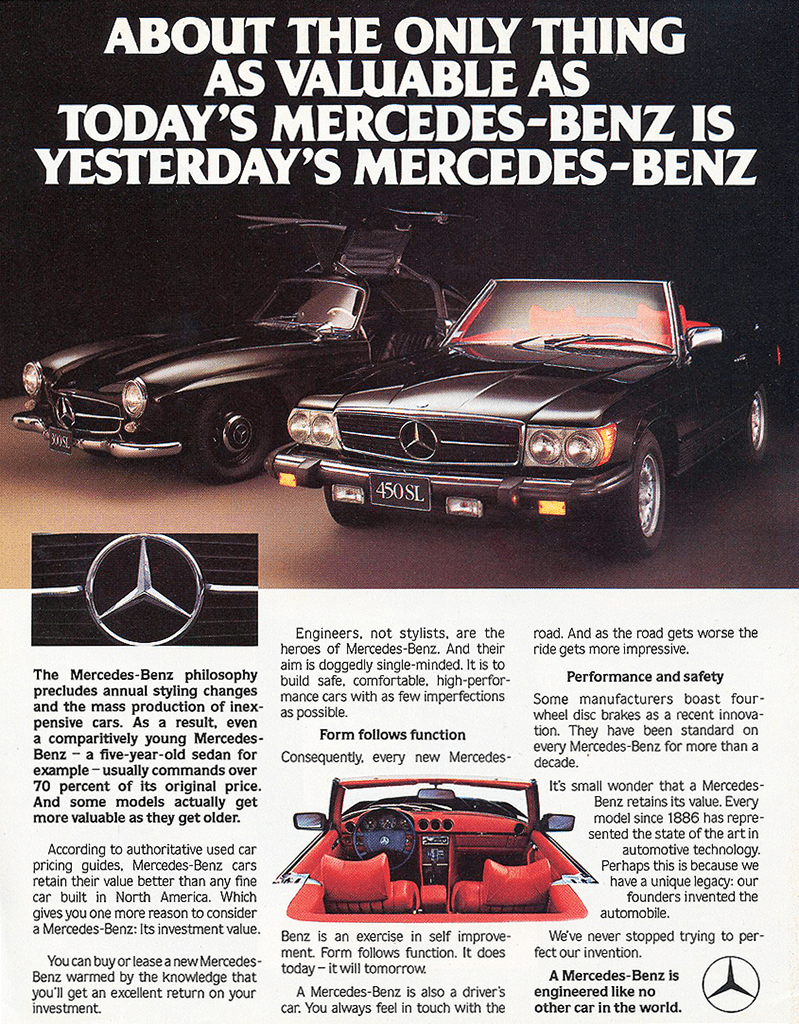
1980 Mercedes-Benz 450SL convertible

A 1980 Mercedes-Benz 450SL convertible sold for $27,000 at Mecum’s “Summer Special” auction in August 2020. I’ve previously written about the other two eighties SL versions: the 380SL and the 560SL. Perhaps it’s time to write about the 450SL.

In production since the 1972 model year, the Mercedes-Benz 450SL changed little in its final year, with a few new exterior colors and some new stereo choices. There were also multiple emissions-related changes to the powertrain, with horsepower ratings dropping from 180 bhp to 160 bhp and torque ratings increasing.

The sole powertrain for the 450SL remained a 4.5 liter/276 ci V8 with Bosch Jetronic fuel injection paired to a three-speed automatic. Car and Driver tested a 1980 450SL and recorded an 11.6-second 0-60 time, but raw acceleration likely wasn’t that important to SL buyers. Mileage also wasn’t great in a vehicle with a 3,730-pound curb weight—this SL was no longer anything resembling Sport Light. The 1980 EPA fuel economy rating was 16 mpg, and most owners report that number as somewhat hopeful. At least the sizeable 23.8-gallon gas tank allowed a range of close to 345 miles with a 10% fuel reserve.

1980 Mercedes-Benz 450SL advertisement

For 1980, the 450SL’s base price was a substantial $35,839—about $152,400 in today’s dollars, which is about 36% more than today’s AMG SL 43 convertible goes for. Standard exterior and mechanical equipment for this expensive car included tinted glass, variable-ratio power steering, power four-wheel disc brakes, and 205/70HR14 tires (a size still available thanks to Vredestein) mounted on 14 x 6 inch light-alloy wheels. Inside, air conditioning, adjustable MB-Tex bucket seats, cruise control, electric windows, and central locking were all included.

Options included a limited-slip differential, 15-inch wheels, leather bucket seats, and an array of Becker stereos. Like many other European cars of the early eighties, the 450SL did not have a standard stereo, though a power antenna was included.

The 450SL was a cultural icon, finding fans among various executives, celebrities, professional athletes, and rock stars when new. It was also a film and television star—famously driven by Richard Gere in American Gigolo, by Stephanie Powers and Robert Wagner on Hart to Hart, and by Patrick Duffy on Dallas.

The View From 2025

450SLs have many adherents to this day, and there is much club support. According to Hagerty’s valuation tools, all the money for a 1980 450SL in #1/Concours condition is $71,900, with a more normal #3/Good condition car going for $14,400. These SLs are always available in the Hemmings Motor News classifieds, on eBay Motors, on Bring a Trailer, and often at in person auctions. As I update this post in April 2025, there are eleven 1980 450SLs available for sale in Hemmings.

Make mine Astral Silver Metallic, please. Sometimes the cliché is correct.

Other eighties Mercedes-Benz models I have written about include the 1985 300CD Turbo coupe and 1986 560SEC coupe.

Last updated April 2025.

1983 Jeep Wagoneer Limited SUV

When Jeep was about to introduce a brand new Wagoneer and Grand Wagoneer in 2020, my thoughts turned back to the nowclassic eighties Wagoneers.

In addition to my historical interest, there’s a personal reason for these thoughts. Back in the eighties, I walked to my local high school almost every day. On cold winter mornings, I’d be trudging alone toward school, and sometimes I’d hear the quiet rumble of a Wagoneer’s V8 behind me along with a female voice. “Get in, John,” she’d say—and I would, grateful for the Wagoneer’s warmth and the lady’s company. I remember you, Patricia, and I hope you are doing well.

“The Ultimate Wagon.”

For 1983, Jeep’s Wagoneer gained a new Selec-Trac four-wheel-drive system, which replaced the decade-old Quadra-Trac system. Jeep also changed the Wagoneer’s trims. 1982’s base Custom trim was no longer available, with what had been the Brougham package now marking the base trim. The loaded Limited trim continued as the top of the Wagoneer line.

The standard engine for the Brougham was a 115 bhp 4.2 liter/258 ci inline six with a two-barrel carburetor. Optional on the Brougham and standard on the Limited was a 175 bhp 5.9 liter/360 ci V8 with a two-barrel carburetor. Mileage was, of course, awful, especially with the V8—the Limited got 12 city/16 highway by the day’s standards. With a 20.3-gallon gas tank, a Limited owner could expect a range of 210 to 230 miles with a 10% fuel reserve. Wagoneers could go just about anywhere, but they couldn’t go that far. They also wouldn’t get there that fast: 0-60 mph took about 16 seconds.

The $13,173 1983 Wagoneer Brougham was about $43,500 in today’s dollars—almost exactly what a base 2025 Grand Cherokee Limited goes for. Standard mechanical equipment included power variable-ratio steering, power front disc/rear drum brakes, and P225/75R15 white sidewall tires (a size still readily available) on 15-inch wheels with full wheel covers. Inside, Coventry checked cloth or Deluxe grain vinyl front and rear bench seats, Custom interior trim, Light Group, and an AM/FM stereo radio were included.

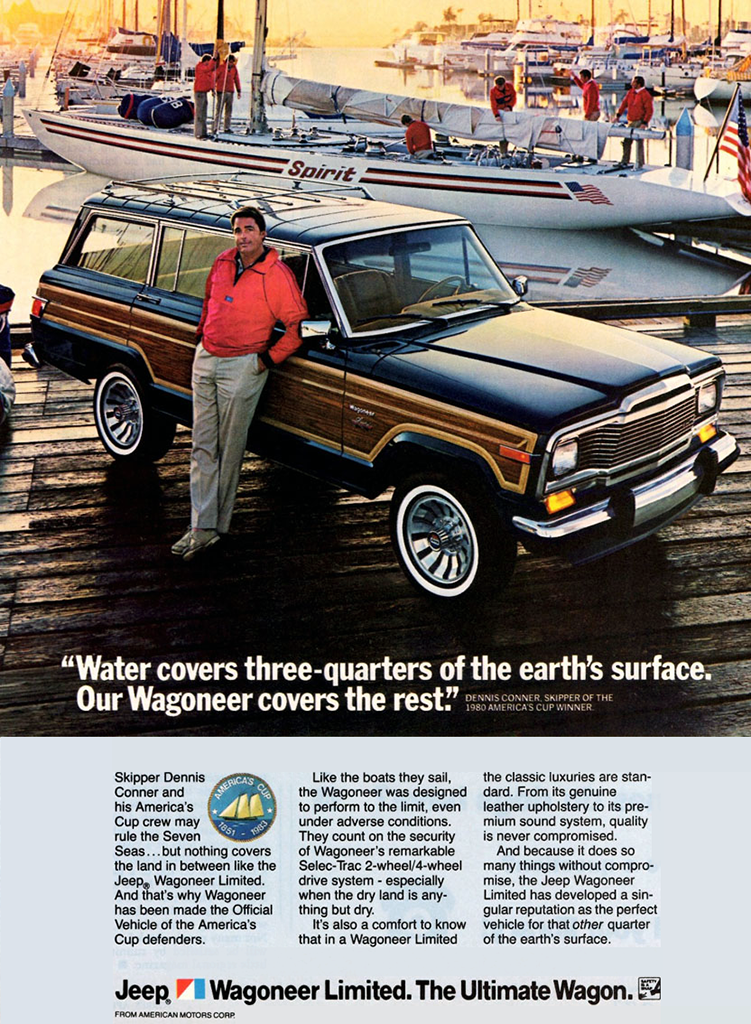
1983 Jeep Wagoneer advertisement
1983 Jeep Wagoneer Limited magazine advertisement

Moving to the upscale Wagoneer Limited added tinted glass, a tilt steering wheel, cruise control, power windows, power door locks, air conditioning, and a premium audio system with electronic tuning. Limited trim and upholstery included leather bucket seats up front, power seats for the driver and front passenger, a leather-wrapped steering wheel, and extra-thick 22-ounce carpeting in the seating area. All of this equipment raised the Limited‘s price to $16,889—$57,700 in today’s dollars, which is 2025 Grand Cherokee Overland money (current Wagoneers are far more dear).

Options & Production Numbers

Options for the Limited included halogen fog lamps ($82), a power sun roof ($1,637), an electric rear window defroster ($184), and a cassette tape player ($300).

Sales of the SJ Wagoneer rose by almost 28% in the 1983 model year, with the 18,478 produced accounting for 21% of overall Jeep production.

The View From 2025

Today, Wagoneers of this era have many adherents—in fact, there’s a company that makes its entire business restoring them. According to Hagerty’s valuation tools, all the money for a 1983 Wagoneer Limited in #1/Concours condition is an astounding $59,100, with a more normal #3/Good condition car going for $27,600.

SJ Jeep Wagoneers are often available in the Hemmings Motor News classifieds, on eBay Motors, on Bring a Trailer, and at in-person auctions. As I update this post in October 2025, a Steel Gray Metallic 1983 Wagoneer Brougham with woodgrain sides and nutmeg leather bucket seats is for sale on Hemmings, asking $37,000.

Make mine Deep Maroon Metallic, please.

I have written about one other Jeep in this blog—the 1982 CJ-8 Scrambler pickup truck. Years ago, I wrote about the 1980 AMC Eagle station wagon.

Last updated October 2025.

1983 Chevrolet Caprice Classic sedan

In mid-2020, a two-tone and stock-appearing Caprice Classic sedan turned a few hundred feet in front of me. Time to finally write a blog entry on the four-door Caprice—I had previously covered the coupe and the station wagon.

“… comfort and quiet for up to six.”

For 1983, Chevrolet’s Caprice Classic sedan was little changed. The headline might have been the return of Black exterior paint.

The Caprice’s standard engine was a Chevrolet-built LC3 110 bhp 3.8 liter/229 ci V6 with a Rochester two-barrel carburetor. Options included a Chevrolet-built LG4 150 bhp 5.0 liter/305 ci V8 with a Rochester four-barrel carburetor and a (don’t do it!) Oldsmobile-built LF9 105 bhp 5.7 liter/350 ci diesel V8. The standard engine for California buyers was a Buick-built LD5 110 bhp 3.8 liter/231 ci V6 with a Rochester two-barrel carburetor. A three-speed automatic was standard for the two V6’s and the diesel, with a four-speed automatic with overdrive standard with the gas V8 and available for the diesel.

Fuel economy with the standard powertrain was rated at 19 city/27 highway mpg, while the V8 was 17 city/30 highway mpg. The diesel was said to get 23 city/35 highway mpg. With a 25.1-gallon gas tank, the owner of a V8 Caprice could expect a range of 430 to 475 miles with a 10% fuel reserve. No matter which engine was under the hood, Chevrolet’s largest car was not quick; 0-60 mph took about 12.5 seconds with the V8.

Caprice Classic sedan pages from the 1983 full-size Chevrolet brochure

Standard mechanical equipment on the $8,802 Caprice Classic sedan (about $29,100 in today’s dollars) included power steering, a front stabilizer bar, power front disc/rear drum brakes, and P205/75R15 radial tires (a size still available thanks to Hankook and Kumho) on 15 x 6 inch wheels with full wheel covers. Inside, Quiet Sound Group, a full-width front bench seat, a quartz electric clock, and a glove box light were included.

Options, Period Reviews, & Production Numbers

Among the many exterior and mechanical options were Custom two-tone paint ($141) in four combinations, tinted glass ($105), halogen hi-beam headlamps ($10), cornering lamps ($55), and an electric rear window defogger ($135). Inside, air conditioning ($725), automatic speed control with resume speed ($170), a Comfortilt steering wheel ($105), power door locks ($170), and a range of Delco radios up to an AM/FM stereo radio with a stereo cassette tape player and four speakers ($298) were available.

The acclaimed F41 Sport Suspension—Car and Driver stated that it would make you “think that your Chevy came from the Black Forest instead of Detroit”—included stiffer springs, tighter shocks, a thicker front stabilizer bar, and a rear stabilizer bar. The F41 was a bargain at $49 and required P225/70R15 white stripe tires ($159). A CL Special Custom interior ($452) included 50/50 Custom cloth seats and a passenger recliner.

The Caprice Classic and other B platform cars—1983’s B body sedan roster included the Buick LeSabre, the Chevrolet Impala, the Oldsmobile Delta 88, and the Pontiac Parisienne—continued to be well regarded. Car and Driver‘s inaugural 10 Best Cars in January 1983 included the Caprice Classic along with the AMC/Renault Alliance, the Ford Mustang GT, the Pontiac 6000 STE, the Volkswagen Rabbit GTI, and five other cars.

Caprices continued to sell well—Chevrolet sold 122,613 sedans in 1983, along with another 45,154 of the closely related but somewhat de-contented Impala four-doors. The Caprice’s production numbers made it the best-selling Chevrolet sedan in that model year, beating out the Cavalier, Celebrity, Chevette, and Malibu offerings.

The View From 2025

Eighties Caprice Classics have their adherents, though many have been modified as donks. Hagerty’s valuation tools do not track the 1976 to 1990 models. You see them in the Hemmings Motor News classifieds, on eBay Motors, and on Bring a Trailer. As I update this post in November 2025, there is a Dark Maroon Metallic 1985 Caprice Classic sedan with a 5.0 liter/305 ci V8 for sale on Hemmings, asking $20,000.

Make mine Dark Fern Metallic, please.

Other B-platform cars I have written about include the 1982 Oldsmobile Delta 88 Royale coupe, the 1983 Pontiac Parisienne sedan, the 1985 Chevrolet Caprice Classic station wagon, and the 1987 Chevrolet Caprice Classic coupe.

Last updated November 2025.

1987 Volvo 780 coupe

“The kind of Volvo you design when you’ve been designing Ferraris, Lamborghinis and Maseratis all your life.”

Designed and produced by Bertone and primarily based on the 760 sedan, the 780 was Volvo’s second attempt at a stylish coupe. The first was also a Bertone creation—the 262C built from 1977 through 1981. Beyond the handsome exterior, the interior was also specific to the 780—not merely a slightly re-purposed 760 design. Among the significant changes from the 760’s interior were a move from five seats to four, with individually-shaped seats for those in the rear.

The 780 used its design and a notably high standard equipment level as differentiators as Volvo attempted to move into higher-end markets. The 780’s base price was $34,785—about $81,700 in today’s dollars, which is well more than any Volvo vehicle’s sticker price in 2020. Back in 1987, the 780’s real competition was unclear. Was it the Acura Legend (also in its first year but much less expensive), the BMW 6-series (much more expensive), the Lincoln Mark VII (far less expensive—at least until many options were added), or some other car?

For 1987, the only powertrain available was the B280F 146 bhp 2.8 liter/174 ci V6 with Bosch LH-Jetronic fuel injection paired with a four-speed automatic transmission. 0-60 mph times were in the 11 second range—Volvo did not intend the 780 to be a sports coupe. Mileage in the 3,415-pound car was rated at 17 city/21 highway by the standards of the day (15/20 by today’s standards). With a relatively small 15.9-gallon fuel tank, 780 drivers could expect 250 to 270 miles of range with a 10% reserve.

1987 Volvo 780 advertisement

Standard exterior equipment for the 780 included tinted glass, a power moonroof with a sliding sunshade, dual power mirrors with a heating element, flush-lens halogen headlamps, front and rear fog lamps, and the Bertone name and logo on both C pillars. Mechanical features included power steering, four-wheel vented power disc brakes with ABS, and 205/60R15 tires (a size still readily available) on 15 x 6 inch 15-spoke alloy wheels.

Inside, the 780 came loaded, with full instrumentation including a tachometer, a power central locking system, power windows, automatic climate control, cruise control, and a driver’s side airbag. Upholstery highlights included heated eight-way power leather front bucket seats and beach burl wood trim. The standard stereo was an AM/FM ETR stereo cassette with a seven-band graphic equalizer, four speakers, a 200-watt amplifier, and a power antenna.

Volvo did not sell a lot of 780’s—but I don’t believe they expected to. Only 9,215 (other sources say 8,518) were produced over six years of production, with about 61% of those going to the United States market. There’s an enthusiast site at 780coupe.com, and folks do collect 780’s. You also sometimes see them in the Hemmings Motor News classifieds and on eBay Motors.

Make mine Blue Metallic, please.

This post is the first on a Volvo in Eighties Cars. There will be others—I definitely expect to get to the 240 wagon at some point.

1985 Volkswagen Cabriolet

“Once again Volkswagen brings a breath of fresh air to the automotive world.”

For the 1985 model year, Volkswagen changed the name of its Rabbit-based convertible in the United States from Rabbit Convertible to Cabriolet. One reason for the Cabriolet rename was likely its base price—at $11,595 (about $35,600 in today’s dollars) around 66% higher than the Golf hatchback coupe’s base price. Another driver was that the Cabriolet retained the Mk1 Rabbit as its basis, rather than joining the Mk2 hatchback coupes and sedans, which were new for 1985 in the United States. All Cabriolets were built by Karmann Coachworks, with most components supplied by Volkswagen, and all had a Karmann badge placed forward of both doors.

The Cabriolet’s standard powertrain was the JH 90 bhp 1.8 liter/109 ci inline four with Bosch K-Jetronic fuel injection paired with a five-speed manual transmission. An automatic transmission was available. Motor Week recorded a 0-60 time of 11.8 seconds with the five-speed in the approximately 2,275-pound Cabriolet.

Volkswagen’s Cabriolet brochure boasted that it was “perhaps the most efficient way to drive from one place to another with the wind in your hair.” This statement was likely correct in 1985; with the five-speed manual, fuel economy ratings by mid-eighties standards were 24 city/29 highway (21/26 by 2025 standards). With a 13.8-gallon gas tank, a Cabriolet owner could expect a range of between 290 and 330 miles with a 10% fuel reserve.

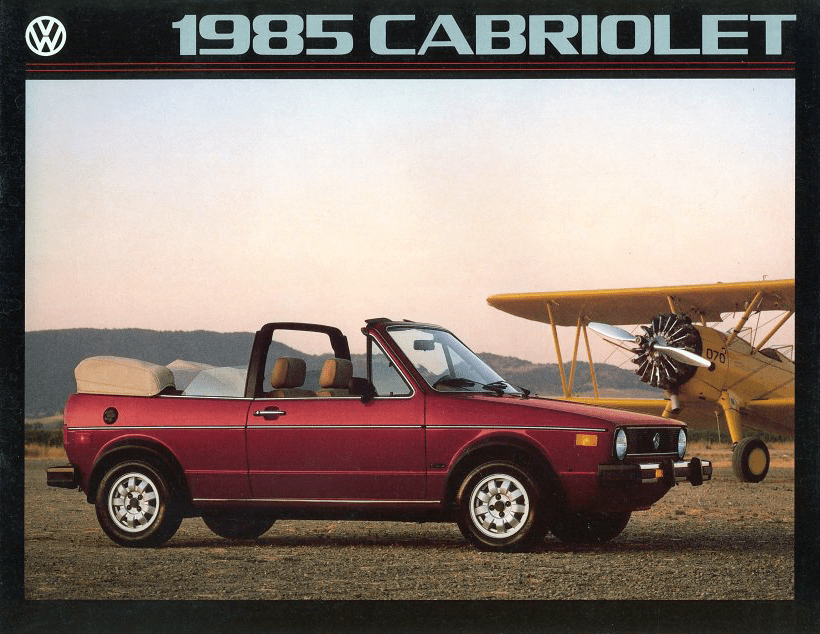
1985 Volkswagen Cabriolet brochure cover

Standard exterior equipment for the Cabriolet included an insulated three-layer convertible top with a heated glass rear window, a boot for the top, tinted glass, and remote-controlled mirrors. Mechanical equipment included front-wheel-drive, a sport suspension, rack-and-pinion steering, power ventilated front disc/rear drum brakes, and 175/70SR13 tires (a size still readily available) on 13-inch wheels. Inside, reclining front bucket seats, full instrumentation, and an electronic AM/FM stereo cassette with four speakers were included.

Options, Competition, & Production Numbers

Options were relatively few: metallic paint, white sidewall tires, 13-inch light-alloy wheels, power steering, cruise control ($200), air conditioning ($725), and cloth sports seats. The Triple White Bestseller package included Alpine White paint, a white convertible top, and white seats. Later in the model year, the usual Wolfsburg Edition promotion was available, with Flash Silver Clearcoat Metallic paint, 185/60HR14 steel-belted radial tires, 14-inch alloy wheels, power steering, a full leather interior, and sports seats.

The mid-priced four-seat convertible market for 1985—all in the $10,500 to $13,500 range—was suddenly rather crowded. In addition to the Volkswagen, potential convertible buyers could choose from the AMC Renault Alliance, the Chevrolet Cavalier/Pontiac Sunbird J-cars, the Chrysler LeBaron/Dodge 600 K-cars, the Ford Mustang/Mercury Capri Fox-bodies, and the Toyota Celica. Despite this various and varied competition, Volkswagen sold an impressive 12,637 Cabriolets in 1985.

The View From 2025

There is definite collector interest in the Cabriolets, and there’s also a lot of information on Cabby Info. Cabriolets are regularly featured in the Hemming’s Motor News classifieds, eBay Motors, and Bring a Trailer.

Make mine Flash Silver Metallic, please.

Other Volkswagens I have written about include the 1981 Dasher station wagon, the 1981 Scirocco S hatchback coupe, the 1983 Rabbit GTI hatchback coupe, and the 1985 Jetta GLI sedan. I’ll have to get to the Quantum and the Vanagon at some point.

Last updated August 2025.

1980 Chevrolet Monza Sport 2+2 hatchback coupe

“Your kind of features. Your kind of fun.”

1980 was the Chevrolet Monza’s final year. Available in base coupe, 2+2 hatchback coupe, and Sport 2+2 hatchback coupe, the Monza received few changes for 1980. The biggest news that wasn’t about deleted models and options (there was no more wagon or V8) was probably the integration of 1979’s Spyder Appearance Package and Spyder Equipment Group into a single Spyder Equipment Package.

The Monza’s standard engine was the LX8 Iron Duke 86 bhp 2.5 liter/151 ci inline four with a Rochester 2SE two-barrel carburetor. The only engine option for 1980 was the LD5 110 bhp 3.8 liter/231 ci V6 with a Rochester M2ME two-barrel carburetor ($225). A four-speed manual was standard, with an optional three-speed automatic ($320) available.

Mileage with the inline four and four-speed manual was pretty impressive in 1980: 22 city/35 highway by the day’s standards. Spending $545 for the automatic and the V6 combination took mileage down to 20 city/27 highway. With the V6/automatic transmission pairing and an 18.5-gallon gas tank, a Monza owner could expect a range of 320 to 350 miles with a 10% fuel reserve.

Exterior and mechanical equipment for the $4,921 Monza Sport 2+2 Hatchback Coupe (approximately $21,200 in 2025 dollars) included tinted windows, a Delco Freedom battery, front disc/rear drum brakes, white-stripe tires, and full wheel covers. Inside, the Monza Sport 2+2 included a Sport steering wheel with a cushioned rim, high-back Sport front bucket seats in cloth/vinyl or all-vinyl, a console, color-keyed seat and shoulder belts, and a Delco AM radio (which could be deleted for a $52 credit).

Packages, Options, & Production Numbers

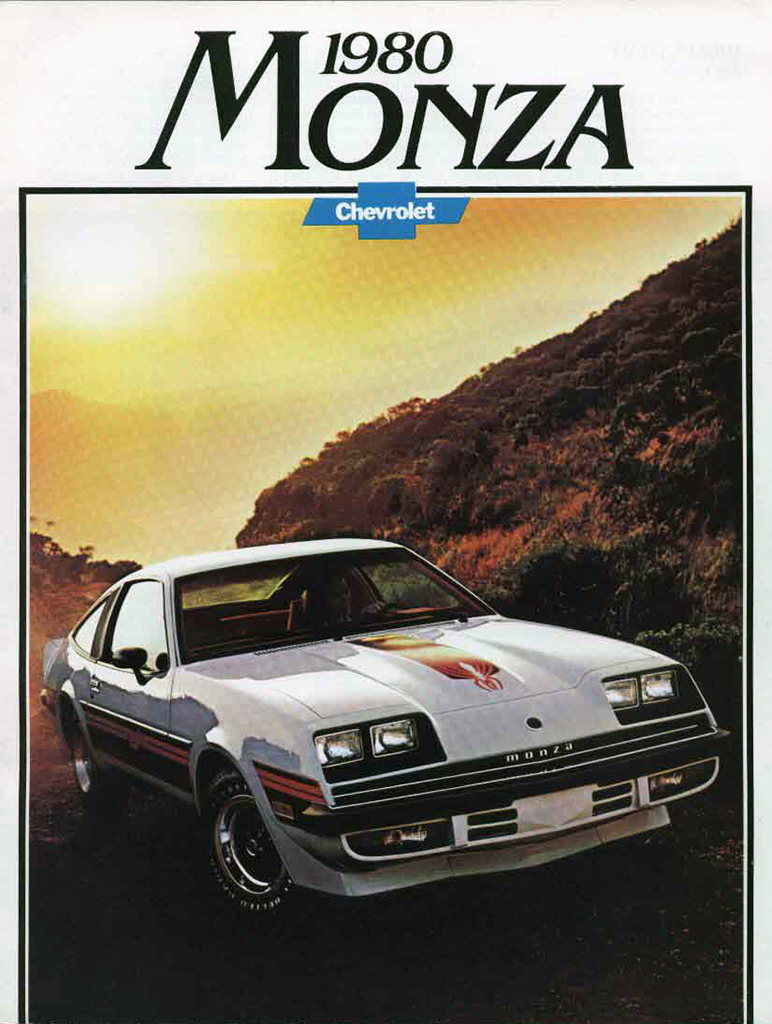
1980 Chevrolet Monza brochure cover

Featured on the cover of the 1980 Monza brochure, the expensive ($521, or about $2,200 in today’s dollars) Spyder Equipment Package added a Spyder hood decal, a body color front air dam and rear spoiler, black Sport mirrors, a sport suspension, and BR70-13 blackwall radial tires (nearly equivalent 195/70R13 tires are available from BF Goodrich) on 13-inch black-painted Rally II wheels with bright trim rings. About 37% of Sport 2+2 Hatchback Coupe buyers chose the Spyder Equipment Package.

Exterior and mechanical options included a Sky Roof manual sunroof ($193), variable-ratio power steering ($158), and power brakes ($76). Inside, you could add air conditioning ($531), a Comfortilt steering wheel ($73), and an AM/FM stereo cassette player ($188).

The Monza sold quite well in its final year—in fact, 1980 was the Monza’s best year out of its six years of production. Chevrolet produced over 169,000, with more than 95,000 being the base coupe.

The View From 2025

There is some club support for the Monza, and they occasionally come up for sale in Hemmings Motor News and on eBay Motors, though many are highly modified drag-racing cars. You do see a few on Bring a Trailer, though you have to sort through sixties Corvairs to find them.

Make mine Dark Blue Metallic, please.

Other 1980 model year Chevrolets I have written about include the Camaro Rally Sport coupe, the Camaro Z28 coupe, the Citation hatchback sedan, and the Corvette coupe. I also wrote about the 1980 Pontiac Sunbird Sport Hatch a few years ago.

Last updated October 2025.

Sa

1983 Renault Alliance sedan

A girlfriend of mine owned a light blue Renault Alliance, which she named “Pierre.”

“Driver appeal and room for five.”

Renault’s Alliance sedan debuted in 1983. Based on the Renault 9 and 11, the Alliance was re-engineered for the North American market and built in AMC’s Kenosha, WI assembly plant—the first front-wheel-drive car built there. The Alliance was available in four-door sedan and two-door coupe versions.

The Alliance’s only engine was Renault’s Cléon-Fonte 64 bhp 1.4 liter/85 ci inline four with Bendix central fuel injection, already over two decades old in its basic design. Transmissions for the sedan varied depending on equipment level; the L (there was no absolutely base sedan—only a coupe) came standard with a four-speed manual, while the better-equipped DL and Limited came with a five-speed manual. All three models could be ordered with an automatic ($420 for an L/$325 for others).

Despite a curb weight of around 2,000 pounds, the Alliance was not a fast car. 0-60 times ranged between 14 and 18 seconds, depending on transmission. On the other hand, fuel mileage ratings were impressive: the four-speed manual returned 37 city/54 highway by the day’s standards. Of course, applying modern standards lowers the numbers, but what would now be 29 city/37 highway still isn’t that bad. Interestingly, the five-speed manual didn’t do any better, despite the extra gear (it did help a little bit with acceleration and lowered noise at highway speeds). Even the automatic was reasonably efficient at 29 city/38 highway. With a 12.4-gallon gas tank, a new Alliance owner could expect a range of between 410 and 455 miles with a 10% fuel reserve.

1983 Renault Alliance advertisement

The Alliance L‘s base price was $6,270—about $20,700 in today’s dollars or almost exactly what a 2025 Nissan Versa SV sedan goes for. Standard mechanical equipment included front-wheel-drive, rack-and-pinion steering, power-assisted front disc/rear drum brakes, and 155/80GR13 tires (a size still available thanks to Kumho) on 13-inch wheels. Inside, vinyl bucket seats, a soft-feel steering wheel, a day/night mirror, and a trip odometer were included.

Moving up to the $6,905 DL added tinted glass, a dual-note horn, and 175/70SR13 tires (still readily available) with wheel trim rings. Inside, DL buyers got Deluxe six-way cloth reclining bucket seats, a color-keyed remote left mirror, a soft-hub steering wheel, a tachometer, and a digital clock.

The top-of-the-line Limited ($7,470) included halogen headlamps and Luxury wheel covers. Inside, Light Group, Visibility Group (dual remote mirrors, lighted visor mirror, and intermittent wipers), textured cloth reclining bucket seats, a rear center armrest, and luxury door panels were included.

Individual Options & Period Reviews

Individual exterior and mechanical options for the Alliance included two-tone paint ($199) and power steering ($199). Inside, power door locks ($170), speed control ($170), rear defroster ($130), air conditioning ($630), and a variety of radios were available. Leather bucket seats were available for the Limited only and set the buyer back $413.

Early on, the Alliance received many good reviews—in fact, it was Motor Trend‘s Car of the Year for 1983. Obtaining this particular plaudit led Renault to (really!) build an MT special edition for the Alliance late in the model year. MT-specific equipment included charcoal gray metallic paint, a decklid luggage rack, painted aluminum wheels, and a right-hand remote mirror. Inside, a leather-wrapped steering wheel and an electronic-tuning stereo radio with six speakers were included.

Those initial positive reviews of the Alliance have not aged well, and many disparaging articles have been written about MT‘s choice. They were not alone—Car and Driver included the Alliance on their 1983 “10 Best” list (26 years later they apologized). Perhaps reviewers of the day wanted the idea of the Alliance to work so much that it clouded their judgment of the actual product delivered.

The View From 2025

I have not seen an Alliance in well over a decade. Alliances rarely appear for sale in the Hemmings Motor News classifieds and on eBay Motors—in fact, they seem to have virtually vanished, despite the 623,573 made between the 1983 and 1987 model years. Bring a Trailer has sold a grand total of four in ten years.

Make mine Diamond Blue Metallic Clearcoat, please.

Another Renault I have written about is the 1982 Fuego hatchback coupe. I’ve also covered the 1980 AMC Eagle station wagon, the 1982 Jeep CJ-8 Scrambler pickup truck, and the 1983 Jeep Wagoneer Limited SUV.

Last updated October 2025.