1985 Chevrolet Citation II hatchback sedan

“One car that does it all.”

1985 was, mercifully, the last year for the Chevrolet Citation. In a sad General Motors tradition, it was also the best Citation (the 1985 Citation had no recalls after the nine that the 1980 had). Half-heartedly renamed Citation II in 1984, the X-car would be replaced by the Nova in 1986. There were some changes: new colors were available, and the dashboard was revised, allowing the “normal” horizontal Delco radios.

For 1985, the Citation II’s standard powertrain remained the LR8 “Iron Duke 92 bhp 2.5 liter/151 ci inline four with throttle-body fuel injection paired with a four-speed manual (the Citation never got a five-speed—even as an option). With the standard powertrain, 0-60 came in a little under 12 seconds in the 2,500-pound car with a theoretical top speed of 101 mph. Mileage was competitive: 24 city/34 highway by the day’s standards (21/31 by today’s standards). With a 14-gallon fuel tank, the owner of a base Citation could expect a range of between 325 and 365 miles with a 10% field reserve.

Powertrain options included two different versions of the 2.8 liter/173 ci V6 (why?): the LE2 112 bhp version with a two-barrel carburetor ($260) and the LB6 130 bhp type with fuel injection ($435). A three-speed automatic was—of course—available ($425). The V6 in general, and especially the fuel-injected version, made the Citation II substantially more spritely: 0-60 times of about 9 seconds and a top speed of about 118 mph. You paid a mileage price for that performance: 19 city/26 highway by 1985 standards (17/24 by today’s standards).
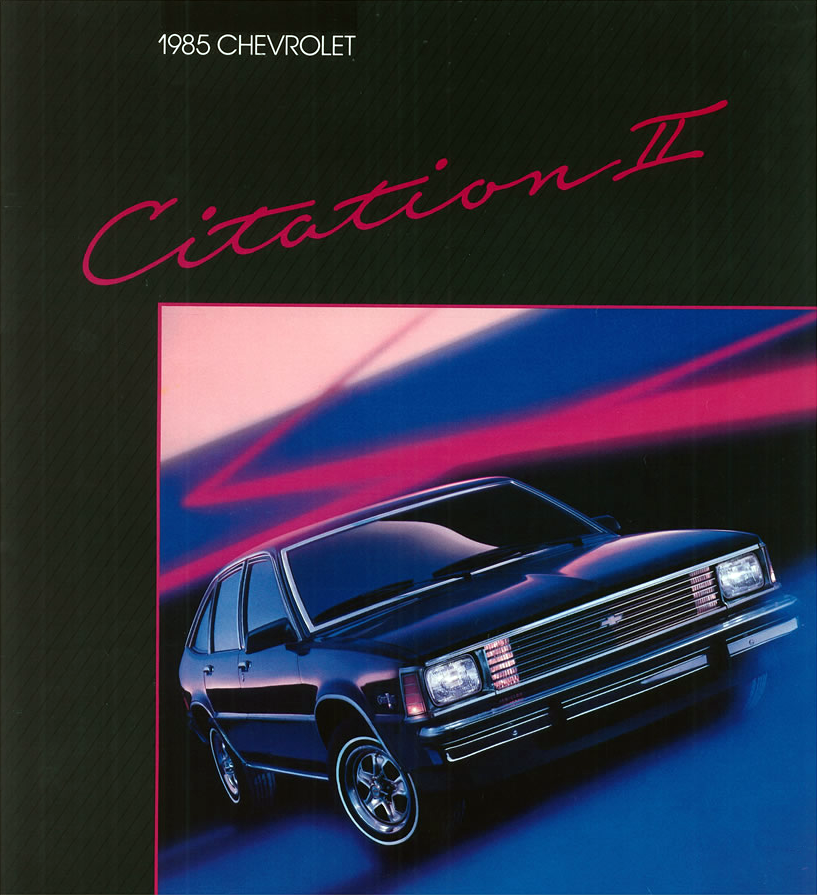
Cover of the 1985 Chevrolet Citation II brochure

Standard exterior and mechanical equipment on the $7,090 Citation II hatchback sedan (approximately $21,500 in 2025 dollars—precisely what base 2025 Chevrolet Trax LS SUV goes for) included halogen headlamps, rack-and-pinion steering, front disk/rear drum brakes, and P185/80R-13 radial tires (now a trailer size) on 13-inch by 5.5-inch steel wheels with full wheel covers. Inside, a low back front bench seat with adjustable head restraints, sliding door locks, a lockable glove box, a folding rear seat, and an AM/FM radio with two speakers were included.

Options & Production Numbers

Exterior and mechanical options included tinted glass ($110), two-tone paint ($176), power brakes ($100), power steering ($215), and the F41 sports suspension (acknowledged to be a bargain at $33). Inside, a quiet sound/rear decor package ($92), air conditioning ($730), cruise control ($175), Comfortilt steering wheel ($110), an electric rear defogger ($140), and an electronic-tuning AM/FM stereo radio with cassette, clock, and seek/scan ($319) were all available.

The 1985 Citation II did not sell—overall sales in this last year fell to a mere 8% of the first year sales. At an average Chevrolet dealership, you could expect it to be outsold by the Chevette, the Cavalier, the Camaro, the Celebrity, the Monte Carlo, and the Caprice Classic.

The View From 2025

I haven’t seen a Citation in years—the last one was an X-11 in early 2014. They rarely appear in the Hemming’s Motor News classifieds, on eBay Motors, or on Bring a Trailer. I’m pretty sure I’ve never seen one shown, though I’m not betting against that at some point.

Make mine the Medium Gray Metallic/Silver Metallic two-tone, please.

Other Citations I’ve written about include the 1980 hatchback sedan and the 1981 X-11 hatchback coupe. X-cars from other marques covered in this blog include the 1983 Buick Skylark T TYPE coupe, the 1984 Oldsmobile Omega sedan, and the 1982 Pontiac Phoenix SJ coupe.

Last updated March 2025.

1981 Chevrolet Monte Carlo Sport Coupe

It was a beautiful weekend in the Philadelphia area in August 2017. Lots of people had their old cars out—one that caught my eye was an eighties Monte Carlo. However, it wasn’t the relatively glamorous SS of the mid-eighties; just a “normal” coupe.

“A matter of personal pride.”

For the 1981 model, the Monte Carlo that had been downsized in 1978 was significantly restyled, both to improve aerodynamics and modernize its looks. Much of the sculpting on the sides (which the middle-school-aged me found appealing) was flattened, the hood was lowered, and the trunk slightly raised. All of this change reduced the drag coefficient by about 10%.

The standard engine continued to be an LC3 110 bhp 3.8 liter/229 ci V6 with a Rochester 2ME two-barrel carburetor. Optional power included a $750 (!) Buick-built LC8 170 bhp 3.8 liter/231 ci V6 with a turbocharger and a Rochester E4ME four-barrel carburetor and a $50 L39 115 bhp 4.4 liter/267 ci V8 with a Rochester 2ME two-barrel carburetor. California got an LG4 150 bhp 5.0 liter/305 ci V8 with a Rochester 4ME four-barrel carburetor as an option replacing the 4.4 liter V8. All engines were paired with a Turbo Hydra-Matic three-speed automatic transmission.

Mileage for the standard engine was 19 city/26 highway by the day’s standards. With an 18.1-gallon gas tank, a Monte Carlo driver could reasonably expect 300 to 325 miles of range with a 10% fuel reserve. Performance wasn’t exactly sparkling: 0-60 mph came in about 14.5 seconds with the standard V6 and 14 seconds for the 4.4 liter V8. The rare (about 2% of 1981 sales) turbo V6 was much faster—about 9 seconds for the 0-60 mph dash.

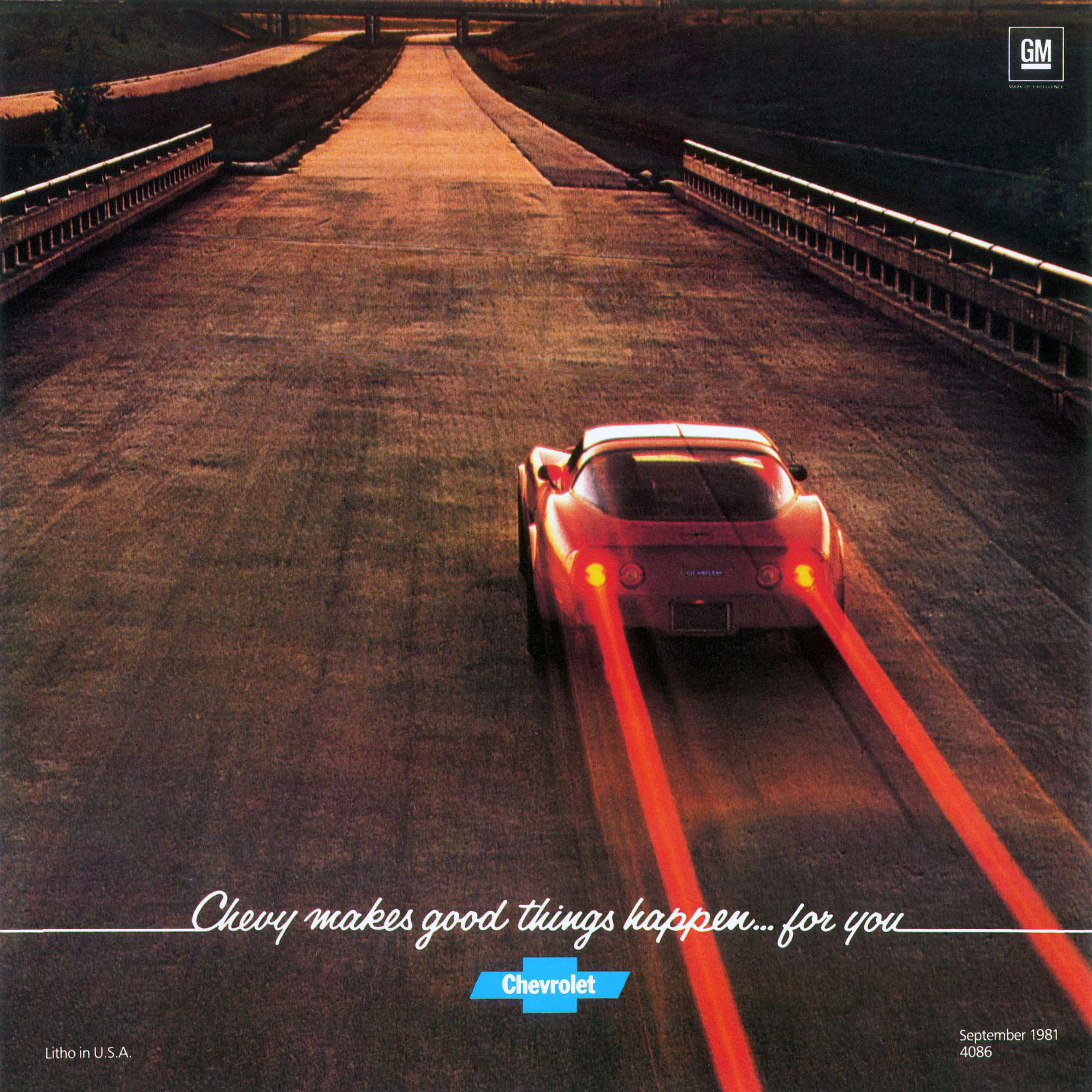
Rear cover of 1981 Chevrolet Monte Carlo brochure

The Monte Carlo Sport Coupe‘s base price was $7,299—approximately $28,000 in today’s dollars or about what a base 2026 Chevrolet Equinox SUV costs. Standard exterior and mechanical equipment included Computer Command Control, Delco Freedom II battery, power steering, power front disc/rear drum brakes, and P195/75R14 steel-belted radial tires (a size still available thanks to Hancook and Kumho) on 14-inch wheels. Inside, a split cloth front bench seat, cut pile carpeting, and an electric clock were standard.

Exterior and mechanical options for the Sport Coupe (there was also a higher-content Landau Coupe) included halogen high beam headlamps ($27), removable glass roof panels ($695), F41 Sport Suspension ($43), limited-slip differential ($67), Rally wheels ($49), and attractive new aluminum wheels ($319). Inside, there were many options: air conditioning ($585), automatic speed control ($132), Comfortilt steering wheel ($81), power windows ($140), power door locks ($93), bucket seats ($118), gauge package ($55), and an AM/FM stereo radio with cassette tape ($264) were all available.

Options & Production Numbers

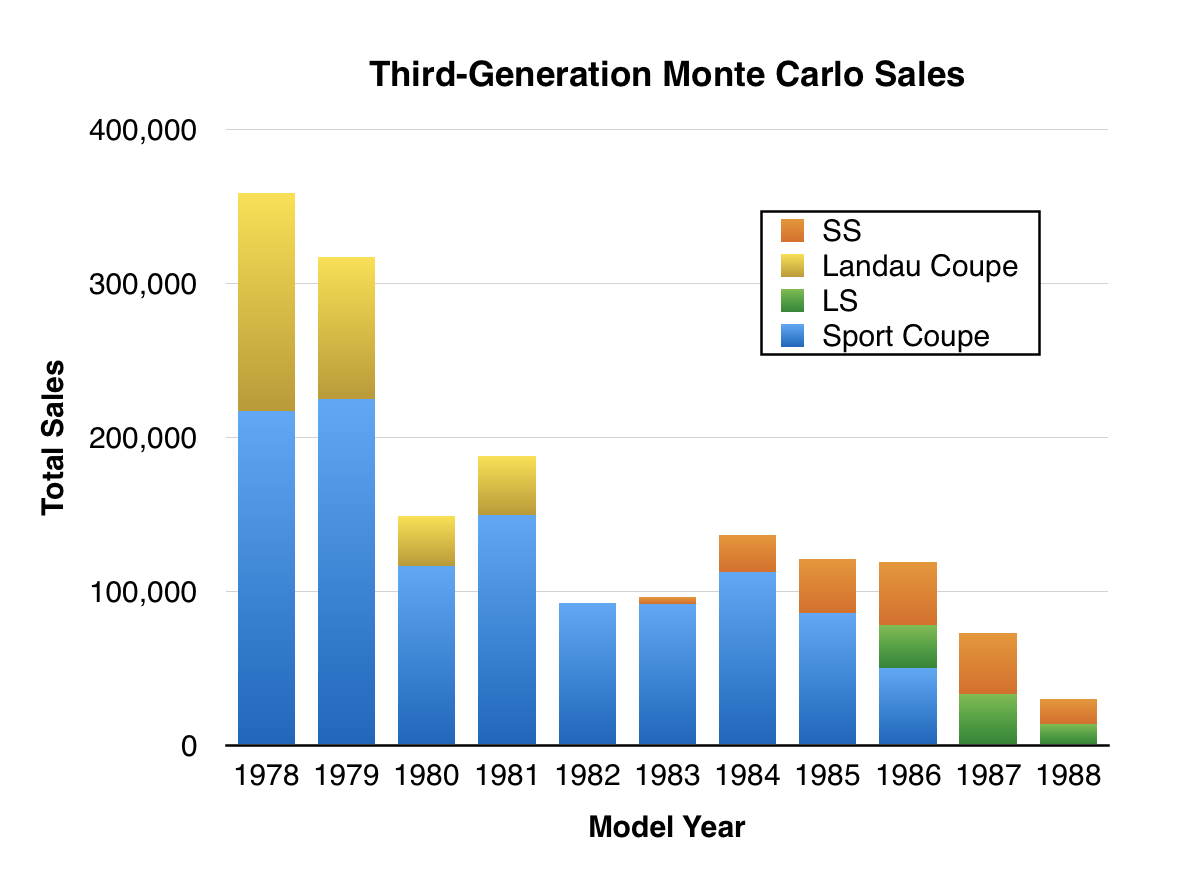
1981 Monte Carlo sales were astounding by modern standards for auto sales—Chevrolet sold 149,659 Sport Coupes along with another 38,191 Landau Coupes. For context, the combined Monte Carlo numbers would be enough to make it the 18th most popular vehicle in 2024, and Chevrolet had four model lines that sold better in 1981 (Chevette, Citation, Malibu, and Impala/Caprice). Chevrolet was probably happy with the increased sales over 1980, but this would not last—1981 turned out to be the eighties high-water mark for Chevrolet’s mid-size personal luxury coupe.

The View From 2025

Third-generation Monte Carlos have a following, though most of the interest is in the aforementioned SS, which is the only eighties Monte rated in Hagerty’s valuation tools. A 1986 maroon Chevrolet Monte Carlo coupe with a maroon interior and cloth bucket seats, an LG4 150 bhp 5.0 liter/305 cubic inch V8 with a four-barrel carburetor, an automatic, and 60,000 miles sold for $9,000 at Barrett-Jackson’s 2016 Las Vegas auction.

These Monte Carlos do show up for sale in the Hemmings Motor News classifieds, on eBay Motors, and on Bring a Trailer. When I updated this post in October 2025, Hemmings was listing a Light Maroon 1984 Monte Carlo with maroon cloth seats, a 3.8 liter V6, and 13,000 miles, asking $24,000.

Make mine Green Light Jade Metallic, please. A rare choice when new, those GM light greens from the early eighties have aged very well.

Other rear-wheel-drive G-platform (designated A-platform before 1982) coupes I have written about include the 1980 Oldsmobile Cutlass, the 1980 Pontiac Grand Am, the 1980 Pontiac Grand Prix SJ, the 1981 Oldsmobile Cutlass Supreme, the 1983 Chevrolet Monte Carlo SS Sport Coupe, the 1984 Buick Regal Grand National, the 1981 Oldsmobile Cutlass Supreme, the 1987 Buick GNX, and the 1987 Pontiac Grand Prix.

Last updated October 2025.

Save

Save

Save

Save

Save

Save

Save

Save

1989 Chevrolet Celebrity sedan

A co-worker of mine casually mentioned that he owns a beige 1989 Chevrolet Celebrity sedan. That’s enough for me to write a blog entry.

“contemporary front-drive technology”

For 1989, Chevrolet’s Celebrity mid-size sedans and wagons were little changed. The major news was that the five-speed manual transmission that (very) few bought was no longer available and that the coupe had been discontinued.

Standard power on the Celebrity remained the Tech IV 98 bhp 2.5 liter/151 ci inline four with throttle-body fuel injection. The LB6 125 bhp 2.8 liter/181 ci V6 with multi-port fuel injection was available for $610. A three-speed automatic transmission was standard on both engines, but buyers of the V6 could add a four-speed automatic for an additional $175.

With these two engines and curb weights in the 2,750 to 2,800-pound range, the Celebrity was not a fast car. 0-60 mph with the four was a little over 13 seconds, while V6 owners got to 60 mph about two seconds faster.

Mileage with the base four was 23 city/30 highway (21/28 by today’s standards), while owners of the top-of-the-line V6/four-speed automatic combination could expect 20 city/29 highway. With a 15.7-gallon fuel tank, Celebrity V6 drivers could expect a range of between 310 and 350 miles with a 10% fuel reserve.

My colleague's 1989 Celebrity, prior to restoration.
My colleague’s 1989 Celebrity before restoration.

Standard equipment on the $11,495 Celebrity (about $30,800 in today’s dollars or about what a 2025 Chevrolet Equinox LT SUV goes for) included power steering, power brakes, 14-inch wheels on P175/75R14 tires (a size now tough to find), and a Delco AM/FM stereo radio with digital clock. Adding the V6 and the four-speed automatic brought the price up to $12,280, or about $33,000 in today’s dollars.

Packages & Options

By 1989, Chevrolet was moving to Preferred Equipment Group option packages as a way to reduce the number of equipment combinations. The Celebrity’s option packages were:

  1. Air conditioning, auxiliary lighting, exterior moldings, floor mats—($931 with the 2.5 liter inline four/$957 with the 2.8 liter V6)
  2. Air conditioning, auxiliary lighting, exterior moldings, floor mats, power door locks, gauge package, cruise control, tilt steering wheel, and intermittent windshield wipers—($1,565 with the 2.5 liter inline four/$1,591 with the 2.8 liter V6)
  3. Air conditioning, auxiliary lighting, exterior moldings, floor mats, power door locks, gauge package, cruise control, tilt steering wheel, and intermittent windshield wipers, sport remote mirrors, AM/FM stereo cassette with digital clock, power trunk opener, and power windows—($2,062 with the 2.5 liter inline four/$2,088 with the 2.8 liter V6)

Adding the Preferred Equipment Group 3 to a Celebrity with the V6 and the four-speed automatic brought the price all the way up to $14,368, or about $38,600 in today’s dollars.

The most glamorous option for the Celebrity continued to be the $230 Eurosport package, which included the F41 sport suspension and P195/75R14 tires (a size still available thanks to Hankook and Kumho) and 14-inch rally wheels. The exterior featured blacked out window trim and red center stripes on the protective rubber door and bumper molding; fender and trunk emblems were red rather than the standard chrome. Eurosports also featured unique red emblems on the interior door panels and dash and a black steering wheel.

Other optional equipment included two-tone paint ($55), aluminum wheels ($195), an engine block heater ($20), cloth bucket seats with a console ($257), and a six-way power driver’s seat ($250).

1989 would end up being the last year for the Celebrity sedan—the wagon would soldier on for one more year.

The View From 2025

Badge for 2,500 web hits

I think of these cars as honest but basic; they aren’t really being collected, though I did see an early (1982-1985) coupe at an AACA show about fifteen years ago. Celebrities occasionally show up for sale in the Hemmings Motor News classifieds, on eBay Motors, and on Bring a Trailer.

Make mine Black, I think.

Other A-bodies I’ve written about in this blog include the 1986 Buick Century sedan, the 1985 Oldsmobile Cutlass Ciera sedan, and the 1983 Pontiac 6000 STE sedan.

Last updated August 2025.

Save

1986 Chevrolet Cavalier Z24 coupe

“Camaro Z28 Is Its Big Brother”

Chevrolet’s Cavalier Z24 was announced for the 1985 model year but didn’t actually become available until the 1986 model year. The most important feature of the Z24 was definitely the engine—GM’s corporate LB6 120 bhp 2.8 liter/171 ci V6 with multi-port fuel injection. Paired with the standard four-speed manual transmission, 0-60 came in about 8.5 seconds in the 2,450-pound car—decent for a sporty compact car in 1986 (the 102 bhp Volkswagen GTI hatchback of the same year was about as fast).

Mileage was 19 city/26 highway by the day’s standards (19/24 by today’s measures). The Z24‘s range was 265 to 275 miles with a 10% fuel reserve—like all Cavaliers, the fuel tank was 13.6 gallons.

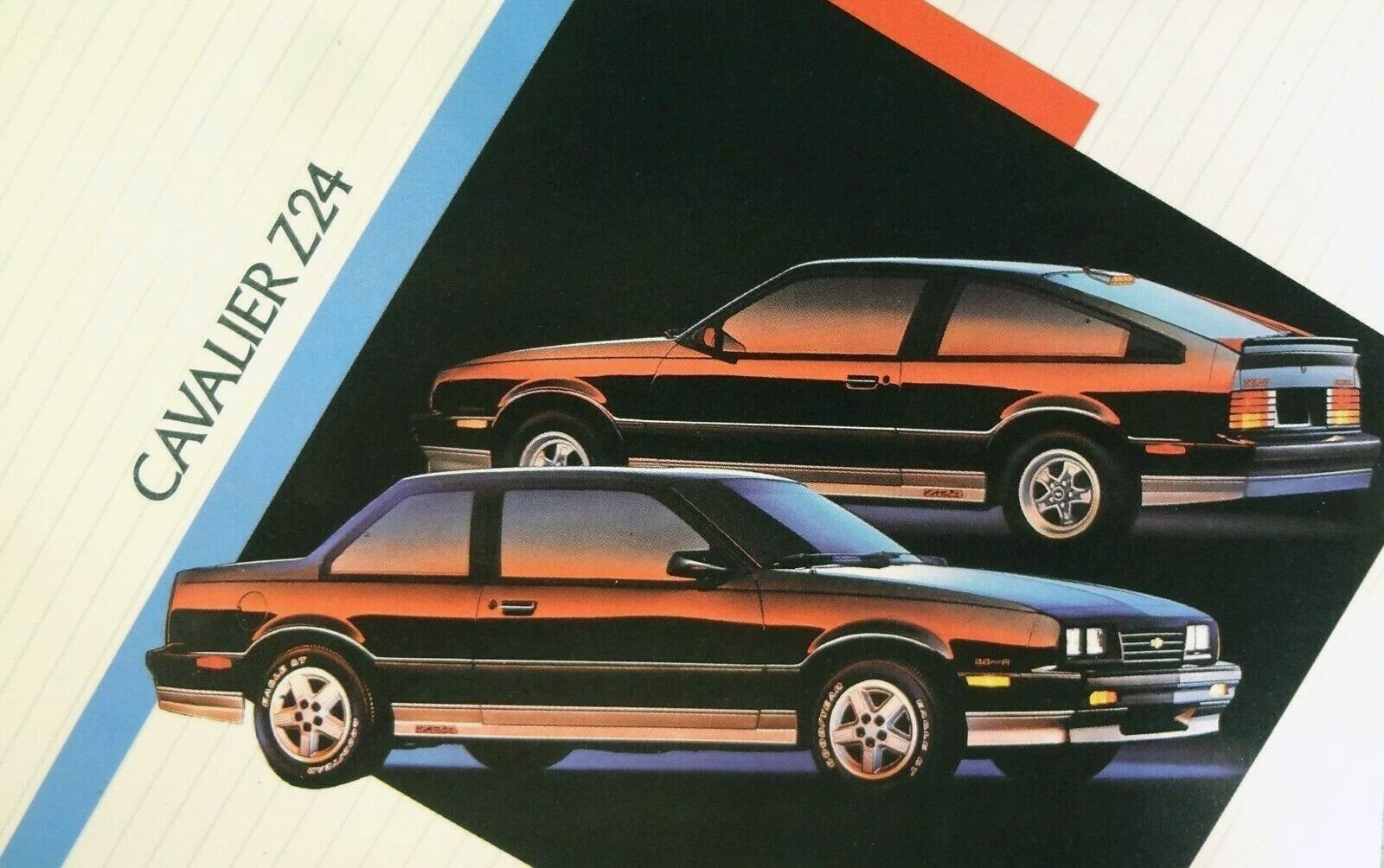
1986 Chevrolet Cavalier Z24 dealer postcard

Standard equipment on the $8,878 Z24 (about $24,500 in today’s dollars) included the aforementioned engine and transmission, a ground effects package, black grille, dual black sport mirrors, the F41 sports suspension, and P215/60R-14 Goodyear Eagle GT radial tires (a size still available thanks to Riken and BFGoodrich) mounted on 14 x 6 inch Rally wheels. Inside, all Z24 buyers received digital instrumentation fed from “a 16K computer,” including a tachometer and trip odometer, along with a rear window defroster, and an AM pushbutton radio with dual front speakers.

All Cavaliers included front wheel drive, a MacPherson strut front suspension, rack and pinion steering, and front disc/rear drum brakes. Inside, reclining front bucket seats, a full floor console, side window defoggers, and a day/night rearview mirror were standard.

Options & Production Numbers

Available options included 14-inch aluminum wheels ($173), tinted glass ($99), air conditioning ($645), cruise control with resume ($175), power door locks ($130), power windows ($195), Comfortilt steering wheel ($115), and an electronic-tuning AM stereo/FM stereo seek/scan radio with cassette player, graphic equalizer, and clock ($494). A comfortably optioned Z24 could easily reach almost $11,000 (about $32,800 in 2025 dollars).

Handsome in a broad-shouldered sort of way, the Z24 coupe sold pretty well for 1986—about 36,000 units. The slightly more expensive hatchback added another 10,000 units: the two models accounted for about 11% of total Cavalier production. Power would increase to 130 bhp in 1987, and a convertible version of the Z24 would come along in 1988. Chevrolet would build the Cavalier Z24 until the end of the 2002 model year.

The View From 2025

A few folks are collecting these cars, but they certainly aren’t common at shows. You do occasionally see Z24s for sale in the Hemming’s Motor News classifieds, on eBay Motors, and on Bring a Trailer, but most of them are the second-generation 1988 and above models.

Make mine Bright Red, please.

Other J platform cars I have covered in this blog include the 1982 Cadillac Cimarron sedan, the 1983 Chevrolet Cavalier CS sedan, the 1984 Buick Skyhawk coupe, the 1984 Pontiac 2000 Sunbird S/E hatchback coupe, the 1985 Oldsmobile Firenza ES sedan, and the 1988 Cadillac Cimarron sedan.

Last updated September 2025.

1985 Chevrolet Caprice Classic Station Wagon

Originally posted on Independence Day 2015, here’s an all-American eighties wagon from forty years ago.

“Big wagon convenience that drives like a Caprice.”

1985 was a year of refinement for Chevrolet’s full-size wagon. The standard engine was Chevrolet’s LG4 5.0 liter/305 ci V8, newly uprated to 165 bhp but still struggling to haul around about two tons and eighteen feet of metal. Paired with a four-speed automatic transmission, fuel economy was 15 city/22 highway by the day’s standards (14/20 by today’s measures). With the 22-gallon gas tank (smaller in the wagon than in the coupe or sedan), the range was from 335 to 365 miles with a 10% reserve.

The full-size Chevrolet interior was also modernized for 1985, with an updated satin finish dash design that allowed for the use of more capable DIN style radios instead of the previous two-knob style.

Station wagon page from the 1985 Caprice Classic brochure

Standard exterior and mechanical equipment on the $10,714 wagon (about $32,500 in today’s dollars) included power steering, power brakes (disk front/drum rear), a three-way tailgate with power window, heavy-duty front and rear suspension, a Delco Freedom II battery, full wheel covers, and white-striped P225/75R-15 all-season radial tires. Inside, Quiet Sound Group, a quartz electric clock, a headlamp-on reminder chime, a lockable glove box with light, a full-width front bench seat with center armrest, a third row seat, and an AM push-button radio with dual front speakers were all part of a base Caprice Classic wagon.

Options & Production Numbers

Exterior and mechanical options included Estate Equipment ($307), a roof carrier ($110), a rear air deflector ($40), a power tailgate lock ($50), a heavy duty battery ($26), heavy duty cooling ($40), an engine block heater ($20), cornering lamps ($55), and high and low beam halogen headlamps ($22).

Inside, buyers could add air conditioning ($730), electronic speed control ($175), a Comfortilt steering wheel ($110), power windows ($185), power door locks ($125), deluxe rear compartment decor ($59), and a GM-Delco ETR AM/FM stereo radio with seek and scan, cassette tape, clock, graphic equalizer and extended range sound system ($394).

Chevrolet sold almost 56,000 Caprice Classic wagons in the 1985 model year, marking about 21% of total full-size Impala/Caprice production.

The View From 2025

I sense that there actually are a few folks preserving these cars, but they certainly aren’t common at shows. You do sometimes see Caprice wagons for sale in the Hemming’s Motor News classifieds, on eBay Motors, and Bring a Trailer. As I update this blog post in August 2025, a Dark Blue Metallic 1989 wagon with dark blue cloth seats is listed for $16,000 on Hemmings.

Make mine that same Dark Blue Metallic, please.

Other B-platform cars I have written about include the 1983 Chevrolet Caprice Classic sedan, the 1987 Chevrolet Caprice Classic coupe, the 1982 Oldsmobile Delta 88 Royale coupe, and the 1983 Pontiac Parisienne sedan.

Last updated August 2025.

1980 Chevrolet Corvette coupe

“How many other cars can you name at a single glance?”

For the 1980 model year, Chevrolet stylists substantially redesigned the Corvette’s long-running “shark” body style for the third time since its debut in the 1968 model year. The front and rear bumper caps were modified with integrated spoilers that decreased the drag coefficient by 14% to 0.443. Chevrolet engineers also managed to remove 167 pounds of curb weight from the Corvette by reducing the thickness of body panels and using aluminum for more parts. For the first time, air conditioning was standard—it had been an option since 1963. Power windows were also newly standard equipment.

There were two engine options for all states but California, both 5.7 liter/350 ci small blocks with four-barrel carburetors: the standard 190 bhp L48 and the optional ($595) 230 bhp L82. The four-speed manual transmission was only available with the L48—the L82 and the California-only 180 bhp 5.0 liter/305 ci LG4 could only be combined with the three-speed automatic transmission. With the relatively rare (about 12% of production) L82 and automatic transmission combination, Car and Driver recorded a 0-60 time of 7.6 seconds and a top speed of 123 mph.

Fuel economy was 14 city/20 highway by the day’s standards with either 350 ci and either transmission. With a 24.1-gallon gas tank, a Corvette’s proud new owner could expect a range of 300 to 330 miles.

1980 Chevrolet Corvette brochure cover
Cover of the 1980 Chevrolet Corvette brochure

The Corvette’s base was $13,140.24 at the beginning of the model year—about $56,400 in 2025 dollars, which is about 20% less than a 2025 Corvette Stingray coupe costs. Corvette buyers got removable roof panels, power-operated retractable headlights, a Delco Freedom battery, four-wheel power disc brakes, power steering, dual remote-control sport mirrors, a choice of transmissions, and P225/70R15 steel-belted radial-ply tires (a size still readily available) on 15-inch wheels. Inside, air conditioning, power windows, a tilt-telescopic steering column, an electric clock, an AM/FM radio, cut-pile carpeting, and a choice of either cloth/vinyl or leather/vinyl bucket seats were all standard.

Options, Production Numbers, & Reviews

Exterior and mechanical options included aluminum wheels ($407), P255/60R15 tires ($426), and a power antenna ($56). Inside, buyers could add power door locks ($140), cruise control ($123), rear window defogger ($109), and dual rear speakers ($52). 1980 would be the last year that the AM/FM stereo radio with 8-track player ($155) would be more popular than the AM/FM stereo radio with cassette player ($173).

The redesign probably kept Corvette sales from dropping as much as they otherwise would have, but they were still off more than 13,000 units from 1979 as the shark aged. The tagline for Car and Driver‘s review of the 1980 Corvette was “America’s only sports car, but that doesn’t excuse everything.”

The View From 2025

There is strong club support for the 1980 Corvette, as there is for all Corvettes. According to Hagerty’s valuation tools, a loaded 1980 Corvette with the L82 engine in #1/Concours condition is $38,100, with a more normal L48-engined car in number #3/Good condition going for $14,900.

1980 Corvettes often appear in the Hemming’s Motor News classifieds (Hemmings currently has twenty for sale), on eBay Motors, and on Bring a Trailer. They are also frequently seen at in-person auctions such as Barrett-Jackson and Mecum. As I update this post in August 2025, a Dark Claret Metallic one with the L82, oyster leather seats, and 28,000 miles is available on Hemmings, asking $19,000.

Make mine White with red leather seats, please—the “heritage” colors.

Other third-generation Corvettes I have written about include the 1981 coupe and the 1982 coupe. 1980 Chevrolet models include the Camaro Rally Sport coupe, the Camaro Z28 coupe, the Citation hatchback sedan, and the Monza Sport 2+2 hatchback coupe.

Last updated August 2025.

1987 Chevrolet Chevette CS hatchback sedan

In May 2019, my ex-wife and I were taking a walk early on a Saturday morning and passed a Chevrolet Chevette parked at the end of our street. That was reason enough to finally complete this blog entry.

“… one of America’s best known cars …”

1987 was the final year for the somewhat antiquated rear wheel drive Chevette—in North America, at least. The 1.8-liter diesel engine was no more, but otherwise little was changed from 1986.

The only engine available was the L17 1.6 liter/98 ci inline four with a Holley 6510c two-barrel carburetor and 65 bhp, but you did have a choice of transmission: the standard four-speed manual, an optional three-speed automatic ($450), or an optional five-speed manual ($75). Mileage with the standard transmission was 28 city/34 highway by the day’s standards (24/31 by today’s measures). With a 12.2-gallon gas tank, Chevette owners could expect a 305 to 340 mile range with a 10% fuel reserve. Predictably, 0-60 mph took a little under 16 long seconds.

The Chevette was a small car, classified by the EPA as a sub-compact. Curb weight for the sedan was 2,137 pounds, with a 97.3-inch wheelbase, a 164.9-inch overall length, a 61.8-inch width, and a 52.8-inch height.

The truly “base” Chevette had been gone since 1985, but standard equipment was spare even on the supposedly upmarket CS. For your $5,495 base price (about $15,900 in 2025 dollars), you got four doors, a rear hatch with a single strut, rack and pinion steering, front disc and rear drum brakes, and P155/80R13 tires (a size still available from Kumho) on 13-inch by 5-inch steel wheels. Inside were vinyl front bucket seats, vinyl rear bench seats, and a floor console.

Options & Production Numbers

Because the standard equipment was so spare, there were a lot of options. Optional exterior and mechanical equipment included power brakes ($105), power steering ($225), an engine block heater ($20), and a custom exterior package ($154). Inside, the buyer could add air conditioning ($675), a tilt steering column ($125), custom cloth bucket seats ($130), a rear defogger ($145), and an AM/FM stereo radio ($119).

Despite being on its last legs, Chevrolet still sold a little over 20,000 Chevette sedans in 1987, along with slightly more than 26,000 coupes.

The View From 2025

Chevettes rarely appear in the Hemming’s Motor News classifieds, on eBay Motors, or on Bring a TrailerBaT has sold a grand a total of three over the years. Mecum did auction a nice looking 1987 Chevette CS hatchback sedan with 47 miles early in 2025—for an astounding $30,000.

Make mine Silver Metallic, please. Something inoffensive seems appropriate.

Last updated April 2025.

1982 Chevrolet Corvette coupe

“Cross-Fire injection adds to the Corvette performance equation.”

1982 was the final year for the “shark” Corvette, but the first year for the L83 Cross-Fire 5.7 liter/350 ci V8—a throttle body fuel-injected design that put out a respectable for the day 200 bhp and 285 lb-ft of torque. The downside was that it was only available with a four-speed automatic transmission; a manual transmission would not return until the middle of the 1984 model year.

Top speed for the 1982 Corvette was 125 mph, and Road & Track managed a 0-60 time of 7.9 seconds. Estimated fuel economy was 15 city/26 highway by the day’s standards—not bad for a fairly large V8 with primitive engine controls. With a 23.7 gallon gas tank, a 1982 Corvette owner could expect a range of 355 to 390 miles with a 10% fuel reserve—notably better than one year earlier.

The heavily-hyped Cross-Fire was an intermediary step for General Motors on the way to true multi-port electronic fuel injection for Chevrolet’s small-block V8. For Corvette, it brought the best horsepower in a standard engine since 1972, though it was not the relative screamer that the L82 (optional from 1973 to 1980) had been. However, the flat intake manifold design compromised fuel injection’s potential fuel economy gains—real improvements would wait until 1985’s L98.

Other changes for 1982 included the availability of the Collector Edition, as well as many new exterior paint colors and interior color options. Lost in the Cross-Fire publicity was the move from a three-speed automatic to a four-speed automatic transmission.

rear cover of 1982 Chevrolet Corvette brochure
Rear cover of 1982 Chevrolet Corvette brochure

Standard exterior and mechanical equipment in the $18,290 base Corvette (about $63,400 in today’s dollars) included tinted glass for all windows, removable roof panels, a Delco Freedom II battery, power steering, four-wheel power disc brakes, and P225/70R15 tires (a size still readily available) on 15-inch by 8-inch steel rally wheels. Inside, air conditioning, power windows, a Tilt-Telescopic steering wheel with a leather-wrapped rim, a quartz analog clock, and an AM/FM stereo radio with dual front speakers were all included.

The Collector Edition, Individual Options, & Production Numbers

The $22,538 Collector Edition (about $78,200 in 2025 dollars and about what a 2026 Corvette Stingray 2LT coupe goes for) added a functional hatchback (a first for Corvette), P255/60R15 Goodyear Eagle GT tires, aluminum wheels, and specific Silver Beige paint, striping, seats, and interior trim—along with a 23% addition to the base price.

Individual exterior and mechanical options included power sport mirrors ($125), power door locks ($155), cruise control ($165), electric rear window defogger ($129), gymkhana suspension (only $61 for specially tuned shock absorbers, higher-rate rear spring, and a rear stabilizer bar), two-tone paint ($428), aluminum wheels ($458), and  P255/60R15 Goodyear Eagle GT tires ($543). Optional interior equipment included a six-way power driver’s seat ($197) and an AM/FM stereo radio with a cassette player ($423).

Options that date this car include the stereo radio with a cassette player and Citizens Band radio ($755), the stereo radio with an 8-track player ($755), and the radio delete (-$124). Corvette buyers piled on the options in 1982: the average buyer ordered $2,195 worth, raising the sticker to $20,485 (about $71,100 in today’s dollars).

In its final year, the shark still sold decently—but the end for a car that featured many design components from 1963 was in sight. Chevrolet moved 25,407, of which 6,759 (about 27%) were the pricey Collector Edition.

The View From 2025

There is strong club support for the 1982 Corvette, as there is for all Corvettes. According to Hagerty’s valuation tools, a loaded non-Collector Edition 1982 Corvette in #1/Concours condition is $42,700, with a more typical number #3/Good condition car going for $17,200. 1982 Corvettes are regularly featured in the Hemmings Motor News classifieds, eBay Motors, and Bring a Trailer. As I update this blog entry in September 2025, there’s a Silver Metallic over Dark Claret Metallic two-tone Corvette with red cloth seats and 15,000 miles for sale on Hemmings, asking $30,000.

Make mine one of the relatively rare (and absolutely gorgeous) Silver Green Metallic cars, with the silver green leather seats.

Other Corvettes I have written about include the 1980 coupe, the 1981 coupe, the 1984 hatchback coupe, the 1986 convertible, and the 1988 35th Anniversary hatchback coupe.

Last updated September 2025.

1980 Chevrolet Citation hatchback sedan

In September 2014, the Hemmings Daily blog included an entry on their Find of the Day—a Dark Blue Metallic 1980 Chevrolet Citation hatchback sedan with 70,000 miles available for $7,000. This officially fits it in my “Who Saves These Cars” category.

“The first Chevy of the ’80s”

For 1980, the Chevrolet Citation was indeed all-new, debuting on April 19, 1979. It may have been the “most thoroughly tested new car in Chevy history,” but the Citation quickly became the most recalled car in history, with an absolutely astounding nine recalls in an era when manufacturers did not readily initiate recalls.

The standard powertrain on the 2,491-pound sedan was the GM’s Iron Duke 90 bhp 2.5 liter/151 ci four with a Rochester Varajet two-barrel carburetor, paired with a four-speed manual transmission. Fuel economy was 24 city/38 highway by the day’s standards (21/34 by today’s measures). With a 14-gallon gas tank, a Citation driver could expect a range of 350 to 390 miles with a 10% fuel reserve. 0-60 times for the Iron Duke are hard to find, but were likely around 16 seconds for the four-speed manual transmission and probably about 19 seconds (oog) with the optional ($337) three-speed automatic transmission.

Spending $225 to upgrade to the LE2 2.8 liter/173 ci V6 (also with a Varajet two-barrel carburetor) got you 115 bhp and a 0-60 time of a little over 13 seconds. Fuel economy dropped, but not by that much: to 20 city/34 highway with the four-speed manual transmission. Moving to the profligate three-speed automatic transmission dropped highway mileage to 30 mpg.

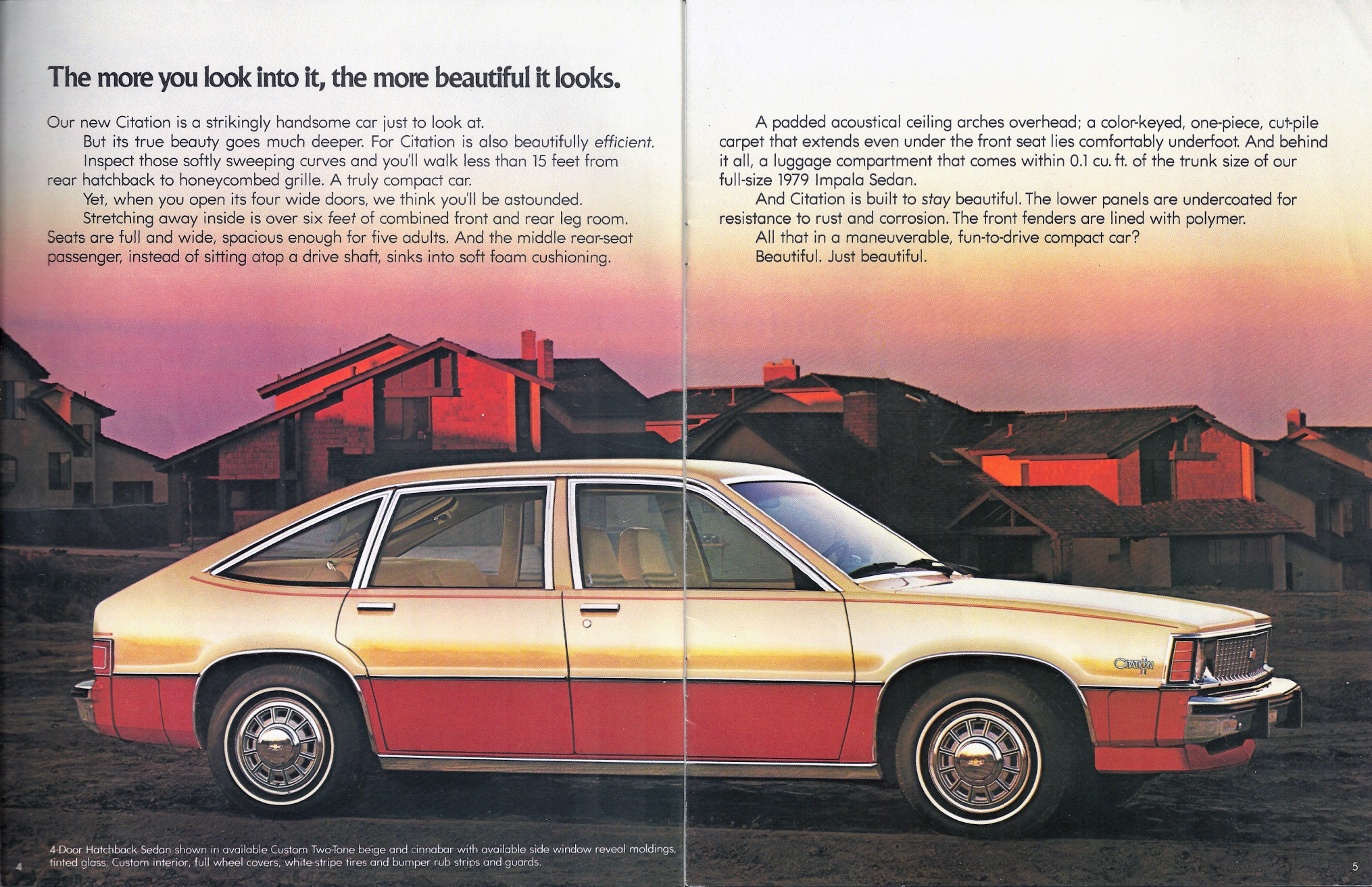
Hatchback sedan pages from the 1980 Chevrolet Citation brochure

The Citation sedan’s base price was $5,153—about $22,100 in 2025 dollars, which is almost exactly what a 2025 Chevrolet Trax LS compact crossover SUV goes for. Standard mechanical equipment included the heavily advertised front-wheel drive, rack-and-pinion steering, front disc brakes, glass-belted P185/80R13 radial tires (now a trailer size), and a Delco Freedom battery. Inside, sliding door locks, a lockable glove box, and an AM radio were considered worth mentioning as standard features. Chevrolet also shamelessly stated that the sedan’s .417 drag coefficient was a sign of “Efficient Aerodynamics.”

Options & Production Numbers

Exterior and mechanical options were many, including tinted glass ($70), a removable sun roof ($240), Sport mirrors (both manual and power), a sport suspension ($21), power brakes ($76), and power steering ($174). Inside, bucket seats, a reclining front passenger seat, a Custom interior, a gauge package ($70), air conditioning ($564), an intermittent windshield wiper system ($39), an electric rear window defogger ($101), automatic speed control ($105), power door locks ($123), power windows ($189), a Comfortilt steering wheel ($75), and an AM/FM stereo radio with cassette ($188) were all available.

Chevrolet sold an astounding 458,033 Citation hatchback sedans in its extended 1980 model year, making it the single most popular version of the Citation.

The View From 2025

As Hemmings showed in 2014, Citations do sometimes come up for sale, though I see few in the condition of the one they highlighted. Citations also occasionally appear at online auctions such as eBay Motors and Bring a Trailer that cater to the eighties car market.

Make mine Light Blue Metallic over Dark Blue Metallic, please. Two-tone paints were big in the early eighties.

Other X-bodies I’ve written about in this blog included the 1983 Buick Skylark T TYPE coupe, the 1981 Chevrolet Citation X-11 hatchback coupe, the 1985 Chevrolet Citation II hatchback sedan, the 1984 Oldsmobile Omega sedan, and the 1982 Pontiac Phoenix SJ coupe.

Last updated September 2025.

1988 Chevrolet Beretta GT coupe

“A car with performance that fulfills the promise offered by its exterior appearance.”

I always liked the Chevrolet Beretta’s styling. It was among the purest executions of the wedge in the 1980s (along with the Bertone/Fiat X1/9, the Pontiac Fiero, and the Triumph TR8).

Chevrolet soft-launched the Beretta as a 1987 model, selling it to rental car agencies. In its first full year of general availability in 1988, there were two Beretta models—the base coupe and the GT. The Beretta GT came standard with the LB6 130 bhp 2.8 liter/173 ci multi-port fuel-injected V6: a notable step up from the “Iron DukeLQ5 90 bhp 2.5 liter/151 ci throttle body fuel-injected inline four that came standard with the coupe.

0-60 mph came in a little over 9 seconds with the five-speed manual transmission and the V6—not that bad, but certainly not stunningly fast either. Fuel economy with the same powertrain combination was 19 city/29 highway by the day’s standards (17/27 by today’s measures). With a 13.5-gallon gas tank, a GT owner could expect a range of 265 to 290 miles with a 10% fuel reserve.

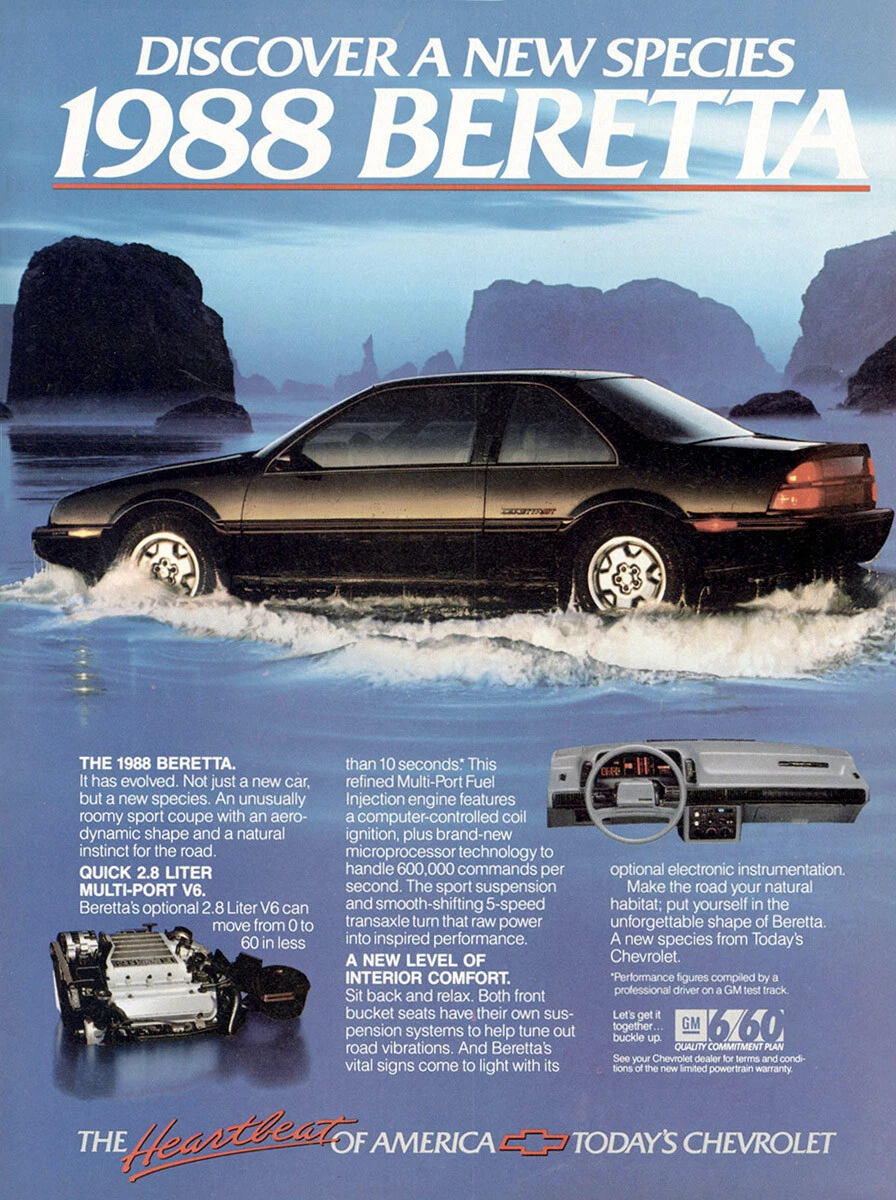
1988 Chevrolet Beretta print advertisement

Standard exterior and mechanical equipment on the $11,851 GT (approximately $33,300 in today’s dollars) included dual sport mirrors, power brakes, and P205/70R14 tires (a size still readily available) on 14-inch wheels. Inside, the Custom interior, tachometer, and an AM/FM stereo radio were all standard.

Packages & Options

The Beretta was one of the early examples of General Motors’ move to option packages as the preferred way to reduce the number of possible equipment combinations. The GT‘s option packages were:

  1. Air conditioning
  2. Floor mats, tilt steering wheel, cruise control, intermittent wipers
  3. Auxiliary lighting, power door locks, power trunk opener, power windows, AM/FM stereo cassette with digital clock

Optional equipment included the GT-only Z51 Performance Handling Package ($153 for larger stabilizer bars, firmer bushings, tuned struts and shocks, and Goodyear Eagle GT + 4 P205/60R15 tires on 15-inch styled steel wheels), rear window defogger ($145), electronic instrumentation ($156), two-tone paint ($123), and AM/FM stereo cassette with digital clock and graphic equalizer.

Midway through the model year, Chevrolet added a Beretta GTU package for $2,500. Designed to reflect the Berretta’s involvement in the IMSA GTU racing series, the GT-based GTU featured a front wraparound chin spoiler, a body color grille and body side moldings, lower rocker panel extensions, breakaway mirrors, a rear valance panel extension, a rear decklid spoiler, GTU graphics, and Goodyear Gatorback P205/55VR-16 tires on 16-inch aluminum alloy wheels.

The View From 2025

Not a lot of folks are collecting Berettas, but there are enthusiast sites. I have not seen one on the road in over a decade. Berettas are rarely seen in the Hemming’s Motor News classifieds or on eBay Motors, but Bring a Trailer has sold six over the last five years.

Make mine Maroon Metallic, please.

Other Chevrolet coupes from the second half of the eighties that I have written about include the 1985 Celebrity Eurosport, the 1986 Cavalier Z24, and the 1988 Corvette 35th Anniversary Edition.

Last updated October 2025.