1987 Chevrolet Cavalier RS convertible

Recently, a near-perfect low-mileage 1987 Chevrolet Cavalier RS convertible came up for auction on Bring a Trailer. This event made me painfully aware that I’d written about the Cavalier sedan and coupe, but somehow not the convertible—time to fix that.

“Sporty performance”

The Chevrolet Cavalier first came to market for the 1982 model year, initially available as a notchback coupe, a hatchback coupe, a notchback sedan, and a station wagon. In the middle of 1983, Chevrolet introduced a convertible version, initially available as the top-of-the-line CS. In 1984, the convertible transitioned to the sporty Type 10. The RS replaced the Type 10 in the 1986 model year, and the convertible went with it. From 1983 through 1987, Cavalier convertible conversions were done by ASC.

The RS convertible’s standard powertrain was the 90 bhp LL8 2.0 liter/121 ci inline four with electronic fuel injection and a four-speed manual. Optional power was the 125 bhp LB6 2.8 liter/173 ci V6 with multiport fuel injection ($660). Both a new-for-1987 Getrag-designed five-speed manual transmission ($75) and a three-speed automatic transmission ($490) were available.

Road tests of the first-generation Cavalier convertible are hard to come by, but 0-60 likely came in a little over 9 seconds with the five-speed/V6 combination. Fuel economy ratings for the same combination were 20 city/26 highway by the day’s standards. With a 14-gallon gas tank, a Cavalier convertible’s enthusiastic new owner could expect a range of 265 to 285 miles with a 10% fuel reserve.

Front cover of the 1987 Chevrolet full line brochure

The 1987 Cavalier RS convertible’s base price was $13,466—about $39,700 in 2025 dollars. Standard exterior and mechanical equipment included a power operated convertible top, tinted glass, left hand remote and right hand manual Sport mirrors, the F41 sport suspension, a front stabilizer bar, power steering, power front disc/rear drum brakes, and P195/70R13 all season radial ply blackwall tires (a size no longer readily available) on 13-inch Rally wheels with trim rings. Inside, Custom Cloth front bucket seats with recliners, a console, a Sport steering wheel, power windows, and an AM radio with dual front speakers were included.

Options & Production Numbers

Individual options available with the RS convertible included aluminum wheels ($212), air conditioning ($675), the Comfortilt steering wheel ($125), electronic speed control with resume speed ($175), an intermittent windshield wiper system ($55), and a power door lock system ($145). A series of four optional audio systems, ranging up to an ETR AM/FM stereo radio with seek and scan, a cassette player, a graphic equalizer, and a clock ($449), was available.

Chevrolet sold 5,826 Cavalier convertibles in the 1987 model year, making that the best production total for any year of the first-generation Cavalier convertible.

The View From 2025

People do collect these small convertibles. They maintain a reasonable presence in the Hemmings Motor News classifieds, on eBay Motors, and on Bring a Trailer.

Make mine Red—I think.

Other Cavaliers I have written about include the 1983 CS sedan and the 1986 Z24 coupe. The other J platform cars I have written about are the 1982 Cadillac Cimarron sedan, the 1984 Buick Skyhawk coupe, the 1984 Pontiac 2000 Sunbird S/E hatchback coupe, the 1985 Oldsmobile Firenza ES sedan, and the 1988 Cadillac Cimarron sedan.

1983 Chevrolet Camaro Z28 hatchback coupe

“… just about everything a road car should be.”

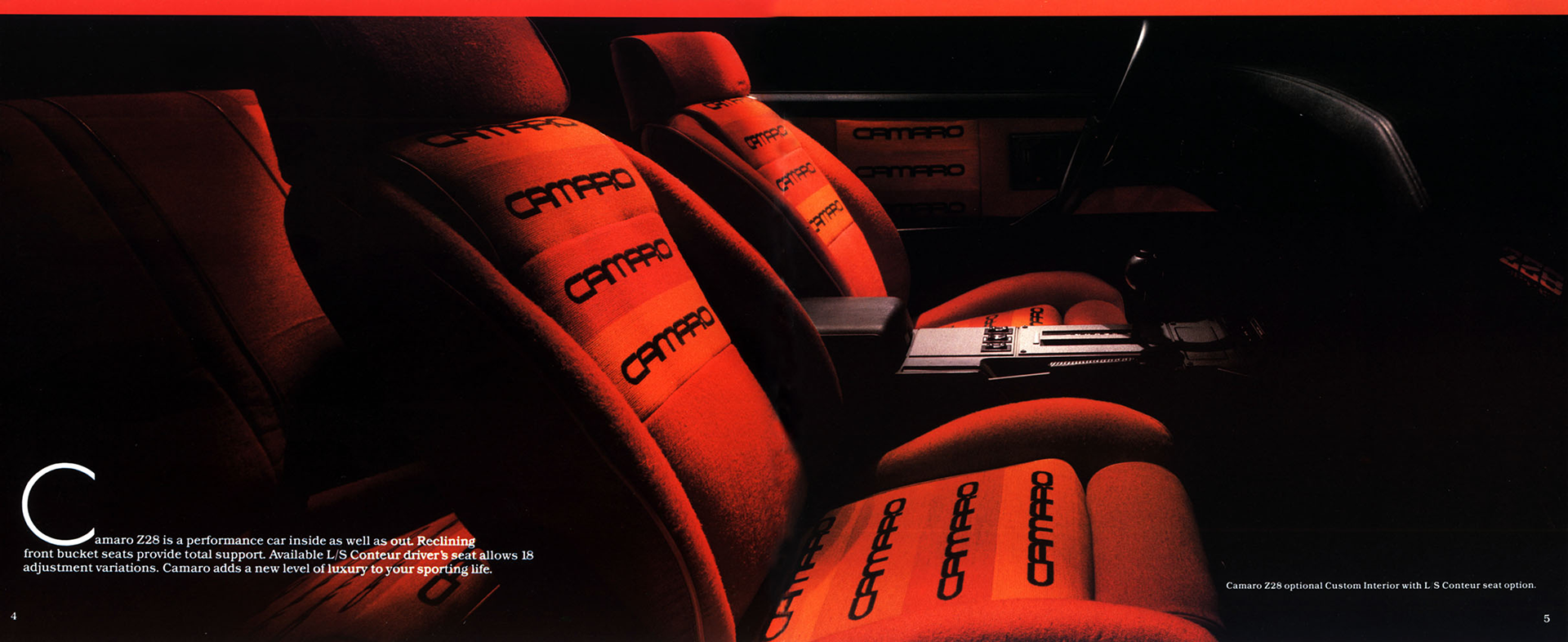
In its second year, changes to the third-generation Chevrolet Camaro Z28  centered on the powertrain. The Z28 gained a new standard Borg-Warner five-speed manual transmission and a new optional four-speed automatic. Both carryover V8 engines gained horsepower, and a new top-of-the-line H.O. engine became available mid-year. Detail changes included new patterns for the optional L/S Conteur bucket seats that repeated the Camaro name in the design. Chevrolet refined the instrument panel graphics, and electronically tuned stereo radios were newly available.

All Z28 engines for 1982 were variations of the Chevrolet’s 5.0 liter/305 ci V8. The Z28‘s standard engine was the LG4 with a four-barrel carburetor, uprated five bhp to 150 bhp. An optional $450 LU5 Cross-Fire with throttle-body fuel injection gained 10 bhp to 175 bhp and required the $295 automatic. In April 1983, the L69 H.O. with 190 bhp became available for $505 and required the five-speed.

Motor Trend recorded a 0-60 time of 7.4 seconds with the top-of-the-line H.O. motor and the five-speed—about 1.5 seconds faster than the best from 1982. Fuel economy ratings for the H.O. were 16 city/26 highway by the day’s standards—the highway rating two mpg better than 1982’s base engine. With a 16.1-gallon gas tank, a Z28 owner with the H.O. could expect a range of 250 to 270 miles with a 10% fuel reserve.

Z28 cutaway pages from the 1983 Chevrolet Camaro brochure

The 1983 Z28‘s base price was $10,336—about $34,200 in 2025 dollars. Standard exterior and mechanical equipment on all 1983 Z28s included a front air dam, “ground effects” rocker molding design, body-color dual Sport mirrors, a rear deck spoiler, power steering, a power front disc/rear drum brake system, and P215/65R-15 steel-belted radial ply white letter tires (a size still readily available) on 15 x 7 inch 5-spoke aluminum wheels. Inside, every 1982 Z28 came with vinyl reclining front bucket seats, a fold-down rear seat, a leather-wrapped steering wheel, special instrumentation, and a quartz analog electric clock.

Options & Production Numbers

Exterior and mechanical options available for the Camaro Z28 include tinted glass ($105), electric twin remote Sport mirrors ($89), removable glass roof panels ($825!), a rear window wiper/washer ($120), a power antenna ($60), a limited slip differential ($95), and four-wheel power disk brakes ($179). Interior options included power windows ($180), a power door lock system ($120), an electric rear window defogger ($135), automatic speed control with resume speed ($170), air conditioning ($725), a Comfortilt steering wheel ($105), and Deluxe luggage compartment trim ($164).

Z28 Custom interior pages in the 1983 Chevrolet Camaro brochure

The Custom interior included the Berlinetta-style seats, seat trim, and door trim, and then added some Z28-specific touches. Pricing for a Custom interior depended on which seats were paired with it, and topped out with the cloth L/S Conteur bucket seats ($650). Five different radios were available, with the fanciest being an electronically tuned AM/FM stereo radio with seek/scan and clock ($520). A loaded Z28 could easily hit $15,000—real money in 1983 and almost $50,000 in today’s dollars.

Chevrolet sold 62,100 Z28s in the 1983 model year. However, the most popular Camaro remained the base Sport Coupe, which moved 63,806 units. The somewhat more luxurious Berlinetta sold another 27,925 copies.

The View From 2025

Third-generation Camaros attract plenty of collector interest, and there is substantial club support. According to Hagerty’s valuation tools, a 1983 Camaro Z28 hatchback coupe with the H.O. motor and t-tops in #1/Concours condition is $46,400, while a far more typical #3/Good condition version goes for $14,600. 1983 Camaro Z28s are often available in the Hemmings Motor News classifieds, on eBay Motors, and at online (Bring a Trailer) and in-person auctions. As I write this blog entry in October 2025, a Silver Metallic Z28 with the Cross-Fire, an automatic, and 4,200 miles is for sale on Hemmings, asking $28,000.

Make mine Red, please.

Other Camaros I have written about include the 1980 Rally Sport coupe, the 1980 Z28 coupe, the 1982 Z28 Indy 500 Commemorative Edition hatchback coupe, the 1984 Sport Coupe hatchback coupe, the 1985 IROC-Z hatchback coupe, and the 1986 Berlinetta hatchback coupe.

1986 Chevrolet Nova sedan

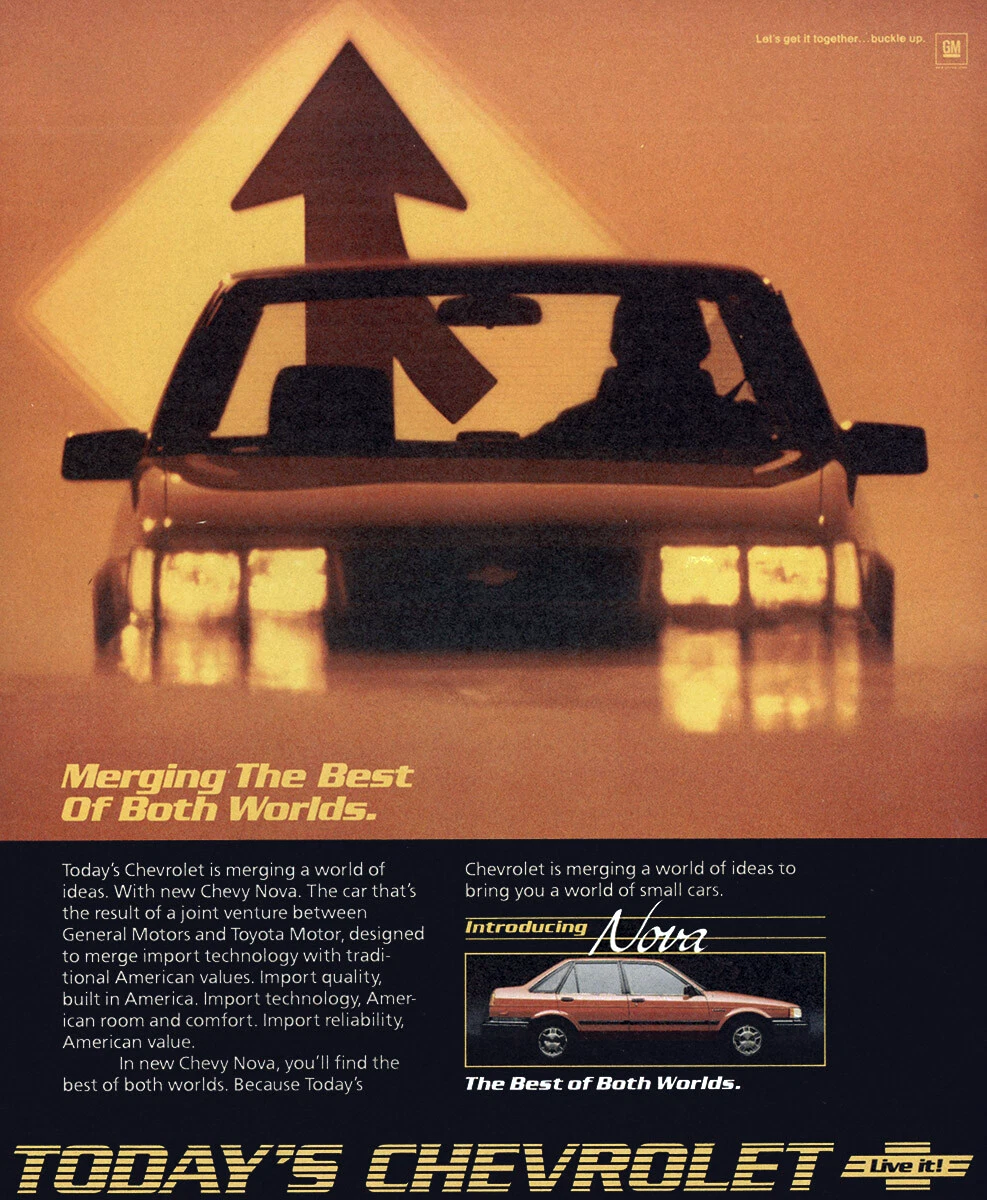
“Merging the best of both worlds.”

After a soft rollout in the Midwest in early 1985, 1986 was the first full model year for the fifth-generation Chevrolet Nova sedan, which was built in the New United Motor Manufacturing Incorporated (NUMMI) plant in Fremont, California—a collaboration between General Motors and Toyota. Of course, these front-wheel-drive Novas had nothing to do with the previous four rear-wheel-drive generations, the last of which had been seen in the 1979 model year.

The new Nova was a rebadged and mildly restyled version of the Japanese market Toyota Sprinter, itself a model sold in Japan as a badge-engineered version of the Toyota Corolla. The pre-existing design was chosen over a clean-sheet approach because it could be brought to market more quickly.

The Nova’s standard powertrain was the 4-AC 70 bhp 1.6 liter/97 ci inline four with a two-barrel carburetor paired with a five-speed manual. A three-speed automatic was optional. Car and Driver recorded a 0-60 time of 12.4 seconds with the manual in a car with a 2,260-pound curb weight—edging toward slow by 1986. Mileage ratings with the manual were 30 city/37 highway by the day’s standards (26/33 by today’s measures). As was normal in the eighties, the automatic gave up some mileage—off two mpg in the city and five mpg on the highway. With a 13.2-gallon gas tank, the owner of a manual Nova could expect a range of 355 to 395 miles with a 10% fuel reserve.

1986 Chevrolet Nova print advertisement

The Nova sedan’s price was $7,435—about $22,700 in 2025 dollars or slightly over what a 2025 Chevrolet Trax LS compact crossover SUV goes for. Standard exterior and mechanical equipment included tinted glass, narrow black body side moldings, front wheel drive, rack-and-pinion steering, power front disk/rear drum brakes, and P155/80R13 all-season steel-belted radial tires (a size still available courtesy of Kumho) on 13-inch wheels with a wheel center cap. Inside, reclining front seats with adjustable head restraints, cloth and vinyl seat trim, cut-pile carpeting, a full length console, side window defoggers, and an AM radio were included.

The Nova CL sedan added a wide body side molding and half-cap wheel covers. Inside, all CLs had a Custom Cloth interior, a driver’s seat with lumbar support and vertical adjustment, a console with a storage box and an armrest, a right-side visor vanity mirror, and an adjustable steering wheel.

Option Packages, Period Reviews, & Production Numbers

The 1986 Nova’s configurability was described mainly by eight separate packages, half of them manual and half automatic:

  • Base Package 1 was the base sedan
  • Base Package 2 ($610) added the three-speed automatic, left-hand remote and right-hand manual outside mirrors, and power steering
  • Base Package 3 ($1,180) added halogen high and low beam headlamps, left-hand remote and right-hand manual outside mirrors, power steering, air conditioning, an electric rear window defogger, and an electronically-tuned AM/FM stereo radio with seek/scan and a digital clock to the base sedan
  • Base Package 4 ($1,575) added halogen high and low beam headlamps, air conditioning, an electric rear window defogger, and an electronically-tuned AM/FM stereo radio with seek/scan and a digital clock to Base Package 2
  • CL Package 5 ($1,730) added halogen high and low beam headlamps, left-hand remote and right-hand manual outside mirrors, power steering, air conditioning, an electric rear window defogger, and an electronically-tuned AM/FM stereo radio with seek/scan and a digital clock to the CL sedan
  • CL Package 6 ($2,125) added the three-speed automatic, halogen high and low beam headlamps, left-hand remote and right-hand manual outside mirrors, power steering, air conditioning, an electric rear window defogger, and an electronically-tuned AM/FM stereo radio with seek/scan and a digital clock to the CL sedan
  • CL Package 7 ($2,515) was the sportiest of the Novas and added P175/70R-13 all-season steel belted radial ply blackwall tires, aluminum wheels, electronic speed control with resume speed, an intermittent windshield washer system, and an electronically-tuned AM/FM stereo radio with seek/scan, stereo cassette tape, and a digital clock to CL Package 5
  • CL Package 8 ($2,620) was the most luxurious Nova and added a power door lock system, electronic speed control with resume speed, an intermittent windshield washer system, and an electronically-tuned AM/FM stereo radio with seek/scan, stereo cassette tape, and a digital clock to CL Package 6

The Nova’s only individual option was Two-Tone paint ($176), which was only available with the CL. The absolute fanciest CL sedan retailed for $10,231—about $30,500 in today’s dollars, which is about what a well-equipped 2025 Chevrolet Trailblazer LT compact crossover SUV goes for.

Period reviews freely acknowledged that the Nova was basically a rebadged Corolla. Road & Track‘s tagline was “we have met the enemy, and they is us”—another repackaging of Walt Kelly. Motor Trend stated that the Nova was the “latest installment in the ongoing serial of “If you can’t beat ’em, join ’em.”” Popular Mechanics got more personal and asked, “Can a Japanese car built in California find happiness in America?”

Chevrolet sold 124,961 Nova sedans in the 1986 model year, in addition to the 27,943 that had been sold in the 1985 soft rollout. Predictably, the quality of the Nova was considerably higher than that of any other Chevrolet compact car.

The View From 2025

Some call them “Toyolets,” but I’m going to declare this version of the Nova as vanished. I haven’t seen a fifth-generation Nova in the wild for decades, and they have little presence in the Hemmings Motor News classifieds or on eBay Motors. Bring a Trailer has sold a grand total of one—a 1987 sedan.

Make mine Dark Red Metallic, please.

Other 1986 Chevrolets I have written about include the Camaro Berlinetta hatchback coupe, the Cavalier Z24 coupe, and the Corvette convertible.

1987 Chevrolet El Camino pickup truck

In the decade plus since I started this blog I have worked on three separate El Camino posts. I’m finally publishing one today.

“There’s nothing quite like it.”

In its final year, the Chevrolet El Camino received few changes. The standard engine remained the LB4 145 bhp 4.3 liter/262 ci V6 with electronic fuel injection. The LG4 150 bhp 5.0 liter/305 ci V8 with a four-barrel carburetor was a $440 option, but it’s unclear whether it made much of a performance difference—0-60 likely came in about 11 seconds. Both engines were paired with a three-speed automatic transmission, with an available four-speed automatic ($175).

Period fuel economy ratings for the four power combinations tell an interesting story:

4.3 liter V65.0 liter V8
Three-speed automatic18 city/22 highway15 city/17 highway
Four-speed automatic18 city/23 highway16 city/22 highway

The short form seems to be that, if you had to have the V8 and you wanted to do some highway driving, you should really get the four-speed automatic. With a 17.7-gallon gas tank, the best-case range was about 305 to 325 miles with a 10% reserve—the V8/three-speed combination was more like 230 to 255 miles.

Pages from the 1987 Chevrolet El Camino brochure

The 1987 El Camino’s base price was $10,013—about $29,400 in today’s dollars, which is almost what a base 2025 Chevrolet Colorado pickup truck goes for. Standard exterior and mechanical equipment included power steering, power front disk/rear drum brakes, and P205/75R14 black sidewall all-season steel-belted radial tires (a size still available) on painted wheels with bright full wheel covers. Inside, a full-width cloth front bench seat with a pull-down center armrest, cut-pile carpeting, and a lighted glove box were standard.

Considered a separate model, the $10,344 El Camino SS Sport Decor added a choice of eight lower body accent colors emphasized by a pin-striping decal, a large front air dam, matching dual aero-type mirrors with a left-hand remote, black quarter window moldings, and painted Rally wheels.

Packages, Options, & Production Numbers

The $238 Conquista package included two-tone paint separated with bright moldings, along with a Conquista decal on the tailgate.

The SS Choo Choo package was available. Choo Choo Customs started with regular El Caminos fitted with Rally wheels and sport mirrors and replaced the stock El Camino fascia with a polyurethane nose similar to the one found on Chevrolet’s Monte Carlo SS Sport Coupe. Decals were placed on the tailgate, doors, and nose, and a specific plaque was added to the dash.

Exterior and mechanical options include Soft-Ray tinted glass ($120), halogen headlamps ($25), a limited slip differential ($100), a sport suspension ($16), and a 22-gallon fuel tank ($29). Inside, reclining front cloth bucket seats ($147 and available with a $110 console), a Comfortilt steering wheel ($125), electronic speed control ($175), air conditioning ($775), power door locks ($145), and power windows ($210) were available. Six different radios were available, ranging from an AM radio ($122) up to an AM stereo/FM stereo with cassette, seek and scan, search and repeat, graphic equalizer, and clock ($579). A well-equipped El Camino could easily get to $12,900 or so—about $37,900 in today’s dollars.

With 15,589 sold, the El Camino was a mere 1.3% of Chevrolet’s production in 1987. This wasn’t actually far off from 1986’s numbers, but was a pronounced decline from the halcyon days of the early 1980s—Chevrolet had sold 40,932 El Caminos in 1980.

The View From 2025

I’ve liked this El Caminos since they debuted. El Caminos have always been attractive to collectors, and the eighties versions are no exception. These trucks often appear for sale in the Hemming’s Motor News classifieds, on eBay Motors, and on Bring a Trailer. According to Hagerty‘s valuation tools, a 1987 El Camino Conquista with the V8 in #1/Concours condition is $29,400, with a more normal #3/Good condition truck going for $10,200. The SS and SS Choo-Choo versions are worth more, but not much more.

Make mine Silver Metallic over Dark Maroon Metallic, please. That makes it a Conquista.

Other 1987 Chevrolets I have written about include the Caprice Classic coupe and the Chevette CS hatchback sedan. Other Chevrolet trucks and SUVs covered in Eighties Cars include the 1983 S-10 Blazer SUV, the 1985 C20 Suburban Silverado SUV, the 1985 K5 Blazer SUV, and the 1985 S-10 pickup truck.

Last updated October 2025.

1985 Chevrolet Celebrity Eurosport coupe

“Celebrity precision.”

1985 was the second year for the Eurosport version of Chevrolet’s Celebrity. Designated as RPO ZV8, the Eurosport followed one year after the introduction of Pontiac’s STE version of the 6000. Among the notable changes for 1985 was the addition of multi-port fuel injection for the H.O. V6, along with hydraulic motor mounts for all engines.

Powertrains, Performance, & Standard Equipment

Despite its sporting pretensions, the Eurosport came standard with the same LR8 Iron Duke 92 bhp 2.5 liter/151 ci inline four with throttle-body fuel injection and four-speed manual that was the base powertrain on “civilian” Celebrities. Many Eurosport buyers upgraded to the LB6 H.O. 130 bhp 2.8 liter/173 cu V6 ($435), which was paired with a choice of a three-speed automatic ($425) or a four-speed automatic ($600).

With the H.O. engine and the four-speed automatic, 0-60 times were a little over 10 seconds in the 2,700 pound Eurosport. Fuel economy was decent with the same powertrain—19 city/28 highway by the day’s standards (17/26 by 2025 standards). With a 16.4-gallon gas tank, a Eurosport owner could expect a range of 320 to 345 miles with a 10% reserve.

Eurosport coupe pages from the 1985 Chevrolet Celebrity brochure

Standard exterior and mechanical equipment on the $8,301 Eurosport coupe (about $25,000 in today’s dollars) included blackout exterior trim, a red accent stripe, fast-ratio power steering, a “special” version of the F41 sport suspension with gas-charged struts and shocks, and P195/75R-14 blackwall all-season steel-belted radial tires on 14 x 5.5 inch Rally wheels. Inside, blackout instrument panel trim and a Sport steering wheel were included—otherwise, a low-optioned Eurosport looked plain inside.

Standard equipment on all Celebrity coupes included “front-drive” (still worth noting in 1985 advertisements), rack and pinion steering, and power front disc/rear drum brakes. Inside, coupe buyers got a two-passenger cloth front bench seat with a center armrest, side window defoggers, and an AM push-button radio with dual front speakers.

Options & Production Numbers

With standard equipment relatively spare, many options were available for the 1985 Celebrity Eurosport coupe. Exterior and mechanical options included Custom Two-Tone paint ($148), tinted glass ($110), dual remote sport mirrors ($91), P195/70R-14 Goodyear Eagle GT blackwall tires ($60), and aluminum wheels ($306).

Inside, cloth reclining front bucket seats ($147), a console ($105), a Gage Package with trip odometer ($64), electronic speed control ($175), power door locks ($125), power windows ($185), air conditioning ($730), and a Comfortilt steering wheel ($110) were all available. Five different optional radios were available, with the top-of-the-line being the UX1 ETR AM stereo/FM stereo radio with seek and scan, cassette player with search and repeat, clock, graphic equalizer, and extended range sound system ($504).

A loaded Eurosport coupe could frequently near $12,000—real money in those days and about $36,400 now.

Production numbers for the 1985 Eurosport coupe are hard to come by, but we do know that Chevrolet sold a total of 29,010 Celebrity coupes in that year. The sedan (239,763 sold) and the wagon (86,149) did far better.

The View From 2025

Eurosports of any type rarely appear in the Hemming’s Motor News classifieds or on eBay Motors, and one has yet to be seen on Bring a Trailer.

Make mine Dark Blue Metallic, please.

Other A-bodies I’ve written about in this blog include the 1983 Pontiac 6000 STE sedan, the 1986 Buick Century sedan, and the 1989 Chevrolet Celebrity sedan—I guess I owe the Oldsmobile Cutlass Ciera some attention.

1984 Chevrolet Corvette hatchback coupe

As a high school student in the early to mid-1980s, I worked part-time at Frankel Chevrolet (a dealership in Ardmore, Pennsylvania). I’ll never forget seeing my first C4 Corvette in early 1983: small block V8 engine with “Cross-Fire Injection” rumbling, lovely over-engineered retractable headlamps up and on, fancy new metallic paint with clear coat looking its best in the setting sun. Viewing this car was a visceral experience for a fifteen-year-old. It was the exact moment when my opinion of Corvettes changed from a grudging respect (I was more of a BMW and Pontiac fan then) to “I will have one of those someday.”

“You’ve never seen anything like this before.”

The phrase “all-new” is rarely accurate in cars, but the 1984 Corvette was close. Only the standard powertrain carried over from 1982, and even that was changed in some visible (a brand new magnesium air cleaner) and measurable (an additional five bhp) ways. The exterior, interior, suspension, and steering were truly all-new for the Corvette.

The standard powertrain was the L83 Cross-Fire 205 bhp 5.7 liter/350 ci V8 with throttle-body fuel injection paired with a Turbo-Hydramatic four-speed automatic transmission. The Doug Nash 4+3 manual transmission with automatic overdrive was available as a no-cost option, but only became available about halfway through the extended 1984 model year. Car and Driver recorded a 0-60 time of 6.7 seconds (Road & Track took 7.1 seconds) and a top speed of 138 mph. Estimated fuel economy was 16 city/28 highway by the day’s standards. With a 20-gallon gas tank, a Corvette coupe’s proud new owner could expect a range of between 325 and 355 miles with a 10% fuel reserve.

Cutaway page from the 1984 Chevrolet Corvette brochure
David Kimble’s cutaway page in the 1984 Chevrolet Corvette brochure

The 1984 Corvette’s base price was $22,361—about $74,200 in today’s dollars or a little over what a 2026 Corvette Stingray 1LT coupe goes for. Standard exterior and mechanical equipment included a one-piece removable fiberglass roof panel, a frameless rear glass hatch, single rectangular hidden headlamps, integral grille-mounted halogen fog lamps, rack-and-pinion power steering, power disc brakes, and P255/50VR-16 tires on 16 x 8.5 inch cast alloy aluminum wheels. Inside, air conditioning, power windows, a tilt and telescope steering wheel, a driver information system, cloth bucket seats, and an AM/FM stereo radio with a power antenna were all included.

Options & Production Numbers

The Z51 Performance Handling Package ($600) included a quicker steering gear, a performance axle ratio, an engine oil cooler, an additional radiator fan, higher-rated Delco-Bilstein shock absorbers, thicker stabilizer bars, and 9.5 inch rear wheels.

Optional exterior and mechanical equipment included two-tone paint ($428), a removable transparent roof panel ($595), a performance axle ratio ($22), and Delco-Bilstein shock absorbers ($189). Optional interior equipment included cruise control ($185), a power door lock system ($165), custom adjustable sports seats ($625), leather seats ($400), a six-way power driver’s seat ($225), and the Delco-GM/Bose Music System ($895).

Chevrolet rarely makes Corvette television commercials, but they usually produce one when introducing a new generation. For the 1984, they pulled out all the stops, at least by the standards of eighties automobile commercials—a spacesuit, lasers, and a cheesy jingle all make an appearance.

The new generation Corvette was very well-received by buyers. Chevrolet sold 51,547 in about eighteen months, making 1984 the second best sales year ever (only 1979 had a higher production total).

Period Reviews & Owner Feedback

Reviews of Chevrolet’s pride were positive but evenhanded. Car and Driver disliked the fact that the new generation was no lighter than the previous generation—a Corvette complaint that extends to today. Many writers also commented on the “Tokyo by Night” digital instrument panel.

Within a year or so, there would start to be an acknowledgment from the automotive press that the optional and heavily hyped Z51 performance handling package was suitable for only the most perfect roads. In their owner’s report, Popular Mechanics quoted a New York salesman as saying “bad ride on rough roads,” while a Texas retiree stated “body rattle is frustrating.” Chevrolet began to adjust beginning in the 1985 model year, but early C4 Corvettes continued to be seen as having an unnecessarily rough ride.

The View From 2025

There’s been a lot written about the 1984 Corvette—both good and bad—and I doubt I have much to add. Despite being pushed back several months from an actual 1983 model year release, it still felt rushed. On the other hand, many people think of the almost all-new fourth-generation Corvettes as the first “modern” version of Chevrolet’s sports car. However, modern is undoubtedly a fluid concept now—more than forty years later. Developed in the late 1970s and early 1980s, the C4s were the first Corvettes with rack-and-pinion steering and a removable one-piece “targa” roof.

There is strong club support for the 1984 Corvette, as there is for all Corvettes. According to Hagerty’s valuation tools, a 1984 Corvette with a clear top and the 4+3 manual in #1/Concours condition is $35,500, with a more typical number #3/Good condition car going for $8,400. 1984 Corvettes are regularly featured in the Hemmings Motor News classifieds, on eBay Motors, and on Bring a Trailer. Early C4s are also often seen at in-person auctions such as Barrett-Jackson and Mecum. As I update this blog entry in October 2025, a Gold Metallic car with saddle cloth adjustable sport bucket seats and 34,000 miles is available on Hemmings, asking $18,000.

Make mine Light Blue Metallic, please. That 1984 Corvette I mentioned seeing earlier was Light Blue Metallic, and I bought, drove extensively, and eventually sold a 1985 model in the same color.

Other Corvettes I have written about include the 1980 coupe, the 1981 coupe, the 1982 coupe, the 1986 convertible, and the 1988 35th Anniversary coupe.

Last updated October 2025.

1983 Chevrolet Monte Carlo SS Sport Coupe

A 1983 Chevrolet Monte Carlo SS with 156 miles sold on Bring a Trailer for $32,000 in early 2021.

“Chevy SS tradition comes alive …”

In the middle of the 1983 model year, Chevrolet announced the Monte Carlo SS. Designated RPO Z65, the SS was designed to help Chevrolet compete better in NASCAR on Sundays—and sell more Monte Carlos on Mondays. There were only two exterior color choices—White and Medium Dark Royal Blue. The changes in the front end and the addition of a rear spoiler cut the drag coefficient by 15% compared to the “civilian” Sport Coupe, making it a respectable 0.375, though not quite the Ford Thunderbird coupe‘s 0.35 Cd.

Aside from the exterior looks, the powertrain was the star—an L69 “H.O.” 175 bhp 5.0 liter/305 ci V8 with a four-barrel carburetor paired with a three-speed automatic transmission. Period road tests resulted in 0-60 mph times of about 8 seconds—about as quick as the Monte’s Buick Regal T-Type and Oldsmobile Cutlass Calais Hurst/Olds platform-mates in the same year. Fuel economy was rated at 17 city/25 highway by the day’s standards (14 city/18 highway by 2025 measures). With an 18.1-gallon gas tank, the enthused new owner of a Monte Carlo SS could expect a range of 260 to 340 miles with a 10% fuel reserve.

1983 Chevrolet Monte Carlo SS flyer

The Monte Carlo SS had a base price of $10,249—about $34,900 in today’s dollars. Standard exterior and mechanical equipment included Sport mirrors, a rear spoiler, a dual outlet exhaust system, power steering, the F41 sport suspension, power front disc/rear drum brakes, and Goodyear Eagle GT P215/65R15 white letter tires (a size still readily available) on 15 x 7 inch stamped steel wheels. Inside, the SS was less differentiated, but it did get a gage package with a tachometer. The standard seat was a blue cloth bench seat with white vinyl inserts and matching door trim.

Options, Period Reviews, & Production Numbers

Many of the standard Sport Coupe’s options were also available for the SS. Exterior examples included tinted glass ($105), hi-beam halogen headlamps ($10), and twin remote Sport mirrors ($60). Inside, options included an intermittent windshield wiper system ($49), an electric rear window defogger ($135), power windows ($180), an electric power door lock system ($120), a power trunk opener ($40), automatic speed control with resume speed ($170), a Comfortilt steering wheel ($105), and air conditioning ($725).

A blue cloth 55/45 seat with white vinyl inserts was available for an extra $133, but no bucket seats were available for the 1983 Monte Carlo. A series of four radios were available, with an AM/FM stereo radio with stereo cassette tape and four speakers ($298) being the top of the line. A fixed mast black antenna was an SS-only option and was included with all radios.

The sportier Monte Carlo was generally received in the press, though many scribes noted the lack of a console, bucket seats, Positraction, and a four-speed automatic—all issues Chevrolet promised to fix. Motor Trend‘s title was “Mid-American GT Revival,” and much of the coverage agreed.

Along with the late introduction, there were production problems in 1983, so the first year total for the fourth-generation Monte Carlo SS was only 4,714. SS sales would hit their stride in the following year, with Chevrolet moving 24,050 out the door.

The View From 2025

These Monte Carlos have enthusiastic forum support, and there is definite collector interest. According to Hagerty’s valuation tools, a 1983 Chevrolet Monte Carlo SS Sport Coupe in #1/Concours condition is $33,300, with a far more normal #3/Good condition version going for $16,400. Monte Carlos SS coupes are often available in the Hemmings Motor News classifieds, on eBay Motors, and at online auctions such as Bring a Trailer that cater to the eighties car market. As I update this blog entry in August 2025, there’s a White 1983 Monte Carlo SS Sport Coupe with 53,000 miles for sale on Hemmings, asking 29,000.

Make mine Medium Dark Royal Blue, please.

I’ve written about one other Monte Carlo—the 1981 Sport Coupe. Other sporty G-platform cars I have written about include the 1980 Pontiac Grand Prix SJ coupe and the 1982 Buick Regal Grand National coupe.

Last updated August 2025.

1984 Chevrolet Camaro Sport Coupe

In early 2022, Bring a Trailer featured a 1984 Chevrolet Camaro Sport Coupe that was generally original except for the wheels and tires. It sold for $8,000.

“Looks. Performance. Price.”

For 1984, the Chevrolet Camaro Sport Coupe had relatively few changes. A four-speed automatic became the only automatic available (1983 Camaros had three-speed and four-speed automatic options). Steel-belted radial tires were newly standard on all Camaros, and all manual transmission vehicles received a hydraulic clutch.

The standard powertrain for the Sport Coupe continued to be the LQ9Iron Duke” 92 bhp 2.5 liter inline four with fuel injection, paired with a four-speed manual transmission. Optional engines were two: the LC1 107 bhp 2.8 liter V6 with a two-barrel carburetor ($250) and the LG4 150 bhp 5.0 liter V8 with a four-barrel carburetor ($550). A five-speed manual ($125) and a four-speed automatic ($525) were optional.

With the standard powertrain, the Sport Coupe was all show, no go. 0-60 tests of four-cylinder F-cars are rare to nonexistent, but reasonable estimates are in the high 14 to high 15 second range. For all that trouble, mileage wasn’t that impressive: 24 city/36 highway by the day’s standards. With a 15.5-gallon gas tank, a four-cylinder Sport Coupe owner could expect a range of 340 to 375 miles with a 10% fuel reserve.

The hot setup for the Sport Coupe, such as it was, was the LG4 V8 paired with the four-speed automatic (five-speed manuals with V8s were Z28-only in 1984). For a total of $1,075, this combination changed the car’s character, with the 0-60 time dropping by almost four seconds compared to the base four. These changes did not mean that a V8 Sport Coupe would see anything but the taillights of a Z28 with the 190 bhp “H.O.” V8. Fuel economy ratings with the V8 also dropped significantly to 18 city/29 highway, but a slightly larger 16.1-gallon fuel tank reduced the range penalty—a V8 Sport Coupe owner could expect a 280 to 305 mile range.

Perhaps the most engaging Sport Coupe—but certainly not the fastest—was the LC1 V6/five-speed manual combination. At $375 over the base car, it was about a second faster from 0-60 mph. Fuel economy ratings of 20 city/31 highway along with a 16.1-gallon fuel tank meant a 330 to 330 mile fuel range.

Sport Coupe pages from the 1984 Camaro brochure

Standard exterior and mechanical equipment for the $8,097 Sport Coupe (about $26,000 in today’s dollars) included dual black side mirrors, fast-ratio power steering, power front disc/rear drum brakes, and P195/75R14 radial tires (a size still reasonably available) on 14-inch body-colored wheels with hubcaps. Inside, reclining front vinyl bucket seats, a floor console, and an AM radio were included.

Options & Production Numbers

Options were many and included body color Sport mirrors ($139), a rear deck spoiler ($69), tinted glass ($110), removable glass roof panels ($850), and four-wheel power disc brakes ($179 and V8-only). Inside, buyers could add a gage package with a tachometer ($149), Deluxe luggage compartment trim ($164 and including a locking rear compartment storage cover), Custom cloth bucket seats ($359 and including quiet sound group), and air conditioning ($730).

Six different optional radios were available, with the top-of-the-line being an electronically tuned AM/FM stereo radio with seek and scan, cassette tape, clock, and graphic equalizer ($493). A well-equipped Sport Coupe could easily sticker for substantially more than a base Berlinetta or Z28.

The 1984 Sport Coupe sold quite well—Chevrolet moved 127,292 units, making it about 49% of overall Camaro sales. 1984 would be the peak for Sport Coupe sales in the 1980s, and it isn’t obvious why.

The View From 2025

Third-generation Camaros have substantial forum support and they attract collector interest. According to Hagerty’s valuation tools, a 1984 Camaro Sport Coupe with the V8 in #1/Concours condition is $21,400, with a far more normal #3/Good condition version going for $7,000. V6 versions get a 30% deduction, while four-cylinder cars go for half price. These Camaros are often available in the Hemmings Motor News classifieds, on eBay Motors, and at online auctions such as Bring a Trailer that cater to the eighties car market.

Make mine Charcoal Metallic, please.

Other third-generation Camaro hatchback coupes I have written about include the 1982 Z28 Indy 500 Commemorative Edition, the 1985 IROC-Z, and the 1986 Berlinetta. I have yet to write about any of the 1987 through 1989 Camaro convertibles.

Last updated October 2025.

1982 Chevrolet Camaro Z28 Indy 500 Commemorative Edition hatchback coupe

Every May, the Indianapolis 500 race is a “tentpole” event in the international racing schedule. Since 1911, there have been designated pace cars, with replica versions often sold. A 1982 Chevrolet Camaro Z28 Indy 500 Commemorative Edition with 2,630 miles sold for a $35,000 hammer price at the 2021 Mecum Indy. Are these distinctive and good-looking (I think) cars finally attracting significant interest?

“Even its shadow boasts performance”

The 1982 Chevrolet Camaro could reasonably be described as all-new. This moniker applied to the “pleasing and exciting” exterior, the interior, much of the chassis, and most of the engines. Road & Track stated that the new Camaro was “keenly anticipated.”

The Z28‘s standard powertrain was the LG4 145 bhp 5.0 liter/305 ci V8 with a four-barrel carburetor paired with a four-speed manual transmission. An optional LU5 Cross-Fire 5.0 liter/305 ci V8 with throttle-body fuel injection and 165 bhp set the buyer back $450 and required the $72 three-speed automatic transmission. 0-60 took just under 10 seconds with the base V8 and the four-speed manual, and shortened to 9 seconds with the top-of-the-line Cross-Fire motor and the automatic.

The Z28 had a base price of $9,700—about $33,600 in 2025 dollars. Standard exterior and mechanical equipment on all 1982 Z28s included a front air dam, “ground effect” lower body extensions, a rear spoiler, body-color dual Sport mirrors, power front disc/rear drum brakes, and 215/65R-15 tires (a size still readily available) on 15 x 7 inch 5-spoke aluminum wheels. Inside, every 1982 Z28 came with full instrumentation, an electric quartz analog clock, courtesy lamps, and a leather-wrapped steering wheel.

1982 Camaro Commerative Edition flyer
1982 Camaro Z28 Indy 500 Commemorative Edition flier

Standard equipment specific to the $10,999.26 (yes, that was really the price) Z50 Indy 500 Commemorative Edition included Silver Metallic/Blue two-tone accent paint, red accents on the wheels, specific commemorative edition decals, Custom interior trim, and blue Custom cloth bucket L/S Conteur (Chevrolet’s spelling) front seats.

Options, Production Numbers, & Period Reviews

Among the many options available for the Camaro Z28 were tinted glass ($88), removable glass roof panels ($790!), power windows ($165), a power door lock system ($106), an electric rear window defogger ($125), automatic speed control ($155), air conditioning ($675), a Comfortilt steering wheel ($95), and a host of radios ($111 to $390).

Chevrolet sold 6,360 Indy 500 Commemorative Edition cars in 1982, in addition to 63,563 “normal” Z28s. However, the most popular Camaro was actually the base Sport Coupe, which moved 78,761 units. The somewhat more luxurious Berlinetta sold another 39,744 copies.

Reviews of the new Camaro were decent. Road & Track liked the Z28‘s exterior and the handling, but bemoaned the interior packaging and the fuel mileage (EPA rated at 17 mpg but rarely attaining that in real life). Car and Driver famously accused the Z28 of being “Emily Post polite” but later retracted the remark.

The View From 2025

Third-generation Camaros attract plenty of collector interest, and there is substantial club support. According to Hagerty’s valuation tools, a 1982 Camaro Z28 hatchback coupe with the Cross-Fire motor in #1/Concours condition is $42,000, with a far more normal #3/Good condition version going for $13,500. 1982 Camaro Commemorative Editions are often available in the Hemmings Motor News classifieds, on eBay Motors, and at online (Bring a Trailer) and in-person auctions. As I update this blog entry in October 2025, a Commemorative Edition with the Cross-Fire, an automatic, and 40,000 miles is for sale on Hemmings, asking $20,000.

Other Camaros I have written about include the 1980 Rally Sport coupe, the 1980 Z28 coupe, the 1985 IROC-Z hatchback coupe, and the 1986 Berlinetta hatchback coupe. Pontiac Firebird Trans Ams with blog entries here include the 1981 coupe, the 1982 hatchback coupe, the 1984 15th Anniversary Edition hatchback coupe, the 1985 hatchback coupe, and the 1989 20th Anniversary Turbo hatchback coupe.

Last updated October 2025.

1985 Chevrolet K5 Blazer SUV

“Finding the back country is up to you.”

For 1985, Chevrolet’s K5 Blazer SUV gained a new grille and the availability of a color-keyed top, but not many other changes.

The Blazer’s standard powertrain for everywhere but California was the LE9 160 bhp 5.0 liter/305 ci V8 with a four-barrel carburetor mated to a four-speed manual. Mileage was rated at 14 city/17 highway by the day’s standards (12/16 by today’s measures). With a 25-gallon gas tank, a Blazer owner could expect a range of 315 to 350 miles with a 10% fuel reserve. The heavy (4,846 pound) Blazer was not quick—0-60 took about 12.5 seconds.

Optional power included a $2,730 LH6 130 bhp 6.2 liter/379 ci diesel V8, which came with a four-speed automatic with overdrive. The diesel came bundled with many other features, including an engine block heater, a heavy-duty radiator, an engine oil cooler, and a dual exhaust system. Mileage for the diesel was rated at 17 city/21 highway.

1985 Chevrolet Blazer brochure cover

Designated as the Custom Deluxe, the base 1985 Blazer’s price was $11,223—about $34,100 in today’s dollars. Standard exterior equipment included a removable fiberglass top and Soft-Ray tinted glass. Mechanical equipment included variable-ratio power steering, power front disc/rear drum brakes, and P215/75R15 tires (a size still readily available) on 15 x 6 inch white painted wheels with bright metal hub caps. Inside, vinyl high back bucket seats and a heater were standard—the base Blazer was relatively spare inside.

Trim, Options, & Production Numbers

The $1,015 Silverado trim required Custom cloth or Custom vinyl seats and included Silverado nameplates inside and out, the Deluxe Front Appearance package, the Deluxe Molding package, bright body side moldings, dual horns, a color-keyed console, a cigarette lighter, an interior headliner, and a Custom steering wheel. The least expensive Blazer Silverado was about $37,200 in today’s dollars—almost exactly what a 2025 Blazer 2LT goes for.

Individual exterior and mechanical options included deep tinted glass ($194), halogen hi-beam headlamps ($17), a 31-gallon fuel tank ($43), and 15 x 7 cast aluminum wheels ($299). Inside, all-weather air conditioning ($740), electronic speed control ($195), power side windows ($190), a power tailgate window ($43), and power door locks ($135) were all available. Upholstery options included Custom vinyl high back bucket seats, Custom cloth high back bucket seats (available only with the Silverado trim), a second row bench seat ($369), and a Comfortilt steering wheel ($115). Seven different audio options were available, ranging from an AM radio ($112) up to an AM/FM stereo radio with a cassette player, electronic tune seek and scan, and a graphic equalizer ($594).

1985 ended up being the Blazer’s best sales year in the eighties, with 40,011 exiting dealer lots—up almost 2% over 1984’s total. This performance helped Chevrolet gain the lead in 1985 sales among manufacturers of light-duty trucks.

The View From 2025

Along with other eighties SUVS, Blazers are attracting significant collector interest. According to Hagerty’s valuation tools, all the money for a 1985 K5 Blazer Silverado in #1/Concours condition is $48,700, with a far more normal #3/Good condition version going for $23,900. Blazers are often available in the Hemmings Motor News classifieds, on eBay Motors, and on Bring a Trailer. As I write this post, a Midnight Blue 1985 Blazer with a Midnight Blue top and blue cloth front bucket seats is for sale on Hemmings, asking $47,500.

Make mine Midnight Blue, please.

Other 1985 Chevrolets I have written about include the Camaro IROC-Z hatchback coupe, the Caprice Classic station wagon, the Celebrity Eurosport coupe, the Citation II hatchback sedan, the C20 Suburban Silverado SUV, and the S-10 pickup truck. It seems I write about a lot of Chevys.

Last updated April 2025.