Eighties Cars Is Speeding up Again

Last May, I posted that Eighties Cars Is Slowing Down For A While. With the fraught situation that the world currently finds itself in, many of us are searching to re-establish upended routines and find ways to slow the spread of COVID-19.

As a very small offering, I have decided to accelerate my postings on Eighties Cars for the foreseeable future. All the best to my readers and stay safe.

End of the Year Review: 2019

2019 was a decent year for Eighties Cars. We managed 23 new or substantially revised blog entries—one every sixteen days. Posts were divided up into fifteen featuring a specific car, seven on auctions, and one announcing a change: Eighties Cars Is Slowing Down For A While. Despite, this 2019 was the best year for page views since I started the blog—we were up a substantial 62% over 2018.

Every year, I look at the end of the year results for most viewed posts. For 2019, it once again looked like the key to the popularity of an individual post was generally in the rarity of the other coverage available for that particular vehicle. It also didn’t hurt to be a Chevrolet, a Buick, or a Pontiac—our readers seem to be GM-centric. In reverse order, I’ll look at the top ten most viewed posts of this year.

10) 1980 Chevrolet Camaro Z28 coupe—these late second-generation Z28s have been sliding up in popularity and value ($34,600 in #1/Concours condition, $15,600 in #3/Good condition for the 5.7 liter/350 ci engine versions), which marks a hole in my overall thesis on what posts are popular. This post’s ranking did drop from #4 to #10 this year.

9) 1987 Chevrolet Caprice Classic coupe—this very old (April 2014) but evidently evergreen post is about the last of the big Caprice coupes. For the six years Eighties Cars has been around, it’s the third most viewed post overall, and it moved up one spot in 2019. A mere 3,110 coupes were sold in the 1987 model year.

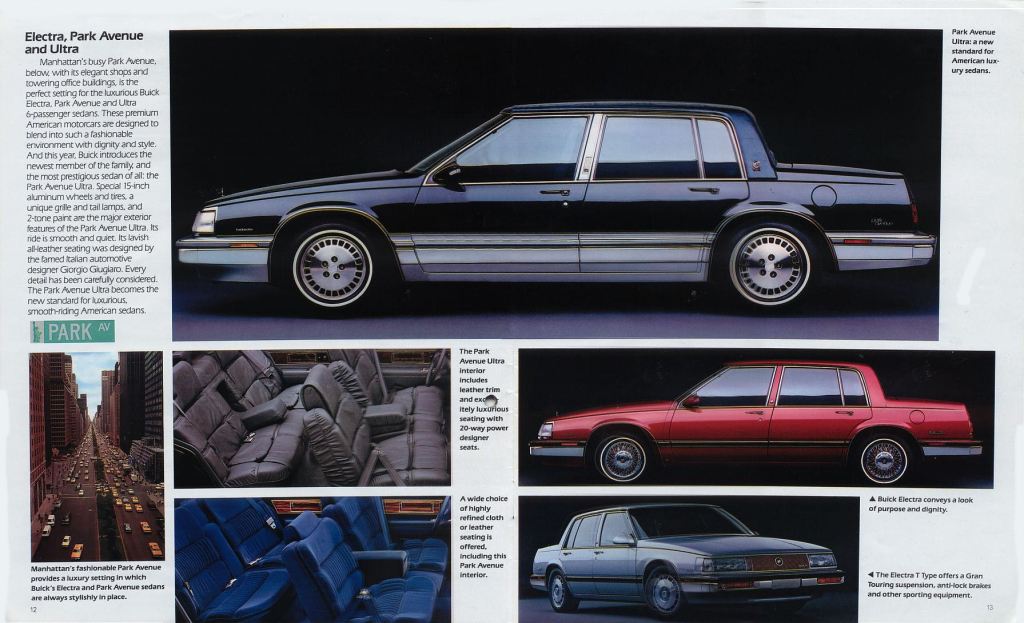
8) 1984 Buick Riviera T-Type coupe—one of my first posts on this blog gets continued interest on a car that Hagerty does see as collectible ($15,100 in #1/Concours condition, $5,100 in #3/Good condition). Dropping two spots this year.

7) 1980 Pontiac Grand Am coupe—another rarely discussed 1980 Pontiac makes the list. This entry was the most viewed post in 2017, so it’s been consistently popular, though it dropped from third to seventh this year. 1,647 Grand Ams were sold in the 1980 model year.

6) 1980 Pontiac Sunbird Sport Hatch—now this is a rarely discussed car, so I understand why the portion of the internet that cares is coming here. They also seem to have vanished entirely from the streets of America. Dropping down one spot from last year.

5) 1989 Chevrolet Celebrity sedan—I doubt there are a ton of articles being written about any of the A-body cars. This August 2016 article inspired by a work colleague’s Celebrity continued to get a substantial number of page hits this year and moved up from #9. 162,462 sedans were sold in the 1989 model year; Chevrolet sold over 2.1 million Celebrities in the 1980s.

4) 1987 Buick LeSabre T Type coupe—a new entry for 2019 is the T Type many don’t know about. A good number seem to be looking as this page received a lot of hits. 4,123 LeSabre T Types were built for 1987.

3) 1985 Buick Somerset Regal coupe—this post has been picked up by other websites a few times, most recently by Jalopnik. Hilariously, I don’t think I would have ever gotten around to writing about the Somerset Regal if I hadn’t seen one on the streets of Philadelphia a few years ago. Down from #2 in 2018, but still the second most popular entry all time.

2) 1987 Mercury Lynx XR3 hatchback coupe—a post that was fast rising at the end of 2018 makes it all the way to #2 in 2019. Mercury is, of course, an orphan make, but this blog entry has been viewed five times more than my entry on the 1981 Ford Escort hatchback coupe.

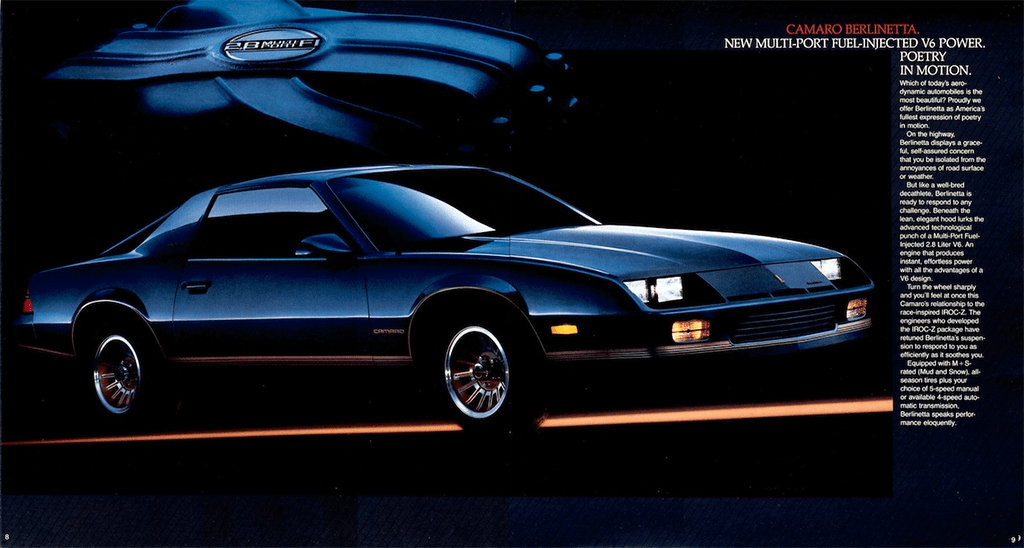
Berlinetta pages from the 1985 Camaro brochure

1) 1986 Chevrolet Camaro Berlinetta hatchback coupe—the Berlinetta is rarely covered, with almost all the eighties Camaro attention going to the Z28 and the IROC-Z. In spite of this, Hagerty does value this car, currently at $13,400 in #1/Concours condition, $6,200 in #3/Good condition for the version with the optional V8. It repeats as my most viewed post and is the all-time most popular entry.

Posts that no longer made the cut in 2019 that were more popular in 2018 include 1982 Chrysler LeBaron convertible and 1981 Toyota Celica Sport Coupe. A post on the rise in the final quarter of 2019 was 1980 Buick Riviera S Type coupe.

Thanks to all who viewed this blog in 2019!

1984 Pontiac 2000 Sunbird S/E hatchback coupe

“One of the world’s most advanced production turbos”

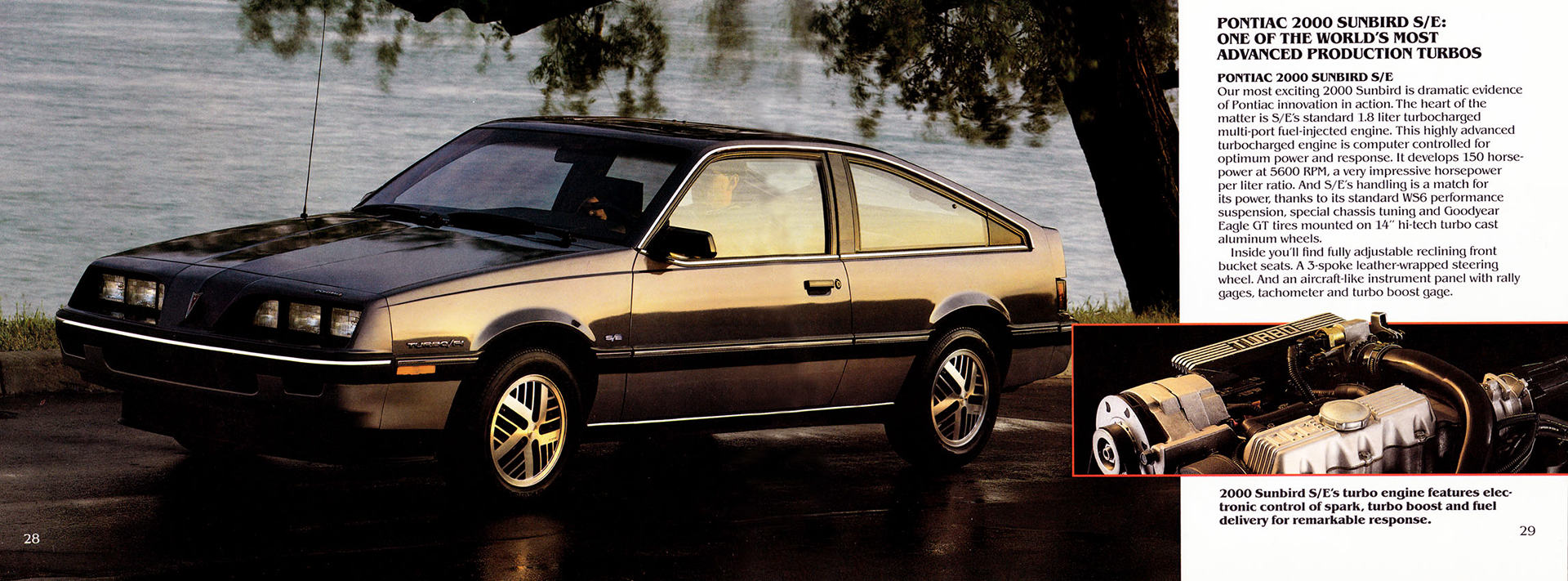
For 1984, Pontiac’s top-of-the-line Sunbird S/E gained a new turbocharged motor along with a minor front-end revision and clear fog lamps.

The S/E‘s new engine was an LA5 150 bhp 1.8 liter/110 ci inline four with a Garrett turbocharger and fuel injection. It was paired with a standard four-speed manual gearbox, with a three-speed automatic optional for $320. With the standard powertrain, Car and Driver recorded a 0-60 time in 8.3 seconds—class-competitive in 1984. Fuel economy ratings were 25 city/36 highway by the day’s standards (20/26 by today’s measures). The Sunbird’s 13.5-gallon gas tank meant that owners could expect a range of 280 to 370 miles with a 10% fuel reserve.

2000 Sunbird S/E pages from the 1984 Pontiac prestige brochure

Standard exterior and mechanical equipment on the $9,489 S/E hatchback coupe (about $30,000 in 2025 dollars) included two-tone paint, power steering, power front disc/rear drum brakes, a WS6 performance suspension, special chassis tuning, and Goodyear Eagle GT P205/60R14 tires (a size now only marginally available) mounted on attractive 14-inch “hi-tech turbo” cast-aluminum wheels. Inside, fully adjustable reclining front seats, a folding split-back rear seat, a three-spoke leather-wrapped steering wheel, rally gages, and a Delco-GM AM radio were included.

Options, Period Reviews, & Production Numbers

Exterior options included a power glass sunroof ($300) and a louvered rear sunshade ($199). Inside, custom air conditioning, electronic cruise control, and Lear Siegler bucket seats ($400) were available.

Reviews of the new turbocharged configuration were positive—Popular Mechanics called it a “150-hp screamer.” 1984 Sunbirds did sell well—almost 170,000, but more than 80% of them were the base coupes and sedans, not the LE or the S/E.

The View From 2025

Sunbirds of this generation (1982-1994) are now almost completely vanished from the nation’s roads, and models other than the convertibles rarely show up in the Hemming’s Motor News classifieds, on eBay Motors, or on Bring a Trailer.

Make mine Black over Silver Metallic, please.

I wrote about the last of the previous-generation Sunbirds here. Other J-platform cars I have covered this blog include the 1984 Buick Skyhawk coupe, the 1982 Cadillac Cimarron sedan, the 1988 Cadillac Cimarron sedan, the 1986 Chevrolet Cavalier Z24 coupe, and the 1985 Oldsmobile Firenza ES sedan.

Last updated May 2025.

1981 Chevrolet Corvette coupe

“Corvette is a rolling showcase of new technology …”

For 1981, Chevrolet’s Corvette gained a new standard powertrain—the L81 190 bhp 5.7 liter/350 ci V8 with a Rochester four-barrel carburetor combined with a four-speed manual transmission (a three-speed automatic was a no-cost option). The new engine featured Computer Command Control, which automatically adjusted the ignition timing and the fuel/air mixture. Chevrolet engineers also replaced the steel rear leaf spring with a fiberglass one in cars with the automatic.

With the four-speed manual, 0-60 came in about 8 seconds—quick for a 1981 model year car. Fuel economy was 14 city/20 highway by the day’s standards with either transmission. With a 23.7-gallon gas tank, one of the 40,606 proud new owners of a 1981 Corvette could expect a range of 295 to 325 miles with a 10% fuel reserve.

For the $16,258.52 base price at the beginning of the model year (about $62,100 in 2026 dollars), Corvette buyers got removable roof panels, a Delco Freedom II battery, four-wheel power disc brakes, power steering, dual sport mirrors, and P225/70R15 tires (a size still readily available) on 15 x 8 inch rally wheels. Inside, air conditioning, power windows, a tilt-telescopic steering column, an AM/FM radio with dual front speakers, a quartz clock, and a choice of either cloth/vinyl or leather/vinyl bucket seats were all standard.

Options, Production Locations, & Advertising

Exterior and mechanical options included two-tone paint ($399), aluminum wheels ($428), and a power antenna ($55). Inside, buyers could add power door locks ($145), cruise control ($155), and a rear window defogger ($119). 1981 was the first year that the AM/FM stereo radio with a cassette player ($423) was more popular than the AM/FM stereo radio with an 8-track player ($386). New options included a power driver’s seat ($183) and electric twin remote sport mirrors ($117).

1981 was the first year Corvettes were produced in two factories at one time. The new Bowling Green, Kentucky plant produced its first Corvette on June 1, 1981, while the St. Louis plant was making its last Corvettes—the final St. Louis Corvette was built on August 1, 1981. All St. Louis Corvettes were painted with lacquer paints, while the new Bowling Green plant had a brand-new paint facility and used enamels with clear top coats.

1981 Chevrolet Corvette brochure cover
Cover of the 1981 Chevrolet Corvette brochure

One of the two 1981 Corvette brochures has what I think is one of the best visual expressions of the “shark” Corvette as its fold-out cover. A silhouetted 1981 is in the foreground, with the image of the curving path it has just traversed carved with a time-lapse of its taillights.

The View From 2026

There is strong club support for the 1981 Corvette, as there is for all Corvettes. According to Hagerty’s valuation tools, a loaded 1981 Corvette in #1/Concours condition is $40,500, with a more normal #3/Good condition car going for $18,600. 1981 Corvettes often appear in the Hemmings Motor News classifieds, on eBay Motors, and on Bring a Trailer. As I update this blog entry in February 2026, there’s a Red 1981 Corvette with Silver leather bucket seats and 46,000 miles available on Hemmings, asking $29,000.

Make mine Autumn Red/Dark Claret, please—two-tones seem appropriate for 1981.

Other Corvettes I have written about in this blog include the 1980 coupe, the 1982 coupe, the 1984 hatchback coupe, the 1986 convertible, and the 1988 35th Anniversary Edition hatchback coupe. I also wrote about traveling long distances in an eighties Corvette.

Last updated February 2026.

1984 Oldsmobile Omega sedan

“… comfort and value you can feel good about …”

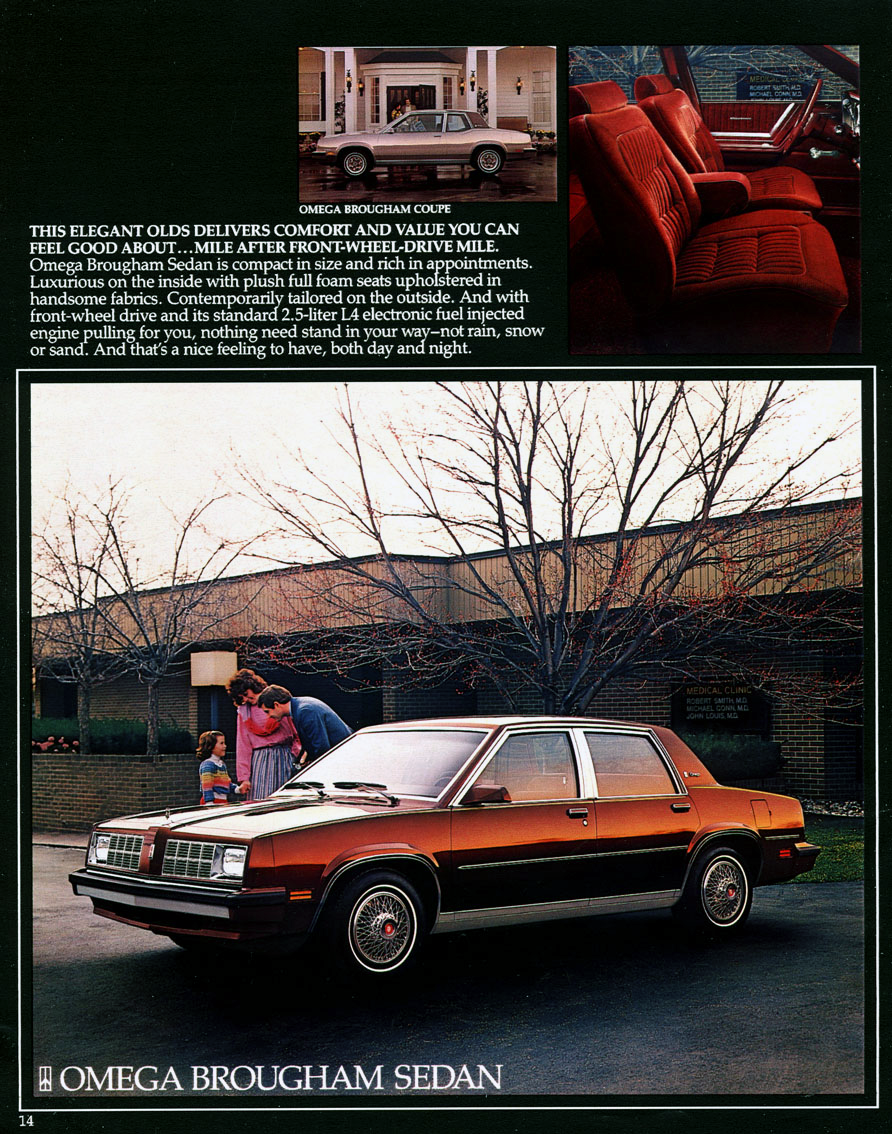
In its final year, Oldsmobile’s Omega variant of GM’s X-car received few changes. The grille now consisted of horizontal stripes with vertical park/signal lamps, and there were new bumper treatments.

The Omega’s standard powertrain continued to be an LR8 “Iron Duke 92 bhp 2.5 liter/151 ci inline four with electronic fuel injection paired with a four-speed manual transmission. Powertrain options included the LE2 112 bhp 2.8 liter/173 ci V6 ($250) and a three-speed automatic transmission ($425). Mileage with the 2.8 liter V6 and the automatic was 21 city/33 highway by the day’s standards (17/24 by today’s measures). With a 14.6-gallon fuel tank, an Omega’s owner could expect a range of between 270 and 350 miles with a 10% fuel reserve.

Standard equipment on the $7,832 (about $24,700 in 2025 dollars) Oldsmobile Omega sedan included front-wheel-drive, power-assisted rack and pinion steering, power front disc/rear drum brakes, P185/80R13 steel-belted radial tires (now a trailer size) on 13-inch wheels, Deluxe wheel discs, Custom bench seating, and a fold-down center armrest.

Omega Brougham page from the 1984 Oldsmobile brochure

Moving up to the $8,104 Omega Brougham added a stand-up hood ornament, a pillar applique molding, lower bodyside moldings, carpeted lower door panels, and a Deluxe steering wheel.

The $675 ES package (RPO W48) remained available in 1984 as an upgrade for the Brougham, but only 224 were ordered. By far the sportiest version of the Omega, the ES included a suspension with higher-rate front and rear springs, firmer front and rear shock absorbers, and thicker stabilizer bars. In an attempt to appear more European, the ES2500 was the version with the 2.5 liter inline-four, while the ES2800 was the version with the 2.8 liter V6. Both versions got a blacked-out grille.

Options & Production Numbers

Exterior and mechanical options on all Omegas included a glass-panel sunroof ($300), power steering, and high-capacity cooling. Inside, cruise control, power windows, and a four-season air conditioner were available.

Omega sales were significant but not great, and they had been dropping steadily from the 1981 peak of almost 148,000 (including over 101,000 sedans). Oldsmobile produced 41,874 Omega sedans in the 1984 model year—small potatoes compared to all the other Oldsmobile sedans available (Firenza, Cutlass Ciera, Cutlass Supreme, Delta 88 Royale, and Ninety-Eight Regency).

The View From 2025

I haven’t seen an Omega on the streets in almost two decades, and they rarely show up in the Hemmings Motor News classifieds, on eBay Motors, or on Bring a Trailer. I’m also pretty sure I’ve never seen one shown, though I’m not betting against that happening at some point.

Make mine Dark Royal Blue Metallic, please.

Other X-cars I have written about include the 1983 Buick Skylark T TYPE coupe, the 1980 Chevrolet Citation hatchback sedan, the 1981 Chevrolet Citation X-11 hatchback coupe, the 1985 Chevrolet Citation II hatchback sedan, and the 1982 Pontiac Phoenix SJ coupe.

Last updated March 2025.

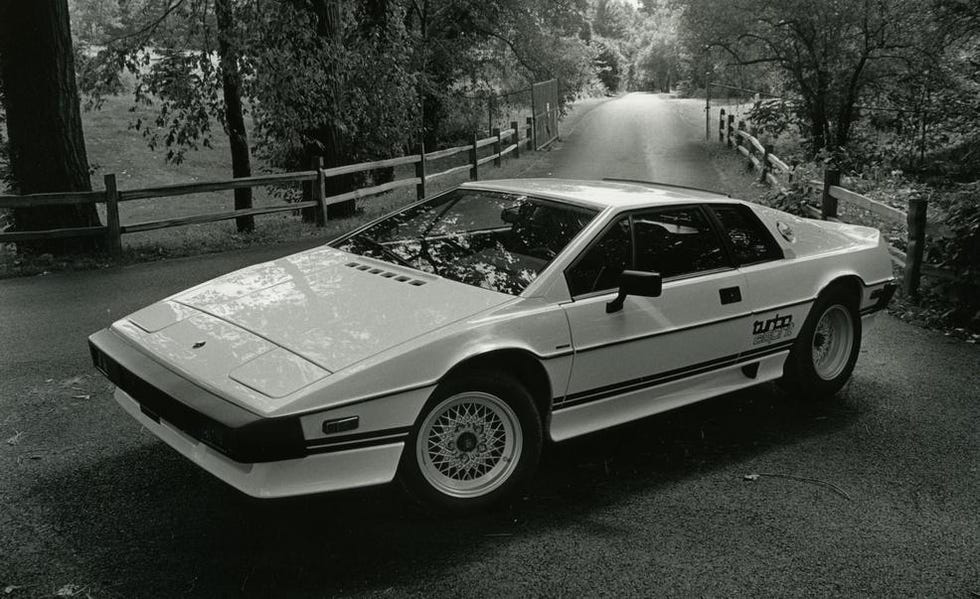
1983 Lotus Turbo Esprit coupe

This early (December 2013) blog entry has been revised and extended enough to consider it a new entry.

“Low, sleek, ultra-competitive.”

The 1983 Lotus Turbo Esprit finally brought the performance that the original Esprit’s supercar looks had promised over half a decade before.

Horsepower was up to 205 bhp from the 140 bhp that had come with the debut of the Esprit in 1977. The engine was still the type-910 2.2 liter/131 ci inline four with a carburetor, but a Garrett AiResearch turbocharger making 8.0 psi of boost was attached along with an intercooler. Other engine technology included an aluminum block, aluminum heads, and four valves per cylinder.

Performance for the almost 3,000-pound exotic substantially improved with the turbo: a 0-60 time of about 6.5 seconds was about 1.5 seconds quicker than the original naturally aspirated car. The Turbo Esprit’s top speed was about 140 mph. From the perspective of 2025, mileage wasn’t so great for a small turbocharged four with a five-speed manual transmission; 14 city/25 highway by the day’s standards and 11/18 by today’s measures. A 22.7-gallon gas tank helped with range, which was likely about 300 to 355 miles with a 10% fuel reserve.

The Esprit’s looks were updated in the same way that many 1970s designs were as they headed into the 1980s. Ground effects were added to the original Giorgetto Giugiaro design, and of course there were huge Turbo Esprit logos on the rear quarters.

1983 Lotus Esprit Turbo photo
1983 Lotus Esprit Turbo photo, courtesy of Car and Driver

Standard exterior and mechanical equipment on the Turbo Esprit included a four-wheel independent suspension, rack and pinion steering, four-wheel disc brakes, and 195/60R15 front tires and 235/60R15 rear tires, all of them Goodyear NCT‘s riding on BBS 15-inch alloy wheels. Inside, air conditioning, power windows, and Connolly leather bucket seats were included.

A few years ago, Car and Driver republished their story on the Turbo Esprit from the November 1983 issue, and it is interesting and instructive to read—though it is notable that they put the Nissan/Datsun 300ZX Turbo on the cover that month instead of the Lotus. They believed that the car would find a hole in the exotic market even at a relatively dear price of $47,984 (about $157,100 in 2025 dollars).

The View From 2025

For reference, according to Hagerty’s valuation tools, all the money for a 1983 Turbo Esprit in #1/Concours condition is currently $65,300, with a more normal #3/Good car going for $30,000. There is good club support for Esprits on LotusTalk, and they regularly show up in the Hemming’s Motor News classifieds, on eBay Motors, and on Bring a Trailer.

Make mine Black, please.

Last updated June 2025.

1988 BMW M3 coupe

In late 2019, my ex-wife and I visited the small but excellent BMW Zentrum Museum in Greer, SC. Of course they had a first-generation M3 on display—so I wrote a blog entry about this game-changing little coupe.

“Created for the race track, destined for the road.”

It took the M3 two-and-a-half years to make it to the United States following its debut in Europe, but most agreed it was worth the wait. Reviews were enthusiastic; Car and Driver exclaimed that “This is a car for us.”

The powertrain was the thing: an S14 192 bhp 2.3 liter/141 ci 16-valve inline four with four valves per cylinder and Bosch Motronic fuel injection mated to a five-speed manual. In a car with a curb weight of 2,734 pounds, this meant impressive acceleration—0-60 times were in the seven-second range. Given this, fuel economy wasn’t bad: 17 city/28 highway on premium gasoline by the day’s standards (15/26 by today’s standards). With a 14.5-gallon gas tank, the proud new owner of an M3 could expect a range of 265 to 295 miles with a 10% fuel reserve.

201433683402
1988 BMW M3 advertisement

Standard exterior equipment on the pricey $34,000 M3 (about $94,000 in 2025 dollars or well over what a loaded 2025 M4 coupe goes for) included tinted glass, halogen headlights, an electric dual position sunroof, boxed-out fender flares, a unique front bumper, and a cap over the C-pillar which helped to feed air onto the large for the day rear wing.

Mechanical features included a limited-slip differential, four-wheel anti-lock disc brakes, and 205/55VR15 tires on 15 x 7 inch cast light alloy BBS wheels. Inside, the M3 was comfortably equipped; leather sport seats, full instrumentation, power door locks, power windows, cruise control, air conditioning, a trip computer, and an AM/FM stereo cassette were all included.

The View From 2025

Over the last 12 years or so, the first-generation M3 has become one of the definitive eighties collector cars, with values for the very best examples nearly doubling. According to Hagerty’s valuation tools, all the money for a 1988 M3 in #1/Concours condition is an astounding $215,000, with a more normal #3/Good car going for $65,700. Some M3s come up for sale in the Hemming’s Motor News classifieds or on eBay Motors, but many are now sold at auction, whether on-line (Bring a Trailer) or in-person.

Make mine Salmon Silver Metallic, I think.

Other BMWs I have written about include the 1983 633CSi coupe, the 1984 325e coupe, the 1987 L6 coupe, the 1987 M6 coupe, and the 1988 750iL sedan.

Last updated March 2025.

Eighties Vehicles at the 2019 Mecum Chicago

Mecum’s late October auction in Chicago provided some fodder for commentary. I’ll concentrate on the at least reasonably stock 1980s cars (and a few trucks) that sold (remember that Mecum auctions are not no reserve auctions—a cream 1985 Excalibur convertible with tan seats was a no sale bid up to $40,000) and add some of my opinions. Eighties vehicles were about 8% of the approximately 660 vehicle lots sold in this auction.

Thursday, October 24th

  • 1989 white Maserati Biturbo Spyder with tan leather bucket seats, a 225 bhp 2.8 liter/170 ci V6 with fuel injection and twin turbochargers, and a five-speed manual, and 17,000 miles—$5,000 hammer price.
  • 1989 blue Alfa Romeo Spider Veloce convertible with a black top, tan leather bucket seats, a 115 bhp 2.0 liter/120 ci inline four with Bosch L-Jetronic fuel injection, a five-speed manual, and 31,000 miles—$5,500
  • 1984 red Mercedes-Benz 560 SEL sedan with tan leather bucket seats, a 227 bhp 5.5 liter/338 ci V8 with Bosch KE-Jetronic fuel injection, and an automatic—$3,000
  • 1989 red Dodge Dakota convertible pickup truck with a black top, a red cloth bench seat, an LA 125 bhp 3.9 liter/238 ci V6 with throttle-body fuel injection, and an automatic—$2,500 for this ASC conversion
  • 1981 burgundy Chevrolet Corvette coupe with silver leather bucket seats, an L81 190 bhp 5.7 liter/350 ci V8 with a Rochester Quadrajet four-barrel carburetor, an automatic, and 83,000 miles—$7,000
  • 1987 silver Alfa Romeo Spider Quadrifoglio convertible with gray leather bucket seats, a 115 bhp 2.0 liter/120 ci inline four with Bosch L-Jetronic fuel injection, and a five-speed manual—$10,000
  • 1983 gray Mercedes-Benz 380 SEC coupe with black leather bucket seats, a 155 bhp 3.8 liter/234 ci V8 with Bosch Jetronic fuel injection, and an automatic—$4,500
  • 1980 Midnight Black Chevrolet pickup truck with a camel tan custom cloth bench seat, an LS9 175 bhp 5.7 liter/350 ci V8 with a four-barrel carburetor, and an automatic—at $12,500 the first vehicle in this auction to meet my criteria for serious collectability of 1980s cars or trucks in stock condition: selling for equal to or above its original base list price. I’ll mark these vehicles in bold green.
  • 1989 white Chevrolet Camaro IROC-Z hatchback coupe with gray cloth bucket seats, an LB9 225 bhp 5.0 liter/305 ci V8 with fuel injection, and a five-speed manual—$7,500
  • 1989 red Ford Mustang LX custom (engine, suspension, wheels/tires) convertible with a black top, red cloth bucket seats, a Windsor 4.9 liter/302 ci V8 with fuel injection, and a five-speed manual—$7,500
  • 1985 Guards Red Porsche 928 S hatchback coupe with black leather bucket seats, a 288 bhp 5.0 liter/302 ci V8 with fuel injection, an automatic, and 77,000 miles—$7,000
  • 1989 Exotic Red Shelby Shadow CSX -VNT sedan with gray cloth bucket seats, a Turbo IV 175 bhp 2.2 liter/135 ci inline four with fuel injection and a turbocharger, and a five-speed manual—$6,500
  • 1989 black Bentley Turbo R sedan with tan leather bucket seats, a 308 bhp 6.75 liter/412  ci V8 with Bosch Motronic fuel injection and a turbocharger, an automatic, and 58,000 miles—$12,000
1989 Bentley Turbo R engine compartment, linked from Mecum’s website
  • 1986 silver Pontiac Fiero SE coupe with a 140 bhp 2.8 liter/173 ci V6 with fuel injection, a four-speed manual, and 11,000 miles—$4,500
  • 1987 black Pontiac Fiero GT coupe with a 135 bhp 2.8 liter/173 ci V6 with fuel injection, and an automatic—$5,500. Lots of Fiero choices at this auction.
  • 1989 white BMW 325is coupe with red bucket seats, an M20B25 168 bhp 2.5 liter/152 ci inline six with Bosch Motronic fuel injection, and an automatic—$4,500
  • 1989 red Cadillac Eldorado coupe with red leather bucket seats, an HT 155 bhp 4.5 liter/273 ci V8 with throttle-body fuel injection, an automatic, and 86,000 miles—$3,500
  • 1980 black Jeep CJ-7 SUV with black vinyl seats, a 112 bhp 4.2 liter/258 ci inline six with a Carter two-barrel carburetor, an automatic, and 60,000 miles—$8,500
  • 1987 silver Pontiac Fiero coupe with gray cloth bucket seats and an automatic—$2,000
  • 1983 tan two-tone Lincoln Continental Mark VI sedan with tan seats, a Windsor 4.9 liter/302 ci V8 with throttle-body fuel injection, an automatic, and 43,000 miles—$9,000

Friday, October 25th

  • 1987 silver Porsche 924 S hatchback coupe with tan bucket seats, a 150 bhp 2.5 liter/151 ci inline four with fuel injection, a five-speed manual, and 68,000 miles—$4,000
  • 1983 white Buick Riviera convertible with a white top, burgundy leather seats, a 140 bhp 5.0 liter/307 ci V8 with a Rochester four-barrel carburetor, an automatic, and 78,000 miles—$6,000
  • 1986 red Ford Bronco II XLT SUV with red cloth bucket seats, a Cologne 140 bhp 2.9 liter/179 ci V6 with fuel injection, an automatic, and 86,000 miles—$7,000. People are starting to collect these Bronco IIs.
  • 1980 black Ferrari 308 GTSi coupe with camel leather bucket seats, a 205 bhp 2.9 liter/173 ci V8 with a Weber two-barrel carburetor, a five-speed manual, and 7,600 miles—$48,000 just brings this Ferrari over its original base price.
  • 1985 Dark Red Metallic Chevrolet Camaro IROC-Z convertible with saddle leather bucket seats, an LB9 215 bhp 5.0 liter/305 ci V8 with fuel injection, a five-speed manual, and 18,000 miles—$14,500
  • 1986 black Buick Grand National coupe with black/gray cloth seats, an LD5 235 bhp 3.8 liter/231 ci V6 with fuel injection and turbocharger, an automatic, and 13,000 miles—$32,500
  • 1983 green Toyota FJ-45 Land Cruiser custom (engine, suspension) SUV with brown seats, an unidentified 6.0 liter engine, and a four-speed manual—$37,400
  • 1986 red Nissan 300ZX hatchback coupe with black bucket seats, a VG30E 160 bhp 3.0 liter/181 ci V6 with fuel injection, and a five-speed manual—$2,500
  • 1983 green Honda Civic custom (everything) wagon with plaid bucket seats, a B18B1 140 bhp 1.8 liter/112 ci inline four with fuel injection, and a five-speed manual—$9,000
  • 1982 blue Chevrolet C10 custom (body, paint, interior, wheels/tires) pickup truck with gray leather bucket seats, an LE3 115 bhp 4.1 liter/250 ci inline six with a two-barrel carburetor, an automatic, and 58,000 miles—$11,000. It’s unusual to see one of these customs with the engine untouched, especially when it’s the six.
  • 1980 yellow Chevrolet Camino custom (body, paint, engine, interior) pickup truck with tan bucket seats, a 5.7 liter/350 ci V8, and an automatic—$12,000
  • 1987 red/dark gray two-tone GMC High Sierra pickup truck with a gray cloth bench seat, a 5.0 liter/305 ci V8 with fuel injection, an automatic, and 35,000 miles—$12,000
  • 1989 White Pontiac 20th Anniversary Turbo Firebird Trans Am hatchback coupe with saddle leather seats, a 250 bhp 3.8 liter/231 ci turbocharged V6 with fuel injection, an automatic, and 18,000 miles—$29,500
  • 1982 blue/orange two-tone Chevrolet Suburban custom (everything) SUV with blue/orange seats, a small block V8 with a four-barrel carburetor, and an automatic—$4,000
  • 1984 white Cadillac Eldorado Biarritz convertible with red tufted leather seats, and HT-4100 135 bhp 4.1 liter/249 ci V8 with fuel injection, and an automatic—$5,000. These convertibles, so expensive when new ($31,286, or about $80,000 in 2019 dollars), have yet to catch on as collector cars.
1984 Cadillac Eldorado Biarritz convertible, linked from Mecum’s website
  • 1980 green GMC custom (paint, interior, wheels/tires) pickup truck with a tan cloth bench seat, a 5.7 liter/350 ci V8 with a Holley four-barrel carburetor, and an automatic—$4,500
  • 1984 yellow Chevrolet Camino custom (body, paint, engine) pickup truck with brown cloth seats, a V8 with a Holley four-barrel carburetor, and an automatic—$12,000

Saturday, October 26th

  • 1987 Linen Gray Metallic Porsche 944 hatchback coupe with tan leather bucket seats, a 150 bhp 2.5 liter/151 ci inline four with fuel injection, and an automatic—$3,000
  • 1987 black Buick Grand National custom (engine) coupe with black/gray cloth seats, a 3.8 liter/231 ci V6 with fuel injection and turbocharger, an automatic, and 55,000 miles—$21,000
  • 1984 white Chevrolet Monte Carlo SS coupe with blue cloth bucket seats, a B4V 180 bhp 5.0 liter/305 ci V8 with a four-barrel carburetor, an automatic, and 16,000 miles—$14,000
  • 1982 black Chevrolet Camaro Z28 hatchback coupe with gray cloth bucket seats, a Cross-Fire LU5 165 bhp 5.0 liter/305 ci V8 with throttle-body fuel injection, an automatic, and 45 miles—$19,000
  • 1982 black Chevrolet Camaro Z28 hatchback coupe with gray cloth bucket seats, a Cross-Fire LU5 165 bhp 5.0 liter/305 ci V8 with throttle-body fuel injection, an automatic, and 4,500 miles—$15,000
  • 1983 green Toyota FJ-45 Land Cruiser SUV with brown leather seats, a 130 ci inline six, and a four-speed manual—$40,000
  • 1983 tan Toyota FJ-45 Land Cruiser SUV with brown leather seats, a 130 ci inline six, and a four-speed manual—$37,000
  • 1982 blue Toyota FJ-40 Land Cruiser SUV with tan leather seats, a 4.2 liter inline six, and a four-speed manual—$15,000
  • 1987 Ivy Mercedes-Benz 560SL convertible with a black soft top, palomino leather bucket seats, a 227 bhp 5.5 liter/338 ci V8 with Bosch KE-Jetronic fuel injection, an automatic, and 67,000 miles—$13,500
  • 1982 red Jeep CJ-8 Scrambler pickup truck with gray bucket seats, a 110 bhp 4.2 liter/258 ci inline six with a Carter two-barrel carburetor, and a manual transmission—$16,000
  • 1987 black Chevrolet Monte Carlo SS Aerocoupe with burgundy cloth bucket seats, a B4V 180 bhp 5.0 liter/305 ci V8 with a four-barrel carburetor, and an automatic—$20,500
  • 1981 gold Mazda RX7 hatchback coupe with brown leather bucket seats, a 12A 100 bhp 1.1 liter/70 ci rotary engine with a four-barrel carburetor, a five-speed manual, and 53,000 miles—$5,500
  • 1988 blue with woodgrain Jeep Wagoneer Limited SUV with tan leather seats, a 177 bhp 4.0 liter/241 ci inline six with fuel injection, and an automatic—$5,500. You rarely see Wagoneers up for auction versus Grand Wagoneers, but here was one.
1988 Jeep Wagoneer, linked from Mecum’s website
  • 1982 Charcoal Chevrolet Corvette coupe with silver gray leather bucket seats, an L83 Cross-Fire 200 bhp 5.7 liter/350 ci V8 with throttle body fuel injection, an automatic, and 36,000 miles—$9,000
  • 1981 stainless steel DeLorean DMC-12 coupe with gray leather bucket seats, a ZMJ-159 130 bhp 2.8 liter/174 ci V6 with Bosch K-Jetronic fuel injection, an automatic, and 16,000 miles—$33,500
  • 1989 green AM General Humvee M998 SUV with a green interior, a 6.2 liter diesel V8, an automatic, and 17,000 miles—$10,500
  • 1989 red Mazda RX7 convertible with a black top, a black interior, a 13B 146 bhp 1.3 liter/80 ci rotary engine with fuel injection, an automatic, and 54,000 miles—$4,000
  • 1983 black Pontiac Firebird Trans Am custom (KITT replica) convertible with tan cloth bucket seats, a Cross-Fire 175 bhp 5.0 liter/305 ci V8 with throttle body fuel injection, an automatic, and 70,000 miles—$15,000

Mecum Chicago had the usual profusion of Chevrolets, along a plethora of Pontiacs and Toyotas. What do you think of these results?

1984 Audi 5000S sedan

“The World’s Most Aerodynamic Sedan”

1984 was the first year of Audi’s new aerodynamic design for their biggest sedan. At the time, the exterior design was differentiating—though many would follow, Audi’s was first. Despite being the top-of-the-line, the 5000S was not a large car by modern standards—every dimension was smaller than Audi’s current A6 sedan.

The standard powertrain on Audi’s new sedan was Volkswagen’s corporate 100 bhp 2.1 liter/123 ci inline five with Bosch K-Jetronic fuel injection mated with a five-speed manual transmission. An automatic was available with the standard engine. The automatic was the only transmission available with the upmarket Turbo option—the same engine with a turbocharger that made 140 bhp.

Period road tests showed 0-60 times of 10.6 seconds for the Turbo, making it not much quicker than the base 5000S but almost 20 mph faster. Fuel economy ratings for the Turbo were 19 city/28 highway by the day’s standards (15/20 by today’s measures). With a 21.2-gallon gas tank, the driver of a new Turbo could expect a 335 to 400 mile range with a 10% fuel reserve.

1984 Audi 5000S advertisement

Standard exterior and mechanical equipment on the $16,840 5000S (about $53,600 in today’s dollars—approximately what a 2025 S4 sedan costs) included halogen headlamps, flush-mounted window glass, power rack-and-pinion steering, power front disc/rear drum brakes, and 185/70SR14 tires (a size still readily available) on 14 x 6 inch aerodynamically styled lightweight aluminum wheels.

Inside, standard features included Electronic Climate Control, cloth bucket seats, a center console, and power windows. Features that look strange to our modern eyes include an illuminated ash tray and a “radio prep kit with power antenna” and four “high-quality” speakers.

Options, Packages, & Controversy

Exterior options for the 5000S included an electric two-way tilting/sliding sunroof, power heated mirrors, and metallic paint. Inside, leather seats, heated seats, and a trip computer were all available.

In addition to more power, the Turbo package included an electric two-way tilting/sliding sunroof, a slightly tighter suspension, four-wheel disc brakes, and 205/60HR15 tires (also still readily available) on 15 x 6 inch aluminum wheels. Inside, power seats, power door locks, a trip computer, and a “fine-sounding” Audi Design/Blaupunkt AM/FM stereo radio with a cassette player and four speakers were included. The Turbo‘s $5,570 additional cost moved the 5000 into another price bracket, bringing it up to about $71,300 in 2025 dollars—more like today’s S6 pricing.

Period reviews of the new design were quite good, and sales reflected that. Then, of course, things all went horribly south with the unintended acceleration controversy. Sales would crater, and it would take Audi many years to recover.

The View From 2025

5000S’s sometimes show up in the Hemming’s Motor News classifieds, on eBay Motors, and on Bring a Trailer, but there’s not a lot of activity—BaT has sold a total of ten over eight years.

Make mine Sapphire Metallic, please.

The only other Audi I have written about so far is the 1983 Quattro hatchback coupe.

Last updated June 2025.

1986 Mercury Capri hatchback coupe

Hemmings has been making a go at auctions. One of their first offerings was a white 1982 Mercury Capri RS coupe with red vinyl bucket seats, a Windsor 157 bhp 4.9 liter/302 ci V8 with a Motorcraft 356CFM two-barrel carburetor, a four-speed manual, and 33,000 miles. That was enough to get me to generate an update to this eight-year-old post about the later 1986 version.

“Proof that getting there can be a fun experience in itself.”

For 1986, Mercury’s Capri had three engine choices and two transmission choices. Standard on the GS was the Lima 88 bhp (aargh!) 2.3 liter/140 ci in-line four with a Carter YFA one-barrel carburetor mated to a four-speed manual transmission. Power options for the GS included the Essex 120 bhp 3.8 liter/231 ci V6 with fuel injection and the (wonderful) Windsor 200 bhp 4.9 liter/302 ci V8 with sequential fuel injection that was standard on the 5.0L. All three engines could be paired with a three-speed automatic transmission for an additional $510 (the V6 required the automatic while the 5.0L came standard with a five-speed manual transmission with overdrive).

Mileage ratings for the various configurations ranged from 23 city/28 highway (21/26 by today’s standards) for the four-speed manual/in-line four combination that I’m not convinced that anyone bought to 17/25 for the “big daddy” five-speed manual paired with the V8.

Performance with the 2.3 liter four paired with either transmission was ghastly. 0-60 came in about 15 seconds, which meant a Capri driver with the Lima engine would see only the taillights of Iron Duke-powered Camaros and Firebirds (such a sad competition!). Moving to the V6 paid significant performance dividends, dropping the 0-60 time by about 3.5 seconds. Of course, the V8 was by far the best: even the automatic was in the 7 second range, while the manual could do 0-60 in about 6.5 seconds.

Mercury made three attempts at the Capri. The first was an imported version of the European Ford Capri and was sold from the 1970 to 1978 model years, first as the Capri and then as the Capri II. The second was Mercury’s version of the Fox body Mustang and was sold from 1979 to 1986. The final version of the Capri was an imported version of the Australian Ford Capri, sold from 1991 to 1994. Sense a trend here?

The base price for a Capri GS was $8,331 (about $24,800 in 2025 dollars). For that money, the Capri came relatively well equipped by mid-1980s standards. External features included halogen headlamps, tinted glass, and the distinctive bubble-back rear hatch with rear-window defroster. Mechanical equipment included power steering, power brakes, and P195/75R14 tires (still available thanks to Hankook and Kumho) on 14-inch wheels with turbine wheel covers. Inside, power windows, interval wipers, tilt steering wheel, and an AM/FM stereo radio were standard.

Pages from the 1986 Mercury Capri brochure

The more sporty Capri 5.0L stickered for $10,950 (about $32,500 in today’s dollars) and added the V8 mentioned above, dual exhaust, a Traction-Lok rear axle, and P225/60VR15 low-profile tires (a size still readily available) on cast-aluminum performance wheels.

Options & Production Numbers

Exterior options for both the GS and the 5.0L included a flip-up open-air roof ($315) or a T-Roof ($1,100). Inside, buyers could add air conditioning ($762), power door lock group ($182), speed control ($176), and an AM/FM stereo radio with cassette ($300).

MercuryCapriSales

Sales for the last of the second-generation Capris were not at all good, but Capri sales had not been good for years—Mercury’s traditional problem wedged between Ford and Lincoln. By 1986, Capri sales were about 9% of Mustang sales.

The View From 2025

Fox body Capris sometimes show up in the Hemming’s Motor News classifieds and eBay Motors, but there’s not a lot of activity. Bring a Trailer has auctioned a total of ten second-generation Capris, most of them the specialty ASC McLaren version. I’ll say that Capris are uncommon rather than unloved.

Make mine Smoke Metallic, please.

Other Mercury models I have written about include the 1983 Grand Marquis sedan, the 1984 Grand Marquis Colony Park LS station wagon, the 1987 Lynx XR3 hatchback coupe, the 1988 Cougar XR-7 coupe, and the 1988 Grand Marquis Colony Park station wagon. I seem to like the big Mercury’s.

Last updated September 2025.