1985 Chevrolet Citation II hatchback sedan

“One car that does it all.”

1985 was, mercifully, the last year for the Chevrolet Citation. In a sad General Motors tradition, it was also the best Citation (the 1985 Citation had no recalls after the nine that the 1980 had). Half-heartedly renamed Citation II in 1984, the X-car would be replaced by the Nova in 1986. There were some changes: new colors were available, and the dashboard was revised, allowing the “normal” horizontal Delco radios.

For 1985, the Citation II’s standard powertrain remained the LR8 “Iron Duke 92 bhp 2.5 liter/151 ci inline four with throttle-body fuel injection paired with a four-speed manual (the Citation never got a five-speed—even as an option). With the standard powertrain, 0-60 came in a little under 12 seconds in the 2,500-pound car with a theoretical top speed of 101 mph. Mileage was competitive: 24 city/34 highway by the day’s standards (21/31 by today’s standards). With a 14-gallon fuel tank, the owner of a base Citation could expect a range of between 325 and 365 miles with a 10% field reserve.

Powertrain options included two different versions of the 2.8 liter/173 ci V6 (why?): the LE2 112 bhp version with a two-barrel carburetor ($260) and the LB6 130 bhp type with fuel injection ($435). A three-speed automatic was—of course—available ($425). The V6 in general, and especially the fuel-injected version, made the Citation II substantially more spritely: 0-60 times of about 9 seconds and a top speed of about 118 mph. You paid a mileage price for that performance: 19 city/26 highway by 1985 standards (17/24 by today’s standards).
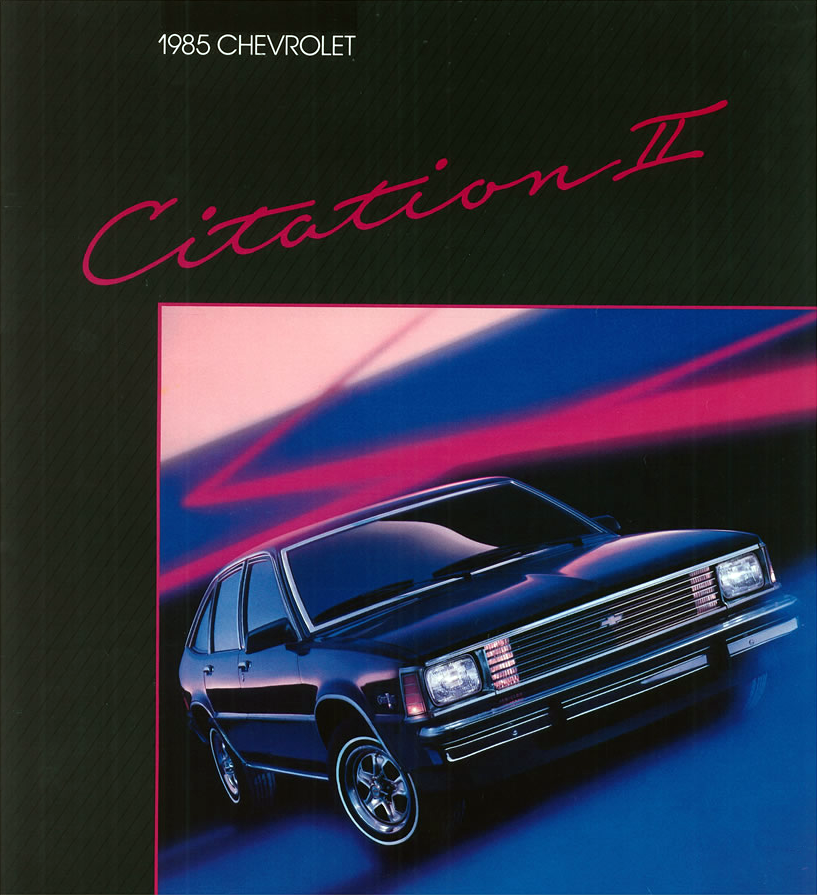
Cover of the 1985 Chevrolet Citation II brochure

Standard exterior and mechanical equipment on the $7,090 Citation II hatchback sedan (approximately $21,500 in 2025 dollars—precisely what base 2025 Chevrolet Trax LS SUV goes for) included halogen headlamps, rack-and-pinion steering, front disk/rear drum brakes, and P185/80R-13 radial tires (now a trailer size) on 13-inch by 5.5-inch steel wheels with full wheel covers. Inside, a low back front bench seat with adjustable head restraints, sliding door locks, a lockable glove box, a folding rear seat, and an AM/FM radio with two speakers were included.

Options & Production Numbers

Exterior and mechanical options included tinted glass ($110), two-tone paint ($176), power brakes ($100), power steering ($215), and the F41 sports suspension (acknowledged to be a bargain at $33). Inside, a quiet sound/rear decor package ($92), air conditioning ($730), cruise control ($175), Comfortilt steering wheel ($110), an electric rear defogger ($140), and an electronic-tuning AM/FM stereo radio with cassette, clock, and seek/scan ($319) were all available.

The 1985 Citation II did not sell—overall sales in this last year fell to a mere 8% of the first year sales. At an average Chevrolet dealership, you could expect it to be outsold by the Chevette, the Cavalier, the Camaro, the Celebrity, the Monte Carlo, and the Caprice Classic.

The View From 2025

I haven’t seen a Citation in years—the last one was an X-11 in early 2014. They rarely appear in the Hemming’s Motor News classifieds, on eBay Motors, or on Bring a Trailer. I’m pretty sure I’ve never seen one shown, though I’m not betting against that at some point.

Make mine the Medium Gray Metallic/Silver Metallic two-tone, please.

Other Citations I’ve written about include the 1980 hatchback sedan and the 1981 X-11 hatchback coupe. X-cars from other marques covered in this blog include the 1983 Buick Skylark T TYPE coupe, the 1984 Oldsmobile Omega sedan, and the 1982 Pontiac Phoenix SJ coupe.

Last updated March 2025.
1987 Mercury Lynx XR3 hatchback coupe

This post is consistently one of the most popular every year and has been so since the first full year after I originally posted it. It seems to me the key to an individual post’s popularity is often in the rarity of the other coverage available for that particular vehicle.

“… the sporting side of Lynx.”

1987 was the final year for the Lynx—Mercury’s version of Ford’s Escort compact. The Escort would soldier on for many more years (through model year 2002), but from 1988 forward, the smallest American-built Mercury would be the Topaz—still a compact, but larger in almost every dimension. For 1986 and 1987, the top-of-the-line Lynx was the XR3 hatchback coupe.

The XR3 designation was not random, but may not have been obvious to much of the North American market. In Europe, XR3 (and later XR3i) was a sporty trim of the Mark III Ford Escort from 1980 forward. Why Ford’s marketers chose to make XR3 the sportiest Lynx instead of using the name for the stateside Escort (which used GT in the mid-1980s) is a question lost in the mists of time, but may have had something to do with XR-7 designation for the sportiest Mercury Cougar.

The Lynx XR3‘s standard (and only) powertrain was a “High Output” 115 bhp 1.9 liter/113 ci inline four with Bosch multi-port fuel injection paired with a five-speed manual transmission. Mileage was good—25 city/34 highway by the day’s standards (about 22 city/31 highway by 2025 measures). Acceleration was reasonably quick: 0-60 came in about 10 seconds in the approximately 2,400-pound car. With a 13-gallon fuel tank, Lynx XR3 drivers could expect a range of 310 to 345 miles with a 10% fuel reserve.

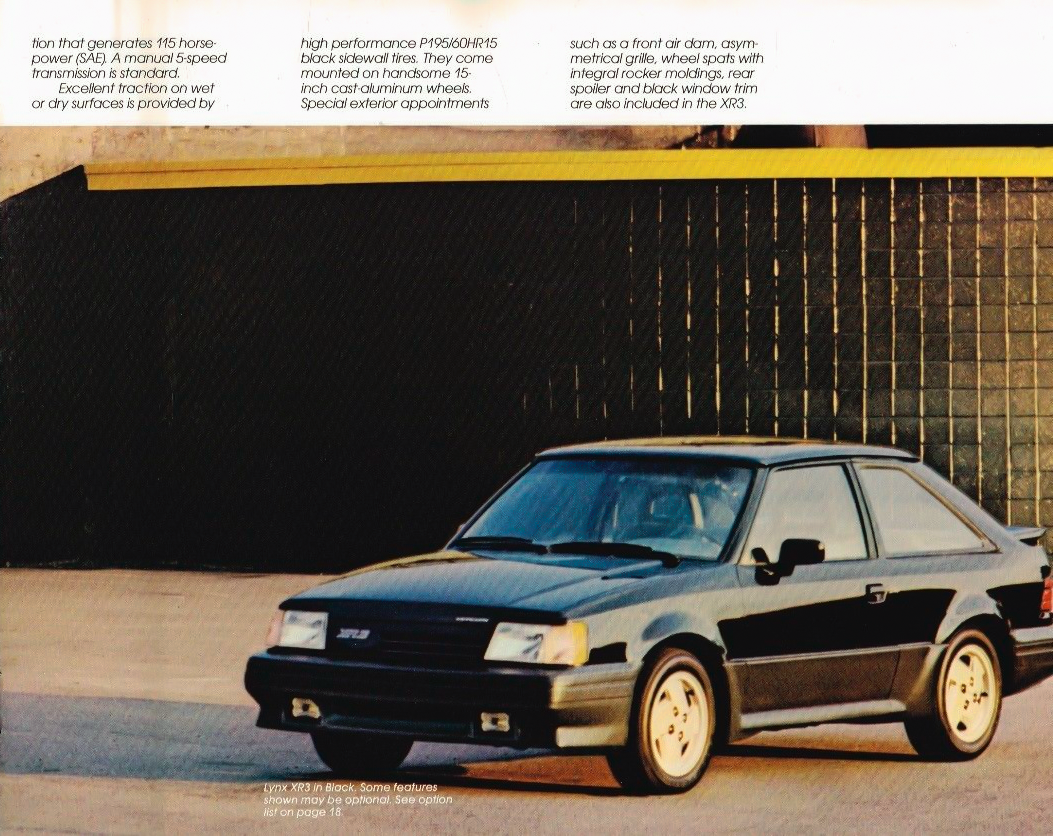
XR3 page from the 1987 Mercury Lynx brochure

Standard exterior and mechanical equipment on the $8,808 Lynx XR3 (about $25,900 in today’s dollars) included an asymmetrical grille, an aerodynamic front air dam with built-in fog lamps, wide wheel flairs, a rear spoiler, dual power mirrors, power steering, and P195/60R15 Goodyear Eagle GT tires (a size still readily available) on 15-inch four-flag cast-aluminum wheels. Inside, cloth sport bucket seats, a full console with a graphic alert display, a split folding rear seat, a leather-wrapped steering wheel, a locking fuel filler door with remote release, and an electronic AM/FM stereo radio with four speakers were included.

Standard exterior and mechanical equipment on every Lynx included aero halogen headlamps, front-wheel-drive, a four-wheel independent suspension, rack-and-pinion steering, and power front disc/rear drum brakes. The Lynx was not a large car—there aren’t many current small coupes remaining to compare it to, but the 2025 Honda Civic hatchback sedan is 5 inches wider and about a foot longer.

Options & Production Numbers

Few options were available since the XR3 came relatively well-equipped for a compact car in the eighties. In fact, seven separate options available for lesser Lynxes were standard on the XR3. Exterior and mechanical options for the XR3 included tinted glass ($105), a rear window wiper/washer ($126), and an engine block heater ($18). Inside, air conditioning ($688), speed control ($176), and a tilt steering wheel ($179) were available.

The final-year Lynx didn’t sell very well: a total of 39,039 in a year when Ford sold 374,765 Escorts. It’s reasonable to say that very few of the 20,930 hatchback coupes were XR3s.

The View From 2025

Badge for 2,500 web hits

First-generation Escorts and Lynxes were once so prevalent on American roads, but have now virtually disappeared. You occasionally see Lynxes for sale in the Hemming’s Motor News classifieds and on eBay Motors. Bring a Trailer has auctioned a grand total of two Lynxes, neither of them XR3s.

Make mine Smoke, please.

Other Mercurys I have written about are the 1980 Cougar XR-7 coupe, the 1983 Grand Marquis sedan, the 1984 Grand Marquis Colony Park LS station wagon, the 1986 Capri hatchback coupe, the 1988 Cougar XR-7 coupe, and the 1988 Grand Marquis Colony Park station wagon. I have also written about the 1981 Ford Escort hatchback coupe.

Last updated December 2025.

1980 MG MGB convertible

Writing a blog entry on cars from 1980 that Hagerty considers to be collectible reminded me that I should probably do an entry on the last of the MGBs.

“The Classic Breed”

1980 was the final year for MG’s MGB convertible, which had been in production since 1962.

Changes for 1980 were minimal. The standard and only powertrain remained the 62.5 bhp (not 62 or 63!) 1.8 liter/110 ci inline four with a Zenith-Stromberg 175 CD carburetor paired with a four-speed manual transmission. 0-60 mph came in a leisurely 16 seconds in the 2,400-pound car. Fuel mileage was decent by the day’s standards: rated at 16 city/30 highway. With a 13-gallon gas tank, an MGB driver could expect a range of about 245 to 265 miles with a 10% fuel reserve.

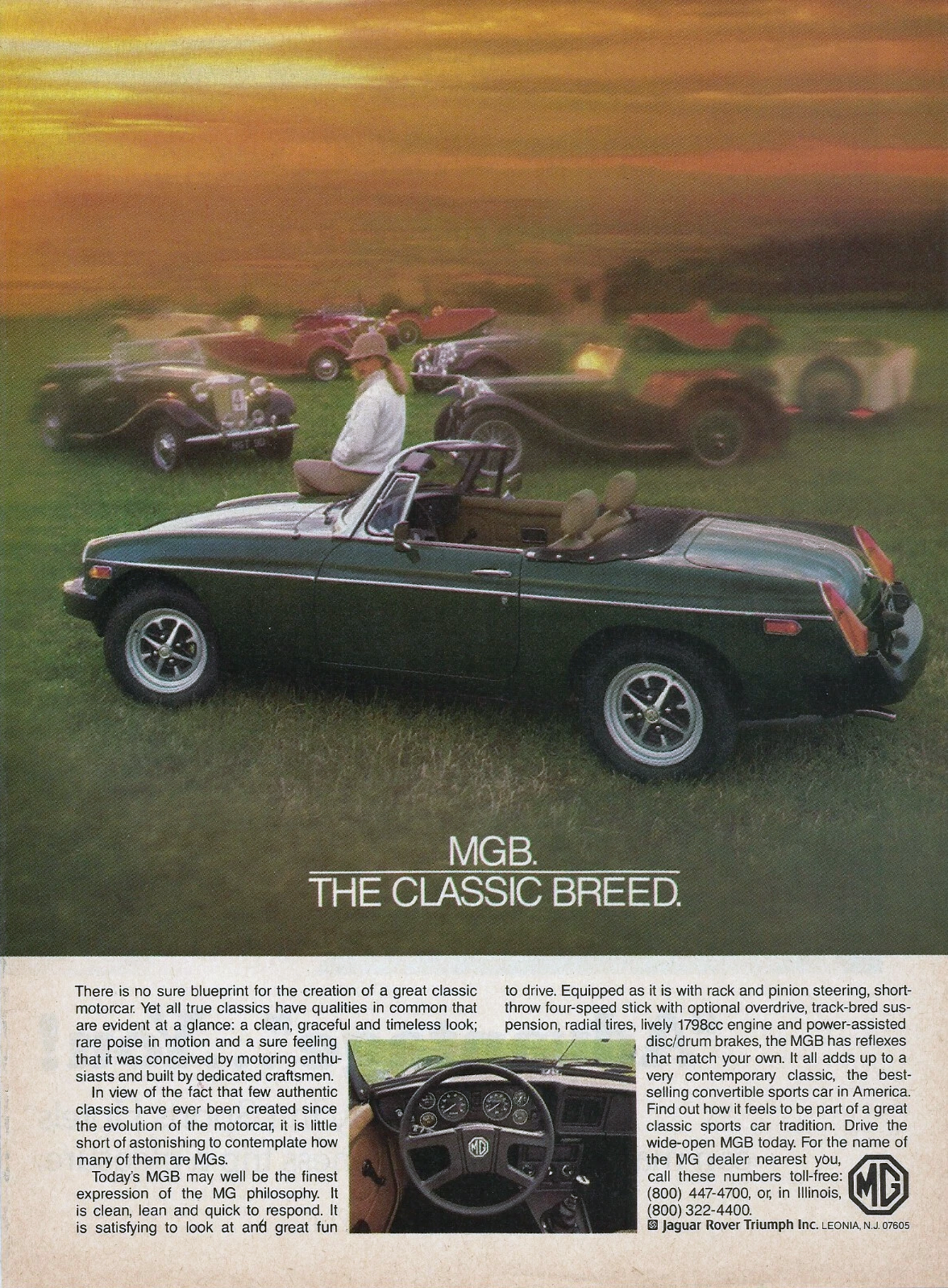
1980 MG MGB print advertisement

Standard exterior and mechanical equipment on the $7,950 MGB (about $33,800 in today’s dollars) included a tonneau cover, a laminated safety glass windshield, rack and pinion steering, power front disc/rear drum brakes, and 165/80-14 radial ply tires (a size still available thanks to Vredestein) on 14-inch Rostyle wheels. Inside, vinyl bucket seats with adjustable head restraints, a center console with a cigarette lighter and heater controls, a lockable glovebox, a map pocket, an electric tachometer, a trip odometer, a map light, and a clock were standard.

Options & One Limited Edition

Optional equipment included an electrically-operated overdrive for the transmission, a luggage rack, “traditional” wire wheels, air conditioning ($653), and various radios with either 8-track or cassette players included.

The Limited Edition that had debuted in 1979 remained available and popular, with 6,668 produced over the two years. In addition to black paint, the Limited Edition included silver body stripes, 5-spoke alloy wheels, an air dam, boot and tonneau covers, chrome luggage rack, a leather padded 3-spoke steering wheel, a Limited Edition dash plaque, and Limited Edition thresholds. All of this cost $600.

The View From 2025

Like all MGs, MGBs have a following and frequently appear in the Hemming’s Motor News classifieds, on eBay Motors, and on Bring a Trailer. According to Hagerty’s valuation tools, a 1980 MGB in #1/Concours condition is $21,500, with a far more typical #3/Good car going for $6,100. A Limited Edition goes for about $1,500 more. As I update this blog entry in September 2025, there is a 1980 MGB Limited Edition with a black interior and 55,000 miles for sale on Hemmings, asking $24,900.

Make mine Brooklands Green, please.

Other sports cars from 1980 I have written about include the Chevrolet Corvette coupe, the Datsun 280-ZX hatchback coupe, the Mercedes-Benz 450SL convertible, the Porsche 911 SC coupe, and the Porsche 924 hatchback coupe.

Last updated September 2025.

Auction Favorite: 1985 Mercedes-Benz 380SL convertible

The Mercedes-Benz 380SL is a common vehicle at the auctions I follow—since starting this blog in late 2013, I’ve seen almost 40 of these convertibles go across the block, mostly at the Barrett-Jackson and Mecum events. I chose to go with 1985 as the model year to write about because it and 1982 have been the two most common years I have seen.

“What do you get when you blend a Mercedes-Benz with a sports car? The incomparable 380SL.”

1985 was the final year for the 380SL—from 1986 on, the heavier and more powerful 560SL would be the only option in North America. There wasn’t much change for 1985; all cars got anti-lock brakes, and later production SLs got a drivers-side airbag. About 11,100 buyers took home this last of the line example, which benefited from having very little real competition.

Motive power was provided by a 155 bhp 3.8 liter/234 ci V8 with Bosch Jetronic fuel injection, connected to a four-speed automatic transmission. As with all R107 models, mileage for the 3,600-pound car wasn’t very good—the ratings of the day were 16 city/18 highway (14/17 by today’s standards). With the 22.5-gallon fuel tank, a 380SL driver could expect a range of between 310 and 350 miles with a 10% fuel reserve. 0-60 came in about 10.5 seconds; despite the claims of Mercedes-Benz, the 380SL was closer to a grand touring car than to a sports car.

The 380SL’s base price for 1985 was $43,820 (about $102,200 in today’s dollars—neatly spaced between what an SL 450 and an SL 550 cost in 2017). For the money, exterior and mechanical standard features included the aforementioned ABS controlling power disk brakes, power steering, a steel hardtop, and 205/70VR14 tires (now a rare size) on 14-inch forged light-alloy wheels. Inside, power windows, power door locks via a vacuum locking system, cruise control, and an AM/FM stereo with cassette player were standard. Air conditioning was also included in the electronic automatic climate control system, though most say it wasn’t that effective. Heated leather seats were optional.

According to Hagerty’s valuation tools, all the money for a 1985 380SL in #1/Concours condition is $28,200, with a more typical #3/Good car going for $13,600. There is decent club support for the 380SL, as there is for almost all Mercedes-Benz’s. 380SLs maintain a substantial presence in the Hemming’s Motor News classifieds and on eBay Motors. As I write this in September 2017, there are 66 advertised on Hemmings, including 14 of the 1985 models.

Make mine Astral Silver Metallic, please. Dealer advertising image courtesy of Alden Jewell.

Save

Save

Save

Save

1981 Pontiac Firebird Trans Am coupe

“Soul Survivor”

1981 was the last year for the second-generation Firebird and, thus, also the final year for the second-generation Trans Am. With the third-generation cars on the way, Pontiac’s eleven-year-old F-car received only minor changes. The “screaming chicken” decal on the hood was now two colors, compared to the four-color decal from 1979 and 1980. Not much could be done about the general lack of space efficiency (the EPA rated the Firebird as a subcompact car), the high curb weight (about 3,700 pounds when the Mustang weighed about 2,800), and the relatively primitive technology.

Engines & Transmissions

The standard Trans Am powertrain was the Pontiac-built L37 150 bhp 4.9 liter/301 ci V8 with a four-barrel carburetor paired with a three-speed automatic. The only choice for Trans Am purchasers who wanted a manual transmission was the Chevrolet-built LG4 145 bhp 5.0 liter/305 ci V8 with a four-barrel carburetor, but you did get a $147 credit.

The top engine was the $437 Pontiac-built LU8 200 bhp 4.9 liter/301 ci V8 with a four-barrel carburetor and an AiResearch turbocharger, which also added a hood-mounted boost gauge. The turbo engine was emissions-certified only with the combination of air conditioning, an automatic transmission, and a 3.08:1 ratio rear axle. For a period of time during the 1981 model year, Pontiac also required rear disc brakes and a limited-slip differential to get that turbo power.

Combining a turbocharger, carburetors, and primitive electronic engine controls was not easy, and reviews of one of the world’s first turbo V8’s were mixed. The relatively primitive gas of the day meant that Pontiac had to retard spark substantially to minimize detonation, which kept the power returns of the turbocharger relatively low. As Car and Driver stated, “by the time the engine reaches 4000 rpm, the show is essential­ly over.”

Performance & Standard Equipment

A Turbo Trans Am would accelerate from 0-60 in a little over eight seconds (Car and Driver clocked 8.2), which was good for 1981. Fuel mileage was predictably bad—15 city/21 highway mpg by the day’s standards for the combination of the turbo engine and the automatic. With a 21-gallon fuel tank, Trans Am owners could expect to travel about 280 to 305 miles before refueling.

Standard exterior and mechanical equipment included in the $8,322 base price of the Trans Am (about $31,700 in today’s dollars) included a black accent grille and headlamp bezels, dual rectangular headlamps, front and rear wheel opening air deflectors, chrome side-splitter tailpipe extensions, a shaker hood, power front disc/rear drum brakes, power steering, and P225/70R15 blackwall tires (a size still readily available) on 15-inch Rally II wheels. Inside front bucket seats, a floor console, a bright engine-turned dash plate, and rally gauges with a tachometer were standard.

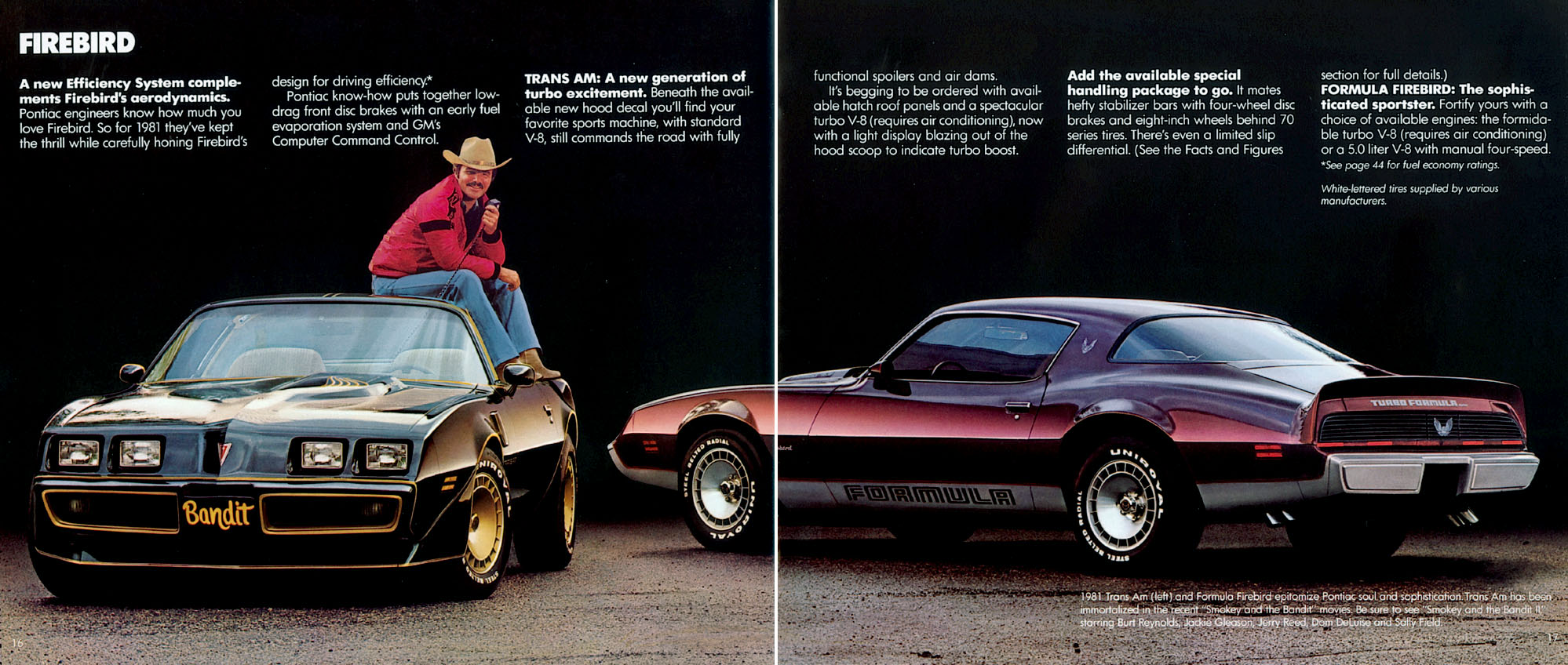
Firebird pages from the 1981 Pontiac brochure

Packages & Options

The Trans Am Special Edition package was $735 additional over a base Trans Am—$1,430 bundled with the removable locking hatch roof (otherwise known as T-tops). There was also a special edition of the Special Edition—the NASCAR Daytona 500 Pace Car, resplendent in oyster white with a black and red interior. It included the LU8 turbocharged engine, the WS6 special performance package, four-wheel power disc brakes, and a limited-slip differential. Inside, the most notable upgrade from other Turbo Trans Ams was Recaro front seats—among the best available production seats from any manufacturer in 1981. All this extra content was a good thing because the NASCAR Daytona 500 Pace Car listed for $12,257—about $46,700 in 2025 dollars.

Exterior and mechanical options available for the Trans Am included the WS6 special performance package, a limited-slip differential, tungsten quartz halogen headlamps ($29), white-lettered tires, cast aluminum wheels, four-wheel power disc brakes, and an automatic power antenna ($50). Inside, an electric rear window defroster ($115), power door locks ($99), Custom air conditioning ($600), Custom bucket seats, and a host of radios (seven!) were all available.

The View From 2025

1000 views badge

Initially neglected by the collector market and with many now used up, late second-generation Trans Ams in good or excellent shape are now getting interesting numbers—almost doubling in the past ten years. According to Hagerty’s valuation tools, all the money for a 1981 Trans Am NASCAR Daytona 500 Pace Car in #1/Concours condition is $69,300, with a more normal non-Turbo Trans Am in #3/Good condition version valued at $14,800. These Trans Ams are often available in the Hemmings Motor News classifieds, on eBay Motors, and on Bring A Trailer, and they frequently show up at in-person auctions.

Make mine the black and gold Special Edition, of course. The NASCAR Daytona 500 Pace Car is tempting, if only for those Recaro seats.

I evidently can’t help myself with eighties Trans Ams; I’ve also written about the 1982 hatchback coupe, the 1984 15th Anniversary hatchback coupe, the 1985 hatchback coupe, and the 1989 Turbo hatchback coupe. I have written about the 1986 SE hatchback coupe and the 1987 Formula hatchback coupe, but I probably should write about the base car at some point.

Last updated September 2025.

1985 Mazda RX-7 GSL-SE hatchback coupe

This post was one of my first twenty in this blog, which I’ve updated to reflect both changes in my posting style and substantial improvements in available data. At this point, it’s changed enough to be considered a new post.

“… artfully appointed to raise the aesthetic pleasures of driving …”

The 1985 Mazda RX-7 GSL-SE was the last of the first generation SA (1978-1980/FB (1981-1985) RX-7s, which had debuted in 1978, timing the market perfectly for a relatively low-priced and good-looking sports car. At $7,195 when released, it hit an attractive price point and entered a market with few natural competitors for such a pure sports car.

Bosch L-Jetronic fuel injection and more power had come in 1984 with the 13B Wankel 1.3 liter/80 ci two-rotor engine. Power increased from 101 bhp to 135 bhp—respectable for a relatively lightweight (2,447 pounds) sports car and dropping 0-60 times more than a second to slightly under 8 seconds. Even with the five-speed manual transmission, mileage remained somewhat of the traditional rotary bugaboo that would eventually drive Mazda out of the rotary business. At 16 city/23 highway by the day’s standards (15/22 by today’s measures), it was not as good as the Nissan/Datsun 300ZX (19/25) or the Toyota Celica Supra (20/24)—both of which had more power. Owners of a new RX-7 could expect to get about 275 to 290 miles of range from the 16.6-gallon fuel tank before starting to look for more gasoline.

Standard exterior and mechanical equipment on every 1985 RX-7 ($10,945 or approximately $33,800 in today’s dollars) included retractable headlamps, tinted glass, side window demisters, electric rear window defroster, and 185/70HR13 radial tires on 5 x 13-inch wheels. Inside, full gauges, reclining bucket seats with adjustable headrests, a full console with armrest, a digital quartz clock, and an AM/FM stereo radio with power antenna were standard.

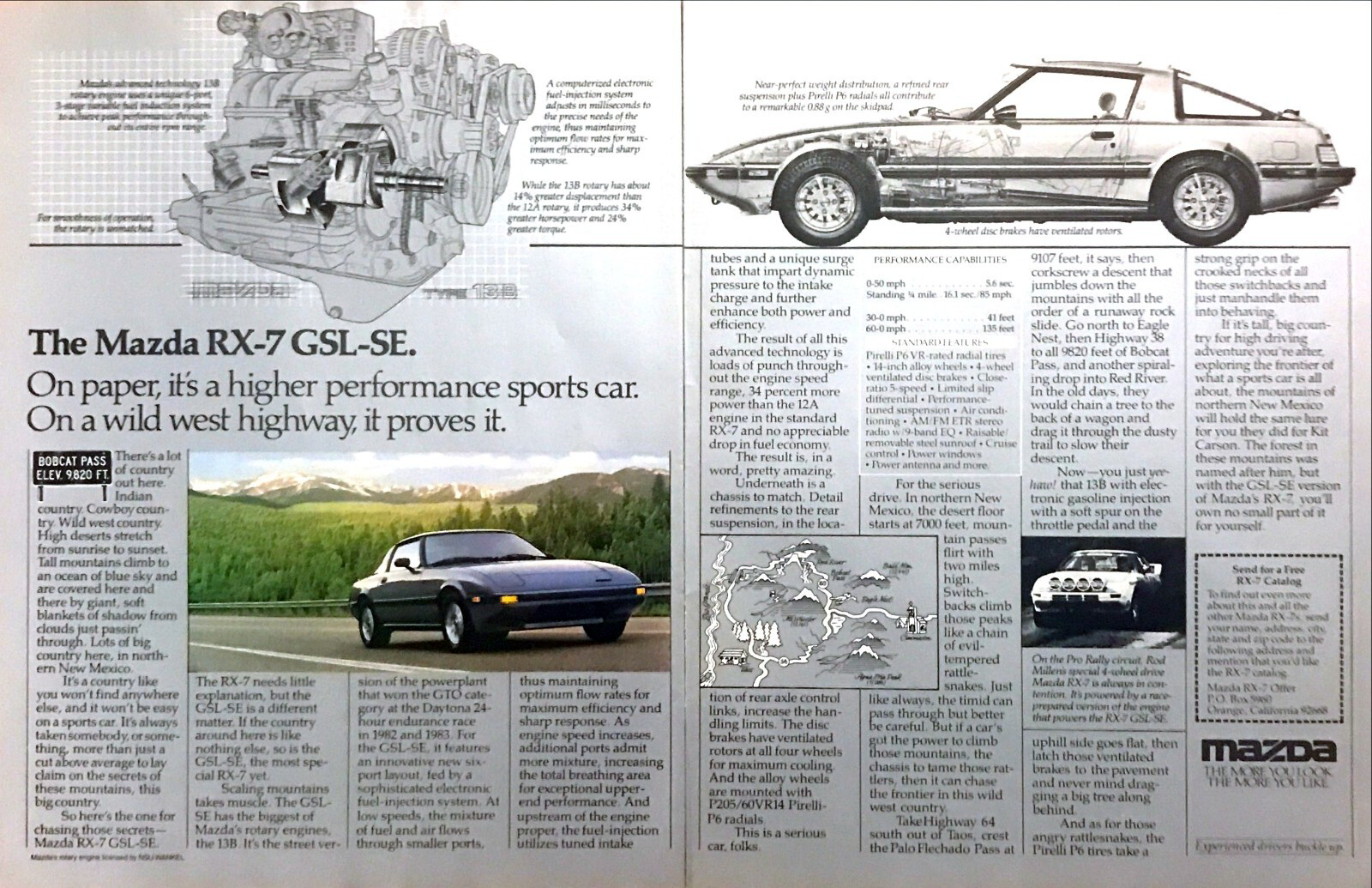
1985 Mazda RX-7 GSL-SE print advertisement

By 1985, the fancier RX-7s had slid well up-market—the GSL-SE‘s package’s price was $16,125 (about $49,700 in 2025 dollars; well more than a loaded 2025 Miata MX-5 RF Grand Touring). Exterior and mechanical equipment on the GSL-SE included retractable halogen headlamps, a raisable/removable steel sunroof, ventilated four-wheel power disc brakes, and “low profile” P205/60VR14 Pirelli P6 tires (a size now tough to find) on 5.5 x 14-inch Performance alloy wheels. Inside, every GSL-SE included striped velour seats with solid velour bolsters, air conditioning, cruise control, power windows, dual black remote control sideview mirrors, and an AM/FM ETR stereo radio with a separate auto-reverse cassette player sitting below—with a nine-band graphic equalizer below that.

Optional equipment for the loaded GSL-SE was limited to a leather package ($700), which included leather seats, leather door trim, and a leather steering wheel.

The View From 2025

I followed a first-generation RX-7 for a while in my eighties sports car about a decade ago, and I was struck by how small it looked—smaller than I remembered these cars as being. They were small, of course: 170 inches long and less than 50 inches tall.

RX-7 aficionados call these “5-letter cars.” According to Hagerty’s valuation tools, all the money for a 1985 RX-7 GSL-SE in #1/Concours condition is $53,400, with a more normal #3/Good condition car going for $11,900. RX-7s have fairly solid club support and maintain a reasonable presence in the Hemmings Motor News classifieds, on eBay Motors, and on Bring a Trailer.

Make mine Sunbeam Silver Metallic, please—I think light silver works best on these cars.

The only other Mazda I have completed a blog entry for is the 1983 626 coupe. Other 1985 sports cars I have written about include the Ferrari 308 GTB Quattrovalvole coupe, the Porsche 911 Carrera Cabriolet, and the Toyota MR2 coupe.

Last updated December 2025.

1989 Chevrolet Celebrity sedan

A co-worker of mine casually mentioned that he owns a beige 1989 Chevrolet Celebrity sedan. That’s enough for me to write a blog entry.

“contemporary front-drive technology”

For 1989, Chevrolet’s Celebrity mid-size sedans and wagons were little changed. The major news was that the five-speed manual transmission that (very) few bought was no longer available and that the coupe had been discontinued.

Standard power on the Celebrity remained the Tech IV 98 bhp 2.5 liter/151 ci inline four with throttle-body fuel injection. The LB6 125 bhp 2.8 liter/181 ci V6 with multi-port fuel injection was available for $610. A three-speed automatic transmission was standard on both engines, but buyers of the V6 could add a four-speed automatic for an additional $175.

With these two engines and curb weights in the 2,750 to 2,800-pound range, the Celebrity was not a fast car. 0-60 mph with the four was a little over 13 seconds, while V6 owners got to 60 mph about two seconds faster.

Mileage with the base four was 23 city/30 highway (21/28 by today’s standards), while owners of the top-of-the-line V6/four-speed automatic combination could expect 20 city/29 highway. With a 15.7-gallon fuel tank, Celebrity V6 drivers could expect a range of between 310 and 350 miles with a 10% fuel reserve.

My colleague's 1989 Celebrity, prior to restoration.
My colleague’s 1989 Celebrity before restoration.

Standard equipment on the $11,495 Celebrity (about $30,800 in today’s dollars or about what a 2025 Chevrolet Equinox LT SUV goes for) included power steering, power brakes, 14-inch wheels on P175/75R14 tires (a size now tough to find), and a Delco AM/FM stereo radio with digital clock. Adding the V6 and the four-speed automatic brought the price up to $12,280, or about $33,000 in today’s dollars.

Packages & Options

By 1989, Chevrolet was moving to Preferred Equipment Group option packages as a way to reduce the number of equipment combinations. The Celebrity’s option packages were:

  1. Air conditioning, auxiliary lighting, exterior moldings, floor mats—($931 with the 2.5 liter inline four/$957 with the 2.8 liter V6)
  2. Air conditioning, auxiliary lighting, exterior moldings, floor mats, power door locks, gauge package, cruise control, tilt steering wheel, and intermittent windshield wipers—($1,565 with the 2.5 liter inline four/$1,591 with the 2.8 liter V6)
  3. Air conditioning, auxiliary lighting, exterior moldings, floor mats, power door locks, gauge package, cruise control, tilt steering wheel, and intermittent windshield wipers, sport remote mirrors, AM/FM stereo cassette with digital clock, power trunk opener, and power windows—($2,062 with the 2.5 liter inline four/$2,088 with the 2.8 liter V6)

Adding the Preferred Equipment Group 3 to a Celebrity with the V6 and the four-speed automatic brought the price all the way up to $14,368, or about $38,600 in today’s dollars.

The most glamorous option for the Celebrity continued to be the $230 Eurosport package, which included the F41 sport suspension and P195/75R14 tires (a size still available thanks to Hankook and Kumho) and 14-inch rally wheels. The exterior featured blacked out window trim and red center stripes on the protective rubber door and bumper molding; fender and trunk emblems were red rather than the standard chrome. Eurosports also featured unique red emblems on the interior door panels and dash and a black steering wheel.

Other optional equipment included two-tone paint ($55), aluminum wheels ($195), an engine block heater ($20), cloth bucket seats with a console ($257), and a six-way power driver’s seat ($250).

1989 would end up being the last year for the Celebrity sedan—the wagon would soldier on for one more year.

The View From 2025

Badge for 2,500 web hits

I think of these cars as honest but basic; they aren’t really being collected, though I did see an early (1982-1985) coupe at an AACA show about fifteen years ago. Celebrities occasionally show up for sale in the Hemmings Motor News classifieds, on eBay Motors, and on Bring a Trailer.

Make mine Black, I think.

Other A-bodies I’ve written about in this blog include the 1986 Buick Century sedan, the 1985 Oldsmobile Cutlass Ciera sedan, and the 1983 Pontiac 6000 STE sedan.

Last updated August 2025.

Save

1985 Mercedes-Benz 300CD Turbo coupe

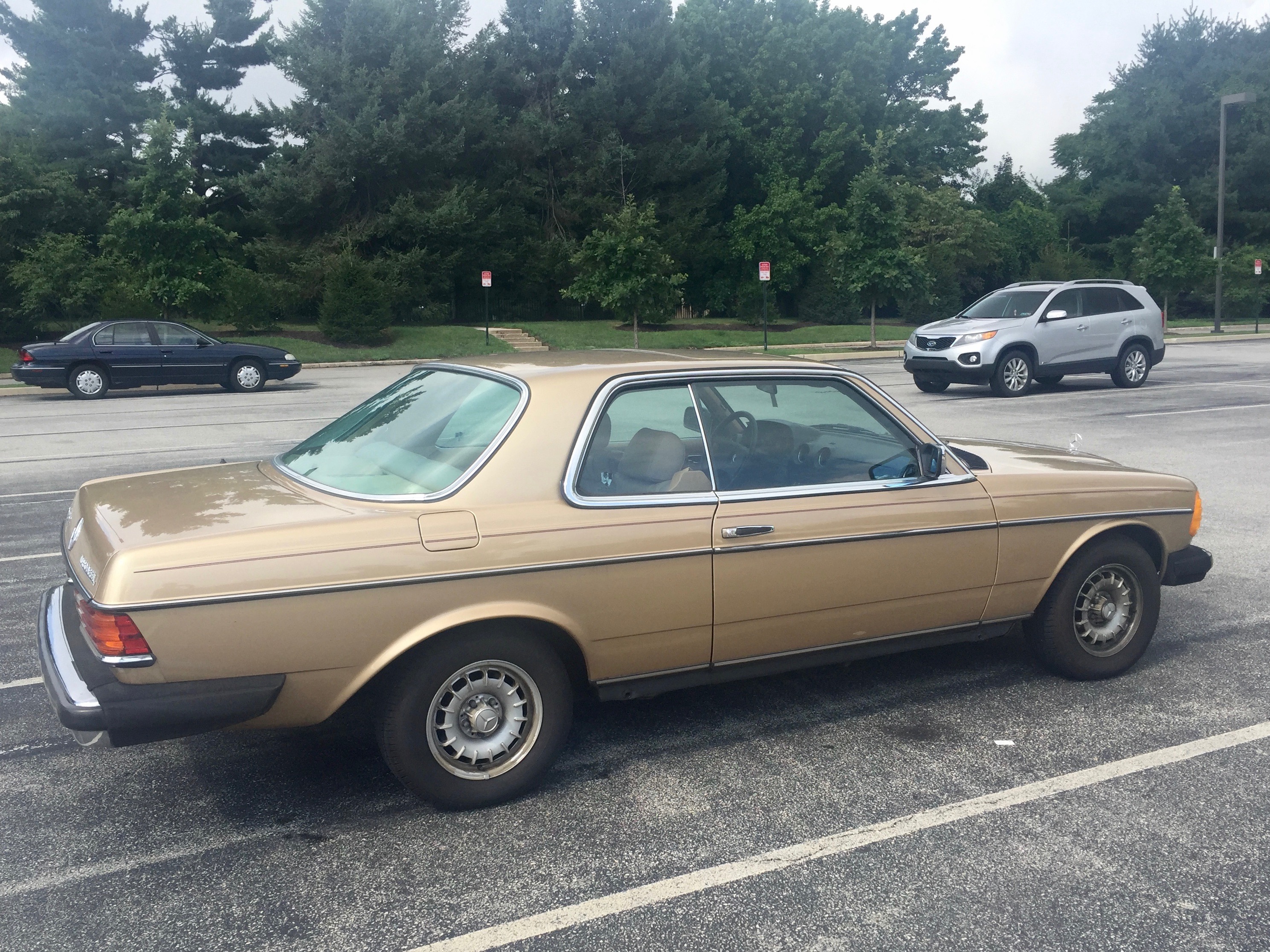
A 1985 Mercedes-Benz 300D Turbo Coupe in Radnor, PA
An (I think) Champagne Metallic Mercedes-Benz 300CD Turbo in Radnor, PA

For some strange reason, one—but only one—of the supermarkets in my area often features interesting eighties cars in its parking lot. Back in mid-2016, there was a Mercedes-Benz 300CD Turbo coupe casually parked among the crossovers—a good enough reason for this blog entry.

“A singular new achievement”

1985 was the last model year for Mercedes-Benz’s mid-size W123 models—the substantially revised and very different-looking W124 models would follow for 1986.

For 1985, the 300CD Turbo powertrain continued to be the fuel-injected 125 bhp 3.0 liter/183 ci inline five turbodiesel connected to a four-speed automatic transmission. At about 3,360 pounds, these were not fast cars—Car and Driver recorded a 0-60 time of 12 seconds. Fuel economy was 22 city/25 highway by the day’s standards—19/23 by today’s measures. With the 21.1-gallon fuel tank, the driver of a 300CD could expect 400 to 445 miles of range with a 10% reserve.

Standard Equipment & Options

The base price for the 300CD Turbo was a non-trivial $35,220—about $108,800 in today’s dollars or almost twice what a 2026 CLE 300 4MATIC coupe goes for. You did get a lot of standard equipment for a 1985 vehicle: power steering, power brakes, halogen headlamps, halogen fog lamps, and 195/70HR14 tires (a size still readily available) on 14-inch light alloy wheels were all included. Inside, eight-way power front bucket seats, power windows, power door locks, cruise control, intermittent windshield wipers, electronic climate control, and an AM/FM stereo with cassette player and power antenna were standard.

There were few options on the 300CD Turbo: leather upholstery, an anti-theft alarm system ($335), and a power sunroof (optional at no extra cost) were available.

The View From 2026

W123 models definitely have a following, especially the relatively rare coupes and the 300TD wagons. According to Hagerty’s valuation tools, all the money for a 1985 300CD in #1/Concours condition is $66,300, with a more normal #3/Good condition car going for $25,400. 300CDs sometimes show up for sale in the Hemmings Motor News classifieds, on eBay Motors, and on Bring a Trailer, often with over 200,000 miles on the odometer. As I update this blog post in February 2026, there’s a Thistle Green Metallic 1982 300CD with Olive seats and unknown mileage for sale on Hemmings, asking $12,800.

I like these coupes, with their smooth hardtop lines and their reasonable size. Make mine Astral Silver Metallic, I think.

Other Mercedes-Benz models I have written about include the 1980 450SL convertible, the 1981 380 SEL sedan, the 1985 380SL convertible, the 1986 560SEC coupe, the 1986 560SL convertible, and the 1989 560SL convertible.

Last updated February 2026.

1985 Ford LTD LX sedan

“Because Mr. Bondurant shouldn’t have all the fun.”

Late in the 1984 model year, Ford added a performance-oriented model to the Fairmont-based LTD line. The LX was loosely based on a few sedans that Bob Bondurant had cobbled together for use at his high-performance driving school. For 1985, the LX wore the updated nose and tail that came along with all 1985 LTDs.

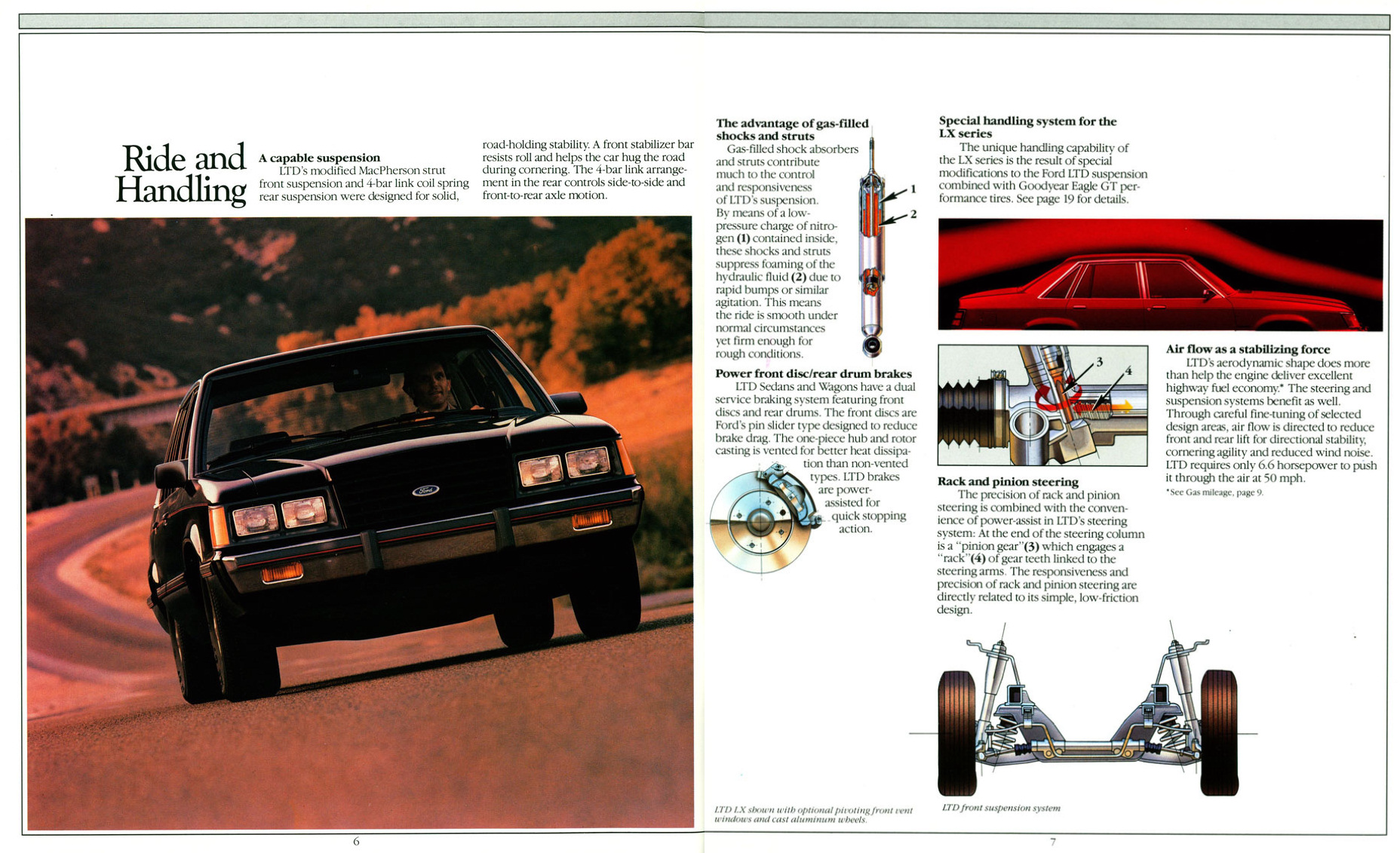
The engine was Ford’s 165 bhp 4.9 liter/302 ci Windsor V8 with electronic fuel injection. The only transmission available was a four-speed automatic transmission. 0-60 came in a respectable 9 seconds—faster than the Dodge 600ES and competitive with the Pontiac 6000 STE. Mileage was 19 city/23 highway by the day’s standards (17/22 by today’s measures). With a 16-gallon gas tank, the range was 280 to 300 miles with a 10% fuel reserve.

LX pages from the 1985 Ford LTD brochure

The 1985 LX had a base price of $11,421—about $35,200 in 2025 dollars. Standard exterior and mechanical equipment included quad rectangular halogen headlamps, power brakes, a Traction-Lok rear axle, a rear stabilizer bar, and P205/70HR Goodyear Eagle tires (a size still readily available) on 14-inch styled road wheels. Inside, dual power mirrors, lumbar-support bucket seats, a center console with a floor shifter for the transmission, brushed aluminum trim on the dash bezels, an upgraded instrument cluster with tachometer, a Tripminder computer, and an AM radio with dual front speakers (ah, the glamor!) were included.

Options included cast aluminum wheels ($224), air conditioning ($743), power windows ($272), power locks ($213), and an electronic AM/FM stereo radio with cassette ($409).

Like some other interesting Ford performance cars from the 1980s (I’m thinking of you, Mustang SVO), LTD LXs did not sell well, with only 3,260 sold over the 1984 and 1985 model years (there would be no 1986 LX).

The View From 2025

Likely because of the limited production numbers, you rarely see LTD LXs in the Hemmings Motor News classifieds or on eBay Motors. Bring a Trailer has sold a few eighties LTDs, but none of the LX variety. There is some enthusiast support.

Make mine Medium Charcoal Metallic, please.

The only other 1985 Ford product I’ve written about is the Ford Eddie Bauer Bronco SUV.

SaveLast updated October 2025.

1980 Pontiac Grand Am coupe

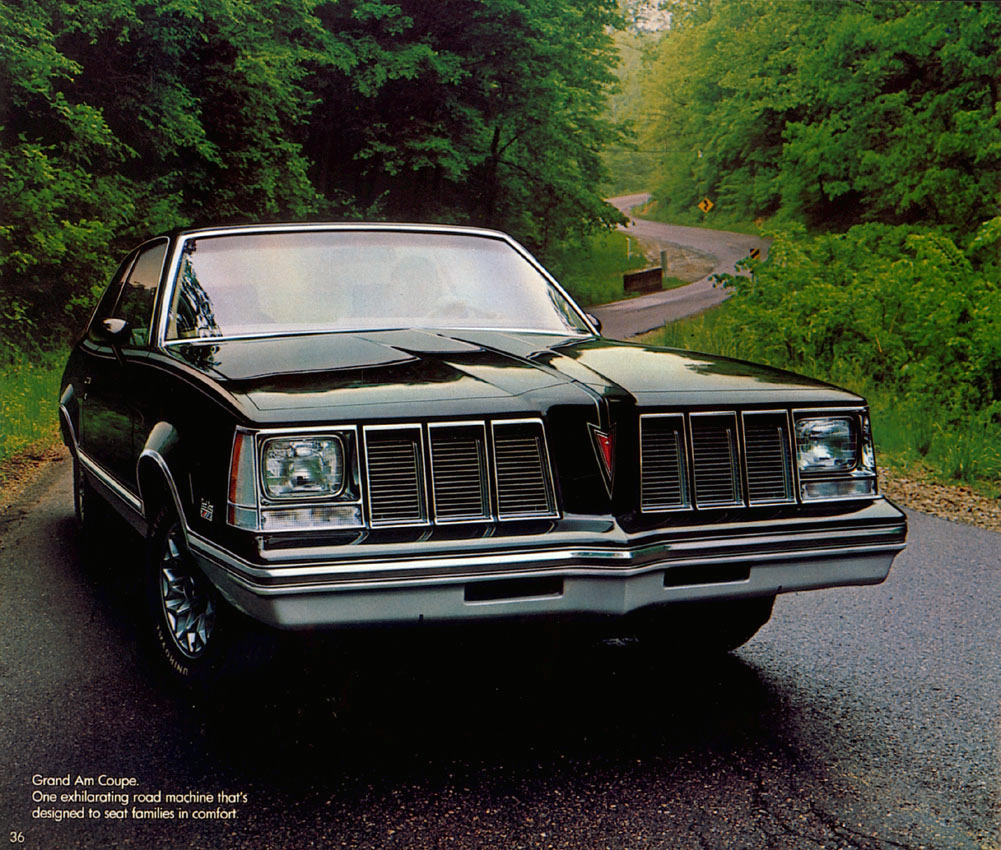
“One exhilarating road machine”

The last of the rear-wheel-drive Grand Ams came in 1980. Unlike in 1978 and 1979, the sedan was no longer available—only the coupe remained.

The standard engine in non-California cars was the L37 155 bhp 4.9 liter/301 ci V8 with four-barrel Rochester carburetor and electronic spark control (California cars got the Chevrolet-sourced LG4 150 bhp 5.0 liter/305 ci V8). The only transmission available was a three-speed Turbo-Hydramatic TH200 automatic transmission. Performance was respectable for 1980—Car and Driver recorded a zero to sixty time of 11 seconds. Mileage was 17 city/25 highway by the day’s standards. With an 18.1-gallon gas tank, range was 280 to 305 miles with a 10% fuel reserve.

New features for 1980 included a revised soft-fascia front end with three sections per side, an Ontario Gray lower accent color for the exterior, a silver upper body accent stripe, larger wraparound black-out tail lamps, and larger front and rear stabilizer bars for the optional ($45) Rally RTS handling package.

Grand Am page from the 1980 Pontiac brochure

The Grand Am’s base price was $7,299—about $31,400 in 2025 dollars. Standard exterior and mechanical equipment included dual sport mirrors, dual horns, power steering, power front disc/rear drum brakes, and 205/75R14 black sidewall radial tires (a size still readily available) on 14-inch Rally IV cast aluminum wheels. Inside, Grand Am purchasers could expect cut-pile carpeting, Custom vinyl front bucket seats with center floor console, rally gages with a clock embedded in a brushed aluminum instrument panel, and a Custom sport steering wheel.

Options, Period Reviews, & Production Numbers

Available exterior and mechanical options included a power sunroof—either metal ($561) or glass ($773), dual remote sport mirrors ($73), Soft-Ray tinted glass ($107), and electric rear window defroster ($107). Inside, air conditioning ($601), power door locks ($93), power windows ($143), a six-way power driver’s seat ($175), a tilt steering wheel ($81), automatic cruise control ($112), and an AM/FM stereo radio with a stereo cassette player ($272) were all available. A nicely configured Grand Am could easily push past $9,700—real money in 1980 and about $41,800 in today’s dollars.

Period reviews settled into the “we’re glad they make it, but we’re not sure we’d buy it” category. Car and Driver called the 1980 Grand Am “a noble experiment” and praised its handling.

Grand Ams didn’t sell at all well in 1980—Pontiac moved only 1,647 of them, after selling almost five times as many coupes only two years prior in 1978. Despite this, Pontiac would not give up on the Grand Am name—it would be back in 1985 as a small front-wheel-drive coupe.

The View From 2025

1000 views badge

Most of the Grand Ams being collected are the larger and more powerful first-generation Colonnade versions sold from 1972 to 1975. You do occasionally see second-generation Grand Ams for sale in the Hemming’s Motor News classifieds and on eBay Motors. Bring a Trailer’s only second-generation Grand Am sale so far was a very rare 1979 Grand Am coupe with a four-speed manual in 2024. I haven’t seen a Grand Am from this generation for many years.

Make mine Starlight Black, please.

Other G-bodies covered in this blog include the 1980 Grand Prix SJ coupe, the 1981 Chevrolet Monte Carlo Sport Coupe, the 1981 Oldsmobile Cutlass Supreme coupe, the 1983 Chevrolet Malibu sedan, the 1983 Chevrolet Monte Carlo SS Sport Coupe, the 1984 Buick Regal Grand National coupe, the 1987 Buick GNX coupe, and the 1987 Pontiac Grand Prix coupe. Another 1980 Pontiac I have written about is the Sunbird Sport Hatch.

Last updated October 2025.

Save

Save