1984 Buick Skyhawk coupe

“Take flight.”

1984 was the third year for the Skyhawk, Buick’s version of the J-car, and it was little changed, except for the mid-year release of a turbocharged engine. New options included a factory stereo with a graphic equalizer.

The Skyhawk’s standard powertrain was an LQ5 86 bhp 2.0 liter/121 ci inline four with throttle-body fuel injection paired with a four-speed manual. An LH8 84 bhp 1.8 liter inline four with throttle-body fuel injection was $50, but required an upgrade to a five-speed manual ($75). Both engines were available with a three-speed automatic ($395). An LA5 turbocharged version of the 1.8 liter engine with 150 bhp was only available with the T TYPE coupe.

Performance wasn’t exactly scintillating with the two non turbocharged engines, but Skyhawk coupe’s relatively low 2,316-pound weight did help. 0-60 times with the 1.8 liter/five-speed combination were likely in the 12 second range. Fuel economy with the same powertrain was rated at 29 city/46 highway by the day’s standards—today’s measures give a far less impressive 23/33. With a 13.5-gallon gas tank, a Skyhawk owner could expect a range of 340 to 455 miles with a 10% fuel reserve.
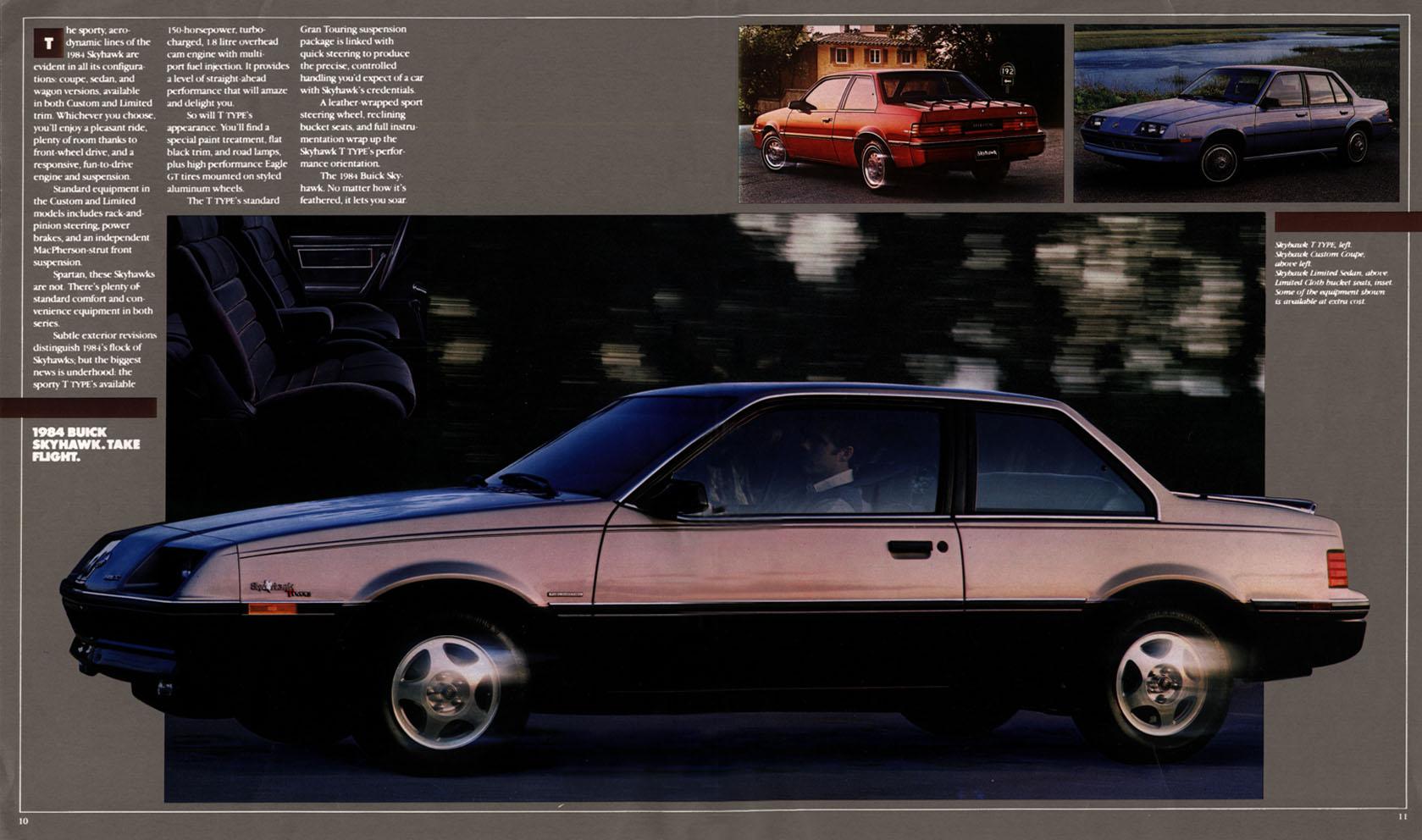
Two Skyhawk pages from the 1984 Buick brochure
Skyhawk pages from the 1984 Buick brochure

Standard exterior and mechanical equipment on the $7,133 base Skyhawk coupe (designated as Custom) included manual rack-and-pinion steering, power front disc/rear drum brakes, and P175/80R13 blackwall tires on 13-inch wheels with Deluxe wheel covers. Inside, full carpeting, reclining front bucket seats, a full-length operating console, a Custom steering wheel, and an AM radio were included.

Moving up to the $7,641 Limited (about $24,100 in 2025 dollars and slightly less than a 2025 Buick Encore GX SUV costs) added dual horns, an acoustic package, a Limited steering wheel, and instrument gauges, along with cloth-covered seats and door panels.

Options & Production Numbers

Exterior and mechanical options for the Skyhawk coupe included tinted glass ($95), tungsten-halogen headlamps ($22), and styled aluminum wheels ($229). Inside, Electronic Touch Climate Control air conditioning ($780), manual air conditioning ($630), power windows ($185), and a series of stereo choices ranging up to an electronic tuning AM/FM stereo radio with cassette tape and graphic equalizer ($505) were all available.

1984 marked the Skyhawk’s peak sales year, with Buick producing 75,760 coupes, 45,648 sedans, and 13,668 station wagons. Buick made them through the 1989 model year, by which time sales numbers had dropped to a mere fraction of those in 1984.

The View From 2025

I haven’t seen a second-generation Skyhawk in person in many years. Still, they are sometimes available in the Hemmings Motor News classifieds and at online auctions such as Bring a Trailer that cater to the eighties car market. When I first published this blog entry in September 2022, Hemmings had a 1986 White Skyhawk T-Type hatchback with gray lower accents, silver/black cloth bucket seats, and 10,000 miles for sale for $16,000.

Make mine Silver Metallic, please.

Other J platform cars I have covered in this blog include the 1982 Cadillac Cimarron sedan, the 1988 Cadillac Cimarron sedan, the 1986 Chevrolet Cavalier Z24 coupe, the 1985 Oldsmobile Firenza ES sedan, and the 1984 Pontiac 2000 Sunbird S/E hatchback coupe.

Last updated March 2025.

1984 Chevrolet Camaro Sport Coupe

In early 2022, Bring a Trailer featured a 1984 Chevrolet Camaro Sport Coupe that was generally original except for the wheels and tires. It sold for $8,000.

“Looks. Performance. Price.”

For 1984, the Chevrolet Camaro Sport Coupe had relatively few changes. A four-speed automatic became the only automatic available (1983 Camaros had three-speed and four-speed automatic options). Steel-belted radial tires were newly standard on all Camaros, and all manual transmission vehicles received a hydraulic clutch.

The standard powertrain for the Sport Coupe continued to be the LQ9Iron Duke” 92 bhp 2.5 liter inline four with fuel injection, paired with a four-speed manual transmission. Optional engines were two: the LC1 107 bhp 2.8 liter V6 with a two-barrel carburetor ($250) and the LG4 150 bhp 5.0 liter V8 with a four-barrel carburetor ($550). A five-speed manual ($125) and a four-speed automatic ($525) were optional.

With the standard powertrain, the Sport Coupe was all show, no go. 0-60 tests of four-cylinder F-cars are rare to nonexistent, but reasonable estimates are in the high 14 to high 15 second range. For all that trouble, mileage wasn’t that impressive: 24 city/36 highway by the day’s standards. With a 15.5-gallon gas tank, a four-cylinder Sport Coupe owner could expect a range of 340 to 375 miles with a 10% fuel reserve.

The hot setup for the Sport Coupe, such as it was, was the LG4 V8 paired with the four-speed automatic (five-speed manuals with V8s were Z28-only in 1984). For a total of $1,075, this combination changed the car’s character, with the 0-60 time dropping by almost four seconds compared to the base four. These changes did not mean that a V8 Sport Coupe would see anything but the taillights of a Z28 with the 190 bhp “H.O.” V8. Fuel economy ratings with the V8 also dropped significantly to 18 city/29 highway, but a slightly larger 16.1-gallon fuel tank reduced the range penalty—a V8 Sport Coupe owner could expect a 280 to 305 mile range.

Perhaps the most engaging Sport Coupe—but certainly not the fastest—was the LC1 V6/five-speed manual combination. At $375 over the base car, it was about a second faster from 0-60 mph. Fuel economy ratings of 20 city/31 highway along with a 16.1-gallon fuel tank meant a 330 to 330 mile fuel range.

Sport Coupe pages from the 1984 Camaro brochure

Standard exterior and mechanical equipment for the $8,097 Sport Coupe (about $26,000 in today’s dollars) included dual black side mirrors, fast-ratio power steering, power front disc/rear drum brakes, and P195/75R14 radial tires (a size still reasonably available) on 14-inch body-colored wheels with hubcaps. Inside, reclining front vinyl bucket seats, a floor console, and an AM radio were included.

Options & Production Numbers

Options were many and included body color Sport mirrors ($139), a rear deck spoiler ($69), tinted glass ($110), removable glass roof panels ($850), and four-wheel power disc brakes ($179 and V8-only). Inside, buyers could add a gage package with a tachometer ($149), Deluxe luggage compartment trim ($164 and including a locking rear compartment storage cover), Custom cloth bucket seats ($359 and including quiet sound group), and air conditioning ($730).

Six different optional radios were available, with the top-of-the-line being an electronically tuned AM/FM stereo radio with seek and scan, cassette tape, clock, and graphic equalizer ($493). A well-equipped Sport Coupe could easily sticker for substantially more than a base Berlinetta or Z28.

The 1984 Sport Coupe sold quite well—Chevrolet moved 127,292 units, making it about 49% of overall Camaro sales. 1984 would be the peak for Sport Coupe sales in the 1980s, and it isn’t obvious why.

The View From 2025

Third-generation Camaros have substantial forum support and they attract collector interest. According to Hagerty’s valuation tools, a 1984 Camaro Sport Coupe with the V8 in #1/Concours condition is $21,400, with a far more normal #3/Good condition version going for $7,000. V6 versions get a 30% deduction, while four-cylinder cars go for half price. These Camaros are often available in the Hemmings Motor News classifieds, on eBay Motors, and at online auctions such as Bring a Trailer that cater to the eighties car market.

Make mine Charcoal Metallic, please.

Other third-generation Camaro hatchback coupes I have written about include the 1982 Z28 Indy 500 Commemorative Edition, the 1985 IROC-Z, and the 1986 Berlinetta. I have yet to write about any of the 1987 through 1989 Camaro convertibles.

Last updated October 2025.

1984 Mercury Grand Marquis Colony Park LS station wagon

At Mecum Kansas City 2021, a Light Desert Tan Mercury Grand Marquis Colony Park LS station wagon with bodyside and tailgate rosewood woodtone appliques sold for $8,500. For Boxing Day 2021, here’s a big American station wagon.

“luxurious working cars”

For 1984, Mercury’s Grand Marquis Colony Park station wagon was little changed. The Colony Park name had been around since 1957 as a signifier of Mercury’s top-of-the-line station wagon.

The Colony Park’s only powertrain—indeed the only powertrain available for any Grand Marquis—was a Windsor 140 bhp 4.9 liter/302ci V8 with fuel injection paired with a four-speed automatic. Fuel economy was 17 city/27 highway by 1984 standards (14/20 by current measures). With an 18.5-gallon fuel tank, a Colony Park owner could expect a range of between 285 and 365 miles with a 10% fuel reserve.

The Colony Park was a large car, with a 114.1-inch wheelbase and 218-inch length. It had changed little since 1979, when Ford downsized its full-size cars to the Panther platform. Changes over the next five years were mostly confined to trim and color variations, along with powertrain changes.

Colony Park pages from the 1984 Grand Marquis brochure

Standard exterior and mechanical equipment on the $11,816 Grand Marquis Colony Park (about $32,500 in today’s dollars or about what a base 2022 Ford Explorer goes for) included the distinctive “bodyside and tailgate rosewood woodtone applique,” a three-way tailgate, a power tailgate window, power steering, power front disc/rear drum brakes, and P215/75R14 white sidewall tires (a size still available thanks to Hankook) on 14-inch wheels with Deluxe wheel covers. Inside, reclining Twin Comfort Lounge front seats in vinyl, a fold-down rear seatback, and AM/FM stereo radio with two rear speakers were included.

At $12,437, the Colony Park LS added tinted glass, Luxury cloth seat trim for the Twin Comfort Lounge front seats, seatback map pockets, and 18-ounce color-keyed cut-pile carpeting.

Packages, Options, and Production Numbers

Packages available for the Colony Park included Convenience Group, Lock Group, Light Group, and the Trailer Towing Package.

Since there were no Lincoln station wagons, the Colony Park LS was the top-of-the-line wagon available from Ford Motor Company in the mid-1980s. Despite all the luxury Mercury implied the Colony Park LS had, it still didn’t include standard air conditioning, though the take rate on the two air conditioning options—one manual ($743) and one automatic ($809)—must have been high.

Other options available included “glamour” paint ($77), a luggage rack ($104), a Traction-Lok axle ($95), fingertip speed control ($176), a leather-wrapped steering wheel ($59), a tilt steering wheel ($110) and the Premium Sound System. Optional P205/75R15 tires ($17/$178 if puncture sealant) required the optional turbine spoke cast aluminum wheels ($361). A well-equipped Colony Park could easily get to $14,600—not that many thousand dollars from Lincoln money.

Mercury sold 17,421 Colony Park wagons in 1984, but the split for the base versus the LS versions is unknown.

Make mine Medium Canyon Red Metallic, please.

Two other Panther-based cars I have written about are the 1980 Lincoln Continental Mark VII coupe and the 1983 Mercury Grand Marquis sedan.

1984 Honda Civic DX hatchback coupe

The 1984 model year brought the third generation Honda Civic, which was available in hatchback coupe, notchback sedan, and wagon versions—along with the CRX, of course. The topic of this post is the hatchback coupe in the upscale DX trim. With its Kammback design, Honda’s new hatchback brought unprecedented style to the compact car segment.

The Civic’s standard powertrain was a 60 bhp 1.3 liter/82 ci inline four with a CVCC three-barrel carburetor and a four-speed manual. However, the DX received a more powerful EW 76 bhp 1.5 liter/91 ci inline four with three valves per cylinder and a CVCC three-barrel carburetor along with a five-speed manual. DX purchasers could also choose an automatic. In a DX with the manual transmission, 0-60 came in about 11 seconds—more than competitive in class in 1984.

With its standard manual transmission, fuel economy ratings for the DX were an excellent 35 city/45 highway by the standards of the day and a still respectable 27/32 by today’s standards. Despite the small 11.9-gallon fuel tank, a new DX owner could expect a range of from 315 to 425 miles with a 10% fuel reserve.

1984 Honda Civic Hatchback advertisement

At the beginning of the model year, the base Civic hatchback coupe went for $5,242—about $13,500 in 2020 dollars. Standard mechanical equipment on every Civic hatchback included front-wheel-drive, rack and pinion steering, and 155/80R13 steel-belted radial tires (a size still available thanks to Kumho) on 13-inch wheels. Inside, every Civic hatchback included a day/night rearview mirror and reclining front bucket seats.

The $6,292 DX—about $16,200 in today’s dollars and almost exactly what a base 2020 Honda Fit hatchback sedan goes for—added the aforementioned engine and transmission upgrades. It also included tinted glass, a rear window defroster, and reclining rear seatbacks.

There were few factory options beyond the automatic transmission, but many accessories listed in the brochure. Air conditioning was a dealer-installed option for the Civic—and would be so well into the 1990s.

Overall, the 1984 Civic sold very well—at 184,846, it set a new sales record for Honda. Third-generation Civics rarely show up for sale in the Hemmings Motor News classifieds but have more of a presence on eBay Motors—though most are either highly modified or with substantial miles.

Make mine Claret Red Metallic, please.

Other Hondas I have written about include the 1983 Civic S hatchback coupe, the 1984 CRX hatchback coupe, the 1985 CRX Si hatchback coupe, the 1986 Accord sedan, and the 1988 Civic sedan.

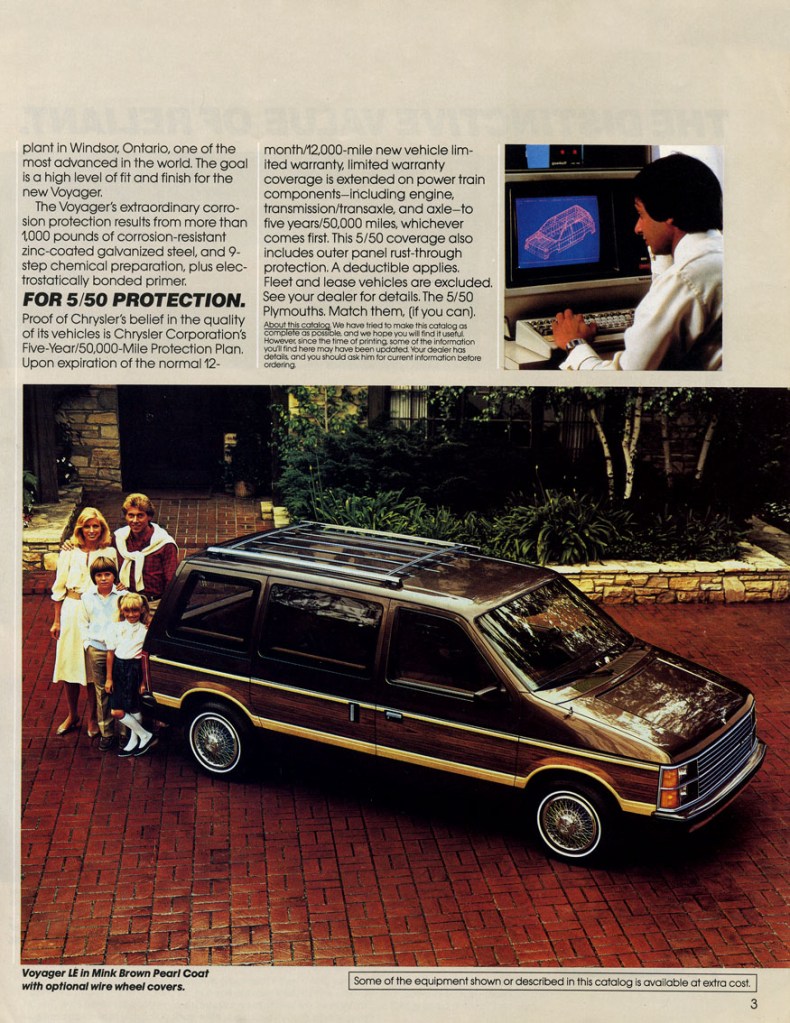
1984 Plymouth Voyager van

1984 Plymouth Voyager on the National Mall
1984 Plymouth Voyager on the National Mall, courtesy of the HVA

In spring 2018, the Historic Vehicle Association placed a series of five notable vehicles in a glass case on the National Mall in Washington, DC. One of those vehicles was a 1984 Plymouth Voyager Limited Edition minivan—highly original, and with a mere 12,000 miles.

“The Magic Wagon.”

Few eighties vehicles changed the world as much as the Dodge Caravan/Plymouth Voyager twins—because few automobiles essentially create a new market segment. The essential glory of K-platform minivans was their splitting of the packaging differences between traditional station wagons and full-size vans, along with their utilization of front-wheel-drive. Astoundingly, Allpar writes that Chrysler had been working on the same basic idea since around 1972. A reason given that those early designs were not brought to market was that General Motors and Ford had not released their own versions. It took Lee Iaccoca’s arrival in late 1978 to finally get upper management support for the T-115 concept.

The Voyager’s standard powertrain was an 84 bhp 2.2 liter/135 ci inline four with a two-barrel carburetor paired with a five-speed manual. Powertrain options included a $439 three-speed automatic and a $259 105 bhp 2.6 liter/156 ci inline four with a two-barrel carburetor (which required the automatic).

For a mainstream vehicle in 1984, the Voyager came respectably equipped. Standard exterior and mechanical equipment ($8,290 or about $26,200 in today’s dollars) included tinted glass for all windows, a right hand sliding door with a vented window, quad halogen headlamps, power rack and pinion steering, and P185/75R14 blackwall tires on 14-inch wheels with bright wheel covers. Inside, a left hand remote control mirror, two-speed windshield wipers, cloth low back front bucket seats, a three-passenger rear seat, full-floor carpeting, and an AM ETR radio with a digital clock were included.

Packages, Options & Production Numbers

Moving up to the S.E./Special Edition package ($227) added black exterior window trim, black lower body paint, road styled wheels with bright centers and trim rings, and Deluxe cloth low back front bucket seats.

Page from the 1984 Plymouth Voyager brochure
L.E. page from the 1984 Plymouth Voyager brochure

The top-of-the-line L.E./Limited Edition package ($815) included everything from the S.E. package and added woodgrain exterior vinyl bodyside panels, dual horns, a Luxury steering wheel, and Luxury cloth high back front bucket seats with recliners.

Individual options included premium wheel covers ($203), a 20-gallon fuel tank ($43), air conditioning ($737), automatic speed control ($179), a rear window defroster ($143), power door locks ($176), and an AM/FM stereo with a cassette player ($389). A Seven-Passenger Seating Package ($336) was available with either the S.E. or the L.E.—that was Chrysler’s nomenclature for adding a third-row seat.

Of course, the Chrysler minivan twins were a huge success, with 209,895 sold in their initial model year. They also received good to great reviews from the automotive press—Car and Driver included them in their 1985 10Best Cars.

Ford and General Motors had notable trouble in responding. Both had competitors (Chevrolet Astro, Ford Aerostar, GMC Safari) in place by the 1986 model year, but the market found them wanting—in part because they were rear-wheel-drive. The first real competition for Chrysler did not come until the mid-nineties when Honda debuted the front-wheel-drive Odyssey.

The View From 2025

Despite their importance, just a few folks out there collect these minivans—though I did spot one at a car show several years ago. Chrysler minivans of this era rarely show up for sale in the Hemmings Motor News classifieds, on eBay Motors, or on Bring a Trailer—in fact, they now are seldom for sale anywhere.

Make mine Gunmetal Blue Pearl Coat, please.

Last updated April 2025.

1984 Maserati Biturbo coupe

After over six years of writing, this is the first Maserati to be featured in Eighties Cars.

“Formula One Performance in a Grand Touring Masterpiece”

After two years of European production, 1984 was the first model year that Maserati’s Pierangelo Andreani-styled Biturbo coupe was available in the United States. The Biturbo was a complete change of pace for Maserati, essentially designed to be an Italian-flavored BMW 3 series competitor.

Of course, the Biturbo was famous for—and named for—it’s engine, the first production twin-turbocharged powerplant in the world. For 1984’s move to the US market, displacement of the V6 was increased to 2.5 liters/152 cubic inches, which resulted in 192 bhp. Unsurprisingly for the era, a Weber two-barrel carburetor fed the fuel/air mixture. The only transmission available for 1984 was a five-speed manual.

page from 1984 maserati Biturbo brochure
Page from the 1984 Maserati Biturbo brochure

Maserati’s four-page brochure claimed a top speed of 130 mph and a 0-60 time of 6.9 seconds in the 2,650-pound Biturbo (quick in 1984), and period road tests came reasonably close to those figures. Fuel economy was less impressive—rated at 15 city/25 highway by the standards of the day (12/18 by today’s standards). With a sizeable 21.2-gallon gas tank, a Biturbo owner could expect a range of between 285 and 380 miles with a 10% fuel reserve.

Standard equipment on the $26,874 Biturbo (about $68,200 in today’s dollars or about what a 2020 Ghibli sedan costs) included a four-wheel independent suspension, rack and pinion steering, four-wheel power disc brakes, and Pirelli P6 195/60HR14 tires (a size still readily available) on 14 x 5.5 inch magnesium alloy wheels. The luxurious interior design was highly acclaimed at the time and remains attractive even to this day.

Initially, the Biturbo sold reasonably well in North America, aided by positive reviews—Popular Mechanics called it “the Clark Kent of cars.” However, a reputation for both engine unreliability (related to the blow-through carburetor/turbo combination) and spotty build quality quickly took its toll, and by 1985 many coupes sat on dealer lots. Decades later, this notoriety would end up landing the 1984 Biturbo on Time magazine’s The 50 Worst Cars of All Time list, where it joined other notably failed cars such as the 1982 Cadillac Cimarron. As always, as with any vehicle, there are different opinions.

According to Hagerty’s valuation tools, all the money for a 1984 Biturbo coupe in #1/Concours condition is currently $8,400, with a more normal #3/Good condition car going for a mere $3,200. These Biturbos sometimes show up for sale in the Hemmings Motor News classifieds and on eBay Motors, but are often in at least somewhat sketchy condition. Make mine Bordeaux, please.

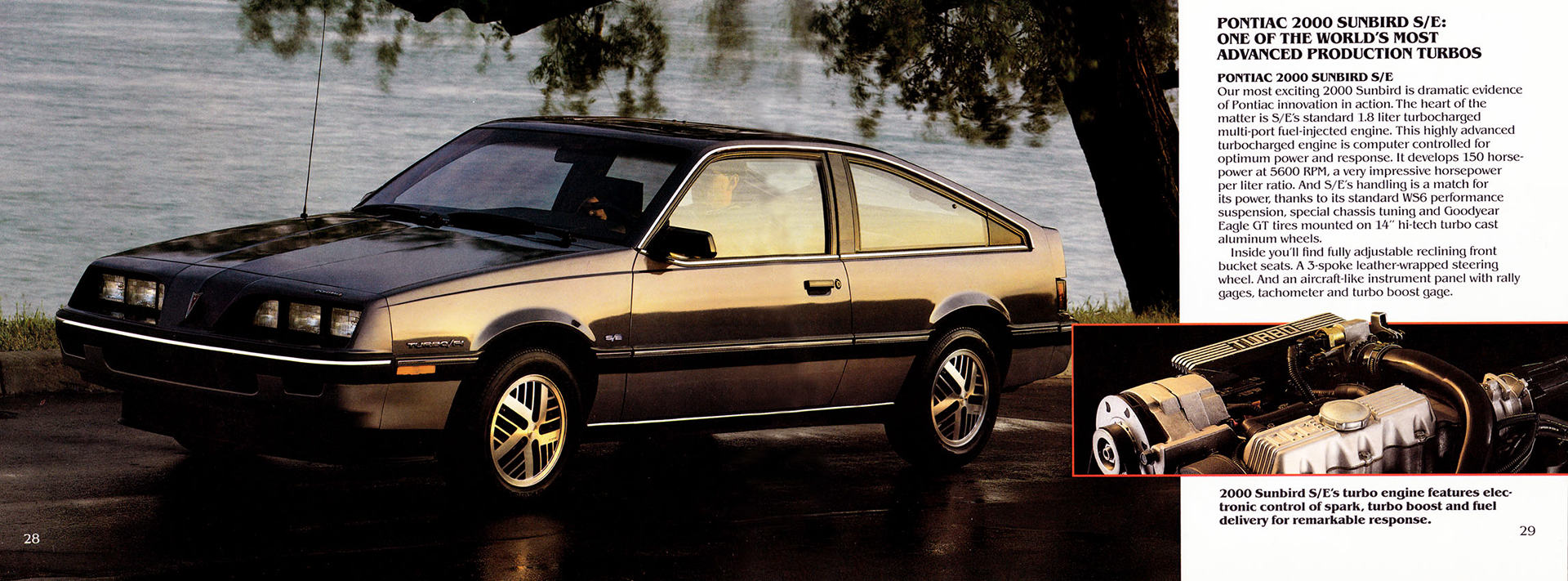
1984 Pontiac 2000 Sunbird S/E hatchback coupe

“One of the world’s most advanced production turbos”

For 1984, Pontiac’s top-of-the-line Sunbird S/E gained a new turbocharged motor along with a minor front-end revision and clear fog lamps.

The S/E‘s new engine was an LA5 150 bhp 1.8 liter/110 ci inline four with a Garrett turbocharger and fuel injection. It was paired with a standard four-speed manual gearbox, with a three-speed automatic optional for $320. With the standard powertrain, Car and Driver recorded a 0-60 time in 8.3 seconds—class-competitive in 1984. Fuel economy ratings were 25 city/36 highway by the day’s standards (20/26 by today’s measures). The Sunbird’s 13.5-gallon gas tank meant that owners could expect a range of 280 to 370 miles with a 10% fuel reserve.

2000 Sunbird S/E pages from the 1984 Pontiac prestige brochure

Standard exterior and mechanical equipment on the $9,489 S/E hatchback coupe (about $30,000 in 2025 dollars) included two-tone paint, power steering, power front disc/rear drum brakes, a WS6 performance suspension, special chassis tuning, and Goodyear Eagle GT P205/60R14 tires (a size now only marginally available) mounted on attractive 14-inch “hi-tech turbo” cast-aluminum wheels. Inside, fully adjustable reclining front seats, a folding split-back rear seat, a three-spoke leather-wrapped steering wheel, rally gages, and a Delco-GM AM radio were included.

Options, Period Reviews, & Production Numbers

Exterior options included a power glass sunroof ($300) and a louvered rear sunshade ($199). Inside, custom air conditioning, electronic cruise control, and Lear Siegler bucket seats ($400) were available.

Reviews of the new turbocharged configuration were positive—Popular Mechanics called it a “150-hp screamer.” 1984 Sunbirds did sell well—almost 170,000, but more than 80% of them were the base coupes and sedans, not the LE or the S/E.

The View From 2025

Sunbirds of this generation (1982-1994) are now almost completely vanished from the nation’s roads, and models other than the convertibles rarely show up in the Hemming’s Motor News classifieds, on eBay Motors, or on Bring a Trailer.

Make mine Black over Silver Metallic, please.

I wrote about the last of the previous-generation Sunbirds here. Other J-platform cars I have covered this blog include the 1984 Buick Skyhawk coupe, the 1982 Cadillac Cimarron sedan, the 1988 Cadillac Cimarron sedan, the 1986 Chevrolet Cavalier Z24 coupe, and the 1985 Oldsmobile Firenza ES sedan.

Last updated May 2025.

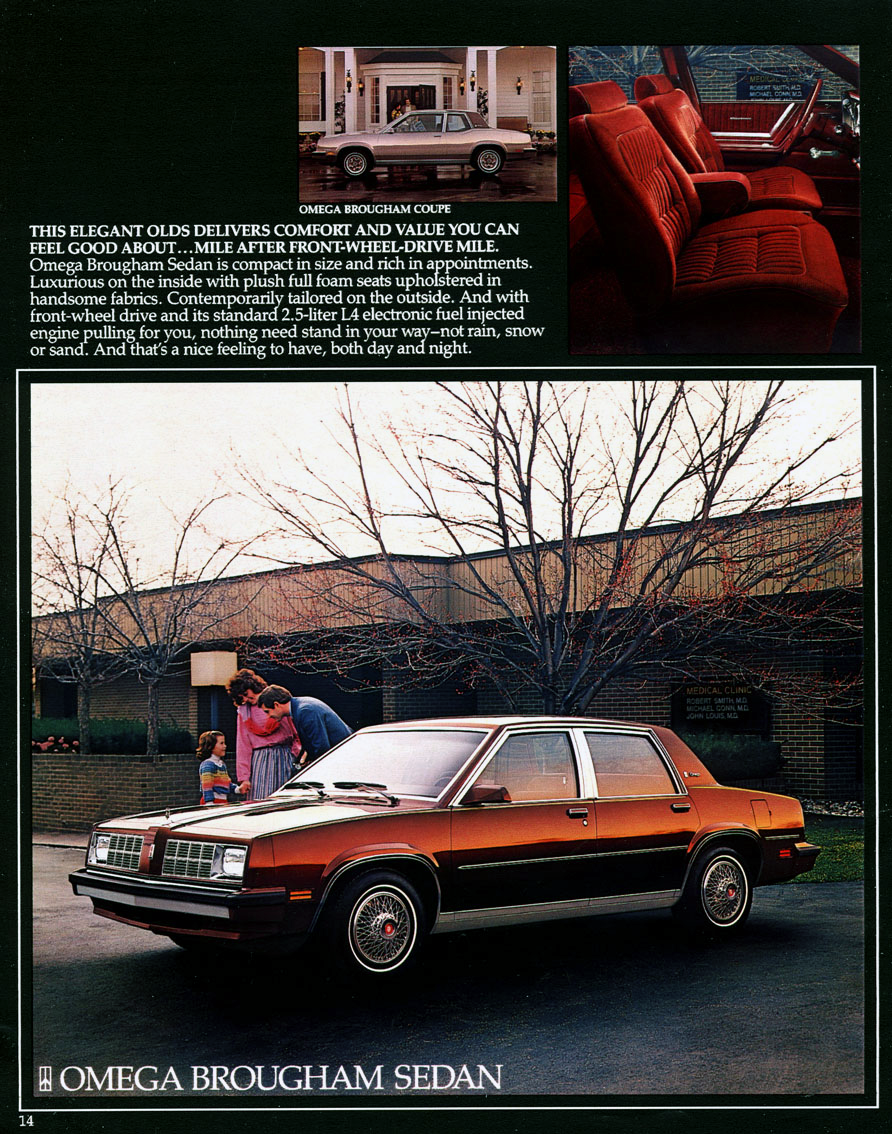
1984 Oldsmobile Omega sedan

“… comfort and value you can feel good about …”

In its final year, Oldsmobile’s Omega variant of GM’s X-car received few changes. The grille now consisted of horizontal stripes with vertical park/signal lamps, and there were new bumper treatments.

The Omega’s standard powertrain continued to be an LR8 “Iron Duke 92 bhp 2.5 liter/151 ci inline four with electronic fuel injection paired with a four-speed manual transmission. Powertrain options included the LE2 112 bhp 2.8 liter/173 ci V6 ($250) and a three-speed automatic transmission ($425). Mileage with the 2.8 liter V6 and the automatic was 21 city/33 highway by the day’s standards (17/24 by today’s measures). With a 14.6-gallon fuel tank, an Omega’s owner could expect a range of between 270 and 350 miles with a 10% fuel reserve.

Standard equipment on the $7,832 (about $24,700 in 2025 dollars) Oldsmobile Omega sedan included front-wheel-drive, power-assisted rack and pinion steering, power front disc/rear drum brakes, P185/80R13 steel-belted radial tires (now a trailer size) on 13-inch wheels, Deluxe wheel discs, Custom bench seating, and a fold-down center armrest.

Omega Brougham page from the 1984 Oldsmobile brochure

Moving up to the $8,104 Omega Brougham added a stand-up hood ornament, a pillar applique molding, lower bodyside moldings, carpeted lower door panels, and a Deluxe steering wheel.

The $675 ES package (RPO W48) remained available in 1984 as an upgrade for the Brougham, but only 224 were ordered. By far the sportiest version of the Omega, the ES included a suspension with higher-rate front and rear springs, firmer front and rear shock absorbers, and thicker stabilizer bars. In an attempt to appear more European, the ES2500 was the version with the 2.5 liter inline-four, while the ES2800 was the version with the 2.8 liter V6. Both versions got a blacked-out grille.

Options & Production Numbers

Exterior and mechanical options on all Omegas included a glass-panel sunroof ($300), power steering, and high-capacity cooling. Inside, cruise control, power windows, and a four-season air conditioner were available.

Omega sales were significant but not great, and they had been dropping steadily from the 1981 peak of almost 148,000 (including over 101,000 sedans). Oldsmobile produced 41,874 Omega sedans in the 1984 model year—small potatoes compared to all the other Oldsmobile sedans available (Firenza, Cutlass Ciera, Cutlass Supreme, Delta 88 Royale, and Ninety-Eight Regency).

The View From 2025

I haven’t seen an Omega on the streets in almost two decades, and they rarely show up in the Hemmings Motor News classifieds, on eBay Motors, or on Bring a Trailer. I’m also pretty sure I’ve never seen one shown, though I’m not betting against that happening at some point.

Make mine Dark Royal Blue Metallic, please.

Other X-cars I have written about include the 1983 Buick Skylark T TYPE coupe, the 1980 Chevrolet Citation hatchback sedan, the 1981 Chevrolet Citation X-11 hatchback coupe, the 1985 Chevrolet Citation II hatchback sedan, and the 1982 Pontiac Phoenix SJ coupe.

Last updated March 2025.
1984 Audi 5000S sedan

“The World’s Most Aerodynamic Sedan”

1984 was the first year of Audi’s new aerodynamic design for their biggest sedan. At the time, the exterior design was differentiating—though many would follow, Audi’s was first. Despite being the top-of-the-line, the 5000S was not a large car by modern standards—every dimension was smaller than Audi’s current A6 sedan.

The standard powertrain on Audi’s new sedan was Volkswagen’s corporate 100 bhp 2.1 liter/123 ci inline five with Bosch K-Jetronic fuel injection mated with a five-speed manual transmission. An automatic was available with the standard engine. The automatic was the only transmission available with the upmarket Turbo option—the same engine with a turbocharger that made 140 bhp.

Period road tests showed 0-60 times of 10.6 seconds for the Turbo, making it not much quicker than the base 5000S but almost 20 mph faster. Fuel economy ratings for the Turbo were 19 city/28 highway by the day’s standards (15/20 by today’s measures). With a 21.2-gallon gas tank, the driver of a new Turbo could expect a 335 to 400 mile range with a 10% fuel reserve.

1984 Audi 5000S advertisement

Standard exterior and mechanical equipment on the $16,840 5000S (about $53,600 in today’s dollars—approximately what a 2025 S4 sedan costs) included halogen headlamps, flush-mounted window glass, power rack-and-pinion steering, power front disc/rear drum brakes, and 185/70SR14 tires (a size still readily available) on 14 x 6 inch aerodynamically styled lightweight aluminum wheels.

Inside, standard features included Electronic Climate Control, cloth bucket seats, a center console, and power windows. Features that look strange to our modern eyes include an illuminated ash tray and a “radio prep kit with power antenna” and four “high-quality” speakers.

Options, Packages, & Controversy

Exterior options for the 5000S included an electric two-way tilting/sliding sunroof, power heated mirrors, and metallic paint. Inside, leather seats, heated seats, and a trip computer were all available.

In addition to more power, the Turbo package included an electric two-way tilting/sliding sunroof, a slightly tighter suspension, four-wheel disc brakes, and 205/60HR15 tires (also still readily available) on 15 x 6 inch aluminum wheels. Inside, power seats, power door locks, a trip computer, and a “fine-sounding” Audi Design/Blaupunkt AM/FM stereo radio with a cassette player and four speakers were included. The Turbo‘s $5,570 additional cost moved the 5000 into another price bracket, bringing it up to about $71,300 in 2025 dollars—more like today’s S6 pricing.

Period reviews of the new design were quite good, and sales reflected that. Then, of course, things all went horribly south with the unintended acceleration controversy. Sales would crater, and it would take Audi many years to recover.

The View From 2025

5000S’s sometimes show up in the Hemming’s Motor News classifieds, on eBay Motors, and on Bring a Trailer, but there’s not a lot of activity—BaT has sold a total of ten over eight years.

Make mine Sapphire Metallic, please.

The only other Audi I have written about so far is the 1983 Quattro hatchback coupe.

Last updated June 2025.

1984 BMW 325e coupe

“High technology dedicated to heightening your pulse rate.”

For many years, I saw BMW’s 325e as a rare misstep for BMW in the eighties, a decade where BMW generally could do no wrong.

The e stood for efficiency, and the engine was BMW’s torque-optimized M20B27 2.7 liter/165 ci inline six with Bosch L-Jetronic fuel injection, making 121 bhp and 170 lb-ft of torque with a fairly low 4,700 rpm redline. Mileage by the standards of the day was pretty good: 21 city/28 highway (18/26 by 2025 measures) with the standard five-speed manual transmission. With a 14.5-gallon gas tank, proud new owners of a 325e could expect between 290 and 315 miles of range with a 10% reserve.

0-60 mph with the five-speed manual took between 8.5 and 9 seconds, and the 325e’s top speed was 116 mph—not exactly the kind of numbers one would expect from the “Ultimate Driving Machine.” As Car and Driver wrote, “the 325e is less of a goer than you would imagine.” Despite this, BMW did its best to present the 325e as a legitimate part of its overall product line.

1984 BMW 325e advertisement

The 325e’s base price was $19,700—about $62,900 in 2025 dollars, which is 15% more than what a 2026 BMW 430i xDrive coupe goes for. Standard exterior and mechanical equipment included tinted glass, bumper-mounted fog lights, halogen headlights, power four-wheel disk brakes, power steering, and 195/60R14 tires (the same size as those on the Isuzu Impulse) on 14-inch wheels. Inside, the 325e came well-equipped: cloth or leatherette manual sport seats, a power sunroof, power windows, power mirrors, power door locks, air conditioning, a three spoke leather sport steering wheel, and a BMW/Alpine four-speaker AM/FM stereo with cassette and power antenna were all included.

Options & Model History

There were relatively few options available for the 325e: a four-speed automatic transmission ($595), leather seats ($790), cruise control ($240), many choices of metallic paint ($420), and a limited slip differential.

In 1986, BMW introduced the 325es variant, which included revised suspension tuning and made the limited slip differential standard. BMW would continue with the 325e and 325es as the top-of-the-line 3 series until 1987, when the 325i and 325is were released with the 2.5 liter/152 ci M20B25 inline 6 featuring a much more sporting 168 bhp. Horsepower for the 325e would climb just a little in 1988, but by 1989 it would be gone, replaced completely in the 3-series model line by the 325i.

The View From 2025

One of the things that strikes me, approximately forty years later, is that I have never heard from a 325e owner who didn’t like their car. We tend to think of our vehicle purchase decisions as valid, but it is rare to see such unanimity. Perhaps I and the automotive press missed something about the appeal of these cars.

The 325e is rarely seen in the Hemmings Motor News classifieds, but examples do show up on eBay Motors and Bring a Trailer. According to Hagerty’s valuation tools, a 1984 325e in #1/Concours condition is $34,200, with a more normal #3/Good condition car going for $14,100.

Make mine Baltic Blue Metallic, please.

Other BMWs I have written about include the 1982 733i sedan, the 1983 633CSi coupe, the 1985 535i sedan, the 1987 L6 coupe, the 1987 M6 coupe, the 1988 750iL sedan, and the 1988 M3 coupe.

Last updated August 2025.