1988 Toyota Supra hatchback coupe

“It draws a crowd, and leaves it behind.”

For 1988, the third-generation A70 Toyota Supra hatchback coupe had few changes of any importance. The high-mounted brake light changed from a rectangular shape to a trapezoid. Cloth seat upholstery patterns were changed from squares to lines, and the climate control and switch gear buttons went from light to medium gray.

The Supra’s standard powertrain was the 7M-GE 200 bhp 3.0 liter/180 ci inline six with fuel injection paired with a five-speed manual transmission. A four-speed electronically controlled automatic was optional—and expensive. 0-60 times with the five-speed were a little under eight seconds in a car that weighed about 3,500 pounds—a weight that was notably heavy for a sports car in those days. Fuel economy with both transmissions was 18 city/23 highway by the day’s standards (16/22 by today’s measures). With an 18.5-gallon gas tank, Supra owners could expect a range of 320 to 340 miles with a 10% fuel reserve.

Designated as 7M-GTE, the Turbo‘s engine gained a turbocharger with an intercooler, adding 30 bhp and dropping the 0-60 time to around 6.4 seconds.

1988 Toyota Supra print advertisement

The Toyota Supra hatchback coupe’s base price was $21,740—about $60,800 in today’s dollars or almost exactly what a 2026 Supra GR 3.0 Premium goes for. Standard exterior and mechanical equipment included a removable sport roof, quick-ratio power steering, 4-wheel power disk brakes, and 225/50VR16 Goodyear unidirectional tires (a size still readily available) on 16 x 7 aluminum alloy wheels. Inside, an 8-way adjustable driver’s seat, split fold-down rear seatbacks, an automatic temperature control air conditioning system, an electric rear window defogger, power windows, and power door locks were included. The standard sound system was an AM stereo/FM stereo electronic radio with a cassette player, Acoustic Flavor (a tone control equalizer), 4-enclosure speakers, and a diversity antenna.

At $23,760, the Turbo added a Sport package, which included a limited-slip differential, headlamp washers, and the Toyota Electronic Modulated Suspension (TEMS) system.

Options & Production Numbers

Individual options were relatively few and included a limited slip differential ($230 for the base car), anti-lock brakes ($1,100), and a 4-way power driver’s seat ($225). The leather seat package was $990.

Toyota sold 19,596 Supras in 1988—solid numbers, but not quite at the level of the Chevrolet Corvette or the Nissan 300 ZX. Of those almost twenty thousand, about 55% were the Turbo.

The View From 2025

According to Hagerty’s valuation tools, a 1988 Toyota Supra in #1/Concours condition is $37,700. The value for a more “normal” #3/Good condition example is $12,200. Turbos are considerably dearer, with #1/Concours being $82,300, #3/Good at $18,800. This generation of Supras maintains a presence in the Hemming’s Motor News classifieds, on eBay Motors, and on Bring a Trailer. When I first wrote this post in April 2025, there was a Dark Blue Pearl 1988 Supra with Blue leather seats and 33,000 miles for sale in Hemmings, asking $29,900.

Make mine Gray Metallic, please.

I’ve written about one other Supra—the 1982 hatchback coupe. Other Toyotas I’ve written about include the 1980 Corolla Tercel Liftback, the 1981 Celica Sport Coupe, the 1983 Camry sedan, the 1984 Corolla SR5 Sport Coupe, and the 1985 MR2 coupe.

Last updated August 2025.

1984 Toyota Corolla SR5 Sports Coupe

“Reborn for 1984”

Toyota’s Corolla was all new for 1984, marking its fifth generation. Confusingly, Corollas were both front-wheel-drive and rear-wheel-drive. If you wanted the notchback coupe, the only way to get it was as a rear-wheel-drive SR5 Sport Coupe, which had an AE86 internal development code.

The SR5 name originally stood for Sport Rally 5-speed. The designation was originally SR-5 and first appeared in 1973 on the second-generation Corolla notchback coupe and the Hilux pickup truck. The SR5 name remains as a trim even in today’s Toyotas, though the five-speed manuals are long gone.

The standard powertrain for 1984 was carried over from the previous generation. It was the 4A-C 70 bhp 1.6 liter/97 ci inline four with a two-barrel carburetor paired with (of course) a five-speed manual. A four-speed automatic was optional. Motor Trend clocked a 0-60 time of 12.9 seconds with the manual. Fuel mileage was rated at 32 city/43 highway by the day’s standards (25/31 by today’s measures). With a 13.2-gallon fuel tank, an SR5 driver could expect a range of 335 to 445 miles with a 10% fuel reserve.

Corolla page from the 1984 Toyota brochure

Standard exterior and mechanical equipment on the $9,381 SR5 Sport Coupe (about $29,800 in today’s dollars or almost exactly what a 2025 Corolla XSE sedan goes for) included tinted glass, retractable halogen headlamps, rack and pinion steering, vented power front disc brakes, and 185/70SR13 steel-belted radial-ply tires (a size still available) on 13-inch wheels. Inside, all SR5s included reclining lo-back front bucket seats, a split-back fold-down rear seat, a center console with storage compartment, dual power remote mirrors, an electric rear window defogger, tilt steering, a tachometer, a digital quartz clock, and an AM/FM/MPX radio.

Options & Period Reviews

Options included a power sunroof, variable assist power steering ($190), dual-stage air conditioning ($1,000!), and a cassette player with Dolby ($173). A Sport Package—yes, you could get a Sport Package on the Sport Coupe—included Sport Seats, special interior trim, and aluminum alloy wheels.

Motor Trend generally liked the SR5, but did gently hint that it was truly all show and no go, mentioning that the front-wheel-drive “civilian” versions were actually slightly faster. They finished by calling the SR5 “affordable, handsome, and pleasant to drive.”

The View From 2025

Fifth-generation Corollas are being saved—especially the sporty ones. You see Corolla SR5s for sale in the Hemming’s Motor News classifieds, on eBay Motors, and on Bring a Trailer.

Make mine Silver Metallic on Black, please—just like in the brochure.

Other Toyotas I have written about include the 1980 Corolla Tercel Liftback, the 1981 Celica Sport Coupe, the 1982 Celica Supra hatchback coupe, the 1983 Camry sedan, and the 1985 MR2 coupe.

Last updated June 2025.

1980 Toyota Corolla Tercel Liftback

“… a price that belies its good looks.”

1980 was the first year that Toyota sold the Corolla Tercel in the United States. Despite its name, the front-wheel-drive Tercel was not related in any meaningful way to the rear-wheel-drive Corolla. Still, Toyota evidently figured that adding the Corolla name would make buyers more confident in their purchasing decision. The Tercel was available as a 2-Door Sedan and a 3-Door Liftback (a four-door sedan would arrive one year later).

The Corolla Tercel Liftback was a small and light car, with a 160-inch length (about 22 inches shorter than a 2025 Corolla) and a curb weight of 2,030 pounds. The Liftback’s standard powertrain combined a 60 bhp 1.5 liter/99 ci inline four paired to a five-speed manual (a three-speed automatic was optional). Unusually for a front-wheel-drive car, the Tercel’s engine was longitudinally placed, which Toyota claimed resulted in easier serviceability.

Road & Track clocked a 0-60 time of 14.8 seconds in a loaded Tercel Liftback SR-5. As might be expected with a 99 cubic inch engine and a five-speed, fuel economy was impressive—33 city/43 highway by the day’s standards. With an 11.9-gallon fuel tank, a Tercel driver could expect a range of 330 to 365 miles with a 10% fuel reserve.

Corolla Tercel Liftback pages from the 1980 Corolla brochure

At $4,848 (about $20,500 in today’s dollars or a little less than a 2025 Corolla LE sedan goes for), the Corolla Tercel Liftback Deluxe had more standard equipment than the 2-Door Sedan, which was the loss leader at $4,198. Standard exterior and mechanical equipment included body side moldings, front-wheel-drive, rack-and-pinion steering, power-assisted front disc/rear drum brakes, and 145SR13 steel-belted radial ply whitewall tires on 13-inch wheels. Inside, vinyl reclining hi-back front bucket seats, a split-back fold-down rear seat, brushed nap wall-to-wall carpeting, an electric rear window defogger, and a day/night rear view mirror were included.

Packages & Options

The $600 SR-5 package required the five-speed manual and added black accents, “brazen” side striping, and 165/70SR13 steel-belted radial ply tires (a size still available thanks to Vredestein) on 13-inch wheels. Inside, SR-5 features included cloth reclining low-back front bucket seats, a rear deck cover, a cargo compartment light, an electric tachometer, and an AM/FM/MPX stereo radio.

Options were relatively few, but did include aluminum alloy wheels ($215), a rear window washer/wiper ($75), and factory (not dealer-installed) air conditioning ($520).

The View From 2025

I haven’t seen a first-generation Tercel in decades—they seem to have largely vanished. Tercels rarely appear in the Hemming’s Motor News classifieds or on eBay Motors, but they do occasionally show up on Bring a Trailer.

Make mine Light Blue Metallic, please.

Other Toyotas I have written about include the 1981 Celica Sport Coupe, the 1982 Celica Supra hatchback coupe, the 1983 Camry sedan, and the 1985 MR2 coupe. This list hints that I should write about an actual Corolla soon.

Last updated March 2025.

1983 Toyota Camry sedan

“Introducing the family Camry”

The Toyota Camry debuted in the middle of the 1983 model year, in four-door sedan and five-door hatchback models. Instead of designing it to compete with European manufacturers, Toyota designed the Camry to compete with American cars. In fact, Car and Driver famously wrote that “the Camry drives as if Buick engineers had moonlighted on its development.” The Camry’s measurements split the difference in size between the GM J-body (Buick Skyhawk, Cadillac Cimarron, Chevrolet Cavalier, Oldsmobile Firenza, and Pontiac 2000) and the GM X-body (Buick Skylark, Chevrolet Citation, Oldsmobile Omega, and Pontiac Phoenix).

Power for the first-year Camry was provided by a 92 bhp 2.0 liter/122 ci inline four with fuel injection, which was available with either a standard five-speed manual or an optional four-speed automatic. With the manual, 0-60 mph came in a little under 13 seconds in the 2,236-pound car. Mileage was good—32 city/44 highway by the day’s standards (25/31 by modern measures). With a 13.8-gallon gas tank, a Camry owner could expect a 350 to 420 mile range with a 10% fuel reserve.

Sedan page from the 1983 Toyota Camry brochure

Standard exterior and mechanical equipment on the $7,988 (about $26,400 in today’s dollars—a 2025 Camry starts at $29,000) Deluxe sedan included tinted glass, front wheel drive, rack-and-pinion steering, power-assisted front disc/rear drum brakes, and 185/70R13 steel-belted radial tires (a size still available from Kumho and Vredestein) on 13-inch styled steel wheels. Inside, reclining front cloth bucket seats with adjustable headrests, an electric rear window defogger, and a quartz analog clock were included.

Upgrading to the $9,698 LE made the four-speed automatic standard and added tungsten halogen headlights, dual outside mirrors with powered remote control, power steering with variable assist, full instrumentation, a fold-down rear seat armrest, a digital quartz clock, and an AM/FM stereo radio with five speakers and an automatic power antenna.

Options, Period Reviews, & Production Numbers

Individual options were relatively few and included aluminum alloy wheels, dual-stage air conditioning ($630), and a power sunroof with maplight ($460). A Power Package included cruise control, power locks, and power windows.

The first-generation Camry was well received and got good reviews—the tagline in Car and Driver‘s test was “At home in America.” 52,651 were sold in that first model year, with sales increasing steadily throughout the decade.

The View From 2025

Unlike other Toyotas that are deemed more collectible from the eighties (Land Cruisers, pickup trucks, Celicas, Supras, MR2s), first-generation Camrys rarely come up for sale in the Hemmings Motor News classifieds, on eBay Motors, or on Bring a Trailer.

Make mine Deep Maroon Metallic, please.

Other Toyotas I’ve written about include the 1980 Corolla Tercel Liftback, the 1981 Celica Sport Coupe, the 1982 Celica Supra hatchback coupe, the 1984 Corolla SR5 Sport Coupe, and the 1985 MR2 coupe.

Last updated December 2025.

1985 Toyota MR2 coupe

One of my favorite high-school teachers owned an MR2—she caused somewhat of a stir when she showed up in it the first time.

“Fun is taking the all-new MR2 out to play.”

The MR2 was undoubtedly one of the most interesting cars Toyota brought to market in the 1980s (development had begun in 1976). Visually evolved from the SV-3 concept car shown at the 1983 Tokyo Motor Show, MR2 stood for “midship runabout 2-seater”.

A small sports car (about thirteen inches shorter than a 2025 Toyota GR86 hatchback coupe) with an angular wedge body, the MR2 became available for the 1985 model year, entering a market that already included the Bertone (formally Fiat) X1/9 and the Pontiac Fiero.

The MR2’s engine was the 16-valve 1.6 liter/97 ci 4A-GE fuel-injected double-overhead-cam inline four, with 112 bhp. Paired with the standard five-speed manual transmission (a four-speed automatic transmission was optional) in the 2,400-pound “Mister Two,” this engine was good for 0-60 in under 9 seconds (Car and Driver recorded 8.2 seconds) and a top speed of about 120 mph. Fuel economy was impressive: 27 city/32 highway by the day’s standards (23/29 by modern measures). With a 10.8-gallon fuel tank, an MR2 owner could expect a range of 250 to 285 miles with a 10% fuel reserve.

1985 Toyota MR2 press release photo
1985 Toyota MR2 press release photo, courtesy of Toyota

The 1985 MR2 coupe’s base price was $10,999—about $33,700 in 2025 dollars or almost exactly what a 2025 Toyota GR86 Premium hatchback coupe costs. Standard exterior and mechanical equipment included tinted glass, rack-and-pinion steering, power disc brakes with ventilated front rotors, and 185/60R14 steel-belted radial blackwall tires (a size still readily available) on 14-inch alloy wheels. Inside, a 7-way adjustable driver’s seat, a leather-wrapped tilt steering wheel, dual power remote side mirrors, an electric rear defogger, and an AM/FM/MPX stereo radio were included in an interior that many considered roomy for the MR2’s size.

Options, A Package, Period Reviews, & Production Numbers

Individual options available for the 1985 MR2 included a moonroof with sunshade ($300), a rear spoiler ($150), automatic air conditioning ($840), cruise control ($185), power windows and locks ($305), and an AM stereo/FM stereo radio with cassette ($365). The Power Package ($305) included power windows and power locks. It wasn’t hard to load an MR2 up to $13,400 or so—about $41,000 in today’s dollars.

MR2s got really good reviews from the likes of Motor Trend (winning “Import Car of the Year”), Road & Track, and, later, Automobile—who famously compared it to a Ferrari 308 and found the MR2 to be the winner. Toyota sold 32,314 MR2s in 1985—impressive numbers for a brand-new product line.

The View From 2025

MR2s do have club support, including a reasonably active forum. According to Hagerty’s valuation tools, a 1985 MR2 in #1/Concours condition is $34,100, with a more normal #3/Good car going for $12,000.

Though MR2 sightings are relatively rare in the Hemming’s Motor News classifieds, first-generation MR2s (sold up until the 1989 model year) show up fairly often on eBay Motors and on Bring a Trailer. When I updated this blog entry in April 2025, there was a Super Red 1987 with black leather seats, a five-speed manual, and 181,000 miles on Hemmings, asking $15,500.

Make mine the same Super Red as the one owned by that high school teacher, please.

Other sporty Toyotas I’ve written about include the 1981 Celica Sport Coupe, the 1982 Celica Supra hatchback coupe, the 1984 Corolla SR5 Sport Coupe, and the 1988 Supra hatchback coupe.

Last updated August 2025.

1982 Toyota Celica Supra hatchback coupe

This post was one of my first entries in this blog. I’ve updated it to reflect both changes in my posting style and substantial improvements in available data.

“The ultimate performance Toyota.”

Remember when Toyota produced a reasonable amount of cool sporty cars?

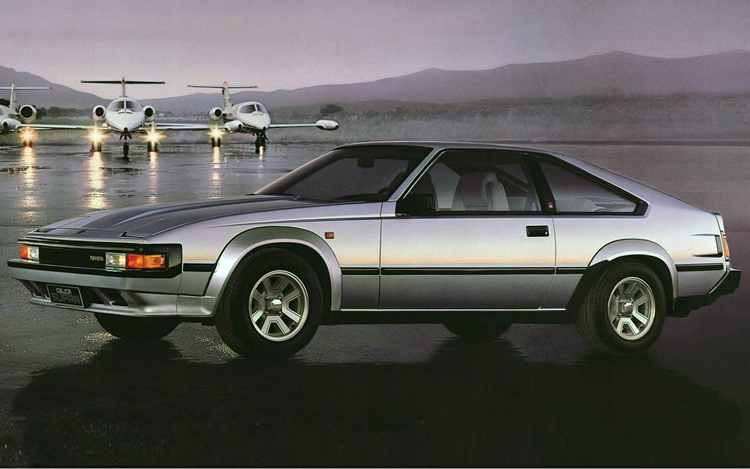
I do—I believe they nailed it with the Mark II Celica Supra. First, the styling: although based on the Celica, the longer hood (to accommodate the Supra’s inline six) along with the retractable headlights (you’ll have to believe me that they were very cool in the 1980s) substantially changed the car’s look. It wasn’t just the styling—Supras also included a notably higher level of interior equipment.

The engine was Toyota’s 145 bhp 5M-GE 2.8 liter/168 ci dual overhead cam fuel injected inline six, giving a 0-60 time of slightly under 9 seconds (spritely for 1982) and a top speed of approximately 125 mph. Over the next few years, engine power would climb to 161 bhp.

Mileage with the standard five-speed manual transmission was 21 city/34 highway by the day’s standards (19/31 by today’s measures). Choosing the optional four-speed automatic transmission—available only for the L-Type submodel—reduced highway mileage to 32. With a 16.1-gallon gas tank, Supra drivers could expect to travel approximately 355 miles before seeking more fuel.

1982 Toyota Celica Supra, the 1982 Motor Trend Import Car Of The Year.
1982 Toyota Celica Supra,
photo courtesy of Motor Trend from their Import Car Of The Year photo shoot.

All Celica Supras included tungsten halogen headlights, a four-wheel independent suspension, rack-and-pinion steering with variable power assist, and ventilated and power-assisted 4-wheel disc brakes. Inside, automatic temperature control air conditioning, power windows, power door locks, cruise control, and a tilt steering wheel were included.

Two models were available: the L– (for “Luxury”) Type and the P– (for “Performance”) Type. The $13,598 L-Type (about $46,800 in 2025 dollars) included standard power mirrors and P195/70R-14 steel-belted radial tires (a size still readily available) on 14 x 5.5-inch aluminum alloy wheels. Inside, striped velour cloth bucket seats were standard.

The $14,598 P-Type (about $50,200 in today’s dollars) included fender flares, a limited-slip differential, Sport Seats with driver’s side 8-way adjustment and pneumatic lumbar support adjustment, and P225/60HR-14 steel-belted radial tires (a size currently available only from BFGoodrich) on 14 x 7 inch aluminum alloy wheels.

Options, Publicity, Period Reception, & Sales Numbers

Options include two-tone exterior paint ($120), black high gloss paint ($70), and an electric sunroof ($440). Options only available for the L-Type included a four-speed automatic transmission, a digital display instrument panel and trip computer ($450), and leather seat trim. Options only for P-Type buyers included a spoiler-type sunshade ($120).

At right is a classic commercial, with legendary (and very tall) race car driver Dan Gurney shilling for the then brand-new Mark II Celica Supra. The second-generation Supra was well-received—Car and Driver included it in their first 10Best list in 1983. Toyota sold 34,048 Celica Supras in 1982.

The View From 2025

According to Hagerty’s valuation tools, a 1982 Toyota Celica Supra in #1/Concours condition is $40,300. The value for a more “normal” #3/Good condition example is $12,400. This generation of Supras maintains a presence in the Hemming’s Motor News classifieds, on eBay Motors, and on Bring a Trailer. When I last updated the contents of this post in July 2025, a Red Metallic 1985 Supra with Gray cloth seats and 114,000 miles was for sale in Hemmings, asking $29,000.

Make mine Silver Gray Metallic, please.

Other Toyotas I’ve written about include the 1980 Corolla Tercel Liftback, the 1981 Celica Sport Coupe, the 1983 Camry sedan, the 1984 Corolla SR5 Sport Coupe, the 1985 MR2 coupe, and the 1988 Supra hatchback coupe.

Last updated July 2025.

1981 Toyota Celica Sport Coupe

We do requests on Eighties Cars, whether or not they are definitive ones. A friend of mine mentioned his 1981 Celica in one of the automotive forums I frequent, and that was enough inspiration for me. In June 2020, Autopolis also published a typically thoughtful post on the second-generation Celicas.

 “The Ultimate Toyota.”

1981 was the final model year for the second-generation Toyota Celica, which debuted in 1978. Despite this, there were some significant changes, including the introduction of a new engine— the 22R 97 bhp 2.4 liter/144 ci inline four with a two-barrel carburetor.

Paired with the standard five-speed manual transmission, the Celica’s fuel economy was an impressive 25 city/37 highway by the day’s standards. Choosing the optional four-speed automatic transmission dropped the highway mileage rating slightly to 35 mpg. With a curb weight of a little over 2,400 pounds, Consumer Guide recorded a 0-60 time of 12.5 seconds—respectable for 1981.

celicas
1981 Celica and Celica Supra poster, courtesy of Flickr user Alden Jewell.

The Celica Sport Coupe was available in ST and GT trim levels. Standard exterior and mechanical equipment on the Celica ST ($6,699 or about $25,600 in today’s dollars) included tinted glass, electronic ignition, power assisted front disc/rear drum brakes, and 175/SR14 steel-belted radial tires (a size still somewhat available) on 14-inch styled steel wheels. Inside, reclining front bucket seats, “cut pile wall-to-wall carpeting,” a simulated woodgrain instrument panel and console, and an electric rear window defogger were included.

Moving up to the GT ($7,429 or about $28,400 in 2025 dollars) added features such as tungsten halogen hi-beam headlamps, a locking gas cap, 185/70SR14 steel-belted radial tires (a size still readily available), dual outside mirrors with driver’s side remote control, a simulated brushed aluminum instrument panel and console, and an AM/FM/MPX stereo with four speakers.

Optional equipment included a sunroof ($290), power steering ($180), and air conditioning ($610). Raised white letter tires, aluminum alloy wheels, cruise control ($115), and an electronic digital-readout AM/FM/MPX tuner stereo with a cassette player, an equalizer/amplifier, and four speakers were GT-only options for the Sport Coupe.

The View From 2025

1000 views badge

Celicas of this generation sometimes come up for sale in Hemmings Motor News, on eBay Motors, and on Bring a Trailer. As I update this post in September 2025, there’s a Silver Metallic 1981 Celica with grey cloth front bucket seats and 67,000 miles for sale on Hemmings, asking $8,000.

Make mine Dark Blue Metallic, please.

Other Toyotas I’ve written about include the 1980 Corolla Tercel Liftback, the 1982 Celica Supra hatchback coupe, the 1983 Camry sedan, the 1984 Corolla SR5 Sport Coupe, the 1985 MR2 coupe, and the 1988 Supra hatchback coupe.

Last updated September 2025.