1980 Pontiac Firebird Turbo Trans Am coupe

Photo of 1980 Pontiac Firebird Turbo Trans Am coupe
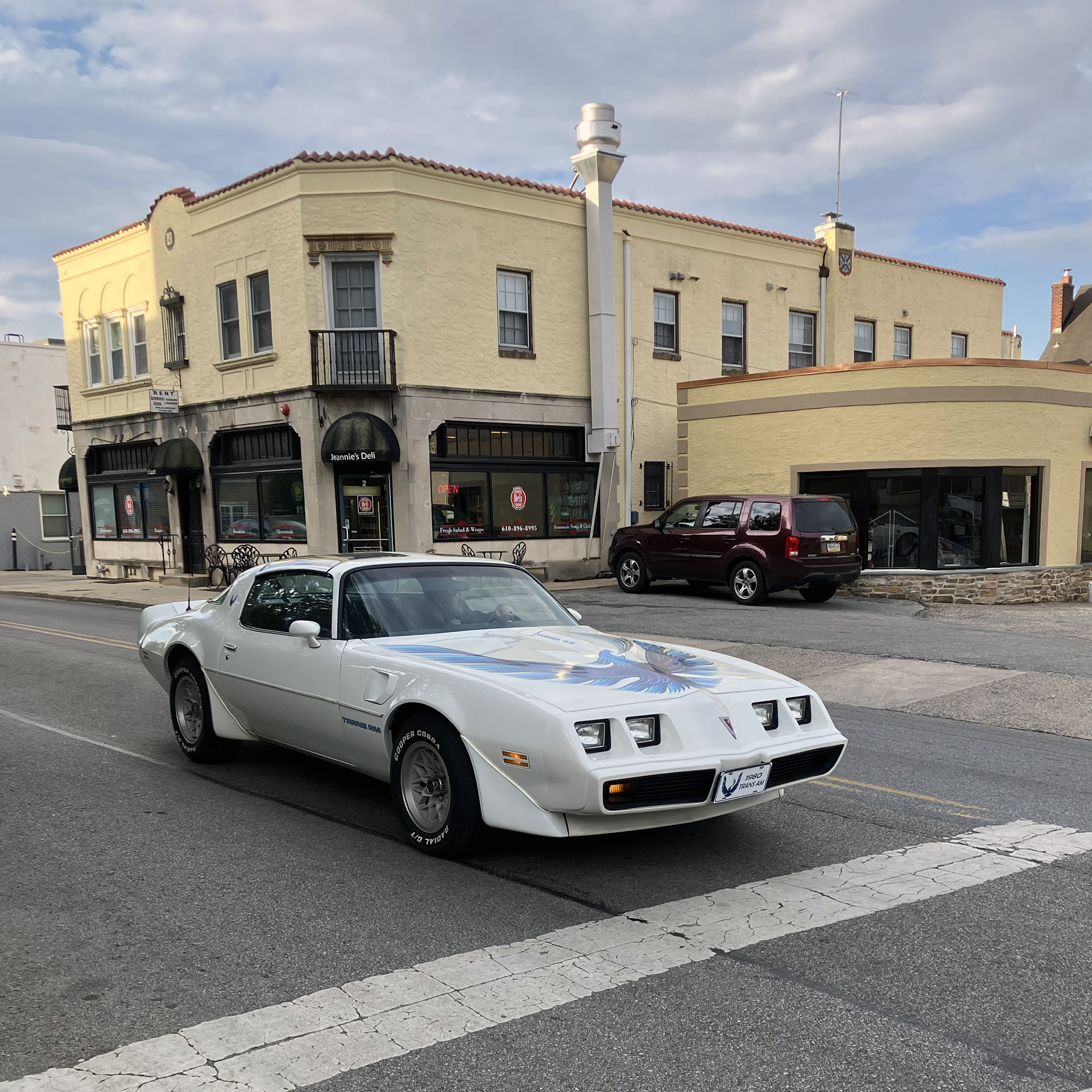
The 1980 Pontiac Firebird Turbo Trans Am coupe my fiancée saw

On a lovely spring morning in early 2025, my fiancée was walking from her house toward the temporary train station in Ardmore, PA. On her way to the station, she saw and (more importantly for this blog post) photographed a 1980 Pontiac Firebird Turbo Trans Am in Cameo White smoothly idling at a stop sign. Underneath the image she texted me, she wrote, “You are escorting me to the train.”

“You picked a winner.”

1980 was a transitional year mechanically for the second-generation Firebird and its Trans Am sub-model, though little else of significance changed. Gone was the 6.6 liter/403 ci V8, with the new top-of-the-line engine being a 4.9 liter/301 cu V8 with a turbocharger. Along with the engine changes, there was an asymmetrical hood design and a special hood decal for the Turbo Trans Am.

Pontiac could not do much about the general lack of space efficiency (the EPA rated the Firebird as a subcompact car), the high curb weight (about 3,700 pounds when the Mustang weighed about 2,800), and the relatively primitive technology.

Engines & Transmissions

The standard Trans Am engine was the Pontiac-built L37 155 bhp 4.9 liter/301 ci V8 with a four-barrel carburetor. The only choice for Trans Am purchasers in California was the Chevrolet-built LG4 145 bhp 5.0 liter/305 ci V8 with a four-barrel carburetor, but you did get a $180 credit.

The Trans Am’s most powerful engine was the $350 Pontiac-built LU8 210 bhp 4.9 liter/301 ci V8 with a Rochester Quadrajet four-barrel carburetor and an AiResearch TBO305 turbocharger. The turbo engine was emissions-certified only with the combination of air conditioning and a 3.08:1 rear axle ratio. All Trans Ams in 1980 came with a three-speed automatic—a one-year pause for the four-speed manual as Pontiac struggled to meet emissions regulations.

Combining a turbocharger, a carburetor, and primitive electronic engine controls was not easy, and reviews of one of the world’s first turbo V8s were mixed. The relatively primitive gas of the day meant that Pontiac had to retard the spark advance substantially to minimize detonation, which kept the turbocharger’s power return relatively low. As Car and Driver stated, “by the time the engine reaches 4000 rpm, the show is essential­ly over.”

Performance & Standard Equipment

A Turbo Trans Am would accelerate from 0-60 in a little over eight seconds (Car and Driver clocked 8.2), which was good for 1980. Fuel mileage was predictably bad—15 city/21 highway mpg by the day’s standards for the combination of the turbo engine and the automatic. With a 20.8-gallon fuel tank, Trans Am owners could expect to travel about 280 to 305 miles before refueling.

Standard exterior and mechanical equipment included in the $7,179 base price of the Trans Am (about $30,900 in today’s dollars) included a front center air dam, dual rectangular headlamps, a black-accented grille, a shaker hood and air cleaner, front and rear wheel opening air deflectors, a rear deck spoiler, a limited slip differential, power steering, power front disc/rear drum brakes, and 225/70-R15 blackwall tires (a size still readily available) on 15-inch Rally II wheels with trim rings. Inside, front bucket seats, a Formula steering wheel, a machined-trimmed instrument panel trim plate, rally gauges with a quartz clock and a tachometer, and a console were included.

Two Special Editions, Options, & Production Numbers

The black-and-gold Trans Am Special Edition package was $748 additional over a base Trans Am—$1,443 bundled with the removable locking hatch roof (otherwise known as T-tops). It included many exterior paint and trim details, including a gold/matte gold hood bird decal, gold headlight grilles, and gold wheels with gold center cap bird emblems. Inside, a gold dash panel, a gold-spoked steering wheel, gold door emblems, and a gold shifter emblem were included. 6,178 buyers took home a Special Edition—about 12% of Trans Am production.
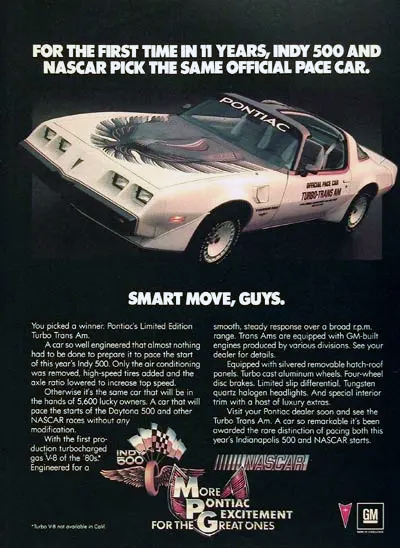
Print advertisement for 1980 Pontiac Firebird Trans Am Pace Car
Print advertisement for the 1980 Pontiac Trans Am Pace Car

There was also a special edition of the Special Edition in completely different colors—the Indianapolis Pace Car Edition. The Indianapolis Pace Car Edition was Cameo White, with Soft Ray tinted glass on all windows, white Turbo cast aluminum wheels, silver T-tops, and oyster interior trim. Mechanical features included the LU8 turbocharged engine, turbo boost gauges, the WS6 special performance package, and four-wheel power disc brakes. Inside, a leather-wrapped steering wheel, Custom air conditioning, and a Delco-GM ETR AM/FM radio with a cassette player were included. All this extra content was a good thing because the Indianapolis Pace Car Edition listed for $11,020.52 (why not just round to the closest dollar?)—about $47,500 in 2025 dollars. After initially promising 5,600 in advertising, Pontiac ended up building 5,700, about 11% of 1980 Trans Am production.

Exterior and mechanical options available for the Trans Am included the WS6 special performance package ($281), tungsten quartz halogen headlamps ($27), white-lettered tires ($68), Turbo cast aluminum wheels, four-wheel power disc brakes ($162), and an automatic power antenna ($50). Inside, an electric rear window defroster ($107), power door locks ($93), Custom air conditioning ($566), a tilt steering wheel ($81), controlled cycle windshield wipers ($41), and a host of radios (seven!) were all available.

Pontiac built a total of 50,896 Trans Ams in the 1980 model year, with 22,176 (44%) having the turbo engine.

The View From 2025

Initially neglected by the collector car market and with many now used up, late second-generation Trans Ams in good or excellent shape are now getting interesting numbers—almost doubling in the past fifteen years. According to Hagerty’s valuation tools, all the money for a 1980 Turbo Trans Am with T-tops in #1/Concours condition is $69,000, while a more normal Turbo Trans Am in #3/Good condition is valued at $24,900. These Trans Ams are often available in the Hemmings Motor News classifieds, on eBay Motors, and on Bring A Trailer, and they frequently show up at in-person auctions.

Make mine the black-and-gold Special Edition, of course.

I evidently can’t help myself with eighties Trans Ams; I’ve also written about the 1981 coupe, the 1982 hatchback coupe, the 1984 15th Anniversary hatchback coupe, the 1985 hatchback coupe, and the 1989 Turbo hatchback coupe. I have also written about the 1986 SE hatchback coupe and the 1987 Formula hatchback coupe, but I probably should write about the base car at some point.

1988 Pontiac Fiero Formula coupe

“Rejoice! Fiero Formula is here.”

In the Fiero’s final year, Pontiac introduced the Formula. Following the Firebird’s lead, the Formula had most of the mechanical components of the top-of-the-line GT, but the look of the original Fiero coupe. The front and rear suspensions for all Fieros was also completely revised, and Bright Yellow was introduced as a mid-year color.

It is a canard of General Motors’ behavior that they discontinue a car as soon as they finally get it right. No more central example exists than the Pontiac Fiero. The Fiero came to market in 1984 with ridiculous expectations, partially driven by Pontiac and in part by how the public sees two-seat mid-engine cars. What had initially been designed as a somewhat sporty commuter car became a significant part of Pontiac’s We Build Excitement strategy.

The painful fact that the Fiero’s mechanical parts were from the low end of the General Motors parts bin soon became stunningly obvious. Citation and Chevette suspension parts were abundant, and the only available engine was the distinctly uninspiring 2.5 liter/151 ci Iron Duke inline four with fuel injection, featuring all of 92 bhp. Predictably, handling and acceleration did not meet expectations. Then, of course, the recalls came—four in all for the 1984 Fiero.

By 1988, Pontiac had gone a long way toward fixing some of the underlying issues. The 2.8 liter/173 ci V6 was made available in 1985, its 140 bhp and multi-port fuel injection both major upgrades. In 1986, the fastback GT body style was added, and a five-speed manual transmission became available for the V6, though only late in the model year. In 1987, the Iron Duke‘s horsepower increased by 6 bhp. Finally, in 1988, the suspension was completely revised (with some Lotus influence).

The Formula‘s standard powertrain was the L44 135 bhp 2.8 liter/173 ci V6 with multi-port fuel injection paired with a five-speed manual—a three-speed automatic ($490) was available. Road & Track recorded a 0-60 time of 8.0 seconds with the five-speed Formula. Mileage in a car with a 2,775-pound curb weight was 17 city/27 highway by the day’s standards (15/25 by today’s measures). With the Fiero’s small 11.9-gallon gas tank, range was between 215 and 235 miles with a 10% fuel reserve.

Fiero pages from the 1988 Pontiac brochure

The Fiero Formula‘s base price was $10,999—approximately $31,000 in today’s dollars, which is about what a 2025 Mazda MX-5 Miata Sport goes for. Standard exterior and mechanical equipment included retracting halogen headlamps, a rear deck spoiler, a tuned dual-port performance exhaust, the WS6 performance suspension, rack-and-pinion steering, power 4-wheel disc brakes, and P205/60R15 front and P215/60R15 rear Goodyear Eagle GT+4 tires (both sizes still readily available) on 15-inch Diamond-Spoke aluminum wheels. Inside, reclining bucket seats, a Rally four-spoke steering wheel, a full-length console, side window defoggers, and a Delco ETR AM/FM stereo radio were included.

Options Groups, Individual Options, & Production Numbers

Pontiac offered three option groups with the Fiero Formula:

  • Option Group I included tinted glass, a tilt steering wheel, and controlled cycle windshield wipers.
  • Option Group II included everything in Option Group I, along with air conditioning, lamp group, a passenger visor vanity mirror, and cruise control.
  • Option Group III ($1,516) included everything in Option Group II, along with power door locks and power windows.

Individual options included a removable sunroof, tinted glass ($120), air conditioning ($775), power windows ($234), controlled cycle windshield wipers ($55), a tilt steering wheel ($125), and an electric rear window defogger ($145). Two optional stereos were available, with the range-topper being the $272 UX1 Delco ETR AM stereo/FM stereo radio with a cassette player, a graphic equalizer, and a clock.

Pontiac sold 5,684 copies of the Fiero Formula in 1988. Both the coupe (13,910) and the GT ($6,849) sold more units, but the Formula did sell better than 1987’s SE.

The View From 2025

Fieros have a good club following and a reasonably strong presence in the Hemmings Motor News classifieds, on eBay Motors, and on Bring a Trailer. According to Hagerty’s valuation tools, a 1988 Fiero Formula in #1/Concours condition is $22,800, while a more common #3/Good condition car is $7,700.

Make mine Medium Red Metallic, please.

Other Fieros I have written about include the 1984 coupe and the 1986 GT coupe. Other late eighties Pontiacs include the 1987 Firebird Formula hatchback coupe, the 1987 Grand Prix coupe, the 1988 Grand Prix coupe, and the 1989 Pontiac 20th Anniversary Turbo Firebird Trans Am hatchback coupe.

Save

Save

Save

Save

Save

1984 Pontiac Fiero coupe

“Dramatically innovative. Exclusively Pontiac.”

The Pontiac Fiero came to market in 1984 with ridiculous expectations, partially driven by Pontiac and partly by how the public sees two-seat mid-engine cars. What had initially been proposed in the late seventies as a “small, sporty commuter car” became a significant part of Pontiac’s mid-eighties We Build Excitement strategy.

Soon, the painful fact that the Fiero’s mechanical parts were from the low end of the General Motors parts bin became stunningly obvious. Citation and Chevette suspension parts abounded, and the only available engine was the distinctly uninspiring 2.5 liter/151 ci Iron Duke inline four with fuel injection, featuring all of 92 bhp.

Predictably, handling and acceleration did not meet expectations, with Road & Track clocking an 11.6-second 0-60 time with the standard four-speed manual. On the other hand, fuel economy numbers were impressive—27 city/47 highway by the day’s standards (21/33 by 2025 measures). Only the tiny 8.7-gallon gas tank kept range with a 10% fuel reserve at a mere 215 to 260 miles.

Fiero pages from the 1984 Pontiac prestige brochure

Standard exterior and mechanical equipment on the $7,999 Fiero (about $25,700 in 2025 dollars) included retractable tungsten halogen headlamps, Sport mirrors, rack and pinion steering, 4-wheel vented power disc brakes, and 185/80R13 tires (a size now only available from Michelin) on 13-inch Rally wheels. Inside, reclining cloth bucket seats, a floor console, and a rear window defroster were included.

Three Optional Models

The $8,499 Fiero Sport added an AM radio. Likely the most important feature of the Sport option was that it added the availability of options such as an automatic transmission, 14-inch tires and wheels, air conditioning, and upgraded seats.

The $9,599 Fiero SE added Soft-Ray tinted glass, the Special Performance Package, 195/70R14 tires (a size still readily available) on 14-inch Hi Tech Turbo wheels, Custom cloth reclining bucket seats, a Formula steering wheel, and an AM radio with a digital readout.

The Indy Pace Car Edition cost an additional $2,895 over an SE and added a specific exterior treatment with ground effects and a rear spoiler, a pop-up sunroof, and white bucket seats with red inserts. All Indy Pace Car Editions had a White over Medium Gray two-tone—Pontiac made 2,000 of them. At a minimum of $12,494 without additional options, they were about $39,200 in today’s dollars, or almost exactly what a 2025 Mazda MX-5 Miata RF Grand Touring goes for.

Individual Options, Production Numbers, & Period Reception

Individual options included a removable glass sunroof ($300), a tilt steering wheel ($110), air conditioning ($730), an electric rear window defogger ($140), power door locks ($125), and power windows ($185).

Fiero sales overall totaled 136,840 in the 1984 model year, with 49% of those being the top-of-the-line SE. First-year sales accounted for 37% of the total number of Fieros produced over five years.

Reviews from the buff books were decent, though there was disappointment at the Iron Duke-only power—especially since Pontiac was already talking about a V6 (and alleging it would be turbocharged). Reading those early reviews, you can sense that the magazines wanted such an undeniably different domestic product to be good.

Then, of course, the recalls came—four in all for the 1984 Fiero. They were primarily related to the fuel system, and the recalls were driven by many fires (perhaps one for every 300 Fieros made in 1984). Pontiac would eventually acknowledge and fix most of the problems, but the damage had been done.

The View From 2025

According to Hagerty’s valuation tools, a 1984 Fiero Indy Pace Car Edition in #1/Concours condition is $25,000, with a more common #3/Good condition car going for $9,800. An SE is about 44% less, while a base car is 46% off. Fieros have a good club and forum following and a fairly strong presence in Hemming’s Motor News classifieds, on eBay Motors, and on Bring a Trailer. As I update this blog entry in December 2025, there’s a White 1984 Fiero Indy Pace Car Edition with 1,676 miles for sale on Hemmings, asking $30,000.

Make mine Fiero Red, please.

SaveTwo other Fieros I have written about are the 1986 GT coupe and the 1988 Formula coupe. Other 1984 Pontiacs I have written about include the Firebird Trans Am 15th Anniversary Edition hatchback coupe and the 2000 Sunbird S/E hatchback coupe.

Last updated December 2025.

1987 Pontiac Firebird Formula hatchback coupe

“The thrill of pure, uncluttered driving excitement is back.”

For 1987, the Formula returned to Pontiac’s offerings after a six-year pause. The general messaging of the Formula was all the performance of the Trans Am, but with few of the Trans Am’s exterior add-ons and little of the interior comfort of the Trans Am GTA. At $12,413—about $36,600 in today’s dollars—the Formula was 14% less expensive than a Trans Am.

The Formula’s standard powertrain was the LG4 170 bhp 5.0 liter/305 ci V8 with a four-barrel carburetor paired with a five-speed manual. The LB9 185 bhp 5.0 liter/305 ci V8 with tuned port injection ($745) and the big dog B2L 210 bhp 5.7 liter/350 ci V8 with tuned port injection ($1,045) were available options. The 5.7-liter engine required the four-speed automatic ($490).

Performance had improved steadily since 1982, yielding a zero to sixty times of about seven seconds. Mileage with arguably the sportiest combination (5.0 liter tuned port injection and five-speed) was 16 city/26 highway by the day’s standards (15/24 by 2025 measures), with the 5.7 liter/automatic transmission combination only slightly worse. With a smallish (approximately 16.0-gallon) fuel tank, a Formula owner with the base powertrain could expect a range of between 280 and 300 miles with a 10% fuel reserve.

Firebird Formula pages from the 1987 Pontiac brochure

Standard exterior and mechanical equipment on the 1987 Firebird Formula included a front air dam, a dome hood, a body color aero deck rear spoiler, a special performance suspension, power brakes, and P245/50VR16 Goodyear Eagle tires on Hi-Tech 16″ x 8″ aluminum wheels. Inside, reclining cloth front bucket seats, cloth rear folding seats, a Formula three-spoke steering wheel, a full-length console with instrument panel, complete analog instrumentation, side window defoggers, and a Delco AM radio were included.

Packages, Individual Options, & Production Numbers

By 1987, General Motors was finally figuring out the build complexity costs of tens or hundreds of individual options. Thus, packages came into play.

  • The Formula Package I ($1,273) included body side moldings, air conditioning with Soft Ray tinted glass, a tilt steering wheel, and a Delco ETR AM/FM stereo with seek, scan, and clock.
  • The Formula Package II ($1,842) included everything in Formula Package I plus cruise control, controlled-cycle windshield wipers, power windows, power door locks, and a deck lid release.

Individual options not included in either of the packages included a removable glass hatch roof ($920), a limited slip differential ($100), an electric rear window defogger ($145), and a series of radios ranging up to the “Touch Control” ETR AM stereo/FM stereo with seek-scan, search-replay/auto reverse cassette, graphic equalizer, and clock ($529).

Pontiac sold 13,164 Formulas in the 1987 model year, accounting for about 16% of overall Firebird sales (the base Firebird coupe was the best seller with approximately 47% of sales). Third-generation Formula sales would peak at 16,670 in 1989, and would never approach that total again.

The View From 2025

I believe the Formula‘s somewhat restrained looks (compared to the Trans Am) have aged well, and their comparative rarity makes them special.

According to Hagerty‘s valuation tools, a 1987 Firebird Formula with the base 5.0 liter V8 and the manual in #1/Concours condition is $25,600, with a far more normal #3/Good condition version going for $9,800. Late-1980s Formulas are sometimes available in the Hemmings Motor News classifieds, on eBay Motors, and on Bring a Trailer.

Make mine Flame Red Metallic, please.

Other eighties Firebirds I have written about include the 1981 Trans Am coupe, the 1982 Trans Am hatchback coupe, the 1985 Trans Am hatchback coupe, the 1986 SE hatchback coupe, and the 1989 Turbo Trans Am hatchback coupe. Someday, I’ll get to a base Firebird—I guess the question is what year.

Last updated November 2025.

1983 Pontiac Parisienne sedan

“It’s clean, uncluttered and handsome.”

In 1983, Pontiac’s Parisienne nameplate, a Canadian presence since 1958, became available in the United States. The story, of course, was not that simple. For the 1982 model year, Pontiac had moved the Bonneville nameplate from the full-size B-platform to the mid-size G-platform and discontinued the slightly less expensive Catalina altogether. Dealers were unhappy with losing the full-size car, and the sales numbers told the reason why.

19811982
Catalina coupe (B-platform)1,073
Catalina sedan (B-platform)6,456
Catalina Safari wagon (B-platform)2,912
Bonneville coupe (B-platform)14,317
Bonneville/Bonneville Brougham sedan (B-platform)55,451
Bonneville Safari wagon (B-platform)6,855
Bonneville G/Bonneville G Brougham sedan (G-platform)64,413
Bonneville G wagon (G-platform)16,100
LeMans/Grand LeMans coupe (G-platform)4,397
Le Mans/LeMans LJ/Grand LeMans sedan (G-platform)47,427
LeMans Safari/Grand LeMans Safari wagon (G-platform)30,041
Totals168,92980,513

By condensing the two platforms into one and dropping the admittedly low-selling coupes, Pontiac cut sales by more than half. Yes, the front-wheel-drive mid-size 6000 was introduced for 1982, but its 57,534 sales didn’t come close to making up for the rear-wheel-drive losses. So, halfway through the 1983 model year, Parisienne’s started to be sold in the United States.

The Parisienne’s base engine was the LD5 110 bhp 3.8 liter/231 ci V6 with a two-barrel carburetor. The LG4 150 bhp 5.0 liter/305 ci V8 with a four-barrel carburetor and the LF9 105 bhp 5.7 liter/350 ci diesel V8 were optional. A three-speed automatic was standard with the V6 and the diesel. A four-speed automatic was required with the gas V8 and optional for the diesel. Mileage with the gas V8 was 18 city/29 highway by the day’s standards (15/21 by today’s measures); with a 25.1-gallon fuel tank, a Parisienne owner could expect a range of about 405 to 530 miles with a 10% fuel reserve.

Page from the 1983 Pontiac Parisienne brochure

Standard exterior and mechanical equipment on the $9,609 base Parisienne sedan included two-tone paint, power steering, power front disc/rear drum brakes, and 205/75R15 blackwall steel-belted radial tires (a size still readily available) on 15-inch wheels with Deluxe wheel covers. Inside, a 50/50 split front seat, an instrument panel with simulated woodgrain trim, a glove compartment with lock and light, and an electric clock were included.

Moving up to the $9,879 Brougham added a 60/40 Luxury cloth front seat with a fold-down center armrest and a passenger recliner, along with Deluxe acoustical insulation.

Options & Production Numbers

Options were many (Pontiac only consented to list “major options” in the brochure), and included tungsten halogen headlamps, air conditioning, cruise control with resume speed feature, power windows, power door locks, an electric rear window defogger, a power antenna, and a choice of three radios ranging up to a Delco-GM stereo with a cassette player and a four-speaker system.

The Parisienne was not nearly as sporty (“We Build Excitement”) as most other products in Pontiac’s 1983 model line, but you could add a limited-slip differential axle, body color Sport mirrors, a gage package, and the Rally handling package, which required slightly wider P225/70R15 whitewall steel-belted radial tires.

Pontiac did feel that they needed to state the obvious about the Parisienne’s badge engineering. In fine print at the bottom of the last page of the brochure was this quote:

“Pontiac Parisienne models are equivalent to models offered by Chevrolet under the nameplate Caprice.”

With little differentiation and a short sales period, Parisienne sales were not high in 1983. Pontiac sold 9,279 base sedans, 5,139 Brougham sedans, and 3,027 station wagons. Sales would climb notably in the full-length 1984 model year—18,713 base sedans, 25,212 Brougham sedans, and 16,599 station wagons.

The View From 2025

Parisienne’s occasionally appear for sale in the Hemming’s Motor News classifieds, on eBay Motors, and on Bring a Trailer.

Other B-platform cars I have written about include the 1983 Chevrolet Caprice Classic sedan, the 1985 Chevrolet Caprice Classic station wagon, the 1987 Chevrolet Caprice Classic coupe, and the 1982 Oldsmobile Delta 88 Royale coupe. I have yet to write about the rear-wheel-drive Buick LeSabre.

1984 Pontiac Firebird Trans Am 15th Anniversary Edition hatchback coupe

I clearly remember a 15th Anniversary Edition Trans Am being displayed inside Marsh Pontiac’s small showroom on the Lincoln Highway in Ardmore, PA.

Published back in late 2020, the initial version of this post got more facts wrong than usual. I pulled it and believe I have fixed most of the issues.

“… leaves the also-rans even further behind …”

For 1984, Pontiac announced a special edition Trans Am to commemorate the Firebird sub-model’s 15th year.

1984 Goodyear Eagle VR print advertisement

The 15th Anniversary Edition was $14,188—$10,689 for a base Trans Am plus $3,499 for the package (about $45,500 in today’s dollars). It featured white paint with blue graphics that hearkened back to the original 1969 Trans Am. Other exterior components included the Aero Package and T-tops—both optional on “normal” Trans Ams. Mechanical features included the L69 H.O. 190 bhp 5.0 liter/305 ci V8 with a four-barrel carburetor, a special handling package, four-wheel power disc brakes, and P245/50R16 Goodyear Eagle VR tires (a size still readily available) on 16 x 8 inch white hi-tech turbo aluminum wheels.

As had been true in many previous Trans Am special editions, the 15th Anniversary Edition Trans Am featured Recaro front bucket seats—these had leather bolsters with cloth inserts. Other interior features specific to the special edition included a leather-wrapped formula steering wheel and leather shift knob. Standard equipment on all 1984 Trans Ams included sport mirrors, a rear deck spoiler, concealed tungsten halogen headlamps, rally gauges, a console, and power steering.

Only the top-of-the-line engine for 1984 was available with the 15th Anniversary Edition, but there was a choice of transmissions. A five-speed manual came standard, with an automatic being a $295 option. 0-60 times from various car magazines came in at around seven seconds—two to three seconds better than it had been just two years prior in 1982. Fuel economy ratings were 16 city/27 highway by 1984 standards (13/20 by today’s measures). With a smallish 13.3-gallon gas tank, a Trans Am owner could expect a range of 200 to 255 miles with a 10% fuel reserve.

Options, Period Reviews, & Production Numbers

Trans Ams (even special editions) did not come loaded in 1984—by the time the 20th Anniversary Edition came around in 1989, that would no longer be so. Exterior and mechanical options included Soft-Ray tinted glass ($110), an electric rear window defogger ($140), and a limited slip differential ($95).

Interior options included air conditioning ($730), power windows ($215), a power antenna ($60), and a Delco AM/FM stereo cassette with a five-band graphic equalizer ($590). Upholstery and trim options included six-way power seats ($215 each), a tilt steering wheel ($110), luggage compartment trim ($110), and cloth floor mats ($20 front/$15 rear). It wasn’t uncommon to see a 15th Anniversary Edition Trans Am with over $3,000 in additional options.

Reviews of the 15th Anniversary Edition were positive. Motor Trend stated that the updated Trans Am’s “5-speed’s shift linkage is merely the best we’ve seen from Detroit in years.”

Pontiac built a symbolic 1,500 15th Anniversary Editions—500 with the five-speed manual and 1,000 with the automatic. Those 1,500 were a small part of the 55,374 total Trans Ams made in the 1984 model year, with those sales less than half of 128,304 Firebirds sold (Pontiac sold a lot of base Firebirds). Both the Trans Am numbers and the overall Firebird sales marked an eighties peak for Pontiac, with only 1980 and 1982 coming close.

The View From 2025

15th Anniversary Edition Trans Ams do attract some collector interest. According to Hagerty’s valuation tools, a 15th Anniversary Edition Trans Am in #1/Concours condition is $41,900, with a far more normal #3/Good condition version going for $15,600. These Trans Ams are often available in the Hemmings Motor News classifieds, on eBay Motors, and on Bring A Trailer, and they sometimes show up at auction.

Make mine White, please—it’s not like I have a choice.

I evidently can’t help myself with eighties Trans Ams; I’ve also written about the 1980 Turbo coupe, the 1981 coupe, the 1982 hatchback coupe, the 1985 hatchback coupe, and the 1989 Turbo hatchback coupe. I have also written about the 1986 SE hatchback coupe and the 1987 Formula hatchback coupe, but I probably should write about the base car at some point.

Last updated December 2025.

1980 Pontiac Grand Prix SJ coupe

Bring a Trailer offered an almost unique 1979 Grand Prix for auction in early 2022. It had a four-speed manual transmission—quite rare in 1979 and no longer available in 1980. With only 858 miles on the odometer, this Grand Prix sold for $35,000.

… carries Grand Prix sportiness to the max

1980 was the final year for the SJ designation on Pontiac’s Grand Prix. Of course, the SJ designation had been around for a long time—and not just for Pontiac. Duesenberg had used SJ in the early 1930s to describe the supercharged versions of their spectacular cars. By 1969, Pontiac had started (shamelessly—no surprise) using SJ for the top-of-the-line version of second generation of their Grand Prix coupe. By 1980, SJ indicated something like “moderately sporty.”

The 1980 Grand Prix returned to a vertical bar grille and featured new taillight lenses with “GP” logos. A three-speed automatic transmission became standard equipment on all Grand Prix models, and the two-barrel 4.9 liter/301 ci Pontiac V8 was replaced by a new 4.3 liter/265 ci V8 rated at 125 hp.

The SJ‘s powertrain choices were slightly loftier. The standard non-California powertrain was a W72 170 bhp 4.9 liter/301 ci V8 with a four-barrel carburetor mated with a three-speed automatic transmission. California cars swapped in the LG4 150 bhp 5.0 liter/305 ci V8 with a four-barrel carburetor. 0-60 came in a little under 10 seconds in a car with a 3,291-pound curb weight—spritely for a personal luxury coupe in 1980. EPA fuel economy ratings for the non-California cars were 17 city/25 highway by the day’s standards. With an 18.1-gallon gas tank, an SJ‘s owner could expect a range of 310 to 340 miles with a 10% fuel reserve.

With a base price of $6,219, standard exterior and mechanical equipment on all Grand Prix’s included dual rectangular headlamps, power steering, power front disc/rear drum brakes, and P195/75R14 tires (a size still readily available) on 14-inch wheels with hubcaps. Interior features included door pull straps, an inside hood release, and an electric quartz clock.

Grand Prix SJ page from the 1980 Pontiac brochure

For $7,295 (about $31,400 in 2025 dollars), the SJ added Custom finned wheel covers, body-color Sport mirrors, wide rocker panel moldings with extensions, accent stripes, and, of course, SJ identification to the exterior. Inside, SJ buyers got rally gages with clock and trip odometer, Lamp Group, and added acoustical insulation. SJ trim and upholstery included a Custom Sport steering wheel, a simulated brushed aluminum instrument panel, a Custom stitched-appearance instrument panel pad, Custom pedal trim plates, and SJ-specific front vinyl bucket seats.

Options & Production Numbers

Options were many—exterior options included two-tone paint in two different styles, cornering lamps, Soft Ray glass, a removable hatch roof, and a power sunroof (either glass or metal). Air conditioning (Custom or climate control), power door locks, and power windows were among the available interior options. Trim and upholstery options included Viscount leather front bucket seats with vinyl bolsters, a power driver’s seat, a tilt steering wheel, and a litter container.

Audio options included dual rear extended range speakers, two power antenna options, and six different stereo radios, including two 8-track tape choices, one cassette tape choice, one CB radio choice, and an ETR radio choice. A buyer looking to make their SJ as sporting as possible would have ordered 205/75R14 tires (which included the Rally Handling Package), Rally II wheels, and rally gages with an instrument panel tachometer (which required either the digital clock or the ETR radio).

Though the Grand Prix sold pretty well overall, the SJ did not—only 7,087 left dealer lots in the 1980 model year. This total meant that the SJ was a mere 6% of Grand Prix sales and hints strongly at why it was gone for the 1981 model year, with the new Grand Prix submodel being the Brougham. Pontiac would use the SJ designation on the sportiest versions of the compact Phoenix until the end of the 1984 model year.

The View From 2025

Grand Prix’s of this generation are not generally considered collector cars—Hagerty does not track any Grand Prix newer than 1977. These cars are sometimes available in the Hemmings Motor News classifieds and on eBay Motors. As we have seen, these Grand Prix’s also show up at auction.

Make mine Bordeaux Red, please.

Other Grand Prix models I have written about include the 1987 coupe and the 1988 coupe. I seem to like Pontiacs—I have covered eighteen other models over the last twelve years.

Last updated December 2025.

1986 Pontiac Firebird SE hatchback coupe

“Comfort and function define every Firebird interior.”

For 1986, Pontiac offered three versions of its sporty Firebird—the base car, the SE, and the Trans Am. The SE was intended to be the most comfortable of the three versions (Pontiac stated that it possessed “a subtle sophistication”), and its $11,995 base price (about $35,300 in today’s dollars) slotted between the $9,279 base coupe and the $12,395 Trans Am.

The SE‘s standard engine was the 135 bhp LB8 2.8 liter V6 with fuel injection, while its only optional engine was the $400 155 bhp LG4 5.0 liter/305 ci v8 with a four-barrel carburetor (only Trans Ams could get fancier V8s). Both engines came standard with a five-speed manual and were offered with an optional four-speed automatic ($465). The V8 with the manual was the quickest (0-60 mph in about 9 seconds) and the fastest (top speed of about 131 mph) SE. EPA gas mileage ratings were 17 city/26 highway with the standard powertrain (15/24 by today’s standards). Interestingly, the V8 wasn’t significantly worse at 16 city/26 highway with the manual or at 17 city/25 highway with the automatic. With a relatively small 15.5-gallon gas tank, SE owners could expect a range of between 265 and 320 miles with a 10% fuel reserve.

1986 base and SE Firebird versions from the Pontiac full-line brochure

Standard exterior and mechanical equipment on all Firebirds included concealed rectangular quartz halogen headlamps, Sport mirrors, power steering, power front disc/rear drum brakes, and P215/65R15 tires on 15-inch wheels. Inside, a full-length console, reclining front bucket seats, cut pile carpeting, and a Delco-GM AM radio were standard.

Additional standard equipment on the SE included hood air louvers, black body side moldings, and 15-inch diamond spoke aluminum wheels. Inside, the Formula steering wheel, shift knob, and parking brake were all leather-wrapped. Luxury Trim Group included Custom front bucket seats, a Deluxe split folding rear seat, and Deluxe door trim. An interior roof console included sub-woofer controls if the subwoofer six-speaker system was ordered.

Options & Production Numbers

Optional exterior and mechanical equipment included a body color rear deck spoiler ($70), a hatch roof with removable glass panels, and power four wheel disc brakes ($179 and requiring the limited slip differential). Inside, Custom air conditioning (which required Soft Ray glass), power door locks, power windows, a six-way power driver’s seat, a tilt steering wheel, and five different radios were available. A loaded SE moved from comfortable to relatively luxurious by mid-1980s standards.

Like its Camaro Berlinetta cousin, the SE did not sell well—it was only 2% of overall Firebird sales in 1986.

The View From 2025

According to Hagerty‘s valuation tools, a 1986 Firebird SE with the V8 and the manual in #1/Concours condition is $15,900, with a far more normal #3/Good condition version going for $5,700. Mid-1980s Trans Ams are always available in the Hemmings Motor News classifieds, on eBay Motors, and on Bring a Trailer, but SEs rarely make an appearance—as I update this post in April 2025, there are no third-generation Firebird SEs for sale on either eBay or Hemmings. I have not seen an SE in over 20 years.

Make mine Midnight Blue over Silver, please.

Other Firebird versions I have written about include the 1981 Trans Am coupe, the 1982 Trans Am hatchback coupe, the 1984 Trans Am 15th Anniversary Edition hatchback coupe, the 1985 Trans Am hatchback coupe, and the 1989 20th Anniversary Turbo Trans Am hatchback coupe. I should probably cover a Formula and a GTA at some point.

Last updated April 2025.

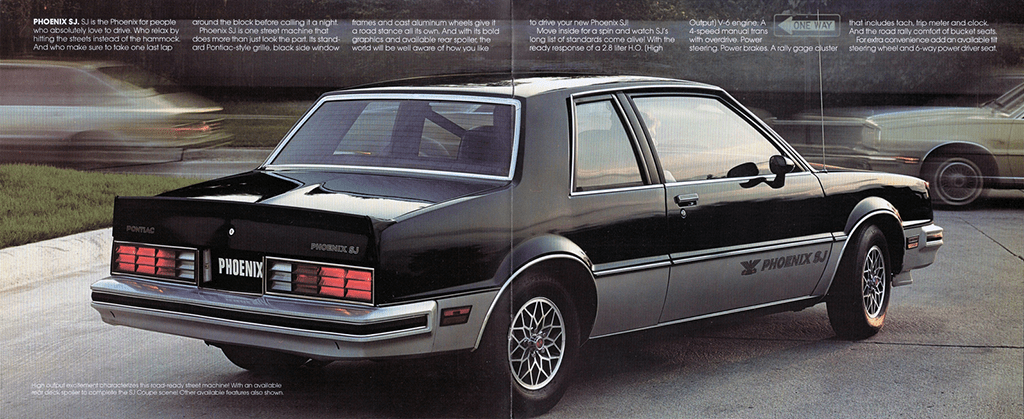
1982 Pontiac Phoenix SJ coupe

In this post, we’re once again revisiting interesting versions of mass-market eighties vehicles that just about nobody bought. This one is on the sportiest version of Pontiac’s X platform entry, which means I have now treated every GM marque’s X car entry at least once.

“… for people who absolutely love to drive.”

For the 1982 model year, the sporty SJ version of Pontiac’s Phoenix compact became its own model, instead of the trim option it had been for the previous two years. Aside from being a specific model, the biggest news was almost certainly that the 2.8 liter High Output V6 was standard for the SJ.

That new standard engine was the GM corporate LH7 135 bhp 2.8 liter/173 ci V6 with a Rochester E2SE two-barrel carburetor. It was paired with either a standard four-speed manual or an optional three-speed automatic. With the manual, 0-60 came in about 9 seconds—respectable for 1982.

Standard exterior and mechanical equipment on all Phoenix coupes included body-color front and rear bumpers, front-wheel-drive, single rectangular halogen headlamps, rack-and-pinion steering, front disc/rear drum brakes, and 185/80R13 tires on 13-inch wheels with hubcaps. Inside, Pontiac included a full-width front seat, a Deluxe steering wheel, and a Delco-GM AM radio with dual front speakers.

The mid-range LJ coupe included custom wheel covers, additional acoustical insulation, a Luxury cushion steering wheel, and a full-width luxury notchback front seat with center armrest.

1982 SJ pages from the Pontiac Phoenix brochure
SJ pages from the 1982 Pontiac Phoenix brochure

For $8,723 (about $29,800 in today’s dollars), the top-of-the-line SJ coupe added two-tone paint and specific graphics, a front air dam, power brakes, power steering, a special suspension, and 205/70R13 tires (now essentially unavailable) on 13-inch cast-aluminum wheels. Inside, additional standard features for the SJ included gauges (rally cluster, clock, tachometer, and trip odometer), a Formula steering wheel, and bucket seats.

Options & Production Numbers

Exterior and mechanical options for the SJ coupe included a removable glass sunroof, tinted glass, and a rear deck spoiler. Inside, Custom air conditioning, an electric rear window defogger, power door locks, power windows, a six-way power driver’s seat, a tilt steering wheel, and a Delco-GM AM/FM stereo with a cassette stereo tape player were among the many options available.

Of course, the SJ designation had been around for a long time—and not just for Pontiac. Duesenberg had used SJ in the early 1930s to describe the supercharged versions of their spectacular cars. By 1969, Pontiac had started (shamelessly—no surprise) using SJ for the top-of-the-line version of their Grand Prix coupe. The SJ designation for the top-of-the-line Grand Prix continued through the 1980 model year.

Despite Pontiac’s evident efforts to market the Phoenix SJ, it simply did not sell. With 994 produced, it was less than 6% of Phoenix coupe sales, with the vast majority going to the base version. Obviously, Pontiac had other things going on in 1982, including the introduction of a brand new Firebird and Trans Am.

The View From 2025

Front-wheel-drive Phoenixes of any sort have now almost completely vanished from the nation’s roads, and they rarely show up in the Hemming’s Motor News classifieds or eBay Motors. Bring a Trailer has sold a grand total of one front-wheel-drive Phoenix. The Phoenix does have one differentiator for me—it’s the single most commented post on Eighties Cars.

Make mine Dark Jadestone Metallic over Gray, please.

Other X platform cars I have written about include the 1980 Chevrolet Citation hatchback sedan, the 1981 Chevrolet Citation X-11 hatchback coupe, the 1983 Buick Skylark T Type coupe, the 1984 Oldsmobile Omega sedan, and the 1985 Chevrolet Citation II hatchback sedan.

Last updated March 2025.

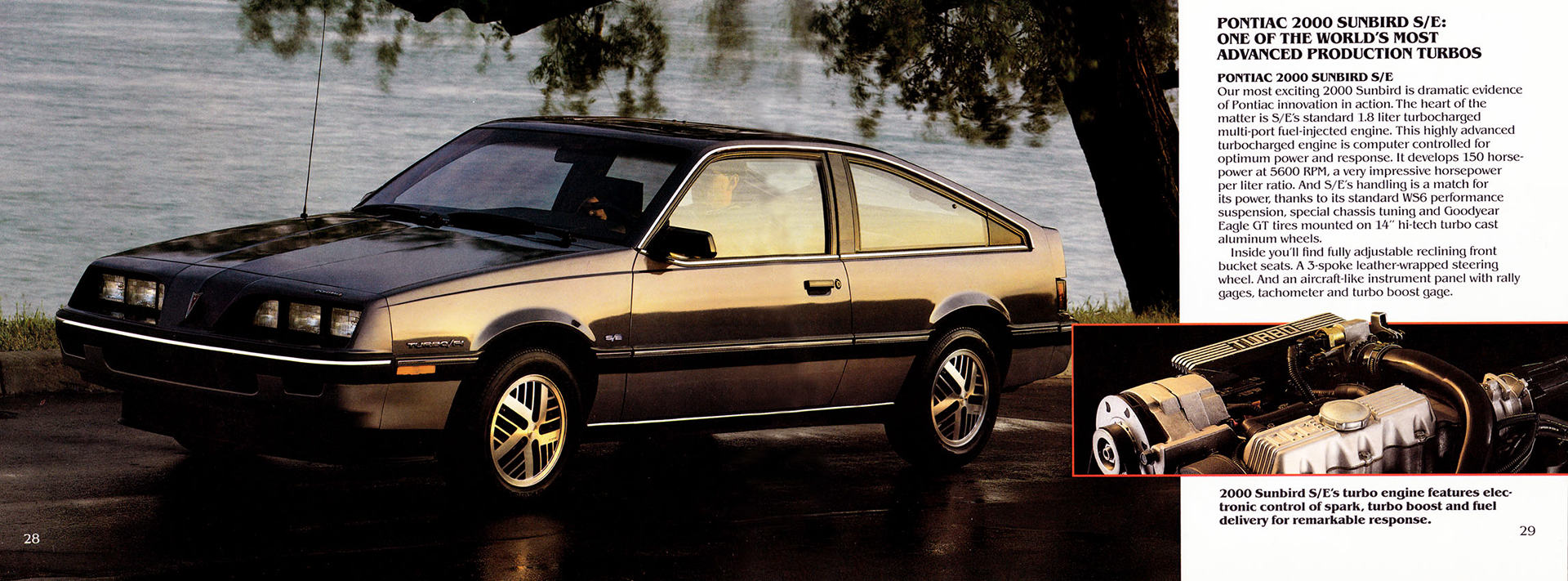
1984 Pontiac 2000 Sunbird S/E hatchback coupe

“One of the world’s most advanced production turbos”

For 1984, Pontiac’s top-of-the-line Sunbird S/E gained a new turbocharged motor along with a minor front-end revision and clear fog lamps.

The S/E‘s new engine was an LA5 150 bhp 1.8 liter/110 ci inline four with a Garrett turbocharger and fuel injection. It was paired with a standard four-speed manual gearbox, with a three-speed automatic optional for $320. With the standard powertrain, Car and Driver recorded a 0-60 time in 8.3 seconds—class-competitive in 1984. Fuel economy ratings were 25 city/36 highway by the day’s standards (20/26 by today’s measures). The Sunbird’s 13.5-gallon gas tank meant that owners could expect a range of 280 to 370 miles with a 10% fuel reserve.

2000 Sunbird S/E pages from the 1984 Pontiac prestige brochure

Standard exterior and mechanical equipment on the $9,489 S/E hatchback coupe (about $30,000 in 2025 dollars) included two-tone paint, power steering, power front disc/rear drum brakes, a WS6 performance suspension, special chassis tuning, and Goodyear Eagle GT P205/60R14 tires (a size now only marginally available) mounted on attractive 14-inch “hi-tech turbo” cast-aluminum wheels. Inside, fully adjustable reclining front seats, a folding split-back rear seat, a three-spoke leather-wrapped steering wheel, rally gages, and a Delco-GM AM radio were included.

Options, Period Reviews, & Production Numbers

Exterior options included a power glass sunroof ($300) and a louvered rear sunshade ($199). Inside, custom air conditioning, electronic cruise control, and Lear Siegler bucket seats ($400) were available.

Reviews of the new turbocharged configuration were positive—Popular Mechanics called it a “150-hp screamer.” 1984 Sunbirds did sell well—almost 170,000, but more than 80% of them were the base coupes and sedans, not the LE or the S/E.

The View From 2025

Sunbirds of this generation (1982-1994) are now almost completely vanished from the nation’s roads, and models other than the convertibles rarely show up in the Hemming’s Motor News classifieds, on eBay Motors, or on Bring a Trailer.

Make mine Black over Silver Metallic, please.

I wrote about the last of the previous-generation Sunbirds here. Other J-platform cars I have covered this blog include the 1984 Buick Skyhawk coupe, the 1982 Cadillac Cimarron sedan, the 1988 Cadillac Cimarron sedan, the 1986 Chevrolet Cavalier Z24 coupe, and the 1985 Oldsmobile Firenza ES sedan.

Last updated May 2025.