1984 Chevrolet Corvette hatchback coupe

As a high school student in the early to mid-1980s, I worked part-time at Frankel Chevrolet (a dealership in Ardmore, Pennsylvania). I’ll never forget seeing my first C4 Corvette in early 1983: small block V8 engine with “Cross-Fire Injection” rumbling, lovely over-engineered retractable headlamps up and on, fancy new metallic paint with clear coat looking its best in the setting sun. Viewing this car was a visceral experience for a fifteen-year-old. It was the exact moment when my opinion of Corvettes changed from a grudging respect (I was more of a BMW and Pontiac fan then) to “I will have one of those someday.”

“You’ve never seen anything like this before.”

The phrase “all-new” is rarely accurate in cars, but the 1984 Corvette was close. Only the standard powertrain carried over from 1982, and even that was changed in some visible (a brand new magnesium air cleaner) and measurable (an additional five bhp) ways. The exterior, interior, suspension, and steering were truly all-new for the Corvette.

The standard powertrain was the L83 Cross-Fire 205 bhp 5.7 liter/350 ci V8 with throttle-body fuel injection paired with a Turbo-Hydramatic four-speed automatic transmission. The Doug Nash 4+3 manual transmission with automatic overdrive was available as a no-cost option, but only became available about halfway through the extended 1984 model year. Car and Driver recorded a 0-60 time of 6.7 seconds (Road & Track took 7.1 seconds) and a top speed of 138 mph. Estimated fuel economy was 16 city/28 highway by the day’s standards. With a 20-gallon gas tank, a Corvette coupe’s proud new owner could expect a range of between 325 and 355 miles with a 10% fuel reserve.

Cutaway page from the 1984 Chevrolet Corvette brochure
David Kimble’s cutaway page in the 1984 Chevrolet Corvette brochure

The 1984 Corvette’s base price was $22,361—about $74,200 in today’s dollars or a little over what a 2026 Corvette Stingray 1LT coupe goes for. Standard exterior and mechanical equipment included a one-piece removable fiberglass roof panel, a frameless rear glass hatch, single rectangular hidden headlamps, integral grille-mounted halogen fog lamps, rack-and-pinion power steering, power disc brakes, and P255/50VR-16 tires on 16 x 8.5 inch cast alloy aluminum wheels. Inside, air conditioning, power windows, a tilt and telescope steering wheel, a driver information system, cloth bucket seats, and an AM/FM stereo radio with a power antenna were all included.

Options & Production Numbers

The Z51 Performance Handling Package ($600) included a quicker steering gear, a performance axle ratio, an engine oil cooler, an additional radiator fan, higher-rated Delco-Bilstein shock absorbers, thicker stabilizer bars, and 9.5 inch rear wheels.

Optional exterior and mechanical equipment included two-tone paint ($428), a removable transparent roof panel ($595), a performance axle ratio ($22), and Delco-Bilstein shock absorbers ($189). Optional interior equipment included cruise control ($185), a power door lock system ($165), custom adjustable sports seats ($625), leather seats ($400), a six-way power driver’s seat ($225), and the Delco-GM/Bose Music System ($895).

Chevrolet rarely makes Corvette television commercials, but they usually produce one when introducing a new generation. For the 1984, they pulled out all the stops, at least by the standards of eighties automobile commercials—a spacesuit, lasers, and a cheesy jingle all make an appearance.

The new generation Corvette was very well-received by buyers. Chevrolet sold 51,547 in about eighteen months, making 1984 the second best sales year ever (only 1979 had a higher production total).

Period Reviews & Owner Feedback

Reviews of Chevrolet’s pride were positive but evenhanded. Car and Driver disliked the fact that the new generation was no lighter than the previous generation—a Corvette complaint that extends to today. Many writers also commented on the “Tokyo by Night” digital instrument panel.

Within a year or so, there would start to be an acknowledgment from the automotive press that the optional and heavily hyped Z51 performance handling package was suitable for only the most perfect roads. In their owner’s report, Popular Mechanics quoted a New York salesman as saying “bad ride on rough roads,” while a Texas retiree stated “body rattle is frustrating.” Chevrolet began to adjust beginning in the 1985 model year, but early C4 Corvettes continued to be seen as having an unnecessarily rough ride.

The View From 2025

There’s been a lot written about the 1984 Corvette—both good and bad—and I doubt I have much to add. Despite being pushed back several months from an actual 1983 model year release, it still felt rushed. On the other hand, many people think of the almost all-new fourth-generation Corvettes as the first “modern” version of Chevrolet’s sports car. However, modern is undoubtedly a fluid concept now—more than forty years later. Developed in the late 1970s and early 1980s, the C4s were the first Corvettes with rack-and-pinion steering and a removable one-piece “targa” roof.

There is strong club support for the 1984 Corvette, as there is for all Corvettes. According to Hagerty’s valuation tools, a 1984 Corvette with a clear top and the 4+3 manual in #1/Concours condition is $35,500, with a more typical number #3/Good condition car going for $8,400. 1984 Corvettes are regularly featured in the Hemmings Motor News classifieds, on eBay Motors, and on Bring a Trailer. Early C4s are also often seen at in-person auctions such as Barrett-Jackson and Mecum. As I update this blog entry in October 2025, a Gold Metallic car with saddle cloth adjustable sport bucket seats and 34,000 miles is available on Hemmings, asking $18,000.

Make mine Light Blue Metallic, please. That 1984 Corvette I mentioned seeing earlier was Light Blue Metallic, and I bought, drove extensively, and eventually sold a 1985 model in the same color.

Other Corvettes I have written about include the 1980 coupe, the 1981 coupe, the 1982 coupe, the 1986 convertible, and the 1988 35th Anniversary coupe.

Last updated October 2025.

1985 Volvo 740 Turbo station wagon

“… an unmistakable outlaw edge.”

The 700 series Volvos had been available in the United States for a few years before Volvo brought the station wagon to our shores to offer Volvo loyalists a step up from the aging 240. The most interesting version of the 700 series wagon to enthusiasts was the 740 Turbo, which was formally introduced in the middle of the 1985 model year.

The 740 Turbo‘s standard engine was a B230FT 160 bhp 2.3 liter/141 ci inline four with fuel injection, a Garrett T3 turbocharger, and an intercooler. A four-speed manual was standard, while a four-speed automatic with overdrive was optional. Car and Driver recorded a 0-60 time of 7.9 seconds in a 740 Turbo sedan with the manual. With the manual, mileage in the 3,042-pound car was rated at 19 city/25 highway by the day’s standards (17/23 by today’s standards). With a 15.8-gallon fuel tank, 740 Turbo drivers could expect 285 to 310 miles of range with a 10% reserve.

1985 Volvo 740 Turbo station wagon advertisement

The 1985 740 Turbo station wagon’s base price was $21,340—about $64,400 in today’s dollars or about what a 2025 V90 Cross Country Ultra station wagon goes for. Standard exterior and mechanical equipment included tinted windows, a front spoiler, halogen high and low beam headlights, a manual sunroof, power-assisted rack-and-pinion steering, power-assisted disc brakes, and 195/60R15 Michelin MXV tires (a size still readily available) on 15-inch wheels. Inside, a rear window wiper/washer, power door locks, cargo tie-down rings, and air conditioning were included. Trim and upholstery features included adjustable front bucket seats with integrated head rests and lumbar support, a heated driver’s seat, a 60/40 split rear seat, and full carpeting including the trunk.

Options & Reviews

Like all Volvo models in the 1980s, the 740 Turbo had few individual factory options—you chose the exterior and interior colors, and that was about it. Cruise control and an AM/FM-stereo radio/cassette with four speakers ($800) were available.

The automobile press of the day liked the 740 Turbo wagon, and it’s interesting to watch MotorWeek‘s review. Common complaints were the lack of an oil pressure gauge—considered essential for turbocharged engines at that time—along with the “archaic” driver’s seat height adjustment. Everyone also felt the need to comment on the Volvo’s very square design.

The View from 2025

All vintage Volvos have strong club support, and there is definite collector interest in the 740 Turbo. 740 Turbo station wagons are often available in the Hemmings Motor News classifieds, on eBay Motors, and at online auctions such as Bring a Trailer that cater to the eighties car market.

Make mine Silver, please.

Other Volvos that have been covered in Eighties Cars are the 1985 240 station wagon and the 1987 780 coupe. I should write about a Volvo sedan or two at some point.

1982 Oldsmobile Delta 88 Royale coupe

At the 2025 Mecum Kissimmee, a white 1982 Oldsmobile Delta 88 Royale coupe with a White vinyl Landau top, a Dark Blue cloth Custom Sport front bench seat, and an indicated 8,900 miles sold for $20,500.

“A well-known, reputable name.”

1982 was a quiet year for Oldsmobile’s Delta 88, with a new grille made with horizontal bars being the most significant change. Inside, the all-in-one Smart Stick multifunction signal lever was new. The coupe was no longer available as a base Delta 88—all Delta 88 coupes for 1982 were either Royales or Royale Broughams.

Like all Delta 88s, the Royale coupe’s standard powertrain was the Buick-made LD7 110 bhp 3.8 liter/231 ci V6 with a two-barrel carburetor mated with a three-speed automatic. Optional was the LF9 105 bhp 5.7 liter/350 ci diesel V8 ($700). There were two optional gasoline V8 engines: the LV8 100 bhp 4.3 liter/260 ci V8 with a two-barrel carburetor ($70) and the LV2 140 bhp 5.0 liter/307 ci V8 ($120) with a four-barrel carburetor. A four-speed automatic ($172) was available with the 5.0 liter V8.

As an aside, I don’t understand the small V8 as an option when a larger and more powerful V8 was available. This choice is seen in many GM cars of the early to mid-1980s, and it makes no sense. For your $70 additional over the stock V6, you got to say you had a V8, you got a supposedly smoother engine, and you lost 10 precious horsepower. From Oldsmobile’s perspective, this additional engine option increased build complexity. Why?

The Delta 88 coupe was not quick—with the best-case 5.0 liter V8, 0-60 took about 12.5 seconds in a car with a 3,690-pound curb weight. The diesel was about seven seconds slower to 60 mph. Mileage wasn’t horrible for a large car in the early 1980s, even with the 5.0 liter V8: 17 city/29 highway by the day’s standards (14/21 by 2025 measures). With a 25.0-gallon fuel tank, a Delta 88 Royale coupe owner could expect a range of about 395 to 515 miles with a 10% fuel reserve.

1982 Delta 88 brochure pages
Delta 88 pages from the 1982 full-size Oldsmobile brochure

Standard exterior and mechanical equipment on the $8,733 Delta 88 Royale coupe (about $30,300 in 2025 dollars) included a driver’s side remote control rear view mirror, low-drag power front disc brakes, power steering, and P205/75R15 steel-belted radial-ply blackwall tires (a size still readily available) mounted on 15-inch wheels with Bright Deluxe wheel discs. Inside, all Royale coupes included wall-to-wall cut-pile carpeting with carpeted lower door panels, a Custom Sport front bench seat, front and rear armrests, an inside day-night rearview mirror, and a Deluxe steering wheel. Oldsmobile did not include a clock or a radio as standard equipment.

Options & Production Numbers

Moving up to the Delta 88 Royale Brougham coupe cost an additional $469 and added bright roof drip moldings, pillar opera lamps, a divided front seat with individual controls, and a Convenience Group of lamps, visor vanity mirror, and chime tones.

Exterior and mechanical options included Soft-Ray tinted glass ($105), an electric sliding Astroroof in tinted glass, an automatic leveling system, an engine block heater, puncture-sealing tires, and Super Stock wheels with matching body color ($95). Inside, automatic cruise control with resume feature ($160), Four-Season ($695) or Tempmatic air conditioning, an electric rear window defogger, power side windows ($170), and power door locks were all available.

Oldsmobile offered a range of seven different radios for the Delta 88, ranging from a base AM radio to an electronically tuned AM/FM stereo/cassette with clock. Buyers could specify an independent digital quartz or analog clock if a Delco radio wasn’t desired.

Oldsmobile sold 41,238 Delta 88 Royale coupes in the 1982 model year. This was respectable, but not particularly great—in fact, they were the lowest in raw sales numbers and third lowest in percentage of overall Oldsmobile sales over the entire life of the eight-generation Delta 88. Of course, 1982 was a really bad year for auto sales in general—domestic auto sales were off by over a million units from 1981.

The View From 2025

There is some collector interest in these big coupes, though Hagerty does not track Delta 88s post-1975. Delta 88s of this era are sometimes available in the Hemmings Motor News classifieds, on eBay Motors, and at online auctions such as Bring a Trailer that cater to the eighties car market. As I update this post in October 2025, there’s an Burgundy 1985 Delta 88 Royale coupe with a claret interior and 83,000 miles for sale on Hemmings, asking $10,500.

Make mine Dark Blue Metallic, please.

Other B-body cars I have written about include the 1983 Chevrolet Caprice Classic sedan, the 1983 Pontiac Parisienne sedan, the 1985 Chevrolet Caprice Classic station wagon, and the 1987 Chevrolet Caprice Classic coupe. I should get to a Buick example.

Last updated October 2025.

1984 Cadillac Eldorado Biarritz convertible

I originally wrote this post in January 2021. In February 2025, it was substantially updated with much additional amplifying detail—enough to make it a new blog entry.

“… this is one convertible that truly brings luxury out in the open.”

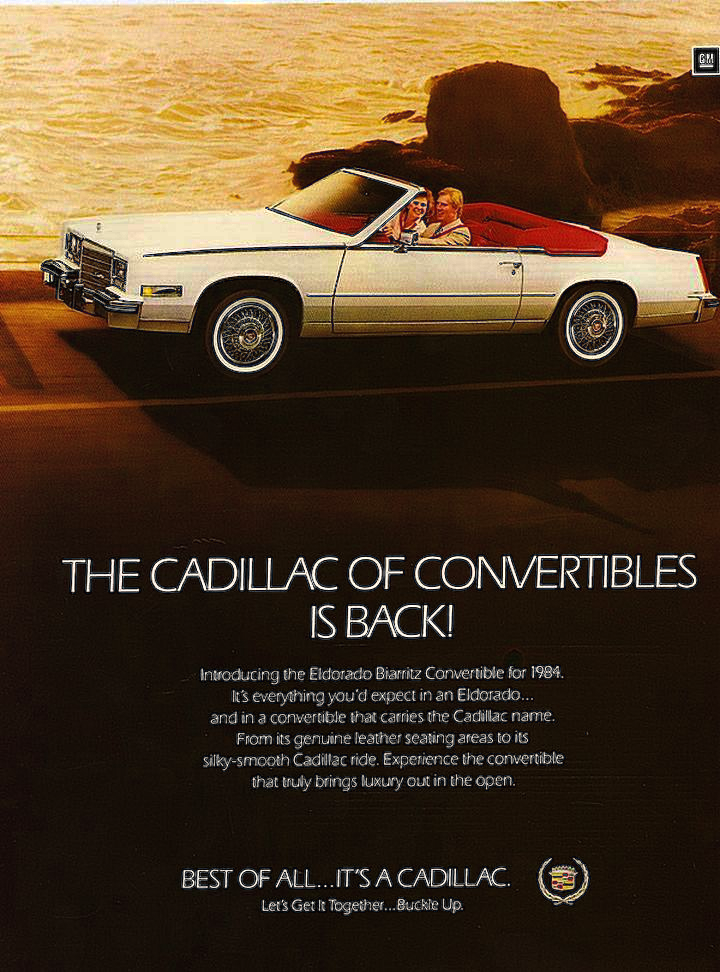
For 1984, Cadillac decided to join the eighties convertible party with a version of the Eldorado Biarritz. With a base price of $31,274 (about $99,900 in today’s dollars), the Eldorado droptop was operating in rarified air. In constant dollars, it was the most costly Eldorado of any type since 1960’s hand-crafted Pininfarina-built Brougham.

The only powertrain available for the 1984 Eldorado convertible was the HT-4100 135 bhp 4.1 liter/249 ci V8 with fuel injection paired with a four-speed automatic. With a curb weight of about 3,900 pounds, 0-60 mph came in around 14 seconds. Fuel economy was rated at 17 city/27 highway by 1984 standards (14/20 by today’s measures). A 20.4-gallon gas tank meant an Eldorado convertible owner could expect a range of between 310 and 360 miles with a 10% fuel reserve.

1984 Cadillac Eldorado convertible advertisement
1984 Cadillac Eldorado Biarritz convertible advertisement

Standard exterior and mechanical equipment on the Biarritz convertible included a power convertible top, power rear quarter windows, car color body side moldings, and P225/70R15 steel-belted radial wide white stripe tires (a size still readily available) on 15-inch wheels with wire wheel discs. Inside, a theft-deterrent system, leather seats, and a leather-trimmed steering wheel rim were standard.

Standard exterior and mechanical equipment on every 1984 Eldorado included Soft Ray tinted glass, front-wheel-drive, a four-wheel independent suspension, power steering, remote mirrors, and four-wheel power disk brakes. Inside, electronic climate control, power door locks, and power windows were all included. Standard audio features included a Delco-GM 2000 stereo with four speakers and a power antenna.

Options & Production Numbers

Options available for the Biarritz convertible included a remote locking fuel filler door ($59), electric power outside rearview mirrors ($101), Twilight Sentinel ($79), cruise control ($185), tilt and telescope steering wheel ($184), a six-way power passenger seat ($380), and a Delco 2000 electronically-tuned AM/FM/cassette stereo radio ($299).

Many significant Eldorado coupe options were not available with the convertible. Some unavailable options included the touring suspension, two-tone paint, the memory seat, and the all-conquering Delco-GM/Bose Symphony Sound System.

Cadillac sold 3,300 Eldorado convertibles in 1984—substantial numbers for such a high-end droptop and well more than the platform-mate Buick Riviera managed to sell in any single year. General Motors ended up having to navigate at least one lawsuit from folks who had purchased the 1976 Eldorado, which Cadillac advertised at the time as “the last convertible.”

There would be no more Eldorado convertibles after the end of tenth-generation Eldorado production in 1985. After a year’s break, the Allanté would debut in 1987 and take convertible Cadillacs into the mid-1990s.

The View From 2025

Badge for 2,500 web hits

Despite their sub-optimal motive power, tenth-generation Eldorados attract collector interest, and there is club support. According to Hagerty’s valuation tools, a 1984 Eldorado convertible in #1/Concours condition is $43,100, with a far more normal #3/Good condition version going for $9,800.

These Eldorados are often available in the Hemmings Motor News classifieds, on eBay Motors, on Bring a Trailer, and at in-person auctions. In January 2025, a Cotillion White 1984 Eldorado convertible with red leather “tufted multi-button” seats sold at Barrett-Jackson Scottsdale for a $11,000 hammer price.

Make mine Autumn Maple Firemist, please.

Other Eldorados I have written about include the 1982 Touring Coupe, the 1986 coupe, and the 1988 coupe. Additional E-body/K-body cars with blog entries include the 1980 Buick Riviera S TYPE coupe, the 1980 Cadillac Seville sedan, the 1982 Oldsmobile Toronado Brougham coupe, and the 1984 Buick Riviera T TYPE coupe.

Last updated August 2025.

1980 Datsun 200-SX coupe

A 1980 Datsun 200-SX coupe sold for $10,000 at the 2025 Barrett-Jackson Scottsdale auction.

“Thrill-injected”

Datsun’s 200-SX was almost entirely new for 1980, with exterior styling notably changed and a significantly enhanced engine. Nissan advertised improved visibility and increased door opening for 1980, but the real upgrade was that the 200-SX was no longer as weird-looking as the 1975-1979 had been. Nissan was in the process of transitioning away from the Datsun name, so the 200-SX’s official name was a clunky “Datsun 200-SX by Nissan.” No matter what, marketing used 200-SX instead of 200SX in 1980, so I’ll follow that in this post.

The only engine available for the 1980 200-SX was the NAPS-Z Z20E 100 bhp 2.0 liter/120 ci inline four with L-Jetronic electronic fuel injection paired with either a five-speed manual or a three-speed automatic. Car and Driver recorded a 0-60 time of 13.3 seconds in the 2,620-pound coupe. EPA fuel economy ratings with the five-speed were 28 city/40 highway—with a 14.0-gallon gas tank, a 200-SX coupe’s owner could expect a range of 430 miles with a 10% fuel reserve.

200-SX pages from the 1980 Datsun brochure

Standard exterior and mechanical equipment on the $6,689 1980 200-SX Deluxe (about $28,300 in 2025 dollars or just a little more than a 2025 Nissan Altima S costs) included four-wheel power-assisted disc brakes, partially recessed windshield wipers, and 185/70SR14 tires (a size still readily available) on 14-inch wheels with full mag style wheel covers. Inside, a quartz sweephand clock, deep pile carpeting, and full reclining front bucket seats with soft vinyl upholstery were included.

Options & Production Numbers

The Sport Luxury (SL) package upgraded 200-SX buyers to soft cloth upholstery, a multi-warning system, a driver’s seat with adjustable lumbar and thigh support, and a four speaker AM/FM stereo radio with power antenna.

The 1980 200-SX had few individual options, and most of them—except for California emissions—seem to have been available only if you had already ponied up for the SL package. These options included power steering, a lift-out skyroof, two-tone paint, and air conditioning.

The buff books liked the 200-SX for its intended purpose—Car and Driver wrote that the new version had “better looks and better manners.” They gently asked for more power, but that would be a long time coming and only in slight increases for the coupe. The 200-SX got 103 bhp in 1982, and the third-generation coupe got 105 bhp in mid-1984 (only the hatchback would get the 133 bhp turbo option).

Nissan sold 92,514 200-SX coupes and hatchbacks in 1980—a notable success, and soundly beating many competitors. This version of the 200-SX would run for four years.

The View From 2025

There is limited collector interest in these second-generation 200-SXs, so it isn’t that surprising that Hagerty’s valuation tools do not track any eighties Datsuns or Nissans other than the Z-cars and Skylines. Eighties 200-SXs rarely appear in the Hemming’s Motor News classifieds, eBay Motors, or Bring a Trailer.

Make mine Satin Blue Metallic, please.

Other Datsuns I have written about include the 1980 280ZX hatchback coupe and the 1981 810 Maxima sedan. Later Nissans I have posted on include the 1984 300ZX hatchback coupe and the 1989 Maxima sedan.

Interesting Eighties Vehicles at the 2025 Barrett-Jackson Scottsdale

Barrett-Jackson‘s signature annual Scottdale auction finished on January 26th. In the middle of 2021, I gave up trying to chronicle every eighties vehicle sold at any particular auction—there’s often an endless sameness to them. So, I now only write about the cars and trucks that are less seen at auction. Below are five of the 2,000 or so vehicles sold at Scottsdale that attracted my eye, described and discussed with a little more detail than usual.

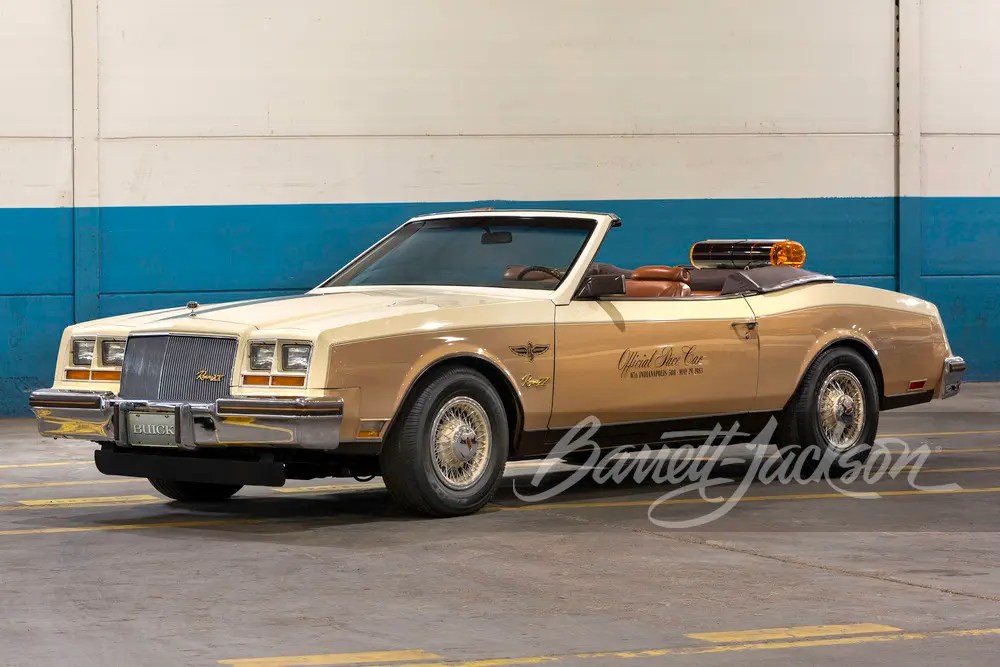
Exterior photo of 1982 Buick Rivera convertible Indy 500 pace car
1982 Buick Riviera,
image linked from Barrett-Jackson’s website

[Lot 113] 1982 Buick Riviera convertible Indianapolis 500 pace car. One of two custom-built for the 1983 Indy 500, with tan two-tone paint and brown leather/suede front bucket seats—a look that resembled, but did not precisely match the 1983 Riviera XX Anniversary coupe. 410 bhp (stock turbo Rivieras never got to half of that) 4.1 liter/252 ci V6 with sequential fuel injection and twin turbochargers, a three-speed automatic, and 12,000 miles—did someone actually daily drive this car at some point, or were most of these shakedown miles? The $47,000 hammer price has to represent an all-time high for a sixth-generation Riviera, though Bring a Trailer and Hagerty are now both showing values in the high $30k range for very nice stock examples.

1980 Datsun 200SX,
image linked from Barrett-Jackson’s website

[140] 1980 Datsun 200SX SL coupe. Satin Blue Metallic with blue cloth/vinyl front bucket seats. Z20 100 bhp 2.0 liter/120 ci inline four with fuel injection, a three-speed automatic, and unstated mileage. $10,000 for a nice-looking example of a car I haven’t seen any examples of in about three decades—despite almost 93,000 being sold in the 1980 model year alone. I should probably write about the 200SX soon [update—I did].

1980 Ford Pinto,
image linked from Barrett-Jackson’s website

[151] 1980 Ford Pinto Squire two-door station wagon. White with woodgrain vinyl bodyside and liftgate paneling and Vaquero cloth front bucket seats. Lima 88 bhp 2.3 liter/135 ci inline four with a two-barrel carburetor, a three-speed automatic, and an indicated 9,500 miles. $6,500 for one of the last and most expensive of the star-crossed Pintos. Who saved this car?

1984 Chevrolet Camaro,
image linked from Barrett-Jackson’s website

[1524.2] 1984 Chevrolet Camaro Z/28 hatchback coupe. Dark Gold Metallic with Camel Custom cloth front bucket seats. L69 “H.O.” 190 bhp 5.0 liter/305 ci V8 with a four-barrel carburetor paired with a five-speed manual (not the four-speed in the on-line listing—those went away after 1982). Eighties Camaros are far from rare at auction (Barrett-Jackson had seven this year), but I loved that this Z/28 had been preserved in its very 80s colors—no red or black here. $13,000 is right at Hagerty’s #3/Good condition money.

1987 Porsche 959, image linked from Barrett-Jackson’s website

[1381] 1987 Porsche 959 Komfort coupe. Silver Metallic with burgundy leather front bucket seats with a silver stripe pattern. 260 bhp 2.8 liter/174 ci flat six with fuel injection, twin turbochargers, and twin intercoolers, a six-speed manual, and 4,000 miles. At $1,325,000, by far the highest eighties vehicle sale at this year’s Barrett-Jackson Scottsdale—almost half a million ahead of an admittedly gorgeous 1989 Porsche 911 Carrera Reimagined by Singer. According to Hagerty, this is merely #3/Good condition money for a Komfort—did someone get a (relative) bargain?

What eighties vehicles did you like at this year’s Barrett-Jackson Scottsdale?

1987 Lincoln Continental sedan

A black 1987 Lincoln Continental with 86,000 miles hammered sold for $8,500 at the 2025 Mecum Kissimmee auction.

“The first thing you’ll notice is that everyone else does.”

In the final year of its seventh generation, the “Fox” Lincoln Continental was little changed. The real wood trim in the interior was retired in favor of imitation wood, and 1986’s weird-looking “geometric cast aluminum” wheels were gone. Otherwise, only color and trim changes were visible.

The V6 and the BMW diesel were long gone, so the 1987 Continental’s only available powertrain was a Windsor 150 bhp 4.9 liter/302 ci V8 with sequential multi-port fuel injection mated with a four-speed automatic with overdrive. 0-60 came in about 11 seconds in a car with a 3,800-pound curb weight. Fuel economy was respectable: 17 city/27 highway by the standards of the day (16/24 by 2025 measures). With a 20.3-gallon gas tank, a Continental owner could expect a range of 365 to 400 miles with a 10% fuel reserve.

The Continental’s base price was $26,402 for 1987—approximately $75,500 in today’s dollars. That’s about $20,000 more than the 2025 Lincoln Corsair Grand Touring SUV goes for—with about the same interior dimensions, including somewhat tight rear legroom.

Page from the 1987 Lincoln Continental brochure

Over its six-year lifespan, Lincoln notably increased the Continental’s base equipment level. By 1987, base exterior and mechanical equipment included quad halogen headlamps, an illuminated/keyless entry system, a power antenna, power-assisted rack-and-pinion steering, an Electronic Air Suspension with automatic level control, four-wheel anti-lock disc brakes, and P215/75R15 white sidewall tires (a size still readily available) on 15-inch forged aluminum wheels. Inside, every Continental for that year included fingertip speed control, interval windshield wipers, Automatic Climate Control, power windows, power door locks, six-way power-adjusted Twin Comfort Lounge cloth seats, and an AM/FM stereo cassette radio with a six-speaker Premium Sound System.

Options & Production Numbers

The now well-equipped Continental offered relatively few options for 1987. Exterior and mechanical options included Glamour paint ($268), dual-shade paint ($320), a power glass moonroof ($1,319), a Traction-Lok differential ($101), puncture sealant white sidewall tires ($200), and wire-spoke aluminum wheels ($693). Interior options included an automatic-dim day/night mirror ($89), an Anti-Theft Alarm System ($200), leather seat surfaces ($569), and the Ford JBL high fidelity 12-speaker audio system ($506).

For $4,300 over the base Continental, the Givenchy Designer Series made the wire-spoke aluminum wheels and leather seat surfaces standard. Special Givenchy two-tone paint and specific trim were also added.

1987 was a decent year for Lincoln’s mid-size sedan. Despite being at the end of its life cycle, 17,597 were sold. This Continental was also the last of the bustlebacks, as Cadillac’s second-generation Seville sedan (1985) and Chrysler’s Imperial coupe (1983) had already departed.

The View From 2025

Continentals of this era do attract some collector interest—though not as much as the Mark VIIs and Town Cars—and there is club support. Being based on the Fox platform means that some mechanical issues are more straightforward and less expensive to solve than they might otherwise be (and that some mild performance upgrades are easier).

According to Hagerty’s valuation tools, all the money for a 1987 Continentals in #1/Concours condition is a somewhat astounding $21,100, with a far more normal #3/Good condition version going for $6,800. These Continentals are sometimes available in the Hemmings Motor News classifieds, on eBay Motors, or on Bring a Trailer, and, as previously discussed, they occasionally show up at auction.

Make mine Cabernet Clearcoat Metallic, please.

Other Lincolns I have covered include the 1980 Continental Mark VI coupe, the 1984 Continental Mark VII LSC coupe, and the 1986 Mark VII coupe. I’m a little surprised that I haven’t written about at least one Town Car.

Interesting Eighties Vehicles at the 2025 Mecum Kissimmee

Mecum’s huge annual Kissimmee auction finished on January 19th this year. In the middle of 2021, I gave up trying to chronicle every eighties vehicle sold at any particular auction—there’s often an endless sameness to them. So, I now only write about the cars and trucks that are less seen at auction—and those that sold (a red 1982 Porsche 935/84 race car was a no-sale at $1,100,000). Here are ten that attracted my eye, described in a little more detail than usual.

1982 Oldsmobile Delta 88 interior, linked from Mecum’s website

[Lot E117] 1982 Oldsmobile Delta 88 Royale coupe. White with a White vinyl Landau top and Dark Blue cloth Custom Sport front bench seat. LV2 140 bhp 5.0 liter/307 ci V8 with a four-barrel carburetor, a four-speed automatic, and 8,900 miles. A $20,500 hammer price indicates that these game-changing B-bodies still have their followers. Perhaps I should write about the Oldsmobile version soon.

1989 Buick LeSabre, linked from Mecum’s website

[E194] 1989 Buick LeSabre T-Type coupe. Black with gray cloth front bucket seats. LN3 165 bhp 3.8 liter/231 ci V6 with fuel injection, a four-speed automatic, and 94,000 miles. Flint made a little under 16,000 of these late T-Types over three years—how many are left? $14,000 bought this example, evidently now sporting a BMW shade of black.

1983 Honda Civic, linked from Mecum’s website

[L189] 1983 Honda Civic 1500S hatchback coupe. Victoria Red with black cloth front bucket seats with red inserts. EM 67 bhp 1.5 liter/91 ci inline four with a two-barrel carburetor, a five-speed manual, and 12,600 miles. $25,000 is real money for a non-CRX eighties Civic—but the 1500S was well-regarded when it was new.

1984 Chevrolet Corvette, courtesy of Mecum

[J123] 1984 Chevrolet Corvette hatchback coupe. Experimental tri-coat Tre-Celeste Pearl with medium gray leather front bucket seats. L83 Cross-Fire 205 bhp 5.7 liter/350 ci V8 with throttle-body fuel injection, a four-speed automatic, and 12,500 miles. Eighties Corvettes are a dime a dozen at auction (there were 33 at Mecum Kissimmee this year), but the color (only painted on two Corvettes) sets this one apart. $20,000.

1987 Chevrolet Chevette exterior
1987 Chevrolet Chevette, courtesy of Mecum

[J235] 1987 Chevrolet Chevette CS hatchback coupe. Silver Metallic with gray cloth front bucket seats. LB0 65 bhp 1.6 liter/98 ci inline four with a two-barrel carburetor, a four-speed manual, and 47 miles. $30,000 for perhaps the nicest one remaining, but it’s still a final year Chevette. From the Ray Fauber Estate Collection, which featured many extremely low mileage vehicles.

1987 Lincoln Continental, linked from Mecum’s website

[G322] 1987 Lincoln Continental sedan. Midnight Black with Oxford Gray leather Twin Comfort Lounge front seats. Windsor 150 bhp 4.9 liter/302 ci V8 with fuel injection, a four-speed automatic, and 86,000 miles. You see a reasonable number of eighties Lincoln Marks, but you don’t see nearly as many of these seventh-generation Continentals. $8,500 for another car I should probably write about at some point [update—I did].

1985 Toyota Cressida, linked from Mecum’s website

[W128] 1988 Toyota Cressida sedan. Dark Red Pearl with burgundy leather front seats. 156 bhp 5M-GEU 2.8 liter/168 ci inline six with fuel injection, a four-speed automatic, and 75,000 miles. $20,000 bought this once top-of-the-line North American Toyota offering—produced just before the advent of Lexus. Cressidas are now rarely seen, though there were two at this year’s Mecum Kissimmee.

1984 Ford Mustang, linked from Mecum’s website

[W207] 1984 Ford Mustang GT Turbo convertible. Light Academy Blue Glow with a blue convertible top and charcoal vinyl front bucket seats. Lima 145 bhp 2.3 liter/183 ci inline four with fuel injection and a turbocharger, a five-speed manual, and 7,300 miles. I was completely unaware of this two-year-only nonSVO turbo Mustang until I viewed these auction results. $10,000 for this attractive and rare Fox-body.

1984 Ferrari 512 BBi, linked from Mecum’s website

[F159] 1984 Ferrari 512 BBi coupe. Rossa Corsa (of course!) with beige leather front bucket seats. Tipo F110A 340 bhp 4.9 liter/302 ci flat 12 with fuel injection, a five-speed manual, and 5,100 miles. At $345,000, the highest eighties vehicle sale of this auction—by a cool $80,000 over a 1988 Testarossa.

1983 Lola T700 Cosworth, linked from Mecum’s website

[S153] 1983 Lola T700 Cosworth Indy race car. In Budweiser colors—red and white. Cosworth DFX 2.7 liter turbocharged V8 with a five-speed manual. The first Newman/Haas-campaigned Indy Car, which was twice driven to victory by Mario Andretti in 1983, this was a race car that did sell—for $250,000.

1987 Buick GNX coupe

There are (many) eighties cars that no one is convinced have a following, and then there is the Buick GNX. Unlike many of the unloved cars I write about, I doubt there’s anything new I can add to the discourse about the GNX. Still, I can’t not cover it. And … thank you, Kendrick Lamar, for the GNX exposure.

“A high-performance investment for the fortunate 500.”

1987 Buick GNX advertisement

The story is familiar to many of us. Buick’s Grand National performance variant of the Regal had been around since 1982, and it had gotten steadily more powerful, gaining a standard turbo V6 in 1984, and an intercooler in 1986. For 1987, Buick announced the GNX, which stood for Grand National Experimental.

Buick built cars with Grand National interiors and sent them to American Specialty Cars (ASC). The GNX added a performance suspension with a torque bar and a GNX-only rear differential cover. Its exterior featured functional front-fender louvers, and 16-inch aluminum mesh wheels with black-out faces and GNX center caps, which were equipped with Goodyear Eagle “Gatorback” tires—245/50VR-16 in front and 255/50VR-16 in the rear.

Most importantly, the GNX included a massaged version of Buick’s LC2 3.8 liter/231 ci turbo V6, making 276 bhp and paired with a four-speed automatic transmission with overdrive. Improvements to the engine over the standard turbo included a Garrett T3 turbocharger with ceramic impeller and a GNX-specific heat shield, a larger capacity intercooler, reprogrammed engine management, and a low-restriction exhaust.

Straight-line acceleration was outstanding for the day—Car and Driver recorded a 0-60 time of 4.7 seconds, with the quarter mile flying by in 13.5 seconds. The GNX handled well for a Regal, but that wasn’t really the point. Mileage ratings were 15 city/23 highway by the day’s standards (about 13 city/21 highway by today’s measures), which triggered the dreaded gas guzzler tax—$650 in this case.

The GNX was not inexpensive—the window sticker showed $29,290 (about $84,400 in 2025 dollars), with the GNX option alone listed as $10,995. Essentially, moving from a Grand National to a GNX added more than 50% to the price.

By 1987, a Grand National came reasonably well-equipped, with Sport mirrors, air conditioning, a leather-wrapped Sport steering wheel, a full-length operating console, and reclining front bucket seats included. A GNX came standard with many comfort and convenience features that were optional on the Grand National, including tungsten-halogen headlamps, electric door locks, power windows, electronic cruise control, tilt steering column, a six-way power driver’s seat, and the top-of-the-line UX1 stereo with graphic equalizer.

Options & Production Numbers

Buick built a mere 547 examples of the GNX—production was always intended to be quite limited. As far as I can tell, there were no factory options.

The View From 2025

According to Hagerty’s valuation tools, all the money for a 1987 Buick GNX coupe in #1/Concours condition is an astounding $257,000, with a far more normal #3/Good condition version going for $110,000.

The GNX has enthusiastic forum support, and there is intense collector interest. GNX coupes are sometimes available in the Hemmings Motor News classifieds, at online auctions such as Bring a Trailer that cater to the eighties car market, and at in-person auctions such as Barrett-Jackson and Mecum.

Make mine Black, of course.

Last updated in February 2025.

End of the Year Review: 2024

Typewriter icon

I look at the end-of-year results for the blog’s most viewed posts every December. For 2024, it once again looked like the key to an individual post’s popularity was often in the rarity of the other coverage available for that particular vehicle. We’ll discuss this year’s top ten most viewed posts in reverse order.

10) 1980 Pontiac Sunbird Sport Hatch—dropping eight slots this year, but hanging on (still top five all-time with almost 4,000 views). Perhaps the salient example of my rarity theory—any first-generation Sunbird coming up for sale is now a rare sight.

9) 1985 Chevrolet C20 Suburban Silverado SUV—the first eighties SUV to make any year’s top ten dropped two spots this year, proving that SUVs don’t dominate everything in 2024. According to Hagerty, a 1985 C20 Suburban Silverado in #1/Concours condition is $47,300, with a more typical #3/Good condition example going for $20,300.

8) 1984 Dodge Daytona Turbo Z hatchback coupe—a newish post from July 2023 makes its first appearance in the top ten. It’s also the highest ranking MOPAR entry ever.

7) 1983 Honda Civic S hatchback coupe—for me, at least, researching early eighties Hondas is challenging. Thus, this post was a 250-word “short take,” but it makes its first appearance in the top ten.

6) 1988 Mercury Cougar XR-7 coupe—Hagerty does not track these distinctive sixth-generation Cougars, though they do track eighties Thunderbirds on the same platform. Dropping one slot for this year.

5) 1989 Buick Electra Park Avenue Ultra sedan—this 2020 post about the top-of-the-line Buick for 1989 (more expensive than the Riviera) rose four spots in 2024.

4) 1980 Pontiac Grand Prix SJ coupe—a relatively recent post from early 2022 shows some staying power. Up two spots in 2024 for Pontiac’s final Grand Prix SJ.

3) 1985 Buick Somerset Regal coupe—this post has been picked up by other websites a few times, including in 2018 by Jalopnik. Hilariously, I don’t think I would have ever gotten around to writing about the Somerset Regal if I hadn’t seen one on the streets of Philadelphia back in 2014. Returning to the top ten this year, this post is the fourth most popular entry since Eighties Cars debuted over a decade ago.

2) 1981 Oldsmobile Cutlass Supreme coupe—this post is #1 all-time (5,500 views), but drops one spot for 2024. Popularity does not always equal collectability, and Hagerty has yet to track eighties Cutlass Supreme values.

1) 1987 Mercury Lynx XR3 hatchback coupe—Mercury is, of course, an orphan make, but this blog entry has been viewed more than six times more than my write-up on the related 1981 Ford Escort hatchback coupe. Up three spots this year.

Three posts that did not make it into the top ten in 2024 after doing so in 2023 were all Chevrolets—the 1980 Chevrolet Camaro Z28 coupe, the 1983 Chevrolet Monte Carlo SS Sport Coupe, and the 1986 Chevrolet Camaro Berlinetta hatchback coupe. The best-performing European product post was the 1983 Jaguar XJ6 sedan (15th). An entry coming on strong at the end of 2024 was the 1984 Buick Skyhawk coupe.

Thanks to all who viewed this blog in 2024!