I walked to the local supermarket today to secure some Coca-Cola which we had somehow run short of. We’re located on the southeastern edge of what most weather forecasters seem to think is going to be a full-out blizzard over the next day and a half or so.
It’s only a couple of blocks to the supermarket. On the way is a little tan house which almost always has an original Natural Suede Tan Dodge Aries or Plymouth Reliant station wagon parked next to it. There is no garage for the wagon, so usually it sits out in the weather and rust is definitely showing in parts of that famously squared-off body.
An early Chrysler corporation K car station wagon sits quietly under a little snow and a car cover this morning
This morning, however, there was a fitted blue car cover on the wagon to help protect it from this particular storm, which has just begun.
I may be projecting here, but I choose to see a lot of love and caring for an old and hardworking friend. Is that cover original or new (you can still get them) ? Does it only go on when the predictions are as dire as today’s? How many miles does that wagon have?
Questions, questions, questions. I don’t think I’ve ever seen the owner — if I do, maybe I’ll ask a few.
The January auction at Mecum Kissimmee provided some interesting fodder for commentary. I’ll concentrate on the at least fairly stock 1980s cars (and a few trucks) that sold (remember that this is not a no reserve auction—a blue 1986 Porsche 930 Turbo slantnose coupe with 29,000 miles was a no sale bid up to $85,000) and add some of my opinions. Mecum Kissemmee is a huge event, so I’m going to separate it into two posts—this first covers from Friday to Wednesday (with no auctions on Monday).
Friday:
1986 silver Chevrolet Corvette convertible with the 4+3 manual—$9,000 hammer price
1986 red Chevrolet Corvette convertible with the 4+3 manual and 14,000 miles—”resale red” and relatively low miles pushes this sale to a slightly more respectable $10,250
1981 gold Pontiac Firebird Trans Am coupe—at $11,500 the first car in this auction to meet my criteria for serious 1980s collectability of original cars: selling for equal to or above its original base list price. I’ll mark these cars in bold green
1984 brown Oldsmobile Cutlass Supreme coupe with 23,000 miles—$10,500 buys another one of these once hugely popular cars (Oldsmobile built 245,000 Cutlass Supreme coupes in 1984) that have started to show up at auction in the last year or so
1983 gold Datsun/Nissan 280ZX coupe—$4,000
1986 black Chevrolet Corvette coupe with 86,000 miles—$5,500
1986 black Chevrolet Monte Carlo SS coupe—$10,500
1986 red Chevrolet very custom pickup truck—$14,000
1989 camouflage AM General cargo truck—$8,750
Saturday:
1988 black Mercedes-Benz 560SL convertible with 15,000 miles—$40,000
1986 silver Mercedes-Benz 560SL convertible with 31,000 miles—$22,000
1981 brown Mercedes-Benz 380SLC coupe with 21,000 miles—$13,500
1982 silver beige Chevrolet Corvette Collector Edition coupe with 15,000 miles—$22,000
1980 white Alfa Romeo Spider convertible—$6,500
1988 black Pontiac Firebird Trans Am GTA coupe with 49,000 miles—$10,250
1982 white Mercedes-Benz 380SEC coupe with AMG body kit—$7,750
1988 black Porsche 944 coupe—$4,000
1986 black Rolls-Royce sedan with 44,000 miles—$7,500 for one of these cars whose values are in steady decline as the frightful cost of performing deferred maintenance for an imperfect car becomes more and more obvious
Sunday:
1980 silver Chevrolet El Camino mild custom pickup truck—$15,000
1989 black Mercedes-Benz 560SL convertible—$15,000
1989 metallic brown Mercedes-Benz 560SEL sedan with 111,000 miles—$3,500
1986 white Pontiac Firebird Trans Am coupe—no mercy at Mecum at $3,000
1980 silver Chevrolet Camaro custom coupe with 64,000 miles—$8,500
1988 white Chevrolet Corvette 35th Anniversary coupe with 41,000 miles—$12,500
1980 bronze Jeep CJ-5 very custom SUV—$22,000
1987 black/burgundy two-tone Rolls-Royce Silver Spur sedan with 41,000 miles—$26,500
1984 white Buick Riviera convertible with white top and red interior, unusual turbo V6, and 40,000 miles—$19,000
1983 silver Datsun/Nissan 280-ZX coupe with turbo/automatic—$8,500
1980 blue MGB convertible—$5,750
Tuesday:
1984 white Pontiac Fiero Indy Pace Car coupe with 2.5 liter 4-cylinder/4-speed manual, headrest mounted speakers, and 550 miles—$13,750
1988 blue Pontiac Firebird Formula custom coupe—$5,000
1982 black Alfa Romeo Spider Veloce convertible—$5,750
1986 red Jeep CJ-7 custom SUV—$9,500
1981 silver Chevrolet Camaro very custom coupe—$14,500
1987 black Buick Regal Grand National coupe with 7,800 miles—$27,000
1980 gray Jeep Cherokee SUV—$10,250
Wednesday:
1987 orange Jeep Comanche pickup truck with 2.5 liter 4-cylinder/5-speed manual and 4-wheel drive—$2,500
1985 burgundy Chevrolet El Camino SS custom pickup truck with the classic Choo Choo nose—$10,000
1987 red Jeep Comanche pickup truck with 2.5 liter 4-cylinder/4-speed manual—$6,250
As always, the January auction at Barrett-Jackson Scottsdale provided much interesting fodder for commentary. I’ll concentrate on the 1980s cars (and a few trucks) that sold (a 1989 red Ferrari F40 coupe was bid up to $975,000 but did not meet reserve) and add some of my opinions.
Monday:
1984 white Cadillac Seville sedan—$4,500 hammer price.
1981 yellow tan AMC Spirit coupe—$4,500
1984 blue silver Mercedes-Benz 380SL convertible with 115,000 mile—$9,500
1982 gold metallic Chevrolet Corvette coupe with 77,000 miles—$10,500
1985 white Chevrolet Corvette coupe with 30,000 miles—$10,000
1987 dark red Callaway Chevrolet Corvette coupe with 14,000 miles—$16,000
1989 black Ford Aerostar custom van with 47,000 miles—$5,000
Tuesday:
1986 black Buick Grand National coupe—at $14,500 the first car in this auction to meet my criteria for serious 1980s collectability of original cars: selling for equal to or above its original list price. I’ll mark these cars in bold green
1986 white Zimmer Golden Spirit coupe—$17,000
1987 root beer Chevrolet C-10 custom pickup truck—$10,500
1980 white Toyota Land Cruiser SUV with 57,000 miles—$36,000
1984 white Cadillac DeVille custom pickup truck—$19,000
1981 black Pontiac Firebird Trans Am coupe with 80 miles—$50,000
1981 white Pontiac Firebird Trans Am very custom coupe—$92,000
1988 guards red Porsche 911 Turbo coupe with 29,000 miles—$105,000
Saturday:
1986 red Porsche 930 Turbo R69 Rinnspeed coupe with 9,500 miles—$150,000
1988 red Ferrari Testarossa coupe with 280 miles—at $245,000, by far the top 1980s sale. It looks like the era of the relatively inexpensive Testarossa is over.
Sunday:
1989 black BMW 635CSi mild custom coupe—$7,500
1982 white Chevrolet C-10 pickup truck—$11,000
1986 white Chevrolet Crew Cab custom pickup truck—$11,000
1988 blue Oldsmobile Cutlass very custom coupe—$7,000
1981 tan Jeep CJ-8 Scrambler custom pickup truck—$10,000
1989 candy red Jaguar XJ-Svery custom (LS2 engine) coupe—$17,000
1980 red/black two-tone Datsun 280ZX mild custom coupe with 58,000 miles—$9,000
Looks like a lot of Mercedes-Benz SLs, turbo Buicks, Chevrolet trucks, and Jeeps. What do you think of this year’s results?
This year’s Barrett-Jackson Las Vegas auction included a good number of interesting vehicles. As usual, I’ll concentrate on the 1980s cars (and some trucks) that sold and add some of my opinions. Where I have covered the specific year and model of a car in this blog, I link to it.
Thursday:
1984 maroon Buick Riviera coupe with 36,000 miles—at a $30,000 hammer price the first eighties vehicle sold in this auction is also the first eighties vehicle to meet my criteria for serious 1980s collectability of original cars or trucks: selling for equal to or above its original base list price. I’ll mark these vehicles in bold green. This was also the highest eighties car or truck sale of the auction.
1981 red Porsche 911 Carrera coupe with 31,000 miles—$29,000
1987 black Buick Grand National coupe with 33,000 miles—$22,500
1986 red Ferrari Mondial 3.2 convertible with 26,000 miles—$24,000
Friday:
1986 black Buick LeSabre Grand National coupe with 17,000 miles—$25,000 for this rare car.
1981 silver DeLorean DMC-12 coupe with 4,000 miles—$35,500
1980 white Pontiac Firebird Turbo Trans Am Pace Car coupe with 234 miles—at $50,000, the highest eighties car or truck sale of the auction.
Saturday:
1987 black Buick Grand National coupe—$21,000
1988 brown Rolls-Royce Silver Wraith II sedan with 50,000 miles—$10,000. It is the wrong color, of course, but will these cars ever recover?
1986 tan/brown two-tone Rolls-Royce or Bentley sedan (not at all clear from the description, but the grill is a Bentley’s)—$7,000
Prices for all cars didn’t seem very strong at this auction—or for that matter at Reno Tahoe, but some eighties cars and trucks did okay. What do you think of this year’s results?
“Cross-Fire injection adds to the Corvette performance equation.”
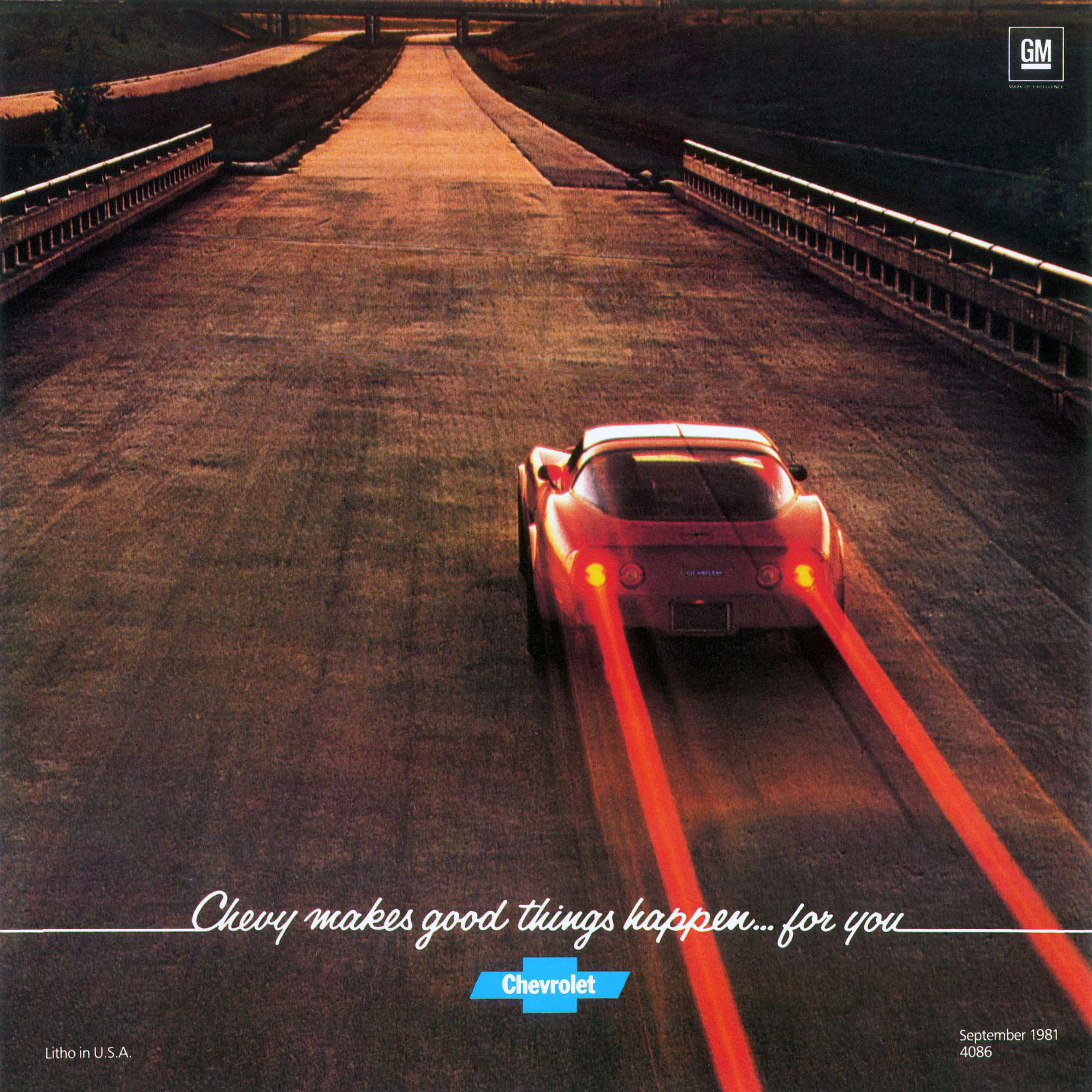
1982 was the final year for the “shark” Corvette, but the first year for the L83 Cross-Fire 5.7 liter/350 ci V8—a throttle body fuel-injected design that put out a respectable for the day 200 bhp and 285 lb-ft of torque. The downside was that it was only available with a four-speed automatic transmission; a manual transmission would not return until the middle of the 1984 model year.
Top speed for the 1982 Corvette was 125 mph, and Road & Track managed a 0-60 time of 7.9 seconds. Estimated fuel economy was 15 city/26 highway by the day’s standards—not bad for a fairly large V8 with primitive engine controls. With a 23.7 gallon gas tank, a 1982 Corvette owner could expect a range of 355 to 390 miles with a 10% fuel reserve—notably better than one year earlier.
The heavily-hyped Cross-Fire was an intermediary step for General Motors on the way to true multi-port electronic fuel injection for Chevrolet’s small-block V8. For Corvette, it brought the best horsepower in a standard engine since 1972, though it was not the relative screamer that the L82 (optional from 1973 to 1980) had been. However, the flat intake manifold design compromised fuel injection’s potential fuel economy gains—real improvements would wait until 1985’s L98.
Other changes for 1982 included the availability of the Collector Edition, as well as many new exterior paint colors and interior color options. Lost in the Cross-Fire publicity was the move from a three-speed automatic to a four-speed automatic transmission.
Rear cover of 1982 Chevrolet Corvette brochure
Standard exterior and mechanical equipment in the $18,290 base Corvette (about $63,400 in today’s dollars) included tinted glass for all windows, removable roof panels, a Delco Freedom II battery, power steering, four-wheel power disc brakes, and P225/70R15 tires (a size still readily available) on 15-inch by 8-inch steel rally wheels. Inside, air conditioning, power windows, a Tilt-Telescopic steering wheel with a leather-wrapped rim, a quartz analog clock, and an AM/FM stereo radio with dual front speakers were all included.
The Collector Edition, Individual Options, & Production Numbers
The $22,538 Collector Edition (about $78,200 in 2025 dollars and about what a 2026 Corvette Stingray 2LT coupe goes for) added a functional hatchback (a first for Corvette), P255/60R15 Goodyear Eagle GT tires, aluminum wheels, and specific Silver Beige paint, striping, seats, and interior trim—along with a 23% addition to the base price.
Individual exterior and mechanical options included power sport mirrors ($125), power door locks ($155), cruise control ($165), electric rear window defogger ($129), gymkhana suspension (only $61 for specially tuned shock absorbers, higher-rate rear spring, and a rear stabilizer bar), two-tone paint ($428), aluminum wheels ($458), and P255/60R15 Goodyear Eagle GT tires ($543). Optional interior equipment included a six-way power driver’s seat ($197) and an AM/FM stereo radio with a cassette player ($423).
Options that date this car include the stereo radio with a cassette player and Citizens Band radio ($755), the stereo radio with an 8-track player ($755), and the radio delete (-$124). Corvette buyers piled on the options in 1982: the average buyer ordered $2,195 worth, raising the sticker to $20,485 (about $71,100 in today’s dollars).
In its final year, the shark still sold decently—but the end for a car that featured many design components from 1963 was in sight. Chevrolet moved 25,407, of which 6,759 (about 27%) were the pricey Collector Edition.
The View From 2025
There is strong club support for the 1982 Corvette, as there is for all Corvettes. According to Hagerty’s valuation tools, a loaded non-Collector Edition 1982 Corvette in #1/Concours condition is $42,700, with a more typical number #3/Good condition car going for $17,200. 1982 Corvettes are regularly featured in the Hemmings Motor News classifieds, eBay Motors, and Bring a Trailer. As I update this blog entry in September 2025, there’s a Silver Metallic over Dark ClaretMetallic two-tone Corvette with red cloth seats and 15,000 miles for sale on Hemmings, asking $30,000.
Make mine one of the relatively rare (and absolutely gorgeous) Silver Green Metallic cars, with the silver green leather seats.
While out driving late in 2014, I saw an early 1980s Chrysler Imperial aggressively carving the back roads in the Philadelphia suburbs near where I live. The body design remains utterly distinctive: the alacrity with which the Imperial was moving makes me assume that it had the carburetor conversion and/or some other engine upgrade.
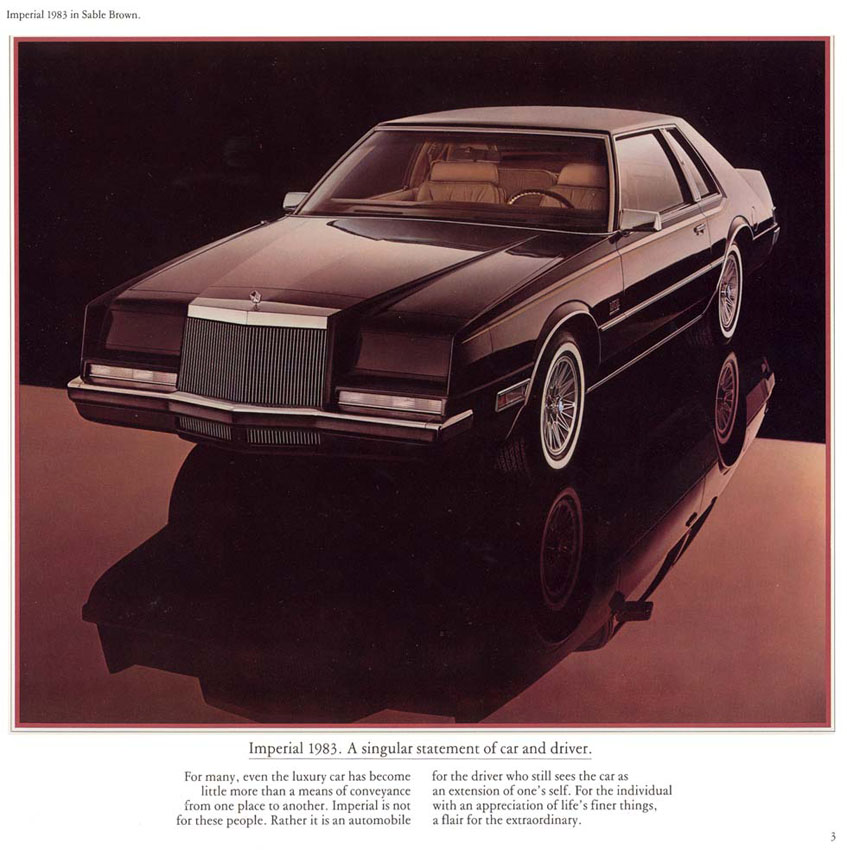
“A singular statement of car and driver.”
Chrysler introduced the “bustle back” Imperial for the 1981 model year, bringing it to market partly to reassure potential buyers that the company would remain in business. By 1983, the Cordoba-based luxury coupe was in its final year, selling a mere 1,427 units as all rear-wheel drive Chrysler products continued their decline.
For 1983, the powertrain continued to be the same: the LA 140 bhp electronic throttle-body fuel-injected 5.2 liter/318 ci V8 paired with a TorqueFlite three-speed automatic transmission. Despite notable attempts at increasing quality (each Imperial went on a five-and-a-half-mile test drive and received numerous other checks before shipping from the factory), the bleeding edge fuel injection continued to be stunningly unreliable—Chrysler frequently ended up replacing it with a carburetted system at the cost of $3,500 plus about 50 hours of labor.
Performance for the 3,900-pound coupe wasn’t impressive: 0-60 came in a little under 14 seconds. To be fair, neither the Cadillac Eldorado nor the Lincoln Continental Mark VI (the Imperial’s intended competitors) were notably faster in 1983. Fuel economy was rated at 16 city/26 highway by the day’s standards, giving a range of 305 to 340 miles with the 18-gallon gas tank and a 10% fuel reserve.
Page from the 1983 Chrysler Imperial brochure
Standard mechanical equipment for the quite well-equipped for 1983 $18,688 Imperial (approximately $61,500 in today’s dollars) included halogen headlights, power brakes, power steering, cruise control, and Goodyear Arriva P205/75R15 steel-belted radial whitewall tires (a size still readily available) on cast aluminum wheels. Exterior equipment included power heated mirrors, power windows, intermittent windshield wipers, and a rear window defroster. Interior equipment included “semi-automatic” air conditioning, a tilt steering wheel, leather and vinyl 60/40 power seats, and a 30-watt AM/FM stereo with cassette and power antenna.
Unusual standard equipment for 1983 in any car included an electronic instrument cluster, a garage door opener, and a two-year/30,000-mile warranty (a lot of warranty in those unreliable days). The only extra cost option was high altitude emissions ($75—why did Chrysler cheap out at this point?); no cost options included cloth and vinyl seats, Michelin tires, and wire wheel covers. Unlike in 1981 and 1982, there was no Frank Sinatra edition for 1983.
The View From 2025
Especially from the rear, the Imperial looks a lot like Cadillac’s 1980 Seville redesign, but seems to have been a separate idea—exterior design had begun in 1977. Not surprisingly, allpar.com has an interesting and detailed article on the 1981-1983 Chrysler Imperial—it is here.
According to Hagerty’s valuation tools, a 1983 Chrysler Imperial in #1/Concours condition is $26,100, with a more normal #3/Good condition car fetching $7,600. Imperials appear in the Hemmings Motor News classifieds and very occasionally on Bring a Trailer. When I updated this entry in April 2025, a Goldenrod Crystal Coat 1982 with 111,000 miles was available on Hemmings, asking $19,800.
With the announcement of the 2015 Mustang and its available EcoBoost turbocharged inline-four, my mind turned back to the 1984 to 1986 Mustang SVO.
“Sophisticated performance for the knowledgeable driver.”
Created by Ford’s Special Vehicle Operations department, the 1984 Ford Mustang SVO was an admirable attempt to take a different and more advanced approach to the pony car market. Released in mid-April 1984, this version of the Fox-body Mustang was built around the Lima turbocharged and fuel-injected 2.3 liter/140 ci inline four, making 175 bhp paired with a Borg-Warner T5 five-speed manual. By the day’s standards, this combination yielded a reasonable 19 city/26 highway (it would be 17/24 by current standards). Car and Driver recorded a respectable 7.5 second 0-60 time and a 128 mph top speed.
1984 Ford Mustang advertisement
Other modifications over the standard Mustang included ventilated four-wheel power disc brakes (replacing the Mustang GT‘s front disc/rear drum setup), and a Koni suspension system featuring adjustable struts and shocks. 16 × 7 inch aluminum wheels with 225/50VR16 Goodyear NCT tires (a size still readily available) were standard for the first year—Gatorbacks didn’t become available until 1985.
The exterior featured an SVO-specific front grille, tinted glass, a functional hood scoop, and a “dual wing” spoiler that was also unique to the SVO. Inside, standard features included SVO-specific adjustable performance seats with lumbar support, a leather-wrapped tilt steering wheel, and an AM/FM stereo radio with a four-channel amplifier and four speakers.
Options & Production Numbers
You could have the interior in any color you wanted as long as that was Charcoal, but you did get to choose from the standard cloth or optional leather seats. A flip-up open air roof ($315), air conditioning ($743), a cassette player ($222), power lock group ($177), and power windows ($198) all remained optional—this was 1984, after all.
With a base price of $15,585 (about $49,200 in 2026 dollars or a little more than what a loaded 2026 Mustang EcoBoost Premium Fastback goes for), sales did not come close to meeting Ford’s hopes—less than 10,000 buyers took home a Mustang SVO over its three years of production. The reasons for its relative failure were many, but I think the most significant problems were:
The average Mustang buyer was happier with a Mustang GT, which, with a base price of $9,578, cost substantially less.
The potential buyer of a vehicle with a turbocharged and intercooled four, four-wheel disc brakes, and an adjustable suspension wasn’t looking to Ford for this car.
The View From 2026
It is interesting to note that Ford was much more successful in the 1990s and 2000s in selling high-end Mustangs. They’ve also done decently with the 2.3 liter (there’s a coincidence!) 315 bhp EcoBoost turbocharged inline-four, which first became available in 2015.
According to Hagerty’s valuation tools, all the money for a 1984 Mustang SVO in #1/Concours condition is $50,100, while a more typical #3/Good car goes for $11,300. SVOs often show up in the Hemmings Motor News classifieds, on eBay Motors, and on Bring a Trailer—as I update this blog entry in February 2026, there’s an Oxford White 1986 Mustang SVO with Charcoal cloth front bucket seats and an indicated 21,000 miles for sale on Hemmings, asking $27,800.
Mecum’s September auction in Dallas included a lot of cars and trucks from the 1980s. As always, I’ll concentrate on the cars that actually sold (remember that Mecum’s events are not no reserve auctions—a white 1987 Porsche 911 Turbo coupe with 92,000 miles was a no sale bid up to $65,000) and add some of my opinions. Where I have covered the specific year and model of a car in this blog, I’ll link to it.
Wednesday:
1987 black BMW M6 coupe—$10,000 hammer price
1985 maroon/gray two-tone Chevrolet El Camino pickup truck—$5,500
1986 tan Chevrolet Silverado mild custom pickup truck—$10,000
1987 red Porsche 944 coupe—$5,000 is between #3 and #4 condition money, according to Hagerty’s valuation tools.
1981 blue Mercedes-Benz 380SL convertible—$5,000
Thursday:
1982 white Ferrari Mondial coupe with 37,000 miles—$12,000
1980 green MGB convertible with 28,000 miles—$11,000
1985 black/silver two-tone Rolls-Royce Silver Spur sedan—$8,500 for this car whose values are in slow but steady decline as the frightful cost of performing deferred maintenance for an imperfect car becomes more and more obvious.
1986 red Chevrolet K10 mild custom pickup truck—at $16,000 the first eighties vehicle sold in this auction is also the first eighties vehicle to meet my criteria for serious 1980s collectability of original cars or trucks: selling for equal to or above its original base list price. I’ll mark these vehicles in bold green.
1987 white Chevrolet K5 Blazer SUV—$12,000
1982 red Fiat X1/9—an ouch! at $3,000 for this tiny (12.5 feet long) little wedge.
1982 red Toyota FJ-60 Land Cruiser SUV—$11,500
1988 black Chevrolet K5 Blazer mild custom SUV—$12,500
1989 burgundy Ford Bronco XLT SUV—$10,500
1983 black/silver two-tone Oldsmobile Hurst/Olds with 42,000 miles—$12,000 for a chance to use that crazy Lightning Rod shifter.
1984 tan Dodge Caravan minivan with 71 miles—$7,000 for a minivan you can drive right to AACA judging.
1988 black Dodge Lancer sedan with 28 miles—$5,500
1987 red Dodge Daytona coupe with 22 miles—$9,000
1988 mauve Dodge Colt station wagon with 41 miles—$8,000
1985 red Jeep CJ-7 SUV—$13,000
1980 red Chevrolet Corvette coupe with 26,000 miles—$10,000
Friday:
1983 white Excalibur Phaeton Series IV coupe – $24,000. Excaliburs are generally regarded as the best of the neo-classics and they do have a following—this is reasonable money for a Series IV.
1988 gray/blue two-tone Chevrolet K5 Blazer SUV with 93,000 miles—$13,500
1986 white Chevrolet K5 Blazer SUV with 52,000 miles—$16,500
1980 black MGB convertible—$5,000
1980 black Chevrolet Corvette coupe—$19,500 is right at solid #2 condition money for a late L48 shark with an automatic, especially one that doesn’t have notably low miles. The black exterior/red leather interior combination along with the mirrored t-tops may have added some money to the final number.
1980 green Toyota FJ-43 Land Cruiser SUV—$38,000
1985 red Jeep CJ-7 custom SUV—$26,000
1987 white Oldsmobile Custom Cruiser station wagon with 76,000 miles—$7,000 for what I see as the most surprising that it was saved eighties car in this auction. Who buys this car and what are their intentions for it?
1981 red Chevrolet Corvette custom coupe—$18,500
1982 gray Datsun 280Z coupe—$7,000
1982 silver DeLorean DMC-12 coupe—$19,000
Saturday:
1981 beige Chevrolet Corvette coupe—$12,000. The wrong color can just kill you with Corvettes.
1986 black Buick Grand National coupe with 9,000 miles—$29,000
1987 white Mercedes-Benz 380SL convertible—$7,000. Are the folks who are bringing these cars to auction making any money on them?
1983 Mustard Yellow Toyota FJ-40 Land Cruiser SUV—$57,000 makes this iconic truck the highest eighties sale of the auction.
1987 orange Land Rover Defender 90 SUV—$39,500
This certainly was a very different sale from the last Mecum auction at Monterey—for example, this one had trucks, and they sold for good money. What do you think of this auction’s results?
In September 2014, the Hemmings Daily blog included an entry on their Find of the Day—a Dark Blue Metallic 1980 Chevrolet Citation hatchback sedan with 70,000 miles available for $7,000. This officially fits it in my “Who Saves These Cars” category.
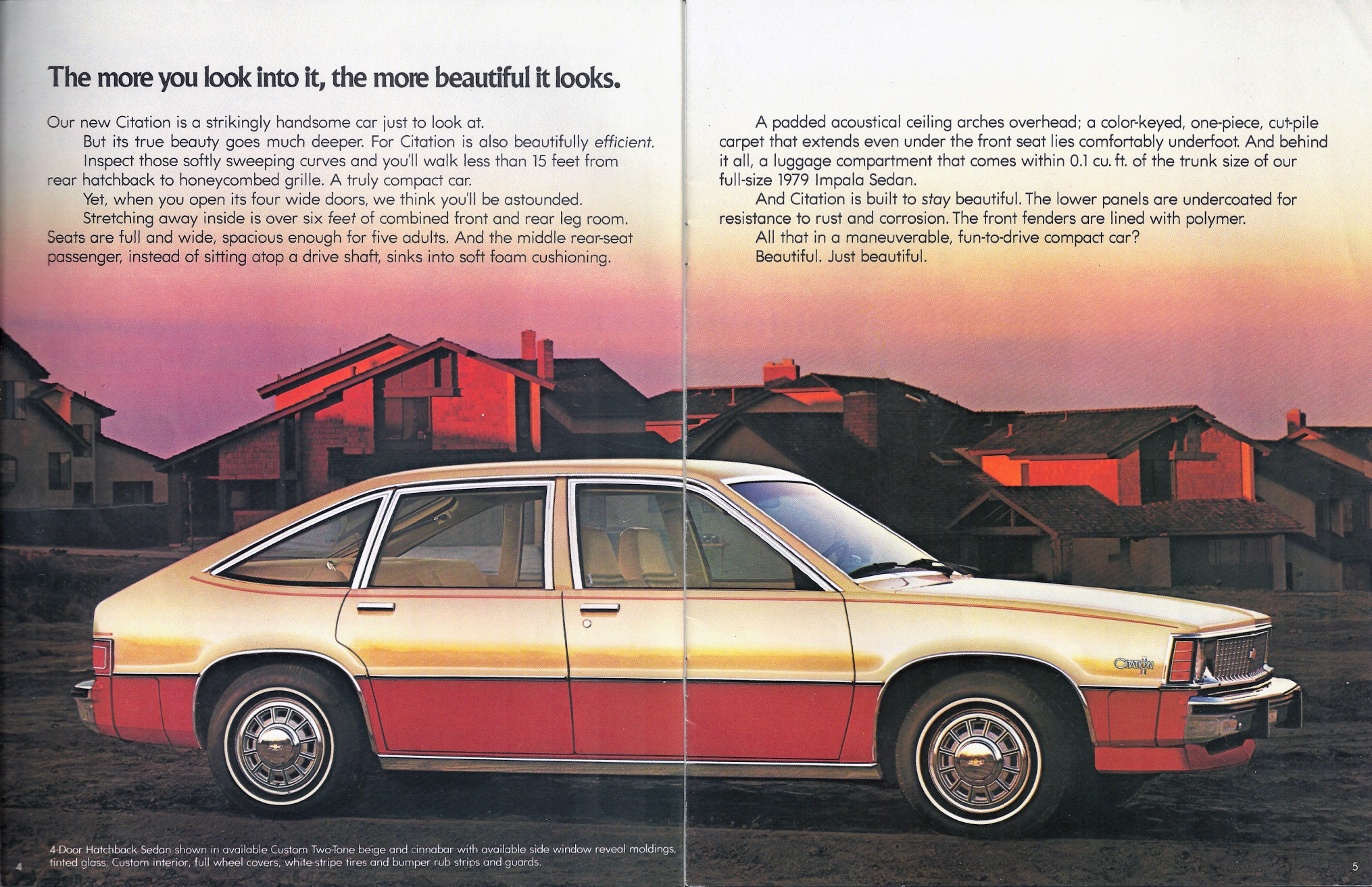
“The first Chevy of the ’80s”
For 1980, the Chevrolet Citation was indeed all-new, debuting on April 19, 1979. It may have been the “most thoroughly tested new car in Chevy history,” but the Citation quickly became the most recalled car in history, with an absolutely astoundingnine recalls in an era when manufacturers did not readily initiate recalls.
The standard powertrain on the 2,491-pound sedan was the GM’s Iron Duke 90 bhp 2.5 liter/151 ci four with a Rochester Varajet two-barrel carburetor, paired with a four-speed manual transmission. Fuel economy was 24 city/38 highway by the day’s standards (21/34 by today’s measures). With a 14-gallon gas tank, a Citation driver could expect a range of 350 to 390 miles with a 10% fuel reserve. 0-60 times for the Iron Duke are hard to find, but were likely around 16 seconds for the four-speed manual transmission and probably about 19 seconds (oog) with the optional ($337) three-speed automatic transmission.
Spending $225 to upgrade to the LE2 2.8 liter/173 ci V6 (also with a Varajet two-barrel carburetor) got you 115 bhp and a 0-60 time of a little over 13 seconds. Fuel economy dropped, but not by that much: to 20 city/34 highway with the four-speed manual transmission. Moving to the profligate three-speed automatic transmission dropped highway mileage to 30 mpg.
Hatchback sedan pages from the 1980 Chevrolet Citation brochure
The Citation sedan’s base price was $5,153—about $22,100 in 2025 dollars, which is almost exactly what a 2025 Chevrolet Trax LS compact crossover SUV goes for. Standard mechanical equipment included the heavily advertised front-wheel drive, rack-and-pinion steering, front disc brakes, glass-belted P185/80R13 radial tires (now a trailer size), and a Delco Freedom battery. Inside, sliding door locks, a lockable glove box, and an AM radio were considered worth mentioning as standard features. Chevrolet also shamelessly stated that the sedan’s .417 drag coefficient was a sign of “Efficient Aerodynamics.”
Options & Production Numbers
Exterior and mechanical options were many, including tinted glass ($70), a removable sun roof ($240), Sport mirrors (both manual and power), a sport suspension ($21), power brakes ($76), and power steering ($174). Inside, bucket seats, a reclining front passenger seat, a Custom interior, a gauge package ($70), air conditioning ($564), an intermittent windshield wiper system ($39), an electric rear window defogger ($101), automatic speed control ($105), power door locks ($123), power windows ($189), a Comfortilt steering wheel ($75), and an AM/FM stereo radio with cassette ($188) were all available.
Chevrolet sold an astounding 458,033 Citation hatchback sedans in its extended 1980 model year, making it the single most popular version of the Citation.
The View From 2025
As Hemmings showed in 2014, Citations do sometimes come up for sale, though I see few in the condition of the one they highlighted. Citations also occasionally appear at online auctions such as eBay Motors and Bring a Trailer that cater to the eighties car market.
Make mine Light Blue Metallic over Dark Blue Metallic, please. Two-tone paints were big in the early eighties.
For 1985, Honda put one of its hottest four-cylinder engines into its tiny CRX, creating the Si. Si stood for Sports, injected, and the new EW3/4 engine was a multiport fuel-injected version of the carburetted 1.5 liter/91 ci engine that had been the top of the line in 1984.
Horsepower was 91 bhp at 5,500 rpm, up 20% from the carburetted engine. This increase doesn’t sound like much, but the CRX only weighed about 1,800 pounds—to get the same power-to-weight ratio in a 2025 Honda Civic sedan, you would need 150 bhp (interestingly, the 2025 Civic coupe has a … 150 bhp engine). Car and Driver recorded a 0-60 time of 9.1 seconds (Motor Trend reported 8.5 seconds) and a top speed of 112 mph. The EPA fuel economy rating with the required five-speed manual transmission was 32 city/36 highway by the day’s standards (27/33 by today’s measures).
Pages from the 1985 Honda CRX Si brochure
The CRX Si’s base price was $7,999—about $24,500 in 2025 dollars or almost exactly what a 2025 Civic sedan costs. Standard exterior equipment included a deep front air dam, halogen headlights, tinted glass, a power sunroof, a rear wiper/washer, and a rear spoiler molded of soft urethane instead of the hard plastic in other CRXs. Mechanical equipment included rack and pinion steering, power-assisted front disc/rear drum brakes, and 175/70R13 tires (a size last seen on the 2005 Hyundai Accent) on 5.0-inch-wide aluminum alloy wheels. Inside, reclining Sport bucket seats with adjustable headrests, a tachometer, and a trip odometer were standard.
Since the CRX Si came pretty loaded by Honda standards, there were no factory options. The Si received an exclusive black paint option in place of the white available in other CRXs—red or blue were also available. Air conditioning was available only as a dealer accessory, as were a rear speaker and a choice of various car stereos: Honda would continue to sell AC as a dealer accessory well into the 1990s.
The View From 2025
According to Hagerty’s valuation tools, all the money for a 1985 CRX Si in #1/Concours condition is an astounding$57,900, with a more normal #3/Good condition car going for $20,800. I don’t see many first-generation CRX Si’s come up for sale in either the Hemmings Motor News classifieds or on eBay Motors. However, there is good club support for the CRX at Red Pepper Racing, and they maintain a semi-regular presence on Bring a Trailer.
Make mine Black, please. It looks sharp with the red band on the new for 1985 charcoal gray body cladding.