1987 Oldsmobile Delta 88 Royale Brougham coupe

This entry is yet another post inspired by a car one of my frequent readers owned.

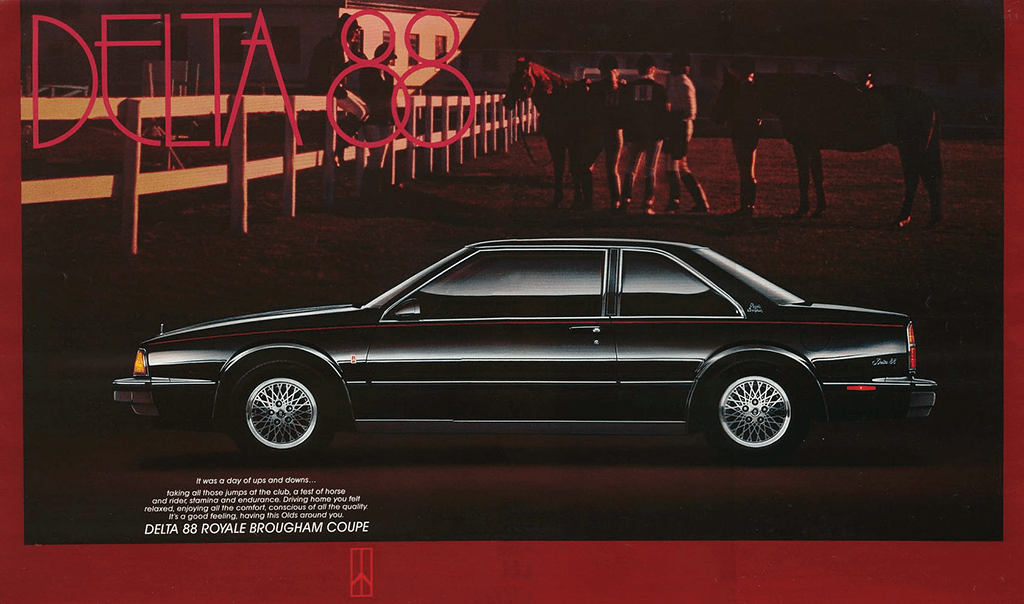
“It’s a good feeling, having this Olds around you.”

1987 was the second model year for the ninth generation of Oldsmobile’s Delta 88. New features were relatively few but included composite headlamps, a new grille, new “aero” side-view mirrors, and a revised taillamp design. For coupes, front automatic safety belts were standard throughout the year—they were a mid-year introduction for sedans. Finally, Oldsmobile bailed on even offering the 125 bhp 3.0 liter/181 ci V6 that had been the base engine for 1986.

The only powertrain available for any Delta 88 Royale in the 1987 model year was the LG3 150 bhp 3.8 liter/231 ci V6 with fuel injection mated to a four-speed automatic. 0-60 mph came in a little over 10 seconds in the 3,203-pound car. EPA fuel economy ratings were 18 city/27 highway by the standards of the day (16/25 by today’s standards). With an 18-gallon fuel tank, a Delta 88 owner could expect a range of between 330 and 365 miles with a 10% fuel reserve.

1987 Oldsmobile brochure
Delta 88 Royale Brougham pages from the 1987 Oldsmobile brochure

Standard exterior and mechanical equipment on the $13,639 Delta 88 Royale coupe (about $39,900 in today’s dollars) included Soft-Ray tinted glass, power rack-and-pinion steering, power brakes, and P205/75R14 tires (a size still somewhat available) on 14-inch wheels with Deluxe wheel discs. Inside, all cars included Lucerne knit velour seats, Four Seasons air conditioning, side window defoggers, and an AM radio with dual front speakers.

Options & Production Numbers

Among the many exterior and mechanical options were a tinted glass sunroof, a full vinyl roof ($200), and a Level III (FE3) suspension. Inside, power door locks, power windows, power seats, a tilt steering wheel, leather seats, an electronic instrument panel, an electronic day/night mirror, and a Delco/Bose Music System were all available.

The Delta 88 Royale coupe sold acceptably for a big coupe in 1987—of the 12,943 made, approximately 65% were the Broughams. Oldsmobile would build the coupes through the end of the 1991 model year, by which point sales had declined to a mere 692 examples. The final Delta 88 of any kind came off the production line on January 6, 1999.

The View From 2025

Hagerty’s valuation tools do not track any Delta 88 after 1975 convertible, and Delta 88s of this generation rarely show up in the Hemming’s Motor News classifieds or on eBay Motors. Bring a Trailer has sold more stock cars of this generation of Delta 88 than production cars.

Make mine Dark Garnet Red Metallic, please.

One other H-platform car I have written about is the 1987 Buick LeSabre T Type coupe. Other Oldsmobiles include the 1981 Cutlass Supreme coupe, the 1982 Toronado Brougham coupe, the 1984 Omega sedan, the 1985 Firenza ES sedan, and the 1985 Ninety-Eight Regency sedan.

Last updated July 2025.

1985 Chevrolet S-10 pickup truck

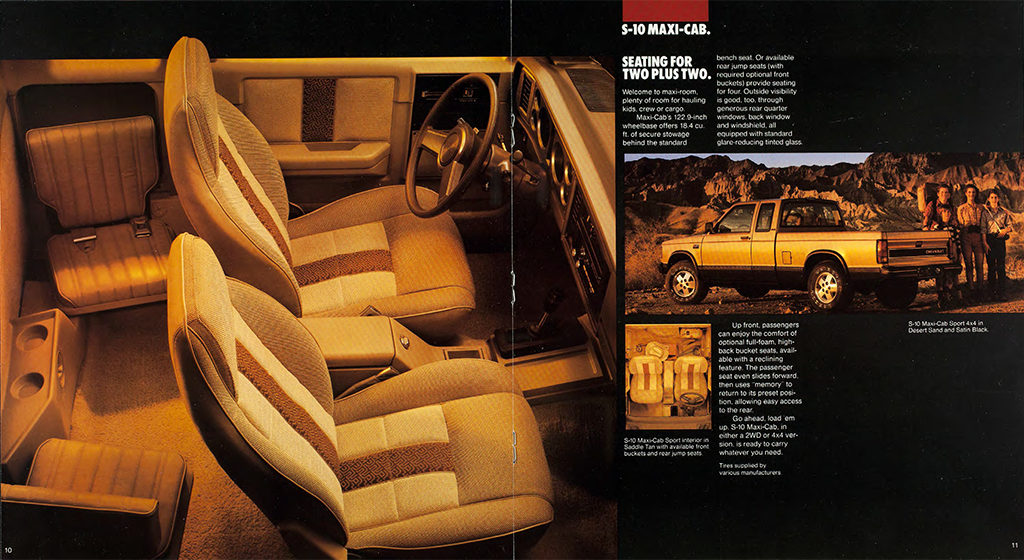
One of my frequent readers once owned the Maxi-Cab version of the 1985 Chevrolet S-10 pickup truck. So, here you go.

“America’s ideal pickup.”

For 1985, Chevrolet offered seven distinct versions of the S-10 pickup truck, divided up by cab style (short, Maxi-Cab/extended cab, or chassis cab), engine (gas or diesel), and drive (2WD or 4WD). Beyond that, three of the versions offered a choice of a long or short box, which resulted in a different wheelbase.

Changes for 1985 were few, with the most significant news probably being improved corrosion protection. Also new was an updated version of GM’s “Iron Duke” inline four, which replaced 1984’s LQ2 2.0 liter inline four.

Only the absolute base truck (short cab, short wheelbase, gas, 2WD) came with the smallest engine, which was the Isuzu-built LR1 82 bhp 1.9 liter/119 ci inline four. That engine also was not available in California. Far more common—and standard on all gasoline configurations except the absolute base truck—was the LN8 “Iron Duke” 92 bhp 2.5 liter/151 ci inline four with throttle body fuel injection, which did have 31 more ft-lbs of torque than the smaller four. Optional “power” for all the gasoline trucks was the LR2 110 bhp 2.8 liter/173 ci V6 with a two-barrel carburetor. The single diesel available was the LQ7 62 bhp 2.2 liter/137 ci inline four, which could only be specified with 2WD.

All four engines came standard with a four-speed manual transmission. Every version but the chassis cab could upgrade to a five-speed manual, while all but the two diesel models could option a four-speed automatic.

Maxi-Cab pages from the 1985 Chevrolet S-10 brochure

Standard equipment on the base $5,990 S-10 (about $18,500 in 2025 dollars) was pretty spare. Still, it included P195/75R14 all-season steel-belted radial tires on 14 x 6 inch painted argent wheels with bright metal hub caps, a color-keyed instrument panel, an upshift light, a locking stowage box, a full headliner, and a vinyl bench seat. At $7,167 (about $22,100 in today’s dollars), all Maxi-Cab S-10s included tinted glass, vacuum power brakes, and a dome lamp. 4WD versions of the Maxi-Cab included a front stabilizer bar and P195/75R15 tires on 15 x 6 inch wheels.

Options & Packages

Among the many exterior and mechanical options available for the Maxi-Cab were two different two-tone paint treatments, a sliding rear window ($107), a heavy-duty radiator ($53), and a 20-gallon fuel tank ($49). Inside, a tachometer, power windows ($190), power door locks ($135), electronic speed control ($195), air conditioning ($740), Custom vinyl high-back bucket seats, folding rear jump seats ($215), and an array of stereos were available.

In addition to individual options, there were also three equipment packages for the Maxi-Cab, which definitely made the S-10 ownership experience more comfortable.

  • The $334 Durango package included a black and chromed grille, black and chromed headlight bezels, a Deluxe chromed bumper with rub strip, wheel trim rings, reflecting lettering on the tailgate, and (of course) Durango nameplates on the front fenders. Inside, Durango purchasers received a side window defogger, a Deluxe vent system, a courtesy lamp, a stowage box and ashtray lamps, a headlamp warning buzzer, a cigar lighter, and a Durango nameplate on the stowage box door. Upholstery included a Deluxe color-keyed steering wheel, a color-keyed floor mat, a color-keyed jack cover, and either a Custom cloth/vinyl bench seat or a leather-grained Custom vinyl bench seat.
  • The $605 Tahoe package included everything in the Durango package. Additions and changes to the Durango package included a black grille, color-keyed door handle inserts, black body side and bright wheel opening moldings, a chromed taillight molding, and Tahoe nameplates on the front fenders. Inside, the Tahoe added a full instrument cluster with brushed metal trim, a right hand visor mirror, and a Tahoe nameplate on the stowage box door. Upholstery included color-keyed carpeting, two vinyl jump seats, and a choice of either leather-grained Custom vinyl bucket seats or dual-tone woven Custom cloth bucket seats. The Tahoe required either Special Custom or Custom trim.
  • Finally, the top-of-the-line Sport package ($868) included everything in the Tahoe package. Additions and changes included a black chrome grille and headlight bezels, two-tone paint, painted argent styled wheels, and Sport nameplates on the front fenders. Inside, the Sport included a color-keyed lockable center console and a Sport nameplate on the stowage box door. Upholstery included a color-keyed Sport steering wheel with a bright shroud, door trim panels with cloth inserts, and high back Sport cloth front bucket seats.

The View From 2025

S-10 pickup trucks from the eighties regularly appear in the Hemming’s Motor News classifieds and on eBay Motors, though many have been heavily modified (small block Chevrolet V8s are common). Bring a Trailer tends to have more stock examples.

Make mine Apple Red, please. If it’s got the Sport package, I’d like it with the Silver Metallic secondary color.

Much of the detailed information for this post—including any hope I had of getting the options packages correct—comes courtesy of the GM Heritage Center. I’ve also written about the 1983 Chevrolet S-10 Blazer SUV.

Last updated October 2025.

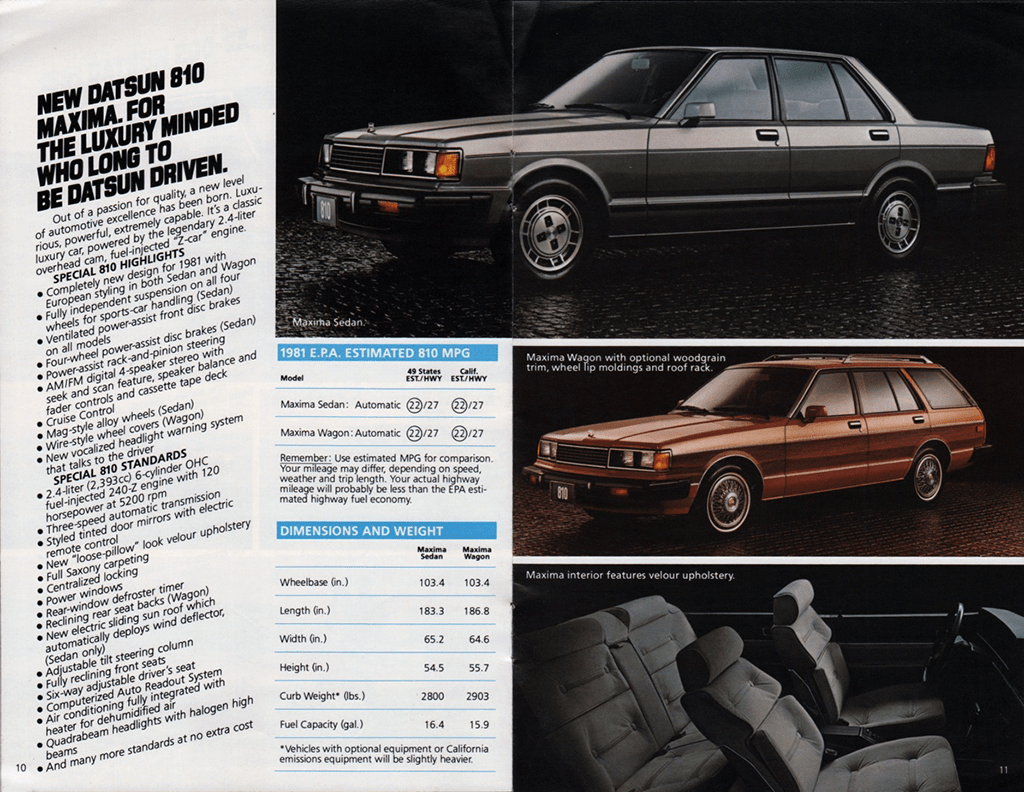
1981 Datsun 810 Maxima sedan

“For the luxury minded who long to be Datsun driven.”

1981 brought the nicest Datsun yet for America, in the form of the 810 Maxima sedan. Datsun aimed high, advertising the Maxima as having the “luxury of a Mercedes” and the “sophistication of a Cadillac.” Nissan was in the process of transitioning away from the Datsun name, so the Maxima‘s official name was a clunky “Datsun 810 Maxima by Nissan.”

The only powertrain initially available for the Maxima was the L24E 118 bhp 2.4 liter/146 ci inline six with Bosch L-Jetronic fuel injection paired with a three-speed automatic. Luxury did not mean quick in 1981—Car and Driver recorded a 0-60 time of 10.5 seconds in a car with a 2,880-pound curb weight. EPA fuel economy ratings were 22 city/27 highway—with a 16.4-gallon gas tank, a Maxima owner could expect a range of 295 to 325 miles with a 10% fuel reserve. In the middle of the model year, the LD28 90 bhp 2.8 liter/170 ci diesel engine became available, with an impressive 28 city/35 highway rating,

Despite being the top of Datsun’s sedan line and “the roomiest and most comfortable Datsun ever created” to that point, the Maxima was not a particularly large car. With a 183.3 inch length, it was less than half an inch longer than today’s Nissan Sentra, which is classified as a compact car. In advertisements, Datsun stated that the Maxima was “about the size of a BMW 528i at less than half the price.” Both of these claims were true, but the Maxima was not yet a “4-Door Sports Car.”

810 Maxima pages from the 1981 Datsun brochure

Standard exterior equipment on the $10,879 1981 Maxima (about $41,400 in 2025 dollars or almost 25% more than a 2025 Nissan Altima SL sedan costs) included an electric sliding sun roof and Quadrabeam headlights with halogen high beams. Mechanical equipment included a fully independent suspension, power-assisted rack-and-pinion steering, four-wheel power-assisted disc brakes, and 185/70SR14 tires (a size still readily available) on 14-inch “mag-style” alloy wheels. Inside, centralized locking, power controls, a tilt steering column, cruise control, and an AM/FM digital four-speaker stereo with a cassette player were included. Standard upholstery included “loose-pillow” velour seats, fully reclining front seats, a six-way adjustable driver’s seat, and full Saxony carpeting. Famously, an early version of the vocalized warning system warned a Maxima‘s driver when the headlights were on.

There were few, if any, options available for the 1981 Maxima sedan. Reviews of the day generally liked the new car’s exterior styling, but the “buff books” complained that the Maxima was only available with a three-speed automatic and velour upholstery. Car and Driver‘s write-up in April 1981 stated: “What we have here seems to be a clear case of over-Americanization.”

The View From 2025

It isn’t that surprising that Hagerty’s valuation tools do not track any eighties Datsuns other than the Z-cars. Eighties Maximas rarely show up in the Hemming’s Motor News classifieds or on eBay Motors. Bring a Trailer has sold a grand total of one 1981 Maxima—which was a diesel.

Make mine Medium Gray Metallic, please.

I have also written about the much sportier 1989 Nissan Maxima sedan.

Last updated August 2025.

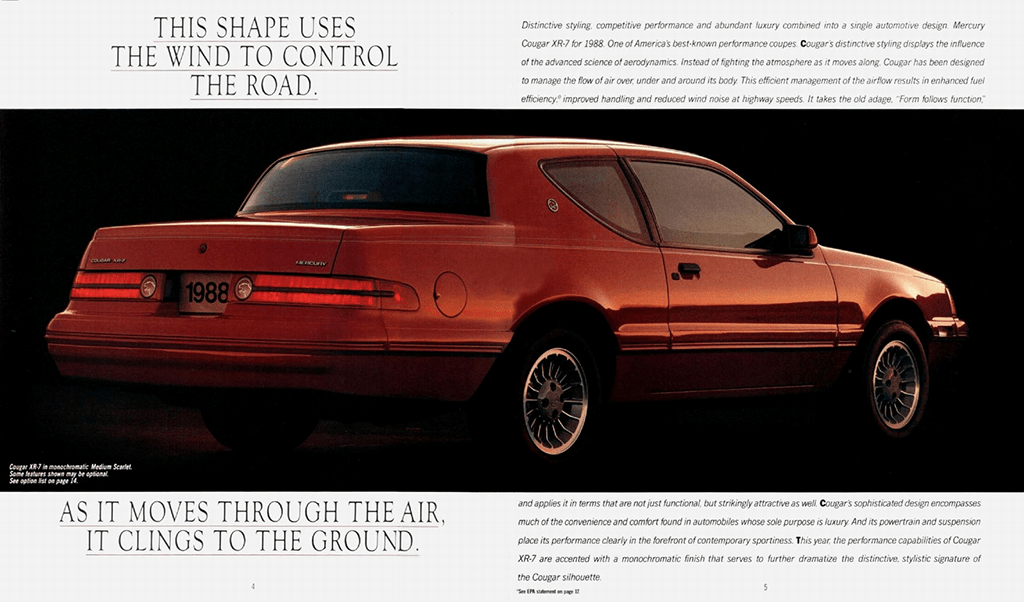
1988 Mercury Cougar XR-7 coupe

“The shape you want to be in.”

For 1988, Mercury’s Cougar personal luxury coupe received relatively few changes after 1987’s substantial restyling. For one year only, the XR-7 received a distinctive monochromatic paint scheme, available only in Oxford WhiteMedium Scarlet, and Black. Creating this look involved changing the wraparound bumper and body-side moldings from black to body color, and deleting the Medium Smoke lower-body accent used in 1987.  The sportiest Cougar also received 15-inch cast-aluminum wheels that had previously been seen on contemporary Ford Mustang GTs. Finally, analog instruments returned to the XR-7 after one year with a digital dashboard.

Though the Cougar LS made do with an Essex 140 bhp 3.8 liter/232 ci V6 with fuel injection as standard power, all XR-7s came with a Windsor 155 bhp 4.9 liter/302 ci V8 with sequential fuel injection. Both engines received power increases in 1988, with multi-port fuel injection and a balance shaft for the V6 being worth 20 bhp, while a split dual exhaust brought another five bhp for the V8. No matter what the engine, all Cougars came with Ford’s corporate AOD four-speed automatic transmission with overdrive.

Recorded 0-60 mph times are spare for the 1988 XR-7, but would likely have been a little under 10 seconds in the 3,485-pound car. Fuel economy ratings are more readily available; the XR-7 was rated 18 city/25 highway by the day’s standards (16/23 by today’s measures). With a 22.1-gallon gas tank, a Cougar XR-7 owner could expect an impressive range of 390 to 430 miles with a 10% fuel reserve.

Standard exterior and mechanical equipment on all Cougars included tinted glass, aero halogen headlamps, a front air dam, dual outside power mirrors, power-assisted rack-and-pinion steering, and power-assisted front disc/rear drum brakes. Inside, air conditioning, cloth upholstery, and an electronic AM/FM stereo with four speakers were included. The Cougar’s base price was $14,134—about $39,200 in 2025 dollars.

XR-7 pages from the 1988 Mercury Cougar brochure

With a base price of $16,266 (about $45,100 in today’s dollars or about what a 2025 Ford Mustang GT fastback goes for), the XR-7 added a Traction-Lok rear axle, a Quadrashock suspension, and P225/60R15 performance tires (a size still readily available) on 15-inch body-color cast-aluminum wheels. Inside, a sport steering wheel, articulated sport seats with power lumbar support, and a full-length center console were included.

Options & Production Numbers

Exterior and mechanical options for the XR-7 included a power moonroof ($841), an electric rear window defroster ($145), an engine block heater ($18), and Argent versions of the standard body-color cast-aluminum wheels. Inside, automatic temperature control ($162), power windows ($222), fingertip speed control ($182), and a tilt steering wheel ($124) were all available. Upholstery options included a leather-wrapped steering wheel ($59), leather seating surfaces ($415), and six-way power seats (either driver’s side only [$251] or driver and front passenger [$502]). A range of audio options included an electronic AM/FM stereo with a cassette player and four speakers ($137), the Premium Sound System with a power amplifier, two additional door-mounted speakers, and premium rear speakers ($168), a graphic equalizer ($218), and a power antenna ($76).

The 1988 Cougar sold well—Mercury moved a total of 113,801 units, with 14,488 (almost 13%) being XR-7s.

The View From 2025

Badge for 2,500 web hits

For unclear reasons, Hagerty’s valuation tools do not track any Cougar after 1973, though they do value Ford Thunderbirds through their entire production history. Eighties Cougars occasionally appear in the Hemming’s Motor News classifieds, on eBay Motors, and on Bring a Trailer.

Make mine Black, please.

Thanks to COOL CATS (a site devoted to the 1983-1988 Mercury Cougar) for providing helpful context for this post.

Other Mercurys I have written about include the 1983 Grand Marquis sedan, the 1986 Capri hatchback coupe, and the 1987 Lynx XR3 hatchback coupe. Regarding the Cougar’s Ford Thunderbird sister, I’ve written about the 1980 coupe and the 1983 Turbo Coupe.

Last updated April 2025.

1981 Triumph TR8 convertible

“Test drive the incredibly responsive TR8 today”

In its final year, Triumph’s TR8 gained Bosch L-Jetronic fuel injection for all fifty states (in 1980, fuel injection had been California-only). The original “the shape of things to come” TR7 design from 1975 remained, but the internals had come a long way.

Though the TRs had always been the “big” Triumphs since their introduction in 1953, big was a relative term. With a length of 160.1 inches, the TR8 was about six inches longer than today’s Mazda Miata convertible.

The standard powertrain was the Rover 133 bhp 3.5 liter/215 ci aluminum block V8 with Bosch L-Jetronic fuel injection paired with a five-speed manual transmission (a three-speed automatic was optional). That V8, of course, had its basic design dating from the 1961 model year and originally came from Buick.

The TR8’s performance was good compared to many sporty cars in 1981; 0-60 mph came in about 8.5 seconds in the 2,654-pound car. Fuel economy was rated at 16 mpg by the standards of the day. With a smallish 14.6-gallon fuel tank, a TR8 driver could expect a range of about 210 miles with a 10% fuel reserve.

1981 Triumph TR8 convertible advertisement

Standard exterior equipment on the rather dear $13,900 TR8 convertible (about $52,600 in today’s dollars) included a central hood bulge, tinted glass, and TR8 badges to easily differentiate it from the four-cylinder TR7. Mechanical equipment included dual exhausts, power-assisted rack-and-pinion steering, power front disc/ rear drum brakes, and 185/70HR13 steel-belted radial tires (a size still readily available) on 13 x 5.5 inch alloy wheels. Inside, full instrumentation, a heater/defroster with a three-speed fan, fully reclining multi-adjustable bucket seats, and a center console with a storage bin and lockable glovebox were included.

Options, Reviews, & Sales Numbers

Optional equipment included fog lamps, a luggage rack, air conditioning, and three different radios. Of these, only the air conditioning was an option from the factory—all other options were dealer-installed.

Reviews of the TR8 in the automotive press were reasonably complementary, which may have been at least partially because convertibles had become so rare. The V8 drew a lot of positive mentions, as did the roomy cockpit. Observed faults included the steering wheel blocking some gauges, the tiny ashtrays (it was indeed a different age), and the rear-mounted battery’s intrusion into the otherwise reasonably capacious trunk.

The 1981 TR8 was an unusual car even when new—a mere 415 were sold, compared to, say, the 40,408 only slightly more expensive Corvettes that Chevrolet managed to move in that same model year.

The View From 2025

Like all Triumphs, TR8s have a following and regularly appear in the Hemming’s Motor News classifieds and on Bring a Trailer. According to Hagerty’s valuation tools, all the money for a 1981 TR8 convertible in #1/Concours condition is $40,800, with a far more typical #3/Good car going for $12,200.

Many TR8s and TR7s had colors and color names that were very much of their age; examples are Aran Beige, Champagne, French Blue, Mimosa, Topaz, and Vermilion. Make mine the somewhat more conservative Poseidon Green Metallic, please.

Other cars from the UK that I have written about include the 1980 MG MGB convertible, the 1982 Rolls-Royce Silver Spirit MK 1 sedan, the 1982 Jaguar XJ-S H.E. coupe, the 1983 Jaguar XJ6 sedan, the 1987 Sterling 825 sedan, the 1989 Bentley Turbo R sedan, and the 1989 Jaguar XJ-S convertible.

Last updated May 2025.

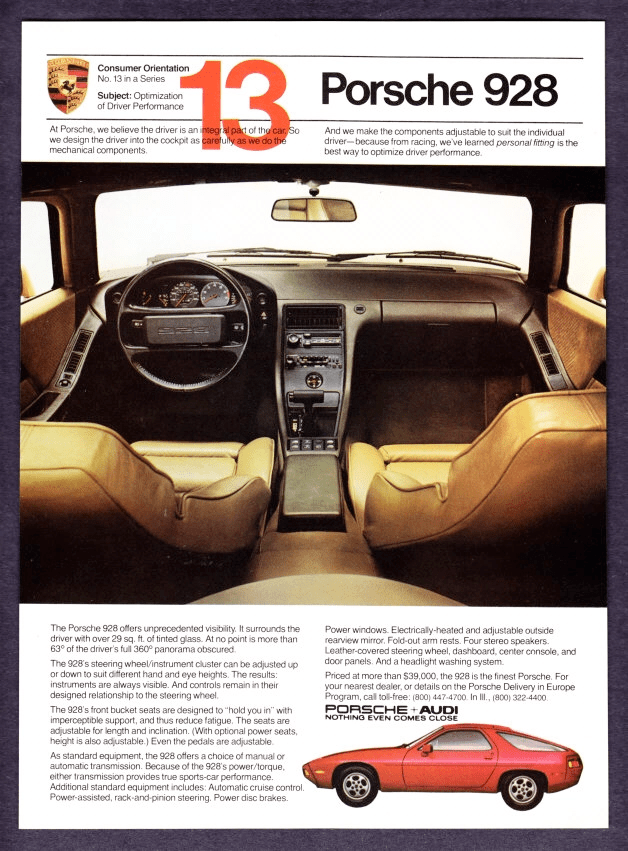
1982 Porsche 928 hatchback coupe

“the finest Porsche ever built”

1982 was the final model year for the first-generation Porsche 928, which would be replaced by the slightly more powerful Porsche 928 S in 1983. Despite the aerodynamic look of Wolfgang Möbius’ exterior design, the 928’s drag coefficient was a middling 0.41.

The standard powertrain remained the 228 bhp M28 4.5 liter/273 ci V8 with Bosch L-Jetronic port fuel injection mated to either a five-speed manual transmission or a Mercedes-Benz sourced three-speed automatic. To the eternal horror of many enthusiasts, the automatic was ordered about twice as often as the manual—something that probably didn’t shock Porsche.

In a car that weighed 3,197 pounds with the manual transmission, 0-60 mph came in approximately 7 seconds, with a top speed of just over 140 mph. Fuel mileage was rated by the EPA at a class-competitive 16 city/25 highway—with a 22.7-gallon gas tank, the proud new owner of a 928 could expect a range of about 380 to 415 miles with a 10% fuel reserve.

1982 Porsche 928 advertisement

The 928 came well-equipped—a good thing considering it had a base price of $39,500 (about $135,200 in today’s dollars or a little less than a 2025 Porsche 911 Carrara T coupe costs). Standard exterior equipment included halogen headlamps, a headlight washing system, and a rear window defogger with a rear wiper. Mechanical equipment included power-assisted rack-and-pinion steering, four-wheel disc brakes, and P225/50VR16 tires (a size still readily available) on 16 x 7 inch wheels.

Inside, automatic cruise control, adjustable pedals, power windows, a central door locking system, and automatic full climate control were all standard. Bucket seats with a driver’s side power seat, a partial leather interior, a leather-covered steering wheel, a steering column that adjusted along with the instrumentation, and an AM/FM stereo radio with a cassette player, four speakers, and a power antenna were also included.

Exterior and mechanical options included an electrical sliding roof, protective side moldings ($195), and pressure-cast alloy wheels ($795). Inside, options included a front passenger power seat, sports seats (either leatherette/cloth or leather), an alarm system ($300), and a Hi-Fi sound system with eight speakers.

The View From 2025

There is excellent club support for the Porsche 928, as there is for all Porsches. According to Hagerty’s valuation tools, all the money for a 1982 Porsche 928 in #1/Concours condition is $68,000, with a more normal #3/Good condition car going for $22,000. Porsche 928s frequently show up for sale in the Hemmings Motor News classifieds, on eBay Motors, and on Bring a Trailer. As I update this blog entry in April 2025, a Guards Red 1982 with black leather seats, an automatic, and 41,000 miles is available on Hemmings, asking $35,000.

Make mine the rare Rosewood Metallic, please.

Other eighties Porsches I have written about include the 1980 924 hatchback coupe, the 1982 924 Turbo hatchback coupe, the 1985 911 Carrera Cabriolet, the 1986 944 Turbo hatchback coupe, the 1987 911 3.2 Carrera coupe, and the 1988 944 hatchback coupe. Other sports cars from the 1982 model year that I have written about include the Chevrolet Corvette coupe and the Fiat X1/9 coupe.

Last updated April 2025.

1985 Oldsmobile Firenza ES sedan

In this post, we’re once again revisiting interesting versions of mass-market eighties vehicles that just about nobody bought. This one is a sporty version of Oldsmobile’s J platform entry.

“A sporty way to tame the open road.”

For 1985, Oldsmobile offered three different Firenza body styles: a three-door hatchback coupe, a four-door sedan, and a five-door wagon. Both the hatchback coupe and the sedan had sporty versions: in the case of the hatchback, it was the GT, while for the sedan, it was the ES. I am going to write about the ES in this post.

The Firenza’s standard powertrain was an 88 bhp LQ5 2.0 liter/121 ci inline four with throttle-body fuel injection paired with a four-speed manual transmission. Engine options included a $50 84 bhp LH8 1.8 liter/110 ci inline OHC four with the throttle-body fuel injection and a far more interesting $560 130 bhp LB6 2.8 liter V6 with multi-port fuel injection. Transmission options included a $75 five-speed manual (available for the LH8 only) and a $425 three-speed automatic (available for all three engines).

Standard equipment exterior and mechanical equipment on all Firenzas included front-wheel-drive, rack and pinion steering, and P175/80R13 blackwall tires on 13-inch wheels. Inside, contour-reclining bucket seats and an AM push-button radio with two front speakers and a fixed mast antenna were included. With a base price of $7,679 (about $23,300 in 2025 dollars), Firenza sedans added Deluxe wheel discs and a Deluxe steering wheel.

Firenza ES page from a 1985 Oldsmobile brochure

Standard exterior equipment on the ES sedan included amber turn signals, a Firenza ES nameplate on the front fenders, and blacked-out trim all around. Mechanical equipment included the 1.8 liter inline four, a five-speed manual transmission, tungsten halogen high-beam headlamps, a firm ride and handling package, and Goodyear Eagle GT P205/60R14 blackwall tires (a size still readily available, though generally not from major manufacturers) on 14-inch wheels with Deluxe styled wheel discs.

Inside, a leather-wrapped steering wheel and a Rallye instrument panel cluster were included. Only three exterior colors were available for the ES: Silver Metallic, Light Teal Blue Metallic, and Carmine Red.

Options & Production Numbers

Among the many exterior and mechanical options available for the ES were Soft-Ray tinted glass, a Vista-Vent glass-panel sunroof ($310), and two-tone paint. Inside, Oldsmobile offered a Four-Season air conditioner, power door locks, and a choice of three optional radios. A special contoured hood was added if the V6 was selected.

For Oldsmobile in 1985, the Firenza was emphatically not the center of the product line, with every other model—all of them at least somewhat larger—selling better. Of the Firenzas that sold, the vast majority were base sedans, not the GT hatchback coupe (498 sold) or the ES sedan (863 sold).

The View From 2025

Firenzas of any sort are now almost completely vanished from the nation’s roads, and they rarely appear in the Hemming’s Motor News classifieds or eBay Motors.

Other J platform cars I have covered in this blog include the 1984 Buick Skyhawk coupe, the 1982 Cadillac Cimarron sedan, the 1988 Cadillac Cimarron sedan, the 1986 Chevrolet Cavalier Z24 coupe, and the 1984 Pontiac 2000 Sunbird S/E hatchback coupe.

Last updated April 2025.

1989 Buick Electra Park Avenue Ultra sedan

“The standard for luxurious, smooth-riding American sedans …”

For 1989, Buick’s Electra Park Avenue received a new trim in the middle of the model year: Ultra. It became the new top-of-the-line Buick sedan.

The only powertrain for the Ultra or for any 1989 Electra was a “3800” LN3 165 bhp 3.8 liter/231 ci V6 with sequential fuel injection teamed with a four-speed automatic transmission. Mileage for the standard engine was 19 city/28 highway by the 1989 measures (17/26 by today’s standards). With an 18-gallon gas tank, an Ultra owner could expect a range of about 345 to 380 miles with a 10% fuel reserve. 0-60 mph took a little under 10 seconds.

Electra pages from the 1989 Buick brochure

Buick piled on the bling for the Ultra—standard exterior equipment included Soft-Ray tinted glass, a unique grille texture, smoked tail lamps, chrome side pillars, a Sterling Silver lower accent paint treatment, and a silver accent body stripe. Mechanical equipment on the $26,218 (approximately $70,100 in 2025 dollars) car included a 4-wheel independent DynaRide suspension, power rack-and-pinion steering, power anti-lock front disk/rear drum brakes, and P205/70R15 whitewall tires (a size still readily available) on 15-inch aluminum wheels.

Inside the Ultra, air conditioning, an AM/FM stereo radio, burled elm trim on the doors and instrument panel, a tilt steering column, power door locks, power mirrors, and power windows were all standard. The all-leather seats were styled by famed Italian automobile designer Giorgetto Giugiaro, with the 55/45 front seats being 20-way for both driver and front passenger.

Options, Period Press, & Production Numbers

Optional items for 1989 included an electric sliding Astroroof ($1,230), a heavily-padded full vinyl top only available for the Ultra, cornering lamps ($60), Electronic Touch Climate Control air conditioning ($165), Twilight Sentinel headlamp control ($60), and the Delco/Bose Music System with ETR AM/FM stereo radio and cassette.

The Electra Park Avenue Ultra received good reviews, with one automotive writer comparing it favorably to the same year’s Mercedes-Benz 300 SE. First-year sales of the 1989 Park Avenue Ultra sedan were decent considering the short window of availability—Buick moved 4,815 examples.

The View From 2025

Badge for 2,500 web hits

These mid to late 1980s C-bodies had a stately look about them. Big and (I think) handsome, they had a lot of interior room despite the second round of downsizing—with 111 cubic feet, they had only one cubic foot less than the previous generation rear-wheel-drive cars. C-body Park Avenue sedans of this era rarely come up for sale in the Hemming’s Motor News classifieds and on eBay Motors, but are sometimes seen on Bring a Trailer.

Make mine Claret Red over Sterling Silver, please. All Ultras came with two-tone exterior paint.

Other C-bodies I have written about in this blog are the 1989 Cadillac Sedan deVille and the 1985 Oldsmobile Ninety-Eight Regency sedan. Among the many eighties Buicks I have written about include the 1980 Riviera S TYPE coupe, the 1983 Skylark T TYPE coupe, the 1984 Regal Grand National coupe, the 1984 Riviera T TYPE coupe, the 1985 Somerset Regal coupe, the 1986 Century sedan, and the 1987 LeSabre T Type coupe.

Last updated July 2025.

1985 Ferrari 308 GTB Quattrovalvole coupe

“Only those who dare … truly live”

1985 was the final year for the Ferrari 308 (the 328 would follow in 1986). Ferrari’s least expensive two-seater was also overshadowed in the public view by the release of its big brother Testarossa.

The engine was Ferrari’s Tipo F105AB 2.9 liter/179 ci V8 with Bosch K-Jetronic fuel injection and four valves per cylinder (thus Quattrovalvole), making 230 bhp and mated to a five-speed manual transmission. In the 3,200 pound GTB, this was good for period 0-60 times of under 7 seconds. Mileage was pretty awful compared to some of the 308’s fuel-injected competition—10 city/16 highway by the day’s standards (9/15 by today’s standards). With an 18.5-gallon gas tank, 308 owners could expect a chastening 200 to 215 mile range with a 10% fuel reserve.

Ferrari 308 GTB Quattrovalvole, courtesy of Ferrari

Standard exterior and mechanical equipment on the $54,000 GTB (about $134,000 in 2020 dollars) included four-wheel disc brakes, rack and pinion steering, and 16-inch alloy wheels. Inside, leather bucket seats, power windows, tinted glass, and a heated rear window were all included. Available options included metallic paint, a deep front spoiler, a satin black finished aerofoil at the rear of the roof, 16 x 8 inch Speedline wheels with Pirelli P7 tires, air conditioning, and cloth seat centers.

The lovely Pininfarina styling that first appeared in 1975 had aged well with relatively few changes. Debuting for the 1983 model year, the Quattrovalvole could be differentiated from previous 308s by the addition of a slim black louvered panel on the hood to aid radiator exhaust air exit and a redesigned radiator grille with rectangular driving lights on each side. Also new were power-operated side mirrors carrying small enamel Ferrari badges and rectangular side repeaters. The interior also received some minor updates, such as a satin black three-spoke steering wheel with a triangular center.

The View From 2025

Values for the 308 have gone up and down over the last decade. According to Hagerty’s valuation tools, all the money for a 1985 Ferrari 308 GTB Quattrovalvole in #1/Concours condition is currently an astounding $234,000, with the targa-top GTS in the same condition getting $174,000 (the GTB is far rarer, at about 20% of overall Quattrovalvole production). Prices drop significantly for more normal #3/Good condition cars—$128,000 for a GTB and $108,000 for a GTS. Ferrari 308s frequently appear for sale in the Hemmings Motor News classifieds, on Bring a Trailer, and at in-person auctions.

Make mine Rosso Corso, of course. Is there really a question?

Other Ferraris I have written about in this blog include the 1983 Berlinetta Boxer 512i coupe and the aforementioned 1985 Testarossa coupe.

Last updated March 2025.

Eighties Cars Is Speeding up Again

Last May, I posted that Eighties Cars Is Slowing Down For A While. With the fraught situation that the world currently finds itself in, many of us are searching to re-establish upended routines and find ways to slow the spread of COVID-19.

As a very small offering, I have decided to accelerate my postings on Eighties Cars for the foreseeable future. All the best to my readers and stay safe.