1988 Chevrolet Corvette 35th Anniversary Edition hatchback coupe

One of the Corvettes judged at an NCRS Mid-Atlantic Regional I attended in 2019 was a 35th Anniversary Edition Corvette coupe. This made it time to write a blog entry about one of the most striking of eighties Corvettes.

“… the influential sports car of the modern era.”

For 1988, the big news for Chevrolet’s Corvette was the 35th Anniversary Edition coupe, which was introduced late in the model year at the New York Auto Show. It was only the second anniversary edition Corvette, following 1978’s Silver Anniversary version. Chevrolet had missed the 30th anniversary (there were no 1983 Corvettes), and one senses that General Motors’ marketing team didn’t want to let another one go by without acknowledgment.

Other improvements for 1988 included carpeted door sills, solution-dyed carpet, and improved “flow-through” ventilation for coupes. A less restrictive muffler system which provided five extra horsepower was standard on coupes with the optional 3.07:1 rear axle ratio (this new muffler system was considered too loud for the standard axle coupes and any convertible). The standard brake rotors were thickened, and Chevrolet made suspension geometry changes to improve control during heavy braking. The Z51 and Z52 packages were upgraded to include P275/40ZR-17 Goodyear Eagle tires on 17 x 9.5 inch wheels. Only available in coupes, the Z51 package also included larger front brake rotors and calipers than in 1987.

The Corvette’s standard powertrain continued to be the L98 5.7 liter/350 ci V8 with fuel injection paired with a four-speed automatic with overdrive. Depending on the rear axle ratio, the coupe’s horsepower was either 240 bhp or 245 bhp. Top speed for the 1988 Corvette was about 155 mph, and Car and Driver recorded a 0-60 time of 5.6 seconds. Estimated fuel economy was 16 city/25 highway by the day’s standards (15/23 by today’s measures). With a 20-gallon fuel tank, a Corvette owner could expect a range of 340 to 370 miles with a 10% fuel reserve.

Standard exterior and mechanical equipment in the $29,489 base Corvette coupe (about $83,200 in today’s dollars) included power steering, power anti-lock disc brakes, and P255/60ZR16 tires (a size still somewhat available) on 16-inch x 8.5-inch wheels. Inside, air conditioning, power windows, power door locks, a tilt-telescopic steering wheel, cruise control, and an ETR AM/FM stereo radio with a clock were all included.
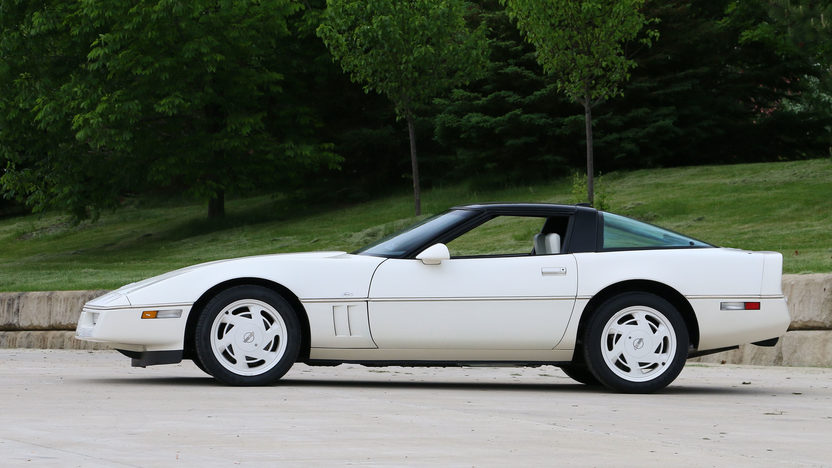
Photo of 1988 35th Anniversary Chevrolet Corvette
1988 Chevrolet Corvette 35th Anniversary Edition, photo courtesy of Mecum.

Additional equipment on the $34,284 35th Anniversary Edition coupe (about $95,200 in 2026 dollars or about what a loaded 2026 Stingray coupe goes for) included white leather seats without the otherwise standard perforations, a white steering wheel, and a black roof bow. In a preview of early 1990s Corvettes, the rub strips were body color rather than the usual black.

Options, Packages, & Production Numbers

Optional exterior and mechanical equipment included an electric rear window defogger ($129), the Doug Nash 4+3 manual transmission (no cost), and a performance axle ratio ($22). Optional interior equipment included power driver’s and power passenger’s seats ($240 each), electronic air conditioning ($150), and a Delco/Bose AM/FM stereo radio with a cassette player ($773).

Two handling packages were available: the Z51 performance handling package ($1,295 for a radiator boost fan, Delco-Bilstein shock absorbers, an engine oil cooler, a heavy-duty radiator, 17 x 9.5 inch wheels, P275/40ZR-17 tires, and a fast steering ratio), and the Z52 sport handling package ($970 for Delco-Bilstein shock absorbers, 17 x 9.5 inch wheels, and P275/40ZR-17 tires). 

To me, the 35th Anniversary Edition is one of the most differentiated of eighties C4 Corvettes, with only the Callaway Turbos being more distinctive. Chevrolet built 2,050 35th Anniversary Edition coupes, making availability restricted—but not that restricted. This number was out of a total of 15,382 coupes, with an additional 7,407 convertibles sold.

The View From 2025

There is strong club support for the 1988 Corvette, as there is for all Corvettes. According to Hagerty’s valuation tools, all the money for a 1988 35th Anniversary Edition coupe in #1/Concours condition is $50,100, with a more typical number #3/Good condition car going for $12,100. 1988 Corvettes often show up in the Hemmings Motor News classifieds, on eBay Motors, and on Bring a Trailer—as I update this blog entry in February 2026, there’s a 35th Anniversary Edition coupe with an indicated 77,000 miles for sale on Hemmings, asking $24,900.

Other eighties Corvettes I have covered include the 1980 coupe, the 1981 coupe, the 1982 coupe, the 1984 hatchback coupe, and the 1986 convertible.

Last updated February 2026.

1982 Fiat X1/9 coupe

“Nothing moves you like a Fiat Sportscar.”

1982 was the final model year that the X1/9 coupe that had debuted in 1974 was sold under the Fiat name—after that, it would be marketed under the Bertone name as Fiat withdrew from the United States. The X1/9 was small; at 156.3 inches in length, it was more than three inches shorter than today’s Fiat 124 Spider.

1982 Fiat X1/9 advertisement.

With its wedge shape, the X1/9 was part of a design trend in inexpensive sports coupes that included the Triumph TR7/TR8, the Pontiac Fiero, and the Toyota MR2.

The only powertrain available on the X1/9 continued to be a 75 bhp 3.5 liter/91 ci inline four with Bosch L-Jetronic fuel injection paired with a five-speed manual. An X1/9 owner could expect a 0-60 time of a little over 11 seconds in a coupe with a curb weight of 2,209 pounds.

Mileage wasn’t as good as you would think: rated at 26 city/37 highway by 1982 standards (20/26 by today’s calculation). With a 12.7-gallon gas tank, the driver of an X1/9 could expect a range of between 265 and 360 miles with a 10% fuel reserve.

Standard equipment on the $10,900 X1/9 (about $29,400 in today’s dollars or about what a 2019 Fiat 124 Spider Abarth convertible goes for) included pop-up headlights, a removable targa roof, rack-and-pinion steering, four-wheel disc brakes, and Pirelli Cinturato P3 P165/70R13 tires (a size still available thanks to Vredestein) on 13 x 5.5 inch wheels. Inside, bucket seats, a four-spoke padded steering wheel, a lockable glove box, and full instrumentation were included.

Options included metallic paint, tinted glass, air conditioning, and an AM/FM stereo radio.

The X1/9 has a following in both its Fiat and Bertone versions. According to Hagerty’s valuation tools, all the money for a 1982 X1/9 in #1/Concours condition is $19,800, with a more normal #3/Good car going for $6,300. X1/9s come up for sale every once in a while in the Hemming’s Motor News classifieds or on eBay Motors. As I write this in February 2019, there’s a 1979 Black Metallic X1/9 with tan/black vinyl seats and 83,000 miles available for $10,500.

1987 Pontiac Grand Prix coupe

While dropping my parents off at church this Sunday morning, I saw a stock-appearing facelifted fourth-generation Grand Prix with two-tone paint out of the corner of my eye—heading west on the Lincoln Highway. As good a reason as any to finally complete this blog post that I’ve been working on for over six months.

“… a Pontiac classic …”

1987 marked the final model year for the G-body Grand Prix coupe—it would be replaced in 1988 by an all-new W-body front-wheel-drive model. Changes were few; the Grand Prix portion of Pontiac’s 1987 brochure emphasized a new sport steering wheel and new 45/55 seats for the LE.

The standard Grand Prix powertrain continued to be the LD5 110 bhp 3.8 liter/231 ci V6 with a two-barrel carburetor paired with a three-speed automatic. Optional engines included the LB4 140 bhp 4.3 liter/263 ci V6 with fuel injection ($200 and available with either a three-speed or a four-speed automatic) and the LG4 150 bhp 5.0 liter/305 ci V8 with a four-barrel carburetor ($590 and only available with a $175 four-speed automatic). With the V8, a Grand Prix owner could expect a 0-60 time of a little over nine seconds in a coupe with a shipping weight of 3,231 pounds.

Mileage wasn’t good with any engine/transmission combination: the best was the 4.3 liter/four-speed automatic combination with 19 city/26 highway (17/24 by today’s standards). Predictably, the V8 was the worst, at 17 city/24 highway—with a 13.6-gallon gas tank the owner of a V8 Grand Prix could expect a range of between 225 and 250 miles with a 10% fuel reserve.

Grand Prix page from the 1987 Pontiac brochure.

Standard equipment on the $11,069 Grand Prix (about $25,300 in 2019 dollars) included power steering, power front disc/rear drum brakes, and P195/75R14 blackwall tires (a size still available thanks to Hankook and Kumho) on 14-inch wheels. General Motors was moving to option groups in the late eighties, and the base Grand Prix had two. Option Group I $1,313) included dual sport sideview mirrors, body side moldings, air conditioning with Soft Ray tinted glass, a tilt steering wheel that was also a luxury cushion steering wheel, and a Delco ETR AM/FM stereo radio. Option Group II ($1,867) added cruise control, lamp group, controlled cycle windshield wipers, power door locks, and power windows.

Moving up to the LE ($11,799) added dual sport sideview mirrors, 45/55 notchback seats in Pallex cloth, and a four-spoke sport steering wheel. For the LE, Option Group I ($1,844) included body side moldings, air conditioning with Soft Ray tinted glass, a tilt steering wheel, cruise control, lamp group, controlled cycle windshield wipers, power door locks, power windows, a visor vanity mirror, and a Delco ETR AM/FM stereo radio. Option Group II ($2,117) added halogen headlamps, a deck lid release, and a power driver’s seat, and made the visor vanity mirror illuminated.

The top-of-the-line Brougham ($12,519) added 45/55 notchback seats in Majestic cloth, power windows, special trim, and a luxury cushion steering wheel. Option Group I ($1,874) for the Brougham included body side moldings, air conditioning with Soft Ray tinted glass, a tilt steering wheel, a power driver’s seat, cruise control, lamp group, controlled cycle windshield wipers, power door locks, a visor vanity mirror, and a Delco ETR AM/FM stereo radio. Option Group II ($2,078) added halogen headlamps, cornering lamps, luggage compartment trim, a deck lid release, dual remote mirrors, and a dome reading lamp, and added illumination to the visor vanity mirror. A Brougham with Option Package 2, the V8, and the four-speed automatic came to a non-trivial $15,362 (about $35,100 in today’s dollars or about what a 2019 Buick Regal Avenir sedan goes for).

Individual exterior and mechanical options included a rally-tuned suspension ($50), a power sunroof ($925), a hatch roof with removable glass panels ($905), a power antenna ($70), two-tone paint ($205 to $295) and turbo-finned cast aluminum wheels ($246). Inside, you could get bucket seats with recliners and console ($292 with Ripple cloth in the base coupe, $69 with Pallex cloth in the LE, or $369 with leather in the LE), and a rally gauge cluster with tachometer ($153) along with a range of stereos up to a Delco ETR AM/FM stereo radio with cassette and graphic equalizer ($450).

The 1987 Grand Prix did not sell well—sales were about 41% of the 1986 total, and, at 16,542, the typical Pontiac dealer sold more Grand Ams, 6000s, Bonnevilles, Sunbirds, Firebirds, and Fieros.

Evidently (based on my observation this morning) someone is saving these cars! Hagerty declines to value any Grand Prix after 1977, but this generation does come up for sale every once in a while in the Hemming’s Motor News classifieds or on eBay Motors. As I write this in February 2019, there’s a 1985 Silver/Medium Gray two-tone Grand Prix LE with gray cloth notchback seats, a 3.8 liter/231 ci V6, an automatic, and 54,000 miles available for $12,900.

Make mine Dark Maroon Metallic, please.

Other rear-wheel drive G-platform (designated A-platform before 1982) cars I have written about include the 1984 Buick Regal Grand National coupe, the 1983 Chevrolet Malibu sedan, the 1981 Chevrolet Monte Carlo Sport Coupe, the 1981 Oldsmobile Cutlass Supreme coupe, and the 1980 Pontiac Grand Am coupe.

1987 Buick LeSabre T Type coupe

“… ranks as the most exciting new LeSabre ever”

1987 was the first year for the T Type version of Buick’s sixth-generation LeSabre. Looking toward a looming future where the rear-wheel-drive Regal would no longer exist, Buick did its best to inject some sportiness into these big (110.8-inch wheelbase) front-wheel-drive coupes.

Power wasn’t great—the only engine available on any LeSabre was the LG3 150 bhp 3.8 liter/231 ci V-6 with sequential fuel injection mated to a four-speed automatic transmission. Car and Driver recorded a 0-60 time of 9.8 seconds in a coupe with a 3,369-pound curb weight—sprightly but not speedy in 1987. Fuel economy was 18 city/27 highway by the day’s standards (16/25 by 2025 standards). With an 18-gallon gas tank, LeSabre owners could expect a range of about 330 to 365 miles with a 10% fuel reserve.

LeSabre coupe pages from the 1987 Buick brochure

Exterior features specific to the $15,591 T Type (about $45,800 in 2025 dollars or about what a 2026 Buick Enclave large crossover SUV goes for) included blackout trim treatment, a front air dam, and a rear deck spoiler. Mechanical equipment included a Gran Touring suspension, a 2.97 performance axle ratio, and 215/65R15 Goodyear Eagle GT blackwall tires (a size still readily available) on 15-inch aluminum-alloy wheels. Inside, a leather-wrapped sport steering wheel, gray/black 45/45 cloth seats, a gage package with red backlighting, and an ETR AM-FM stereo radio with graphic equalizer, cassette tape, and more red backlighting were included.

Standard exterior and mechanical equipment on all LeSabre coupes included composite tungsten-halogen headlamps, power rack and pinion steering, clearcoat paint, dual horns, Soft-Ray tinted glass, and a fixed-mast radio antenna. Inside, air conditioning, adjustable front-seat headrests, and cut-pile carpeting were standard.

Options, Period Reviews, & Production Numbers

Exterior and mechanical options included an anti-lock brake system ($925), flip-open Vista-Vent removable glass sunroof ($350), electric side mirrors ($91), intermittent windshield wipers ($55), and power antenna ($95). Inside, automatic climate control ($165), power door locks ($145), power windows ($210), tilt steering column ($125), and electronic cruise control ($175) were available.

The automotive press and the auto market itself weren’t quite sure what to make of the LeSabre T Type—Consumer Guide said: “it had nothing exceptional to rave about.” Sales were not good in a year when the LeSabre overall sold quite well; only 4,123 out of the 16,899 coupes sold.

The View From 2025

1000 views badge

A few folks do collect these cars, but I haven’t seen a LeSabre coupe of any type for many years. This generation of LeSabres does maintain some presence in the Hemming’s Motor News classifieds, on eBay Motors, and on Bring a Trailer.

Make mine Dark Blue Metallic, please.

Other sporty Buick coupes I have written about include the 1980 Rivera S TYPE, the 1983 Skylark T TYPE, the 1984 Regal Grand National, the 1984 Riviera T TYPE, the 1987 GNX, and the 1988 Reatta.

Last updated September 2025.

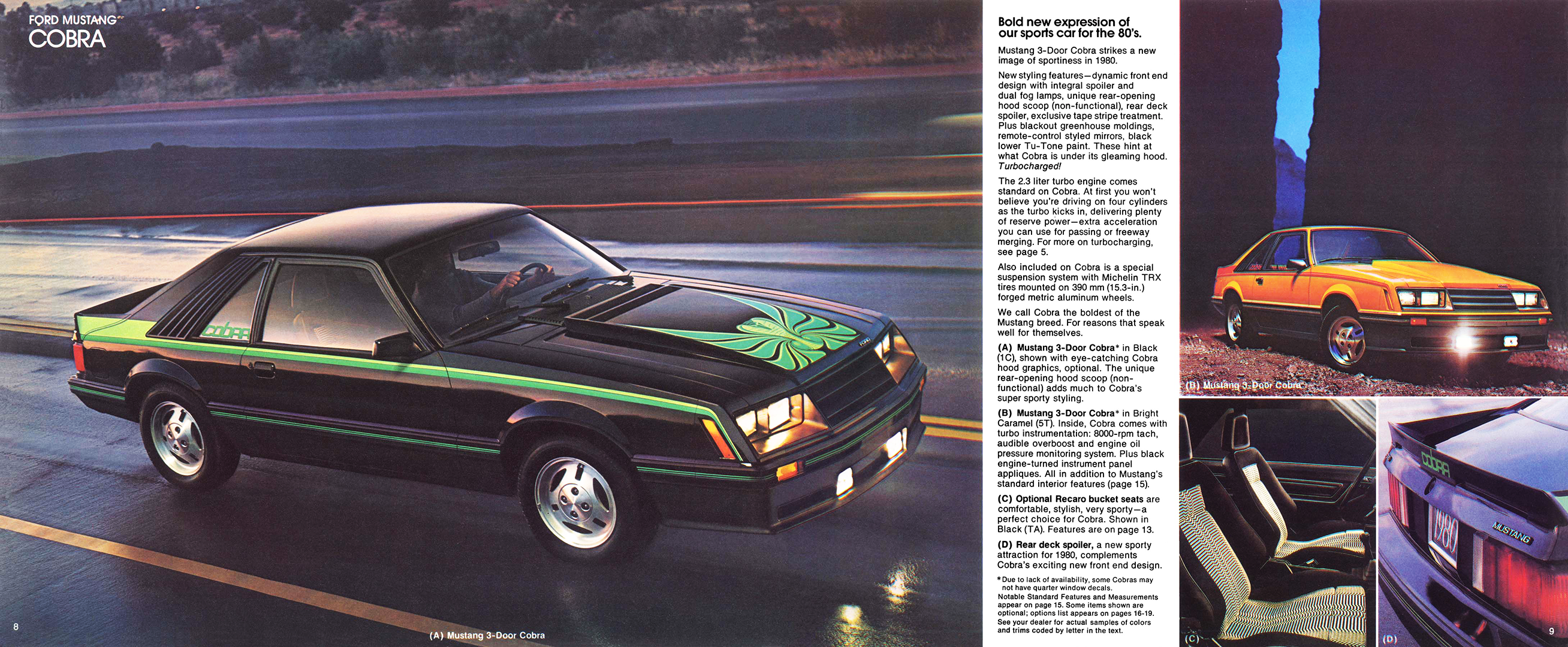
1980 Ford Mustang Cobra hatchback coupe

“A sports car for the 80’s.”

1980 was the second year for the Fox-body Mustang and brought few changes from the debut year—and some of those weren’t great, such as a downgraded V8. The Cobra inherited some features from the 1979 Pace Car, including a front spoiler, dual fog lamps, and a rear deck spoiler.

The standard powertrain on the base Mustang was Ford’s Lima 88 bhp 2.3 liter/140 ci inline four with a Motorcraft 5200 two-barrel carburetor matched with a four-speed manual. A Windsor 119 bhp 4.2 liter/255 ci V8 with a Motorcraft 2150 two-barrel carburetor was available with a three-speed automatic, but the top-of-the-line powertrain was a turbocharged version of the Lima inline four with a Holley 6500 two-barrel carburetor making 132 bhp paired with the four-speed manual. Thus, for 1980, the fastest available Mustang had a 0-60 time of a little under 11 seconds. With a 12.5-gallon fuel tank and 18 city/30 highway fuel mileage (about 15/25 by today’s standards), a Cobra‘s proud new owner could expect a range of about 225 to 270 miles with a 10% fuel reserve.

Cobra pages from the 1980 Ford Mustang brochure

Standard mechanical equipment on the $7,098 Cobra (about $30,600 in today’s dollars or just a little under what the 2026 Mustang EcoBoost fastback goes for) included the turbocharged inline four, the four-speed manual, a “special suspension system” with heavy duty front and rear stabilizer bars and special shock valving, a sport-tuned exhaust with bright tailpipe extension, and Michelin TRX 190/65R390 tires (they’re still available!) on 15.3-inch forged aluminum wheels. Exterior equipment included dual remote styled mirrors and black lower bodyside paint. A Cobra‘s interior didn’t have many upgrades, but you did get an 8,000-rpm tachometer and a black engine-turned instrument panel applique.

Standard equipment on all Mustang hatchback coupes included dual rectangular halogen headlamps, wraparound taillamps, a modified MacPherson strut front suspension, front disc/rear drum brakes, and rack and pinion steering. Inside, full instrumentation (tachometer, trip odometer, fuel/temperature/oil/alternator gauges), a sports steering wheel, color-keyed cut pile carpeting, all vinyl high-back bucket seats, a lockable glove box, and a cigarette lighter were included.

Options, Sales, & Period Reviews

Exterior and mechanical options included Cobra hood graphics ($88), a flip-up open air roof ($219), black liftgate louvers ($141), and a rear window/wiper washer ($79). Inside, you could choose SelectAir conditioning ($538), Recaro high-back bucket seats ($531), an electric rear window defroster ($96), interval windshield wipers ($39), a tilt steering wheel ($78), and the power lock group ($113). A series of stereos were available, with the most capable being an AM/FM stereo radio with a cassette tape player ($271). Higher-end stereos could be paired with the Premium Sound System ($94), which added a higher-power amplifier and more capable rear speakers.

1980 Ford Mustangs sold decently, accounting for about 23% of Ford’s overall sales in a down year. Reviews of the day were unhappy, but understanding about the loss of the 4.9 liter/302 ci V8 in the middle of the second oil crisis—Car and Driver stated that “Whether you like life with turbochargers or not, you might as well get used to it.”

The View From 2025

Folks are definitely collecting these early Fox-body Mustangs. According to Hagerty’s valuation tools, all the money for a 1980 Cobra in #1/Concours condition is an astounding $53,400, with a more normal #3/Good car going for $13,800. Cobras come up for sale occasionally in the Hemming’s Motor News classifieds, on eBay Motors, and on Bring a Trailer.

Make mine Black, I think, perhaps with those extra-cost Cobra hood graphics.

Later Fox-body Mustangs I have covered include the 1981 coupe, the 1982 GT hatchback coupe, the 1983 GT convertible, the 1984 SVO hatchback coupe, and the 1987 LX coupe.

Last updated October 2025.

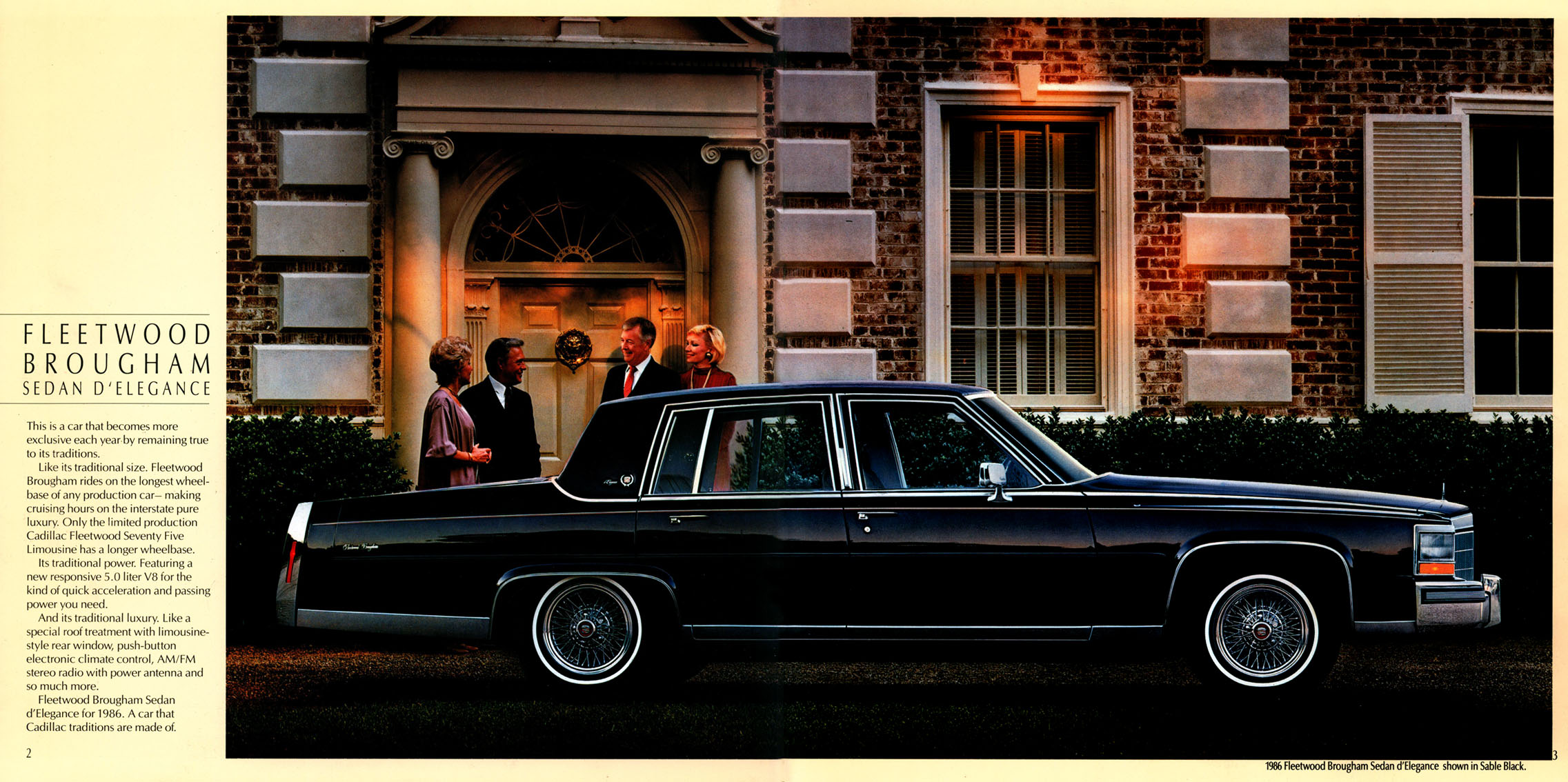
1986 Cadillac Fleetwood Brougham sedan

“Owning a Cadillac is a satisfying experience.”

For 1986, Cadillac transitioned the Fleetwood Brougham from the Cadillac-built HT-4100 130 bhp 4.1 liter/249 ci V8 with fuel injection to the Oldsmobile-built 140 bhp 5.0 liter/307 ci V8 with a Rochester four-barrel carburetor. Production for the model year started late—it didn’t get going until February 1986.

The only powertrain available mated the aforementioned V8 to a four-speed automatic transmission. Mileage was rated at 18 city/25 highway by the day’s standards (16/23 by today’s measures). With a 20.7-gallon fuel tank, a Fleetwood Brougham buyer could expect a range of between 365 and 400 miles with a 10% reserve. The target market didn’t really care about performance, but the 0-60 time was a little under 13 seconds.

Standard exterior equipment on the $21,265 Fleetwood Brougham (about $63,400 in today’s dollars or a little over what a loaded 2025 Cadillac CT5 sedan goes for) included Soft Ray tinted glass and a full padded roof treatment. Mechanical equipment included rear-wheel-drive, power front disc/rear drum brakes, and P215/75R15 steel-belted all-season radial whitewall tires (a size still readily available, including in whitewall) on 15-inch wheels. Inside, an illuminated entry system, power door locks, power windows, electronic climate control, and dual comfort 55/45 heather cloth seats with a six-way power adjuster for the driver were all included in these comfortably equipped cars.

Sedan d'Elegance pages from the 1986 Cadillac Fleetwood Brougham brochure
Sedan d’Elegance pages from the 1986 Cadillac Fleetwood Brougham brochure

Upgrading to the Sedan d’Elegance added adjustable rear seat reading lamps, controlled cycle wipers, tufted pillow-style seating areas, a six-way power seat and manual recliner for the front passenger, and an AM/FM stereo radio with power antenna.

Options & Production Numbers

Among the many exterior and mechanical options were the electrically powered Astroroof ($1,255), electronic level control ($203), and wire wheels ($860 to $940). Inside, Twilight Sentinel ($85), automatic door locks ($170), a power trunk lid release ($40), and a driver’s side memory seat ($215) were available.

The 1986 Fleetwood Brougham sold decently, especially considering the short year—49,115 examples went out the door. By 1986, these cars had evolved into stately evocations of another age. No longer an expression of anything reasonably current in the automotive world, they still received surprising respect in some quarters. In 1987, the name was shortened to just Brougham, but Cadillac would sell the same basic model through the 1992 model year with only one notable update in 1990.

The View From 2025

Folks are collecting these rear-wheel-drive eighties Cadillacs, but values do not approach those of Fleetwoods from previous decades. According to Hagerty’s valuation tools, a 1986 Fleetwood Brougham sedan in #1/Concours condition is $38,500, with a more typical number #3/Good condition car going for $14,300. Eighties Fleetwood Broughams and their ilk are regularly featured in the Hemming’s Motor News classifieds, on eBay Motors, and on Bring a Trailer.

Make mine Autumn Maple Firemist, please.

Other Cadillacs I have written about include the 1980 Seville sedan, the 1982 Cimarron sedan, the 1982 Eldorado Touring Coupe, the 1984 Eldorado Biarritz convertible, the 1986 Eldorado coupe, the 1988 Cimarron sedan, the 1988 Eldorado coupe, the 1989 Allante convertible, and the 1989 Sedan deVille.

Last updated September 2025.

1986 Chevrolet Corvette convertible

“Yes to wind. Yes to sunshine.”

For 1986, the big news for Corvette was the return of the convertible, gone since 1975. Other improvements included Bosch ABS II anti-lock brakes, a Vehicle Anti-Theft System (VATS), and the mid-year introduction of aluminum cylinder heads.

The standard powertrain was the L98 235 bhp 5.7 liter/350 ci V8 with fuel injection paired with a Turbo-Hydramatic four-speed automatic transmission. Car and Driver recorded a 0-60 time of 6.0 seconds and a top speed of 144 mph. Estimated fuel economy was 17 city/24 highway by the standards of the day (15/22 by today’s standards). With a 20-gallon fuel tank, a Corvette convertible’s proud new owner could expect a range of between 335 and 370 miles with a 10% fuel reserve.

Built in collaboration with ASC, the convertible included a manual top, a rear-hinged deck panel to cover the top, and an X-brace underneath the floor. The newly-required high-mounted rear brake light was integrated into the rear fascia. Even the gas filler cover was different from the coupe—square because there was no rounded rear hatchback glass for it to wrap around.

1986 Chevrolet Corvette convertible brochure page
1986 Chevrolet Corvette brochure page

Standard exterior and mechanical equipment for the $32,032 Corvette convertible (about $93,612 in today’s dollars or about what a well-equipped 2025 Corvette Stingray convertible goes for) included a Delco Freedom Plus II battery, power operated quartz-halogen retractable headlamps, power rack-and-pinion steering, power brakes, and P255/50VR-16 tires on 16 x 9.5 inch cast alloy aluminum wheels. Inside, air conditioning, power windows, Tilt-Telescopic steering wheel, driver information system, cloth bucket seats, and an AM/FM stereo radio with power antenna were all included.

Options & Production Numbers

Optional exterior and mechanical equipment included a performance axle ratio ($22) and Delco-Bilstein shock absorbers ($189)—the Doug Nash 4+3 manual transmission was a no-cost option. Optional interior equipment included cruise control ($185), a power door lock system ($175), electronic control air conditioning ($150), a six-way power driver’s seat ($225), and the Delco-GM/Bose Music System ($895). The Z51 Performance Handling Package was not available with the convertible.

The return of the Corvette convertible was well-received—Chevrolet sold 7,315 in about half a model year, even at $5,000 more than the coupe. Reviews were also good; Car and Driver stated that the convertible was “a mighty hospitable carriage.”

The View From 2025

There is strong club support for the 1986 Corvette, as there is for all Corvettes. According to Hagerty’s valuation tools, all the money for a 1986 Corvette convertible in #1/Concours condition is $31,500, with a more normal number #3/Good condition car going for $10,800. 1986 Corvette convertibles are regularly featured in the Hemming’s Motor News classifieds and on eBay Motors—as I write this in December 2018, there’s a Yellow car with black leather seats and 29,000 miles available on Hemmings for $17,900.

Make mine White, with red leather seats—the “heritage colors” that match the first Corvette back in 1953.

Last updated February 2025.

1988 Honda Civic sedan

There’s a white fourth-generation Honda Civic sedan routinely parked on the street about two blocks from my house. You can tell that it hasn’t led a particularly sheltered life, but it’s obviously still in regular use. That makes it time to add one of those sedans to my suite of eighties Hondas: the 1983 Civic 1500 S hatchback coupe, the 1984 Civic CRX hatchback coupe, the 1985 Civic CRX Si hatchback coupe, and the 1986 Accord sedan.

“That was then. This is now.”

For the 1988 model year, the Honda Civic was completely revised, with a brand new design with a lower hood line, an innovative four-wheel double wishbone suspension, and a wheelbase up almost two inches to 98.4 inches. All Civic sedans for the North American market were built in Honda’s still relatively new Marysville, Ohio factory.

1988 Honda Civic sedan advertisement

The Civic sedan’s standard powertrain was the D15B2 92 bhp 1.5 liter/91 ci inline four with twin-injector fuel injection mated with a five-speed manual. Fuel economy was quite good—33 city/37 highway by the standards of the day (28/34 by 2018 standards). An optional four-speed automatic took mileage down to 28 city/33 highway. With an 11.9-gallon gas tank, a Civic owner could expect a range of between 330 and 375 miles with a 10% fuel reserve.

The Civic’s performance was competitive for the class—0-60 came in about 11 seconds with the five-speed manual in a car whose curb weight ranged from 2,039 to 2,205 pounds. The sedan was almost a second slower with the automatic; common in many cars in the eighties.

For $8,795 (about $19,200 in today’s dollars), the base DX version of the sedan came with flush low profile halogen headlights, tinted glass, rack and pinion steering, front disc/rear drum brakes, and 175/70R13 steel-belted radial tires (a size still readily available) on 13 x 5 inch wheels. Inside, the DX included an adjustable steering column, a rear window defroster, intermittent wipers, and full carpeting.

Moving up to $9,625 LX (about $21,000 in 2018 dollars or about $1,500 more than a 2019 Civic LX sedan goes for) added power brakes, a tachometer, power windows, power door locks, power side mirrors, and a digital quartz clock.

Other than the choice of trim level, exterior and interior colors, and transmission, there were no options. Air conditioning was available only as a dealer accessory, as was a choice of various car stereos: Honda would continue to sell AC as a dealer accessory well into the 1990s.

The larger 1988 Civic was well received—it made Car and Driver‘s 10 Best list and sold like hot cakes; a 1988 Civic LX sedan marked the one-millionth car built at the Marysville plant in early April 1988. They were still small cars by modern standards—the 1988 Civic was only about five inches longer than the current Honda Fit.

In 2018, this generation of Civic sedan rarely comes up for sale in the Hemmings Motor News classifieds. Some do show up on eBay Motors, but they’re often in sketchy condition.

Make mine Cardinal Red Metallic, please.

1987 Sterling 825 sedan

“… such effortless motion, …”

1987 Sterling 825 interior

The Sterling 825 sedan was an interesting (perhaps desperate) attempt at re-introducing Rover cars to the North American market, but with different branding than the brutally unsuccessful Rover 3500 hatchback sedan from 1980. Based on the same platform as the acclaimed Acura Legend, the Sterling featured an angular exterior design and an interior with traditional British luxury cues, such as Connolly leather seats and burled walnut trim. On the exterior, only the door handles were obviously shared between the Acura and the Sterling.

A Honda-built 151 bhp 2.5 liter/152 ci V6 with fuel injection combined with a five-speed manual transmission yielded mpg ratings of 18 city /24 highway by the day’s standards (16/22 by modern standards). The optional four-speed automatic transmission dropped mpg incrementally to 17 city/23 highway. With the standard powertrain and an 18-gallon gas tank, a Sterling driver could expect a 310 to 340 mile range with a 10% fuel reserve.

Equipment, Reception, & Production Numbers

The $19,200 (about $55,300 in today’s dollars or about what a loaded 2025 Acura TLX sedan goes for) 825 S came with remote locking, power rack-and-pinion steering, power brakes, and 195/65R15 tires (a size still readily available) on 15-inch alloy wheels. Inside, air conditioning, power windows, an electric moonroof, cruise control, velour cloth seats, and a Phillips AM/FM stereo cassette with six speakers were all included.

Moving up to the $23,900 (about $68,800 in 2025 dollars) 825 SL added a four-speed automatic transmission, Bosch anti-lock brakes, Deluxe alloy wheels, a 10-function trip computer, leather upholstery with a heated driver’s seat, and an eight-speaker stereo.

Advertised as “The inevitable British road car.” Sterling sold 14,171 units of the 825 in the 1987 model year—not a bad debut. But, trouble was brewing; in an attempt to generate more jobs in the United Kingdom, Rover had decided to use Lucas electronic systems instead of those from Honda. Predictably, those electronics weren’t reliable, and there were also issues with the interior plastics and the exterior paint. Finally, rust came much too quickly.

All this meant that sales dropped rapidly. In 1988, only 8,901 were sold, and every year following that, things got worse. In August 1991, Sterling announced they were leaving the North American market after selling a total of about 35,000 cars over five years.

The View From 2025

The Sterling 825 rarely comes up for sale in the Hemmings Motor News classifieds or on eBay Motors. However, as I update this post in early 2025, there’s a 1988 825 SL on Bring a Trailer. I haven’t seen one in person in many years, but I believe I’d still notice that handsome styling if I did.

Make mine Pulsar, I think.

Last updated March 2025.

1986 Buick Century sedan

A white Buick Century sedan was parked outside one of my local supermarkets for a few weeks in late 2018. Followers of Eighties Cars know that presence was likely to generate a blog entry.

“… truly satisfying motoring in the European tradition.”

For 1986, Buick’s Century gained a new slanted grille along with lower profile headlamps. The other major news was that the T Type coupe had been discontinued, though the sedan version of the most sporting Century remained alive. Both the sedan and the coupe were available in Custom (base) and Limited trim, while the wagon was available in Custom (base) and Estate versions. We’ll concentrate on the sedan in this post.

Standard power on the Century remained the Iron Duke 92 bhp 2.5 liter/151 ci inline four with throttle-body fuel injection. Two different V6 engines were available: a $435 112 bhp 2.8 liter/181 ci V6 with a two-barrel carburetor and a $695 150 bhp 3.8 liter/231 ci V6 with sequential fuel injection. A three-speed automatic transmission was standard with the 2.5 liter inline four and 2.8 liter V6, but buyers could add a four-speed automatic for an additional $175.

With these three engines, two transmissions, and curb weights in the 2,750 to 2,850-pound range, there was a wide variance in performance. 0-60 mph with the inline four/three-speed automatic combination was about 15 seconds, while 3.8 liter/231 ci V6 owners with the four-speed automatic could expect to get from 0-60 in about 11.5 seconds.

Mileage ratings with the base four and three-speed automatic were 22 city/32 highway (19/29 by today’s standards), while owners of the top-of-the-line V6/four-speed automatic combination could expect 19 city/29 highway (17/26 by 2025 standards). With a 15.7-gallon fuel tank, Century V6 drivers could expect a range of between 305 and 340 miles with a 10% fuel reserve.

Century page from the 1986 Buick brochure

Standard equipment on the $10,228 Century Custom (about $29,900 in 2025 dollars—just about what a 2025 Encore GX SUV goes for) included front-wheel drive, power rack-and-pinion steering, power front disc/rear drum brakes, and 185/75R14 tires (a size still available from Hankook) on 14-inch wheels. Inside, a cloth notchback front bench seat and a Delco AM radio with dual front speakers and a fixed antenna were included.

Moving up to the $10,729 Limited (about $31,400 in today’s dollars) added 55/45 notchback velour seats and a hood ornament.

The relatively rare $13,714 T Type (about $40,100 in 2025 dollars) included the 3.8 liter/231 ci V6 and four-speed automatic combination, along with a Gran Touring suspension and 215/60R14 tires on 14-inch aluminum wheels. Inside, a sport leather-wrapped steering wheel, a full length storage console, and reclining cloth bucket seats were included.

Options & Production Numbers

Century buyers had many choices to personalize their sedans. Optional exterior and mechanical equipment included aluminum wheels ($199), Soft-Ray tinted glass ($115), and an engine block heater ($18). Inside, air conditioning ($750), cruise control ($175), Twilight Sentinel ($57), power windows ($270), power door locks ($180), tilt steering ($115), and a six-way power driver’s seat ($225) were available.

The 1986 Buick Century sedan sold rather well—sales inched up slightly from 1985 as Buick moved about 232,000, with 5,286 being the T Type version. The Century overall remained the most popular vehicle at most Buick dealers.

The View From 2025

I think of these A-body cars as basic and honest. Centurys sometimes show up for sale in the Hemmings Motor News classifieds or on eBay Motors, though this is increasingly unusual. Bring a Trailer has sold just a few of this fifth generation.

Make mine Dark Blue Metallic, please.

Other A-bodies I’ve written about in this blog include the 1983 Pontiac 6000 STE sedan and the 1989 Chevrolet Celebrity sedan—I guess I owe the Oldsmobile Cutlass Ciera some attention.

Updated March 2025.