1987 Dodge Aries LE sedan

We had a lot of road work going on in our area in September 2020. I had to take a short detour, which sent me down a route that included a few blocks I’d never traveled. I saw a white Dodge Aries sedan parked on the side of the road. A day later, I went back and took a couple of pictures. The Aries was in pretty good shape and sported a Pennsylvania classic car plate.

“More car for the money than you thought possible.”

For 1987, changes to the Dodge Aries sedan were minor. A stainless steel exhaust system was new, as were standard front bucket seats.

The Aries’ standard powertrain was an E86 97 bhp 2.2 liter/135 ci inline four with central fuel injection paired with a five-speed manual transmission. A 100 bhp 2.5 liter/152 ci inline four was a $287 option for the LE only and required the $534 TorqueFlite automatic transmission.

Fuel economy with the standard powertrain was rated at 25 city/32 highway by the day’s standards (22/29 by 2025 measures), while ratings for the 2.5 liter/automatic combination dropped to 22/27. With a 14-gallon gas tank, the owner of a base Aries sedan could expect a range of 320 to 360 miles with a 10% fuel reserve. The driver of a 2.5 liter Aries could expect about 50 miles less. Best case 0-60 times were about 10.5 seconds in a car with a shipping weight of just under 2,500 pounds.

1985 Dodge Aries LE sedan photo
1987 Dodge Aries LE sedan circa 2020

Standard exterior and mechanical equipment for the $7,655 Dodge Aries sedan included halogen headlights, manual rack-and-pinion steering, power front disc/rear drum brakes, a compact spare tire, and P175/80R13 black sidewall tires (now generally a trailer size) on 13-inch wheels with hubcaps. Inside, a manual left exterior mirror, a Deluxe two-spoke steering wheel, a mini console, and cloth with vinyl trim low-back bucket seats with reclining seatbacks were included.

Moving up to the $8,134 LE (which 93% of Aries sedan buyers did), added Deluxe wheel covers, a power left exterior mirror, Deluxe windshield wipers with intermittent wipe, a trunk light, cloth door trim panels, and an AM electronic tuning radio with a digital clock. The LE could get a vinyl bench seat at no extra charge.

Packages, Options, & Production Numbers

Chrysler Corporation had begun to move to more options packages by the mid-eighties. The Aries sedan had four for 1987:

  • Basic Equipment Package ($261) included Deluxe 13-inch wheel covers, a black power left exterior mirror, Deluxe windshield wipers with intermittent wipe, and an AM electronic tuning radio with a digital clock. It was (natch!) only available for the base sedan.
  • Popular Equipment Discount Package included tinted glass, bodyside tape stripes, an automatic transmission, power-assisted steering, and P185/70R14 black sidewall tires (a size still readily available) on 14-inch wheels with Deluxe wheel covers. Inside, the package included black dual remote exterior mirrors, special sound insulation, trunk dress-up, and an AM stereo/FM stereo electronic tuning radio with a cassette player, four speakers, and a digital clock. This package was LE-only and went for $740.
  • Premium Equipment Discount Package ($1,312 and LE-only) included everything in the Popular Equipment Discount Package and added an electric rear window defroster, electronic speed control, a Luxury two-spoke steering wheel, a tilt steering column, and power door locks.
  • Light Package ($59 and LE-only) included an ash receiver light, a cigar lighter light, a headlights-on warning buzzer, an ignition switch light with time delay, and an underhood light.

Individual options included tinted glass ($121), 14-inch cast aluminum road wheels ($332 with either the Popular or Premium packages/$381 without), a conventional spare tire ($75 for 13-inch wheel/$85 for $14-inch wheel), and air conditioning ($790 and requiring tinted glass). Between the packages and the options, a loaded LE sedan could surpass $11,000 on its window sticker.

The Aries sedan continued to sell respectably in 1987, with 71,216 sold. It remained by far the best-selling Dodge sedan.

The View From 2025

Interestingly, K cars have not entirely disappeared from the road—quite unlike many of their eighties peers. Examples of the Aries rarely show up for sale in the Hemmings Motor News classifieds and on eBay Motors, though they do appear on cars.com and Bring a Trailer.

Make mine the extra cost ($41) Twilight Blue Pearl Coat, please.

Other K and K-based cars I have written about include the 1981 Plymouth Reliant coupe, the 1982 Chrysler LeBaron convertible, the 1984 Chrysler Laser hatchback coupe, the 1984 Dodge Daytona Turbo Z hatchback coupe, the 1984 Plymouth Voyager minivan, the 1985 Dodge 600 Club Coupe, and the 1986 Chrysler Town and Country convertible.

Last updated April 2025.

1987 Volvo 780 coupe

“The kind of Volvo you design when you’ve been designing Ferraris, Lamborghinis and Maseratis all your life.”

Designed and produced by Bertone and primarily based on the 760 sedan, the 780 was Volvo’s second attempt at a stylish coupe. The first was also a Bertone creation—the 262C built from 1977 through 1981. Beyond the handsome exterior, the interior was also specific to the 780—not merely a slightly re-purposed 760 design. Among the significant changes from the 760’s interior were a move from five seats to four, with individually-shaped seats for those in the rear.

The 780 used its design and a notably high standard equipment level as differentiators as Volvo attempted to move into higher-end markets. The 780’s base price was $34,785—about $81,700 in today’s dollars, which is well more than any Volvo vehicle’s sticker price in 2020. Back in 1987, the 780’s real competition was unclear. Was it the Acura Legend (also in its first year but much less expensive), the BMW 6-series (much more expensive), the Lincoln Mark VII (far less expensive—at least until many options were added), or some other car?

For 1987, the only powertrain available was the B280F 146 bhp 2.8 liter/174 ci V6 with Bosch LH-Jetronic fuel injection paired with a four-speed automatic transmission. 0-60 mph times were in the 11 second range—Volvo did not intend the 780 to be a sports coupe. Mileage in the 3,415-pound car was rated at 17 city/21 highway by the standards of the day (15/20 by today’s standards). With a relatively small 15.9-gallon fuel tank, 780 drivers could expect 250 to 270 miles of range with a 10% reserve.

1987 Volvo 780 advertisement

Standard exterior equipment for the 780 included tinted glass, a power moonroof with a sliding sunshade, dual power mirrors with a heating element, flush-lens halogen headlamps, front and rear fog lamps, and the Bertone name and logo on both C pillars. Mechanical features included power steering, four-wheel vented power disc brakes with ABS, and 205/60R15 tires (a size still readily available) on 15 x 6 inch 15-spoke alloy wheels.

Inside, the 780 came loaded, with full instrumentation including a tachometer, a power central locking system, power windows, automatic climate control, cruise control, and a driver’s side airbag. Upholstery highlights included heated eight-way power leather front bucket seats and beach burl wood trim. The standard stereo was an AM/FM ETR stereo cassette with a seven-band graphic equalizer, four speakers, a 200-watt amplifier, and a power antenna.

Volvo did not sell a lot of 780’s—but I don’t believe they expected to. Only 9,215 (other sources say 8,518) were produced over six years of production, with about 61% of those going to the United States market. There’s an enthusiast site at 780coupe.com, and folks do collect 780’s. You also sometimes see them in the Hemmings Motor News classifieds and on eBay Motors.

Make mine Blue Metallic, please.

This post is the first on a Volvo in Eighties Cars. There will be others—I definitely expect to get to the 240 wagon at some point.

1987 Ford Thunderbird standard coupe

The inspiration for this blog entry is a 1987 Thunderbird standard coupe that one of my frequent readers owned. As I was pretty deep into writing it, the Hemmings blog just happened to re-publish an article that ran in Hemmings Classic Car earlier in 2020—also about the 1987 Thunderbird (though mainly about the Turbo Coupe). Luckily, I have a slightly different view, in what looks to be a rather long-form entry.

“In step with the times”

For 1987, Ford significantly revised the Thunderbird—even though it didn’t look that different, the late mid-life update of what had been a 1983 model year debut cost approximately $250 million. Few exterior parts were carried over from the 1986 model, with notable changes including composite headlights, a more pointed nose, flush-fitting side glass, and full-width taillamps. There were far less differences inside—Ford had spent all of the money on the exterior and mechanical revisions.

The standard engine for the 1987 Thunderbird was an Essex 120 bhp 3.8 liter/231 ci V6 with throttle-body fuel injection. Optional power on the base coupe and LX (and standard on the Sport) was a $638 Windsor 150 bhp 4.9 liter/302 ci V8 with sequential fuel injection. Both engines came with a four-speed automatic transmission. The most powerful engine available on any Thunderbird remained the Turbo Coupe-specific Lima 2.3 liter/140 ci inline four with a turbocharger and fuel injection. With the new for 1987 addition of an intercooler, this engine produced an impressive 190 bhp with the five-speed manual, but only 150 bhp with the automatic—a difference common among many Ford performance cars of the 1980s.

1987 Ford Thunderbird brochure page
Standard coupe page from the 1987 Ford Thunderbird brochure

Standard exterior and mechanical equipment on every 1987 Thunderbird standard coupe included dual aerodynamic halogen headlamps, tinted glass, power rack and pinion steering, power front disc/ rear drum brakes, and P215/70R14 tires (a size still readily available) on 14 x 5.5 inch wheels with Luxury wheel covers. Inside, the standard coupe included a reclining cloth split bench seat with a consolette, a quartz electric clock, and an electronic AM/FM stereo radio with four speakers. All of this cost $12,972—approximately $38,000 in today’s dollars or almost exactly what a 2025 Ford Mustang EcoBoost Premium Hatchback goes for.

Options & Packages

Exterior and mechanical options for the standard coupe included two-tone paint ($218), a power moonroof ($841), and cast aluminum wheels ($343). Inside, dual power seats ($302), a digital clock ($61), and a range of audio options, including the Premium Sound System, were available. There were three different upgrades from the standard version of the Thunderbird, each with a distinctive personality:

  • For an additional $2,411, the luxury-oriented LX included everything in the standard coupe and added dual remote-control electric mirrors, styled road wheels, an electronic digital clock, speed control, interval windshield wipers, power windows, and an electronic AM/FM stereo radio with a cassette player and four speakers. LX upholstery included a Luxury cloth split bench seat in a special sew style and a leather-wrapped steering wheel.
  • The Sport included everything in the standard coupe and added a heavy-duty battery, a Traction-Lok axle, styled road wheels, an electronic digital clock, a leather-wrapped steering wheel, speed control, and individual cloth seats with a full console. The Sport came standard with the 4.9 liter/302 ci V8 that was optional in the standard and LX versions, which Ford stated was its “driving force.” It cost $2,107 more than the standard coupe.
  • The top-of-the-line Turbo Coupe included everything in the standard coupe and added dual remote-control electric mirrors, Hella fog lamps, four-wheel disc brakes (newly anti-lock for 1987), a Traction-Lok axle, dual exhaust, and P225/60R16 Goodyear performance tires on 16 x 7 inch cast aluminum wheels. Inside, full analog instrumentation, interval windshield wipers, power windows, and adjustable articulated cloth sport bucket seats were standard for Turbo Coupe buyers. The Turbo Coupe cost $16,805—about $49,200 in today’s dollars and almost 30% more than the standard coupe. Ford confidently stated that it was “one of the most complete performance cars on the road today.”

Period Reviews & Production Numbers

Some in the automotive press were impressed by the Thunderbird’s substantial refresh for 1987, with Motor Trend giving it their Car of the Year award. Popular Mechanics was a little more even-handed; they liked many of the exterior changes but were unimpressed by the acceleration of either the V8 or the turbo four. Whatever the opinions were from the buff books, sales still slid substantially—dropping by almost 22% from 163,965 in 1986 to 128,135 in 1987.

The View From 2025

According to Hagerty’s valuation tools, a 1987 Thunderbird standard coupe in #1/Concours condition is currently valued at $16,300, while a more typical #3/Good condition car goes for $9,000. Turbo Coupes are worth substantially more, garnering $27,300 for a #1/Concours example.

These 1987 and 1988 Thunderbirds frequently appear for sale in the Hemming’s Motor News classifieds, eBay Motors, and Bring a Trailer. As I update this blog entry in August 2025, there’s a White 1988 coupe with cinnabar cloth bucket seats, the 302 ci V8, and 6,700 miles for sale on Hemmings, asking $12,500.

Make mine Medium Canyon Red, please.

Other Thunderbirds I have written about in this blog are the 1980 coupe and the 1983 Turbo Coupe (I’ve also written about the closely related 1988 Mercury Cougar XR-7 coupe). A sampling of the many other Fords I have written about includes the 1981 Escort hatchback coupe, the 1982 Mustang GT hatchback coupe, and the 1986 Taurus sedan.

Last updated August 2025.

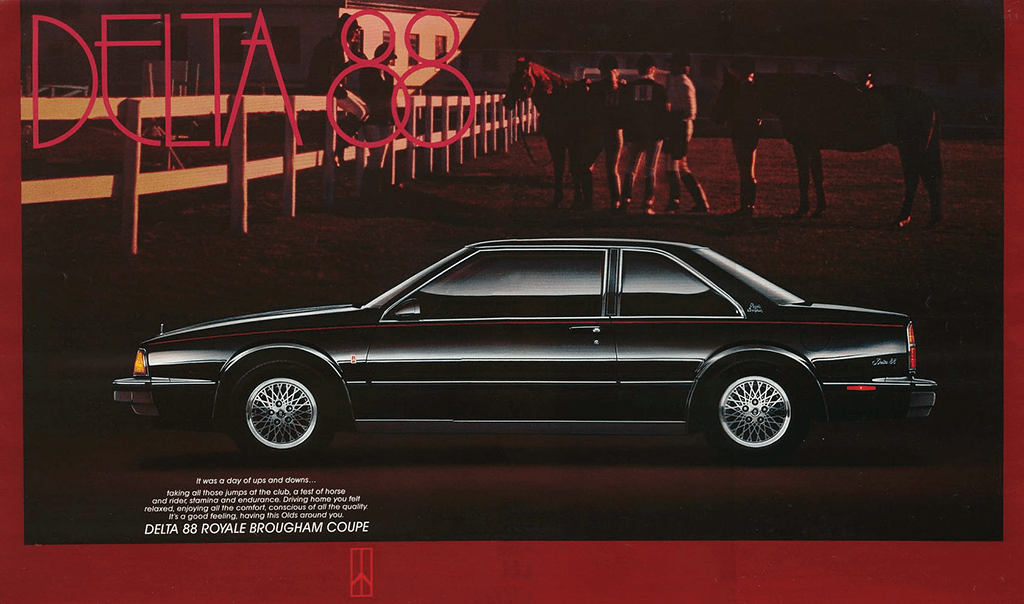
1987 Oldsmobile Delta 88 Royale Brougham coupe

This entry is yet another post inspired by a car one of my frequent readers owned.

“It’s a good feeling, having this Olds around you.”

1987 was the second model year for the ninth generation of Oldsmobile’s Delta 88. New features were relatively few but included composite headlamps, a new grille, new “aero” side-view mirrors, and a revised taillamp design. For coupes, front automatic safety belts were standard throughout the year—they were a mid-year introduction for sedans. Finally, Oldsmobile bailed on even offering the 125 bhp 3.0 liter/181 ci V6 that had been the base engine for 1986.

The only powertrain available for any Delta 88 Royale in the 1987 model year was the LG3 150 bhp 3.8 liter/231 ci V6 with fuel injection mated to a four-speed automatic. 0-60 mph came in a little over 10 seconds in the 3,203-pound car. EPA fuel economy ratings were 18 city/27 highway by the standards of the day (16/25 by today’s standards). With an 18-gallon fuel tank, a Delta 88 owner could expect a range of between 330 and 365 miles with a 10% fuel reserve.

1987 Oldsmobile brochure
Delta 88 Royale Brougham pages from the 1987 Oldsmobile brochure

Standard exterior and mechanical equipment on the $13,639 Delta 88 Royale coupe (about $39,900 in today’s dollars) included Soft-Ray tinted glass, power rack-and-pinion steering, power brakes, and P205/75R14 tires (a size still somewhat available) on 14-inch wheels with Deluxe wheel discs. Inside, all cars included Lucerne knit velour seats, Four Seasons air conditioning, side window defoggers, and an AM radio with dual front speakers.

Options & Production Numbers

Among the many exterior and mechanical options were a tinted glass sunroof, a full vinyl roof ($200), and a Level III (FE3) suspension. Inside, power door locks, power windows, power seats, a tilt steering wheel, leather seats, an electronic instrument panel, an electronic day/night mirror, and a Delco/Bose Music System were all available.

The Delta 88 Royale coupe sold acceptably for a big coupe in 1987—of the 12,943 made, approximately 65% were the Broughams. Oldsmobile would build the coupes through the end of the 1991 model year, by which point sales had declined to a mere 692 examples. The final Delta 88 of any kind came off the production line on January 6, 1999.

The View From 2025

Hagerty’s valuation tools do not track any Delta 88 after 1975 convertible, and Delta 88s of this generation rarely show up in the Hemming’s Motor News classifieds or on eBay Motors. Bring a Trailer has sold more stock cars of this generation of Delta 88 than production cars.

Make mine Dark Garnet Red Metallic, please.

One other H-platform car I have written about is the 1987 Buick LeSabre T Type coupe. Other Oldsmobiles include the 1981 Cutlass Supreme coupe, the 1982 Toronado Brougham coupe, the 1984 Omega sedan, the 1985 Firenza ES sedan, and the 1985 Ninety-Eight Regency sedan.

Last updated July 2025.

1987 Pontiac Grand Prix coupe

While dropping my parents off at church this Sunday morning, I saw a stock-appearing facelifted fourth-generation Grand Prix with two-tone paint out of the corner of my eye—heading west on the Lincoln Highway. As good a reason as any to finally complete this blog post that I’ve been working on for over six months.

“… a Pontiac classic …”

1987 marked the final model year for the G-body Grand Prix coupe—it would be replaced in 1988 by an all-new W-body front-wheel-drive model. Changes were few; the Grand Prix portion of Pontiac’s 1987 brochure emphasized a new sport steering wheel and new 45/55 seats for the LE.

The standard Grand Prix powertrain continued to be the LD5 110 bhp 3.8 liter/231 ci V6 with a two-barrel carburetor paired with a three-speed automatic. Optional engines included the LB4 140 bhp 4.3 liter/263 ci V6 with fuel injection ($200 and available with either a three-speed or a four-speed automatic) and the LG4 150 bhp 5.0 liter/305 ci V8 with a four-barrel carburetor ($590 and only available with a $175 four-speed automatic). With the V8, a Grand Prix owner could expect a 0-60 time of a little over nine seconds in a coupe with a shipping weight of 3,231 pounds.

Mileage wasn’t good with any engine/transmission combination: the best was the 4.3 liter/four-speed automatic combination with 19 city/26 highway (17/24 by today’s standards). Predictably, the V8 was the worst, at 17 city/24 highway—with a 13.6-gallon gas tank the owner of a V8 Grand Prix could expect a range of between 225 and 250 miles with a 10% fuel reserve.

Grand Prix page from the 1987 Pontiac brochure.

Standard equipment on the $11,069 Grand Prix (about $25,300 in 2019 dollars) included power steering, power front disc/rear drum brakes, and P195/75R14 blackwall tires (a size still available thanks to Hankook and Kumho) on 14-inch wheels. General Motors was moving to option groups in the late eighties, and the base Grand Prix had two. Option Group I $1,313) included dual sport sideview mirrors, body side moldings, air conditioning with Soft Ray tinted glass, a tilt steering wheel that was also a luxury cushion steering wheel, and a Delco ETR AM/FM stereo radio. Option Group II ($1,867) added cruise control, lamp group, controlled cycle windshield wipers, power door locks, and power windows.

Moving up to the LE ($11,799) added dual sport sideview mirrors, 45/55 notchback seats in Pallex cloth, and a four-spoke sport steering wheel. For the LE, Option Group I ($1,844) included body side moldings, air conditioning with Soft Ray tinted glass, a tilt steering wheel, cruise control, lamp group, controlled cycle windshield wipers, power door locks, power windows, a visor vanity mirror, and a Delco ETR AM/FM stereo radio. Option Group II ($2,117) added halogen headlamps, a deck lid release, and a power driver’s seat, and made the visor vanity mirror illuminated.

The top-of-the-line Brougham ($12,519) added 45/55 notchback seats in Majestic cloth, power windows, special trim, and a luxury cushion steering wheel. Option Group I ($1,874) for the Brougham included body side moldings, air conditioning with Soft Ray tinted glass, a tilt steering wheel, a power driver’s seat, cruise control, lamp group, controlled cycle windshield wipers, power door locks, a visor vanity mirror, and a Delco ETR AM/FM stereo radio. Option Group II ($2,078) added halogen headlamps, cornering lamps, luggage compartment trim, a deck lid release, dual remote mirrors, and a dome reading lamp, and added illumination to the visor vanity mirror. A Brougham with Option Package 2, the V8, and the four-speed automatic came to a non-trivial $15,362 (about $35,100 in today’s dollars or about what a 2019 Buick Regal Avenir sedan goes for).

Individual exterior and mechanical options included a rally-tuned suspension ($50), a power sunroof ($925), a hatch roof with removable glass panels ($905), a power antenna ($70), two-tone paint ($205 to $295) and turbo-finned cast aluminum wheels ($246). Inside, you could get bucket seats with recliners and console ($292 with Ripple cloth in the base coupe, $69 with Pallex cloth in the LE, or $369 with leather in the LE), and a rally gauge cluster with tachometer ($153) along with a range of stereos up to a Delco ETR AM/FM stereo radio with cassette and graphic equalizer ($450).

The 1987 Grand Prix did not sell well—sales were about 41% of the 1986 total, and, at 16,542, the typical Pontiac dealer sold more Grand Ams, 6000s, Bonnevilles, Sunbirds, Firebirds, and Fieros.

Evidently (based on my observation this morning) someone is saving these cars! Hagerty declines to value any Grand Prix after 1977, but this generation does come up for sale every once in a while in the Hemming’s Motor News classifieds or on eBay Motors. As I write this in February 2019, there’s a 1985 Silver/Medium Gray two-tone Grand Prix LE with gray cloth notchback seats, a 3.8 liter/231 ci V6, an automatic, and 54,000 miles available for $12,900.

Make mine Dark Maroon Metallic, please.

Other rear-wheel drive G-platform (designated A-platform before 1982) cars I have written about include the 1984 Buick Regal Grand National coupe, the 1983 Chevrolet Malibu sedan, the 1981 Chevrolet Monte Carlo Sport Coupe, the 1981 Oldsmobile Cutlass Supreme coupe, and the 1980 Pontiac Grand Am coupe.

1987 Buick LeSabre T Type coupe

“… ranks as the most exciting new LeSabre ever”

1987 was the first year for the T Type version of Buick’s sixth-generation LeSabre. Looking toward a looming future where the rear-wheel-drive Regal would no longer exist, Buick did its best to inject some sportiness into these big (110.8-inch wheelbase) front-wheel-drive coupes.

Power wasn’t great—the only engine available on any LeSabre was the LG3 150 bhp 3.8 liter/231 ci V-6 with sequential fuel injection mated to a four-speed automatic transmission. Car and Driver recorded a 0-60 time of 9.8 seconds in a coupe with a 3,369-pound curb weight—sprightly but not speedy in 1987. Fuel economy was 18 city/27 highway by the day’s standards (16/25 by 2025 standards). With an 18-gallon gas tank, LeSabre owners could expect a range of about 330 to 365 miles with a 10% fuel reserve.

LeSabre coupe pages from the 1987 Buick brochure

Exterior features specific to the $15,591 T Type (about $45,800 in 2025 dollars or about what a 2026 Buick Enclave large crossover SUV goes for) included blackout trim treatment, a front air dam, and a rear deck spoiler. Mechanical equipment included a Gran Touring suspension, a 2.97 performance axle ratio, and 215/65R15 Goodyear Eagle GT blackwall tires (a size still readily available) on 15-inch aluminum-alloy wheels. Inside, a leather-wrapped sport steering wheel, gray/black 45/45 cloth seats, a gage package with red backlighting, and an ETR AM-FM stereo radio with graphic equalizer, cassette tape, and more red backlighting were included.

Standard exterior and mechanical equipment on all LeSabre coupes included composite tungsten-halogen headlamps, power rack and pinion steering, clearcoat paint, dual horns, Soft-Ray tinted glass, and a fixed-mast radio antenna. Inside, air conditioning, adjustable front-seat headrests, and cut-pile carpeting were standard.

Options, Period Reviews, & Production Numbers

Exterior and mechanical options included an anti-lock brake system ($925), flip-open Vista-Vent removable glass sunroof ($350), electric side mirrors ($91), intermittent windshield wipers ($55), and power antenna ($95). Inside, automatic climate control ($165), power door locks ($145), power windows ($210), tilt steering column ($125), and electronic cruise control ($175) were available.

The automotive press and the auto market itself weren’t quite sure what to make of the LeSabre T Type—Consumer Guide said: “it had nothing exceptional to rave about.” Sales were not good in a year when the LeSabre overall sold quite well; only 4,123 out of the 16,899 coupes sold.

The View From 2025

1000 views badge

A few folks do collect these cars, but I haven’t seen a LeSabre coupe of any type for many years. This generation of LeSabres does maintain some presence in the Hemming’s Motor News classifieds, on eBay Motors, and on Bring a Trailer.

Make mine Dark Blue Metallic, please.

Other sporty Buick coupes I have written about include the 1980 Rivera S TYPE, the 1983 Skylark T TYPE, the 1984 Regal Grand National, the 1984 Riviera T TYPE, the 1987 GNX, and the 1988 Reatta.

Last updated September 2025.

1987 Sterling 825 sedan

“… such effortless motion, …”

1987 Sterling 825 interior

The Sterling 825 sedan was an interesting (perhaps desperate) attempt at re-introducing Rover cars to the North American market, but with different branding than the brutally unsuccessful Rover 3500 hatchback sedan from 1980. Based on the same platform as the acclaimed Acura Legend, the Sterling featured an angular exterior design and an interior with traditional British luxury cues, such as Connolly leather seats and burled walnut trim. On the exterior, only the door handles were obviously shared between the Acura and the Sterling.

A Honda-built 151 bhp 2.5 liter/152 ci V6 with fuel injection combined with a five-speed manual transmission yielded mpg ratings of 18 city /24 highway by the day’s standards (16/22 by modern standards). The optional four-speed automatic transmission dropped mpg incrementally to 17 city/23 highway. With the standard powertrain and an 18-gallon gas tank, a Sterling driver could expect a 310 to 340 mile range with a 10% fuel reserve.

Equipment, Reception, & Production Numbers

The $19,200 (about $55,300 in today’s dollars or about what a loaded 2025 Acura TLX sedan goes for) 825 S came with remote locking, power rack-and-pinion steering, power brakes, and 195/65R15 tires (a size still readily available) on 15-inch alloy wheels. Inside, air conditioning, power windows, an electric moonroof, cruise control, velour cloth seats, and a Phillips AM/FM stereo cassette with six speakers were all included.

Moving up to the $23,900 (about $68,800 in 2025 dollars) 825 SL added a four-speed automatic transmission, Bosch anti-lock brakes, Deluxe alloy wheels, a 10-function trip computer, leather upholstery with a heated driver’s seat, and an eight-speaker stereo.

Advertised as “The inevitable British road car.” Sterling sold 14,171 units of the 825 in the 1987 model year—not a bad debut. But, trouble was brewing; in an attempt to generate more jobs in the United Kingdom, Rover had decided to use Lucas electronic systems instead of those from Honda. Predictably, those electronics weren’t reliable, and there were also issues with the interior plastics and the exterior paint. Finally, rust came much too quickly.

All this meant that sales dropped rapidly. In 1988, only 8,901 were sold, and every year following that, things got worse. In August 1991, Sterling announced they were leaving the North American market after selling a total of about 35,000 cars over five years.

The View From 2025

The Sterling 825 rarely comes up for sale in the Hemmings Motor News classifieds or on eBay Motors. However, as I update this post in early 2025, there’s a 1988 825 SL on Bring a Trailer. I haven’t seen one in person in many years, but I believe I’d still notice that handsome styling if I did.

Make mine Pulsar, I think.

Last updated March 2025.

1987 Mercury Lynx XR3 hatchback coupe

This post is consistently one of the most popular every year and has been so since the first full year after I originally posted it. It seems to me the key to an individual post’s popularity is often in the rarity of the other coverage available for that particular vehicle.

“… the sporting side of Lynx.”

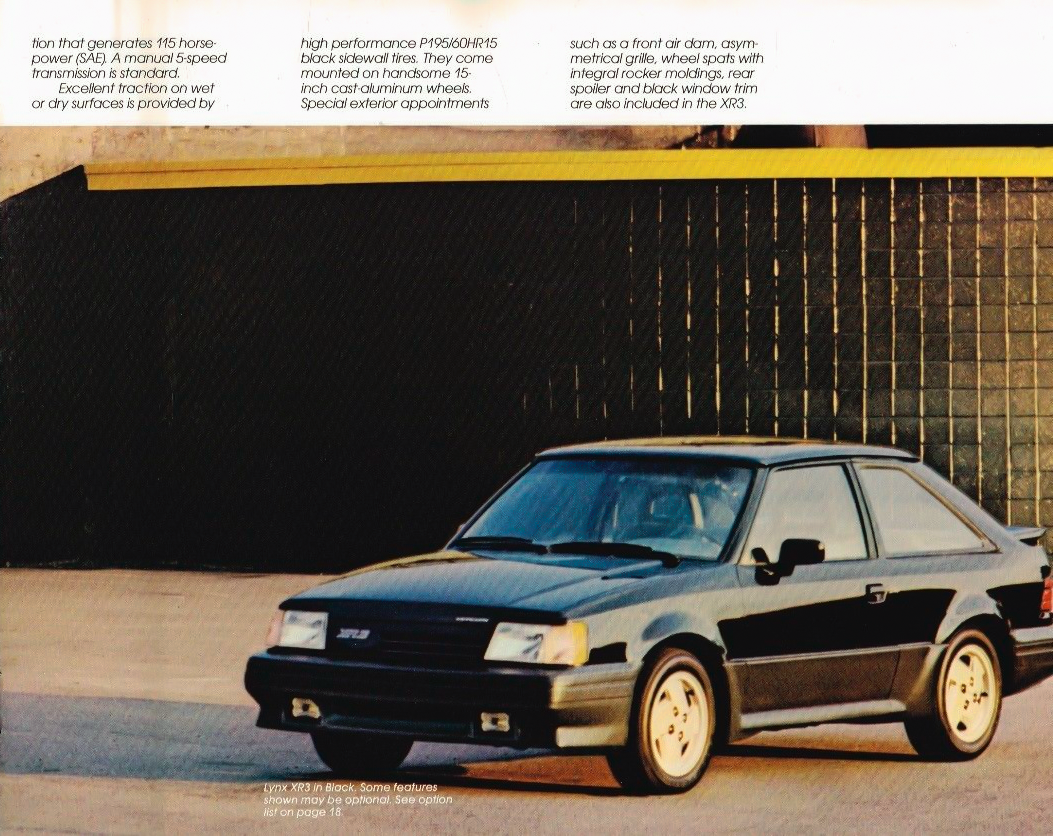
1987 was the final year for the Lynx—Mercury’s version of Ford’s Escort compact. The Escort would soldier on for many more years (through model year 2002), but from 1988 forward, the smallest American-built Mercury would be the Topaz—still a compact, but larger in almost every dimension. For 1986 and 1987, the top-of-the-line Lynx was the XR3 hatchback coupe.

The XR3 designation was not random, but may not have been obvious to much of the North American market. In Europe, XR3 (and later XR3i) was a sporty trim of the Mark III Ford Escort from 1980 forward. Why Ford’s marketers chose to make XR3 the sportiest Lynx instead of using the name for the stateside Escort (which used GT in the mid-1980s) is a question lost in the mists of time, but may have had something to do with XR-7 designation for the sportiest Mercury Cougar.

The Lynx XR3‘s standard (and only) powertrain was a “High Output” 115 bhp 1.9 liter/113 ci inline four with Bosch multi-port fuel injection paired with a five-speed manual transmission. Mileage was good—25 city/34 highway by the day’s standards (about 22 city/31 highway by 2025 measures). Acceleration was reasonably quick: 0-60 came in about 10 seconds in the approximately 2,400-pound car. With a 13-gallon fuel tank, Lynx XR3 drivers could expect a range of 310 to 345 miles with a 10% fuel reserve.

XR3 page from the 1987 Mercury Lynx brochure

Standard exterior and mechanical equipment on the $8,808 Lynx XR3 (about $25,900 in today’s dollars) included an asymmetrical grille, an aerodynamic front air dam with built-in fog lamps, wide wheel flairs, a rear spoiler, dual power mirrors, power steering, and P195/60R15 Goodyear Eagle GT tires (a size still readily available) on 15-inch four-flag cast-aluminum wheels. Inside, cloth sport bucket seats, a full console with a graphic alert display, a split folding rear seat, a leather-wrapped steering wheel, a locking fuel filler door with remote release, and an electronic AM/FM stereo radio with four speakers were included.

Standard exterior and mechanical equipment on every Lynx included aero halogen headlamps, front-wheel-drive, a four-wheel independent suspension, rack-and-pinion steering, and power front disc/rear drum brakes. The Lynx was not a large car—there aren’t many current small coupes remaining to compare it to, but the 2025 Honda Civic hatchback sedan is 5 inches wider and about a foot longer.

Options & Production Numbers

Few options were available since the XR3 came relatively well-equipped for a compact car in the eighties. In fact, seven separate options available for lesser Lynxes were standard on the XR3. Exterior and mechanical options for the XR3 included tinted glass ($105), a rear window wiper/washer ($126), and an engine block heater ($18). Inside, air conditioning ($688), speed control ($176), and a tilt steering wheel ($179) were available.

The final-year Lynx didn’t sell very well: a total of 39,039 in a year when Ford sold 374,765 Escorts. It’s reasonable to say that very few of the 20,930 hatchback coupes were XR3s.

The View From 2025

Badge for 2,500 web hits

First-generation Escorts and Lynxes were once so prevalent on American roads, but have now virtually disappeared. You occasionally see Lynxes for sale in the Hemming’s Motor News classifieds and on eBay Motors. Bring a Trailer has auctioned a grand total of two Lynxes, neither of them XR3s.

Make mine Smoke, please.

Other Mercurys I have written about are the 1980 Cougar XR-7 coupe, the 1983 Grand Marquis sedan, the 1984 Grand Marquis Colony Park LS station wagon, the 1986 Capri hatchback coupe, the 1988 Cougar XR-7 coupe, and the 1988 Grand Marquis Colony Park station wagon. I have also written about the 1981 Ford Escort hatchback coupe.

Last updated December 2025.

1987 Chevrolet Chevette CS hatchback sedan

In May 2019, my ex-wife and I were taking a walk early on a Saturday morning and passed a Chevrolet Chevette parked at the end of our street. That was reason enough to finally complete this blog entry.

“… one of America’s best known cars …”

1987 was the final year for the somewhat antiquated rear wheel drive Chevette—in North America, at least. The 1.8-liter diesel engine was no more, but otherwise little was changed from 1986.

The only engine available was the L17 1.6 liter/98 ci inline four with a Holley 6510c two-barrel carburetor and 65 bhp, but you did have a choice of transmission: the standard four-speed manual, an optional three-speed automatic ($450), or an optional five-speed manual ($75). Mileage with the standard transmission was 28 city/34 highway by the day’s standards (24/31 by today’s measures). With a 12.2-gallon gas tank, Chevette owners could expect a 305 to 340 mile range with a 10% fuel reserve. Predictably, 0-60 mph took a little under 16 long seconds.

The Chevette was a small car, classified by the EPA as a sub-compact. Curb weight for the sedan was 2,137 pounds, with a 97.3-inch wheelbase, a 164.9-inch overall length, a 61.8-inch width, and a 52.8-inch height.

The truly “base” Chevette had been gone since 1985, but standard equipment was spare even on the supposedly upmarket CS. For your $5,495 base price (about $15,900 in 2025 dollars), you got four doors, a rear hatch with a single strut, rack and pinion steering, front disc and rear drum brakes, and P155/80R13 tires (a size still available from Kumho) on 13-inch by 5-inch steel wheels. Inside were vinyl front bucket seats, vinyl rear bench seats, and a floor console.

Options & Production Numbers

Because the standard equipment was so spare, there were a lot of options. Optional exterior and mechanical equipment included power brakes ($105), power steering ($225), an engine block heater ($20), and a custom exterior package ($154). Inside, the buyer could add air conditioning ($675), a tilt steering column ($125), custom cloth bucket seats ($130), a rear defogger ($145), and an AM/FM stereo radio ($119).

Despite being on its last legs, Chevrolet still sold a little over 20,000 Chevette sedans in 1987, along with slightly more than 26,000 coupes.

The View From 2025

Chevettes rarely appear in the Hemming’s Motor News classifieds, on eBay Motors, or on Bring a TrailerBaT has sold a grand a total of three over the years. Mecum did auction a nice looking 1987 Chevette CS hatchback sedan with 47 miles early in 2025—for an astounding $30,000.

Make mine Silver Metallic, please. Something inoffensive seems appropriate.

Last updated April 2025.

1987 Chevrolet Caprice Classic coupe

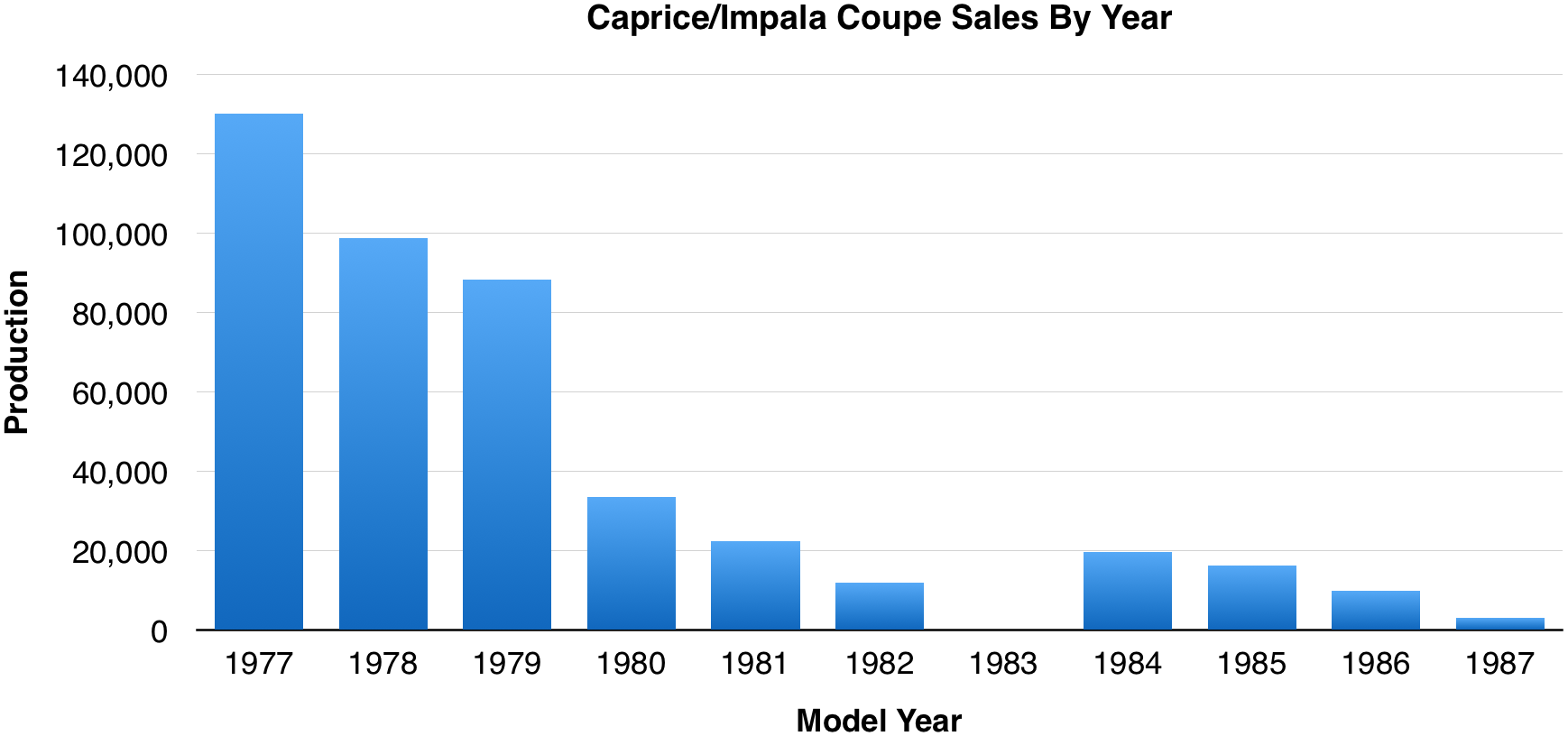
For somewhat unclear reasons, this was my most popular post on this blog for several years. Because of this, I updated it about five years ago to reflect both changes in my posting style and substantial improvements in available data.

“… the personal flair of a distinctive coupe.”

ChevroletCoupeSales

1987 was the final model year for Chevrolet’s Caprice Classic coupe, with only 3,110 made. Beginning in 1988, the Caprice would soldier on with just the sedan and wagon, as the once very popular big American coupes continued to lose favor.

The standard power team on the coupe (and sedan) was the LB4 140 bhp 4.3 liter/262 ci V6 with throttle-body fuel injection and a three-speed automatic transmission. Mileage was rated at 18 city/23 highway by the day’s standards (16/22 by modern measures).

Optional power was the LG4 165 bhp 5.0 liter/305 ci V8 with a four-barrel carburetor paired with a four-speed automatic transmission (I see what you did there, Chevrolet). In 1987, this combination was rated at 18 city/25 highway (16/23 by 2025 standards). With a large 25-gallon fuel tank, you could reasonably expect a comfortable range of about 440 to 480 miles with a 10% fuel reserve—impressive for a 3,600-pound full-size car back then. Even with the V8, these cars were not fast—0-60 came in about 10.5 seconds.

Coupe pages from the 1987 Chevrolet Caprice Classic brochure

Standard equipment for the $11,392 coupe (about $33,000 in today’s dollars) included power steering, power brakes, halogen headlights, and P205/75R15 all-season radial tires (a size still readily available) on 15-inch wheels. Inside, a full-width cloth bench seat, Quiet Sound Group, and an AM radio were standard.

Optional equipment included air conditioning ($775), cruise control ($175), power door locks ($145), power windows ($210), power seats ($240 each), power trunk opener ($50), a 50/50 split-front seat ($195), and AM/FM stereo cassette with graphic equalizer ($435).

Flights of Fancy

I have fun sometimes (often?) building a “unicorn” configuration for these old cars. When I was working at the local Chevrolet dealership in the mid-eighties, I dreamed up a Caprice S. Here’s what optional equipment it would have required, all still available in 1987:

  • F41 Sport Suspension (includes a rear stabilizer bar, 15-inch by 7-inch wheels, and sportier shock absorbers)
  • LG4 5.0 liter/305 ci V8
  • P225/70R-15 tires
  • Sport wheel covers
  • Limited slip differential
  • Performance axle ratio
  • Heavy-duty cooling
  • Dual power Sport mirrors
  • Special instrumentation/gauge package

So, a “John-configured” coupe would have listed for at least $15,096—real money in 1987 and about $43,700 in 2025 dollars. A desperate product planner might have tried to get the leather seats from the Brougham available in the Coupe and maybe scored some black wall tires, but that’s another story …

The View From 2025

Badge for 2,500 web hits

These big and (I think) handsome coupes occasionally appear in the Hemmings Motor News classifieds, on eBay Motors, and on Bring a Trailer. However, Hagerty’s valuation tools do not track Caprice Classic values between 1975 and 1991.

Make mine Silver Metallic, please, though I’m tempted by the Black/Medium Gray Metallic two-tone.

Other B-platform cars I have written about include the 1983 Chevrolet Caprice Classic sedan, the 1985 Chevrolet Caprice Classic station wagon, and the 1982 Oldsmobile Delta 88 Royale coupe.

Last updated April 2025.