In the spring of 2021, I had a major medical issue that involved lower back surgery. Close followers of this blog might have noticed the paucity of posts between late January and late May.
When I returned home from not one but two hospitals, one of the first things that came to mind was what to do with my 1985 Chevrolet Corvette coupe. With its hard-riding Z51 sport suspension and challenging entry/exit, this car is not for someone who has had back surgery—and I don’t believe in keeping cars around that we don’t drive.
After thinking about it for a while, I decided to auction my Corvette on Bring a Trailer at no reserve—there was nothing that would want me to keep the car. I chose Bring a Trailer in part because I wanted to reach a wide audience: I figured that my 1985’s Light Blue Metallic color was a love it or hate it deal, and I wanted potential bidders to be able to self-sort.
I filled out the vehicle submission form, and the next step was to get the car photographed. Bring a Trailer‘s assigned professional came out in mid-July on what must have been the hottest day of the summer. He took many both accurate and complimentary photos of the car.
In late August, the auction began. Like most Bring a Trailer auctions, it ran for slightly over a week. I was eager not to misrepresent the car but equally interested in putting its best face forward. This desire meant that I spent a lot of time in the comments section.
The 1985 leaves
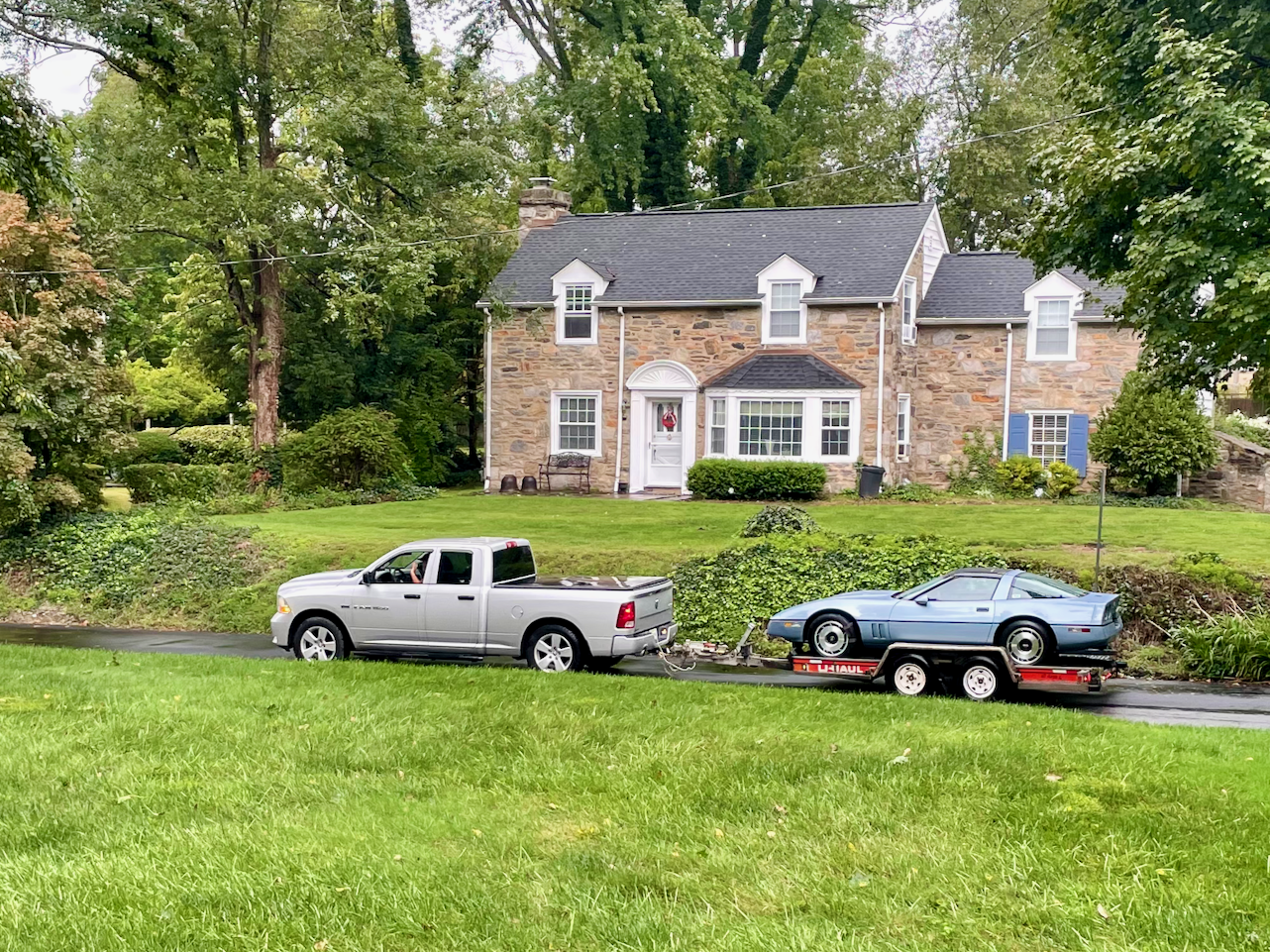
Three days after the auction ended, the winning buyer sent one of his employees out to pick up the car. He loaded the car onto an open trailer (very on-brand for the purchase venue) in the light rain. A few minutes later, he drove away, and my life with a 1985 Corvette ended.
I was sad to see the Corvette go, but not unhappy. My view is that the car owed us nothing—we enjoyed it for seventeen years and it was our ticket to many interesting experiences. I hope the new owner has as much fun with this C4 as we did.
For 1985, Chevrolet’s K5 Blazer SUV gained a new grille and the availability of a color-keyed top, but not many other changes.
The Blazer’s standard powertrain for everywhere but California was the LE9 160 bhp 5.0 liter/305 ci V8 with a four-barrel carburetor mated to a four-speed manual. Mileage was rated at 14 city/17 highway by the day’s standards (12/16 by today’s measures). With a 25-gallon gas tank, a Blazer owner could expect a range of 315 to 350 miles with a 10% fuel reserve. The heavy (4,846 pound) Blazer was not quick—0-60 took about 12.5 seconds.
Optional power included a $2,730 LH6 130 bhp 6.2 liter/379 ci diesel V8, which came with a four-speed automatic with overdrive. The diesel came bundled with many other features, including an engine block heater, a heavy-duty radiator, an engine oil cooler, and a dual exhaust system. Mileage for the diesel was rated at 17 city/21 highway.
1985 Chevrolet Blazer brochure cover
Designated as the Custom Deluxe, the base 1985 Blazer’s price was $11,223—about $34,100 in today’s dollars. Standard exterior equipment included a removable fiberglass top and Soft-Ray tinted glass. Mechanical equipment included variable-ratio power steering, power front disc/rear drum brakes, and P215/75R15 tires (a size still readily available) on 15 x 6 inch white painted wheels with bright metal hub caps. Inside, vinyl high back bucket seats and a heater were standard—the base Blazer was relatively spare inside.
Trim, Options, & Production Numbers
The $1,015 Silverado trim required Custom cloth or Custom vinyl seats and included Silverado nameplates inside and out, the Deluxe Front Appearance package, the Deluxe Molding package, bright body side moldings, dual horns, a color-keyed console, a cigarette lighter, an interior headliner, and a Custom steering wheel. The least expensive Blazer Silverado was about $37,200 in today’s dollars—almost exactly what a 2025 Blazer 2LT goes for.
Individual exterior and mechanical options included deep tinted glass ($194), halogen hi-beam headlamps ($17), a 31-gallon fuel tank ($43), and 15 x 7 cast aluminum wheels ($299). Inside, all-weather air conditioning ($740), electronic speed control ($195), power side windows ($190), a power tailgate window ($43), and power door locks ($135) were all available. Upholstery options included Custom vinyl high back bucket seats, Custom cloth high back bucket seats (available only with the Silverado trim), a second row bench seat ($369), and a Comfortilt steering wheel ($115). Seven different audio options were available, ranging from an AM radio ($112) up to an AM/FM stereo radio with a cassette player, electronic tune seek and scan, and a graphic equalizer ($594).
1985 ended up being the Blazer’s best sales year in the eighties, with 40,011 exiting dealer lots—up almost 2% over 1984’s total. This performance helped Chevrolet gain the lead in 1985 sales among manufacturers of light-duty trucks.
The View From 2025
Along with other eighties SUVS, Blazers are attracting significant collector interest. According to Hagerty’s valuation tools, all the money for a 1985 K5 Blazer Silverado in #1/Concours condition is $48,700, with a far more normal #3/Good condition version going for $23,900. Blazers are often available in the Hemmings Motor News classifieds, on eBay Motors, and on Bring a Trailer. As I write this post, a MidnightBlue 1985 Blazer with a Midnight Blue top and blue cloth front bucket seats is for sale on Hemmings, asking $47,500.
The big news for 1985’s Ford Bronco SUV was the November 1984 introduction of an Eddie Bauer edition, which became the new top-of-the-line. Of course, the full-size Bronco was not the first Ford to be “Bauerized”—that was actually the 1984 Ford Bronco II compact SUV.
Eddie Bauer Bronco page from the 1985 Bronco brochure
The Eddie Bauer Bronco went for $15,972—about $49,200 in today’s dollars, or about what a 2025 Bronco Badlands 2 Door goes for. Exterior features distinctive to the Eddie Bauer Bronco included a specific two-tone paint treatment, dual accent bodyside paint stripes, privacy glass for the quarter windows, and Deluxe argent styled steel wheels.
Interior equipment for Ford’s new special edition included air conditioning, speed control, a tilt steering wheel, Light Group, and an AM/FM stereo radio. Upholstery included reclining all-tan cloth front captains chairs with folding armrests and zippered pouches on the seatbacks, a matching rear bench seat, a floor console, and deep 16 oz color-keyed carpeting.
Powertrains, Performance, & Fuel Economy
The Bronco’s powertrain story was not simple in 1985. All Bronco equipment levels (base, XLT, and Eddie Bauer) came standard with the 120 bhp Big Six 4.9 liter/300 ci inline six with a one-barrel carburetor. The year started with two engine options, both versions of theWindsor 5.8 liter/351 ci V8. At $1,041 was a 150 bhp example with a two-barrel carburetor, while an H.O. version with a four-barrel carburetor put out 210 bhp and cost $1,418. Arriving at about the same time that the Eddie Bauer edition did was a Windsor 190 bhp 4.9 liter/302 ci V8 with fuel injection, which set buyers back $1,202.
A four-speed manual was standard with the six and the smaller V8, while an automatic was the standard and only transmission with both of the 5.8 liter engines. The six could be ordered with a four-speed manual with overdrive, while the 4.9 liter V8 could be had with an overdrive automatic.
Mileage ratings sharply separated the six from all the V8s. With the Big Six and the four-speed manual, a Bronco owner could expect 16 city/21 highway. That dropped to 13/17 with the 5.0 liter V8 and was even worse with the two 5.8 liter engines. Thus, the Bronco’s range with its 25-gallon gas tank and a 10% fuel reserve could vary from a high of 415 miles to a low of 260 miles. Of course, the V8s were noticeably quicker—about two to four seconds faster to 60 mph.
Base Equipment, Options, & Production Numbers
Standard exterior and mechanical equipment on all Broncos included halogen headlights, tinted glass, a heavy-duty radiator, variable-ratio power steering, power front disc/rear drum brakes, and P235/75R15 tires (a size still readily available) on 15-inch wheels. Inside, dome lights, a locking glove box, and a rear flip/fold bench seat were included.
Options for the well-equipped Eddie Bauer Bronco included heavy-duty shocks and springs ($155), a Traction-Lok limited slip rear axle ($238), power windows ($239), and an AM/FM stereo radio with a cassette tape player ($235).
Bronco sales were up a little over 10% to 52,316 for the 1985 model year, easily outselling the competing Chevrolet Blazer and Dodge Ramcharger. Sales of the eighties Bronco would peak in 1989, with 66,730 moved.
The View From 2025
Along with other eighties SUVS, Broncos are attracting significant collector interest. According to Hagerty’s valuation tools, all the money for a 1985 Eddie Bauer Bronco with the 5.8 liter H.O. V8 (the most prized engine) in #1/Concours condition is $50,000, with a far more normal #3/Good condition version going for $29,900. Eighties Broncos are often available in the Hemmings Motor News classifieds, on eBay Motors, and on Bring a Trailer.
“Once again Volkswagen brings a breath of fresh air to the automotive world.”
For the 1985 model year, Volkswagen changed the name of its Rabbit-based convertible in the United States from Rabbit Convertible to Cabriolet. One reason for the Cabriolet rename was likely its base price—at $11,595 (about $35,600 in today’s dollars) around 66% higher than the Golf hatchback coupe’s base price. Another driver was that the Cabriolet retained the Mk1 Rabbit as its basis, rather than joining the Mk2 hatchback coupes and sedans, which were new for 1985 in the United States. All Cabriolets were built by Karmann Coachworks, with most components supplied by Volkswagen, and all had a Karmann badge placed forward of both doors.
The Cabriolet’s standard powertrain was the JH 90 bhp 1.8 liter/109 ci inline four with Bosch K-Jetronic fuel injection paired with a five-speed manual transmission. An automatic transmission was available. Motor Week recorded a 0-60 time of 11.8 seconds with the five-speed in the approximately 2,275-pound Cabriolet.
Volkswagen’s Cabriolet brochure boasted that it was “perhaps the most efficient way to drive from one place to another with the wind in your hair.” This statement was likely correct in 1985; with the five-speed manual, fuel economy ratings by mid-eighties standards were 24 city/29 highway (21/26 by 2025 standards). With a 13.8-gallon gas tank, a Cabriolet owner could expect a range of between 290 and 330 miles with a 10% fuel reserve.
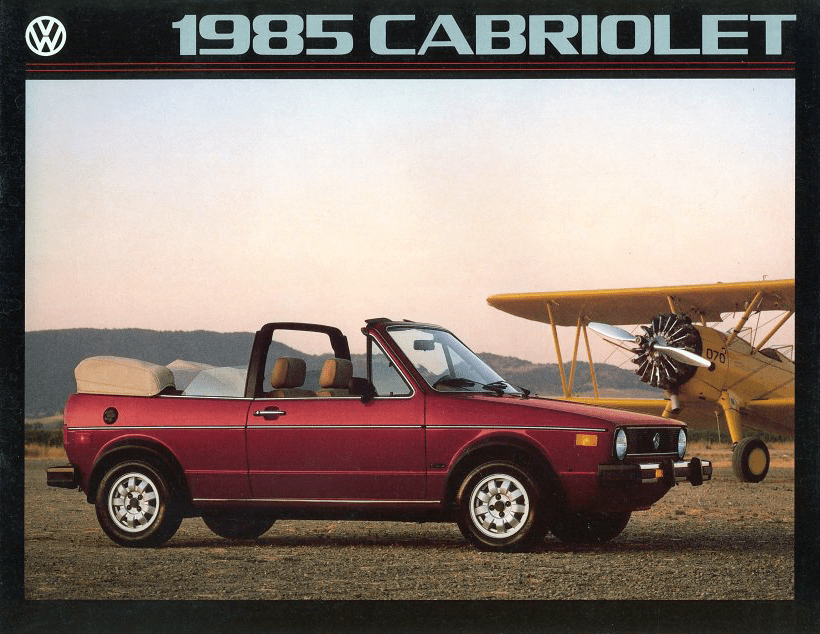
1985 Volkswagen Cabriolet brochure cover
Standard exterior equipment for the Cabriolet included an insulated three-layer convertible top with a heated glass rear window, a boot for the top, tinted glass, and remote-controlled mirrors. Mechanical equipment included front-wheel-drive, a sport suspension, rack-and-pinion steering, power ventilated front disc/rear drum brakes, and 175/70SR13 tires (a size still readily available) on 13-inch wheels. Inside, reclining front bucket seats, full instrumentation, and an electronic AM/FM stereo cassette with four speakers were included.
Options, Competition, & Production Numbers
Options were relatively few: metallic paint, white sidewall tires, 13-inch light-alloy wheels, power steering, cruise control ($200), air conditioning ($725), and cloth sports seats. The Triple White Bestseller package included Alpine White paint, a white convertible top, and white seats. Later in the model year, the usual Wolfsburg Edition promotion was available, with Flash Silver Clearcoat Metallic paint, 185/60HR14 steel-belted radial tires, 14-inch alloy wheels, power steering, a full leather interior, and sports seats.
The mid-priced four-seat convertible market for 1985—all in the $10,500 to $13,500 range—was suddenly rather crowded. In addition to the Volkswagen, potential convertible buyers could choose from the AMC Renault Alliance, the Chevrolet Cavalier/Pontiac Sunbird J-cars, the Chrysler LeBaron/Dodge 600 K-cars, the Ford Mustang/Mercury Capri Fox-bodies, and the Toyota Celica. Despite this various and varied competition, Volkswagen sold an impressive 12,637 Cabriolets in 1985.
In mid-2020, my ex-wife and I were out for a walk. As we headed down my town’s portion of the Lincoln Highway, we saw a glorious Iris Blue Metallic Porsche 911 Carrera Cabriolet with a dark blue top and blue leather seats. I, of course, neglected to take a photo.
“Driving in its most beautiful form.”
Not much was changed for 1985 for Porsche’s 911 Carrera Cabriolet—the fuel tank size increased from 21.1 to 22.5 gallons, and the pricey “Turbo Look” optional body style was extended from the coupe to the Targa and Cabriolet models. The Cabriolet entered its third year, having debuted in the final year of the 911 SC generation.
The Carrera continued with the 200 bhp 3.2 liter/193 ci flat six with Bosch Motronic fuel injection that had debuted in 1984. With the standard Getrag five-speed manual transmission, 0-60 mph came in about 6.3 seconds, with a claimed top speed of 146 mph in the 2,750-pound Carrera (the 2025 911 Carrera Cabriolet is over 3,500 pounds). Fuel mileage was 17 city/25 highway by the day’s standards (15/23 by today’s measures) with premium gas. With a 22.5-gallon gas tank, a 911 Carrera’s proud new owner could expect a range of between 385 and 425 miles with a 10% fuel reserve.
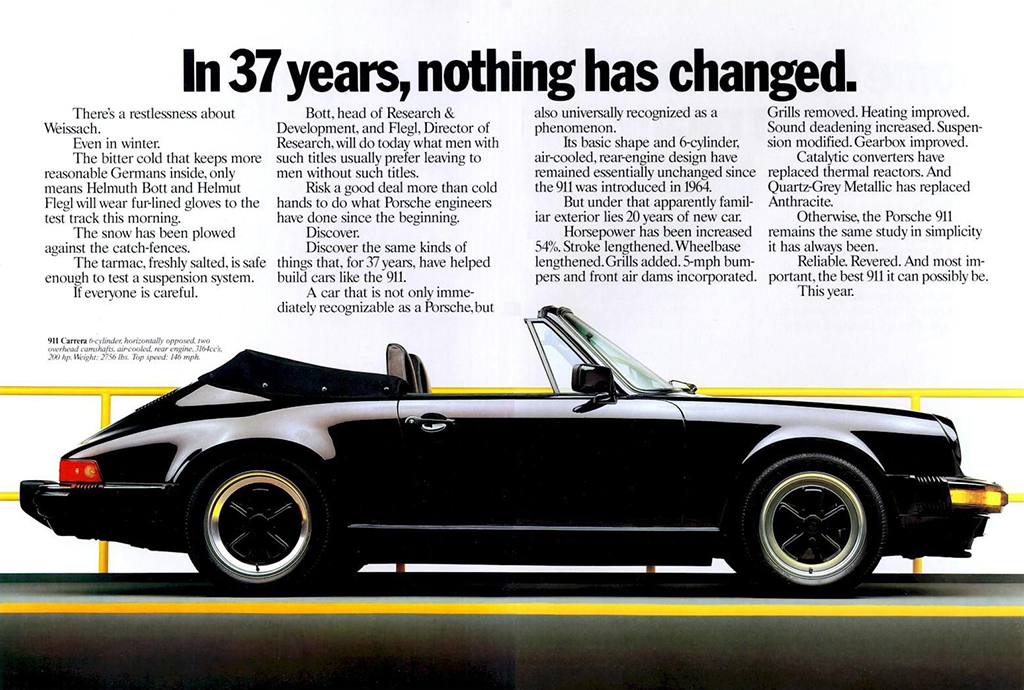
Porsche Carrera Cabriolet advertisement
For the 911 Carrera Cabriolet’s $36,450 base price (about $110,500 in 2025 dollars), exterior and mechanical equipment included tinted glass, halogen headlights, fog lights, and power four-wheel vented disc brakes. The front 185/70VR15 tires sat on 15 x 6 inch pressure-cast light alloy wheels, while the rear 215/60VR15 tires were mounted on 15 x 7 inch pressure-cast light alloy wheels (Pirelli still makes these tire sizes). Inside, heated power mirrors, power windows, air conditioning, and reclining bucket seats were all standard. A stereo was not included—Porsche evidently assumed that 911 buyers had their own ideas about what should be in that part of the dash—and Crutchfieldstill provides. Stuttgart did deign to provide four “high-quality” speakers, a fader control, interference suppression, and a power antenna.
Exterior and mechanical options for the Cabriolet included a color-coordinated tonneau cover, a limited slip differential ($595), front and rear spoilers, and 16-inch forged alloy wheels (6 inches wide in the front, 7 inches wide in the back—and setting the buyer back $1,580). Inside, options included automatic cruise control ($320), power door locks ($250), a passenger power seat ($380), an alarm system ($200), and a Blaupunkt Monterey digital cassette radio ($625).
The View From 2025
It’s little surprise that 911 Cabriolets from the 1980s have maintained their value quite well. According to Hagerty’s valuation tools, all the money for a 1985 Porsche 911 Carrera Cabriolet in #1/Concours condition is $95,000, with a more normal #3/Good condition car going for $42,000.
Porsche 911 Carrera Cabriolets have (of course) excellent club support from many sources and are often available in the Hemmings Motor News classifieds, on eBay Motors, and on Bring a Trailer. As I update this blog entry in April 2025, a Moss Green Metallic 1986 Cabriolet with black leather seats is for sale on Hemmings, asking $60,000.
Make mine the exact same color scheme we saw in 2020, please.
For Memorial Day 2020, here’s some truly large American iron.
I was working at the local Chevrolet dealership when a special-ordered Suburban Silverado came in with a 454. It was late in 1984—no passenger car was shipping with anything approaching a big block. But this C20 Suburban had a “rat motor” inside, and you could hear a distinct difference.
For 1985, Chevrolet changed little with the Suburban in the 13th model year of its seventh generation (Suburbans go back to 1935). There was a new grille, but that was about it other than minor trim changes.
The standard powertrain for the C20 Suburban was an LT9 160 bhp 5.7 liter/350 ci V8 with a four-barrel carburetor paired with a floor-mounted four-speed manual transmission. Engine options included an LH6 148 bhp 6.2 liter/379 ci diesel V8 and the aforementioned LE8 230 bhp 7.4 liter/454 ci V8 with a four-barrel carburetor (which required power steering and a heavy-duty battery and was a $700 option). A three-speed automatic was available for all three engines, while a four-speed automatic was for only the 350 ci engine.
The Suburban was a substantial vehicle for 1985, with a 129.5 inch wheelbase and 219.1 inches of overall length. With a 4,705-pound curb weight, C20 Suburbans had a gross vehicle weight rating of 8,600 pounds—high enough not to receive fuel economy ratings, which was likely a good thing. A standard 27-gallon fuel tank kept the range respectable, but filling it was painful to the wallet.
Standard equipment for the base C20 Suburban (which Chevrolet designated the Custom Deluxe) included power front disc/rear drum brakes, 16 x 6.5 inch wheels, a vinyl bench seat, and a heater and defogger. At $10,953, the C20 was approximately $32,200 in today’s dollars or about half of what a base 2025 Suburban costs—SUVs have moved substantially upmarket in the last 35 years. For most of the eighties, Chevrolet offered two upgraded trims:
Scottsdale trim ($459 for gasoline-engined Suburbans) included black body-side moldings, dual horns, two dome lamps, a cigarette lighter, and Scottsdale nameplates on the front fenders and instrument panel.
Silverado trim ($1,259 for gasoline-engined Suburbans) required Custom cloth or Custom vinyl seats. It included a Deluxe molding package, bright body-side moldings, Deluxe front appearance, dual horns, and Silverado nameplates on the front fenders. Inside, a cigarette lighter, a dome lamp, voltmeter, temperature, and oil pressure gages, and a Silverado nameplate on the instrument panel were included.
Options & Production Numbers
Beyond the trims, the 1985 Suburban’s options list was long and complicated. Suburban buyers first had to choose whether they wanted panel rear doors (standard) or a tailgate with manual drop glass ($36). Next came seating choices: front seat only, front seat and folding center seat, or front seat, folding center seat, and removable rear seat.
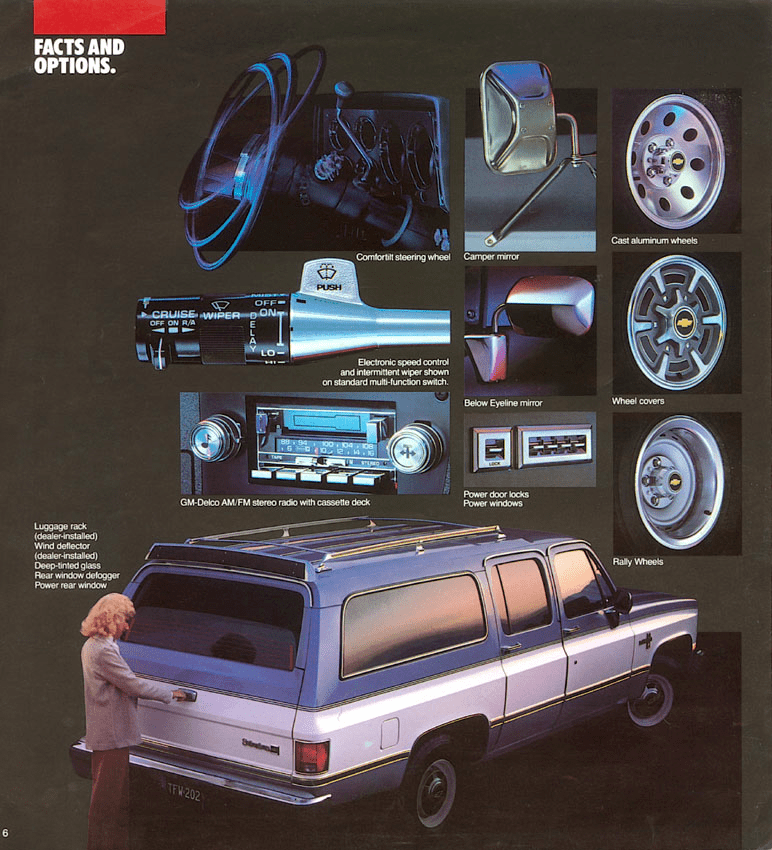
Options page from the 1985 Suburban brochure
Other exterior and mechanical options included deep tinted glass in two different configurations, halogen high beam headlamps, two optional gas tank sizes (31-gallon and 41-gallon), and a wide range of wheels and tires. Inside, air conditioning (front or front and rear), an electric rear window defogger, electronic speed control, power door locks, power windows, a quartz electric clock, Custom reclining bucket seats with a console, and a range of radios up to an AM/FM stereo with a cassette player were all available.
Chevrolet sold 64,470 Suburbans in the 1985 model year—many of them heavily optioned.
The View From 2025
These seventh-generation Suburbans have their fans. According to Hagerty’s valuation tools, all the money for a 1985 C20 Suburban Silverado in #1/Concours condition is $47,300, with a more typical #3/Good condition example going for $20,300. Suburbans frequently show up for sale in the Hemmings Motor News classifieds, on eBay Motors, and on Bring a Trailer. As I update this post in April 2025, a 1985 Indian Bronze MetallicSilverado with a Burgundy Custom cloth bench seat, a 5.7 liter/350 ci V8, an automatic, and 66,000 miles is available on Hemmings, asking $80,000.
Make mine Apple Red, with Saddle Tan Custom cloth reclining bucket seats, please—just like that 454 all those years ago.
One of my frequent readers once owned the Maxi-Cab version of the 1985 Chevrolet S-10 pickup truck. So, here you go.
“America’s ideal pickup.”
For 1985, Chevrolet offered seven distinct versions of the S-10 pickup truck, divided up by cab style (short, Maxi-Cab/extended cab, or chassis cab), engine (gas or diesel), and drive (2WD or 4WD). Beyond that, three of the versions offered a choice of a long or short box, which resulted in a different wheelbase.
Changes for 1985 were few, with the most significant news probably being improved corrosion protection. Also new was an updated version of GM’s “Iron Duke” inline four, which replaced 1984’s LQ2 2.0 liter inline four.
Only the absolute base truck (short cab, short wheelbase, gas, 2WD) came with the smallest engine, which was the Isuzu-built LR1 82 bhp 1.9 liter/119 ci inline four. That engine also was not available in California. Far more common—and standard on all gasoline configurations except the absolute base truck—was the LN8 “Iron Duke” 92 bhp 2.5 liter/151 ci inline four with throttle body fuel injection, which did have 31 more ft-lbs of torque than the smaller four. Optional “power” for all the gasoline trucks was the LR2 110 bhp 2.8 liter/173 ci V6 with a two-barrel carburetor. The single diesel available was the LQ7 62 bhp 2.2 liter/137 ci inline four, which could only be specified with 2WD.
All four engines came standard with a four-speed manual transmission. Every version but the chassis cab could upgrade to a five-speed manual, while all but the two diesel models could option a four-speed automatic.
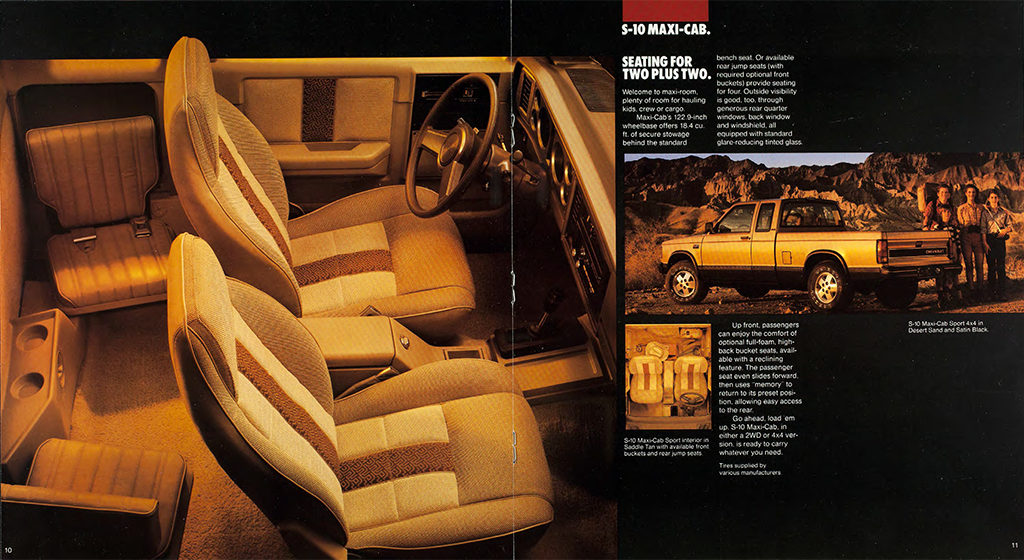
Maxi-Cab pages from the 1985 Chevrolet S-10 brochure
Standard equipment on the base $5,990 S-10 (about $18,500 in 2025 dollars) was pretty spare. Still, it included P195/75R14 all-season steel-belted radial tires on 14 x 6 inch painted argent wheels with bright metal hub caps, a color-keyed instrument panel, an upshift light, a locking stowage box, a full headliner, and a vinyl bench seat. At $7,167 (about $22,100 in today’s dollars), all Maxi-Cab S-10s included tinted glass, vacuum power brakes, and a dome lamp. 4WD versions of the Maxi-Cab included a front stabilizer bar and P195/75R15 tires on 15 x 6 inch wheels.
Options & Packages
Among the many exterior and mechanical options available for the Maxi-Cab were two different two-tone paint treatments, a sliding rear window ($107), a heavy-duty radiator ($53), and a 20-gallon fuel tank ($49). Inside, a tachometer, power windows ($190), power door locks ($135), electronic speed control ($195), air conditioning ($740), Custom vinyl high-back bucket seats, folding rear jump seats ($215), and an array of stereos were available.
In addition to individual options, there were also three equipment packages for the Maxi-Cab, which definitely made the S-10 ownership experience more comfortable.
The $334 Durango package included a black and chromed grille, black and chromed headlight bezels, a Deluxe chromed bumper with rub strip, wheel trim rings, reflecting lettering on the tailgate, and (of course) Durango nameplates on the front fenders. Inside, Durango purchasers received a side window defogger, a Deluxe vent system, a courtesy lamp, a stowage box and ashtray lamps, a headlamp warning buzzer, a cigar lighter, and a Durango nameplate on the stowage box door. Upholstery included a Deluxe color-keyed steering wheel, a color-keyed floor mat, a color-keyed jack cover, and either a Custom cloth/vinyl bench seat or a leather-grained Custom vinyl bench seat.
The $605 Tahoe package included everything in the Durango package. Additions and changes to the Durango package included a black grille, color-keyed door handle inserts, black body side and bright wheel opening moldings, a chromed taillight molding, and Tahoe nameplates on the front fenders. Inside, the Tahoe added a full instrument cluster with brushed metal trim, a right hand visor mirror, and a Tahoe nameplate on the stowage box door. Upholstery included color-keyed carpeting, two vinyl jump seats, and a choice of either leather-grained Custom vinyl bucket seats or dual-tone woven Custom cloth bucket seats. The Tahoe required either Special Custom or Custom trim.
Finally, the top-of-the-line Sport package ($868) included everything in the Tahoe package. Additions and changes included a black chrome grille and headlight bezels, two-tone paint, painted argent styled wheels, and Sport nameplates on the front fenders. Inside, the Sport included a color-keyed lockable center console and a Sport nameplate on the stowage box door. Upholstery included a color-keyed Sport steering wheel with a bright shroud, door trim panels with cloth inserts, and high back Sport cloth front bucket seats.
The View From 2025
S-10 pickup trucks from the eighties regularly appear in the Hemming’s Motor News classifieds and on eBay Motors, though many have been heavily modified (small block Chevrolet V8s are common). Bring a Trailer tends to have more stock examples.
Make mine Apple Red, please. If it’s got the Sport package, I’d like it with the Silver Metallic secondary color.
Much of the detailed information for this post—including any hope I had of getting the options packages correct—comes courtesy of the GM Heritage Center. I’ve also written about the 1983 Chevrolet S-10 Blazer SUV.
In this post, we’re once again revisiting interesting versions of mass-market eighties vehicles that just about nobody bought. This one is a sporty version of Oldsmobile’s J platform entry.
“A sporty way to tame the open road.”
For 1985, Oldsmobile offered three different Firenza body styles: a three-door hatchback coupe, a four-door sedan, and a five-door wagon. Both the hatchback coupe and the sedan had sporty versions: in the case of the hatchback, it was the GT, while for the sedan, it was the ES. I am going to write about the ES in this post.
The Firenza’s standard powertrain was an 88 bhp LQ5 2.0 liter/121 ci inline four with throttle-body fuel injection paired with a four-speed manual transmission. Engine options included a $50 84 bhp LH8 1.8 liter/110 ci inline OHC four with the throttle-body fuel injection and a far more interesting $560 130 bhp LB6 2.8 liter V6 with multi-port fuel injection. Transmission options included a $75 five-speed manual (available for the LH8 only) and a $425 three-speed automatic (available for all three engines).
Standard equipment exterior and mechanical equipment on all Firenzas included front-wheel-drive, rack and pinion steering, and P175/80R13 blackwall tires on 13-inch wheels. Inside, contour-reclining bucket seats and an AM push-button radio with two front speakers and a fixed mast antenna were included. With a base price of $7,679 (about $23,300 in 2025 dollars), Firenza sedans added Deluxe wheel discs and a Deluxe steering wheel.
Firenza ES page from a 1985 Oldsmobile brochure
Standard exterior equipment on the ES sedan included amber turn signals, a Firenza ES nameplate on the front fenders, and blacked-out trim all around. Mechanical equipment included the 1.8 liter inline four, a five-speed manual transmission, tungsten halogen high-beam headlamps, a firm ride and handling package, and Goodyear Eagle GT P205/60R14 blackwall tires (a size still readily available, though generally not from major manufacturers) on 14-inch wheels with Deluxe styled wheel discs.
Inside, a leather-wrapped steering wheel and a Rallye instrument panel cluster were included. Only three exterior colors were available for the ES: Silver Metallic, Light Teal Blue Metallic, and Carmine Red.
Options & Production Numbers
Among the many exterior and mechanical options available for the ES were Soft-Ray tinted glass, a Vista-Vent glass-panel sunroof ($310), and two-tone paint. Inside, Oldsmobile offered a Four-Season air conditioner, power door locks, and a choice of three optional radios. A special contoured hood was added if the V6 was selected.
For Oldsmobile in 1985, the Firenza was emphatically not the center of the product line, with every other model—all of them at least somewhat larger—selling better. Of the Firenzas that sold, the vast majority were base sedans, not the GT hatchback coupe (498 sold) or the ES sedan (863 sold).
1985 was the final year for the Ferrari 308 (the 328 would follow in 1986). Ferrari’s least expensive two-seater was also overshadowed in the public view by the release of its big brother Testarossa.
The engine was Ferrari’s Tipo F105AB 2.9 liter/179 ci V8 with Bosch K-Jetronic fuel injection and four valves per cylinder (thus Quattrovalvole), making 230 bhp and mated to a five-speed manual transmission. In the 3,200 pound GTB, this was good for period 0-60 times of under 7 seconds. Mileage was pretty awful compared to some of the 308’s fuel-injected competition—10 city/16 highway by the day’s standards (9/15 by today’s standards). With an 18.5-gallon gas tank, 308 owners could expect a chastening 200 to 215 mile range with a 10% fuel reserve.
Ferrari 308 GTB Quattrovalvole, courtesy of Ferrari
Standard exterior and mechanical equipment on the $54,000 GTB (about $134,000 in 2020 dollars) included four-wheel disc brakes, rack and pinion steering, and 16-inch alloy wheels. Inside, leather bucket seats, power windows, tinted glass, and a heated rear window were all included. Available options included metallic paint, a deep front spoiler, a satin black finished aerofoil at the rear of the roof, 16 x 8 inch Speedline wheels with Pirelli P7 tires, air conditioning, and cloth seat centers.
The lovely Pininfarina styling that first appeared in 1975 had aged well with relatively few changes. Debuting for the 1983 model year, the Quattrovalvole could be differentiated from previous 308s by the addition of a slim black louvered panel on the hood to aid radiator exhaust air exit and a redesigned radiator grille with rectangular driving lights on each side. Also new were power-operated side mirrors carrying small enamel Ferrari badges and rectangular side repeaters. The interior also received some minor updates, such as a satin black three-spoke steering wheel with a triangular center.
The View From 2025
Values for the 308 have gone up and down over the last decade. According to Hagerty’s valuation tools, all the money for a 1985 Ferrari 308 GTB Quattrovalvole in #1/Concours condition is currently an astounding $234,000, with the targa-top GTS in the same condition getting $174,000 (the GTB is far rarer, at about 20% of overall Quattrovalvole production). Prices drop significantly for more normal #3/Good condition cars—$128,000 for a GTB and $108,000 for a GTS. Ferrari 308s frequently appear for sale in the Hemmings Motor News classifieds, on Bring a Trailer, and at in-person auctions.
Make mine RossoCorso, of course. Is there really a question?
“For the North American continent the Merkur XR4Ti represents an innovative, new total performance machine.”
The Merkur XR4Ti never had a chance.
There, I’ve said it. Though the redoubtable Bob Lutz was involved, I can’t even imagine the combination of decisions that made Ford think that selling a Karmann-assembled version of the European Ford Sierra at Lincoln-Mercury dealers in the mid-1980s was ever going to work out. By early 1989, the XR4Ti was gone.
Because the Cologne 2.8 liter V6 the Sierra used in Germany could not clear US emissions, the engine the XR4Ti received was Ford’s Lima 2.3 liter/140 ci turbocharged and fuel-injected inline four also seen in the Ford Mustang SVO and Ford Thunderbird Turbo Coupe. In its Merkur guise, it made 175 bhp with the standard five-speed manual transmission and 145 bhp (ouch!) with the optional ($427) three-speed automatic transmission. Car and Driver recorded a 0-60 time of 7.0 seconds flat and a top speed of 129 mph with the manual. Fuel economy wasn’t particularly good: with the manual, it was 19 city/24 highway by the day’s standards (17/22 by today’s measures). With a 15.1-gallon gas tank, a Merkur owner could expect a range of 265 to 290 miles with a 10% fuel reserve.
1985 Merkur print advertisement.
Base price for the 1985 XR4Ti was $16,361 (about $50,200 in 2025 dollars). Standard exterior and mechanical features included integrated halogen headlamps, tinted glass, power-assisted front disc/rear drum brakes, nitrogen pressurized shock absorbers, variable-ratio power-assisted rack-and-pinion steering, and Pirelli P6 195/60HR14 steel-belted radial tires (a size still readily available) fitted on 14-inch cast aluminum-alloy “phone dial” wheels. Inside, standard equipment included Oxford cloth front bucket seats with infinitely variable manual reclining seatbacks, a 60/40 folding rear seat, air conditioning, dual power outside rear-view mirrors, and an electronic AM/FM stereo cassette radio with four speakers. The famous (and polarizing) biplane rear spoiler was derived from the one on the Probe III concept car Ford had shown in 1981.
Convenience Group & A Few Individual Options
A $470 Convenience group was available, which included power central door locking, power windows, and speed control.
Individual options other than the automatic transmission were relatively few: metallic paint ($274), a tilt/slide moonroof ($549), leather seats ($890), heated front bucket seats ($183), and a fuel mileage computer.
Period Reviews & Production Numbers
The XR4Ti received general approval from the automotive press. Motor Trend called it “Lincoln-Mercury’s Antidote for the BMW Syndrome.” Writing in Car and Driver, Brock Yates predicted that the Merkur would “pile into the upscale sports sedan market like a runaway freight train.”
Of course, this didn’t happen. Production numbers by model year are not easily available, but Karmann built a total of 45,368 XR4Tis over five calendar years. Ford had hoped to sell 16,000 to 20,000 a year.
The View From 2025
According to Hagerty’s valuation tools, a 1985 Merkur XR4Ti in #1/Concours condition is $15,300, with a more normal #3/Good car going for $7,900. I find it interesting that Hagerty tracks them at all—there are many that I think of as equally interesting cars that they don’t track. You rarely see them for sale in the Hemming’s Motor News classifieds or eBay Motors—they are at least a little more common on Bring a Trailer.
Make mine Paris Blue Metallic with the optional Gray leather interior, please. The real question is how many are left.
I really should write about the Scorpio hatchback sedan someday.






 Eighties Cars