Along with the other X-cars, the Buick Skylark was all new for 1980. Only the model name was carried over as the Skylark moved from rear-wheel-drive to front-wheel-drive and downsized yet again, losing about a foot and a half in overall length.
The Skylark name was a long-running and important one to Buick. 1953’s gorgeous limited production Roadmaster Skylark convertible was followed by the smaller Century-based Skylark convertible in 1954. In the middle of the 1961 model year, the Skylark name was reintroduced as a luxury trim of the Special compact. For 1962, the Skylark became its own model. By 1964, the Skylark had become its own model line and had moved to an intermediate size. The intermediate rear wheel drive Skylark would continue for three generations (with one slight interruption in 1973-74).
Like with every other 1980 X-car, the Skylark’s standard engine was GM’s Iron Duke 90 bhp 2.5 liter/151 ci inline four with a Rochester Varajet II two-barrel carburetor, paired with a four-speed manual transmission. Fuel economy was 24 city/38 highway by the day’s standards (21/34 by today’s measures). With a 14-gallon gas tank, a Skylark’s driver could expect a range of 350 to 390 miles with a 10% fuel reserve. 0-60 times for the Iron Duke are hard to find, but were likely around 16 seconds for the four-speed manual transmission and probably about 19 seconds (oog) with the optional ($337) three-speed automatic transmission.
Spending $225 to upgrade to the LE2 2.8 liter/173 ci V6 with a Rochester Varajet II two-barrel carburetor got you 115 bhp and a 0-60 time of a little over 13 seconds. Fuel economy dropped substantially to 20 city/28 highway with the four-speed manual transmission. Moving to the three-speed automatic transmission dropped highway mileage to 27 mpg.
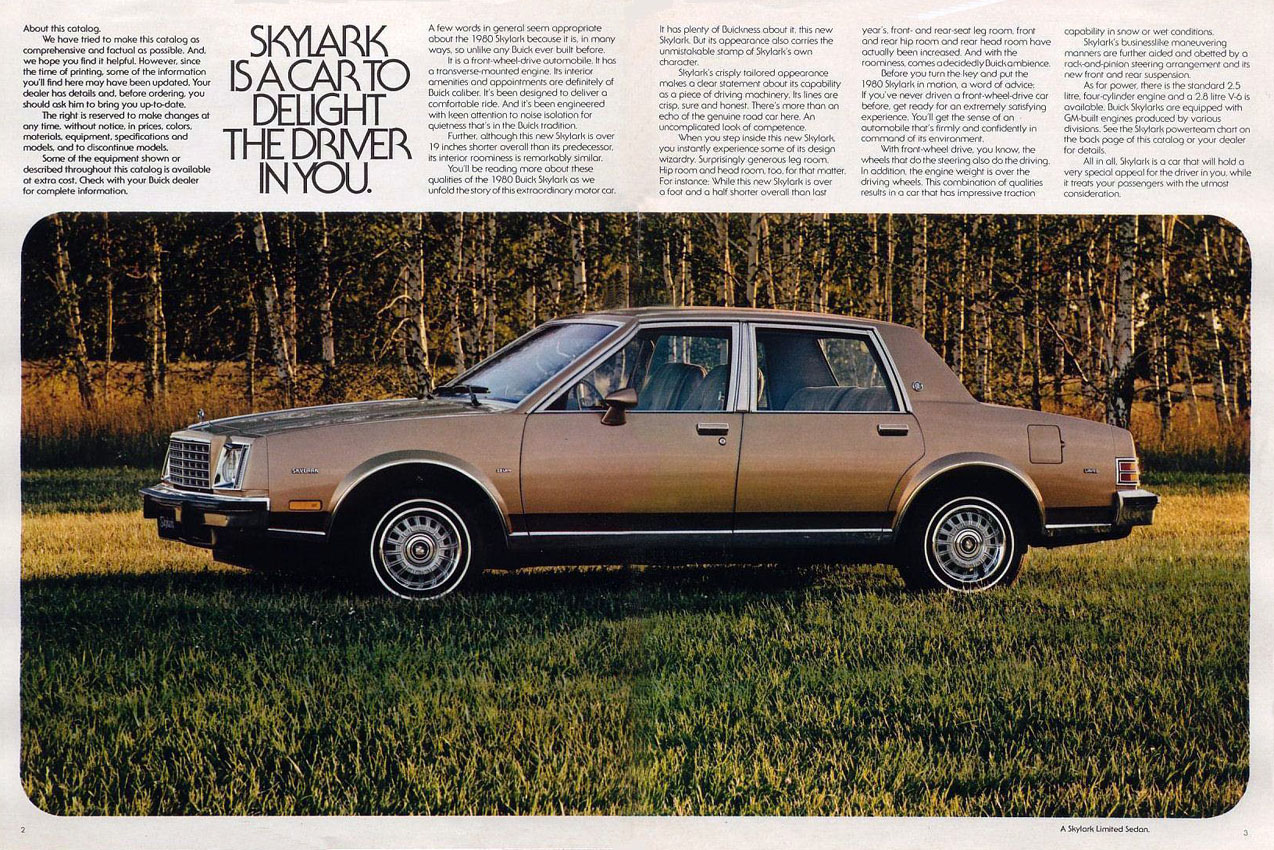
Sedan pages from the 1980 Buick Skylark brochure
Standard exterior and mechanical equipment on the $5,306 Buick Skylark sedan included front-wheel-drive, rack-and-pinion steering, front disc/rear drum brakes, and P185/80R13 fiberglass-belted radial-ply tires (a size now only marginally available) on 13-inch wheels. Inside, buyers got a no-cost choice of either a houndstooth cloth or a vinyl notchback front bench seat. A Delco AM radio with two front speakers and a windshield antenna was also included.
The $5,726 Skylark Limited included a distinctive hood ornament, wide rocker and wheel opening moldings, Deluxe wheel covers, and a gas strut under the hood. Inside, a choice of a Limited level brushed woven cloth or a vinyl notch back seat with a fold-down center armrest, door entry courtesy lights, a simulated wood grain instrument panel, a special acoustic insulation package, and a plush carpeted back window panel were present. Limited identification was, of course, included.
The $5,920 Skylark Sport Sedan included a specially styled grille, amber front park and turn lamps, front and rear bumper strips, black moldings, wheel opening moldings, Sport mirrors, smoked tail lamp lenses, a Rallye ride-and-handling package system, a larger rear stabilizer bar, and P205/70R-13 steel-belted radial-ply blackwall tires on Designers’ Sport wheels. Inside, the Sport Sedan included a Sport steering wheel and a black instrument panel with a voltmeter, a temperature gage, and a trip odometer.
Options & Production Numbers
The Skylark’s options list gives you a sense that Buick was trying to serve two masters. The base prices were affordable, but you could load the Skylark sedan up with thousands of dollars’ worth of options, bringing it close to a Century or a LeSabre.
Individual exterior and mechanical options for the Skylark included the Designers’ Accent paint treatment ($174), a Landau top, a long vinyl top, a Vista-Vent flip-open glass sunroof ($240), power steering ($164), power brakes ($76), and chrome-plated road wheels ($141). Inside, front bucket seats ($48), a 6-way power seat ($165), a full-length operating console, Cruise-Master speed control ($105), a tilt steering column ($75), air conditioning ($564), power windows ($189), and electric door locks ($123) were available.
Four Delco radios ranging up to an AM/FM stereo with a cassette tape player and a CB ($491) were available. Lower body sport stripes with a Hawk decal were available only for the Skylark Sports versions.
Buick sold 80,940 base Skylark sedans in the 1980 model year. Combined Limited and Sports Sedan sales totalled 86,948, with the vast majority being the Limited. The Skylark was 26% of Buick’s total production in 1980.
Despite an astoundingnine recalls for the 1980 version, the Skylark’s yearly sales percentage declines were notably less than those of other X cars—by 1983, Buick was actually selling more Skylarks than Chevrolet was selling Citations. The fifth-generation Skylark sedan, which Buick called its “little limousine,” would continue through the 1985 model year and end up selling 729,523 copies over six model years.
The seventh-generation Riviera debuted on November 14th, 1985. For a third and final time, Buick downsized the Riviera—this time to a 108-inch wheelbase and a 187.2-inch overall length. The size reduction (more than 19 inches shorter) made this generation the smallest and lightest of all Rivieras. Among the planning assumptions for the seventh generation model and its Eldorado and Toronado platform-mates was that gasoline would cost approximately $3.00 a gallon upon debut. Instead, fuel was going for around $1.19 when the three prestige coupes entered the market in late 1985.
In part because of the assumptions mentioned previously, there were no more V8s for the Riviera—from 1986 forward, the Riviera that had been V8 only until 1979 would now be V6 only. Also gone forever was the diesel V8, almost certainly less missed by buyers than the gasoline versions. Production moved to a brand new plant in Hamtramck, MI. Finally, the Riviera was also back to being coupe-only—the four-year experiment with the glamorous, attention-getting, and pricey convertibles was no more.
After many years that had some (sometimes many) choices, the only available powertrain for 1986 was the LG2 “3800” 140 bhp 3.8 liter/231 ci V6 with sequential fuel injection paired with a Turbo Hydramatic 440-T4 automatic transmission with overdrive. The LG2 was a version of the previous generation Riviera’s LD5 modified for transverse front-wheel-drive usage and was first seen as an option in the 1984 versions of the Buick Century and the Oldsmobile Cutlass Ciera. Though it was “just” a V6, the LG2 had the same power rating as the 1985’s base V8, making the substantially lighter “civilian” 1986 Riviera quicker than its 1985 equivalent. The 0-60 time was about 10 seconds, making the Riviera quite competitive in class.
Fuel mileage for the new Riviera was 19 city/30 highway by the day’s standards. With an 18.0-gallon fuel tank, the driver of a 1986 Riviera could reasonably expect a range of 370 to 415 miles with a 10% fuel reserve. This impressive range put paid to the reputation of Rivieras of years past, who were often said to “pass anything but a gas station”—and sometimes had about 200 miles between fill-ups. The 1986 ended up with among the longest ranges of any Riviera, despite having a smaller fuel tank than most.
Along with its downsizing, powertrain, and configuration revisions, a change also came to the Riviera’s styling brief. Buick described the seventh-generation exterior as a “gentle wedge form” and paid far more attention to aerodynamics than with any previous generation (more advanced technology made these objectives more easily attainable). Led by William Porter, the division settled on its new Riviera look quickly—the final design for the new generation was recognizable even in renderings done many years earlier, in late 1980.
As might be expected with the far lighter weight (the Riv shed more than 500 pounds) and smaller engine, fuel economy was better than any Riviera before—or after. Perhaps more surprisingly, the available interior room was quite close to that of the sixth-generation cars, a sign of careful and skilled packaging design.
For the first time in its history, the presumed differentiator for a new generation of Rivieras was inside the car—not its exterior design. The Graphic Control Center included seven to ten microprocessors (depending on the particular options ordered) and a 3 x 4 inch touch-sensitive cathode-ray tube screen. This component was bleeding edge for publicly available technology in the mid-1980s and certainly not inexpensive to produce—dealer cost for a replacement unit was said to be over $2,000. The Graphic Control Center was also easily a quarter of a century ahead of its time—probably not the right choice for the average Riviera customer.
Designed by Delco Electronics over several years with assistance from Buick engineers, the Graphic Control Center was prototyped in one hundred 1984 and 1985 Rivieras. In production form, it included diagnostic displays, a trip monitor, retained accessory power, and controls for the electronic air conditioning and sound system. Touching gauges brought up additional information, including a tachometer along with battery and coolant gauges.
The Graphic Control Center was heavily promoted in both the press and Buick’s sales materials—the 24-page 1986 Riviera brochure devoted its first four inside pages to it. At the time, Buick’s chief engineer, Dave Sharpe, told Popular Mechanics that the new Riviera targeted America’s young “technotypes.” From over a third of a century away, it’s quite unclear who he was talking about.
The 1986 Riviera had many new standard features: four-wheel power disc brakes were finally included on every example after having been an option for almost a decade. Another item newly standard on the seventh-generation Riviera was tungsten-halogen headlamps—first seen on a Riviera in the 1972Silver Arrow III concept car and optional on production Rivieras since 1981. So was a high-mounted stop lamp—federally mandated for all 1986 automobiles and a faint echo of the fourth-generation Rivieras.
Every one of the 15 exterior colors was also new—even the Riviera’s black and white color formulations (both of which had been constant for at least a decade) did not carry over from 1985. The Riviera’s four Firemist colors were shared with Cadillac and Oldsmobile—but not with other Buicks as had been true in the fifth-generation cars.
Flies In The Ointment
From a marketing perspective, the 1986 Riviera was more than a foot shorter than that year’s Buick Regal coupe—whose base price of $10,654 was $9,177 less than the $19,831 that the supposedly senior coupe went for. A persistent rumor stated that Buick dealers were told not to place the Riviera too close to the similar-looking but even less expensive Somerset Regal coupe, which had been on their showroom floors since the beginning of the 1985 model year. As early as September 1985, Popular Mechanics pointedly queried, “why make an expensive car look like a cheaper model?”
As if that wasn’t enough, the Riviera’s size was also quite close to that of the LeSabre—traditionally the largest coupe in the Buick family, and now also front wheel drive. It also probably did not help that 1986 Riviera prices were up almost 16% over the 1985 version, even when accounting for inflation.
Due to these and other contributing factors, Riviera sales collapsed, declining 66% to 22,138—a painful state of affairs for General Motors, which the Riviera shared with its Eldorado (off 72%) and Toronado (down 62%) stablemates. Six years later, GM had now managed to duplicate the carnage that Ford had experienced with its 1980 downsizing. Notably, Ford Thunderbird, Lincoln Mark VII (the Continental name departed that year), and Mercury Cougar sales were all up for 1986, along with those of some of GM’s “junior” personal luxury coupes. The December 1987 issue of Special Interest Autos simply called it “the E-body disaster” and speculated that it was costing GM half a billion dollars a year in lost profits.
It seems clear that General Motors had utterly misjudged what the appeal of its new prestige coupe platform was to folks who might actually consider buying it. One can only wonder how many hundreds of thousands of future vehicle sales were lost as the revised E-body offerings for 1986 got buyers permanently out of the habit of buying big personal luxury coupes—what only one year prior had been over 181,000 high-profit sales. To add to the pain, a short but memorable star turn by a Riviera in the 1986 Arnold Schwarzenegger vehicle Raw Deal featured a sixth-generation convertible—not a seventh-generation coupe.
Pages from the 1986 Buick Riviera brochure
The relatively few folks who did purchase a 1986 Riviera got a well-equipped car by mid-eighties standards. Standard exterior equipment included Soft-Ray tinted glass, cornering lamps, and an automatic power antenna. Mechanical equipment included power steering, a DynaRide four-wheel independent suspension with automatic level control, and 205/70R14 all-season whitewall tires on 14-inch wheels with Deluxe wheel covers. Inside, standard features included Electric Speed Control cruise control, a tilt steering column, a Limited steering wheel with cruise-control switches, electric door locks, and a Delco ETR AM-FM stereo with seek and scan, a clock, and four extended-range speakers. Interior trim and upholstery featured a full-length console with a floor shift, manual reclining cloth front bucket seats, and a six-way power driver’s seat.
One Package & Individual Options
The sporty T Type package (at $21,577, an additional $1,746 over the base Riviera) carried over its designation from the previous generation but lost its differentiating turbocharged V6—making it no quicker than any other Riviera. It did at least handle better than the average Riviera—the T Type’s 1986 guise included a Gran Touring suspension and P215/60R15 Goodyear Eagle GT blackwall tires on 15-inch aluminum wheels. T Type’s were only available with Flame Red, White, Silver Metallic, or Black exterior paint, and all featured gray lower accent paint. Inside, every T Type included a leather-wrapped steering wheel with cruise control switches and the heavily-hyped Power Comfort six-way power bucket seats for driver and front passenger—with reversible cloth and leather center sections that attached with velcro. The Power Comfort seats included inflatable lumbar supports, electrically adjustable headrests, and double pivoting systems for the lower seatback. A little over 9% of Riviera buyers took home a T Type in 1986.
In addition to all that was newly standard, new options for 1986 included a keyless entry system (available mid-year), a heated outside drivers mirror, and the availability of lumbar support with the optional seats. The radio delete option no longer existed—every Riviera buyer was driving home for the dealership with some kind of factory radio. The number of options in 1986 was reduced to less than one-third of what it had been in 1985, as Buick worked aggressively to reduce build complexity—but removed much of the path to a truly personal Riviera.
The View From 2025
With the excellent support of the Riviera Owners Association, a few folks are collecting these early seventh-generation Rivieras. According to Hagerty’s valuation tools, a base 1986 Buick Riviera in #1/Concours condition is $15,500, with a more normal #3/Good condition car going for $7,600. Rivieras of this generation sometimes show up in the Hemming’s Motor News classifieds, on eBay Motors, and on Bring a Trailer.
Make mine Black Cherry Metallic, please. I know that means that the 1986 Riviera I want won’t be a T Type.
The 1989 model year brought the first significant changes to the exterior of the seventh-generation Riviera. The wheelbase and other hard points could not be easily or inexpensively modified, but Buick did extend the rear portion of the body by 11 inches. One version of that year’s brochure (which came with what must have seemed hip floppy discs) claimed that it was “noticeably longer,” while another stated that it was “reminiscent of classic Rivieras.” In the real world, there was no denying that the restyled exterior effectively called back to the suddenly beloved sixth generation. This was a strange symmetry, as Bill Mitchell passed in September 1988.
1989 Buick Riviera press release photo
Various other components also scaled up along with the body; the Riviera moved up to P205/70R15 tires on 15-inch wheels. The roofline had a wider sail panel, and side trim and rocker moldings were modified. New standard equipment included a driver’s side airbag (returning to the Riviera almost a quarter-century later than those first airbags), a leather-wrapped steering wheel, and a leather-wrapped shift handle.
Making all these changes only three years into the sixth generation Riviera’s life cycle marked a significant and unexpected effort, which was led by Anthony Derhake, vehicle chief engineer for the Riviera. What remained of the domestic personal luxury coupe market responded well—Riviera sales increased 146% (!) to 21,189, likely making Buick’s restyling and re-imagining well worth all that effort. Of course, those upgrades didn’t come free; the Riviera’s base price was up over 4% to $22,540 (about $60,300 in today’s dollars).
Amongst all this change, there was also a significant minus for folks who liked choices in their Rivieras: the T Type was no longer available. After eight years (ten if one counts the S Type), Buick essentially gave up on the idea of a specifically branded sporty Riviera for a second time. A $104 Gran Touring package featuring much of the performance-related equipment from the now-retired T-Type remained available.
Many of the changes for 1989 didn’t help Buick in its eternal goal—which continues to this day—of reaching more youthful buyers. Although temporarily successful, the move to more traditional styling was a complete abdication of the hopes for the Riviera that the division had articulated only three years prior.
One thing that didn’t change significantly for the 1989’s exterior was the colors. Eleven of the thirteen available colors remained precisely the same. The only exceptions were Sterling Silver (which changed its formulation but not its name) and a brand new extra-cost Pearlescent Diamond White offering.
Standard exterior equipment for the 1989 Riviera included Soft-Ray tinted glass, tungsten-halogen headlamps, coach lamps, an electric rear window defogger, and a power antenna. Mechanical equipment included four-wheel power disc brakes, power steering, a Dynaride four-wheel independent suspension with automatic level control, and P205/70R15 tires on 15-inch wheels with custom locking wire wheelcovers.
Inside, standard equipment included the Electronic Control Center, Electronic Touch Climate Control air conditioning, a tilt steering column, Electric Speed Control, and electric door locks. Interior trim and upholstery featured manual reclining cloth front bucket seats with an easy-entry passenger feature, a six-way power driver’s seat, and an operating console. An ETR AM/FM stereo radio with seek and scan, clock, and cassette tape player with auto-reverse, search/repeat, and Concert Sound speakers was standard.
The only available powertrain continued to be the LN3“3800” 165 bhp 3.8 liter/231 ci V6 with sequential fuel injection paired with a Turbo Hydramatic 440-T4 automatic transmission with overdrive. Fuel mileage ratings were 19 city/28 highway, with the highway number off one gallon from 1988 as the refreshed Riviera gained about 75 pounds along with its added length. The 1989 Riviera’s 0-60 mph time was once again a “respectable” 10 seconds due to its increased weight.
Options & Period Reviews
Exterior and mechanical options included an electric sliding Astroroof ($1,230), a Landau top ($695), and an anti-lock brake system ($925). Inside, you could get a 16-way adjustable driver’s bucket seat ($1,230) and a cellular telephone installed in the console armrest ($1,975). Buick offered two optional stereos, with the top-of-the-line being the Delco GM/Bose Gold Series Music System ($783), which included an ETR AM stereo-FM stereo radio with seek and scan, a clock, and a cassette tape player with Dolby noise reduction, auto-reverse, and search/repeat.
A new option for 1989 was the Remote Radio Keyless Entry System, which included automatic electric door locks. Pearlescent Diamond White paint ($210) also became available—an extra-cost three-stage paint option that wasn’t a Firemist paint but had the same price.
The $104 Gran Touring package included the Gran Touring suspension, a 2.97 performance axle ratio, fast-ratio power steering, and P215/60R15 Goodyear Eagle (Buick remained with Goodyear for tires for many years, but kept changing the specific fitment) blackwall tires on 15-inch aluminum wheels.
Along with the undeniable interest from potential owners, the 1989 exterior redesign also attracted at least some attention from the automotive press. Popular Mechanics stated that it was a “radical restyling” that counter-intuitively returned the Riviera “to the look of the past.”
The View From 2025
With the excellent support of the Riviera Owners Association, folks are collecting these late seventh-generation Rivieras. According to Hagerty’s valuation tools, a 1989 Buick Riviera in #1/Concours condition is $16,900, with a more normal #3/Good condition car going for $9,100.
Please make mine the extra-cost (but still gorgeous) Sapphire Blue Firemist.
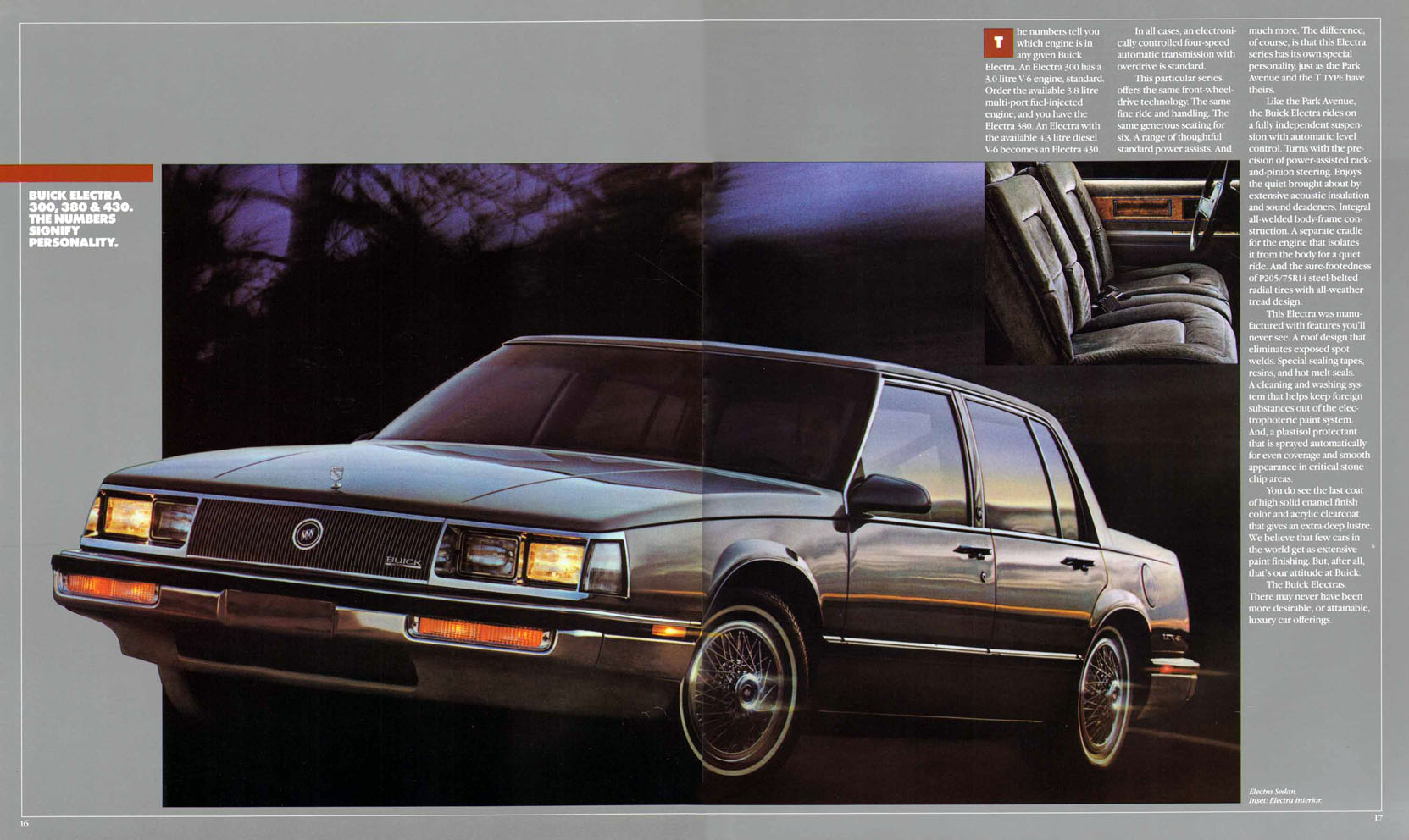
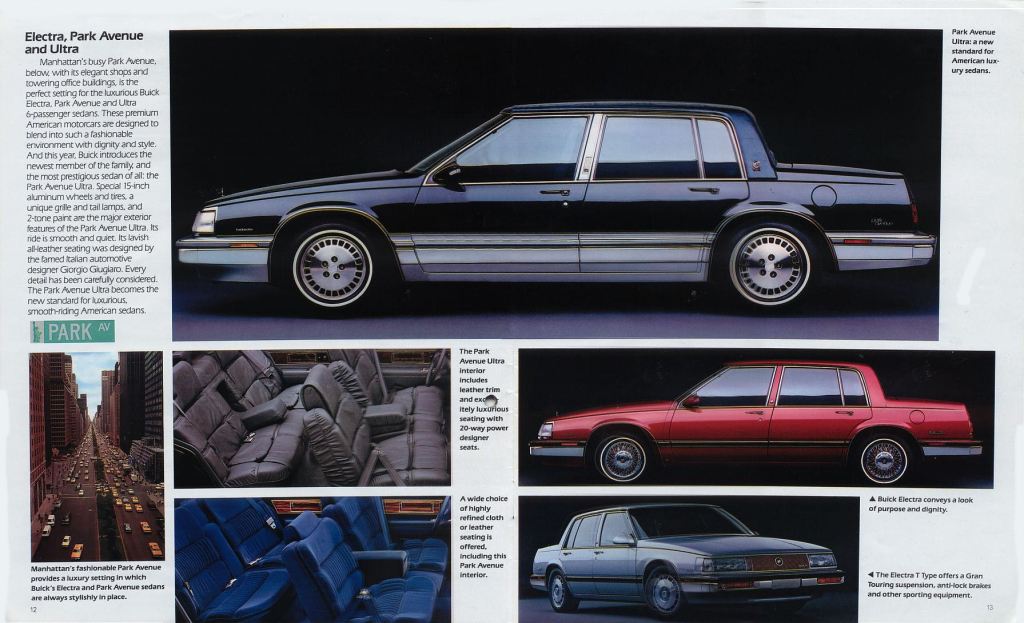
The 1985 Buick Electra sedan was substantially downsized from the previous year and switched to front wheel drive. The big sedan’s overall length decreased by over two feet from 221.3 inches to 197 inches, while shipping weight dropped by about 14%. Design details of the all-new Electra included a front-hinged hood, a flush-mounted windshield, and a flush-mounted back window.
Standard power came from the LK9 110 bhp 3.0 liter/181 ci V6 with a two-barrel carburetor. Optional engines were the 125 bhp LG3 3.8 liter/231 ci multi-port fuel-injected V6 ($260) and the 85 bhp LS2 4.3 liter/261 ci V6 diesel ($390). All engines were teamed with a four-speed automatic transmission with overdrive. For 1985 only, Buick named base model Electras by their engine size—Electra 300, Electra 380, and Electra 430. The 3.0 liter V6 was discontinued in the middle of the 1985 model year, and the diesel V6 would be gone by the time the 1986 model year rolled around.
MotorWeek clocked a 0-60 time of 12 seconds flat in a 1985 Electra with the 3.8 liter V6. Mileage for the short-lived standard engine was 18 city/25 highway by the 1985 measures (16/23 by today’s standards). Hilariously, the upmarket 3.8 liter engine was rated at 19 city/26 highway, the precision of the multi-port fuel injection more than making up for the increased displacement. Buyers of the diesel could expect 22 city/32 highway. With an 18-gallon gas tank, an Electra 380 owner could expect a range of 335 to 360 miles with a 10% fuel reserve.
Pages from the 1985 Buick Electra brochure
The Electra 300‘s base price was $14,331—approximately $43,800 in 2025 dollars and about what a 2025 Buick Enclave full-size crossover goes for. Standard exterior and mechanical equipment included Soft-Ray tinted glass, rack-and-pinion steering with power assist, an independent four-wheel suspension, automatic level control, low drag power front disc/rear drum brakes, and P205/75R14 steel-belted radial-ply blackwall tires (a size still available thanks to Hankook and Kumho) on 14-inch wheels. Inside, cloth 45/55 notchback front seats, a six-way power driver’s seat, manual seatback recliners, air conditioning, power windows, and an electronically-tuned AM/FM stereo radio with clock were standard.
An Electra purchaser could go in two directions if the base model wasn’t enough—more luxury or a sporting touch. Most buyers opted for luxury, which continued to be represented by the Park Avenue. The $16,240 Park Avenue added whitewall tires, a tilt steering column, Electronic Cruise Control, electric door locks, an electric trunk release, and an electronically-tuned AM/FM stereo radio with seek and scan and clock. The Park Avenue included the 3.8 liter V6, but allowed buyers to choose the diesel.
Choosing the $15,568 T TYPE added black accents, a Gran Touring suspension (higher-rate springs, larger shock absorbers, and bigger front and rear stabilizer bars), styled aluminum alloy wheels, cloth 45/55 front sport seats with a storage console, and a leather wrapped Sport steering wheel. The T TYPE included and required the 3.8 liter V6.
Options & Production Numbers
Individual options included an electric sliding glass Astroroof ($1,195), a six-way power passenger’s seat ($215), Electronic Touch Climate Control air conditioning ($165), Twilight Sentinel headlamp control ($60), an electric rear window defogger ($140), and the all-conquering Delco GM/Bose Music System ($895).
55/45 leather front seats ($425) were only available with the Park Avenue. Options only available for the T TYPE included 45/45 leather front Sport seats ($175) and Goodyear Eagle GT P215/65R15 performance tires paired with 15 x 6 inch aluminum wheels.
These C-bodies (there were also Cadillac and Oldsmobile versions) had a stately appearance. Big and (I think) handsome, they had a lot of interior room despite the downsizing—at 111 cubic feet, they had only one cubic foot less than the 1984.
Sales of the 1985 Electra sedan and its variants were good—at 131,011 sedans, more than double the 52,551 that had been sold in 1984. It’s unclear what percentage of buyers went with the Park Avenue or the T TYPE, but I’m betting that the Park Avenue was quite popular.
The View From 2025
C-body Electra sedans sometimes come up for sale in the Hemming’s Motor News classifieds and on eBay Motors. Bring a Trailer has sold four from this generation, including two 1985s.
Make mine the extra-cost ($200) Blue Firemist, please.
On my birthday, here’s a big, comfortable eighties convertible.
“A classic in its own time.”
After being considered by Buick since the early 1960s, the 1982 model year’s most significant news for the Riviera was the advent of the first production convertibles—though the division didn’t deliver the first examples until July 1982. Every Riviera convertible began life as a “normal” Riviera coupe built at GM’s Linden, NJ assembly plant. Cars destined to become convertibles were assembled with neither a rear seat nor a headliner and were finished in either White or Red Firemist paint with maple leather interiors.
Buick then shipped these coupes about 675 miles to American Sunroof Corporation (ASC) in Lansing, MI, where the involved process of changing them to convertibles began. This procedure required cutting the top off, strengthening the body, adding a different rear seat (narrower than the one fitted to the coupe), and installing the white diamond-grain vinyl convertible top and the associated electronics for the power top’s operation. This process took more than 300 parts and required a quoted 10 hours of labor per car—both notable additions. Once completed, new Riviera convertibles underwent two separate leak tests to ensure the top’s integrity before being shipped to Buick dealers. Buick general manager Lloyd Reuss was quoted as saying, “it’s not a hacksaw job,” perhaps comparing it to contemporary efforts from Chrysler and Ford.
Advertisement for the 1982 Buick Riviera convertible
Additional standard equipment packaged with the Riviera convertible included contrasting body-side stripes, four-wheel disc brakes, Custom locking wire wheel covers, deluxe trunk trim, 45/45 leather seats, and the aforementioned Firemist paint (if one went with red). Convertible-specific components included a power-operated convertible top, a cloth headliner, power-operated rear quarter windows, and a “special” radio speaker system. It was a good thing that Riviera convertibles came well-equipped because they were really expensive—with a base price of $24,064, 1982’s droptop Riv was about 66% more expensive than its coupe relation’s barrier to entry. In constant dollars, the sixth-generation convertibles are easily the most costly production Rivieras ever built.
Options & Production Numbers
Exterior and mechanical options for the convertible included door edge guards ($15), an 85-amp Delcotron generator ($35), tungsten-halogen high beam headlamps ($10), and Twilight Sentinel headlamp control ($97). Inside, electric seat back recliners for the driver and front passenger ($139 each), Electronic Touch Climate Control air conditioning ($150), and a tilt and telescoping steering column ($150) were available. Buick offered five optional radios for the Riviera, ranging up to a Delco ETR AM-FM stereo radio with a cassette tape player, CB, and Triband power antenna.
For all its expense—a Riviera convertible started at about $80,200 in today’s dollars—the convertible made and continues to make a distinct impression. A friend of mine who has owned his Riviera convertible since new remembers viewing one at a Buick dealership and thinking it was one of the most beautiful cars he had ever seen.
Buick sold 1,248 Riviera convertibles in the 1982 model year, making the droptop 2.8% of overall production. Approximately sixty were part of Buick’s Select 60 program for top dealers.
The View From 2025
There’s robust discussion and support for the sixth-generation Riviera on the AACA’s Buick Riviera page. According to Hagerty’s valuation tools, a 1982 Riviera convertible in #1/Concours condition is $40,600, with a far more normal #3/Good condition going for $12,900. Riviera convertibles often come up for sale in the Hemmings Motor News classifieds, on eBay Motors, on Bring a Trailer, and at in-person auctions.
Make mine Red Firemist, please.
Other sixth-generation Rivieras I have written about include the 1980 S TYPE and the 1984 T TYPE. I should write about a “civilian” coupe at some point.
Most material in this blog entry was sourced from the unfinished Riviera Project.
There are (many) eighties cars that no one is convinced have a following, and then there is the Buick GNX. Unlike many of the unloved cars I write about, I doubt there’s anything new I can add to the discourse about the GNX. Still, I can’t not cover it. And … thank you, Kendrick Lamar, for the GNX exposure.
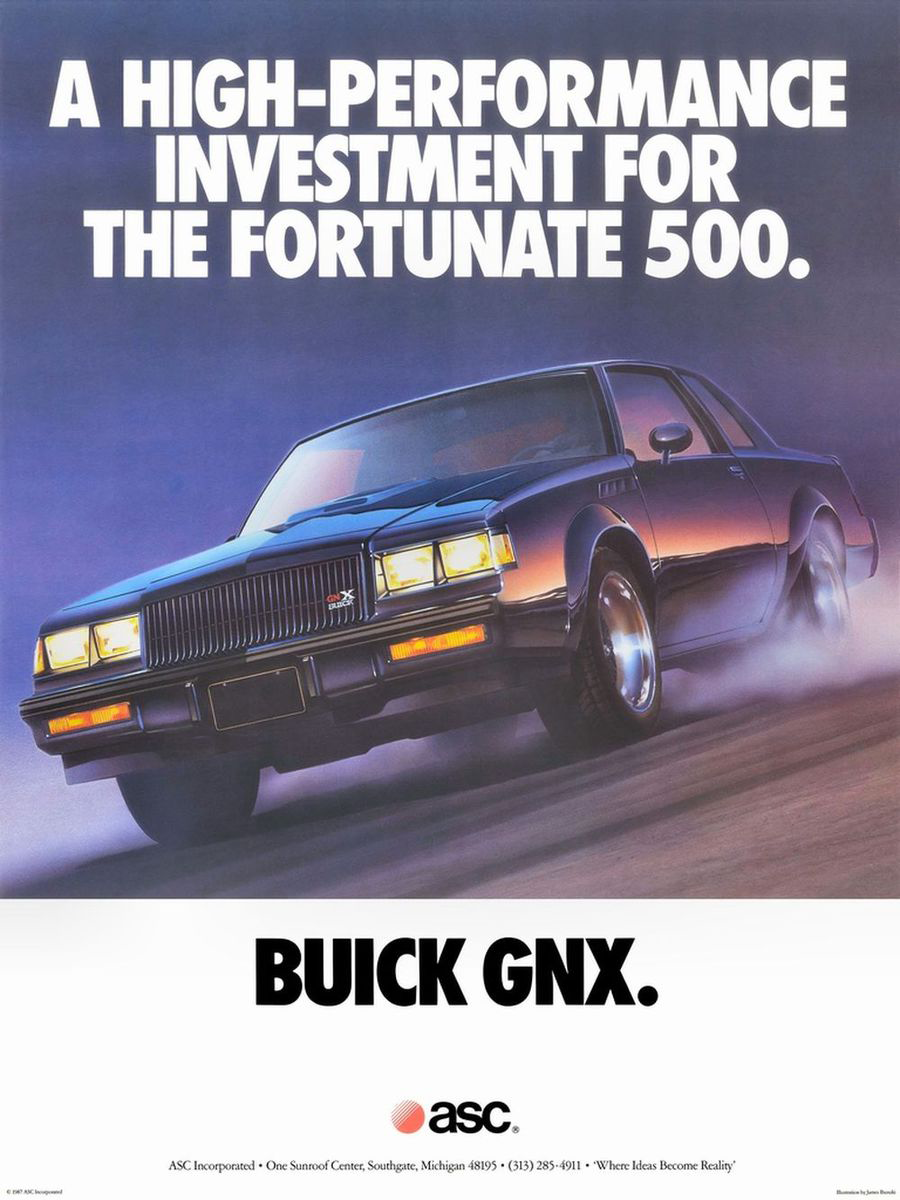
“A high-performance investment for the fortunate 500.”
1987 Buick GNX advertisement
The story is familiar to many of us. Buick’s Grand National performance variant of the Regal had been around since 1982, and it had gotten steadily more powerful, gaining a standard turbo V6 in 1984, and an intercooler in 1986. For 1987, Buick announced the GNX, which stood for Grand National Experimental.
Buick built cars with Grand National interiors and sent them to American Specialty Cars (ASC). The GNX added a performance suspension with a torque bar and a GNX-only rear differential cover. Its exterior featured functional front-fender louvers, and 16-inch aluminum mesh wheels with black-out faces and GNX center caps, which were equipped with Goodyear Eagle “Gatorback” tires—245/50VR-16 in front and 255/50VR-16 in the rear.
Most importantly, the GNX included a massaged version of Buick’s LC2 3.8 liter/231 ci turbo V6, making 276 bhp and paired with a four-speed automatic transmission with overdrive. Improvements to the engine over the standard turbo included a Garrett T3 turbocharger with ceramic impeller and a GNX-specific heat shield, a larger capacity intercooler, reprogrammed engine management, and a low-restriction exhaust.
Straight-line acceleration was outstanding for the day—Car and Driver recorded a 0-60 time of 4.7 seconds, with the quarter mile flying by in 13.5 seconds. The GNX handled well for a Regal, but that wasn’t really the point. Mileage ratings were 15 city/23 highway by the day’s standards (about 13 city/21 highway by today’s measures), which triggered the dreaded gas guzzler tax—$650 in this case.
The GNX was not inexpensive—the window sticker showed $29,290 (about $84,400 in 2025 dollars), with the GNX option alone listed as $10,995. Essentially, moving from a Grand National to a GNX added more than 50% to the price.
By 1987, a Grand National came reasonably well-equipped, with Sport mirrors, air conditioning, a leather-wrapped Sport steering wheel, a full-length operating console, and reclining front bucket seats included. A GNX came standard with many comfort and convenience features that were optional on the Grand National, including tungsten-halogen headlamps, electric door locks, power windows, electronic cruise control, tilt steering column, a six-way power driver’s seat, and the top-of-the-line UX1 stereo with graphic equalizer.
Options & Production Numbers
Buick built a mere 547 examples of the GNX—production was always intended to be quite limited. As far as I can tell, there were no factory options.
The View From 2025
According to Hagerty’s valuation tools, all the money for a 1987 Buick GNX coupe in #1/Concours condition is an astounding$257,000, with a far more normal #3/Good condition version going for $110,000.
The GNX has enthusiastic forum support, and there is intense collector interest. GNX coupes are sometimes available in the Hemmings Motor News classifieds, at online auctions such as Bring a Trailer that cater to the eighties car market, and at in-person auctions such as Barrett-Jackson and Mecum.
1984 was the third year for the Skyhawk, Buick’s version of the J-car, and it was little changed, except for the mid-year release of a turbocharged engine. New options included a factory stereo with a graphic equalizer.
The Skyhawk’s standard powertrain was an LQ5 86 bhp 2.0 liter/121 ci inline four with throttle-body fuel injection paired with a four-speed manual. An LH8 84 bhp 1.8 liter inline four with throttle-body fuel injection was $50, but required an upgrade to a five-speed manual ($75). Both engines were available with a three-speed automatic ($395). An LA5 turbocharged version of the 1.8 liter engine with 150 bhp was only available with the T TYPE coupe.
Performance wasn’t exactly scintillating with the two non turbocharged engines, but Skyhawk coupe’s relatively low 2,316-pound weight did help. 0-60 times with the 1.8 liter/five-speed combination were likely in the 12 second range. Fuel economy with the same powertrain was rated at 29 city/46 highway by the day’s standards—today’s measures give a far less impressive 23/33. With a 13.5-gallon gas tank, a Skyhawk owner could expect a range of 340 to 455 miles with a 10% fuel reserve.
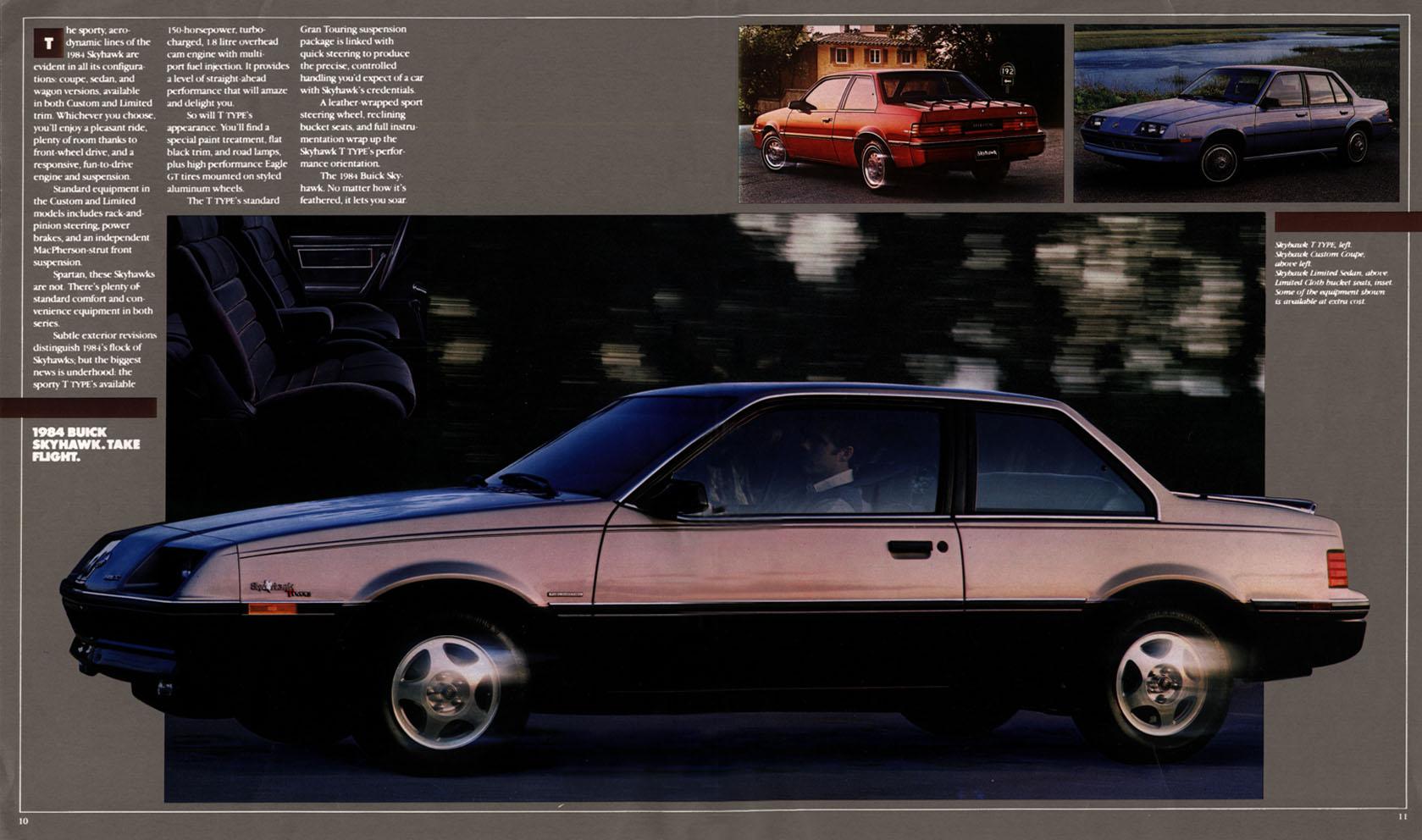
Skyhawk pages from the 1984 Buick brochure
Standard exterior and mechanical equipment on the $7,133 base Skyhawk coupe (designated as Custom) included manual rack-and-pinion steering, power front disc/rear drum brakes, and P175/80R13 blackwall tires on 13-inch wheels with Deluxe wheel covers. Inside, full carpeting, reclining front bucket seats, a full-length operating console, a Custom steering wheel, and an AM radio were included.
Moving up to the $7,641 Limited (about $24,100 in 2025 dollars and slightly less than a 2025 Buick Encore GX SUV costs) added dual horns, an acoustic package, a Limited steering wheel, and instrument gauges, along with cloth-covered seats and door panels.
Options & Production Numbers
Exterior and mechanical options for the Skyhawk coupe included tinted glass ($95), tungsten-halogen headlamps ($22), and styled aluminum wheels ($229). Inside, Electronic Touch Climate Control air conditioning ($780), manual air conditioning ($630), power windows ($185), and a series of stereo choices ranging up to an electronic tuning AM/FM stereo radio with cassette tape and graphic equalizer ($505) were all available.
1984 marked the Skyhawk’s peak sales year, with Buick producing 75,760 coupes, 45,648 sedans, and 13,668 station wagons. Buick made them through the 1989 model year, by which time sales numbers had dropped to a mere fraction of those in 1984.
The View From 2025
I haven’t seen a second-generation Skyhawk in person in many years. Still, they are sometimes available in the Hemmings Motor News classifieds and at online auctions such as Bring a Trailer that cater to the eighties car market. When I first published this blog entry in September 2022, Hemmings had a 1986 White Skyhawk T-Type hatchback with gray lower accents, silver/black cloth bucket seats, and 10,000 miles for sale for $16,000.
Buick made things more than a bit confusing for some of its higher-end coupe buyers in the middle of the 1988 model year by introducing the two-seater Reatta. For the first time since its introduction in 1963, the Riviera was definitively no longer the top of the two-door Buick line—with a base price of $25,000, the Reatta’s barrier to entry was almost 16% higher.
“Beauty with purpose.”
Designed to be a sporty car, but with no delusions of being a sports car, Buick targeted the Reatta at a perceived niche in the two-seater market for a luxury coupe at a substantially lower price than the high-end luxury convertibles of the day. As Buick general manager Edward Mertz said in January 1988, it was “priced many thousands of dollars less than luxury and sports cars at the top end of the market.” The Reatta was not nearly as expensive as the Cadillac Allanté convertible (which had a base price of $56,533 in 1988) or the Mercedes-Benz 560SL convertible ($61,130 in that same year) but could claim to be nearly as comfortable. Compared to the Cadillac and (especially) the Mercedes, the Reatta lacked refinement and prestige—both important to potential buyers.
Despite being based on the same E-platform as the Riviera, the Reatta’s exterior styling was distinctive, even if some of the proportions looked a little off to some. However, many parts of its interior were familiar to Riviera buyers—indeed, Buick benchmarked the Reatta’s two seats to the Riviera’s driver and front passenger experience. Because of this, the Reatta’s Electronic Control Center was essentially the same as the Riviera’s, and the Reatta’s optional driver’s seat closely resembled the one in the Riviera T Type.
The Reatta’s sole powertrain was a 3800 165 bhp 3.8 liter/231 ci V6 with fuel injection paired with a four-speed automatic. Car and Driver tested a 1988 Reatta, and recorded a 0-60 mph time of 9.1 seconds in a vehicle with a 3,380-pound curb weight. Mileage was respectable—19 city/29 highway by the day’s standards (17/26 by today’s measures). With an 18.2-gallon gas tank, a Reatta owner could expect a range of 355 to 390 miles with a 10% fuel reserve—enough to take those road trips that Buick was convinced the Reatta would be primarily used for.
1988 Buick Reatta brochure cover
Standard exterior and mechanical equipment on the Reatta included Soft-Ray tinted glass, fast-ratio power steering, an independent four-wheel Gran Touring suspension, four-wheel anti-lock disk brakes, and P215/65R15 Goodyear Eagle GT+4 tires (a size still readily available) on 15-inch wheels. Inside, power windows, electric door locks, six-way power seats, and Electronic Touch Climate Control air conditioning were included. The standard and only audio system was an ETR AM stereo-FM stereo radio with seek and scan, a cassette tape player with auto reverse, search/repeat, a graphic equalizer, a clock, eight Concert Sound speakers, and an automatic power antenna.
Options & Production Numbers
Buick’s new coupe came loaded, with only two options in its introductory year: an electric sliding steel sunroof ($895) and a 16-way adjustable leather and suede driver’s seat ($680).
First-year sales of the Reatta were decent for a new two-seat coupe without that all-important pre-existing audience that many of its competitors had—Buick moved 4,708 of them in about nine months.
The View From 2025
There is collector interest in the Reatta, including club support. According to Hagerty‘s valuation tools, a 1988 BuickReatta coupe in #1/Concours condition is $22,700, with a far more normal #3/Good condition version going for $4,200.
“The standard for luxurious, smooth-riding American sedans …”
For 1989, Buick’s Electra Park Avenue received a new trim in the middle of the model year: Ultra. It became the new top-of-the-line Buick sedan.
The only powertrain for the Ultra or for any 1989 Electra was a “3800”LN3 165 bhp 3.8 liter/231 ci V6 with sequential fuel injection teamed with a four-speed automatic transmission. Mileage for the standard engine was 19 city/28 highway by the 1989 measures (17/26 by today’s standards). With an 18-gallon gas tank, an Ultra owner could expect a range of about 345 to 380 miles with a 10% fuel reserve. 0-60 mph took a little under 10 seconds.
Electra pages from the 1989 Buick brochure
Buick piled on the bling for the Ultra—standard exterior equipment included Soft-Ray tinted glass, a unique grille texture, smoked tail lamps, chrome side pillars, a Sterling Silver lower accent paint treatment, and a silver accent body stripe. Mechanical equipment on the $26,218 (approximately $70,100 in 2025 dollars) car included a 4-wheel independent DynaRide suspension, power rack-and-pinion steering, power anti-lock front disk/rear drum brakes, and P205/70R15 whitewall tires (a size still readily available) on 15-inch aluminum wheels.
Inside the Ultra, air conditioning, an AM/FM stereo radio, burled elm trim on the doors and instrument panel, a tilt steering column, power door locks, power mirrors, and power windows were all standard. The all-leather seats were styled by famed Italian automobile designer Giorgetto Giugiaro, with the 55/45 front seats being 20-way for both driver and front passenger.
Options, Period Press, & Production Numbers
Optional items for 1989 included an electric sliding Astroroof ($1,230), a heavily-padded full vinyl top only available for the Ultra, cornering lamps ($60), Electronic Touch Climate Control air conditioning ($165), Twilight Sentinel headlamp control ($60), and the Delco/Bose Music System with ETR AM/FM stereo radio and cassette.
The Electra Park Avenue Ultra received good reviews, with one automotive writer comparing it favorably to the same year’s Mercedes-Benz 300 SE. First-year sales of the 1989 Park Avenue Ultra sedan were decent considering the short window of availability—Buick moved 4,815 examples.
The View From 2025
These mid to late 1980s C-bodies had a stately look about them. Big and (I think) handsome, they had a lot of interior room despite the second round of downsizing—with 111 cubic feet, they had only one cubic foot less than the previous generation rear-wheel-drive cars. C-body Park Avenue sedans of this era rarely come up for sale in the Hemming’s Motor News classifieds and on eBay Motors, but are sometimes seen on Bring a Trailer.
Make mine Claret Red over Sterling Silver, please. All Ultras came with two-tone exterior paint.
1987 was the first year for the T Type version of Buick’s sixth-generation LeSabre. Looking toward a looming future where the rear-wheel-drive Regal would no longer exist, Buick did its best to inject some sportiness into these big (110.8-inch wheelbase) front-wheel-drive coupes.
Power wasn’t great—the only engine available on any LeSabre was the LG3 150 bhp 3.8 liter/231 ci V-6 with sequential fuel injection mated to a four-speed automatic transmission. Car and Driver recorded a 0-60 time of 9.8 seconds in a coupe with a 3,369-pound curb weight—sprightly but not speedy in 1987. Fuel economy was 18 city/27 highway by the day’s standards (16/25 by 2025 standards). With an 18-gallon gas tank, LeSabre owners could expect a range of about 330 to 365 miles with a 10% fuel reserve.
LeSabre coupe pages from the 1987 Buick brochure
Exterior features specific to the $15,591T Type (about $45,800 in 2025 dollars or about what a 2026 Buick Enclavelarge crossover SUV goes for) included blackout trim treatment, a front air dam, and a rear deck spoiler. Mechanical equipment included a Gran Touring suspension, a 2.97 performance axle ratio, and 215/65R15 Goodyear Eagle GT blackwall tires (a size still readily available) on 15-inch aluminum-alloy wheels. Inside, a leather-wrapped sport steering wheel, gray/black 45/45 cloth seats, a gage package with red backlighting, and an ETR AM-FM stereo radio with graphic equalizer, cassette tape, and more red backlighting were included.
Standard exterior and mechanical equipment on all LeSabre coupes included composite tungsten-halogen headlamps, power rack and pinion steering, clearcoat paint, dual horns, Soft-Ray tinted glass, and a fixed-mast radio antenna. Inside, air conditioning, adjustable front-seat headrests, and cut-pile carpeting were standard.
Options, Period Reviews, & Production Numbers
Exterior and mechanical options included an anti-lock brake system ($925), flip-open Vista-Vent removable glass sunroof ($350), electric side mirrors ($91), intermittent windshield wipers ($55), and power antenna ($95). Inside, automatic climate control ($165), power door locks ($145), power windows ($210), tilt steering column ($125), and electronic cruise control ($175) were available.
The automotive press and the auto market itself weren’t quite sure what to make of the LeSabre T Type—Consumer Guide said: “it had nothing exceptional to rave about.” Sales were not good in a year when the LeSabre overall sold quite well; only 4,123 out of the 16,899 coupes sold.
The View From 2025
A few folks do collect these cars, but I haven’t seen a LeSabre coupe of any type for many years. This generation of LeSabres does maintain some presence in the Hemming’s Motor News classifieds, on eBay Motors, and on Bring a Trailer.







 Eighties Cars