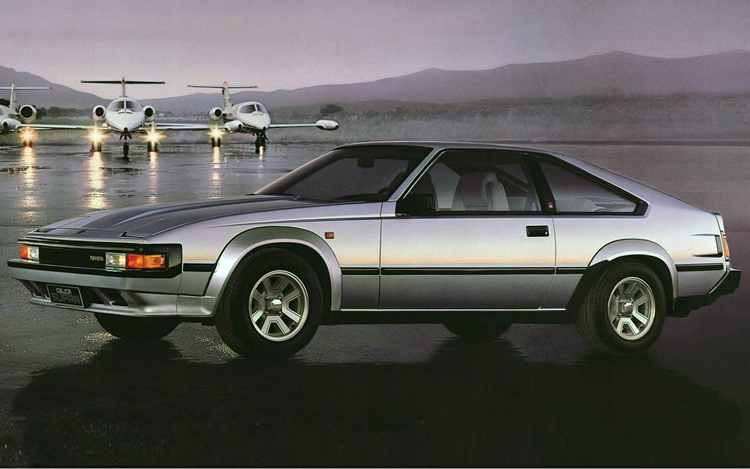
1982 Toyota Celica Supra hatchback coupe

This post was one of my first entries in this blog. I’ve updated it to reflect both changes in my posting style and substantial improvements in available data.

“The ultimate performance Toyota.”

Remember when Toyota produced a reasonable amount of cool sporty cars?

I do—I believe they nailed it with the Mark II Celica Supra. First, the styling: although based on the Celica, the longer hood (to accommodate the Supra’s inline six) along with the retractable headlights (you’ll have to believe me that they were very cool in the 1980s) substantially changed the car’s look. It wasn’t just the styling—Supras also included a notably higher level of interior equipment.

The engine was Toyota’s 145 bhp 5M-GE 2.8 liter/168 ci dual overhead cam fuel injected inline six, giving a 0-60 time of slightly under 9 seconds (spritely for 1982) and a top speed of approximately 125 mph. Over the next few years, engine power would climb to 161 bhp.

Mileage with the standard five-speed manual transmission was 21 city/34 highway by the day’s standards (19/31 by today’s measures). Choosing the optional four-speed automatic transmission—available only for the L-Type submodel—reduced highway mileage to 32. With a 16.1-gallon gas tank, Supra drivers could expect to travel approximately 355 miles before seeking more fuel.

1982 Toyota Celica Supra, the 1982 Motor Trend Import Car Of The Year.
1982 Toyota Celica Supra,
photo courtesy of Motor Trend from their Import Car Of The Year photo shoot.

All Celica Supras included tungsten halogen headlights, a four-wheel independent suspension, rack-and-pinion steering with variable power assist, and ventilated and power-assisted 4-wheel disc brakes. Inside, automatic temperature control air conditioning, power windows, power door locks, cruise control, and a tilt steering wheel were included.

Two models were available: the L– (for “Luxury”) Type and the P– (for “Performance”) Type. The $13,598 L-Type (about $46,800 in 2025 dollars) included standard power mirrors and P195/70R-14 steel-belted radial tires (a size still readily available) on 14 x 5.5-inch aluminum alloy wheels. Inside, striped velour cloth bucket seats were standard.

The $14,598 P-Type (about $50,200 in today’s dollars) included fender flares, a limited-slip differential, Sport Seats with driver’s side 8-way adjustment and pneumatic lumbar support adjustment, and P225/60HR-14 steel-belted radial tires (a size currently available only from BFGoodrich) on 14 x 7 inch aluminum alloy wheels.

Options, Publicity, Period Reception, & Sales Numbers

Options include two-tone exterior paint ($120), black high gloss paint ($70), and an electric sunroof ($440). Options only available for the L-Type included a four-speed automatic transmission, a digital display instrument panel and trip computer ($450), and leather seat trim. Options only for P-Type buyers included a spoiler-type sunshade ($120).

At right is a classic commercial, with legendary (and very tall) race car driver Dan Gurney shilling for the then brand-new Mark II Celica Supra. The second-generation Supra was well-received—Car and Driver included it in their first 10Best list in 1983. Toyota sold 34,048 Celica Supras in 1982.

The View From 2025

According to Hagerty’s valuation tools, a 1982 Toyota Celica Supra in #1/Concours condition is $40,300. The value for a more “normal” #3/Good condition example is $12,400. This generation of Supras maintains a presence in the Hemming’s Motor News classifieds, on eBay Motors, and on Bring a Trailer. When I last updated the contents of this post in July 2025, a Red Metallic 1985 Supra with Gray cloth seats and 114,000 miles was for sale in Hemmings, asking $29,000.

Make mine Silver Gray Metallic, please.

Other Toyotas I’ve written about include the 1980 Corolla Tercel Liftback, the 1981 Celica Sport Coupe, the 1983 Camry sedan, the 1984 Corolla SR5 Sport Coupe, the 1985 MR2 coupe, and the 1988 Supra hatchback coupe.

Last updated July 2025.

1981 Toyota Celica Sport Coupe

We do requests on Eighties Cars, whether or not they are definitive ones. A friend of mine mentioned his 1981 Celica in one of the automotive forums I frequent, and that was enough inspiration for me. In June 2020, Autopolis also published a typically thoughtful post on the second-generation Celicas.

 “The Ultimate Toyota.”

1981 was the final model year for the second-generation Toyota Celica, which debuted in 1978. Despite this, there were some significant changes, including the introduction of a new engine— the 22R 97 bhp 2.4 liter/144 ci inline four with a two-barrel carburetor.

Paired with the standard five-speed manual transmission, the Celica’s fuel economy was an impressive 25 city/37 highway by the day’s standards. Choosing the optional four-speed automatic transmission dropped the highway mileage rating slightly to 35 mpg. With a curb weight of a little over 2,400 pounds, Consumer Guide recorded a 0-60 time of 12.5 seconds—respectable for 1981.

celicas
1981 Celica and Celica Supra poster, courtesy of Flickr user Alden Jewell.

The Celica Sport Coupe was available in ST and GT trim levels. Standard exterior and mechanical equipment on the Celica ST ($6,699 or about $25,600 in today’s dollars) included tinted glass, electronic ignition, power assisted front disc/rear drum brakes, and 175/SR14 steel-belted radial tires (a size still somewhat available) on 14-inch styled steel wheels. Inside, reclining front bucket seats, “cut pile wall-to-wall carpeting,” a simulated woodgrain instrument panel and console, and an electric rear window defogger were included.

Moving up to the GT ($7,429 or about $28,400 in 2025 dollars) added features such as tungsten halogen hi-beam headlamps, a locking gas cap, 185/70SR14 steel-belted radial tires (a size still readily available), dual outside mirrors with driver’s side remote control, a simulated brushed aluminum instrument panel and console, and an AM/FM/MPX stereo with four speakers.

Optional equipment included a sunroof ($290), power steering ($180), and air conditioning ($610). Raised white letter tires, aluminum alloy wheels, cruise control ($115), and an electronic digital-readout AM/FM/MPX tuner stereo with a cassette player, an equalizer/amplifier, and four speakers were GT-only options for the Sport Coupe.

The View From 2025

1000 views badge

Celicas of this generation sometimes come up for sale in Hemmings Motor News, on eBay Motors, and on Bring a Trailer. As I update this post in September 2025, there’s a Silver Metallic 1981 Celica with grey cloth front bucket seats and 67,000 miles for sale on Hemmings, asking $8,000.

Make mine Dark Blue Metallic, please.

Other Toyotas I’ve written about include the 1980 Corolla Tercel Liftback, the 1982 Celica Supra hatchback coupe, the 1983 Camry sedan, the 1984 Corolla SR5 Sport Coupe, the 1985 MR2 coupe, and the 1988 Supra hatchback coupe.

Last updated September 2025.

1986 Cadillac Eldorado coupe

“Imaginatively new. Decidedly Cadillac.”

Is it possible to miss the market more than this? For the 1986 model year, Cadillac downsized the front wheel drive Eldorado coupe again. This time, the wheelbase dropped to 108 inches, and overall length was down by over 16 inches to 188 inches—what was supposed to be the top of the non-limousine Cadillac line was now about the size of a 1986 Chevrolet Celebrity (or a 2025 Cadillac CT4 sedan) and a full three feet shorter than the (admittedly massive) 1978 Eldorado.

EightiesEldoradoSales

Predictably, Eldorado buyers didn’t go for it. Sales collapsed from about 74,000 in 1985 to about 21,000 in 1986—definitely not what would be expected from a complete model revision. Six years later, GM had now managed to duplicate the carnage that Ford had experienced with its 1980 luxury vehicle downsizing. Notably, Ford Thunderbird, Lincoln Mark VII (the Continental name departed that year), and Mercury Cougar sales were all up for 1986, along with those of some of GM’s “junior” personal luxury coupes. The December 1987 issue of Special Interest Autos simply called the Eldorado/Riviera/Toronado downsizing “the E-body disaster” and speculated that it was costing GM half a billion dollars a year in lost profits.

1986 Cadillac Eldorado brochure page

So, what did those relatively few buyers get with their $24,251 (about $70,900 in today’s dollars) 1986 Eldorado? Standard exterior and mechanical equipment included power four-wheel disc brakes, power steering, and aluminum alloy wheels. Inside, front bucket seats, power mirrors, power windows, power door locks, a power trunk release, cruise control, electronic climate control, and an AM/FM stereo radio with power antenna were all included, so the Eldorado was at least pretty well equipped.

Packages, Options, & Performance Numbers

Moving up to the Biarritz (almost always the top-of-the-line Eldorado since 1956) cost either $3,095 (with cloth seats) or $3,495 (with leather seats) raising the price to either $27,346 ($79,900 today) or $27,746 ($81,100 today). Standard equipment on the Biarritz included nicer seats with power lumbar support, two-tone paint, and real walnut accents.

Options included a power Astroroof ($1,255), a nicely integrated cellular phone ($2,850), the FE2 touring suspension with 15-inch aluminum alloy wheels and 215/60R15 Goodyear Eagle GT tires ($155), and the Delco-GM/Bose Symphony Sound System ($895).

The Eldorado’s engine was Cadillac’s 130 bhp HT-4100 throttle body fuel injected 4.1 liter/249 ci V8 paired with a four-speed automatic transmission. Fuel economy was 17 city/26 highway by the standards of the day (15/24 by today’s standards). Since the engine and transmission remained the same and the Eldorado was smaller and lighter, performance was better but still not very impressive: 0-60 improved to about 11 seconds.

The View From 2025

According to Hagerty’s valuation tools, all the money for a 1986 Eldorado in #1/Concours condition is $19,100, with a far more typical #3/Good car going for $6,900. Eldorados of this age come up for sale regularly in the Hemmings Motor News classifieds, on eBay Motors, and Bring a Trailer, so folks are saving them.

Make mine Corinthian Blue Firemist, please.

Other Eldorados I have written about include the 1982 Touring Coupe, the 1984 Biarritz convertible, and the 1988 coupe.

Last updated March 2025.

1983 Audi Quattro hatchback coupe

“Totally different by design.”

Audi’s Quattro had been changing the perception of all-wheel-drive in Europe since late 1980, but finally made it to American soil for the 1983 model year with a few modifications (such as larger bumpers) specific to the market.

The only available engine was the WX turbocharged and fuel0-injected 2.1 liter inline five cylinder making 160 bhp and running on premium gas. This engine was paired with a five-speed manual transmission connected to (of course!) the Quattro generation I all-wheel-drive system with manually lockable center and rear differentials. Motor Trend clocked a 1983 Quattro with a 0-60 time of 7.9 seconds—not bad for the early eighties. Fuel economy was 17 city/28 highway by the day’s standards (14/20 by today’s measures).

The Quattro was an expensive car, especially for an eighties Audi—almost three times the cost of the far more plebeian Audi 80 coupe it was based on (and whose squarish styling it closely resembled). At $35,000 (about $114,000 in 2025 dollars), it was approximately $5,000 more than a 1983 Porsche 911. But, there was nothing like it.

Page from the 1983 Audi Quattro brochure

All 1983 Quattros included tinted glass, front and rear spoilers, halogen headlamps, an independent suspension, four-wheel power-assisted disc brakes, power rack and pinion steering, and 205/60R15 steel-belted radial tires (a size still readily available) on 6J x 15-inch light-alloy wheels. Inside, power door locks, power window lifts, full gauges, cruise control, and an AM/FM stereo cassette were all included.

Options & Production Numbers

Options for the 1983 Quattro were few—a removable sunroof panel ($450), special metallic exterior paint, leather upholstery ($1,500), electrically heated front seats, floor mats, and a rear-window wiper/washer ($210).

Total sales in the United States were only 664 over the three years between 1983 and 1985.

The View From 2025

Original (“Ur”) Quattros have a strong following. Quattros sometimes appear in the Hemming’s Motor News classifieds and Bring a Trailer, but there just aren’t that many to sell. According to Hagerty’s valuation tools, all the money for a 1983 Audi Quattro in #1/Concours condition is $100,000. A more “normal” Quattro in #3/Good condition is valued at $47,100.

Color is a tough choice here, but I’m going to violate my usual “it is a German car, it looks good in silver” rule and ask that mine be Mars Red.

The only other Audi I have written about is the 1984 5000S sedan.

Last updated April 2025.

1983 Mitsubishi Starion hatchback coupe

Bring a Trailer had a Plymouth Conquest (the badge-engineered version of the Starion) up for auction in February 2025. I learned enough from the comments to want to update this elderly blog entry.

“The sportscar that’s charged with more than a turbo.”

The 1983 Mitsubishi Starion was a significant change of pace for Mitsubishi. Seen back in the day as a poor man’s Porsche 944 at about two-thirds of the price, the rear-wheel-drive Starion reached customers that Mitsubishi had never competed for before. Because of Chrysler’s relationship with Mitsubishi, nearly identical cars were sold starting in 1985, first as the Plymouth Conquest and Dodge Conquest and then as the Chrysler Conquest beginning in 1987 (gotta love branding).

For 1983, motive power was provided by the Astron G54B 145 bhp 2.6 liter/156 ci inline four with fuel injection and a turbocharger connected to a five-speed manual (no automatic transmission was available in 1983). 0-60 came in about 9 seconds in a car that weighed about 2,700 pounds. Mileage was 19 city/24 highway by the standards of the day (17/22 by today’s standards). With a relatively large 19.8-gallon gas tank, a Starion owner could expect a range of between 310 and 385 miles with a 10% fuel reserve.

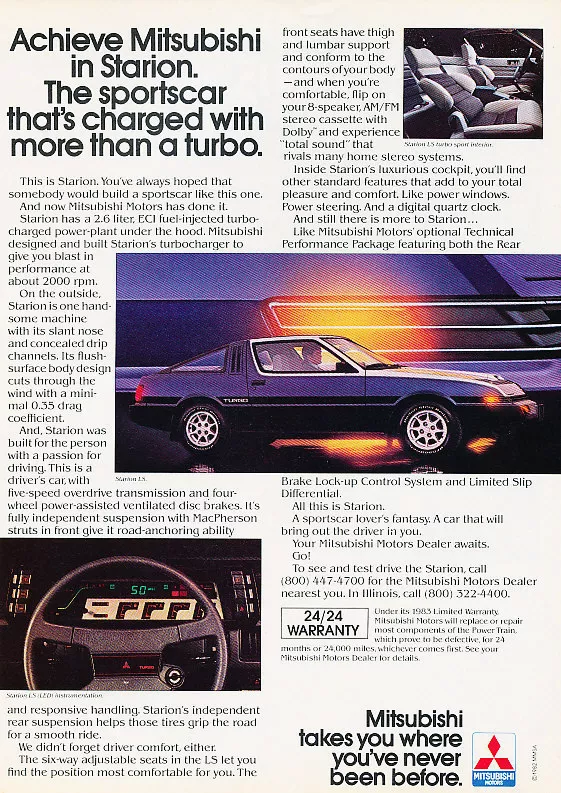
1983 Mitsubishi Starion advertisement

At $12,079 (about $39,500 in today’s dollars), the base Starion EX included a fully independent suspension, four-wheel power-assisted ventilated disc brakes, power steering, P195/70R14 tires (a size still readily available), and 14-inch alloy wheels. Inside, power windows and a digital quartz clock were standard. Moving up to the LS—an additional $1,840, making the car a $45,600 purchase in 2025—added P215/60R15 tires and 15-inch wheels, air conditioning, six-way adjustable front seats, digital instrumentation, and an AM/FM stereo cassette with eight speakers.

Options & Production Numbers

Options included a sunroof, cruise control, and the Technical Performance Package. LS purchasers could go crazy and get leather seat facings and a single two-tone paint option (Italian Silver over Behring Blue Metallic).

Mitsubishi sold 6,297 Starions in the 1983 model year—pretty good for a make and model with little previous sporting reputation in North America. Period reviews were generally positive, and watching MotorWeek‘s treatment is interesting.

The View From 2025

I have not seen a Starion on the road in decades, but at least a few are being saved, and there is some online support. A quick perusal shows that lack of maintenance of the complex for its day engine causes most of the serious issues with this car.

You occasionally see Starions come up for sale in the Hemmings Motor News classifieds or on eBay Motors, but there were none for sale when I last checked—the later 3000 GT does better. Bring a Trailer auctions a fair amount—enough to have a specific category.

Make mine Safari Red, of course.

Last updated June 2025.

Eighties Vehicles at the 2014 Mecum Seattle

Mecum’s short two day June auction in Seattle includes a lot of cars and trucks from the 1980s. As always, I’ll concentrate on the cars and trucks that actually sold (remember that this is not a no reserve auction) and add some of my opinions. Where I have covered the specific year and model of a car in this blog, I link to it.

Friday:

  • 1989 red Cadillac Allanté convertible with 23,000 miles—$11,500 hammer price.
  • 1981 gray/blue two-tone Chevrolet El Camino custom truck—$9,000
  • 1982 black Mercedes-Benz 380SL convertible—$7,500
  • 1987 white Buick Regal Turbo-T coupe with 39,000 miles—at $20,000 the first vehicle in this auction to meet my criteria for serious 1980s collectability of original cars or trucks: selling for equal to or above its original base list price. I’ll mark these vehicles in bold green.
  • 1986 copper GMC custom pickup truck—an ouch! at $5,750
  • 1988 red Ferrari Testarossa coupe with 17,000 miles—$45,000
  • 1984 white Cadillac Eldorado convertible with 40,000 miles—$16,000
  • 1987 Bright Red Chevrolet Corvette convertible—$6,500
  • 1985 white Ferrari Testarossa coupe with 13,000 miles—$57,500 buys you the Miami Vice look, but is the dreaded major service just around the corner?
  • 1985 burgundy Cadillac Eldorado convertible—$7,500. What, other than indeterminate miles, made this go for less than half what the white 1984 did on the same day? And, by the way, why are eighties Eldorado convertibles suddenly showing up at auction?
  • 1984 silver Mercedes-Benz 300D limousine—$11,500. Who buys this car and what would their intentions be for it?
  • 1988 Gray Pearl Mercedes-Benz 560SL convertible with 36,000 miles—$25,000. Not nearly what they cost new, but holding at least some value.
  • 1987 orange Land Rover Defender 90 SUV—$43,000
  • 1989 orange Porsche 944 Turbo coupe modified for racing—$11,000
  • 1986 Iris Blue Porsche 911 Carrera coupe—$23,000. Perhaps the declared 148,000 miles drove the price down …
  • 1982 white Toyota SR5 pickup truck with 63,000 miles—$8,000

Saturday:

  • 1981 yellow Chevrolet K10 custom pickup truck—$18,000
  • 1988 red Porsche 911 Targa coupe with 57,000 miles—$30,000
  • 1987 white Avanti II convertible—$18,000. Mecum listed this as a Studebaker Avanti convertible, but of course this is not correct. This is one of the “continuation” square headlight Avantis built by a series of relatively unsuccessful entrepreneurs in the 1980s. This one has a 305 cubic inch Chevrolet V8 engine under the hood.
  • 1984 “Blurple” Porsche 911 Turbo Cabriolet very custom convertible built for Sir Mix-A Lot and featured on the back cover of his Mack Daddy album—at $30,000, can you get more eighties than this?

What do you think of this auction’s results?

Some Long Distance Travel In An Eighties Car

Last month, my wife and I took a 6,281 mile “jaunt” in my eighties car – a 29 1/2 year old 1985 Light Blue Metallic Chevrolet Corvette coupe.

Last year, Lauren challenged me, causing me to me to write this … screed in May 2013:

“It’s Not The Same As It Was In 2004 …

… I took the 1985 out for some miles today and I noticed some things.

It’s a more tenuous feeling taking her out than it was in 2004. Of course, that was 33,000 miles ago, but the car seems more … fragile. I’m mindful of all that sweat equity (mine and many others) in it and the knowledge that it is now so … old. Less and less early C4s on the road for any reason and she’ll be thirty (!) years old in November 2014.

The car judges well and drives acceptably but the problems remain present and they are a litany: the “dumb as a bag of rocks” computer, the creaks and rattles in the interior, the passenger side power window near death, the console light that keeps slowly melting the console plastic, the seats and steering wheel not far from a recovery, the repaint that is who knows how many thousands of miles out, the characteristic droops on both front and rear bumpers that will need to be fixed with the repaint. They’re known problems and they can get fixed: but some of them (seats, repaint, bumpers) will require cubic dollars.

Continue reading “Some Long Distance Travel In An Eighties Car”

1984 Buick Riviera T TYPE coupe

This entry was one of my first posts on this blog. I’ve updated it to reflect both changes in my posting style and substantial improvements in available data. In hindsight, it turns out that it was also my initial inspiration for the Riviera Project I am currently working on.

“… the thrill of turbocharged performance and responsive handling.”

For 1984, the T TYPE (their spelling) version of Buick’s Riviera gained sequential fuel injection, yielding a respectable 200 bhp from the evergreen LM9 3.8 liter/231 ci turbo V6. Performance figures for the later Riviera T TYPEs are hard to come by, but I’m betting that 0-60 mph came in between 9 and 10 seconds.

Fuel mileage for the big coupe was decent by the day’s standards: 14 city/21 highway (13/20 by today’s measures). With the 21.2-gallon gas tank, range was about 310 to 335 miles with a 10% fuel reserve. A T TYPE continued to be the only way to get your Riviera coupe turbocharged, though you could get a “civilian” Riviera convertible with the turbocharger.

Riviera pages from the 1984 Buick brochure

The $17,050 T TYPE (about $54,500 in 2025 dollars) came with a blacked-out grille, amber parking light and turn signal lenses, black mirrors, and P205/75R15 tires (a size still readily available) on 15-inch styled aluminum wheels. Additional instrumentation for the T TYPE included a turbo boost gauge and an LED tachometer. The 1984 T TYPE also included the Gran Touring Package, which featured stiffer springs, recalibrated shock absorbers, and larger diameter anti-sway bars front and rear.

Standard exterior and mechanical features on all 1984 Rivieras included a four-speed automatic transmission, power steering, power brakes, and power antenna. Inside, every Riviera had air conditioning, power door locks, and power windows.

Options & Production Numbers

An extensive list of options included electronic climate control ($150), rear window defogger ($140), and Twilight Sentinel ($60). Options available for every Riviera except the convertible included the Delco/Bose Music System ($895) and the Astroroof ($1,195).

Sales weren’t great—with only 1,153 made, T TYPEs accounted for only about 2% of the robust overall Riviera sales. T TYPE sales would continue to dip in the last year for the “big” sixth-generation Riviera—there were only 1,069 made in 1985. My theory is that there weren’t a ton of folks searching for a big (206 inches long and 3,660 pounds) performance-oriented (but not really high performance) coupe in the mid-1980s, and there was competition from vehicles like the brand-new Lincoln Mark VII LSC.

The View From 2025

1000 views badge

Folks are saving the sixth-generation Rivieras—there’s robust discussion and support on the AACA’s Buick Riviera page. According to Hagerty’s valuation tools, a 1984 Riviera T TYPE in #1/Concours condition is $37,400, with a far more normal #3/Good condition going for $11,400. T TYPEs also come up for sale occasionally in the Hemming’s Motor News classifieds or on eBay Motors. Bring a Trailer has yet to sell a sixth-generation T TYPE.

Make mine the extra-cost ($210) Medium Sand Gray Firemist, please. I love those Buick color names and believe everyone should have at least one Firemist.

Other Buick coupes I have written about include the 1980 Rivera S TYPE, the 1983 Skylark T TYPE, the 1984 Regal Grand National, the 1985 Somerset Regal, the 1987 GNX, the 1987 LeSabre T Type, and the 1988 Reatta.

Last updated August 2025.

Save

1980 Chevrolet Camaro Z28 coupe

I saw a white 1980 or 1981 Z28 with blue graphics (I believe the only way you can tell them apart is to get close enough to see the VIN’s length) out driving in June 2014, not once but twice. It wasn’t quite in show condition, but it still looked pretty sharp, and you so rarely see these cars on the road these days. We’ll go with the 1980 version for this post because it had slightly more horsepower.

“The Maximum Camaro.”

For 1980, the aging second-generation Chevrolet Camaro (the title of Car and Driver‘s road test for the 1980 Z28 was a cruelA medieval warrior on the path to a rocking chair“) received some updates, including exterior styling changes and a more powerful engine for the Z28. Not much could be done about the general lack of space efficiency (the EPA rated all Camaros as subcompact cars), the relatively high weight, and the fairly primitive technology.

The standard Z28 powertrain for states other than California was the LM1 5.7 liter/350 ci V8 with a four-barrel Rochester carburetor and 8.2:1 compression matched with a four-speed manual transmission (a three-speed automatic was available for $63). At 190 bhp, this engine had the most horsepower seen in any Camaro since 1974 (sigh). For 1980, Chevrolet engineers added a solenoid-driven air intake to the back of the redesigned hood scoop.

Car and Driver managed to get the 3,660-pound Z28 with the four-speed from 0-60 in 8.5 seconds with a 120 mph top speed. Fuel mileage was predictably bad—14 city/21 highway by the day’s standards. With a 20.9-gallon gas tank, a Z28 owner could expect a range of 270 to 295 miles with a 10% fuel reserve.

Z28 pages from the 1980 Chevrolet Camaro brochure

The Z28‘s base price was $7,121—about $30,600 in today’s dollars. Standard exterior and mechanical equipment included heavy-duty shocks and springs, body color Sport mirrors, a front air dam, a rear spoiler, and P225/70R15 white-lettered radial tires (a size still readily available) on body-colored 15-inch wheels. Inside, power steering, full gages, center console, cut-pile carpeting, and vinyl bucket seats were standard. No radio of any sort was included, with Chevrolet’s assumption likely being that the average Z28 buyer would look for assistance from Crutchfield and others for their sound.

Options & Production Numbers

External options included 15 x 7-inch cast aluminum wheels ($184), tinted glass ($68), and removable glass roof panels ($695). Inside, you could add air conditioning ($566), an intermittent windshield wiper system ($41), an electric rear window defogger ($107), automatic speed control ($112), power door locks ($93), power windows ($143), a Comfortilt steering wheel ($81), and nine different radios including an AM/FM stereo radio with a stereo cassette player ($272).

Although Z28 sales were good in 1980, they did not match 1979’s numbers. Chevrolet sold 45,137 Z28s in the 1980 model year, making them almost 30% of total Camaro production.

The View From 2025

Badge for 2,500 web hits

Long neglected by the collector market and with most now used up, late second-generation Z28s in good or great shape now get interesting numbers at online and in-person auctions. According to Hagerty’s valuation tools, all the money for a 1980 Z28 with the LM1 motor, the four-speed manual, and T-tops in #1/Concours condition is $60,100. A more normal #3/Good condition version is valued at $23,400. Second-generation Camaros have good club support and are often available in the Hemmings Motor News classifieds, on eBay Motors, and on Bring a Trailer.

Make mine Red, I think. Surprisingly—at least to me—the most popular Camaro color in 1980 was Dark Blue.

Other Camaros I have covered include the 1980 Rally Sport coupe, the 1982 Z28 Indy 500 Commemorative Edition hatchback coupe, the 1984 Sport Coupe, the 1985 IROC-Z hatchback coupe, and the 1986 Berlinetta hatchback coupe.

Last updated August 2025.

Eighties Cars At The 2014 Mecum Spring Classic

Mecum’s May auction in Indianapolis provided some interesting fodder for commentary. I’ll concentrate on the 1980s cars and trucks that actually sold (remember that this is not a no reserve auction) and add some of my opinions.

Tuesday:

  • 1980 white Chevrolet Corvette coupe—$8,750 hammer price.
  • 1989 red Pontiac Firebird Trans Am coupe—$6,250
  • 1981 red Chevrolet Corvette coupe—$6,750
  • 1983 blue Cadillac Eldorado coupe—an ouch! at $3,250.
  • 1986 white Chevrolet Corvette convertible with 45,000 miles—$8,750
  • 1983 silver Jaguar XJS coupe—$6,500
  • 1984 black Zimmer Golden Spirit coupe—this Mercury Cougar-based neo-classic fetched $18,500.
  • 1986 silver Chevrolet Corvette coupe—$5,750

Wednesday:

  • 1988 silver Toyota Land Cruiser SUV—$9,250
  • 1981 blue Cadillac Eldorado Pierre Cardin Evolution I coupe. This strange looking Eldorado with a notably extended nose sold for $8,000.
  • 1982 beige Jeep CJ-8 Scrambler pickup truckat $28,000 the first vehicle in this auction to meet my criteria for serious 1980s collectability of original cars or trucks: selling for equal to or above its original base list price. I’ll mark these vehicles in bold green.
  • 1984 red Chevrolet Corvette coupe with 7,500 miles—$9,750
  • 1985 white Chevrolet Corvette coupe with 5,600 miles—$10,500
  • 1981 white Jeep CJ-8 Scrambler pickup truck with 9,000 miles—$21,000
  • 1982 Silver Beige Chevrolet Corvette Collector Edition coupe with 25,000 miles—$15,500
  • 1987 black Mercedes-Benz 560SL convertible—$8,000

Thursday:

  • 1987 black Buick Grand National coupe with 19,500 miles—$20,000
  • 1988 white Tiffany Classic coupe with 17,000 miles—$16,000. Another neo-classic, this one also Mercury Cougar-based.
  • 1983 red Ferrari 308 GTS Targa with 22,500 miles—$44,000
  • 1986 black Oldsmobile Cutlass 442 coupe with 43,200 miles—$14,000
  • 1980 white Porsche 911 coupe—$20,000
  • 1982 yellow/white Pontiac Firebird Trans Am funny car driven by Don Prudhomme—the first funny car to hit 250 mph in the quarter mile. Estimated at $200,000 to $250,000, but “only” sold for $105,000—race cars of all types and all ages seem to be a challenge at auction.
  • 1981 black Pontiac Firebird Trans Am coupe—$13,000
  • 1980 black Pontiac Firebird Trans Am coupe—$15,000

Friday:

  • 1982 Silver Beige Chevrolet Corvette Collector Edition coupe—$13,000. Is it possible that there are actually more seats than butts for what is unquestionably the nicest and most livable of the late sharks?
  • 1985 beige two-tone Chevrolet Short Bed mild custom pickup truck—$7,500
  • 1987 black Buick Grand National coupe—$8,000
  • 1981 black Pontiac Firebird Trans Am coupereal money at $32,500

Saturday:

  • 1986 AM General 6×6 truck—$15,500
  • 1989 red Porsche 928 S4 coupe with 16,500 miles—$50,000

What do you think of this auction’s results?