1986 Hyundai Excel hatchback coupe

“The good-looking car at the great-looking price.”

Hyundai was new to the United States in 1986, and the first product they sold was the Excel, available in hatchback coupe, hatchback sedan, and sedan versions.

The Excel L‘s standard powertrain was a 4G15 68 bhp 1.5 liter/90 ci inline four with a carburetor paired with a four-speed manual. The GL and GLS upmarket trims included a five-speed manual and had a three-speed automatic available as an option. Whichever transmission was chosen, the Excel was not exactly fast: Car and Driver reported a 0-60 time of just over 16 seconds.

Fuel economy by 1986 standards was 28 city/31 highway with the four-speed manual—24/28 by current measures. Predictably, the five-speed manual was better on the highway than the three-speed automatic. With a 10.6-gallon fuel tank on all but the GLS/automatic combination, Excel owners could expect a range of between 235 to 300 miles with a 10% fuel reserve.

Designed by Giorgetto Giugiaro, the Excel’s styling was pleasing, if somewhat anonymous. At the time, some Hyundai executives were concerned that it looked a little too much like the concurrent Izuzu I-Mark/Chevrolet Spectrum—also designed by Giugiaro.

1986 Hyundai Excel advertisement

With a base price of $4,995 (about $14,700 in today’s dollars), the Excel L was the second cheapest car for sale in the United States—the Yugo GV was, of course, the most affordable. One of Hyundai’s strategies was to differentiate with standard equipment compared to the economy car competition. Thus, standard exterior and mechanical equipment included halogen headlamps, an electric rear window defroster, front-wheel drive, rack-and-pinion steering, power front disc/rear drum brakes, and name-brand Goodyear Corsa P155/80R13 all-season tires (a size still available) on 13-inch styled steel wheels. Inside, a lockable glove box, a color-keyed dash, vinyl reclining front bucket seats, and split fold-down rear seats were included.

Moving up to the $5,895 GL added tinted glass, styled steel wheels with hub covers and wheel trim rings, a remote hatch release, dual remote control rearview mirrors, an analog quartz clock, a full center console, cloth/vinyl front bucket seats, and Luxury door trim with cloth inserts.

The top-of-the-line $6,395 GLS included full wheel covers, thicker carpeting, a color-keyed Luxury steering wheel, cloth front bucket seats with driver’s side height and lumbar adjustment, and a Panasonic ETR AM/FM stereo cassette deck with auto-reverse and two speakers.

Options & Production Numbers

Individual options were few—a power sliding sunroof, Goodyear Corsa P175/70R13 all-season tires on aluminum alloy wheels, air conditioning, and a Panasonic ETR AM/FM stereo cassette deck with auto-reverse, Dolby noise reduction, and four speakers. Initial reviews of the Excel were decent and initial sales were quite strong, with 168,882 sold in the 1986 model year.

The View From 2025

The view of the Excel from today is not so kind. The Excel turned out to be notably less reliable than the Yugo and also had significant rust problems—even compared to other mid-1980s economy cars. Hyundai now barely acknowledges the Excel, though it occasionally gets mentioned in press releases. I haven’t seen a first-generation Excel in many years.

Make mine Medium Red Metallic, please.

This post is my first Hyundai article, but one of many on vanished vehicles.

Last updated April 2025.

1983 Renault Alliance sedan

A girlfriend of mine owned a light blue Renault Alliance, which she named “Pierre.”

“Driver appeal and room for five.”

Renault’s Alliance sedan debuted in 1983. Based on the Renault 9 and 11, the Alliance was re-engineered for the North American market and built in AMC’s Kenosha, WI assembly plant—the first front-wheel-drive car built there. The Alliance was available in four-door sedan and two-door coupe versions.

The Alliance’s only engine was Renault’s Cléon-Fonte 64 bhp 1.4 liter/85 ci inline four with Bendix central fuel injection, already over two decades old in its basic design. Transmissions for the sedan varied depending on equipment level; the L (there was no absolutely base sedan—only a coupe) came standard with a four-speed manual, while the better-equipped DL and Limited came with a five-speed manual. All three models could be ordered with an automatic ($420 for an L/$325 for others).

Despite a curb weight of around 2,000 pounds, the Alliance was not a fast car. 0-60 times ranged between 14 and 18 seconds, depending on transmission. On the other hand, fuel mileage ratings were impressive: the four-speed manual returned 37 city/54 highway by the day’s standards. Of course, applying modern standards lowers the numbers, but what would now be 29 city/37 highway still isn’t that bad. Interestingly, the five-speed manual didn’t do any better, despite the extra gear (it did help a little bit with acceleration and lowered noise at highway speeds). Even the automatic was reasonably efficient at 29 city/38 highway. With a 12.4-gallon gas tank, a new Alliance owner could expect a range of between 410 and 455 miles with a 10% fuel reserve.

1983 Renault Alliance advertisement

The Alliance L‘s base price was $6,270—about $20,700 in today’s dollars or almost exactly what a 2025 Nissan Versa SV sedan goes for. Standard mechanical equipment included front-wheel-drive, rack-and-pinion steering, power-assisted front disc/rear drum brakes, and 155/80GR13 tires (a size still available thanks to Kumho) on 13-inch wheels. Inside, vinyl bucket seats, a soft-feel steering wheel, a day/night mirror, and a trip odometer were included.

Moving up to the $6,905 DL added tinted glass, a dual-note horn, and 175/70SR13 tires (still readily available) with wheel trim rings. Inside, DL buyers got Deluxe six-way cloth reclining bucket seats, a color-keyed remote left mirror, a soft-hub steering wheel, a tachometer, and a digital clock.

The top-of-the-line Limited ($7,470) included halogen headlamps and Luxury wheel covers. Inside, Light Group, Visibility Group (dual remote mirrors, lighted visor mirror, and intermittent wipers), textured cloth reclining bucket seats, a rear center armrest, and luxury door panels were included.

Individual Options & Period Reviews

Individual exterior and mechanical options for the Alliance included two-tone paint ($199) and power steering ($199). Inside, power door locks ($170), speed control ($170), rear defroster ($130), air conditioning ($630), and a variety of radios were available. Leather bucket seats were available for the Limited only and set the buyer back $413.

Early on, the Alliance received many good reviews—in fact, it was Motor Trend‘s Car of the Year for 1983. Obtaining this particular plaudit led Renault to (really!) build an MT special edition for the Alliance late in the model year. MT-specific equipment included charcoal gray metallic paint, a decklid luggage rack, painted aluminum wheels, and a right-hand remote mirror. Inside, a leather-wrapped steering wheel and an electronic-tuning stereo radio with six speakers were included.

Those initial positive reviews of the Alliance have not aged well, and many disparaging articles have been written about MT‘s choice. They were not alone—Car and Driver included the Alliance on their 1983 “10 Best” list (26 years later they apologized). Perhaps reviewers of the day wanted the idea of the Alliance to work so much that it clouded their judgment of the actual product delivered.

The View From 2025

I have not seen an Alliance in well over a decade. Alliances rarely appear for sale in the Hemmings Motor News classifieds and on eBay Motors—in fact, they seem to have virtually vanished, despite the 623,573 made between the 1983 and 1987 model years. Bring a Trailer has sold a grand total of four in ten years.

Make mine Diamond Blue Metallic Clearcoat, please.

Another Renault I have written about is the 1982 Fuego hatchback coupe. I’ve also covered the 1980 AMC Eagle station wagon, the 1982 Jeep CJ-8 Scrambler pickup truck, and the 1983 Jeep Wagoneer Limited SUV.

Last updated October 2025.

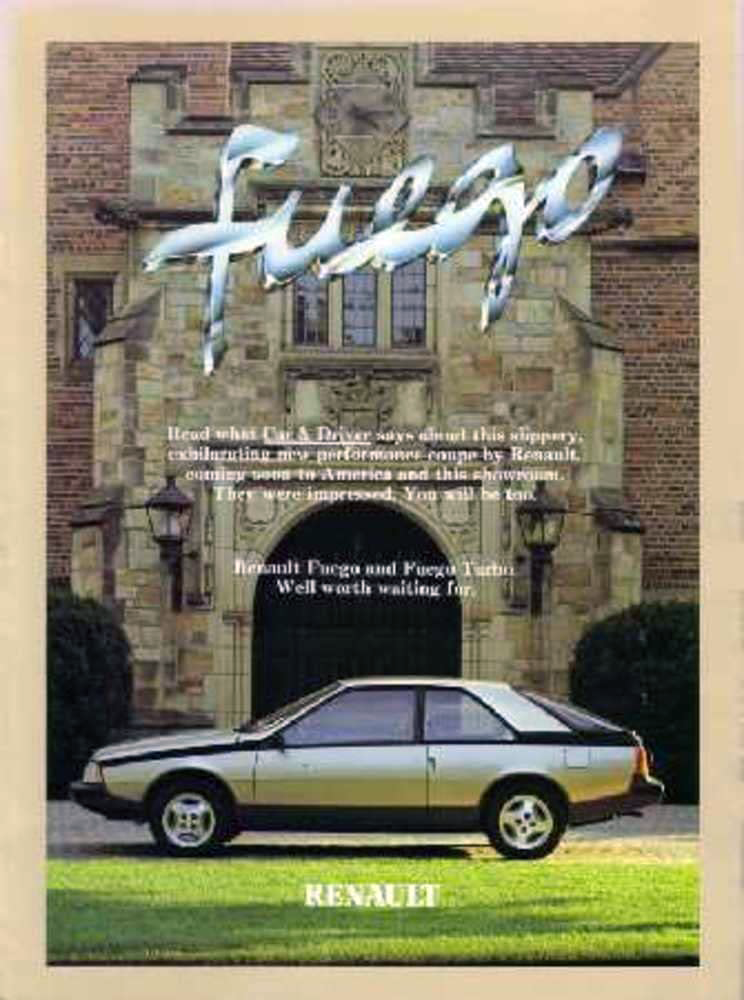
1982 Renault Fuego hatchback coupe

A friend of mine mentioned recently that he once owned an early Renault Fuego Turbo. As good a reason as any to finally complete this blog post—one I’ve had “in the hopper” for years.

After some sales success in Europe, Renault’s Fuego hatchback coupe became available for sale in the United States in 1982. Based on the Renault 18 sedan and using its floorpan and drivetrain, the Fuego was a different approach to a sporty coupe from what most manufacturers offered in the early eighties. Designed by Michel Jardin, the Fuego’s exterior looked like nothing else on the market, though some saw faint echos of the Porsche 924 and 928.

Two versions of the Fuego were available on its debut in the USA: the base Fuego coupe and the line-leading Fuego Turbo. The coupe came with an 81 bhp 1.6 liter/101 ci inline four with Bosch L-Jetronic fuel injection mated with a five-speed manual transmission. The Turbo featured an A5L 107 bhp 1.6 liter/96 ci inline four with Bosch L-Jetronic fuel injection and a Garrett T3 turbocharger paired with the same five-speed transmission.

As one might expect, performance was notably different for the two models. With a 2,372-pound curb weight, owners of a new Fuego Turbo could expect a 0-60 time of little over 10 seconds. A base Fuego was about 3.5 seconds slower, putting it in the same category as other slow sporty coupes for 1982, such as Lima-powered Mustangs and Capris and Iron Duke-powered Camaros and Firebirds. Mileage ratings were impressive for either version—the Turbo registered 26 city/39 highway mileage rating by the standards of the day. With a 14.8-gallon fuel, a Fuego Turbo owner could expect a range of 390 to 435 miles with a 10% fuel reserve.

1982 Renault Fuego advertisement

Standard equipment for the $8,654 base Fuego included front-wheel-drive, rack-and-pinion steering, front disc/rear drum brakes, and P185/70R13 tires on 13-inch wheels.

Standard equipment on the $10,704 Fuego Turbo included power rack-and-pinion steering, 190/65 HR 365 (metric) Michelin TRX radial tires on 14.4-inch cast alloy wheels, air conditioning, and an AM/FM stereo. An electric sunroof was a $400 option.

Despite their success in Europe, Fuegos did not sell well in North America, which was Renault’s evident lot in life. Peak sales of 33,229 in 1982 declined every year going forward—by 1986, the Fuego’s last year in the US, they were a mere 4,152.

Those who did buy a Fuego reported that they were generally happy with their choice. A January 1983 Popular Mechanics Owner’s Report found that owners liked the handling and styling, but wanted more power.

According to Hagerty’s valuation tools, all the money for a 1982 Renault Fuego in #1/Concours condition is $5,400, with a more typical #3/Good condition example going for $1,700. For unclear reasons, Hagerty only has values for the base version and not the Turbo. Fuegos rarely show up for sale in the Hemmings Motor News classifieds and on eBay Motors—in fact, they seem to have basically vanished. There was an interesting write-up on the Fuego in OldMotors last year.

Make mine Silver Poly, please.

This post is another first—my first Renault. I should probably cover the Alliance I spent a portion of the early nineties in sometime soon …

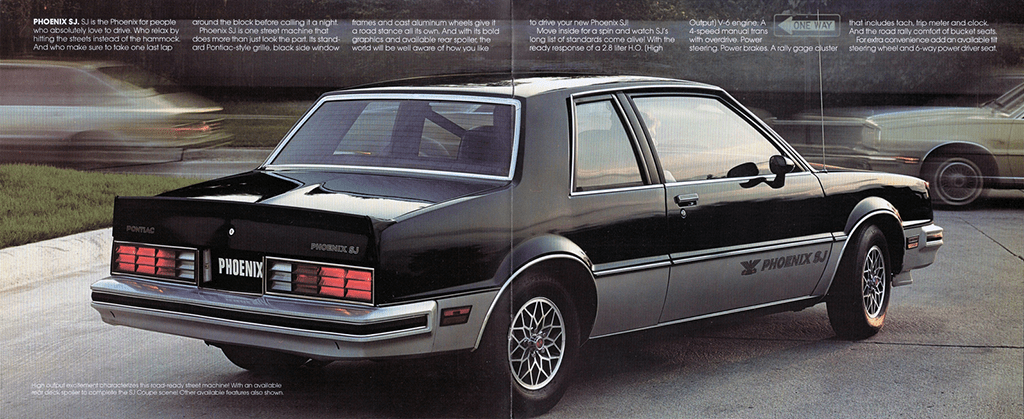
1982 Pontiac Phoenix SJ coupe

In this post, we’re once again revisiting interesting versions of mass-market eighties vehicles that just about nobody bought. This one is on the sportiest version of Pontiac’s X platform entry, which means I have now treated every GM marque’s X car entry at least once.

“… for people who absolutely love to drive.”

For the 1982 model year, the sporty SJ version of Pontiac’s Phoenix compact became its own model, instead of the trim option it had been for the previous two years. Aside from being a specific model, the biggest news was almost certainly that the 2.8 liter High Output V6 was standard for the SJ.

That new standard engine was the GM corporate LH7 135 bhp 2.8 liter/173 ci V6 with a Rochester E2SE two-barrel carburetor. It was paired with either a standard four-speed manual or an optional three-speed automatic. With the manual, 0-60 came in about 9 seconds—respectable for 1982.

Standard exterior and mechanical equipment on all Phoenix coupes included body-color front and rear bumpers, front-wheel-drive, single rectangular halogen headlamps, rack-and-pinion steering, front disc/rear drum brakes, and 185/80R13 tires on 13-inch wheels with hubcaps. Inside, Pontiac included a full-width front seat, a Deluxe steering wheel, and a Delco-GM AM radio with dual front speakers.

The mid-range LJ coupe included custom wheel covers, additional acoustical insulation, a Luxury cushion steering wheel, and a full-width luxury notchback front seat with center armrest.

1982 SJ pages from the Pontiac Phoenix brochure
SJ pages from the 1982 Pontiac Phoenix brochure

For $8,723 (about $29,800 in today’s dollars), the top-of-the-line SJ coupe added two-tone paint and specific graphics, a front air dam, power brakes, power steering, a special suspension, and 205/70R13 tires (now essentially unavailable) on 13-inch cast-aluminum wheels. Inside, additional standard features for the SJ included gauges (rally cluster, clock, tachometer, and trip odometer), a Formula steering wheel, and bucket seats.

Options & Production Numbers

Exterior and mechanical options for the SJ coupe included a removable glass sunroof, tinted glass, and a rear deck spoiler. Inside, Custom air conditioning, an electric rear window defogger, power door locks, power windows, a six-way power driver’s seat, a tilt steering wheel, and a Delco-GM AM/FM stereo with a cassette stereo tape player were among the many options available.

Of course, the SJ designation had been around for a long time—and not just for Pontiac. Duesenberg had used SJ in the early 1930s to describe the supercharged versions of their spectacular cars. By 1969, Pontiac had started (shamelessly—no surprise) using SJ for the top-of-the-line version of their Grand Prix coupe. The SJ designation for the top-of-the-line Grand Prix continued through the 1980 model year.

Despite Pontiac’s evident efforts to market the Phoenix SJ, it simply did not sell. With 994 produced, it was less than 6% of Phoenix coupe sales, with the vast majority going to the base version. Obviously, Pontiac had other things going on in 1982, including the introduction of a brand new Firebird and Trans Am.

The View From 2025

Front-wheel-drive Phoenixes of any sort have now almost completely vanished from the nation’s roads, and they rarely show up in the Hemming’s Motor News classifieds or eBay Motors. Bring a Trailer has sold a grand total of one front-wheel-drive Phoenix. The Phoenix does have one differentiator for me—it’s the single most commented post on Eighties Cars.

Make mine Dark Jadestone Metallic over Gray, please.

Other X platform cars I have written about include the 1980 Chevrolet Citation hatchback sedan, the 1981 Chevrolet Citation X-11 hatchback coupe, the 1983 Buick Skylark T Type coupe, the 1984 Oldsmobile Omega sedan, and the 1985 Chevrolet Citation II hatchback sedan.

Last updated March 2025.

1985 Oldsmobile Firenza ES sedan

In this post, we’re once again revisiting interesting versions of mass-market eighties vehicles that just about nobody bought. This one is a sporty version of Oldsmobile’s J platform entry.

“A sporty way to tame the open road.”

For 1985, Oldsmobile offered three different Firenza body styles: a three-door hatchback coupe, a four-door sedan, and a five-door wagon. Both the hatchback coupe and the sedan had sporty versions: in the case of the hatchback, it was the GT, while for the sedan, it was the ES. I am going to write about the ES in this post.

The Firenza’s standard powertrain was an 88 bhp LQ5 2.0 liter/121 ci inline four with throttle-body fuel injection paired with a four-speed manual transmission. Engine options included a $50 84 bhp LH8 1.8 liter/110 ci inline OHC four with the throttle-body fuel injection and a far more interesting $560 130 bhp LB6 2.8 liter V6 with multi-port fuel injection. Transmission options included a $75 five-speed manual (available for the LH8 only) and a $425 three-speed automatic (available for all three engines).

Standard equipment exterior and mechanical equipment on all Firenzas included front-wheel-drive, rack and pinion steering, and P175/80R13 blackwall tires on 13-inch wheels. Inside, contour-reclining bucket seats and an AM push-button radio with two front speakers and a fixed mast antenna were included. With a base price of $7,679 (about $23,300 in 2025 dollars), Firenza sedans added Deluxe wheel discs and a Deluxe steering wheel.

Firenza ES page from a 1985 Oldsmobile brochure

Standard exterior equipment on the ES sedan included amber turn signals, a Firenza ES nameplate on the front fenders, and blacked-out trim all around. Mechanical equipment included the 1.8 liter inline four, a five-speed manual transmission, tungsten halogen high-beam headlamps, a firm ride and handling package, and Goodyear Eagle GT P205/60R14 blackwall tires (a size still readily available, though generally not from major manufacturers) on 14-inch wheels with Deluxe styled wheel discs.

Inside, a leather-wrapped steering wheel and a Rallye instrument panel cluster were included. Only three exterior colors were available for the ES: Silver Metallic, Light Teal Blue Metallic, and Carmine Red.

Options & Production Numbers

Among the many exterior and mechanical options available for the ES were Soft-Ray tinted glass, a Vista-Vent glass-panel sunroof ($310), and two-tone paint. Inside, Oldsmobile offered a Four-Season air conditioner, power door locks, and a choice of three optional radios. A special contoured hood was added if the V6 was selected.

For Oldsmobile in 1985, the Firenza was emphatically not the center of the product line, with every other model—all of them at least somewhat larger—selling better. Of the Firenzas that sold, the vast majority were base sedans, not the GT hatchback coupe (498 sold) or the ES sedan (863 sold).

The View From 2025

Firenzas of any sort are now almost completely vanished from the nation’s roads, and they rarely appear in the Hemming’s Motor News classifieds or eBay Motors.

Other J platform cars I have covered in this blog include the 1984 Buick Skyhawk coupe, the 1982 Cadillac Cimarron sedan, the 1988 Cadillac Cimarron sedan, the 1986 Chevrolet Cavalier Z24 coupe, and the 1984 Pontiac 2000 Sunbird S/E hatchback coupe.

Last updated April 2025.

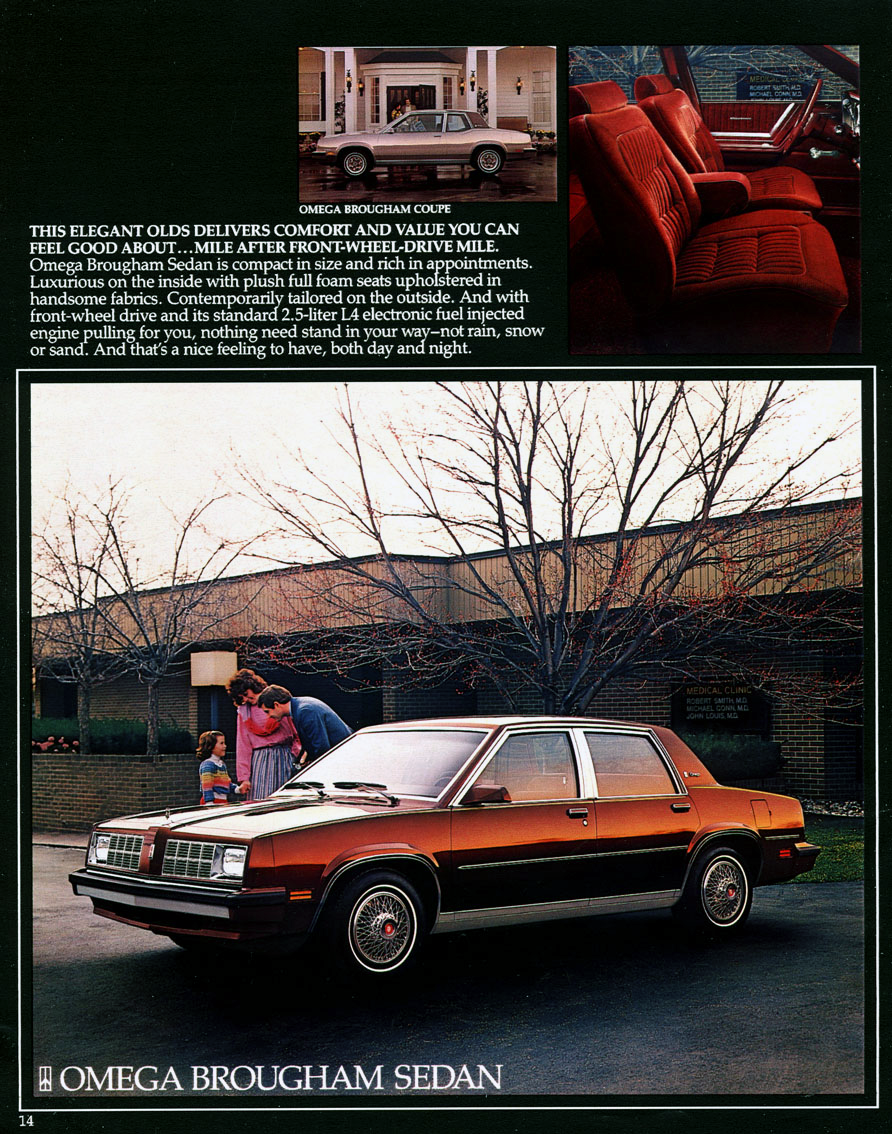
1984 Oldsmobile Omega sedan

“… comfort and value you can feel good about …”

In its final year, Oldsmobile’s Omega variant of GM’s X-car received few changes. The grille now consisted of horizontal stripes with vertical park/signal lamps, and there were new bumper treatments.

The Omega’s standard powertrain continued to be an LR8 “Iron Duke 92 bhp 2.5 liter/151 ci inline four with electronic fuel injection paired with a four-speed manual transmission. Powertrain options included the LE2 112 bhp 2.8 liter/173 ci V6 ($250) and a three-speed automatic transmission ($425). Mileage with the 2.8 liter V6 and the automatic was 21 city/33 highway by the day’s standards (17/24 by today’s measures). With a 14.6-gallon fuel tank, an Omega’s owner could expect a range of between 270 and 350 miles with a 10% fuel reserve.

Standard equipment on the $7,832 (about $24,700 in 2025 dollars) Oldsmobile Omega sedan included front-wheel-drive, power-assisted rack and pinion steering, power front disc/rear drum brakes, P185/80R13 steel-belted radial tires (now a trailer size) on 13-inch wheels, Deluxe wheel discs, Custom bench seating, and a fold-down center armrest.

Omega Brougham page from the 1984 Oldsmobile brochure

Moving up to the $8,104 Omega Brougham added a stand-up hood ornament, a pillar applique molding, lower bodyside moldings, carpeted lower door panels, and a Deluxe steering wheel.

The $675 ES package (RPO W48) remained available in 1984 as an upgrade for the Brougham, but only 224 were ordered. By far the sportiest version of the Omega, the ES included a suspension with higher-rate front and rear springs, firmer front and rear shock absorbers, and thicker stabilizer bars. In an attempt to appear more European, the ES2500 was the version with the 2.5 liter inline-four, while the ES2800 was the version with the 2.8 liter V6. Both versions got a blacked-out grille.

Options & Production Numbers

Exterior and mechanical options on all Omegas included a glass-panel sunroof ($300), power steering, and high-capacity cooling. Inside, cruise control, power windows, and a four-season air conditioner were available.

Omega sales were significant but not great, and they had been dropping steadily from the 1981 peak of almost 148,000 (including over 101,000 sedans). Oldsmobile produced 41,874 Omega sedans in the 1984 model year—small potatoes compared to all the other Oldsmobile sedans available (Firenza, Cutlass Ciera, Cutlass Supreme, Delta 88 Royale, and Ninety-Eight Regency).

The View From 2025

I haven’t seen an Omega on the streets in almost two decades, and they rarely show up in the Hemmings Motor News classifieds, on eBay Motors, or on Bring a Trailer. I’m also pretty sure I’ve never seen one shown, though I’m not betting against that happening at some point.

Make mine Dark Royal Blue Metallic, please.

Other X-cars I have written about include the 1983 Buick Skylark T TYPE coupe, the 1980 Chevrolet Citation hatchback sedan, the 1981 Chevrolet Citation X-11 hatchback coupe, the 1985 Chevrolet Citation II hatchback sedan, and the 1982 Pontiac Phoenix SJ coupe.

Last updated March 2025.

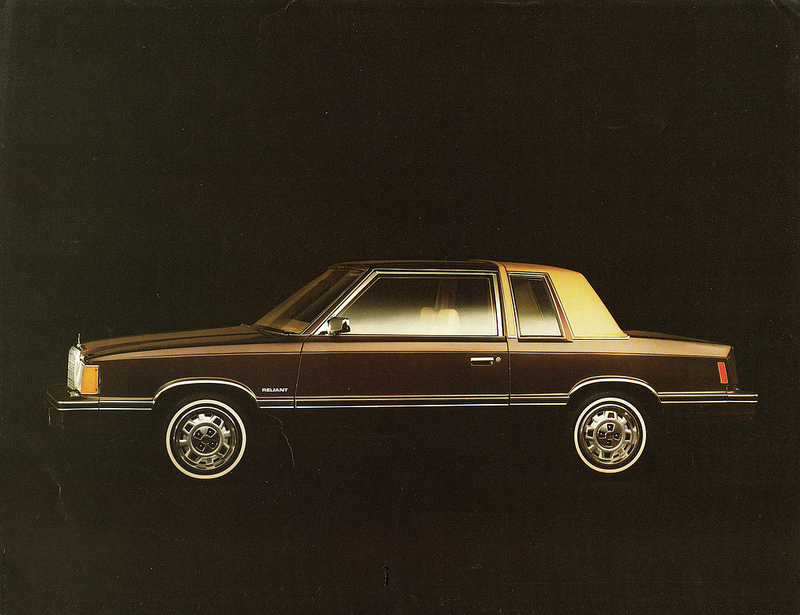
1981 Plymouth Reliant coupe

Lee Iacocca passed in July 2019 after leading a full life—he was 94. In his honor, I revised my write-up on one of his most famous creations.

“right for the times we drive in”

The 1981 Plymouth Reliant and its sibling, the Dodge Aries, are the K-body cars often (and reasonably) credited with saving Chrysler in the early 1980s. The first K cars were basic transportation, famously (like the GM X cars a year before) with no roll-down rear windows and just barely mid-size by the EPA’s classification—with an overall length of 176 inches, the Reliant coupe is almost exactly as long as a 2025 Mini Countryman.

The standard powertrain was an 84 bhp 2.2 liter/135 ci inline four with a Holley two-barrel carburetor paired with a four-speed manual. A Mitsubishi built 92 bhp 2.6 liter/156 ci inline four was optional for $159 and required both power steering ($174) and the three-speed TorqueFlite automatic ($360). Gas mileage with the base powertrain combination was rated at 29 city/41 highway by the day’s standards (23/29 by today’s measures). With a 13-gallon gas tank, a Reliant coupe with the standard engine and transmission could travel between 305 and 410 miles with a 10% fuel reserve.

1981PlymouthReliant
1981 Plymouth Reliant two-door coupe, scan courtesy of Alden Jewell

For $5,880 (about $22,200 in 2025 dollars), you got a Reliant coupe with front-wheel drive, rack-and-pinion steering, front disc/rear drum brakes, and P175/75R13 tires (a size that isn’t generally available anymore) on 13-inch wheels. Inside, a cloth and vinyl split back bench seat and an AM radio were included. The base coupe was only available in Pearl White, Natural Suede Tan, and Formal Black.

Spending another $435 on your Reliant coupe moved you up to Custom trim, which added quarter-window louvers, halogen headlights, a cigarette lighter, a color-keyed Deluxe two-spoke steering wheel, a digital clock, and a glove box lock. You also got many more exterior and interior color choices.

The top-of-the-line Special Edition (SE) Reliant coupes ($6,789 or about $25,600 in today’s dollars) added dual horns, deluxe wheel covers, special sound insulation, a cloth bench seat, and a snazzier “luxury” two-spoke steering wheel. Cloth bucket seats ($91) were only available with the SE.

Options, Production Numbers, & Performance

External and mechanical options for all Reliant coupes included tinted glass ($75), a glass sunroof ($246), and power brakes ($82). Both the mid-range upgrade P185/75R13 tires and the P165/75R14 upmarket tires (a size that fit the mid-90s Plymouth Neon compact just fine) are still readily available.

Inside, air conditioning cost $605 and required tinted glass, power brakes, and power steering—things were tightly engineered in the early 1980s. Other options included automatic speed control ($132), intermittent wipers ($44), a tilt steering wheel ($81), power door locks ($93), power front seats ($173 and said to be quite rare), along with a variety of radios up to an AM/FM radio with a cassette tape player and four speakers ($224).

The Reliant sold well in 1981—between the coupe and the sedan, Plymouth moved 101,127. Motor Trend managed to get a 2.2 liter with the automatic to do 0-60 in 12.4 seconds—they tried with another Reliant running the same combination, and it took 14.0 (oog) seconds. Top speed (if you could call it that) ranged from 88 to 96 mph in the 2,350-pound car.

The View From 2025

In 2025, Plymouth Reliants coupes rarely come up for sale in the Hemmings Motor News classifieds, on eBay Motors, or on Bring a Trailer, though you do see them occasionally on Craigslist. I haven’t seen a coupe in the wild for many years.

Make mine Baron Red, I think.

Other K-body and K-body based cars I have covered in this blog include the 1982 Chrysler LeBaron convertible, the 1984 Chrysler Laser hatchback coupe, the 1984 Dodge Daytona hatchback coupe, the 1985 Dodge 600 Club Coupe, and the 1986 Chrysler Town & Country convertible, and the 1987 Dodge Aries LE sedan. I also did a short commentary on an unidentified K-car wagon called Some Quiet Love For A K Car.

Last updated April 2025.

1987 Sterling 825 sedan

“… such effortless motion, …”

1987 Sterling 825 interior

The Sterling 825 sedan was an interesting (perhaps desperate) attempt at re-introducing Rover cars to the North American market, but with different branding than the brutally unsuccessful Rover 3500 hatchback sedan from 1980. Based on the same platform as the acclaimed Acura Legend, the Sterling featured an angular exterior design and an interior with traditional British luxury cues, such as Connolly leather seats and burled walnut trim. On the exterior, only the door handles were obviously shared between the Acura and the Sterling.

A Honda-built 151 bhp 2.5 liter/152 ci V6 with fuel injection combined with a five-speed manual transmission yielded mpg ratings of 18 city /24 highway by the day’s standards (16/22 by modern standards). The optional four-speed automatic transmission dropped mpg incrementally to 17 city/23 highway. With the standard powertrain and an 18-gallon gas tank, a Sterling driver could expect a 310 to 340 mile range with a 10% fuel reserve.

Equipment, Reception, & Production Numbers

The $19,200 (about $55,300 in today’s dollars or about what a loaded 2025 Acura TLX sedan goes for) 825 S came with remote locking, power rack-and-pinion steering, power brakes, and 195/65R15 tires (a size still readily available) on 15-inch alloy wheels. Inside, air conditioning, power windows, an electric moonroof, cruise control, velour cloth seats, and a Phillips AM/FM stereo cassette with six speakers were all included.

Moving up to the $23,900 (about $68,800 in 2025 dollars) 825 SL added a four-speed automatic transmission, Bosch anti-lock brakes, Deluxe alloy wheels, a 10-function trip computer, leather upholstery with a heated driver’s seat, and an eight-speaker stereo.

Advertised as “The inevitable British road car.” Sterling sold 14,171 units of the 825 in the 1987 model year—not a bad debut. But, trouble was brewing; in an attempt to generate more jobs in the United Kingdom, Rover had decided to use Lucas electronic systems instead of those from Honda. Predictably, those electronics weren’t reliable, and there were also issues with the interior plastics and the exterior paint. Finally, rust came much too quickly.

All this meant that sales dropped rapidly. In 1988, only 8,901 were sold, and every year following that, things got worse. In August 1991, Sterling announced they were leaving the North American market after selling a total of about 35,000 cars over five years.

The View From 2025

The Sterling 825 rarely comes up for sale in the Hemmings Motor News classifieds or on eBay Motors. However, as I update this post in early 2025, there’s a 1988 825 SL on Bring a Trailer. I haven’t seen one in person in many years, but I believe I’d still notice that handsome styling if I did.

Make mine Pulsar, I think.

Last updated March 2025.

1983 Buick Skylark T TYPE coupe

“A road car with a very distinct personality.”

Buick offered five separate T TYPE models (their spelling) in 1983. One of the new ones was the Skylark coupe, Buick’s version of the X-car.

The Skylark T TYPE‘s standard powertrain was the LH7 “high output” 135 bhp 2.8 liter/173 ci V6 with a Rochester E2SE two-barrel carburetor paired with a four-speed manual. The 0-60 time was a little over 9 seconds—respectable but not great in 1983. Mileage was 21 city/34 highway by the day’s standards (17/23 by today’s measures). With a 15.1-gallon gas tank, a T TYPE owner could expect a range of 270 to 335 miles with a 10% fuel reserve.

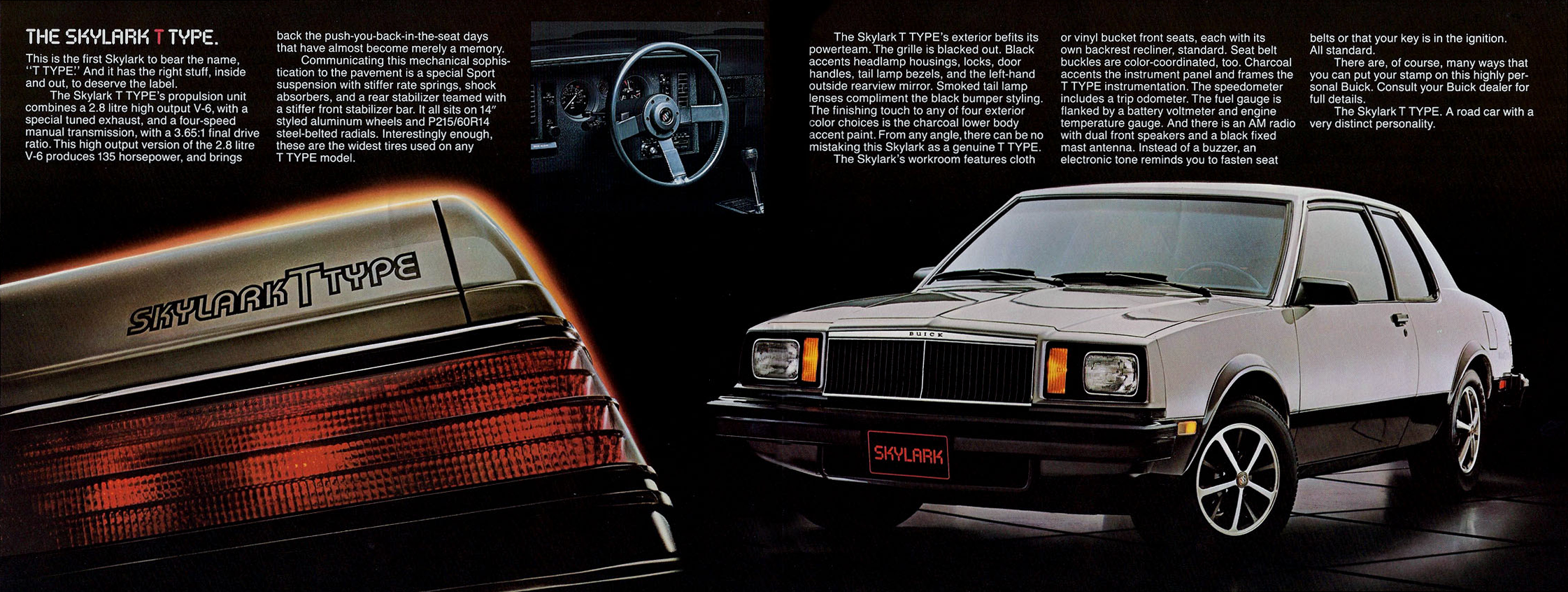
Skylark pages from the 1983 Buick T TYPE brochure

Standard mechanical equipment on the $9,337 T TYPE coupe (approximately $30,700 in today’s dollars or about what a 2026 Buick Encore GX Avenir SUV costs) included a Sport suspension (stiffer rate springs, stiffer shock absorbers, a more rigid front stabilizer bar, and added rear stabilizer bar), a “special tuned” exhaust, a 3.65:1 final drive ratio, and P215/60R14 steel belted radial tires (a size still available from BFGoodrich and Riken) on 14-inch styled aluminum wheels. Exterior equipment specific to the T TYPE included a blacked out grille, smoked tail lamp lenses, and charcoal lower body accent paint. Inside, vinyl or cloth bucket seats with backrest recliner, a full-length operating console, a special Sport steering wheel, and color-coordinated seat belt buckles were included.

Standard equipment on all Skylarks included front-wheel drive, power rack and pinion steering, power front disc/rear drum brakes, tungsten-halogen high/low beam headlamps, a Delco Freedom II Plus battery, and an AM radio with two front speakers and a fixed-mast radio antenna.

Options & Production Numbers

Options included dual electric remote mirrors ($78), the Vista-Vent flip-open removable glass sunroof ($295), air conditioning ($725), Cruise Master speed control with resume ($170), power windows ($180), tilt steering ($105), and an ETR AM/FM stereo radio with a cassette player and a graphic equalizer ($505).

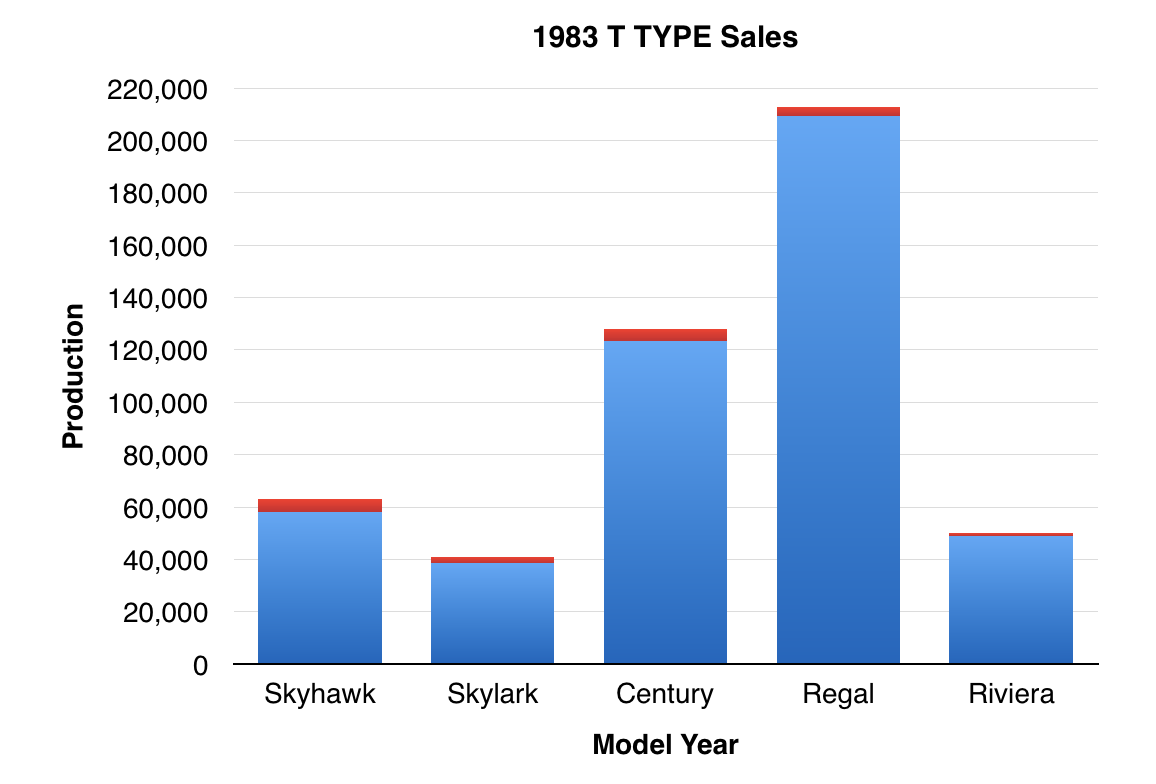
Despite Buick’s commitment to extending the T TYPE line (they even went to the trouble of creating a T TYPE brochure), sales were not impressive—about 3.5% of the sales of the Skyhawk, Skylark, Century, Regal, and Riviera. Of the T TYPEs, the Skylark was comparatively successful, with 2,489 sold—about 6.1% of overall Skylark sales.

The View From 2025

I haven’t seen a Skylark T TYPE since they were new, and I saw one parked outside of the long-gone Crown Buick on the Lincoln Highway in Ardmore, PA. Skylarks of this era are rarely seen in the Hemmings Motor News classifieds, on eBay Motors, or on Bring a Trailer—when one does come up for sale, Hemmings considers it worthy of a portion of a blog entry.

There were only four exterior colors available for the Skylark T TYPE: White, Silver Metallic, Dark Red Metallic, and Light Sand Gray. Make mine Silver Metallic, please.

Other X-cars I have written about in this blog include the 1980 Chevrolet Citation hatchback sedan, the 1981 Chevrolet Citation X-11 hatchback coupe, the 1985 Chevrolet Citation II hatchback sedan, the 1984 Oldsmobile Omega sedan, and the 1982 Pontiac Phoenix SJ coupe.

Last updated August 2025.

1985 Chevrolet Citation II hatchback sedan

“One car that does it all.”

1985 was, mercifully, the last year for the Chevrolet Citation. In a sad General Motors tradition, it was also the best Citation (the 1985 Citation had no recalls after the nine that the 1980 had). Half-heartedly renamed Citation II in 1984, the X-car would be replaced by the Nova in 1986. There were some changes: new colors were available, and the dashboard was revised, allowing the “normal” horizontal Delco radios.

For 1985, the Citation II’s standard powertrain remained the LR8 “Iron Duke 92 bhp 2.5 liter/151 ci inline four with throttle-body fuel injection paired with a four-speed manual (the Citation never got a five-speed—even as an option). With the standard powertrain, 0-60 came in a little under 12 seconds in the 2,500-pound car with a theoretical top speed of 101 mph. Mileage was competitive: 24 city/34 highway by the day’s standards (21/31 by today’s standards). With a 14-gallon fuel tank, the owner of a base Citation could expect a range of between 325 and 365 miles with a 10% field reserve.

Powertrain options included two different versions of the 2.8 liter/173 ci V6 (why?): the LE2 112 bhp version with a two-barrel carburetor ($260) and the LB6 130 bhp type with fuel injection ($435). A three-speed automatic was—of course—available ($425). The V6 in general, and especially the fuel-injected version, made the Citation II substantially more spritely: 0-60 times of about 9 seconds and a top speed of about 118 mph. You paid a mileage price for that performance: 19 city/26 highway by 1985 standards (17/24 by today’s standards).

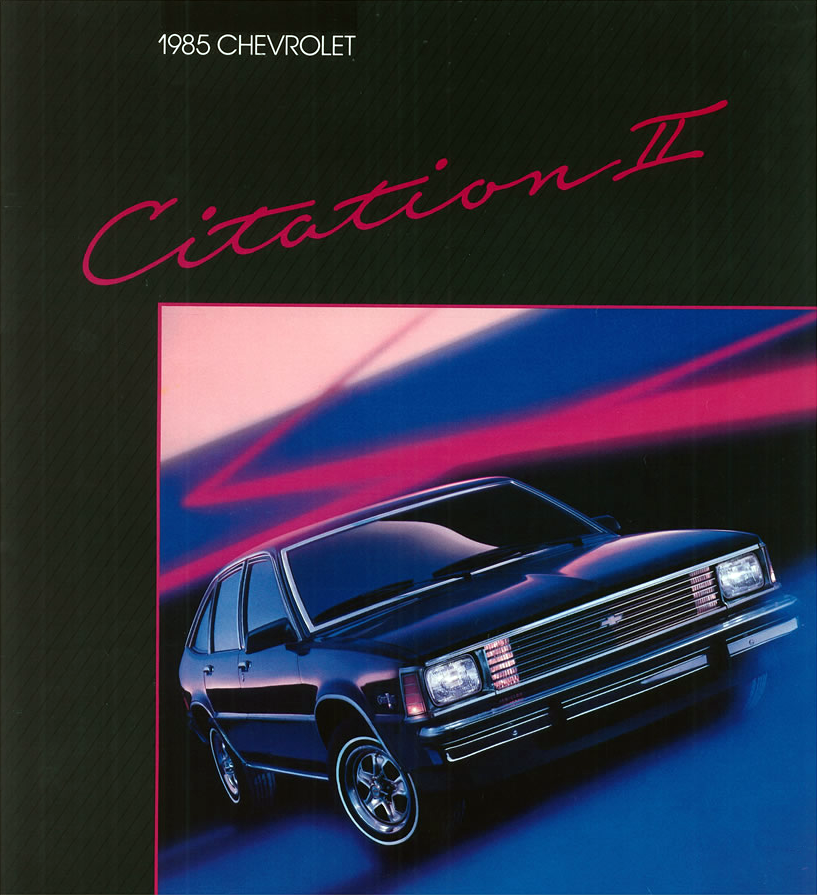
Cover of the 1985 Chevrolet Citation II brochure

Standard exterior and mechanical equipment on the $7,090 Citation II hatchback sedan (approximately $21,500 in 2025 dollars—precisely what base 2025 Chevrolet Trax LS SUV goes for) included halogen headlamps, rack-and-pinion steering, front disk/rear drum brakes, and P185/80R-13 radial tires (now a trailer size) on 13-inch by 5.5-inch steel wheels with full wheel covers. Inside, a low back front bench seat with adjustable head restraints, sliding door locks, a lockable glove box, a folding rear seat, and an AM/FM radio with two speakers were included.

Options & Production Numbers

Exterior and mechanical options included tinted glass ($110), two-tone paint ($176), power brakes ($100), power steering ($215), and the F41 sports suspension (acknowledged to be a bargain at $33). Inside, a quiet sound/rear decor package ($92), air conditioning ($730), cruise control ($175), Comfortilt steering wheel ($110), an electric rear defogger ($140), and an electronic-tuning AM/FM stereo radio with cassette, clock, and seek/scan ($319) were all available.

The 1985 Citation II did not sell—overall sales in this last year fell to a mere 8% of the first year sales. At an average Chevrolet dealership, you could expect it to be outsold by the Chevette, the Cavalier, the Camaro, the Celebrity, the Monte Carlo, and the Caprice Classic.

The View From 2025

I haven’t seen a Citation in years—the last one was an X-11 in early 2014. They rarely appear in the Hemming’s Motor News classifieds, on eBay Motors, or on Bring a Trailer. I’m pretty sure I’ve never seen one shown, though I’m not betting against that at some point.

Make mine the Medium Gray Metallic/Silver Metallic two-tone, please.

Other Citations I’ve written about include the 1980 hatchback sedan and the 1981 X-11 hatchback coupe. X-cars from other marques covered in this blog include the 1983 Buick Skylark T TYPE coupe, the 1984 Oldsmobile Omega sedan, and the 1982 Pontiac Phoenix SJ coupe.

Last updated March 2025.