The Sterling 825 sedan was an interesting (perhaps desperate) attempt at re-introducing Rover cars to the North American market, but with different branding than the brutally unsuccessful Rover 3500 hatchback sedan from 1980. Based on the same platform as the acclaimed Acura Legend, the Sterling featured an angular exterior design and an interior with traditional British luxury cues, such as Connolly leather seats and burled walnut trim. On the exterior, only the door handles were obviously shared between the Acura and the Sterling.
A Honda-built 151 bhp 2.5 liter/152 ci V6 with fuel injection combined with a five-speed manual transmission yielded mpg ratings of 18 city /24 highway by the day’s standards (16/22 by modern standards). The optional four-speed automatic transmission dropped mpg incrementally to 17 city/23 highway. With the standard powertrain and an 18-gallon gas tank, a Sterling driver could expect a 310 to 340 mile range with a 10% fuel reserve.
Equipment, Reception, & Production Numbers
The $19,200 (about $55,300 in today’s dollars or about what a loaded 2025 Acura TLX sedan goes for) 825 S came with remote locking, power rack-and-pinion steering, power brakes, and 195/65R15 tires (a size still readily available) on 15-inch alloy wheels. Inside, air conditioning, power windows, an electric moonroof, cruise control, velour cloth seats, and a Phillips AM/FM stereo cassette with six speakers were all included.
Moving up to the $23,900 (about $68,800 in 2025 dollars) 825 SL added a four-speed automatic transmission, Bosch anti-lock brakes, Deluxe alloy wheels, a 10-function trip computer, leather upholstery with a heated driver’s seat, and an eight-speaker stereo.
Advertised as “The inevitable British road car.” Sterling sold 14,171 units of the 825 in the 1987 model year—not a bad debut. But, trouble was brewing; in an attempt to generate more jobs in the United Kingdom, Rover had decided to use Lucas electronic systems instead of those from Honda. Predictably, those electronics weren’t reliable, and there were also issues with the interior plastics and the exterior paint. Finally, rust came much too quickly.
All this meant that sales dropped rapidly. In 1988, only 8,901 were sold, and every year following that, things got worse. In August 1991, Sterling announced they were leaving the North American market after selling a total of about 35,000 cars over five years.
The View From 2025
The Sterling 825 rarely comes up for sale in the Hemmings Motor News classifieds or on eBay Motors. However, as I update this post in early 2025, there’s a 1988 825 SL on Bring a Trailer. I haven’t seen one in person in many years, but I believe I’d still notice that handsome styling if I did.
1985 was, mercifully, the last year for the Chevrolet Citation. In a sad General Motors tradition, it was also the best Citation (the 1985 Citation had no recalls after the nine that the 1980 had). Half-heartedly renamed Citation II in 1984, the X-car would be replaced by the Nova in 1986. There were some changes: new colors were available, and the dashboard was revised, allowing the “normal” horizontal Delco radios.
For 1985, the Citation II’s standard powertrain remained the LR8 “Iron Duke“ 92 bhp 2.5 liter/151 ci inline four with throttle-body fuel injection paired with a four-speed manual (the Citation never got a five-speed—even as an option). With the standard powertrain, 0-60 came in a little under 12 seconds in the 2,500-pound car with a theoretical top speed of 101 mph. Mileage was competitive: 24 city/34 highway by the day’s standards (21/31 by today’s standards). With a 14-gallon fuel tank, the owner of a base Citation could expect a range of between 325 and 365 miles with a 10% field reserve.
Powertrain options included two different versions of the 2.8 liter/173 ci V6 (why?): the LE2 112 bhp version with a two-barrel carburetor ($260) and the LB6 130 bhp type with fuel injection ($435). A three-speed automatic was—of course—available ($425). The V6 in general, and especially the fuel-injected version, made the Citation II substantially more spritely: 0-60 times of about 9 seconds and a top speed of about 118 mph. You paid a mileage price for that performance: 19 city/26 highway by 1985 standards (17/24 by today’s standards).
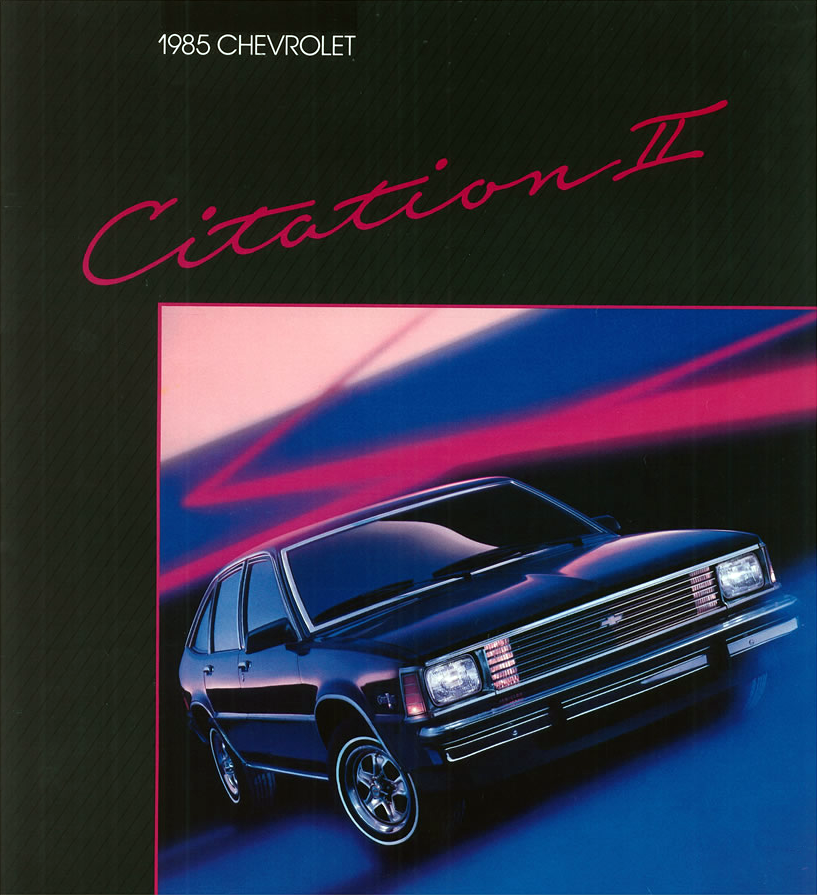
Cover of the 1985 Chevrolet Citation II brochure
Standard exterior and mechanical equipment on the $7,090 Citation II hatchback sedan (approximately $21,500 in 2025 dollars—precisely what base 2025 Chevrolet Trax LS SUV goes for) included halogen headlamps, rack-and-pinion steering, front disk/rear drum brakes, and P185/80R-13 radial tires (now a trailer size) on 13-inch by 5.5-inch steel wheels with full wheel covers. Inside, a low back front bench seat with adjustable head restraints, sliding door locks, a lockable glove box, a folding rear seat, and an AM/FM radio with two speakers were included.
Options & Production Numbers
Exterior and mechanical options included tinted glass ($110), two-tone paint ($176), power brakes ($100), power steering ($215), and the F41 sports suspension (acknowledged to be a bargain at $33). Inside, a quiet sound/rear decor package ($92), air conditioning ($730), cruise control ($175), Comfortilt steering wheel ($110), an electric rear defogger ($140), and an electronic-tuning AM/FM stereo radio with cassette, clock, and seek/scan ($319) were all available.
The 1985 Citation II did not sell—overall sales in this last year fell to a mere 8% of the first year sales. At an average Chevrolet dealership, you could expect it to be outsold by the Chevette, the Cavalier, the Camaro, the Celebrity, the Monte Carlo, and the Caprice Classic.
The View From 2025
I haven’t seen a Citation in years—the last one was an X-11 in early 2014. They rarely appear in the Hemming’s Motor News classifieds, on eBay Motors, or on Bring a Trailer. I’m pretty sure I’ve never seen one shown, though I’m not betting against that at some point.
Make mine the Medium Gray Metallic/Silver Metallic two-tone, please.
Hemmings Motor News published an extended discussion on the Cadillac Cimarron in their always interesting Hemmings Daily blog, so I figured I’d bring one of my first posts up to a more current location.
“A new kind of Cadillac for a new kind of Cadillac owner.”
Ah—the poor Cadillac Cimarron, rushed to market for CAFE and other reasons without much thought as to who would actually buy it. When released in 1982, it was just a nice as possible, relatively well equipped Chevrolet Cavalier.
Inside page from the 1982 Cadillac Cimarron brochure
The only engine available for 1982 was the 88 bhp L46 1.8 liter/112 ci inline four with Rochester Varajet II two-barrel carburetor. When paired with the standard four-speed manual transmission, mileage was an impressive 26 city/42 highway by the standards of the day (about 21/31 by modern standards), but the car was slow—0-60 mph took about 14 seconds. A three-speed automatic transmission was optional and likely even slower (estimates come to about 16 seconds). The 13.7-gallon fuel tank gave a range of between 330 and 420 miles with a 10% reserve.
The $12,181 base price (about $32,900 in today’s dollars—just a little under what a base 2018 Cadillac ATS sedan costs) included standard exterior and mechanical features such as power brakes, power steering, power mirrors, intermittent windshield wipers, and P195/70R13 tires on 13-inch aluminum wheels. Air conditioning, leather seating areas, a leather steering wheel, a tachometer, and an AM/FM stereo radio with four speakers were all standard in the interior.
Options included a sunroof ($261), cruise control (about $150), power door locks ($12—why bother making them an option?), power windows (yes, the base 1982 Cimarron came with roll-up windows—power windows were an extra $216), six-way power seats ($366), tilt steering wheel ($88), and an AM/FM stereo radio with cassette ($153). It wasn’t hard to load a Cimarron up to almost $13,500—real money in 1982 and about $36,400 in 2018 dollars.
In typical General Motors fashion, the Cimarron improved each year (sometimes significantly). However, the stench of that horribly failed initial release stayed with the car until Cadillac finally stopped selling them at the end of the 1988 model year. By that point, the Cimarron had upgraded from the fairly awful four-cylinder to a decent (and standard) V6 and had exterior styling that was at least somewhat more differentiated from Chevrolet’s.
So, the Cimarron remains a spectacularly easy target—routinely making those “worst ten cars of all time” lists and suchlike. I have yet to see a Cimarron at a serious classic car show, but I’m betting some intrepid soul will save one and bring it back.
Surprisingly, Hagerty does track the Cimarron with their valuation tools—according to them, all the money for a 1982 in #1/Concours condition is $6,100, with a far more typical #3/Good car going for $1,600. I can’t remember ever seeing one for sale in the Hemmings Motor News classifieds—they’re treated by Cadillac folks like Ford folks treat the Mustang II from the 1970s. You do occasionally see them on eBay Motors.
For 1980, Lincoln completely revised the Continental Mark series, downsizing it for the first time and adding a sedan. The coupe was over 14 inches shorter than the 1979 Mark V and about 750 pounds lighter. However, the Mark VI was still a big car by any standard—more than two feet longer than a 2025 Mercedes-Benz CLE coupe.
Standard power for 1980 was a Windsor 129 bhp 4.9 liter/302 ci V8 with throttle-body fuel injection paired with a four-speed automatic overdrive transmission. Buyers could specify a $160 upgrade, which was the Windsor (notCleveland) 140 bhp 5.8 liter/351 ci V8 with a Motorcraft 7200 VV two-barrel carburetor. With the standard powertrain, 0-60 took about 14 seconds in the 3,892-pound car. Mileage was 17 city/24 highway by the day’s standards—with the 18-gallon gas tank, Mark VI owners could expect a range of 300 to 330 miles with a 10% fuel reserve.
Standard exterior and mechanical equipment on the $16,291 base Mark VI ($70,200 in today’s dollars or a little over what a 2025 Lincoln Aviator Reserve mid-size SUV costs) included hidden halogen headlamps, luxury wheel covers, and Michelin P205/75R15 white sidewall steel-belted radial tires (a size still readily available) on 15-inch wheels. Inside, cloth Twin Comfort lounge seats, power windows, an electronic instrument panel with message center, a four-spoke color-keyed steering wheel, automatic temperature control air conditioning, and an AM/FM stereo radio with power antenna were all standard.
Packages, Options, & Production Numbers
As had been true for many years, there were multiple Designer Series packages available for the Mark VI:
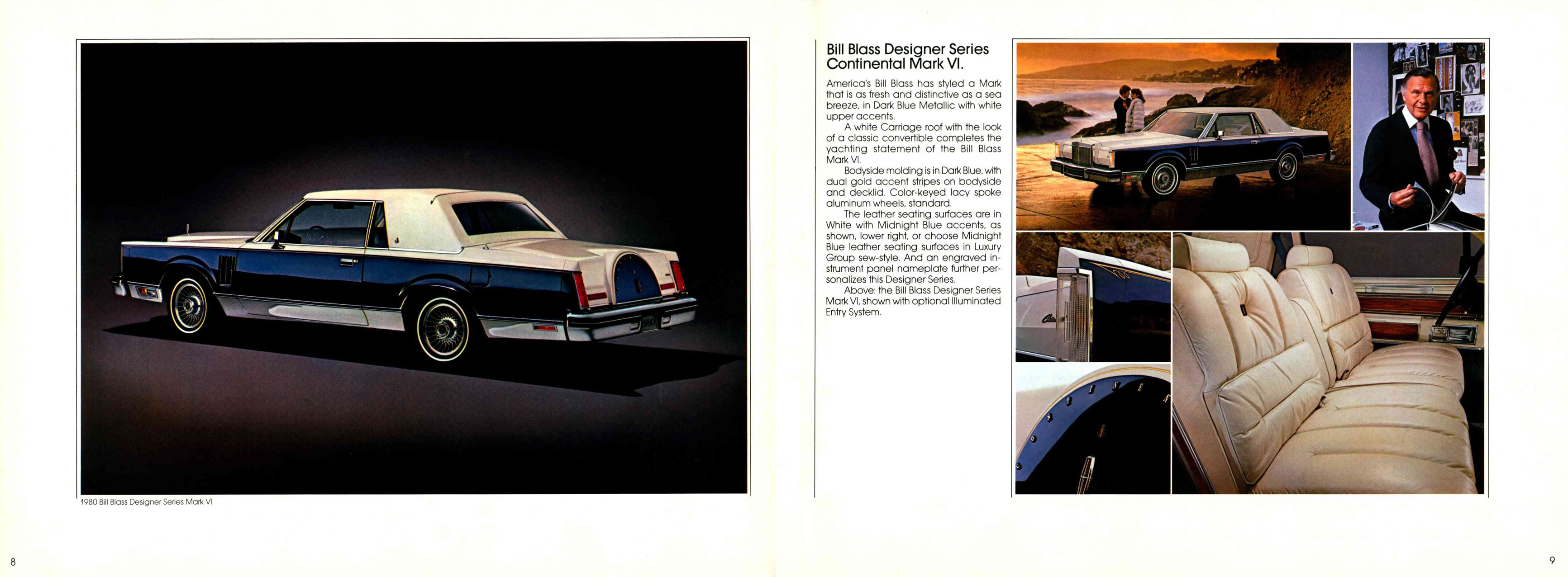
Bill Blass pages from the 1980 Lincoln Continental Mark VI brochure
The Bill Blass Designer Series package ($1,825) included Dark Blue Metallic paint with white upper accents, a white Carriage roof, dark blue bodyside moldings, dual gold accent stripes on bodyside and decklid, and color-keyed lacy spoke aluminum wheels. Inside, leather seating surfaces were a choice of white with blue accents or midnight blue in the Luxury Group sew-style.
The Cartier Designer Series package ($2,191) included Light Pewter Metallic/Medium Pewter Metallic two-tone paint, a Medium Pewter Landau roof, color-keyed turbine spoke aluminum wheels, light pewter bodyside moldings, single dark red accent stripes on the body and decklid, the Cartier signature in the opera windows, and the Cartier monogram on logo on the front fender louvers and the decklid. Inside, there was a choice of either cloth or leather seating surfaces in the Luxury Group sew-style.
The Givenchy Designer Series package ($1,739) included Light Fawn Metallic/Bittersweet Metallic two-tone paint, with tri-band pinstriping, a Light Fawn full vinyl roof, wire wheel covers, and the Givenchy monogram on the hood and the rear decklid. Inside, the Givenchy had bittersweet six-way power Twin Comfort seats in the Luxury Group sew-style.
The Pucci Designer Series package ($2,191) included Light Fawn Metallic/Medium Fawn Metallic two-tone paint, with tri-band pinstriping, a Light Fawn Landau roof, color-keyed lacy spoke aluminum wheels, and the Pucci logo on the front fender louvers and the decklid. Inside, leather seating surfaces had light champagne bolsters with medium champagne inserts in the Luxury Group sew-style.
—all four Designers Series packages included a personalized engraved nameplate on the instrument panel.
There was also the Signature Series ($5,485), which added just about every major option and brought the price to $21,776 (about $93,800 in 2025 dollars). Standard exterior and mechanical features on the Signature Series included a Valino grain vinyl Landau roof and color-keyed turbine spoke cast aluminum wheels. Inside, the Signature Series included Twin Comfort Lounge six-way power seats, the Keyless Entry System, an Automatic Garage Door Opener Control, Speed Control, a tilt steering wheel, the defroster group, illuminated visor vanity mirrors, and a six-speaker Premium Sound System. The Signature Series was available in Silver Metallic or Dark Maroon and could be ordered with Dark Red Signature Body Cloth or leather seating surfaces.
Individual options included touring lamps ($67), a power glass moonroof, wide white sidewall tires, Twin Comfort Lounge six-way power seats ($171), a tilt steering wheel ($83), and Speed Control ($149).
Like the Ford Thunderbird of the same year, the 1980 Continental Mark VI did not sell. Sales of the coupe dropped to 27% of the 1979 number—even if you added the newly available sedan, they were still down 49%; not a good look for a brand-new model. To make the news worse, the virtually unchanged Cadillac Eldorado (which had been downsized in 1979) more than doubled the Mark VI coupe’s sales. The agony would continue for several years, only changing with the release of the aerodynamic and significantly smaller Mark VII in 1984.
The View From 2025
According to Hagerty’s valuation tools, a 1980 Continental Mark VI coupe in #1/Concours condition is $23,000, with a far more typical #3/Good car going for $6,300. Values slide up with the various Designer Series packages and the Signature Series, but only by about 5% to 10%. This generation of Marks maintains some presence in the Hemmings Motor News classifieds, on eBay Motors, and on Bring a Trailer. As I update this blog entry in October 2025, there’s a French Vanilla Metallic 1982 coupe with a black vinyl roof, midnight blue leather seats, and 11,000 miles for sale on Hemmings, asking $11,000.
On a June afternoon in 2015, I was walking in the University City section of Philadelphia when I saw a later Cadillac Cimarron driving towards me in surprisingly good shape.That was as good a reason as any to finally complete this blog entry.
“… built for those who consider driving a sporty pastime.”
It is an article of faith in the automotive world that General Motors often finally gets a car right just before killing it. Examples that spring to mind are the last Pontiac Fieros and the last Cadillac Allantés. However, in the case of the Cadillac Cimarron, all GM could do was make it less awful and embarrassing.
Exterior styling was at least somewhat more differentiated from the Chevrolet Cavalier sedan than the earliest Cimarrons had been. Cadillac added a more aggressive and distinctive grille in 1984, the front end was lengthened in 1985, and ribbed lower body cladding appeared in 1986.
The only engine available for 1988 was the 125 bhp LB6 2.8 liter/173 ci V6 with multi-port fuel injection. When paired with the standard five-speed manual transmission, mileage was 20 city/29 highway by the standards of the day (18/27 by today’s standards). A three-speed automatic transmission was optional and rated at 20 city/27 highway. 0-60 in the 2,800-pound car came in about 9.5 seconds with the manual transmission and about 10.5 seconds with the automatic transmission.
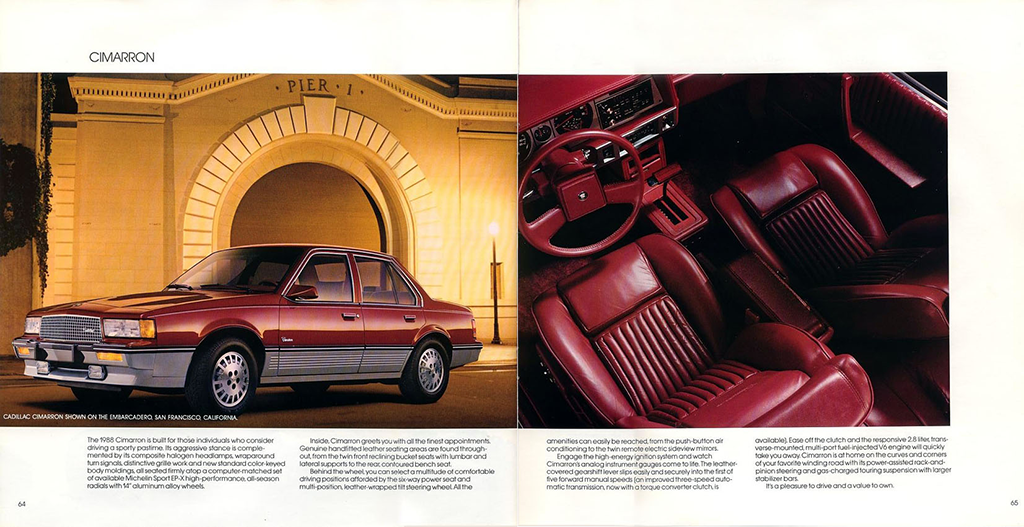
Cimarron pages from the 1988 Cadillac brochure
The 1988 Cimarron’s base price was $16,071—about $45,300 in today’s dollars, or about what a 2026 Cadillac CT4 Premium Luxury sedan goes for. Standard exterior and mechanical features included power-assisted rack and pinion steering, power front disc/rear drum brakes, and P195/70R14 steel-belted all-seasons radial tires (a size still readily available) on 14-inch aluminum alloy wheels. Inside, leather seating areas, a six-way power driver seat, a leather steering wheel, a tachometer, intermittent windshield wipers, air conditioning, power mirrors, power door locks, power windows, cruise control, a tilt steering wheel, and an AM/FM stereo radio with four speakers were all standard.
Options & Production Numbers
Among the relatively few options were a Vista Vent sunroof, an engine block heater, Twilight Sentinel, and the Delco-GM Bose Symphony Sound System.
By 1988, sales of the Cimarron had completely collapsed. After a first-year peak of almost 26,000 units sold in the 1982 model year, sales dropped to a sad 6,454 in the Cimarron’s final model year.
The View From 2026
I have yet to see a Cimarron at a serious antique car show—they’re treated by Cadillac folks like Ford folks treat the Mustang II from the 1970s—but I’m betting some intrepid soul will save one and bring it back for judging. Hagerty does track them—according to their valuation tools, a 1988 Cimarron with the five-speed manual in #1/Concours condition is $9,200, while a far more typical #3/Good car goes for $3,400. You occasionally see them for sale in the Hemmings Motor News classifieds, on eBay Motors, and on Bring a Trailer.
In May 2019, my ex-wife and I were taking a walk early on a Saturday morning and passed a Chevrolet Chevette parked at the end of our street. That was reason enough to finally complete this blog entry.
“… one of America’s best known cars …”
1987 was the final year for the somewhat antiquated rear wheel drive Chevette—in North America, at least. The 1.8-liter diesel engine was no more, but otherwise little was changed from 1986.
The only engine available was the L17 1.6 liter/98 ci inline four with a Holley 6510c two-barrel carburetor and 65 bhp, but you did have a choice of transmission: the standard four-speed manual, an optional three-speed automatic ($450), or an optional five-speed manual ($75). Mileage with the standard transmission was 28 city/34 highway by the day’s standards (24/31 by today’s measures). With a 12.2-gallon gas tank, Chevette owners could expect a 305 to 340 mile range with a 10% fuel reserve. Predictably, 0-60 mph took a little under 16 long seconds.
The Chevette was a small car, classified by the EPA as a sub-compact. Curb weight for the sedan was 2,137 pounds, with a 97.3-inch wheelbase, a 164.9-inch overall length, a 61.8-inch width, and a 52.8-inch height.
The truly “base” Chevette had been gone since 1985, but standard equipment was spare even on the supposedly upmarket CS. For your $5,495 base price (about $15,900 in 2025 dollars), you got four doors, a rear hatch with a single strut, rack and pinion steering, front disc and rear drum brakes, and P155/80R13 tires (a size still available from Kumho) on 13-inch by 5-inch steel wheels. Inside were vinyl front bucket seats, vinyl rear bench seats, and a floor console.
Options & Production Numbers
Because the standard equipment was so spare, there were a lot of options. Optional exterior and mechanical equipment included power brakes ($105), power steering ($225), an engine block heater ($20), and a custom exterior package ($154). Inside, the buyer could add air conditioning ($675), a tilt steering column ($125), custom cloth bucket seats ($130), a rear defogger ($145), and an AM/FM stereo radio ($119).
Despite being on its last legs, Chevrolet still sold a little over 20,000 Chevette sedans in 1987, along with slightly more than 26,000 coupes.
In September 2014, the Hemmings Daily blog included an entry on their Find of the Day—a Dark Blue Metallic 1980 Chevrolet Citation hatchback sedan with 70,000 miles available for $7,000. This officially fits it in my “Who Saves These Cars” category.
“The first Chevy of the ’80s”
For 1980, the Chevrolet Citation was indeed all-new, debuting on April 19, 1979. It may have been the “most thoroughly tested new car in Chevy history,” but the Citation quickly became the most recalled car in history, with an absolutely astoundingnine recalls in an era when manufacturers did not readily initiate recalls.
The standard powertrain on the 2,491-pound sedan was the GM’s Iron Duke 90 bhp 2.5 liter/151 ci four with a Rochester Varajet two-barrel carburetor, paired with a four-speed manual transmission. Fuel economy was 24 city/38 highway by the day’s standards (21/34 by today’s measures). With a 14-gallon gas tank, a Citation driver could expect a range of 350 to 390 miles with a 10% fuel reserve. 0-60 times for the Iron Duke are hard to find, but were likely around 16 seconds for the four-speed manual transmission and probably about 19 seconds (oog) with the optional ($337) three-speed automatic transmission.
Spending $225 to upgrade to the LE2 2.8 liter/173 ci V6 (also with a Varajet two-barrel carburetor) got you 115 bhp and a 0-60 time of a little over 13 seconds. Fuel economy dropped, but not by that much: to 20 city/34 highway with the four-speed manual transmission. Moving to the profligate three-speed automatic transmission dropped highway mileage to 30 mpg.
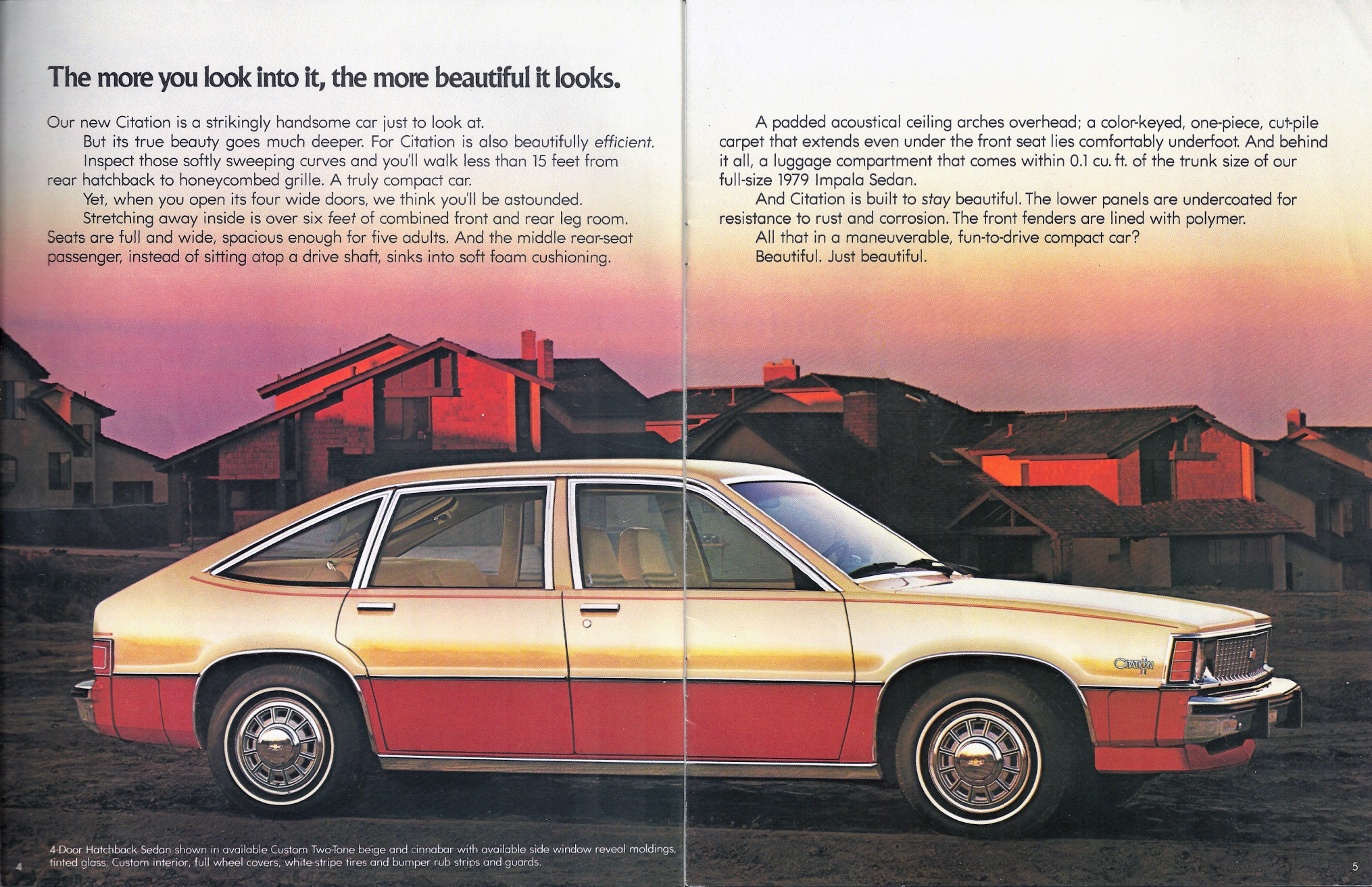
Hatchback sedan pages from the 1980 Chevrolet Citation brochure
The Citation sedan’s base price was $5,153—about $22,100 in 2025 dollars, which is almost exactly what a 2025 Chevrolet Trax LS compact crossover SUV goes for. Standard mechanical equipment included the heavily advertised front-wheel drive, rack-and-pinion steering, front disc brakes, glass-belted P185/80R13 radial tires (now a trailer size), and a Delco Freedom battery. Inside, sliding door locks, a lockable glove box, and an AM radio were considered worth mentioning as standard features. Chevrolet also shamelessly stated that the sedan’s .417 drag coefficient was a sign of “Efficient Aerodynamics.”
Options & Production Numbers
Exterior and mechanical options were many, including tinted glass ($70), a removable sun roof ($240), Sport mirrors (both manual and power), a sport suspension ($21), power brakes ($76), and power steering ($174). Inside, bucket seats, a reclining front passenger seat, a Custom interior, a gauge package ($70), air conditioning ($564), an intermittent windshield wiper system ($39), an electric rear window defogger ($101), automatic speed control ($105), power door locks ($123), power windows ($189), a Comfortilt steering wheel ($75), and an AM/FM stereo radio with cassette ($188) were all available.
Chevrolet sold an astounding 458,033 Citation hatchback sedans in its extended 1980 model year, making it the single most popular version of the Citation.
The View From 2025
As Hemmings showed in 2014, Citations do sometimes come up for sale, though I see few in the condition of the one they highlighted. Citations also occasionally appear at online auctions such as eBay Motors and Bring a Trailer that cater to the eighties car market.
Make mine Light Blue Metallic over Dark Blue Metallic, please. Two-tone paints were big in the early eighties.
Is it possible to miss the market more than this? For the 1986 model year, Cadillac downsized the front wheel drive Eldorado coupe again. This time, the wheelbase dropped to 108 inches, and overall length was down by over 16 inches to 188 inches—what was supposed to be the top of the non-limousine Cadillac line was now about the size of a 1986 Chevrolet Celebrity (or a 2025 Cadillac CT4 sedan) and a full three feetshorter than the (admittedly massive) 1978 Eldorado.
Predictably, Eldorado buyers didn’t go for it. Sales collapsed from about 74,000 in 1985 to about 21,000 in 1986—definitely not what would be expected from a complete model revision. Six years later, GM had now managed to duplicate the carnage that Ford had experienced with its 1980 luxury vehicle downsizing. Notably, Ford Thunderbird, Lincoln Mark VII (the Continental name departed that year), and Mercury Cougar sales were all up for 1986, along with those of some of GM’s “junior” personal luxury coupes. The December 1987 issue of Special Interest Autos simply called the Eldorado/Riviera/Toronado downsizing “the E-body disaster” and speculated that it was costing GM half a billion dollars a year in lost profits.
1986 Cadillac Eldorado brochure page
So, what did those relatively few buyers get with their $24,251 (about $70,900 in today’s dollars) 1986 Eldorado? Standard exterior and mechanical equipment included power four-wheel disc brakes, power steering, and aluminum alloy wheels. Inside, front bucket seats, power mirrors, power windows, power door locks, a power trunk release, cruise control, electronic climate control, and an AM/FM stereo radio with power antenna were all included, so the Eldorado was at least pretty well equipped.
Packages, Options, & Performance Numbers
Moving up to the Biarritz (almost always the top-of-the-line Eldorado since 1956) cost either $3,095 (with cloth seats) or $3,495 (with leather seats) raising the price to either $27,346 ($79,900 today) or $27,746 ($81,100 today). Standard equipment on the Biarritz included nicer seats with power lumbar support, two-tone paint, and real walnut accents.
Options included a power Astroroof ($1,255), a nicely integrated cellular phone ($2,850), the FE2 touring suspension with 15-inch aluminum alloy wheels and 215/60R15 Goodyear Eagle GT tires ($155), and the Delco-GM/Bose Symphony Sound System ($895).
The Eldorado’s engine was Cadillac’s 130 bhp HT-4100 throttle body fuel injected 4.1 liter/249 ci V8 paired with a four-speed automatic transmission. Fuel economy was 17 city/26 highway by the standards of the day (15/24 by today’s standards). Since the engine and transmission remained the same and the Eldorado was smaller and lighter, performance was better but still not very impressive: 0-60 improved to about 11 seconds.
1986 was the last model year for the Berlinetta semi-luxury version of Chevrolet’s Camaro, and they were by far the rarest of the three Camaro types available. With only 4,579 Berlinettas built in 1986, Chevrolet sold more than eleven times as many IROC-Zs alone. There were few changes for the 1986 Berlinetta—among them the appearance of the federally mounted center high-mounted stop lamp, new colors, updated interiors, and a new automatic closure for the large and heavy rear hatch.
The base powertrain for the Berlinetta was the LB8 135 bhp 2.8 liter/173 ci multi-port fuel-injected V6 with a five-speed manual transmission. Optional power was the $450 LG4 155 bhp 5.0 liter/305 ci V8 with a Rochester Quadrajet four-barrel carburetor, which was paired with a $425 four-speed automatic transmission (the five-speed manual was not available with the V8 on the Berlinetta).
Fuel economy with the base powertrain combination was 17 city/26 highway by the day’s standards (15/24 by modern measures). Moving up to the V8 dropped mileage ratings only slightly—to 17/25, and reduced the 0-60 mph time to a respectable 9 seconds in a car that weighed approximately 3,065 pounds. With a 16.2-gallon fuel tank (for some reason 0.7 gallons larger than with the V6), a V8 Berlinetta owner could expect a range of 275 to 305 miles with a 10% fuel reserve.
Your $11,902 base price (about $35,400 in today’s dollars) bought standard mechanical and exterior equipment including power brakes, power steering, dual horns, and P205/70R-14 blackwall steel-belted radial tires (a size still readily available) on 14 x 7 inch wheels with Berlinetta-specific full wheel covers. Inside, custom cloth reclining seats with adjustable headrests, a Berlinetta-only steering wheel, intermittent windshield wipers, a roof console with a removable flashlight, a fold-down rear seat, a locking rear storage cover, Quiet Sound Group, and an AM/FM stereo radio with a clock and four speakers were included.
Chevrolet Camaro Berlinetta print advertisement
Of course, the most notable interior component in the Berlinetta was the “Welcome aboard Starship Camaro.” (yes, that was an actual advertisement) electronic instrument cluster with dual adjustable control pods, a vacuum-fluorescent digital speedometer, and a bar graph tachometer. To an aspiring young audiophile, the killer feature of this interior was the optional (an extra $242) AM/FM stereo on a swivel with a “proper” upright (no slot) cassette deck and a five-band graphic equalizer. For 1986 only, the stereo received substantially improved backlighting.
Options
Among the many exterior and mechanical options were four-wheel disc brakes ($179 and only available with the V8), t-tops ($846—ouch!), a rear spoiler ($69), halogen headlamps ($25), electric rear window defogger ($145), and nice looking Berlinetta-only aluminum finned wheels ($225). Inside, you could add cruise control ($185), Comfortilt steering wheel ($115), power door locks ($145), and Berlinetta-specific electronically-controlled air conditioning ($775). The Berlinetta could get expensive: I had no trouble getting a V8 version up to $15,400—about $45,800 in 2025 dollars.
The View From 2025
According to Hagerty’s valuation tools, a 1986 Berlinetta with the LG4 in (rare) #1/Concours condition is $21,900, with a more normal #3/Good condition car going for $6,100. Third-generation Camaros generally have good club support and are often available in the Hemmings Motor News classifieds, on eBay Motors, and on Bring a Trailer. However, Berlinettas of any year (Chevrolet first brought them to market in 1979) are relatively rare. As I update this blog post in August 2025, there is a Medium Gray Metallic 1986 Berlinetta with gray cloth seats, the V8, and 29,000 miles available for sale on Hemmings, asking $17,900.
Make mine Black, please.
Thanks to the GM Heritage Center for some really specific information on the 1986 Berlinetta.
Welcome, Jalopnik and Autoblog readers! We have many meh cars at Eighties Cars—the unloved category covers most of them.
I saw a reasonably original Buick Somerset Regal with Dark Gray Metallic paint on a side road in Philadelphia in March 2104. It was the first one I’d seen in many years.
“There has never been a Buick quite like the Somerset Regal”
Buick’s Somerset Regal was a new model for 1985. Available initially only in coupe form, Buick’s version of the N-body (Oldsmobile had the Calais, and Pontiac had the Grand Am) was designed to at least partially replace the Skylark. It failed miserably, surviving for only three years before being subsumed back into the Skylark product line. Respectable first-year sales of 86,076 declined to 75,620 in 1986 and 46,501 in 1987.
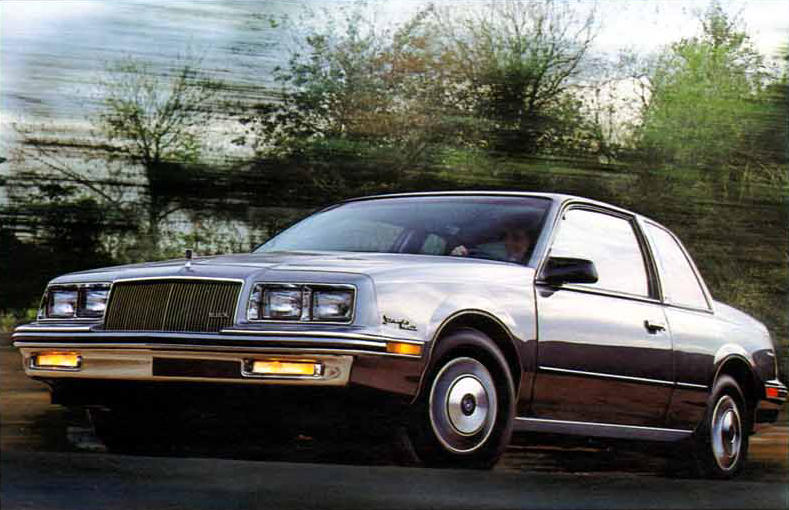
Exterior photo of the Somerset Regal from the 1985 Buick brochure
The Somerset Regal was not a big car by today’s standards. With 180 inches of length and a 103.4-inch wheelbase, it is within shouting distance of a 2025 Honda Civic sedan, which is 184.8 inches long and has a 107.7-inch wheelbase. Of course, cars, in general, have gotten a lot bigger in these thirty years—the Somerset Regal was notably more substantial than the 1985 Honda Accord.
The standard powertrain was a Tech IV 92 bhp 2.5 liter/151 ci inline four with throttle body fuel injection (a slightly upgraded Iron Duke) paired with a five-speed manual transmission, but I believe most buyers went with the optional ($425) three-speed automatic instead. The hot set-up (if you could call it that) was the optional ($560) LN7 125 bhp 3.0 liter/181 ci multi-port fuel-injected V6, available only with the automatic. 0-60 times ranged from 11 to 13 seconds.
Mileage for the inline four and five-speed manual combination was an impressive 24 city/34 highway by the day’s standards (21/31 by 2025 measures). Choosing the more realistic three-speed automatic cost two mpg, while upgrading to the V6 dropped you all the way down to 20 city/26 highway. With a 13.6-gallon gas tank, owners of the most profligate powertrain combination could expect a range of between 255 and 280 miles with a 10% fuel reserve.
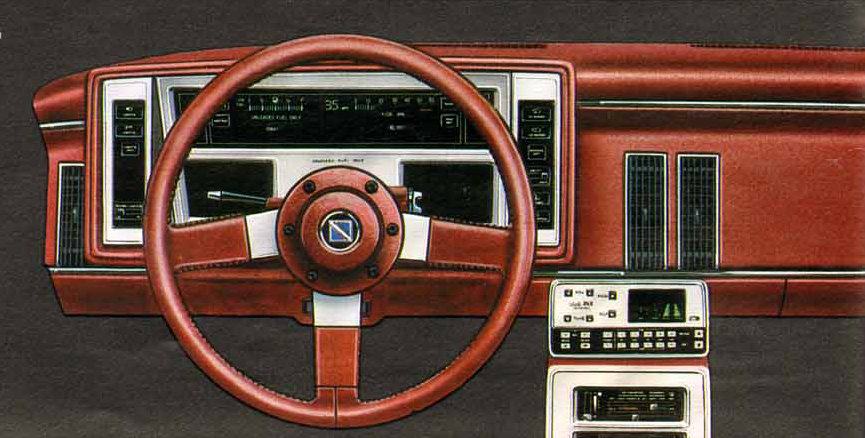
Interior of the Somerset Regal from the 1985 Buick brochure
For the Somerset Regal’s $8,857 base price (about $27,300 in today’s dollars), standard equipment included power brakes, power steering, tungsten-halogen headlights, and body-colored bumpers. The interior included cloth or vinyl bucket seats, a center console, brushed metal accents, electronic digital instrumentation (somewhat upmarket at the time), and an AM radio. Moving up to the Limited trim added dual horns, chrome bumpers, and courtesy lamps, along with snazzier cloth seats and an upmarket steering wheel.
Standard features that date the Somerset Regal included the Delco Freedom II Plus battery, front and rear ashtrays in the console, and the P185/80R13 tires (now considered a trailer size) on 13-inch wheels.
Options
Options included the $645 air conditioning (in the mid-1980s not yet standard on most cars), cruise control ($175), leather seats ($275 and only available with the Limited), power door locks ($130), power windows ($195), Vista-Vent sunroof, Delco GM/Bose Music System AM/FM stereo cassette ($995!), cast-aluminum wheels ($229), and a Gran Touring suspension ($27).
The View From 2025
These Somerset Regals are now almost completely gone. Bring a Trailer did sell a very rare 1986 Somerset T-Type (Buick removed the Regal part of the name after only one year) in mid-2023. I haven’t seen one in the Hemmings Motor News classifieds or on eBay Motors in several years.





 Eighties Cars