1986 Jeep CJ-7 SUV

“Only in a Jeep.”

1986 was the final model year for the Jeep CJ-7, which had debuted in 1976. Because of this, there were only minor trim and detail changes.

The CJ-7’s standard powertrain was an AMC 86 bhp 2.5 liter/150 ci inline four with electronic fuel injection paired with a four-speed manual transmission and part-time four wheel drive. An AMC 102 bhp 4.2 liter/258 ci inline six with a two-barrel carburetor was a $361 option. Both engines could be had with a five-speed manual ($250), but only the inline six could be paired with a Torque-flite automatic ($495).

Jeep CJs were neither economical nor fast—but most Jeep fanciers would have and do argue that isn’t the point. The spriteliest powertrain combination (inline six/five-speed) came in with fuel economy ratings of 17 city/21 highway by the day’s standards (15/20 by modern measures). With the standard 15.1-gallon gas tank, a CJ-7’s presumably happy owner could expect a range of 240 to 255 miles with a 10% fuel reserve. It’s no wonder many went for the $57 20-gallon extra capacity fuel tank, which promised ranges of over 300 miles.

Front cover of the 1986 Jeep CJ brochure

The 1986 CJ-7’s base price was $7,500—about $22,400 in today’s dollars. Standard exterior and mechanical equipment included a roll bar, a moveable tailgate, a swing away spare tire carrier, a front stabilizer bar, manual front disc brakes, and free-wheeling hubs. Inside, linen-grain vinyl high back bucket seats, a padded instrument panel, a day/night mirror, an electric washer and 2-speed wipers, a cigarette lighter, and a heater and defroster were included.

Packages, Options, & Production Numbers

Jeep offered two packages for the 1986 CJ-7:

  • The $1,253 Renegade package included special Renegade exterior graphics, rocker panel protection moldings, and 15 x 7 white styled steel wheels. Inside, a denim-look vinyl rear seat, a soft feel 3-spoke Sport steering wheel, and intermittent wipers were included.
  • The $3,304 Laredo package included a chrome grille panel with pinstripe, a hard top, a Laredo hood decal, and 15 x 7 chrome styled steel wheels. Inside, a leather-wrapped 3-spoke steering wheel, a console, a rear seat, courtesy lights, a tachometer and clock, and intermittent wipers were included. A Laredo with no other options came to $10,804—about $32,300 in 2025 dollars, or about 10% less than a 2026 Jeep Wrangler Sport 2-door goes for.

Individual options included heavy duty engine cooling ($57), power steering ($274), power disc brakes ($125), a rear Trac-lok differential ($255), a conventional spare tire ($94), and a tilt steering wheel ($118). Many CJ-7s exited dealer showrooms with stickers that were about twice the base price.

Jeep produced 25,929 CJ-7s in the 1986 model year. They marked the final version of the original Civilian Jeep from 1945, whose total production measured over 1.5 million units.

The View From 2025

CJ-7s have a devoted fanbase, and their values reflect that. According to Hagerty’s valuation tools, a 1986 CJ-7 Renegade with the inline six in #1/Concours condition is $48,800, while a more typical #3/Good condition example goes for $24,500. CJ-7s frequently show up for sale in the Hemmings Motor News classifieds, on eBay Motors, and on Bring a Trailer.

Make mine Garnet Metallic, please.

Other Jeeps I have written about include the 1982 CJ-8 Scrambler pickup truck and the 1983 Wagoneer Limited SUV.

1981 Chrysler LeBaron coupe

“A personal car with classic style.”

1981 was the final model year for the coupe version of Chrysler’s M body, which had been around since 1977. For Chrysler, that last coupe would be the LeBaron.

The LeBaron’s standard engine was the 85 bhp Slant Six 3.7 liter/225 ci inline six with a one-barrel carburetor. Optional power was provided by the LA 130 bhp 5.2 liter/318 ci V8 with a two-barrel carburetor—an upcharge of $62. No matter what engine the buyer selected, the transmission was a three-speed TorqueFlite automatic.

For no apparent reason, both engines had higher horsepower ratings in California. The reason is more evident for the V8—California got a four-barrel carburetor (along with 35 more horsepower), while the other 49 states only rated a two-barrel. However, the Slant Six got a one-barrel carburetor in all fifty states, but five more horsepower in California. All of this meant that the California V8 version of the LeBaron was a relative screamer—almost two seconds faster in the 0-60 sprint than the 49 states version.

For 1981, the coupe was available in Special, Salon, and Medallion versions. Standard mechanical equipment on the $6,672 Special (about $25,600 in today’s dollars) included power steering, power front disc/rear drum brakes, and P195/75R15 glass-belted radial-ply white sidewall tires (a size still available in whitewall thanks to Coker Tire) on 15-inch Safety-Rim wheels with Deluxe wheel covers. Inside, a cloth and vinyl front bench seat and a glove box lock were included. Individual totals for the Special coupe and sedan are unknown, but the combined total was 11,980.

Coupe page from the 1981 Chrysler LeBaron brochure
Salon coupe page from the 1981 Chrysler LeBaron brochure

The $7,263 Salon added body-side accent stripes, dual horns, a left outside remote mirror, a day/night inside mirror, and a cloth and vinyl front seat with a center armrest. Chrysler built 17,485 LeBaron Salon coupes and sedans in the 1981 model year.

The $7,768 Medallion added a padded vinyl Landau roof, sill molding extensions, a rear deck accent stripe, Premier wheel covers, a trunk dress-up, a 60/40 cloth front seat, and a Luxury steering wheel. Only 7,635 1981 LeBaron Medallion coupes and sedans were produced.

Groups, Packages, & Individual Options

Many groups and packages were available with the LeBaron, and their pricing varied depending on whether you were starting with a Special, a Salon, or a Medallion.

  • The Deluxe Wiper/Washer Package included Deluxe windshield wipers with intermittent wipe and a windshield washer fluid level indicator.
  • The Light Package ($85-$99) included map/dome reading lights, a glove box light, an ash receiver light, fuel, temperature, and alternator warning lights, and a trunk light.
  • The Basic Group ($937-$1125) included tinted glass on all windows, a padded vinyl Landau roof, dual horns, manual air conditioning, and an AM radio. It also included both the Deluxe Wiper/Washer Package and the Light Package.
  • The Sport Appearance Package ($154-$258) included color-keyed styled steel road wheels, dual sport-styled remote control mirrors (painted or chromed), and a Luxury two-spoke steering wheel.
  • The Two-Tone Paint Package ($158) included a choice of two two-tone exterior paint combinations and color-break body accent stripes.
  • The Handling Package ($163) included special Firm-Feel power steering, heavy-duty shock absorbers, heavy-duty rear springs, a rear sway bar, and P205/75R15 steel-belted radial wider whitewall tires on extra-wide wheel rims.
  • The Protection Group ($58-$67) included door edge protectors and front and rear color-keyed floormats.
  • The Deluxe Insulation Package ($10-$109) included undercoating, special sound insulation, and a trunk dress-up.

Individual exterior and mechanical options included Starmist paint ($55), halogen headlamps ($40), a T-bar roof ($695), a power glass sunroof ($865), wire wheel covers ($106-$249), and forged aluminum wheels ($183-$326). Inside, cloth/vinyl bucket seats ($101 for the Salon coupe), a console ($106 for the Salon coupe), a leather-covered steering wheel ($21-$60), air conditioning ($606), automatic temperature control air conditioning ($656), power windows ($145-$202), and power door locks ($96-$136) were available. A series of seven radios ranged up to an AM/FM stereo radio with a CB ($355-$447).

The View From 2025

These LeBarons are rare on the ground, but they have not completely vanished. They’re gone from the Hemmings Motor News classifieds and eBay Motors, but Bring a Trailer has sold eight of this generation of LeBaron in the last six years, two of them coupes.

Make mine Burnished Silver Metallic, please. Just like in the brochure.

Other rear-wheel-drive coupes from Chrysler Corporation that I have written about include the 1980 Chrysler Cordoba, the 1983 Chrysler Cordoba, and the 1983 Imperial. I have written posts about two other M-bodies—the 1987 Chrysler Fifth Avenue sedan and the 1989 Dodge Diplomat sedan. Other 1981 personal luxury coupes include the Chevrolet Monte Carlo Sport Coupe and the Oldsmobile Cutlass Supreme.

1988 Pontiac Fiero Formula coupe

“Rejoice! Fiero Formula is here.”

In the Fiero’s final year, Pontiac introduced the Formula. Following the Firebird’s lead, the Formula had most of the mechanical components of the top-of-the-line GT, but the look of the original Fiero coupe. The front and rear suspensions for all Fieros was also completely revised, and Bright Yellow was introduced as a mid-year color.

It is a canard of General Motors’ behavior that they discontinue a car as soon as they finally get it right. No more central example exists than the Pontiac Fiero. The Fiero came to market in 1984 with ridiculous expectations, partially driven by Pontiac and in part by how the public sees two-seat mid-engine cars. What had initially been designed as a somewhat sporty commuter car became a significant part of Pontiac’s We Build Excitement strategy.

The painful fact that the Fiero’s mechanical parts were from the low end of the General Motors parts bin soon became stunningly obvious. Citation and Chevette suspension parts were abundant, and the only available engine was the distinctly uninspiring 2.5 liter/151 ci Iron Duke inline four with fuel injection, featuring all of 92 bhp. Predictably, handling and acceleration did not meet expectations. Then, of course, the recalls came—four in all for the 1984 Fiero.

By 1988, Pontiac had gone a long way toward fixing some of the underlying issues. The 2.8 liter/173 ci V6 was made available in 1985, its 140 bhp and multi-port fuel injection both major upgrades. In 1986, the fastback GT body style was added, and a five-speed manual transmission became available for the V6, though only late in the model year. In 1987, the Iron Duke‘s horsepower increased by 6 bhp. Finally, in 1988, the suspension was completely revised (with some Lotus influence).

The Formula‘s standard powertrain was the L44 135 bhp 2.8 liter/173 ci V6 with multi-port fuel injection paired with a five-speed manual—a three-speed automatic ($490) was available. Road & Track recorded a 0-60 time of 8.0 seconds with the five-speed Formula. Mileage in a car with a 2,775-pound curb weight was 17 city/27 highway by the day’s standards (15/25 by today’s measures). With the Fiero’s small 11.9-gallon gas tank, range was between 215 and 235 miles with a 10% fuel reserve.

Fiero pages from the 1988 Pontiac brochure

The Fiero Formula‘s base price was $10,999—approximately $31,000 in today’s dollars, which is about what a 2025 Mazda MX-5 Miata Sport goes for. Standard exterior and mechanical equipment included retracting halogen headlamps, a rear deck spoiler, a tuned dual-port performance exhaust, the WS6 performance suspension, rack-and-pinion steering, power 4-wheel disc brakes, and P205/60R15 front and P215/60R15 rear Goodyear Eagle GT+4 tires (both sizes still readily available) on 15-inch Diamond-Spoke aluminum wheels. Inside, reclining bucket seats, a Rally four-spoke steering wheel, a full-length console, side window defoggers, and a Delco ETR AM/FM stereo radio were included.

Options Groups, Individual Options, & Production Numbers

Pontiac offered three option groups with the Fiero Formula:

  • Option Group I included tinted glass, a tilt steering wheel, and controlled cycle windshield wipers.
  • Option Group II included everything in Option Group I, along with air conditioning, lamp group, a passenger visor vanity mirror, and cruise control.
  • Option Group III ($1,516) included everything in Option Group II, along with power door locks and power windows.

Individual options included a removable sunroof, tinted glass ($120), air conditioning ($775), power windows ($234), controlled cycle windshield wipers ($55), a tilt steering wheel ($125), and an electric rear window defogger ($145). Two optional stereos were available, with the range-topper being the $272 UX1 Delco ETR AM stereo/FM stereo radio with a cassette player, a graphic equalizer, and a clock.

Pontiac sold 5,684 copies of the Fiero Formula in 1988. Both the coupe (13,910) and the GT ($6,849) sold more units, but the Formula did sell better than 1987’s SE.

The View From 2025

Fieros have a good club following and a reasonably strong presence in the Hemmings Motor News classifieds, on eBay Motors, and on Bring a Trailer. According to Hagerty’s valuation tools, a 1988 Fiero Formula in #1/Concours condition is $22,800, while a more common #3/Good condition car is $7,700.

Make mine Medium Red Metallic, please.

Other Fieros I have written about include the 1984 coupe and the 1986 GT coupe. Other late eighties Pontiacs include the 1987 Firebird Formula hatchback coupe, the 1987 Grand Prix coupe, the 1988 Grand Prix coupe, and the 1989 Pontiac 20th Anniversary Turbo Firebird Trans Am hatchback coupe.

Save

Save

Save

Save

Save

1989 Dodge Diplomat sedan

“Negotiate the road in a classic.”

For 1989, Dodge’s M-body Diplomat sedan was little changed. The base model was dropped, leaving only the mid-range Salon and the higher-end SE.

The powertrain remained the same—an LA 140 bhp 5.2 liter/318 ci V8 with a Carter two-barrel carburetor paired with a TorqueFlite three-speed automatic. With a 3,582-pound shipping weight, 0-60 came in about 12 seconds. Compared to other large rear-wheel-drive sedans, fuel economy was a somewhat uncompetitive 16 city/22 highway by the day’s standards (15/20 by today’s measures). With an 18-gallon gas tank, a Diplomat driver could expect a range of 285 to 305 miles with a 10% fuel reserve.

Standard exterior and mechanical equipment on the $11,995 Diplomat Salon sedan included quad halogen headlights, tinted glass, power-assisted steering, power-assisted front vented disk/rear drum brakes, and P205/75R15 steel-belted radial all-season white sidewall tires (a size still readily available, even as a whitewall) on 15-inch wheels with Deluxe wheel covers. Inside, a cloth/vinyl split-back bench seat with a folding center armrest and adjustable head restraints, tilt steering, a driver’s airbag, intermittent wipers, and an electronically tuned AM stereo/FM stereo with an integral digital clock and four speakers were included.

Diplomat SE photo from the 1989 Dodge brochure

The $14,795 SE added a full non-padded vinyl roof, Premium wheel covers, all-cloth individually adjustable front seats with dual seatback recliners, a lighted passenger mirror, chrome exterior dual power mirrors, automatic temperature control air conditioning, cruise control, an electrically heated rear window defroster, and the Protection Package. All of this extra equipment made for a 3,782-pound shipping weight—200 pounds more than the Salon.

Packages, Individual Options, & Production Numbers

By 1989, buying a Dodge Diplomat was all about the packages:

  • The Popular Equipment Discount Package ($1,141) included Premium wheel covers, automatic temperature control air conditioning, an electrically heated rear window defroster, chrome exterior dual power mirrors, and automatic speed control.
  • The SE Luxury Equipment Discount Package ($1,202) included wire wheel covers with locks, a driver’s side power seat, a Luxury leather-wrapped steering wheel, illuminated left and right vanity mirrors, power door locks, power windows, and a power deck lid release. It also included most but not all of the Light Package, including a headlight switch with time delay, a glove box light, a trunk light, and alternator, door ajar, engine oil temperature, and low fuel warning lights.
  • The Light Package ($122) included a headlight switch with time delay, a glove box light, and a trunk light. It also included alternator, door ajar, engine oil temperature, and low fuel warning lights.
  • The Protection Package ($185) included color-keyed vinyl bodyside moldings, black rear bumper guards, undercoating, and front and rear carpeted floor mats.

Individual options for both Diplomat versions included pearl clear coat paint ($41), power door locks ($201), and power windows ($294). Dodge also proudly offered a Premium electronically tuned AM stereo/FM stereo with up-and-down seek-and-scan and a cassette tape player ($262). The electronic cassette tape player included Dolby B noise reduction, automatic reverse, true fast forward and rewind, an automatic metal tape sensor, and tape program music search.

A full non-padded vinyl roof ($206), chrome exterior dual power mirrors ($164), and automatic temperature control air conditioning ($855) were available for the Salon. A power glass sunroof ($1,108) and a power antenna ($72) were SE-only options. A loaded SE could run to about $17,500—real money in 1989 and about $47,300 in today’s dollars.

Dodge sold a mere 5,709 Diplomats in the 1989 model year, sharply fewer than the 19,173 in 1988, when the base Diplomat was also available.

The View From 2025

The Diplomat was one of the last of Chrysler Corporation’s traditional rear-wheel-drive cars—the final year in a line that extended directly back to the original Diplomat in 1977, and had roots in the mid-1960s with the third-generation Dart. Earlier this year, I blogged about Chrysler Corporation’s Transition To Front-Wheel-Drive.

I’m going to declare these Diplomats as vanished, though I would not have said that a decade ago. They’re gone from the Hemmings Motor News classifieds and eBay Motors. Bring a Trailer has sold three Diplomats in the last five years, two of them sedans.

Make mine the extra-cost Twilight Blue Pearl Coat, please.

Four years ago, I wrote a post about the 1987 Chrysler Fifth Avenue sedan—an M-body sister to the Diplomat. Other rear-wheel-drive Chrysler products I have written about include the 1980 Chrysler Cordoba coupe, the 1980 Plymouth Volaré station wagon, the 1981 Chrysler New Yorker sedan, the 1983 Chrysler Cordoba coupe, and the 1983 Imperial coupe.

1980 Lincoln Versailles sedan

“Plush, inviting elegance”

1980 was the final year for Lincoln’s Versailles sedan, and little was changed. There was a new starter under the hood and an improved jack in the trunk. Twin Comfort Lounge seats replaced 1979’s Flight Bench seats. Two options were no more—the full vinyl roof and the floor-mounted shift lever. Otherwise, only color and trim changes were visible.

The 1980 Versailles’ only available powertrain was a Windsor 132 bhp 4.9 liter/302 ci V8 with a Variable Venturi carburetor mated to a three-speed automatic transmission. Car and Driver recorded a 0-60 time of 12.7 seconds, making the 3,880-pound Versailles somewhat less than a hot rod Lincoln. Fuel economy ratings were 15 city/20 highway by the day’s standards. With a 19.3-gallon gas tank, a Versailles owner could expect a range of 250 to 270 miles with a 10% fuel reserve.

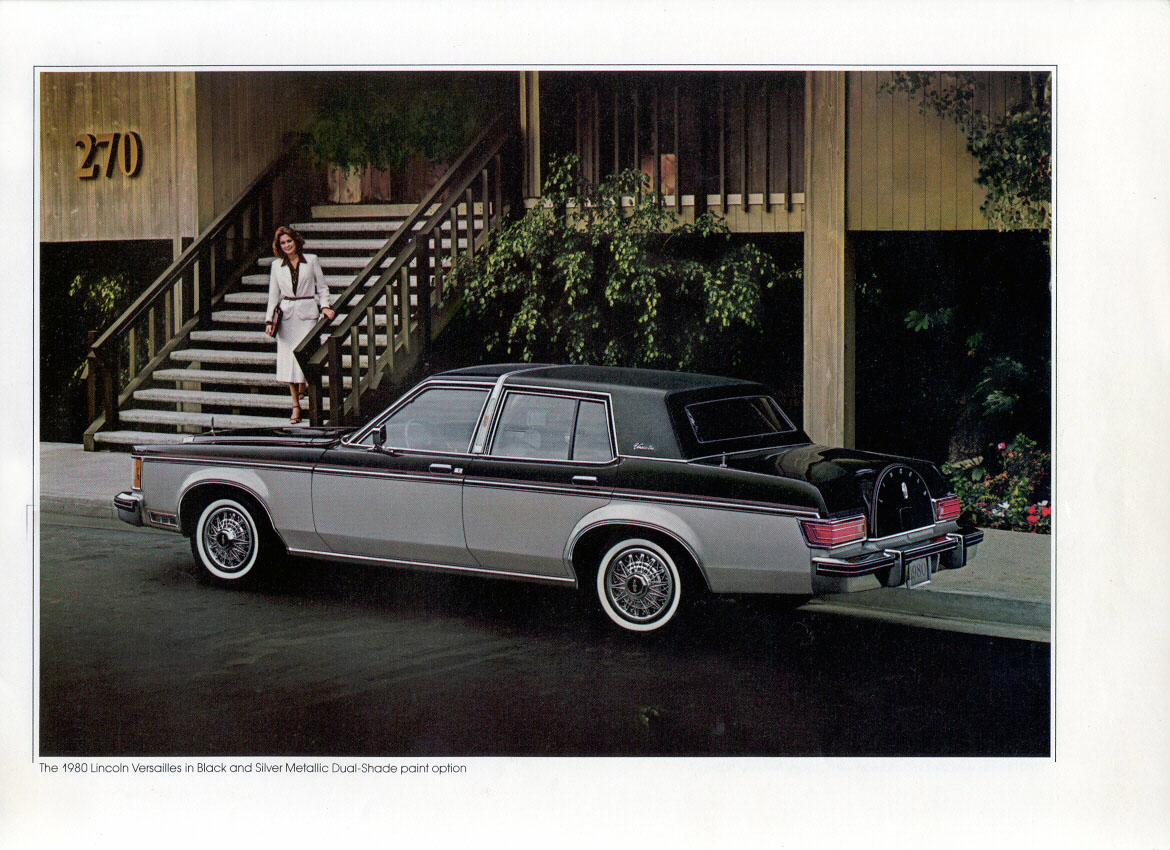
Page from the 1980 Lincoln Versailles brochure

The Versailles’ base price was $14,674 for 1980—approximately $63,000 in today’s dollars. Standard exterior and mechanical equipment included tinted glass, power steering, four-wheel power disc brakes, and FR78-14 tires (the modern semi-equivelant P205/75R14 is somewhat available). Inside, every Versailles for that year included Twin Comfort Lounge seats with fold-down center armrests, a leather-wrapped Luxury steering wheel, the Automatic Temperature Control air conditioning/heater, power windows, and an electronic AM/FM stereo search radio with a power antenna.

By 1980, base exterior and mechanical equipment included quad halogen headlamps, an illuminated/keyless entry system, an Electronic Air Suspension with automatic level control, and P215/75R15 white sidewall tires (a size still readily available) on 15-inch forged aluminum wheels. Inside, every Continental for that year included fingertip speed control, interval windshield wipers, and power door locks.

Options & Production Numbers

The Versailles had two no-cost options. Buyers got to choose either forged aluminum wheels or wire wheel covers. They also got to choose either a coach roof with a frenched backlite in Valino vinyl or convertible theme styling in Calvary Twill vinyl—no Versailles roof went unadorned.

A defroster group was $132, while a power lock group was $169. The reclining bucket seat group was $416.

Extra-cost exterior and mechanical options included dual-shade paint ($80) and a power glass panel moonroof ($1,128). Inside, leather/vinyl interior trim ($416), a tilt steering wheel ($81), and an electric rear defroster ($109) were available.

A mere 4,784 copies of the Versailles were sold in its final model year. This meant that it had failed utterly in its stated goal of competing with Cadillac’s Seville, which sold about ten times as many units in the 1979, 1980, and 1981 model years.

The View From 2025

Versailles do attract some collector interest—though not as much as the Mark VIIs and Town Cars—and there is club support. According to Hagerty’s valuation tools, a 1980 Versailles in #1/Concours condition is $17,200, while a far more normal #3/Good condition version goes for $6,900. They are sometimes available in the Hemmings Motor News classifieds and on eBay Motors, and they occasionally show up at in-person auctions. Bring a Trailer has sold a grand total of one Versailles—a 1978.

Make mine Cabernet Clearcoat Metallic, please.

Other Lincolns I have covered include the 1980 Continental Mark VI coupe, the 1984 Continental Mark VII LSC coupe, the 1986 Mark VII coupe, the 1987 Continental sedan, and the 1989 Town Car sedan.

1989 Lincoln Town Car sedan

“Luxury that needs no introduction.”

For the 1989 model year, the final big Lincoln of the 1980s remained essentially unchanged. The base version gained a fancier “Frenched” back window on its standard vinyl roof. Otherwise, only color and trim changes were visible.

The 1989 Town Car’s only available powertrain was a Windsor 150 bhp 4.9 liter/302 ci V8 with sequential multi-port fuel injection mated with a four-speed automatic with overdrive. An optional dual exhaust added 10 bhp. 0-60 came in a little over 11 seconds in a car with about a 4,100-pound curb weight. Fuel economy was 17 city/24 highway by the day’s standards (15/22 by 2025 measures). With a smallish 18.0-gallon gas tank (compared to the competition), a Town Car owner could expect a middling range of 300 to 330 miles with a 10% fuel reserve.

Front cover of the 1989 Lincoln Town Car brochure

The Town Car’s base price was $25,205 for 1989—approximately $67,700 in today’s dollars, or almost exactly what the 2025 Lincoln Aviator Reserve SUV goes for. Standard exterior and mechanical equipment included quad-rectangular halogen headlamps, tinted glass, power recirculating ball steering, power front disc/rear drum brakes, and P215/70R15 white sidewall steel-belted radial tires (a size still readily available) on 15-inch steel wheels with full wheel covers. Inside, 50/50 Twin Comfort Lounge cloth front seats, a six-way power driver’s seat, interval wipers, fingertip speed control, Automatic Climate Control, power windows, power vents, power door locks, and an AM/FM stereo cassette radio with a six-speaker Premium Sound System were included.

Series’, Options, & Production Numbers

For $3,301 over the base Continental, the Signature Series added the Comfort/Convenience Group, which included a six-way power front passenger’s seat, rear floor mats, dual illuminated visor vanity mirrors, a headlamp convenience system, and a power decklid pulldown. A Luxury half-vinyl coach roof with a frenched rear window, turbine-spoke aluminum wheels, and an illuminated/keyless entry system also came with the Signature Series.

For an additional $1,326, the Cartier Designer Series included everything in the Signature Series and added Dual-Shade paint in Silver Frost Clearcoat Metallic over Pewter Clearcoat Metallic, a Silver Frost coach roof, and maroon accent stripes. Inside, a leather-wrapped steering wheel and front floor mats with the Cartier logo were included. Cartier purchasers got a no-cost choice of either leather and cloth seat trim or all leather seat trim.

Exterior and mechanical options included a power glass moonroof ($1,420), a Traction-Lok differential ($101), and wire-spoke aluminum wheels ($873 for the base car, $395 otherwise). Interior options included an automatic-dim day/night mirror ($89), an Anti-Theft Alarm System ($200), a twelve-speaker Ford JBL Audio System with a 140-watt amplifier ($525), and a compact disc player ($617). The Cartier Designer Series was the only way to get Dual-Shade paint in the 1988 model year.

1989 was a good year for Lincoln’s traditional full-size sedan. 123,669 were sold, making the Town Car almost 60% of total Lincoln production, and marking the peak for the first-generation Town Car.

The View From 2025

Town Cars of this era attract collector interest—and there is club support. According to Hagerty’s valuation tools, a 1989 Town Car in #1/Concours condition is $26,900, with a far more normal #3/Good condition version going for $4,800. These Town Cars are often available in the Hemmings Motor News classifieds, on eBay Motors, and on Bring a Trailer. As I write this blog entry in September 2025, there’s a Cinnabar Clearcoat Metallic 1989 Town Car with 8,700 miles for sale on Hemmings, asking $34,500.

Make mine that same Cinnabar Clearcoat Metallic, please.

Other Lincolns I have covered include the 1980 Continental Mark VI coupe, the 1984 Continental Mark VII LSC coupe, the 1986 Mark VII coupe, and the 1987 Continental sedan.

1982 Ford Thunderbird coupe

For some reason, I’m always interested in the last year of a “failed” model. Usually, not much gets changed, as the manufacturer’s hopes have already been dashed. For Labor Day 2025, we’ll cover the fruits of Ford’s labors for the 1982 model year.

“Three distinctive series, each built to be driven with pride.”

For 1982, Ford’s Thunderbird personal luxury coupe added a 3.8 liter V6 option, and removed the 4.9 liter V8 option. A Tripminder trip computer was a new option, and the gas tank size increased to 21 gallons. Otherwise, Ford changed little besides colors and trims.

Ford engine availability and power ratings were still in decline in 1982—except if you were purchasing a Mustang. The Thunderbird’s standard powertrain was the Thriftpower Six 87 bhp 3.3 liter/200 ci inline six with a one-barrel carburetor paired with a SelectShift three-speed automatic transmission. Powertrain upgrades were available: buyers could specify the aforementioned Essex 112 bhp 3.8 liter/232 ci V6 with a two-barrel carburetor or the Windsor 120 bhp 4.2 liter/255 ci V8 with a Motorcraft two-barrel carburetor. Both of the optional engines cost $241.

The Thunderbird was a notably different car depending on the engine choice. Looking at the table, it’s hard not to believe that the new Essex engine was the winner—almost as quick as the Windsor V8, and with notably better fuel mileage than either the inline six or the V8.

Thriftpower Six
(3.3 liter inline six)
Essex
(3.8 liter V6)
Windsor
(4.2 liter V8)
0-60 mph
(approximate)
17.3 seconds13.2 seconds12.6 seconds
Fuel mileage
(1982 standards)
17 city/24 highway19 city/30 highway17 city/26 highway
Range
(10% fuel reserve)
315 to 345 miles375 to 415 miles330 to 365 miles

Standard exterior and mechanical equipment on the $8,492 base Thunderbird (about $29,400 in today’s dollars) included concealed rectangular halogen headlamps, variable ratio power rack and pinion steering, power front disc/rear drum brakes, full wheel covers, and P-metric white sidewall steel-belted radial ply tires. Inside, a Flight bench seat in fine-ribbed cloth and vinyl trim, a day/night inside mirror, a trip odometer, a quartz electric clock, and an AM radio were included.

Packages, Options, & Production Numbers

Ford continued to decontent the $9,703 Town Landau (approximately $33,600 now), so its price was closer to the base Thunderbird compared to 1980. Moving up still added Luxury wheel covers, dual remote control mirrors, diagnostic warning lights, interval windshield wipers, a tilt steering wheel, and an AM/FM stereo radio. The Luxury vinyl roof—a padded rear half vinyl roof with a color-coordinated wrapover band and coach lamps—was also standard on the Town Landau. Finally, the included Interior Decor Group added cloth covered head restraints (vinyl if vinyl trim was purchased), Decor door trim panels with assist straps, and a choice of either split bench seats with dual recliners in higher level knit cloth fabric or bucket seats with console.

For the second year, the Heritage edition was the top-of-the-line Thunderbird ($12,472 then, $43,100 now). Exterior and mechanical features the Heritage edition added over the Town Landau included front cornering lamps, complete tinted glass, rocker panel moldings, the 3.8 liter V6 engine, an Automatic Overdrive transmission, and wire wheel covers. Inside, the Heritage edition included a 6-way power driver’s seat, an electronic instrument cluster, air conditioning with manual controls, the power lock group, and an AM/FM stereo search radio.

Every Heritage edition buyer also got a padded rear half vinyl roof with a brushed aluminum wrapover band, coach lamps, and a frenched backlight. They also received the Interior Luxury Group, which included split bench seats with dual recliners in crushed velour cloth, cloth covered head restraints, a Luxury steering wheel, an automated parking brake release, a right hand visor illuminated vanity mirror, 18-oz floor carpeting, burled rosewood woodtone instrument and door panel appliques, the Light Group (dual beam map light, instrument panel courtesy lights, and engine compartment light), power side windows, interval windshield wipers, diagnostic warning lights, an electronic digital clock, and Luxury luggage compartment trim.

Individual options included a flip-up open-air roof ($276), metallic glow paint ($80), a Tu-Tone paint/tape treatment ($128-206), the Keyless Entry System ($319), Recaro bucket seats with a console ($523/$405/$222 depending on series), the SelectAire conditioner with automatic temperature control ($754 for all but the Heritage, which charged $78), and the Tripminder trip computer ($215-261). Nine different audio selections were available, ranging up to an electronic AM/FM stereo search radio with a cassette tape player and the Dolby noise reduction system ($318/$233/$87), which could be paired with the Premium Sound System ($133-187).

Ford sold 45,142 Thunderbirds in the 1982 model year, which was the lowest number since 1975. It was handily outsold by all four of the mid-size GM coupes: Buick Regal, Chevrolet Monte Carlo, Oldsmobile Cutlass, and Pontiac Grand Prix. It would take the next Thunderbird design in 1983 to redress this balance.

The View From 2025

According to Hagerty’s valuation tools, a 1982 Thunderbird with the V8 in #1/Concours condition is $17,400, with a far more typical #3/Good “normal” Thunderbird with the six going for $6,500. This generation of Thunderbirds maintains a presence in the Hemmings Motor News classifieds, on eBay Motors, and on Bring a Trailer, but you see very few 1982 examples. As I update this blog entry in October 2025, there’s a Silver Metallic 1980 with gray cloth seats and the 255 ci V8 on Hemmings, showing 73,000 miles and asking $11,500.

Make mine the extra-cost Medium Blue Glow, please.

Other eighties Thunderbirds I have written about include the 1980 coupe, the 1983 Turbo Coupe, and the 1987 standard coupe.

Last updated October 2025.

1983 BMW 320i coupe

“Performance: The Unabridged Version”

By the 1983 model, BMW’s E21 320i coupe was showing some of the vicissitudes of age. What had been almost mind-blowing for 1977 no longer seemed quite as differentiating.

The 320i’s engine continued to be BMW’s M10B18 1.8 liter/108 ci inline four with Bosch K-Jetronic fuel injection, making 101 bhp and 100 lb-ft of torque. Car and Driver recorded a 0-60 mph time of 9.8 seconds and a top speed of 105 mph. Mileage by the day’s standards was pretty good: 25 city/36 highway with the five-speed manual transmission. With a 15.3-gallon gas tank, the proud new owner of a 320i could expect between 345 and 375 miles of range with a 10% fuel reserve.

1983 BMW 320i print advertisement

The 320i’s base price was $13,290—about $43,700 in 2025 dollars, which is almost exactly what a 2026 BMW 230i xDrive coupe goes for. Standard exterior and mechanical equipment included tinted glass all around, a four wheel independent suspension, rack and pinion steering, power front disc/rear drum brakes, and 185/70X13 steel belted radial tires (a size still available) on 13-inch wheels. Inside, fully reclining front seats, a flow thru ventilation system, a rear window defroster, an electronic tachometer, and an LED digital quartz clock were included.

Packages, Options, & Model History

BMW offered two packages for the 1983 320i:

  • The $2,620 S Package included a front air dam, a limited-slip differential, a sport suspension, BBS wheels, Recaro sport seats, and a leather-wrapped steering wheel
  • The $1,685 Luxus Touring Group Package included fog lamps, air conditioning, and an AM/FM stereo cassette player

Individual options included a manual sunroof ($555) and metallic paint ($440).

The 320i was in production from the 1977 to the 1983 model years. Initially, the engine was the same 2.0 liter inline four that had been in the sainted 2002. In 1980, BMW moved to the 1.8 liter inline four that the 320i would have until its production ended. The E30 318i would replace the 320i from 1984 forward.

The View From 2025

The 320i is rarely seen on eBay Motors, but examples do show up in the Hemmings Motor News classifieds and on Bring a Trailer. According to Hagerty’s valuation tools, a 1983 320i in #1/Concours condition is $35,400, with a more normal #3/Good condition car going for $11,700.

Make mine the extra-cost Baltic Blue Metallic, please.

Other BMWs I have written about include the 1982 733i sedan, the 1983 633CSi coupe, the 1984 325e coupe, the 1985 535i sedan, the 1987 L6 coupe, the 1987 M6 coupe, the 1988 750iL sedan, and the 1988 M3 coupe.

1982 Honda Prelude Sport Coupe

“Think of it as a civilized sports car.”

1982 was the final year for the first generation of Honda’s Prelude Sport Coupe. Honda changed little from the 1981 model year—the major variation was more dealer accessories. Two of the three available exterior colors also changed.

The Prelude’s engine was the EK CVCC 75 bhp 1.8 liter inline four with a three-barrel carburetor. The standard transmission was a five-speed manual, and a three-speed automatic was available. 0-60 mph came in about 11.5 seconds in a car with a curb weight of 2,138 pounds. EPA fuel economy ratings with the manual were 29 city/40 highway by the day’s standards. With a 13.2-gallon gas tank, the owner of a 1982 Prelude with the five-speed could expect a range of 335 to 365 miles with a 10% fuel reserve.

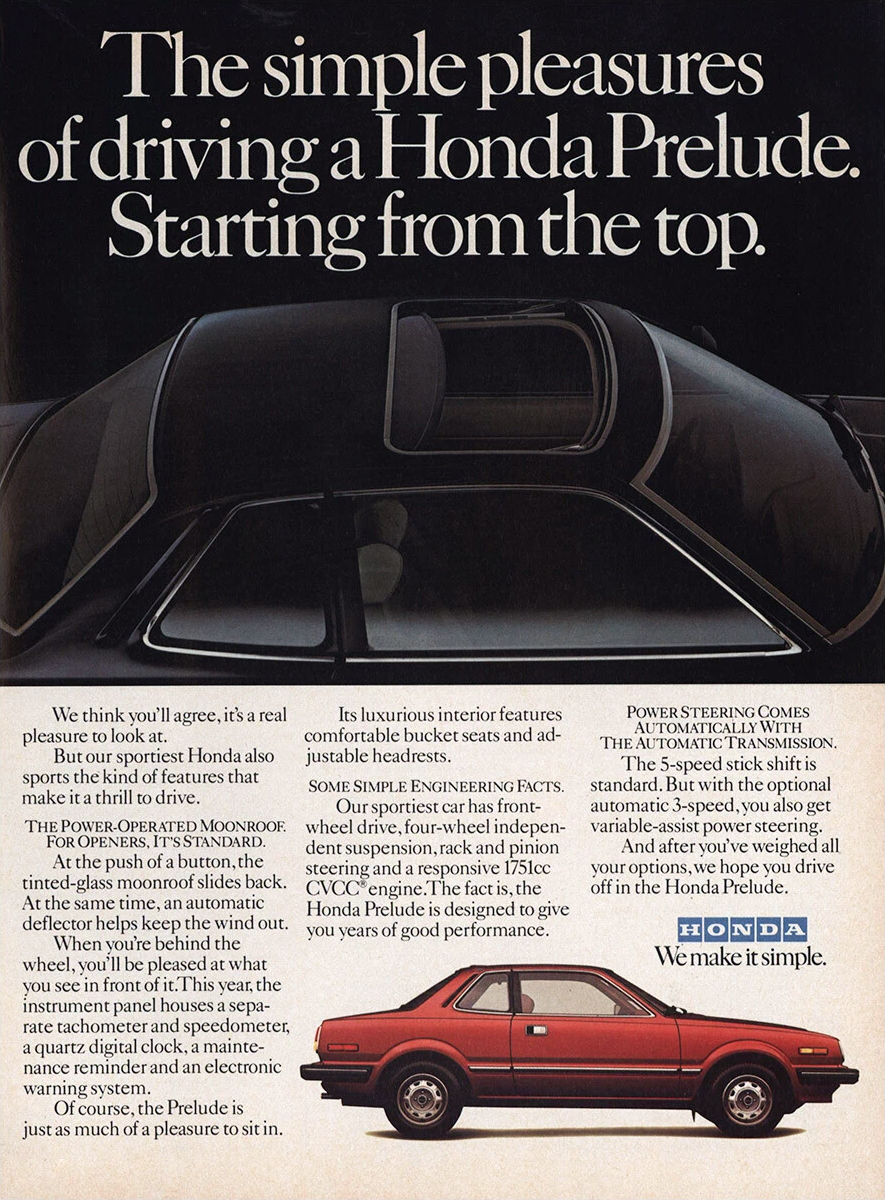
1982 Honda Prelude print advertisement

The 1982 Prelude Sport Coupe’s base price was $7,995—about $27,700 in today’s dollars or almost exactly what a 2025 Honda Civic hatchback sedan goes for. Standard exterior and mechanical equipment included tinted glass, a power-operated moonroof, rack and pinion steering, power-assisted front disc/rear drum brakes, and 175/70SR13 steel-belted radial ply tires (a size still available) on 13-inch wheels with bright metal wheel trim wings. Inside, reclining front bucket seats with 4-way adjustable headrests, a four-spoke Sport steering wheel, two-speed plus intermittent wipers, a quartz digital clock, front side window defrosters, a remote trunk release, and a rear window defroster were included.

Accessories & Production Numbers

There were no factory options for the Prelude other than transmission and paint color. Dealer accessories included aluminum alloy wheels and air conditioning. Dealers also offered twelve (!) audio choices, ranging up to an AM/FM stereo radio with electronic tuning, a digital display, and an autoreverse cassette with Dolby—but I would probably have just given Crutchfield a call.

Honda sold 37,872 Preludes in the United States in the 1982 model year—a solid finish for the first generation.

The View From 2025

There’s Prelude news right now—Honda promises that the Prelude will be coming back for the 2026 model year. Closer to our topic, first-generation Preludes were once commonly seen on American roads, but have virtually disappeared by now. You occasionally see these Preludes for sale in the Hemmings Motor News classifieds, on eBay Motors, and on Bring a Trailer.

Make mine Windsor Blue Metallic, please. Honda offered a grand total of three color choices for the 1982 Prelude. More color choices for the Prelude wouldn’t come until the 1985 model year arrived.

Other Hondas I have written about include the 1983 Accord sedan, the 1983 Civic S hatchback coupe, the 1984 Civic DX hatchback coupe, the 1984 Civic CRX hatchback coupe, the 1985 Civic CRX Si hatchback coupe, the 1986 Accord sedan, the 1986 Prelude Si coupe, and the 1988 Civic sedan.

1983 Chrysler Cordoba coupe

“We’ve Re-Engineered The American Luxury Car”

Chrysler’s Cordoba changed little in its final model year. The lower-priced LS version was no more. Some options were also gone—there was no more four-spoke steering wheel.

The spectacular success of the Cordoba in the mid-seventies—and all the hope it brought to Chrysler—was long gone by 1983. The first-generation’s mid-life refresh in 1978 was far from a success, but the results of the 1980 downsizing were even worse.

The Cordoba’s standard powertrain was the Slant Six 90 bhp 3.7 liter/225 ci inline six with a one-barrel carburetor mated to a three-speed TorqueFlite automatic transmission. Fuel economy ratings with the Slant Six were 18 city/24 highway by the day’s standards—not really competitive with GM’s intermediate coupes and showing the strain of a smaller engine in a relatively heavy (3,380 pound) car. With an 18-gallon gas tank, a Cordoba owner could expect a range of 280 to 305 miles with a 10% fuel reserve.

The optional engine was an LA 130 bhp 5.2 liter/318 ci V8 with a two-barrel carburetor. Fuel economy ratings with the V8 were 17 city/26 highway by 1983 standards, making the V8 a good choice if you could afford the extra $225.

1983 Chrysler Cordoba brochure cover

The 1983 Cordoba’s base price was $9,580—about $30,800 in today’s dollars. Standard exterior and mechanical equipment included a Special Edition landau roof, power steering, power front disc/rear drum brakes, and P195/75R15 glass belted radial white sidewall tires (a size now generally only available from specialty companies such as Coker Tire) on 15-inch wheels with Sport wheel covers. Inside, a cloth and vinyl front 60/40 seat with a folding center armrest and a passenger recliner, a two-spoke Luxury steering wheel, and an AM radio were included.

Packages, Options, & Production Numbers

Chrysler offered four packages for the 1983 Cordoba:

  • The $1,121 Basic Group included semi-automatic air conditioning, Deluxe wipers with intermittent wipe, and Light Group
  • The $114 Protection Group included color-keyed front and rear accessory floor mats and a litter container
  • The $143 Light Group included an underhood light, a door-ajar warning light, a map light, a glove box light, and a trunk light
  • The $587 Convertible Roof Package included a vinyl simulated convertible roof with simulated roof bows and a simulated rear convertible window

Individual exterior and mechanical options included wire wheel covers ($244), forged aluminum wheels ($107), and a power antenna ($60). Inside, leather and vinyl bucket seats ($529), a console ($75), a leather-wrapped steering wheel ($60), a tilt steering wheel ($99), semi-automatic air conditioning ($877), Deluxe wipers with intermittent wipe ($52), power windows ($180), and power door locks ($120). Three optional radios ranging up to an Electronic Search-Tune AM/FM stereo radio with a cassette player with Dolby system were available, with all including four speakers.

Chart of Chrysler Cordoba sales by model year

Chrysler sold 13,471 1983 Cordobas—less than one-tenth as many as were sold in each of the first three model years. Given those sale numbers—and those of the related Imperial and Mirada—it’s easy to see why all of these mid-size coupes would be gone in the 1984 model year.

The View From 2025

These Cordobas don’t seem to have made it as collectible cars. They’re seldom seen in either the Hemmings Motor News classifieds or on eBay Motors. Bring a Trailer has yet to auction a second-generation Cordoba.

Make mine Silver Crystal Coat, please.

Other real-wheel-drive eighties Chryslers I have written about include the 1980 Cordoba coupe, the 1981 New Yorker sedan, the 1983 Imperial coupe, and the 1987 Fifth Avenue sedan.