1988 BMW M3 coupe

In late 2019, my ex-wife and I visited the small but excellent BMW Zentrum Museum in Greer, SC. Of course they had a first-generation M3 on display—so I wrote a blog entry about this game-changing little coupe.

“Created for the race track, destined for the road.”

It took the M3 two-and-a-half years to make it to the United States following its debut in Europe, but most agreed it was worth the wait. Reviews were enthusiastic; Car and Driver exclaimed that “This is a car for us.”

The powertrain was the thing: an S14 192 bhp 2.3 liter/141 ci 16-valve inline four with four valves per cylinder and Bosch Motronic fuel injection mated to a five-speed manual. In a car with a curb weight of 2,734 pounds, this meant impressive acceleration—0-60 times were in the seven-second range. Given this, fuel economy wasn’t bad: 17 city/28 highway on premium gasoline by the day’s standards (15/26 by today’s standards). With a 14.5-gallon gas tank, the proud new owner of an M3 could expect a range of 265 to 295 miles with a 10% fuel reserve.

201433683402
1988 BMW M3 advertisement

Standard exterior equipment on the pricey $34,000 M3 (about $94,000 in 2025 dollars or well over what a loaded 2025 M4 coupe goes for) included tinted glass, halogen headlights, an electric dual position sunroof, boxed-out fender flares, a unique front bumper, and a cap over the C-pillar which helped to feed air onto the large for the day rear wing.

Mechanical features included a limited-slip differential, four-wheel anti-lock disc brakes, and 205/55VR15 tires on 15 x 7 inch cast light alloy BBS wheels. Inside, the M3 was comfortably equipped; leather sport seats, full instrumentation, power door locks, power windows, cruise control, air conditioning, a trip computer, and an AM/FM stereo cassette were all included.

The View From 2025

Over the last 12 years or so, the first-generation M3 has become one of the definitive eighties collector cars, with values for the very best examples nearly doubling. According to Hagerty’s valuation tools, all the money for a 1988 M3 in #1/Concours condition is an astounding $215,000, with a more normal #3/Good car going for $65,700. Some M3s come up for sale in the Hemming’s Motor News classifieds or on eBay Motors, but many are now sold at auction, whether on-line (Bring a Trailer) or in-person.

Make mine Salmon Silver Metallic, I think.

Other BMWs I have written about include the 1983 633CSi coupe, the 1984 325e coupe, the 1987 L6 coupe, the 1987 M6 coupe, and the 1988 750iL sedan.

Last updated March 2025.

1984 Audi 5000S sedan

“The World’s Most Aerodynamic Sedan”

1984 was the first year of Audi’s new aerodynamic design for their biggest sedan. At the time, the exterior design was differentiating—though many would follow, Audi’s was first. Despite being the top-of-the-line, the 5000S was not a large car by modern standards—every dimension was smaller than Audi’s current A6 sedan.

The standard powertrain on Audi’s new sedan was Volkswagen’s corporate 100 bhp 2.1 liter/123 ci inline five with Bosch K-Jetronic fuel injection mated with a five-speed manual transmission. An automatic was available with the standard engine. The automatic was the only transmission available with the upmarket Turbo option—the same engine with a turbocharger that made 140 bhp.

Period road tests showed 0-60 times of 10.6 seconds for the Turbo, making it not much quicker than the base 5000S but almost 20 mph faster. Fuel economy ratings for the Turbo were 19 city/28 highway by the day’s standards (15/20 by today’s measures). With a 21.2-gallon gas tank, the driver of a new Turbo could expect a 335 to 400 mile range with a 10% fuel reserve.

1984 Audi 5000S advertisement

Standard exterior and mechanical equipment on the $16,840 5000S (about $53,600 in today’s dollars—approximately what a 2025 S4 sedan costs) included halogen headlamps, flush-mounted window glass, power rack-and-pinion steering, power front disc/rear drum brakes, and 185/70SR14 tires (a size still readily available) on 14 x 6 inch aerodynamically styled lightweight aluminum wheels.

Inside, standard features included Electronic Climate Control, cloth bucket seats, a center console, and power windows. Features that look strange to our modern eyes include an illuminated ash tray and a “radio prep kit with power antenna” and four “high-quality” speakers.

Options, Packages, & Controversy

Exterior options for the 5000S included an electric two-way tilting/sliding sunroof, power heated mirrors, and metallic paint. Inside, leather seats, heated seats, and a trip computer were all available.

In addition to more power, the Turbo package included an electric two-way tilting/sliding sunroof, a slightly tighter suspension, four-wheel disc brakes, and 205/60HR15 tires (also still readily available) on 15 x 6 inch aluminum wheels. Inside, power seats, power door locks, a trip computer, and a “fine-sounding” Audi Design/Blaupunkt AM/FM stereo radio with a cassette player and four speakers were included. The Turbo‘s $5,570 additional cost moved the 5000 into another price bracket, bringing it up to about $71,300 in 2025 dollars—more like today’s S6 pricing.

Period reviews of the new design were quite good, and sales reflected that. Then, of course, things all went horribly south with the unintended acceleration controversy. Sales would crater, and it would take Audi many years to recover.

The View From 2025

5000S’s sometimes show up in the Hemming’s Motor News classifieds, on eBay Motors, and on Bring a Trailer, but there’s not a lot of activity—BaT has sold a total of ten over eight years.

Make mine Sapphire Metallic, please.

The only other Audi I have written about so far is the 1983 Quattro hatchback coupe.

Last updated June 2025.

1981 Plymouth Reliant coupe

Lee Iacocca passed in July 2019 after leading a full life—he was 94. In his honor, I revised my write-up on one of his most famous creations.

“right for the times we drive in”

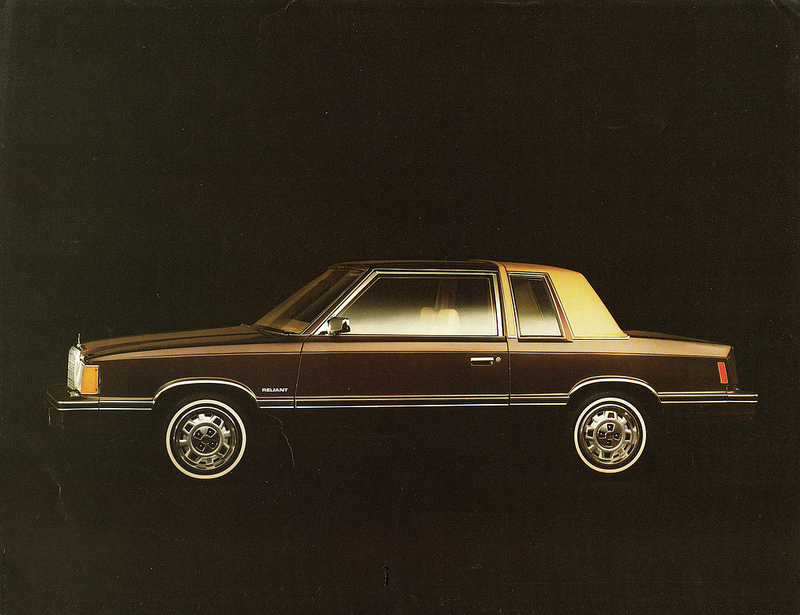
The 1981 Plymouth Reliant and its sibling, the Dodge Aries, are the K-body cars often (and reasonably) credited with saving Chrysler in the early 1980s. The first K cars were basic transportation, famously (like the GM X cars a year before) with no roll-down rear windows and just barely mid-size by the EPA’s classification—with an overall length of 176 inches, the Reliant coupe is almost exactly as long as a 2025 Mini Countryman.

The standard powertrain was an 84 bhp 2.2 liter/135 ci inline four with a Holley two-barrel carburetor paired with a four-speed manual. A Mitsubishi built 92 bhp 2.6 liter/156 ci inline four was optional for $159 and required both power steering ($174) and the three-speed TorqueFlite automatic ($360). Gas mileage with the base powertrain combination was rated at 29 city/41 highway by the day’s standards (23/29 by today’s measures). With a 13-gallon gas tank, a Reliant coupe with the standard engine and transmission could travel between 305 and 410 miles with a 10% fuel reserve.

1981PlymouthReliant
1981 Plymouth Reliant two-door coupe, scan courtesy of Alden Jewell

For $5,880 (about $22,200 in 2025 dollars), you got a Reliant coupe with front-wheel drive, rack-and-pinion steering, front disc/rear drum brakes, and P175/75R13 tires (a size that isn’t generally available anymore) on 13-inch wheels. Inside, a cloth and vinyl split back bench seat and an AM radio were included. The base coupe was only available in Pearl White, Natural Suede Tan, and Formal Black.

Spending another $435 on your Reliant coupe moved you up to Custom trim, which added quarter-window louvers, halogen headlights, a cigarette lighter, a color-keyed Deluxe two-spoke steering wheel, a digital clock, and a glove box lock. You also got many more exterior and interior color choices.

The top-of-the-line Special Edition (SE) Reliant coupes ($6,789 or about $25,600 in today’s dollars) added dual horns, deluxe wheel covers, special sound insulation, a cloth bench seat, and a snazzier “luxury” two-spoke steering wheel. Cloth bucket seats ($91) were only available with the SE.

Options, Production Numbers, & Performance

External and mechanical options for all Reliant coupes included tinted glass ($75), a glass sunroof ($246), and power brakes ($82). Both the mid-range upgrade P185/75R13 tires and the P165/75R14 upmarket tires (a size that fit the mid-90s Plymouth Neon compact just fine) are still readily available.

Inside, air conditioning cost $605 and required tinted glass, power brakes, and power steering—things were tightly engineered in the early 1980s. Other options included automatic speed control ($132), intermittent wipers ($44), a tilt steering wheel ($81), power door locks ($93), power front seats ($173 and said to be quite rare), along with a variety of radios up to an AM/FM radio with a cassette tape player and four speakers ($224).

The Reliant sold well in 1981—between the coupe and the sedan, Plymouth moved 101,127. Motor Trend managed to get a 2.2 liter with the automatic to do 0-60 in 12.4 seconds—they tried with another Reliant running the same combination, and it took 14.0 (oog) seconds. Top speed (if you could call it that) ranged from 88 to 96 mph in the 2,350-pound car.

The View From 2025

In 2025, Plymouth Reliants coupes rarely come up for sale in the Hemmings Motor News classifieds, on eBay Motors, or on Bring a Trailer, though you do see them occasionally on Craigslist. I haven’t seen a coupe in the wild for many years.

Make mine Baron Red, I think.

Other K-body and K-body based cars I have covered in this blog include the 1982 Chrysler LeBaron convertible, the 1984 Chrysler Laser hatchback coupe, the 1984 Dodge Daytona hatchback coupe, the 1985 Dodge 600 Club Coupe, and the 1986 Chrysler Town & Country convertible, and the 1987 Dodge Aries LE sedan. I also did a short commentary on an unidentified K-car wagon called Some Quiet Love For A K Car.

Last updated April 2025.

1986 Chevrolet Corvette convertible

“Yes to wind. Yes to sunshine.”

For 1986, the big news for Corvette was the return of the convertible, gone since 1975. Other improvements included Bosch ABS II anti-lock brakes, a Vehicle Anti-Theft System (VATS), and the mid-year introduction of aluminum cylinder heads.

The standard powertrain was the L98 235 bhp 5.7 liter/350 ci V8 with fuel injection paired with a Turbo-Hydramatic four-speed automatic transmission. Car and Driver recorded a 0-60 time of 6.0 seconds and a top speed of 144 mph. Estimated fuel economy was 17 city/24 highway by the standards of the day (15/22 by today’s standards). With a 20-gallon fuel tank, a Corvette convertible’s proud new owner could expect a range of between 335 and 370 miles with a 10% fuel reserve.

Built in collaboration with ASC, the convertible included a manual top, a rear-hinged deck panel to cover the top, and an X-brace underneath the floor. The newly-required high-mounted rear brake light was integrated into the rear fascia. Even the gas filler cover was different from the coupe—square because there was no rounded rear hatchback glass for it to wrap around.

1986 Chevrolet Corvette convertible brochure page
1986 Chevrolet Corvette brochure page

Standard exterior and mechanical equipment for the $32,032 Corvette convertible (about $93,612 in today’s dollars or about what a well-equipped 2025 Corvette Stingray convertible goes for) included a Delco Freedom Plus II battery, power operated quartz-halogen retractable headlamps, power rack-and-pinion steering, power brakes, and P255/50VR-16 tires on 16 x 9.5 inch cast alloy aluminum wheels. Inside, air conditioning, power windows, Tilt-Telescopic steering wheel, driver information system, cloth bucket seats, and an AM/FM stereo radio with power antenna were all included.

Options & Production Numbers

Optional exterior and mechanical equipment included a performance axle ratio ($22) and Delco-Bilstein shock absorbers ($189)—the Doug Nash 4+3 manual transmission was a no-cost option. Optional interior equipment included cruise control ($185), a power door lock system ($175), electronic control air conditioning ($150), a six-way power driver’s seat ($225), and the Delco-GM/Bose Music System ($895). The Z51 Performance Handling Package was not available with the convertible.

The return of the Corvette convertible was well-received—Chevrolet sold 7,315 in about half a model year, even at $5,000 more than the coupe. Reviews were also good; Car and Driver stated that the convertible was “a mighty hospitable carriage.”

The View From 2025

There is strong club support for the 1986 Corvette, as there is for all Corvettes. According to Hagerty’s valuation tools, all the money for a 1986 Corvette convertible in #1/Concours condition is $31,500, with a more normal number #3/Good condition car going for $10,800. 1986 Corvette convertibles are regularly featured in the Hemming’s Motor News classifieds and on eBay Motors—as I write this in December 2018, there’s a Yellow car with black leather seats and 29,000 miles available on Hemmings for $17,900.

Make mine White, with red leather seats—the “heritage colors” that match the first Corvette back in 1953.

Last updated February 2025.

1988 Honda Civic sedan

There’s a white fourth-generation Honda Civic sedan routinely parked on the street about two blocks from my house. You can tell that it hasn’t led a particularly sheltered life, but it’s obviously still in regular use. That makes it time to add one of those sedans to my suite of eighties Hondas: the 1983 Civic 1500 S hatchback coupe, the 1984 Civic CRX hatchback coupe, the 1985 Civic CRX Si hatchback coupe, and the 1986 Accord sedan.

“That was then. This is now.”

For the 1988 model year, the Honda Civic was completely revised, with a brand new design with a lower hood line, an innovative four-wheel double wishbone suspension, and a wheelbase up almost two inches to 98.4 inches. All Civic sedans for the North American market were built in Honda’s still relatively new Marysville, Ohio factory.

1988 Honda Civic sedan advertisement

The Civic sedan’s standard powertrain was the D15B2 92 bhp 1.5 liter/91 ci inline four with twin-injector fuel injection mated with a five-speed manual. Fuel economy was quite good—33 city/37 highway by the standards of the day (28/34 by 2018 standards). An optional four-speed automatic took mileage down to 28 city/33 highway. With an 11.9-gallon gas tank, a Civic owner could expect a range of between 330 and 375 miles with a 10% fuel reserve.

The Civic’s performance was competitive for the class—0-60 came in about 11 seconds with the five-speed manual in a car whose curb weight ranged from 2,039 to 2,205 pounds. The sedan was almost a second slower with the automatic; common in many cars in the eighties.

For $8,795 (about $19,200 in today’s dollars), the base DX version of the sedan came with flush low profile halogen headlights, tinted glass, rack and pinion steering, front disc/rear drum brakes, and 175/70R13 steel-belted radial tires (a size still readily available) on 13 x 5 inch wheels. Inside, the DX included an adjustable steering column, a rear window defroster, intermittent wipers, and full carpeting.

Moving up to $9,625 LX (about $21,000 in 2018 dollars or about $1,500 more than a 2019 Civic LX sedan goes for) added power brakes, a tachometer, power windows, power door locks, power side mirrors, and a digital quartz clock.

Other than the choice of trim level, exterior and interior colors, and transmission, there were no options. Air conditioning was available only as a dealer accessory, as was a choice of various car stereos: Honda would continue to sell AC as a dealer accessory well into the 1990s.

The larger 1988 Civic was well received—it made Car and Driver‘s 10 Best list and sold like hot cakes; a 1988 Civic LX sedan marked the one-millionth car built at the Marysville plant in early April 1988. They were still small cars by modern standards—the 1988 Civic was only about five inches longer than the current Honda Fit.

In 2018, this generation of Civic sedan rarely comes up for sale in the Hemmings Motor News classifieds. Some do show up on eBay Motors, but they’re often in sketchy condition.

Make mine Cardinal Red Metallic, please.

1987 Sterling 825 sedan

“… such effortless motion, …”

1987 Sterling 825 interior

The Sterling 825 sedan was an interesting (perhaps desperate) attempt at re-introducing Rover cars to the North American market, but with different branding than the brutally unsuccessful Rover 3500 hatchback sedan from 1980. Based on the same platform as the acclaimed Acura Legend, the Sterling featured an angular exterior design and an interior with traditional British luxury cues, such as Connolly leather seats and burled walnut trim. On the exterior, only the door handles were obviously shared between the Acura and the Sterling.

A Honda-built 151 bhp 2.5 liter/152 ci V6 with fuel injection combined with a five-speed manual transmission yielded mpg ratings of 18 city /24 highway by the day’s standards (16/22 by modern standards). The optional four-speed automatic transmission dropped mpg incrementally to 17 city/23 highway. With the standard powertrain and an 18-gallon gas tank, a Sterling driver could expect a 310 to 340 mile range with a 10% fuel reserve.

Equipment, Reception, & Production Numbers

The $19,200 (about $55,300 in today’s dollars or about what a loaded 2025 Acura TLX sedan goes for) 825 S came with remote locking, power rack-and-pinion steering, power brakes, and 195/65R15 tires (a size still readily available) on 15-inch alloy wheels. Inside, air conditioning, power windows, an electric moonroof, cruise control, velour cloth seats, and a Phillips AM/FM stereo cassette with six speakers were all included.

Moving up to the $23,900 (about $68,800 in 2025 dollars) 825 SL added a four-speed automatic transmission, Bosch anti-lock brakes, Deluxe alloy wheels, a 10-function trip computer, leather upholstery with a heated driver’s seat, and an eight-speaker stereo.

Advertised as “The inevitable British road car.” Sterling sold 14,171 units of the 825 in the 1987 model year—not a bad debut. But, trouble was brewing; in an attempt to generate more jobs in the United Kingdom, Rover had decided to use Lucas electronic systems instead of those from Honda. Predictably, those electronics weren’t reliable, and there were also issues with the interior plastics and the exterior paint. Finally, rust came much too quickly.

All this meant that sales dropped rapidly. In 1988, only 8,901 were sold, and every year following that, things got worse. In August 1991, Sterling announced they were leaving the North American market after selling a total of about 35,000 cars over five years.

The View From 2025

The Sterling 825 rarely comes up for sale in the Hemmings Motor News classifieds or on eBay Motors. However, as I update this post in early 2025, there’s a 1988 825 SL on Bring a Trailer. I haven’t seen one in person in many years, but I believe I’d still notice that handsome styling if I did.

Make mine Pulsar, I think.

Last updated March 2025.

1985 Merkur XR4Ti hatchback coupe

“For the North American continent the Merkur XR4Ti represents an innovative, new total performance machine.”

The Merkur XR4Ti never had a chance.

There, I’ve said it. Though the redoubtable Bob Lutz was involved, I can’t even imagine the combination of decisions that made Ford think that selling a Karmann-assembled version of the European Ford Sierra at Lincoln-Mercury dealers in the mid-1980s was ever going to work out. By early 1989, the XR4Ti was gone.

Because the Cologne 2.8 liter V6 the Sierra used in Germany could not clear US emissions, the engine the XR4Ti received was Ford’s Lima 2.3 liter/140 ci turbocharged and fuel-injected inline four also seen in the Ford Mustang SVO and Ford Thunderbird Turbo Coupe. In its Merkur guise, it made 175 bhp with the standard five-speed manual transmission and 145 bhp (ouch!) with the optional ($427) three-speed automatic transmission. Car and Driver recorded a 0-60 time of 7.0 seconds flat and a top speed of 129 mph with the manual. Fuel economy wasn’t particularly good: with the manual, it was 19 city/24 highway by the day’s standards (17/22 by today’s measures). With a 15.1-gallon gas tank, a Merkur owner could expect a range of 265 to 290 miles with a 10% fuel reserve.

1985 Merkur print advertisement.

Base price for the 1985 XR4Ti was $16,361 (about $50,200 in 2025 dollars). Standard exterior and mechanical features included integrated halogen headlamps, tinted glass, power-assisted front disc/rear drum brakes, nitrogen pressurized shock absorbers, variable-ratio power-assisted rack-and-pinion steering, and Pirelli P6 195/60HR14 steel-belted radial tires (a size still readily available) fitted on 14-inch cast aluminum-alloy “phone dial” wheels. Inside, standard equipment included Oxford cloth front bucket seats with infinitely variable manual reclining seatbacks, a 60/40 folding rear seat, air conditioning, dual power outside rear-view mirrors, and an electronic AM/FM stereo cassette radio with four speakers. The famous (and polarizing) biplane rear spoiler was derived from the one on the Probe III concept car Ford had shown in 1981.

Convenience Group & A Few Individual Options

A $470 Convenience group was available, which included power central door locking, power windows, and speed control.

Individual options other than the automatic transmission were relatively few: metallic paint ($274), a tilt/slide moonroof ($549), leather seats ($890), heated front bucket seats ($183), and a fuel mileage computer.

Period Reviews & Production Numbers

The XR4Ti received general approval from the automotive press. Motor Trend called it “Lincoln-Mercury’s Antidote for the BMW Syndrome.” Writing in Car and Driver, Brock Yates predicted that the Merkur would “pile into the upscale sports sedan market like a runaway freight train.”

Of course, this didn’t happen. Production numbers by model year are not easily available, but Karmann built a total of 45,368 XR4Tis over five calendar years. Ford had hoped to sell 16,000 to 20,000 a year.

The View From 2025

According to Hagerty’s valuation tools, a 1985 Merkur XR4Ti in #1/Concours condition is $15,300, with a more normal #3/Good car going for $7,900. I find it interesting that Hagerty tracks them at all—there are many that I think of as equally interesting cars that they don’t track. You rarely see them for sale in the Hemming’s Motor News classifieds or eBay Motors—they are at least a little more common on Bring a Trailer.

Make mine Paris Blue Metallic with the optional Gray leather interior, please. The real question is how many are left.

I really should write about the Scorpio hatchback sedan someday.

Last updated September 2025.

1983 Toyota Camry sedan

“Introducing the family Camry”

The Toyota Camry debuted in the middle of the 1983 model year, in four-door sedan and five-door hatchback models. Instead of designing it to compete with European manufacturers, Toyota designed the Camry to compete with American cars. In fact, Car and Driver famously wrote that “the Camry drives as if Buick engineers had moonlighted on its development.” The Camry’s measurements split the difference in size between the GM J-body (Buick Skyhawk, Cadillac Cimarron, Chevrolet Cavalier, Oldsmobile Firenza, and Pontiac 2000) and the GM X-body (Buick Skylark, Chevrolet Citation, Oldsmobile Omega, and Pontiac Phoenix).

Power for the first-year Camry was provided by a 92 bhp 2.0 liter/122 ci inline four with fuel injection, which was available with either a standard five-speed manual or an optional four-speed automatic. With the manual, 0-60 mph came in a little under 13 seconds in the 2,236-pound car. Mileage was good—32 city/44 highway by the day’s standards (25/31 by modern measures). With a 13.8-gallon gas tank, a Camry owner could expect a 350 to 420 mile range with a 10% fuel reserve.

Sedan page from the 1983 Toyota Camry brochure

Standard exterior and mechanical equipment on the $7,988 (about $26,400 in today’s dollars—a 2025 Camry starts at $29,000) Deluxe sedan included tinted glass, front wheel drive, rack-and-pinion steering, power-assisted front disc/rear drum brakes, and 185/70R13 steel-belted radial tires (a size still available from Kumho and Vredestein) on 13-inch styled steel wheels. Inside, reclining front cloth bucket seats with adjustable headrests, an electric rear window defogger, and a quartz analog clock were included.

Upgrading to the $9,698 LE made the four-speed automatic standard and added tungsten halogen headlights, dual outside mirrors with powered remote control, power steering with variable assist, full instrumentation, a fold-down rear seat armrest, a digital quartz clock, and an AM/FM stereo radio with five speakers and an automatic power antenna.

Options, Period Reviews, & Production Numbers

Individual options were relatively few and included aluminum alloy wheels, dual-stage air conditioning ($630), and a power sunroof with maplight ($460). A Power Package included cruise control, power locks, and power windows.

The first-generation Camry was well received and got good reviews—the tagline in Car and Driver‘s test was “At home in America.” 52,651 were sold in that first model year, with sales increasing steadily throughout the decade.

The View From 2025

Unlike other Toyotas that are deemed more collectible from the eighties (Land Cruisers, pickup trucks, Celicas, Supras, MR2s), first-generation Camrys rarely come up for sale in the Hemmings Motor News classifieds, on eBay Motors, or on Bring a Trailer.

Make mine Deep Maroon Metallic, please.

Other Toyotas I’ve written about include the 1980 Corolla Tercel Liftback, the 1981 Celica Sport Coupe, the 1982 Celica Supra hatchback coupe, the 1984 Corolla SR5 Sport Coupe, and the 1985 MR2 coupe.

Last updated December 2025.

1988 Pontiac Grand Prix coupe

“… one of the most aerodynamic cars in the world.”

The Grand Prix was all new for 1988. Gone was the elderly G-body rear-wheel-drive (dating from 1978), replaced by an aerodynamic front-wheel drive W-body.

For 1988, the standard Grand Prix powertrain was the LB6 130 bhp 2.8 liter/173 ci V6 with fuel injection paired to a four-speed automatic (a five-speed manual was available). With a curb weight of 3,038 pounds, 0-60 took a little over 10 seconds with the standard powertrain. Mileage with the same powertrain was 20 city/29 highway by the standards of the day (18/26 by today’s standards). A 16.0-gallon fuel tank meant that a Grand Prix owner could expect a range of between 315 and 355 miles with a 10% fuel reserve.

The 1988 Grand Prix came in base, LE, and SE forms. Standard exterior and mechanical equipment in the $12,539 base coupe (about $27,300 in today’s dollars) included composite halogen headlamps, dual sport mirrors, power steering, four-wheel power disc brakes, an independent rear suspension, and P195/75R14 tires (a size still available from multiple vendors) on 14 x 6 inch wheels with custom wheel covers. Inside, notchback front bench seats, an electronic digital speedometer, a glove box with a combination lock, and an AM/FM stereo radio were included.

Moving up a little to the $13,239 LE added power windows with illuminated switches, lamp group, 40/60 split reclining pallex cloth seats, rear folding armrest with pass through to the luggage compartment, and mechanical analog gauges with tachometer and trip odometer.

The top-of-the-line $15,249 SE (about $32,300 in 2018 dollars) added the Y99 Rally Tuned suspension, dual exhaust system, and P215/65R15 tires on 15-inch aluminum wheels and switched the standard transmission to a five-speed manual. Inside, air conditioning, leather-wrapped tilt steering wheel, cruise control, power cloth front bucket seats with three-position lumbar controls, and rear bucket seats were all part of the SE experience.

Options included power door locks, an electric rear window defogger, a power antenna, and a UX1 AM stereo/FM stereo radio with seek, scan, auto-reverse cassette, five-band graphic equalizer, and digital clock.

The 1988 Grand Prix was relatively well received—it was Motor Trend‘s Car of the Year, and Pontiac sold 86,357 cars in slightly over half a model year (sales only began in January 1988), which marked more than five times as many as the last of the G-body versions in 1987. For 1989, sales would top 136,000 and would stay over 100,000 for every year through 1995.

Grand Prix’s of this generation are rarely seen in the Hemming’s Motor News classifieds and on eBay Motors. Sometimes you do see the ASC/McLaren or GTP versions, but rarely the “civilian” models.

Make mine red, please.

1983 Buick Skylark T TYPE coupe

“A road car with a very distinct personality.”

Buick offered five separate T TYPE models (their spelling) in 1983. One of the new ones was the Skylark coupe, Buick’s version of the X-car.

The Skylark T TYPE‘s standard powertrain was the LH7 “high output” 135 bhp 2.8 liter/173 ci V6 with a Rochester E2SE two-barrel carburetor paired with a four-speed manual. The 0-60 time was a little over 9 seconds—respectable but not great in 1983. Mileage was 21 city/34 highway by the day’s standards (17/23 by today’s measures). With a 15.1-gallon gas tank, a T TYPE owner could expect a range of 270 to 335 miles with a 10% fuel reserve.

Skylark pages from the 1983 Buick T TYPE brochure

Standard mechanical equipment on the $9,337 T TYPE coupe (approximately $30,700 in today’s dollars or about what a 2026 Buick Encore GX Avenir SUV costs) included a Sport suspension (stiffer rate springs, stiffer shock absorbers, a more rigid front stabilizer bar, and added rear stabilizer bar), a “special tuned” exhaust, a 3.65:1 final drive ratio, and P215/60R14 steel belted radial tires (a size still available from BFGoodrich and Riken) on 14-inch styled aluminum wheels. Exterior equipment specific to the T TYPE included a blacked out grille, smoked tail lamp lenses, and charcoal lower body accent paint. Inside, vinyl or cloth bucket seats with backrest recliner, a full-length operating console, a special Sport steering wheel, and color-coordinated seat belt buckles were included.

Standard equipment on all Skylarks included front-wheel drive, power rack and pinion steering, power front disc/rear drum brakes, tungsten-halogen high/low beam headlamps, a Delco Freedom II Plus battery, and an AM radio with two front speakers and a fixed-mast radio antenna.

Options & Production Numbers

Options included dual electric remote mirrors ($78), the Vista-Vent flip-open removable glass sunroof ($295), air conditioning ($725), Cruise Master speed control with resume ($170), power windows ($180), tilt steering ($105), and an ETR AM/FM stereo radio with a cassette player and a graphic equalizer ($505).

Despite Buick’s commitment to extending the T TYPE line (they even went to the trouble of creating a T TYPE brochure), sales were not impressive—about 3.5% of the sales of the Skyhawk, Skylark, Century, Regal, and Riviera. Of the T TYPEs, the Skylark was comparatively successful, with 2,489 sold—about 6.1% of overall Skylark sales.

The View From 2025

I haven’t seen a Skylark T TYPE since they were new, and I saw one parked outside of the long-gone Crown Buick on the Lincoln Highway in Ardmore, PA. Skylarks of this era are rarely seen in the Hemmings Motor News classifieds, on eBay Motors, or on Bring a Trailer—when one does come up for sale, Hemmings considers it worthy of a portion of a blog entry.

There were only four exterior colors available for the Skylark T TYPE: White, Silver Metallic, Dark Red Metallic, and Light Sand Gray. Make mine Silver Metallic, please.

Other X-cars I have written about in this blog include the 1980 Chevrolet Citation hatchback sedan, the 1981 Chevrolet Citation X-11 hatchback coupe, the 1985 Chevrolet Citation II hatchback sedan, the 1984 Oldsmobile Omega sedan, and the 1982 Pontiac Phoenix SJ coupe.

Last updated August 2025.