1982 Cadillac Cimarron sedan

Hemmings Motor News published an extended discussion on the Cadillac Cimarron in their always interesting Hemmings Daily blog, so I figured I’d bring one of my first posts up to a more current location.

“A new kind of Cadillac for a new kind of Cadillac owner.”

Ah—the poor Cadillac Cimarron, rushed to market for CAFE and other reasons without much thought as to who would actually buy it. When released in 1982, it was just a nice as possible, relatively well equipped Chevrolet Cavalier.

Inside page from the 1982 Cadillac Cimarron brochure

The only engine available for 1982 was the 88 bhp L46 1.8 liter/112 ci inline four with Rochester Varajet II two-barrel carburetor. When paired with the standard four-speed manual transmission, mileage was an impressive 26 city/42 highway by the standards of the day (about 21/31 by modern standards), but the car was slow—0-60 mph took about 14 seconds. A three-speed automatic transmission was optional and likely even slower (estimates come to about 16 seconds). The 13.7-gallon fuel tank gave a range of between 330 and 420 miles with a 10% reserve.

The $12,181 base price (about $32,900 in today’s dollars—just a little under what a base 2018 Cadillac ATS sedan costs) included standard exterior and mechanical features such as power brakes, power steering, power mirrors, intermittent windshield wipers, and P195/70R13 tires on 13-inch aluminum wheels. Air conditioning, leather seating areas, a leather steering wheel, a tachometer, and an AM/FM stereo radio with four speakers were all standard in the interior.

Options included a sunroof ($261), cruise control (about $150), power door locks ($12—why bother making them an option?), power windows (yes, the base 1982 Cimarron came with roll-up windows—power windows were an extra $216), six-way power seats ($366), tilt steering wheel ($88), and an AM/FM stereo radio with cassette ($153). It wasn’t hard to load a Cimarron up to almost $13,500—real money in 1982 and about $36,400 in 2018 dollars.

In typical General Motors fashion, the Cimarron improved each year (sometimes significantly). However, the stench of that horribly failed initial release stayed with the car until Cadillac finally stopped selling them at the end of the 1988 model year. By that point, the Cimarron had upgraded from the fairly awful four-cylinder to a decent (and standard) V6 and had exterior styling that was at least somewhat more differentiated from Chevrolet’s.

So, the Cimarron remains a spectacularly easy target—routinely making those “worst ten cars of all time” lists and suchlike. I have yet to see a Cimarron at a serious classic car show, but I’m betting some intrepid soul will save one and bring it back.

Surprisingly, Hagerty does track the Cimarron with their valuation tools—according to them, all the money for a 1982 in #1/Concours condition is $6,100, with a far more typical #3/Good car going for $1,600. I can’t remember ever seeing one for sale in the Hemmings Motor News classifieds—they’re treated by Cadillac folks like Ford folks treat the Mustang II from the 1970s. You do occasionally see them on eBay Motors.

Save

1986 Honda Accord sedan

“Once again, other manufacturers will be forced to return to their drawing boards.”

The Honda Accord was all-new for 1986, with a brand-new body and an upgraded base engine—the standard powertrain was the A20A 98 bhp 2.0 liter/120 ci inline four with a two-barrel carburetor paired to a five-speed manual transmission (a four-speed automatic was optional). Acceleration was acceptable: 0-60 came in a little under 11 seconds in the approximately 2,400-pound car. On the other hand, fuel economy was good: 27 city/33 highway by the day’s standards (about 23 city/30 highway by 2025 measures). With a 15.9-gallon fuel tank, Accord drivers could expect a range of from 380 to 430 miles with a 10% fuel reserve.

By modern standards, the 1986 Accord was not a large car: with a 102.4-inch wheelbase and a 178.5-inch length, it was more than five inches shorter in both wheelbase and length than a 2025 Honda Civic sedan and was classified by the EPA as a subcompact car (the modern Accord is classified as a large car). What’s even more striking is the height or lack thereof: at 53.3 inches, the Accord was only three inches taller than the same year’s Camaro. The 1986 Accord had a six-inch longer wheelbase, three inches more of length, and was almost an inch shorter than the 1985 version.

1986 Honda Accord advertisement.

Standard exterior and mechanical equipment on the base Accord DX sedan included front wheel drive, a double wishbone front and rear suspension, power brakes, variable-assist power steering, pop-up halogen headlights, hidden wipers, and P185/70R13 tires (a size still available) on 13-inch wheels with full wheel covers. Inside, reclining front bucket seats, an adjustable steering column, and cruise control were included. The DX went for $9,299—about $27,800 in 2025 dollars.

Moving up to the LX added air conditioning, power door locks, power windows, and an AM/FM stereo with cassette player and power antenna. The top-of-the-line LXi went for $12,675 (about $37,900 in today’s dollars or just a little under what a 2025 Accord Touring Hybrid sedan goes for) and added the 110 bhp fuel-injected engine, cast aluminum alloy wheels, and a power moonroof.

Period Reviews & Production Numbers

The 1986 Honda Accord was well-received. It was present on Car and Driver‘s 10 Best list and got good reviews from the other “buff books.” Honda sold 325,000 in the United States, making it the fifth best-selling car model that year.

The View From 2025

Third-generation Accords were once prevalent on American roads, but have virtually disappeared by now. You do occasionally see these Accords for sale in the Hemmings Motor News classifieds, on eBay Motors, and on Bring a Trailer.

Make mine Montreal Blue Metallic, please.

Other Hondas I have written about include the 1982 Honda Prelude Sport Coupe, the 1983 Accord sedan, the 1983 Civic S hatchback coupe, the 1984 Civic DX hatchback coupe, the 1984 Civic CRX hatchback coupe, the 1985 Civic CRX Si hatchback coupe, the 1986 Prelude Si coupe, and the 1988 Civic sedan.

Last updated December 2025.

1980 Lincoln Continental Mark VI coupe

“A car befitting its illustrious heritage”

For 1980, Lincoln completely revised the Continental Mark series, downsizing it for the first time and adding a sedan. The coupe was over 14 inches shorter than the 1979 Mark V and about 750 pounds lighter. However, the Mark VI was still a big car by any standard—more than two feet longer than a 2025 Mercedes-Benz CLE coupe.

Standard power for 1980 was a Windsor 129 bhp 4.9 liter/302 ci V8 with throttle-body fuel injection paired with a four-speed automatic overdrive transmission. Buyers could specify a $160 upgrade, which was the Windsor (not Cleveland) 140 bhp 5.8 liter/351 ci V8 with a Motorcraft 7200 VV two-barrel carburetor. With the standard powertrain, 0-60 took about 14 seconds in the 3,892-pound car. Mileage was 17 city/24 highway by the day’s standards—with the 18-gallon gas tank, Mark VI owners could expect a range of 300 to 330 miles with a 10% fuel reserve.

Standard exterior and mechanical equipment on the $16,291 base Mark VI ($70,200 in today’s dollars or a little over what a 2025 Lincoln Aviator Reserve mid-size SUV costs) included hidden halogen headlamps, luxury wheel covers, and Michelin P205/75R15 white sidewall steel-belted radial tires (a size still readily available) on 15-inch wheels. Inside, cloth Twin Comfort lounge seats, power windows, an electronic instrument panel with message center, a four-spoke color-keyed steering wheel, automatic temperature control air conditioning, and an AM/FM stereo radio with power antenna were all standard.

Packages, Options, & Production Numbers

As had been true for many years, there were multiple Designer Series packages available for the Mark VI:

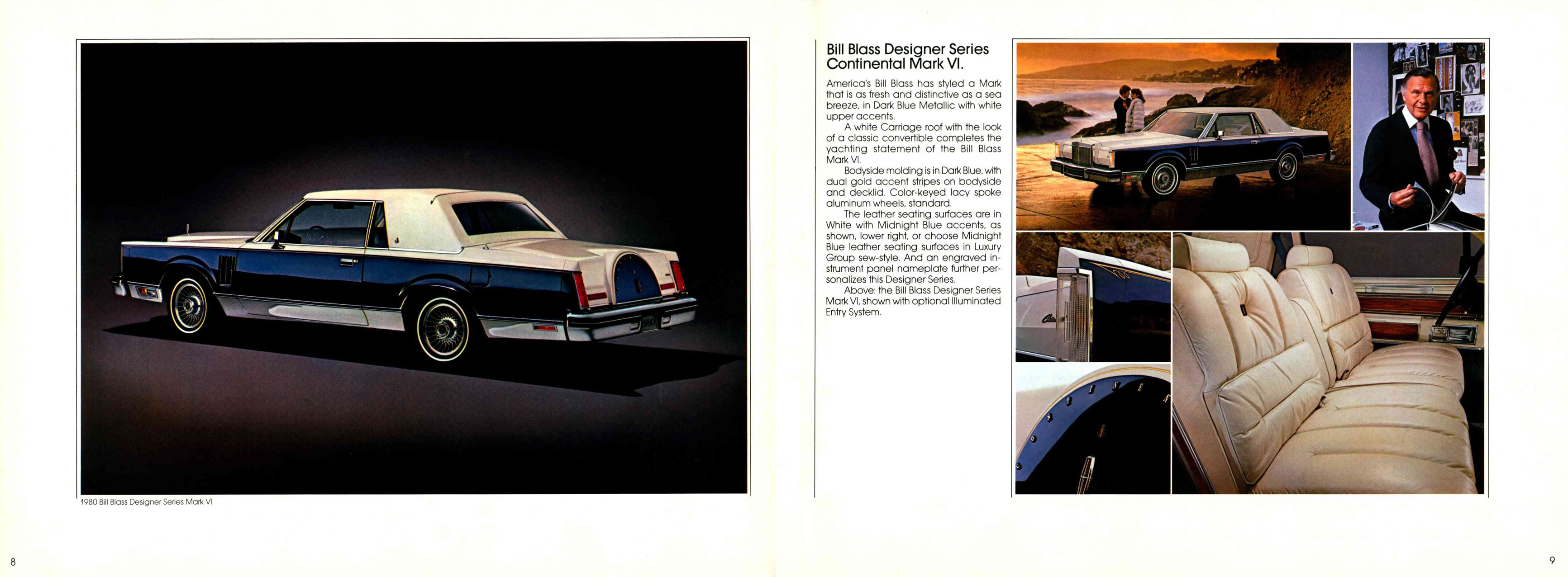
Bill Blass pages from the 1980 Lincoln Continental Mark VI brochure
  • The Bill Blass Designer Series package ($1,825) included Dark Blue Metallic paint with white upper accents, a white Carriage roof, dark blue bodyside moldings, dual gold accent stripes on bodyside and decklid, and color-keyed lacy spoke aluminum wheels. Inside, leather seating surfaces were a choice of white with blue accents or midnight blue in the Luxury Group sew-style.
  • The Cartier Designer Series package ($2,191) included Light Pewter Metallic/Medium Pewter Metallic two-tone paint, a Medium Pewter Landau roof, color-keyed turbine spoke aluminum wheels, light pewter bodyside moldings, single dark red accent stripes on the body and decklid, the Cartier signature in the opera windows, and the Cartier monogram on logo on the front fender louvers and the decklid. Inside, there was a choice of either cloth or leather seating surfaces in the Luxury Group sew-style.
  • The Givenchy Designer Series package ($1,739) included Light Fawn Metallic/Bittersweet Metallic two-tone paint, with tri-band pinstriping, a Light Fawn full vinyl roof, wire wheel covers, and the Givenchy monogram on the hood and the rear decklid. Inside, the Givenchy had bittersweet six-way power Twin Comfort seats in the Luxury Group sew-style.
  • The Pucci Designer Series package ($2,191) included Light Fawn Metallic/Medium Fawn Metallic two-tone paint, with tri-band pinstriping, a Light Fawn Landau roof, color-keyed lacy spoke aluminum wheels, and the Pucci logo on the front fender louvers and the decklid. Inside, leather seating surfaces had light champagne bolsters with medium champagne inserts in the Luxury Group sew-style.

—all four Designers Series packages included a personalized engraved nameplate on the instrument panel.

There was also the Signature Series ($5,485), which added just about every major option and brought the price to $21,776 (about $93,800 in 2025 dollars). Standard exterior and mechanical features on the Signature Series included a Valino grain vinyl Landau roof and color-keyed turbine spoke cast aluminum wheels. Inside, the Signature Series included Twin Comfort Lounge six-way power seats, the Keyless Entry System, an Automatic Garage Door Opener Control, Speed Control, a tilt steering wheel, the defroster group, illuminated visor vanity mirrors, and a six-speaker Premium Sound System. The Signature Series was available in Silver Metallic or Dark Maroon and could be ordered with Dark Red Signature Body Cloth or leather seating surfaces.

Individual options included touring lamps ($67), a power glass moonroof, wide white sidewall tires, Twin Comfort Lounge six-way power seats ($171), a tilt steering wheel ($83), and Speed Control ($149).

Like the Ford Thunderbird of the same year, the 1980 Continental Mark VI did not sell. Sales of the coupe dropped to 27% of the 1979 number—even if you added the newly available sedan, they were still down 49%; not a good look for a brand-new model. To make the news worse, the virtually unchanged Cadillac Eldorado (which had been downsized in 1979) more than doubled the Mark VI coupe’s sales. The agony would continue for several years, only changing with the release of the aerodynamic and significantly smaller Mark VII in 1984.

The View From 2025

According to Hagerty’s valuation tools, a 1980 Continental Mark VI coupe in #1/Concours condition is $23,000, with a far more typical #3/Good car going for $6,300. Values slide up with the various Designer Series packages and the Signature Series, but only by about 5% to 10%. This generation of Marks maintains some presence in the Hemmings Motor News classifieds, on eBay Motors, and on Bring a Trailer. As I update this blog entry in October 2025, there’s a French Vanilla Metallic 1982 coupe with a black vinyl roof, midnight blue leather seats, and 11,000 miles for sale on Hemmings, asking $11,000.

Make mine Dark Maroon, please.

Other Lincolns I have written about include the 1984 Continental Mark VII LSC coupe, the 1986 Mark VII coupe, the 1987 Continental sedan, and the 1989 Town Car sedan.

Last updated October 2025.

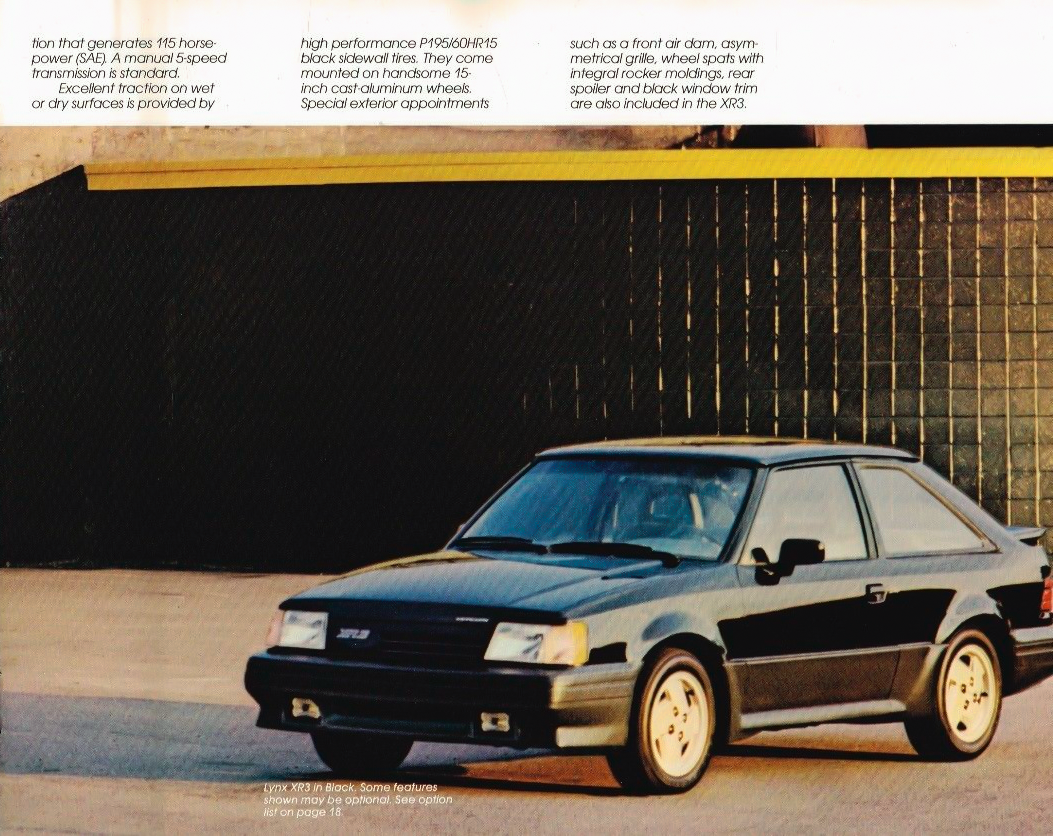
1987 Mercury Lynx XR3 hatchback coupe

This post is consistently one of the most popular every year and has been so since the first full year after I originally posted it. It seems to me the key to an individual post’s popularity is often in the rarity of the other coverage available for that particular vehicle.

“… the sporting side of Lynx.”

1987 was the final year for the Lynx—Mercury’s version of Ford’s Escort compact. The Escort would soldier on for many more years (through model year 2002), but from 1988 forward, the smallest American-built Mercury would be the Topaz—still a compact, but larger in almost every dimension. For 1986 and 1987, the top-of-the-line Lynx was the XR3 hatchback coupe.

The XR3 designation was not random, but may not have been obvious to much of the North American market. In Europe, XR3 (and later XR3i) was a sporty trim of the Mark III Ford Escort from 1980 forward. Why Ford’s marketers chose to make XR3 the sportiest Lynx instead of using the name for the stateside Escort (which used GT in the mid-1980s) is a question lost in the mists of time, but may have had something to do with XR-7 designation for the sportiest Mercury Cougar.

The Lynx XR3‘s standard (and only) powertrain was a “High Output” 115 bhp 1.9 liter/113 ci inline four with Bosch multi-port fuel injection paired with a five-speed manual transmission. Mileage was good—25 city/34 highway by the day’s standards (about 22 city/31 highway by 2025 measures). Acceleration was reasonably quick: 0-60 came in about 10 seconds in the approximately 2,400-pound car. With a 13-gallon fuel tank, Lynx XR3 drivers could expect a range of 310 to 345 miles with a 10% fuel reserve.

XR3 page from the 1987 Mercury Lynx brochure

Standard exterior and mechanical equipment on the $8,808 Lynx XR3 (about $25,900 in today’s dollars) included an asymmetrical grille, an aerodynamic front air dam with built-in fog lamps, wide wheel flairs, a rear spoiler, dual power mirrors, power steering, and P195/60R15 Goodyear Eagle GT tires (a size still readily available) on 15-inch four-flag cast-aluminum wheels. Inside, cloth sport bucket seats, a full console with a graphic alert display, a split folding rear seat, a leather-wrapped steering wheel, a locking fuel filler door with remote release, and an electronic AM/FM stereo radio with four speakers were included.

Standard exterior and mechanical equipment on every Lynx included aero halogen headlamps, front-wheel-drive, a four-wheel independent suspension, rack-and-pinion steering, and power front disc/rear drum brakes. The Lynx was not a large car—there aren’t many current small coupes remaining to compare it to, but the 2025 Honda Civic hatchback sedan is 5 inches wider and about a foot longer.

Options & Production Numbers

Few options were available since the XR3 came relatively well-equipped for a compact car in the eighties. In fact, seven separate options available for lesser Lynxes were standard on the XR3. Exterior and mechanical options for the XR3 included tinted glass ($105), a rear window wiper/washer ($126), and an engine block heater ($18). Inside, air conditioning ($688), speed control ($176), and a tilt steering wheel ($179) were available.

The final-year Lynx didn’t sell very well: a total of 39,039 in a year when Ford sold 374,765 Escorts. It’s reasonable to say that very few of the 20,930 hatchback coupes were XR3s.

The View From 2025

Badge for 2,500 web hits

First-generation Escorts and Lynxes were once so prevalent on American roads, but have now virtually disappeared. You occasionally see Lynxes for sale in the Hemming’s Motor News classifieds and on eBay Motors. Bring a Trailer has auctioned a grand total of two Lynxes, neither of them XR3s.

Make mine Smoke, please.

Other Mercurys I have written about are the 1980 Cougar XR-7 coupe, the 1983 Grand Marquis sedan, the 1984 Grand Marquis Colony Park LS station wagon, the 1986 Capri hatchback coupe, the 1988 Cougar XR-7 coupe, and the 1988 Grand Marquis Colony Park station wagon. I have also written about the 1981 Ford Escort hatchback coupe.

Last updated December 2025.

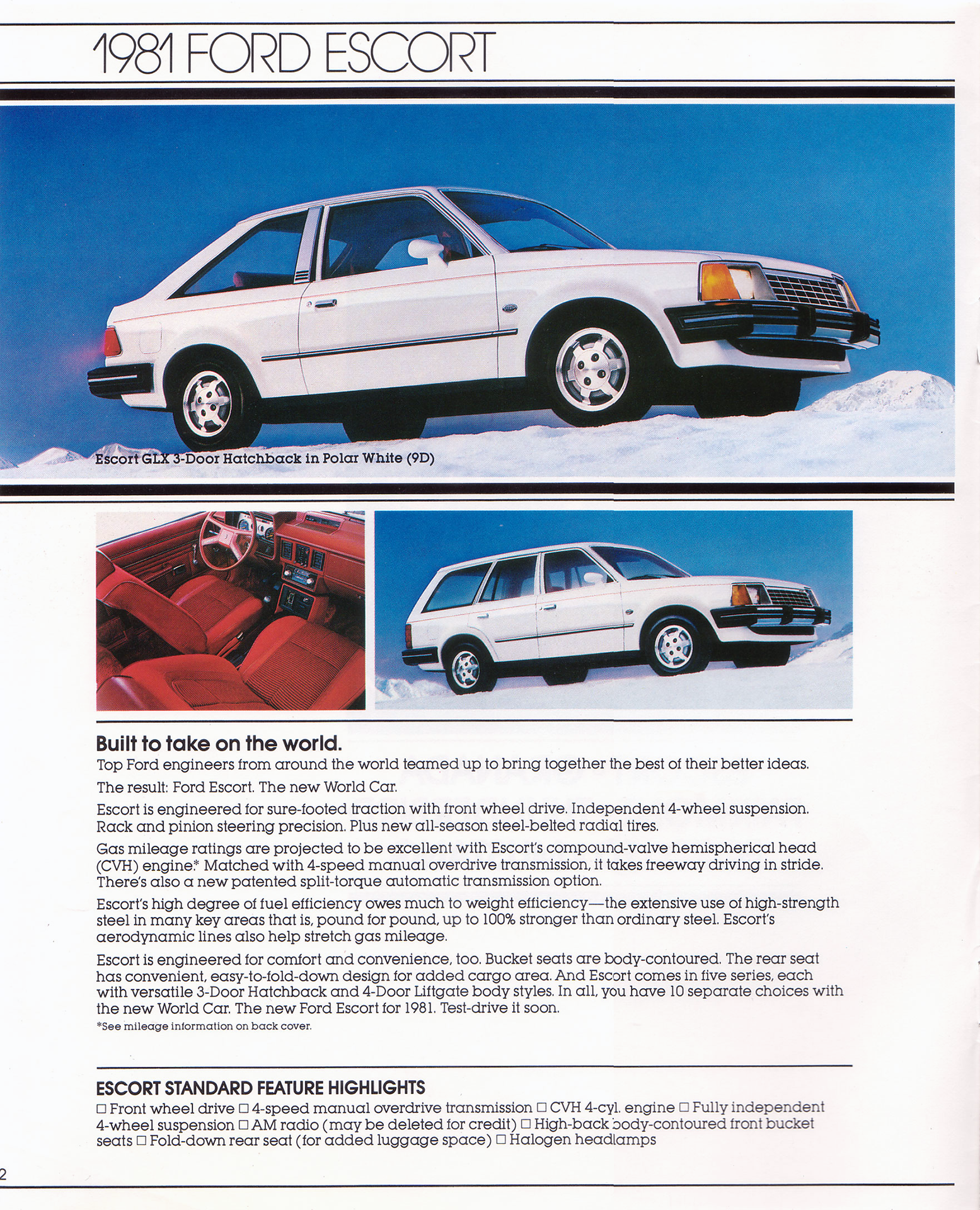
1981 Ford Escort hatchback coupe

“Built to take on the world.”

Ford’s biggest news for 1981 was the all-new Escort. Marketed as a “World Car,” the Escort replaced the unloved Pinto and represented a three billion dollar commitment from Ford. The new Escort was shorter, thinner, taller, and about 400 pounds lighter than the Pinto it supplanted.

The Escort’s standard powertrain was the Compound Valve Hemispherical (CVH) 65 bhp 1.6 liter/98 ci inline four with Holley-Weber 5740 2-barrel carburetor paired to a four-speed manual transmission (a three-speed automatic was a $344 option). Mileage with the standard powertrain was impressive: 28 city/43 highway by the day’s standards (about 23/31 by 2025 measures). Acceleration was less so: 0-60 came in about 14 seconds in the approximately 2,000-pound car. With a 10-gallon fuel tank, Escort drivers could expect a range of from 260 to 285 miles with a 10% fuel reserve.

Standard exterior and mechanical equipment on the $5,158 base Escort (about $19,600 in today’s dollars) included front wheel drive, rack-and-pinion steering, a fully independent four-wheel suspension, halogen headlamps, and P155/80R13 tires (a size still available thanks to Kumho) on 13-inch steel wheels. Inside, high-back body-contoured front bucket seats, a fold-down rear bench seat, and an AM radio were included.

As was often true with 1980s Fords, there were many trim levels. L added bright headlamp surrounds and a bright grill along with other brightwork. Moving up to the GL gave the purchaser reclining bucket seats and a four-spoke steering wheel. GLX added dual color-keyed remote sport mirrors, digital clock, locking glovebox, and P165/80R13 tires on styled steel wheels—but started at $6,476 (about $19,200 in 2018 dollars).

Fitting between the GL and the GLX in price, the somewhat sporty SS included black grill and headlamp housing, tape striping, and handling suspension ($37 for other Escorts).

Options & Production Numbers

Exterior and mechanical options included power brakes ($79) and power steering ($163). Inside, air conditioning ($530), fingertip speed control ($132), a floor console ($98), cloth/vinyl seat trim ($28), and an AM/FM stereo radio with cassette player ($187) were all available.

The first-year Escort and its platform-mate Mercury Lynx sold well: 193,000 Escort hatchback coupes, 128,000 Escort liftback sedans, 73,000 Lynx hatchback coupes, and 39,000 Lynx liftback sedans, making for a total of over 430,000.

The View From 2025

First-generation Escorts and Lynx’s were once so prevalent on American roads, but have virtually disappeared by now. You do occasionally see Escorts for sale in the Hemming’s Motor News classifieds and on eBay Motors, but there were none out there as I update this blog entry in June 2025. Bring a Trailer has sold a total of four first-generation US Escorts in a decade—the UK versions (deservedly) attract far more collector interest.

Make mine the extra-cost Medium Red Glow, please.

The only other 1981 Ford I have written about is the Mustang coupe. I have also written about the rare 1987 Mercury Lynx XR3 hatchback coupe.

Last updated June 2025.

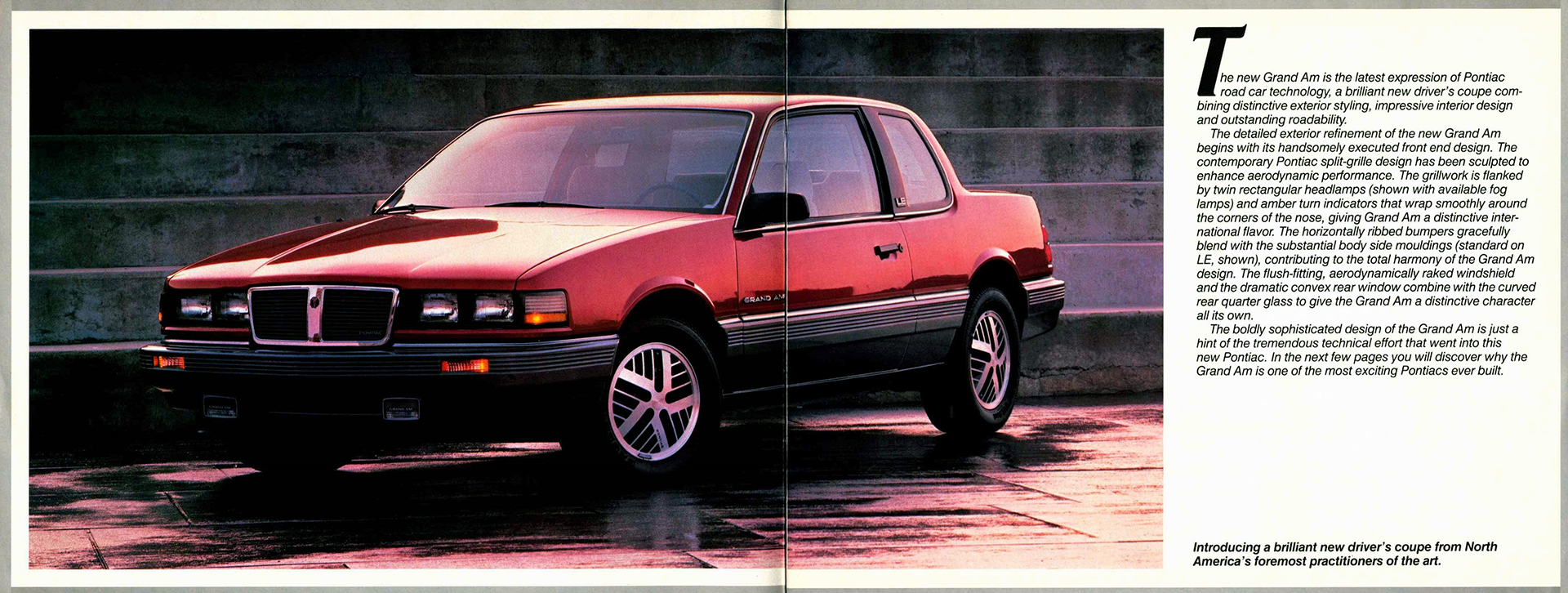
1985 Pontiac Grand Am coupe

“Introducing a brilliant new driver’s coupe”

The Grand Am name returned for the 1985 model year. Instead of the rear-wheel-drive coupe and sedan that it had been in its previous two lives from 1973 to 1980 (with none in 1976 or 1977), it was now a front-wheel-drive coupe, part of GM’s N-body offerings. As such, its first relatives were the Buick Somerset Regal and the Oldsmobile Calais.

The standard powertrain on the Grand Am was GM’s Tech IV 92 bhp 2.5 liter/151 ci inline four with throttle-body fuel injection connected to a five-speed manual. For $560, optional power was the LN7 125 bhp 3.0 liter/181 ci V6 with fuel injection, which required the $425 automatic transmission (also available with the base engine). 0-60 times for early N-body cars are hard to come by, but were likely about 10.5 seconds for the standard powertrain and about 9.0 seconds for the V6/automatic combination—the 2,419-pound shipping weight helped. Mileage with the standard powertrain was rated at 24 city/34 highway by the day’s standards (21/31 by today’s measures). With the 13.6-gallon tank, Grand Am buyers could expect a range of 310 to 350 miles with a 10% fuel reserve.

Standard exterior and mechanical equipment on the $7,995 base coupe (about $24,400 in 2025 dollars) included power rack and pinion steering, power front disc/rear drum brakes, and P185/80R13 tires (now a trailer size) on 13-inch Rally wheels. Inside, reclining bucket seats and an integral floor console were included.

The LE (starting at $8,495 or about $25,900 in today’s dollars) included “substantial body side moldings,” upgraded front bucket seats with adjustable headrests, deluxe door trim, and a fold-down rear seat armrest.

Options included the Rally Tuned suspension ($50) and cruise control ($175). A Driver’s Package was also available, which included 215/60R14 Goodyear Eagle GT radials (a size available thanks to BFGoodrich and Riken) on 14-inch turbo cast aluminum wheels, “sport-tuned” front and rear stabilizers, and a Driver Information Center.

The View From 2025

I think these were handsome cars, especially with those turbo cast aluminum wheels—Pontiac had great wheel designs in the eighties. Like many American cars of the era that aren’t considered to be collectible, they have essentially vanished despite over 82,000 sold in 1985 alone. They’re invisible in the Hemming’s Motor News classifieds and on eBay Motors and are hard to find anywhere—Bring a Trailer has sold two 1990 models, but none from the eighties.

Make mine Red, please.

Last updated June 2025.

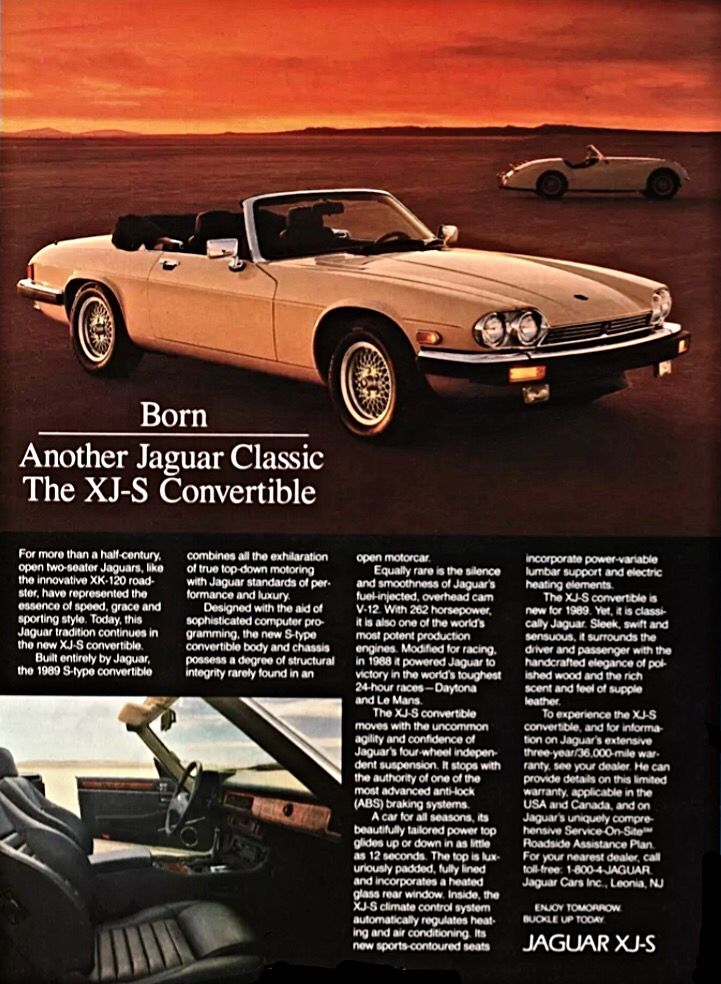
1989 Jaguar XJ-S convertible

“A car for all seasons …”

For 1989, a full convertible version of the Jaguar XJ-S finally became available after five years of the little-loved targa convertible. The power top, which could go up and down in as little as 12 seconds, was padded, lined, and included a heated glass rear window.

The only powertrain available for any XJ-S continued to be the 262 bhp H.E. 5.3 liter/326 ci V12 with Lucas-Bosch fuel injection paired with a three-speed automatic transmission sourced from General Motors (a powertrain that had been around since 1982). Performance was respectable for the almost 4,200-pound convertible: 0-60 mph in a little under 9 seconds. Mileage remained what you might expect from a thirsty V12—12 city/16 highway by the standards of the day (11/15 by today’s standards). With a 21.7-gallon fuel tank, an XJ-S owner could expect a range of between 250 and 275 miles, with a 10% fuel reserve.

1989 Jaguar XJ-S convertible advertisement

Standard equipment on the $57,000 car (about $151,300 in today’s dollars) included a four-wheel independent suspension, power steering, and four-wheel anti-lock power disc brakes. 15-inch alloy wheels were paired with Pirelli P600 235/60VR15 tires—which are still available!

Inside, the buyer received air conditioning with automatic temperature control, power windows, heated power mirrors, power door locks, intermittent windshield wipers, cruise control, and an AM/FM stereo cassette with Dolby and metal tape capability. New sport-contoured seats featured power-variable lumbar support and electric heating elements.

The View From 2025

The Jaguar XJ-S has good club support, and there are some restoration parts available. There’s also a free 738-page (!) ebook written by an XJ-S owner named Kirby Palm and featuring much hard-earned advice. Keeping an XJ-S at 100% is non-trivial—as it is with so many high-end eighties cars.

Like all Jaguars, XJ-S convertibles have a following and make frequent appearances in the Hemming’s Motor News classifieds, on eBay Motors, and on Bring a Trailer. According to Hagerty’s valuation tools, all the money for a 1989 XJ-S convertible in #1/Concours condition is $45,000, with a far more typical #3/Good car going for $16,400.

Make mine British Racing Green, please.

Two other eighties Jaguars I have written about are the 1982 XJ-S H.E. coupe and the 1983 XJ6 sedan.

Last updated March 2025.

1981: What Cars Are Collectible?

The question always arises: what cars are considered collectable? One way is to look at what Hagerty tracks with their valuation tools. For 1981 cars, the full list is below—I have added a few comments.

question mark graphic

Alfa Romeo; GTV-6 hatchback coupe, Spyder convertible

Alpine; A310 coupe

Aston Martin; Lagonda sedan, V8 coupe and convertible

Avanti; Avanti II coupe

Bentley; Corniche convertible, Mulsanne sedan

Bitter; SC coupe

BMW; 320i coupe, 633CSi coupe, 733i sedan, M1 coupe

Bristol; 412 convertible

Buick; Regal coupe, Riviera coupe

Cadillac; DeVille coupe and sedan, Eldorado coupe, Fleetwood coupe and sedan, Seville sedan

Checker; Marathon sedan

Chevrolet; C10/K10 pickup truck, C10/K10 Blazer SUV, C10/K10 Suburban SUV, C20/K20 pickup truck, C20/K20 Suburban SUV, C30/K30 pickup truck, Camaro coupe, Corvette coupe, El Camino pickup truck

Chrysler; Imperial coupe

Clenet; SII convertible

Datsun; 280ZX hatchback coupe

Delorean; DMC-12 coupe

DeTomaso; Deauville sedan, Pantera coupe

Dodge; Ramcharger SUV

Excalibur; Series IV convertible

Ferrari; 308 GTBi/GTSi coupe, 400i coupe, 512 BB coupe, Mondial coupe

Fiat; 2000 convertible, X1/9 coupe

Ford; Bronco SUV, F-100 pickup truck, F-150 pickup truck, F-250 pickup truck, F-350 pickup truck, GT40 coupe and convertible, Mustang coupe and hatchback coupe, Thunderbird coupe

GMC; C1500/K1500 pickup truck, C2500/K2500 pickup truck, C3500/K3500 pickup truck, Caballero pickup truck

Jaguar; XJ-6 sedan, XJ-S coupe

Jeep; Cherokee SUV, CJ-5 SUV, CJ-7 SUV, CJ-8 Scrambler pickup truck, Wagoneer SUV

Lamborghini; Countach coupe

Lancia; Beta coupe, convertible, sedan, and station wagon, Gamma coupe and sedan, Scorpion coupe

Lincoln; Continental coupe and sedan, Continental Mark VI coupe and sedan

Lotus; Esprit coupe

Maserati; Kyalami coupe, Merak coupe, Quattroporte III sedan

Matra; Murena coupe

Mazda; RX-7 hatchback coupe

Mercedes-Benz; 240D sedan, 280CE coupe, 280E sedan, 300CD coupe, 300D sedan, 300SD sedan, 300TD station wagon, 380SEL sedan, 380SL convertible, 380SLC coupe

Morgan; 4/4 convertible, Plus 8 convertible

Panther; DeVille convertible and sedan, J72 convertible, Kallista convertible

Peugeot; 504 convertible

Plymouth; Trail Duster SUV

Pontiac; Firebird coupe

Porsche; 911 coupe, 924 hatchback coupe, 928 hatchback coupe

Puma; GT coupe, GTC coupe and convertible

Replicar; sedan and convertible

Rolls-Royce; Camargue coupe, Corniche I convertible, Phantom VI sedan, Silver Spirit sedan, Silver Spur sedan

Saab; 99 coupe

Stutz; Bearcat convertible, Blackhawk coupe, Iv-Porte sedan, Royale sedan

Toyota; Celica hatchback coupe, Land Cruiser SUV

Triumph; TR7 convertible, TR8 coupe and convertible

Volvo; 262C coupe

Hagerty casts a wide net, except when they don’t (why does the Toronado go away in 1981 if it was around in 1980?). Speaking of going away, AMC, International, and Subaru all get no love when it comes to 1981 models.

Coupes are dominant—37% of 128 models listed with an additional 5% being hatchback coupes. Unsurprisingly, the rarest body style is a station wagon, at 2%.

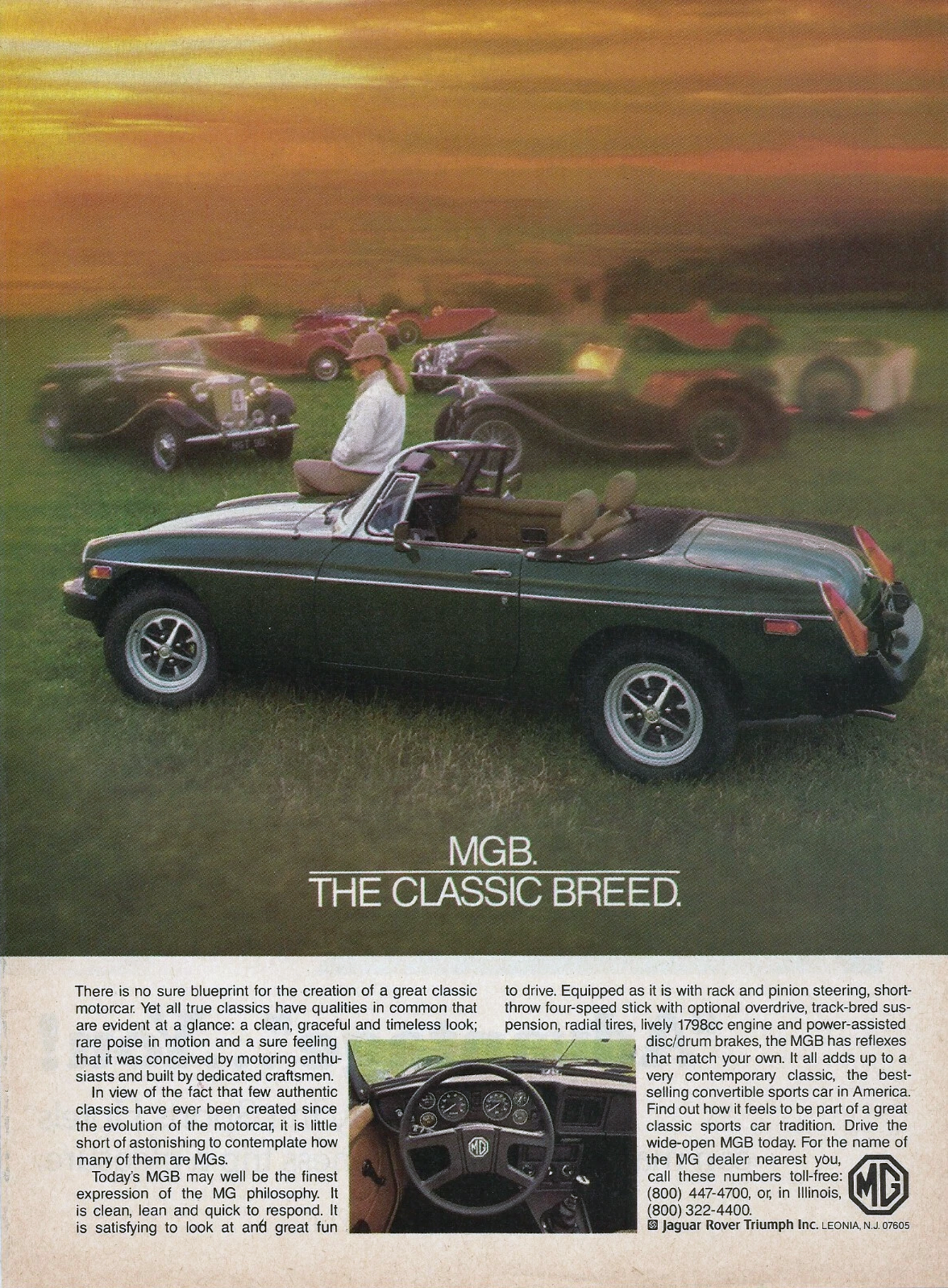
1980 MG MGB convertible

Writing a blog entry on cars from 1980 that Hagerty considers to be collectible reminded me that I should probably do an entry on the last of the MGBs.

“The Classic Breed”

1980 was the final year for MG’s MGB convertible, which had been in production since 1962.

Changes for 1980 were minimal. The standard and only powertrain remained the 62.5 bhp (not 62 or 63!) 1.8 liter/110 ci inline four with a Zenith-Stromberg 175 CD carburetor paired with a four-speed manual transmission. 0-60 mph came in a leisurely 16 seconds in the 2,400-pound car. Fuel mileage was decent by the day’s standards: rated at 16 city/30 highway. With a 13-gallon gas tank, an MGB driver could expect a range of about 245 to 265 miles with a 10% fuel reserve.

1980 MG MGB print advertisement

Standard exterior and mechanical equipment on the $7,950 MGB (about $33,800 in today’s dollars) included a tonneau cover, a laminated safety glass windshield, rack and pinion steering, power front disc/rear drum brakes, and 165/80-14 radial ply tires (a size still available thanks to Vredestein) on 14-inch Rostyle wheels. Inside, vinyl bucket seats with adjustable head restraints, a center console with a cigarette lighter and heater controls, a lockable glovebox, a map pocket, an electric tachometer, a trip odometer, a map light, and a clock were standard.

Options & One Limited Edition

Optional equipment included an electrically-operated overdrive for the transmission, a luggage rack, “traditional” wire wheels, air conditioning ($653), and various radios with either 8-track or cassette players included.

The Limited Edition that had debuted in 1979 remained available and popular, with 6,668 produced over the two years. In addition to black paint, the Limited Edition included silver body stripes, 5-spoke alloy wheels, an air dam, boot and tonneau covers, chrome luggage rack, a leather padded 3-spoke steering wheel, a Limited Edition dash plaque, and Limited Edition thresholds. All of this cost $600.

The View From 2025

Like all MGs, MGBs have a following and frequently appear in the Hemming’s Motor News classifieds, on eBay Motors, and on Bring a Trailer. According to Hagerty’s valuation tools, a 1980 MGB in #1/Concours condition is $21,500, with a far more typical #3/Good car going for $6,100. A Limited Edition goes for about $1,500 more. As I update this blog entry in September 2025, there is a 1980 MGB Limited Edition with a black interior and 55,000 miles for sale on Hemmings, asking $24,900.

Make mine Brooklands Green, please.

Other sports cars from 1980 I have written about include the Chevrolet Corvette coupe, the Datsun 280-ZX hatchback coupe, the Mercedes-Benz 450SL convertible, the Porsche 911 SC coupe, and the Porsche 924 hatchback coupe.

Last updated September 2025.

1980: What Cars Are Collectible?

The question always arises: what cars are considered collectable? One way is to look at what Hagerty tracks with their valuation tools. For 1980 cars, the full list is below—I have added a few comments.

question mark graphic

Alfa Romeo; Spyder convertible

Alpine; A310 coupe

American Motors; AMX hatchback coupe (in its final year), Pacer hatchback coupe and station wagon, but no Eagle

Aston Martin; Lagonda sedan, V8 coupe and convertible

Avanti; Avanti II coupe

Bentley; Corniche convertible, T2 sedan

BMW; 320i coupe, 633CSi coupe, 733i sedan, M1 coupe

Bristol; 412 convertible

Buick; Regal coupe, Riviera coupe

Cadillac; DeVille coupe and sedan, Eldorado coupe, Fleetwood coupe and sedan, Seville sedan

Checker; Marathon sedan

Chevrolet; C10/K10 pickup truck, C10/K10 Blazer SUV, C10/K10 Suburban SUV, C20/K20 pickup truck, C20/K20 Suburban SUV, Camaro coupe, Corvette coupe, El Camino pickup truck

Clenet; SII convertible

Datsun; 280ZX hatchback coupe

DeTomaso; Deauville sedan (a car I’d never heard of before)

Dodge; D150/W150 pickup truck, D200/W200 pickup truck, D300 pickup truck, Ramcharger SUV

Excalibur; Series IV convertible

Ferrari; 308 GTBi/GTSi coupe, 400i coupe, 512 BB coupe, Mondial coupe

Fiat; 2000 convertible, X1/9 coupe

Ford; Bronco SUV, F-100 pickup truck, F-150 pickup truck, F-250 pickup truck, F-350 pickup truck, Mustang coupe and hatchback coupe, Thunderbird coupe

GMC; C1500/K1500 pickup truck, C2500/K2500 pickup truck, C3500/K3500 pickup truck, Caballero pickup truck

International; Scout II SUV

Jaguar; XJ-6 sedan, XJ-S coupe

Jeep; Cherokee SUV, CJ-5 SUV, CJ-7 SUV, Wagoneer SUV

Lamborghini; Countach coupe

Lancia; Beta coupe, convertible, sedan, and station wagon, Gamma coupe and sedan, Scorpion coupe

Lincoln; Continental coupe and sedan, Continental Mark VI coupe and sedan, Versailles sedan

Lotus; Eclat coupe, Elite hatchback coupe, Esprit coupe

Maserati; Kyalami coupe, Merak coupe, Quattroporte III sedan (I am reminded that I have yet to discuss any eighties Maserati in this blog)

Matra; Bagheera coupe, Murena coupe

Mazda; RX-7 hatchback coupe

Mercedes-Benz; 240D sedan, 280CE coupe, 280E sedan, 280SE sedan, 300CD coupe, 300D sedan, 300SD sedan, 300TD station wagon, 450SEL sedan, 450SL convertible, 450SLC coupe

MG; MGB convertible

Morgan; 4/4 convertible, Plus 8 convertible

Oldsmobile; Toronado coupe

Panther; DeVille convertible and sedan, J72 convertible, Lima convertible

Peugeot; 504 convertible

Plymouth; Trail Duster SUV

Pontiac; Firebird coupe but no Grand Am (Hagerty only tracks them up to 1975)

Porsche; 911 coupe, 924 hatchback coupe, 928 hatchback coupe

Puma; GT coupe, GTC coupe and convertible, GTS convertible

Replicar; sedan and convertible

Rolls-Royce; Camargue coupe, Corniche I coupe and convertible, Phantom VI sedan, Silver Shadow II sedan, Silver Wraith II sedan

Stutz; Bearcat convertible, Blackhawk coupe, Duplex/Iv-Porte/Victoria sedan, Royale sedan

Subaru; BRAT pickup truck

Toyota; Celica hatchback coupe, Land Cruiser SUV

Triumph; TR7 coupe and convertible, TR8 coupe and convertible

Volvo; 242 coupe, 242GT coupe, 244 sedan, 245 station wagon, 262C coupe, 264 sedan, 265 station wagon

Hagerty casts a wide net (AMX!). Coupes are dominant—33% of 156 models listed with an additional 6% being hatchback coupes. Unsurprisingly, the rarest body style is a station wagon, at 3%.