1980 Buick Riviera S TYPE coupe

I’ve was on a Riviera kick in 2018, brought on (no lie!) by the appearance of a 1965 model in a Hallmark Movies & Mysteries movie. I covered the 1984 T-Type in 2016—here’s the 1980 S TYPE.

“… an impressive road car.”

In its second year, Buick’s sixth-generation Riviera gained little but revised body mounts and new side mirrors with a notably more integrated look. Buick continued to offer Riviera fans a slightly more sporty S TYPE (Buick’s brochure spelling) version, returning to a theme first present with the 1965 Riviera Grand Sport.

The S TYPE‘s standard powertrain was the LD5 170 bhp 3.8 liter/231 ci V6 with turbocharger and a Rochester M4ME four-barrel carburetor paired with a Turbo Hydra-matic automatic transmission. The LG4 155 bhp 5.7 liter/350 ci V8 with a Rochester M4ME four-barrel carburetor was optional (it was standard on the base Riviera). The S TYPE was spritely for a big (3,633 pound) coupe by 1980 standards, but not fast: 0-60 came in about 11 seconds, which compared well with the Cadillac Eldorado, [Chrysler] Imperial, Lincoln Continental Mark VI, and Oldsmobile Toronado. Fuel mileage was rated at 16 city/23 highway by the (rather unrealistic) standards of the day—with a 21.2-gallon fuel tank, range was about 305 miles with a 10% fuel reserve.

S TYPE pages from the 1980 Buick Riviera brochure

The $11,823 S TYPE (about $50,400 in 2025 dollars, or about what a 2025 Buick Envista Sport Touring SUV goes for) came with amber front park and turn signal lenses, tungsten-halogen high-beam headlights, dual remote black mirrors, and GR70-R15 tires (equivalent to P225/70R15, which is still a readily available size) on 15-inch wheels with Designer’s Sport wheel covers. Inside, cloth or vinyl bucket seats, sport steering wheel, storage console, and black-trimmed instrument panel were all standard. The 1980 S TYPE also included a Rallye ride-and-handling suspension with larger front and rear stabilizer bars and stiffer shock absorbers.

Standard exterior and mechanical features on all 1980 Rivieras included front-wheel drive, four-wheel independent suspension, automatic level control, Soft Ray tinted glass, power steering, and power front disc/rear drum brakes. Inside, every Riviera had air conditioning, electric door locks, power windows, a driver’s-side 6-way power seat, and an AM/FM stereo radio with automatic power antenna.

Options & Sales Numbers

Exterior and mechanical options included four-wheel disc brakes ($222), electric rear window defogger ($109), and the Astroroof ($1,058). Inside, automatic air conditioner ($150), Cruise-Master speed control ($118), Twilight Sentinel ($51), a passenger-side 6-way power seat ($179), and leather with vinyl bucket seats ($360) were all available. You couldn’t get the tilt and telescoping steering column on an S TYPE, but you could get a tilt only steering column ($83).

Sales of the S TYPE were decent in 1980—with 7,217 made, it accounted for about 15% of overall Riviera sales. For 1981, the Riviera S TYPE was supplanted by the T-Type.

The View From 2025

There’s robust discussion and support for sixth-generation Rivieras on the AACA’s Buick Riviera page, which is affiliated with the Riviera Owners Association. According to Hagerty’s valuation tools, all the money for a 1980 Riviera in #1/Concours condition is $37,200, with a more normal #3/Good car going for $10,900. S TYPEs also come up for sale every once in a while in the Hemming’s Motor News classifieds or on eBay Motors, though there aren’t any right now.

Make mine the extra-cost ($186) Gray Firemist, please. I love those Buick color names and believe everyone should have at least one Firemist.

Last updated May 2025.
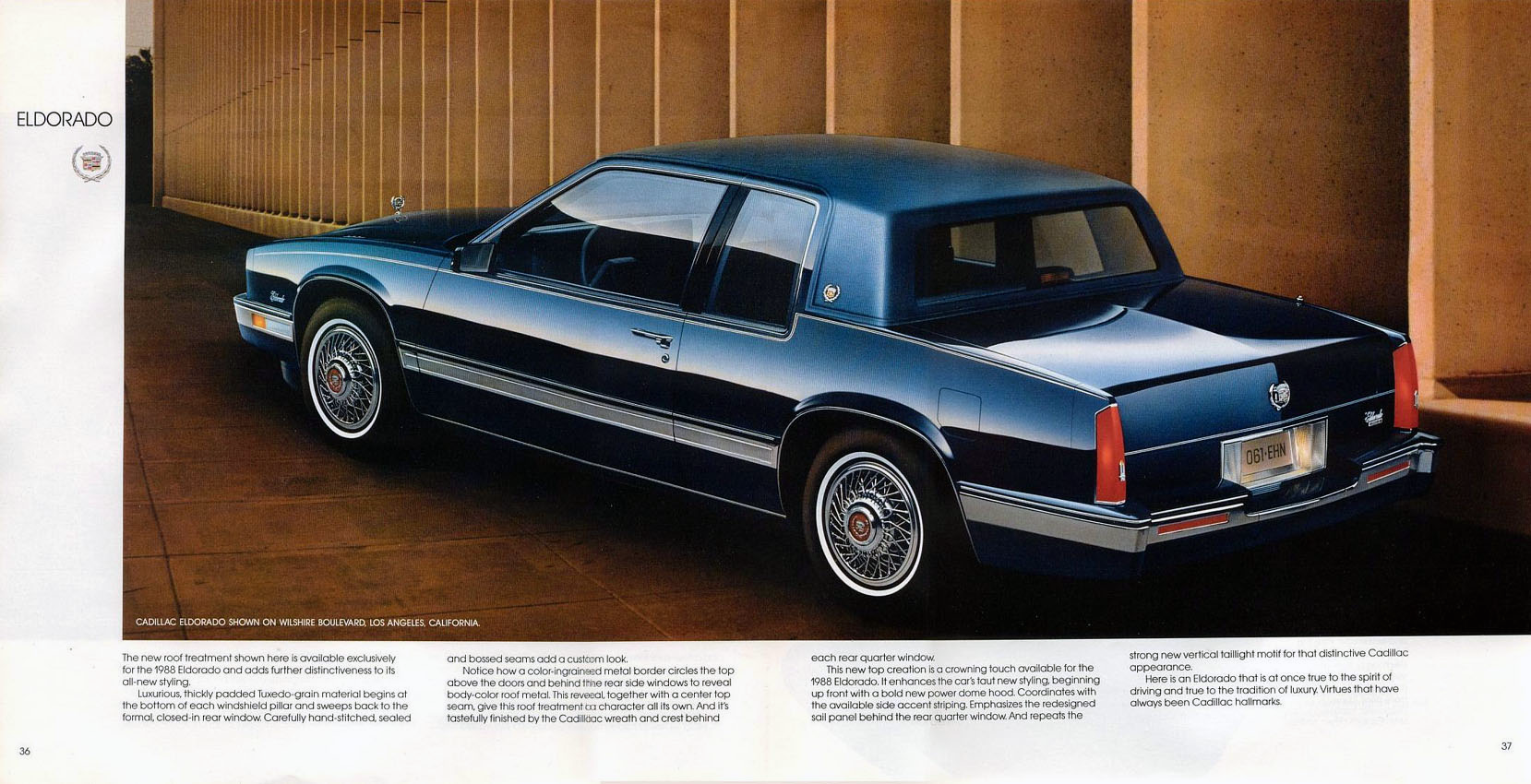
1988 Cadillac Eldorado coupe

“… a bold styling statement.”

For 1988, Cadillac’s Eldorado gained a new 4.5 liter V8, along with a power dome hood, a revised grille, a reshaped rear window treatment, and an extended trunk. Length increased by three inches, and the 1988 Eldorado looked slightly more like the Eldo people had grown to expect. New options for the 1988 Eldorado included an anti-lock brake system and a fully padded roof, which hearkened back to previous generations. All of these changes were developed in a rapid 51 weeks.

The Eldorado’s powertrain was Cadillac’s 155 bhp HT series 4.5 liter/273 ci V8 with throttle body fuel injection paired with a four-speed automatic transmission. Acceleration improved notably—the Eldorado’s 0-60 mph time was now under 10 seconds for the first time since the early 1970s. Fuel economy was 17 city/24 highway by the day’s standards (15/22 by today’s measures). With an 18.8-gallon fuel tank, an Eldorado owner could expect a range of between 315 and 345 miles with a 10% fuel reserve.

1988 Cadillac Eldorado brochure pages

So, what did those buyers get with their $24,891 (about $70,000 in today’s dollars) 1988 Eldorado? Standard exterior and mechanical equipment included front wheel drive, a four-wheel independent suspension, power-assisted rack and pinion steering, power four-wheel disc brakes, and 205/70R14 tires (a size still readily available) on 14-inch aluminum wheels. Inside, six-way front power seats, a leather-trimmed steering wheel with tilt and telescope adjustment, cruise control, power side mirrors, power windows, power door locks, electronic climate control, Twilight Sentinel, and an AM/FM stereo radio with power antenna were all included—the Eldorado was pretty well equipped.

Packages, Options, & Production Numbers

Moving up to the Biarritz (almost always the top-of-the-line Eldorado since 1956) added wire wheels, two-tone paint, nicer front seats with power lumbar support and power recliners, and real walnut trim on the instrument panel, console, and door trim plates.

Options included anti-lock brakes, touring suspension with 15-inch aluminum alloy wheels, Astroroof, a nicely integrated cellular phone, and the Delco/Bose Symphony Sound System.

The exterior redesign and the new engine definitely assisted sales—they were nearly double what they had been in 1987, though still not close to the salad days of 1985 and prior.

The View From 2025

According to Hagerty’s valuation tools, a 1988 Eldorado in #1/Concours condition is $15,100, with a far more typical #3/Good car going for a mere $5,500. Eldorados of this age come up for sale regularly in the Hemmings Motor News classifieds, on eBay Motors, and Bring a Trailer, so folks are saving them.

Make mine Carmine Red, please.

Other Eldorados I have written about include the 1982 Touring Coupe, the 1984 Biarritz convertible, and the 1986 coupe.

Last updated December 2025.

1985 Merkur XR4Ti hatchback coupe

“For the North American continent the Merkur XR4Ti represents an innovative, new total performance machine.”

The Merkur XR4Ti never had a chance.

There, I’ve said it. Though the redoubtable Bob Lutz was involved, I can’t even imagine the combination of decisions that made Ford think that selling a Karmann-assembled version of the European Ford Sierra at Lincoln-Mercury dealers in the mid-1980s was ever going to work out. By early 1989, the XR4Ti was gone.

Because the Cologne 2.8 liter V6 the Sierra used in Germany could not clear US emissions, the engine the XR4Ti received was Ford’s Lima 2.3 liter/140 ci turbocharged and fuel-injected inline four also seen in the Ford Mustang SVO and Ford Thunderbird Turbo Coupe. In its Merkur guise, it made 175 bhp with the standard five-speed manual transmission and 145 bhp (ouch!) with the optional ($427) three-speed automatic transmission. Car and Driver recorded a 0-60 time of 7.0 seconds flat and a top speed of 129 mph with the manual. Fuel economy wasn’t particularly good: with the manual, it was 19 city/24 highway by the day’s standards (17/22 by today’s measures). With a 15.1-gallon gas tank, a Merkur owner could expect a range of 265 to 290 miles with a 10% fuel reserve.

1985 Merkur print advertisement.

Base price for the 1985 XR4Ti was $16,361 (about $50,200 in 2025 dollars). Standard exterior and mechanical features included integrated halogen headlamps, tinted glass, power-assisted front disc/rear drum brakes, nitrogen pressurized shock absorbers, variable-ratio power-assisted rack-and-pinion steering, and Pirelli P6 195/60HR14 steel-belted radial tires (a size still readily available) fitted on 14-inch cast aluminum-alloy “phone dial” wheels. Inside, standard equipment included Oxford cloth front bucket seats with infinitely variable manual reclining seatbacks, a 60/40 folding rear seat, air conditioning, dual power outside rear-view mirrors, and an electronic AM/FM stereo cassette radio with four speakers. The famous (and polarizing) biplane rear spoiler was derived from the one on the Probe III concept car Ford had shown in 1981.

Convenience Group & A Few Individual Options

A $470 Convenience group was available, which included power central door locking, power windows, and speed control.

Individual options other than the automatic transmission were relatively few: metallic paint ($274), a tilt/slide moonroof ($549), leather seats ($890), heated front bucket seats ($183), and a fuel mileage computer.

Period Reviews & Production Numbers

The XR4Ti received general approval from the automotive press. Motor Trend called it “Lincoln-Mercury’s Antidote for the BMW Syndrome.” Writing in Car and Driver, Brock Yates predicted that the Merkur would “pile into the upscale sports sedan market like a runaway freight train.”

Of course, this didn’t happen. Production numbers by model year are not easily available, but Karmann built a total of 45,368 XR4Tis over five calendar years. Ford had hoped to sell 16,000 to 20,000 a year.

The View From 2025

According to Hagerty’s valuation tools, a 1985 Merkur XR4Ti in #1/Concours condition is $15,300, with a more normal #3/Good car going for $7,900. I find it interesting that Hagerty tracks them at all—there are many that I think of as equally interesting cars that they don’t track. You rarely see them for sale in the Hemming’s Motor News classifieds or eBay Motors—they are at least a little more common on Bring a Trailer.

Make mine Paris Blue Metallic with the optional Gray leather interior, please. The real question is how many are left.

I really should write about the Scorpio hatchback sedan someday.

Last updated September 2025.

1983 Toyota Camry sedan

“Introducing the family Camry”

The Toyota Camry debuted in the middle of the 1983 model year, in four-door sedan and five-door hatchback models. Instead of designing it to compete with European manufacturers, Toyota designed the Camry to compete with American cars. In fact, Car and Driver famously wrote that “the Camry drives as if Buick engineers had moonlighted on its development.” The Camry’s measurements split the difference in size between the GM J-body (Buick Skyhawk, Cadillac Cimarron, Chevrolet Cavalier, Oldsmobile Firenza, and Pontiac 2000) and the GM X-body (Buick Skylark, Chevrolet Citation, Oldsmobile Omega, and Pontiac Phoenix).

Power for the first-year Camry was provided by a 92 bhp 2.0 liter/122 ci inline four with fuel injection, which was available with either a standard five-speed manual or an optional four-speed automatic. With the manual, 0-60 mph came in a little under 13 seconds in the 2,236-pound car. Mileage was good—32 city/44 highway by the day’s standards (25/31 by modern measures). With a 13.8-gallon gas tank, a Camry owner could expect a 350 to 420 mile range with a 10% fuel reserve.

Sedan page from the 1983 Toyota Camry brochure

Standard exterior and mechanical equipment on the $7,988 (about $26,400 in today’s dollars—a 2025 Camry starts at $29,000) Deluxe sedan included tinted glass, front wheel drive, rack-and-pinion steering, power-assisted front disc/rear drum brakes, and 185/70R13 steel-belted radial tires (a size still available from Kumho and Vredestein) on 13-inch styled steel wheels. Inside, reclining front cloth bucket seats with adjustable headrests, an electric rear window defogger, and a quartz analog clock were included.

Upgrading to the $9,698 LE made the four-speed automatic standard and added tungsten halogen headlights, dual outside mirrors with powered remote control, power steering with variable assist, full instrumentation, a fold-down rear seat armrest, a digital quartz clock, and an AM/FM stereo radio with five speakers and an automatic power antenna.

Options, Period Reviews, & Production Numbers

Individual options were relatively few and included aluminum alloy wheels, dual-stage air conditioning ($630), and a power sunroof with maplight ($460). A Power Package included cruise control, power locks, and power windows.

The first-generation Camry was well received and got good reviews—the tagline in Car and Driver‘s test was “At home in America.” 52,651 were sold in that first model year, with sales increasing steadily throughout the decade.

The View From 2025

Unlike other Toyotas that are deemed more collectible from the eighties (Land Cruisers, pickup trucks, Celicas, Supras, MR2s), first-generation Camrys rarely come up for sale in the Hemmings Motor News classifieds, on eBay Motors, or on Bring a Trailer.

Make mine Deep Maroon Metallic, please.

Other Toyotas I’ve written about include the 1980 Corolla Tercel Liftback, the 1981 Celica Sport Coupe, the 1982 Celica Supra hatchback coupe, the 1984 Corolla SR5 Sport Coupe, and the 1985 MR2 coupe.

Last updated December 2025.

1988 Pontiac Grand Prix coupe

“… one of the most aerodynamic cars in the world.”

The Grand Prix was all new for 1988. Gone was the elderly G-body rear-wheel-drive (dating from 1978), replaced by an aerodynamic front-wheel drive W-body.

For 1988, the standard Grand Prix powertrain was the LB6 130 bhp 2.8 liter/173 ci V6 with fuel injection paired to a four-speed automatic (a five-speed manual was available). With a curb weight of 3,038 pounds, 0-60 took a little over 10 seconds with the standard powertrain. Mileage with the same powertrain was 20 city/29 highway by the standards of the day (18/26 by today’s standards). A 16.0-gallon fuel tank meant that a Grand Prix owner could expect a range of between 315 and 355 miles with a 10% fuel reserve.

The 1988 Grand Prix came in base, LE, and SE forms. Standard exterior and mechanical equipment in the $12,539 base coupe (about $27,300 in today’s dollars) included composite halogen headlamps, dual sport mirrors, power steering, four-wheel power disc brakes, an independent rear suspension, and P195/75R14 tires (a size still available from multiple vendors) on 14 x 6 inch wheels with custom wheel covers. Inside, notchback front bench seats, an electronic digital speedometer, a glove box with a combination lock, and an AM/FM stereo radio were included.

Moving up a little to the $13,239 LE added power windows with illuminated switches, lamp group, 40/60 split reclining pallex cloth seats, rear folding armrest with pass through to the luggage compartment, and mechanical analog gauges with tachometer and trip odometer.

The top-of-the-line $15,249 SE (about $32,300 in 2018 dollars) added the Y99 Rally Tuned suspension, dual exhaust system, and P215/65R15 tires on 15-inch aluminum wheels and switched the standard transmission to a five-speed manual. Inside, air conditioning, leather-wrapped tilt steering wheel, cruise control, power cloth front bucket seats with three-position lumbar controls, and rear bucket seats were all part of the SE experience.

Options included power door locks, an electric rear window defogger, a power antenna, and a UX1 AM stereo/FM stereo radio with seek, scan, auto-reverse cassette, five-band graphic equalizer, and digital clock.

The 1988 Grand Prix was relatively well received—it was Motor Trend‘s Car of the Year, and Pontiac sold 86,357 cars in slightly over half a model year (sales only began in January 1988), which marked more than five times as many as the last of the G-body versions in 1987. For 1989, sales would top 136,000 and would stay over 100,000 for every year through 1995.

Grand Prix’s of this generation are rarely seen in the Hemming’s Motor News classifieds and on eBay Motors. Sometimes you do see the ASC/McLaren or GTP versions, but rarely the “civilian” models.

Make mine red, please.

1983 Buick Skylark T TYPE coupe

“A road car with a very distinct personality.”

Buick offered five separate T TYPE models (their spelling) in 1983. One of the new ones was the Skylark coupe, Buick’s version of the X-car.

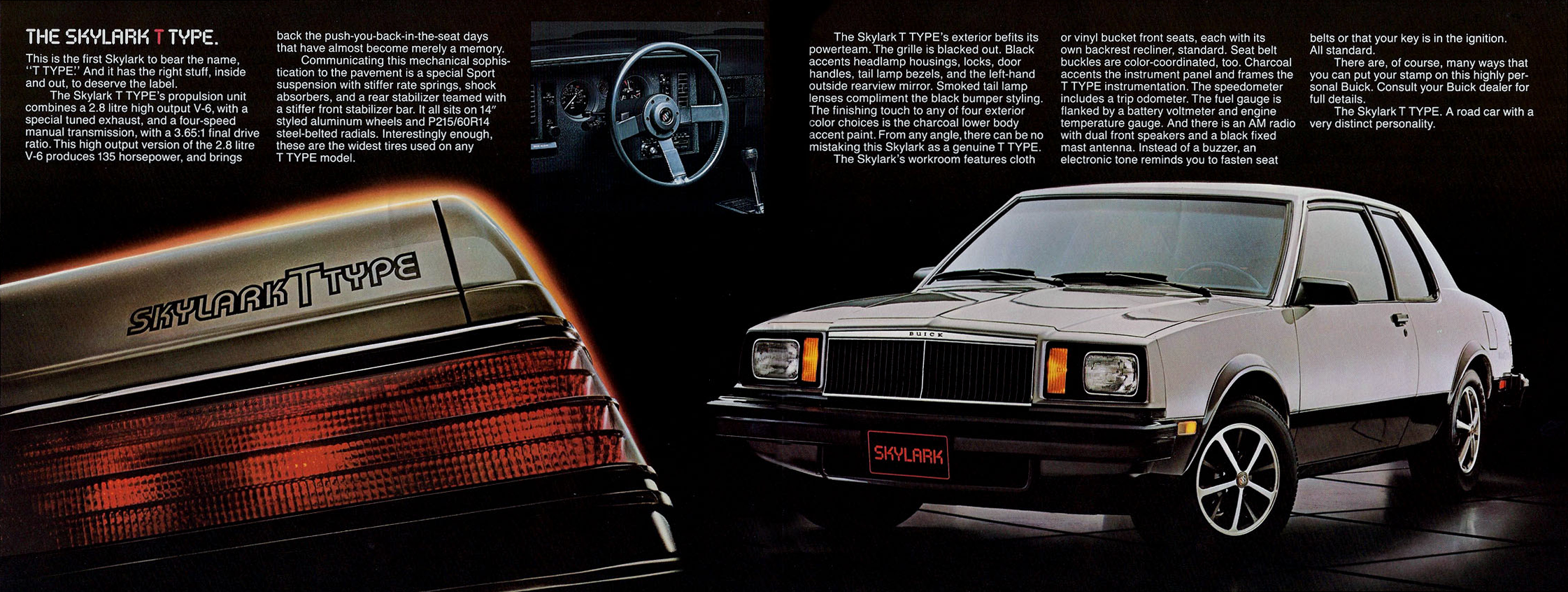
The Skylark T TYPE‘s standard powertrain was the LH7 “high output” 135 bhp 2.8 liter/173 ci V6 with a Rochester E2SE two-barrel carburetor paired with a four-speed manual. The 0-60 time was a little over 9 seconds—respectable but not great in 1983. Mileage was 21 city/34 highway by the day’s standards (17/23 by today’s measures). With a 15.1-gallon gas tank, a T TYPE owner could expect a range of 270 to 335 miles with a 10% fuel reserve.

Skylark pages from the 1983 Buick T TYPE brochure

Standard mechanical equipment on the $9,337 T TYPE coupe (approximately $30,700 in today’s dollars or about what a 2026 Buick Encore GX Avenir SUV costs) included a Sport suspension (stiffer rate springs, stiffer shock absorbers, a more rigid front stabilizer bar, and added rear stabilizer bar), a “special tuned” exhaust, a 3.65:1 final drive ratio, and P215/60R14 steel belted radial tires (a size still available from BFGoodrich and Riken) on 14-inch styled aluminum wheels. Exterior equipment specific to the T TYPE included a blacked out grille, smoked tail lamp lenses, and charcoal lower body accent paint. Inside, vinyl or cloth bucket seats with backrest recliner, a full-length operating console, a special Sport steering wheel, and color-coordinated seat belt buckles were included.

Standard equipment on all Skylarks included front-wheel drive, power rack and pinion steering, power front disc/rear drum brakes, tungsten-halogen high/low beam headlamps, a Delco Freedom II Plus battery, and an AM radio with two front speakers and a fixed-mast radio antenna.

Options & Production Numbers

Options included dual electric remote mirrors ($78), the Vista-Vent flip-open removable glass sunroof ($295), air conditioning ($725), Cruise Master speed control with resume ($170), power windows ($180), tilt steering ($105), and an ETR AM/FM stereo radio with a cassette player and a graphic equalizer ($505).

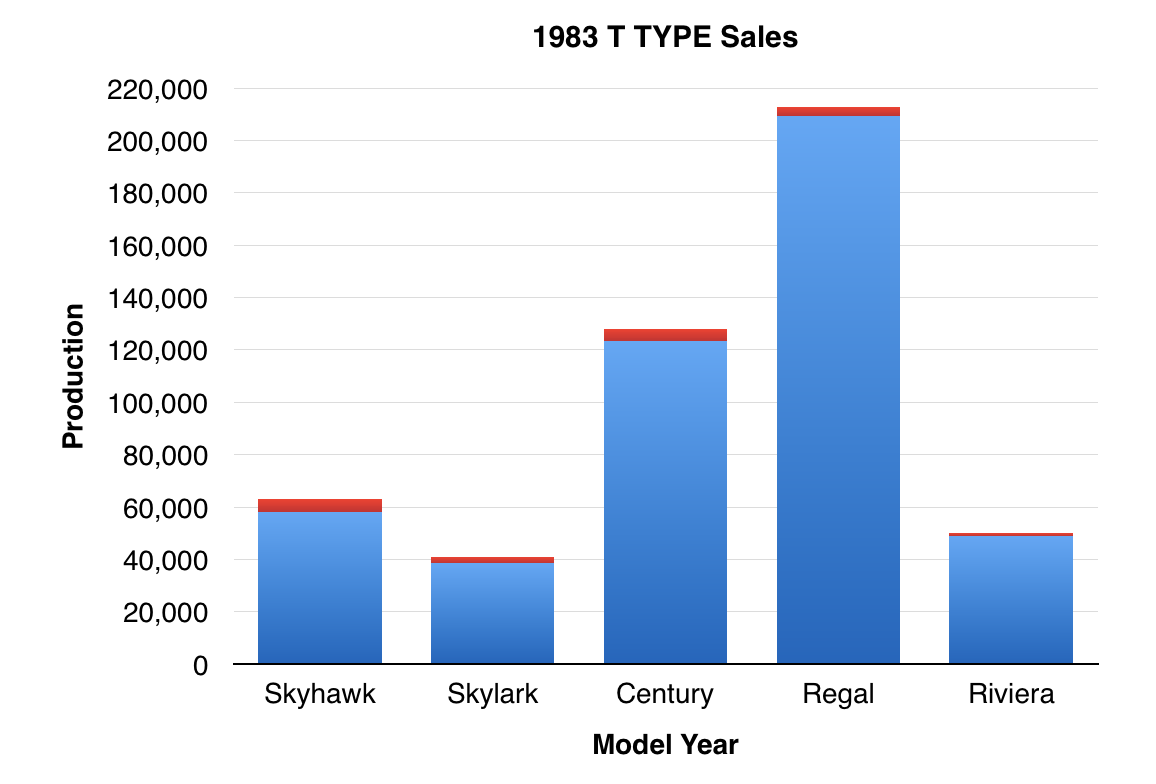
Despite Buick’s commitment to extending the T TYPE line (they even went to the trouble of creating a T TYPE brochure), sales were not impressive—about 3.5% of the sales of the Skyhawk, Skylark, Century, Regal, and Riviera. Of the T TYPEs, the Skylark was comparatively successful, with 2,489 sold—about 6.1% of overall Skylark sales.

The View From 2025

I haven’t seen a Skylark T TYPE since they were new, and I saw one parked outside of the long-gone Crown Buick on the Lincoln Highway in Ardmore, PA. Skylarks of this era are rarely seen in the Hemmings Motor News classifieds, on eBay Motors, or on Bring a Trailer—when one does come up for sale, Hemmings considers it worthy of a portion of a blog entry.

There were only four exterior colors available for the Skylark T TYPE: White, Silver Metallic, Dark Red Metallic, and Light Sand Gray. Make mine Silver Metallic, please.

Other X-cars I have written about in this blog include the 1980 Chevrolet Citation hatchback sedan, the 1981 Chevrolet Citation X-11 hatchback coupe, the 1985 Chevrolet Citation II hatchback sedan, the 1984 Oldsmobile Omega sedan, and the 1982 Pontiac Phoenix SJ coupe.

Last updated August 2025.

1980 Chevrolet Camaro Rally Sport coupe

At Barrett-Jackson’s 2018 Northeast auction, a bright blue metallic 1980 Chevrolet Camaro Rally Sport coupe with black vinyl seats, a 3.8 liter/229 ci V6 with a two-barrel carburetor, an automatic, and 45,000 miles crossed the block. The hammer price was $4,700 for this honest, reasonably original car that no one ever tried to turn into something resembling a Z28. I find these non-top-of-the-line cars interesting because they are rarely saved, leading to something like what we have with 1957 Chevrolets, where you’d think 90% of them were Bel Airs.

“It’s an escape from the ordinary.”

For 1980, Chevrolet featured four versions of the Camaro. The base model was the Sport Coupe, followed by the Rally Sport, the Berlinetta, and the Z28. This post is about the Rally Sport, which cost $5,916 (almost exactly $25,000 in today’s dollars) and got a few changes in the final year of this particular iteration. A new blacked-out grille and a new three-tone striping package were visible, while a new standard V6 sat inside.

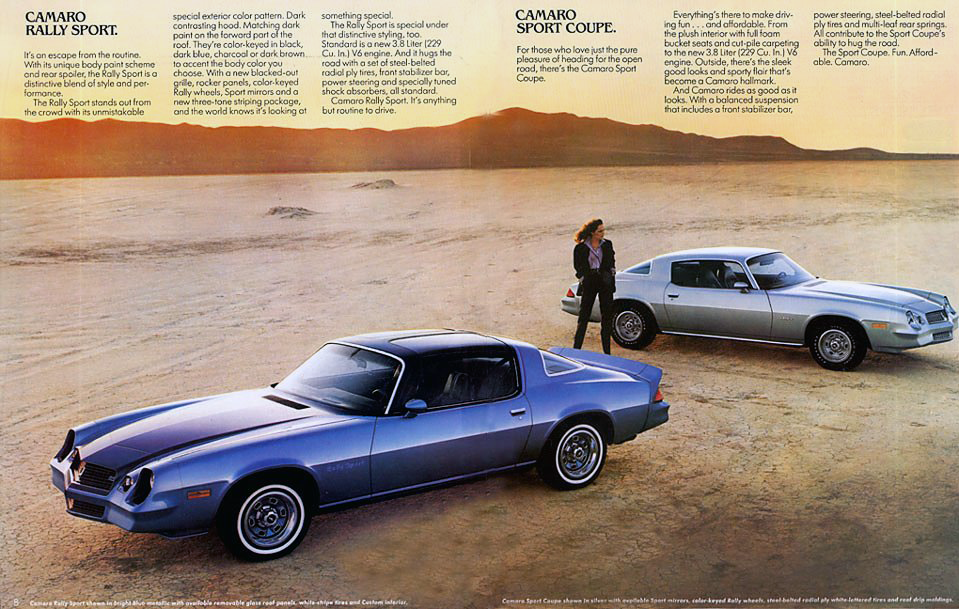
Rally Sport page from 1980 Camaro brochure
Rally Sport and Sport Coupe pages from the 1980 Chevrolet Camaro brochure

That new standard powertrain on the 1980 Rally Sport was the LC3 115 bhp 3.8 liter/229 ci V6 with a Rochester M2ME two-barrel carburetor paired with a three-speed manual. EPA fuel economy was 20 city/26 highway by the standards of the day—with a 20.9-gallon gas tank, a Camaro owner could expect to go 390 to 430 miles with a 10% fuel reserve. The trade-off was performance that belied the Camaro’s sporty looks: 0-60 in a little under 13 seconds with a top speed of 112 mph.

Optional powertrains included two V8s, both of which required power brakes ($81): the L39 120 bhp 4.4 liter/267 ci with a two-barrel carburetor ($180) and the LG4 155 bhp 5.0 liter/305 ci with a four-barrel carburetor ($295). An automatic ($358) was available with all three engines, while a four-speed manual was only available with the larger of the two V8s. The LG4/four-speed combination yielded notably better performance than the base powertrain: 0-60 in about 10 seconds. It didn’t make mileage that much worse—16 city/24 highway by 1980 standards.

Standard exterior and mechanical equipment on all Rally Sports included High Energy ignition, power steering, front stabilizer bar, sport mirrors, rear spoiler, concealed windshield wipers, front disc/rear drum brakes, and 205/75R14 steel-belted radial ply tires (a size still available thanks to Hancook and Kumho) on 14-inch color-keyed Rally wheels. Inside, flow-through ventilation system, contoured full-foam vinyl bucket seats, a “centre” (as spelled in the brochure) floor console, and cut-pile colour-keyed carpeting were included.

Options & Production Numbers

Exterior and mechanical options included removable glass panels ($695) and 14 x 7 aluminum wheels ($337). Inside, air conditioning ($566), intermittent windshield wiper system ($41), electric rear window defogger ($107), automatic speed control ($112), power door locks ($93), power windows ($143), a Custom interior ($68), a gauge package with a tachometer ($120), Comfortilt steering wheel ($81), and an AM/FM stereo radio with stereo cassette tape ($272) were all available.

Though the Z28 wasn’t the most popular Camaro, the Rally Sport did not hold up its end of the bargain (likely why it was gone in 1981). The leading seller remained the entry-level Sport Coupe (46% of production), followed by the Z28 (30%), the Berlinetta (16%), and the Rally Sport (8%).

The View From 2025

Badge for 2,500 web hits

According to Hagerty’s valuation tools, all the money for a 1980 Camaro Rally Sport with the LG4 V8, a four-speed, and T-tops in #1/Concours condition is an astounding $24,400, with a far more typical #3/Good car with same equipment going for $14,200. Values slide down substantially with the base equipment—a base V6 Rally Sport in #3 condition is only worth $10,300.

This generation of the Rally Sport maintains some presence in the Hemming’s Motor News classifieds, on eBay Motors, and at online auctions such as Bring a Trailer that cater to the eighties car market. As I update this post in February 2025, there’s a Bronze Metallic 1981 with the LG4, an automatic, and 77,000 miles for sale asking $16,000.

Make mine Bright Blue Metallic, please.

Last updated February 2025.

1980 Plymouth Volaré station wagon

“Value where it counts.”

For 1980, Plymouth’s Volaré got a new grille but was otherwise little changed aside from a few new options. 1980 would be the Volaré’s last year—the Reliant would replace it in 1981.

The Volaré’s standard engine continued to be Chrysler’s evergreen 3.7 liter/225 ci Slant Six with a Holley one-barrel carburetor, making 90 bhp and giving a 0-60 time of a little over 16 seconds. Optional power was (of course) the LA 5.2 liter/318 ci V8 with a Carter two-barrel carburetor, making 120 bhp, costing an additional $211, and bringing the 0-60 time down to about 14.5 seconds. A three-speed manual was standard with the six, but a TorqueFlite automatic was required with the V8. Mileage with the three-speed manual and the six was (ooog) 16—with the 18-gallon fuel tank, a Volaré driver could expect a 235 to 260-mile range with a 10% fuel reserve.

Station wagon pages from the 1980 Plymouth Volare brochure
Station wagon pages from the 1980 Plymouth Volaré brochure

Standard exterior and mechanical equipment on the $5,422 Volaré station wagon (about $23,100 in today’s dollars) included power front disc/rear drum brakes, a torsion bar front suspension, and P195/75R14 glass-belted radial-ply tires. Inside, a heater, a defroster, a three-spoke steering wheel, an all-vinyl bench seat, and an AM radio were included.

Options, Packages, & Production Numbers

Exterior and mechanical options included halogen headlamps ($37), a power liftgate ($24), a luggage rack ($91), a rear wiper/washer system ($64), and cast aluminum road wheels ($287). Inside, air conditioning ($543), automatic speed control ($106), an electronic digital clock with a fluorescent display ($55), carpeting in the rear ($69), lockable storage bins ($24), and a range of stereos were available.

A Premier package ($831) added woodtone trim on the body sides, rear gate, instrument panel, and glove box door, along with a hood ornament, deluxe wheel covers, and 60/40 individually adjustable vinyl seats. You could also get (but few did) the $721 Sport Wagon package, which included fender flares, front air dam, tape stripes, black grille highlights, dual sport mirrors, aTuff three-spoke color-keyed steering wheel, and eight-spoke road wheels with trim rings. Finally, the Handling/Performance package ($385) included heavy-duty shocks, Firm-Feel power steering, and FR70x14 Aramid-belted radial tires.

Like almost every Chrysler product in 1980, sales of the Volaré station wagon were not good. At 16,895, they were well less than half of 1979’s total of 44,085. Sales would recover substantially with the release of the Reliant station wagon in 1981.

The View From 2025

Plymouth Volarés and Dodge Aspens were once common on American roads, but have virtually disappeared by now. You do occasionally see them for sale in the Hemming’s Motor News classifieds, on eBay Motors, and on Bring a Trailer, but there are no Volaré station wagons out there as I updated this blog entry in April 2025.

Make mine Light Cashmere, please, with the Premier package. Beige seems somehow correct.

Other Plymouths I have written about include the 1980 Horizon hatchback sedan, the 1981 Reliant coupe, and the 1984 Voyager minivan.

Last updated April 2025.

1982: What Cars Are Collectible?

The question always arises: what cars are considered collectable? One way is to look at what Hagerty tracks with their valuation tools. For 1982 cars, the full list is below—I have added a few comments.

question mark graphic

Alfa Romeo; GTV-6 hatchback coupe, Spyder convertible

Alpine; A310 coupe

Aston Martin; Lagonda sedan, V8 coupe and convertible

Avanti; Avanti II coupe

Bentley; Corniche convertible, Mulsanne sedan

Bitter; SC coupe

BMW; 320i coupe

Bristol; 412 convertible

Buick; Regal coupe, Riviera coupe and convertible

Cadillac; Cimarron sedan, DeVille coupe and sedan, Eldorado coupe, Fleetwood coupe and sedan, Seville sedan (yes, Hagerty really tracks the Cimarron)

Checker; Marathon sedan

Chevrolet; C10/K10 pickup truck, C10/K10 Blazer SUV, C10/K10 Suburban SUV, C20/K20 pickup truck, C20/K20 Suburban SUV, C30/K30 pickup truck, Camaro hatchback coupe, Corvette coupe, El Camino pickup truck

Chrysler; Imperial coupe

Clenet; SII convertible. SIII coupe and convertible

Datsun; 280ZX hatchback coupe

Delorean; DMC-12 coupe

DeTomaso; Deauville sedan, Pantera coupe

Dodge; Ramcharger SUV

Duesenberg; LaGrande convertible

Excalibur; Series IV convertible

Ferrari; 308 GTBi/GTSi coupe, 400i coupe, 512 BB coupe, Mondial coupe

Fiat; X1/9 coupe

Ford; Bronco SUV, F-100 pickup truck, F-150 pickup truck, F-250 pickup truck, F-350 pickup truck, GT40 coupe and convertible, Mustang hatchback coupe, Thunderbird coupe

GMC; C1500/K1500 pickup truck, C2500/K2500 pickup truck, C3500/K3500 pickup truck, Caballero pickup truck

Jaguar; XJ-S coupe

Jeep; Cherokee SUV, CJ-5 SUV, CJ-7 SUV, CJ-8 Scrambler pickup truck, Wagoneer SUV

Lamborghini; Countach coupe, Jalpa coupe

Lancia; Beta coupe, convertible, and station wagon, Gamma coupe and sedan

Lincoln; Continental sedan, Continental Mark VI coupe and sedan, Town Car sedan

Lotus; Esprit coupe

Maserati; Quattroporte III sedan

Matra; Murena coupe

Mazda; RX-7 hatchback coupe

Mercedes-Benz; 240D sedan, 300CD coupe, 300D sedan, 300SD sedan, 300TD station wagon, 380SEL sedan, 380SL convertible, 380SLC coupe

Morgan; 4/4 convertible, Plus 8 convertible

Panther; DeVille convertible and sedan, Kallista convertible

Peugeot; 504 convertible

Pontiac; Firebird hatchback coupe

Porsche; 911 coupe, 924 hatchback coupe, 928 hatchback coupe

Puma; GT coupe, GTC coupe and convertible

Renault; Fuego hatchback coupe

Rolls-Royce; Camargue coupe, Corniche I convertible, Phantom VI sedan, Silver Spirit sedan, Silver Spur sedan

Stutz; Bearcat convertible, Blackhawk coupe, IV-Porte sedan

Subaru: BRAT pickup truck

Toyota; Celica hatchback coupe, Land Cruiser SUV

TVR; 280i coupe and convertible

Hagerty casts a wide net, except when they don’t. Coupes are dominant—32% of 117 models listed with an additional 9% being hatchback coupes. Unsurprisingly, the rarest body style is a station wagon, at 2%.

1985 Chevrolet Citation II hatchback sedan

“One car that does it all.”

1985 was, mercifully, the last year for the Chevrolet Citation. In a sad General Motors tradition, it was also the best Citation (the 1985 Citation had no recalls after the nine that the 1980 had). Half-heartedly renamed Citation II in 1984, the X-car would be replaced by the Nova in 1986. There were some changes: new colors were available, and the dashboard was revised, allowing the “normal” horizontal Delco radios.

For 1985, the Citation II’s standard powertrain remained the LR8 “Iron Duke 92 bhp 2.5 liter/151 ci inline four with throttle-body fuel injection paired with a four-speed manual (the Citation never got a five-speed—even as an option). With the standard powertrain, 0-60 came in a little under 12 seconds in the 2,500-pound car with a theoretical top speed of 101 mph. Mileage was competitive: 24 city/34 highway by the day’s standards (21/31 by today’s standards). With a 14-gallon fuel tank, the owner of a base Citation could expect a range of between 325 and 365 miles with a 10% field reserve.

Powertrain options included two different versions of the 2.8 liter/173 ci V6 (why?): the LE2 112 bhp version with a two-barrel carburetor ($260) and the LB6 130 bhp type with fuel injection ($435). A three-speed automatic was—of course—available ($425). The V6 in general, and especially the fuel-injected version, made the Citation II substantially more spritely: 0-60 times of about 9 seconds and a top speed of about 118 mph. You paid a mileage price for that performance: 19 city/26 highway by 1985 standards (17/24 by today’s standards).

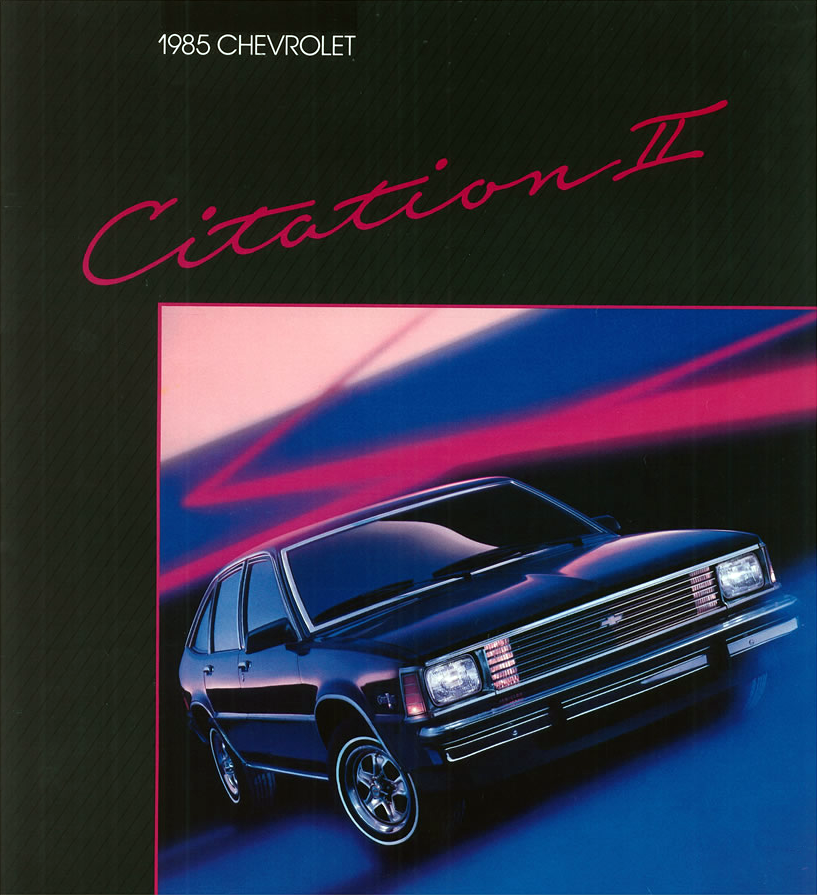
Cover of the 1985 Chevrolet Citation II brochure

Standard exterior and mechanical equipment on the $7,090 Citation II hatchback sedan (approximately $21,500 in 2025 dollars—precisely what base 2025 Chevrolet Trax LS SUV goes for) included halogen headlamps, rack-and-pinion steering, front disk/rear drum brakes, and P185/80R-13 radial tires (now a trailer size) on 13-inch by 5.5-inch steel wheels with full wheel covers. Inside, a low back front bench seat with adjustable head restraints, sliding door locks, a lockable glove box, a folding rear seat, and an AM/FM radio with two speakers were included.

Options & Production Numbers

Exterior and mechanical options included tinted glass ($110), two-tone paint ($176), power brakes ($100), power steering ($215), and the F41 sports suspension (acknowledged to be a bargain at $33). Inside, a quiet sound/rear decor package ($92), air conditioning ($730), cruise control ($175), Comfortilt steering wheel ($110), an electric rear defogger ($140), and an electronic-tuning AM/FM stereo radio with cassette, clock, and seek/scan ($319) were all available.

The 1985 Citation II did not sell—overall sales in this last year fell to a mere 8% of the first year sales. At an average Chevrolet dealership, you could expect it to be outsold by the Chevette, the Cavalier, the Camaro, the Celebrity, the Monte Carlo, and the Caprice Classic.

The View From 2025

I haven’t seen a Citation in years—the last one was an X-11 in early 2014. They rarely appear in the Hemming’s Motor News classifieds, on eBay Motors, or on Bring a Trailer. I’m pretty sure I’ve never seen one shown, though I’m not betting against that at some point.

Make mine the Medium Gray Metallic/Silver Metallic two-tone, please.

Other Citations I’ve written about include the 1980 hatchback sedan and the 1981 X-11 hatchback coupe. X-cars from other marques covered in this blog include the 1983 Buick Skylark T TYPE coupe, the 1984 Oldsmobile Omega sedan, and the 1982 Pontiac Phoenix SJ coupe.

Last updated March 2025.