1986 Lincoln Mark VII coupe

Back when I lived in Bryn Mawr, PA, a Silver Blue Lincoln Mark VII sat on a driveway about three blocks from my house. The sporty LSC version attracts most of the attention with these cars—it has previously attracted mine. However, this post is about the “base” coupe.

“The most completely equipped car sold in America”

Lincoln dropped the Continental sub-marque name from the Mark series in 1986. That was probably the biggest news in the Mark VII’s third year, but there were other enhancements and changes. The standard V8 gained 10 bhp, while the LSC got a 60 bhp bump. Lincoln added the newly required high-mount rear stop lamp, and both anti-lock brakes and keyless entry became standard across the line. Inside, power front seat recliners and the Premium Sound System were newly standard. The Versace Designer Series was no more, but the Bill Blass Designer Series continued.

The base Mark’s only available powertrain was a Windsor 150 bhp 4.9 liter/302 ci V8 with fuel injection mated with a four-speed automatic with overdrive. 0-60 came in about 10.5 seconds in a car with a curb weight approaching 3,700 pounds. Fuel economy was respectable: 18 city/26 highway by the day’s standards (16/24 by 2025 measures). With a 22.1-gallon gas tank, a Mark VII owner could expect a range of 400 to 435 miles with a 10% fuel reserve.

1986 Lincoln Mark VII brochure pages
Pages from the 1986 Lincoln Mark VII brochure

The Mark VII’s base price was $22,399 for 1986—approximately $65,900 in today’s dollars, or about what a 2025 Lincoln Aviator Reserve mid-size SUV goes for. Standard exterior and mechanical equipment included flush-mounted aerodynamic halogen headlamps, tinted glass on all windows, a power antenna, power-assisted rack-and-pinion steering, an Electronic Air Suspension with automatic level control, and P215/75R15 white sidewall tires (a size still readily available) on 15-inch cast-aluminum road wheels. Inside, every Mark VII included fingertip speed control, interval windshield wipers with speed controls, Electronic Automatic Climate Control, cloth six-way power seats, and an AM/FM stereo cassette radio with four speakers.

Options & Production Numbers

The well-equipped Mark VII offered relatively few options for 1986. Items buyers could choose included a power glass moonroof ($1,319), a Traction-Lok differential ($165), strange-looking geometric cast-aluminum wheels ($298), wire-spoke aluminum wheels ($693), and leather seating surfaces ($551).

1986 was a solid year for Lincoln’s big coupe. Sales increased by 9% over the previous year, and Car and Driver chose the LSC variant as one of their 10Best. All of this happened while sales of the newly downsized Buick Riviera, Cadillac Eldorado, and Oldsmobile Toronado collapsed.

The View From 2025

Mark VIIs do attract collector interest, and there is model-specific club support along with the bigger Lincoln car clubs. According to Hagerty’s valuation tools, all the money for a 1986 Mark VII in #1/Concours condition is $35,900, with a far more normal #3/Good condition version going for $9,200. These Marks are often available in the Hemmings Motor News classifieds, on eBay Motors, and on Bring a Trailer, and they sometimes show up at in-person auctions. As I update this post in April 2025, a Dark Shadow Blue Clearcoat Metallic 1988 Mark VII Bill Blass Edition with shadow blue leather seats and 53,000 miles is for sale on Hemmings, asking $33,000.

Make mine the extra-cost ($268) Flemish Blue Glamour Clearcoat Metallic, please. What a name!

Other Lincolns I have written about include the 1980 Continental Mark VI coupe, the 1984 Continental Mark VII LSC coupe, and the 1987 Lincoln Continental sedan.

Last updated April 2025.

1986 Dodge Ramcharger SUV

Mecum’s “Summer Special” auction in August 2020 included three examples of the 1980s Ramcharger. The one that did the best was a 1986 Royal S.E.—the top-of-the-line for that year. Its hammer price was $15,500.

“Tough in the Rough.”

For 1986, Dodge’s Ramcharger SUV received a new crosshair grille that strongly resembled the design seen on Dodge’s early 1970s pickup trucks. The side mirror assemblies were simplified, but otherwise, there was little change, aside from new colors.

The Ramcharger’s standard engine was an LA 150 bhp 5.2 liter/318 ci V8 with a two-barrel carburetor. It came with a four-speed manual transmission if four-wheel drive was chosen, and a three-speed automatic transmission if two-wheel drive was preferred. An LA 175 bhp 5.9 liter/360 ci V8 with a four-barrel carburetor went for an additional $261. With the base powertrain, fuel economy was rated at an uninspiring (and somewhat uncompetitive) 11 city/14 highway by the day’s standards in an SUV with a curb weight starting at 4,045 pounds. A capacious 35-gallon gas tank gave a respectable 360 to 395-mile range with a 10% fuel reserve.

1986 Dodge Ramcharger brcohure cover
1986 Dodge Ramcharger brochure cover

The Ramcharger’s base price was $11,534—about $34,400 in today’s dollars, which is about 20% less than a 2026 Durango GT SUV goes for. Standard exterior and mechanical equipment included tinted glass, chrome front and rear bumpers, two-wheel drive, power-assisted front disc/rear drum brakes, power steering, and P235/75R15 tires (a size still readily available) on 15 x 6.5-inch wheels with bright hubcaps. Inside, Deluxe vinyl low-back front bucket seats and an ETR AM radio with a digital clock were included. The four-wheel-drive version of the Ramcharger went for an additional $1,229.

Individual Options, Option Packages, & Production Numbers

Among the many individual options available were aluminum road wheels ($350), a heavy-duty alternator ($145), intermittent windshield wipers ($55), air conditioning ($740), and an ETR AM stereo/FM stereo radio with a cassette player and a clock ($360).

A few option packages were available. Prospector Package I ($768) included a bright grille, Deluxe wheel covers, a Ram’s Head hood ornament, Prospector nameplates, and a convenience package. Prospector Package II ($1,251) added the Royal S.E. décor package and power door locks. Finally, the top-of-the-line Prospector Package III ($3,269 2WD/$3,186 4WD) added two-tone paint, air conditioning, power windows, speed control, and a tilt steering column.

The Ramcharger’s sales peaked at 37,055 in the 1985 model year and would never again come close to that level. With little changed for 1986, sales slipped substantially, with only 20,815 Ramchargers produced compared to 37,310 Chevrolet Blazers and 57,488 Ford Broncos.

The View From 2025

Along with other eighties SUVS, Ramchargers are attracting significant collector interest. According to Hagerty’s valuation tools, a loaded 1986 Ramcharger Royal S.E. 4×4 in #1/Concours condition is $45,100, while a far more normal #3/Good condition AD-100 version goes for $16,300. Ramchargers are often available in the Hemmings Motor News classifieds, on eBay Motors, and on Bring a Trailer. As I update this post in December 2025, a Black 1986 Ramcharger Prospecter with black bucket seats and 38,000 miles is for sale on Hemmings, asking $26,000.

Make mine Charcoal Gray Metallic, please.

Other Dodges I have written about include the 1983 Shelby Charger hatchback coupe, the 1984 Daytona Turbo Z hatchback coupe, the 1985 600 Club Coupe, the 1985 Omni GLH hatchback sedan, the 1985 Shelby Charger hatchback coupe, the 1987 Aries LE sedan, and the 1989 Diplomat sedan. I have also written about the 1985 Chevrolet K5 Blazer SUV and the 1985 Ford Eddie Bauer Bronco SUV.

Last updated December 2025.

1986 Mercury Capri hatchback coupe

Hemmings has been making a go at auctions. One of their first offerings was a white 1982 Mercury Capri RS coupe with red vinyl bucket seats, a Windsor 157 bhp 4.9 liter/302 ci V8 with a Motorcraft 356CFM two-barrel carburetor, a four-speed manual, and 33,000 miles. That was enough to get me to generate an update to this eight-year-old post about the later 1986 version.

“Proof that getting there can be a fun experience in itself.”

For 1986, Mercury’s Capri had three engine choices and two transmission choices. Standard on the GS was the Lima 88 bhp (aargh!) 2.3 liter/140 ci in-line four with a Carter YFA one-barrel carburetor mated to a four-speed manual transmission. Power options for the GS included the Essex 120 bhp 3.8 liter/231 ci V6 with fuel injection and the (wonderful) Windsor 200 bhp 4.9 liter/302 ci V8 with sequential fuel injection that was standard on the 5.0L. All three engines could be paired with a three-speed automatic transmission for an additional $510 (the V6 required the automatic while the 5.0L came standard with a five-speed manual transmission with overdrive).

Mileage ratings for the various configurations ranged from 23 city/28 highway (21/26 by today’s standards) for the four-speed manual/in-line four combination that I’m not convinced that anyone bought to 17/25 for the “big daddy” five-speed manual paired with the V8.

Performance with the 2.3 liter four paired with either transmission was ghastly. 0-60 came in about 15 seconds, which meant a Capri driver with the Lima engine would see only the taillights of Iron Duke-powered Camaros and Firebirds (such a sad competition!). Moving to the V6 paid significant performance dividends, dropping the 0-60 time by about 3.5 seconds. Of course, the V8 was by far the best: even the automatic was in the 7 second range, while the manual could do 0-60 in about 6.5 seconds.

Mercury made three attempts at the Capri. The first was an imported version of the European Ford Capri and was sold from the 1970 to 1978 model years, first as the Capri and then as the Capri II. The second was Mercury’s version of the Fox body Mustang and was sold from 1979 to 1986. The final version of the Capri was an imported version of the Australian Ford Capri, sold from 1991 to 1994. Sense a trend here?

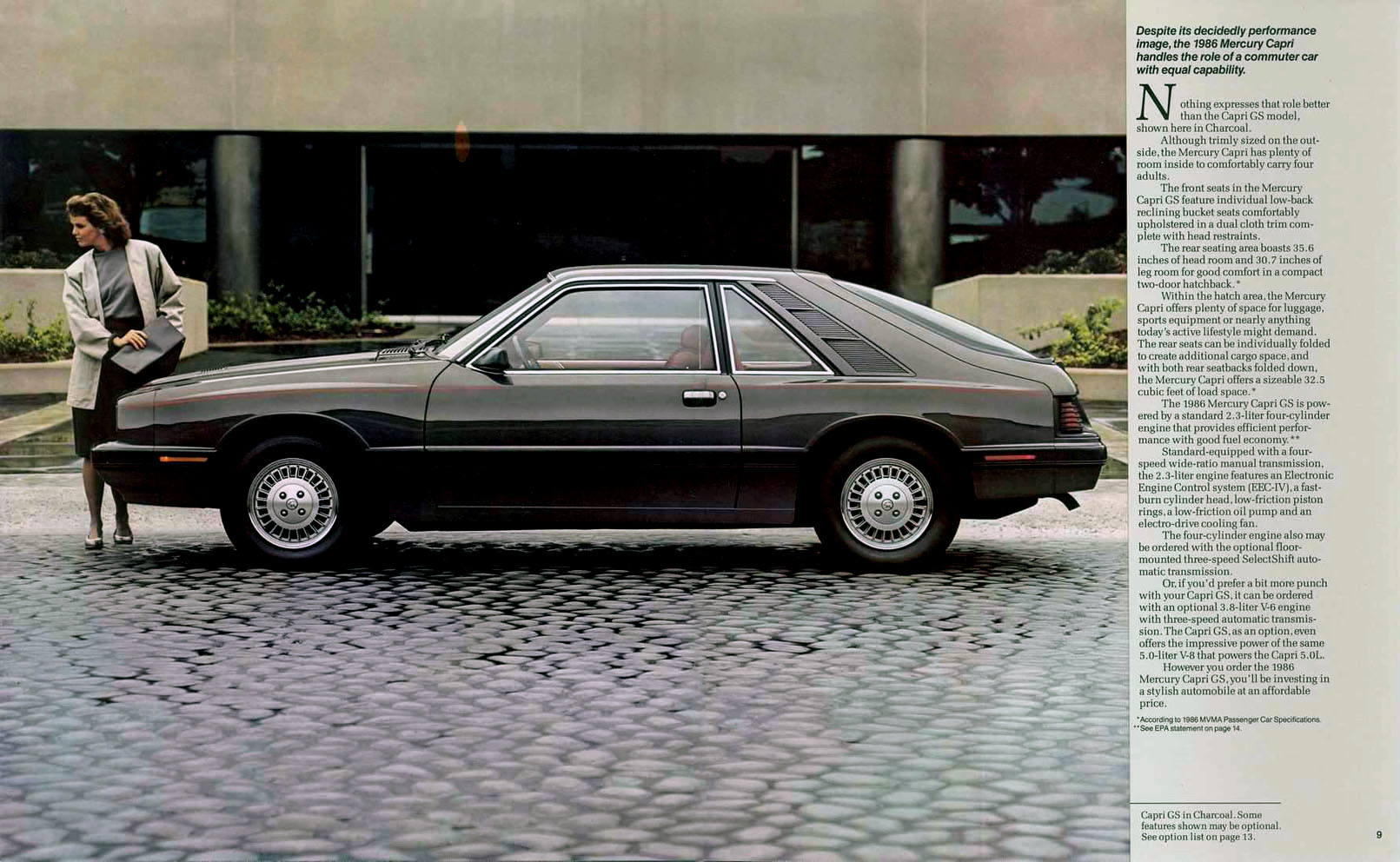
The base price for a Capri GS was $8,331 (about $24,800 in 2025 dollars). For that money, the Capri came relatively well equipped by mid-1980s standards. External features included halogen headlamps, tinted glass, and the distinctive bubble-back rear hatch with rear-window defroster. Mechanical equipment included power steering, power brakes, and P195/75R14 tires (still available thanks to Hankook and Kumho) on 14-inch wheels with turbine wheel covers. Inside, power windows, interval wipers, tilt steering wheel, and an AM/FM stereo radio were standard.

Pages from the 1986 Mercury Capri brochure

The more sporty Capri 5.0L stickered for $10,950 (about $32,500 in today’s dollars) and added the V8 mentioned above, dual exhaust, a Traction-Lok rear axle, and P225/60VR15 low-profile tires (a size still readily available) on cast-aluminum performance wheels.

Options & Production Numbers

Exterior options for both the GS and the 5.0L included a flip-up open-air roof ($315) or a T-Roof ($1,100). Inside, buyers could add air conditioning ($762), power door lock group ($182), speed control ($176), and an AM/FM stereo radio with cassette ($300).

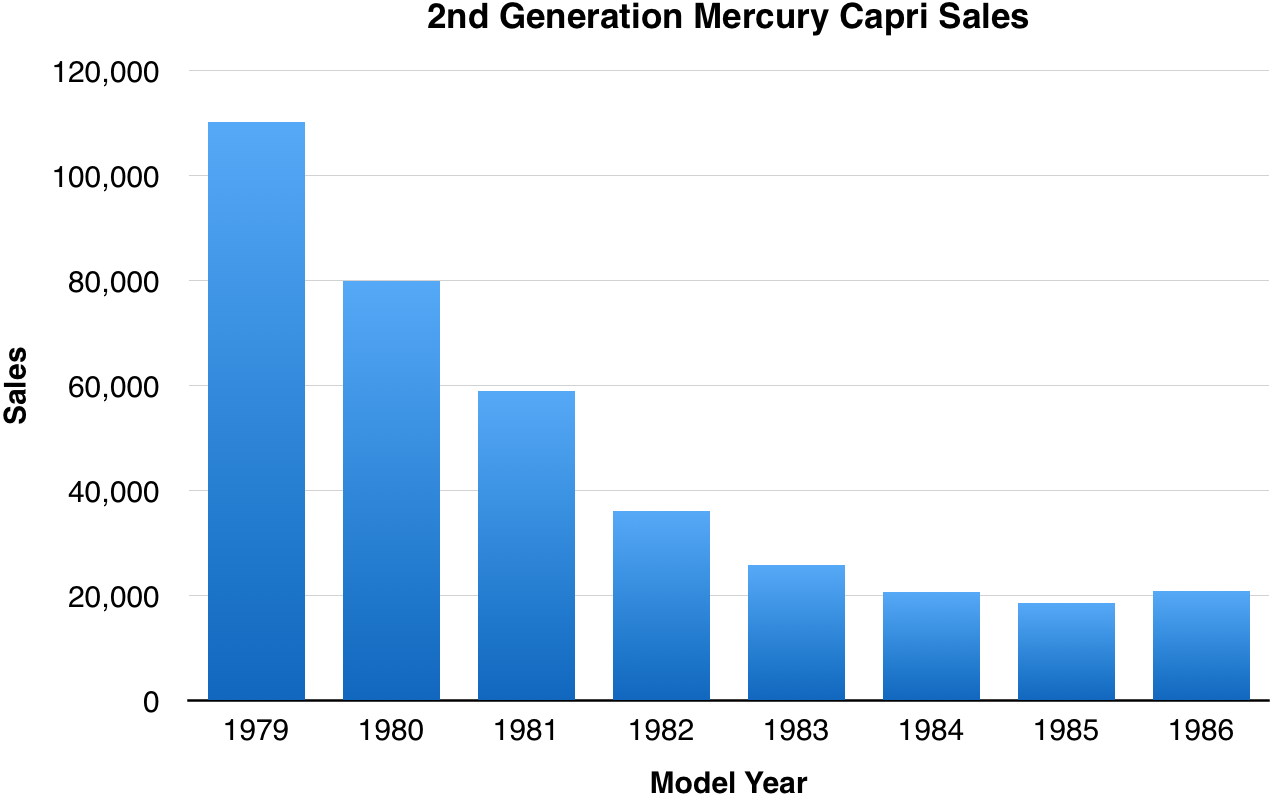
MercuryCapriSales

Sales for the last of the second-generation Capris were not at all good, but Capri sales had not been good for years—Mercury’s traditional problem wedged between Ford and Lincoln. By 1986, Capri sales were about 9% of Mustang sales.

The View From 2025

Fox body Capris sometimes show up in the Hemming’s Motor News classifieds and eBay Motors, but there’s not a lot of activity. Bring a Trailer has auctioned a total of ten second-generation Capris, most of them the specialty ASC McLaren version. I’ll say that Capris are uncommon rather than unloved.

Make mine Smoke Metallic, please.

Other Mercury models I have written about include the 1983 Grand Marquis sedan, the 1984 Grand Marquis Colony Park LS station wagon, the 1987 Lynx XR3 hatchback coupe, the 1988 Cougar XR-7 coupe, and the 1988 Grand Marquis Colony Park station wagon. I seem to like the big Mercury’s.

Last updated September 2025.

1986 Cadillac Fleetwood Brougham sedan

“Owning a Cadillac is a satisfying experience.”

For 1986, Cadillac transitioned the Fleetwood Brougham from the Cadillac-built HT-4100 130 bhp 4.1 liter/249 ci V8 with fuel injection to the Oldsmobile-built 140 bhp 5.0 liter/307 ci V8 with a Rochester four-barrel carburetor. Production for the model year started late—it didn’t get going until February 1986.

The only powertrain available mated the aforementioned V8 to a four-speed automatic transmission. Mileage was rated at 18 city/25 highway by the day’s standards (16/23 by today’s measures). With a 20.7-gallon fuel tank, a Fleetwood Brougham buyer could expect a range of between 365 and 400 miles with a 10% reserve. The target market didn’t really care about performance, but the 0-60 time was a little under 13 seconds.

Standard exterior equipment on the $21,265 Fleetwood Brougham (about $63,400 in today’s dollars or a little over what a loaded 2025 Cadillac CT5 sedan goes for) included Soft Ray tinted glass and a full padded roof treatment. Mechanical equipment included rear-wheel-drive, power front disc/rear drum brakes, and P215/75R15 steel-belted all-season radial whitewall tires (a size still readily available, including in whitewall) on 15-inch wheels. Inside, an illuminated entry system, power door locks, power windows, electronic climate control, and dual comfort 55/45 heather cloth seats with a six-way power adjuster for the driver were all included in these comfortably equipped cars.

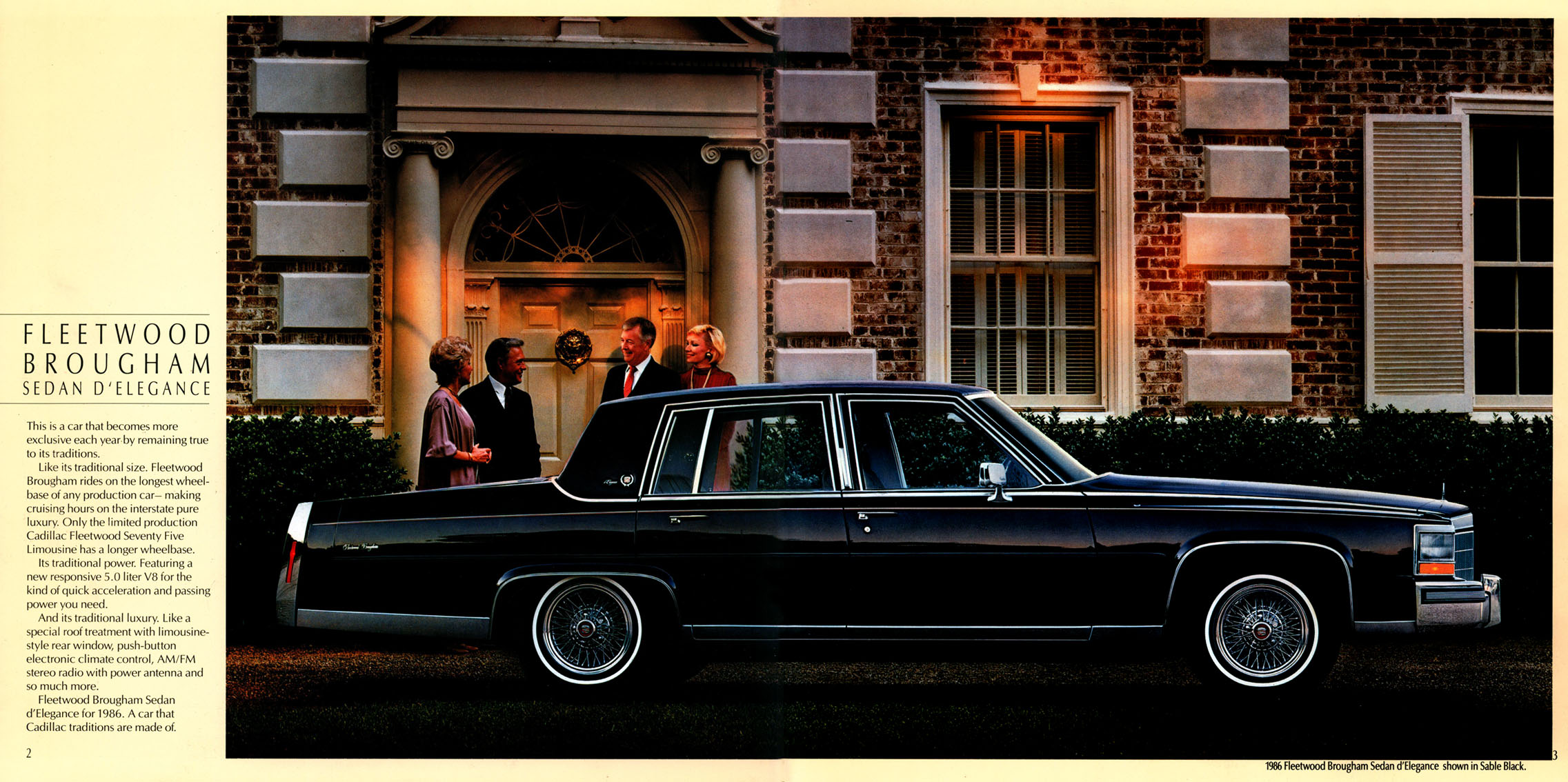
Sedan d'Elegance pages from the 1986 Cadillac Fleetwood Brougham brochure
Sedan d’Elegance pages from the 1986 Cadillac Fleetwood Brougham brochure

Upgrading to the Sedan d’Elegance added adjustable rear seat reading lamps, controlled cycle wipers, tufted pillow-style seating areas, a six-way power seat and manual recliner for the front passenger, and an AM/FM stereo radio with power antenna.

Options & Production Numbers

Among the many exterior and mechanical options were the electrically powered Astroroof ($1,255), electronic level control ($203), and wire wheels ($860 to $940). Inside, Twilight Sentinel ($85), automatic door locks ($170), a power trunk lid release ($40), and a driver’s side memory seat ($215) were available.

The 1986 Fleetwood Brougham sold decently, especially considering the short year—49,115 examples went out the door. By 1986, these cars had evolved into stately evocations of another age. No longer an expression of anything reasonably current in the automotive world, they still received surprising respect in some quarters. In 1987, the name was shortened to just Brougham, but Cadillac would sell the same basic model through the 1992 model year with only one notable update in 1990.

The View From 2025

Folks are collecting these rear-wheel-drive eighties Cadillacs, but values do not approach those of Fleetwoods from previous decades. According to Hagerty’s valuation tools, a 1986 Fleetwood Brougham sedan in #1/Concours condition is $38,500, with a more typical number #3/Good condition car going for $14,300. Eighties Fleetwood Broughams and their ilk are regularly featured in the Hemming’s Motor News classifieds, on eBay Motors, and on Bring a Trailer.

Make mine Autumn Maple Firemist, please.

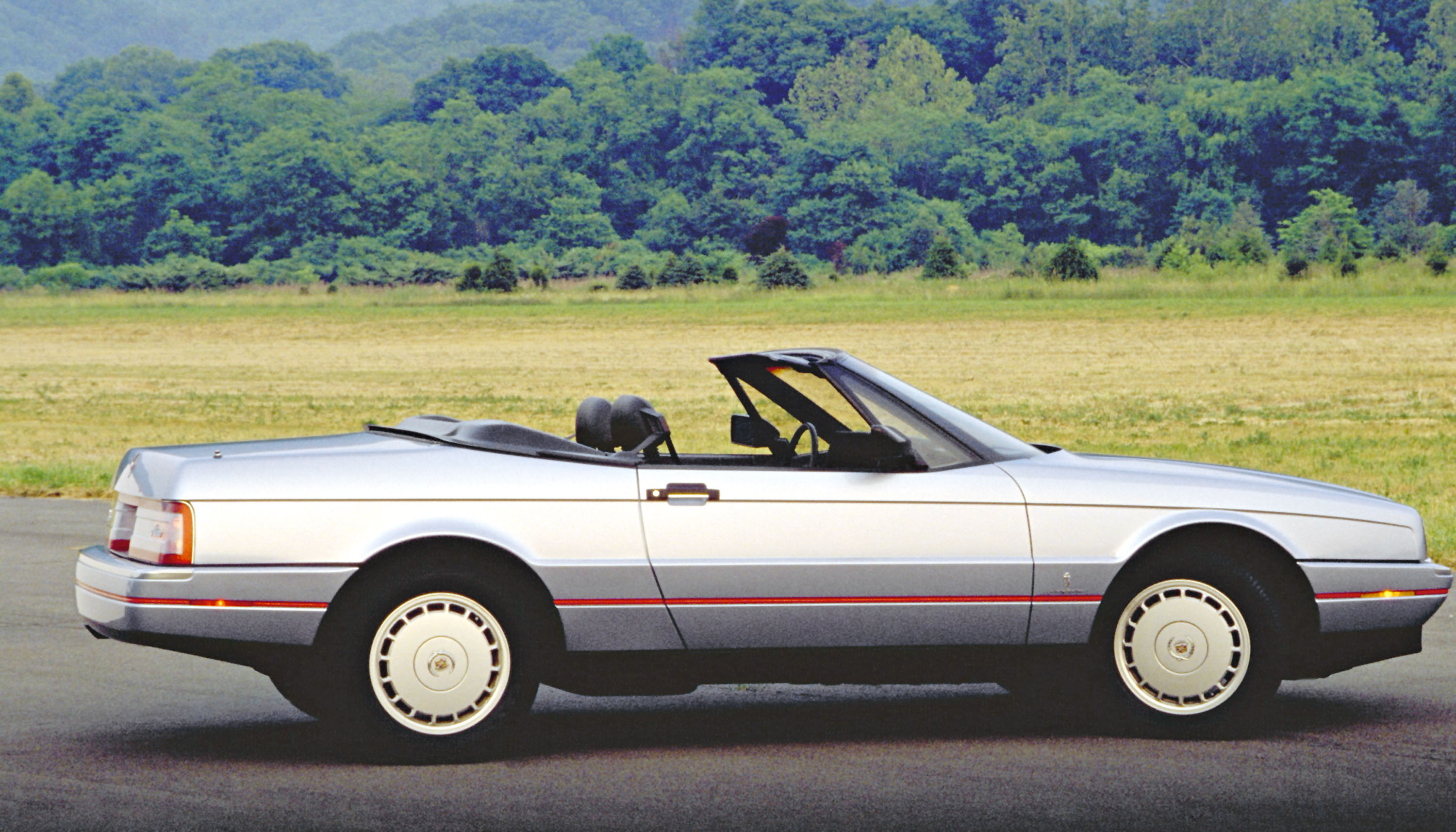
Other Cadillacs I have written about include the 1980 Seville sedan, the 1982 Cimarron sedan, the 1982 Eldorado Touring Coupe, the 1984 Eldorado Biarritz convertible, the 1986 Eldorado coupe, the 1988 Cimarron sedan, the 1988 Eldorado coupe, the 1989 Allante convertible, and the 1989 Sedan deVille.

Last updated September 2025.

1986 Chevrolet Corvette convertible

“Yes to wind. Yes to sunshine.”

For 1986, the big news for Corvette was the return of the convertible, gone since 1975. Other improvements included Bosch ABS II anti-lock brakes, a Vehicle Anti-Theft System (VATS), and the mid-year introduction of aluminum cylinder heads.

The standard powertrain was the L98 235 bhp 5.7 liter/350 ci V8 with fuel injection paired with a Turbo-Hydramatic four-speed automatic transmission. Car and Driver recorded a 0-60 time of 6.0 seconds and a top speed of 144 mph. Estimated fuel economy was 17 city/24 highway by the standards of the day (15/22 by today’s standards). With a 20-gallon fuel tank, a Corvette convertible’s proud new owner could expect a range of between 335 and 370 miles with a 10% fuel reserve.

Built in collaboration with ASC, the convertible included a manual top, a rear-hinged deck panel to cover the top, and an X-brace underneath the floor. The newly-required high-mounted rear brake light was integrated into the rear fascia. Even the gas filler cover was different from the coupe—square because there was no rounded rear hatchback glass for it to wrap around.

1986 Chevrolet Corvette convertible brochure page
1986 Chevrolet Corvette brochure page

Standard exterior and mechanical equipment for the $32,032 Corvette convertible (about $93,612 in today’s dollars or about what a well-equipped 2025 Corvette Stingray convertible goes for) included a Delco Freedom Plus II battery, power operated quartz-halogen retractable headlamps, power rack-and-pinion steering, power brakes, and P255/50VR-16 tires on 16 x 9.5 inch cast alloy aluminum wheels. Inside, air conditioning, power windows, Tilt-Telescopic steering wheel, driver information system, cloth bucket seats, and an AM/FM stereo radio with power antenna were all included.

Options & Production Numbers

Optional exterior and mechanical equipment included a performance axle ratio ($22) and Delco-Bilstein shock absorbers ($189)—the Doug Nash 4+3 manual transmission was a no-cost option. Optional interior equipment included cruise control ($185), a power door lock system ($175), electronic control air conditioning ($150), a six-way power driver’s seat ($225), and the Delco-GM/Bose Music System ($895). The Z51 Performance Handling Package was not available with the convertible.

The return of the Corvette convertible was well-received—Chevrolet sold 7,315 in about half a model year, even at $5,000 more than the coupe. Reviews were also good; Car and Driver stated that the convertible was “a mighty hospitable carriage.”

The View From 2025

There is strong club support for the 1986 Corvette, as there is for all Corvettes. According to Hagerty’s valuation tools, all the money for a 1986 Corvette convertible in #1/Concours condition is $31,500, with a more normal number #3/Good condition car going for $10,800. 1986 Corvette convertibles are regularly featured in the Hemming’s Motor News classifieds and on eBay Motors—as I write this in December 2018, there’s a Yellow car with black leather seats and 29,000 miles available on Hemmings for $17,900.

Make mine White, with red leather seats—the “heritage colors” that match the first Corvette back in 1953.

Last updated February 2025.

1986 Buick Century sedan

A white Buick Century sedan was parked outside one of my local supermarkets for a few weeks in late 2018. Followers of Eighties Cars know that presence was likely to generate a blog entry.

“… truly satisfying motoring in the European tradition.”

For 1986, Buick’s Century gained a new slanted grille along with lower profile headlamps. The other major news was that the T Type coupe had been discontinued, though the sedan version of the most sporting Century remained alive. Both the sedan and the coupe were available in Custom (base) and Limited trim, while the wagon was available in Custom (base) and Estate versions. We’ll concentrate on the sedan in this post.

Standard power on the Century remained the Iron Duke 92 bhp 2.5 liter/151 ci inline four with throttle-body fuel injection. Two different V6 engines were available: a $435 112 bhp 2.8 liter/181 ci V6 with a two-barrel carburetor and a $695 150 bhp 3.8 liter/231 ci V6 with sequential fuel injection. A three-speed automatic transmission was standard with the 2.5 liter inline four and 2.8 liter V6, but buyers could add a four-speed automatic for an additional $175.

With these three engines, two transmissions, and curb weights in the 2,750 to 2,850-pound range, there was a wide variance in performance. 0-60 mph with the inline four/three-speed automatic combination was about 15 seconds, while 3.8 liter/231 ci V6 owners with the four-speed automatic could expect to get from 0-60 in about 11.5 seconds.

Mileage ratings with the base four and three-speed automatic were 22 city/32 highway (19/29 by today’s standards), while owners of the top-of-the-line V6/four-speed automatic combination could expect 19 city/29 highway (17/26 by 2025 standards). With a 15.7-gallon fuel tank, Century V6 drivers could expect a range of between 305 and 340 miles with a 10% fuel reserve.

Century page from the 1986 Buick brochure

Standard equipment on the $10,228 Century Custom (about $29,900 in 2025 dollars—just about what a 2025 Encore GX SUV goes for) included front-wheel drive, power rack-and-pinion steering, power front disc/rear drum brakes, and 185/75R14 tires (a size still available from Hankook) on 14-inch wheels. Inside, a cloth notchback front bench seat and a Delco AM radio with dual front speakers and a fixed antenna were included.

Moving up to the $10,729 Limited (about $31,400 in today’s dollars) added 55/45 notchback velour seats and a hood ornament.

The relatively rare $13,714 T Type (about $40,100 in 2025 dollars) included the 3.8 liter/231 ci V6 and four-speed automatic combination, along with a Gran Touring suspension and 215/60R14 tires on 14-inch aluminum wheels. Inside, a sport leather-wrapped steering wheel, a full length storage console, and reclining cloth bucket seats were included.

Options & Production Numbers

Century buyers had many choices to personalize their sedans. Optional exterior and mechanical equipment included aluminum wheels ($199), Soft-Ray tinted glass ($115), and an engine block heater ($18). Inside, air conditioning ($750), cruise control ($175), Twilight Sentinel ($57), power windows ($270), power door locks ($180), tilt steering ($115), and a six-way power driver’s seat ($225) were available.

The 1986 Buick Century sedan sold rather well—sales inched up slightly from 1985 as Buick moved about 232,000, with 5,286 being the T Type version. The Century overall remained the most popular vehicle at most Buick dealers.

The View From 2025

I think of these A-body cars as basic and honest. Centurys sometimes show up for sale in the Hemmings Motor News classifieds or on eBay Motors, though this is increasingly unusual. Bring a Trailer has sold just a few of this fifth generation.

Make mine Dark Blue Metallic, please.

Other A-bodies I’ve written about in this blog include the 1983 Pontiac 6000 STE sedan and the 1989 Chevrolet Celebrity sedan—I guess I owe the Oldsmobile Cutlass Ciera some attention.

Updated March 2025.

1986 Honda Accord sedan

“Once again, other manufacturers will be forced to return to their drawing boards.”

The Honda Accord was all-new for 1986, with a brand-new body and an upgraded base engine—the standard powertrain was the A20A 98 bhp 2.0 liter/120 ci inline four with a two-barrel carburetor paired to a five-speed manual transmission (a four-speed automatic was optional). Acceleration was acceptable: 0-60 came in a little under 11 seconds in the approximately 2,400-pound car. On the other hand, fuel economy was good: 27 city/33 highway by the day’s standards (about 23 city/30 highway by 2025 measures). With a 15.9-gallon fuel tank, Accord drivers could expect a range of from 380 to 430 miles with a 10% fuel reserve.

By modern standards, the 1986 Accord was not a large car: with a 102.4-inch wheelbase and a 178.5-inch length, it was more than five inches shorter in both wheelbase and length than a 2025 Honda Civic sedan and was classified by the EPA as a subcompact car (the modern Accord is classified as a large car). What’s even more striking is the height or lack thereof: at 53.3 inches, the Accord was only three inches taller than the same year’s Camaro. The 1986 Accord had a six-inch longer wheelbase, three inches more of length, and was almost an inch shorter than the 1985 version.

1986 Honda Accord advertisement.

Standard exterior and mechanical equipment on the base Accord DX sedan included front wheel drive, a double wishbone front and rear suspension, power brakes, variable-assist power steering, pop-up halogen headlights, hidden wipers, and P185/70R13 tires (a size still available) on 13-inch wheels with full wheel covers. Inside, reclining front bucket seats, an adjustable steering column, and cruise control were included. The DX went for $9,299—about $27,800 in 2025 dollars.

Moving up to the LX added air conditioning, power door locks, power windows, and an AM/FM stereo with cassette player and power antenna. The top-of-the-line LXi went for $12,675 (about $37,900 in today’s dollars or just a little under what a 2025 Accord Touring Hybrid sedan goes for) and added the 110 bhp fuel-injected engine, cast aluminum alloy wheels, and a power moonroof.

Period Reviews & Production Numbers

The 1986 Honda Accord was well-received. It was present on Car and Driver‘s 10 Best list and got good reviews from the other “buff books.” Honda sold 325,000 in the United States, making it the fifth best-selling car model that year.

The View From 2025

Third-generation Accords were once prevalent on American roads, but have virtually disappeared by now. You do occasionally see these Accords for sale in the Hemmings Motor News classifieds, on eBay Motors, and on Bring a Trailer.

Make mine Montreal Blue Metallic, please.

Other Hondas I have written about include the 1982 Honda Prelude Sport Coupe, the 1983 Accord sedan, the 1983 Civic S hatchback coupe, the 1984 Civic DX hatchback coupe, the 1984 Civic CRX hatchback coupe, the 1985 Civic CRX Si hatchback coupe, the 1986 Prelude Si coupe, and the 1988 Civic sedan.

Last updated December 2025.

1986 Acura Legend Touring Sedan

“No other automobile line has accomplished so much, so soon.”

The 1986 Acura Legend Touring Sedan was the top-of-the-line vehicle available from the then brand-new Acura brand and the first Honda product made with a six-cylinder engine.

I have always said that Honda is an engine company, and the Legend’s C25A 151 bhp 2.5 liter/152 ci fuel-injected 24-valve SOHC V6 was an interesting one, with a 90-degree V-angle to the crankshaft. Mileage with the standard five-speed manual transmission was decent—20 city/25 highway by the day’s standards (18/23 by 2025 measures). An 18-gallon gas tank gave the Legend a 330 to 365 mile range with a 10% fuel reserve. With that same five-speed manual, 0-60 mph came in a little under nine seconds in the 3,078-pound car.

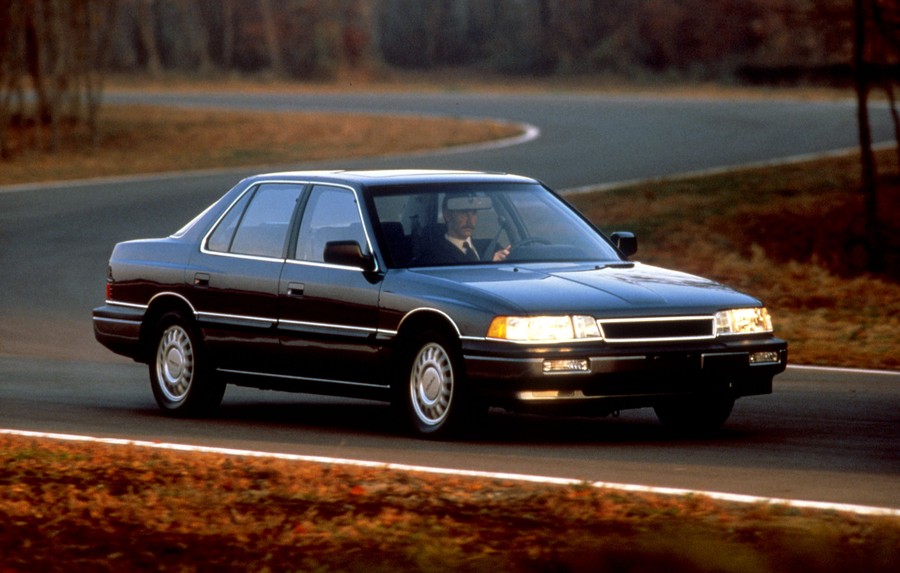
Photo of 1986 Acura Legend
1986 Acura Legend Touring Sedan

The Acura Legend Touring Sedan’s base price was $19,898—about $59,300 in 2025 dollars, which is almost exactly what a 2025 Acura TLX Type S costs. Standard exterior and mechanical equipment included halogen headlamps, tinted glass, a power tilt/slide sunroof, power steering, power-assisted four-wheel disc brakes, and Michelin MXV 205/60R15 radial tires (a size still readily available) on 15-inch light alloy wheels. Inside, reclining front bucket seats, a power driver’s seat, air conditioning, power folding mirrors, remote locking/keyless entry, an information system that could monitor maintenance intervals, fluid levels, and fuel economy, and a driver’s side air bag were also included. Audio was provided with an AM/FM multiplex, electronically tuned cassette radio with a 7-band programmable graphic equalizer, four speakers, dual-diversity antennas, and remote controls. The Legend was well-equipped—the only factory option available was a four-speed automatic transmission.

The View From 2025

I don’t see a lot of Legends come up for sale in either the Hemmings Motor News classifieds or on eBay Motors, but you do see a reasonable amount on Bring a Trailer. First-generation Legends have a small but avid following (with decent online support), and I find that they stand out when I see them.

Make mine Blade Silver Metallic, please.

I have also written about the related 1987 Sterling 825 sedan.

Last updated September 2025.

Sav

1986 Chevrolet Cavalier Z24 coupe

“Camaro Z28 Is Its Big Brother”

Chevrolet’s Cavalier Z24 was announced for the 1985 model year but didn’t actually become available until the 1986 model year. The most important feature of the Z24 was definitely the engine—GM’s corporate LB6 120 bhp 2.8 liter/171 ci V6 with multi-port fuel injection. Paired with the standard four-speed manual transmission, 0-60 came in about 8.5 seconds in the 2,450-pound car—decent for a sporty compact car in 1986 (the 102 bhp Volkswagen GTI hatchback of the same year was about as fast).

Mileage was 19 city/26 highway by the day’s standards (19/24 by today’s measures). The Z24‘s range was 265 to 275 miles with a 10% fuel reserve—like all Cavaliers, the fuel tank was 13.6 gallons.

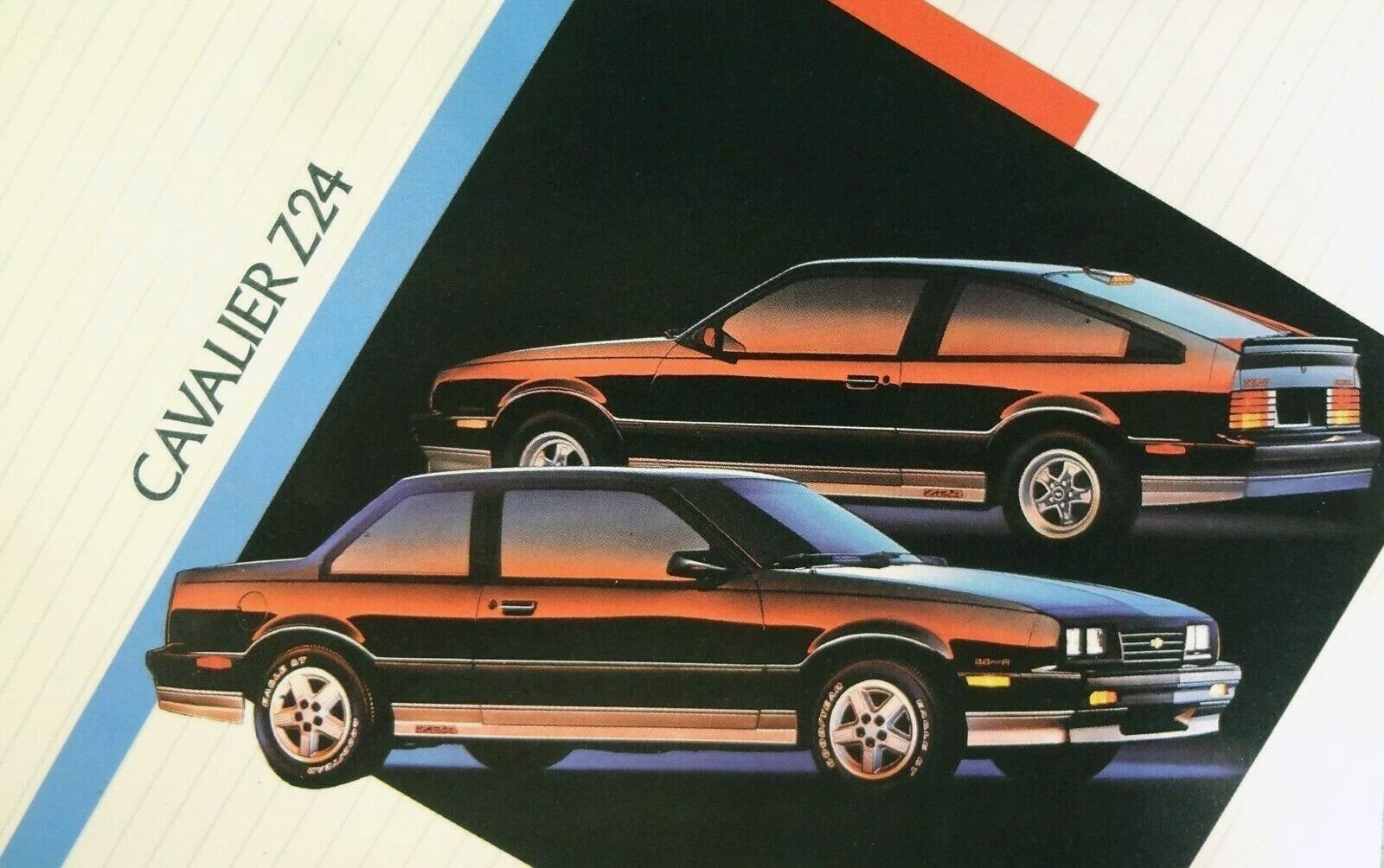
1986 Chevrolet Cavalier Z24 dealer postcard

Standard equipment on the $8,878 Z24 (about $24,500 in today’s dollars) included the aforementioned engine and transmission, a ground effects package, black grille, dual black sport mirrors, the F41 sports suspension, and P215/60R-14 Goodyear Eagle GT radial tires (a size still available thanks to Riken and BFGoodrich) mounted on 14 x 6 inch Rally wheels. Inside, all Z24 buyers received digital instrumentation fed from “a 16K computer,” including a tachometer and trip odometer, along with a rear window defroster, and an AM pushbutton radio with dual front speakers.

All Cavaliers included front wheel drive, a MacPherson strut front suspension, rack and pinion steering, and front disc/rear drum brakes. Inside, reclining front bucket seats, a full floor console, side window defoggers, and a day/night rearview mirror were standard.

Options & Production Numbers

Available options included 14-inch aluminum wheels ($173), tinted glass ($99), air conditioning ($645), cruise control with resume ($175), power door locks ($130), power windows ($195), Comfortilt steering wheel ($115), and an electronic-tuning AM stereo/FM stereo seek/scan radio with cassette player, graphic equalizer, and clock ($494). A comfortably optioned Z24 could easily reach almost $11,000 (about $32,800 in 2025 dollars).

Handsome in a broad-shouldered sort of way, the Z24 coupe sold pretty well for 1986—about 36,000 units. The slightly more expensive hatchback added another 10,000 units: the two models accounted for about 11% of total Cavalier production. Power would increase to 130 bhp in 1987, and a convertible version of the Z24 would come along in 1988. Chevrolet would build the Cavalier Z24 until the end of the 2002 model year.

The View From 2025

A few folks are collecting these cars, but they certainly aren’t common at shows. You do occasionally see Z24s for sale in the Hemming’s Motor News classifieds, on eBay Motors, and on Bring a Trailer, but most of them are the second-generation 1988 and above models.

Make mine Bright Red, please.

Other J platform cars I have covered in this blog include the 1982 Cadillac Cimarron sedan, the 1983 Chevrolet Cavalier CS sedan, the 1984 Buick Skyhawk coupe, the 1984 Pontiac 2000 Sunbird S/E hatchback coupe, the 1985 Oldsmobile Firenza ES sedan, and the 1988 Cadillac Cimarron sedan.

Last updated September 2025.

1986 Mercedes-Benz 560SEC coupe

Only a couple of blocks from my house at the time, I walked by a black 560SEC with a tan interior in really good condition in July 2015—a good enough reason as any to write this post.

“Bold lines which reflect the latest in motoring refinement.”

For 1986, Mercedes-Benz’s big W126 S-Class coupe gained an upgraded 238 bhp M117 5.5 liter/338 ci Bosch K-Jetronic fuel-injected V8 paired with a four-speed automatic transmission. The mid-cycle refresh also differed cosmetically from previous years with the addition of flush-face halogen headlamps and integral headlight wipers.

0-60 came in a sprightly 7.5 seconds in the 3,900-pound car while mileage was a predictably bad 14 city/16 highway by the day’s standards (12/15 by modern measures), which earned the 560SEC a $1,500 gas guzzler tax. With the relatively large 23.8-gallon fuel tank, range was between 290 and 320 miles with a 10% reserve.

Photo of a 560SEC on the streets of Bryn Mawr, PA
A 560SEC on the streets of Bryn Mawr, PA

The 1986 560SEC’s base price, including distribution and transportation, was an eye-watering $64,900—approximately $193,900 in today’s dollars, or about what a 2026 Mercedes-Benz AMG GT 63 coupe goes for. Standard exterior and mechanical equipment included halogen head lamps with washers and wipers, tinted glass, an electric sliding roof with a pop-up feature, four-wheel anti-lock disc brakes, and 215/65VR15 steel belted radial-ply tires on 15-inch “fifteen slot” light alloy wheels. Interior equipment included dual-stage heated front bucket seats, an electrically adjustable steering wheel, a driver’s side airbag, electronic automatic climate control (said to be less effective than you’d expect), cruise control, and a Becker Grand Prix AM/FM stereo radio with a cassette player and an automatic antenna.

Optional equipment included a power rear sun shade, a front passenger air bag, rear headrests ($245), and California emissions.

The View From 2025

There is decent club support for the 560SEC, as there is for almost all Mercedes-Benzes. According to Hagerty’s valuation tools, all the money for a 1986 Mercedes-Benz 560SEC in #1 condition is $117,000, with a more normal #3 condition car going for $24,900. 560SECs frequently show up for sale in the Hemmings Motor News classifieds, on eBay Motors, and on Bring a Trailer. As I update this post in December 2025, there’s a Black 560SEC with a black interior and 184,000 miles listed on Hemmings for $20,000.

Make mine Black Pearl Metallic, please.

Other Mercedes-Benz models I have written about include the 1980 450SL convertible, the 1981 380 SEL sedan, the 1985 380SL convertible, the 1985 300SD coupe, the 1986 560SL convertible, and the 1989 560SL convertible.

Last updated December 2025.