1980 Plymouth Volaré station wagon

“Value where it counts.”

For 1980, Plymouth’s Volaré got a new grille but was otherwise little changed aside from a few new options. 1980 would be the Volaré’s last year—the Reliant would replace it in 1981.

The Volaré’s standard engine continued to be Chrysler’s evergreen 3.7 liter/225 ci Slant Six with a Holley one-barrel carburetor, making 90 bhp and giving a 0-60 time of a little over 16 seconds. Optional power was (of course) the LA 5.2 liter/318 ci V8 with a Carter two-barrel carburetor, making 120 bhp, costing an additional $211, and bringing the 0-60 time down to about 14.5 seconds. A three-speed manual was standard with the six, but a TorqueFlite automatic was required with the V8. Mileage with the three-speed manual and the six was (ooog) 16—with the 18-gallon fuel tank, a Volaré driver could expect a 235 to 260-mile range with a 10% fuel reserve.

Station wagon pages from the 1980 Plymouth Volare brochure
Station wagon pages from the 1980 Plymouth Volaré brochure

Standard exterior and mechanical equipment on the $5,422 Volaré station wagon (about $23,100 in today’s dollars) included power front disc/rear drum brakes, a torsion bar front suspension, and P195/75R14 glass-belted radial-ply tires. Inside, a heater, a defroster, a three-spoke steering wheel, an all-vinyl bench seat, and an AM radio were included.

Options, Packages, & Production Numbers

Exterior and mechanical options included halogen headlamps ($37), a power liftgate ($24), a luggage rack ($91), a rear wiper/washer system ($64), and cast aluminum road wheels ($287). Inside, air conditioning ($543), automatic speed control ($106), an electronic digital clock with a fluorescent display ($55), carpeting in the rear ($69), lockable storage bins ($24), and a range of stereos were available.

A Premier package ($831) added woodtone trim on the body sides, rear gate, instrument panel, and glove box door, along with a hood ornament, deluxe wheel covers, and 60/40 individually adjustable vinyl seats. You could also get (but few did) the $721 Sport Wagon package, which included fender flares, front air dam, tape stripes, black grille highlights, dual sport mirrors, aTuff three-spoke color-keyed steering wheel, and eight-spoke road wheels with trim rings. Finally, the Handling/Performance package ($385) included heavy-duty shocks, Firm-Feel power steering, and FR70x14 Aramid-belted radial tires.

Like almost every Chrysler product in 1980, sales of the Volaré station wagon were not good. At 16,895, they were well less than half of 1979’s total of 44,085. Sales would recover substantially with the release of the Reliant station wagon in 1981.

The View From 2025

Plymouth Volarés and Dodge Aspens were once common on American roads, but have virtually disappeared by now. You do occasionally see them for sale in the Hemming’s Motor News classifieds, on eBay Motors, and on Bring a Trailer, but there are no Volaré station wagons out there as I updated this blog entry in April 2025.

Make mine Light Cashmere, please, with the Premier package. Beige seems somehow correct.

Other Plymouths I have written about include the 1980 Horizon hatchback sedan, the 1981 Reliant coupe, and the 1984 Voyager minivan.

Last updated April 2025.

1980 Lincoln Continental Mark VI coupe

“A car befitting its illustrious heritage”

For 1980, Lincoln completely revised the Continental Mark series, downsizing it for the first time and adding a sedan. The coupe was over 14 inches shorter than the 1979 Mark V and about 750 pounds lighter. However, the Mark VI was still a big car by any standard—more than two feet longer than a 2025 Mercedes-Benz CLE coupe.

Standard power for 1980 was a Windsor 129 bhp 4.9 liter/302 ci V8 with throttle-body fuel injection paired with a four-speed automatic overdrive transmission. Buyers could specify a $160 upgrade, which was the Windsor (not Cleveland) 140 bhp 5.8 liter/351 ci V8 with a Motorcraft 7200 VV two-barrel carburetor. With the standard powertrain, 0-60 took about 14 seconds in the 3,892-pound car. Mileage was 17 city/24 highway by the day’s standards—with the 18-gallon gas tank, Mark VI owners could expect a range of 300 to 330 miles with a 10% fuel reserve.

Standard exterior and mechanical equipment on the $16,291 base Mark VI ($70,200 in today’s dollars or a little over what a 2025 Lincoln Aviator Reserve mid-size SUV costs) included hidden halogen headlamps, luxury wheel covers, and Michelin P205/75R15 white sidewall steel-belted radial tires (a size still readily available) on 15-inch wheels. Inside, cloth Twin Comfort lounge seats, power windows, an electronic instrument panel with message center, a four-spoke color-keyed steering wheel, automatic temperature control air conditioning, and an AM/FM stereo radio with power antenna were all standard.

Packages, Options, & Production Numbers

As had been true for many years, there were multiple Designer Series packages available for the Mark VI:

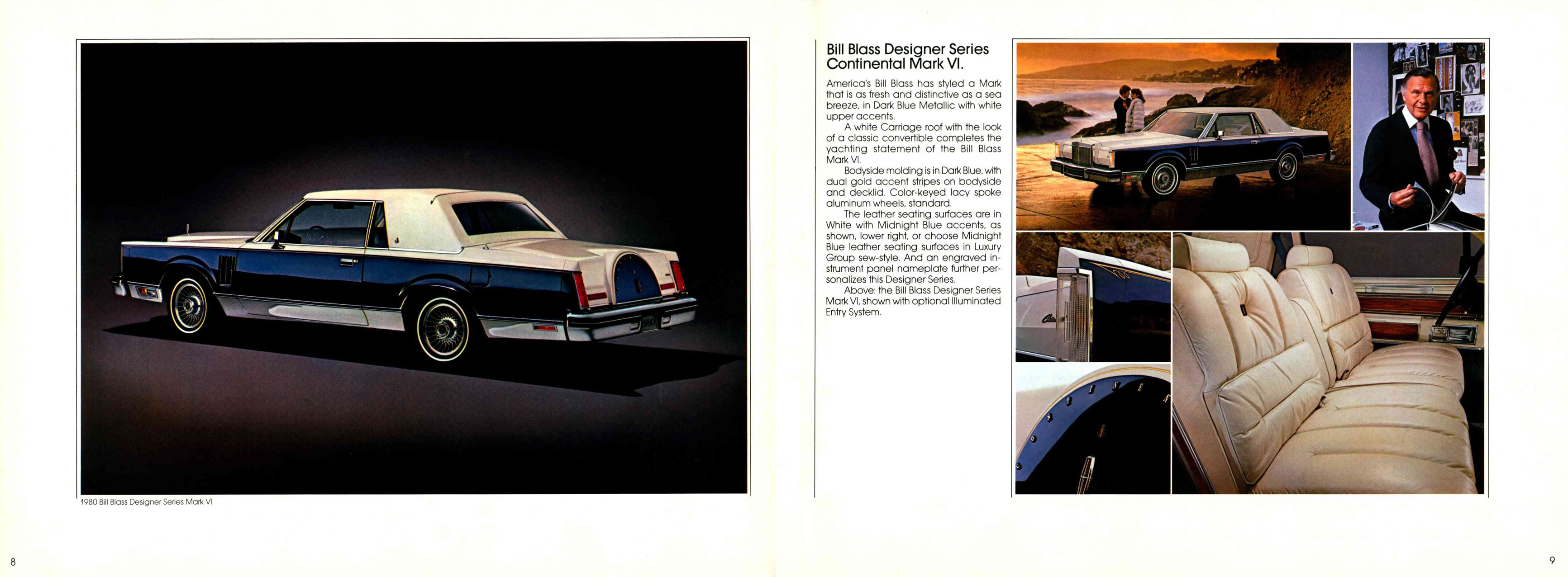
Bill Blass pages from the 1980 Lincoln Continental Mark VI brochure
  • The Bill Blass Designer Series package ($1,825) included Dark Blue Metallic paint with white upper accents, a white Carriage roof, dark blue bodyside moldings, dual gold accent stripes on bodyside and decklid, and color-keyed lacy spoke aluminum wheels. Inside, leather seating surfaces were a choice of white with blue accents or midnight blue in the Luxury Group sew-style.
  • The Cartier Designer Series package ($2,191) included Light Pewter Metallic/Medium Pewter Metallic two-tone paint, a Medium Pewter Landau roof, color-keyed turbine spoke aluminum wheels, light pewter bodyside moldings, single dark red accent stripes on the body and decklid, the Cartier signature in the opera windows, and the Cartier monogram on logo on the front fender louvers and the decklid. Inside, there was a choice of either cloth or leather seating surfaces in the Luxury Group sew-style.
  • The Givenchy Designer Series package ($1,739) included Light Fawn Metallic/Bittersweet Metallic two-tone paint, with tri-band pinstriping, a Light Fawn full vinyl roof, wire wheel covers, and the Givenchy monogram on the hood and the rear decklid. Inside, the Givenchy had bittersweet six-way power Twin Comfort seats in the Luxury Group sew-style.
  • The Pucci Designer Series package ($2,191) included Light Fawn Metallic/Medium Fawn Metallic two-tone paint, with tri-band pinstriping, a Light Fawn Landau roof, color-keyed lacy spoke aluminum wheels, and the Pucci logo on the front fender louvers and the decklid. Inside, leather seating surfaces had light champagne bolsters with medium champagne inserts in the Luxury Group sew-style.

—all four Designers Series packages included a personalized engraved nameplate on the instrument panel.

There was also the Signature Series ($5,485), which added just about every major option and brought the price to $21,776 (about $93,800 in 2025 dollars). Standard exterior and mechanical features on the Signature Series included a Valino grain vinyl Landau roof and color-keyed turbine spoke cast aluminum wheels. Inside, the Signature Series included Twin Comfort Lounge six-way power seats, the Keyless Entry System, an Automatic Garage Door Opener Control, Speed Control, a tilt steering wheel, the defroster group, illuminated visor vanity mirrors, and a six-speaker Premium Sound System. The Signature Series was available in Silver Metallic or Dark Maroon and could be ordered with Dark Red Signature Body Cloth or leather seating surfaces.

Individual options included touring lamps ($67), a power glass moonroof, wide white sidewall tires, Twin Comfort Lounge six-way power seats ($171), a tilt steering wheel ($83), and Speed Control ($149).

Like the Ford Thunderbird of the same year, the 1980 Continental Mark VI did not sell. Sales of the coupe dropped to 27% of the 1979 number—even if you added the newly available sedan, they were still down 49%; not a good look for a brand-new model. To make the news worse, the virtually unchanged Cadillac Eldorado (which had been downsized in 1979) more than doubled the Mark VI coupe’s sales. The agony would continue for several years, only changing with the release of the aerodynamic and significantly smaller Mark VII in 1984.

The View From 2025

According to Hagerty’s valuation tools, a 1980 Continental Mark VI coupe in #1/Concours condition is $23,000, with a far more typical #3/Good car going for $6,300. Values slide up with the various Designer Series packages and the Signature Series, but only by about 5% to 10%. This generation of Marks maintains some presence in the Hemmings Motor News classifieds, on eBay Motors, and on Bring a Trailer. As I update this blog entry in October 2025, there’s a French Vanilla Metallic 1982 coupe with a black vinyl roof, midnight blue leather seats, and 11,000 miles for sale on Hemmings, asking $11,000.

Make mine Dark Maroon, please.

Other Lincolns I have written about include the 1984 Continental Mark VII LSC coupe, the 1986 Mark VII coupe, the 1987 Continental sedan, and the 1989 Town Car sedan.

Last updated October 2025.

1980 MG MGB convertible

Writing a blog entry on cars from 1980 that Hagerty considers to be collectible reminded me that I should probably do an entry on the last of the MGBs.

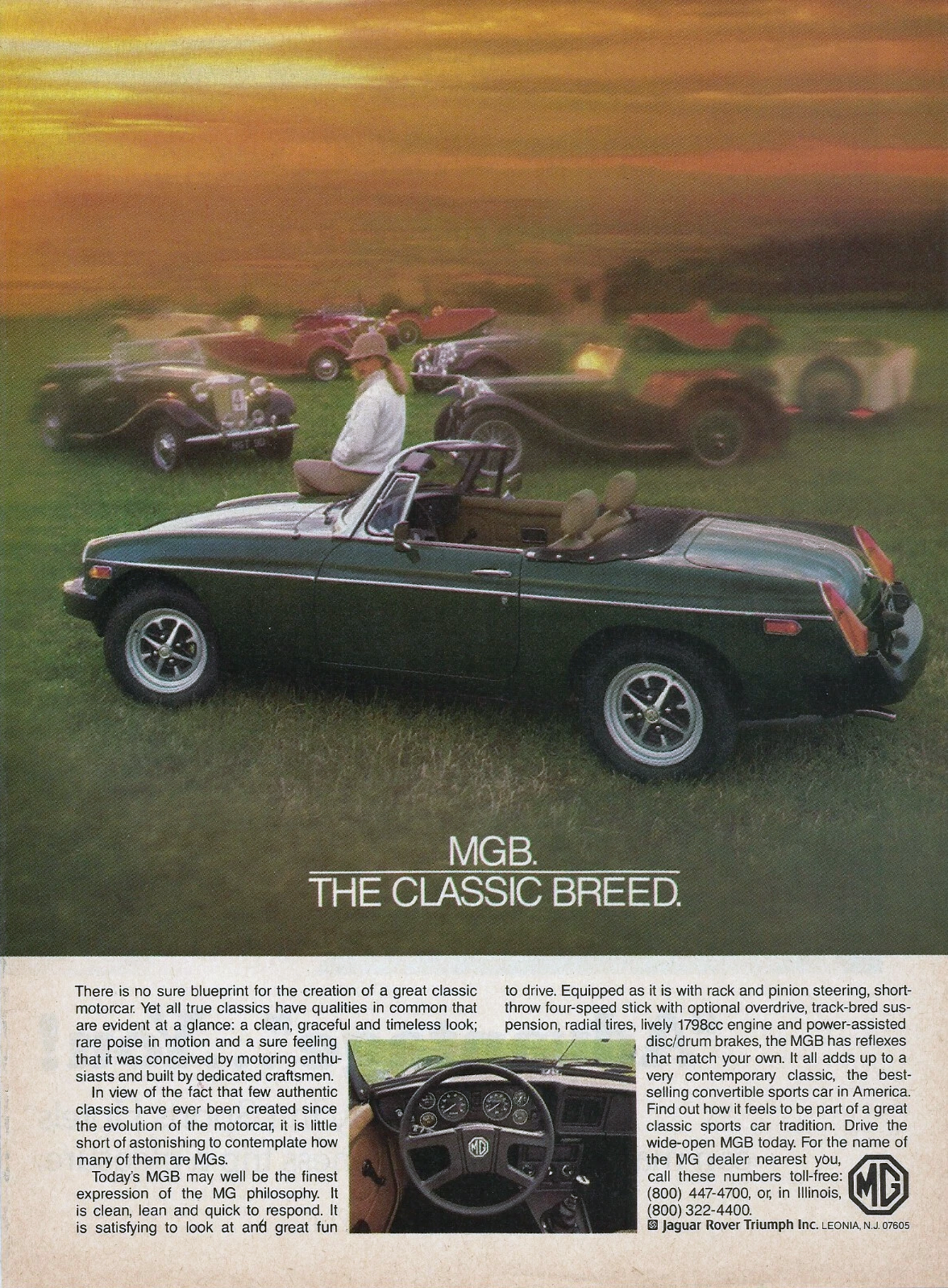
“The Classic Breed”

1980 was the final year for MG’s MGB convertible, which had been in production since 1962.

Changes for 1980 were minimal. The standard and only powertrain remained the 62.5 bhp (not 62 or 63!) 1.8 liter/110 ci inline four with a Zenith-Stromberg 175 CD carburetor paired with a four-speed manual transmission. 0-60 mph came in a leisurely 16 seconds in the 2,400-pound car. Fuel mileage was decent by the day’s standards: rated at 16 city/30 highway. With a 13-gallon gas tank, an MGB driver could expect a range of about 245 to 265 miles with a 10% fuel reserve.

1980 MG MGB print advertisement

Standard exterior and mechanical equipment on the $7,950 MGB (about $33,800 in today’s dollars) included a tonneau cover, a laminated safety glass windshield, rack and pinion steering, power front disc/rear drum brakes, and 165/80-14 radial ply tires (a size still available thanks to Vredestein) on 14-inch Rostyle wheels. Inside, vinyl bucket seats with adjustable head restraints, a center console with a cigarette lighter and heater controls, a lockable glovebox, a map pocket, an electric tachometer, a trip odometer, a map light, and a clock were standard.

Options & One Limited Edition

Optional equipment included an electrically-operated overdrive for the transmission, a luggage rack, “traditional” wire wheels, air conditioning ($653), and various radios with either 8-track or cassette players included.

The Limited Edition that had debuted in 1979 remained available and popular, with 6,668 produced over the two years. In addition to black paint, the Limited Edition included silver body stripes, 5-spoke alloy wheels, an air dam, boot and tonneau covers, chrome luggage rack, a leather padded 3-spoke steering wheel, a Limited Edition dash plaque, and Limited Edition thresholds. All of this cost $600.

The View From 2025

Like all MGs, MGBs have a following and frequently appear in the Hemming’s Motor News classifieds, on eBay Motors, and on Bring a Trailer. According to Hagerty’s valuation tools, a 1980 MGB in #1/Concours condition is $21,500, with a far more typical #3/Good car going for $6,100. A Limited Edition goes for about $1,500 more. As I update this blog entry in September 2025, there is a 1980 MGB Limited Edition with a black interior and 55,000 miles for sale on Hemmings, asking $24,900.

Make mine Brooklands Green, please.

Other sports cars from 1980 I have written about include the Chevrolet Corvette coupe, the Datsun 280-ZX hatchback coupe, the Mercedes-Benz 450SL convertible, the Porsche 911 SC coupe, and the Porsche 924 hatchback coupe.

Last updated September 2025.

1980: What Cars Are Collectible?

The question always arises: what cars are considered collectable? One way is to look at what Hagerty tracks with their valuation tools. For 1980 cars, the full list is below—I have added a few comments.

question mark graphic

Alfa Romeo; Spyder convertible

Alpine; A310 coupe

American Motors; AMX hatchback coupe (in its final year), Pacer hatchback coupe and station wagon, but no Eagle

Aston Martin; Lagonda sedan, V8 coupe and convertible

Avanti; Avanti II coupe

Bentley; Corniche convertible, T2 sedan

BMW; 320i coupe, 633CSi coupe, 733i sedan, M1 coupe

Bristol; 412 convertible

Buick; Regal coupe, Riviera coupe

Cadillac; DeVille coupe and sedan, Eldorado coupe, Fleetwood coupe and sedan, Seville sedan

Checker; Marathon sedan

Chevrolet; C10/K10 pickup truck, C10/K10 Blazer SUV, C10/K10 Suburban SUV, C20/K20 pickup truck, C20/K20 Suburban SUV, Camaro coupe, Corvette coupe, El Camino pickup truck

Clenet; SII convertible

Datsun; 280ZX hatchback coupe

DeTomaso; Deauville sedan (a car I’d never heard of before)

Dodge; D150/W150 pickup truck, D200/W200 pickup truck, D300 pickup truck, Ramcharger SUV

Excalibur; Series IV convertible

Ferrari; 308 GTBi/GTSi coupe, 400i coupe, 512 BB coupe, Mondial coupe

Fiat; 2000 convertible, X1/9 coupe

Ford; Bronco SUV, F-100 pickup truck, F-150 pickup truck, F-250 pickup truck, F-350 pickup truck, Mustang coupe and hatchback coupe, Thunderbird coupe

GMC; C1500/K1500 pickup truck, C2500/K2500 pickup truck, C3500/K3500 pickup truck, Caballero pickup truck

International; Scout II SUV

Jaguar; XJ-6 sedan, XJ-S coupe

Jeep; Cherokee SUV, CJ-5 SUV, CJ-7 SUV, Wagoneer SUV

Lamborghini; Countach coupe

Lancia; Beta coupe, convertible, sedan, and station wagon, Gamma coupe and sedan, Scorpion coupe

Lincoln; Continental coupe and sedan, Continental Mark VI coupe and sedan, Versailles sedan

Lotus; Eclat coupe, Elite hatchback coupe, Esprit coupe

Maserati; Kyalami coupe, Merak coupe, Quattroporte III sedan (I am reminded that I have yet to discuss any eighties Maserati in this blog)

Matra; Bagheera coupe, Murena coupe

Mazda; RX-7 hatchback coupe

Mercedes-Benz; 240D sedan, 280CE coupe, 280E sedan, 280SE sedan, 300CD coupe, 300D sedan, 300SD sedan, 300TD station wagon, 450SEL sedan, 450SL convertible, 450SLC coupe

MG; MGB convertible

Morgan; 4/4 convertible, Plus 8 convertible

Oldsmobile; Toronado coupe

Panther; DeVille convertible and sedan, J72 convertible, Lima convertible

Peugeot; 504 convertible

Plymouth; Trail Duster SUV

Pontiac; Firebird coupe but no Grand Am (Hagerty only tracks them up to 1975)

Porsche; 911 coupe, 924 hatchback coupe, 928 hatchback coupe

Puma; GT coupe, GTC coupe and convertible, GTS convertible

Replicar; sedan and convertible

Rolls-Royce; Camargue coupe, Corniche I coupe and convertible, Phantom VI sedan, Silver Shadow II sedan, Silver Wraith II sedan

Stutz; Bearcat convertible, Blackhawk coupe, Duplex/Iv-Porte/Victoria sedan, Royale sedan

Subaru; BRAT pickup truck

Toyota; Celica hatchback coupe, Land Cruiser SUV

Triumph; TR7 coupe and convertible, TR8 coupe and convertible

Volvo; 242 coupe, 242GT coupe, 244 sedan, 245 station wagon, 262C coupe, 264 sedan, 265 station wagon

Hagerty casts a wide net (AMX!). Coupes are dominant—33% of 156 models listed with an additional 6% being hatchback coupes. Unsurprisingly, the rarest body style is a station wagon, at 3%.

1980 Ford Thunderbird coupe

“New Thunderbird elegance in a new size …”

To me, the 1980 Ford Thunderbird was one of those “why?” cars, though the competitive drivers were obvious. The third Ford based on the “Fox” platform (the Fairmont and the Mustang had come first), the eighth-generation ‘bird was one of the most radically downsized automobiles in the North American auto industry. In comparison to its 1979 predecessor, the base 1980 Thunderbird was 17 inches shorter and 900 pounds lighter.

Standard power for 1980 was a Windsor 118 bhp 4.2 liter/255 ci V8 with a Motorcraft two-barrel carburetor paired with a SelectShift three-speed automatic transmission. Powertrain upgrades were available: buyers could specify a $150 131 bhp 4.9 liter/302 ci V8 with a two-barrel carburetor and could then add a $133 automatic overdrive transmission (with that engine only).

With the standard powertrain, 0-60 mph took about 15 seconds in the 3,100-pound car—the best powertrain combination dropped that time to a far more respectable 11.1 seconds. Mileage was 18 city/26 highway by the day’s standards—with a 17.5-gallon gas tank, a Thunderbird owner could expect a range of 285 to 310 miles with a 10% fuel reserve.

Standard exterior and mechanical equipment on the $6,816 base Thunderbird (about $29,400 in today’s dollars) included variable ratio power rack-and-pinion steering, power front disc/rear drum brakes, a Thunderbird hood ornament with color-coordinated insert, full wheel covers, and P185/75R14 black sidewall tires on 14-inch wheels. Inside, a tweed cloth-and-vinyl Flight Bench seat, a day/night inside mirror, an electric clock, and an AM radio were all standard.

Packages, Options, & Production Numbers

Moving up to the $10,424 Town Landau (approximately $44,900 now) added a lot of equipment, including dual remote control mirrors, interval windshield wipers, and TR-type wide oval low-profile white sidewall radial tires on cast aluminum wheels. Inside, a velour cloth split front bench seat, six-way power driver’s seat, SelectAire air conditioning, power windows, power lock group, tilt steering wheel, and an electronic AM/FM stereo radio were included.

The top-of-the-line Silver Anniversary edition ($12,172 then, $52,400 now) added the 4.9 liter engine, the automatic overdrive transmission, Keyless Entry System, and a power antenna. Inside, Silver Anniversary buyers got a patterned luxury cloth split front bench seat, a leather-wrapped steering wheel, Fingertip Speed Control, and—of course—all kinds of Silver Anniversary badging.

Options included a power-operated moonroof ($219), an electronic information cluster ($275-$313), and leather upholstery ($349).

To say the market was not ready for the 1980 Thunderbird is a distinct understatement. Despite a much better level of standard equipment, the Thunderbird was only five inches longer than the plebian Fairmont. Sales of Ford’s halo model collapsed: dropping from 284,141 in 1979 to 156,803 in 1980, and losing almost a full percentage point of sales during a year when none of the main General Motors competitors in the personal luxury coupe market had more than a facelift.

It would get worse in the following two years: 86,693 in 1981 and 45,142 in 1982. By 1982, the Thunderbird was being handily outsold by all four of the mid-size GM coupes: Buick Regal, Chevrolet Monte Carlo, Oldsmobile Cutlass, and Pontiac Grand Prix. It would take the next Thunderbird design in 1983 to redress this balance.

The View From 2025

According to Hagerty’s valuation tools, a 1980 Thunderbird Silver Anniversary in #1/Concours condition is $25,500, with a far more typical #3/Good “normal” Thunderbird going for $8,800. This generation of Thunderbirds maintains some presence in the Hemming’s Motor News classifieds, on eBay Motors, and on Bring a Trailer. As I write this blog entry in October 2025, there’s a Silver Metallic 1980 with gray cloth seats and the 255 ci V8 on Hemmings, showing 73,000 miles and asking $11,500.

Make mine Midnight Blue Metallic, please—that’s one of the six Silver Anniversary edition colors.

Other eighties Thunderbirds I have written about include the 1982 coupe, the 1983 Turbo Coupe, and the 1987 standard coupe.

Last updated October 2025.

1980 Plymouth Horizon hatchback sedan

The October 2017 issue of Hemmings Classic Car included an article on an “Unbelievable Restoration of a 1979 Plymouth Horizon,” which certainly falls into my “Who Saves These Cars?” category. In honor of this, I updated a blog entry on the 1980 Horizon.

“Handling it with confidence.”

1980 was the third model year for Chrysler’s “Omnirizon” front-wheel drive subcompact. Once again, the only available engine was a Volkswagen-sourced 1.7 liter/105 ci four-cylinder with a Holley two-barrel carburetor and all of 65 bhp. With the standard four-speed manual transmission, 0-60 came in about 14.5 seconds in the 2,135-pound car. Fuel economy was rated at 24 city/31 highway by the day’s standards, so the 13-gallon gas tank gave a range of 265 to 285 miles with a 10% fuel reserve.

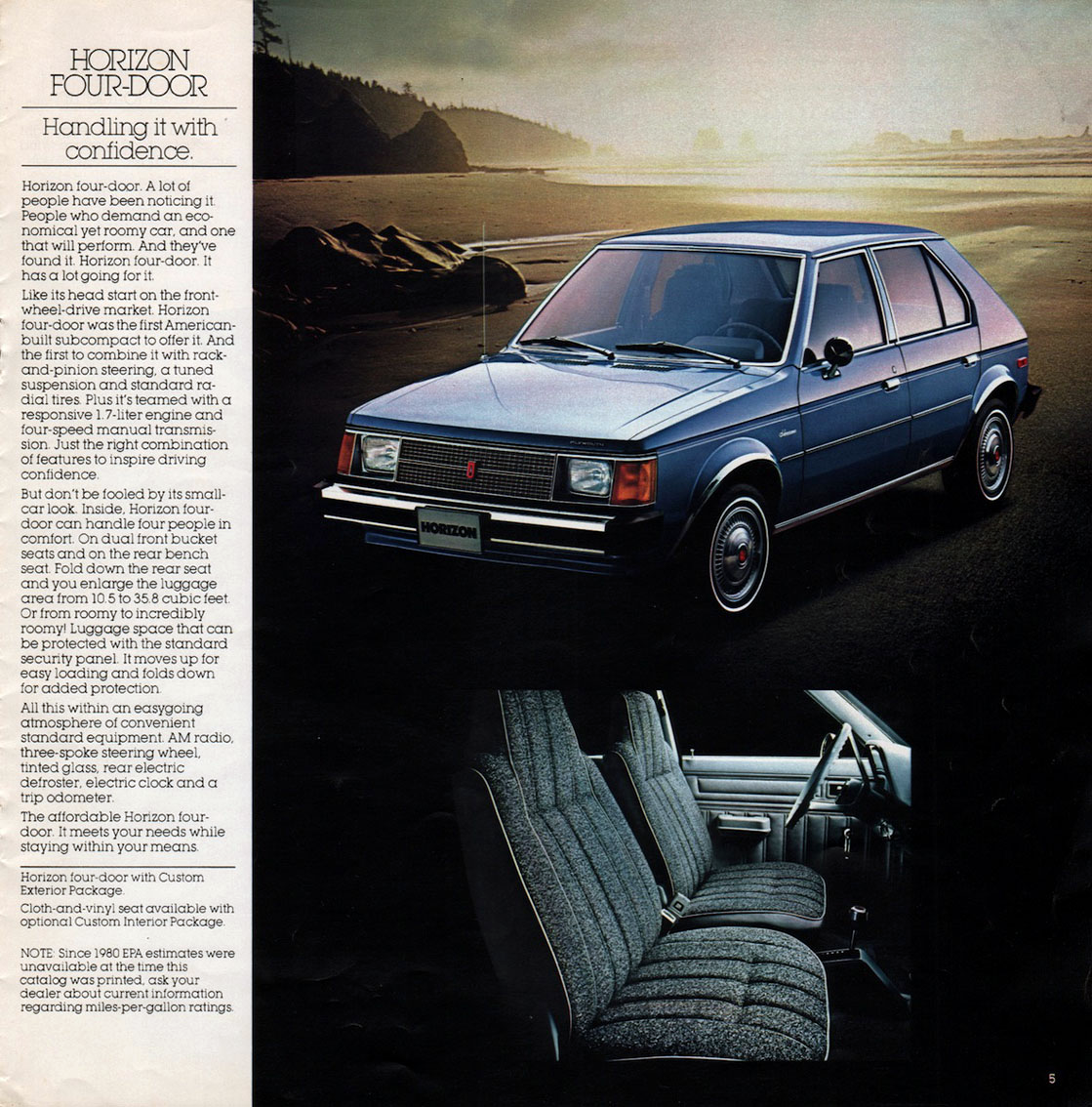
Four-door page from the 1980 Plymouth Horizon brochure

Standard exterior and mechanical equipment on the $5,526 car (about $23,900 in today’s dollars) included rack and pinion steering, front disc/rear drum brakes, a rear electric defroster, tinted glass, and P155/80R13 glass-belted radial tires (a size still available from Kumho) on 13-inch wheels. Standard interior equipment included a heater, an AM radio, and an electric clock.

A variety of exterior and interior packages were available to dress up the rather spare base Horizon. The Custom exterior package ($101) added some bright moldings to the outside of the car. Moving up to the Premium exterior ($207) added some more bright moldings and deluxe wheel covers. The Premium Woodgrain exterior added (natch!) woodgrain appliques on the body sides and lower liftgate pane. The Custom ($112) interior added a glove box lock, a cigarette lighter, custom door panels, and custom vinyl seats. The top-of-the-line Premium ($355) interior added a color-keyed console, a “luxury” three-spoke steering wheel, premium door panels, and a reclining passenger-side seatback.

Options & Production Numbers

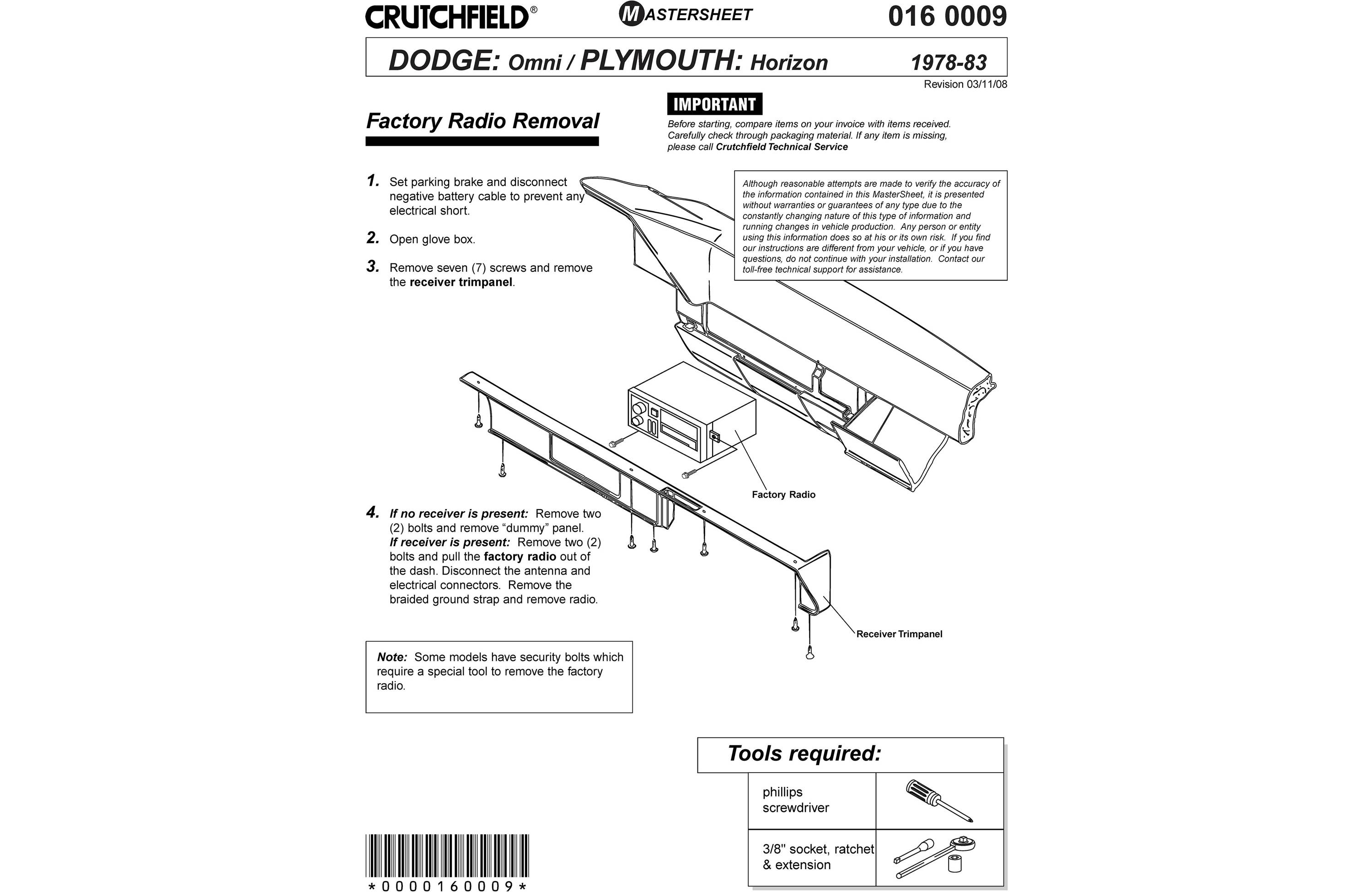
Exterior and mechanical options included a removable flip-up glass sun roof ($182), power steering ($161), power front brakes ($77), and a three-speed TorqueFlite automatic transmission ($340) which further slowed the Horizon’s acceleration. Inside, air conditioning ($541), a sport steering wheel ($40), and an AM/FM stereo radio ($93) were available—there were no eight-tracks or cassettes available as factory stereos (it was left to Crutchfield and others to provide those upgrades—and they still do).

The Horizon continued to sell reasonably well in the 1980 model year, with almost 86,000 units sold. The slightly sportier two-door TC3 hatchback added another 60,000 or so units. Combined, the two models accounted for 58% of Plymouth’s dire 1980 automobile sales totals in the United States (Plymouth’s other offerings for that year included the Arrow, Champ, Gran Fury, Sapparo, and Volaré).

The View From 2025

1000 views badge

A few folks are trying to save “Omnirizons”—including that fellow featured in Hemmings Classic Car (journalist Robert Suhr)—but you rarely see these cars for sale in the Hemming’s Motor News classifieds, on eBay Motors, or on Bring a Trailer. The exception, of course, is the later and much faster Dodge Omni GLH.

Make mine Crimson Red Metallic, please.

Other Plymouths I have written about include the 1980 Volaré station wagon, the 1981 Reliant coupe, and the 1984 Voyager minivan. I have also written about Chrysler’s transition to front-wheel-drive.

Last updated October 2025.

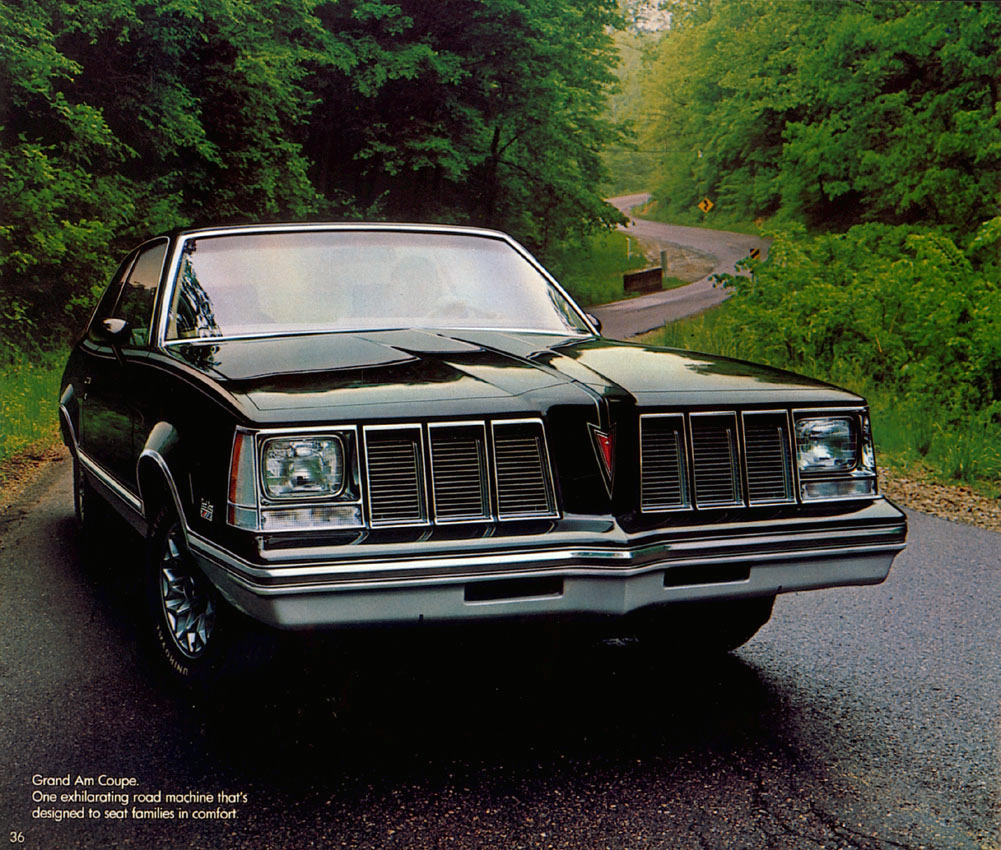
1980 Pontiac Grand Am coupe

“One exhilarating road machine”

The last of the rear-wheel-drive Grand Ams came in 1980. Unlike in 1978 and 1979, the sedan was no longer available—only the coupe remained.

The standard engine in non-California cars was the L37 155 bhp 4.9 liter/301 ci V8 with four-barrel Rochester carburetor and electronic spark control (California cars got the Chevrolet-sourced LG4 150 bhp 5.0 liter/305 ci V8). The only transmission available was a three-speed Turbo-Hydramatic TH200 automatic transmission. Performance was respectable for 1980—Car and Driver recorded a zero to sixty time of 11 seconds. Mileage was 17 city/25 highway by the day’s standards. With an 18.1-gallon gas tank, range was 280 to 305 miles with a 10% fuel reserve.

New features for 1980 included a revised soft-fascia front end with three sections per side, an Ontario Gray lower accent color for the exterior, a silver upper body accent stripe, larger wraparound black-out tail lamps, and larger front and rear stabilizer bars for the optional ($45) Rally RTS handling package.

Grand Am page from the 1980 Pontiac brochure

The Grand Am’s base price was $7,299—about $31,400 in 2025 dollars. Standard exterior and mechanical equipment included dual sport mirrors, dual horns, power steering, power front disc/rear drum brakes, and 205/75R14 black sidewall radial tires (a size still readily available) on 14-inch Rally IV cast aluminum wheels. Inside, Grand Am purchasers could expect cut-pile carpeting, Custom vinyl front bucket seats with center floor console, rally gages with a clock embedded in a brushed aluminum instrument panel, and a Custom sport steering wheel.

Options, Period Reviews, & Production Numbers

Available exterior and mechanical options included a power sunroof—either metal ($561) or glass ($773), dual remote sport mirrors ($73), Soft-Ray tinted glass ($107), and electric rear window defroster ($107). Inside, air conditioning ($601), power door locks ($93), power windows ($143), a six-way power driver’s seat ($175), a tilt steering wheel ($81), automatic cruise control ($112), and an AM/FM stereo radio with a stereo cassette player ($272) were all available. A nicely configured Grand Am could easily push past $9,700—real money in 1980 and about $41,800 in today’s dollars.

Period reviews settled into the “we’re glad they make it, but we’re not sure we’d buy it” category. Car and Driver called the 1980 Grand Am “a noble experiment” and praised its handling.

Grand Ams didn’t sell at all well in 1980—Pontiac moved only 1,647 of them, after selling almost five times as many coupes only two years prior in 1978. Despite this, Pontiac would not give up on the Grand Am name—it would be back in 1985 as a small front-wheel-drive coupe.

The View From 2025

1000 views badge

Most of the Grand Ams being collected are the larger and more powerful first-generation Colonnade versions sold from 1972 to 1975. You do occasionally see second-generation Grand Ams for sale in the Hemming’s Motor News classifieds and on eBay Motors. Bring a Trailer’s only second-generation Grand Am sale so far was a very rare 1979 Grand Am coupe with a four-speed manual in 2024. I haven’t seen a Grand Am from this generation for many years.

Make mine Starlight Black, please.

Other G-bodies covered in this blog include the 1980 Grand Prix SJ coupe, the 1981 Chevrolet Monte Carlo Sport Coupe, the 1981 Oldsmobile Cutlass Supreme coupe, the 1983 Chevrolet Malibu sedan, the 1983 Chevrolet Monte Carlo SS Sport Coupe, the 1984 Buick Regal Grand National coupe, the 1987 Buick GNX coupe, and the 1987 Pontiac Grand Prix coupe. Another 1980 Pontiac I have written about is the Sunbird Sport Hatch.

Last updated October 2025.

Save

Save

1980 Chevrolet Corvette coupe

“How many other cars can you name at a single glance?”

For the 1980 model year, Chevrolet stylists substantially redesigned the Corvette’s long-running “shark” body style for the third time since its debut in the 1968 model year. The front and rear bumper caps were modified with integrated spoilers that decreased the drag coefficient by 14% to 0.443. Chevrolet engineers also managed to remove 167 pounds of curb weight from the Corvette by reducing the thickness of body panels and using aluminum for more parts. For the first time, air conditioning was standard—it had been an option since 1963. Power windows were also newly standard equipment.

There were two engine options for all states but California, both 5.7 liter/350 ci small blocks with four-barrel carburetors: the standard 190 bhp L48 and the optional ($595) 230 bhp L82. The four-speed manual transmission was only available with the L48—the L82 and the California-only 180 bhp 5.0 liter/305 ci LG4 could only be combined with the three-speed automatic transmission. With the relatively rare (about 12% of production) L82 and automatic transmission combination, Car and Driver recorded a 0-60 time of 7.6 seconds and a top speed of 123 mph.

Fuel economy was 14 city/20 highway by the day’s standards with either 350 ci and either transmission. With a 24.1-gallon gas tank, a Corvette’s proud new owner could expect a range of 300 to 330 miles.

1980 Chevrolet Corvette brochure cover
Cover of the 1980 Chevrolet Corvette brochure

The Corvette’s base was $13,140.24 at the beginning of the model year—about $56,400 in 2025 dollars, which is about 20% less than a 2025 Corvette Stingray coupe costs. Corvette buyers got removable roof panels, power-operated retractable headlights, a Delco Freedom battery, four-wheel power disc brakes, power steering, dual remote-control sport mirrors, a choice of transmissions, and P225/70R15 steel-belted radial-ply tires (a size still readily available) on 15-inch wheels. Inside, air conditioning, power windows, a tilt-telescopic steering column, an electric clock, an AM/FM radio, cut-pile carpeting, and a choice of either cloth/vinyl or leather/vinyl bucket seats were all standard.

Options, Production Numbers, & Reviews

Exterior and mechanical options included aluminum wheels ($407), P255/60R15 tires ($426), and a power antenna ($56). Inside, buyers could add power door locks ($140), cruise control ($123), rear window defogger ($109), and dual rear speakers ($52). 1980 would be the last year that the AM/FM stereo radio with 8-track player ($155) would be more popular than the AM/FM stereo radio with cassette player ($173).

The redesign probably kept Corvette sales from dropping as much as they otherwise would have, but they were still off more than 13,000 units from 1979 as the shark aged. The tagline for Car and Driver‘s review of the 1980 Corvette was “America’s only sports car, but that doesn’t excuse everything.”

The View From 2025

There is strong club support for the 1980 Corvette, as there is for all Corvettes. According to Hagerty’s valuation tools, a loaded 1980 Corvette with the L82 engine in #1/Concours condition is $38,100, with a more normal L48-engined car in number #3/Good condition going for $14,900.

1980 Corvettes often appear in the Hemming’s Motor News classifieds (Hemmings currently has twenty for sale), on eBay Motors, and on Bring a Trailer. They are also frequently seen at in-person auctions such as Barrett-Jackson and Mecum. As I update this post in August 2025, a Dark Claret Metallic one with the L82, oyster leather seats, and 28,000 miles is available on Hemmings, asking $19,000.

Make mine White with red leather seats, please—the “heritage” colors.

Other third-generation Corvettes I have written about include the 1981 coupe and the 1982 coupe. 1980 Chevrolet models include the Camaro Rally Sport coupe, the Camaro Z28 coupe, the Citation hatchback sedan, and the Monza Sport 2+2 hatchback coupe.

Last updated August 2025.

1980 Datsun 280-ZX hatchback coupe

Yutaka Katayama passed on February 19th, 2015, after a long and full life—he was 105. “Mr. K” was the person most responsible for bringing the Z car to market. It is beyond the purview of this blog to head back to the original and groundbreaking 240Z, but we can take a look at the second-generation 280-ZX.

“It’s Black. It’s Gold. And it is awesome.”

For 1980, the 280-ZX received a ‘T’ bar roof and a new digital clock for the GL version, but Datsun otherwise mostly stood pat for the standard car. There were five new colors available.

Power continued to be provided by the L28E 135 bhp 2.8 liter/168 ci V6 with multi-port fuel injection. Car and Driver recorded a 0-60 time of 9.4 seconds in the 2,970-pound coupe—reasonably competitive in 1980. The top speed was about 117 mph.

With the standard five-speed manual transmission, EPA fuel economy ratings were 21 city/31 highway by 1980 standards. Moving to the three-speed automatic transmission significantly impacted mileage—ratings on the sticker were 19/26. With a 21.2-gallon gas tank, an owner of a manual-equipped 280ZX could expect an impressive range of 405 to 445 miles with a 10% fuel reserve.

Standard exterior and mechanical equipment on the $9,899 280-ZX Deluxe (about $41,800 in 2025 dollars or about what a current Nissan Z Sport starts at) included tinted glass, a power antenna, a four-wheel independent suspension, four-wheel power disc brakes, rack-and-pinion steering, and P195/75HR14 tires (a size still readily available) on 14-inch steel disc wheels. Inside, a six-way driver’s seat with lumbar support, a quartz sweephand clock, and an AM/FM stereo radio with three speakers were standard.

Stepping up to the $12,238 Grand Luxury (GL) added a ‘T’ bar roof, a rear window wiper/washer, power recirculating ball steering, and aluminum alloy wheels. Inside, Datsun added cruise control, fully integrated air conditioning, a quartz digital clock, a lockable hidden storage compartment, a six-way adjustable seat with lumbar adjustment for the passenger, and an AM/FM stereo radio with four speakers and surround sound control.

Special Editions & Options

1980 Datsun 280-ZX advertisement
1980 Datsun 280-ZX 10th Anniversary Edition advertisement

For 1980, there was also a 10th Anniversary Edition (auto manufacturers were beginning to become aware that anniversary cars could really bring the buyers) available in two different two-tones: either Thunder Black and Rallye Red or Thunder Black and Golden Mist Metallic. The 10th Anniversary Edition went for $13,850—about $59,700 in today’s dollars, or almost exactly what a 2026 Nissan Z Heritage Edition goes for.

Standard exterior and mechanical equipment on the loaded 10th Anniversary Edition included everything on the GL, along with the aforementioned two-tone paint, special badging, headlamp washers, and Goodyear Wingfoot radial tires on alloy wheels with colored inserts. Inside, a limited edition numbered plaque, automatic heating and air conditioning, leather six-way bucket seats, a Hitachi AM/FM stereo radio with cassette, and power windows were included. Period window stickers show no options for the 10th Anniversary Edition.

Exterior and mechanical options for the “normal” 280-ZX included a blackout package (Deluxe), mag-style cast aluminum wheels (Deluxe), two-tone paint (GL), and rear window shade louvers (of course). Buyers could add fully integrated air conditioning (Deluxe), leather seating surfaces (GL), a CB one-hand mic system, and the usual cassette and 8-track stereo choices to the interior.

Production Numbers & Period Reviews

Overall production numbers for the 280-ZX were impressive—Nissan reported 53,687 sold for the 1980 model year. Interestingly, 1980 was the worst year of five for the 280-ZX—86,007 were sold in 1979. Of the 1980 sales, 3,000 were the 10th Anniversary Edition—2,500 black/gold and 500 black/red.

Contemporary reviews were glass-half-full. Car and Driver‘s tagline was “A Japanese Corvette,” and they talked about Datsun discreetly following Chevrolet in terms of price and features. The new ‘T’ bar roof was generally liked for both its availability and its execution—as Popular Mechanics stated, this was the “closest the car would come to being a convertible.”

The View From 2025

There is good club support for the 280-ZX, though not quite at the level available for the now-classic original 240Z. According to Hagerty’s valuation tools, all the money for a 1980 280-ZX coupe in #1/Concours condition is $84,400, with a more typical number #3/Good condition car going for $13,200. 280-ZXs often appear in the Hemming’s Motor News classifieds, on eBay Motors, and on Bring a Trailer.

Lord help me, I would like one in the black and gold two-tone …

Other Datsuns I have written about include the 1980 200-SX coupe and the 1981 810 Maxima sedan. Later Nissans I have posted on include the 1984 300ZX hatchback coupe and the 1989 Maxima sedan.

Last updated in September 2025.

1980 Chevrolet Citation hatchback sedan

In September 2014, the Hemmings Daily blog included an entry on their Find of the Day—a Dark Blue Metallic 1980 Chevrolet Citation hatchback sedan with 70,000 miles available for $7,000. This officially fits it in my “Who Saves These Cars” category.

“The first Chevy of the ’80s”

For 1980, the Chevrolet Citation was indeed all-new, debuting on April 19, 1979. It may have been the “most thoroughly tested new car in Chevy history,” but the Citation quickly became the most recalled car in history, with an absolutely astounding nine recalls in an era when manufacturers did not readily initiate recalls.

The standard powertrain on the 2,491-pound sedan was the GM’s Iron Duke 90 bhp 2.5 liter/151 ci four with a Rochester Varajet two-barrel carburetor, paired with a four-speed manual transmission. Fuel economy was 24 city/38 highway by the day’s standards (21/34 by today’s measures). With a 14-gallon gas tank, a Citation driver could expect a range of 350 to 390 miles with a 10% fuel reserve. 0-60 times for the Iron Duke are hard to find, but were likely around 16 seconds for the four-speed manual transmission and probably about 19 seconds (oog) with the optional ($337) three-speed automatic transmission.

Spending $225 to upgrade to the LE2 2.8 liter/173 ci V6 (also with a Varajet two-barrel carburetor) got you 115 bhp and a 0-60 time of a little over 13 seconds. Fuel economy dropped, but not by that much: to 20 city/34 highway with the four-speed manual transmission. Moving to the profligate three-speed automatic transmission dropped highway mileage to 30 mpg.

Hatchback sedan pages from the 1980 Chevrolet Citation brochure

The Citation sedan’s base price was $5,153—about $22,100 in 2025 dollars, which is almost exactly what a 2025 Chevrolet Trax LS compact crossover SUV goes for. Standard mechanical equipment included the heavily advertised front-wheel drive, rack-and-pinion steering, front disc brakes, glass-belted P185/80R13 radial tires (now a trailer size), and a Delco Freedom battery. Inside, sliding door locks, a lockable glove box, and an AM radio were considered worth mentioning as standard features. Chevrolet also shamelessly stated that the sedan’s .417 drag coefficient was a sign of “Efficient Aerodynamics.”

Options & Production Numbers

Exterior and mechanical options were many, including tinted glass ($70), a removable sun roof ($240), Sport mirrors (both manual and power), a sport suspension ($21), power brakes ($76), and power steering ($174). Inside, bucket seats, a reclining front passenger seat, a Custom interior, a gauge package ($70), air conditioning ($564), an intermittent windshield wiper system ($39), an electric rear window defogger ($101), automatic speed control ($105), power door locks ($123), power windows ($189), a Comfortilt steering wheel ($75), and an AM/FM stereo radio with cassette ($188) were all available.

Chevrolet sold an astounding 458,033 Citation hatchback sedans in its extended 1980 model year, making it the single most popular version of the Citation.

The View From 2025

As Hemmings showed in 2014, Citations do sometimes come up for sale, though I see few in the condition of the one they highlighted. Citations also occasionally appear at online auctions such as eBay Motors and Bring a Trailer that cater to the eighties car market.

Make mine Light Blue Metallic over Dark Blue Metallic, please. Two-tone paints were big in the early eighties.

Other X-bodies I’ve written about in this blog included the 1983 Buick Skylark T TYPE coupe, the 1981 Chevrolet Citation X-11 hatchback coupe, the 1985 Chevrolet Citation II hatchback sedan, the 1984 Oldsmobile Omega sedan, and the 1982 Pontiac Phoenix SJ coupe.

Last updated September 2025.