1985 Chevrolet C20 Suburban Silverado SUV

For Memorial Day 2020, here’s some truly large American iron.

I was working at the local Chevrolet dealership when a special-ordered Suburban Silverado came in with a 454. It was late in 1984—no passenger car was shipping with anything approaching a big block. But this C20 Suburban had a “rat motor” inside, and you could hear a distinct difference.

For 1985, Chevrolet changed little with the Suburban in the 13th model year of its seventh generation (Suburbans go back to 1935). There was a new grille, but that was about it other than minor trim changes.

The standard powertrain for the C20 Suburban was an LT9 160 bhp 5.7 liter/350 ci V8 with a four-barrel carburetor paired with a floor-mounted four-speed manual transmission. Engine options included an LH6 148 bhp 6.2 liter/379 ci diesel V8 and the aforementioned LE8 230 bhp 7.4 liter/454 ci V8 with a four-barrel carburetor (which required power steering and a heavy-duty battery and was a $700 option). A three-speed automatic was available for all three engines, while a four-speed automatic was for only the 350 ci engine.

The Suburban was a substantial vehicle for 1985, with a 129.5 inch wheelbase and 219.1 inches of overall length. With a 4,705-pound curb weight, C20 Suburbans had a gross vehicle weight rating of 8,600 pounds—high enough not to receive fuel economy ratings, which was likely a good thing. A standard 27-gallon fuel tank kept the range respectable, but filling it was painful to the wallet.

Standard equipment for the base C20 Suburban (which Chevrolet designated the Custom Deluxe) included power front disc/rear drum brakes, 16 x 6.5 inch wheels, a vinyl bench seat, and a heater and defogger. At $10,953, the C20 was approximately $32,200 in today’s dollars or about half of what a base 2025 Suburban costs—SUVs have moved substantially upmarket in the last 35 years. For most of the eighties, Chevrolet offered two upgraded trims:

  • Scottsdale trim ($459 for gasoline-engined Suburbans) included black body-side moldings, dual horns, two dome lamps, a cigarette lighter, and Scottsdale nameplates on the front fenders and instrument panel.
  • Silverado trim ($1,259 for gasoline-engined Suburbans) required Custom cloth or Custom vinyl seats. It included a Deluxe molding package, bright body-side moldings, Deluxe front appearance, dual horns, and Silverado nameplates on the front fenders. Inside, a cigarette lighter, a dome lamp, voltmeter, temperature, and oil pressure gages, and a Silverado nameplate on the instrument panel were included.

Options & Production Numbers

Beyond the trims, the 1985 Suburban’s options list was long and complicated. Suburban buyers first had to choose whether they wanted panel rear doors (standard) or a tailgate with manual drop glass ($36). Next came seating choices: front seat only, front seat and folding center seat, or front seat, folding center seat, and removable rear seat.
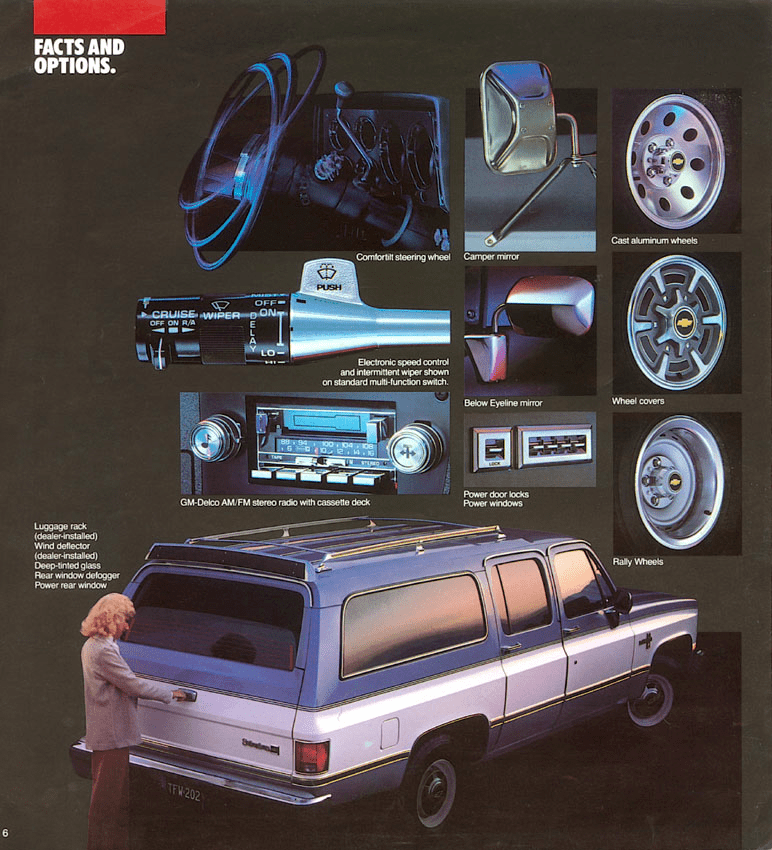
Options page from the 1985 Suburban brochure

Other exterior and mechanical options included deep tinted glass in two different configurations, halogen high beam headlamps, two optional gas tank sizes (31-gallon and 41-gallon), and a wide range of wheels and tires. Inside, air conditioning (front or front and rear), an electric rear window defogger, electronic speed control, power door locks, power windows, a quartz electric clock, Custom reclining bucket seats with a console, and a range of radios up to an AM/FM stereo with a cassette player were all available.

Chevrolet sold 64,470 Suburbans in the 1985 model year—many of them heavily optioned.

The View From 2025

Badge for 2,500 web hits

These seventh-generation Suburbans have their fans. According to Hagerty’s valuation tools, all the money for a 1985 C20 Suburban Silverado in #1/Concours condition is $47,300, with a more typical #3/Good condition example going for $20,300. Suburbans frequently show up for sale in the Hemmings Motor News classifieds, on eBay Motors, and on Bring a Trailer. As I update this post in April 2025, a 1985 Indian Bronze Metallic Silverado with a Burgundy Custom cloth bench seat, a 5.7 liter/350 ci V8, an automatic, and 66,000 miles is available on Hemmings, asking $80,000.

Make mine Apple Red, with Saddle Tan Custom cloth reclining bucket seats, please—just like that 454 all those years ago.

Last updated April 2025.
1989 Buick Electra Park Avenue Ultra sedan

“The standard for luxurious, smooth-riding American sedans …”

For 1989, Buick’s Electra Park Avenue received a new trim in the middle of the model year: Ultra. It became the new top-of-the-line Buick sedan.

The only powertrain for the Ultra or for any 1989 Electra was a “3800” LN3 165 bhp 3.8 liter/231 ci V6 with sequential fuel injection teamed with a four-speed automatic transmission. Mileage for the standard engine was 19 city/28 highway by the 1989 measures (17/26 by today’s standards). With an 18-gallon gas tank, an Ultra owner could expect a range of about 345 to 380 miles with a 10% fuel reserve. 0-60 mph took a little under 10 seconds.

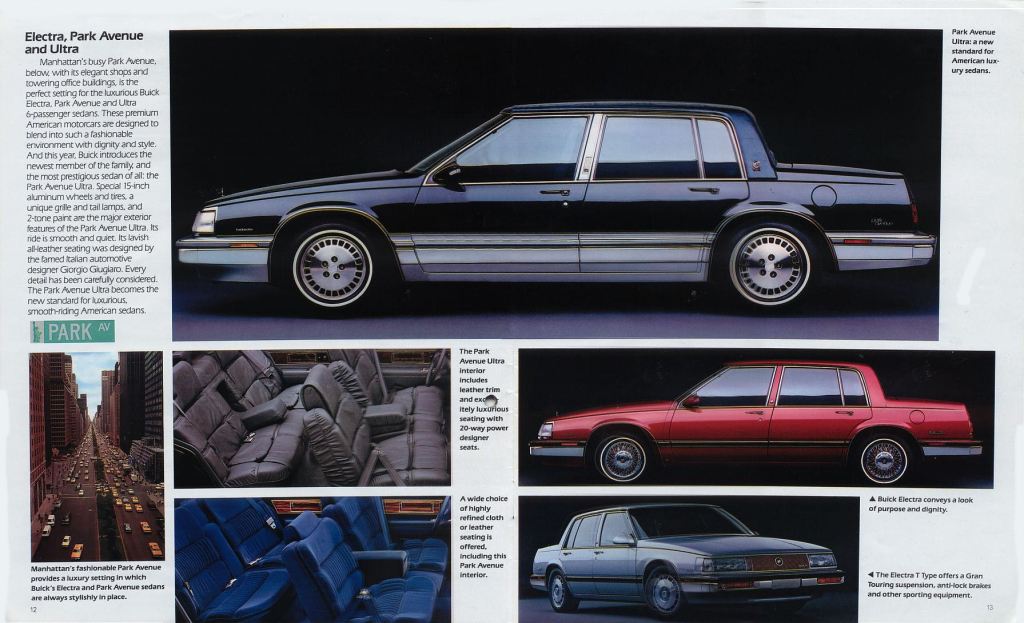
Electra pages from the 1989 Buick brochure

Buick piled on the bling for the Ultra—standard exterior equipment included Soft-Ray tinted glass, a unique grille texture, smoked tail lamps, chrome side pillars, a Sterling Silver lower accent paint treatment, and a silver accent body stripe. Mechanical equipment on the $26,218 (approximately $70,100 in 2025 dollars) car included a 4-wheel independent DynaRide suspension, power rack-and-pinion steering, power anti-lock front disk/rear drum brakes, and P205/70R15 whitewall tires (a size still readily available) on 15-inch aluminum wheels.

Inside the Ultra, air conditioning, an AM/FM stereo radio, burled elm trim on the doors and instrument panel, a tilt steering column, power door locks, power mirrors, and power windows were all standard. The all-leather seats were styled by famed Italian automobile designer Giorgetto Giugiaro, with the 55/45 front seats being 20-way for both driver and front passenger.

Options, Period Press, & Production Numbers

Optional items for 1989 included an electric sliding Astroroof ($1,230), a heavily-padded full vinyl top only available for the Ultra, cornering lamps ($60), Electronic Touch Climate Control air conditioning ($165), Twilight Sentinel headlamp control ($60), and the Delco/Bose Music System with ETR AM/FM stereo radio and cassette.

The Electra Park Avenue Ultra received good reviews, with one automotive writer comparing it favorably to the same year’s Mercedes-Benz 300 SE. First-year sales of the 1989 Park Avenue Ultra sedan were decent considering the short window of availability—Buick moved 4,815 examples.

The View From 2025

Badge for 2,500 web hits

These mid to late 1980s C-bodies had a stately look about them. Big and (I think) handsome, they had a lot of interior room despite the second round of downsizing—with 111 cubic feet, they had only one cubic foot less than the previous generation rear-wheel-drive cars. C-body Park Avenue sedans of this era rarely come up for sale in the Hemming’s Motor News classifieds and on eBay Motors, but are sometimes seen on Bring a Trailer.

Make mine Claret Red over Sterling Silver, please. All Ultras came with two-tone exterior paint.

Other C-bodies I have written about in this blog are the 1989 Cadillac Sedan deVille and the 1985 Oldsmobile Ninety-Eight Regency sedan. Among the many eighties Buicks I have written about include the 1980 Riviera S TYPE coupe, the 1983 Skylark T TYPE coupe, the 1984 Regal Grand National coupe, the 1984 Riviera T TYPE coupe, the 1985 Somerset Regal coupe, the 1986 Century sedan, and the 1987 LeSabre T Type coupe.

Last updated July 2025.

1980 Chevrolet Camaro Rally Sport coupe

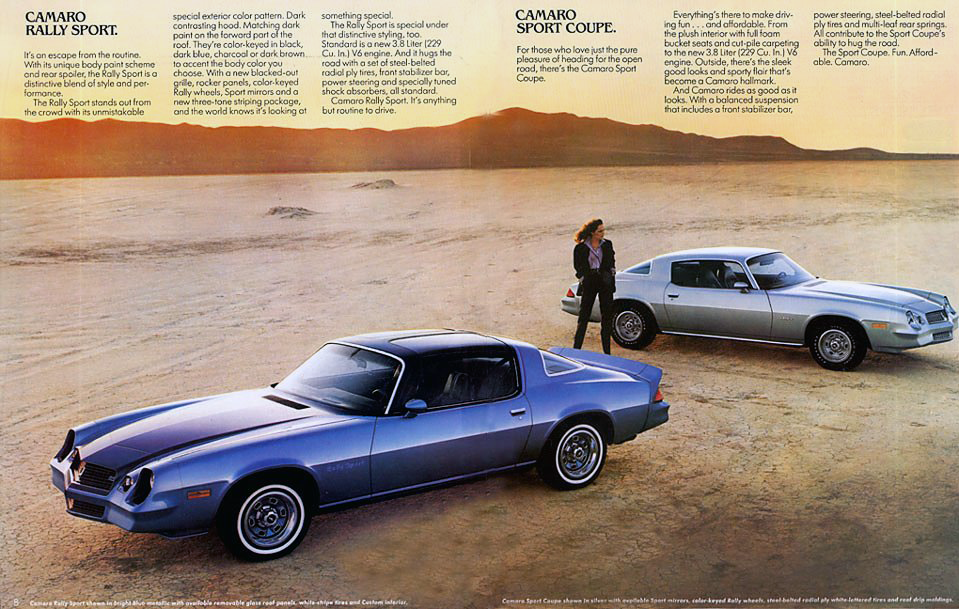
At Barrett-Jackson’s 2018 Northeast auction, a bright blue metallic 1980 Chevrolet Camaro Rally Sport coupe with black vinyl seats, a 3.8 liter/229 ci V6 with a two-barrel carburetor, an automatic, and 45,000 miles crossed the block. The hammer price was $4,700 for this honest, reasonably original car that no one ever tried to turn into something resembling a Z28. I find these non-top-of-the-line cars interesting because they are rarely saved, leading to something like what we have with 1957 Chevrolets, where you’d think 90% of them were Bel Airs.

“It’s an escape from the ordinary.”

For 1980, Chevrolet featured four versions of the Camaro. The base model was the Sport Coupe, followed by the Rally Sport, the Berlinetta, and the Z28. This post is about the Rally Sport, which cost $5,916 (almost exactly $25,000 in today’s dollars) and got a few changes in the final year of this particular iteration. A new blacked-out grille and a new three-tone striping package were visible, while a new standard V6 sat inside.

Rally Sport page from 1980 Camaro brochure
Rally Sport and Sport Coupe pages from the 1980 Chevrolet Camaro brochure

That new standard powertrain on the 1980 Rally Sport was the LC3 115 bhp 3.8 liter/229 ci V6 with a Rochester M2ME two-barrel carburetor paired with a three-speed manual. EPA fuel economy was 20 city/26 highway by the standards of the day—with a 20.9-gallon gas tank, a Camaro owner could expect to go 390 to 430 miles with a 10% fuel reserve. The trade-off was performance that belied the Camaro’s sporty looks: 0-60 in a little under 13 seconds with a top speed of 112 mph.

Optional powertrains included two V8s, both of which required power brakes ($81): the L39 120 bhp 4.4 liter/267 ci with a two-barrel carburetor ($180) and the LG4 155 bhp 5.0 liter/305 ci with a four-barrel carburetor ($295). An automatic ($358) was available with all three engines, while a four-speed manual was only available with the larger of the two V8s. The LG4/four-speed combination yielded notably better performance than the base powertrain: 0-60 in about 10 seconds. It didn’t make mileage that much worse—16 city/24 highway by 1980 standards.

Standard exterior and mechanical equipment on all Rally Sports included High Energy ignition, power steering, front stabilizer bar, sport mirrors, rear spoiler, concealed windshield wipers, front disc/rear drum brakes, and 205/75R14 steel-belted radial ply tires (a size still available thanks to Hancook and Kumho) on 14-inch color-keyed Rally wheels. Inside, flow-through ventilation system, contoured full-foam vinyl bucket seats, a “centre” (as spelled in the brochure) floor console, and cut-pile colour-keyed carpeting were included.

Options & Production Numbers

Exterior and mechanical options included removable glass panels ($695) and 14 x 7 aluminum wheels ($337). Inside, air conditioning ($566), intermittent windshield wiper system ($41), electric rear window defogger ($107), automatic speed control ($112), power door locks ($93), power windows ($143), a Custom interior ($68), a gauge package with a tachometer ($120), Comfortilt steering wheel ($81), and an AM/FM stereo radio with stereo cassette tape ($272) were all available.

Though the Z28 wasn’t the most popular Camaro, the Rally Sport did not hold up its end of the bargain (likely why it was gone in 1981). The leading seller remained the entry-level Sport Coupe (46% of production), followed by the Z28 (30%), the Berlinetta (16%), and the Rally Sport (8%).

The View From 2025

Badge for 2,500 web hits

According to Hagerty’s valuation tools, all the money for a 1980 Camaro Rally Sport with the LG4 V8, a four-speed, and T-tops in #1/Concours condition is an astounding $24,400, with a far more typical #3/Good car with same equipment going for $14,200. Values slide down substantially with the base equipment—a base V6 Rally Sport in #3 condition is only worth $10,300.

This generation of the Rally Sport maintains some presence in the Hemming’s Motor News classifieds, on eBay Motors, and at online auctions such as Bring a Trailer that cater to the eighties car market. As I update this post in February 2025, there’s a Bronze Metallic 1981 with the LG4, an automatic, and 77,000 miles for sale asking $16,000.

Make mine Bright Blue Metallic, please.

Last updated February 2025.

1987 Mercury Lynx XR3 hatchback coupe

This post is consistently one of the most popular every year and has been so since the first full year after I originally posted it. It seems to me the key to an individual post’s popularity is often in the rarity of the other coverage available for that particular vehicle.

“… the sporting side of Lynx.”

1987 was the final year for the Lynx—Mercury’s version of Ford’s Escort compact. The Escort would soldier on for many more years (through model year 2002), but from 1988 forward, the smallest American-built Mercury would be the Topaz—still a compact, but larger in almost every dimension. For 1986 and 1987, the top-of-the-line Lynx was the XR3 hatchback coupe.

The XR3 designation was not random, but may not have been obvious to much of the North American market. In Europe, XR3 (and later XR3i) was a sporty trim of the Mark III Ford Escort from 1980 forward. Why Ford’s marketers chose to make XR3 the sportiest Lynx instead of using the name for the stateside Escort (which used GT in the mid-1980s) is a question lost in the mists of time, but may have had something to do with XR-7 designation for the sportiest Mercury Cougar.

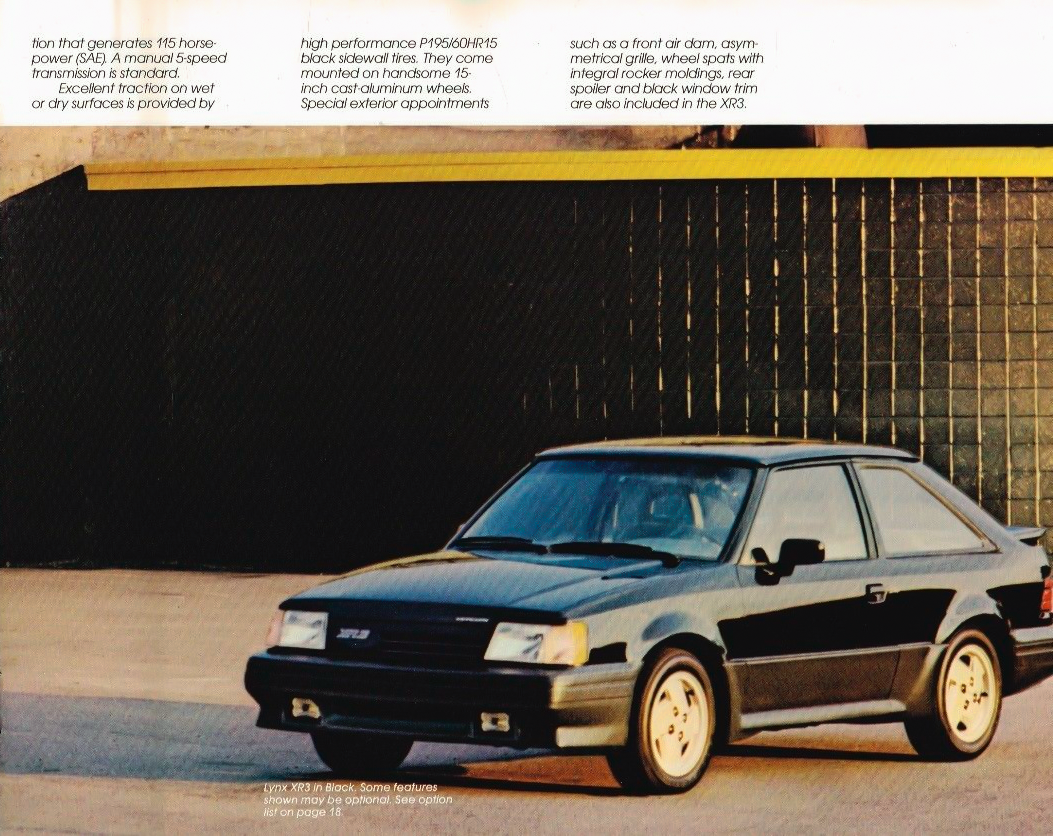
The Lynx XR3‘s standard (and only) powertrain was a “High Output” 115 bhp 1.9 liter/113 ci inline four with Bosch multi-port fuel injection paired with a five-speed manual transmission. Mileage was good—25 city/34 highway by the day’s standards (about 22 city/31 highway by 2025 measures). Acceleration was reasonably quick: 0-60 came in about 10 seconds in the approximately 2,400-pound car. With a 13-gallon fuel tank, Lynx XR3 drivers could expect a range of 310 to 345 miles with a 10% fuel reserve.

XR3 page from the 1987 Mercury Lynx brochure

Standard exterior and mechanical equipment on the $8,808 Lynx XR3 (about $25,900 in today’s dollars) included an asymmetrical grille, an aerodynamic front air dam with built-in fog lamps, wide wheel flairs, a rear spoiler, dual power mirrors, power steering, and P195/60R15 Goodyear Eagle GT tires (a size still readily available) on 15-inch four-flag cast-aluminum wheels. Inside, cloth sport bucket seats, a full console with a graphic alert display, a split folding rear seat, a leather-wrapped steering wheel, a locking fuel filler door with remote release, and an electronic AM/FM stereo radio with four speakers were included.

Standard exterior and mechanical equipment on every Lynx included aero halogen headlamps, front-wheel-drive, a four-wheel independent suspension, rack-and-pinion steering, and power front disc/rear drum brakes. The Lynx was not a large car—there aren’t many current small coupes remaining to compare it to, but the 2025 Honda Civic hatchback sedan is 5 inches wider and about a foot longer.

Options & Production Numbers

Few options were available since the XR3 came relatively well-equipped for a compact car in the eighties. In fact, seven separate options available for lesser Lynxes were standard on the XR3. Exterior and mechanical options for the XR3 included tinted glass ($105), a rear window wiper/washer ($126), and an engine block heater ($18). Inside, air conditioning ($688), speed control ($176), and a tilt steering wheel ($179) were available.

The final-year Lynx didn’t sell very well: a total of 39,039 in a year when Ford sold 374,765 Escorts. It’s reasonable to say that very few of the 20,930 hatchback coupes were XR3s.

The View From 2025

Badge for 2,500 web hits

First-generation Escorts and Lynxes were once so prevalent on American roads, but have now virtually disappeared. You occasionally see Lynxes for sale in the Hemming’s Motor News classifieds and on eBay Motors. Bring a Trailer has auctioned a grand total of two Lynxes, neither of them XR3s.

Make mine Smoke, please.

Other Mercurys I have written about are the 1980 Cougar XR-7 coupe, the 1983 Grand Marquis sedan, the 1984 Grand Marquis Colony Park LS station wagon, the 1986 Capri hatchback coupe, the 1988 Cougar XR-7 coupe, and the 1988 Grand Marquis Colony Park station wagon. I have also written about the 1981 Ford Escort hatchback coupe.

Last updated December 2025.

1980 Plymouth Horizon hatchback sedan

The October 2017 issue of Hemmings Classic Car included an article on an “Unbelievable Restoration of a 1979 Plymouth Horizon,” which certainly falls into my “Who Saves These Cars?” category. In honor of this, I updated a blog entry on the 1980 Horizon.

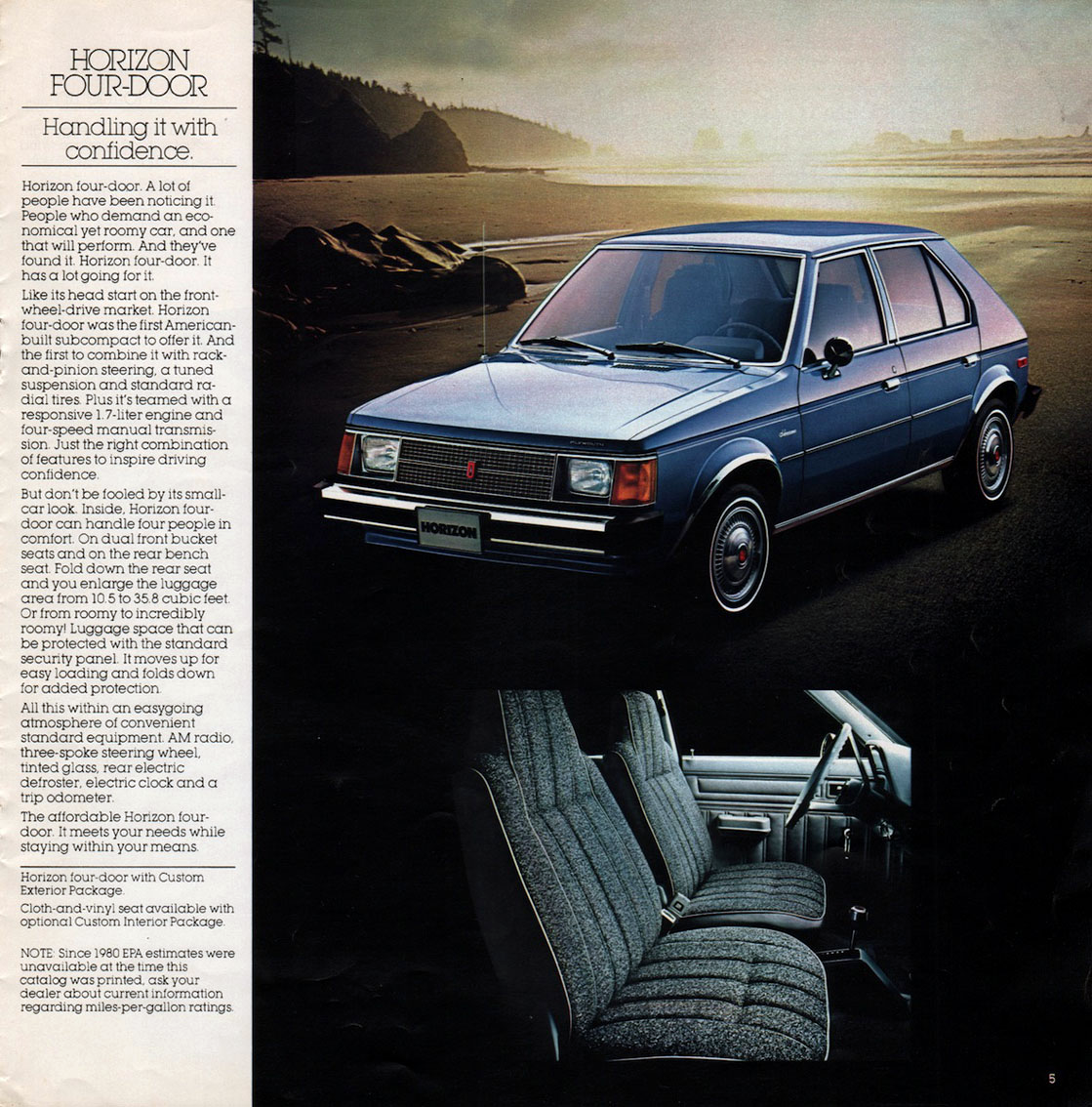
“Handling it with confidence.”

1980 was the third model year for Chrysler’s “Omnirizon” front-wheel drive subcompact. Once again, the only available engine was a Volkswagen-sourced 1.7 liter/105 ci four-cylinder with a Holley two-barrel carburetor and all of 65 bhp. With the standard four-speed manual transmission, 0-60 came in about 14.5 seconds in the 2,135-pound car. Fuel economy was rated at 24 city/31 highway by the day’s standards, so the 13-gallon gas tank gave a range of 265 to 285 miles with a 10% fuel reserve.

Four-door page from the 1980 Plymouth Horizon brochure

Standard exterior and mechanical equipment on the $5,526 car (about $23,900 in today’s dollars) included rack and pinion steering, front disc/rear drum brakes, a rear electric defroster, tinted glass, and P155/80R13 glass-belted radial tires (a size still available from Kumho) on 13-inch wheels. Standard interior equipment included a heater, an AM radio, and an electric clock.

A variety of exterior and interior packages were available to dress up the rather spare base Horizon. The Custom exterior package ($101) added some bright moldings to the outside of the car. Moving up to the Premium exterior ($207) added some more bright moldings and deluxe wheel covers. The Premium Woodgrain exterior added (natch!) woodgrain appliques on the body sides and lower liftgate pane. The Custom ($112) interior added a glove box lock, a cigarette lighter, custom door panels, and custom vinyl seats. The top-of-the-line Premium ($355) interior added a color-keyed console, a “luxury” three-spoke steering wheel, premium door panels, and a reclining passenger-side seatback.

Options & Production Numbers

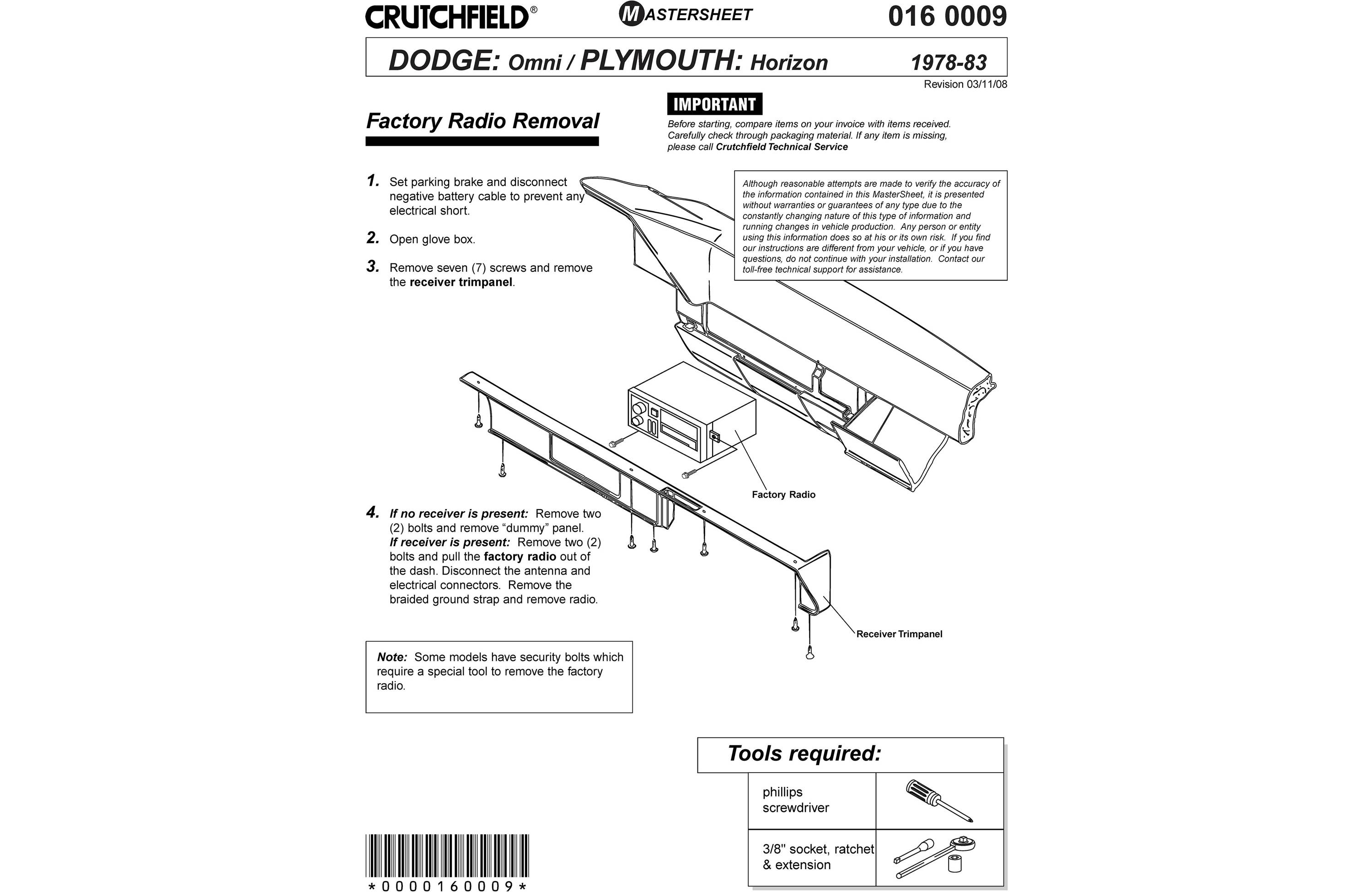
Exterior and mechanical options included a removable flip-up glass sun roof ($182), power steering ($161), power front brakes ($77), and a three-speed TorqueFlite automatic transmission ($340) which further slowed the Horizon’s acceleration. Inside, air conditioning ($541), a sport steering wheel ($40), and an AM/FM stereo radio ($93) were available—there were no eight-tracks or cassettes available as factory stereos (it was left to Crutchfield and others to provide those upgrades—and they still do).

The Horizon continued to sell reasonably well in the 1980 model year, with almost 86,000 units sold. The slightly sportier two-door TC3 hatchback added another 60,000 or so units. Combined, the two models accounted for 58% of Plymouth’s dire 1980 automobile sales totals in the United States (Plymouth’s other offerings for that year included the Arrow, Champ, Gran Fury, Sapparo, and Volaré).

The View From 2025

1000 views badge

A few folks are trying to save “Omnirizons”—including that fellow featured in Hemmings Classic Car (journalist Robert Suhr)—but you rarely see these cars for sale in the Hemming’s Motor News classifieds, on eBay Motors, or on Bring a Trailer. The exception, of course, is the later and much faster Dodge Omni GLH.

Make mine Crimson Red Metallic, please.

Other Plymouths I have written about include the 1980 Volaré station wagon, the 1981 Reliant coupe, and the 1984 Voyager minivan. I have also written about Chrysler’s transition to front-wheel-drive.

Last updated October 2025.

1989 Chevrolet Celebrity sedan

A co-worker of mine casually mentioned that he owns a beige 1989 Chevrolet Celebrity sedan. That’s enough for me to write a blog entry.

“contemporary front-drive technology”

For 1989, Chevrolet’s Celebrity mid-size sedans and wagons were little changed. The major news was that the five-speed manual transmission that (very) few bought was no longer available and that the coupe had been discontinued.

Standard power on the Celebrity remained the Tech IV 98 bhp 2.5 liter/151 ci inline four with throttle-body fuel injection. The LB6 125 bhp 2.8 liter/181 ci V6 with multi-port fuel injection was available for $610. A three-speed automatic transmission was standard on both engines, but buyers of the V6 could add a four-speed automatic for an additional $175.

With these two engines and curb weights in the 2,750 to 2,800-pound range, the Celebrity was not a fast car. 0-60 mph with the four was a little over 13 seconds, while V6 owners got to 60 mph about two seconds faster.

Mileage with the base four was 23 city/30 highway (21/28 by today’s standards), while owners of the top-of-the-line V6/four-speed automatic combination could expect 20 city/29 highway. With a 15.7-gallon fuel tank, Celebrity V6 drivers could expect a range of between 310 and 350 miles with a 10% fuel reserve.

My colleague's 1989 Celebrity, prior to restoration.
My colleague’s 1989 Celebrity before restoration.

Standard equipment on the $11,495 Celebrity (about $30,800 in today’s dollars or about what a 2025 Chevrolet Equinox LT SUV goes for) included power steering, power brakes, 14-inch wheels on P175/75R14 tires (a size now tough to find), and a Delco AM/FM stereo radio with digital clock. Adding the V6 and the four-speed automatic brought the price up to $12,280, or about $33,000 in today’s dollars.

Packages & Options

By 1989, Chevrolet was moving to Preferred Equipment Group option packages as a way to reduce the number of equipment combinations. The Celebrity’s option packages were:

  1. Air conditioning, auxiliary lighting, exterior moldings, floor mats—($931 with the 2.5 liter inline four/$957 with the 2.8 liter V6)
  2. Air conditioning, auxiliary lighting, exterior moldings, floor mats, power door locks, gauge package, cruise control, tilt steering wheel, and intermittent windshield wipers—($1,565 with the 2.5 liter inline four/$1,591 with the 2.8 liter V6)
  3. Air conditioning, auxiliary lighting, exterior moldings, floor mats, power door locks, gauge package, cruise control, tilt steering wheel, and intermittent windshield wipers, sport remote mirrors, AM/FM stereo cassette with digital clock, power trunk opener, and power windows—($2,062 with the 2.5 liter inline four/$2,088 with the 2.8 liter V6)

Adding the Preferred Equipment Group 3 to a Celebrity with the V6 and the four-speed automatic brought the price all the way up to $14,368, or about $38,600 in today’s dollars.

The most glamorous option for the Celebrity continued to be the $230 Eurosport package, which included the F41 sport suspension and P195/75R14 tires (a size still available thanks to Hankook and Kumho) and 14-inch rally wheels. The exterior featured blacked out window trim and red center stripes on the protective rubber door and bumper molding; fender and trunk emblems were red rather than the standard chrome. Eurosports also featured unique red emblems on the interior door panels and dash and a black steering wheel.

Other optional equipment included two-tone paint ($55), aluminum wheels ($195), an engine block heater ($20), cloth bucket seats with a console ($257), and a six-way power driver’s seat ($250).

1989 would end up being the last year for the Celebrity sedan—the wagon would soldier on for one more year.

The View From 2025

Badge for 2,500 web hits

I think of these cars as honest but basic; they aren’t really being collected, though I did see an early (1982-1985) coupe at an AACA show about fifteen years ago. Celebrities occasionally show up for sale in the Hemmings Motor News classifieds, on eBay Motors, and on Bring a Trailer.

Make mine Black, I think.

Other A-bodies I’ve written about in this blog include the 1986 Buick Century sedan, the 1985 Oldsmobile Cutlass Ciera sedan, and the 1983 Pontiac 6000 STE sedan.

Last updated August 2025.

Save

1981 Oldsmobile Cutlass Supreme coupe

 “America’s favorite Cutlass for flair, value and price”

For 1981, the exterior of Oldsmobile’s Cutlass Supreme coupe was substantially revised, with a lowered front, a slightly higher decklid, and quad headlamps. With the new styling, aerodynamic drag dropped by about 15%.

The standard engine remained the 110 bhp 3.8 liter/231 ci V6 with a Rochester M2ME two-barrel carburetor. The optional engines, a 4.3 liter/261 ci V8 with a Rochester M2MC two-barrel carburetor ($50) and a 5.7 liter/350 ci diesel V8 ($695!), both had (this makes no sense) five less horsepower than the V6. A three-speed automatic transmission was the only transmission available with any engine. Early eighties Cutlass Supremes were stylish but slow—0-60 came in about 14 seconds with the standard motor. Mileage with the V6 was 21 city/30 highway by the day’s standards (17/22 by today’s measures); with an 18.1-gallon gas tank, a Cutlass Supreme owner could expect a range of 320 to 370 miles with a 10% fuel reserve.

Cutlass Supreme page from the 1981 mid-size Oldsmobile brochure

Standard equipment on the $7,484 Cutlass Supreme (about $28,400 in today’s dollars) included power steering, power front disc brakes, and P195/75R14 steel-belted radial-ply blackwall tires (a size still reasonably available) on 14-inch wheels. Inside, a Custom Sport bench seat with a choice of vinyl or cloth, a Deluxe steering wheel, an instrument panel with simulated butterfly walnut veneer, and Flo-thru ventilation were included.

Moving up to the $7,969 Brougham added snazzier exterior moldings, full wheel discs, and a divided cloth velour tufted bench seat.

The $8,004 Cutlass Calais added special painted wheel discs, halogen high beam headlamps, a ride and handling package, reclining front bucket seats in cloth or vinyl, a Rallye gage instrument cluster, and a Custom Sport steering wheel.

Options & Production Numbers

Optional exterior and mechanical equipment included cast-aluminum wheels, tungsten halogen high beam headlamps, engine block heater, limited-slip differential, power antenna, dual sport mirrors, electric rear window defogger, and removable glass roof panels ($695). Inside, you could add either Four-Season or Tempmatic air conditioning, a Tilt-Away steering wheel, cruise control, power windows, power door locks, bucket seats, a digital or regular electric clock, and a series of radios.

The Cutlass Supreme sure was popular—Oldsmobile sold almost 189,000 of them in the 1981 model year along with another 94,000 Cutlass Supreme Brougham coupes for a total of over a quarter of a million. Olds made it well known that the Cutlass brand overall continued to be the most popular car in the United States.

The View From 2025

5,000 views graphic

A few folks are collecting these cars, but they still aren’t common at shows. You do see fourth-generation Cutlass Supremes for sale in the Hemming’s Motor News classifieds, on eBay Motors, and on Bring a Trailer, though non-Hurst/Olds or 4-4-2 versions are relatively rare.

Make mine Dark Blue Metallic, please.

Among the many rear-wheel-drive G-platform (designated A-platform before 1982) cars I have written about are the 1980 Oldsmobile Cutlass coupe, the 1980 Pontiac Grand Am coupe, the 1980 Pontiac Grand Prix SJ coupe, the 1981 Chevrolet Monte Carlo Sport Coupe, the 1983 Chevrolet Malibu sedan, the 1983 Monte Carlo SS Sport Coupe, the 1984 Buick Regal Grand National coupe, the 1985 Oldsmobile Cutlass Supreme coupe, the 1987 Buick GNX coupe, and the 1987 Pontiac Grand Prix coupe.

Last updated June 2025.

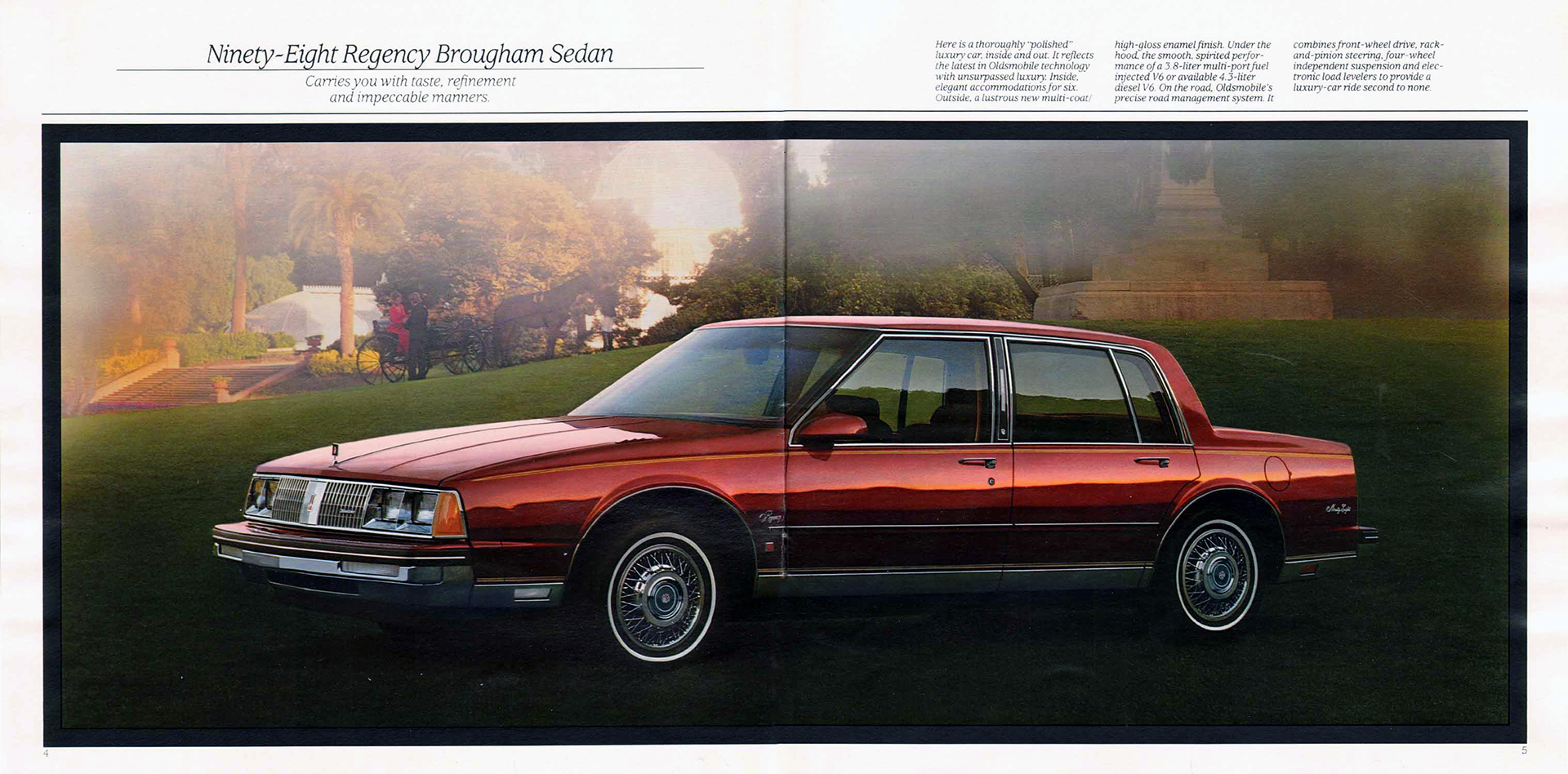
1985 Oldsmobile Ninety-Eight Regency sedan

“It goes beyond the Ninety-Eight of your mind to the Ninety-Eight of your dreams.”

The 1985 Oldsmobile Ninety-Eight Regency sedan was substantially downsized from the previous year and switched to front wheel drive. Overall length dropped over two feet from 221.1 inches to 196.1 inches.

Standard power (if you could call it that) came from the LK9 110 bhp 3.0 liter/181 ci V6 with a two-barrel carburetor. Optional engines were the 125 bhp LG3 3.8 liter/231 ci multi-port fuel-injected V6 and the LS2 4.3 liter/261 ci V6 diesel (don’t do it!) putting out all of 85 bhp (at least it had 165 lb-ft of torque). All engines were teamed with a four-speed automatic transmission. Both the 3.0 liter V6 and the diesel V6 would be gone by the time the 1986 model year rolled around.

Mileage for the standard engine was 18 city/25 highway by the 1985 measures (16/23 by today’s standards). Hilariously, the upmarket 3.8 liter engine was rated at 19 city/26 highway, the multi-port fuel injection more than making up for the increased displacement. Buyers of the diesel could expect 22 city/32 highway. With an 18-gallon gas tank, a Ninety-Eight Regency owner could expect a range of about 315 to 350 miles with a 10% fuel reserve. The target market probably didn’t care about 0-60 times, which was a good thing; the best case was likely about 12 seconds.

Standard mechanical equipment on the $14,665 (approximately $44,800 in 2025 dollars) Ninety-Eight Regency included an automatic leveling system, power rack-and-pinion steering, power front disc brakes, and P205/75R14 steel-belted radial-ply white-stripe all season tires (a size still available thanks to Hankook and Kumho) on 14-inch wheels with bright deluxe wheel discs. Inside, four-season air conditioning, an AM/FM stereo radio, a six-way power driver’s seat, power door locks, power mirrors, and power windows were all standard.

Brougham pages from 1985 Oldsmobile Ninety-Eight Regency brochure

Stepping up to the $15,864 (approximately $48,400 in today’s dollars) Ninety-Eight Regency Brougham made the 3.8 liter engine standard and added simulated wire wheels with locks, fancier seats, a deluxe steering wheel with tilt-away feature, and intermittent windshield wipers—along with over 300 pounds of weight.

Options & Production Numbers

Individual options included an Astroroof ($1,230), cornering lamps ($60), an electronic air conditioner ($125), and Twilight Sentinel headlamp control ($60).

These C-bodies (there were also Buick and Cadillac versions) had a stately appearance. Big and (I think) handsome, they had a lot of interior room despite the downsizing—at 110 cubic feet, they had only two cubic feet less than the 1984.

Sales of the 1985 Ninety-Eight Regency sedan were good—at almost 155,000, more than double the approximately 69,000 that had been sold in 1984. A little over 70% of Regency buyers opted to move up to the Brougham.

The View From 2025

1000 views badge

C-body Ninety-Eight Regency sedans sometimes come up for sale in the Hemming’s Motor News classifieds and on eBay Motors. Bring a Trailer has sold one of this era, and it was a diesel.

Make mine Platinum Metallic, please.

Other 1985 Oldsmobiles I have written about include the Cutlass Ciera sedan, the Cutlass Supreme coupe, and the Firenza ES sedan.

Last updated June 2025.

1980 Chevrolet Camaro Z28 coupe

I saw a white 1980 or 1981 Z28 with blue graphics (I believe the only way you can tell them apart is to get close enough to see the VIN’s length) out driving in June 2014, not once but twice. It wasn’t quite in show condition, but it still looked pretty sharp, and you so rarely see these cars on the road these days. We’ll go with the 1980 version for this post because it had slightly more horsepower.

“The Maximum Camaro.”

For 1980, the aging second-generation Chevrolet Camaro (the title of Car and Driver‘s road test for the 1980 Z28 was a cruelA medieval warrior on the path to a rocking chair“) received some updates, including exterior styling changes and a more powerful engine for the Z28. Not much could be done about the general lack of space efficiency (the EPA rated all Camaros as subcompact cars), the relatively high weight, and the fairly primitive technology.

The standard Z28 powertrain for states other than California was the LM1 5.7 liter/350 ci V8 with a four-barrel Rochester carburetor and 8.2:1 compression matched with a four-speed manual transmission (a three-speed automatic was available for $63). At 190 bhp, this engine had the most horsepower seen in any Camaro since 1974 (sigh). For 1980, Chevrolet engineers added a solenoid-driven air intake to the back of the redesigned hood scoop.

Car and Driver managed to get the 3,660-pound Z28 with the four-speed from 0-60 in 8.5 seconds with a 120 mph top speed. Fuel mileage was predictably bad—14 city/21 highway by the day’s standards. With a 20.9-gallon gas tank, a Z28 owner could expect a range of 270 to 295 miles with a 10% fuel reserve.

Z28 pages from the 1980 Chevrolet Camaro brochure

The Z28‘s base price was $7,121—about $30,600 in today’s dollars. Standard exterior and mechanical equipment included heavy-duty shocks and springs, body color Sport mirrors, a front air dam, a rear spoiler, and P225/70R15 white-lettered radial tires (a size still readily available) on body-colored 15-inch wheels. Inside, power steering, full gages, center console, cut-pile carpeting, and vinyl bucket seats were standard. No radio of any sort was included, with Chevrolet’s assumption likely being that the average Z28 buyer would look for assistance from Crutchfield and others for their sound.

Options & Production Numbers

External options included 15 x 7-inch cast aluminum wheels ($184), tinted glass ($68), and removable glass roof panels ($695). Inside, you could add air conditioning ($566), an intermittent windshield wiper system ($41), an electric rear window defogger ($107), automatic speed control ($112), power door locks ($93), power windows ($143), a Comfortilt steering wheel ($81), and nine different radios including an AM/FM stereo radio with a stereo cassette player ($272).

Although Z28 sales were good in 1980, they did not match 1979’s numbers. Chevrolet sold 45,137 Z28s in the 1980 model year, making them almost 30% of total Camaro production.

The View From 2025

Badge for 2,500 web hits

Long neglected by the collector market and with most now used up, late second-generation Z28s in good or great shape now get interesting numbers at online and in-person auctions. According to Hagerty’s valuation tools, all the money for a 1980 Z28 with the LM1 motor, the four-speed manual, and T-tops in #1/Concours condition is $60,100. A more normal #3/Good condition version is valued at $23,400. Second-generation Camaros have good club support and are often available in the Hemmings Motor News classifieds, on eBay Motors, and on Bring a Trailer.

Make mine Red, I think. Surprisingly—at least to me—the most popular Camaro color in 1980 was Dark Blue.

Other Camaros I have covered include the 1980 Rally Sport coupe, the 1982 Z28 Indy 500 Commemorative Edition hatchback coupe, the 1984 Sport Coupe, the 1985 IROC-Z hatchback coupe, and the 1986 Berlinetta hatchback coupe.

Last updated August 2025.

1987 Chevrolet Caprice Classic coupe

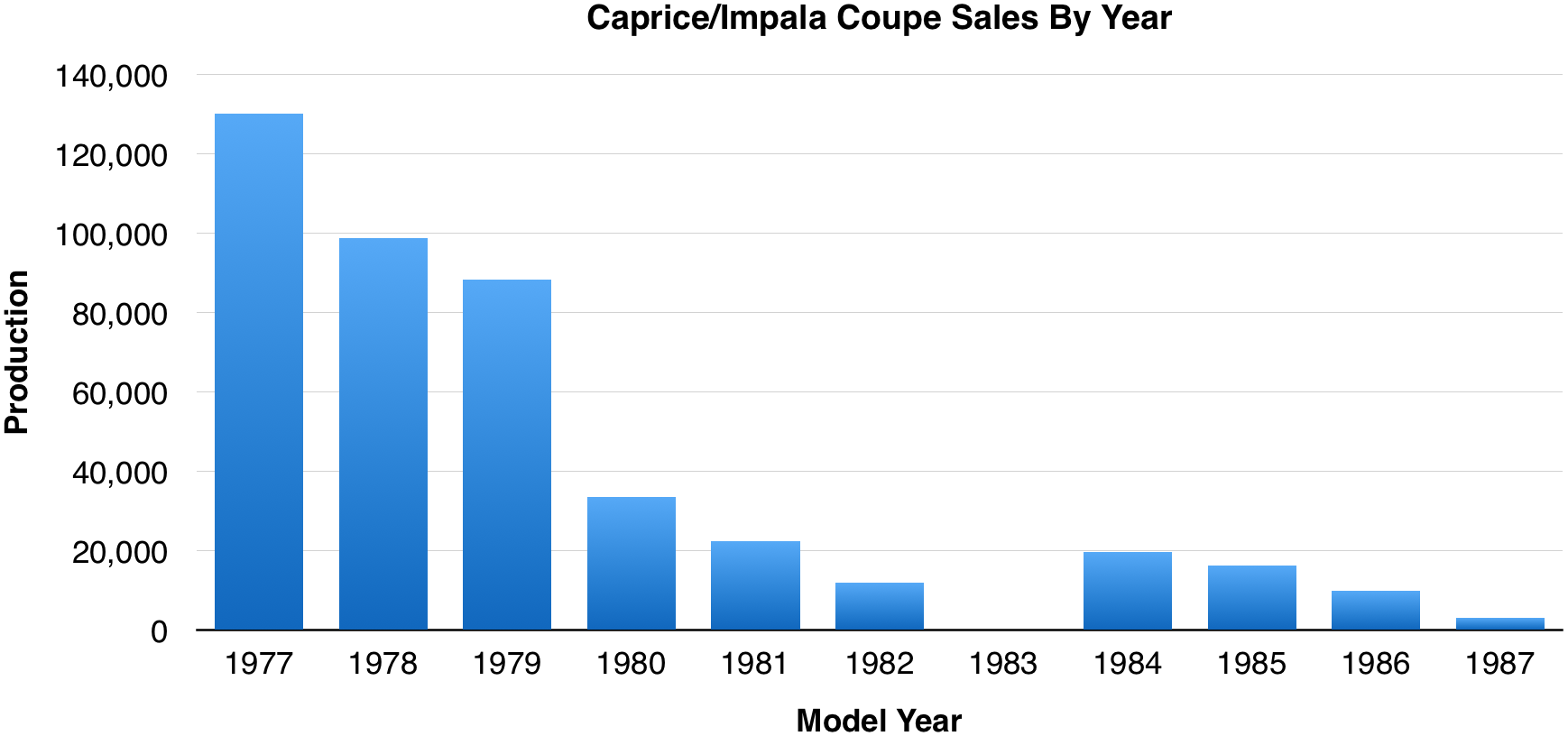
For somewhat unclear reasons, this was my most popular post on this blog for several years. Because of this, I updated it about five years ago to reflect both changes in my posting style and substantial improvements in available data.

“… the personal flair of a distinctive coupe.”

ChevroletCoupeSales

1987 was the final model year for Chevrolet’s Caprice Classic coupe, with only 3,110 made. Beginning in 1988, the Caprice would soldier on with just the sedan and wagon, as the once very popular big American coupes continued to lose favor.

The standard power team on the coupe (and sedan) was the LB4 140 bhp 4.3 liter/262 ci V6 with throttle-body fuel injection and a three-speed automatic transmission. Mileage was rated at 18 city/23 highway by the day’s standards (16/22 by modern measures).

Optional power was the LG4 165 bhp 5.0 liter/305 ci V8 with a four-barrel carburetor paired with a four-speed automatic transmission (I see what you did there, Chevrolet). In 1987, this combination was rated at 18 city/25 highway (16/23 by 2025 standards). With a large 25-gallon fuel tank, you could reasonably expect a comfortable range of about 440 to 480 miles with a 10% fuel reserve—impressive for a 3,600-pound full-size car back then. Even with the V8, these cars were not fast—0-60 came in about 10.5 seconds.

Coupe pages from the 1987 Chevrolet Caprice Classic brochure

Standard equipment for the $11,392 coupe (about $33,000 in today’s dollars) included power steering, power brakes, halogen headlights, and P205/75R15 all-season radial tires (a size still readily available) on 15-inch wheels. Inside, a full-width cloth bench seat, Quiet Sound Group, and an AM radio were standard.

Optional equipment included air conditioning ($775), cruise control ($175), power door locks ($145), power windows ($210), power seats ($240 each), power trunk opener ($50), a 50/50 split-front seat ($195), and AM/FM stereo cassette with graphic equalizer ($435).

Flights of Fancy

I have fun sometimes (often?) building a “unicorn” configuration for these old cars. When I was working at the local Chevrolet dealership in the mid-eighties, I dreamed up a Caprice S. Here’s what optional equipment it would have required, all still available in 1987:

  • F41 Sport Suspension (includes a rear stabilizer bar, 15-inch by 7-inch wheels, and sportier shock absorbers)
  • LG4 5.0 liter/305 ci V8
  • P225/70R-15 tires
  • Sport wheel covers
  • Limited slip differential
  • Performance axle ratio
  • Heavy-duty cooling
  • Dual power Sport mirrors
  • Special instrumentation/gauge package

So, a “John-configured” coupe would have listed for at least $15,096—real money in 1987 and about $43,700 in 2025 dollars. A desperate product planner might have tried to get the leather seats from the Brougham available in the Coupe and maybe scored some black wall tires, but that’s another story …

The View From 2025

Badge for 2,500 web hits

These big and (I think) handsome coupes occasionally appear in the Hemmings Motor News classifieds, on eBay Motors, and on Bring a Trailer. However, Hagerty’s valuation tools do not track Caprice Classic values between 1975 and 1991.

Make mine Silver Metallic, please, though I’m tempted by the Black/Medium Gray Metallic two-tone.

Other B-platform cars I have written about include the 1983 Chevrolet Caprice Classic sedan, the 1985 Chevrolet Caprice Classic station wagon, and the 1982 Oldsmobile Delta 88 Royale coupe.

Last updated April 2025.