Mecum’s annual Glendale, AZ auction finished on March 22nd this year, with 1,351 car and truck lots crossing the block over five days and 881 selling (65%). Below are six of the 65 eighties vehicles that sold (out of 85 lots) that attracted my eye.
1988 Suzuki Samurai LX, linked from Mecum’s website
[Lot G109] 1988 Suzuki SamuraiJX SUV. White with a white top and brown/black vinyl front bucket seats. G13A 64 bhp 1.3 liter/81 ci inline four with a one-barrel carburetor, a five-speed manual, and 63,000 miles. $12,000 hammer price for a reasonably stock Samurai.
1983 Pontiac Parisienne Brougham, linked from Mecum’s website
[G117] 1983 Pontiac Parisienne Brougham sedan. Dark Maroon Metallic with a maroon vinyl top and a maroon cloth front seat. LG4 150 bhp 5.0 liter/305 ci V8 with a four-barrel carburetor, a three-speed automatic, and 102,000 miles. $9,000 for this Canadian market car—the speedometer is the giveaway. I covered the US version earlier this month.
1981 Chevrolet El Camino, linked from Mecum’s website
[L189] 1981 Chevrolet El Camino pickup truck. Medium SandstoneMetallic with a tan cloth split-back front bench seat. LC3 110 bhp 3.8 liter/229 ci V6, a three-speed automatic, and 23,000 miles. $10,000 for an unmodified eighties El Camino—which is unusual. I finally published a post about the El Camino recently, discussing the 1987.
1980 Chrysler New Yorker, linked from Mecum’s website
[T166] 1980 Chrysler New Yorker Fifth Avenue Edition (you can tell by the front fender louvres) sedan. Black with a Black padded Landau roof and a beige leather and vinyl split 60/40 front bench seat. LA 135 bhp 5.9 liter/360 ci V8 with a two-barrel carburetor, a TorqueFlite three-speed automatic, and 16,000 miles. $11,000—how many are left, especially with the “big” V8? Methinks I should write about these cars …
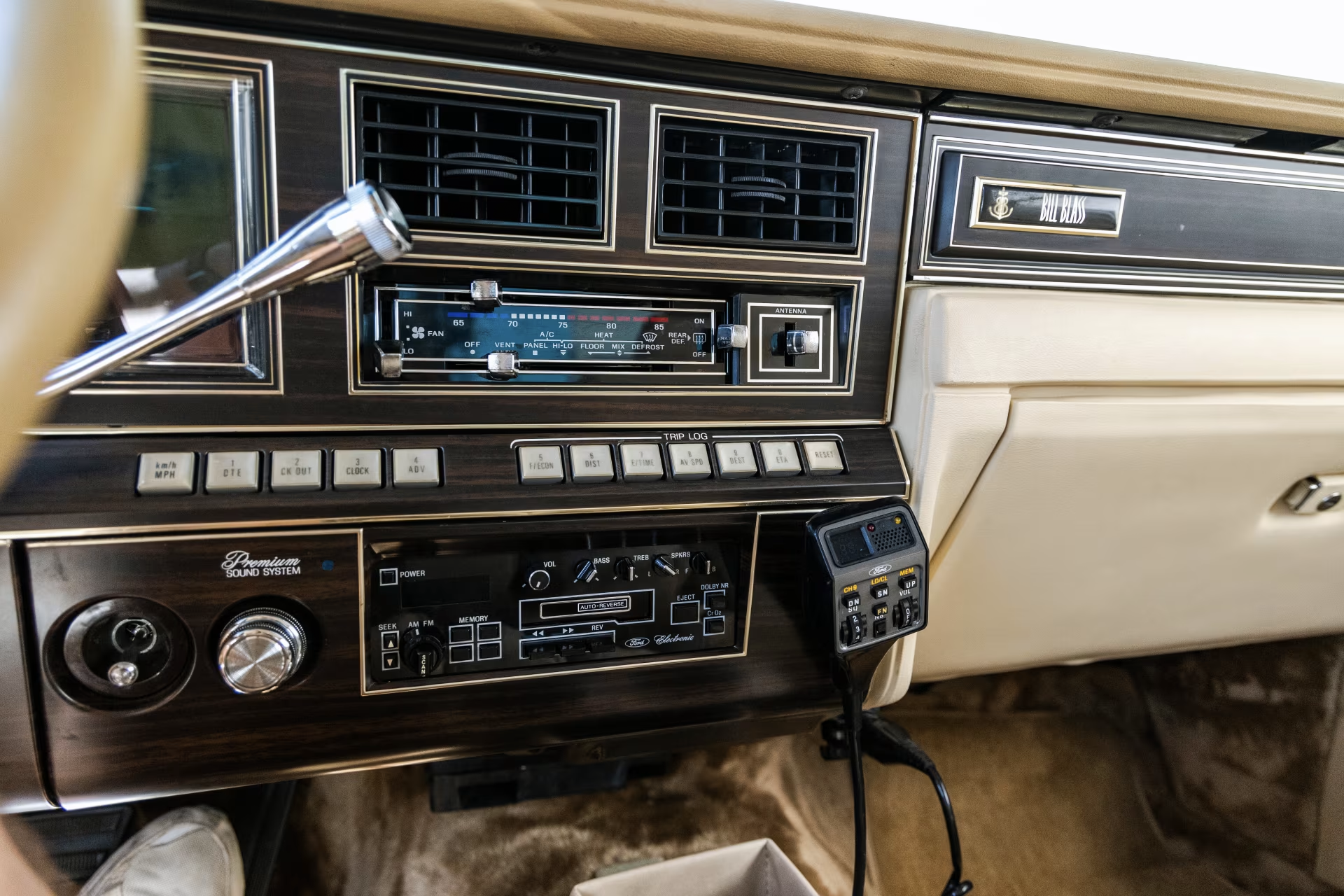
1983 Lincoln Continental Mark VI interior detail, courtesy of Mecum
[T168] 1983 Lincoln Continental Mark VIBill Blass Edition coupe. MidnightBlack upper body over French Vanilla over Midnight Black lower body with a Black Cambria carriage roof and French VanillaTwin Comfort Lounge front seats with leather seating surfaces (Lincoln’s lengthy description). Windsor 150 bhp 4.9 liter/302 ci V8 with fuel injection, a four-speed automatic, and 18,000 miles. $24,000 is solid money for a 1983 Mark VI. I have written about the debut Mark VI coupe.
1989 Chevrolet Blazer, linked from Mecum’s website
[F97] 1989 Chevrolet K5 BlazerSilverado SUV. Gray Metallic with a Gray top and Slate Gray Custom vinyl reclining front bucket seats. L05 210 bhp 5.7 liter/250 ci V8 with electronic fuel injection, a four-speed automatic, and 27 miles. Someone bid $112,500 for an essentially brand-new but 34-year-old Blazer (I have written about the 1985 version).
For 1980, Ford’s pickup truck was nearly all-new, with a more aerodynamic body that reduced drag at highway speeds by up to 13%. There was also an increased emphasis on comfort, with increased legroom over 1979. Ford sold four versions of the full-size truck—the light-duty F-100, the F-150, the 3/4 ton F-250, and the 1-ton F-350. For this blog post, we’ll concentrate on the F-150, which was the best-selling of the four versions, and pick the more popular rear-wheel-drive example over the four-wheel-drive.
The standard engine was the 101 bhp Big Six 4.9 liter/300 ci six. A 130 bhp 4.9 liter/302 ci V8 ($315) and a 156 bhp 5.8 liter/351 ci V8 ($477) were optional. A three-speed manual transmission was standard on rear-wheel-drive F-150s, but many buyers chose the four-speed manual ($175), the four-speed manual with overdrive ($208), or the Select-Shift three-speed automatic ($408).
Pages from the 1980 Ford Pickup brochure
Standard exterior and mechanical equipment on the base $5,314 Custom F-150 short bed included a bright grille surround, an independent front suspension, power front disc/rear drum brakes, P215/75R15SL black sidewall tires (a size still readily available), and 15-inch wheels with argent hub caps. Inside, all vinyl seat trim, a coat hook, a dome light, and a glove box with a latch were included.
Packages
The 1980 Ford F-150 was replete with packages that ranged from making it a little nicer to reasonably luxurious.
The $339 Ranger package added a brushed aluminum lower bodyside molding and bright hub caps on the exterior. Inside, all-vinyl or cloth and vinyl seat trim, color keyed seat belts, and a cigarette lighter were included.
Exterior features of the $472 Ranger XLT package depended on whether the truck was Flareside or Styleside. Flareside pickups had tailgate trim with raised FORD letters in a contrasting color with a dual-colored tape stripe setting off the letters. Styleside pickups included a brushed aluminum tailgate applique with bright letters. Inside, all Ranger XLTs included grained vinyl seat trim with cloth inserts, carpeted lower door trim panels, bright aluminum door scuff plates, and color-keyed cut-pile carpeting.
Exterior features of the top-of-the-line Ranger Lariat package ($760) included a brushed aluminum lower bodyside molding with a black vinyl insert and (of course) three Lariat plaques. Inside, all Ranger Lariats included a unique seat trim sew style in cloth and vinyl or all-vinyl, thick cut-pile carpeting, a Luxury-type steering wheel, and an instrument panel with a polished woodtone applique and a bright Ranger Lariat script.
Free Wheeling package “A” ($407) included pinstriping, blackout grille, blackout headlamp doors, and Sport wheel covers.
Free Wheeling package “B” ($1,266) included everything in package “A” plus foglamps, bumper guards, the Handling Package, and 10-hole aluminum wheels. Flareside pickups received a bright channel bumper, while Styleside pickups got a bright rear contour bumper. Inside, a simulated leather-wrapped steering wheel and the Sports Instrumentation Package with tachometer, trip odometer, ammeter, and oil pressure gauge.
Options & Production Numbers
Individual options were many and included tinted glass on all windows ($36), a sliding rear window ($102), variable-ratio power steering ($215), white styled steel wheels ($161), and forged aluminum wheels available either with a brushed finish ($311) or a polished finish ($361). Inside, a tilt steering wheel ($83), air conditioning ($611), and Speed Control ($160) were available. A choice of five radios ranged up to an AM/FM stereo with cassette tape ($324). Despite the luxury emphasis, power door locks and power windows were not available—they wouldn’t be offered until 1982.
Ford sold 173,050 F-150s in the 1980 model year. That number sounds like a lot, but 1980 was a bad year for the automotive industry overall and an awful year for Ford, whose US market share dropped from 23.8% in 1979 to 20.5% in 1980. Of Ford trucks, only the imported Courier compact pickup would hold the line on sales volume.
The View From 2025
Folks are collecting these seventh-generation Ford pickup trucks. F-150s often appear for sale in the Hemming’s Motor News classifieds, on eBay Motors, and on Bring a Trailer. According to Hagerty‘s valuation tools, a 1980 Ford F-150 Styleside short bed with the 302 ci V8 in #1/Concours condition is $44,300, with a more normal #3/Good condition truck going for $13,000. A long bed subtracts around 2%, while the 351 ci V8 adds about 5%. Four-wheel-drive is worth an additional 14% or so.
Make mine Candyapple Red, please. I’m unsure if I want any of the four two-tone options.
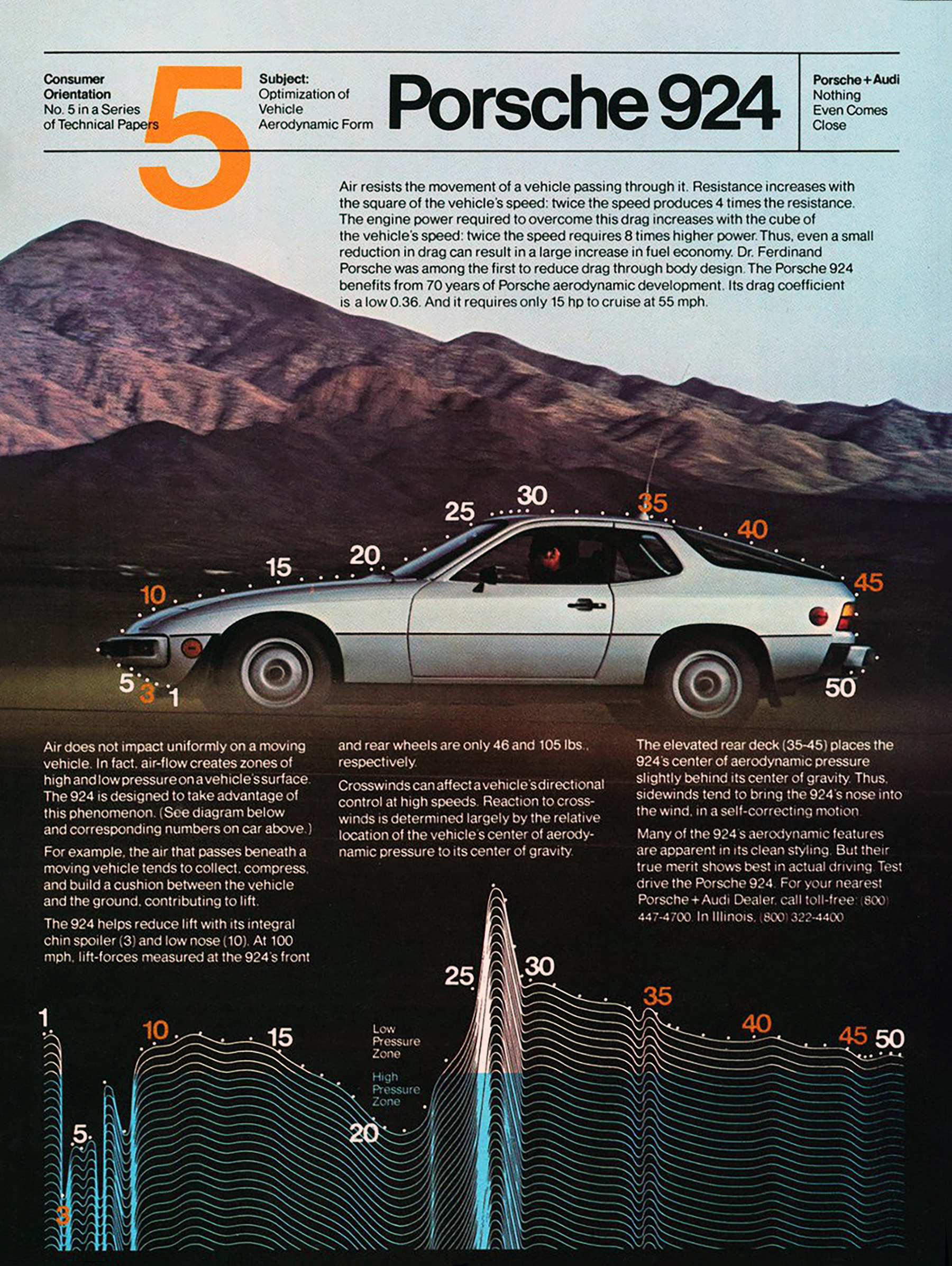
“Many of the 924’s aerodynamic features are apparent in its clean styling.”
For 1980, Porsche’s entry-level 924 generally stood pat. The five-speed transmission changed to an Audi design and a breakerless ignition system was added. Otherwise, a few exterior color changes marked the turn of the model year.
The 924’s engine remained the Volkswagen/Audi EA831 110 bhp 2.0 liter/121 ci inline four with Bosch K-Jetronic fuel injection. This engine—used in many applications—did not make the 924 quick. Period testing with the five-speed manual (an Audi-sourced three-speed automatic was optional) recorded 0-60 mph times of about 10.6 seconds in a car with a curb weight of a little over 2,600 pounds. Fuel economy ratings with the manual were 19 city/32 highway by the day’s standards. With a 17.4-gallon gas tank, a 924 driver could expect a range of 360 to 400 miles with a 10% fuel reserve.
1980 Porsche 924 print advertisement
The 924’s base price was $15,970—about $68,600 in today’s dollars, which is about 9% less than a 2025 Porsche 718 Cayman coupe goes for. Standard exterior and mechanical equipment included retractable headlights, an integral front spoiler, tinted glass, a manual antenna, a four-wheel independent suspension, a front stabilizer bar, rack and pinion steering, power assisted front disc brakes, and 165HR-14 tires on 14-inch wheels. Inside, reclining front bucket seats, a center console, full carpeting, intermittent windshield wipers, power windows, a tachometer, a quartz clock, and an electric window defogger were included.
Options & Production Numbers
Among the options available for the 924 were a removable top ($485), spoke type light alloy wheels ($545), a 4 spoke leather covered steering wheel ($185), heated outside mirrors ($110 each), and air conditioning ($725).
Porsche sold 3,700 examples of the base 924 in the United States in 1980, along with 3,440 units of the far sprightlier Turbo version.
The View From 2025
924s are often cited as “the car that saved Porsche,” and there is good club support for them, as there is for all Porsches. Folks are collecting 924s, though the lack of power limits their appeal. According to Hagerty‘s valuation tools, a 1980 Porsche 924 in #1/Concours condition is $34,000, with a more normal #3/Good condition car going for $8,500. Porsche 924s often show up for sale in the Hemmings Motor News classifieds, on eBay Motors, and on Bring a Trailer.
Make mine Inari Silver Metallic over Onyx Green Metallic, please. Two-tones were a thing in the early eighties.
For 1988, the third-generation A70 Toyota Supra hatchback coupe had few changes of any importance. The high-mounted brake light changed from a rectangular shape to a trapezoid. Cloth seat upholstery patterns were changed from squares to lines, and the climate control and switch gear buttons went from light to medium gray.
The Supra’s standard powertrain was the 7M-GE 200 bhp 3.0 liter/180 ci inline six with fuel injection paired with a five-speed manual transmission. A four-speed electronically controlled automatic was optional—and expensive. 0-60 times with the five-speed were a little under eight seconds in a car that weighed about 3,500 pounds—a weight that was notably heavy for a sports car in those days. Fuel economy with both transmissions was 18 city/23 highway by the day’s standards (16/22 by today’s measures). With an 18.5-gallon gas tank, Supra owners could expect a range of 320 to 340 miles with a 10% fuel reserve.
Designated as 7M-GTE, the Turbo‘s engine gained a turbocharger with an intercooler, adding 30 bhp and dropping the 0-60 time to around 6.4 seconds.
1988 Toyota Supra print advertisement
The Toyota Supra hatchback coupe’s base price was $21,740—about $60,800 in today’s dollars or almost exactly what a 2026 Supra GR 3.0 Premium goes for. Standard exterior and mechanical equipment included a removable sport roof, quick-ratio power steering, 4-wheel power disk brakes, and 225/50VR16 Goodyear unidirectional tires (a size still readily available) on 16 x 7 aluminum alloy wheels. Inside, an 8-way adjustable driver’s seat, split fold-down rear seatbacks, an automatic temperature control air conditioning system, an electric rear window defogger, power windows, and power door locks were included. The standard sound system was an AM stereo/FM stereo electronic radio with a cassette player, Acoustic Flavor (a tone control equalizer), 4-enclosure speakers, and a diversity antenna.
At $23,760, the Turbo added a Sport package, which included a limited-slip differential, headlamp washers, and the Toyota Electronic Modulated Suspension (TEMS) system.
Options & Production Numbers
Individual options were relatively few and included a limited slip differential ($230 for the base car), anti-lock brakes ($1,100), and a 4-way power driver’s seat ($225). The leather seat package was $990.
Toyota sold 19,596 Supras in 1988—solid numbers, but not quite at the level of the Chevrolet Corvette or the Nissan 300 ZX. Of those almost twenty thousand, about 55% were the Turbo.
The View From 2025
According to Hagerty’s valuation tools, a 1988 Toyota Supra in #1/Concours condition is $37,700. The value for a more “normal” #3/Good condition example is $12,200. Turbos are considerably dearer, with #1/Concours being $82,300, #3/Good at $18,800. This generation of Supras maintains a presence in the Hemming’s Motor News classifieds, on eBay Motors, and on Bring a Trailer. When I first wrote this post in April 2025, there was a Dark Blue Pearl 1988 Supra with Blue leather seats and 33,000 miles for sale in Hemmings, asking $29,900.
In 1983, Pontiac’s Parisienne nameplate, a Canadian presence since 1958, became available in the United States. The story, of course, was not that simple. For the 1982 model year, Pontiac had moved the Bonneville nameplate from the full-size B-platform to the mid-size G-platform and discontinued the slightly less expensive Catalina altogether. Dealers were unhappy with losing the full-size car, and the sales numbers told the reason why.
1981
1982
Catalina coupe (B-platform)
1,073
Catalina sedan (B-platform)
6,456
Catalina Safari wagon (B-platform)
2,912
Bonneville coupe (B-platform)
14,317
Bonneville/Bonneville Brougham sedan (B-platform)
55,451
Bonneville Safari wagon (B-platform)
6,855
Bonneville G/Bonneville G Brougham sedan (G-platform)
By condensing the two platforms into one and dropping the admittedly low-selling coupes, Pontiac cut sales by more than half. Yes, the front-wheel-drive mid-size 6000 was introduced for 1982, but its 57,534 sales didn’t come close to making up for the rear-wheel-drive losses. So, halfway through the 1983 model year, Parisienne’s started to be sold in the United States.
The Parisienne’s base engine was the LD5 110 bhp 3.8 liter/231 ci V6 with a two-barrel carburetor. The LG4 150 bhp 5.0 liter/305 ci V8 with a four-barrel carburetor and the LF9 105 bhp 5.7 liter/350 ci diesel V8 were optional. A three-speed automatic was standard with the V6 and the diesel. A four-speed automatic was required with the gas V8 and optional for the diesel. Mileage with the gas V8 was 18 city/29 highway by the day’s standards (15/21 by today’s measures); with a 25.1-gallon fuel tank, a Parisienne owner could expect a range of about 405 to 530 miles with a 10% fuel reserve.
Page from the 1983 Pontiac Parisienne brochure
Standard exterior and mechanical equipment on the $9,609 base Parisienne sedan included two-tone paint, power steering, power front disc/rear drum brakes, and 205/75R15 blackwall steel-belted radial tires (a size still readily available) on 15-inch wheels with Deluxe wheel covers. Inside, a 50/50 split front seat, an instrument panel with simulated woodgrain trim, a glove compartment with lock and light, and an electric clock were included.
Moving up to the $9,879 Brougham added a 60/40 Luxury cloth front seat with a fold-down center armrest and a passenger recliner, along with Deluxe acoustical insulation.
Options & Production Numbers
Options were many (Pontiac only consented to list “major options” in the brochure), and included tungsten halogen headlamps, air conditioning, cruise control with resume speed feature, power windows, power door locks, an electric rear window defogger, a power antenna, and a choice of three radios ranging up to a Delco-GM stereo with a cassette player and a four-speaker system.
The Parisienne was not nearly as sporty (“We Build Excitement”) as most other products in Pontiac’s 1983 model line, but you could add a limited-slip differential axle, body color Sport mirrors, a gage package, and the Rally handling package, which required slightly wider P225/70R15 whitewall steel-belted radial tires.
Pontiac did feel that they needed to state the obvious about the Parisienne’s badge engineering. In fine print at the bottom of the last page of the brochure was this quote:
“Pontiac Parisienne models are equivalent to models offered by Chevrolet under the nameplate Caprice.”
With little differentiation and a short sales period, Parisienne sales were not high in 1983. Pontiac sold 9,279 base sedans, 5,139 Brougham sedans, and 3,027 station wagons. Sales would climb notably in the full-length 1984 model year—18,713 base sedans, 25,212 Brougham sedans, and 16,599 station wagons.
“Sleek with clean lines that slice through the wind.”
For 1981, Ford’s Mustang gained a “rakish” new optional T-Roof and the availability of power windows. The base seats were now reclining. Otherwise, things generally stood pat.
The 1981 Mustang’s standard powertrain was the Lima 88 bhp 2.3 liter/140 ci inline-four paired with a four-speed manual transmission. Optional engines included the Thriftpower 94 bhp 3.3 liter/200 ci inline six ($213) and a 120 bhp 4.2 liter/255 ci V8 ($263). A five-speed manual ($152 and only available with the inline-four) and a Select-Shift automatic ($349 and required with the V8) were offered. Despite being relatively light, no 1981 Mustang was fast—Car and Driver recorded an 11.2 second 0-60 time with the V8.
EPA fuel economy ratings ranged from 23 mpg with the inline-four engine and either of the two manual transmissions to 19 mpg with either the inline six/four-speed or the V8/automatic transmission combinations. With a small 12.4-gallon gas tank, a Mustang V8 owner could expect a mere 190 to 210 miles with a 10% fuel reserve.
Standard Equipment, Sub-Models, & Packages
Standard equipment on all Mustangs included dual rectangular halogen headlamps, front disc/rear drum brakes, rack and pinion steering, and 13-inch P-metric steel-belted radial-ply tires on 13-inch wheels. Inside, fully reclining vinyl high-back front bucket seats, color-keyed cut-pile carpeting, and an AM radio were included.
The notchback and hatchback (Ford insisted on calling them 2-Door and 3-Door) had slightly different standard equipment. The notchback/2-Door went for $6,171 and included color keyed rear pillar louvers, full wheel covers, and a Deluxe steering wheel. The hatchback/3-door went for $6,408 (about $24,100 in today’s dollars) and included black rear pillar louvers, Sport wheels, a fold-down rear seat, and a Sports steering wheel.
The Ghia—available as a $6,645 notchback or a $6,729 hatchback—added Ghia insignia, bright rocker panel moldings, pinstripes, dual black remote control mirrors, and 14-inch P-metric steel-belted radial-ply tires on 14-inch wheels with turbine wheel covers. Inside, Ghia buyers got the Ghia sound insulation package, Luxury color-keyed cut-pile carpeting, and a Luxury 4-spoke steering wheel.
Cobra pages from the 1981 Mustang brochure
Mechanically, the $1,588 Cobra package added a Sport-tuned exhaust with bright tailpipe extension, a Handling Suspension System, and 195/65R 390 Michelin TRX black sidewall tires on 15.3-inch forged metric aluminum wheels. Exterior Cobra features included a Black lower Tu-Tone paint treatment, a front end integral spoiler, dual fog lamps, a non-functional rear-opening hood scoop, and a rear end spoiler. Internal Cobra features included an 8,000 RPM tachometer, black engine-turned design appliques, and a Cobra medallion on the instrument panel. A 2.3 liter turbocharged engine was initially supposed to be part of the Cobra package (and showed up in some brochures), but Ford tabled it in the United States because of reliability issues in the 1980 model year. A base Cobra was $7,966—about $30,000 in today’s dollars, which is almost what a base 2025 Mustang EcoBoost fastback goes for.
Options & Production Numbers
Exterior and mechanical options for all Mustangs included tinted glass ($76), metallic glow paint ($48), Tu-Tone paint, a flip-up open air roof, a T-Roof ($874), power front disc brakes ($76), variable ratio power steering ($163), and a Traction-Lok differential ($64). Inside, Recaro high-back bucket seats ($732), a console ($168), the SelectAire Conditioner ($560), a tilt steering wheel, two different leather-wrapped steering wheels (Sport or Luxury), fingertip speed control ($132), and power side windows ($140) were available. A choice of stereos ranging up to an AM/FM stereo radio with a cassette tape player ($174) could be ordered.
Options that look weird to our 2025 eyes included a carriage roof ($644) or a full vinyl roof ($115), both for the notchback only. Notchback purchasers could also specify an Interior Accent Group, which included a Deluxe sound package, fully relining low-back front bucket seats in a higher level of vinyl, and a passenger visor vanity mirror. Black liftgate louvers ($145) and a rear window wiper/washer ($85) could be ordered for the hatchback.
Mustang sales were lower in 1981 model year than in 1980, but automotive sales were generally down due to the concurrent recession. The base car continued to be by far the most popular—with the notchback (77,458 sold) and the hatchback (77,399) split almost exactly. Ghia‘s were also divided evenly—13,422 notchbacks and 14,273 hatchbacks. Only 1,821 hatchbacks were ordered with the Cobra package, which would be gone when the 1982 model year came around—more than replaced by the GT.
The View From 2025
According to Hagerty’s valuation tools, all the money for a 1981 Cobra V8 fastback in #1/Concours condition is $37,300, with a more normal #3/Good base Mustang inline four notchback going for $12,900. 1981 Mustangs sometimes appear in the Hemming’s Motor News classifieds, on eBay Motors, and on Bring a Trailer, but the absence of an impressive stock engine does seem to hold them back compared to the 1982 and later models.
“Inheriting All The Traditions Of The Best Car In The World”
The introduction of the Silver Spirit in the United States waited one year after the model’s debut in England. The Silver Spirit and the slightly lengthened Silver Spur followed the long-running Silver Shadow and Silver Wraith II models.
The powertrain for Rolls-Royce sedans remained a 6.75 liter/413 ci V8 mated with a three-speed automatic. In 1981 guise with Bosch K-Jetronic fuel injection, the venerable V8 (development had begun in 1952) was rated at 175 bhp. Despite the Silver Spirit’s 4,900-pound curb weight, Car and Driver recorded a respectable 10.8-second 0-60 time. Fuel mileage was distinctly unrespectable—rated at 10 city/13 highway and triggering a $650 gas guzzler tax. With a large 28.6-gallon gas tank, a Silver Spirit owner could expect a range of 265 to 295 miles with a 10% fuel reserve.
The Silver Spirit retailed for an astounding $109,000—about $410,100 in 2025 dollars. This price was at a time when a top-of-the-line Mercedes-Benz 380 SEL went for $44,300, and the comparable BMW 733i was $32,000. Cadillac’s range-topping Seville was a “mere” $23,400.
Page from the 1981 Rolls-Royce Silver Spirit brochure
Standard exterior and mechanical equipment on the Silver Spirit included power-assisted rack and pinion steering, power four-wheel disc brakes, and 235/70HR-15 Michelin XVX tires (a size and type still readily available) on 15-inch wheels. Inside, wood burl trim, leather upholstery, adjustable front bucket seats, automatic speed control, automatic temperature control, and a Blaupunkt Bucharest stereo radio with a cassette player and four speakers were included. There were no formal options, though the factory would satisfy almost any color, upholstery, or trim request for an additional charge.
The View From 2025
Like all Rolls-Royces, the Silver Spirit attracts collector interest, and there is support from the Rolls-Royce forums. Like many late-model Rolls-Royces, Silver Spirits face extreme depreciation because of the costs of deferred maintenance.
According to Hagerty’s valuation tools, a 1981 Rolls-Royce Silver Spirit in #1/Concours condition is $16,300, with a more normal #3/Good condition car going for $8,200. Silver Spirits sometimes appear for sale in the Hemming’s Motor News classifieds, on eBay Motors, and on Bring a Trailer.
Make mine Tudor Red, please.
The Silver Spirit is the first Rolls-Royce I have written about, though I did write about the closely related 1989 Bentley Turbo R sedan. Thus, I have not yet written about the Camargue coupe or the Corniche convertible.
Toyota’s Corolla was all new for 1984, marking its fifth generation. Confusingly, Corollas were both front-wheel-drive and rear-wheel-drive. If you wanted the notchback coupe, the only way to get it was as a rear-wheel-drive SR5 Sport Coupe, which had an AE86 internal development code.
The SR5 name originally stood for Sport Rally 5-speed. The designation was originally SR-5 and first appeared in 1973 on the second-generation Corolla notchback coupe and the Hilux pickup truck. The SR5 name remains as a trim even in today’s Toyotas, though the five-speed manuals are long gone.
The standard powertrain for 1984 was carried over from the previous generation. It was the 4A-C 70 bhp 1.6 liter/97 ci inline four with a two-barrel carburetor paired with (of course) a five-speed manual. A four-speed automatic was optional. Motor Trend clocked a 0-60 time of 12.9 seconds with the manual. Fuel mileage was rated at 32 city/43 highway by the day’s standards (25/31 by today’s measures). With a 13.2-gallon fuel tank, an SR5 driver could expect a range of 335 to 445 miles with a 10% fuel reserve.
Corolla page from the 1984 Toyota brochure
Standard exterior and mechanical equipment on the $9,381 SR5 Sport Coupe (about $29,800 in today’s dollars or almost exactly what a 2025 Corolla XSE sedan goes for) included tinted glass, retractable halogen headlamps, rack and pinion steering, vented power front disc brakes, and 185/70SR13 steel-belted radial-ply tires (a size still available) on 13-inch wheels. Inside, all SR5s included reclining lo-back front bucket seats, a split-back fold-down rear seat, a center console with storage compartment, dual power remote mirrors, an electric rear window defogger, tilt steering, a tachometer, a digital quartz clock, and an AM/FM/MPX radio.
Options & Period Reviews
Options included a power sunroof, variable assist power steering ($190), dual-stage air conditioning ($1,000!), and a cassette player with Dolby ($173). A Sport Package—yes, you could get a Sport Package on the Sport Coupe—included Sport Seats, special interior trim, and aluminum alloy wheels.
Motor Trend generally liked the SR5, but did gently hint that it was truly all show and no go, mentioning that the front-wheel-drive “civilian” versions were actually slightly faster. They finished by calling the SR5 “affordable, handsome, and pleasant to drive.”
Writing about the 1981 Mercedes-Benz 380 SEL sedan recently got me looking at what writers of the day thought were its competitors. I posted about the Jaguar XJ6 a couple of years ago—perhaps it’s time to finally finish this post about the 733i.
“Engineered for drivers, not onlookers.”
For 1982, BMW’s top-of-the-line 733i sedan received a slight horsepower bump. Otherwise, things changed little from 1981, when the significant upgrade had been the introduction of a five-speed overdrive manual. The general look and marketing of the 7-series remained about the same as it had been when BMW launched it in 1977.
The 733i’s standard powertrain was the M30B32 181 bhp 3.3 liter inline six coupled to the aforementioned five-speed manual. More than forty years later, the manuals are popular with collectors, but the smart money is that most 733i’s were ordered new with the three-speed automatic ($775). With the manual, 0-60 came in about eight seconds—crazy fast for a sedan in 1982, let alone one with a curb weight of almost 3,600 pounds. Fuel economy was rated at 19 city/29 highway mpg—with a 22.5-gallon gas tank, a 733i driver could expect a range of 395 to 435 miles with a 10% fuel reserve.
1982 BMW 733i advertisement
The $33,315 733i (about $114,700 in today’s dollars or almost what a 2025 760i xDrive sedan goes for) came well-equipped. Standard exterior and mechanical equipment included tinted glass, halogen high beam lights, an electric dual position sunroof, power assisted steering, power assisted four wheel disc brakes, and P205/70R14 steel-belted radial tires (a size still readily available) on 14-inch light alloy wheels. Inside, leather upholstery, fully adjustable front bucket seats, an adjustable telescopic steering column, electric windows, an electric central locking system, air conditioning, and an AM/FM stereo cassette radio with an electric antenna were included. The famous deluxe toolkit was integrated into the trunk.
The View From 2025
Like many BMWs, the 733i does attract collector interest, and there is support from BMW car clubs. According to Hagerty’s valuation tools, all the money for a 1982 BMW 733i in #1/Concours condition is $32,200, with a more normal #3/Good condition car going for $8,400. 733i’s frequently appear for sale in the Hemming’s Motor News classifieds, on eBay Motors, and on Bring A Trailer.
Make mine New Polaris Metallic, please. I know silver is a BMW and other German car cliché, but sometimes a cliché is correct.
In the early 1980s, the Oldsmobile Cutlass in its various forms was often the best-selling car model of any type in the United States. Within the Cutlass line, the coupes were the most prevalent.
For 1980, Oldsmobile’s Cutlass coupe was little changed other than the return of quad headlamps. The significant Cutlass change was with the sedans, where most of the unpopular slantback models transitioned to notchbacks that resembled baby first-generation Cadillac Sevilles.
The standard engine remained the LD5 110 bhp 3.8 liter/231 ci V6 with a Rochester M2ME two-barrel carburetor. There were three optional engines: a $180 105 bhp 4.3 liter/261 ci V8 with a Rochester M2MC two-barrel carburetor, a $295 155 bhp 5.0 liter/305 ci V8 with a Rochester M4MC four-barrel carburetor, and a $960 105 bhp 5.7 liter/350 ci diesel V8. A three-speed automatic transmission was the only transmission available with any engine. Most early eighties Cutlasses were stylish but slow—0-60 came in a little under 15 seconds with the base V6. Mileage with the V6 was 21 city/30 highway by the day’s standards—with an 18.1-gallon gas tank, a Cutlass owner could expect a range of about 315 to 415 miles with a 10% fuel reserve.
Standard equipment on the $6,252 Cutlass Supreme (about $26,900 in today’s dollars) included power steering, power front disc brakes, and P195/75R14 steel-belted radial-ply blackwall tires (a size still available thanks to Hankook and Kumho) on 14-inch wheels. Inside, a Deluxe steering wheel and a Custom Sport bench seat with a center armrest and a choice of vinyl or cloth were included.
Moving up to the Cutlass SupremeBrougham ($6,691) added snazzier exterior moldings, full wheel discs, and a divided cloth velour bench seat with individual controls.
Calais page from the 1980 Oldsmobile Cutlass brochure
Described as “the grand touring Cutlass,” the $6,716 Cutlass Calais added special painted wheel discs, tungsten halogen high beam headlamps, a Rallye suspension, reclining front bucket seats in cloth or vinyl, a Rallye gage instrument cluster, and a CustomSport steering wheel.
Available only on the Calais, the $1,425 4-4-2 package added the L34 170 bhp 5.7 liter/350 ci V8 not available on any other Cutlass. Other 4-4-2 equipment included Sport mirrors, a Sport console, an electric digital clock, and P205/70R14 raised white-letter steel-belted radial-ply tires on aluminum Sport wheels. A choice of 4-4-2 only gold trim over black paint or gold trim over white paint color schemes along with W-30 insignia meant that everyone would know you had the sportiest and by far the fastest Cutlass for 1980.
Options & Production Numbers
Optional exterior and mechanical equipment included cast-aluminum wheels, tungsten halogen high beam headlamps, an engine block heater, a limited-slip differential, a power antenna, dual Sport mirrors, an electric rear window defogger, a sunroof, and a T-roof with lift-out panels. Inside, you could add either Four-Season ($601) or Tempmatic air conditioning, a Tilt-Away steering wheel, automatic cruise control, power windows, power door locks, bucket seats, a digital or regular electric clock, and a series of radios. Oldsmobile also offered value packages that combined various popular options at a discount.
The Cutlass coupe sure was popular—Oldsmobile sold 169,597 Cutlass Supreme coupes in the 1980 model year, along with another 77,875 Cutlass SupremeBrougham coupes and 26,269 Cutlass Calais coupes for a total of well over a quarter of a million. Olds made it well known that the Cutlass brand overall continued to be the most popular car in the United States.
A mere 866 Cutlasses were ordered with the 4-4-2 option—a hint to Olds that they should further emphasize luxury over sport. Lansing would bring back the 4-4-2 in 1985 as a replacement for the 1983-1984 Hurst/Olds.









 Eighties Cars