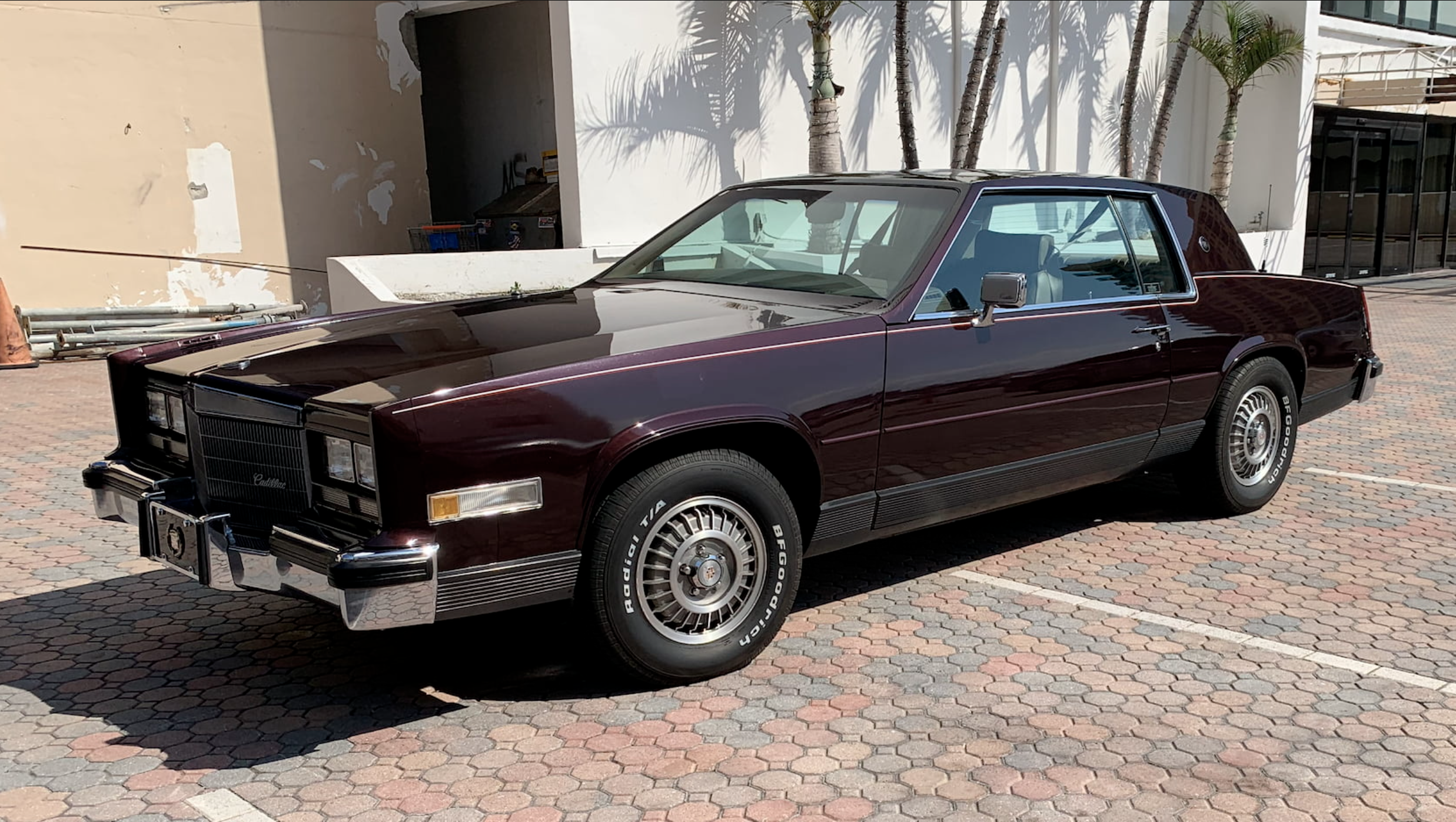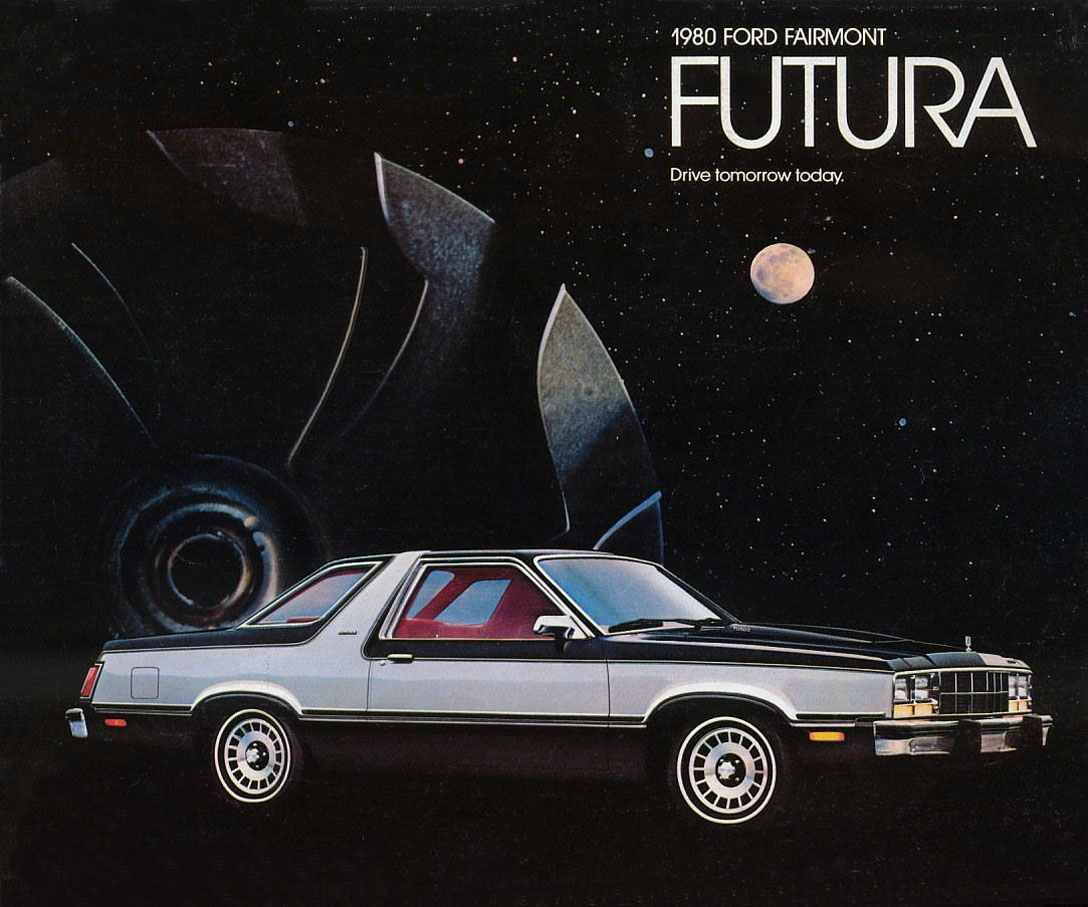
1980 Ford Fairmont Futura coupe

“Drive your Futura of tomorrow … today.”

1980 model year changes to Ford’s Fairmont Futura coupe included new engine choices and a new Tu-Tone paint treatment. Newly standard were P-metric steel-belted radial ply tires, high-illumination halogen headlamps, and a maintenance-free battery.

The Fairmont was the first of the Fox platforms to make it to market. Initially available for the 1978 model year, it replaced the Maverick as Ford’s compact offering. The Futura coupe’s distinctive wrapover B-pillar design came from a March 1976 Fairmont-based Thunderbird proposal.

Ford had been using the Fairmont name for a while by 1978—Ford of Australia had first used it in 1965. The Futura name was even older, dating back to a Lincoln concept car designed in 1954 and debuting as a higher-trim model of the Falcon in 1961.

Powertrains, Performance, & Standard Equipment

The Fairmont Futura’s standard engine was the Lima 88 bhp 2.3 liter/140 ci inline four with a two-barrel carburetor. The Thriftpower 91 bhp 3.3 liter/200 ci inline six with a one-barrel carburetor ($169) was available, and had 36% more torque than the four. A Windsor 119 bhp 4.2 liter/255 ci V8 with a two-barrel carburetor ($288) was also available—a substantial downgrade from the 139 bhp 4.9 liter/302 ci engine that had been available in 1978 and 1979.

There was once some argument, but it now seems reasonably clear that some Futuras were built with the heavily advertised turbocharged four ($481). This engine was rated at 120 bhp and included a prominent hood bulge with Turbo insignia. Reliability must not have met Ford’s expectations, because the turbocharged four didn’t make it to the 1981 model year.

A four-speed manual was standard with the base 2.3 liter inline four, while a four-speed manual with overdrive was standard with the 3.3 liter inline six. A SelectShift three-speed automatic ($340) was required with the turbocharged four and the V8, and optional for the two other engines.

Performance wasn’t great, but few domestic competitors were much better. Road & Track clocked a 15.8-second 0-60 time with the base powertrain. Best-case times with either the turbo four or the V8 were probably about two seconds better, but a Futura driver wasn’t looking to go racing.

Fuel economy ratings with the base powertrain were impressive: 28 city/38 highway by the day’s standards. The far more common 3.3 liter six/automatic combination was 20/27, with the V8 getting 18/26. The turbo came in at 19/26. With a 14-gallon fuel tank, Fairmont buyers with the 3.3 liter six and the automatic could expect a range of 270 to 295 miles.

Cover of the 1980 Ford Fairmont Futura brochure

The Fairmont Futura coupe’s base price was $5,531—$23,500 in today’s dollars. Standard exterior and mechanical equipment included dual rectangular halogen headlamps, wraparound taillamps, rack and pinion steering, front disc/rear drum brakes, and P-metric 14-inch black sidewall radial-ply radial tires on 14-inch wheels with Deluxe wheel covers. Inside, accent vinyl low-back front bucket seats and a Deluxe steering wheel hub were included.

Some of the Futura‘s standard interiors depended on the engine and transmission chosen. Buyers of the base 2.3 liter four with the four-speed manual and the turbocharged four with the automatic got low-back front bucket seats in pebble-grain vinyl. Buyers of the 3.3 liter six with the manual and the V8 with the automatic got a bench seat.

Packages, Options, & Production Numbers

The Ghia package ($193) included dual remote-control mirrors, a Ghia badge, plush cut-pile carpeting, a carpeted trunk, a Luxury steering wheel, a glove box lock, sun visors, and a right hand visor vanity mirror. Ghia buyers got a Flight Bench seat in either Luxury velour cloth or pebble-grain vinyl if they chose an automatic transmission, or bucket seats with the four-speed manual.

The Sports group ($114) included an over-the-roof tape stripe, color-keyed turbine wheel covers, and a charcoal/argent grille.

Individual exterior and mechanical options included power front disc brakes ($78) and power steering ($165). Inside, air conditioning ($671), a tilt steering wheel ($78), fingertip speed control ($116), power side windows ($135), and power door locks ($88) were available.

Ford produced 51,878 Futura coupes in 1980, making up 16% of overall Fairmont production in a year where overall Ford sales were down. 1,158 Fairmonts were turbos.

The View From 2025

It is striking both how many Fairmont versions there were and how much effort Ford put into marketing the Futura. Ford presented six versions of the Fairmont:

  • a 2-door sedan, which had a normal roofline and looked much plainer than the Futura
  • a 4-door sedan
  • the Futura coupe
  • the Futura sedan, which joined mid-year and had the same grille and many of the same features as the Futura coupe
  • a 4-door wagon
  • a Squire-branded 4-door wagon with woodgrain vinyl

Though the Futura got two full pages in the Fairmont brochure, Ford also made an eight-page Futura-specific brochure available.

Fairmont Futuras are not often seen for sale in any venue. AutoTrader Classic has an occasional Fairmont, while Bring a Trailer has sold a grand total of one Fairmont overall—a wagon. The word Fairmont appears in the Hemmings Motor News classifieds more as a component (of Model A replicas, for example) than a vehicle. One exception to this lack of sales visibility came in January 2024, when Barrett-Jackson auctioned a 1978 Ford Futura coupe for a $34,000 hammer price—it was the 100,000,000 U.S.-built Ford vehicle.

Make mine Candyapple Red, please.

Other 1980 Fords I have written about include the F-150 pickup truck, the Fiesta hatchback coupe, the Mustang Cobra hatchback coupe, and the Thunderbird coupe. I evidently do not write about a lot of Ford sedans.

1987 Pontiac Firebird Formula hatchback coupe

“The thrill of pure, uncluttered driving excitement is back.”

For 1987, the Formula returned to Pontiac’s offerings after a six-year pause. The general messaging of the Formula was all the performance of the Trans Am, but with few of the Trans Am’s exterior add-ons and little of the interior comfort of the Trans Am GTA. At $12,413—about $36,600 in today’s dollars—the Formula was 14% less expensive than a Trans Am.

The Formula’s standard powertrain was the LG4 170 bhp 5.0 liter/305 ci V8 with a four-barrel carburetor paired with a five-speed manual. The LB9 185 bhp 5.0 liter/305 ci V8 with tuned port injection ($745) and the big dog B2L 210 bhp 5.7 liter/350 ci V8 with tuned port injection ($1,045) were available options. The 5.7-liter engine required the four-speed automatic ($490).

Performance had improved steadily since 1982, yielding a zero to sixty times of about seven seconds. Mileage with arguably the sportiest combination (5.0 liter tuned port injection and five-speed) was 16 city/26 highway by the day’s standards (15/24 by 2025 measures), with the 5.7 liter/automatic transmission combination only slightly worse. With a smallish (approximately 16.0-gallon) fuel tank, a Formula owner with the base powertrain could expect a range of between 280 and 300 miles with a 10% fuel reserve.

Firebird Formula pages from the 1987 Pontiac brochure

Standard exterior and mechanical equipment on the 1987 Firebird Formula included a front air dam, a dome hood, a body color aero deck rear spoiler, a special performance suspension, power brakes, and P245/50VR16 Goodyear Eagle tires on Hi-Tech 16″ x 8″ aluminum wheels. Inside, reclining cloth front bucket seats, cloth rear folding seats, a Formula three-spoke steering wheel, a full-length console with instrument panel, complete analog instrumentation, side window defoggers, and a Delco AM radio were included.

Packages, Individual Options, & Production Numbers

By 1987, General Motors was finally figuring out the build complexity costs of tens or hundreds of individual options. Thus, packages came into play.

  • The Formula Package I ($1,273) included body side moldings, air conditioning with Soft Ray tinted glass, a tilt steering wheel, and a Delco ETR AM/FM stereo with seek, scan, and clock.
  • The Formula Package II ($1,842) included everything in Formula Package I plus cruise control, controlled-cycle windshield wipers, power windows, power door locks, and a deck lid release.

Individual options not included in either of the packages included a removable glass hatch roof ($920), a limited slip differential ($100), an electric rear window defogger ($145), and a series of radios ranging up to the “Touch Control” ETR AM stereo/FM stereo with seek-scan, search-replay/auto reverse cassette, graphic equalizer, and clock ($529).

Pontiac sold 13,164 Formulas in the 1987 model year, accounting for about 16% of overall Firebird sales (the base Firebird coupe was the best seller with approximately 47% of sales). Third-generation Formula sales would peak at 16,670 in 1989, and would never approach that total again.

The View From 2025

I believe the Formula‘s somewhat restrained looks (compared to the Trans Am) have aged well, and their comparative rarity makes them special.

According to Hagerty‘s valuation tools, a 1987 Firebird Formula with the base 5.0 liter V8 and the manual in #1/Concours condition is $25,600, with a far more normal #3/Good condition version going for $9,800. Late-1980s Formulas are sometimes available in the Hemmings Motor News classifieds, on eBay Motors, and on Bring a Trailer.

Make mine Flame Red Metallic, please.

Other eighties Firebirds I have written about include the 1981 Trans Am coupe, the 1982 Trans Am hatchback coupe, the 1985 Trans Am hatchback coupe, the 1986 SE hatchback coupe, and the 1989 Turbo Trans Am hatchback coupe. Someday, I’ll get to a base Firebird—I guess the question is what year.

Last updated November 2025.

1986 Porsche 911 Turbo coupe

“There is nothing else like it. Nothing.”

After a six-year pause, Porsche brought the 911 Turbo back to the United States market in 1986. The difference compared to other 911s was, of course, the engine, a Bosch fuel-injected 282 bhp 3.3 liter/201 ci flat six with a turbocharger.

With the standard four-speed manual transmission (the Porsche five-speed could not reliably handle the Turbo‘s power), you could expect to hit 60 mph in 6.1 seconds, with a top speed of 157 mph in the 3,000-pound Turbo (the 2025 911 Turbo coupe is about 3,700 pounds). Fuel mileage was an unimpressive 16 city/22 highway by the day’s standards (15/20 by today’s measures) with premium gas, which meant you were paying a $500 gas guzzler tax. A 22.5-gallon gas tank meant a range of 355 to 380 miles with a 10% fuel reserve.

1986 Porsche 930 Turbo print advertisement

The 911 Turbo‘s base price was $53,475—about $157,000 in 2025 dollars. Standard exterior and mechanical equipment included tinted glass all around, a front and rear spoiler, heatable and electrically adjustable outside mirrors, heatable windshield washer nozzles, integrated fog lights, four-wheel vented disc brakes (but no ABS), and an engine oil cooler. Tires were 225/50VR-16 in the front and 245/45VR-16 for the rear, both mounted to 16-inch forged alloy wheels (both tire sizes are still readily available). Inside, a leather interior, a 4-spoke leather-covered steering wheel, an air conditioner, a central locking system, power windows, and Blaupunkt’s Monterey AM/FM stereo cassette with four speakers were all standard.

Production & Period Reviews

Porsche sold 1,424 Turbos in the United States during the 1986 model year, with many of the eager buyers happy to avoid the vicissitudes of gray market imports.

Like many turbocharged Porsches in the 1980s, the 911 Turbo was somewhat of a poster child for turbo lag. The immortal quote from Car and Driver:

“A cheerleader in a clapped-out Mustang II will have no trouble beating you across an intersection while checking her makeup. As a matter of fact, one did exactly that to us.”

All the buff books agreed that the wider rear wheels and tires substantially improved the handling over 1970s Turbos. However, there was a feeling that the mid-eighties Turbo was not as differentiating as the seventies version had been, perhaps because many other performance cars (including others from Porsche) had closed the gap by 1986.

The View From 2025

After all that has been written about them, I don’t feel I have anything startlingly new to say about the 911 Turbo—perhaps the reason it has taken me so long to generate a blog post about it.

Porsche 911 Turbos have (of course) excellent club support from many sources and are often available in the Hemmings Motor News classifieds, on eBay Motors, and on Bring a Trailer. 911 Turbos from the 1980s have held their values very well. According to Hagerty’s valuation tools, all the money for a 1986 Porsche 911 Turbo coupe in #1/Concours condition is $275,000, with a more normal #3/Good condition car going for $175,000. As I write this blog entry in April 2025, there’s a Black 1986 911 Turbo with black leather seats and 16,000 miles for sale on Hemmings, asking $182,500.

Make mine Silver Metallic, please.

Other eighties Porsches I have written about include the 1980 924 hatchback coupe, the 1982 924 Turbo hatchback coupe, the 1982 928 hatchback coupe, the 1985 911 Carrera Cabriolet, the 1986 944 Turbo hatchback coupe, the 1987 911 Carrera coupe, and the 1988 944 hatchback coupe.

Chrysler Corporation’s Transition To Front-Wheel-Drive

I was working on a blog post on the 1981 Chrysler New Yorker, and I got to thinking about the nuts and bolts of Chrysler’s transition to front-wheel-drive in the United States. For this study, I looked at only non-imported cars (no Arrows, Colts, or Sapporos), and only at offerings from the Chrysler, Dodge, and Plymouth brands.

1977: the year before the Omni/Horizon hatchback sedan debuted, Chrysler Corporation had four platforms, all of them rear-wheel-drive. The F-body Aspen/Volaré compact was by far the sales leader—approximately 48% of Chrysler’s 1.2 million sales. The other offerings were the M-body premium mid-size (new for 1977, with the Dodge Diplomat sedan fated to make it all the way to 1989), the B-body mid-size, and the C-body full-size.

1978: the L-body Omni/Horizon hatchback sold well in its first year, with almost 167,000 exiting Dodge and Plymouth dealerships. These numbers comprised 15% of overall domestic production, with the Aspen/Volaré still being the sales leader. Chrysler Corporation sales declined by about 13%.

1979: a coupe version of the L-body made it to market, branded as Omni 024 and Horizon TC3. Overall Omni/Horizon sales were now 27% of total production, partly because Chrysler’s sales continued to collapse (off another 11%). Chrysler did bring the downsized rear-wheel-drive R-body full-size platform to market, replacing the C-body. 1979 was the last year that the Aspen/Volaré led Chrysler sales.

1980: Omni/Horizon sales increased by 2% to 264,000. They were now 41% of overall domestic production and by far the sales leader in another down year. The rear-wheel-drive J-body coupes (Cordoba and Mirada) replaced the B-body, but didn’t sell any better. 1980 was the final year for the Aspen/Volaré.

1981: a lot changed at your local Dodge or Plymouth showroom in 1981. The Aspen/Volaré was retired, putatively replaced by the heavily publicized Aries/Reliant K-body. Sales of the two front-wheel-drive platforms combined for 81% of overall production, and domestic Chrysler automobile production was up for the first time in many years.

1982: Chrysler added Super K models to the mix—really just slightly nicer versions of the Aries and Reliant. The Chrysler brand got its first front-wheel-drive offering with the LeBaron coupe, sedan, station wagon, and (late in the model year) convertible. The rear-wheel-drive C-body full-size was retired after only three years, with the New Yorker and Gran Fury marques transitioning to the rear-wheel-drive M-body mid-size platform. Despite the increased front-wheel-drive choices, their percentage of production increased only half a percent.

1983: Chrysler introduced the E-body—an extended version of the K-body with three more inches of wheelbase. Dodge got the 600 sedan, while Chrysler got two models—the E Class and the New Yorker (switching platforms yet again). Chrysler’s M-body offering was renamed to New Yorker Fifth Avenue, but I’m betting many potential buyers were still confused. 1983 was also the last year for the J-body coupes, with the Cordoba, Imperial, and Mirada going away.

1984: the sporty G-body Daytona and Laser hatchbacks were announced. Chrysler rebranded the rear-wheel-drive New Yorker Fifth Avenue as simply Fifth Avenue—probably a good idea. With only the M-body as a rear-wheel drive offering, the percentage of front-wheel-drive vehicles reached 88%.

1985: the Chrysler E Class vanished, but magically reappeared as the Plymouth Caravelle. The H-class mid-size sedan debuted in Lancer and LeBaron GTS forms. Dodge kept interest going in the aging L-body with increasingly quicker variants: 1985 had the Omni GLH and the Shelby Charger.

Chart of Chrysler's transition from rear-wheel-drive to front-wheel-drive

1986: unlike the previous five years, things were relatively quiet in 1986, with no model introductions or phase-outs. The K-body convertible was in its final year—there would be no Chrysler LeBarons (Mark Cross or Town & Country) or Dodge 600s after 1986.

1987: the Super K platform disappeared, and the P-body and front-wheel-drive J-body platforms debuted. The K-body offerings no longer included a LeBaron coupe or convertible, but the LeBaron sedan and station wagon and the Aries/Reliant twins were still good for a quarter of overall production. The percentage of front-wheel drive cars hit 90%, but Chrysler still sold over 100,000 of the M-body sedans, with the Chrysler Fifth Avenue being the leader.

1988: the front-wheel-drive C-body debuted, at that point the largest Chrysler front-wheel-drive offering—by an inch of wheelbase. It was seen in the Dodge Dynasty, and yet another version of the New Yorker—the end-of-the-line E-body based New Yorker was branded as New Yorker Turbo. Front-wheel-drive sales hit 93%.

1989: the E-body went away, with the A-body Dodge Spirit and Plymouth Acclaim sedans replacing it. For the first time since 1980, the K-body was not the best-selling platform—the C-body took over the sales crown in its second year, with 207,000 sold. Front-wheel-drive was now 97% of production.

1990: Chrysler Corporation discontinued three platforms in 1990. The K-body and H-body went away, but most important for this narrative is that the rear-wheel-drive M-body was gone. The transition was complete, but Chrysler would return to rear-wheel-drive in 1992 with the Dodge Viper.

1981 Chrysler New Yorker sedan

“So many reasons for superiority.”

For 1981, Chrysler’s full-size New Yorker sedan got few changes. The 5.9 liter/360 ci V8 was no longer available, but the optional four-barrel version of the 5.2 liter/318 ci V8 received a horsepower bump. There was a new grille, but otherwise, changes between a 1980 and a 1981 New Yorker are tricky to spot.

The standard powertrain for the New Yorker was the 130 bhp LA 5.2 liter/318 ci V8 with a two-barrel carburetor mated to a TorqueFlite three-speed automatic transmission. New Yorker buyers could choose a four-barrel version of the same engine ($68) that was rated at a respectable for 1981 165 bhp.

No matter which engine, performance was unimpressive in a car with a 3,900-pound curb weight. The 0-60 time was likely a little over 14 seconds with the base engine, with the optional mill dropping that number by about two seconds. Fuel economy was 17 city/26 highway by the day’s standards with the base engine and 16 highway/23 with the uprated one. With a 20.9-gallon gas tank, a New Yorker owner could expect a range of 330 to 405 miles with a 10% fuel reserve.

New Yorker page from the 1981 full-size Chrysler brochure

Standard exterior and mechanical equipment on the $10,463 1981 New Yorker (about $39,500 in today’s dollars) included tinted glass on all windows, a Landau padded vinyl roof, power front disc/rear drum brakes, and P205/75R15 steel-belted wide white sidewall tires on 15-inch wheels with Premier wheel covers. Inside, cloth and vinyl 60/40 individually adjustable seats with folding center armrest and passenger seat recliner, a Luxury steering wheel, manual control air conditioning, power windows, and an AM/FM stereo radio were included. Standard on the New Yorker, the Light Package included a trunk light, a glove box light, an ash receiver light, a rear door courtesy light, and an under hood light.

Packages, Options, & Production Numbers

Chrysler’s marketers seem to have reacted to challenging market conditions by giving buyers many choices of packages and options. Package choices for the New Yorker included:

  • The Basic package ($156) included a vinyl body-side molding, a right remote control convex mirror, deluxe windshield wipers, and undercoating.
  • The Premium Speaker System ($95) included two front and two piezo electric two-way coaxial rear speakers, along with a 15 watt per channel rear amplifier.
  • The Heavy-Duty package included a heavy-duty suspension, a 3.2 axle ratio, an auxiliary transmission oil cooler, a power steering oil cooler, and a 500-amp Long Life Maintenance Free battery. It required the optional four-barrel carburetted V8 and P225/70R15 steel belted radial tires.
  • The Open Road Handling package ($180) included a Firm Feel suspension (front and rear heavy-duty sway bars, heavy-duty shock absorbers, heavy-duty front torsion bars, heavy-duty rear springs), special Firm Feel power steering, and P225/70R15 steel belted wider white sidewall radial tires.
  • The Fifth Avenue Edition package ($1,822) included halogen headlights, cornering lamps, front fender louvers, special lighted quarter windows, wire wheel covers, a conventional spare tire, and a 500-amp Long Life Maintenance Free battery. Inside, Fifth Avenue buyers got a left power seat, deep pile carpets, front and rear floor mats, a Luxury steering with leather-wrapped rim, a tilt steering column, semi automatic temperature control air conditioning, semi-automatic speed control, power door locks, and a power deck lid. They also got the Premium Speaker System and a choice of four stereos, along with a power antenna (except with the CB choice).
  • The Carriage Roof package ($854) was only available with the Fifth Avenue Edition. It included a brushed stainless steel forward half roof cap and a padded Landau top with a small frenched backlight, bright surround moldings, and a forward bright transverse molding with integral electro luminescent lights.

Individual exterior and mechanical options included special paint ($68), a halogen headlamp system ($41), a power operated glass sun roof ($934), and styled aluminum road wheels ($321, $70 with the Fifth Avenue Edition). Inside, a leather 60/40 bench seat ($676), a tilt steering wheel ($84), and an electrically heated rear window defroster ($112 and required in New York State) were available. Three stereos were optional for the New Yorker, with the most pricey being the AM/FM stereo with a CB transceiver and a fixed tri band antenna ($261 and included with the Fifth Avenue Edition). A well-equipped New Yorker could easily run to about $13,300—real money in 1981 and about $50,100 in today’s dollars.

Despite the hopeful brochure slogans, it was clear in 1981 that the era of the big Chrysler was ending—New Yorker sales were off 36% to 6,548. The situation with the less-expensive Newport was even worse, with a decline of 67%. By the 1982 model year, full-size Chryslers would be gone, with the M-body New Yorker mid-size being Chrysler’s new top-of-the-line sedan. The R-bodies had only lasted three model years.

There were many reasons for this failure. Probably made worse by frightening build complexity, Chrysler’s quality was at perhaps its absolute nadir, and the word had gotten out. Overall automotive market conditions were also not great, with the early eighties being tough for many marques. Finally, there was legitimate and realistic concern that Chrysler might go out of business.

The View From 2025

There are not a lot of these handsome cars left. Hagerty doesn’t track New Yorkers built after 1970, so it’s hard to get a feel for values. They occasionally appear in the Hemmings Motor News classifieds, on eBay Motors, and on Bring a Trailer. In March 2025, a 1980 New Yorker Fifth Avenue Edition hammered for $11,000 at Mecum Glendale.

Make mine the extra-cost Mahogany Starmist, please.

Other eighties Chryslers I have written about include the 1980 Cordoba coupe, the 1982 LeBaron convertible, the 1983 Imperial coupe, the 1984 Laser hatchback coupe, the 1986 Town & Country convertible, and the 1987 Fifth Avenue sedan.

1987 Chevrolet El Camino pickup truck

In the decade plus since I started this blog I have worked on three separate El Camino posts. I’m finally publishing one today.

“There’s nothing quite like it.”

In its final year, the Chevrolet El Camino received few changes. The standard engine remained the LB4 145 bhp 4.3 liter/262 ci V6 with electronic fuel injection. The LG4 150 bhp 5.0 liter/305 ci V8 with a four-barrel carburetor was a $440 option, but it’s unclear whether it made much of a performance difference—0-60 likely came in about 11 seconds. Both engines were paired with a three-speed automatic transmission, with an available four-speed automatic ($175).

Period fuel economy ratings for the four power combinations tell an interesting story:

4.3 liter V65.0 liter V8
Three-speed automatic18 city/22 highway15 city/17 highway
Four-speed automatic18 city/23 highway16 city/22 highway

The short form seems to be that, if you had to have the V8 and you wanted to do some highway driving, you should really get the four-speed automatic. With a 17.7-gallon gas tank, the best-case range was about 305 to 325 miles with a 10% reserve—the V8/three-speed combination was more like 230 to 255 miles.

Pages from the 1987 Chevrolet El Camino brochure

The 1987 El Camino’s base price was $10,013—about $29,400 in today’s dollars, which is almost what a base 2025 Chevrolet Colorado pickup truck goes for. Standard exterior and mechanical equipment included power steering, power front disk/rear drum brakes, and P205/75R14 black sidewall all-season steel-belted radial tires (a size still available) on painted wheels with bright full wheel covers. Inside, a full-width cloth front bench seat with a pull-down center armrest, cut-pile carpeting, and a lighted glove box were standard.

Considered a separate model, the $10,344 El Camino SS Sport Decor added a choice of eight lower body accent colors emphasized by a pin-striping decal, a large front air dam, matching dual aero-type mirrors with a left-hand remote, black quarter window moldings, and painted Rally wheels.

Packages, Options, & Production Numbers

The $238 Conquista package included two-tone paint separated with bright moldings, along with a Conquista decal on the tailgate.

The SS Choo Choo package was available. Choo Choo Customs started with regular El Caminos fitted with Rally wheels and sport mirrors and replaced the stock El Camino fascia with a polyurethane nose similar to the one found on Chevrolet’s Monte Carlo SS Sport Coupe. Decals were placed on the tailgate, doors, and nose, and a specific plaque was added to the dash.

Exterior and mechanical options include Soft-Ray tinted glass ($120), halogen headlamps ($25), a limited slip differential ($100), a sport suspension ($16), and a 22-gallon fuel tank ($29). Inside, reclining front cloth bucket seats ($147 and available with a $110 console), a Comfortilt steering wheel ($125), electronic speed control ($175), air conditioning ($775), power door locks ($145), and power windows ($210) were available. Six different radios were available, ranging from an AM radio ($122) up to an AM stereo/FM stereo with cassette, seek and scan, search and repeat, graphic equalizer, and clock ($579). A well-equipped El Camino could easily get to $12,900 or so—about $37,900 in today’s dollars.

With 15,589 sold, the El Camino was a mere 1.3% of Chevrolet’s production in 1987. This wasn’t actually far off from 1986’s numbers, but was a pronounced decline from the halcyon days of the early 1980s—Chevrolet had sold 40,932 El Caminos in 1980.

The View From 2025

I’ve liked this El Caminos since they debuted. El Caminos have always been attractive to collectors, and the eighties versions are no exception. These trucks often appear for sale in the Hemming’s Motor News classifieds, on eBay Motors, and on Bring a Trailer. According to Hagerty‘s valuation tools, a 1987 El Camino Conquista with the V8 in #1/Concours condition is $29,400, with a more normal #3/Good condition truck going for $10,200. The SS and SS Choo-Choo versions are worth more, but not much more.

Make mine Silver Metallic over Dark Maroon Metallic, please. That makes it a Conquista.

Other 1987 Chevrolets I have written about include the Caprice Classic coupe and the Chevette CS hatchback sedan. Other Chevrolet trucks and SUVs covered in Eighties Cars include the 1983 S-10 Blazer SUV, the 1985 C20 Suburban Silverado SUV, the 1985 K5 Blazer SUV, and the 1985 S-10 pickup truck.

Last updated October 2025.

Interesting Eighties Vehicles at the 2025 Mecum Glendale

Mecum’s annual Glendale, AZ auction finished on March 22nd this year, with 1,351 car and truck lots crossing the block over five days and 881 selling (65%). Below are six of the 65 eighties vehicles that sold (out of 85 lots) that attracted my eye.

Photo of 1988 Suzuki Samurai LX
1988 Suzuki Samurai LX, linked from Mecum’s website

[Lot G109] 1988 Suzuki Samurai JX SUV. White with a white top and brown/black vinyl front bucket seats. G13A 64 bhp 1.3 liter/81 ci inline four with a one-barrel carburetor, a five-speed manual, and 63,000 miles. $12,000 hammer price for a reasonably stock Samurai.

Photo of 1983 Pontiac Parisienne Brougham
1983 Pontiac Parisienne Brougham, linked from Mecum’s website

[G117] 1983 Pontiac Parisienne Brougham sedan. Dark Maroon Metallic with a maroon vinyl top and a maroon cloth front seat. LG4 150 bhp 5.0 liter/305 ci V8 with a four-barrel carburetor, a three-speed automatic, and 102,000 miles. $9,000 for this Canadian market car—the speedometer is the giveaway. I covered the US version earlier this month.

1981 Chevrolet El Camino, linked from Mecum’s website

[L189] 1981 Chevrolet El Camino pickup truck. Medium Sandstone Metallic with a tan cloth split-back front bench seat. LC3 110 bhp 3.8 liter/229 ci V6, a three-speed automatic, and 23,000 miles. $10,000 for an unmodified eighties El Camino—which is unusual. I finally published a post about the El Camino recently, discussing the 1987.

1980 Chrysler New Yorker, linked from Mecum’s website

[T166] 1980 Chrysler New Yorker Fifth Avenue Edition (you can tell by the front fender louvres) sedan. Black with a Black padded Landau roof and a beige leather and vinyl split 60/40 front bench seat. LA 135 bhp 5.9 liter/360 ci V8 with a two-barrel carburetor, a TorqueFlite three-speed automatic, and 16,000 miles. $11,000—how many are left, especially with the “big” V8? Methinks I should write about these cars …

Photo of 1983 Lincoln Continental Mark VI dash center
1983 Lincoln Continental Mark VI interior detail, courtesy of Mecum

[T168] 1983 Lincoln Continental Mark VI Bill Blass Edition coupe. Midnight Black upper body over French Vanilla over Midnight Black lower body with a Black Cambria carriage roof and French Vanilla Twin Comfort Lounge front seats with leather seating surfaces (Lincoln’s lengthy description). Windsor 150 bhp 4.9 liter/302 ci V8 with fuel injection, a four-speed automatic, and 18,000 miles. $24,000 is solid money for a 1983 Mark VI. I have written about the debut Mark VI coupe.

1989 Chevrolet Blazer, linked from Mecum’s website

[F97] 1989 Chevrolet K5 Blazer Silverado SUV. Gray Metallic with a Gray top and Slate Gray Custom vinyl reclining front bucket seats. L05 210 bhp 5.7 liter/250 ci V8 with electronic fuel injection, a four-speed automatic, and 27 miles. Someone bid $112,500 for an essentially brand-new but 34-year-old Blazer (I have written about the 1985 version).

1980 Ford F-150 pickup truck

“First new truck of the 80’s …”

For 1980, Ford’s pickup truck was nearly all-new, with a more aerodynamic body that reduced drag at highway speeds by up to 13%. There was also an increased emphasis on comfort, with increased legroom over 1979. Ford sold four versions of the full-size truck—the light-duty F-100, the F-150, the 3/4 ton F-250, and the 1-ton F-350. For this blog post, we’ll concentrate on the F-150, which was the best-selling of the four versions, and pick the more popular rear-wheel-drive example over the four-wheel-drive.

The standard engine was the 101 bhp Big Six 4.9 liter/300 ci six. A 130 bhp 4.9 liter/302 ci V8 ($315) and a 156 bhp 5.8 liter/351 ci V8 ($477) were optional. A three-speed manual transmission was standard on rear-wheel-drive F-150s, but many buyers chose the four-speed manual ($175), the four-speed manual with overdrive ($208), or the Select-Shift three-speed automatic ($408).

Pages from the 1980 Ford Pickup brochure

Standard exterior and mechanical equipment on the base $5,314 Custom F-150 short bed included a bright grille surround, an independent front suspension, power front disc/rear drum brakes, P215/75R15SL black sidewall tires (a size still readily available), and 15-inch wheels with argent hub caps. Inside, all vinyl seat trim, a coat hook, a dome light, and a glove box with a latch were included.

Packages

The 1980 Ford F-150 was replete with packages that ranged from making it a little nicer to reasonably luxurious.

  • The $339 Ranger package added a brushed aluminum lower bodyside molding and bright hub caps on the exterior. Inside, all-vinyl or cloth and vinyl seat trim, color keyed seat belts, and a cigarette lighter were included.
  • Exterior features of the $472 Ranger XLT package depended on whether the truck was Flareside or Styleside. Flareside pickups had tailgate trim with raised FORD letters in a contrasting color with a dual-colored tape stripe setting off the letters. Styleside pickups included a brushed aluminum tailgate applique with bright letters. Inside, all Ranger XLTs included grained vinyl seat trim with cloth inserts, carpeted lower door trim panels, bright aluminum door scuff plates, and color-keyed cut-pile carpeting.
  • Exterior features of the top-of-the-line Ranger Lariat package ($760) included a brushed aluminum lower bodyside molding with a black vinyl insert and (of course) three Lariat plaques. Inside, all Ranger Lariats included a unique seat trim sew style in cloth and vinyl or all-vinyl, thick cut-pile carpeting, a Luxury-type steering wheel, and an instrument panel with a polished woodtone applique and a bright Ranger Lariat script.
  • Free Wheeling package “A” ($407) included pinstriping, blackout grille, blackout headlamp doors, and Sport wheel covers.
  • Free Wheeling package “B” ($1,266) included everything in package “A” plus foglamps, bumper guards, the Handling Package, and 10-hole aluminum wheels. Flareside pickups received a bright channel bumper, while Styleside pickups got a bright rear contour bumper. Inside, a simulated leather-wrapped steering wheel and the Sports Instrumentation Package with tachometer, trip odometer, ammeter, and oil pressure gauge.

Options & Production Numbers

Individual options were many and included tinted glass on all windows ($36), a sliding rear window ($102), variable-ratio power steering ($215), white styled steel wheels ($161), and forged aluminum wheels available either with a brushed finish ($311) or a polished finish ($361). Inside, a tilt steering wheel ($83), air conditioning ($611), and Speed Control ($160) were available. A choice of five radios ranged up to an AM/FM stereo with cassette tape ($324). Despite the luxury emphasis, power door locks and power windows were not available—they wouldn’t be offered until 1982.

Ford sold 173,050 F-150s in the 1980 model year. That number sounds like a lot, but 1980 was a bad year for the automotive industry overall and an awful year for Ford, whose US market share dropped from 23.8% in 1979 to 20.5% in 1980. Of Ford trucks, only the imported Courier compact pickup would hold the line on sales volume.

The View From 2025

Folks are collecting these seventh-generation Ford pickup trucks. F-150s often appear for sale in the Hemming’s Motor News classifieds, on eBay Motors, and on Bring a Trailer. According to Hagerty‘s valuation tools, a 1980 Ford F-150 Styleside short bed with the 302 ci V8 in #1/Concours condition is $44,300, with a more normal #3/Good condition truck going for $13,000. A long bed subtracts around 2%, while the 351 ci V8 adds about 5%. Four-wheel-drive is worth an additional 14% or so.

Make mine Candyapple Red, please. I’m unsure if I want any of the four two-tone options.

Other Ford products from 1980 that I have written about include the Ford Fiesta hatchback coupe, the Ford Mustang Cobra hatchback coupe, the Ford Thunderbird coupe, and the Lincoln Continental Mark VI coupe. I’ve also written about the 1985 Eddie Bauer Bronco SUV.

1980 Porsche 924 hatchback coupe

“Many of the 924’s aerodynamic features are apparent in its clean styling.”

For 1980, Porsche’s entry-level 924 generally stood pat. The five-speed transmission changed to an Audi design and a breakerless ignition system was added. Otherwise, a few exterior color changes marked the turn of the model year.

The 924’s engine remained the Volkswagen/Audi EA831 110 bhp 2.0 liter/121 ci inline four with Bosch K-Jetronic fuel injection. This engine—used in many applications—did not make the 924 quick. Period testing with the five-speed manual (an Audi-sourced three-speed automatic was optional) recorded 0-60 mph times of about 10.6 seconds in a car with a curb weight of a little over 2,600 pounds. Fuel economy ratings with the manual were 19 city/32 highway by the day’s standards. With a 17.4-gallon gas tank, a 924 driver could expect a range of 360 to 400 miles with a 10% fuel reserve.

1980 Porsche 924 print advertisement

The 924’s base price was $15,970—about $68,600 in today’s dollars, which is about 9% less than a 2025 Porsche 718 Cayman coupe goes for. Standard exterior and mechanical equipment included retractable headlights, an integral front spoiler, tinted glass, a manual antenna, a four-wheel independent suspension, a front stabilizer bar, rack and pinion steering, power assisted front disc brakes, and 165HR-14 tires on 14-inch wheels. Inside, reclining front bucket seats, a center console, full carpeting, intermittent windshield wipers, power windows, a tachometer, a quartz clock, and an electric window defogger were included.

Options & Production Numbers

Among the options available for the 924 were a removable top ($485), spoke type light alloy wheels ($545), a 4 spoke leather covered steering wheel ($185), heated outside mirrors ($110 each), and air conditioning ($725).

Porsche sold 3,700 examples of the base 924 in the United States in 1980, along with 3,440 units of the far sprightlier Turbo version.

The View From 2025

924s are often cited as “the car that saved Porsche,” and there is good club support for them, as there is for all Porsches. Folks are collecting 924s, though the lack of power limits their appeal. According to Hagerty‘s valuation tools, a 1980 Porsche 924 in #1/Concours condition is $34,000, with a more normal #3/Good condition car going for $8,500. Porsche 924s often show up for sale in the Hemmings Motor News classifieds, on eBay Motors, and on Bring a Trailer.

Make mine Inari Silver Metallic over Onyx Green Metallic, please. Two-tones were a thing in the early eighties.

Other eighties Porsches I have written about include the 1982 928 hatchback coupe, the 1982 Porsche 924 Turbo hatchback coupe, the 1985 911 Carrera Cabriolet, the 1986 944 Turbo hatchback coupe, the 1987 911 3.2 Carrera coupe, and the 1988 944 hatchback coupe.

1988 Toyota Supra hatchback coupe

“It draws a crowd, and leaves it behind.”

For 1988, the third-generation A70 Toyota Supra hatchback coupe had few changes of any importance. The high-mounted brake light changed from a rectangular shape to a trapezoid. Cloth seat upholstery patterns were changed from squares to lines, and the climate control and switch gear buttons went from light to medium gray.

The Supra’s standard powertrain was the 7M-GE 200 bhp 3.0 liter/180 ci inline six with fuel injection paired with a five-speed manual transmission. A four-speed electronically controlled automatic was optional—and expensive. 0-60 times with the five-speed were a little under eight seconds in a car that weighed about 3,500 pounds—a weight that was notably heavy for a sports car in those days. Fuel economy with both transmissions was 18 city/23 highway by the day’s standards (16/22 by today’s measures). With an 18.5-gallon gas tank, Supra owners could expect a range of 320 to 340 miles with a 10% fuel reserve.

Designated as 7M-GTE, the Turbo‘s engine gained a turbocharger with an intercooler, adding 30 bhp and dropping the 0-60 time to around 6.4 seconds.

1988 Toyota Supra print advertisement

The Toyota Supra hatchback coupe’s base price was $21,740—about $60,800 in today’s dollars or almost exactly what a 2026 Supra GR 3.0 Premium goes for. Standard exterior and mechanical equipment included a removable sport roof, quick-ratio power steering, 4-wheel power disk brakes, and 225/50VR16 Goodyear unidirectional tires (a size still readily available) on 16 x 7 aluminum alloy wheels. Inside, an 8-way adjustable driver’s seat, split fold-down rear seatbacks, an automatic temperature control air conditioning system, an electric rear window defogger, power windows, and power door locks were included. The standard sound system was an AM stereo/FM stereo electronic radio with a cassette player, Acoustic Flavor (a tone control equalizer), 4-enclosure speakers, and a diversity antenna.

At $23,760, the Turbo added a Sport package, which included a limited-slip differential, headlamp washers, and the Toyota Electronic Modulated Suspension (TEMS) system.

Options & Production Numbers

Individual options were relatively few and included a limited slip differential ($230 for the base car), anti-lock brakes ($1,100), and a 4-way power driver’s seat ($225). The leather seat package was $990.

Toyota sold 19,596 Supras in 1988—solid numbers, but not quite at the level of the Chevrolet Corvette or the Nissan 300 ZX. Of those almost twenty thousand, about 55% were the Turbo.

The View From 2025

According to Hagerty’s valuation tools, a 1988 Toyota Supra in #1/Concours condition is $37,700. The value for a more “normal” #3/Good condition example is $12,200. Turbos are considerably dearer, with #1/Concours being $82,300, #3/Good at $18,800. This generation of Supras maintains a presence in the Hemming’s Motor News classifieds, on eBay Motors, and on Bring a Trailer. When I first wrote this post in April 2025, there was a Dark Blue Pearl 1988 Supra with Blue leather seats and 33,000 miles for sale in Hemmings, asking $29,900.

Make mine Gray Metallic, please.

I’ve written about one other Supra—the 1982 hatchback coupe. Other Toyotas I’ve written about include the 1980 Corolla Tercel Liftback, the 1981 Celica Sport Coupe, the 1983 Camry sedan, the 1984 Corolla SR5 Sport Coupe, and the 1985 MR2 coupe.

Last updated August 2025.