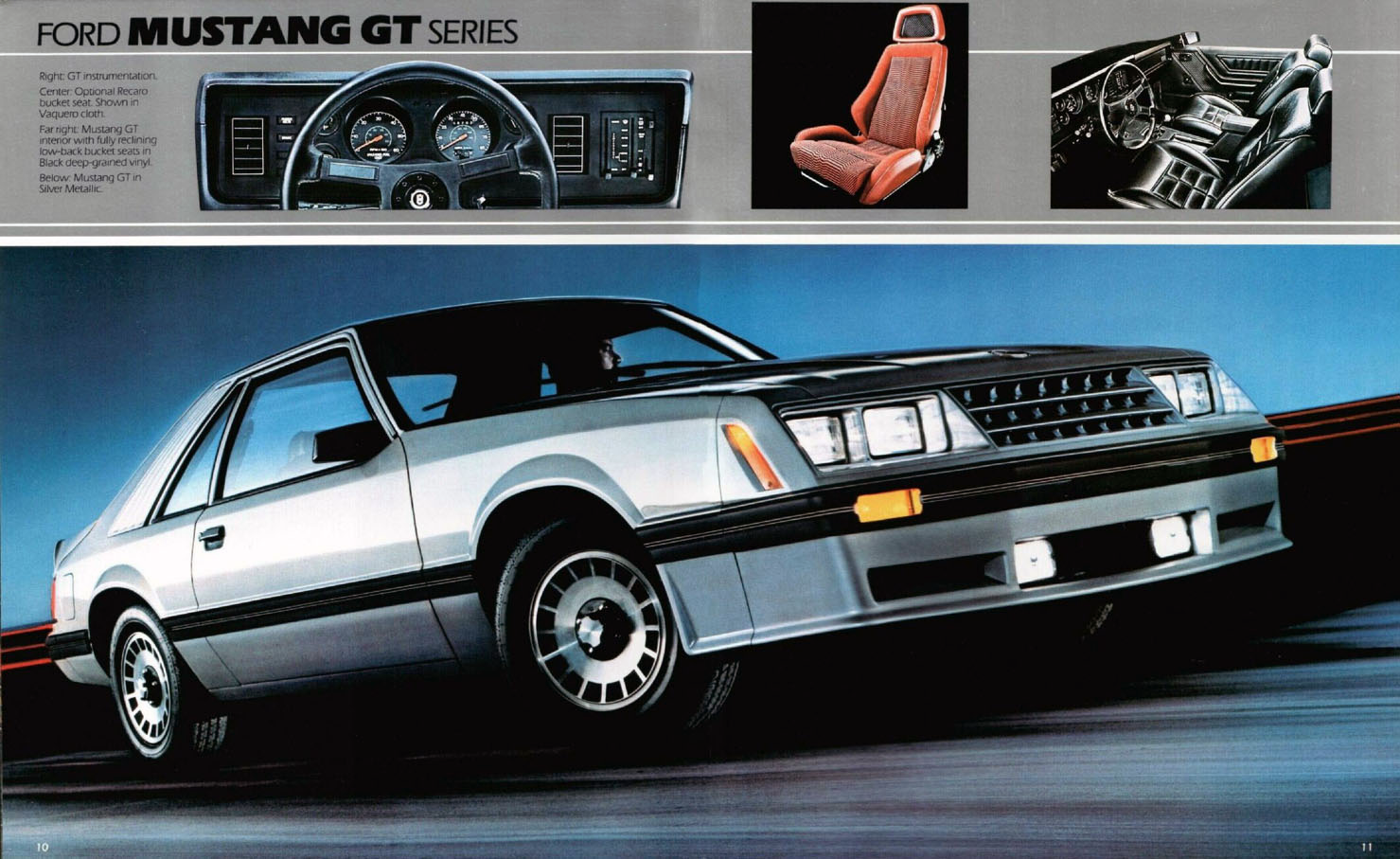
1982 Ford Mustang GT hatchback coupe

This post was one of the earliest in this blog. I’ve updated it to reflect both changes in my posting style and substantial improvements in available data.

“If excitement is your master key, this one opens all the doors.”

The 1982 Ford Mustang GT marked the return to form of America’s definitive pony car and ignited a second round of the power wars with the then brand new third generation Camaro and Firebird. Along with the new GT trim level, the new high output (H.O.) version of the venerable 4.9 liter/302 ci V8 was up to 157 bhp—quite an upgrade from 1981’s 4.2 liter/255 ci engine.

157 bhp feels quaint these days—the lowest horsepower engine for the 2025 Mustang is the 315 bhp turbo four. Still, the 1981 Mustang had topped out at (oog…) 120 bhp and as tested 0-60 times in the 2,600 pound GT dropped by over 3 seconds for 1982, with Motor Trend recording a 6.9-second time in a test car they acknowledged might be a little warmed over. Road & Track timed an 8.0 second 0-60 time in a more civilian GT.

GT pages from the 1982 Ford Mustang brochure

You could get the H.O. engine with any Mustang, but the hot setup was with the GT, which offered a four-speed manual transmission and a 3.08:1 rear axle ratio with a Traction-Lok limited slip differential. Other options that were standard with the $8,308 GT (about $28,800 in today’s dollars) with the 302 were power steering and traction bars. The GT also received cast aluminum wheels, a front air dam, dual fog lamps, a forward-facing hood scoop, and the same rear spoiler initially featured on the first year of the Fox-body Mustang 1979 Pace Car.

Options, Period Reviews, & Production Numbers

Options for the Mustang GT included the SelectAire Conditioner ($676), snazzy Recaro high-back bucket seats ($834), power side windows ($165), and an AM/FM stereo with either 8-track or cassette player ($178)—it seems that 1982 was Ford’s crossover year for 8-track versus cassette.

Period reviews were overwhelmingly positive—Motor Trend stated that the 1982 GT was “it’s the best-balanced, most capable Mustang ever done.” Road & Track mentioned that Ford was leading the “U.S. industry in restoring exhilarating engine performance to the list of options.”

Ford built 23,447 Mustang GTs in the 1982 model year, marking a solid success and attracting a lot of notice. At 45,901 produced, the best seller continued to be the far more vanilla GL fastback.

The View From 2025

This generation of the Mustang GT often appears in the Hemming’s Motor News classifieds, on eBay Motors, and on Bring a Trailer. According to Hagerty’s valuation tools, a 1982 Ford Mustang GT in #1/Concours condition is $44,700, with a more normal #3/Good car going for $12,700.

I only have four exterior color choices with a 1982 Mustang GT—make mine Bright Red, please.

Other Mustangs I have written about include the 1980 Cobra hatchback coupe, the 1981 coupe, the 1983 GT convertible, the 1984 SVO hatchback coupe, and the 1987 LX coupe.

Last updated September 2025.

Eighties Vehicles at the 2014 Barrett-Jackson Reno Tahoe

This year’s Barrett-Jackson Reno Tahoe auction included a few interesting vehicles. As usual, I’ll concentrate on the 1980s cars (and some trucks) that sold and add some of my opinions. Where I have covered the specific year and model of a car in this blog, I link to it.

Thursday:

  • 1983 white GMC Jimmy SUV—$5,700 hammer price.
  • 1980 blue MGB convertible—$5,800 for one of the last of the MGBs.
  • 1981 red Chevrolet C-10 custom pickup truck—$8,500
  • 1983 white Mercedes-Benz 380SL convertible with 97,000 miles—an ouch! at $5,300.
  • 1987 brandywine Chevrolet C-10 custom pickup truck—$8,700
  • 1984 black Chevrolet K-10 custom pickup truck—$12,200
  • 1982 Silver Beige Chevrolet Corvette Collector Edition coupe—$14,000 is between #3 and $4 money, according to Hagerty’s valuation tools.
  • 1989 champagne Mercedes-Benz 560SL convertible—$6,750

Friday:

  • 1987 red Avanti coupe—$8,700 for the eighties version of Raymond Loewy’s elegant sixties coupe.
  • 1989 black Rolls-Royce Silver Spur sedan with 88,000 miles—$17,000
  • 1986 white Zimmer Golden Spirit coupe with 37,000 miles—$20,000 for this “neo-classic”; is it really nicer or a better investment than the Rolls?
  • 1985 white Chevrolet C-10 custom pickup truck—$13,000

Saturday

  • 1987 black Buick Regal Grand National GNX coupe with 37,000 miles—at $43,000, this was the highest eighties car sale of the auction, but only a #4 by Hagerty’s valuation tools. It was, however the only vehicle in this auction to meet my criteria for serious 1980s collectability of original cars or trucks: selling for equal to or above its original base list price.

What do you think of this year’s results?

1984 Lincoln Continental Mark VII LSC coupe

This was one of my early posts in this blog. I’ve updated it to reflect both changes in my posting style and substantial improvements in available data.

“The ultimate American road car.”

The Lincoln Continental Mark VII was all new for 1984. The standard powertrain for 1984 was a Windsor 140 bhp 4.9 liter/302 ci V8 with throttle-body fuel-injection connected to a four-speed automatic transmission. Despite the LSC’s 3,600 pound weight, 0-60 still came in under 9 seconds. Mileage by the standards of the day was 17 city/22 highway (14/20 by today’s standards). With a 22.3-gallon fuel tank, a Mark VII owner could expect a range of 340 to 390 miles with a 10% reserve.

Standard mechanical equipment on all Mark VIIs included four-wheel disk brakes, four-wheel air ride suspension, and the first composite headlights available in the United States. Inside, a Trip Minder computer, air conditioning, rear window defroster, interval wipers, tilt steering, cruise control, remote release fuel door, power windows, power door locks, power side view mirrors, power six-way driver’s seat, and an AM/FM stereo were all included.

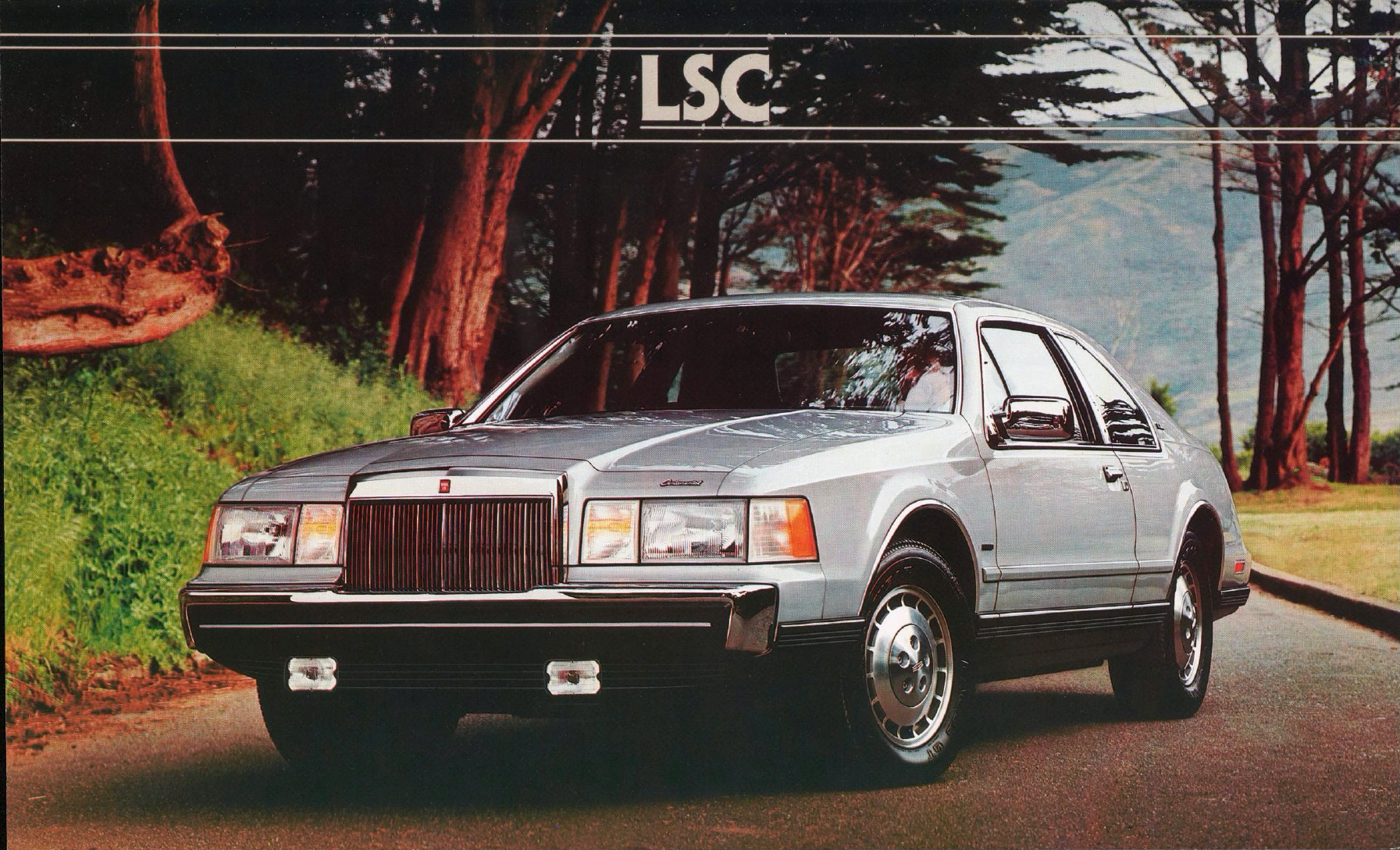
Continental Mark VII LSC page from the 1984 Lincoln brochure

The new LSC trim level added about $2,000 to the base Mark VII’s non-trivial $21,707 price (making the LSC start at about $54,400 in 2014 dollars). LSC-specific components included a stiffer air suspension, dual exhaust, leather seats, fog lamps, and P215/65R15 Goodyear Eagle GT radial tires (a size still readily available) on forged aluminum 15 x 6-inch wheels. A Traction-Lok limited slip differential was optional for $95.

Ford wanted the LSC to compete with the big BMW (635 CSi) and Mercedes-Benz (500 SEC) coupes, but it seems more likely that most LSC buyers were cross-shopping cars like the Buick Riviera T-Type, the Cadillac Eldorado Touring Coupe, or (horrors!) the Ford Thunderbird Turbo Coupe.

I always liked the look of the LSC—I think the stylists combined “traditional” Mark traits such as the rear spare tire hump with Ford’s new aerodynamic direction very effectively. At the time, people complained about the somewhat limited interior room and the quite small trunk for such a large car. The period of the big coupe was beginning to fade, but the LSC was indeed an interesting approach.

According to Hagerty’s valuation tools, all the money for a 1984 Continental Mark VII LSC in #1/Concours condition is $9,100, with a more “normal” #3/Good condition LSC fetching $4,200. Lincoln Mark VIIs show up in the Hemmings Motor News classifieds reasonably regularly—as I write this in July 2014,  there’s a Sandstone 1988 LSC with 55,000 miles listed for $8,000.

Make mine Platinum Clearcoat Metallic, please.

Eighties Vehicles at the 2014 Mecum Harrisburg

Mecum’s inaugural three day (for cars) July auction in Harrisburg included a lot of cars and trucks from the 1980s. As always, I’ll concentrate on the cars and trucks that actually sold (remember that this is not a no reserve auction—a 1987 black Buick GNX coupe was a no sale bid up to $53,000) and add some of my opinions. Where I have covered the specific year and model of a car in this blog, I link to it.

Thursday:

  •  1983 tan Volkwagon Vanagon Camper van with 49,000 miles—$7,500 hammer price.
  • 1983 black Chrysler LeBaron convertible—an ouch! at $3,500
  • 1986 blue Buick Electra diesel coupe with 65,000 miles—at $3,500, A) who buys this car and B) who kept it all these years?
  • 1988 red Ford Mustang GT convertible with 54,000 miles—$10,500
  • 1987 black Mercedes-Benz 560SEC coupe with 68,000 miles—$11,000 for a car rarely seen at auction.
  • 1987 red Chevrolet Corvette custom coupe—a Lingenfelter modified engine drove this to $13,000.
  • 1983 white Buick Riviera XX Anniversary Edition convertible—at $4,500, going for under Hagerty‘s #4 “fair” condition number. Perhaps it was high miles; mileage wasn’t listed.
  • 1985 orange Nissan 300ZX coupe—$3,750
  • 1983 burgundy GMC custom pickup—$10,500
  • 1989 red Alfa Romeo Graduate convertible (yes, it was named after the 1967 film)—$14,500
  • 1989 white Mercedes-Benz 560SL convertible with 38,000 miles—$19,000
  • 1981 silver Chevrolet Corvette coupe—at $16,000 the first vehicle in this auction to meet my criteria for serious 1980s collectability of original cars or trucks: selling for equal to or above its original base list price. I’ll mark these vehicles in bold green.
  • 1989 red Porsche 911 Carrera 4 coupe—$24,500
  • 1988 white Pontiac Fiero GT coupe with 8,000 miles—$16,250 is solid money for the last year of Pontiac’s little two seaters, a little more than Hagerty’s “all the money”.
  • 1980 gold Triumph TR8 convertible with 25,000 miles—$13,000 shows that there is at least some of a market for the last and best of the Triumph wedges.
  • 1984 yellow Chevrolet C10 custom pickup—$12,500
  • 1989 black Chevrolet Corvette mild custom convertible with 37,000 miles—$15,500
  • 1982 white Ford Granada station wagon with 59,000 miles—$5,000

Friday:

  • 1985 white Cadillac Eldorado Biarritz coupe with 45,000 miles—$7,000
  • 1988 gray Pontiac Firebird Trans Am GTA convertible with 11,000 miles—$11,500
  • 1988 yellow Chrysler TC by Maserati convertible with 4,000 miles—$8,000. There are a few loyal owners of these, but this is a case where absolutely no one else gets it.
  • 1984 red Cadillac Coupe DeVille coupe with 11,000 miles—$7,750
  • 1988 blue Cadillac Eldorado Biarritz coupe with 24,000 miles—$8,000
  • 1988 red Pontiac Firebird Trans Am coupe with 8,000 miles—$15,500
  • 1982 silver/blue two-tone Chevrolet Camaro Z/28 Pace Car Edition coupe with 10,000 miles—$17,000 for this good looking but fairly gutless (165 bhp) first year of the third-generation Camaro.
  • 1985 red Porsche 911 Carrera Targa Turbo-Look coupe—at $45,000, sharing the highest eighties car sale of the auction with the Ferrari 308 GTS on Saturday.
  • 1989 red Chevrolet Corvette convertible with 26,000 miles—$18,000
  • 1981 silver DeLorean DMC-12 coupe with 20,000 miles—$21,500

Saturday:

  • 1988 blue Jeep Commanche pickup—$5,000
  • 1984 red Ferrari 308 GTS with 20,000 miles—$45,000
  • 1984 tan AM General M923 truck with 13,000 miles—$9,000

What do you think of this auction’s results?
1985 Toyota MR2 coupe

One of my favorite high-school teachers owned an MR2—she caused somewhat of a stir when she showed up in it the first time.

“Fun is taking the all-new MR2 out to play.”

The MR2 was undoubtedly one of the most interesting cars Toyota brought to market in the 1980s (development had begun in 1976). Visually evolved from the SV-3 concept car shown at the 1983 Tokyo Motor Show, MR2 stood for “midship runabout 2-seater”.

A small sports car (about thirteen inches shorter than a 2025 Toyota GR86 hatchback coupe) with an angular wedge body, the MR2 became available for the 1985 model year, entering a market that already included the Bertone (formally Fiat) X1/9 and the Pontiac Fiero.

The MR2’s engine was the 16-valve 1.6 liter/97 ci 4A-GE fuel-injected double-overhead-cam inline four, with 112 bhp. Paired with the standard five-speed manual transmission (a four-speed automatic transmission was optional) in the 2,400-pound “Mister Two,” this engine was good for 0-60 in under 9 seconds (Car and Driver recorded 8.2 seconds) and a top speed of about 120 mph. Fuel economy was impressive: 27 city/32 highway by the day’s standards (23/29 by modern measures). With a 10.8-gallon fuel tank, an MR2 owner could expect a range of 250 to 285 miles with a 10% fuel reserve.

1985 Toyota MR2 press release photo
1985 Toyota MR2 press release photo, courtesy of Toyota

The 1985 MR2 coupe’s base price was $10,999—about $33,700 in 2025 dollars or almost exactly what a 2025 Toyota GR86 Premium hatchback coupe costs. Standard exterior and mechanical equipment included tinted glass, rack-and-pinion steering, power disc brakes with ventilated front rotors, and 185/60R14 steel-belted radial blackwall tires (a size still readily available) on 14-inch alloy wheels. Inside, a 7-way adjustable driver’s seat, a leather-wrapped tilt steering wheel, dual power remote side mirrors, an electric rear defogger, and an AM/FM/MPX stereo radio were included in an interior that many considered roomy for the MR2’s size.

Options, A Package, Period Reviews, & Production Numbers

Individual options available for the 1985 MR2 included a moonroof with sunshade ($300), a rear spoiler ($150), automatic air conditioning ($840), cruise control ($185), power windows and locks ($305), and an AM stereo/FM stereo radio with cassette ($365). The Power Package ($305) included power windows and power locks. It wasn’t hard to load an MR2 up to $13,400 or so—about $41,000 in today’s dollars.

MR2s got really good reviews from the likes of Motor Trend (winning “Import Car of the Year”), Road & Track, and, later, Automobile—who famously compared it to a Ferrari 308 and found the MR2 to be the winner. Toyota sold 32,314 MR2s in 1985—impressive numbers for a brand-new product line.

The View From 2025

MR2s do have club support, including a reasonably active forum. According to Hagerty’s valuation tools, a 1985 MR2 in #1/Concours condition is $34,100, with a more normal #3/Good car going for $12,000.

Though MR2 sightings are relatively rare in the Hemming’s Motor News classifieds, first-generation MR2s (sold up until the 1989 model year) show up fairly often on eBay Motors and on Bring a Trailer. When I updated this blog entry in April 2025, there was a Super Red 1987 with black leather seats, a five-speed manual, and 181,000 miles on Hemmings, asking $15,500.

Make mine the same Super Red as the one owned by that high school teacher, please.

Other sporty Toyotas I’ve written about include the 1981 Celica Sport Coupe, the 1982 Celica Supra hatchback coupe, the 1984 Corolla SR5 Sport Coupe, and the 1988 Supra hatchback coupe.

Last updated August 2025.

1985 Oldsmobile Ninety-Eight Regency sedan

“It goes beyond the Ninety-Eight of your mind to the Ninety-Eight of your dreams.”

The 1985 Oldsmobile Ninety-Eight Regency sedan was substantially downsized from the previous year and switched to front wheel drive. Overall length dropped over two feet from 221.1 inches to 196.1 inches.

Standard power (if you could call it that) came from the LK9 110 bhp 3.0 liter/181 ci V6 with a two-barrel carburetor. Optional engines were the 125 bhp LG3 3.8 liter/231 ci multi-port fuel-injected V6 and the LS2 4.3 liter/261 ci V6 diesel (don’t do it!) putting out all of 85 bhp (at least it had 165 lb-ft of torque). All engines were teamed with a four-speed automatic transmission. Both the 3.0 liter V6 and the diesel V6 would be gone by the time the 1986 model year rolled around.

Mileage for the standard engine was 18 city/25 highway by the 1985 measures (16/23 by today’s standards). Hilariously, the upmarket 3.8 liter engine was rated at 19 city/26 highway, the multi-port fuel injection more than making up for the increased displacement. Buyers of the diesel could expect 22 city/32 highway. With an 18-gallon gas tank, a Ninety-Eight Regency owner could expect a range of about 315 to 350 miles with a 10% fuel reserve. The target market probably didn’t care about 0-60 times, which was a good thing; the best case was likely about 12 seconds.

Standard mechanical equipment on the $14,665 (approximately $44,800 in 2025 dollars) Ninety-Eight Regency included an automatic leveling system, power rack-and-pinion steering, power front disc brakes, and P205/75R14 steel-belted radial-ply white-stripe all season tires (a size still available thanks to Hankook and Kumho) on 14-inch wheels with bright deluxe wheel discs. Inside, four-season air conditioning, an AM/FM stereo radio, a six-way power driver’s seat, power door locks, power mirrors, and power windows were all standard.

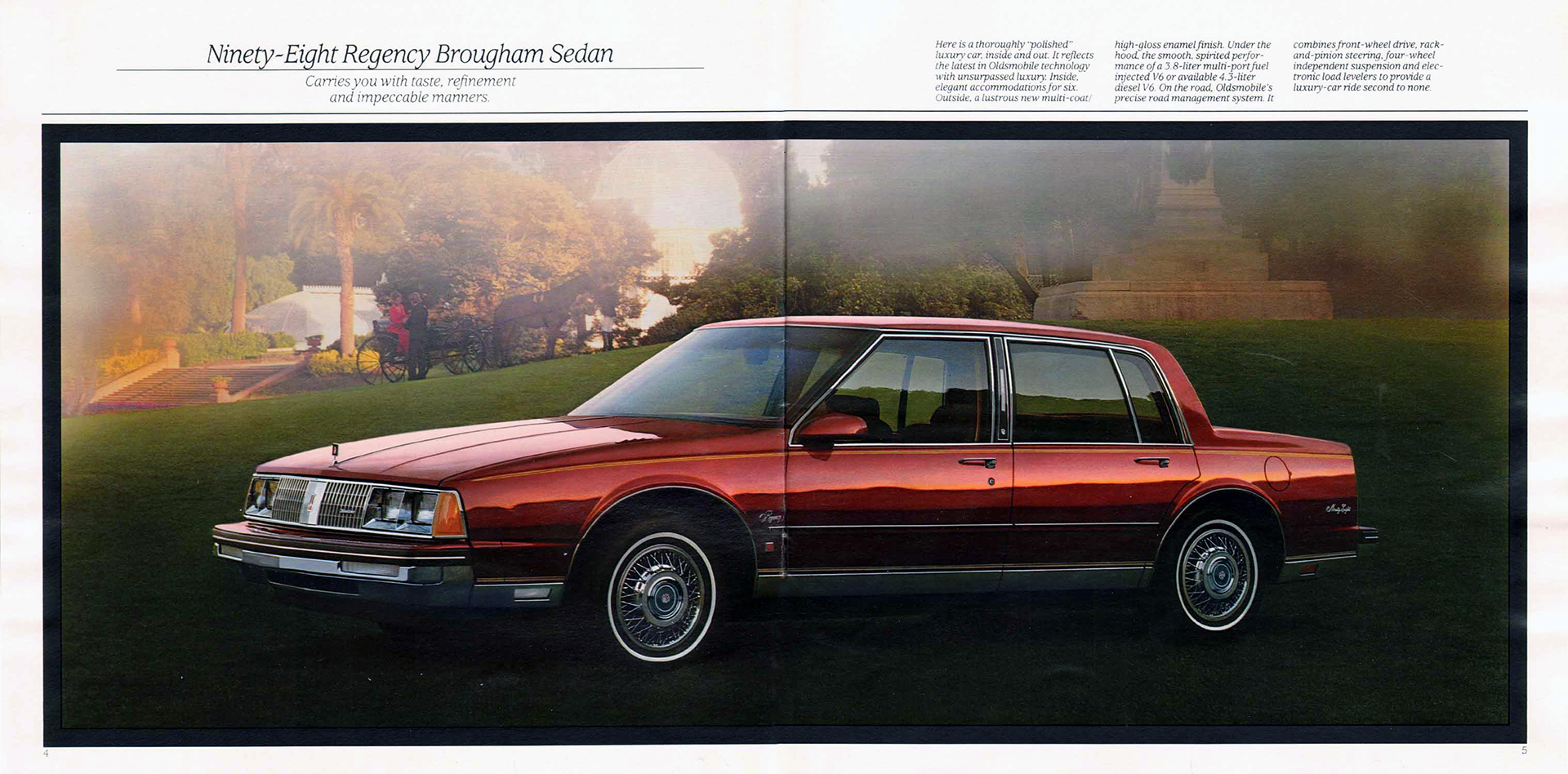
Brougham pages from 1985 Oldsmobile Ninety-Eight Regency brochure

Stepping up to the $15,864 (approximately $48,400 in today’s dollars) Ninety-Eight Regency Brougham made the 3.8 liter engine standard and added simulated wire wheels with locks, fancier seats, a deluxe steering wheel with tilt-away feature, and intermittent windshield wipers—along with over 300 pounds of weight.

Options & Production Numbers

Individual options included an Astroroof ($1,230), cornering lamps ($60), an electronic air conditioner ($125), and Twilight Sentinel headlamp control ($60).

These C-bodies (there were also Buick and Cadillac versions) had a stately appearance. Big and (I think) handsome, they had a lot of interior room despite the downsizing—at 110 cubic feet, they had only two cubic feet less than the 1984.

Sales of the 1985 Ninety-Eight Regency sedan were good—at almost 155,000, more than double the approximately 69,000 that had been sold in 1984. A little over 70% of Regency buyers opted to move up to the Brougham.

The View From 2025

1000 views badge

C-body Ninety-Eight Regency sedans sometimes come up for sale in the Hemming’s Motor News classifieds and on eBay Motors. Bring a Trailer has sold one of this era, and it was a diesel.

Make mine Platinum Metallic, please.

Other 1985 Oldsmobiles I have written about include the Cutlass Ciera sedan, the Cutlass Supreme coupe, and the Firenza ES sedan.

Last updated June 2025.

1983 Isuzu Impulse hatchback coupe

“Follow Your Impulse”

1983 was the first model year that Isuzu’s Impulse (known as the Piazza in most other parts of the world) became available in the United States. The first-generation Impulse was built on a variant of the aging rear-drive T-body chassis used by the lowly Chevrolet Chevette but was definitely aimed at a notably different market.

The Impulse came much better equipped than any Chevette: standard mechanical equipment for the $9,998 base price (about $32,300 in 2025 dollars) included four-wheel disc brakes and P195/60R14 tires (a size still readily available) on 14-inch alloy wheels. Inside, power steering, power windows, power door locks, cruise control, air conditioning, tinted glass, a tilt steering wheel, and an AM/FM stereo radio were all included. Optional equipment was spare, with only an improved stereo and turbine wheels available.

For 1983, power for the 2,700-pound Impulse was provided by a 90 bhp 1.9 liter/119 ci SOHC inline four with multi-point fuel injection (a turbocharged engine would not become available until 1985). Transmissions available were a standard five-speed manual and an optional four-speed automatic. Fuel economy with the manual transmission was 22 city/28 highway by the day’s standards (19/26 by 2025 standards). 0-60 took between 12 to 13 seconds, with a top speed of about 110 mph. With a 15.3-gallon fuel tank, you could expect a range of between 310 and 345 miles with a 10% fuel reserve.

Of course, the Impulse’s absolute killer feature was its exterior styling, which was very close to Giorgetto Giugiaro’s 1979 Ace Of Clubs show car. Road & Track put the Impulse on the cover of their June 1983 issue, with the tagline being “Sensuous show car hits the road.”

First-generation Isuzu Impulse, courtesy of Isuzu.

Isuzu must get real credit for messing as little as possible with Giugiaro’s excellent and differentiating design—few automakers were willing to leave as well enough alone as they did. They changed only a few things, adding slightly larger bumpers to meet the five mph DOT requirement, shortening the windshield and lengthening the hood to allow for easier installation of the engine on the assembly line, and enlarging the overall dimensions a few inches to allow for more interior space.

Isuzu also made the interior as close as possible to the original show car. In particular, two pods on either side of the steering wheel included most controls—and they adjusted with the standard tilt steering. All four seats were adjustable—rear seat adjustability was very unusual in subcompact cars in the 1980s.

The View From 2025

Impulses of this generation are rarely seen in the Hemming’s Motor News classifieds or on eBay Motors. They do occasionally appear on Bring a Trailer, with a 1984 Impulse auctioning off in November 2024.

Make mine Black, please.

Last updated in February 2025.

1983 Ferrari 512 BBi coupe

I used to live about a mile from a Ferrari dealership. As I walked near it back in 2014, I saw a trailer parked around the corner with a low-slung sports car inside. Getting a little closer showed that it was definitely a 512. “Now that’s a Ferrari!”, I said. The man unloading the car chuckled as I walked away.

For 1983, Ferrari’s lovely Pinanfarina-designed 512 BBi received few, if any, changes. The BBi’s engine was Ferrari’s Tipo F110 A 340 bhp 4.9 liter/302 ci flat 12 with Bosch K-Jetronic fuel injection—the 512 had moved to fuel injection (and added the i) for the 1982 model year. When paired with the five-speed manual transmission, 0-60 came in about 5.5 seconds with a top speed of 170 mph or so—fast, fast, fast for 1983.

Photo of a 1983 Ferrari 512 BBi
Photo of a 1983 Ferrari 512 BBi, courtesy of Wikipedia photographer dave_7

Ferraris had gotten more luxurious: standard equipment on the 512 BBi included air conditioning (often said to be inadequate), leather seats, power mirrors, power windows, power door locks driven from the key, a Nardi steering wheel, and a Pioneer AM/FM stereo cassette deck with 7-band graphic equalizer.

Although the 512 BBi was not legal in the U.S., some importers converted them to U.S. specifications by adding catalytic converters, side reflectors, and larger bumpers.

Of course, there’s a fairly famous eighties music video associated with this car.

Sammy Hagar may have his issues, but the 512 BBi he drives in the video made for this song demonstrates exquisite taste. When interviewed by Motor Trend in 2008, he still owned it.

The View From 2025

There’s some really excellent support for 512s (and all Ferraris) from the folks on FerrariChat (who contributed to the original version of this post). According to Hagerty’s valuation tools, all the money for a 1983 512 BBi in #1/Concours condition is $345,000 (though recent auction results may make that seem low). A more “normal” #3/Good condition example is valued at $224,000. Ferrari 512s frequently appear for sale in the Hemmings Motor News classifieds, on Bring a Trailer, and at in-person auctions.

Make mine Rosso Corsa (red), please, though I’m quite tempted by how they look in Grigio (grey).

Other Ferraris I have written about include the 1985 308 GTB Quattrovalvole coupe and the 1985 Testarossa coupe.

Last updated February 2025.

1989 Pontiac 20th Anniversary Turbo Firebird Trans Am hatchback coupe

Originally posted on the fourth of July in 2014, here’s some eighties American iron.

“The Only Modification It Needed To Pace The Indy 500 Was A Decal.”

For 1989, the big news in the Pontiac camp was the release of the 20th Anniversary Turbo Firebird Trans Am, which was essentially a Trans Am GTA coupe with an exclusive engine option and some specific trim elements.

Rated at 250 bhp but actually making about 300 bhp, the LC2 3.8 liter/231 ci sequential fuel-injected, turbocharged, and intercooled V6 was teamed with the 200-4R four-speed automatic transmission. Mileage was 16 city/24 highway by the day’s standards (15/22 by today’s standards), and nobody cared. What they did care about was the acceleration—Car and Driver managed to achieve a 4.6 second 0-60 time (Pontiac had claimed 5.5 seconds) and a top speed of 153 mph. At least in power, the third generation Trans Am had come a long way from 1982

1989 Pontiac Firebird brochure cover, courtesy of Flickr user Alden Jewell.
1989 Pontiac Firebird brochure cover, courtesy of Flickr user Alden Jewell

The 20th Anniversary Turbo Firebird Trans Am’s base price was $31,198—about $84,100 in 2025 dollars. Buyers got all the Trans Am GTA exterior and mechanical equipment, which included fog lamps, a power antenna, power steering, four-wheel disc brakes, the special performance package, a limited slip differential, and 245/50-VR16 black sidewall tires (a size still readily available) mounted on gold 16 x 8 diamond-spoke aluminum wheels. Turbo Trans Am-specific additions included larger brake rotors and softer front springs. In addition, there were Turbo Trans Am emblems on the fenders and 20th emblems on the nose and rear pillars.

Inside, standard GTA equipment included air conditioning, power door locks, power windows, power mirrors, tilt steering, cruise control, a rear window defroster, a power deck lid release, and an AM/FM stereo cassette with an equalizer and steering wheel controls. Turbo Trans Am owners also got a turbo-boost gauge inside the tachometer face.

Options & Production Numbers

Pontiac built a total of 1,550 Turbo Trans Ams for sale (there were another 5 test cars), with 85% of them being t-tops with leather bucket seats (buyers could order cloth bucket seats and/or the hardtop, but few did). Period window stickers show the t-top roof and the custom leather interior combined in a value option package.

The View From 2025

Unlike many other eighties cars, 1989 Turbo Trans Ams hold their value just fine. According to Hagerty’s valuation tools, all the money for a 1989 20th Anniversary Turbo Trans Am in #1/Concours condition is $79,000, though some have sold for more. A more “normal” #3/Good condition example is valued at $29,900. Turbo Trans Ams often come up for sale in the Hemmings Motor News classifieds and on eBay Motors, but many are now sold at auction, whether online (Bring a Trailer) or in-person.

Make mine White, please. As with many other General Motors special editions, there’s no color option.

I’ve written about six different eighties Trans Ams; the 1980 Turbo coupe, the 1981 coupe, the 1982 hatchback coupe, the 1984 15th Anniversary hatchback coupe, and the 1985 hatchback coupe. I have also written about the 1986 SE hatchback coupe and the 1987 Formula hatchback coupe, but I probably should write about the base car at some point.

Last updated December 2025.

1988 Chevrolet Beretta GT coupe

“A car with performance that fulfills the promise offered by its exterior appearance.”

I always liked the Chevrolet Beretta’s styling. It was among the purest executions of the wedge in the 1980s (along with the Bertone/Fiat X1/9, the Pontiac Fiero, and the Triumph TR8).

Chevrolet soft-launched the Beretta as a 1987 model, selling it to rental car agencies. In its first full year of general availability in 1988, there were two Beretta models—the base coupe and the GT. The Beretta GT came standard with the LB6 130 bhp 2.8 liter/173 ci multi-port fuel-injected V6: a notable step up from the “Iron DukeLQ5 90 bhp 2.5 liter/151 ci throttle body fuel-injected inline four that came standard with the coupe.

0-60 mph came in a little over 9 seconds with the five-speed manual transmission and the V6—not that bad, but certainly not stunningly fast either. Fuel economy with the same powertrain combination was 19 city/29 highway by the day’s standards (17/27 by today’s measures). With a 13.5-gallon gas tank, a GT owner could expect a range of 265 to 290 miles with a 10% fuel reserve.

1988 Chevrolet Beretta print advertisement

Standard exterior and mechanical equipment on the $11,851 GT (approximately $33,300 in today’s dollars) included dual sport mirrors, power brakes, and P205/70R14 tires (a size still readily available) on 14-inch wheels. Inside, the Custom interior, tachometer, and an AM/FM stereo radio were all standard.

Packages & Options

The Beretta was one of the early examples of General Motors’ move to option packages as the preferred way to reduce the number of possible equipment combinations. The GT‘s option packages were:

  1. Air conditioning
  2. Floor mats, tilt steering wheel, cruise control, intermittent wipers
  3. Auxiliary lighting, power door locks, power trunk opener, power windows, AM/FM stereo cassette with digital clock

Optional equipment included the GT-only Z51 Performance Handling Package ($153 for larger stabilizer bars, firmer bushings, tuned struts and shocks, and Goodyear Eagle GT + 4 P205/60R15 tires on 15-inch styled steel wheels), rear window defogger ($145), electronic instrumentation ($156), two-tone paint ($123), and AM/FM stereo cassette with digital clock and graphic equalizer.

Midway through the model year, Chevrolet added a Beretta GTU package for $2,500. Designed to reflect the Berretta’s involvement in the IMSA GTU racing series, the GT-based GTU featured a front wraparound chin spoiler, a body color grille and body side moldings, lower rocker panel extensions, breakaway mirrors, a rear valance panel extension, a rear decklid spoiler, GTU graphics, and Goodyear Gatorback P205/55VR-16 tires on 16-inch aluminum alloy wheels.

The View From 2025

Not a lot of folks are collecting Berettas, but there are enthusiast sites. I have not seen one on the road in over a decade. Berettas are rarely seen in the Hemming’s Motor News classifieds or on eBay Motors, but Bring a Trailer has sold six over the last five years.

Make mine Maroon Metallic, please.

Other Chevrolet coupes from the second half of the eighties that I have written about include the 1985 Celebrity Eurosport, the 1986 Cavalier Z24, and the 1988 Corvette 35th Anniversary Edition.

Last updated October 2025.