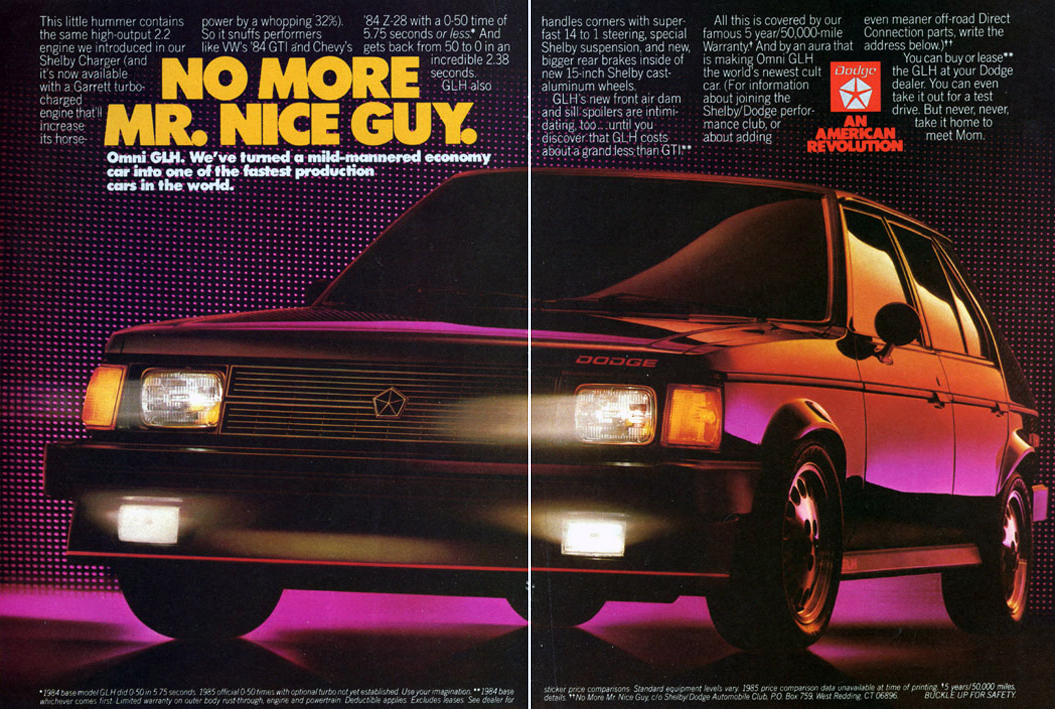
Though 1984 was the debut year for the Dodge Omni GLH, 1985 was the first year that Chrysler’s Turbo I 2.2 liter/135 ci turbocharged inline four was available with it (for an additional $872). Packing 146 bhp and 170 lb-ft of torque, the turbo delivered 0-60 times in about 7.5 seconds. Standard power on the GLH was the High Output 110 bhp 2.2 liter/135 ci inline four, and both engines came with a five-speed manual transmission.
Mileage for the turbo was 21 city/30 highway (18/27 by today’s standards) on premium gasoline. Giving up the turbo took you to 25/34 and let you run on regular fuel. Range with the 13-gallon gas tank was almost 300 miles with a 10% reserve.
Omni GLH pages from the 1985 Dodge Performance brochure
The base price for an Omni GLH was $7,620 (about $23,100 in 2025 dollars). For that money, purchasers got a front air dam and side skirts, both finished in black, as was the grille. Distinctive aluminum 16-hole “pizza” wheels rolled on low-profile 195/50R15 tires—now considered a tiny size, but still available. Power steering, power brakes, and a sport suspension were standard and fog lamps completed the “sporty for a 4-door compact” look.
Inside, a GLH was pretty basic. You did get cloth high-backed bucket seats, a Rallye instrument cluster, dual remote mirrors, intermittent windshield wipers, and an AM/FM stereo radio.
Options & Production Numbers
The GLH had few exterior add-ons available. Inside, buyers could add options such as air conditioning ($643), a rear window defroster ($132), automatic speed control ($179), and an AM/FM stereo radio with cassette.
Dodge sold 6,513 Omni GLH models in 1985, including 3,004 normally-aspirated models and 3,509 with the turbo, making the GLH about 9% of total Omni/Horizon production for that model year.
Mecum’s April auction at Kansas City provided some interesting fodder for commentary. I’ll concentrate on the 1980s cars and trucks that actually sold (remember that this is not a no reserve auction — a black 1987 Buick Grand National coupe with 36,000 miles was bid up to $25,000) and add some of my opinions.
Thursday:
1986 black Mercedes-Benz 560SL convertible — $8,000 hammer price.
1986 red Chevrolet Corvette convertible with 54,000 miles — $8,500
1984 blue Chevrolet K10 custom pickup — $5,250
1986 white (of course!) Ford Bronco SUV with 41,000 miles — $10,500
1989 red Chevrolet Corvette convertible — $6,250
1989 red Lincoln Mark VII LSC coupe with 22,000 miles — $10,750
1986 burgundy Chevrolet Monte Carlo SS coupe with 81,000 miles — $7,500
Friday:
1984 blue Chevrolet Monte Carlo SS custom coupe — $13,000
1985 white Cadillac Eldorado Biarritz convertible — $11,000
1981 black Chevrolet Corvette coupe — $12,750
1982 silver beige Chevrolet Corvette Collector’s Edition coupe with 3,500 miles — at $19,000, the highest eighties vehicle sale at this auction.
1982 silver beige Chevrolet Corvette Collector’s Edition coupe with 8,100 miles — $17,000
1982 silver Chevrolet Corvette coupe with 4,000 miles — $16,500
1984 red Chevrolet Corvette coupe with 12,000 miles — $12,000. According to Hagerty’s valuation tools, all the money for an 1984 Corvette in #1 condition is $15,300.
1985 red Chevrolet C10 mild custom pickup — $18,000.
This auction backed up the truism that heading mid-west to get a collector car bargain is often a good idea. Fully half of the eighties cars that actually sold were Corvettes, with four of the 1982 Collector’s Edition coupes sold — it seems folks are finally giving up on these cars (the nicest of the late sharks) ever being worth real money.
This year’s Barrett-Jackson Palm Beach auction included some interesting vehicles. I’ll concentrate on the at least fairly stock 1980s cars (and a few trucks) that sold in this mostly no reserve auction (a black 1989 Lamborghini Countach Anniversary Edition coupe with 2,200 miles was a no-sale bid up to $335,000) and add some of my opinions.
Friday:
1986 beige Mercedes-Benz 420SEL sedan with 77,000 miles—$3,500 hammer price.
1985 brown Lincoln Town Car sedan with 37,000 miles—an ouch! at $2,500.
1986 red Chevrolet Corvette convertible with 14,000 miles—$9,500
1986 white Chrysler Laser XT custom (some Dodge Daytona parts) coupe once owned by NASCAR Hall of Fame driver Cotton Owens—$5,000 indicates that in this particular case celebrity ownership didn’t help the bidding much.
1981 black Pontiac Firebird Trans Am coupe—at $17,500 the first vehicle in this auction to meet my criteria for serious 1980s collectability of original cars or trucks: selling for equal to or above its original base list price. I’ll mark these vehicles in bold green.
1980 red Ferrari 308 GTSi coupe—$45,000 is between number #1 and #2 money, according to Hagerty’s valuation tools.
1982 red Chevrolet Corvette coupe with 6,600 miles—$26,000 is good money for a non-Collector’s Edition 1982.
1985 beige/tan Excalibur Series IV Phaeton convertible with 5,600 miles—$29,000 for the most-respected of the neo-classics.
1986 white Chevrolet El Camino pickup with the SS Choo Choo Customs package and 47,000 miles—$29,000
1988 yellow Jeep Grand Wagoneer SUV with 55,000 miles—$10,000
1988 red Chevrolet Corvette convertible with 6,500 miles—$20,000
1986 black Ferrari Mondial convertible with 34,000 miles—$22,500
1988 red Porsche 911 Carrera Cabriolet with factory slant nose and 11,000 miles—$43,000
1980 green Porsche 911 custom coupe—$26,000
1983 green Toyota Land Cruiser FJ-40 SUV—$38,000
1988 black Mercedes-Benz 560SEC with aftermarket convertible conversion and 10,000 miles—$17,000
1989 tan Jeep Wrangler very custom SUV—$10,500
Saturday:
1983 black/gray two-tone Lincoln Continental Mark VI coupe with 38,000 miles—$4,500
1987 black Mercedes-Benz 560SL convertible—$25,000
RM Sotheby’s traditional one-day auction at Amelia Island in mid March had a few 1980s cars this year among the hundred or so total. These particular cars definitely occupy the extreme high-end for eighties cars—none sold for less than their original list price.
1989 Guards Red Porsche 911 Speedster convertible with tan and black partial leather interior and 6,400 miles—$264,000 for this Turbo-look version. This is actually only a little over #2 money, according to Hagerty’s valuation tools.
1988 Guards Red Porsche 911 Turbo convertible with champagne leather seats and 2,400 miles—$363,000 for this “slant nose”
1980 Nero Daytona (black) Ferrari 512 BB coupe with black leather interior and 12,000 miles—$418,000 for this lovely piece, despite the fact that it was not in its original red over black two-tone. All the money for a 1980 512 BB used to be about $225,000; obviously this is no longer true.
1988 Jaguar XJR-9 race car—$2,145,000 for the winner of the 1990 24 Hours of Daytona. Race cars don’t generally do well at auction; this car was a definite exception, perhaps aided by the locale.
1987 Guards Red Porsche 911 Turbo coupe with champagne leather interior and 12,000 miles—$220,000
Mecum’s one-day no-reserve auction in late February of what had been the Jim Rogers’ Classic Car Museum collection had a few 1980s cars among the 231 total. As one would expect for long-time museum cars, all cars in the auction were explicitly represented as “may still need mechanical and fuel system maintenance” and “car has not been driven”. Most had at least had their engines started.
1984 red Avanti coupe with red interior and 22,000 miles. A Steven Blake-era Avanti (no more Avanti IIs by 1984) with a 180 bhp/190 bhp (depending on who you believe) Chevrolet 305 V8 and an automatic transmission—$10,000 is between #3 and #4 money according to Hagerty’s valuation tools
1986 brown Jaguar XJ12 Vanden Plas sedan with 4,800 miles—$20,000 seems like a lot of money for this car, even with the low mileage. The cream interior did look near perfect.
1988 triple white Rolls-Royce Corniche II convertible with 15,000 miles—at $68,000, by far the highest eighties sale of the auction and about $10,000 over Hagerty’s “all the money”
1980 red/silver two-tone Rolls-Royce Silver Shadow II sedan with red interior—$19,000
1986 red Porsche 928S coupe with automatic transmission—$17,000 indicates about #2 condition
The rest of the auction was perhaps a little more interesting than these five cars. The oldest car was a black and silver 1915 Ford Motel T while the newest vehicles (from 2012) were a brace of Fisker Karma sedans and a Mercedes-Benz Sprinter conversion. The least expensive sale was a yellow 1948 Chevrolet fire truck that went for $3,000 while the most expensive car was a beige 1962 Rolls-Royce Mulliner convertible that hammered for $320,000. The distribution of cost versus year is shown in the chart below.
Yutaka Katayama passed on February 19th, 2015, after a long and full life—he was 105. “Mr. K” was the person most responsible for bringing the Z car to market. It is beyond the purview of this blog to head back to the original and groundbreaking 240Z, but we can take a look at the second-generation 280-ZX.
“It’s Black. It’s Gold. And it is awesome.”
For 1980, the 280-ZX received a ‘T’ bar roof and a new digital clock for the GL version, but Datsun otherwise mostly stood pat for the standard car. There were five new colors available.
Power continued to be provided by the L28E 135 bhp 2.8 liter/168 ci V6 with multi-port fuel injection. Car and Driver recorded a 0-60 time of 9.4 seconds in the 2,970-pound coupe—reasonably competitive in 1980. The top speed was about 117 mph.
With the standard five-speed manual transmission, EPA fuel economy ratings were 21 city/31 highway by 1980 standards. Moving to the three-speed automatic transmission significantly impacted mileage—ratings on the sticker were 19/26. With a 21.2-gallon gas tank, an owner of a manual-equipped 280ZX could expect an impressive range of 405 to 445 miles with a 10% fuel reserve.
Standard exterior and mechanical equipment on the $9,899 280-ZX Deluxe (about $41,800 in 2025 dollars or about what a current Nissan Z Sport starts at) included tinted glass, a power antenna, a four-wheel independent suspension, four-wheel power disc brakes, rack-and-pinion steering, and P195/75HR14 tires (a size still readily available) on 14-inch steel disc wheels. Inside, a six-way driver’s seat with lumbar support, a quartz sweephand clock, and an AM/FM stereo radio with three speakers were standard.
Stepping up to the $12,238 Grand Luxury (GL) added a ‘T’ bar roof, a rear window wiper/washer, power recirculating ball steering, and aluminum alloy wheels. Inside, Datsun added cruise control, fully integrated air conditioning, a quartz digital clock, a lockable hidden storage compartment, a six-way adjustable seat with lumbar adjustment for the passenger, and an AM/FM stereo radio with four speakers and surround sound control.
For 1980, there was also a 10th Anniversary Edition (auto manufacturers were beginning to become aware that anniversary cars could really bring the buyers) available in two different two-tones: either Thunder Black and Rallye Red or Thunder Black and Golden Mist Metallic. The 10th Anniversary Edition went for $13,850—about $59,700 in today’s dollars, or almost exactly what a 2026 Nissan Z Heritage Edition goes for.
Standard exterior and mechanical equipment on the loaded10th Anniversary Edition included everything on the GL, along with the aforementioned two-tone paint, special badging, headlamp washers, and Goodyear Wingfoot radial tires on alloy wheels with colored inserts. Inside, a limited edition numbered plaque, automatic heating and air conditioning, leather six-way bucket seats, a Hitachi AM/FM stereo radio with cassette, and power windows were included. Period window stickers show no options for the 10th Anniversary Edition.
Exterior and mechanical options for the “normal” 280-ZX included a blackout package (Deluxe), mag-style cast aluminum wheels (Deluxe), two-tone paint (GL), and rear window shade louvers (of course). Buyers could add fully integrated air conditioning (Deluxe), leather seating surfaces (GL), a CB one-hand mic system, and the usual cassette and 8-track stereo choices to the interior.
Production Numbers & Period Reviews
Overall production numbers for the 280-ZX were impressive—Nissan reported 53,687 sold for the 1980 model year. Interestingly, 1980 was the worst year of five for the 280-ZX—86,007 were sold in 1979. Of the 1980 sales, 3,000 were the 10th Anniversary Edition—2,500 black/gold and 500 black/red.
Contemporary reviews were glass-half-full. Car and Driver‘s tagline was “A Japanese Corvette,” and they talked about Datsun discreetly following Chevrolet in terms of price and features. The new ‘T’ bar roof was generally liked for both its availability and its execution—as Popular Mechanics stated, this was the “closest the car would come to being a convertible.”
The View From 2025
There is good club support for the 280-ZX, though not quite at the level available for the now-classic original 240Z. According to Hagerty’s valuation tools, all the money for a 1980 280-ZXcoupe in #1/Concours condition is $84,400, with a more typical number #3/Good condition car going for $13,200. 280-ZXs often appear in the Hemming’s Motor News classifieds, on eBay Motors, and on Bring a Trailer.
Lord help me, I would like one in the black and gold two-tone …
I was driving westbound on the Schuylkill Expressway in Philadelphia on a morning in February 2015 when I saw a Fox Mustang convertible (red exterior, black top).A good enough reason to write a blog entry about these attractive cars.
“It’s not just a convertible … it’s a Mustang.”
For 1983, the big news for the Ford Mustang was the return of the convertible for the first time since the 1973 model year. Introduced on November 5th, 1982, the convertible was available only in the luxury GLX trim and the performance GT trim—lower-end L andGL trims remained with the notchback coupe (L and GL) and the hatchback coupe (GL). The GLX was also available only with V6 and V8 engines (no inline-four—turbo or not—would sully the drop-top experience).
The V6 engine choice for the GLX was the Essex 112 bhp 3.8 liter/231 ci with a two-barrel carburetor. Optional on the GLX ($595 additional) and standard on the GT was (of course) the Windsor 175 bhp 4.9 liter/302 ci V8 with a four-barrel carburetor.
Starting at $9,449 (about $30,800 in today’s dollars) and rising significantly during the middle of the model year to a non-trivial $12,467 (about $40,300 in 2025 funds, which is almost exactly what a 2025 Mustang EcoBoost convertible starts at), the GLX did come reasonably well equipped. Standard external and mechanical features included power front disc brakes, tinted glass, and an automatic transmission. Standard interior equipment included a light group and an AM radio.
Convertible pages from the 1983 Ford Mustang brochure
The GT version of the convertible listed for $13,479 (about $43,600 in 2025 dollars). Standard external and mechanical features included power front disc brakes, power steering, rear spoiler, and a five-speed manual transmission. Standard interior equipment included an AM radio.
All 1983 Mustangs included dual rectangular halogen headlamps, a modified MacPherson strut front suspension, front disc/rear drum brakes, and rack and pinion steering. Inside, full instrumentation (tachometer, trip odometer, fuel/temperature/oil/alternator gauges), full vinyl bucket seats, and a cigarette lighter were included.
Options & Production Numbers
The Mustang option list was long. Inside, air conditioning ($724), speed control ($170), power locks ($160), a tilt steering wheel ($105), and an AM/FM stereo radio with a cassette player ($199) were all available.
All 1983 Mustang convertibles came with a power top, and all windows rolled down—an emphasis Ford frequently made in reference to the Chrysler K car convertibles.
The 1983 Ford Mustang convertible sold reasonably well considering its expense (the GT convertible stickered for 45% more than the GT hatchback). For that year, it probably saved total Mustang sales from dropping below 100,000—helping hold that off until 1991. Between 1983 and 1993, Ford would sell over a quarter of a million of the pony car convertibles.
The View From 2025
There is strong club support for the 1983 Mustang, as there is for all Mustangs except the mid-seventies Mustang IIs. According to Hagerty’s valuation tools, all the money for a 1983 Mustang GT convertible in #1/Concours condition is $58,300, with a more typical #3/Good condition car going for $14,500. 1983 Mustangs often show up in the Hemming’s Motor News classifieds, on eBay Motors, and on Bring a Trailer—as I update this blog entry in March 2025, there’s a Red 1983 Mustang GLX convertible with a white top, a white vinyl interior, an aftermarket V8, and 89,000 miles available on Hemmings for $18,000.
In June 2022, a Saddle Brown Crystal 1984 Chrysler Laser XE with 17,000 miles came up for auction on Bring a Trailer. That was enough reason for me to substantially update this now ten-year-old post.
“The competition is good. We had to be better.”
Debuting in 1984, the Chrysler Laser was intended to be an upscale complement to the Dodge Daytona. Its equipment was not notably different from the Daytona’s, but the Laser had a more luxurious emphasis with a slightly softer suspension.
Two engines were available. The base engine, Chrysler’s 93 bhp 2.2 liter/135 ci inline four, was available with a standard five-speed manual transmission or a three-speed automatic transmission ($439). Mileage with the manual was 22 city/32 highway by 1984 standards (19/29 by today’s measures). Moving to the automatic helped city mileage a bit but dropped highway mileage significantly—23/27.
The more interesting engine was the optional Turbo I 142 bhp 2.2 liter/135 ci turbocharged inline four with the same transmission choices as the base engine. Depending on whether you were adding the turbo to the base Laser or the XE, the extra cost was either $934 or $872. Mileage with the hot setup (turbo and manual) was 20 city/27 highway by the day’s standards (18/25 by 2025 measures), while Road & Track recorded a 0-60 time of 8.6 seconds. Moving to the three-speed automatic once again killed highway mileage, making the ratings 20 and 23. With a 14-gallon gas tank, the owner of a five-speed/turbo Laser could expect a range of between 275 and 295 miles with a 10% fuel reserve.
1984 Chrysler Laser television commercial
Standard exterior and mechanical equipment on the base Laser (priced at $8,648 or about $27,500 in today’s dollars) included a rear spoiler, power-assisted rack and pinion steering, power front disc/rear drum brakes, and P185/75R14 steel belted radial black sidewall tires (a size still readily available) on 14-inch wheels with Premium wheelcovers. Inside, a leather-wrapped steering wheel, intermittent wipers, and an AM radio with a digital clock were included.
Moving up to Laser XE ($10,546 or about $33,500 in 2025 dollars) added features such as an electronic instrument cluster, tilt steering wheel, driver’s side sport seat, dual power side mirrors, and an AM/FM stereo radio.
Options, Period Reviews, & Production Numbers
Optional equipment included air conditioning ($737), cruise control ($179), rear defroster ($168 base/$143 XE), power windows ($185), power door locks ($125), and AM/FM stereo cassette ($285/$160). With all the trimmings, a Laser XE could fairly easily get to $12,900 or so or about $41,000 in today’s dollars—almost what a 2025 Dodge Hornet R/T SUV costs.
The buff books liked the presence of the Laser and Daytona on the market, but wanted more. The final paragraph of Road & Track’s review began with, “although we applaud the concept and basic execution of the Laser, the car badly needs refinement.” In particular, they complained of a booming resonance anytime the engine exceeded 2,000 RPM—not great in a sporty car that Chrysler claimed was a sports car.
The Laser sold decently in its first year, with almost 34,000 base coupes and nearly 26,000 XEs crossing dealer lots. These numbers were actually better than its Dodge Daytona sister car (with a total of almost 50,000 sold).
However, Chrysler must have been disappointed—this was an era where the Chevrolet Camaro, Ford Mustang, and Pontiac Firebird were routinely selling in the hundreds of thousands (the three models combined for 530,000 sold in 1984).
Chrysler would never see these first-year totals again—by 1987, the Laser would be gone, with the Daytona hanging on through the 1993 model year after a few pretty good years in the late 1980s.
The View From 2025
Lasers rarely appear in the Hemmings Motor News classifieds, on eBay Motors, or on Bring a Trailer (the most recent BaT example was only the fifth in eight years). You see some Daytonas on eBay and BaT, but even they are relatively uncommon.
Not surprisingly, allpar.com has an interesting and detailed article on the front-wheel-drive Lasers and Daytonas—it is here.
The January auction at Mecum Kissimmee provided some interesting fodder for commentary. I’ll concentrate on the at least fairly stock 1980s cars (and a few trucks) that sold (remember that this is not a no reserve auction—a blue 1986 Porsche 930 Turbo custom coupe with 29,000 miles was a no sale bid up to $85,000) and add some of my opinions. Mecum Kissemmee is a huge event, so I’m going to separate it into two posts—this second covers from Thursday to the final and rather spare Sunday.
Thursday:
1980 silver Chevrolet Corvette coupe with the L82/automatic combination and 66 miles—$24,000
1984 black/silver two-tone Oldsmobile Hurst/Olds custom coupe – $29,500. An interesting and unusual resto-mod which retained the original lightning rod shifter. How much would it have gone for if it was stock?
1981 brown Chevrolet Camaro Z/28 custom coupe—$15,000
1986 white Chevrolet Monte Carlo SS custom coupe with an aftermarket five-speed manual—$9,500
1981 red Chevrolet Corvette coupe with 55,000 miles—$13,000
1989 red Chevrolet Camaro IROC-Z convertible with the LB9/ automatic combination and 9,300 miles—$20,500
1985 red Chevrolet Camaro IROC-Z coupe with the LB9/ automatic combination and 963 miles—$21,000
1980 platinum Porsche 911SC Weissach Edition coupe with a five-speed manual and 9,500 miles—$56,000 for this handsome car with multiple awards
1989 red/tan two-tone Ford Bronco II Eddie Bauer Edition SUV with 42,000 miles—$8,500
Friday:
1980 red Porsche 928 coupe with the automatic and 46,000 miles—$9,500
1987 black Buick Regal Grand National coupe with 6,900 miles—$28,000
1987 black Porsche 911 Carrera Targa coupe with 66,000 miles—$37,500
1981 red Chevrolet Corvette very custom convertible (by definition, since Chevrolet didn’t make any “shark” convertibles after 1975) with 45,000 miles—$19,000
1981 white Chevrolet Camaro Z/28 coupe with 58,000 miles—$17,000
1987 black Buick Regal GNX coupe with 276 miles—at $80,000, the fourth highest eighties sale of the auction and hitting the lower limit of Mecum’s estimate
1983 red Porsche 930 Turbo coupe with the power sunroof and 33,000 miles—at $65,000, not quite making Mecum’s lower estimate
1987 white Porsche 930 Turbo coupe with power sunroof and 40,000 miles—at $85,000, the second highest eighties sale of the auction
1988 white Rolls-Royce Corniche II convertible with 65,000 miles—$47,000
Saturday:
1987 red Porsche 930 Turbo coupe with 34,000 miles—at $84,500, the third highest eighties sale of the auction
1987 black Buick Regal GNX coupe with 10,000 miles—at $67,500, the fifth highest eighties sale of the auction
1988 white Chevrolet Corvette Corvette Challenge race car with 5,300 miles, driven in five 1988 races by R. K. Smith and Brad Murphey—$45,000
1988 white Chevrolet Corvette 35th Anniversary coupe with the 4+3 manual, the Z51 sport suspension, and 9 miles—$38,000
1989 red Lamborghini Countach 25th Anniversary Edition coupe with 6,500 miles—at $350,000, by far the highest eighties sale of the auction
Sunday:
1985 red Jeep CJ-7 SUV—$7,500
1988 red Chevrolet Corvette coupe—$6,000
1984 blue Chevrolet Corvette coupe with 60,000 miles—$4,000
I walked to the local supermarket today to secure some Coca-Cola which we had somehow run short of. We’re located on the southeastern edge of what most weather forecasters seem to think is going to be a full-out blizzard over the next day and a half or so.
It’s only a couple of blocks to the supermarket. On the way is a little tan house which almost always has an original Natural Suede Tan Dodge Aries or Plymouth Reliant station wagon parked next to it. There is no garage for the wagon, so usually it sits out in the weather and rust is definitely showing in parts of that famously squared-off body.
An early Chrysler corporation K car station wagon sits quietly under a little snow and a car cover this morning
This morning, however, there was a fitted blue car cover on the wagon to help protect it from this particular storm, which has just begun.
I may be projecting here, but I choose to see a lot of love and caring for an old and hardworking friend. Is that cover original or new (you can still get them) ? Does it only go on when the predictions are as dire as today’s? How many miles does that wagon have?
Questions, questions, questions. I don’t think I’ve ever seen the owner — if I do, maybe I’ll ask a few.