1980 Ford Pinto 2-door sedan

“It may be the best small car value of 1980.”

Ford’s Pinto was little changed in its final year, with minor trim and detail changes and the removal of the V6 engine option.

The only engine remaining was the Lima 88 bhp 2.3 liter/140 ci inline four with a two-barrel carburetor. A four-speed manual was standard, while a SelectShift automatic was optional ($340). 0-60 came in a little over 14 seconds with the manual. Fuel economy was 24 city/38 highway by the day’s standards. With a 13.0-gallon gas tank assembly that now included a longer fuel filler neck and a stronger fuel filler cap than in earlier years, a Pinto owner could expect a range of 295 to 325 miles with a 10% fuel reserve.
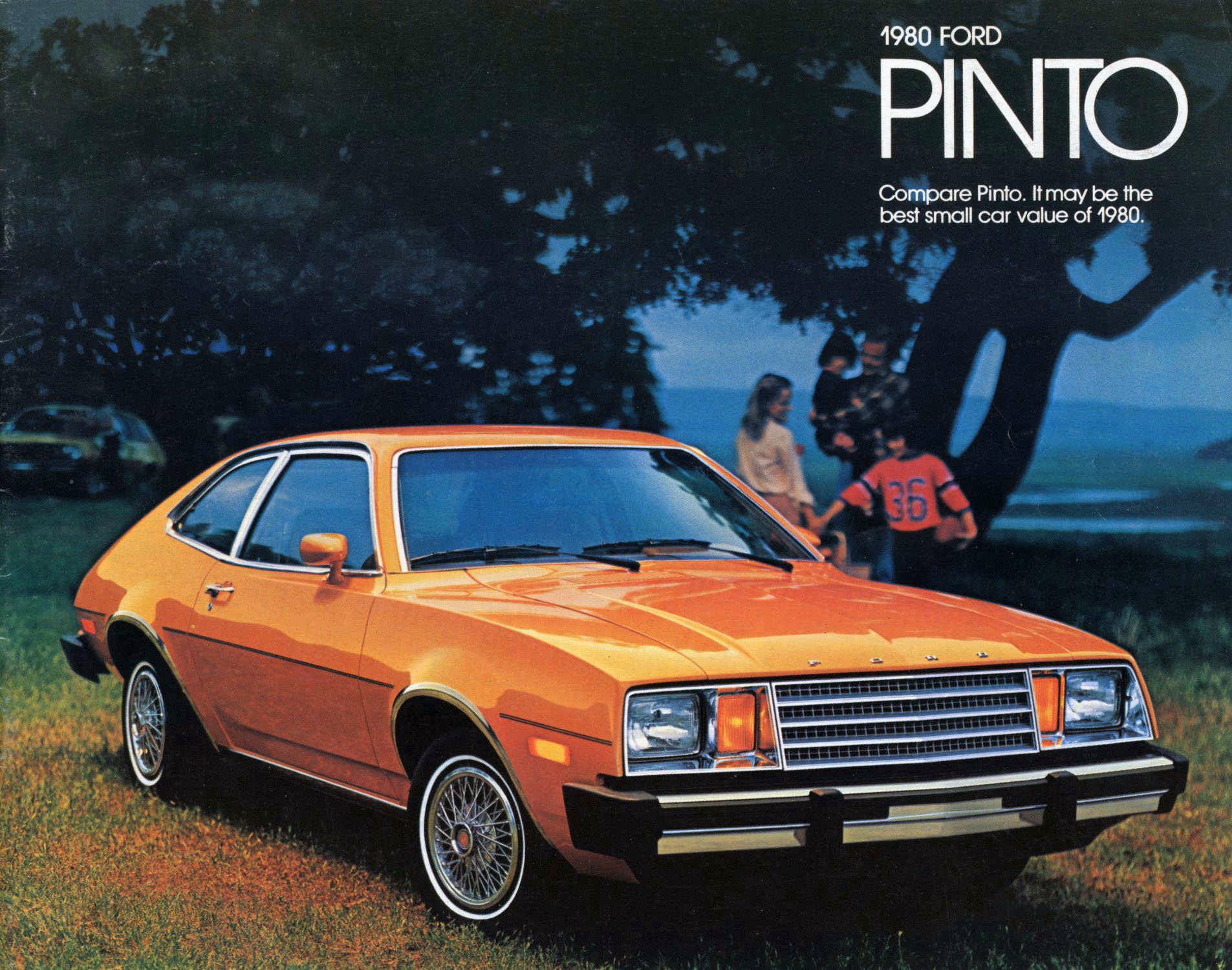
1980 Ford Pinto brochure cover

The 1980 Pinto 2-door sedan’s base price was $4,605—about $19,700 in today’s dollars and 30% less expensive than any 2025 Ford product. Standard exterior and mechanical equipment included tinted glass all around, vinyl insert bodyside moldings, rack and pinion steering, front disc/rear drum brakes, and 13-inch black sidewall steel-belted radial ply tires on 13-inch wheels with full wheel covers. Inside, all vinyl or cloth and vinyl high back bucket seats, a mini-console with a storage bin, and an AM pushbutton radio were included.

Packages, Options, & Production Numbers

The wide variety of packages and groups available for the 2-door sedan included:

  • Convenience Group ($118)—pivoting quarter windows, interval windshield wipers, day/night mirror, cigarette lighter
  • ESS Package ($313)—black accents, premium bodyside molding, styled steel wheels with trim rings, ESS nomenclature
  • Exterior Decor Group ($44)—bright grille and headlamp doors, along with bright rocker panel and wheellip moldings, bodyside accent stripes
  • Interior Accent Group ($50)—Deluxe steering wheel, day/night mirror, woodtone appliques, cigarette lighter, rear seat ashtray
  • Interior Decor Group ($238)—cloth/vinyl or all-vinyl low-back bucket seats, Deluxe door trim, Deluxe steering wheel, woodtone appliques, deluxe sound insulation package, courtesy light switch on passenger door
  • Light Group ($41)—map light, lights in glove box, ashtray, engine, and trunk, courtesy light switch on passenger door
  • Sports Package ($118)—3.08 performance rear axle with the manual transmission, Sport steering wheel with black metal spokes, instrumentation (tachometer, ammeter, temperature gauge)

Individual options included a flip-up open air roof ($219), Medium Red Glow metallic glow paint, a Tu-Tone paint/tape treatment, power front disc/rear drum brakes ($78), power steering ($160), the SelectAire conditioner ($538), and series of radios ranging up to an AM/FM stereo with cassette tape player and two door-mounted speakers ($191).

The best-selling Pinto remained the 2-door sedan (Ford’s description), which looked like it should be a hatchback but wasn’t. Ford sold 84,043 of the 2-door sedans (including the decontented Pony edition) compared to 61,542 of the Runabout, which actually was a hatchback but cost 3% more. The all-new Escort would follow in 1981, but that’s another story.

The View From 2025

I haven’t seen a Pinto in the wild for decades, and they have little presence in the Hemmings Motor News classifieds or on eBay Motors. Bring a Trailer has sold four 1980 Pintos in six years.

Make mine Dark Pine Metallic, please.

Other 1980 Fords I have written about include the Fairmont Futura coupe, the Mustang Cobra coupe, and the Thunderbird coupe.

1987 Plymouth Turismo hatchback coupe

“Fun is affordable again.”

For 1987, Plymouth’s Turismo hatchback coupe was little changed as it headed into its final model year. The 2.2-liter engine became standard, along with argent Rallye wheels.

The Turismo’s standard powertrain was the K 96 bhp 2.2 liter/135 ci inline four with a two-barrel carburetor paired with a five-speed manual transmission. A three-speed automatic was available as part of the Basic package or the Duster package. 0-60 times are hard to come by for the Turismo, but I’m betting on a little over 10 seconds for the 2,281-pound car—with the five-speed. Fuel economy is better known—25 city/35 highway with the five-speed by the day’s standards (22/32 by today’s measures). With a 13-gallon gas tank, a Turismo driver could expect a range of 320 to 350 miles with a 10% fuel reserve.

Front cover of the 1987 Plymouth Turismo brochure

The $7,199 Turismo (about $21,200 in today’s dollars) had better base equipment for 1987 than it had in previous years. Standard exterior and mechanical equipment included tinted glass, black bodyside moldings, halogen headlights, an electric rear window defroster, a remote liftgate release, power brakes, and P165/80R13 steel belted radial tires (a size now only available from Michelin at considerable expense) on argent 13-inch Rallye steel wheels. Inside, cloth with vinyl trim low-back front bucket seats, a four-spoke color-keyed Sport steering wheel, and an electric rear window defroster were included.

Packages, Options, & Production Numbers

Plymouth offered three packages for the 1987 Turismo:

  • The $776 Basic package included the three-speed automatic and power-assisted steering.
  • The $575 Duster manual package included Duster and Plymouth decals, black dual remote control exterior mirrors, power-assisted steering, cloth with vinyl trim Sport reclining high-back front bucket seats with increased lateral support, Deluxe door trim panels with cloth inserts, a console, and an electronic tuning AM stereo/FM stereo radio with a digital clock and four speakers
  • The $1,009 Duster automatic package included Duster and Plymouth decals, black dual remote control exterior mirrors, the three-speed automatic, power-assisted steering, cloth with vinyl trim Sport reclining high-back front bucket seats with increased lateral support, Deluxe door trim panels with cloth inserts, a console, and an electronic tuning AM stereo/FM stereo radio with a digital clock and four speakers

There were few individual options, but they included California emissions, air conditioning ($701), and an AM/FM stereo cassette with Dynamic Noise Reduction and auto reverse ($246).

Plymouth sold 24,104 Turismos in its final model year—a far cry from the 52,162 sold two years prior. Introduced for 1987, the Sundance coupe would be the putative replacement going forward in Plymouth’s model line.

The View From 2025

I’m going to declare this version of the L-body as vanished. I haven’t seen a Turismo in the wild for decades, and they have little presence in the Hemmings Motor News classifieds or on eBay Motors. Bring a Trailer hasn’t sold any Turismos, though they did sell one of the Scamp pickup truck variants in 2019.

Make mine Garnet Red Pearl Coat, please.

Other Plymouths I have written about include the 1980 Horizon hatchback sedan, the 1980 Volaré station wagon, the 1981 Reliant coupe, and the 1984 Voyager minivan. I’ve also written about the 1983 and 1985 versions of the Dodge Shelby Charger hatchback coupe—the Turismo’s higher-performance sibling.

Last updated October 2025.

1981 Chrysler New Yorker sedan

“So many reasons for superiority.”

For 1981, Chrysler’s full-size New Yorker sedan got few changes. The 5.9 liter/360 ci V8 was no longer available, but the optional four-barrel version of the 5.2 liter/318 ci V8 received a horsepower bump. There was a new grille, but otherwise, changes between a 1980 and a 1981 New Yorker are tricky to spot.

The standard powertrain for the New Yorker was the 130 bhp LA 5.2 liter/318 ci V8 with a two-barrel carburetor mated to a TorqueFlite three-speed automatic transmission. New Yorker buyers could choose a four-barrel version of the same engine ($68) that was rated at a respectable for 1981 165 bhp.

No matter which engine, performance was unimpressive in a car with a 3,900-pound curb weight. The 0-60 time was likely a little over 14 seconds with the base engine, with the optional mill dropping that number by about two seconds. Fuel economy was 17 city/26 highway by the day’s standards with the base engine and 16 highway/23 with the uprated one. With a 20.9-gallon gas tank, a New Yorker owner could expect a range of 330 to 405 miles with a 10% fuel reserve.

New Yorker page from the 1981 full-size Chrysler brochure

Standard exterior and mechanical equipment on the $10,463 1981 New Yorker (about $39,500 in today’s dollars) included tinted glass on all windows, a Landau padded vinyl roof, power front disc/rear drum brakes, and P205/75R15 steel-belted wide white sidewall tires on 15-inch wheels with Premier wheel covers. Inside, cloth and vinyl 60/40 individually adjustable seats with folding center armrest and passenger seat recliner, a Luxury steering wheel, manual control air conditioning, power windows, and an AM/FM stereo radio were included. Standard on the New Yorker, the Light Package included a trunk light, a glove box light, an ash receiver light, a rear door courtesy light, and an under hood light.

Packages, Options, & Production Numbers

Chrysler’s marketers seem to have reacted to challenging market conditions by giving buyers many choices of packages and options. Package choices for the New Yorker included:

  • The Basic package ($156) included a vinyl body-side molding, a right remote control convex mirror, deluxe windshield wipers, and undercoating.
  • The Premium Speaker System ($95) included two front and two piezo electric two-way coaxial rear speakers, along with a 15 watt per channel rear amplifier.
  • The Heavy-Duty package included a heavy-duty suspension, a 3.2 axle ratio, an auxiliary transmission oil cooler, a power steering oil cooler, and a 500-amp Long Life Maintenance Free battery. It required the optional four-barrel carburetted V8 and P225/70R15 steel belted radial tires.
  • The Open Road Handling package ($180) included a Firm Feel suspension (front and rear heavy-duty sway bars, heavy-duty shock absorbers, heavy-duty front torsion bars, heavy-duty rear springs), special Firm Feel power steering, and P225/70R15 steel belted wider white sidewall radial tires.
  • The Fifth Avenue Edition package ($1,822) included halogen headlights, cornering lamps, front fender louvers, special lighted quarter windows, wire wheel covers, a conventional spare tire, and a 500-amp Long Life Maintenance Free battery. Inside, Fifth Avenue buyers got a left power seat, deep pile carpets, front and rear floor mats, a Luxury steering with leather-wrapped rim, a tilt steering column, semi automatic temperature control air conditioning, semi-automatic speed control, power door locks, and a power deck lid. They also got the Premium Speaker System and a choice of four stereos, along with a power antenna (except with the CB choice).
  • The Carriage Roof package ($854) was only available with the Fifth Avenue Edition. It included a brushed stainless steel forward half roof cap and a padded Landau top with a small frenched backlight, bright surround moldings, and a forward bright transverse molding with integral electro luminescent lights.

Individual exterior and mechanical options included special paint ($68), a halogen headlamp system ($41), a power operated glass sun roof ($934), and styled aluminum road wheels ($321, $70 with the Fifth Avenue Edition). Inside, a leather 60/40 bench seat ($676), a tilt steering wheel ($84), and an electrically heated rear window defroster ($112 and required in New York State) were available. Three stereos were optional for the New Yorker, with the most pricey being the AM/FM stereo with a CB transceiver and a fixed tri band antenna ($261 and included with the Fifth Avenue Edition). A well-equipped New Yorker could easily run to about $13,300—real money in 1981 and about $50,100 in today’s dollars.

Despite the hopeful brochure slogans, it was clear in 1981 that the era of the big Chrysler was ending—New Yorker sales were off 36% to 6,548. The situation with the less-expensive Newport was even worse, with a decline of 67%. By the 1982 model year, full-size Chryslers would be gone, with the M-body New Yorker mid-size being Chrysler’s new top-of-the-line sedan. The R-bodies had only lasted three model years.

There were many reasons for this failure. Probably made worse by frightening build complexity, Chrysler’s quality was at perhaps its absolute nadir, and the word had gotten out. Overall automotive market conditions were also not great, with the early eighties being tough for many marques. Finally, there was legitimate and realistic concern that Chrysler might go out of business.

The View From 2025

There are not a lot of these handsome cars left. Hagerty doesn’t track New Yorkers built after 1970, so it’s hard to get a feel for values. They occasionally appear in the Hemmings Motor News classifieds, on eBay Motors, and on Bring a Trailer. In March 2025, a 1980 New Yorker Fifth Avenue Edition hammered for $11,000 at Mecum Glendale.

Make mine the extra-cost Mahogany Starmist, please.

Other eighties Chryslers I have written about include the 1980 Cordoba coupe, the 1982 LeBaron convertible, the 1983 Imperial coupe, the 1984 Laser hatchback coupe, the 1986 Town & Country convertible, and the 1987 Fifth Avenue sedan.

1987 Chevrolet El Camino pickup truck

In the decade plus since I started this blog I have worked on three separate El Camino posts. I’m finally publishing one today.

“There’s nothing quite like it.”

In its final year, the Chevrolet El Camino received few changes. The standard engine remained the LB4 145 bhp 4.3 liter/262 ci V6 with electronic fuel injection. The LG4 150 bhp 5.0 liter/305 ci V8 with a four-barrel carburetor was a $440 option, but it’s unclear whether it made much of a performance difference—0-60 likely came in about 11 seconds. Both engines were paired with a three-speed automatic transmission, with an available four-speed automatic ($175).

Period fuel economy ratings for the four power combinations tell an interesting story:

4.3 liter V65.0 liter V8
Three-speed automatic18 city/22 highway15 city/17 highway
Four-speed automatic18 city/23 highway16 city/22 highway

The short form seems to be that, if you had to have the V8 and you wanted to do some highway driving, you should really get the four-speed automatic. With a 17.7-gallon gas tank, the best-case range was about 305 to 325 miles with a 10% reserve—the V8/three-speed combination was more like 230 to 255 miles.

Pages from the 1987 Chevrolet El Camino brochure

The 1987 El Camino’s base price was $10,013—about $29,400 in today’s dollars, which is almost what a base 2025 Chevrolet Colorado pickup truck goes for. Standard exterior and mechanical equipment included power steering, power front disk/rear drum brakes, and P205/75R14 black sidewall all-season steel-belted radial tires (a size still available) on painted wheels with bright full wheel covers. Inside, a full-width cloth front bench seat with a pull-down center armrest, cut-pile carpeting, and a lighted glove box were standard.

Considered a separate model, the $10,344 El Camino SS Sport Decor added a choice of eight lower body accent colors emphasized by a pin-striping decal, a large front air dam, matching dual aero-type mirrors with a left-hand remote, black quarter window moldings, and painted Rally wheels.

Packages, Options, & Production Numbers

The $238 Conquista package included two-tone paint separated with bright moldings, along with a Conquista decal on the tailgate.

The SS Choo Choo package was available. Choo Choo Customs started with regular El Caminos fitted with Rally wheels and sport mirrors and replaced the stock El Camino fascia with a polyurethane nose similar to the one found on Chevrolet’s Monte Carlo SS Sport Coupe. Decals were placed on the tailgate, doors, and nose, and a specific plaque was added to the dash.

Exterior and mechanical options include Soft-Ray tinted glass ($120), halogen headlamps ($25), a limited slip differential ($100), a sport suspension ($16), and a 22-gallon fuel tank ($29). Inside, reclining front cloth bucket seats ($147 and available with a $110 console), a Comfortilt steering wheel ($125), electronic speed control ($175), air conditioning ($775), power door locks ($145), and power windows ($210) were available. Six different radios were available, ranging from an AM radio ($122) up to an AM stereo/FM stereo with cassette, seek and scan, search and repeat, graphic equalizer, and clock ($579). A well-equipped El Camino could easily get to $12,900 or so—about $37,900 in today’s dollars.

With 15,589 sold, the El Camino was a mere 1.3% of Chevrolet’s production in 1987. This wasn’t actually far off from 1986’s numbers, but was a pronounced decline from the halcyon days of the early 1980s—Chevrolet had sold 40,932 El Caminos in 1980.

The View From 2025

I’ve liked this El Caminos since they debuted. El Caminos have always been attractive to collectors, and the eighties versions are no exception. These trucks often appear for sale in the Hemming’s Motor News classifieds, on eBay Motors, and on Bring a Trailer. According to Hagerty‘s valuation tools, a 1987 El Camino Conquista with the V8 in #1/Concours condition is $29,400, with a more normal #3/Good condition truck going for $10,200. The SS and SS Choo-Choo versions are worth more, but not much more.

Make mine Silver Metallic over Dark Maroon Metallic, please. That makes it a Conquista.

Other 1987 Chevrolets I have written about include the Caprice Classic coupe and the Chevette CS hatchback sedan. Other Chevrolet trucks and SUVs covered in Eighties Cars include the 1983 S-10 Blazer SUV, the 1985 C20 Suburban Silverado SUV, the 1985 K5 Blazer SUV, and the 1985 S-10 pickup truck.

Last updated October 2025.

1981 Volkswagen Dasher station wagon

A 1981 Volkswagen Dasher station wagon sold for $7,600 on Bring a Trailer in February 2025. It was a brown diesel with a manual transmission—directly mapping to a certain internet cliché (except for being front-wheel-drive). I’m relatively spare on Volkswagen blog entries, so here we go.

“More luxury. More space.”

The Volkswagen Dasher station wagon was a small car, classified by the EPA as a subcompact. Its 97.2-inch wheelbase was half a foot shorter than the 2025 Golf GTI’s and its curb weight was slightly less than 2,200 pounds. Putative compact station wagon competition for the 1981 Dasher included the Ford Escort, the Honda Civic, the Plymouth Reliant, and the Renault 18i Sportwagon.

For its eighth and final year, the Dasher station wagon’s only powertrain was a 52 bhp 1.6 liter/97 ci diesel four paired with a four-speed manual transmission. Fuel mileage was quite good—36 mpg by the day’s standards. Diesel Dashers were slow, slow, slow—even by 1981 standards. 0-60 came in 19.3 seconds and VW claimed a top speed of 85 mph.

1981 Volkswagen print advertisement

Standard exterior and mechanical equipment on the $9,040 Dasher station wagon (about $34,400 in today’s dollars or about what a loaded 2025 Volkswagen Taos SEL compact SUV goes for) included front-wheel-drive, rack and pinion steering, power-assisted self-adjusting front disc/rear drum brakes, an electric rear window defogger/defroster, and 155/80R13 steel belted radial tires (a size still available from Kumho and Michelin) on 13-inch wheels with wheel covers. Inside, a padded steering wheel, a trip odometer, a quartz crystal chronometer, a wood-grained instrument panel, cut pile carpeting, and reclining front bucket seats in crushed velour were included.

Options

Options included tinted glass ($70), a manual sunroof ($260), 175/70R13 white sidewall tires ($130), air conditioning ($620), leatherette upholstery ($65), and an AM/FM stereo radio ($275).

The View From 2025

Dashers have largely vanished, which is what made so many take notice of that recent Bring a Trailer offering. There is limited collector interest in these cars, so it isn’t that surprising that Hagerty’s valuation tools do not track any 1981 Volkswagens. Dashers rarely appear in the Hemming’s Motor News classifieds, on eBay Motors, or on Bring a TrailerBaT has sold a grand total of three Dashers in eleven years.

Make mine Helios Blue Metallic, please.

Other Volkswagens I have written about include the 1981 Scirocco S hatchback coupe, the 1983 Rabbit GTI hatchback coupe, and the 1985 Cabriolet.

Last updated July 2025.

1982 Oldsmobile Delta 88 Royale coupe

At the 2025 Mecum Kissimmee, a white 1982 Oldsmobile Delta 88 Royale coupe with a White vinyl Landau top, a Dark Blue cloth Custom Sport front bench seat, and an indicated 8,900 miles sold for $20,500.

“A well-known, reputable name.”

1982 was a quiet year for Oldsmobile’s Delta 88, with a new grille made with horizontal bars being the most significant change. Inside, the all-in-one Smart Stick multifunction signal lever was new. The coupe was no longer available as a base Delta 88—all Delta 88 coupes for 1982 were either Royales or Royale Broughams.

Like all Delta 88s, the Royale coupe’s standard powertrain was the Buick-made LD7 110 bhp 3.8 liter/231 ci V6 with a two-barrel carburetor mated with a three-speed automatic. Optional was the LF9 105 bhp 5.7 liter/350 ci diesel V8 ($700). There were two optional gasoline V8 engines: the LV8 100 bhp 4.3 liter/260 ci V8 with a two-barrel carburetor ($70) and the LV2 140 bhp 5.0 liter/307 ci V8 ($120) with a four-barrel carburetor. A four-speed automatic ($172) was available with the 5.0 liter V8.

As an aside, I don’t understand the small V8 as an option when a larger and more powerful V8 was available. This choice is seen in many GM cars of the early to mid-1980s, and it makes no sense. For your $70 additional over the stock V6, you got to say you had a V8, you got a supposedly smoother engine, and you lost 10 precious horsepower. From Oldsmobile’s perspective, this additional engine option increased build complexity. Why?

The Delta 88 coupe was not quick—with the best-case 5.0 liter V8, 0-60 took about 12.5 seconds in a car with a 3,690-pound curb weight. The diesel was about seven seconds slower to 60 mph. Mileage wasn’t horrible for a large car in the early 1980s, even with the 5.0 liter V8: 17 city/29 highway by the day’s standards (14/21 by 2025 measures). With a 25.0-gallon fuel tank, a Delta 88 Royale coupe owner could expect a range of about 395 to 515 miles with a 10% fuel reserve.

1982 Delta 88 brochure pages
Delta 88 pages from the 1982 full-size Oldsmobile brochure

Standard exterior and mechanical equipment on the $8,733 Delta 88 Royale coupe (about $30,300 in 2025 dollars) included a driver’s side remote control rear view mirror, low-drag power front disc brakes, power steering, and P205/75R15 steel-belted radial-ply blackwall tires (a size still readily available) mounted on 15-inch wheels with Bright Deluxe wheel discs. Inside, all Royale coupes included wall-to-wall cut-pile carpeting with carpeted lower door panels, a Custom Sport front bench seat, front and rear armrests, an inside day-night rearview mirror, and a Deluxe steering wheel. Oldsmobile did not include a clock or a radio as standard equipment.

Options & Production Numbers

Moving up to the Delta 88 Royale Brougham coupe cost an additional $469 and added bright roof drip moldings, pillar opera lamps, a divided front seat with individual controls, and a Convenience Group of lamps, visor vanity mirror, and chime tones.

Exterior and mechanical options included Soft-Ray tinted glass ($105), an electric sliding Astroroof in tinted glass, an automatic leveling system, an engine block heater, puncture-sealing tires, and Super Stock wheels with matching body color ($95). Inside, automatic cruise control with resume feature ($160), Four-Season ($695) or Tempmatic air conditioning, an electric rear window defogger, power side windows ($170), and power door locks were all available.

Oldsmobile offered a range of seven different radios for the Delta 88, ranging from a base AM radio to an electronically tuned AM/FM stereo/cassette with clock. Buyers could specify an independent digital quartz or analog clock if a Delco radio wasn’t desired.

Oldsmobile sold 41,238 Delta 88 Royale coupes in the 1982 model year. This was respectable, but not particularly great—in fact, they were the lowest in raw sales numbers and third lowest in percentage of overall Oldsmobile sales over the entire life of the eight-generation Delta 88. Of course, 1982 was a really bad year for auto sales in general—domestic auto sales were off by over a million units from 1981.

The View From 2025

There is some collector interest in these big coupes, though Hagerty does not track Delta 88s post-1975. Delta 88s of this era are sometimes available in the Hemmings Motor News classifieds, on eBay Motors, and at online auctions such as Bring a Trailer that cater to the eighties car market. As I update this post in October 2025, there’s an Burgundy 1985 Delta 88 Royale coupe with a claret interior and 83,000 miles for sale on Hemmings, asking $10,500.

Make mine Dark Blue Metallic, please.

Other B-body cars I have written about include the 1983 Chevrolet Caprice Classic sedan, the 1983 Pontiac Parisienne sedan, the 1985 Chevrolet Caprice Classic station wagon, and the 1987 Chevrolet Caprice Classic coupe. I should get to a Buick example.

Last updated October 2025.

1987 Buick GNX coupe

There are (many) eighties cars that no one is convinced have a following, and then there is the Buick GNX. Unlike many of the unloved cars I write about, I doubt there’s anything new I can add to the discourse about the GNX. Still, I can’t not cover it. And … thank you, Kendrick Lamar, for the GNX exposure.

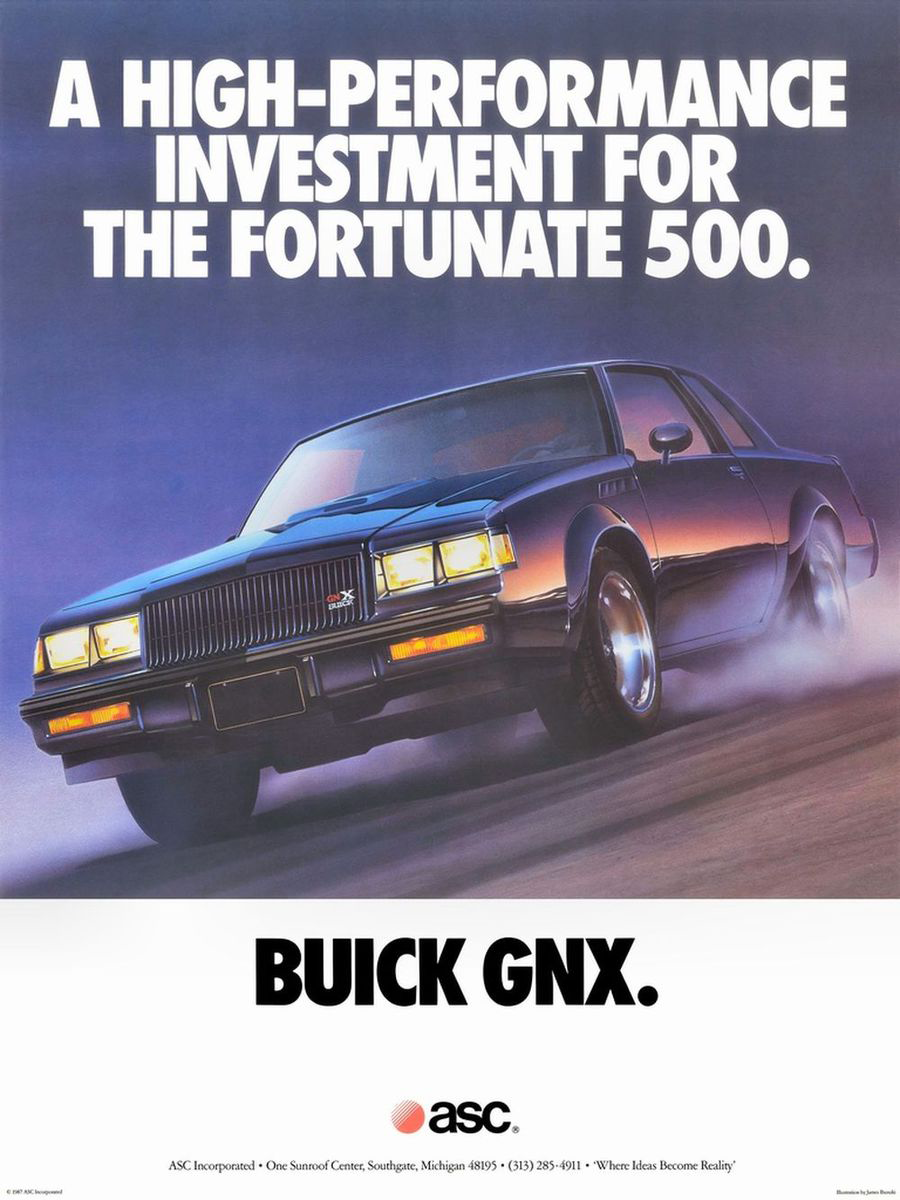
“A high-performance investment for the fortunate 500.”

1987 Buick GNX advertisement

The story is familiar to many of us. Buick’s Grand National performance variant of the Regal had been around since 1982, and it had gotten steadily more powerful, gaining a standard turbo V6 in 1984, and an intercooler in 1986. For 1987, Buick announced the GNX, which stood for Grand National Experimental.

Buick built cars with Grand National interiors and sent them to American Specialty Cars (ASC). The GNX added a performance suspension with a torque bar and a GNX-only rear differential cover. Its exterior featured functional front-fender louvers, and 16-inch aluminum mesh wheels with black-out faces and GNX center caps, which were equipped with Goodyear Eagle “Gatorback” tires—245/50VR-16 in front and 255/50VR-16 in the rear.

Most importantly, the GNX included a massaged version of Buick’s LC2 3.8 liter/231 ci turbo V6, making 276 bhp and paired with a four-speed automatic transmission with overdrive. Improvements to the engine over the standard turbo included a Garrett T3 turbocharger with ceramic impeller and a GNX-specific heat shield, a larger capacity intercooler, reprogrammed engine management, and a low-restriction exhaust.

Straight-line acceleration was outstanding for the day—Car and Driver recorded a 0-60 time of 4.7 seconds, with the quarter mile flying by in 13.5 seconds. The GNX handled well for a Regal, but that wasn’t really the point. Mileage ratings were 15 city/23 highway by the day’s standards (about 13 city/21 highway by today’s measures), which triggered the dreaded gas guzzler tax—$650 in this case.

The GNX was not inexpensive—the window sticker showed $29,290 (about $84,400 in 2025 dollars), with the GNX option alone listed as $10,995. Essentially, moving from a Grand National to a GNX added more than 50% to the price.

By 1987, a Grand National came reasonably well-equipped, with Sport mirrors, air conditioning, a leather-wrapped Sport steering wheel, a full-length operating console, and reclining front bucket seats included. A GNX came standard with many comfort and convenience features that were optional on the Grand National, including tungsten-halogen headlamps, electric door locks, power windows, electronic cruise control, tilt steering column, a six-way power driver’s seat, and the top-of-the-line UX1 stereo with graphic equalizer.

Options & Production Numbers

Buick built a mere 547 examples of the GNX—production was always intended to be quite limited. As far as I can tell, there were no factory options.

The View From 2025

According to Hagerty’s valuation tools, all the money for a 1987 Buick GNX coupe in #1/Concours condition is an astounding $257,000, with a far more normal #3/Good condition version going for $110,000.

The GNX has enthusiastic forum support, and there is intense collector interest. GNX coupes are sometimes available in the Hemmings Motor News classifieds, at online auctions such as Bring a Trailer that cater to the eighties car market, and at in-person auctions such as Barrett-Jackson and Mecum.

Make mine Black, of course.

Last updated in February 2025.

1984 Oldsmobile Ninety-Eight Regency coupe

At the 2023 Mecum Indy, a white Oldsmobile Ninety-Eight Regency coupe with an indicated 6,100 miles sold for $20,000.

1984 would end up being the final year for the rear-wheel-drive Oldsmobile Ninety-Eight—1985 would move the Ninety-Eight to the front-wheel-drive C-body. There were few changes for 1984: the 4.1 liter V6 was dropped (making the 5.0 liter V8 standard), there was a new grille with a crosshatch pattern, and the vertical taillamps now had Oldsmobile emblems in their lenses. Changes in options included different body side mouldings and new wire wheel cover designs.

The Ninety-Eight Regency‘s standard powertrain was the LV2 140 bhp 5.0 liter/307 ci V8 with a four-barrel carburetor mated to a four-speed automatic. Optional everywhere but in California was the LF9 105 bhp 5.7 liter/350 ci diesel V8 ($700). The Ninety-Eight coupe was not quick—with the standard powertrain, 0-60 took about 13.5 seconds in a car with a 3,915-pound curb weight. The diesel was about six seconds slower to 60 mph. Mileage with the gas V8 wasn’t horrible: 17 city/29 highway by the day’s standards (14/21 by today’s measures). With a large 25.1-gallon fuel tank, a Ninety-Eight Regency coupe owner could expect a range of 400 to 465 miles with a 10% fuel reserve.

Coupe page from the 1984 Regency brochure

Standard exterior and mechanical equipment on the $13,974 Ninety-Eight Regency coupe (about $44,900 in 2025 dollars) included Soft-Ray tinted glass, rear fender skirts, sail panel opera lamps, power front disc brakes, power steering, and P215/75R15 steel-belted radial-ply white-stripe tires (a size still readily available) mounted on 15-inch wheels with Bright Deluxe wheel discs. Inside, all Regency coupes included power side windows, power door locks, Four-Season air conditioning, an electric rear window defroster, a digital quartz clock, front and rear centre armrests, and an AM-FM stereo radio with two rear speakers.

Options & Production Numbers

Exterior and mechanical options included an electric sliding glass Astroroof ($1,195), an automatic leveling system, an engine block heater, and puncture-sealing tires. Inside, Custom leather trims in seating surfaces, electronic cruise control with resume and acceleration features ($175), Tempmatic air conditioning ($55), and automatic power door locks were all available. Options that date this car included a front seat litter container and an ETR AM/FM Stereo with seek and scan, digital display clock, cassette tape player, and a 40-channel CB.

Oldsmobile sold 7,855 Ninety-Eight Regency coupes in the 1984 model year, marking the fewest coupes sold in the 10th generation. Though large American coupes in general were fading away, 1985’s all-new front-wheel-drive Ninety-Eight would still offer coupe versions. Despite being all-new, the coupes wouldn’t sell much better in 1985 and would be gone after the end of the 1987 model year.

The View From 2025

There is some collector interest in these cars, though Hagerty does not track their values. Ninety-Eights of this era are often available in the Hemmings Motor News classifieds and at online auctions such as Bring a Trailer that cater to the eighties car market.

Make mine Autumn Maple Firemist, please.

Stunningly, this is the first rear-wheel-drive C-body I have written about, though I have written about the re-designated D-body 1986 Cadillac Fleetwood Brougham sedan. I probably should write about the Electra and the de Ville at some point.

Last updated October 2025.

1981 Volkswagen Scirocco S hatchback coupe

I’ve liked the styling of the first-generation Scirocco since it was new. It was, of course, designed by one of the all-time masters.

“For the most discriminating and demanding sports car enthusiasts”

1981 was the final model year for the first-generation Scirocco, which was first available in North America in 1975. Though the Scirocco used the same platform as the Golf, it was actually released about six months before the Golf.

With its basic form penned by Giorgetto Giugiaro—who seemed to have a hand in nearly every 1970s Volkswagen design—the Scirocco debuted at the 1973 Geneva Motor Show. Like the Karmann Ghia that it putatively replaced, the Scirocco was assembled by Karmann.

Classified as sub-compact by the EPA, the Scirocco was not a large car—its 155.7-inch length is more than a foot shorter than the current Golf GTI. For 1981, the configuration of the Scirocco sold in North America moved to a slightly large 1.7 liter engine, transitioned the standard transmission from a four-speed manual to a five-speed manual, and offered a new Scirocco S package.

The Scirocco’s standard powertrain was the EA827 74 bhp 1.7 liter/105 ci inline four with fuel injection mated with a five-speed manual. A three-speed automatic was optional. With a curb weight of 1,892 pounds, 0-60 came in a little over 11 seconds. Fuel economy was rated at 25 city/40 highway by the day’s standards. With a 10.6-gallon gas tank, a Scirocco owner could expect a range of 280 to 310 miles with a 10% fuel reserve.

Scirocco S pages from the 1981 brochure

Standard mechanical features on the $8,495 Scirocco (about $32,000 in today’s dollars or almost exactly what a 2025 Golf GTI goes for) included front-wheel-drive, rack-and-pinion steering, power-assisted front disc/rear drum brakes, and 175/70SR13 steel-belted radial tires (a size still readily available) on 13-inch wheels. Inside, a tachometer, a trip odometer, and front bucket seats were standard.

Packages & Options

A new package for 1981 was the S, which included black trim, a red VW radiator badge and belt-line moulding, a larger front spoiler, light alloy wheels, and specially designed striped cloth sport seats. The S package was available in three of the eight standard Scirocco colors and cost $520.

Options for the Scirocco were few—a sunroof, a rear window wiper/washer, the aforementioned three-speed automatic transmission, and air conditioning.

The View From 2025

First-generation Sciroccos attract collector interest, and there is club support. They are sometimes available in the Hemmings Motor News classifieds, on eBay Motors, and at online auctions such as Bring a Trailer that cater to the eighties car market.

Make mine Cirrus Gray Metallic, please.

Other Volkswagens I have written about include the 1981 Dasher station wagon, the 1983 Rabbit GTI hatchback coupe, and the 1985 Cabriolet.

Last updated April 2025.

1980 Mercedes-Benz 450SL convertible

A 1980 Mercedes-Benz 450SL convertible sold for $27,000 at Mecum’s “Summer Special” auction in August 2020. I’ve previously written about the other two eighties SL versions: the 380SL and the 560SL. Perhaps it’s time to write about the 450SL.

In production since the 1972 model year, the Mercedes-Benz 450SL changed little in its final year, with a few new exterior colors and some new stereo choices. There were also multiple emissions-related changes to the powertrain, with horsepower ratings dropping from 180 bhp to 160 bhp and torque ratings increasing.

The sole powertrain for the 450SL remained a 4.5 liter/276 ci V8 with Bosch Jetronic fuel injection paired to a three-speed automatic. Car and Driver tested a 1980 450SL and recorded an 11.6-second 0-60 time, but raw acceleration likely wasn’t that important to SL buyers. Mileage also wasn’t great in a vehicle with a 3,730-pound curb weight—this SL was no longer anything resembling Sport Light. The 1980 EPA fuel economy rating was 16 mpg, and most owners report that number as somewhat hopeful. At least the sizeable 23.8-gallon gas tank allowed a range of close to 345 miles with a 10% fuel reserve.

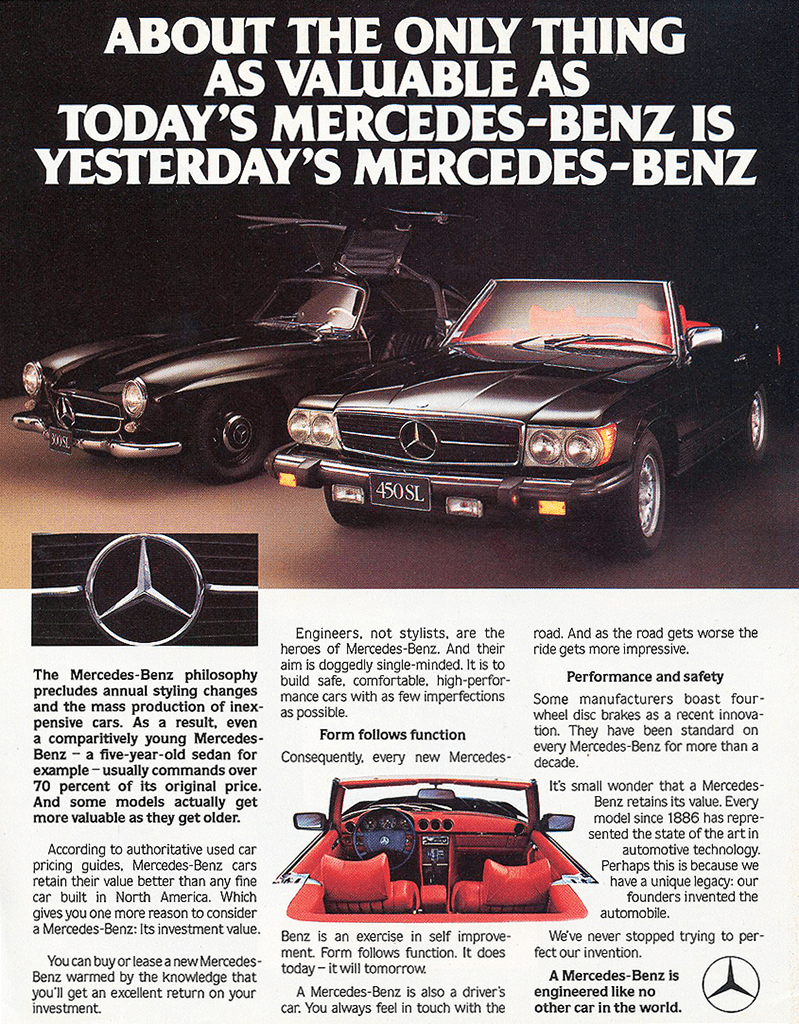
1980 Mercedes-Benz 450SL advertisement

For 1980, the 450SL’s base price was a substantial $35,839—about $152,400 in today’s dollars, which is about 36% more than today’s AMG SL 43 convertible goes for. Standard exterior and mechanical equipment for this expensive car included tinted glass, variable-ratio power steering, power four-wheel disc brakes, and 205/70HR14 tires (a size still available thanks to Vredestein) mounted on 14 x 6 inch light-alloy wheels. Inside, air conditioning, adjustable MB-Tex bucket seats, cruise control, electric windows, and central locking were all included.

Options included a limited-slip differential, 15-inch wheels, leather bucket seats, and an array of Becker stereos. Like many other European cars of the early eighties, the 450SL did not have a standard stereo, though a power antenna was included.

The 450SL was a cultural icon, finding fans among various executives, celebrities, professional athletes, and rock stars when new. It was also a film and television star—famously driven by Richard Gere in American Gigolo, by Stephanie Powers and Robert Wagner on Hart to Hart, and by Patrick Duffy on Dallas.

The View From 2025

450SLs have many adherents to this day, and there is much club support. According to Hagerty’s valuation tools, all the money for a 1980 450SL in #1/Concours condition is $71,900, with a more normal #3/Good condition car going for $14,400. These SLs are always available in the Hemmings Motor News classifieds, on eBay Motors, on Bring a Trailer, and often at in person auctions. As I update this post in April 2025, there are eleven 1980 450SLs available for sale in Hemmings.

Make mine Astral Silver Metallic, please. Sometimes the cliché is correct.

Other eighties Mercedes-Benz models I have written about include the 1985 300CD Turbo coupe and 1986 560SEC coupe.

Last updated April 2025.