“Inheriting All The Traditions Of The Best Car In The World”
The introduction of the Silver Spirit in the United States waited one year after the model’s debut in England. The Silver Spirit and the slightly lengthened Silver Spur followed the long-running Silver Shadow and Silver Wraith II models.
The powertrain for Rolls-Royce sedans remained a 6.75 liter/413 ci V8 mated with a three-speed automatic. In 1981 guise with Bosch K-Jetronic fuel injection, the venerable V8 (development had begun in 1952) was rated at 175 bhp. Despite the Silver Spirit’s 4,900-pound curb weight, Car and Driver recorded a respectable 10.8-second 0-60 time. Fuel mileage was distinctly unrespectable—rated at 10 city/13 highway and triggering a $650 gas guzzler tax. With a large 28.6-gallon gas tank, a Silver Spirit owner could expect a range of 265 to 295 miles with a 10% fuel reserve.
The Silver Spirit retailed for an astounding $109,000—about $410,100 in 2025 dollars. This price was at a time when a top-of-the-line Mercedes-Benz 380 SEL went for $44,300, and the comparable BMW 733i was $32,000. Cadillac’s range-topping Seville was a “mere” $23,400.
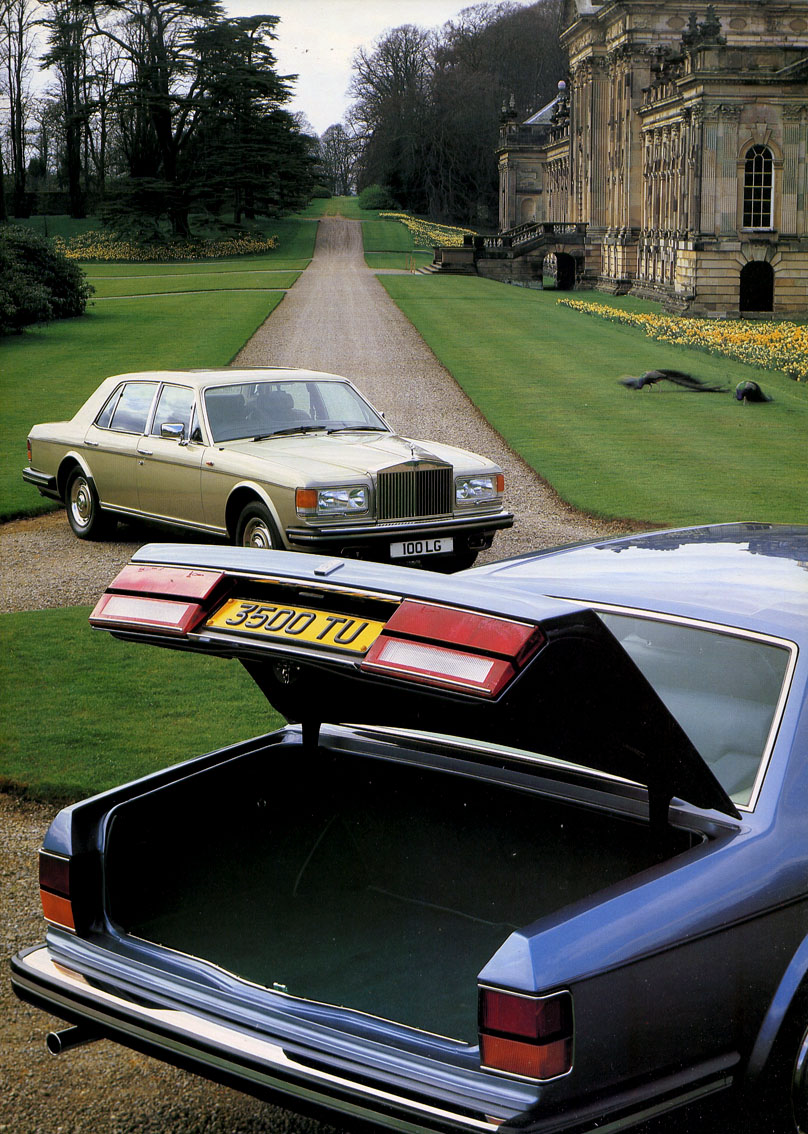
Page from the 1981 Rolls-Royce Silver Spirit brochure
Standard exterior and mechanical equipment on the Silver Spirit included power-assisted rack and pinion steering, power four-wheel disc brakes, and 235/70HR-15 Michelin XVX tires (a size and type still readily available) on 15-inch wheels. Inside, wood burl trim, leather upholstery, adjustable front bucket seats, automatic speed control, automatic temperature control, and a Blaupunkt Bucharest stereo radio with a cassette player and four speakers were included. There were no formal options, though the factory would satisfy almost any color, upholstery, or trim request for an additional charge.
The View From 2025
Like all Rolls-Royces, the Silver Spirit attracts collector interest, and there is support from the Rolls-Royce forums. Like many late-model Rolls-Royces, Silver Spirits face extreme depreciation because of the costs of deferred maintenance.
According to Hagerty’s valuation tools, a 1981 Rolls-Royce Silver Spirit in #1/Concours condition is $16,300, with a more normal #3/Good condition car going for $8,200. Silver Spirits sometimes appear for sale in the Hemming’s Motor News classifieds, on eBay Motors, and on Bring a Trailer.
Make mine Tudor Red, please.
The Silver Spirit is the first Rolls-Royce I have written about, though I did write about the closely related 1989 Bentley Turbo R sedan. Thus, I have not yet written about the Camargue coupe or the Corniche convertible.
Toyota’s Corolla was all new for 1984, marking its fifth generation. Confusingly, Corollas were both front-wheel-drive and rear-wheel-drive. If you wanted the notchback coupe, the only way to get it was as a rear-wheel-drive SR5 Sport Coupe, which had an AE86 internal development code.
The SR5 name originally stood for Sport Rally 5-speed. The designation was originally SR-5 and first appeared in 1973 on the second-generation Corolla notchback coupe and the Hilux pickup truck. The SR5 name remains as a trim even in today’s Toyotas, though the five-speed manuals are long gone.
The standard powertrain for 1984 was carried over from the previous generation. It was the 4A-C 70 bhp 1.6 liter/97 ci inline four with a two-barrel carburetor paired with (of course) a five-speed manual. A four-speed automatic was optional. Motor Trend clocked a 0-60 time of 12.9 seconds with the manual. Fuel mileage was rated at 32 city/43 highway by the day’s standards (25/31 by today’s measures). With a 13.2-gallon fuel tank, an SR5 driver could expect a range of 335 to 445 miles with a 10% fuel reserve.
Corolla page from the 1984 Toyota brochure
Standard exterior and mechanical equipment on the $9,381 SR5 Sport Coupe (about $29,800 in today’s dollars or almost exactly what a 2025 Corolla XSE sedan goes for) included tinted glass, retractable halogen headlamps, rack and pinion steering, vented power front disc brakes, and 185/70SR13 steel-belted radial-ply tires (a size still available) on 13-inch wheels. Inside, all SR5s included reclining lo-back front bucket seats, a split-back fold-down rear seat, a center console with storage compartment, dual power remote mirrors, an electric rear window defogger, tilt steering, a tachometer, a digital quartz clock, and an AM/FM/MPX radio.
Options & Period Reviews
Options included a power sunroof, variable assist power steering ($190), dual-stage air conditioning ($1,000!), and a cassette player with Dolby ($173). A Sport Package—yes, you could get a Sport Package on the Sport Coupe—included Sport Seats, special interior trim, and aluminum alloy wheels.
Motor Trend generally liked the SR5, but did gently hint that it was truly all show and no go, mentioning that the front-wheel-drive “civilian” versions were actually slightly faster. They finished by calling the SR5 “affordable, handsome, and pleasant to drive.”
For 1981, Mercedes-Benz’s big W126 S-Class sedan made its way into the North American market after a year of sales in Europe. There were two offerings—a 300 SD diesel sedan and a 380 SEL with an extended wheelbase. The BMW 733i and the Jaguar XJ6 Series III were putative competitors, though the new Mercedes was considerably more expensive.
The 380 SEL’s only available powertrain was the M116 155 bhp 3.8 liter/234 ci V8 with Bosch K-Jetronic fuel injection paired with a four-speed automatic transmission. Road & Track clocked a 0-60 time of 10.1 seconds in a car with a 3,800-pound curb weight while mileage was 17 mpg by the day’s standards. With a relatively large 23.8-gallon fuel tank, range was between 330 and 365 miles with a 10% reserve.
1981 Mercedes-Benz 380 SEL and 300 SD advertisement
The 380 SEL listed for an eye-watering $44,298—about $165,900 in today’s dollars (a modern S 580 4MATIC sedan starts at $128,600). Standard exterior and mechanical included tinted glass, halogen head lamps, an automatic power antenna, power assisted four-wheel disc brakes, power steering, and Michelin XVS 205/70HR-14 tires (a size still available) on 14-inch light alloy wheels. Interior equipment included 8-way electrically adjusted front seats, an electrically adjustable rear seat, a choice of leather or velour upholstery, cruise control, climate control, electric windows, a central locking system, and an electronic AM/FM stereo radio with a cassette player.
Options, Production Numbers, & Period Reviews
Since the 380 SEL came loaded, there were not a lot of options beyond the exterior and interior colors. An electrically operated sliding roof ($795) and heated seats ($360) were available.
Production numbers are hard to come by, but an estimated 20,000 380 SELs were imported into the United States for the 1981 model year. Period reviews were extremely positive—Road & Track concluded theirs with “quite simply, Mercedes’ new S-class is a class unto itself.”
The View From 2025
There is excellent club support for the 380 SEL, as there is for almost all Mercedes-Benz’s. That same club support warns potential buyers against the M116 engine’s notorious timing chain issues, though I believe nearly all of the original single chains have been replaced with double chains by now. There’s also frequent mention that the 380 SEL’s climate control did not meet the standards of domestic luxury car manufacturers in the early eighties.
That said, the W126 is frequently cited as the best S-class ever made—substantially improving over the already impressive W116.
According to Hagerty’s valuation tools, all the money for a 1981 Mercedes-Benz 380 SEL in #1 condition is $42,600, with a more normal #3 condition car going for $13,400. 380 SELs frequently appear for sale in the Hemming’s Motor News classifieds, on eBay Motors, and on Bring A Trailer.
As a high school student in the early to mid-1980s, I worked part-time at Frankel Chevrolet (a dealership in Ardmore, Pennsylvania). I’ll never forget seeing my first C4 Corvette in early 1983: small block V8 engine with “Cross-Fire Injection” rumbling, lovely over-engineered retractable headlamps up and on, fancy new metallic paint with clear coat looking its best in the setting sun. Viewing this car was a visceral experience for a fifteen-year-old. It was the exact moment when my opinion of Corvettes changed from a grudging respect (I was more of a BMW and Pontiac fan then) to “I will have one of those someday.”
“You’ve never seen anything like this before.”
The phrase “all-new” is rarely accurate in cars, but the 1984 Corvette was close. Only the standard powertrain carried over from 1982, and even that was changed in some visible (a brand new magnesium air cleaner) and measurable (an additional five bhp) ways. The exterior, interior, suspension, and steering were truly all-new for the Corvette.
The standard powertrain was the L83 Cross-Fire 205 bhp 5.7 liter/350 ci V8 with throttle-body fuel injection paired with a Turbo-Hydramatic four-speed automatic transmission. The Doug Nash 4+3 manual transmission with automatic overdrive was available as a no-cost option, but only became available about halfway through the extended 1984 model year. Car and Driver recorded a 0-60 time of 6.7 seconds (Road & Track took 7.1 seconds) and a top speed of 138 mph. Estimated fuel economy was 16 city/28 highway by the day’s standards. With a 20-gallon gas tank, a Corvette coupe’s proud new owner could expect a range of between 325 and 355 miles with a 10% fuel reserve.
David Kimble’s cutaway page in the 1984 Chevrolet Corvette brochure
The 1984 Corvette’s base price was $22,361—about $74,200 in today’s dollars or a little over what a 2026 Corvette Stingray 1LT coupe goes for. Standard exterior and mechanical equipment included a one-piece removable fiberglass roof panel, a frameless rear glass hatch, single rectangular hidden headlamps, integral grille-mounted halogen fog lamps, rack-and-pinion power steering, power disc brakes, and P255/50VR-16 tires on 16 x 8.5 inch cast alloy aluminum wheels. Inside, air conditioning, power windows, a tilt and telescope steering wheel, a driver information system, cloth bucket seats, and an AM/FM stereo radio with a power antenna were all included.
Options & Production Numbers
The Z51 Performance Handling Package ($600) included a quicker steering gear, a performance axle ratio, an engine oil cooler, an additional radiator fan, higher-rated Delco-Bilstein shock absorbers, thicker stabilizer bars, and 9.5 inch rear wheels.
Optional exterior and mechanical equipment included two-tone paint ($428), a removable transparent roof panel ($595), a performance axle ratio ($22), and Delco-Bilstein shock absorbers ($189). Optional interior equipment included cruise control ($185), a power door lock system ($165), custom adjustable sports seats ($625), leather seats ($400), a six-way power driver’s seat ($225), and the Delco-GM/Bose Music System ($895).
Chevrolet rarely makes Corvette television commercials, but they usually produce one when introducing a new generation. For the 1984, they pulled out all the stops, at least by the standards of eighties automobile commercials—a spacesuit, lasers, and a cheesy jingle all make an appearance.
The new generation Corvette was very well-received by buyers. Chevrolet sold 51,547 in about eighteen months, making 1984 the second best sales year ever (only 1979 had a higher production total).
Period Reviews & Owner Feedback
Reviews of Chevrolet’s pride were positive but evenhanded. Car and Driver disliked the fact that the new generation was no lighter than the previous generation—a Corvette complaint that extends to today. Many writers also commented on the “Tokyo by Night” digital instrument panel.
Within a year or so, there would start to be an acknowledgment from the automotive press that the optional and heavily hyped Z51 performance handling package was suitable for only the most perfect roads. In their owner’s report, Popular Mechanics quoted a New York salesman as saying “bad ride on rough roads,” while a Texas retiree stated “body rattle is frustrating.” Chevrolet began to adjust beginning in the 1985 model year, but early C4 Corvettes continued to be seen as having an unnecessarily rough ride.
The View From 2025
There’s been a lot written about the 1984 Corvette—both good and bad—and I doubt I have much to add. Despite being pushed back several months from an actual 1983 model year release, it still felt rushed. On the other hand, many people think of the almost all-new fourth-generation Corvettes as the first “modern” version of Chevrolet’s sports car. However, modern is undoubtedly a fluid concept now—more than forty years later. Developed in the late 1970s and early 1980s, the C4s were the first Corvettes with rack-and-pinion steering and a removable one-piece “targa” roof.
There is strong club support for the 1984 Corvette, as there is for all Corvettes. According to Hagerty’s valuation tools, a 1984 Corvette with a clear top and the 4+3 manual in #1/Concours condition is $35,500, with a more typical number #3/Good condition car going for $8,400. 1984 Corvettes are regularly featured in the Hemmings Motor News classifieds, on eBay Motors, and on Bring a Trailer. Early C4s are also often seen at in-person auctions such as Barrett-Jackson and Mecum. As I update this blog entry in October 2025, a Gold Metallic car with saddle cloth adjustable sport bucket seats and 34,000 miles is available on Hemmings, asking $18,000.
Make mine Light Blue Metallic, please. That 1984 Corvette I mentioned seeing earlier was Light Blue Metallic, and I bought, drove extensively, and eventually sold a 1985 model in the same color.
The 700 series Volvos had been available in the United States for a few years before Volvo brought the station wagon to our shores to offer Volvo loyalists a step up from the aging 240. The most interesting version of the 700 series wagon to enthusiasts was the 740 Turbo, which was formally introduced in the middle of the 1985 model year.
The 740 Turbo‘s standard engine was a B230FT 160 bhp 2.3 liter/141 ci inline four with fuel injection, a Garrett T3 turbocharger, and an intercooler. A four-speed manual was standard, while a four-speed automatic with overdrive was optional. Car and Driver recorded a 0-60 time of 7.9 seconds in a 740 Turbosedan with the manual. With the manual, mileage in the 3,042-pound car was rated at 19 city/25 highway by the day’s standards (17/23 by today’s standards). With a 15.8-gallon fuel tank, 740 Turbo drivers could expect 285 to 310 miles of range with a 10% reserve.
1985 Volvo 740 Turbo station wagon advertisement
The 1985 740 Turbo station wagon’s base price was $21,340—about $64,400 in today’s dollars or about what a 2025 V90 Cross Country Ultra station wagon goes for. Standard exterior and mechanical equipment included tinted windows, a front spoiler, halogen high and low beam headlights, a manual sunroof, power-assisted rack-and-pinion steering, power-assisted disc brakes, and 195/60R15 Michelin MXV tires (a size still readily available) on 15-inch wheels. Inside, a rear window wiper/washer, power door locks, cargo tie-down rings, and air conditioning were included. Trim and upholstery features included adjustable front bucket seats with integrated head rests and lumbar support, a heated driver’s seat, a 60/40 split rear seat, and full carpeting including the trunk.
Options & Reviews
Like all Volvo models in the 1980s, the 740 Turbo had few individual factory options—you chose the exterior and interior colors, and that was about it. Cruise control and an AM/FM-stereo radio/cassette with four speakers ($800) were available.
The automobile press of the day liked the 740 Turbo wagon, and it’s interesting to watch MotorWeek‘s review. Common complaints were the lack of an oil pressure gauge—considered essential for turbocharged engines at that time—along with the “archaic” driver’s seat height adjustment. Everyone also felt the need to comment on the Volvo’s very square design.
The View from 2025
All vintage Volvos have strong club support, and there is definite collector interest in the 740 Turbo. 740 Turbo station wagons are often available in the Hemmings Motor News classifieds, on eBay Motors, and at online auctions such as Bring a Trailer that cater to the eighties car market.
Make mine Silver, please.
Other Volvos that have been covered in Eighties Cars are the 1985 240 station wagon and the 1987 780 coupe. I should write about a Volvo sedan or two at some point.
A 1980 Datsun 200-SX coupe sold for $10,000 at the 2025 Barrett-Jackson Scottsdale auction.
“Thrill-injected”
Datsun’s 200-SX was almost entirely new for 1980, with exterior styling notably changed and a significantly enhanced engine. Nissan advertised improved visibility and increased door opening for 1980, but the real upgrade was that the 200-SX was no longer as weird-looking as the 1975-1979 had been. Nissan was in the process of transitioning away from the Datsun name, so the 200-SX’s official name was a clunky “Datsun 200-SX by Nissan.” No matter what, marketing used 200-SX instead of 200SX in 1980, so I’ll follow that in this post.
The only engine available for the 1980 200-SX was the NAPS-ZZ20E 100 bhp 2.0 liter/120 ci inline four with L-Jetronic electronic fuel injection paired with either a five-speed manual or a three-speed automatic. Car and Driver recorded a 0-60 time of 13.3 seconds in the 2,620-pound coupe. EPA fuel economy ratings with the five-speed were 28 city/40 highway—with a 14.0-gallon gas tank, a 200-SX coupe’s owner could expect a range of 430 miles with a 10% fuel reserve.
200-SX pages from the 1980 Datsun brochure
Standard exterior and mechanical equipment on the $6,689 1980 200-SX Deluxe (about $28,300 in 2025 dollars or just a little more than a 2025 Nissan Altima S costs) included four-wheel power-assisted disc brakes, partially recessed windshield wipers, and 185/70SR14 tires (a size still readily available) on 14-inch wheels with full mag style wheel covers. Inside, a quartz sweephand clock, deep pile carpeting, and full reclining front bucket seats with soft vinyl upholstery were included.
Options & Production Numbers
The Sport Luxury (SL) package upgraded 200-SX buyers to soft cloth upholstery, a multi-warning system, a driver’s seat with adjustable lumbar and thigh support, and a four speaker AM/FM stereo radio with power antenna.
The 1980 200-SX had few individual options, and most of them—except for California emissions—seem to have been available only if you had already ponied up for the SL package. These options included power steering, a lift-out skyroof, two-tone paint, and air conditioning.
The buff books liked the 200-SX for its intended purpose—Car and Driver wrote that the new version had “better looks and better manners.” They gently asked for more power, but that would be a long time coming and only in slight increases for the coupe. The 200-SX got 103 bhp in 1982, and the third-generation coupe got 105 bhp in mid-1984 (only the hatchback would get the 133 bhp turbo option).
Nissan sold 92,514 200-SX coupes and hatchbacks in 1980—a notable success, and soundly beating many competitors. This version of the 200-SX would run for four years.
Buick made things more than a bit confusing for some of its higher-end coupe buyers in the middle of the 1988 model year by introducing the two-seater Reatta. For the first time since its introduction in 1963, the Riviera was definitively no longer the top of the two-door Buick line—with a base price of $25,000, the Reatta’s barrier to entry was almost 16% higher.
“Beauty with purpose.”
Designed to be a sporty car, but with no delusions of being a sports car, Buick targeted the Reatta at a perceived niche in the two-seater market for a luxury coupe at a substantially lower price than the high-end luxury convertibles of the day. As Buick general manager Edward Mertz said in January 1988, it was “priced many thousands of dollars less than luxury and sports cars at the top end of the market.” The Reatta was not nearly as expensive as the Cadillac Allanté convertible (which had a base price of $56,533 in 1988) or the Mercedes-Benz 560SL convertible ($61,130 in that same year) but could claim to be nearly as comfortable. Compared to the Cadillac and (especially) the Mercedes, the Reatta lacked refinement and prestige—both important to potential buyers.
Despite being based on the same E-platform as the Riviera, the Reatta’s exterior styling was distinctive, even if some of the proportions looked a little off to some. However, many parts of its interior were familiar to Riviera buyers—indeed, Buick benchmarked the Reatta’s two seats to the Riviera’s driver and front passenger experience. Because of this, the Reatta’s Electronic Control Center was essentially the same as the Riviera’s, and the Reatta’s optional driver’s seat closely resembled the one in the Riviera T Type.
The Reatta’s sole powertrain was a 3800 165 bhp 3.8 liter/231 ci V6 with fuel injection paired with a four-speed automatic. Car and Driver tested a 1988 Reatta, and recorded a 0-60 mph time of 9.1 seconds in a vehicle with a 3,380-pound curb weight. Mileage was respectable—19 city/29 highway by the day’s standards (17/26 by today’s measures). With an 18.2-gallon gas tank, a Reatta owner could expect a range of 355 to 390 miles with a 10% fuel reserve—enough to take those road trips that Buick was convinced the Reatta would be primarily used for.
1988 Buick Reatta brochure cover
Standard exterior and mechanical equipment on the Reatta included Soft-Ray tinted glass, fast-ratio power steering, an independent four-wheel Gran Touring suspension, four-wheel anti-lock disk brakes, and P215/65R15 Goodyear Eagle GT+4 tires (a size still readily available) on 15-inch wheels. Inside, power windows, electric door locks, six-way power seats, and Electronic Touch Climate Control air conditioning were included. The standard and only audio system was an ETR AM stereo-FM stereo radio with seek and scan, a cassette tape player with auto reverse, search/repeat, a graphic equalizer, a clock, eight Concert Sound speakers, and an automatic power antenna.
Options & Production Numbers
Buick’s new coupe came loaded, with only two options in its introductory year: an electric sliding steel sunroof ($895) and a 16-way adjustable leather and suede driver’s seat ($680).
First-year sales of the Reatta were decent for a new two-seat coupe without that all-important pre-existing audience that many of its competitors had—Buick moved 4,708 of them in about nine months.
The View From 2025
There is collector interest in the Reatta, including club support. According to Hagerty‘s valuation tools, a 1988 BuickReatta coupe in #1/Concours condition is $22,700, with a far more normal #3/Good condition version going for $4,200.
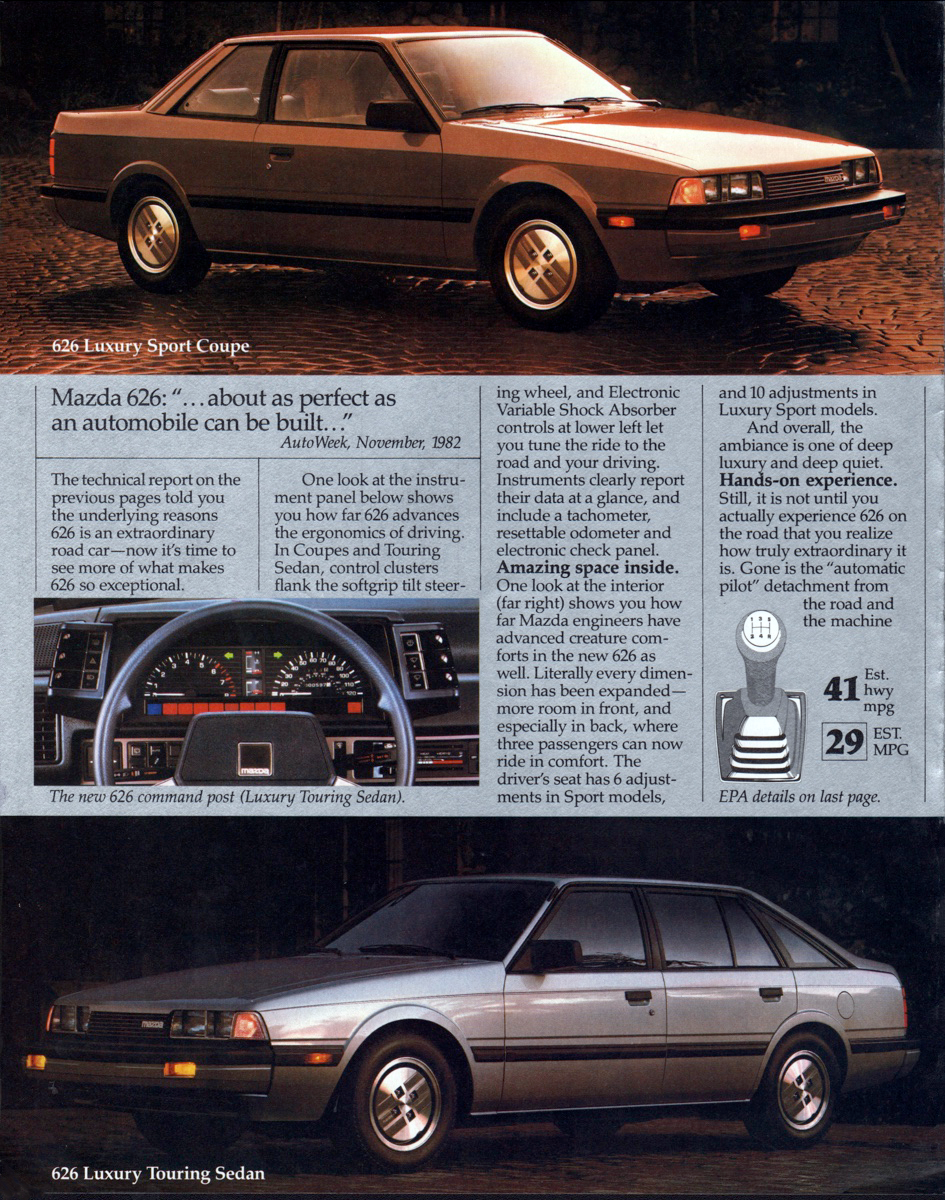
For 1983, Mazda’s 626 coupe, sedan, and liftback were all new as they switched from rear-wheel-drive to front-wheel-drive. Styling was also more aerodynamic, with the coupe receiving a 0.34 Cd. Finally, almost every interior dimension was expanded.
The 626’s standard powertrain was the FE 83 bhp 2.0 liter/121 ci inline four with a two-barrel carburetor paired with a five-speed manual. 0-60 mph took about 12.5 seconds in a car with a 2,545-pound curb weight. EPA fuel economy ratings were 29 city/41 highway by the day’s standards. With a 15.8-gallon fuel tank, a new 626 coupe owner could expect an impressive range of 405 to 450 miles with a 10% fuel reserve.
626 page from the 1983 Mazda brochure
Standard equipment on the $9,295 626 DL coupe (about $30,100 in today’s dollars or about what a 2025 Mazda3 2.5 S Carbon Edition sedan goes for) included rack-and-pinion steering, vacuum-assisted front disc/rear drum brakes, and 185/70R-14 tires (a size still available) on 14 x 5.5 inch wheels. Inside, electric window lifts, electric adjustable mirrors, cruise control, and an AM/FM stereo cassette were included.
The LX coupe added power steering, cruise control, and the trick Electronic Variable Shock Absorber (EVSA) suspension.
Options & Period Reviews
Options included 15 x 6 inch cast alloy wheels with uprated 195/60R-15 tires (a combination that yielded class-leading skid pad results and is still readily available), an electric sunroof ($430), and air conditioning ($650).
The third-generation 626 got a very good reception from the automotive press, with Road & Track stating that it was “an impressive update” that had been “delivered as promised.” AutoWeek gave Mazda a splash quote they used in advertisements—”about as perfect as an automobile can be built.”
The View From 2025
The third-generation Mazda 626 was once quite common (at least in the Philadelphia suburbs), but I haven’t seen one in over a decade. This era of 626 is sometimes available in the Hemmings Motor News classifieds, on eBay Motors, and at online auctions such as Bring a Trailer that cater to the eighties car market.
A 1983 Chevrolet Monte Carlo SS with 156 miles sold on Bring a Trailer for $32,000 in early 2021.
“Chevy SS tradition comes alive …”
In the middle of the 1983 model year, Chevrolet announced the Monte Carlo SS. Designated RPO Z65, the SS was designed to help Chevrolet compete better in NASCAR on Sundays—and sell more Monte Carlos on Mondays. There were only two exterior color choices—White and Medium Dark Royal Blue. The changes in the front end and the addition of a rear spoiler cut the drag coefficient by 15% compared to the “civilian” Sport Coupe, making it a respectable 0.375, though not quite the Ford Thunderbird coupe‘s 0.35 Cd.
Aside from the exterior looks, the powertrain was the star—an L69 “H.O.” 175 bhp 5.0 liter/305 ci V8 with a four-barrel carburetor paired with a three-speed automatic transmission. Period road tests resulted in 0-60 mph times of about 8 seconds—about as quick as the Monte’s Buick Regal T-Type and Oldsmobile Cutlass Calais Hurst/Olds platform-mates in the same year. Fuel economy was rated at 17 city/25 highway by the day’s standards (14 city/18 highway by 2025 measures). With an 18.1-gallon gas tank, the enthused new owner of a Monte Carlo SS could expect a range of 260 to 340 miles with a 10% fuel reserve.
1983 Chevrolet Monte Carlo SS flyer
The Monte Carlo SS had a base price of $10,249—about $34,900 in today’s dollars. Standard exterior and mechanical equipment included Sport mirrors, a rear spoiler, a dual outlet exhaust system, power steering, the F41 sport suspension, power front disc/rear drum brakes, and Goodyear Eagle GT P215/65R15 white letter tires (a size still readily available) on 15 x 7 inch stamped steel wheels. Inside, the SS was less differentiated, but it did get a gage package with a tachometer. The standard seat was a blue cloth bench seat with white vinyl inserts and matching door trim.
Options, Period Reviews, & Production Numbers
Many of the standard Sport Coupe’s options were also available for the SS. Exterior examples included tinted glass ($105), hi-beam halogen headlamps ($10), and twin remote Sport mirrors ($60). Inside, options included an intermittent windshield wiper system ($49), an electric rear window defogger ($135), power windows ($180), an electric power door lock system ($120), a power trunk opener ($40), automatic speed control with resume speed ($170), a Comfortilt steering wheel ($105), and air conditioning ($725).
A blue cloth 55/45 seat with white vinyl inserts was available for an extra $133, but no bucket seats were available for the 1983 Monte Carlo. A series of four radios were available, with an AM/FM stereo radio with stereo cassette tape and four speakers ($298) being the top of the line. A fixed mast black antenna was an SS-only option and was included with all radios.
The sportier Monte Carlo was generally received in the press, though many scribes noted the lack of a console, bucket seats, Positraction, and a four-speed automatic—all issues Chevrolet promised to fix. Motor Trend‘s title was “Mid-American GT Revival,” and much of the coverage agreed.
Along with the late introduction, there were production problems in 1983, so the first year total for the fourth-generation Monte Carlo SS was only 4,714. SS sales would hit their stride in the following year, with Chevrolet moving 24,050 out the door.
The View From 2025
These Monte Carlos have enthusiastic forum support, and there is definite collector interest. According to Hagerty’s valuation tools, a 1983 Chevrolet Monte Carlo SS Sport Coupe in #1/Concours condition is $33,300, with a far more normal #3/Good condition version going for $16,400. Monte Carlos SS coupes are often available in the Hemmings Motor News classifieds, on eBay Motors, and at online auctions such as Bring a Trailer that cater to the eighties car market. As I update this blog entry in August 2025, there’s a White 1983 Monte Carlo SS Sport Coupe with 53,000 miles for sale on Hemmings, asking 29,000.
1980 was the first year that Toyota sold the Corolla Tercel in the United States. Despite its name, the front-wheel-drive Tercel was not related in any meaningful way to the rear-wheel-drive Corolla. Still, Toyota evidently figured that adding the Corolla name would make buyers more confident in their purchasing decision. The Tercel was available as a 2-Door Sedan and a 3-Door Liftback (a four-door sedan would arrive one year later).
The Corolla Tercel Liftback was a small and light car, with a 160-inch length (about 22 inches shorter than a 2025 Corolla) and a curb weight of 2,030 pounds. The Liftback’s standard powertrain combined a 60 bhp 1.5 liter/99 ci inline four paired to a five-speed manual (a three-speed automatic was optional). Unusually for a front-wheel-drive car, the Tercel’s engine was longitudinally placed, which Toyota claimed resulted in easier serviceability.
Road & Track clocked a 0-60 time of 14.8 seconds in a loaded Tercel Liftback SR-5. As might be expected with a 99 cubic inch engine and a five-speed, fuel economy was impressive—33 city/43 highway by the day’s standards. With an 11.9-gallon fuel tank, a Tercel driver could expect a range of 330 to 365 miles with a 10% fuel reserve.
Corolla Tercel Liftback pages from the 1980 Corolla brochure
At $4,848 (about $20,500 in today’s dollars or a little less than a 2025 Corolla LE sedan goes for), the Corolla Tercel Liftback Deluxe had more standard equipment than the 2-Door Sedan, which was the loss leader at $4,198. Standard exterior and mechanical equipment included body side moldings, front-wheel-drive, rack-and-pinion steering, power-assisted front disc/rear drum brakes, and 145SR13 steel-belted radial ply whitewall tires on 13-inch wheels. Inside, vinyl reclining hi-back front bucket seats, a split-back fold-down rear seat, brushed nap wall-to-wall carpeting, an electric rear window defogger, and a day/night rear view mirror were included.
Packages & Options
The $600 SR-5 package required the five-speed manual and added black accents, “brazen” side striping, and 165/70SR13 steel-belted radial ply tires (a size still available thanks to Vredestein) on 13-inch wheels. Inside, SR-5 features included cloth reclining low-back front bucket seats, a rear deck cover, a cargo compartment light, an electric tachometer, and an AM/FM/MPX stereo radio.
Options were relatively few, but did include aluminum alloy wheels ($215), a rear window washer/wiper ($75), and factory (not dealer-installed) air conditioning ($520).





 Eighties Cars