Along with its sedan sister, the Cadillac Coupe de Ville was all-new for the 1985 model. Introduced in April 1984, it moved to front wheel drive and lost significant length, width, and weight compared to its immediate predecessor.
The Coupe de Ville’s powertrain was Cadillac’s 125 bhp HT-4100 4.1 liter/249 ci V8 with throttle body fuel injection paired with a four-speed automatic transmission. Fuel economy was 17 city/26 highway by the standards of the day (15/24 by today’s measures). Since the engine and transmission remained essentially the same and the Coupe de Ville was smaller and lighter, performance improved but still not very impressive: 0-60 improved to a little under 12 seconds.
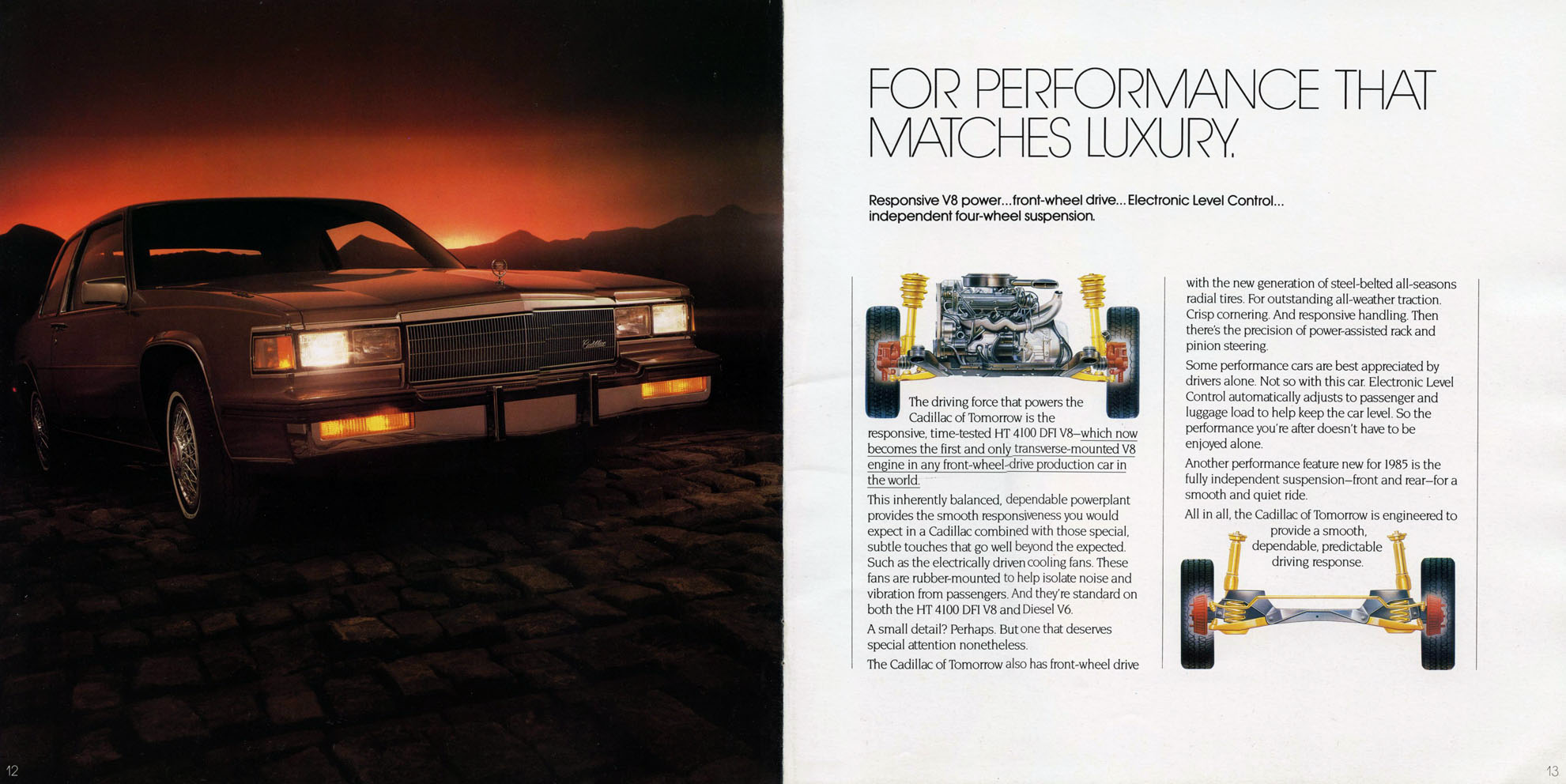
Coupe pages from the 1985 Cadillac de Ville brochure
The 1985 Coupe de Ville’s base price was $18,355—about $57,700 in today’s dollars, or about what a loaded 2026 Cadillac CT5 Premium Luxury sedan goes for. Standard exterior and mechanical equipment included Soft Ray tinted glass, power front disc/rear drum brakes, power rack-and-pinion steering, and P205/75R14 white stripe all-seasons steel-belted radial tires on 14-inch wheels. Inside, a front notch bench seat, electrically powered door locks, electronic climate control, and an ETR AM/FM stereo signal seeking radio with scanner and digital display were included.
Options & Period Reception
Options included firemist paint ($235), aluminum alloy wheels ($429), cruise control ($185), Twilight Sentinel ($79), automatic door locks ($162), and the all-conquering Delco-GM/Bose Symphony Sound System ($895).
The challenge—of course—with downsizing the de Ville was that the target market did not appreciate downsizing. Many thought that the previous downsizing—in 1977—had been quite enough. Reviews from the “buff books” were a general “huh?”. Car and Driver wrote “Could it be that Cadillac is trying too hard to turn its efficient new sedan into an old-school luxocruiser?”
The View From 2026
According to Hagerty’s valuation tools, a 1985 Coupe de Ville in #1/Concours condition is $18,100, while a far more typical #3/Good car goes for $8,200. Coupe de Villes of this age come up for sale regularly in the Hemmings Motor News classifieds, on eBay Motors, and Bring a Trailer, so folks are saving them.
The storied Carrera name returned to Porsche’s 911 for the 1984 model year with big changes in the engine, suspension, and brakes.
The Carrera’s new engine was the 200 bhp 3.2 liter/193 ci flat six with Bosch Motronic fuel injection. With the standard Getrag five-speed manual transmission, 0-60 mph came in about 6.3 seconds, with a claimed top speed of 152 mph in the 2,866-pound curb weight Carrera Targa (the 2025 911 Carrera Targa is about 3,772 pounds). Fuel mileage was 19 city/32 highway by the day’s standards (15/23 by today’s measures) with premium gas. With a 21.1-gallon gas tank, a 911 Carrera’s proud new owner could expect a range of between 365 and 435 miles with a 10% fuel reserve.
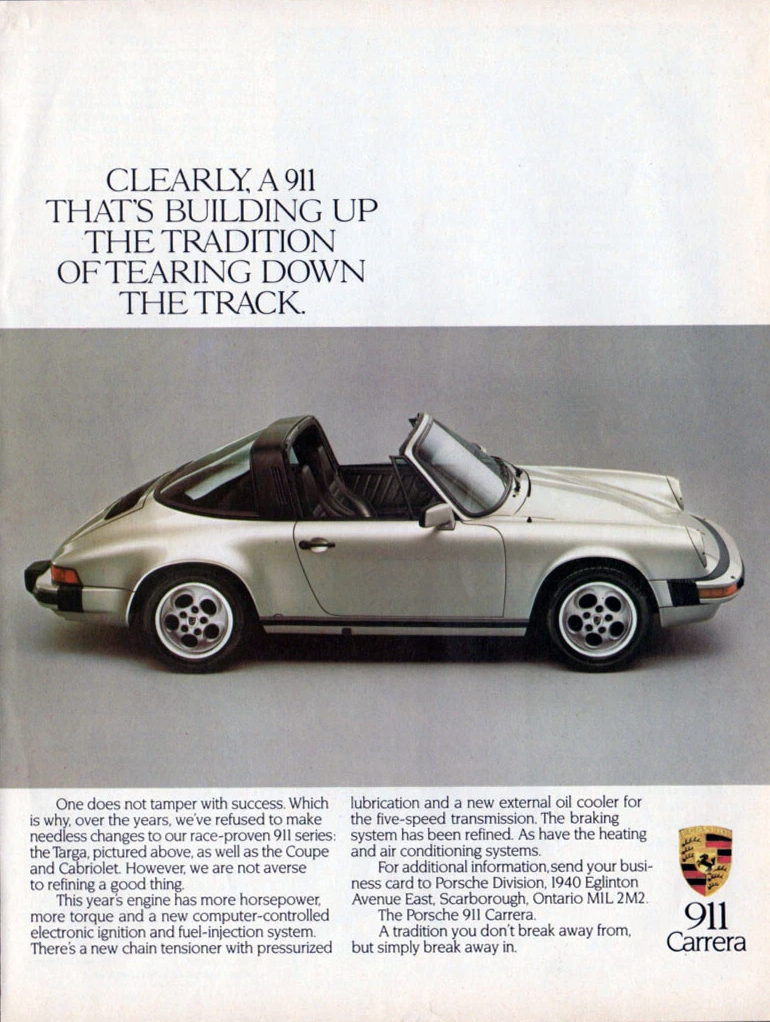
Print advertisement for the 1984 Porsche 911 Carrera Targa
The 1984 911 Carrera Targa‘s base price was $33,450—about $107,300 in 2025 dollars and approximately 39% less than a 2025 Porsche 911 Targa 4S goes for. Standard exterior and mechanical equipment included halogen headlights, fog lights, and tinted glass, and power vented disc brakes on all four wheels. The front 185/70VR15 tires sat on 15 x 6 inch alloy wheels, while the rear 215/60VR15 tires were mounted on 15 x 7 inch alloy wheels (Pirelli still makes these tire sizes). Inside, reclining front bucket seats, a leather Sport steering wheel, power windows, and air conditioning (said not to be very capable) were included. A stereo was not included—Porsche evidently assumed that 911 buyers had their own ideas about what should be in that part of the dash—and Crutchfieldstill provides. Stuttgart did deign to provide “4 speaker stereo preparation with automatic power antenna.”
Options & Period Reviews
Exterior and mechanical options for the Targa included a limited slip differential ($590), front and rear spoilers ($1,325), and 16-inch forged alloy wheels (6 inches wide in the front, 7 inches wide in the back—and setting the buyer back $1,580). Inside, options included automatic heating control ($485), automatic cruise control, power door locks, a passenger power seat, an alarm system, and a Blaupunkt Monterey digital cassette radio.
Period reviews were enthusiastic. Car and Driver stated that the 911 Carrera had “rousing performance.”
The View From 2025
It’s little surprise that eighties 911 Carreras have maintained their value quite well. According to Hagerty’s valuation tools, all the money for a 1984 Porsche 911 Carrera Targa in #1/Concours condition is $126,000, with a more normal #3/Good condition car going for $60,000.
Porsche 911 Carrera Targas have (of course) excellent club support from many sources and are often available in the Hemmings Motor News classifieds, on eBay Motors, and on Bring a Trailer. As I update this blog entry in April 2025, a Moss Green Metallic 1986 Cabriolet with black leather seats is for sale on Hemmings, asking $60,000.
Midway through the 1982 model year, the Lamborghini Countach received a larger version of its V12. With that, the model designation changed from LP400 S to 5000S. Just because (why not?), this version was also sometimes called the LP500 S.
The engine requires some more detail. The 4.8 liter/291 ci V12 came with six Weber carburetors and made 325 bhp in North American form. With the standard five-speed manual, the 0-60 time was 5.7 seconds. As might be expected, fuel economy by the day’s standards was not impressive—12 city/18 highway (10/13 by 2025 measures). At least the two 15.4-gallon gas tanks allowed a range of 320 to 370 miles before a 5000S driver had to search for more premium fuel.
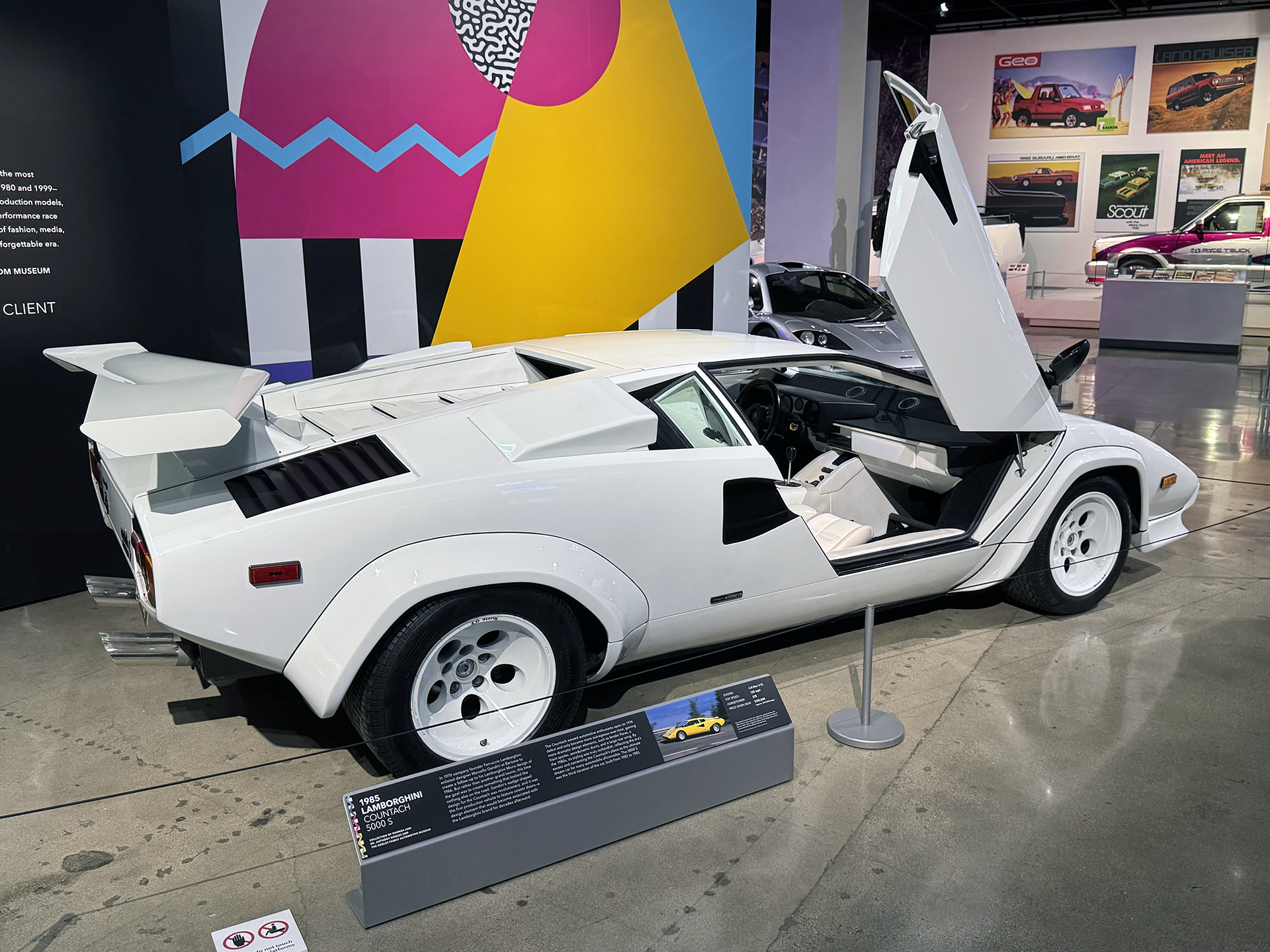
1985 Lamborghini Countach 5000S coupe at the Peterson Museum
I saw Countachs of various types at the wonderful Petersen Automotive Museum in Los Angeles in late 2025, and it was a great reminder of how vertically short these cars are—the spec for the 5000S was 42.1 inches. When Lamborghini released the Countach LPI 800-4 homage for the 2022 model year, it was actually 2.7 inches taller.
The 1982 Countach 5000S‘s base price was an eye-watering $99,500—about $342,000 in today’s dollars, or about 14% less than what a 2026 Lamborghini Temerario coupe goes for (Lamborghinis have gotten no cheaper in the last forty years) . Standard exterior and mechanical equipment included rack-and-pinion steering, ventilated disc brakes, and 205/50ZR15 front tires and 345/35ZR15 rear tires (both Pirelli P7s) on 15-inch wheels. Inside, leather bucket seats, a tilt-and-telescoping steering wheel, and air conditioning were included.
Options & Production Numbers
Options included a rear wing ($5,500), a sports exhaust, gold wheels, and a series of stereos (including a $3,000 one from Alpine).
Lamborghini built 321 5000S Countachs from March 1982 through March 1985. At that point, the Countach Quattrovalvole took over.
The View From 2025
The view from 2025 is just fine, thank you—according to Hagerty’s valuation tools, all the money for a 1982 Countach 5000S in #1/Concours condition is an astounding$676,000. A more “normal” #3/Good condition example is valued at $407,000. 5000Ss frequently appear for sale in the Hemmings Motor News classifieds, on Bring a Trailer, and at in-person auctions.
Make mine Black, please.
The 5000S is the first Lamborghini I have written about in Eighties Cars. Another 1985 exotic I have written about is the Ferrari Testarossa coupe.
Ford’s sporty Probe hatchback coupe was all-new for 1989, adding another model line to Dearborn’s expansive list of offerings.
Few eighties cars came to market with as much of a backstory as the Probe. Most enthusiasts at the time knew that Ford’s original intention had been to make the new Mazda-based front-wheel-drive car the next-generation Mustang, replacing the beloved but aging rear-wheel-drive Fox-platform version. Autoweek magazine’s April 13, 1987 issue was the first to publicly reveal these plans in a cover story titled “Exclusive: The ’89 Mustang.” The response from Mustang traditionalists was visceral, and later in 1987, Ford decided to bring the new design to market as a separate model.
The Probe’s engine depended on the version. GL and LX models received a Mazda F2 110 bhp 2.2 liter/133 ci inline four with three valves per cylinder and multi-port electronic fuel injection. The top-of-the-line GT received the same engine, but with a turbocharger and an intercooler, resulting in 145 bhp and the designation of F2T. All Probes came standard with a five-speed manual transmission, but only the GL and the LX offered an electronically-controlled four-speed automatic with overdrive as an option.
Car and Driver recorded a 0-60 time of 6.7 seconds in the 1989 Probe GT—really fast for a car with a supposed 145 bhp (many period reviews believed the rating to be very conservative) and a 2,940-pound curb weight. Fuel economy for the GT was rated at 21 city/27 highway by the day’s standards (19/25 by today’s measures). With a 15.1-gallon gas tank, a Probe GT‘s owner could expect a range of 300 to 325 miles with a 10% fuel reserve.
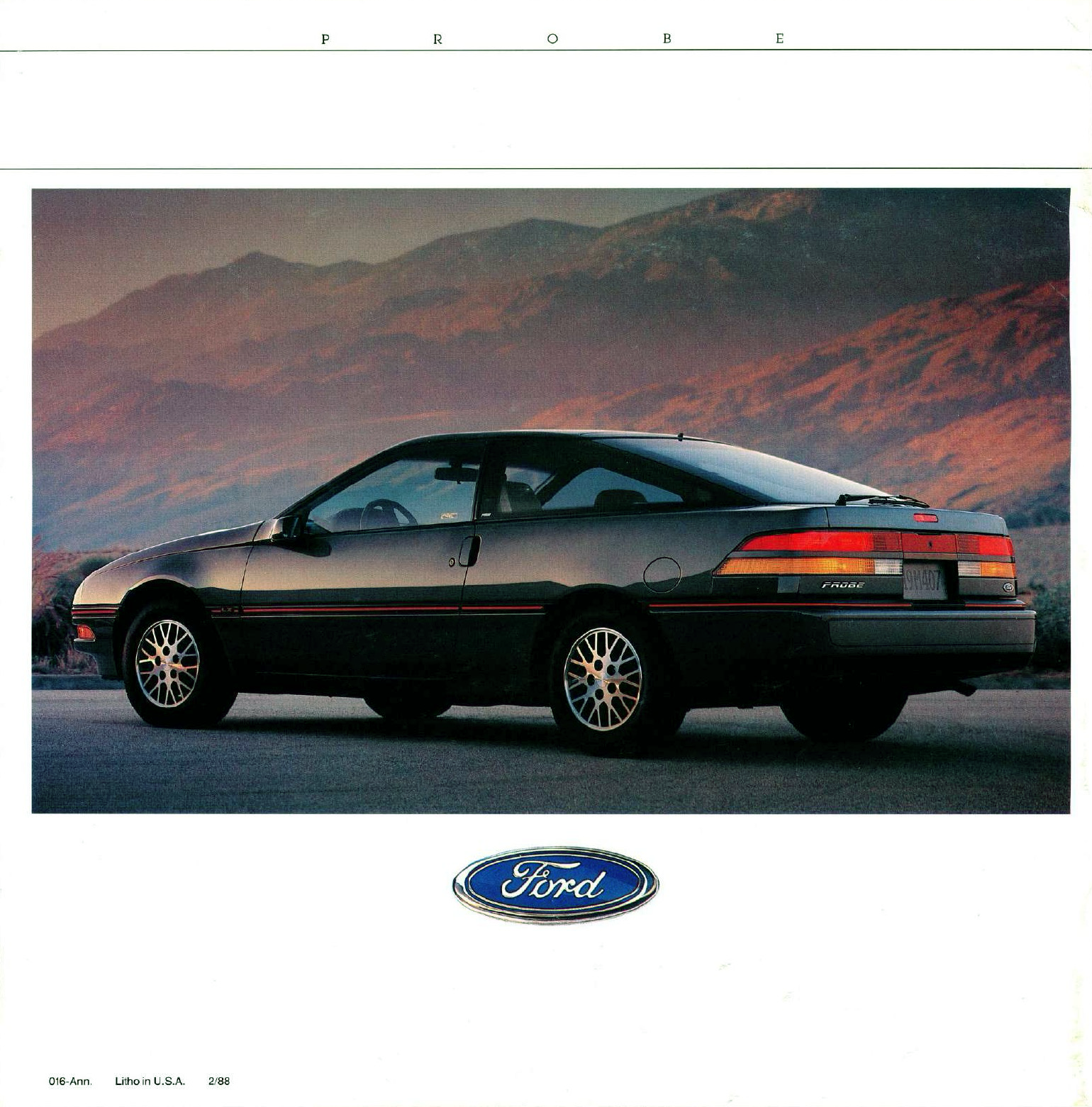
Rear cover of the 1989 Ford Probe brochure
The GL‘s base price was $10,459—about $28,300 in today’s dollars. Standard exterior and mechanical equipment included concealed/retractable halogen headlamps, power rack-and-pinion steering, power front disc/rear drum brakes, and P185/70SR14 steel-belted black sidewall radial tires (a size still readily available) on 14-inch wheels with standard Deluxe wheel covers. Inside, front bucket seats, 50/50 split fold-down rear seats, Deluxe cloth seat trim, full analog instrumentation with a tachometer, and an electronic AM/FM stereo radio were included.
The LX ($11,443) added complete tinted glass, Luxury wheel covers, all-cloth multi-adjustable front bucket seats, Luxury floor carpeting, a full console with a folding armrest and a storage bin, a rear window defroster, a remote liftgate release, a remote inside fuel filler release, and the Light Group.
Exterior and mechanical changes or additions with the GT ($13,593) included a unique front fascia with fog lamps, a unique rear end treatment with a two-tone spoiler, variable-assist power rack-and-pinion steering, power 4-wheel disc brakes, and P195/60VR15 Goodyear Eagle speed-rated performance steel-belted radial tires on 15-inch aluminum wheels. Inside, the GT included Sport cloth seat trim.
Packages, Individual Options, & Production Numbers
By 1989, Ford was delivering much of its optional equipment in Preferred Equipment Packages.
GL Preferred Equipment Package 250A was the base GL package.
GL Preferred Equipment Package 251A ($334) added complete tinted glass, dual electric remote mirrors, a tilt steering column/instrument cluster, interval windshield wipers and mist function, a rear window defroster, and the Light Group.
LX Preferred Equipment Package 252A was the base LX package.
LX Preferred Equipment Package 253A ($2,214) added a 6-way power driver seat adjustment, a leather-wrapped steering wheel and shift knob, an illuminated entry system, an electronic instrument cluster, speed control, an electronic air conditioner with push button controls, power windows, power door locks, a rear wiper/washer, a trip computer, and an electronic AM/FM stereo radio with a cassette tape player, premium sound system, and a power antenna.
GT Preferred Equipment Package 260A was the base GT package.
GT Preferred Equipment Package 261A ($2,621) added an anti-lock brake system, a 6-way power driver seat adjustment, a leather-wrapped steering wheel and shift knob, an illuminated entry system, speed control, and an electronic air conditioner with push button controls, power windows, power door locks, a trip computer, and an electronic AM/FM stereo radio with a cassette tape player, premium sound system, and a power antenna.
Individual options included a flip-up open air roof ($355), an air conditioner with manual controls ($927), power door locks ($155), and three optional stereos.
The 1989 Probe was a smash hit for Ford, with 162,889 made. Combining those numbers with the Mustang’s 206,789 produced definitely validated Ford’s decision to proceed with two separate models.
The View From 2025
I haven’t seen a Probe on the road in years. They’re gone from the Hemmings Motor News classifieds and eBay Motors, but Bring a Trailer has sold three of this generation of Probe in the last six years.
Make mine Deep Titanium Clearcoat Metallic, please.
“Computer-refined design for five-passenger comfort”
The Ford Tempo and Mercury Topaz debuted for the 1984 model year in May 1983. Based on the Escort, they were putative replacements for the Ford Fairmont and Mercury Zephyr.
The Tempo’s base engine and transmission combination was the 2300 HSC 90 bhp 2.3 liter/140 ci inline four with a one-barrel carburetor paired with a four-speed manual. A Mazda-built 52 bhp 2.0 liter/122 ci diesel four was available for $588, but it isn’t clear how many bought it. Road & Track recorded a 0-60 time of 13.6 seconds with the optional five-speed manual ($76) and the gas engine. A three-speed automatic was $439 and was available only with the gas engine and the fancier GL and GLX trims.
1984 Ford Tempo print advertisement
The 1984 Tempo L sedan’s base price was $6,936—about $22,700 in today’s dollars. Standard exterior and mechanical equipment included single rectangular halogen headlamps, rack and pinion steering, power front disc/rear drum brakes, and P175/80R13 steel-belted radial ply black sidewall tires on 13-inch wheels with Deluxe wheel covers. Inside, individually adjustable front seats with cloth seating surfaces and reclining seat backs, Deluxe carpeting, a mini-console, an A-frame Luxury steering wheel, an inside hood release, and an AM radio with dual front speakers were included.
The $7,159 GL sedan added Luxury wheel covers, Luxury sound insulation, interval windshield wipers, and an electronic digital clock.
The $7,621 GLX sedan added bumper end cap extensions, dual door-mounted remote-control mirrors, a dual note horn, Luxury carpeting, and Luxury luggage compartment trim.
Groups, Packages, Individual Options, & Production Numbers
Ford offered four option groups and packages with the Tempo:
The Light/Convenience Group ($50-$85) included ashtray, glovebox, and engine compartment lights, rear door dome light switches, a swivel map light, a headlamps on buzzer, and a trip odometer
The Power Lock Group ($202-$254) included power door locks, a power decklid release, and a remote control fuel filler door
The Sports Appearance Group ($299) was only available with the GL and included styled steel wheels with trim rings, Sport front seats with a 4-way manual driver’s seat, rear seats with integral headrests, unique sew-style and fabric, a Sport steering wheel, and a Sport instrument cluster
The TR Performance Suspension Package ($366-$424) included Michelin TRX tires, TR-Type cast aluminum wheels, and special steering and suspension components
Individual exterior and mechanical options included tinted glass ($510), metallic glow paint ($63), a flip-up open air roof ($315), and power steering ($223). Inside, power side windows ($272), a driver’s side power seat ($224), Fingertip Speed Control ($176), and an electric rear window defroster ($140) were offered. A series of five optional radios were offered, ranging up to an electronic AM/FM stereo search radio with a cassette player ($396).
Options not available with the L included air conditioning ($743) and all-vinyl seats (no charge). A loaded GLX could easily reach $9,400—about $30,800 in today’s dollars, or about what a 2026 Ford Escape Active crossover goes for.
The Tempo sedan sold well in its extended debut year—Ford moved a total of 295,149, which was more than four times as many as the final-year 1983 Fairmont sedan.
In October 2025, a Mercury Cougar XR-7 coupe with 16,000 miles came up for auction on Bring a Trailer. It was the first fifth-generation Cougar to appear on BaT—enough to get me to write a blog entry about this era of Mercury’s personal luxury car.
“From a pedigree of personal luxury.”
Mercury made big changes to the Cougar for the 1980 model year, moving from six separate models to just one. The Cougar sedan was gone entirely, and both the base and the Brougham coupes were no more. Only the XR-7 coupe remained, and it was all new.
The third Mercury based on the “Fox” platform (the Zephyr and the Capri had come first), the fifth-generation Cougar was one of the more radically downsized automobiles in the North American auto industry. In comparison to its 1979 predecessor, the 1980 Cougar XR-7 was 17 inches shorter and 700 pounds lighter.
Standard power for 1980 was a Windsor 118 bhp 4.2 liter/255 ci V8 with a Motorcraft two-barrel carburetor paired with a SelectShift three-speed automatic transmission. Powertrain upgrades were available; buyers could specify a $150 Windsor 131 bhp 4.9 liter/302 ci V8 with a two-barrel carburetor and then add a $138 automatic overdrive transmission (available only with that engine). Buyers who purchased both powertrain upgrades got a sprightlier car with a slightly longer range.
Windsor (4.2 liter V8)
Windsor (4.9 liter V8)
Windsor (4.9 liter V8)
Transmission
3-speed Select Shift
3-speed Select Shift
4-speed Automatic Overdrive
0-60 mph (approximate)
14.9 seconds
12.7 seconds
11.1 seconds
Fuel mileage (1982 standards)
18 city/26 highway
17 city/26 highway
17 city/29 highway
Range (10% fuel reserve)
285 to 310 miles
275 to 300 miles
295 to 325 miles
Pages from the 1980 Mercury Cougar XR-7 brochure
The XR-7‘s base price was $6,569—about $28,300 in today’s dollars. Standard exterior and mechanical equipment included a half vinyl roof, variable ratio power rack-and-pinion steering, power front disc/rear drum brakes, and P185/75R14 black sidewall steel-belted radial tires on 14-inch wheels with full wheel covers. Inside, a cloth front Flight Bench seat, a four-spoke color-keyed steering wheel, a two-tier instrument panel, a trip odometer, and an analog clock were standard. The XR-7 had no standard radio of any type—interestingly, all Thunderbirds included at least an AM radio.
Groups, Individual Options, & Production Numbers
Mercury offered three groups to upgrade the base XR-7:
The Decor Group ($516) added Luxury wheel covers, dual bright remote control mirrors, Twin Comfort Lounge front seats, a Luxury steering wheel, and Deluxe seat belts
The Luxury Group ($1,987) added a Luxury half vinyl roof, dual remote control sail-mounted mirrors, and metric TR Type radial white sidewall tires on cast aluminum wheels. Inside, it included Twin Comfort Lounge front seats with Luxury trim, the Electronic Instrument Panel, a Luxury steering wheel, power windows, and Light Group
The Sports Group ($1,687) added a Tu-tone paint treatment, metric TR Type radial white sidewall tires on cast aluminum wheels, dual bright remote control mirrors, Recaro front bucket seats with a console, and power side windows
Individual options included tinted glass ($71), a flip-up moonroof ($219), air conditioning ($571), and automatic speed control ($108). Leather interior trim ($303) was only available with the Luxury Group. A choice of nine radios, ranging up to an AM/FM stereo with auto-search ($333), was available. A well-equipped Cougar XR-7 could easily reach $10,500—about $45,200 in 2025 dollars.
To say the market was not ready for the 1980 Cougar XR-7 is a distinct understatement. Despite a significantly higher level of standard equipment, the XR-7 was less than five inches longer than the Zephyr Z-7 coupe, whose base price was almost 20% less. Sales of Mercury’s halo coupe collapsed, dropping from 163,716 in 1979 to 58,082 in 1980, and losing substantial sales share during a year when none of the leading General Motors competitors in the personal luxury coupe market had more than a facelift.
The View From 2025
For unclear reasons, Hagerty’s valuation tools do not track any Cougar after 1973, although they do value Ford Thunderbirds through their entire production history. Fifth-generation Cougars occasionally appear in the Hemming’s Motor News classifieds and on eBay Motors. As I write this blog entry in October 2025, there’s a Medium Blue Metallic 1980 Cougar XR-7 coupe with a dark blue vinyl top and a blue interior for sale on Hemmings, showing 31,000 miles and asking $12,000.
Make mine the same Silver Metallic/Back Tu-tone that is in those brochure pages, please.
The 1986 Mercedes-Benz 560SL marked the last significant revision to the R107 generation that had begun way back in 1972 with the 450SL. In addition to a larger and more powerful V8, Mercedes added a new rear suspension, anti-lock brakes (ABS), a limited-slip differential, a driver’s side airbag, and standard leather upholstery. The 560SL also got the federally-required high-mounted third brake light, mounted awkwardly on the trunk.
Motive power was provided by a Bosch fuel-injected 227 bhp 5.5 liter/338 ci V8 connected to a four-speed automatic transmission. Motor Trend recorded a 0-60 time of 6.8 seconds, while Road & Track recorded 7.5 seconds—no matter what, the 560SL was over three seconds faster than the 380SL. Mileage wasn’t exactly a priority in a car with 3,781-pound curb weight—the ratings of the day were 14 city mpg/17 highway (adding a $1,300 gas guzzler tax to every vehicle), by today’s standards that would be 12 city/16 highway. With the 22.5-gallon gas tank, 560SL owners could expect a range of between 280 and 315 miles with a 10% fuel reserve.
The 560SL’s base price at the beginning of the 1986 model year was $48,200—about $143,700 in today’s dollars, which is slightly under what a 2026 AMG SL 55 convertible goes for. By the end of the 1986 model year, the 560SL’s base price had risen to $53,730.
560SL pages from the 1986 Mercedes-Benz brochure
For their money, SL buyers got a plethora of standard equipment. Standard exterior and mechanical features included halogen head and fog lamps, tinted glass, power assisted steering, power assisted four wheel disc brakes, and 205/65R15 steel belted radial-ply tires (a size still readily available) on 15-inch light alloy wheels. Inside, adjustable front bucket seats and head restraints, a leather covered steering wheel and gear selector, cruise control, a central locking system, electric window lifts, fully automatic climate control, an electronic AM and FM stereo radio with a cassette player, and a first aid kit were included.
Options & Production Numbers
The 560SL offered only three factory options: heated seats, electronically adjustable headrests, and California emissions ($30).
About 13,788 well-healed buyers took home the first-year 560SL, up about 69% from the final year 380SL.
The View From 2025
There is solid club and forum support for the 560SL, as there is for almost all Mercedes-Benzes. According to Hagerty’s valuation tools, all the money for a 1986 560SL in #1/Concours condition is an astounding$150,000, while a more normal #3/Good condition car goes for $22,300. 560SLs maintain a substantial presence in the Hemming’s Motor News classifieds, on eBay Motors, and on Bring a Trailer. As I wrote this blog post in September 2025, there were 74 available on Hemmings, including 15 of the 1986 models.
I have a personal connection with the Yugo. My father’s younger brother worked for Malcolm Bricklin for many years, including with Yugo America. Years later, my uncle made it to the front page of the Wall Street Journal in an article entitled A Drag Racer Turns Handicap Of His Yugo to His Advantage.
“Introducing the same old idea.”
Famously advertised with a base price of $3,990, the 1986 Yugo GV was a response to escalating prices—the average transaction price of a car in the United States had just passed $10,000. Built by Zastava in Yugoslavia, the Yugo was a shortened variant of the Fiat 128—a design dating from 1969. Serial entrepreneur Malcolm Bricklin saw potential in the Yugo and created Yugo America to import the car into the United States. The GV stood for Great Value.
The Yugo was a tiny car by mid-1980s standards, with a 139-inch length and an 84-inch wheelbase. The slightly more expensive 1986 Chevrolet Chevette hatchback coupe was 18% longer and had a 13% greater wheelbase, while the same year’s class-leading Honda Civic hatchback was 8% longer and had a 12% greater wheelbase. The also newly available Hyundai Excel hatchback coupe was notably larger.
Power, if you could call it that, was provided by a 55 bhp 1.1 liter/68 ci inline four with a two-barrel carburetor. A four-speed manual was standard, and Car and Driver recorded a 0-60 time of 14.0 seconds. Fuel mileage was rated at 25 city/31 highway by the day’s standards (22/29 by modern measures). With a small 8.4-gallon gas tank, a Yugo owner could expect a short range of 195 to 210 miles with a 10% fuel reserve.
1986 Yugo GV print advertisement
Standard exterior and mechanical equipment on the Yugo GV included opening front vent windows, a rear-window wiper, front-wheel-drive, rack and pinion steering, front disc/rear drum brakes, and 145R13 74H tires (now barely available) on 13-inch wheels. Inside, cloth/vinyl reclining front bucket seats, a fold-down rear seat, a rear-window defroster, and a small tool kit were included. A full-sized spare tire was stored under the hood.
The Yugo offered few options—neither air conditioning nor an automatic transmission were available for the 1986 model year. Yugo buyers could choose a variety of dealer-installed radios.
Many Jokes & One Survey
Yugo jokes were many. Just a few of them:
What do you call a Yugo with twin tailpipes? A wheelbarrow.
What do you call a Yugo with a flat tire? Totaled.
How do you make a Yugo go from 0 to 60 in five seconds? Push it off a cliff.
Why do Yugos have rear-window defrosters? To keep your hands warm.
How do you double the value of a Yugo? Fill the gas tank.
What’s on the first page of the Yugo owner’s manual? The bus schedule.
Popular Mechanics‘ owners survey for the Yugo GV found that Yugo buyers wanted a new car instead of a comparably-priced used one, and that, as one said, “you have to keep the car in perspective.”
The View From 2025
Oh, these are vanished. Bring a Trailer has sold a grand total of eight over nine years, and they’re long gone from Hemmings and eBay Motors.
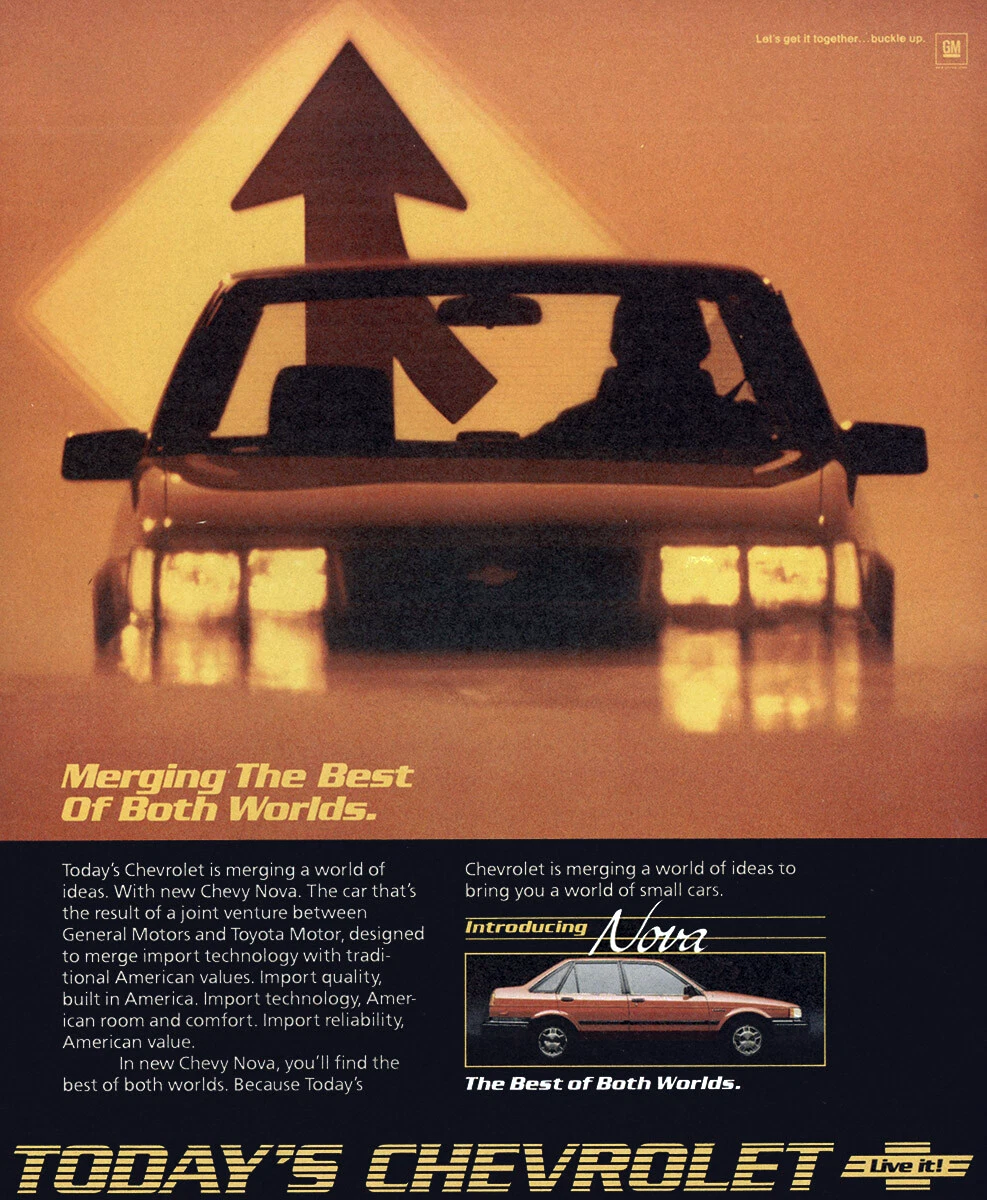
After a soft rollout in the Midwest in early 1985, 1986 was the first full model year for the fifth-generation Chevrolet Nova sedan, which was built in the New United Motor Manufacturing Incorporated (NUMMI) plant in Fremont, California—a collaboration between General Motors and Toyota. Of course, these front-wheel-drive Novas had nothing to do with the previous four rear-wheel-drive generations, the last of which had been seen in the 1979 model year.
The new Nova was a rebadged and mildly restyled version of the Japanese market Toyota Sprinter, itself a model sold in Japan as a badge-engineered version of the Toyota Corolla. The pre-existing design was chosen over a clean-sheet approach because it could be brought to market more quickly.
The Nova’s standard powertrain was the 4-AC 70 bhp 1.6 liter/97 ci inline four with a two-barrel carburetor paired with a five-speed manual. A three-speed automatic was optional. Car and Driver recorded a 0-60 time of 12.4 seconds with the manual in a car with a 2,260-pound curb weight—edging toward slow by 1986. Mileage ratings with the manual were 30 city/37 highway by the day’s standards (26/33 by today’s measures). As was normal in the eighties, the automatic gave up some mileage—off two mpg in the city and five mpg on the highway. With a 13.2-gallon gas tank, the owner of a manual Nova could expect a range of 355 to 395 miles with a 10% fuel reserve.
1986 Chevrolet Nova print advertisement
The Nova sedan’s price was $7,435—about $22,700 in 2025 dollars or slightly over what a 2025 Chevrolet Trax LS compact crossover SUV goes for. Standard exterior and mechanical equipment included tinted glass, narrow black body side moldings, front wheel drive, rack-and-pinion steering, power front disk/rear drum brakes, and P155/80R13 all-season steel-belted radial tires (a size still available courtesy of Kumho) on 13-inch wheels with a wheel center cap. Inside, reclining front seats with adjustable head restraints, cloth and vinyl seat trim, cut-pile carpeting, a full length console, side window defoggers, and an AM radio were included.
The Nova CL sedan added a wide body side molding and half-cap wheel covers. Inside, all CLs had a Custom Cloth interior, a driver’s seat with lumbar support and vertical adjustment, a console with a storage box and an armrest, a right-side visor vanity mirror, and an adjustable steering wheel.
Option Packages, Period Reviews, & Production Numbers
The 1986 Nova’s configurability was described mainly by eight separate packages, half of them manual and half automatic:
Base Package 1 was the base sedan
Base Package 2 ($610) added the three-speed automatic, left-hand remote and right-hand manual outside mirrors, and power steering
Base Package 3 ($1,180) added halogen high and low beam headlamps, left-hand remote and right-hand manual outside mirrors, power steering, air conditioning, an electric rear window defogger, and an electronically-tuned AM/FM stereo radio with seek/scan and a digital clock to the base sedan
Base Package 4 ($1,575) added halogen high and low beam headlamps, air conditioning, an electric rear window defogger, and an electronically-tuned AM/FM stereo radio with seek/scan and a digital clock to Base Package 2
CL Package 5 ($1,730) added halogen high and low beam headlamps, left-hand remote and right-hand manual outside mirrors, power steering, air conditioning, an electric rear window defogger, and an electronically-tuned AM/FM stereo radio with seek/scan and a digital clock to the CL sedan
CL Package 6 ($2,125) added the three-speed automatic, halogen high and low beam headlamps, left-hand remote and right-hand manual outside mirrors, power steering, air conditioning, an electric rear window defogger, and an electronically-tuned AM/FM stereo radio with seek/scan and a digital clock to the CL sedan
CL Package 7 ($2,515) was the sportiest of the Novas and added P175/70R-13 all-season steel belted radial ply blackwall tires, aluminum wheels, electronic speed control with resume speed, an intermittent windshield washer system, and an electronically-tuned AM/FM stereo radio with seek/scan, stereo cassette tape, and a digital clock to CL Package 5
CL Package 8 ($2,620) was the most luxurious Nova and added a power door lock system, electronic speed control with resume speed, an intermittent windshield washer system, and an electronically-tuned AM/FM stereo radio with seek/scan, stereo cassette tape, and a digital clock to CL Package 6
The Nova’s only individual option was Two-Tone paint ($176), which was only available with the CL. The absolute fanciest CL sedan retailed for $10,231—about $30,500 in today’s dollars, which is about what a well-equipped 2025 Chevrolet Trailblazer LT compact crossover SUV goes for.
Period reviews freely acknowledged that the Nova was basically a rebadged Corolla. Road & Track‘s tagline was “we have met the enemy, and they is us”—another repackaging of Walt Kelly. Motor Trend stated that the Nova was the “latest installment in the ongoing serial of “If you can’t beat ’em, join ’em.”” Popular Mechanics got more personal and asked, “Can a Japanese car built in California find happiness in America?”
Chevrolet sold 124,961 Nova sedans in the 1986 model year, in addition to the 27,943 that had been sold in the 1985 soft rollout. Predictably, the quality of the Nova was considerably higher than that of any other Chevrolet compact car.
The View From 2025
Some call them “Toyolets,” but I’m going to declare this version of the Nova as vanished. I haven’t seen a fifth-generation Nova in the wild for decades, and they have little presence in the Hemmings Motor News classifieds or on eBay Motors. Bring a Trailer has sold a grand total of one—a 1987 sedan.
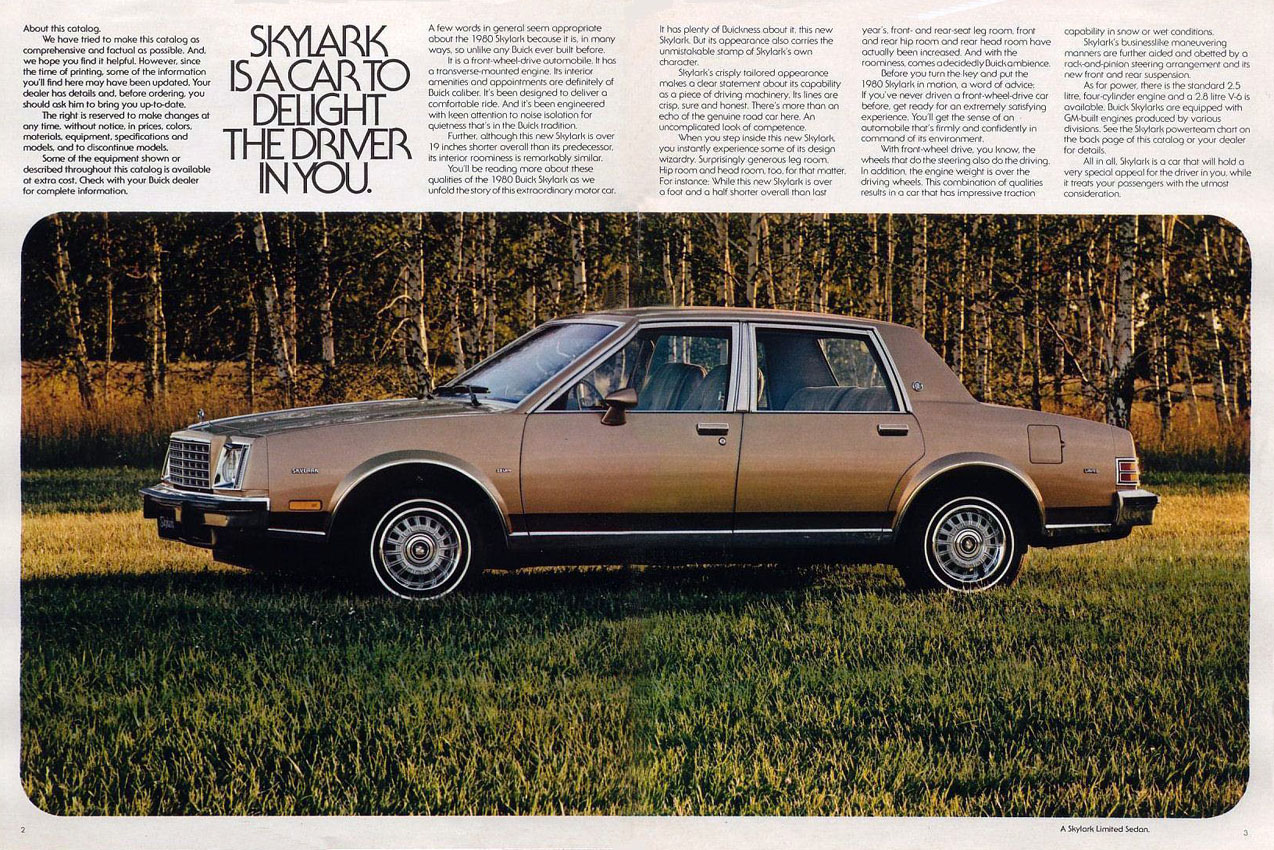
Along with the other X-cars, the Buick Skylark was all new for 1980. Only the model name was carried over as the Skylark moved from rear-wheel-drive to front-wheel-drive and downsized yet again, losing about a foot and a half in overall length.
The Skylark name was a long-running and important one to Buick. 1953’s gorgeous limited production Roadmaster Skylark convertible was followed by the smaller Century-based Skylark convertible in 1954. In the middle of the 1961 model year, the Skylark name was reintroduced as a luxury trim of the Special compact. For 1962, the Skylark became its own model. By 1964, the Skylark had become its own model line and had moved to an intermediate size. The intermediate rear wheel drive Skylark would continue for three generations (with one slight interruption in 1973-74).
Like with every other 1980 X-car, the Skylark’s standard engine was GM’s Iron Duke 90 bhp 2.5 liter/151 ci inline four with a Rochester Varajet II two-barrel carburetor, paired with a four-speed manual transmission. Fuel economy was 24 city/38 highway by the day’s standards (21/34 by today’s measures). With a 14-gallon gas tank, a Skylark’s driver could expect a range of 350 to 390 miles with a 10% fuel reserve. 0-60 times for the Iron Duke are hard to find, but were likely around 16 seconds for the four-speed manual transmission and probably about 19 seconds (oog) with the optional ($337) three-speed automatic transmission.
Spending $225 to upgrade to the LE2 2.8 liter/173 ci V6 with a Rochester Varajet II two-barrel carburetor got you 115 bhp and a 0-60 time of a little over 13 seconds. Fuel economy dropped substantially to 20 city/28 highway with the four-speed manual transmission. Moving to the three-speed automatic transmission dropped highway mileage to 27 mpg.
Sedan pages from the 1980 Buick Skylark brochure
Standard exterior and mechanical equipment on the $5,306 Buick Skylark sedan included front-wheel-drive, rack-and-pinion steering, front disc/rear drum brakes, and P185/80R13 fiberglass-belted radial-ply tires (a size now only marginally available) on 13-inch wheels. Inside, buyers got a no-cost choice of either a houndstooth cloth or a vinyl notchback front bench seat. A Delco AM radio with two front speakers and a windshield antenna was also included.
The $5,726 Skylark Limited included a distinctive hood ornament, wide rocker and wheel opening moldings, Deluxe wheel covers, and a gas strut under the hood. Inside, a choice of a Limited level brushed woven cloth or a vinyl notch back seat with a fold-down center armrest, door entry courtesy lights, a simulated wood grain instrument panel, a special acoustic insulation package, and a plush carpeted back window panel were present. Limited identification was, of course, included.
The $5,920 Skylark Sport Sedan included a specially styled grille, amber front park and turn lamps, front and rear bumper strips, black moldings, wheel opening moldings, Sport mirrors, smoked tail lamp lenses, a Rallye ride-and-handling package system, a larger rear stabilizer bar, and P205/70R-13 steel-belted radial-ply blackwall tires on Designers’ Sport wheels. Inside, the Sport Sedan included a Sport steering wheel and a black instrument panel with a voltmeter, a temperature gage, and a trip odometer.
Options & Production Numbers
The Skylark’s options list gives you a sense that Buick was trying to serve two masters. The base prices were affordable, but you could load the Skylark sedan up with thousands of dollars’ worth of options, bringing it close to a Century or a LeSabre.
Individual exterior and mechanical options for the Skylark included the Designers’ Accent paint treatment ($174), a Landau top, a long vinyl top, a Vista-Vent flip-open glass sunroof ($240), power steering ($164), power brakes ($76), and chrome-plated road wheels ($141). Inside, front bucket seats ($48), a 6-way power seat ($165), a full-length operating console, Cruise-Master speed control ($105), a tilt steering column ($75), air conditioning ($564), power windows ($189), and electric door locks ($123) were available.
Four Delco radios ranging up to an AM/FM stereo with a cassette tape player and a CB ($491) were available. Lower body sport stripes with a Hawk decal were available only for the Skylark Sports versions.
Buick sold 80,940 base Skylark sedans in the 1980 model year. Combined Limited and Sports Sedan sales totalled 86,948, with the vast majority being the Limited. The Skylark was 26% of Buick’s total production in 1980.
Despite an astoundingnine recalls for the 1980 version, the Skylark’s yearly sales percentage declines were notably less than those of other X cars—by 1983, Buick was actually selling more Skylarks than Chevrolet was selling Citations. The fifth-generation Skylark sedan, which Buick called its “little limousine,” would continue through the 1985 model year and end up selling 729,523 copies over six model years.



 Eighties Cars