1986 Chevrolet Nova sedan

“Merging the best of both worlds.”

After a soft rollout in the Midwest in early 1985, 1986 was the first full model year for the fifth-generation Chevrolet Nova sedan, which was built in the New United Motor Manufacturing Incorporated (NUMMI) plant in Fremont, California—a collaboration between General Motors and Toyota. Of course, these front-wheel-drive Novas had nothing to do with the previous four rear-wheel-drive generations, the last of which had been seen in the 1979 model year.

The new Nova was a rebadged and mildly restyled version of the Japanese market Toyota Sprinter, itself a model sold in Japan as a badge-engineered version of the Toyota Corolla. The pre-existing design was chosen over a clean-sheet approach because it could be brought to market more quickly.

The Nova’s standard powertrain was the 4-AC 70 bhp 1.6 liter/97 ci inline four with a two-barrel carburetor paired with a five-speed manual. A three-speed automatic was optional. Car and Driver recorded a 0-60 time of 12.4 seconds with the manual in a car with a 2,260-pound curb weight—edging toward slow by 1986. Mileage ratings with the manual were 30 city/37 highway by the day’s standards (26/33 by today’s measures). As was normal in the eighties, the automatic gave up some mileage—off two mpg in the city and five mpg on the highway. With a 13.2-gallon gas tank, the owner of a manual Nova could expect a range of 355 to 395 miles with a 10% fuel reserve.
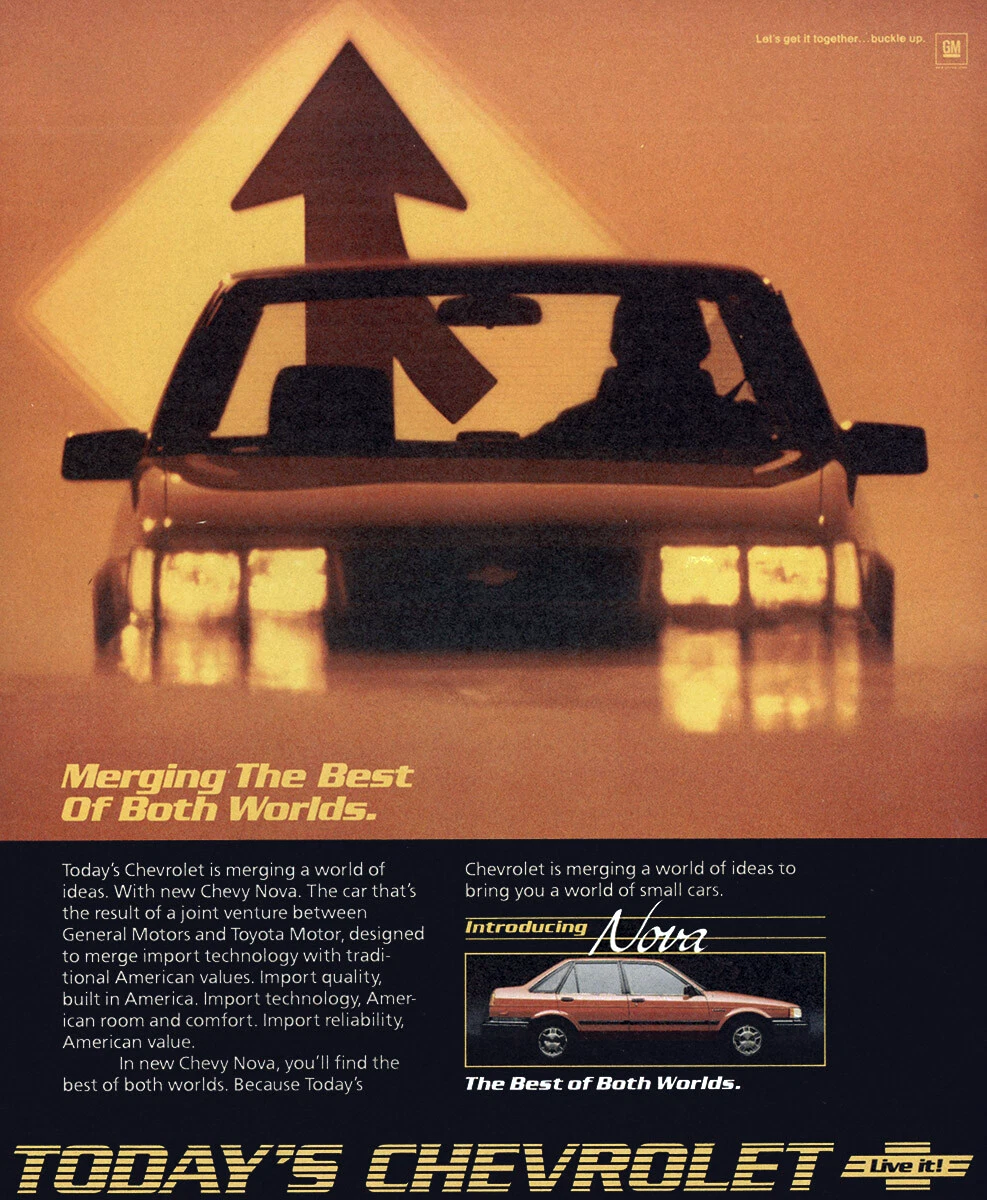
1986 Chevrolet Nova print advertisement

The Nova sedan’s price was $7,435—about $22,700 in 2025 dollars or slightly over what a 2025 Chevrolet Trax LS compact crossover SUV goes for. Standard exterior and mechanical equipment included tinted glass, narrow black body side moldings, front wheel drive, rack-and-pinion steering, power front disk/rear drum brakes, and P155/80R13 all-season steel-belted radial tires (a size still available courtesy of Kumho) on 13-inch wheels with a wheel center cap. Inside, reclining front seats with adjustable head restraints, cloth and vinyl seat trim, cut-pile carpeting, a full length console, side window defoggers, and an AM radio were included.

The Nova CL sedan added a wide body side molding and half-cap wheel covers. Inside, all CLs had a Custom Cloth interior, a driver’s seat with lumbar support and vertical adjustment, a console with a storage box and an armrest, a right-side visor vanity mirror, and an adjustable steering wheel.

Option Packages, Period Reviews, & Production Numbers

The 1986 Nova’s configurability was described mainly by eight separate packages, half of them manual and half automatic:

  • Base Package 1 was the base sedan
  • Base Package 2 ($610) added the three-speed automatic, left-hand remote and right-hand manual outside mirrors, and power steering
  • Base Package 3 ($1,180) added halogen high and low beam headlamps, left-hand remote and right-hand manual outside mirrors, power steering, air conditioning, an electric rear window defogger, and an electronically-tuned AM/FM stereo radio with seek/scan and a digital clock to the base sedan
  • Base Package 4 ($1,575) added halogen high and low beam headlamps, air conditioning, an electric rear window defogger, and an electronically-tuned AM/FM stereo radio with seek/scan and a digital clock to Base Package 2
  • CL Package 5 ($1,730) added halogen high and low beam headlamps, left-hand remote and right-hand manual outside mirrors, power steering, air conditioning, an electric rear window defogger, and an electronically-tuned AM/FM stereo radio with seek/scan and a digital clock to the CL sedan
  • CL Package 6 ($2,125) added the three-speed automatic, halogen high and low beam headlamps, left-hand remote and right-hand manual outside mirrors, power steering, air conditioning, an electric rear window defogger, and an electronically-tuned AM/FM stereo radio with seek/scan and a digital clock to the CL sedan
  • CL Package 7 ($2,515) was the sportiest of the Novas and added P175/70R-13 all-season steel belted radial ply blackwall tires, aluminum wheels, electronic speed control with resume speed, an intermittent windshield washer system, and an electronically-tuned AM/FM stereo radio with seek/scan, stereo cassette tape, and a digital clock to CL Package 5
  • CL Package 8 ($2,620) was the most luxurious Nova and added a power door lock system, electronic speed control with resume speed, an intermittent windshield washer system, and an electronically-tuned AM/FM stereo radio with seek/scan, stereo cassette tape, and a digital clock to CL Package 6

The Nova’s only individual option was Two-Tone paint ($176), which was only available with the CL. The absolute fanciest CL sedan retailed for $10,231—about $30,500 in today’s dollars, which is about what a well-equipped 2025 Chevrolet Trailblazer LT compact crossover SUV goes for.

Period reviews freely acknowledged that the Nova was basically a rebadged Corolla. Road & Track‘s tagline was “we have met the enemy, and they is us”—another repackaging of Walt Kelly. Motor Trend stated that the Nova was the “latest installment in the ongoing serial of “If you can’t beat ’em, join ’em.”” Popular Mechanics got more personal and asked, “Can a Japanese car built in California find happiness in America?”

Chevrolet sold 124,961 Nova sedans in the 1986 model year, in addition to the 27,943 that had been sold in the 1985 soft rollout. Predictably, the quality of the Nova was considerably higher than that of any other Chevrolet compact car.

The View From 2025

Some call them “Toyolets,” but I’m going to declare this version of the Nova as vanished. I haven’t seen a fifth-generation Nova in the wild for decades, and they have little presence in the Hemmings Motor News classifieds or on eBay Motors. Bring a Trailer has sold a grand total of one—a 1987 sedan.

Make mine Dark Red Metallic, please.

Other 1986 Chevrolets I have written about include the Camaro Berlinetta hatchback coupe, the Cavalier Z24 coupe, and the Corvette convertible.

1989 Lincoln Town Car sedan

“Luxury that needs no introduction.”

For the 1989 model year, the final big Lincoln of the 1980s remained essentially unchanged. The base version gained a fancier “Frenched” back window on its standard vinyl roof. Otherwise, only color and trim changes were visible.

The 1989 Town Car’s only available powertrain was a Windsor 150 bhp 4.9 liter/302 ci V8 with sequential multi-port fuel injection mated with a four-speed automatic with overdrive. An optional dual exhaust added 10 bhp. 0-60 came in a little over 11 seconds in a car with about a 4,100-pound curb weight. Fuel economy was 17 city/24 highway by the day’s standards (15/22 by 2025 measures). With a smallish 18.0-gallon gas tank (compared to the competition), a Town Car owner could expect a middling range of 300 to 330 miles with a 10% fuel reserve.

Front cover of the 1989 Lincoln Town Car brochure

The Town Car’s base price was $25,205 for 1989—approximately $67,700 in today’s dollars, or almost exactly what the 2025 Lincoln Aviator Reserve SUV goes for. Standard exterior and mechanical equipment included quad-rectangular halogen headlamps, tinted glass, power recirculating ball steering, power front disc/rear drum brakes, and P215/70R15 white sidewall steel-belted radial tires (a size still readily available) on 15-inch steel wheels with full wheel covers. Inside, 50/50 Twin Comfort Lounge cloth front seats, a six-way power driver’s seat, interval wipers, fingertip speed control, Automatic Climate Control, power windows, power vents, power door locks, and an AM/FM stereo cassette radio with a six-speaker Premium Sound System were included.

Series’, Options, & Production Numbers

For $3,301 over the base Continental, the Signature Series added the Comfort/Convenience Group, which included a six-way power front passenger’s seat, rear floor mats, dual illuminated visor vanity mirrors, a headlamp convenience system, and a power decklid pulldown. A Luxury half-vinyl coach roof with a frenched rear window, turbine-spoke aluminum wheels, and an illuminated/keyless entry system also came with the Signature Series.

For an additional $1,326, the Cartier Designer Series included everything in the Signature Series and added Dual-Shade paint in Silver Frost Clearcoat Metallic over Pewter Clearcoat Metallic, a Silver Frost coach roof, and maroon accent stripes. Inside, a leather-wrapped steering wheel and front floor mats with the Cartier logo were included. Cartier purchasers got a no-cost choice of either leather and cloth seat trim or all leather seat trim.

Exterior and mechanical options included a power glass moonroof ($1,420), a Traction-Lok differential ($101), and wire-spoke aluminum wheels ($873 for the base car, $395 otherwise). Interior options included an automatic-dim day/night mirror ($89), an Anti-Theft Alarm System ($200), a twelve-speaker Ford JBL Audio System with a 140-watt amplifier ($525), and a compact disc player ($617). The Cartier Designer Series was the only way to get Dual-Shade paint in the 1988 model year.

1989 was a good year for Lincoln’s traditional full-size sedan. 123,669 were sold, making the Town Car almost 60% of total Lincoln production, and marking the peak for the first-generation Town Car.

The View From 2025

Town Cars of this era attract collector interest—and there is club support. According to Hagerty’s valuation tools, a 1989 Town Car in #1/Concours condition is $26,900, with a far more normal #3/Good condition version going for $4,800. These Town Cars are often available in the Hemmings Motor News classifieds, on eBay Motors, and on Bring a Trailer. As I write this blog entry in September 2025, there’s a Cinnabar Clearcoat Metallic 1989 Town Car with 8,700 miles for sale on Hemmings, asking $34,500.

Make mine that same Cinnabar Clearcoat Metallic, please.

Other Lincolns I have covered include the 1980 Continental Mark VI coupe, the 1984 Continental Mark VII LSC coupe, the 1986 Mark VII coupe, and the 1987 Continental sedan.

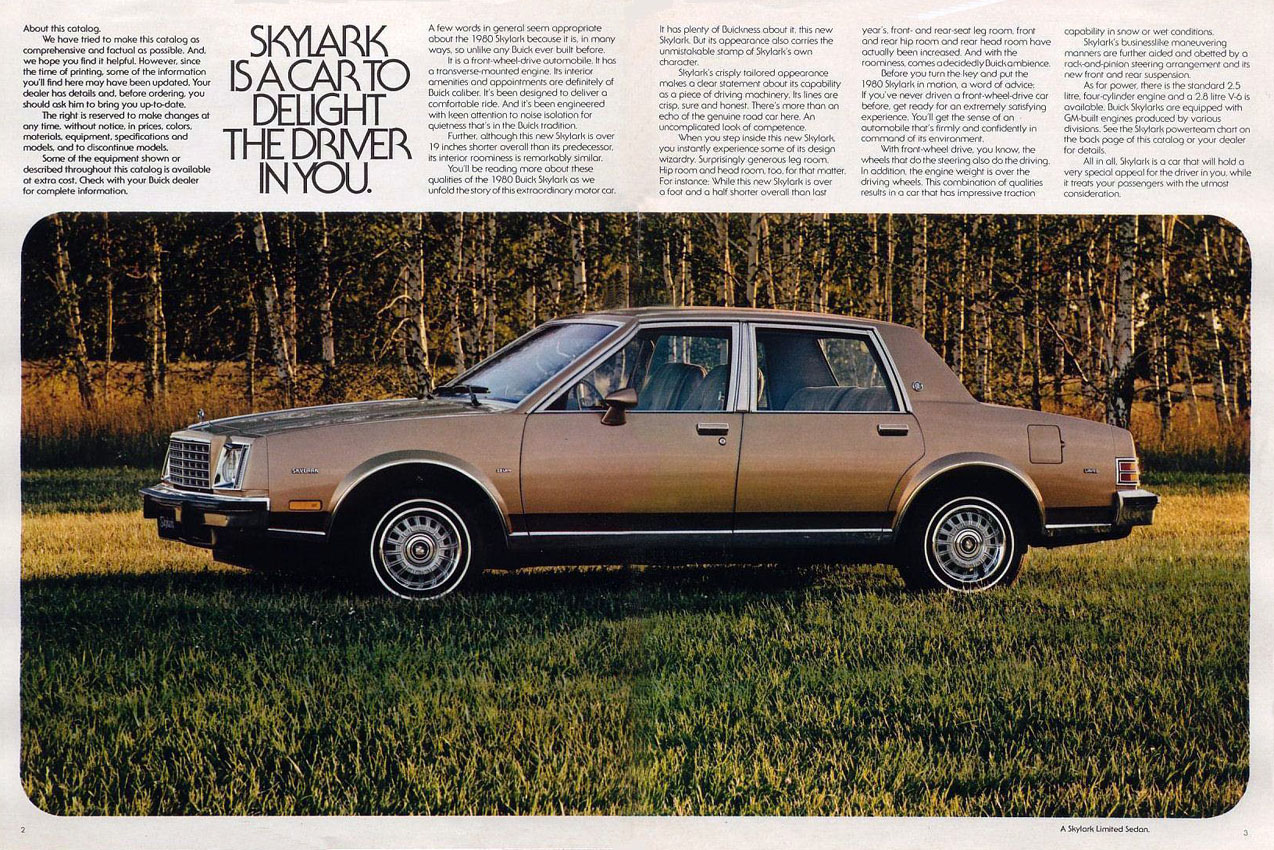
1980 Buick Skylark sedan

“… a car to delight the driver in you.”

Along with the other X-cars, the Buick Skylark was all new for 1980. Only the model name was carried over as the Skylark moved from rear-wheel-drive to front-wheel-drive and downsized yet again, losing about a foot and a half in overall length.

The Skylark name was a long-running and important one to Buick. 1953’s gorgeous limited production Roadmaster Skylark convertible was followed by the smaller Century-based Skylark convertible in 1954. In the middle of the 1961 model year, the Skylark name was reintroduced as a luxury trim of the Special compact. For 1962, the Skylark became its own model. By 1964, the Skylark had become its own model line and had moved to an intermediate size. The intermediate rear wheel drive Skylark would continue for three generations (with one slight interruption in 1973-74).

Like with every other 1980 X-car, the Skylark’s standard engine was GM’s Iron Duke 90 bhp 2.5 liter/151 ci inline four with a Rochester Varajet II two-barrel carburetor, paired with a four-speed manual transmission. Fuel economy was 24 city/38 highway by the day’s standards (21/34 by today’s measures). With a 14-gallon gas tank, a Skylark’s driver could expect a range of 350 to 390 miles with a 10% fuel reserve. 0-60 times for the Iron Duke are hard to find, but were likely around 16 seconds for the four-speed manual transmission and probably about 19 seconds (oog) with the optional ($337) three-speed automatic transmission.

Spending $225 to upgrade to the LE2 2.8 liter/173 ci V6 with a Rochester Varajet II two-barrel carburetor got you 115 bhp and a 0-60 time of a little over 13 seconds. Fuel economy dropped substantially to 20 city/28 highway with the four-speed manual transmission. Moving to the three-speed automatic transmission dropped highway mileage to 27 mpg.

Sedan pages from the 1980 Buick Skylark brochure

Standard exterior and mechanical equipment on the $5,306 Buick Skylark sedan included front-wheel-drive, rack-and-pinion steering, front disc/rear drum brakes, and P185/80R13 fiberglass-belted radial-ply tires (a size now only marginally available) on 13-inch wheels. Inside, buyers got a no-cost choice of either a houndstooth cloth or a vinyl notchback front bench seat. A Delco AM radio with two front speakers and a windshield antenna was also included.

The $5,726 Skylark Limited included a distinctive hood ornament, wide rocker and wheel opening moldings, Deluxe wheel covers, and a gas strut under the hood. Inside, a choice of a Limited level brushed woven cloth or a vinyl notch back seat with a fold-down center armrest, door entry courtesy lights, a simulated wood grain instrument panel, a special acoustic insulation package, and a plush carpeted back window panel were present. Limited identification was, of course, included.

The $5,920 Skylark Sport Sedan included a specially styled grille, amber front park and turn lamps, front and rear bumper strips, black moldings, wheel opening moldings, Sport mirrors, smoked tail lamp lenses, a Rallye ride-and-handling package system, a larger rear stabilizer bar, and P205/70R-13 steel-belted radial-ply blackwall tires on Designers’ Sport wheels. Inside, the Sport Sedan included a Sport steering wheel and a black instrument panel with a voltmeter, a temperature gage, and a trip odometer.

Options & Production Numbers

The Skylark’s options list gives you a sense that Buick was trying to serve two masters. The base prices were affordable, but you could load the Skylark sedan up with thousands of dollars’ worth of options, bringing it close to a Century or a LeSabre.

Individual exterior and mechanical options for the Skylark included the Designers’ Accent paint treatment ($174), a Landau top, a long vinyl top, a Vista-Vent flip-open glass sunroof ($240), power steering ($164), power brakes ($76), and chrome-plated road wheels ($141). Inside, front bucket seats ($48), a 6-way power seat ($165), a full-length operating console, Cruise-Master speed control ($105), a tilt steering column ($75), air conditioning ($564), power windows ($189), and electric door locks ($123) were available.

Four Delco radios ranging up to an AM/FM stereo with a cassette tape player and a CB ($491) were available. Lower body sport stripes with a Hawk decal were available only for the Skylark Sports versions.

Buick sold 80,940 base Skylark sedans in the 1980 model year. Combined Limited and Sports Sedan sales totalled 86,948, with the vast majority being the Limited. The Skylark was 26% of Buick’s total production in 1980.

Despite an astounding nine recalls for the 1980 version, the Skylark’s yearly sales percentage declines were notably less than those of other X cars—by 1983, Buick was actually selling more Skylarks than Chevrolet was selling Citations. The fifth-generation Skylark sedan, which Buick called its “little limousine,” would continue through the 1985 model year and end up selling 729,523 copies over six model years.

The View From 2025

A few—but only a few—of the X-cars were saved, and Skylarks of this generation occasionally appear in the Hemming’s Motor News classifieds, on eBay Motors, and on Bring a Trailer.

Make mine Dark Red Metallic, please.

Other X-bodies I’ve written about in this blog included the 1980 Chevrolet Citation hatchback sedan, the 1981 Chevrolet Citation X-11 hatchback coupe, the 1982 Pontiac Phoenix SJ coupe, the 1983 Buick Skylark T TYPE coupe, the 1984 Oldsmobile Omega sedan, and the 1985 Chevrolet Citation II hatchback sedan.

1982 Ford Thunderbird coupe

For some reason, I’m always interested in the last year of a “failed” model. Usually, not much gets changed, as the manufacturer’s hopes have already been dashed. For Labor Day 2025, we’ll cover the fruits of Ford’s labors for the 1982 model year.

“Three distinctive series, each built to be driven with pride.”

For 1982, Ford’s Thunderbird personal luxury coupe added a 3.8 liter V6 option, and removed the 4.9 liter V8 option. A Tripminder trip computer was a new option, and the gas tank size increased to 21 gallons. Otherwise, Ford changed little besides colors and trims.

Ford engine availability and power ratings were still in decline in 1982—except if you were purchasing a Mustang. The Thunderbird’s standard powertrain was the Thriftpower Six 87 bhp 3.3 liter/200 ci inline six with a one-barrel carburetor paired with a SelectShift three-speed automatic transmission. Powertrain upgrades were available: buyers could specify the aforementioned Essex 112 bhp 3.8 liter/232 ci V6 with a two-barrel carburetor or the Windsor 120 bhp 4.2 liter/255 ci V8 with a Motorcraft two-barrel carburetor. Both of the optional engines cost $241.

The Thunderbird was a notably different car depending on the engine choice. Looking at the table, it’s hard not to believe that the new Essex engine was the winner—almost as quick as the Windsor V8, and with notably better fuel mileage than either the inline six or the V8.

Thriftpower Six
(3.3 liter inline six)
Essex
(3.8 liter V6)
Windsor
(4.2 liter V8)
0-60 mph
(approximate)
17.3 seconds13.2 seconds12.6 seconds
Fuel mileage
(1982 standards)
17 city/24 highway19 city/30 highway17 city/26 highway
Range
(10% fuel reserve)
315 to 345 miles375 to 415 miles330 to 365 miles

Standard exterior and mechanical equipment on the $8,492 base Thunderbird (about $29,400 in today’s dollars) included concealed rectangular halogen headlamps, variable ratio power rack and pinion steering, power front disc/rear drum brakes, full wheel covers, and P-metric white sidewall steel-belted radial ply tires. Inside, a Flight bench seat in fine-ribbed cloth and vinyl trim, a day/night inside mirror, a trip odometer, a quartz electric clock, and an AM radio were included.

Packages, Options, & Production Numbers

Ford continued to decontent the $9,703 Town Landau (approximately $33,600 now), so its price was closer to the base Thunderbird compared to 1980. Moving up still added Luxury wheel covers, dual remote control mirrors, diagnostic warning lights, interval windshield wipers, a tilt steering wheel, and an AM/FM stereo radio. The Luxury vinyl roof—a padded rear half vinyl roof with a color-coordinated wrapover band and coach lamps—was also standard on the Town Landau. Finally, the included Interior Decor Group added cloth covered head restraints (vinyl if vinyl trim was purchased), Decor door trim panels with assist straps, and a choice of either split bench seats with dual recliners in higher level knit cloth fabric or bucket seats with console.

For the second year, the Heritage edition was the top-of-the-line Thunderbird ($12,472 then, $43,100 now). Exterior and mechanical features the Heritage edition added over the Town Landau included front cornering lamps, complete tinted glass, rocker panel moldings, the 3.8 liter V6 engine, an Automatic Overdrive transmission, and wire wheel covers. Inside, the Heritage edition included a 6-way power driver’s seat, an electronic instrument cluster, air conditioning with manual controls, the power lock group, and an AM/FM stereo search radio.

Every Heritage edition buyer also got a padded rear half vinyl roof with a brushed aluminum wrapover band, coach lamps, and a frenched backlight. They also received the Interior Luxury Group, which included split bench seats with dual recliners in crushed velour cloth, cloth covered head restraints, a Luxury steering wheel, an automated parking brake release, a right hand visor illuminated vanity mirror, 18-oz floor carpeting, burled rosewood woodtone instrument and door panel appliques, the Light Group (dual beam map light, instrument panel courtesy lights, and engine compartment light), power side windows, interval windshield wipers, diagnostic warning lights, an electronic digital clock, and Luxury luggage compartment trim.

Individual options included a flip-up open-air roof ($276), metallic glow paint ($80), a Tu-Tone paint/tape treatment ($128-206), the Keyless Entry System ($319), Recaro bucket seats with a console ($523/$405/$222 depending on series), the SelectAire conditioner with automatic temperature control ($754 for all but the Heritage, which charged $78), and the Tripminder trip computer ($215-261). Nine different audio selections were available, ranging up to an electronic AM/FM stereo search radio with a cassette tape player and the Dolby noise reduction system ($318/$233/$87), which could be paired with the Premium Sound System ($133-187).

Ford sold 45,142 Thunderbirds in the 1982 model year, which was the lowest number since 1975. It was handily outsold by all four of the mid-size GM coupes: Buick Regal, Chevrolet Monte Carlo, Oldsmobile Cutlass, and Pontiac Grand Prix. It would take the next Thunderbird design in 1983 to redress this balance.

The View From 2025

According to Hagerty’s valuation tools, a 1982 Thunderbird with the V8 in #1/Concours condition is $17,400, with a far more typical #3/Good “normal” Thunderbird with the six going for $6,500. This generation of Thunderbirds maintains a presence in the Hemmings Motor News classifieds, on eBay Motors, and on Bring a Trailer, but you see very few 1982 examples. As I update this blog entry in October 2025, there’s a Silver Metallic 1980 with gray cloth seats and the 255 ci V8 on Hemmings, showing 73,000 miles and asking $11,500.

Make mine the extra-cost Medium Blue Glow, please.

Other eighties Thunderbirds I have written about include the 1980 coupe, the 1983 Turbo Coupe, and the 1987 standard coupe.

Last updated October 2025.

1983 Dodge Shelby Charger hatchback coupe

“It ain’t just paint.”

Dodge released the Shelby Charger hatchback coupe in February 1983. Based on the Dodge Charger 2.2, the Shelby Charger marked the reunion of Lee Iacocca and Carroll Shelby, years after their legendary success with the 1965 to 1970 Ford Mustang. It was the first vehicle to emerge from the Chrysler-Shelby technical center in Santa Fe Springs, CA.

Motive power was provided by a 107 bhp 2.2 liter/135 ci inline four with a two-barrel carburetor, which was mated to a five-speed manual transmission. With the aid of a 2,400-pound curb weight, Car and Driver recorded a 0-60 mph time of 9.0 seconds—sprightly for a reasonably priced sports coupe in 1983 and faster than the class-leading Volkswagen GTI. As usual, most other testers were notably slower—Road & Track listed a 10.0 second 0-60 time.

Fuel economy ratings were an impressive 25 city/40 highway by the day’s standards. With a 13-gallon gas tank, the owner of a Shelby Charger could expect a range of 310 to 340 miles with a 10% fuel reserve.

1983 Dodge Shelby Charger print advertisement

The Dodge Shelby Charger’s base price was $8,290—about $27,400 in today’s dollars, or about 9% less than a 2025 Dodge Hornet GT crossover goes for. Standard exterior and mechanical equipment included a front air dam, halogen headlamps, tinted glass on all windows, a rear spoiler, a special handling sport suspension, quick ratio power rack and pinion steering, heavy duty power front disc/rear drum brakes, and 195/50VR15 Goodyear Eagle GT tires (a size still readily available) on 15-inch cast aluminum wheels. Inside, front cloth bucket seats featured a CS logo, a Sport steering wheel, a console, a Rallye instrument panel cluster with a tachometer, clock, and trip odometer, and a power liftgate release were included.

Options, Period Reviews, & Production Numbers

Options included air conditioning ($632), automatic speed control ($176), and a series of four radios ranging up to an electronically tuned AM/FM stereo with a cassette player ($485).

Period reviews were generally positive, with many magazines pleased to see Carroll Shelby back in the automotive modification business. Car and Driver stated that the Shelby Charger was “built to slay giants.” Road & Track‘s tag line was “Carroll helps Chrysler bring back the Sixties,” which seems like just a bit of overreach. R&T also compared the Shelby Charger with the Nissan 200SX and the Toyota Celica GT-S. All was not perfect, and just about everyone complained about the seats and the steering wheel.

Dodge produced 8,251 Shelby Chargers for the 1983 model year, making the shortened first year of production the highest of the five years the model was available. 63% of 1983 Shelby Chargers were Santa Fe Blue Crystal Coat, with the rest being Silver Metallic. After 1987, the front-wheel-drive Charger would be gone, replaced by the Shadow, which would have its own Shelby version.

The View From 2025

Though Hagerty doesn’t track their values, Shelby Chargers do have their own following as part of Dodge’s storied high-performance history. They are often available in the Hemmings Motor News classifieds, on eBay Motors, and on Bring a Trailer. As I update this blog post in October 2025, there’s a Ruby Red Pearl Coat 1985 Shelby Charger with a grey and tan interior and 134,000 miles for sale on Hemmings, asking $19,000.

Make mine Santa Fe Blue Crystal Coat, please. That also gets me the silver stripe.

Other sporty Dodges I have written about include the 1984 Daytona Turbo Z hatchback coupe, the 1985 Shelby Charger hatchback coupe, and the 1985 Omni GLH hatchback sedan. I should write about the Shadow, and maybe the Mirada.

Last updated October 2025.

1987 Porsche 928 S4 hatchback coupe

“The most technologically advanced Porsche you can get.”

1987 was the first model year for the Porsche 928 S4 (the 4 stood for fourth-generation). The 928’s new standard engine was the 320 bhp M28 5.0 liter/302 ci V8 with Bosch L-Jetronic port fuel injection, which was mated to either a five-speed manual transmission or a Mercedes-sourced four-speed automatic. The 928 S4 also featured a new front bumper, bigger taillights, a new (and large) rear spoiler, and many detail changes. The drag coefficient dropped to 0.34, compared to 0.39 in 1986’s 928 S.

We’ll go with 928 S4 as the model designation, because that’s what Porsche calls it now. Period window stickers show 928S-4, period advertisements used 928S 4, and period reviews often used 928S4—another example of why I have a page about nomenclature.

In a car that weighed 3,507 pounds with the manual transmission, Car and Driver recorded a 0-60 time of 5.3 seconds, with a top speed of 159 mph. The EPA rated fuel mileage at a class-competitive 15 city/23 highway (14/21 by today’s measures). With a 22.7-gallon gas tank, the proud new owner of a 928 S4 could expect a range of about 360 to 385 miles with a 10% fuel reserve.

1987 Porsche 928 S4 print advertisement

The 928’s base price changed significantly over the 1987 model year. Period window stickers vary from $58,900 (about $173,100 in 2025 dollars) to $66,710 (about $188,000 in today’s dollars or almost exactly what a 2025 Porsche 911 Carrera 4 GTS coupe costs). Standard exterior and mechanical equipment included headlight washers, an electric rear window defogger, a rear window wiper, power rack and pinion steering, and vented power disc brakes. 225/50VR16 tires on 16 x 7J wheels out front were balanced by 245/45VR16 tires on 16 x 8J wheels (both tire sizes are still available). Inside, power front leather seats, a 4-spoke leather steering wheel, air conditioning with automatic climate control, power windows, a central locking system, and an AM/FM stereo radio with a cassette player and eight speakers were included.

Options, Production Numbers, & Period Reviews

Exterior and mechanical options included a limited slip differential ($722) and sport shock absorbers ($247). Inside, options included lumbar support ($422-$456 per seat), heated seats ($160 per seat), an alarm system ($445), and increased air conditioning ($967-$992).

Porsche sold 15,682 928 S4s worldwide over five years. Period reviews were generally positive—Car and Driver‘s tagline was “vindicated at last.” The “buff books” also noted the notable difference in personalities and performance between the manual and the automatic versions of the 928 S4, relevant because the automatic was about 80% of sales.

The View From 2025

There is excellent club support for the Porsche 928, as there is for all Porsches. According to Hagerty’s valuation tools, all the money for a 1987 Porsche 928 S4 with the manual in #1/Concours condition is $99,000, with a more normal #3/Good condition car with an automatic going for $29,300. Porsche 928s frequently show up for sale in the Hemmings Motor News classifieds, on eBay Motors, and on Bring a Trailer. As I update this blog entry in December 2025, a Cassis Red Metallic 1987 with an automatic and 145,000 miles is available on Hemmings, asking $15,750.

Make mine Ocean Blue, please.

I have also written about the the 1982 928 hatchback coupe. Other eighties Porsches I have covered include the 1980 911 SC coupe, the 1980 924 hatchback coupe, the 1982 924 Turbo hatchback coupe, the 1984 911 Carrera Targa, the 1985 911 Carrera Cabriolet, the 1986 911 Turbo coupe, the 1986 944 Turbo hatchback coupe, the 1987 911 3.2 Carrera coupe, and the 1988 944 hatchback coupe.

Last updated December 2025.

1983 BMW 320i coupe

“Performance: The Unabridged Version”

By the 1983 model, BMW’s E21 320i coupe was showing some of the vicissitudes of age. What had been almost mind-blowing for 1977 no longer seemed quite as differentiating.

The 320i’s engine continued to be BMW’s M10B18 1.8 liter/108 ci inline four with Bosch K-Jetronic fuel injection, making 101 bhp and 100 lb-ft of torque. Car and Driver recorded a 0-60 mph time of 9.8 seconds and a top speed of 105 mph. Mileage by the day’s standards was pretty good: 25 city/36 highway with the five-speed manual transmission. With a 15.3-gallon gas tank, the proud new owner of a 320i could expect between 345 and 375 miles of range with a 10% fuel reserve.

1983 BMW 320i print advertisement

The 320i’s base price was $13,290—about $43,700 in 2025 dollars, which is almost exactly what a 2026 BMW 230i xDrive coupe goes for. Standard exterior and mechanical equipment included tinted glass all around, a four wheel independent suspension, rack and pinion steering, power front disc/rear drum brakes, and 185/70X13 steel belted radial tires (a size still available) on 13-inch wheels. Inside, fully reclining front seats, a flow thru ventilation system, a rear window defroster, an electronic tachometer, and an LED digital quartz clock were included.

Packages, Options, & Model History

BMW offered two packages for the 1983 320i:

  • The $2,620 S Package included a front air dam, a limited-slip differential, a sport suspension, BBS wheels, Recaro sport seats, and a leather-wrapped steering wheel
  • The $1,685 Luxus Touring Group Package included fog lamps, air conditioning, and an AM/FM stereo cassette player

Individual options included a manual sunroof ($555) and metallic paint ($440).

The 320i was in production from the 1977 to the 1983 model years. Initially, the engine was the same 2.0 liter inline four that had been in the sainted 2002. In 1980, BMW moved to the 1.8 liter inline four that the 320i would have until its production ended. The E30 318i would replace the 320i from 1984 forward.

The View From 2025

The 320i is rarely seen on eBay Motors, but examples do show up in the Hemmings Motor News classifieds and on Bring a Trailer. According to Hagerty’s valuation tools, a 1983 320i in #1/Concours condition is $35,400, with a more normal #3/Good condition car going for $11,700.

Make mine the extra-cost Baltic Blue Metallic, please.

Other BMWs I have written about include the 1982 733i sedan, the 1983 633CSi coupe, the 1984 325e coupe, the 1985 535i sedan, the 1987 L6 coupe, the 1987 M6 coupe, the 1988 750iL sedan, and the 1988 M3 coupe.

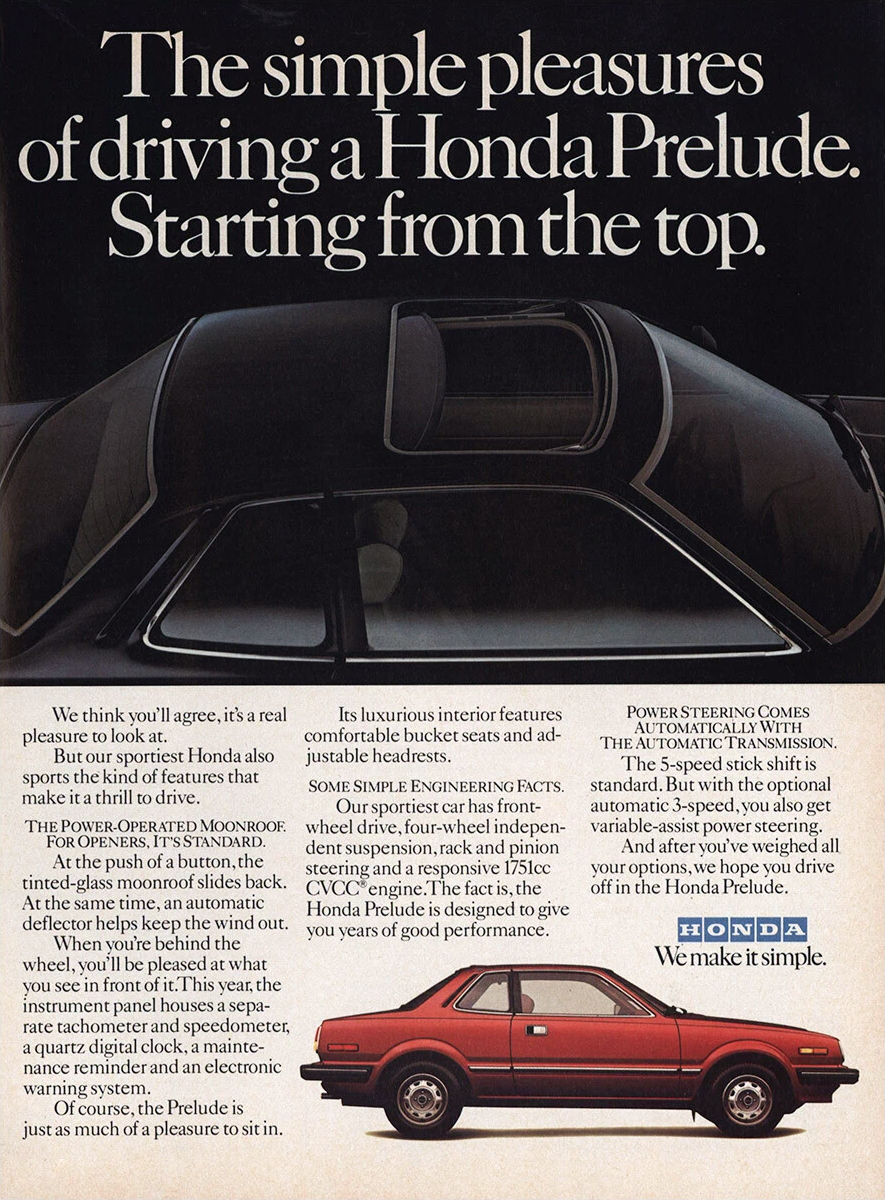
1982 Honda Prelude Sport Coupe

“Think of it as a civilized sports car.”

1982 was the final year for the first generation of Honda’s Prelude Sport Coupe. Honda changed little from the 1981 model year—the major variation was more dealer accessories. Two of the three available exterior colors also changed.

The Prelude’s engine was the EK CVCC 75 bhp 1.8 liter inline four with a three-barrel carburetor. The standard transmission was a five-speed manual, and a three-speed automatic was available. 0-60 mph came in about 11.5 seconds in a car with a curb weight of 2,138 pounds. EPA fuel economy ratings with the manual were 29 city/40 highway by the day’s standards. With a 13.2-gallon gas tank, the owner of a 1982 Prelude with the five-speed could expect a range of 335 to 365 miles with a 10% fuel reserve.

1982 Honda Prelude print advertisement

The 1982 Prelude Sport Coupe’s base price was $7,995—about $27,700 in today’s dollars or almost exactly what a 2025 Honda Civic hatchback sedan goes for. Standard exterior and mechanical equipment included tinted glass, a power-operated moonroof, rack and pinion steering, power-assisted front disc/rear drum brakes, and 175/70SR13 steel-belted radial ply tires (a size still available) on 13-inch wheels with bright metal wheel trim wings. Inside, reclining front bucket seats with 4-way adjustable headrests, a four-spoke Sport steering wheel, two-speed plus intermittent wipers, a quartz digital clock, front side window defrosters, a remote trunk release, and a rear window defroster were included.

Accessories & Production Numbers

There were no factory options for the Prelude other than transmission and paint color. Dealer accessories included aluminum alloy wheels and air conditioning. Dealers also offered twelve (!) audio choices, ranging up to an AM/FM stereo radio with electronic tuning, a digital display, and an autoreverse cassette with Dolby—but I would probably have just given Crutchfield a call.

Honda sold 37,872 Preludes in the United States in the 1982 model year—a solid finish for the first generation.

The View From 2025

There’s Prelude news right now—Honda promises that the Prelude will be coming back for the 2026 model year. Closer to our topic, first-generation Preludes were once commonly seen on American roads, but have virtually disappeared by now. You occasionally see these Preludes for sale in the Hemmings Motor News classifieds, on eBay Motors, and on Bring a Trailer.

Make mine Windsor Blue Metallic, please. Honda offered a grand total of three color choices for the 1982 Prelude. More color choices for the Prelude wouldn’t come until the 1985 model year arrived.

Other Hondas I have written about include the 1983 Accord sedan, the 1983 Civic S hatchback coupe, the 1984 Civic DX hatchback coupe, the 1984 Civic CRX hatchback coupe, the 1985 Civic CRX Si hatchback coupe, the 1986 Accord sedan, the 1986 Prelude Si coupe, and the 1988 Civic sedan.

1986 Buick Riviera coupe

“… a new philosophy about personal luxury cars.”

The seventh-generation Riviera debuted on November 14th, 1985. For a third and final time, Buick downsized the Riviera—this time to a 108-inch wheelbase and a 187.2-inch overall length. The size reduction (more than 19 inches shorter) made this generation the smallest and lightest of all Rivieras. Among the planning assumptions for the seventh generation model and its Eldorado and Toronado platform-mates was that gasoline would cost approximately $3.00 a gallon upon debut. Instead, fuel was going for around $1.19 when the three prestige coupes entered the market in late 1985.

In part because of the assumptions mentioned previously, there were no more V8s for the Riviera—from 1986 forward, the Riviera that had been V8 only until 1979 would now be V6 only. Also gone forever was the diesel V8, almost certainly less missed by buyers than the gasoline versions. Production moved to a brand new plant in Hamtramck, MI. Finally, the Riviera was also back to being coupe-only—the four-year experiment with the glamorous, attention-getting, and pricey convertibles was no more.

After many years that had some (sometimes many) choices, the only available powertrain for 1986 was the LG2 “3800” 140 bhp 3.8 liter/231 ci V6 with sequential fuel injection paired with a Turbo Hydramatic 440-T4 automatic transmission with overdrive. The LG2 was a version of the previous generation Riviera’s LD5 modified for transverse front-wheel-drive usage and was first seen as an option in the 1984 versions of the Buick Century and the Oldsmobile Cutlass Ciera. Though it was “just” a V6, the LG2 had the same power rating as the 1985’s base V8, making the substantially lighter “civilian” 1986 Riviera quicker than its 1985 equivalent. The 0-60 time was about 10 seconds, making the Riviera quite competitive in class.

Fuel mileage for the new Riviera was 19 city/30 highway by the day’s standards. With an 18.0-gallon fuel tank, the driver of a 1986 Riviera could reasonably expect a range of 370 to 415 miles with a 10% fuel reserve. This impressive range put paid to the reputation of Rivieras of years past, who were often said to “pass anything but a gas station”­—and sometimes had about 200 miles between fill-ups. The 1986 ended up with among the longest ranges of any Riviera, despite having a smaller fuel tank than most.

Along with its downsizing, powertrain, and configuration revisions, a change also came to the Riviera’s styling brief. Buick described the seventh-generation exterior as a “gentle wedge form” and paid far more attention to aerodynamics than with any previous generation (more advanced technology made these objectives more easily attainable). Led by William Porter, the division settled on its new Riviera look quickly—the final design for the new generation was recognizable even in renderings done many years earlier, in late 1980.

As might be expected with the far lighter weight (the Riv shed more than 500 pounds) and smaller engine, fuel economy was better than any Riviera before—or after. Perhaps more surprisingly, the available interior room was quite close to that of the sixth-generation cars, a sign of careful and skilled packaging design.

For the first time in its history, the presumed differentiator for a new generation of Rivieras was inside the car—not its exterior design. The Graphic Control Center included seven to ten microprocessors (depending on the particular options ordered) and a 3 x 4 inch touch-sensitive cathode-ray tube screen. This component was bleeding edge for publicly available technology in the mid-1980s and certainly not inexpensive to produce­—dealer cost for a replacement unit was said to be over $2,000. The Graphic Control Center was also easily a quarter of a century ahead of its time—probably not the right choice for the average Riviera customer.

Designed by Delco Electronics over several years with assistance from Buick engineers, the Graphic Control Center was prototyped in one hundred 1984 and 1985 Rivieras. In production form, it included diagnostic displays, a trip monitor, retained accessory power, and controls for the electronic air conditioning and sound system. Touching gauges brought up additional information, including a tachometer along with battery and coolant gauges.

The Graphic Control Center was heavily promoted in both the press and Buick’s sales materials—the 24-page 1986 Riviera brochure devoted its first four inside pages to it. At the time, Buick’s chief engineer, Dave Sharpe, told Popular Mechanics that the new Riviera targeted America’s young “technotypes.” From over a third of a century away, it’s quite unclear who he was talking about.

The 1986 Riviera had many new standard features: four-wheel power disc brakes were finally included on every example after having been an option for almost a decade. Another item newly standard on the seventh-generation Riviera was tungsten-halogen headlamps—first seen on a Riviera in the 1972 Silver Arrow III concept car and optional on production Rivieras since 1981. So was a high-mounted stop lamp—federally mandated for all 1986 automobiles and a faint echo of the fourth-generation Rivieras.

Every one of the 15 exterior colors was also new—even the Riviera’s black and white color formulations (both of which had been constant for at least a decade) did not carry over from 1985. The Riviera’s four Firemist colors were shared with Cadillac and Oldsmobile—but not with other Buicks as had been true in the fifth-generation cars.

Flies In The Ointment

From a marketing perspective, the 1986 Riviera was more than a foot shorter than that year’s Buick Regal coupe—whose base price of $10,654 was $9,177 less than the $19,831 that the supposedly senior coupe went for. A persistent rumor stated that Buick dealers were told not to place the Riviera too close to the similar-looking but even less expensive Somerset Regal coupe, which had been on their showroom floors since the beginning of the 1985 model year. As early as September 1985, Popular Mechanics pointedly queried, “why make an expensive car look like a cheaper model?”

As if that wasn’t enough, the Riviera’s size was also quite close to that of the LeSabre—traditionally the largest coupe in the Buick family, and now also front wheel drive. It also probably did not help that 1986 Riviera prices were up almost 16% over the 1985 version, even when accounting for inflation.

Due to these and other contributing factors, Riviera sales collapsed, declining 66% to 22,138—a painful state of affairs for General Motors, which the Riviera shared with its Eldorado (off 72%) and Toronado (down 62%) stablemates. Six years later, GM had now managed to duplicate the carnage that Ford had experienced with its 1980 downsizing. Notably, Ford Thunderbird, Lincoln Mark VII (the Continental name departed that year), and Mercury Cougar sales were all up for 1986, along with those of some of GM’s “junior” personal luxury coupes. The December 1987 issue of Special Interest Autos simply called it “the E-body disaster” and speculated that it was costing GM half a billion dollars a year in lost profits.

It seems clear that General Motors had utterly misjudged what the appeal of its new prestige coupe platform was to folks who might actually consider buying it. One can only wonder how many hundreds of thousands of future vehicle sales were lost as the revised E-body offerings for 1986 got buyers permanently out of the habit of buying big personal luxury coupes—what only one year prior had been over 181,000 high-profit sales. To add to the pain, a short but memorable star turn by a Riviera in the 1986 Arnold Schwarzenegger vehicle Raw Deal featured a sixth-generation convertible—not a seventh-generation coupe.

Pages from the 1986 Buick Riviera brochure

The relatively few folks who did purchase a 1986 Riviera got a well-equipped car by mid-eighties standards. Standard exterior equipment included Soft-Ray tinted glass, cornering lamps, and an automatic power antenna. Mechanical equipment included power steering, a DynaRide four-wheel independent suspension with automatic level control, and 205/70R14 all-season whitewall tires on 14-inch wheels with Deluxe wheel covers. Inside, standard features included Electric Speed Control cruise control, a tilt steering column, a Limited steering wheel with cruise-control switches, electric door locks, and a Delco ETR AM-FM stereo with seek and scan, a clock, and four extended-range speakers. Interior trim and upholstery featured a full-length console with a floor shift, manual reclining cloth front bucket seats, and a six-way power driver’s seat.

One Package & Individual Options

The sporty T Type package (at $21,577, an additional $1,746 over the base Riviera) carried over its designation from the previous generation but lost its differentiating turbocharged V6—making it no quicker than any other Riviera. It did at least handle better than the average Riviera—the T Type’s 1986 guise included a Gran Touring suspension and P215/60R15 Goodyear Eagle GT blackwall tires on 15-inch aluminum wheels. T Type’s were only available with Flame Red, White, Silver Metallic, or Black exterior paint, and all featured gray lower accent paint.
Inside, every T Type included a leather-wrapped steering wheel with cruise control switches and the heavily-hyped Power Comfort six-way power bucket seats for driver and front passenger—with reversible cloth and leather center sections that attached with velcro. The Power Comfort seats included inflatable lumbar supports, electrically adjustable headrests, and double pivoting systems for the lower seatback. A little over 9% of Riviera buyers took home a T Type in 1986.

In addition to all that was newly standard, new options for 1986 included a keyless entry system (available mid-year), a heated outside drivers mirror, and the availability of lumbar support with the optional seats. The radio delete option no longer existed—every Riviera buyer was driving home for the dealership with some kind of factory radio. The number of options in 1986 was reduced to less than one-third of what it had been in 1985, as Buick worked aggressively to reduce build complexity—but removed much of the path to a truly personal Riviera.

The View From 2025

With the excellent support of the Riviera Owners Association, a few folks are collecting these early seventh-generation Rivieras. According to Hagerty’s valuation tools, a base 1986 Buick Riviera in #1/Concours condition is $15,500, with a more normal #3/Good condition car going for $7,600. Rivieras of this generation sometimes show up in the Hemming’s Motor News classifieds, on eBay Motors, and on Bring a Trailer.

Make mine Black Cherry Metallic, please. I know that means that the 1986 Riviera I want won’t be a T Type.

Other Rivieras I have written about include the 1980 S TYPE, the 1982 convertible, the 1984 T TYPE, and the 1989 coupe.

Most material in this blog entry was sourced from the unfinished Riviera Project.

1987 Ford Mustang LX 2-door sedan

“You get the more formal look of the sedan with the high performance of the GT.”

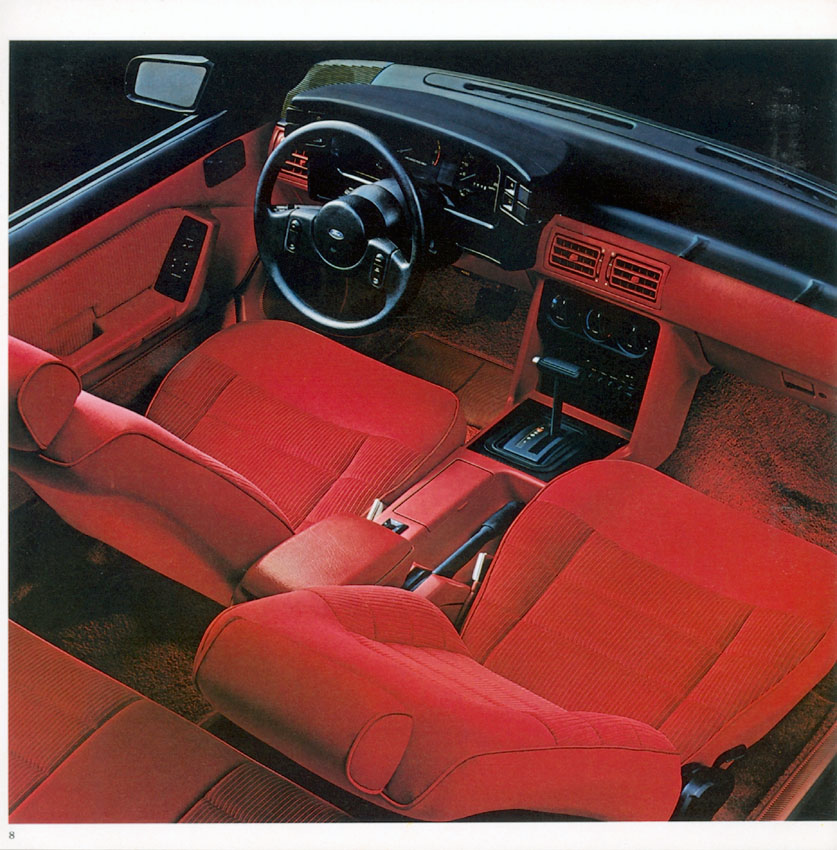
For the 1987 model year, Ford’s Fox-body Mustang received a facelift of both its interior and exterior. Ford restyled the front end, which gave the aging design (work had begun on the Fox-body Mustang in 1976) more of an “aero” look, in keeping with the overall mid-1980s Ford styling direction embodied by the Thunderbird and Taurus. The quarter glass windows were now each a single larger flush piece of glass with “Mustang” lettering at the bottom rear corners, replacing the smaller glass paired with louvers that had been in use since the 1979 model year. Taillights on the LX were revised with clear lenses for the turn signals. The interior received an all-new dash, center console, and revised seat and door trim.

With the SVO gone, the remaining models were the LX and the GT. Ford discontinued the V6 option, leaving only the standard 90 bhp Lima 2.3 liter/140 ci inline four with new-for-1987 fuel injection and the optional 225 bhp Windsor 4.9 liter/302 ci V8 with sequential fuel injection, which was part of an $1,885 5.0L EFI HO V-8 Engine Package. A five-speed manual transmission was standard, while a four-speed automatic was a $515 option.

From a performance and fuel economy perspective, the inline four LX and the V8 LX might as well have been different cars. The Lima-based Mustang with the manual took about 13.3 seconds to get to 60 mph, with the automatic/inline four combination being a few tenths worse. The payoff was fuel economy—25 city/31 highway by the day’s standards for the base powertrain (22/28 by today’s measures). The automatic was about 10% less efficient. With a 15.4-gallon gas tank, an LX owner with the base powertrain could expect an impressive range of 350 to 385 miles with a 10% fuel reserve.

In marked contrast, the Windsor-based Mustang with the manual took about 6.2 seconds to get to 60 mph, with the automatic version taking about 6.7 seconds. Fuel economy was 16 city/24 highway by the day’s standards (15/22 by 2025 measures). Interestingly, the automatic was about 13% more efficient when paired with the V8. An LX owner with the V8 and five-speed manual could expect a range of 260 to 275 miles with a 10% fuel reserve.

LX interior page from the 1987 Ford Mustang brochure

The 1987 Mustang LX 2-door sedan (Ford’s nomenclature) had a base price of $8,043—about $23,500 in today’s dollars, which is approximately 26% less than a base 2025 Mustang costs. Standard exterior and mechanical equipment included power rack and pinion steering, power front disc/rear drum brakes, and P195/75R14 black sidewall steel-belted radial tires on 14-inch wheels with turbine wheel covers. Inside, reclining cloth low back front bucket seats, Light Group, full instrumentation, a console, and an electronic AM/FM stereo search radio with four speakers were included.

Groups, Packages, & Individual Options

Seven groups and packages were available for the Mustang LX 2-door sedan:

  • Preferred Equipment Group 240A was the base package
  • Light Group was included with the base package and included lights for the engine compartment, the luggage compartment, the ashtray, and the glove box. A dual beam dome/map light and a headlamps on reminder chime were also included
  • Special Value Group 240A (no cost for inline four/$735 for V8) included Power Lock Group, an electronic AM/FM stereo radio with cassette tape player, speed control, and styled road wheels
  • Power Lock Group ($244) included power door locks, a remote locking fuel door, and a trunk release
  • Climate Control Group ($1,005 for inline four/$978 for V8) included tinted glass, a heavy-duty battery, air conditioning, and a rear window defroster
  • Custom Equipment Group ($624) included dual electric remote control mirrors, power side windows, dual illuminated visor mirrors, a tilt steering wheel, and a graphic equalizer
  • The 5.0L EFI HO V-8 Engine Package ($1,885) included a Traction-Lok axle, GT suspension system components, a 15:1 steering ratio, a heavy-duty battery, P225/60VR15 handling tires, and cast aluminum wheels

Exterior and mechanical options for the Mustang LX 2-door included complete tinted glass ($120) and wire style wheel covers. Inside, a tilt steering wheel ($124), an air conditioner ($788), and power front side windows were available. Stereo options included an electronic AM/FM stereo radio with cassette tape player ($178), a graphic equalizer ($218), and the Premium Sound System ($168 for six upgraded speakers and a 4-channel power amplifier). The Handling Suspension Package and cast aluminum wheels were optional with the inline four but included with the V8.

Period Reviews & Production Numbers

The enthusiast press—including Car and Driver, Hot Rod, and Motor Trend—swiftly realized that the LX 2-door sedan with the V8 was 80 pounds lighter than the GT, which made it slightly quicker. At $9,928, the V8 LX was also 16% cheaper than the GT, making it one of the outstanding performance bargains of the 1980s.

Production data is surprisingly uncertain (wouldn’t the Mustang have been worth paying attention to?), but some of the more likely data states that Ford sold 43,257 Mustang LX 2-door sedans, of which 4,888 (or 11%) were V8s.

The View From 2025

There is strong club support for the 1987 Mustang, as there is for all Mustangs except the mid-seventies Mustang IIs. According to Hagerty’s valuation tools, all the money for a 1987 Mustang notchback coupe in #1/Concours condition is $52,500, with a more typical #3/Good condition car going for $18,600. 1987 Mustangs often show up in the Hemming’s Motor News classifieds, on eBay Motors, and on Bring a Trailer—BaT has sold three 2-door 1987 LXs over the years.

Make mine Medium Shadow Blue Metallic, please. One quarter of the 12 Mustang colors for 1987 were blues.

Other Mustangs I have written about include the 1980 Cobra hatchback coupe, the 1981 coupe, the 1982 GT hatchback coupe, the 1983 GT convertible, and the 1984 SVO hatchback coupe.