1988 Pontiac Fiero Formula coupe

“Rejoice! Fiero Formula is here.”

In the Fiero’s final year, Pontiac introduced the Formula. Following the Firebird’s lead, the Formula had most of the mechanical components of the top-of-the-line GT, but the look of the original Fiero coupe. The front and rear suspensions for all Fieros was also completely revised, and Bright Yellow was introduced as a mid-year color.

It is a canard of General Motors’ behavior that they discontinue a car as soon as they finally get it right. No more central example exists than the Pontiac Fiero. The Fiero came to market in 1984 with ridiculous expectations, partially driven by Pontiac and in part by how the public sees two-seat mid-engine cars. What had initially been designed as a somewhat sporty commuter car became a significant part of Pontiac’s We Build Excitement strategy.

The painful fact that the Fiero’s mechanical parts were from the low end of the General Motors parts bin soon became stunningly obvious. Citation and Chevette suspension parts were abundant, and the only available engine was the distinctly uninspiring 2.5 liter/151 ci Iron Duke inline four with fuel injection, featuring all of 92 bhp. Predictably, handling and acceleration did not meet expectations. Then, of course, the recalls came—four in all for the 1984 Fiero.

By 1988, Pontiac had gone a long way toward fixing some of the underlying issues. The 2.8 liter/173 ci V6 was made available in 1985, its 140 bhp and multi-port fuel injection both major upgrades. In 1986, the fastback GT body style was added, and a five-speed manual transmission became available for the V6, though only late in the model year. In 1987, the Iron Duke‘s horsepower increased by 6 bhp. Finally, in 1988, the suspension was completely revised (with some Lotus influence).

The Formula‘s standard powertrain was the L44 135 bhp 2.8 liter/173 ci V6 with multi-port fuel injection paired with a five-speed manual—a three-speed automatic ($490) was available. Road & Track recorded a 0-60 time of 8.0 seconds with the five-speed Formula. Mileage in a car with a 2,775-pound curb weight was 17 city/27 highway by the day’s standards (15/25 by today’s measures). With the Fiero’s small 11.9-gallon gas tank, range was between 215 and 235 miles with a 10% fuel reserve.

Fiero pages from the 1988 Pontiac brochure

The Fiero Formula‘s base price was $10,999—approximately $31,000 in today’s dollars, which is about what a 2025 Mazda MX-5 Miata Sport goes for. Standard exterior and mechanical equipment included retracting halogen headlamps, a rear deck spoiler, a tuned dual-port performance exhaust, the WS6 performance suspension, rack-and-pinion steering, power 4-wheel disc brakes, and P205/60R15 front and P215/60R15 rear Goodyear Eagle GT+4 tires (both sizes still readily available) on 15-inch Diamond-Spoke aluminum wheels. Inside, reclining bucket seats, a Rally four-spoke steering wheel, a full-length console, side window defoggers, and a Delco ETR AM/FM stereo radio were included.

Options Groups, Individual Options, & Production Numbers

Pontiac offered three option groups with the Fiero Formula:

  • Option Group I included tinted glass, a tilt steering wheel, and controlled cycle windshield wipers.
  • Option Group II included everything in Option Group I, along with air conditioning, lamp group, a passenger visor vanity mirror, and cruise control.
  • Option Group III ($1,516) included everything in Option Group II, along with power door locks and power windows.

Individual options included a removable sunroof, tinted glass ($120), air conditioning ($775), power windows ($234), controlled cycle windshield wipers ($55), a tilt steering wheel ($125), and an electric rear window defogger ($145). Two optional stereos were available, with the range-topper being the $272 UX1 Delco ETR AM stereo/FM stereo radio with a cassette player, a graphic equalizer, and a clock.

Pontiac sold 5,684 copies of the Fiero Formula in 1988. Both the coupe (13,910) and the GT ($6,849) sold more units, but the Formula did sell better than 1987’s SE.

The View From 2025

Fieros have a good club following and a reasonably strong presence in the Hemmings Motor News classifieds, on eBay Motors, and on Bring a Trailer. According to Hagerty’s valuation tools, a 1988 Fiero Formula in #1/Concours condition is $22,800, while a more common #3/Good condition car is $7,700.

Make mine Medium Red Metallic, please.

Other Fieros I have written about include the 1984 coupe and the 1986 GT coupe. Other late eighties Pontiacs include the 1987 Firebird Formula hatchback coupe, the 1987 Grand Prix coupe, the 1988 Grand Prix coupe, and the 1989 Pontiac 20th Anniversary Turbo Firebird Trans Am hatchback coupe.
Save

Save

Save

Save

Save

1988 Mercury Grand Marquis Colony Park station wagon

“The shape you want to be in.”

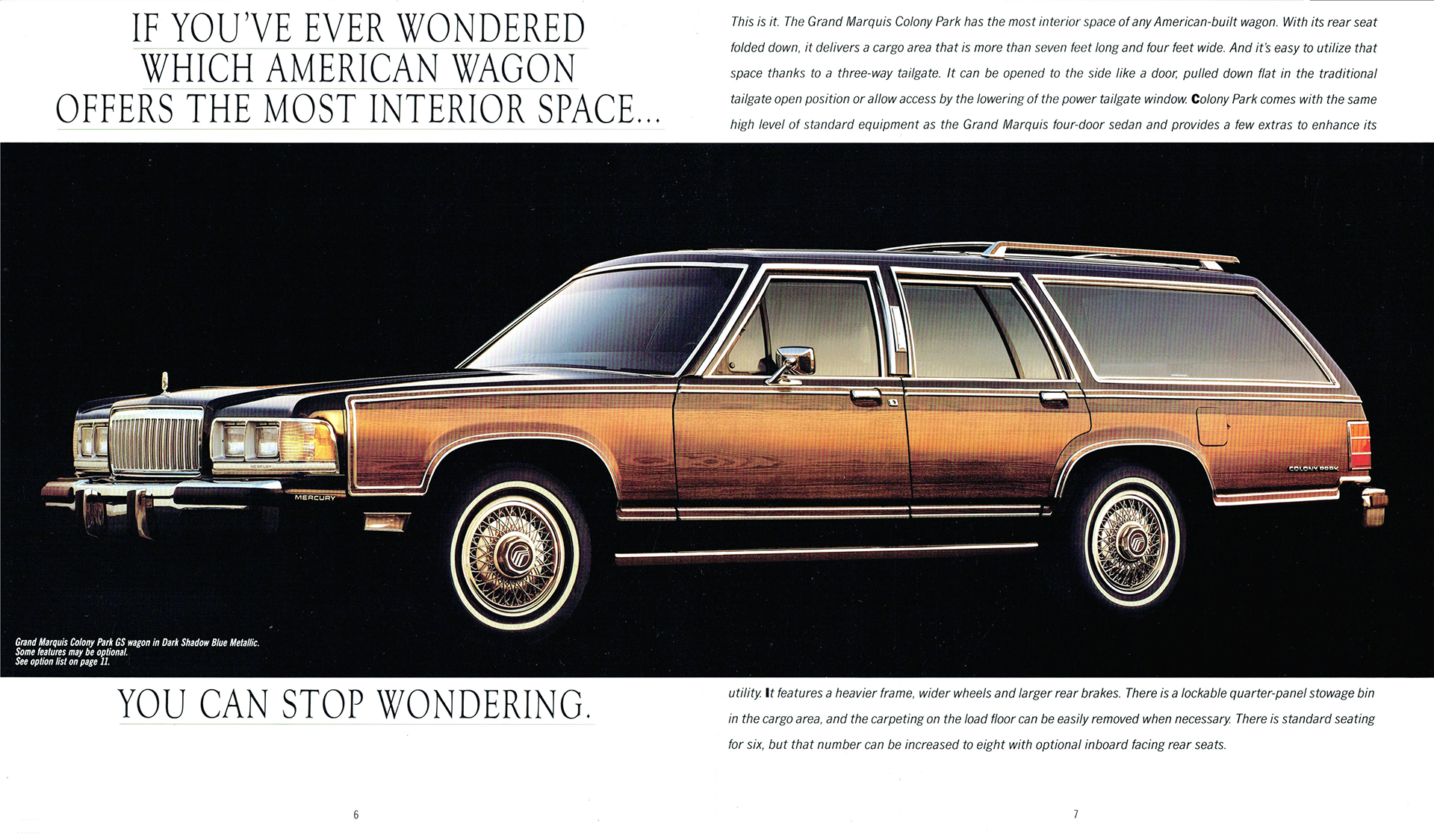
For 1988, Mercury’s full-size Colony Park station wagon gained a new and at least somewhat more aerodynamic front end that better integrated the fenders, grille, headlights, and bumper. Inside, the front seats were updated, and the Insta-Clear heated windshield was newly available.

The Colony Park name had a long history within Mercury. The first Colony Park branded wagons appeared in 1957 as the “glamorous style leader” of Mercury’s wagon line. Because there were no Lincoln wagons, the Colony Park was consistently the highest-end wagon available from Ford Motor Company for almost 35 years, and it could be equipped to near-Lincoln levels.

The only powertrain available on the 1988 Colony Park was the Windsor 150 bhp 4.9 liter/302 ci V8 with multi-port fuel injection paired with a four-speed automatic transmission. Acceleration figures are hard to find for this 4,000-pound wagon, but it certainly wasn’t fast. Fuel economy ratings were 17 city/24 highway by the day’s standards (15/22 by today’s measures). With an 18.0-gallon gas tank, Colony Park owners could expect a range of 300 to 330 miles with a 10% fuel reserve.

Colony Park pages from the 1988 Mercury Grand Marquis brochure

The 1988 Mercury Grand Marquis Colony Park GS station wagon’s base price was $16,341—about $45,500 in today’s dollars. Standard exterior and mechanical equipment included a bodyside rosewood appliqué, tinted glass, a rear-bumper step pad, power brakes, power steering, and P215/70R15 tires on 15-inch wheels with Deluxe full wheel covers. Inside, vinyl twin comfort seats with dual recliners, Luxury sound insulation, air conditioning, power side windows, a power tailgate window, a quarter-panel stowage bin with lock, a tailgate-activated cargo compartment light, and an electronic AM/FM stereo with four speakers were standard.

For an additional $585, the LS added turbine spoke aluminum wheels, Luxury twin comfort lounge seats with high level cloth, a rear seat center armrest, and the Light Group.

Packages, Options, & Production Numbers

Two packages were available on the Colony Park:

  • Preferred Equipment Package 192A (about $1,700) included front cornering lamps, a Deluxe luggage rack, a 6-way power driver’s seat, dual inboard facing rear seats in vinyl, a tilt steering wheel, fingertip speed control, an electric rear window defroster, and the Power Lock Group.
  • Preferred Equipment Package 193A included everything in 192A and added a power antenna, a leather-wrapped steering wheel, dual illuminated vanity mirrors, and the Premium Sound System (power amplifier, upgraded front and rear speakers, plus two additional speakers).

Exterior and mechanical options included a narrow bodyside molding ($66), the Insta-Clear heated windshield ($250), an automatic leveling suspension ($195), a heavy-duty suspension ($26), and an engine block heater ($18). Inside, buyers could add Automatic Climate Control ($211), a Tripminder computer ($215), and a high-level AM/FM stereo cassette audio system ($472). LS purchasers could also add leather seating surfaces ($415). A loaded LS could near $20,500—not that far from Lincoln Town Car money.

Mercury sold 9,456 Colony Park wagons in the 1988 model year—down about 12% from the previous year despite the freshened styling. Mercury’s offering continued to be outsold by both Buick’s Estate wagons (Electra and LeSabre) and Oldsmobile’s Custom Cruiser wagons—likely its natural competitors.

The View From 2025

Sixth-generation Colony Park wagons sometimes show up for sale in the Hemmings Motor News classifieds, on eBay Motors, and on Bring a Trailer. As I write this blog entry in June 2025, there’s a Silver Metallic 1986 Colony Park with 117,000 miles for sale on Hemmings, asking $12,500.

Make mine Medium Cabernet Metallic, I think.

Other Mercurys I have written about include the 1983 Grand Marquis sedan, the 1986 Capri hatchback coupe, the 1987 Lynx XR3 hatchback coupe, and the 1988 Cougar XR-7 coupe.

1988 Toyota Supra hatchback coupe

“It draws a crowd, and leaves it behind.”

For 1988, the third-generation A70 Toyota Supra hatchback coupe had few changes of any importance. The high-mounted brake light changed from a rectangular shape to a trapezoid. Cloth seat upholstery patterns were changed from squares to lines, and the climate control and switch gear buttons went from light to medium gray.

The Supra’s standard powertrain was the 7M-GE 200 bhp 3.0 liter/180 ci inline six with fuel injection paired with a five-speed manual transmission. A four-speed electronically controlled automatic was optional—and expensive. 0-60 times with the five-speed were a little under eight seconds in a car that weighed about 3,500 pounds—a weight that was notably heavy for a sports car in those days. Fuel economy with both transmissions was 18 city/23 highway by the day’s standards (16/22 by today’s measures). With an 18.5-gallon gas tank, Supra owners could expect a range of 320 to 340 miles with a 10% fuel reserve.

Designated as 7M-GTE, the Turbo‘s engine gained a turbocharger with an intercooler, adding 30 bhp and dropping the 0-60 time to around 6.4 seconds.

1988 Toyota Supra print advertisement

The Toyota Supra hatchback coupe’s base price was $21,740—about $60,800 in today’s dollars or almost exactly what a 2026 Supra GR 3.0 Premium goes for. Standard exterior and mechanical equipment included a removable sport roof, quick-ratio power steering, 4-wheel power disk brakes, and 225/50VR16 Goodyear unidirectional tires (a size still readily available) on 16 x 7 aluminum alloy wheels. Inside, an 8-way adjustable driver’s seat, split fold-down rear seatbacks, an automatic temperature control air conditioning system, an electric rear window defogger, power windows, and power door locks were included. The standard sound system was an AM stereo/FM stereo electronic radio with a cassette player, Acoustic Flavor (a tone control equalizer), 4-enclosure speakers, and a diversity antenna.

At $23,760, the Turbo added a Sport package, which included a limited-slip differential, headlamp washers, and the Toyota Electronic Modulated Suspension (TEMS) system.

Options & Production Numbers

Individual options were relatively few and included a limited slip differential ($230 for the base car), anti-lock brakes ($1,100), and a 4-way power driver’s seat ($225). The leather seat package was $990.

Toyota sold 19,596 Supras in 1988—solid numbers, but not quite at the level of the Chevrolet Corvette or the Nissan 300 ZX. Of those almost twenty thousand, about 55% were the Turbo.

The View From 2025

According to Hagerty’s valuation tools, a 1988 Toyota Supra in #1/Concours condition is $37,700. The value for a more “normal” #3/Good condition example is $12,200. Turbos are considerably dearer, with #1/Concours being $82,300, #3/Good at $18,800. This generation of Supras maintains a presence in the Hemming’s Motor News classifieds, on eBay Motors, and on Bring a Trailer. When I first wrote this post in April 2025, there was a Dark Blue Pearl 1988 Supra with Blue leather seats and 33,000 miles for sale in Hemmings, asking $29,900.

Make mine Gray Metallic, please.

I’ve written about one other Supra—the 1982 hatchback coupe. Other Toyotas I’ve written about include the 1980 Corolla Tercel Liftback, the 1981 Celica Sport Coupe, the 1983 Camry sedan, the 1984 Corolla SR5 Sport Coupe, and the 1985 MR2 coupe.

Last updated August 2025.

1988 Buick Reatta coupe

Buick made things more than a bit confusing for some of its higher-end coupe buyers in the middle of the 1988 model year by introducing the two-seater Reatta. For the first time since its introduction in 1963, the Riviera was definitively no longer the top of the two-door Buick line—with a base price of $25,000, the Reatta’s barrier to entry was almost 16% higher.

“Beauty with purpose.”

Designed to be a sporty car, but with no delusions of being a sports car, Buick targeted the Reatta at a perceived niche in the two-seater market for a luxury coupe at a substantially lower price than the high-end luxury convertibles of the day. As Buick general manager Edward Mertz said in January 1988, it was “priced many thousands of dollars less than luxury and sports cars at the top end of the market.” The Reatta was not nearly as expensive as the Cadillac Allanté convertible (which had a base price of $56,533 in 1988) or the Mercedes-Benz 560SL convertible ($61,130 in that same year) but could claim to be nearly as comfortable. Compared to the Cadillac and (especially) the Mercedes, the Reatta lacked refinement and prestige—both important to potential buyers.

Despite being based on the same E-platform as the Riviera, the Reatta’s exterior styling was distinctive, even if some of the proportions looked a little off to some. However, many parts of its interior were familiar to Riviera buyers—indeed, Buick benchmarked the Reatta’s two seats to the Riviera’s driver and front passenger experience. Because of this, the Reatta’s Electronic Control Center was essentially the same as the Riviera’s, and the Reatta’s optional driver’s seat closely resembled the one in the Riviera T Type.

The Reatta’s sole powertrain was a 3800 165 bhp 3.8 liter/231 ci V6 with fuel injection paired with a four-speed automatic. Car and Driver tested a 1988 Reatta, and recorded a 0-60 mph time of 9.1 seconds in a vehicle with a 3,380-pound curb weight. Mileage was respectable—19 city/29 highway by the day’s standards (17/26 by today’s measures). With an 18.2-gallon gas tank, a Reatta owner could expect a range of 355 to 390 miles with a 10% fuel reserve—enough to take those road trips that Buick was convinced the Reatta would be primarily used for.

1988 Buick Reatta brochure cover

Standard exterior and mechanical equipment on the Reatta included Soft-Ray tinted glass, fast-ratio power steering, an independent four-wheel Gran Touring suspension, four-wheel anti-lock disk brakes, and P215/65R15 Goodyear Eagle GT+4 tires (a size still readily available) on 15-inch wheels. Inside, power windows, electric door locks, six-way power seats, and Electronic Touch Climate Control air conditioning were included. The standard and only audio system was an ETR AM stereo-FM stereo radio with seek and scan, a cassette tape player with auto reverse, search/repeat, a graphic equalizer, a clock, eight Concert Sound speakers, and an automatic power antenna.

Options & Production Numbers

Buick’s new coupe came loaded, with only two options in its introductory year: an electric sliding steel sunroof ($895) and a 16-way adjustable leather and suede driver’s seat ($680).

First-year sales of the Reatta were decent for a new two-seat coupe without that all-important pre-existing audience that many of its competitors had—Buick moved 4,708 of them in about nine months.

The View From 2025

There is collector interest in the Reatta, including club support. According to Hagerty‘s valuation tools, a 1988 Buick Reatta coupe in #1/Concours condition is $22,700, with a far more normal #3/Good condition version going for $4,200.

Reatta coupes are often available in the Hemmings Motor News classifieds, at online auctions such as Bring a Trailer that cater to the eighties car market, and at in-person auctions such as Barrett-Jackson and Mecum.

Make mine Claret Red Metallic, please.

Other Buick coupes I have written about include the 1980 Rivera S TYPE, the 1983 Skylark T TYPE, the 1984 Regal Grand National, the 1984 Riviera T TYPE, the 1985 Somerset Regal, the 1987 GNX, and the 1987 LeSabre T Type. I seem to find Buick coupes interesting.

Last updated August 2025.

1988 Mercury Cougar XR-7 coupe

“The shape you want to be in.”

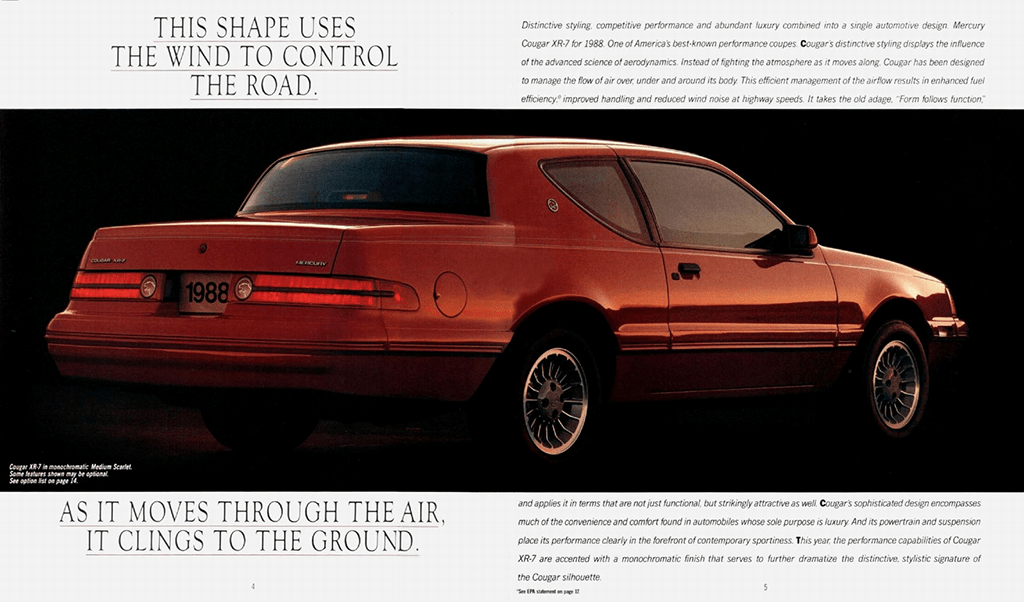
For 1988, Mercury’s Cougar personal luxury coupe received relatively few changes after 1987’s substantial restyling. For one year only, the XR-7 received a distinctive monochromatic paint scheme, available only in Oxford WhiteMedium Scarlet, and Black. Creating this look involved changing the wraparound bumper and body-side moldings from black to body color, and deleting the Medium Smoke lower-body accent used in 1987.  The sportiest Cougar also received 15-inch cast-aluminum wheels that had previously been seen on contemporary Ford Mustang GTs. Finally, analog instruments returned to the XR-7 after one year with a digital dashboard.

Though the Cougar LS made do with an Essex 140 bhp 3.8 liter/232 ci V6 with fuel injection as standard power, all XR-7s came with a Windsor 155 bhp 4.9 liter/302 ci V8 with sequential fuel injection. Both engines received power increases in 1988, with multi-port fuel injection and a balance shaft for the V6 being worth 20 bhp, while a split dual exhaust brought another five bhp for the V8. No matter what the engine, all Cougars came with Ford’s corporate AOD four-speed automatic transmission with overdrive.

Recorded 0-60 mph times are spare for the 1988 XR-7, but would likely have been a little under 10 seconds in the 3,485-pound car. Fuel economy ratings are more readily available; the XR-7 was rated 18 city/25 highway by the day’s standards (16/23 by today’s measures). With a 22.1-gallon gas tank, a Cougar XR-7 owner could expect an impressive range of 390 to 430 miles with a 10% fuel reserve.

Standard exterior and mechanical equipment on all Cougars included tinted glass, aero halogen headlamps, a front air dam, dual outside power mirrors, power-assisted rack-and-pinion steering, and power-assisted front disc/rear drum brakes. Inside, air conditioning, cloth upholstery, and an electronic AM/FM stereo with four speakers were included. The Cougar’s base price was $14,134—about $39,200 in 2025 dollars.

XR-7 pages from the 1988 Mercury Cougar brochure

With a base price of $16,266 (about $45,100 in today’s dollars or about what a 2025 Ford Mustang GT fastback goes for), the XR-7 added a Traction-Lok rear axle, a Quadrashock suspension, and P225/60R15 performance tires (a size still readily available) on 15-inch body-color cast-aluminum wheels. Inside, a sport steering wheel, articulated sport seats with power lumbar support, and a full-length center console were included.

Options & Production Numbers

Exterior and mechanical options for the XR-7 included a power moonroof ($841), an electric rear window defroster ($145), an engine block heater ($18), and Argent versions of the standard body-color cast-aluminum wheels. Inside, automatic temperature control ($162), power windows ($222), fingertip speed control ($182), and a tilt steering wheel ($124) were all available. Upholstery options included a leather-wrapped steering wheel ($59), leather seating surfaces ($415), and six-way power seats (either driver’s side only [$251] or driver and front passenger [$502]). A range of audio options included an electronic AM/FM stereo with a cassette player and four speakers ($137), the Premium Sound System with a power amplifier, two additional door-mounted speakers, and premium rear speakers ($168), a graphic equalizer ($218), and a power antenna ($76).

The 1988 Cougar sold well—Mercury moved a total of 113,801 units, with 14,488 (almost 13%) being XR-7s.

The View From 2025

Badge for 2,500 web hits

For unclear reasons, Hagerty’s valuation tools do not track any Cougar after 1973, though they do value Ford Thunderbirds through their entire production history. Eighties Cougars occasionally appear in the Hemming’s Motor News classifieds, on eBay Motors, and on Bring a Trailer.

Make mine Black, please.

Thanks to COOL CATS (a site devoted to the 1983-1988 Mercury Cougar) for providing helpful context for this post.

Other Mercurys I have written about include the 1983 Grand Marquis sedan, the 1986 Capri hatchback coupe, and the 1987 Lynx XR3 hatchback coupe. Regarding the Cougar’s Ford Thunderbird sister, I’ve written about the 1980 coupe and the 1983 Turbo Coupe.

Last updated April 2025.

1988 BMW M3 coupe

In late 2019, my ex-wife and I visited the small but excellent BMW Zentrum Museum in Greer, SC. Of course they had a first-generation M3 on display—so I wrote a blog entry about this game-changing little coupe.

“Created for the race track, destined for the road.”

It took the M3 two-and-a-half years to make it to the United States following its debut in Europe, but most agreed it was worth the wait. Reviews were enthusiastic; Car and Driver exclaimed that “This is a car for us.”

The powertrain was the thing: an S14 192 bhp 2.3 liter/141 ci 16-valve inline four with four valves per cylinder and Bosch Motronic fuel injection mated to a five-speed manual. In a car with a curb weight of 2,734 pounds, this meant impressive acceleration—0-60 times were in the seven-second range. Given this, fuel economy wasn’t bad: 17 city/28 highway on premium gasoline by the day’s standards (15/26 by today’s standards). With a 14.5-gallon gas tank, the proud new owner of an M3 could expect a range of 265 to 295 miles with a 10% fuel reserve.

201433683402
1988 BMW M3 advertisement

Standard exterior equipment on the pricey $34,000 M3 (about $94,000 in 2025 dollars or well over what a loaded 2025 M4 coupe goes for) included tinted glass, halogen headlights, an electric dual position sunroof, boxed-out fender flares, a unique front bumper, and a cap over the C-pillar which helped to feed air onto the large for the day rear wing.

Mechanical features included a limited-slip differential, four-wheel anti-lock disc brakes, and 205/55VR15 tires on 15 x 7 inch cast light alloy BBS wheels. Inside, the M3 was comfortably equipped; leather sport seats, full instrumentation, power door locks, power windows, cruise control, air conditioning, a trip computer, and an AM/FM stereo cassette were all included.

The View From 2025

Over the last 12 years or so, the first-generation M3 has become one of the definitive eighties collector cars, with values for the very best examples nearly doubling. According to Hagerty’s valuation tools, all the money for a 1988 M3 in #1/Concours condition is an astounding $215,000, with a more normal #3/Good car going for $65,700. Some M3s come up for sale in the Hemming’s Motor News classifieds or on eBay Motors, but many are now sold at auction, whether on-line (Bring a Trailer) or in-person.

Make mine Salmon Silver Metallic, I think.

Other BMWs I have written about include the 1983 633CSi coupe, the 1984 325e coupe, the 1987 L6 coupe, the 1987 M6 coupe, and the 1988 750iL sedan.

Last updated March 2025.

1988 Chevrolet Corvette 35th Anniversary Edition hatchback coupe

One of the Corvettes judged at an NCRS Mid-Atlantic Regional I attended in 2019 was a 35th Anniversary Edition Corvette coupe. This made it time to write a blog entry about one of the most striking of eighties Corvettes.

“… the influential sports car of the modern era.”

For 1988, the big news for Chevrolet’s Corvette was the 35th Anniversary Edition coupe, which was introduced late in the model year at the New York Auto Show. It was only the second anniversary edition Corvette, following 1978’s Silver Anniversary version. Chevrolet had missed the 30th anniversary (there were no 1983 Corvettes), and one senses that General Motors’ marketing team didn’t want to let another one go by without acknowledgment.

Other improvements for 1988 included carpeted door sills, solution-dyed carpet, and improved “flow-through” ventilation for coupes. A less restrictive muffler system which provided five extra horsepower was standard on coupes with the optional 3.07:1 rear axle ratio (this new muffler system was considered too loud for the standard axle coupes and any convertible). The standard brake rotors were thickened, and Chevrolet made suspension geometry changes to improve control during heavy braking. The Z51 and Z52 packages were upgraded to include P275/40ZR-17 Goodyear Eagle tires on 17 x 9.5 inch wheels. Only available in coupes, the Z51 package also included larger front brake rotors and calipers than in 1987.

The Corvette’s standard powertrain continued to be the L98 5.7 liter/350 ci V8 with fuel injection paired with a four-speed automatic with overdrive. Depending on the rear axle ratio, horsepower for the coupe was either 240 bhp or 245 bhp. Top speed for the 1988 Corvette was about 155 mph, and Car and Driver recorded a 0-60 time of 5.6 seconds. Estimated fuel economy was 16 city/25 highway by the day’s standards (15/23 by today’s measures). With a 20-gallon fuel tank, a Corvette owner could expect a range of 340 to 370 miles with a 10% fuel reserve.

Standard exterior and mechanical equipment in the $29,489 base Corvette coupe (about $81,600 in today’s dollars) included power steering, power anti-lock disc brakes, and P255/60ZR16 tires (a size still available thanks to BF Goodrich) on 16-inch x 8.5-inch wheels. Inside, air conditioning, power windows, power door locks, a tilt-telescopic steering wheel, cruise control, and an ETR AM/FM stereo radio with a clock were all included.

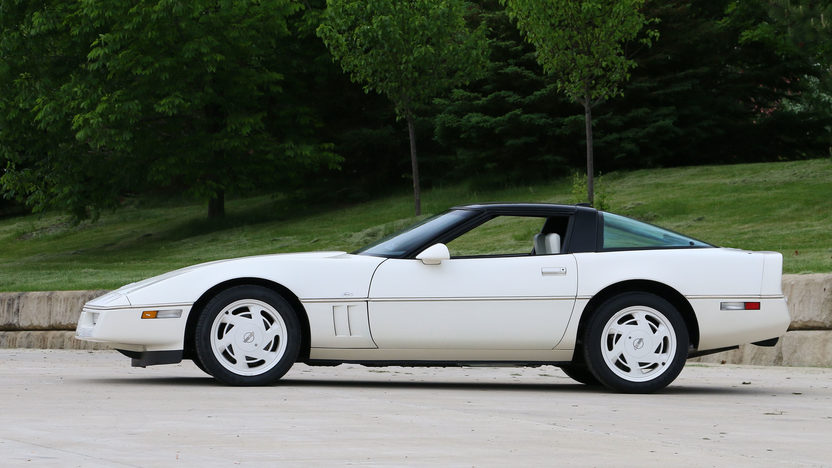
Photo of 1988 35th Anniversary Chevrolet Corvette
1988 Chevrolet Corvette 35th Anniversary Edition, photo courtesy of Mecum.

Additional equipment on the $34,284 35th Anniversary Edition coupe (about $94,900 in 2025 dollars or about what a loaded 2025 Stingray coupe goes for) included white leather seats without the otherwise standard perforations, a white steering wheel, and a black roof bow. In a preview of early 1990s Corvettes, the rub strips were body color instead of the usual black.

Options, Packages, & Production Numbers

Optional exterior and mechanical equipment included an electric rear window defogger ($129), the Doug Nash 4+3 manual transmission (no cost), and a performance axle ratio ($22). Optional interior equipment included power driver’s and power passenger’s seats ($240 each), electronic air conditioning ($150), and a Delco/Bose AM/FM stereo radio with a cassette player ($773).

Two handling packages were available: the Z51 performance handling package ($1,295 for a radiator boost fan, Delco-Bilstein shock absorbers, an engine oil cooler, a heavy-duty radiator, 17 x 9.5 inch wheels, P275/40ZR-17 tires, and a fast steering ratio), and the Z52 sport handling package ($970 for Delco-Bilstein shock absorbers, 17 x 9.5 inch wheels, and P275/40ZR-17 tires). 

To me, the 35th Anniversary Edition is one of the most differentiated of eighties C4 Corvettes, with only the Callaway Turbos being more distinctive. Chevrolet built 2,050 35th Anniversary Edition coupes, making availability restricted—but not that restricted. This number was out of a total of 15,382 coupes, with an additional 7,407 convertibles sold.

The View From 2025

There is strong club support for the 1988 Corvette, as there is for all Corvettes. According to Hagerty’s valuation tools, all the money for a 1988 35th Anniversary Edition coupe in #1/Concours condition is $47,700, with a more typical number #3/Good condition car going for $11,400. 1988 Corvettes often show up in the Hemming’s Motor News classifieds, on eBay Motors, and on Bring a Trailer—as I update this blog entry in April 2025, there’s a 35th Anniversary Edition coupe with 8,100 miles for sale on Hemmings, asking $30,000.

Other eighties Corvettes I have covered include the 1980 coupe, the 1981 coupe, the 1982 coupe, the 1984 hatchback coupe, and the 1986 convertible.

Last updated April 2025.

1988 Honda Civic sedan

There’s a white fourth-generation Honda Civic sedan routinely parked on the street about two blocks from my house. You can tell that it hasn’t led a particularly sheltered life, but it’s obviously still in regular use. That makes it time to add one of those sedans to my suite of eighties Hondas: the 1983 Civic 1500 S hatchback coupe, the 1984 Civic CRX hatchback coupe, the 1985 Civic CRX Si hatchback coupe, and the 1986 Accord sedan.

“That was then. This is now.”

For the 1988 model year, the Honda Civic was completely revised, with a brand new design with a lower hood line, an innovative four-wheel double wishbone suspension, and a wheelbase up almost two inches to 98.4 inches. All Civic sedans for the North American market were built in Honda’s still relatively new Marysville, Ohio factory.

1988 Honda Civic sedan advertisement

The Civic sedan’s standard powertrain was the D15B2 92 bhp 1.5 liter/91 ci inline four with twin-injector fuel injection mated with a five-speed manual. Fuel economy was quite good—33 city/37 highway by the standards of the day (28/34 by 2018 standards). An optional four-speed automatic took mileage down to 28 city/33 highway. With an 11.9-gallon gas tank, a Civic owner could expect a range of between 330 and 375 miles with a 10% fuel reserve.

The Civic’s performance was competitive for the class—0-60 came in about 11 seconds with the five-speed manual in a car whose curb weight ranged from 2,039 to 2,205 pounds. The sedan was almost a second slower with the automatic; common in many cars in the eighties.

For $8,795 (about $19,200 in today’s dollars), the base DX version of the sedan came with flush low profile halogen headlights, tinted glass, rack and pinion steering, front disc/rear drum brakes, and 175/70R13 steel-belted radial tires (a size still readily available) on 13 x 5 inch wheels. Inside, the DX included an adjustable steering column, a rear window defroster, intermittent wipers, and full carpeting.

Moving up to $9,625 LX (about $21,000 in 2018 dollars or about $1,500 more than a 2019 Civic LX sedan goes for) added power brakes, a tachometer, power windows, power door locks, power side mirrors, and a digital quartz clock.

Other than the choice of trim level, exterior and interior colors, and transmission, there were no options. Air conditioning was available only as a dealer accessory, as was a choice of various car stereos: Honda would continue to sell AC as a dealer accessory well into the 1990s.

The larger 1988 Civic was well received—it made Car and Driver‘s 10 Best list and sold like hot cakes; a 1988 Civic LX sedan marked the one-millionth car built at the Marysville plant in early April 1988. They were still small cars by modern standards—the 1988 Civic was only about five inches longer than the current Honda Fit.

In 2018, this generation of Civic sedan rarely comes up for sale in the Hemmings Motor News classifieds. Some do show up on eBay Motors, but they’re often in sketchy condition.

Make mine Cardinal Red Metallic, please.

1988 Cadillac Eldorado coupe

“… a bold styling statement.”

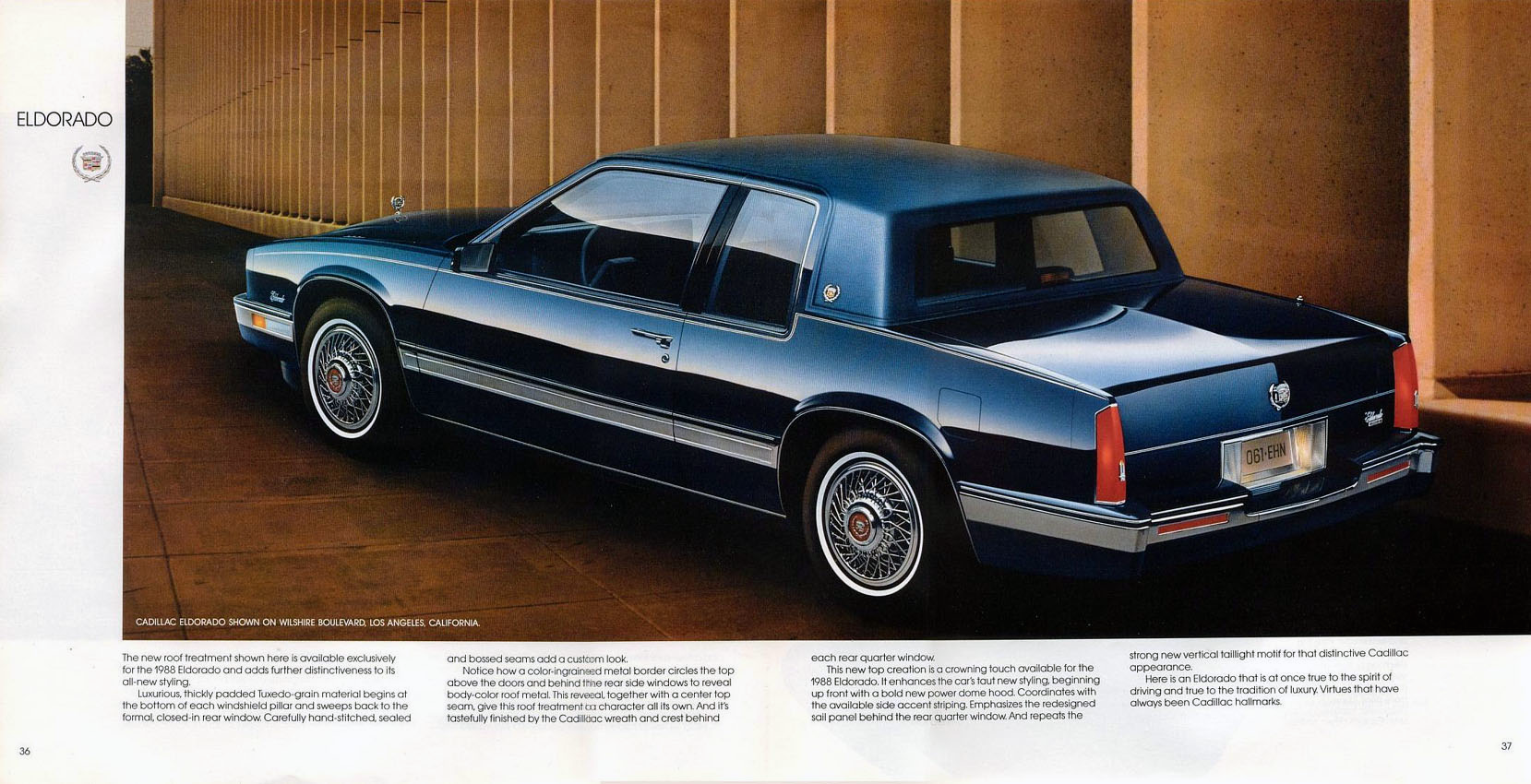
For 1988, Cadillac’s Eldorado gained a new 4.5 liter V8, along with a power dome hood, a revised grille, a reshaped rear window treatment, and an extended trunk. Length increased by three inches, and the 1988 Eldorado looked slightly more like the Eldo people had grown to expect. New options for the 1988 Eldorado included an anti-lock brake system and a fully padded roof, which hearkened back to previous generations. All of these changes were developed in a rapid 51 weeks.

The Eldorado’s powertrain was Cadillac’s 155 bhp HT series 4.5 liter/273 ci V8 with throttle body fuel injection paired with a four-speed automatic transmission. Acceleration improved notably—the Eldorado’s 0-60 mph time was now under 10 seconds for the first time since the early 1970s. Fuel economy was 17 city/24 highway by the day’s standards (15/22 by today’s measures). With an 18.8-gallon fuel tank, an Eldorado owner could expect a range of between 315 and 345 miles with a 10% fuel reserve.

1988 Cadillac Eldorado brochure pages

So, what did those buyers get with their $24,891 (about $69,700 in today’s dollars) 1988 Eldorado? Standard exterior and mechanical equipment included front wheel drive, a four-wheel independent suspension, power-assisted rack and pinion steering, power four-wheel disc brakes, and 205/70R14 tires (a size still readily available) on 14-inch aluminum wheels. Inside, six-way front power seats, a leather-trimmed steering wheel with tilt and telescope adjustment, cruise control, power side mirrors, power windows, power door locks, electronic climate control, Twilight Sentinel, and an AM/FM stereo radio with power antenna were all included—the Eldorado was pretty well equipped.

Packages, Options, & Production Numbers

Moving up to the Biarritz (almost always the top-of-the-line Eldorado since 1956) added wire wheels, two-tone paint, nicer front seats with power lumbar support and power recliners, and real walnut trim on the instrument panel, console, and door trim plates.

Options included anti-lock brakes, touring suspension with 15-inch aluminum alloy wheels, Astroroof, a nicely integrated cellular phone, and the Delco/Bose Symphony Sound System.

The exterior redesign and the new engine definitely assisted sales—they were nearly double what they had been in 1987, though still not close to the salad days of 1985 and prior.

The View From 2025

According to Hagerty’s valuation tools, a 1988 Eldorado in #1/Concours condition is $16,800, with a far more typical #3/Good car going for a mere $6,100. Eldorados of this age come up for sale regularly in the Hemmings Motor News classifieds, on eBay Motors, and Bring a Trailer, so folks are saving them.

Make mine Carmine Red, please.

Other Eldorados I have written about include the 1982 Touring Coupe, the 1984 Biarritz convertible, and the 1986 coupe.

Last updated August 2025.

1988 Pontiac Grand Prix coupe

“… one of the most aerodynamic cars in the world.”

The Grand Prix was all new for 1988. Gone was the elderly G-body rear-wheel-drive (dating from 1978), replaced by an aerodynamic front-wheel drive W-body.

For 1988, the standard Grand Prix powertrain was the LB6 130 bhp 2.8 liter/173 ci V6 with fuel injection paired to a four-speed automatic (a five-speed manual was available). With a curb weight of 3,038 pounds, 0-60 took a little over 10 seconds with the standard powertrain. Mileage with the same powertrain was 20 city/29 highway by the standards of the day (18/26 by today’s standards). A 16.0-gallon fuel tank meant that a Grand Prix owner could expect a range of between 315 and 355 miles with a 10% fuel reserve.

The 1988 Grand Prix came in base, LE, and SE forms. Standard exterior and mechanical equipment in the $12,539 base coupe (about $27,300 in today’s dollars) included composite halogen headlamps, dual sport mirrors, power steering, four-wheel power disc brakes, an independent rear suspension, and P195/75R14 tires (a size still available from multiple vendors) on 14 x 6 inch wheels with custom wheel covers. Inside, notchback front bench seats, an electronic digital speedometer, a glove box with a combination lock, and an AM/FM stereo radio were included.

Moving up a little to the $13,239 LE added power windows with illuminated switches, lamp group, 40/60 split reclining pallex cloth seats, rear folding armrest with pass through to the luggage compartment, and mechanical analog gauges with tachometer and trip odometer.

The top-of-the-line $15,249 SE (about $32,300 in 2018 dollars) added the Y99 Rally Tuned suspension, dual exhaust system, and P215/65R15 tires on 15-inch aluminum wheels and switched the standard transmission to a five-speed manual. Inside, air conditioning, leather-wrapped tilt steering wheel, cruise control, power cloth front bucket seats with three-position lumbar controls, and rear bucket seats were all part of the SE experience.

Options included power door locks, an electric rear window defogger, a power antenna, and a UX1 AM stereo/FM stereo radio with seek, scan, auto-reverse cassette, five-band graphic equalizer, and digital clock.

The 1988 Grand Prix was relatively well received—it was Motor Trend‘s Car of the Year, and Pontiac sold 86,357 cars in slightly over half a model year (sales only began in January 1988), which marked more than five times as many as the last of the G-body versions in 1987. For 1989, sales would top 136,000 and would stay over 100,000 for every year through 1995.

Grand Prix’s of this generation are rarely seen in the Hemming’s Motor News classifieds and on eBay Motors. Sometimes you do see the ASC/McLaren or GTP versions, but rarely the “civilian” models.

Make mine red, please.