1987 Chevrolet Cavalier RS convertible

Recently, a near-perfect low-mileage 1987 Chevrolet Cavalier RS convertible came up for auction on Bring a Trailer. This event made me painfully aware that I’d written about the Cavalier sedan and coupe, but somehow not the convertible—time to fix that.

“Sporty performance”

The Chevrolet Cavalier first came to market for the 1982 model year, initially available as a notchback coupe, a hatchback coupe, a notchback sedan, and a station wagon. In the middle of 1983, Chevrolet introduced a convertible version, initially available as the top-of-the-line CS. In 1984, the convertible transitioned to the sporty Type 10. The RS replaced the Type 10 in the 1986 model year, and the convertible went with it. From 1983 through 1987, Cavalier convertible conversions were done by ASC.

The RS convertible’s standard powertrain was the 90 bhp LL8 2.0 liter/121 ci inline four with electronic fuel injection and a four-speed manual. Optional power was the 125 bhp LB6 2.8 liter/173 ci V6 with multiport fuel injection ($660). Both a new-for-1987 Getrag-designed five-speed manual transmission ($75) and a three-speed automatic transmission ($490) were available.

Road tests of the first-generation Cavalier convertible are hard to come by, but 0-60 likely came in a little over 9 seconds with the five-speed/V6 combination. Fuel economy ratings for the same combination were 20 city/26 highway by the day’s standards. With a 14-gallon gas tank, a Cavalier convertible’s enthusiastic new owner could expect a range of 265 to 285 miles with a 10% fuel reserve.

Front cover of the 1987 Chevrolet full line brochure

The 1987 Cavalier RS convertible’s base price was $13,466—about $39,700 in 2025 dollars. Standard exterior and mechanical equipment included a power operated convertible top, tinted glass, left hand remote and right hand manual Sport mirrors, the F41 sport suspension, a front stabilizer bar, power steering, power front disc/rear drum brakes, and P195/70R13 all season radial ply blackwall tires (a size no longer readily available) on 13-inch Rally wheels with trim rings. Inside, Custom Cloth front bucket seats with recliners, a console, a Sport steering wheel, power windows, and an AM radio with dual front speakers were included.

Options & Production Numbers

Individual options available with the RS convertible included aluminum wheels ($212), air conditioning ($675), the Comfortilt steering wheel ($125), electronic speed control with resume speed ($175), an intermittent windshield wiper system ($55), and a power door lock system ($145). A series of four optional audio systems, ranging up to an ETR AM/FM stereo radio with seek and scan, a cassette player, a graphic equalizer, and a clock ($449), was available.

Chevrolet sold 5,826 Cavalier convertibles in the 1987 model year, making that the best production total for any year of the first-generation Cavalier convertible.

The View From 2025

People do collect these small convertibles. They maintain a reasonable presence in the Hemmings Motor News classifieds, on eBay Motors, and on Bring a Trailer.

Make mine Red—I think.

Other Cavaliers I have written about include the 1983 CS sedan and the 1986 Z24 coupe. The other J platform cars I have written about are the 1982 Cadillac Cimarron sedan, the 1984 Buick Skyhawk coupe, the 1984 Pontiac 2000 Sunbird S/E hatchback coupe, the 1985 Oldsmobile Firenza ES sedan, and the 1988 Cadillac Cimarron sedan.

1987 Porsche 928 S4 hatchback coupe

“The most technologically advanced Porsche you can get.”

1987 was the first model year for the Porsche 928 S4 (the 4 stood for fourth-generation). The 928’s new standard engine was the 320 bhp M28 5.0 liter/302 ci V8 with Bosch L-Jetronic port fuel injection, which was mated to either a five-speed manual transmission or a Mercedes-sourced four-speed automatic. The 928 S4 also featured a new front bumper, bigger taillights, a new (and large) rear spoiler, and many detail changes. The drag coefficient dropped to 0.34, compared to 0.39 in 1986’s 928 S.

We’ll go with 928 S4 as the model designation, because that’s what Porsche calls it now. Period window stickers show 928S-4, period advertisements used 928S 4, and period reviews often used 928S4—another example of why I have a page about nomenclature.

In a car that weighed 3,507 pounds with the manual transmission, Car and Driver recorded a 0-60 time of 5.3 seconds, with a top speed of 159 mph. The EPA rated fuel mileage at a class-competitive 15 city/23 highway (14/21 by today’s measures). With a 22.7-gallon gas tank, the proud new owner of a 928 S4 could expect a range of about 360 to 385 miles with a 10% fuel reserve.

1987 Porsche 928 S4 print advertisement

The 928’s base price changed significantly over the 1987 model year. Period window stickers vary from $58,900 (about $172,500 in 2025 dollars) to $66,710 (about $187,400 in today’s dollars or almost exactly what a 2025 Porsche 911 Carrera 4 GTS coupe costs). Standard exterior and mechanical equipment included headlight washers, an electric rear window defogger, a rear window wiper, power rack and pinion steering, and vented power disc brakes. 225/50VR16 tires on 16 x 7J wheels out front were balanced by 245/45VR16 tires on 16 x 8J wheels (both tire sizes are still available). Inside, power front leather seats, a 4-spoke leather steering wheel, air conditioning with automatic climate control, power windows, a central locking system, and an AM/FM stereo radio with a cassette player and eight speakers were included.

Options, Production Numbers, & Period Reviews

Exterior and mechanical options included a limited slip differential ($722) and sport shock absorbers ($247). Inside, options included lumbar support ($422-$456 per seat), heated seats ($160 per seat), an alarm system ($445), and increased air conditioning ($967-$992).

Porsche sold 15,682 928 S4s worldwide over five years. Period reviews were generally positive—Car and Driver‘s tagline was “vindicated at last.” The “buff books” also noted the notable difference in personalities and performance between the manual and the automatic versions of the 928 S4, relevant because the automatic was about 80% of sales.

The View From 2025

There is excellent club support for the Porsche 928, as there is for all Porsches. According to Hagerty’s valuation tools, all the money for a 1987 Porsche 928 S4 with the manual in #1/Concours condition is $99,000, with a more normal #3/Good condition car with an automatic going for $29,300. Porsche 928s frequently show up for sale in the Hemmings Motor News classifieds, on eBay Motors, and on Bring a Trailer. As I update this blog entry in November 2025, a Black 1987 with an automatic and 33,000 miles is available on Hemmings, asking $34,900.

Make mine Ocean Blue, please.

I have also written about the the 1982 928 hatchback coupe. Other eighties Porsches I have covered include the 1980 911 SC coupe, the 1980 924 hatchback coupe, the 1982 924 Turbo hatchback coupe, the 1985 911 Carrera Cabriolet, the 1986 911 Turbo coupe, the 1986 944 Turbo hatchback coupe, the 1987 911 3.2 Carrera coupe, and the 1988 944 hatchback coupe.

Last updated November 2025.

1987 Ford Mustang LX 2-door sedan

“You get the more formal look of the sedan with the high performance of the GT.”

For the 1987 model year, Ford’s Fox-body Mustang received a facelift of both its interior and exterior. Ford restyled the front end, which gave the aging design (work had begun on the Fox-body Mustang in 1976) more of an “aero” look, in keeping with the overall mid-1980s Ford styling direction embodied by the Thunderbird and Taurus. The quarter glass windows were now each a single larger flush piece of glass with “Mustang” lettering at the bottom rear corners, replacing the smaller glass paired with louvers that had been in use since the 1979 model year. Taillights on the LX were revised with clear lenses for the turn signals. The interior received an all-new dash, center console, and revised seat and door trim.

With the SVO gone, the remaining models were the LX and the GT. Ford discontinued the V6 option, leaving only the standard 90 bhp Lima 2.3 liter/140 ci inline four with new-for-1987 fuel injection and the optional 225 bhp Windsor 4.9 liter/302 ci V8 with sequential fuel injection, which was part of an $1,885 5.0L EFI HO V-8 Engine Package. A five-speed manual transmission was standard, while a four-speed automatic was a $515 option.

From a performance and fuel economy perspective, the inline four LX and the V8 LX might as well have been different cars. The Lima-based Mustang with the manual took about 13.3 seconds to get to 60 mph, with the automatic/inline four combination being a few tenths worse. The payoff was fuel economy—25 city/31 highway by the day’s standards for the base powertrain (22/28 by today’s measures). The automatic was about 10% less efficient. With a 15.4-gallon gas tank, an LX owner with the base powertrain could expect an impressive range of 350 to 385 miles with a 10% fuel reserve.

In marked contrast, the Windsor-based Mustang with the manual took about 6.2 seconds to get to 60 mph, with the automatic version taking about 6.7 seconds. Fuel economy was 16 city/24 highway by the day’s standards (15/22 by 2025 measures). Interestingly, the automatic was about 13% more efficient when paired with the V8. An LX owner with the V8 and five-speed manual could expect a range of 260 to 275 miles with a 10% fuel reserve.

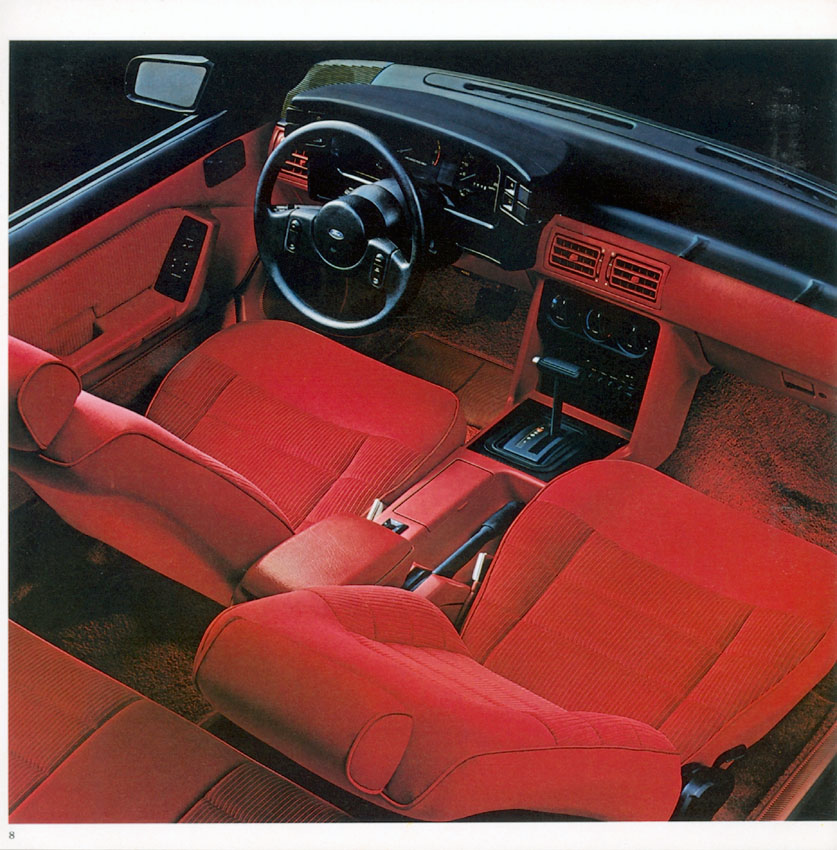
LX interior page from the 1987 Ford Mustang brochure

The 1987 Mustang LX 2-door sedan (Ford’s nomenclature) had a base price of $8,043—about $23,500 in today’s dollars, which is approximately 26% less than a base 2025 Mustang costs. Standard exterior and mechanical equipment included power rack and pinion steering, power front disc/rear drum brakes, and P195/75R14 black sidewall steel-belted radial tires on 14-inch wheels with turbine wheel covers. Inside, reclining cloth low back front bucket seats, Light Group, full instrumentation, a console, and an electronic AM/FM stereo search radio with four speakers were included.

Groups, Packages, & Individual Options

Seven groups and packages were available for the Mustang LX 2-door sedan:

  • Preferred Equipment Group 240A was the base package
  • Light Group was included with the base package and included lights for the engine compartment, the luggage compartment, the ashtray, and the glove box. A dual beam dome/map light and a headlamps on reminder chime were also included
  • Special Value Group 240A (no cost for inline four/$735 for V8) included Power Lock Group, an electronic AM/FM stereo radio with cassette tape player, speed control, and styled road wheels
  • Power Lock Group ($244) included power door locks, a remote locking fuel door, and a trunk release
  • Climate Control Group ($1,005 for inline four/$978 for V8) included tinted glass, a heavy-duty battery, air conditioning, and a rear window defroster
  • Custom Equipment Group ($624) included dual electric remote control mirrors, power side windows, dual illuminated visor mirrors, a tilt steering wheel, and a graphic equalizer
  • The 5.0L EFI HO V-8 Engine Package ($1,885) included a Traction-Lok axle, GT suspension system components, a 15:1 steering ratio, a heavy-duty battery, P225/60VR15 handling tires, and cast aluminum wheels

Exterior and mechanical options for the Mustang LX 2-door included complete tinted glass ($120) and wire style wheel covers. Inside, a tilt steering wheel ($124), an air conditioner ($788), and power front side windows were available. Stereo options included an electronic AM/FM stereo radio with cassette tape player ($178), a graphic equalizer ($218), and the Premium Sound System ($168 for six upgraded speakers and a 4-channel power amplifier). The Handling Suspension Package and cast aluminum wheels were optional with the inline four but included with the V8.

Period Reviews & Production Numbers

The enthusiast press—including Car and Driver, Hot Rod, and Motor Trend—swiftly realized that the LX 2-door sedan with the V8 was 80 pounds lighter than the GT, which made it slightly quicker. At $9,928, the V8 LX was also 16% cheaper than the GT, making it one of the outstanding performance bargains of the 1980s.

Production data is surprisingly uncertain (wouldn’t the Mustang have been worth paying attention to?), but some of the more likely data states that Ford sold 43,257 Mustang LX 2-door sedans, of which 4,888 (or 11%) were V8s.

The View From 2025

There is strong club support for the 1987 Mustang, as there is for all Mustangs except the mid-seventies Mustang IIs. According to Hagerty’s valuation tools, all the money for a 1987 Mustang notchback coupe in #1/Concours condition is $52,500, with a more typical #3/Good condition car going for $18,600. 1987 Mustangs often show up in the Hemming’s Motor News classifieds, on eBay Motors, and on Bring a Trailer—BaT has sold three 2-door 1987 LXs over the years.

Make mine Medium Shadow Blue Metallic, please. One quarter of the 12 Mustang colors for 1987 were blues.

Other Mustangs I have written about include the 1980 Cobra hatchback coupe, the 1981 coupe, the 1982 GT hatchback coupe, the 1983 GT convertible, and the 1984 SVO hatchback coupe.

1987 Plymouth Turismo hatchback coupe

“Fun is affordable again.”

For 1987, Plymouth’s Turismo hatchback coupe was little changed as it headed into its final model year. The 2.2-liter engine became standard, along with argent Rallye wheels.

The Turismo’s standard powertrain was the K 96 bhp 2.2 liter/135 ci inline four with a two-barrel carburetor paired with a five-speed manual transmission. A three-speed automatic was available as part of the Basic package or the Duster package. 0-60 times are hard to come by for the Turismo, but I’m betting on a little over 10 seconds for the 2,281-pound car—with the five-speed. Fuel economy is better known—25 city/35 highway with the five-speed by the day’s standards (22/32 by today’s measures). With a 13-gallon gas tank, a Turismo driver could expect a range of 320 to 350 miles with a 10% fuel reserve.

Front cover of the 1987 Plymouth Turismo brochure

The $7,199 Turismo (about $21,200 in today’s dollars) had better base equipment for 1987 than it had in previous years. Standard exterior and mechanical equipment included tinted glass, black bodyside moldings, halogen headlights, an electric rear window defroster, a remote liftgate release, power brakes, and P165/80R13 steel belted radial tires (a size now only available from Michelin at considerable expense) on argent 13-inch Rallye steel wheels. Inside, cloth with vinyl trim low-back front bucket seats, a four-spoke color-keyed Sport steering wheel, and an electric rear window defroster were included.

Packages, Options, & Production Numbers

Plymouth offered three packages for the 1987 Turismo:

  • The $776 Basic package included the three-speed automatic and power-assisted steering.
  • The $575 Duster manual package included Duster and Plymouth decals, black dual remote control exterior mirrors, power-assisted steering, cloth with vinyl trim Sport reclining high-back front bucket seats with increased lateral support, Deluxe door trim panels with cloth inserts, a console, and an electronic tuning AM stereo/FM stereo radio with a digital clock and four speakers
  • The $1,009 Duster automatic package included Duster and Plymouth decals, black dual remote control exterior mirrors, the three-speed automatic, power-assisted steering, cloth with vinyl trim Sport reclining high-back front bucket seats with increased lateral support, Deluxe door trim panels with cloth inserts, a console, and an electronic tuning AM stereo/FM stereo radio with a digital clock and four speakers

There were few individual options, but they included California emissions, air conditioning ($701), and an AM/FM stereo cassette with Dynamic Noise Reduction and auto reverse ($246).

Plymouth sold 24,104 Turismos in its final model year—a far cry from the 52,162 sold two years prior. Introduced for 1987, the Sundance coupe would be the putative replacement going forward in Plymouth’s model line.

The View From 2025

I’m going to declare this version of the L-body as vanished. I haven’t seen a Turismo in the wild for decades, and they have little presence in the Hemmings Motor News classifieds or on eBay Motors. Bring a Trailer hasn’t sold any Turismos, though they did sell one of the Scamp pickup truck variants in 2019.

Make mine Garnet Red Pearl Coat, please.

Other Plymouths I have written about include the 1980 Horizon hatchback sedan, the 1980 Volaré station wagon, the 1981 Reliant coupe, and the 1984 Voyager minivan. I’ve also written about the 1983 and 1985 versions of the Dodge Shelby Charger hatchback coupe—the Turismo’s higher-performance sibling.

Last updated October 2025.

1987 Pontiac Firebird Formula hatchback coupe

“The thrill of pure, uncluttered driving excitement is back.”

For 1987, the Formula returned to Pontiac’s offerings after a six-year pause. The general messaging of the Formula was all the performance of the Trans Am, but with few of the Trans Am’s exterior add-ons and little of the interior comfort of the Trans Am GTA. At $12,413—about $36,600 in today’s dollars—the Formula was 14% less expensive than a Trans Am.

The Formula’s standard powertrain was the LG4 170 bhp 5.0 liter/305 ci V8 with a four-barrel carburetor paired with a five-speed manual. The LB9 185 bhp 5.0 liter/305 ci V8 with tuned port injection ($745) and the big dog B2L 210 bhp 5.7 liter/350 ci V8 with tuned port injection ($1,045) were available options. The 5.7-liter engine required the four-speed automatic ($490).

Performance had improved steadily since 1982, yielding a zero to sixty times of about seven seconds. Mileage with arguably the sportiest combination (5.0 liter tuned port injection and five-speed) was 16 city/26 highway by the day’s standards (15/24 by 2025 measures), with the 5.7 liter/automatic transmission combination only slightly worse. With a smallish (approximately 16.0-gallon) fuel tank, a Formula owner with the base powertrain could expect a range of between 280 and 300 miles with a 10% fuel reserve.

Firebird Formula pages from the 1987 Pontiac brochure

Standard exterior and mechanical equipment on the 1987 Firebird Formula included a front air dam, a dome hood, a body color aero deck rear spoiler, a special performance suspension, power brakes, and P245/50VR16 Goodyear Eagle tires on Hi-Tech 16″ x 8″ aluminum wheels. Inside, reclining cloth front bucket seats, cloth rear folding seats, a Formula three-spoke steering wheel, a full-length console with instrument panel, complete analog instrumentation, side window defoggers, and a Delco AM radio were included.

Packages, Individual Options, & Production Numbers

By 1987, General Motors was finally figuring out the build complexity costs of tens or hundreds of individual options. Thus, packages came into play.

  • The Formula Package I ($1,273) included body side moldings, air conditioning with Soft Ray tinted glass, a tilt steering wheel, and a Delco ETR AM/FM stereo with seek, scan, and clock.
  • The Formula Package II ($1,842) included everything in Formula Package I plus cruise control, controlled-cycle windshield wipers, power windows, power door locks, and a deck lid release.

Individual options not included in either of the packages included a removable glass hatch roof ($920), a limited slip differential ($100), an electric rear window defogger ($145), and a series of radios ranging up to the “Touch Control” ETR AM stereo/FM stereo with seek-scan, search-replay/auto reverse cassette, graphic equalizer, and clock ($529).

Pontiac sold 13,164 Formulas in the 1987 model year, accounting for about 16% of overall Firebird sales (the base Firebird coupe was the best seller with approximately 47% of sales). Third-generation Formula sales would peak at 16,670 in 1989, and would never approach that total again.

The View From 2025

I believe the Formula‘s somewhat restrained looks (compared to the Trans Am) have aged well, and their comparative rarity makes them special.

According to Hagerty‘s valuation tools, a 1987 Firebird Formula with the base 5.0 liter V8 and the manual in #1/Concours condition is $25,600, with a far more normal #3/Good condition version going for $9,800. Late-1980s Formulas are sometimes available in the Hemmings Motor News classifieds, on eBay Motors, and on Bring a Trailer.

Make mine Flame Red Metallic, please.

Other eighties Firebirds I have written about include the 1981 Trans Am coupe, the 1982 Trans Am hatchback coupe, the 1985 Trans Am hatchback coupe, the 1986 SE hatchback coupe, and the 1989 Turbo Trans Am hatchback coupe. Someday, I’ll get to a base Firebird—I guess the question is what year.

Last updated November 2025.

1987 Chevrolet El Camino pickup truck

In the decade plus since I started this blog I have worked on three separate El Camino posts. I’m finally publishing one today.

“There’s nothing quite like it.”

In its final year, the Chevrolet El Camino received few changes. The standard engine remained the LB4 145 bhp 4.3 liter/262 ci V6 with electronic fuel injection. The LG4 150 bhp 5.0 liter/305 ci V8 with a four-barrel carburetor was a $440 option, but it’s unclear whether it made much of a performance difference—0-60 likely came in about 11 seconds. Both engines were paired with a three-speed automatic transmission, with an available four-speed automatic ($175).

Period fuel economy ratings for the four power combinations tell an interesting story:

4.3 liter V65.0 liter V8
Three-speed automatic18 city/22 highway15 city/17 highway
Four-speed automatic18 city/23 highway16 city/22 highway

The short form seems to be that, if you had to have the V8 and you wanted to do some highway driving, you should really get the four-speed automatic. With a 17.7-gallon gas tank, the best-case range was about 305 to 325 miles with a 10% reserve—the V8/three-speed combination was more like 230 to 255 miles.

Pages from the 1987 Chevrolet El Camino brochure

The 1987 El Camino’s base price was $10,013—about $29,400 in today’s dollars, which is almost what a base 2025 Chevrolet Colorado pickup truck goes for. Standard exterior and mechanical equipment included power steering, power front disk/rear drum brakes, and P205/75R14 black sidewall all-season steel-belted radial tires (a size still available) on painted wheels with bright full wheel covers. Inside, a full-width cloth front bench seat with a pull-down center armrest, cut-pile carpeting, and a lighted glove box were standard.

Considered a separate model, the $10,344 El Camino SS Sport Decor added a choice of eight lower body accent colors emphasized by a pin-striping decal, a large front air dam, matching dual aero-type mirrors with a left-hand remote, black quarter window moldings, and painted Rally wheels.

Packages, Options, & Production Numbers

The $238 Conquista package included two-tone paint separated with bright moldings, along with a Conquista decal on the tailgate.

The SS Choo Choo package was available. Choo Choo Customs started with regular El Caminos fitted with Rally wheels and sport mirrors and replaced the stock El Camino fascia with a polyurethane nose similar to the one found on Chevrolet’s Monte Carlo SS Sport Coupe. Decals were placed on the tailgate, doors, and nose, and a specific plaque was added to the dash.

Exterior and mechanical options include Soft-Ray tinted glass ($120), halogen headlamps ($25), a limited slip differential ($100), a sport suspension ($16), and a 22-gallon fuel tank ($29). Inside, reclining front cloth bucket seats ($147 and available with a $110 console), a Comfortilt steering wheel ($125), electronic speed control ($175), air conditioning ($775), power door locks ($145), and power windows ($210) were available. Six different radios were available, ranging from an AM radio ($122) up to an AM stereo/FM stereo with cassette, seek and scan, search and repeat, graphic equalizer, and clock ($579). A well-equipped El Camino could easily get to $12,900 or so—about $37,900 in today’s dollars.

With 15,589 sold, the El Camino was a mere 1.3% of Chevrolet’s production in 1987. This wasn’t actually far off from 1986’s numbers, but was a pronounced decline from the halcyon days of the early 1980s—Chevrolet had sold 40,932 El Caminos in 1980.

The View From 2025

I’ve liked this El Caminos since they debuted. El Caminos have always been attractive to collectors, and the eighties versions are no exception. These trucks often appear for sale in the Hemming’s Motor News classifieds, on eBay Motors, and on Bring a Trailer. According to Hagerty‘s valuation tools, a 1987 El Camino Conquista with the V8 in #1/Concours condition is $29,400, with a more normal #3/Good condition truck going for $10,200. The SS and SS Choo-Choo versions are worth more, but not much more.

Make mine Silver Metallic over Dark Maroon Metallic, please. That makes it a Conquista.

Other 1987 Chevrolets I have written about include the Caprice Classic coupe and the Chevette CS hatchback sedan. Other Chevrolet trucks and SUVs covered in Eighties Cars include the 1983 S-10 Blazer SUV, the 1985 C20 Suburban Silverado SUV, the 1985 K5 Blazer SUV, and the 1985 S-10 pickup truck.

Last updated October 2025.

1987 Buick GNX coupe

There are (many) eighties cars that no one is convinced have a following, and then there is the Buick GNX. Unlike many of the unloved cars I write about, I doubt there’s anything new I can add to the discourse about the GNX. Still, I can’t not cover it. And … thank you, Kendrick Lamar, for the GNX exposure.

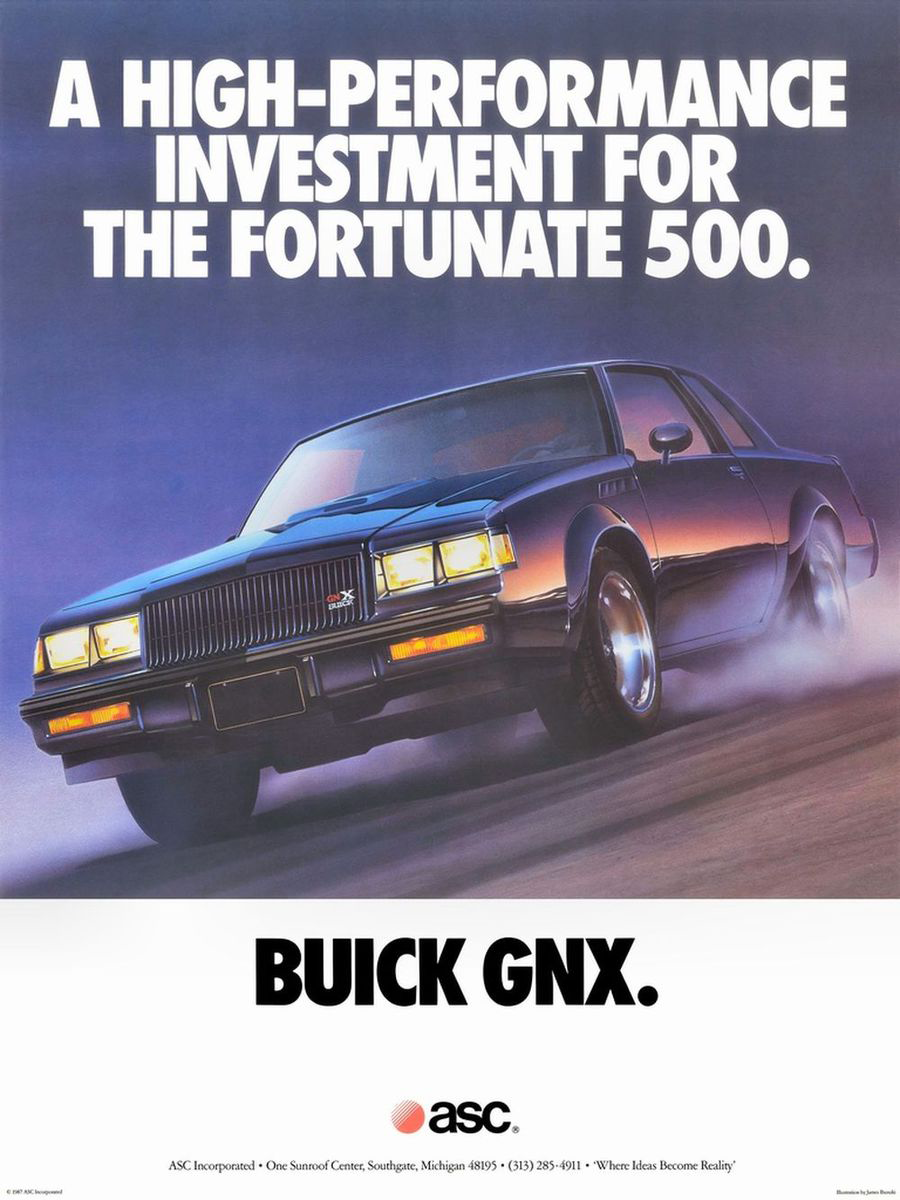
“A high-performance investment for the fortunate 500.”

1987 Buick GNX advertisement

The story is familiar to many of us. Buick’s Grand National performance variant of the Regal had been around since 1982, and it had gotten steadily more powerful, gaining a standard turbo V6 in 1984, and an intercooler in 1986. For 1987, Buick announced the GNX, which stood for Grand National Experimental.

Buick built cars with Grand National interiors and sent them to American Specialty Cars (ASC). The GNX added a performance suspension with a torque bar and a GNX-only rear differential cover. Its exterior featured functional front-fender louvers, and 16-inch aluminum mesh wheels with black-out faces and GNX center caps, which were equipped with Goodyear Eagle “Gatorback” tires—245/50VR-16 in front and 255/50VR-16 in the rear.

Most importantly, the GNX included a massaged version of Buick’s LC2 3.8 liter/231 ci turbo V6, making 276 bhp and paired with a four-speed automatic transmission with overdrive. Improvements to the engine over the standard turbo included a Garrett T3 turbocharger with ceramic impeller and a GNX-specific heat shield, a larger capacity intercooler, reprogrammed engine management, and a low-restriction exhaust.

Straight-line acceleration was outstanding for the day—Car and Driver recorded a 0-60 time of 4.7 seconds, with the quarter mile flying by in 13.5 seconds. The GNX handled well for a Regal, but that wasn’t really the point. Mileage ratings were 15 city/23 highway by the day’s standards (about 13 city/21 highway by today’s measures), which triggered the dreaded gas guzzler tax—$650 in this case.

The GNX was not inexpensive—the window sticker showed $29,290 (about $84,400 in 2025 dollars), with the GNX option alone listed as $10,995. Essentially, moving from a Grand National to a GNX added more than 50% to the price.

By 1987, a Grand National came reasonably well-equipped, with Sport mirrors, air conditioning, a leather-wrapped Sport steering wheel, a full-length operating console, and reclining front bucket seats included. A GNX came standard with many comfort and convenience features that were optional on the Grand National, including tungsten-halogen headlamps, electric door locks, power windows, electronic cruise control, tilt steering column, a six-way power driver’s seat, and the top-of-the-line UX1 stereo with graphic equalizer.

Options & Production Numbers

Buick built a mere 547 examples of the GNX—production was always intended to be quite limited. As far as I can tell, there were no factory options.

The View From 2025

According to Hagerty’s valuation tools, all the money for a 1987 Buick GNX coupe in #1/Concours condition is an astounding $257,000, with a far more normal #3/Good condition version going for $110,000.

The GNX has enthusiastic forum support, and there is intense collector interest. GNX coupes are sometimes available in the Hemmings Motor News classifieds, at online auctions such as Bring a Trailer that cater to the eighties car market, and at in-person auctions such as Barrett-Jackson and Mecum.

Make mine Black, of course.

Last updated in February 2025.

1987 BMW L6 coupe

I like to think that I was pretty aware of automotive model lines in the eighties. Somehow, I completely missed the BMW L6 coupe until 2022.

“Contempt for Compromise”

For 1987 only, BMW bifurcated the 6-series coupe line into two distinct versions: the sporting M6 and the luxury-oriented L6.

The L6’s only powertrain was the M30B34 182 bhp 3.4 liter/209 ci inline six with fuel injection paired with a four-speed automatic. 0-60 came in a little over 9 seconds in a car with a 3,490-pound curb weight. Fuel economy was rated at 16 city/21 highway by the day’s standards (15 city/20 highway by modern measures). With an 18.5-gallon gas tank, an L6’s proud new owner could expect a range of between 290 and 310 miles with a 10% fuel reserve.

1987 BMW L6 and M6 advertisement

The $49,500 L6 came well-equipped—a good thing, as that is approximately $145,400 in 2025 dollars, which is substantially more than a loaded 2025 840i XDrive coupe costs. Exterior and mechanical features included a sunroof, power steering, four wheel disc brakes, and 220/55-390 Michelin TRX tires (available from Coker Tire) on 390 mm aluminum wheels. Inside, automatic air conditioning, cruise control, power leather seats, power windows, and power mirrors were included. Distinctive features included a rear center console with individual climate controls, a leather headliner, and a unique leather dash that was notorious for peeling and warping due to the heat from the windshield. 

Options & Production Numbers

With all that standard equipment, few options were available. A limited slip differential was $390.

The L6 did not sell very well in its single year—BMW moved 1,217. For comparison, the M6 sold 1,767 in the same year.

The View From 2025

Many vintage BMWs have strong forum support, and there is definite collector interest in the 6-series coupes. L6 coupes are sometimes available in the Hemmings Motor News classifieds, on eBay Motors, and at online auctions such as Bring a Trailer which cater to the eighties car market.

Make mine Salmon Silver Metallic, please.

BMW models I have written about other than the 1987 L6 and M6 include the 1982 733i sedan, the 1983 320i coupe, the 1983 633CSi coupe, the 1984 325e coupe, the 1988 M3 coupe, and the 1988 750iL sedan.

Last updated October 2025.

1987 Chrysler Fifth Avenue sedan

Up until a few years ago, I still occasionally saw M-body Fifth Avenues on the road. They were always well-kept, but also actually being driven. Now, they seem gone.

“Fifth Avenue remembers what fine car buyers demand!”

Little changed for 1987, Chrysler’s rear-wheel-drive Fifth Avenue sedan did receive an updated steering wheel. Otherwise, things continued along virtually the same as they had been since the M-body Chrysler went from the New Yorker Fifth Avenue name to the Fifth Avenue name in 1984.

The only powertrain available was an LA 140 bhp 5.2 liter/318 ci V8 with a Carter two-barrel carburetor paired with a TorqueFlite three-speed automatic transmission—the slant six had departed from the M-body after 1983. 0-60 came in about 12 seconds in a car with a 3,741-pound curb weight. Mileage ratings were 16 city/21 highway by 1987 standards—which equals 15 city/20 highway today. With an 18-gallon gas tank, a Fifth Avenue owner could expect a range of 285 to 300 miles with a 10% fuel reserve.

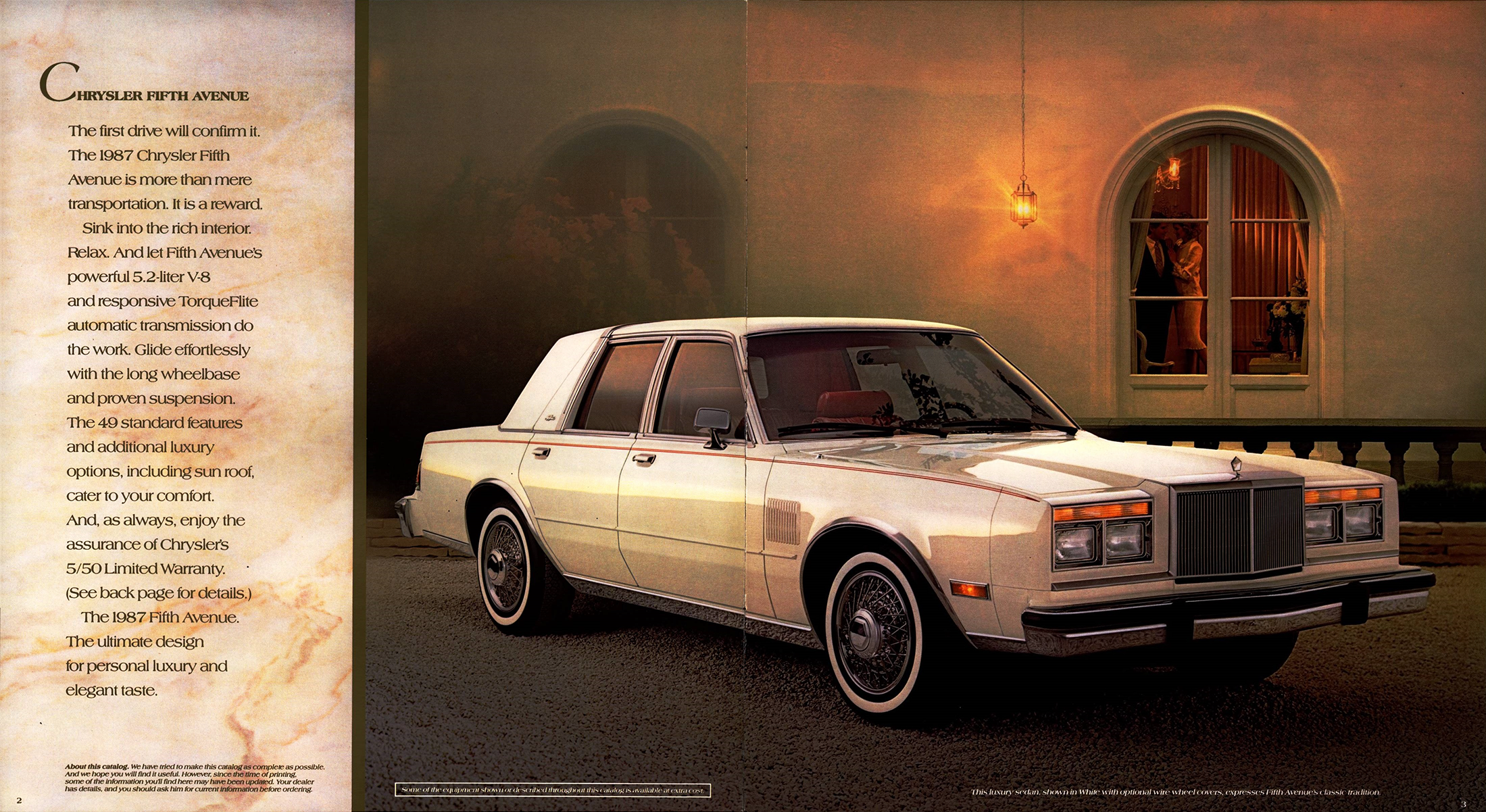
Pages from the 1987 Chrysler Fifth Avenue brochure

Standard exterior features on the $15,422 Fifth Avenue (about $41,700 in today’s dollars) included a color-keyed padded vinyl Landau roof and tinted glass on all windows. Mechanical features included power front disc/rear drum brakes, power-assisted steering, and P205/75R15 tires (a size still readily available) on 15-inch wheels with Premium wheel covers. Inside, an air conditioning/heater with automatic temperature control, power windows, a Luxury two-spoke steering wheel, and an AM radio were included.

Packages, Individual Options, & Production Numbers

The Luxury Equipment Discount Package added hood stripes, electroluminescent opera lights, and wire wheel covers with locks. Inside, the same package added automatic speed control, a tilt steering column, Deluxe intermittent windshield washers/wipers, a power deck lid release, and an AM stereo/FM stereo radio with the Premium speaker system and a power antenna. Added upholstery features with the package included a Corinthian (of course) leather 60/40 front seat with vinyl trim, dual front power seats, and a Luxury leather-wrapped two-spoke steering wheel. This substantial package cost $2,113 when ordered with the Ultimate Sound audio system and $2,251 if ordered without Chrysler’s top-of-the-line stereo. Either way, it added 14% to 15% to the Fifth Avenue’s base price.

A Two-Tone Paint Package ($485) was also available. This package included (natch!) two-tone paint with a choice of three colors matched with Radiant Silver, a special padded vinyl Landau roof with electroluminescent opera lights, and cast aluminum 15-inch wheels.

Individual options included a power glass sun roof ($1,076) and a left power seat ($240). A range of three optional car stereos topped out with the $609 Ultimate Sound system, which included an AM stereo/FM stereo radio, a cassette tape player with automatic reverse and Dynamic Noise Reduction (DNR), a five-band graphic equalizer, and a joystick balance/fader control. Many individual options cost less when ordered with the Luxury Equipment Discount Package.

Chrysler sold 70,579 Fifth Avenues in 1987, making it the single most popular Chrysler model, though all the various LeBaron models combined were good for far more sales. With tooling that had long since been paid for, all the M-body cars (the Dodge Diplomat and Plymouth Gran Fury were also in production) were probably good for Chrysler’s profits.

The View From 2025

These cars were the last of the old Chryslers, with a platform dating back to 1977 and some engineering elements that were far older. When rear-wheel-drive returned to big Chryslers in 2005, it was based on a Mercedes-Benz E-class platform. Earlier this year, I blogged about Chrysler Corporation’s Transition To Front-Wheel-Drive.

Though they are far from collector cars, Fifth Avenues of this generation are sometimes available in the Hemmings Motor News classifieds, on eBay Motors, and on Bring a Trailer. They also occasionally show up at in-person auctions.

Make mine Crimson Red, please.

Other rear-wheel-drive Chrysler products I have written about include the 1980 Chrysler Cordoba coupe, the 1980 Plymouth Volaré station wagon, the 1981 Chrysler New Yorker sedan, the 1983 Chrysler Cordoba coupe, the 1983 Imperial coupe, and the 1989 Dodge Diplomat sedan.

Last updated December 2025.

1987 BMW M6 coupe

At the 2021 Mecum Indy, a Cinnabar Red 1987 BMW M6 coupe with tan leather front bucket seats sold for $50,000. That compelled me to write this blog post, but that price would be somewhat of a steal now.

“For the zealots.”

For the 1987 model year, BMW finally brought the European M635CSi (available since 1983) to North America, but rebadged it as the M6. This rebadging meant that the “civilian” 6-series (previously the 633CSi) was redesignated as the L6. Specific M6 details included front and rear M badging, a larger front air dam and rear spoiler, and matching color side mirrors.

The M6’s engine was the S38B35 256 bhp 3.5 liter/211 ci inline six with Bosch Motronic fuel injection. With an 18.5-gallon gas tank, the fuel economy rating of 10 city/19 highway mpg (9/17 by today’s measures) meant a short range of between 220 and 240 miles with a 10% fuel reserve. Car and Driver recorded a 0-60 time of 6.1 seconds.

The M6’s base price was $58,970—about $172,500 in today’s dollars, and about 23% more than a 2025 M8 Gran Coupe starts at. Standard exterior and mechanical equipment included metallic paint, halogen headlights, speed-related power steering, four-wheel power anti-lock disc brakes, and Michelin TRX 240/45VR-415 tires (still available!) on 7.7-by-16.3-inch BBS alloy wheels.

1987 BMW M advertisement

Inside the very well-equipped M6, BMW paired leather reclining front bucket seats with memory with leather rear bucket seats. Other interior accouterments included front and rear air conditioning, power heated side mirrors, power door locks, a three-spoke leather-covered steering wheel, a trip computer, and a digital clock. Audio entertainment was provided by a BMW Sound System with an AM/FM stereo radio, a cassette player, eight speakers, and a power antenna.

Production Numbers & Period Reviews

The 1987 M6 had no factory options—buyers chose the exterior and interior colors, and that was it.

BMW produced a total of 1,767 M6 coupes for North America between September 1986 and September 1988. Reviews were excellent, with the only complaints being the eye-watering price and the fuel mileage (“drinks gas like a fiend”). Car and Driver stated that the M6 was “one of those wild, wonderful cars that throw the scales of automotive justice totally off balance.”

The View From 2025

Like many BMWs, the M6 attracts collector interest, and there is series-specific club support along with that of the bigger BMW car clubs. According to Hagerty’s valuation tools, all the money for a 1987 M6 in #1/Concours condition is $126,000, with a far more normal #3/Good condition version going for $40,600.

M6’s are often available in the Hemmings Motor News classifieds, on eBay Motors, and on Bring a Trailer. As I update this post in July 2025, a Royal Blue Metallic 1987 M6 with lotus white leather front bucket seats and 70,000 miles is for sale on Hemmings, asking $44,900.

Make mine Silver, please—I think.

Other BMWs I have written about include the 1982 733i sedan, the 1983 633CSi coupe, the 1984 325e coupe, the 1985 535i sedan, the 1987 L6 coupe, the 1988 M3 coupe, and the 1988 750iL sedan.

Last updated July 2025.