1984 Buick Regal Grand National coupe

On a Sunday morning in July 2015, I saw a Buick Grand National actually being driven. The silhouette was distinctive, even from a quarter of a mile away. Strangely, they look tall and even a little bit fragile nowadays.

“The hottest Buick this side of a banked oval.”

1984 was the first year that Buick offered a Grand National package for the Regal. The Regal T Types had debuted in 1983, but the Grand National definitely kicked things up a notch.

The star was, of course, the engine. For 1984, Buick’s turbocharged LD5 3.8 liter/231 ci V6 gained sequential fuel injection, bumping horsepower up from 180 bhp to an even 200 bhp. Paired with a four-speed automatic transmission, 0-60 came in a little under 8 seconds. Mileage was 18 city/22 highway by the day’s standards (16/20 by 2025 measures). With an 18-gallon fuel tank, the Grand National‘s range was between 290 and 325 miles with a 10% fuel reserve.

1984 Buick Grand National advertisement

Standard mechanical equipment on the $13,400 Grand National (about $42,400 in today’s dollars) included power brakes, power steering, dual exhausts, performance rear axle, Gran Touring suspension, and P215/65R15 blackwall tires (a size still readily available) on black-accented 15-inch aluminum wheels. A Grand National‘s exterior equipment included a turbo “power bulge” on the hood, dual mirrors, dual horns, front air dam, rear decklid spoiler, and that distinctive Black paint with black accents—responsible for the “Darth Buick” nickname. Air conditioning, Lear Siegler cloth/leather seats, a tachometer, a turbo boost gauge, and a leather-wrapped steering wheel were all included inside.

Options

Optional equipment included dual remote sport mirrors ($30), electric rear defogger ($140), touch climate control air conditioning ($150), tilt steering ($110), power windows ($185), Twilight Sentinel ($57), and electronic tuning AM/FM stereo radio with cassette and graphic equalizer ($605).

The View From 2025

Buick Regal Grand Nationals have what can only be called a fanatical following. According to Hagerty’s valuation tools, all the money for a 1984 Grand National in #1/Concours condition is an impressive $45,100, with a more normal #3/Good condition car going for $17,100. Grand Nationals frequently show up for sale in the Hemmings Motor News classifieds, on eBay Motors, and on Bring a Trailer. As I update this blog entry in April 2025, a 1986 Grand National with 1,706 miles is available on Hemmings, asking $78,500.

I don’t have to tell you what color I want mine in.

Other sporty eighties Buicks I have written about include the 1980 Riviera S TYPE coupe, the 1983 Skylark T TYPE coupe, the 1984 Riviera T TYPE coupe, the 1987 GNX coupe (of course!), the 1987 LeSabre T Type coupe, and the 1988 Reatta coupe.

Last updated April 2025.

1984 Chrysler Laser hatchback coupe

In June 2022, a Saddle Brown Crystal 1984 Chrysler Laser XE with 17,000 miles came up for auction on Bring a Trailer. That was enough reason for me to substantially update this now ten-year-old post.

“The competition is good. We had to be better.”

Debuting in 1984, the Chrysler Laser was intended to be an upscale complement to the Dodge Daytona. Its equipment was not notably different from the Daytona’s, but the Laser had a more luxurious emphasis with a slightly softer suspension.

Two engines were available. The base engine, Chrysler’s 93 bhp 2.2 liter/135 ci inline four, was available with a standard five-speed manual transmission or a three-speed automatic transmission ($439). Mileage with the manual was 22 city/32 highway by 1984 standards (19/29 by today’s measures). Moving to the automatic helped city mileage a bit but dropped highway mileage significantly—23/27.

The more interesting engine was the optional Turbo I 142 bhp 2.2 liter/135 ci turbocharged inline four with the same transmission choices as the base engine. Depending on whether you were adding the turbo to the base Laser or the XE, the extra cost was either $934 or $872. Mileage with the hot setup (turbo and manual) was 20 city/27 highway by the day’s standards (18/25 by 2025 measures), while Road & Track recorded a 0-60 time of 8.6 seconds. Moving to the three-speed automatic once again killed highway mileage, making the ratings 20 and 23. With a 14-gallon gas tank, the owner of a five-speed/turbo Laser could expect a range of between 275 and 295 miles with a 10% fuel reserve.

1984 Chrysler Laser television commercial

Standard exterior and mechanical equipment on the base Laser (priced at $8,648 or about $27,500 in today’s dollars) included a rear spoiler, power-assisted rack and pinion steering, power front disc/rear drum brakes, and P185/75R14 steel belted radial black sidewall tires (a size still readily available) on 14-inch wheels with Premium wheelcovers. Inside, a leather-wrapped steering wheel, intermittent wipers, and an AM radio with a digital clock were included.

Moving up to Laser XE ($10,546 or about $33,500 in 2025 dollars) added features such as an electronic instrument cluster, tilt steering wheel, driver’s side sport seat, dual power side mirrors, and an AM/FM stereo radio.

Options, Period Reviews, & Production Numbers

Optional equipment included air conditioning ($737), cruise control ($179), rear defroster ($168 base/$143 XE), power windows ($185), power door locks ($125), and AM/FM stereo cassette ($285/$160). With all the trimmings, a Laser XE could fairly easily get to $12,900 or so or about $41,000 in today’s dollars—almost what a 2025 Dodge Hornet R/T SUV costs.

The buff books liked the presence of the Laser and Daytona on the market, but wanted more. The final paragraph of Road & Track’s review began with, “although we applaud the concept and basic execution of the Laser, the car badly needs refinement.” In particular, they complained of a booming resonance anytime the engine exceeded 2,000 RPM—not great in a sporty car that Chrysler claimed was a sports car.

The Laser sold decently in its first year, with almost 34,000 base coupes and nearly 26,000 XEs crossing dealer lots. These numbers were actually better than its Dodge Daytona sister car (with a total of almost 50,000 sold).

However, Chrysler must have been disappointed—this was an era where the Chevrolet Camaro, Ford Mustang, and Pontiac Firebird were routinely selling in the hundreds of thousands (the three models combined for 530,000 sold in 1984).

Chrysler would never see these first-year totals again—by 1987, the Laser would be gone, with the Daytona hanging on through the 1993 model year after a few pretty good years in the late 1980s.

DaytonaLaserSales

The View From 2025

Lasers rarely appear in the Hemmings Motor News classifieds, on eBay Motors, or on Bring a Trailer (the most recent BaT example was only the fifth in eight years). You see some Daytonas on eBay and BaT, but even they are relatively uncommon.

Not surprisingly, allpar.com has an interesting and detailed article on the front-wheel-drive Lasers and Daytonas—it is here.

Make mine Black, please.

Other sporty Chrysler corporation products I have written about include the 1985 Dodge Shelby Charger hatchback coupe and the 1985 Dodge Omni GLH hatchback sedan.

Last updated June 2025.

1984 Ford Mustang SVO hatchback coupe

With the announcement of the 2015 Mustang and its available EcoBoost turbocharged inline-four, my mind turned back to the 1984 to 1986 Mustang SVO.

“Sophisticated performance for the knowledgeable driver.”

Created by Ford’s Special Vehicle Operations department, the 1984 Ford Mustang SVO was an admirable attempt to take a different and more advanced approach to the pony car market. This version of the Fox-body Mustang was built around the Lima turbocharged and fuel-injected 2.3 liter/140 ci inline four, making 175 bhp paired with a Borg-Warner T5 five-speed manual. By the day’s standards, this combination yielded a reasonable 19 city/26 highway (it would be 17/24 by current standards). Car and Driver recorded a respectable 7.5 second 0-60 time and a 128 mph top speed.

1984 Ford Mustang advertisement

Other modifications over the standard Mustang included ventilated four-wheel power disc brakes (replacing the Mustang GT‘s front disc/rear drum setup), and a Koni suspension system featuring adjustable struts and shocks. 16 × 7 inch aluminum wheels with 225/50VR16 Goodyear NCT tires (a size still readily available) were standard for the first year—Gatorbacks didn’t become available until 1985.

The exterior featured an SVO-specific front grille, tinted glass, a hood with a functional scoop, and a “dual wing” spoiler that was also unique to the SVO. Inside, standard features included SVO-specific adjustable performance seats with lumbar support, a leather-wrapped tilt steering wheel, and an AM/FM stereo radio with a four-channel amplifier and four speakers.

Options & Production Numbers

You could have the interior in any color you wanted as long as that was Charcoal, but you did get to choose from the standard cloth or optional leather seats. A flip-up open air roof ($315), air conditioning ($743), a cassette player ($222), power door locks ($177), and power windows ($198) all remained optional—this was 1984, after all.

With a base price of $15,596 (about $49,300 in 2025 dollars or well more than what a loaded 2025 Mustang EcoBoost Premium Fastback goes for), sales did not come close to meeting Ford’s hopes—less than 10,000 buyers took home a Mustang SVO over its three years of production. The reasons for its relative failure were many, but I think the most significant problems were:

  • The average Mustang buyer was happier with a Mustang GT, which, with a base price of $9,578, cost substantially less.
  • The potential buyer of a vehicle with a turbocharged and intercooled four, four-wheel disc brakes, and an adjustable suspension wasn’t looking to Ford for this car.

The View From 2025

It is interesting to note that Ford was much more successful in the 1990s and 2000s in selling high-end Mustangs. They’ve also done decently with the 2.3 liter (there’s a coincidence!) 315 bhp EcoBoost turbocharged inline-four, which first became available in 2015.

According to Hagerty’s valuation tools, all the money for a 1984 Mustang SVO in #1/Concours condition is $36,200, with a more normal #3/Good car going for $9,800. SVOs often show up in the Hemming’s Motor News classifieds, on eBay Motors, and on Bring a Trailer—as I update this blog entry in March 2025, there’s a Black 1984 Mustang SVO with a Charcoal cloth interior and 66,000 miles asking $20,000 on Hemmings.

Make my SVO Silver Metallic, please.

Other Mustangs I have written about include the 1980 Cobra hatchback coupe, the 1982 GT hatchback coupe, and the 1983 GT convertible.

Last updated March 2025.

1984 Lincoln Continental Mark VII LSC coupe

This was one of my early posts in this blog. I’ve updated it to reflect both changes in my posting style and substantial improvements in available data.

“The ultimate American road car.”

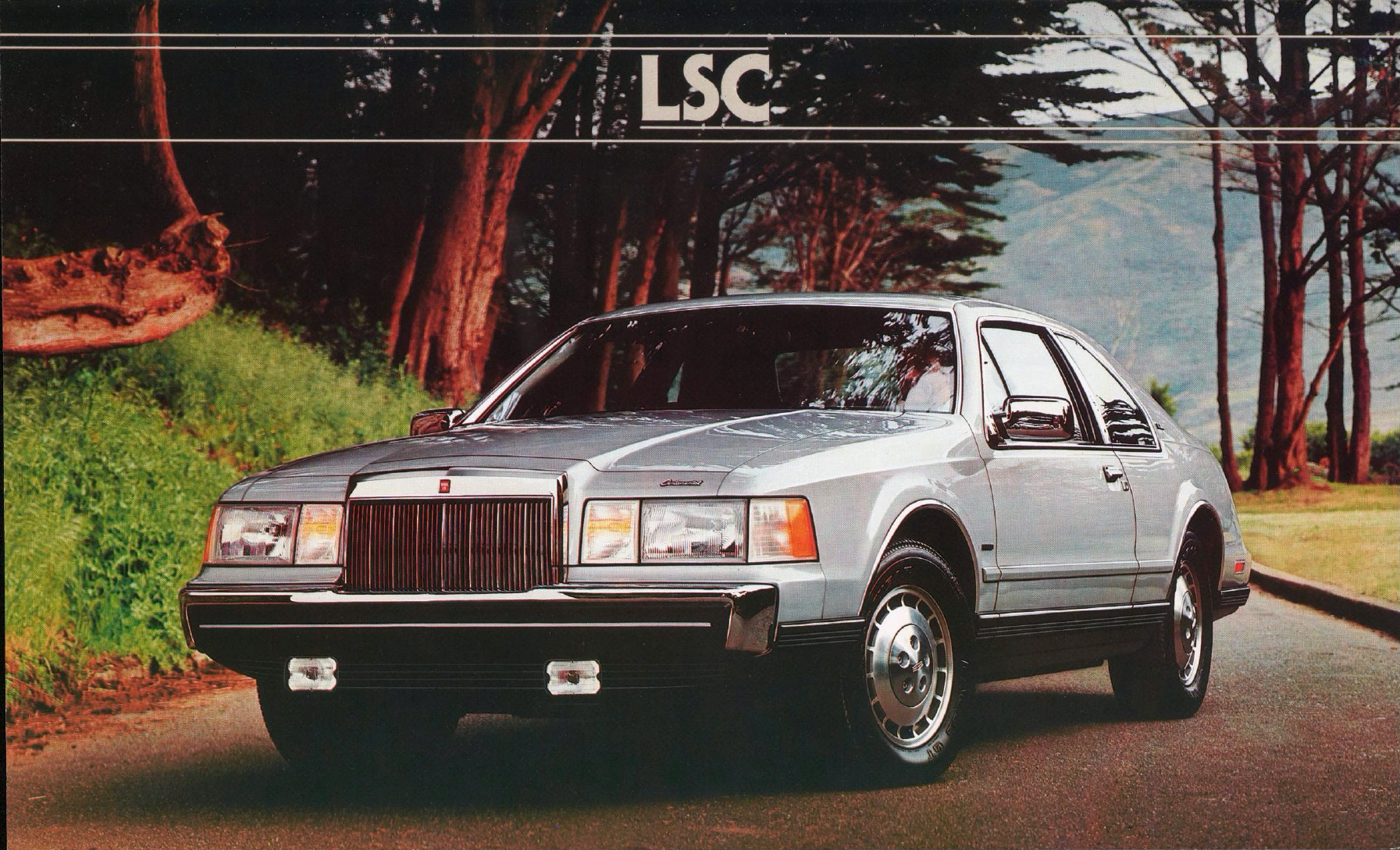
The Lincoln Continental Mark VII was all new for 1984. The standard powertrain for 1984 was a Windsor 140 bhp 4.9 liter/302 ci V8 with throttle-body fuel-injection connected to a four-speed automatic transmission. Despite the LSC’s 3,600 pound weight, 0-60 still came in under 9 seconds. Mileage by the standards of the day was 17 city/22 highway (14/20 by today’s standards). With a 22.3-gallon fuel tank, a Mark VII owner could expect a range of 340 to 390 miles with a 10% reserve.

Standard mechanical equipment on all Mark VIIs included four-wheel disk brakes, four-wheel air ride suspension, and the first composite headlights available in the United States. Inside, a Trip Minder computer, air conditioning, rear window defroster, interval wipers, tilt steering, cruise control, remote release fuel door, power windows, power door locks, power side view mirrors, power six-way driver’s seat, and an AM/FM stereo were all included.

Continental Mark VII LSC page from the 1984 Lincoln brochure

The new LSC trim level added about $2,000 to the base Mark VII’s non-trivial $21,707 price (making the LSC start at about $54,400 in 2014 dollars). LSC-specific components included a stiffer air suspension, dual exhaust, leather seats, fog lamps, and P215/65R15 Goodyear Eagle GT radial tires (a size still readily available) on forged aluminum 15 x 6-inch wheels. A Traction-Lok limited slip differential was optional for $95.

Ford wanted the LSC to compete with the big BMW (635 CSi) and Mercedes-Benz (500 SEC) coupes, but it seems more likely that most LSC buyers were cross-shopping cars like the Buick Riviera T-Type, the Cadillac Eldorado Touring Coupe, or (horrors!) the Ford Thunderbird Turbo Coupe.

I always liked the look of the LSC—I think the stylists combined “traditional” Mark traits such as the rear spare tire hump with Ford’s new aerodynamic direction very effectively. At the time, people complained about the somewhat limited interior room and the quite small trunk for such a large car. The period of the big coupe was beginning to fade, but the LSC was indeed an interesting approach.

According to Hagerty’s valuation tools, all the money for a 1984 Continental Mark VII LSC in #1/Concours condition is $9,100, with a more “normal” #3/Good condition LSC fetching $4,200. Lincoln Mark VIIs show up in the Hemmings Motor News classifieds reasonably regularly—as I write this in July 2014,  there’s a Sandstone 1988 LSC with 55,000 miles listed for $8,000.

Make mine Platinum Clearcoat Metallic, please.

1984 Buick Riviera T TYPE coupe

This entry was one of my first posts on this blog. I’ve updated it to reflect both changes in my posting style and substantial improvements in available data. In hindsight, it turns out that it was also my initial inspiration for the Riviera Project I am currently working on.

“… the thrill of turbocharged performance and responsive handling.”

For 1984, the T TYPE (their spelling) version of Buick’s Riviera gained sequential fuel injection, yielding a respectable 200 bhp from the evergreen LM9 3.8 liter/231 ci turbo V6. Performance figures for the later Riviera T TYPEs are hard to come by, but I’m betting that 0-60 mph came in between 9 and 10 seconds.

Fuel mileage for the big coupe was decent by the day’s standards: 14 city/21 highway (13/20 by today’s measures). With the 21.2-gallon gas tank, range was about 310 to 335 miles with a 10% fuel reserve. A T TYPE continued to be the only way to get your Riviera coupe turbocharged, though you could get a “civilian” Riviera convertible with the turbocharger.

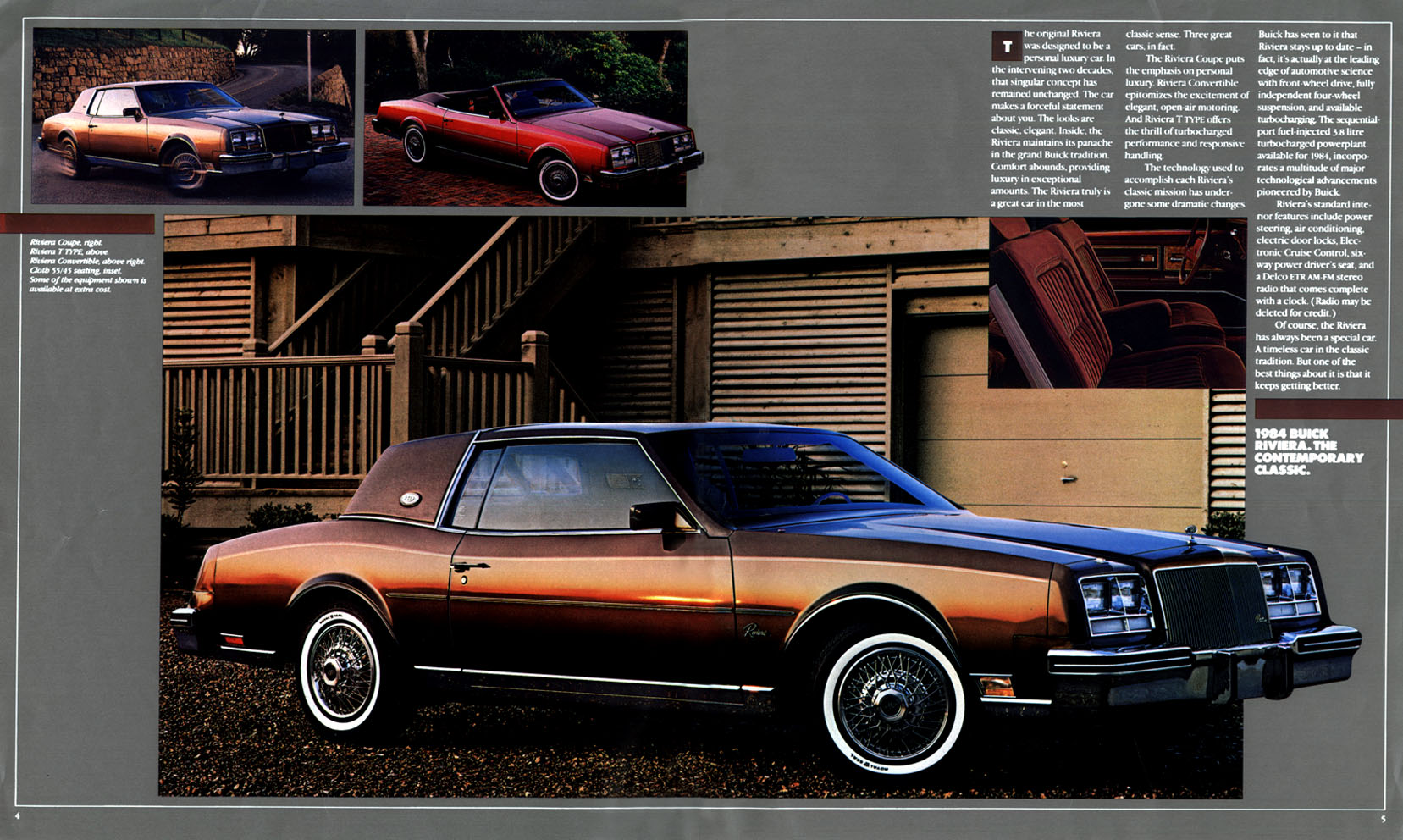
Riviera pages from the 1984 Buick brochure

The $17,050 T TYPE (about $54,500 in 2025 dollars) came with a blacked-out grille, amber parking light and turn signal lenses, black mirrors, and P205/75R15 tires (a size still readily available) on 15-inch styled aluminum wheels. Additional instrumentation for the T TYPE included a turbo boost gauge and an LED tachometer. The 1984 T TYPE also included the Gran Touring Package, which featured stiffer springs, recalibrated shock absorbers, and larger diameter anti-sway bars front and rear.

Standard exterior and mechanical features on all 1984 Rivieras included a four-speed automatic transmission, power steering, power brakes, and power antenna. Inside, every Riviera had air conditioning, power door locks, and power windows.

Options & Production Numbers

An extensive list of options included electronic climate control ($150), rear window defogger ($140), and Twilight Sentinel ($60). Options available for every Riviera except the convertible included the Delco/Bose Music System ($895) and the Astroroof ($1,195).

Sales weren’t great—with only 1,153 made, T TYPEs accounted for only about 2% of the robust overall Riviera sales. T TYPE sales would continue to dip in the last year for the “big” sixth-generation Riviera—there were only 1,069 made in 1985. My theory is that there weren’t a ton of folks searching for a big (206 inches long and 3,660 pounds) performance-oriented (but not really high performance) coupe in the mid-1980s, and there was competition from vehicles like the brand-new Lincoln Mark VII LSC.

The View From 2025

1000 views badge

Folks are saving the sixth-generation Rivieras—there’s robust discussion and support on the AACA’s Buick Riviera page. According to Hagerty’s valuation tools, a 1984 Riviera T TYPE in #1/Concours condition is $37,400, with a far more normal #3/Good condition going for $11,400. T TYPEs also come up for sale occasionally in the Hemming’s Motor News classifieds or on eBay Motors. Bring a Trailer has yet to sell a sixth-generation T TYPE.

Make mine the extra-cost ($210) Medium Sand Gray Firemist, please. I love those Buick color names and believe everyone should have at least one Firemist.

Other Buick coupes I have written about include the 1980 Rivera S TYPE, the 1983 Skylark T TYPE, the 1984 Regal Grand National, the 1985 Somerset Regal, the 1987 GNX, the 1987 LeSabre T Type, and the 1988 Reatta.

Last updated August 2025.

Save

1984 Honda Civic CRX hatchback coupe

“Are you using the right car for your gasoline?”

Even for the 1980s, the 1984 Honda Civic CRX two-seater was absolutely tiny, with a length of a little over 12 feet and a weight of around 1,800 pounds. The CRX debuted as a new model included with the introduction of the all-new third generation Civic line.

There were two engine choices for the CRX in 1984. The CRX got a 1.3 liter/82 ci inline four with a three-barrel carburetor and all of 60 bhp—but this got you 46 city/52 highway by the standards of the day (still 38/47 by today’s standards). It also got you a 0-60 time of about 12 seconds.

Moving up to the 1.5 got you the EW1 76 bhp 1.5 liter/91 ci inline four with a three-barrel carburetor—enough to reduce the 0-60 time to just over 10 seconds and still get 32 city/38 highway by the eighties standards (28/35 by the current standard). A five-speed manual was standard with both engines, but you could get a three-speed automatic with the 1.5—though I’m not at all sure why you’d want one.

All CRXs included a front air dam, a rear spoiler, tinted glass, a front stabilizer bar, rack and pinion steering, power-assisted front disc/rear drum brakes, and 165/70R-13 steel-belted radial tires on 13-inch wheels. Inside, reclining front bucket seats, a 3-spoke Sport steering wheel, and a tachometer were included.

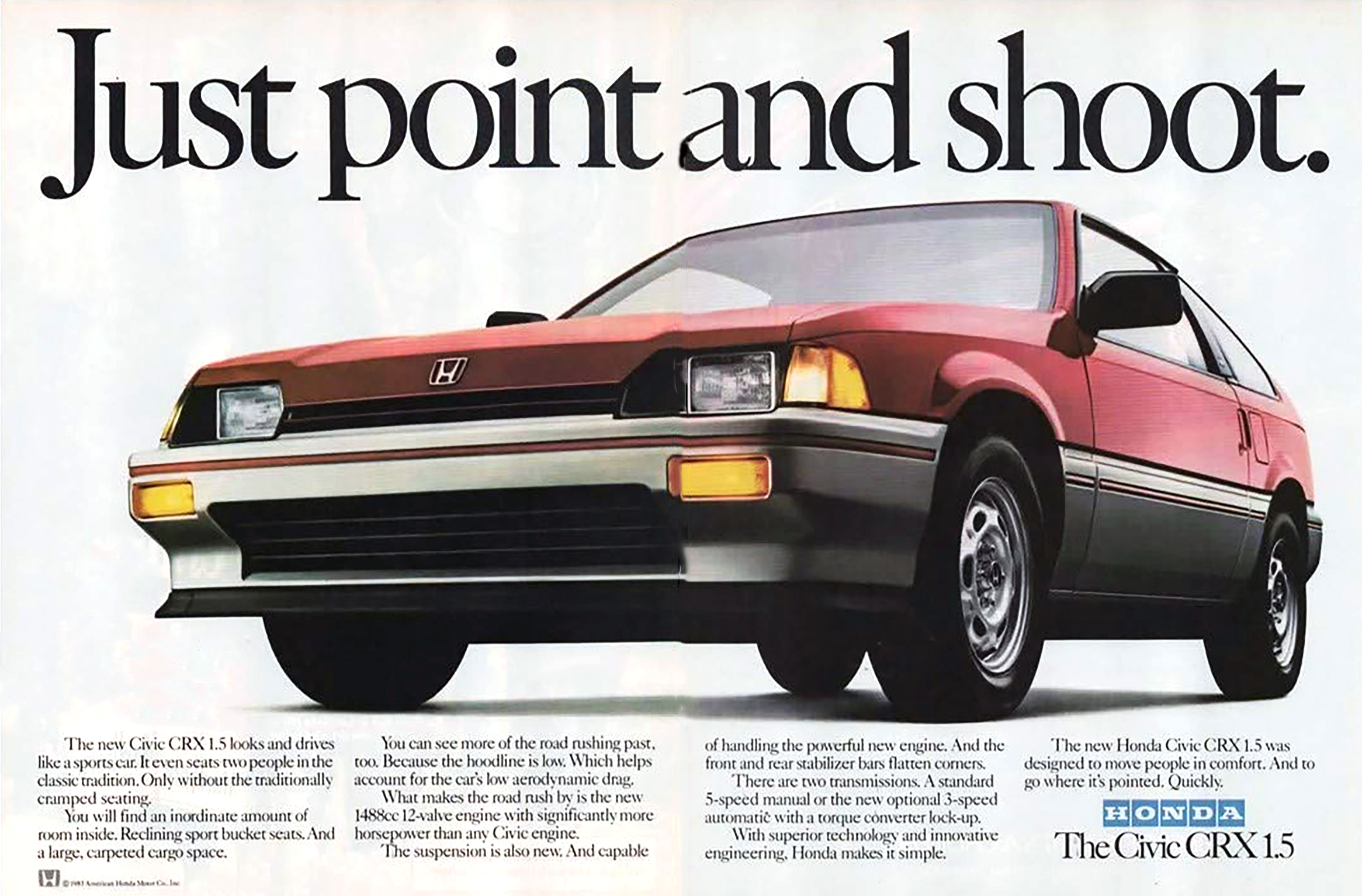
1984 Honda Civic CRX print advertisement
1984 Honda Civic CRX 1.5 print advertisement

The 1.5 added halogen headlights, dual remote-control outside mirrors, a sport suspension, a rear stabilizer bar, vented front disc brakes, and Michelin 175/70R-13 steel-belted radial tires (a size still somewhat available) on wider wheels. Inside, a quartz digital clock was added.

Options & Production Numbers

Past the engine and transmission choices, California emissions, and the three initial factory colors, the CRX had no factory options. Dealer installed options included air conditioning, aluminum alloy wheels, and a selection of radios.

The first generation CRX found its markets and sold quite well, with over 48,000 in 1984 and a total of 218,000 over four years. In 1985, the fuel injected 91 bhp Si would come along—but that is a topic for another blog post.

The View From 2025

I see early CRX’s occasionally, but they’ve become rarer and rarer on the roads in the northeast. I have yet to see one at an auto show, but I’d love to. First-generation CRX’s are sometimes available in the Hemmings Motor News classifieds, on eBay Motors, and at online auctions such as Bring a Trailer that cater to the eighties car market.

Make my 1984 CRX a 1.5 in Baltic Blue (with the standard metallic gray lower rocker panels), please.

Other Hondas I have written about include the 1983 Civic S hatchback coupe, the 1984 Civic DX hatchback coupe, the 1985 Civic CRX Si hatchback coupe, the 1986 Accord sedan, the 1986 Prelude Si coupe, and the 1988 Civic sedan.

Last updated June 2025.

1984 Nissan/Datsun 300 ZX hatchback coupe

“Every move you make, every turn that you make confirms you are in the most technologically advanced Z car ever made.”

This Nissan/Datsun 300 ZX is not the generation with most of the glamor—that 300ZX was the one that followed in the 1990s. For 1984, Nissan moved from the inline 6 of the 280-ZX to a 3.0 liter/181 ci V6 with fuel injection, available either naturally aspirated (160 bhp) or turbocharged (200 bhp). The styling was completely and controversially revised for the first time in the history of the Z car—a massive revision akin to that of the Chevrolet Corvette for the same year.

Car and Driver recorded a 0-60 time of 7.3 seconds in a Turbo with the four-speed automatic. Fuel economy with the same powertrain was 19 city/28 highway by the day’s standards (15/20 by 2025 measures). With an 18.5-gallon gas tank, 300 ZX Turbo owner could expect a range of 295 to 390 miles with a 10% fuel reserve.

1984 Nissan 300 ZX advertisement

Standard exterior and mechanical equipment on the well-equipped $15,800 300 ZX (about $50,700 in 2025 dollars or almost what a 2026 Nissan Z Performance starts at) included blue tinted glass windows, a fully automated motorized antenna, pop-up halogen headlights, ventilated four-wheel power disc brakes, power rack-and-pinion steering, and P215/60R15 tires (a size still readily available) on 15-inch alloy wheels. Inside, an eight-way manually adjustable driver’s seat, power windows, tilt steering column with memory, air conditioning, and a 40-watt AM/FM stereo with electronic digital display, scan tuning, a cassette deck with Dolby noise reduction, and four speakers were standard.

At $18,200, the 300 ZX Turbo added three-way adjustable shock absorbers, headlight washers, an oil temperature gauge, and a turbo boost gauge—in addition to the turbo engine itself. The Turbo also had different wheels, tires, and final drive ratios.

Packages, Options, & Production Numbers

The 300 ZX to have in 1984 was undoubtedly the 50th Anniversary Edition (released to celebrate Nissan’s half-century) which was an absolutely loaded turbocharged model with a Light Pewter Metallic and Thunder Black color scheme. All Anniversary Editions came equipped with flared front and rear fenders, Bodysonic bass speakers in the seats (individually adjustable for driver and passenger from the console), a T-bar sun roof with removable mirrored glass panels and fitted storage pockets, black leather bucket seats, and Pirelli P7 225/50VR16 low-profile tires (a specific tire still available) on 16-inch aluminum alloy wheels. Other equipment included a digital dash with MPG and compass readouts and steering wheel controls for the cruise control and the radio. Nissan even included a fitted car cover.

The only option available on the Anniversary Edition was the choice of a five-speed manual transmission or a four-speed automatic transmission. 5,148 out of the 75,351 (!) 1984 300ZXs produced for the US market were Anniversary Editions at a non-trivial list price of $26,000 (about $83,400 in 2025 dollars).

“Normal” 300 ZX coupes had few individual options beyond a T-bar sun roof with removable glass panels and fitted storage pockets. The Leather Package included leather bucket seats (natch!), an eight-way adjustable power driver’s seat with six power functions, an electronic instrument display, a leather-wrapped two-spoke steering wheel, and an 80-watt AM/FM stereo with electronic digital display, automatic program search display, memory presets, an auto-reverse cassette deck with Dolby noise reduction and metal tape compatibility, and eight speakers.

The View From 2025

According to Hagerty’s valuation tools, a base 1984 300 ZX in #1/Concours condition is $35,700, with a far more typical #3/Good car going for $9,600. Values for the Anniversary Edition are well more—about $58,600 for the very best. 300 ZXs make regular appearances in the Hemmings Motor News classifieds, on eBay Motors, and on Bring a Trailer, though you sometimes have to be careful to check under both Datsun and Nissan. As I update this blog post in December 2025, there’s a 50th Anniversary Edition with 55,000 miles for sale in Hemmings, asking $37,000.

Make mine Wine Metallic, please. Dark Green Metallic tempted me, but it’s believed that only one 300 ZX was painted in that color.

Other Datsuns and Nissans I’ve written about include the 1980 200-SX coupe, the 1980 280-ZX hatchback coupe, the 1981 810 Maxima sedan, and the 1989 Maxima sedan.

Last updated December 2025.

Save

Save