1984 Ford Tempo sedan

“Computer-refined design for five-passenger comfort”

The Ford Tempo and Mercury Topaz debuted for the 1984 model year in May 1983. Based on the Escort, they were putative replacements for the Ford Fairmont and Mercury Zephyr.

The Tempo’s base engine and transmission combination was the 2300 HSC 90 bhp 2.3 liter/140 ci inline four with a one-barrel carburetor paired with a four-speed manual. A Mazda-built 52 bhp 2.0 liter/122 ci diesel four was available for $588, but it isn’t clear how many bought it. Road & Track recorded a 0-60 time of 13.6 seconds with the optional five-speed manual ($76) and the gas engine. A three-speed automatic was $439 and was available only with the gas engine and the fancier GL and GLX trims.

1984 Ford Tempo print advertisement

The 1984 Tempo L sedan’s base price was $6,936—about $22,700 in today’s dollars. Standard exterior and mechanical equipment included single rectangular halogen headlamps, rack and pinion steering, power front disc/rear drum brakes, and P175/80R13 steel-belted radial ply black sidewall tires on 13-inch wheels with Deluxe wheel covers. Inside, individually adjustable front seats with cloth seating surfaces and reclining seat backs, Deluxe carpeting, a mini-console, an A-frame Luxury steering wheel, an inside hood release, and an AM radio with dual front speakers were included.

The $7,159 GL sedan added Luxury wheel covers, Luxury sound insulation, interval windshield wipers, and an electronic digital clock.

The $7,621 GLX sedan added bumper end cap extensions, dual door-mounted remote-control mirrors, a dual note horn, Luxury carpeting, and Luxury luggage compartment trim.

Groups, Packages, Individual Options, & Production Numbers

Ford offered four option groups and packages with the Tempo:

  • The Light/Convenience Group ($50-$85) included ashtray, glovebox, and engine compartment lights, rear door dome light switches, a swivel map light, a headlamps on buzzer, and a trip odometer
  • The Power Lock Group ($202-$254) included power door locks, a power decklid release, and a remote control fuel filler door
  • The Sports Appearance Group ($299) was only available with the GL and included styled steel wheels with trim rings, Sport front seats with a 4-way manual driver’s seat, rear seats with integral headrests, unique sew-style and fabric, a Sport steering wheel, and a Sport instrument cluster
  • The TR Performance Suspension Package ($366-$424) included Michelin TRX tires, TR-Type cast aluminum wheels, and special steering and suspension components

Individual exterior and mechanical options included tinted glass ($510), metallic glow paint ($63), a flip-up open air roof ($315), and power steering ($223). Inside, power side windows ($272), a driver’s side power seat ($224), Fingertip Speed Control ($176), and an electric rear window defroster ($140) were offered. A series of five optional radios were offered, ranging up to an electronic AM/FM stereo search radio with a cassette player ($396).

Options not available with the L included air conditioning ($743) and all-vinyl seats (no charge). A loaded GLX could easily reach $9,400—about $30,800 in today’s dollars, or about what a 2026 Ford Escape Active crossover goes for.

The Tempo sedan sold well in its extended debut year—Ford moved a total of 295,149, which was more than four times as many as the final-year 1983 Fairmont sedan.

The View From 2025

These cars have vanished. They’re gone from the Hemmings Motor News classifieds and eBay Motors. Bring a Trailer has sold four Tempos in the last four years, two of them sedans.

Make mine Dark Academy Blue Metallic, please.

Other eighties Ford sedans I have written about include the 1985 LTD LX and the 1986 Taurus.

1984 Pontiac Fiero coupe

“Dramatically innovative. Exclusively Pontiac.”

The Pontiac Fiero came to market in 1984 with ridiculous expectations, partially driven by Pontiac and partly by how the public sees two-seat mid-engine cars. What had initially been proposed in the late seventies as a “small, sporty commuter car” became a significant part of Pontiac’s mid-eighties We Build Excitement strategy.

Soon, the painful fact that the Fiero’s mechanical parts were from the low end of the General Motors parts bin became stunningly obvious. Citation and Chevette suspension parts abounded, and the only available engine was the distinctly uninspiring 2.5 liter/151 ci Iron Duke inline four with fuel injection, featuring all of 92 bhp.

Predictably, handling and acceleration did not meet expectations, with Road & Track clocking an 11.6-second 0-60 time with the standard four-speed manual. On the other hand, fuel economy numbers were impressive—27 city/47 highway by the day’s standards (21/33 by 2025 measures). Only the tiny 8.7-gallon gas tank kept range with a 10% fuel reserve at a mere 215 to 260 miles.

Fiero pages from the 1984 Pontiac prestige brochure

Standard exterior and mechanical equipment on the $7,999 Fiero (about $25,700 in 2025 dollars) included retractable tungsten halogen headlamps, Sport mirrors, rack and pinion steering, 4-wheel vented power disc brakes, and 185/80R13 tires (a size now only available from Michelin) on 13-inch Rally wheels. Inside, reclining cloth bucket seats, a floor console, and a rear window defroster were included.

Three Optional Models

The $8,499 Fiero Sport added an AM radio. Likely the most important feature of the Sport option was that it added the availability of options such as an automatic transmission, 14-inch tires and wheels, air conditioning, and upgraded seats.

The $9,599 Fiero SE added Soft-Ray tinted glass, the Special Performance Package, 195/70R14 tires (a size still readily available) on 14-inch Hi Tech Turbo wheels, Custom cloth reclining bucket seats, a Formula steering wheel, and an AM radio with a digital readout.

The Indy Pace Car Edition cost an additional $2,895 over an SE and added a specific exterior treatment with ground effects and a rear spoiler, a pop-up sunroof, and white bucket seats with red inserts. All Indy Pace Car Editions had a White over Medium Gray two-tone—Pontiac made 2,000 of them. At a minimum of $12,494 without additional options, they were about $39,200 in today’s dollars, or almost exactly what a 2025 Mazda MX-5 Miata RF Grand Touring goes for.

Individual Options, Production Numbers, & Period Reception

Individual options included a removable glass sunroof ($300), a tilt steering wheel ($110), air conditioning ($730), an electric rear window defogger ($140), power door locks ($125), and power windows ($185).

Fiero sales overall totaled 136,840 in the 1984 model year, with 49% of those being the top-of-the-line SE. First-year sales accounted for 37% of the total number of Fieros produced over five years.

Reviews from the buff books were decent, though there was disappointment at the Iron Duke-only power—especially since Pontiac was already talking about a V6 (and alleging it would be turbocharged). Reading those early reviews, you can sense that the magazines wanted such an undeniably different domestic product to be good.

Then, of course, the recalls came—four in all for the 1984 Fiero. They were primarily related to the fuel system, and the recalls were driven by many fires (perhaps one for every 300 Fieros made in 1984). Pontiac would eventually acknowledge and fix most of the problems, but the damage had been done.

The View From 2025

According to Hagerty’s valuation tools, a 1984 Fiero Indy Pace Car Edition in #1/Concours condition is $25,000, with a more common #3/Good condition car going for $9,800. An SE is about 44% less, while a base car is 46% off. Fieros have a good club and forum following and a fairly strong presence in Hemming’s Motor News classifieds, on eBay Motors, and on Bring a Trailer. As I update this blog entry in December 2025, there’s a White 1984 Fiero Indy Pace Car Edition with 1,676 miles for sale on Hemmings, asking $30,000.

Make mine Fiero Red, please.

SaveTwo other Fieros I have written about are the 1986 GT coupe and the 1988 Formula coupe. Other 1984 Pontiacs I have written about include the Firebird Trans Am 15th Anniversary Edition hatchback coupe and the 2000 Sunbird S/E hatchback coupe.

Last updated December 2025.

1984 Toyota Corolla SR5 Sports Coupe

“Reborn for 1984”

Toyota’s Corolla was all new for 1984, marking its fifth generation. Confusingly, Corollas were both front-wheel-drive and rear-wheel-drive. If you wanted the notchback coupe, the only way to get it was as a rear-wheel-drive SR5 Sport Coupe, which had an AE86 internal development code.

The SR5 name originally stood for Sport Rally 5-speed. The designation was originally SR-5 and first appeared in 1973 on the second-generation Corolla notchback coupe and the Hilux pickup truck. The SR5 name remains as a trim even in today’s Toyotas, though the five-speed manuals are long gone.

The standard powertrain for 1984 was carried over from the previous generation. It was the 4A-C 70 bhp 1.6 liter/97 ci inline four with a two-barrel carburetor paired with (of course) a five-speed manual. A four-speed automatic was optional. Motor Trend clocked a 0-60 time of 12.9 seconds with the manual. Fuel mileage was rated at 32 city/43 highway by the day’s standards (25/31 by today’s measures). With a 13.2-gallon fuel tank, an SR5 driver could expect a range of 335 to 445 miles with a 10% fuel reserve.

Corolla page from the 1984 Toyota brochure

Standard exterior and mechanical equipment on the $9,381 SR5 Sport Coupe (about $29,800 in today’s dollars or almost exactly what a 2025 Corolla XSE sedan goes for) included tinted glass, retractable halogen headlamps, rack and pinion steering, vented power front disc brakes, and 185/70SR13 steel-belted radial-ply tires (a size still available) on 13-inch wheels. Inside, all SR5s included reclining lo-back front bucket seats, a split-back fold-down rear seat, a center console with storage compartment, dual power remote mirrors, an electric rear window defogger, tilt steering, a tachometer, a digital quartz clock, and an AM/FM/MPX radio.

Options & Period Reviews

Options included a power sunroof, variable assist power steering ($190), dual-stage air conditioning ($1,000!), and a cassette player with Dolby ($173). A Sport Package—yes, you could get a Sport Package on the Sport Coupe—included Sport Seats, special interior trim, and aluminum alloy wheels.

Motor Trend generally liked the SR5, but did gently hint that it was truly all show and no go, mentioning that the front-wheel-drive “civilian” versions were actually slightly faster. They finished by calling the SR5 “affordable, handsome, and pleasant to drive.”

The View From 2025

Fifth-generation Corollas are being saved—especially the sporty ones. You see Corolla SR5s for sale in the Hemming’s Motor News classifieds, on eBay Motors, and on Bring a Trailer.

Make mine Silver Metallic on Black, please—just like in the brochure.

Other Toyotas I have written about include the 1980 Corolla Tercel Liftback, the 1981 Celica Sport Coupe, the 1982 Celica Supra hatchback coupe, the 1983 Camry sedan, and the 1985 MR2 coupe.

Last updated June 2025.

1984 Pontiac Firebird Trans Am 15th Anniversary Edition hatchback coupe

I clearly remember a 15th Anniversary Edition Trans Am being displayed inside Marsh Pontiac’s small showroom on the Lincoln Highway in Ardmore, PA.

Published back in late 2020, the initial version of this post got more than the usual amount of facts wrong. I pulled it and believe I have fixed most of the issues.

“… leaves the also-rans even further behind …”

For 1984, Pontiac announced a special edition Trans Am to commemorate the Firebird sub-model’s 15th year.

1984 Goodyear Eagle VR print advertisement

The 15th Anniversary Edition was $14,188—$10,689 for a base Trans Am plus $3,499 for the package (about $44,600 in today’s dollars). It featured white paint with blue graphics that hearkened back to the original 1969 Trans Am. Other exterior components included the Aero Package and T-tops—both optional on “normal” Trans Ams. Mechanical features included the L69 H.O. 190 bhp 5.0 liter/305 ci V8 with a four-barrel carburetor, a special handling package, four-wheel power disc brakes, and P245/50R16 Goodyear Eagle VR tires (a size still readily available) on 16 x 8 inch white hi-tech turbo aluminum wheels.

As had been true in many previous Trans Am special editions, the 15th Anniversary Edition Trans Am featured Recaro front bucket seats—these had leather bolsters with cloth inserts. Other interior features specific to the special edition included a leather-wrapped formula steering wheel and leather shift knob. Standard equipment on all 1984 Trans Ams included sport mirrors, a rear deck spoiler, concealed tungsten halogen headlamps, rally gauges, a console, and power steering.

Only the top-of-the-line engine for 1984 was available with the 15th Anniversary Edition, but there was a choice of transmissions. A five-speed manual came standard, with an automatic being a $295 option. 0-60 times from various car magazines came in at around seven seconds—two to three seconds better than it had been just three years prior in 1982. Fuel economy ratings were 16 city/27 highway by 1984 standards (13/20 by today’s measures). With a smallish 13.3-gallon gas tank, a Trans Am owner could expect a range of 200 to 255 miles with a 10% fuel reserve.

Options, Period Reviews, & Production Numbers

Trans Ams (even special editions ones) did not come loaded in 1984—by the time the 20th Anniversary Edition came around in 1989, that would no longer be so. Exterior and mechanical options included Soft-Ray tinted glass ($110), an electric rear window defogger ($140), and a limited slip differential ($95).

Interior options included air conditioning ($730), power windows ($215), a power antenna ($60), and a Delco AM/FM stereo cassette with a five-band graphic equalizer ($590). Upholstery and trim options included six-way power seats ($215 each), a tilt steering wheel ($110), luggage compartment trim ($110), and cloth floor mats ($20 front/$15 rear). It wasn’t uncommon to see a 15th Anniversary Edition Trans Am with over $3,000 in additional options.

Reviews of the 15th Anniversary Edition were positive. Motor Trend stated that the updated Trans Am’s “5-speed’s shift linkage is merely the best we’ve seen from Detroit in years.”

Pontiac built a symbolic 1,500 15th Anniversary Editions—500 with the five-speed manual and 1,000 with the automatic. Those 1,500 were a small part of the 55,374 total Trans Ams made in the 1984 model year, with those sales less than half of 128,304 Firebirds sold (Pontiac sold a lot of base Firebirds). Both the Trans Am numbers and the overall Firebird sales marked an eighties peak for Pontiac, with only 1980 and 1982 coming close.

The View From 2025

15th Anniversary Edition Trans Ams do attract some collector interest. According to Hagerty’s valuation tools, all the money for a 15th Anniversary Edition Trans Am with the five-speed in #1/Concours condition is $38,000, with a far more normal #3/Good condition version with an automatic going for $12,900. These Trans Ams are often available in the Hemmings Motor News classifieds, on eBay Motors, and on Bring A Trailer, and they sometimes show up at auction.

Make mine White, please—it’s not like I have a choice.

I evidently can’t help myself with eighties Trans Ams; I’ve also written about the 1981, the 1982, the 1985, and the 1989 Turbo. I have written about the 1986 SE, but I probably should write about the Formula at some point—perhaps even the base car.

Last updated March 2025.

1984 Chevrolet Corvette hatchback coupe

As a high school student in the early to mid-1980s, I worked part-time at Frankel Chevrolet (a dealership in Ardmore, Pennsylvania). I’ll never forget seeing my first C4 Corvette in early 1983: small block V8 engine with “Cross-Fire Injection” rumbling, lovely over-engineered retractable headlamps up and on, fancy new metallic paint with clear coat looking its best in the setting sun. Viewing this car was a visceral experience for a fifteen-year-old. It was the exact moment when my opinion of Corvettes changed from a grudging respect (I was more of a BMW and Pontiac fan then) to “I will have one of those someday.”

“You’ve never seen anything like this before.”

The phrase “all-new” is rarely accurate in cars, but the 1984 Corvette was close. Only the standard powertrain carried over from 1982, and even that was changed in some visible (a brand new magnesium air cleaner) and measurable (an additional five bhp) ways. The exterior, interior, suspension, and steering were truly all-new for the Corvette.

The standard powertrain was the L83 Cross-Fire 205 bhp 5.7 liter/350 ci V8 with throttle-body fuel injection paired with a Turbo-Hydramatic four-speed automatic transmission. The Doug Nash 4+3 manual transmission with automatic overdrive was available as a no-cost option, but only became available about halfway through the extended 1984 model year. Car and Driver recorded a 0-60 time of 6.7 seconds (Road & Track took 7.1 seconds) and a top speed of 138 mph. Estimated fuel economy was 16 city/28 highway by the day’s standards. With a 20-gallon gas tank, a Corvette coupe’s proud new owner could expect a range of between 325 and 355 miles with a 10% fuel reserve.

Cutaway page from the 1984 Chevrolet Corvette brochure
David Kimble’s cutaway page in the 1984 Chevrolet Corvette brochure

The 1984 Corvette’s base price was $22,361—about $74,200 in today’s dollars or a little over what a 2026 Corvette Stingray 1LT coupe goes for. Standard exterior and mechanical equipment included a one-piece removable fiberglass roof panel, a frameless rear glass hatch, single rectangular hidden headlamps, integral grille-mounted halogen fog lamps, rack-and-pinion power steering, power disc brakes, and P255/50VR-16 tires on 16 x 8.5 inch cast alloy aluminum wheels. Inside, air conditioning, power windows, a tilt and telescope steering wheel, a driver information system, cloth bucket seats, and an AM/FM stereo radio with a power antenna were all included.

Options & Production Numbers

The Z51 Performance Handling Package ($600) included a quicker steering gear, a performance axle ratio, an engine oil cooler, an additional radiator fan, higher-rated Delco-Bilstein shock absorbers, thicker stabilizer bars, and 9.5 inch rear wheels.

Optional exterior and mechanical equipment included two-tone paint ($428), a removable transparent roof panel ($595), a performance axle ratio ($22), and Delco-Bilstein shock absorbers ($189). Optional interior equipment included cruise control ($185), a power door lock system ($165), custom adjustable sports seats ($625), leather seats ($400), a six-way power driver’s seat ($225), and the Delco-GM/Bose Music System ($895).

Chevrolet rarely makes Corvette television commercials, but they usually produce one when introducing a new generation. For the 1984, they pulled out all the stops, at least by the standards of eighties automobile commercials—a spacesuit, lasers, and a cheesy jingle all make an appearance.

The new generation Corvette was very well-received by buyers. Chevrolet sold 51,547 in about eighteen months, making 1984 the second best sales year ever (only 1979 had a higher production total).

Period Reviews & Owner Feedback

Reviews of Chevrolet’s pride were positive but evenhanded. Car and Driver disliked the fact that the new generation was no lighter than the previous generation—a Corvette complaint that extends to today. Many writers also commented on the “Tokyo by Night” digital instrument panel.

Within a year or so, there would start to be an acknowledgment from the automotive press that the optional and heavily hyped Z51 performance handling package was suitable for only the most perfect roads. In their owner’s report, Popular Mechanics quoted a New York salesman as saying “bad ride on rough roads,” while a Texas retiree stated “body rattle is frustrating.” Chevrolet began to adjust beginning in the 1985 model year, but early C4 Corvettes continued to be seen as having an unnecessarily rough ride.

The View From 2025

There’s been a lot written about the 1984 Corvette—both good and bad—and I doubt I have much to add. Despite being pushed back several months from an actual 1983 model year release, it still felt rushed. On the other hand, many people think of the almost all-new fourth-generation Corvettes as the first “modern” version of Chevrolet’s sports car. However, modern is undoubtedly a fluid concept now—more than forty years later. Developed in the late 1970s and early 1980s, the C4s were the first Corvettes with rack-and-pinion steering and a removable one-piece “targa” roof.

There is strong club support for the 1984 Corvette, as there is for all Corvettes. According to Hagerty’s valuation tools, a 1984 Corvette with a clear top and the 4+3 manual in #1/Concours condition is $35,500, with a more typical number #3/Good condition car going for $8,400. 1984 Corvettes are regularly featured in the Hemmings Motor News classifieds, on eBay Motors, and on Bring a Trailer. Early C4s are also often seen at in-person auctions such as Barrett-Jackson and Mecum. As I update this blog entry in October 2025, a Gold Metallic car with saddle cloth adjustable sport bucket seats and 34,000 miles is available on Hemmings, asking $18,000.

Make mine Light Blue Metallic, please. That 1984 Corvette I mentioned seeing earlier was Light Blue Metallic, and I bought, drove extensively, and eventually sold a 1985 model in the same color.

Other Corvettes I have written about include the 1980 coupe, the 1981 coupe, the 1982 coupe, the 1986 convertible, and the 1988 35th Anniversary coupe.

Last updated October 2025.

1982 Oldsmobile Delta 88 Royale coupe

At the 2025 Mecum Kissimmee, a white 1982 Oldsmobile Delta 88 Royale coupe with a White vinyl Landau top, a Dark Blue cloth Custom Sport front bench seat, and an indicated 8,900 miles sold for $20,500.

“A well-known, reputable name.”

1982 was a quiet year for Oldsmobile’s Delta 88, with a new grille made with horizontal bars being the most significant change. Inside, the all-in-one Smart Stick multifunction signal lever was new. The coupe was no longer available as a base Delta 88—all Delta 88 coupes for 1982 were either Royales or Royale Broughams.

Like all Delta 88s, the Royale coupe’s standard powertrain was the Buick-made LD7 110 bhp 3.8 liter/231 ci V6 with a two-barrel carburetor mated with a three-speed automatic. Optional was the LF9 105 bhp 5.7 liter/350 ci diesel V8 ($700). There were two optional gasoline V8 engines: the LV8 100 bhp 4.3 liter/260 ci V8 with a two-barrel carburetor ($70) and the LV2 140 bhp 5.0 liter/307 ci V8 ($120) with a four-barrel carburetor. A four-speed automatic ($172) was available with the 5.0 liter V8.

As an aside, I don’t understand the small V8 as an option when a larger and more powerful V8 was available. This choice is seen in many GM cars of the early to mid-1980s, and it makes no sense. For your $70 additional over the stock V6, you got to say you had a V8, you got a supposedly smoother engine, and you lost 10 precious horsepower. From Oldsmobile’s perspective, this additional engine option increased build complexity. Why?

The Delta 88 coupe was not quick—with the best-case 5.0 liter V8, 0-60 took about 12.5 seconds in a car with a 3,690-pound curb weight. The diesel was about seven seconds slower to 60 mph. Mileage wasn’t horrible for a large car in the early 1980s, even with the 5.0 liter V8: 17 city/29 highway by the day’s standards (14/21 by 2025 measures). With a 25.0-gallon fuel tank, a Delta 88 Royale coupe owner could expect a range of about 395 to 515 miles with a 10% fuel reserve.

1982 Delta 88 brochure pages
Delta 88 pages from the 1982 full-size Oldsmobile brochure

Standard exterior and mechanical equipment on the $8,733 Delta 88 Royale coupe (about $30,300 in 2025 dollars) included a driver’s side remote control rear view mirror, low-drag power front disc brakes, power steering, and P205/75R15 steel-belted radial-ply blackwall tires (a size still readily available) mounted on 15-inch wheels with Bright Deluxe wheel discs. Inside, all Royale coupes included wall-to-wall cut-pile carpeting with carpeted lower door panels, a Custom Sport front bench seat, front and rear armrests, an inside day-night rearview mirror, and a Deluxe steering wheel. Oldsmobile did not include a clock or a radio as standard equipment.

Options & Production Numbers

Moving up to the Delta 88 Royale Brougham coupe cost an additional $469 and added bright roof drip moldings, pillar opera lamps, a divided front seat with individual controls, and a Convenience Group of lamps, visor vanity mirror, and chime tones.

Exterior and mechanical options included Soft-Ray tinted glass ($105), an electric sliding Astroroof in tinted glass, an automatic leveling system, an engine block heater, puncture-sealing tires, and Super Stock wheels with matching body color ($95). Inside, automatic cruise control with resume feature ($160), Four-Season ($695) or Tempmatic air conditioning, an electric rear window defogger, power side windows ($170), and power door locks were all available.

Oldsmobile offered a range of seven different radios for the Delta 88, ranging from a base AM radio to an electronically tuned AM/FM stereo/cassette with clock. Buyers could specify an independent digital quartz or analog clock if a Delco radio wasn’t desired.

Oldsmobile sold 41,238 Delta 88 Royale coupes in the 1982 model year. This was respectable, but not particularly great—in fact, they were the lowest in raw sales numbers and third lowest in percentage of overall Oldsmobile sales over the entire life of the eight-generation Delta 88. Of course, 1982 was a really bad year for auto sales in general—domestic auto sales were off by over a million units from 1981.

The View From 2025

There is some collector interest in these big coupes, though Hagerty does not track Delta 88s post-1975. Delta 88s of this era are sometimes available in the Hemmings Motor News classifieds, on eBay Motors, and at online auctions such as Bring a Trailer that cater to the eighties car market. As I update this post in October 2025, there’s an Burgundy 1985 Delta 88 Royale coupe with a claret interior and 83,000 miles for sale on Hemmings, asking $10,500.

Make mine Dark Blue Metallic, please.

Other B-body cars I have written about include the 1983 Chevrolet Caprice Classic sedan, the 1983 Pontiac Parisienne sedan, the 1985 Chevrolet Caprice Classic station wagon, and the 1987 Chevrolet Caprice Classic coupe. I should get to a Buick example.

Last updated October 2025.

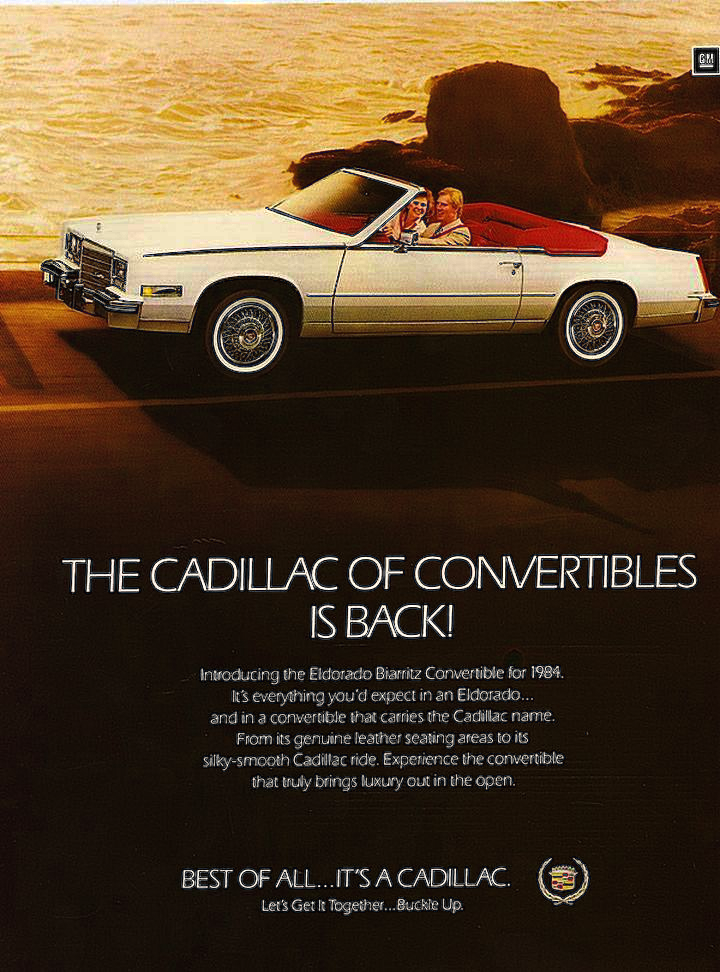
1984 Cadillac Eldorado Biarritz convertible

I originally wrote this post in January 2021. In February 2025, it was substantially updated with much additional amplifying detail—enough to make it a new blog entry.

“… this is one convertible that truly brings luxury out in the open.”

For 1984, Cadillac decided to join the eighties convertible party with a version of the Eldorado Biarritz. With a base price of $31,274 (about $99,900 in today’s dollars), the Eldorado droptop was operating in rarified air. In constant dollars, it was the most costly Eldorado of any type since 1960’s hand-crafted Pininfarina-built Brougham.

The only powertrain available for the 1984 Eldorado convertible was the HT-4100 135 bhp 4.1 liter/249 ci V8 with fuel injection paired with a four-speed automatic. With a curb weight of about 3,900 pounds, 0-60 mph came in around 14 seconds. Fuel economy was rated at 17 city/27 highway by 1984 standards (14/20 by today’s measures). A 20.4-gallon gas tank meant an Eldorado convertible owner could expect a range of between 310 and 360 miles with a 10% fuel reserve.

1984 Cadillac Eldorado convertible advertisement
1984 Cadillac Eldorado Biarritz convertible advertisement

Standard exterior and mechanical equipment on the Biarritz convertible included a power convertible top, power rear quarter windows, car color body side moldings, and P225/70R15 steel-belted radial wide white stripe tires (a size still readily available) on 15-inch wheels with wire wheel discs. Inside, a theft-deterrent system, leather seats, and a leather-trimmed steering wheel rim were standard.

Standard exterior and mechanical equipment on every 1984 Eldorado included Soft Ray tinted glass, front-wheel-drive, a four-wheel independent suspension, power steering, remote mirrors, and four-wheel power disk brakes. Inside, electronic climate control, power door locks, and power windows were all included. Standard audio features included a Delco-GM 2000 stereo with four speakers and a power antenna.

Options & Production Numbers

Options available for the Biarritz convertible included a remote locking fuel filler door ($59), electric power outside rearview mirrors ($101), Twilight Sentinel ($79), cruise control ($185), tilt and telescope steering wheel ($184), a six-way power passenger seat ($380), and a Delco 2000 electronically-tuned AM/FM/cassette stereo radio ($299).

Many significant Eldorado coupe options were not available with the convertible. Some unavailable options included the touring suspension, two-tone paint, the memory seat, and the all-conquering Delco-GM/Bose Symphony Sound System.

Cadillac sold 3,300 Eldorado convertibles in 1984—substantial numbers for such a high-end droptop and well more than the platform-mate Buick Riviera managed to sell in any single year. General Motors ended up having to navigate at least one lawsuit from folks who had purchased the 1976 Eldorado, which Cadillac advertised at the time as “the last convertible.”

There would be no more Eldorado convertibles after the end of tenth-generation Eldorado production in 1985. After a year’s break, the Allanté would debut in 1987 and take convertible Cadillacs into the mid-1990s.

The View From 2025

Badge for 2,500 web hits

Despite their sub-optimal motive power, tenth-generation Eldorados attract collector interest, and there is club support. According to Hagerty’s valuation tools, a 1984 Eldorado convertible in #1/Concours condition is $43,100, with a far more normal #3/Good condition version going for $9,800.

These Eldorados are often available in the Hemmings Motor News classifieds, on eBay Motors, on Bring a Trailer, and at in-person auctions. In January 2025, a Cotillion White 1984 Eldorado convertible with red leather “tufted multi-button” seats sold at Barrett-Jackson Scottsdale for a $11,000 hammer price.

Make mine Autumn Maple Firemist, please.

Other Eldorados I have written about include the 1982 Touring Coupe, the 1986 coupe, and the 1988 coupe. Additional E-body/K-body cars with blog entries include the 1980 Buick Riviera S TYPE coupe, the 1980 Cadillac Seville sedan, the 1982 Oldsmobile Toronado Brougham coupe, and the 1984 Buick Riviera T TYPE coupe.

Last updated August 2025.

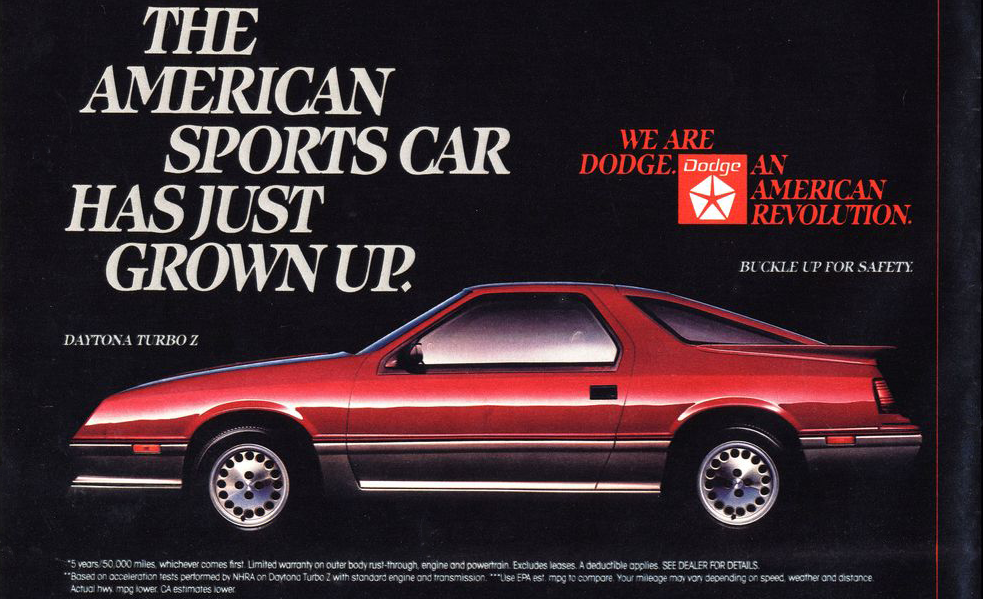
1984 Dodge Daytona Turbo Z hatchback coupe

“The American sports car has just grown up.”

1984 was the first year for Dodge’s Daytona. Built on the K-car platform but with a shorter wheelbase, the Daytona was now Dodge’s sportiest car, upending the Shelby Charger. The Turbo Z was the top-of-the-line of three available Daytona versions.

The Daytona Turbo and Turbo Z‘s standard powertrain was the Turbo I 142 bhp 2.2 liter/135 ci inline four with fuel injection and a turbocharger paired with a five-speed manual transmission. A three-speed automatic transmission was optional ($439). Mileage with the hot setup (turbo and manual) was 20 city/27 highway by the day’s standards (18/25 by 2025 measures), while the 0-60 time was about 8.5 seconds. Moving to the three-speed automatic killed highway mileage, making the ratings 20 and 23. With a 14-gallon gas tank, a five-speed Daytona’s owner could expect a range of 270 to 295 miles with a 10% fuel reserve.

1984 Daytona Turbo Z advertisement

Standard exterior and mechanical equipment on the Daytona Turbo (priced at $10,227 or about $32,400 in today’s dollars) included dual horns, a performance handling package, quick ratio power steering, power brakes, and 195/60R15 Goodyear Eagle GT tires (a size still readily available) on 15-inch cast aluminum wheels. Inside, performance front bucket seats, dual remote power mirrors, a leather-wrapped Sport steering wheel, a center console, and an AM radio with a digital clock were included.

Moving up to Turbo Z ($11,454 or about $36,300 in 2025 dollars) added two-tone paint, a deeper front air dam, extended ground effects, and a specific three-piece rear spoiler.

Options & Production Numbers

Optional equipment included air conditioning ($737), cruise control ($179), tilt steering column ($110), power windows ($185), power door locks ($125), a range of stereos, and a Premium Speaker System ($132). With all the trimmings, a Turbo Z could fairly easily get to $13,200 or so or about $41,800 in today’s dollars—almost exactly what a 2023 Dodge Challenger R/T costs.

Dodge moved almost 50,000 Daytonas in the 1984 model year. The closely related Chrysler Laser actually sold more units in its first two years.

However, Chrysler Corporation must have been disappointed—this was an era where the Chevrolet Camaro, Ford Mustang, and Pontiac Firebird were routinely selling in the hundreds of thousands (the three models combined for 530,000 sold in 1984). By 1987, the Laser would be gone, with the Daytona hanging on through the 1993 model year after a few pretty good years in the late 1980s.

DaytonaLaserSales

Initial reception to the Daytona was good—Car and Driver called it “America’s first legitimate front-wheel-drive muscle car.”

The View From 2025

Daytonas sometimes appear in the Hemmings Motor News classifieds, on eBay Motors, or on Bring a Trailer (BaT has auctioned eleven in the last four years).

Make mine the Red/Silver two-tone, please.

Other sporty Chrysler corporation products I have written about include the 1984 Chrysler Laser hatchback coupe, the 1985 Dodge Shelby Charger hatchback coupe, and the 1985 Dodge Omni GLH hatchback sedan.

Last updated April 2025.

1984 Oldsmobile Ninety-Eight Regency coupe

At the 2023 Mecum Indy, a white Oldsmobile Ninety-Eight Regency coupe with an indicated 6,100 miles sold for $20,000.

1984 would end up being the final year for the rear-wheel-drive Oldsmobile Ninety-Eight—1985 would move the Ninety-Eight to the front-wheel-drive C-body. There were few changes for 1984: the 4.1 liter V6 was dropped (making the 5.0 liter V8 standard), there was a new grille with a crosshatch pattern, and the vertical taillamps now had Oldsmobile emblems in their lenses. Changes in options included different body side mouldings and new wire wheel cover designs.

The Ninety-Eight Regency‘s standard powertrain was the LV2 140 bhp 5.0 liter/307 ci V8 with a four-barrel carburetor mated to a four-speed automatic. Optional everywhere but in California was the LF9 105 bhp 5.7 liter/350 ci diesel V8 ($700). The Ninety-Eight coupe was not quick—with the standard powertrain, 0-60 took about 13.5 seconds in a car with a 3,915-pound curb weight. The diesel was about six seconds slower to 60 mph. Mileage with the gas V8 wasn’t horrible: 17 city/29 highway by the day’s standards (14/21 by today’s measures). With a large 25.1-gallon fuel tank, a Ninety-Eight Regency coupe owner could expect a range of 400 to 465 miles with a 10% fuel reserve.

Coupe page from the 1984 Regency brochure

Standard exterior and mechanical equipment on the $13,974 Ninety-Eight Regency coupe (about $44,900 in 2025 dollars) included Soft-Ray tinted glass, rear fender skirts, sail panel opera lamps, power front disc brakes, power steering, and P215/75R15 steel-belted radial-ply white-stripe tires (a size still readily available) mounted on 15-inch wheels with Bright Deluxe wheel discs. Inside, all Regency coupes included power side windows, power door locks, Four-Season air conditioning, an electric rear window defroster, a digital quartz clock, front and rear centre armrests, and an AM-FM stereo radio with two rear speakers.

Options & Production Numbers

Exterior and mechanical options included an electric sliding glass Astroroof ($1,195), an automatic leveling system, an engine block heater, and puncture-sealing tires. Inside, Custom leather trims in seating surfaces, electronic cruise control with resume and acceleration features ($175), Tempmatic air conditioning ($55), and automatic power door locks were all available. Options that date this car included a front seat litter container and an ETR AM/FM Stereo with seek and scan, digital display clock, cassette tape player, and a 40-channel CB.

Oldsmobile sold 7,855 Ninety-Eight Regency coupes in the 1984 model year, marking the fewest coupes sold in the 10th generation. Though large American coupes in general were fading away, 1985’s all-new front-wheel-drive Ninety-Eight would still offer coupe versions. Despite being all-new, the coupes wouldn’t sell much better in 1985 and would be gone after the end of the 1987 model year.

The View From 2025

There is some collector interest in these cars, though Hagerty does not track their values. Ninety-Eights of this era are often available in the Hemmings Motor News classifieds and at online auctions such as Bring a Trailer that cater to the eighties car market.

Make mine Autumn Maple Firemist, please.

Stunningly, this is the first rear-wheel-drive C-body I have written about, though I have written about the re-designated D-body 1986 Cadillac Fleetwood Brougham sedan. I probably should write about the Electra and the de Ville at some point.

Last updated October 2025.

1984 Buick Skyhawk coupe

“Take flight.”

1984 was the third year for the Skyhawk, Buick’s version of the J-car, and it was little changed, except for the mid-year release of a turbocharged engine. New options included a factory stereo with a graphic equalizer.

The Skyhawk’s standard powertrain was an LQ5 86 bhp 2.0 liter/121 ci inline four with throttle-body fuel injection paired with a four-speed manual. An LH8 84 bhp 1.8 liter inline four with throttle-body fuel injection was $50, but required an upgrade to a five-speed manual ($75). Both engines were available with a three-speed automatic ($395). An LA5 turbocharged version of the 1.8 liter engine with 150 bhp was only available with the T TYPE coupe.

Performance wasn’t exactly scintillating with the two non turbocharged engines, but Skyhawk coupe’s relatively low 2,316-pound weight did help. 0-60 times with the 1.8 liter/five-speed combination were likely in the 12 second range. Fuel economy with the same powertrain was rated at 29 city/46 highway by the day’s standards—today’s measures give a far less impressive 23/33. With a 13.5-gallon gas tank, a Skyhawk owner could expect a range of 340 to 455 miles with a 10% fuel reserve.

Two Skyhawk pages from the 1984 Buick brochure
Skyhawk pages from the 1984 Buick brochure

Standard exterior and mechanical equipment on the $7,133 base Skyhawk coupe (designated as Custom) included manual rack-and-pinion steering, power front disc/rear drum brakes, and P175/80R13 blackwall tires on 13-inch wheels with Deluxe wheel covers. Inside, full carpeting, reclining front bucket seats, a full-length operating console, a Custom steering wheel, and an AM radio were included.

Moving up to the $7,641 Limited (about $24,100 in 2025 dollars and slightly less than a 2025 Buick Encore GX SUV costs) added dual horns, an acoustic package, a Limited steering wheel, and instrument gauges, along with cloth-covered seats and door panels.

Options & Production Numbers

Exterior and mechanical options for the Skyhawk coupe included tinted glass ($95), tungsten-halogen headlamps ($22), and styled aluminum wheels ($229). Inside, Electronic Touch Climate Control air conditioning ($780), manual air conditioning ($630), power windows ($185), and a series of stereo choices ranging up to an electronic tuning AM/FM stereo radio with cassette tape and graphic equalizer ($505) were all available.

1984 marked the Skyhawk’s peak sales year, with Buick producing 75,760 coupes, 45,648 sedans, and 13,668 station wagons. Buick made them through the 1989 model year, by which time sales numbers had dropped to a mere fraction of those in 1984.

The View From 2025

I haven’t seen a second-generation Skyhawk in person in many years. Still, they are sometimes available in the Hemmings Motor News classifieds and at online auctions such as Bring a Trailer that cater to the eighties car market. When I first published this blog entry in September 2022, Hemmings had a 1986 White Skyhawk T-Type hatchback with gray lower accents, silver/black cloth bucket seats, and 10,000 miles for sale for $16,000.

Make mine Silver Metallic, please.

Other J platform cars I have covered in this blog include the 1982 Cadillac Cimarron sedan, the 1988 Cadillac Cimarron sedan, the 1986 Chevrolet Cavalier Z24 coupe, the 1985 Oldsmobile Firenza ES sedan, and the 1984 Pontiac 2000 Sunbird S/E hatchback coupe.

Last updated March 2025.