1980 Chevrolet Camaro Z28 coupe

I saw a white 1980 or 1981 Z28 with blue graphics (I believe the only way you can tell them apart is to get close enough to see the VIN’s length) out driving in June 2014, not once but twice. It wasn’t quite in show condition, but it still looked pretty sharp, and you so rarely see these cars on the road these days. We’ll go with the 1980 version for this post because it had slightly more horsepower.

“The Maximum Camaro.”

For 1980, the aging second-generation Chevrolet Camaro (the title of Car and Driver‘s road test for the 1980 Z28 was a cruelA medieval warrior on the path to a rocking chair“) received some updates, including exterior styling changes and a more powerful engine for the Z28. Not much could be done about the general lack of space efficiency (the EPA rated all Camaros as subcompact cars), the relatively high weight, and the fairly primitive technology.

The standard Z28 powertrain for states other than California was the LM1 5.7 liter/350 ci V8 with a four-barrel Rochester carburetor and 8.2:1 compression matched with a four-speed manual transmission (a three-speed automatic was available for $63). At 190 bhp, this engine had the most horsepower seen in any Camaro since 1974 (sigh). For 1980, Chevrolet engineers added a solenoid-driven air intake to the back of the redesigned hood scoop.

Car and Driver managed to get the 3,660-pound Z28 with the four-speed from 0-60 in 8.5 seconds with a 120 mph top speed. Fuel mileage was predictably bad—14 city/21 highway by the day’s standards. With a 20.9-gallon gas tank, a Z28 owner could expect a range of 270 to 295 miles with a 10% fuel reserve.

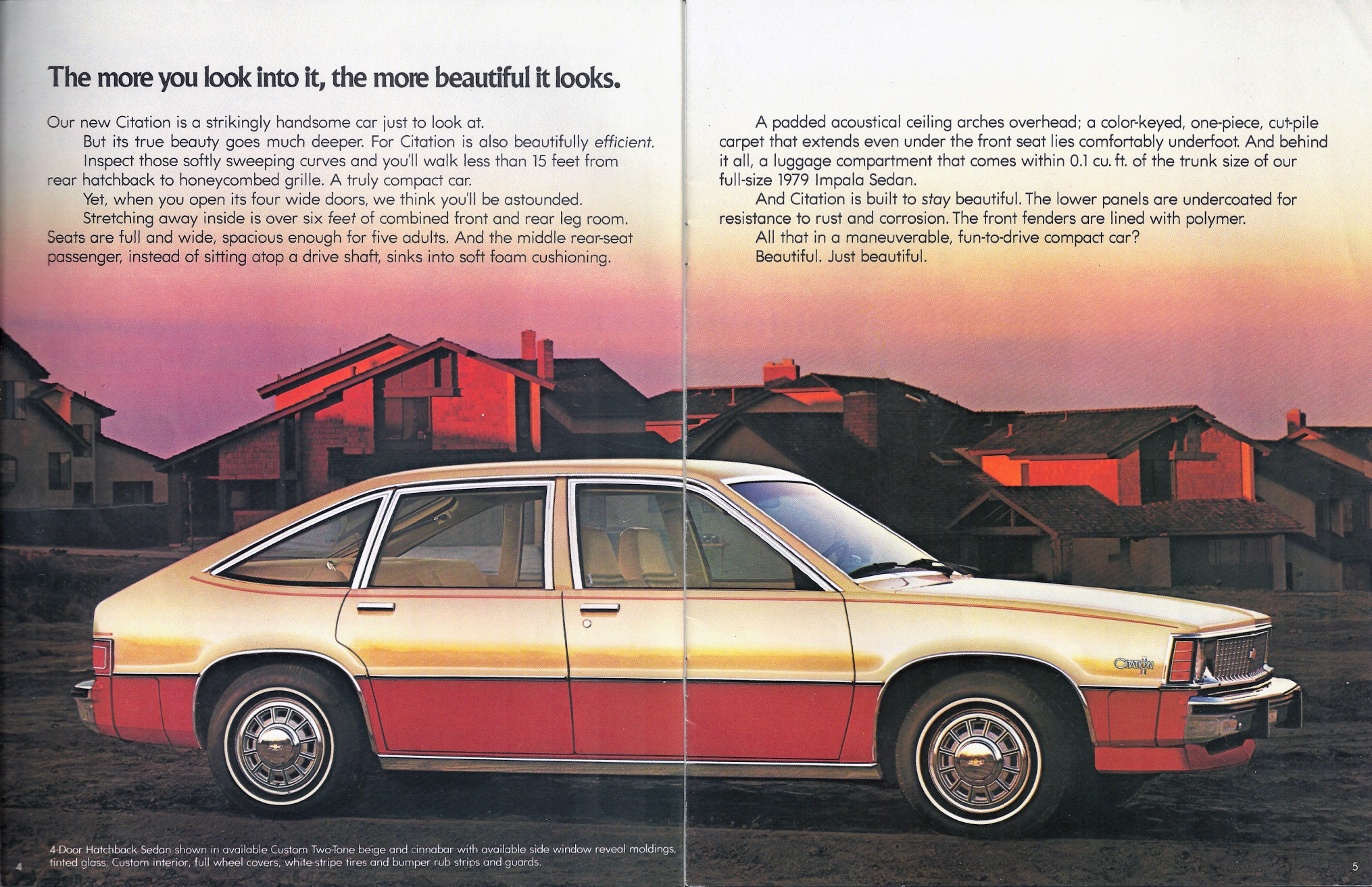
Z28 pages from the 1980 Chevrolet Camaro brochure

The Z28‘s base price was $7,121—about $30,600 in today’s dollars. Standard exterior and mechanical equipment included heavy-duty shocks and springs, body color Sport mirrors, a front air dam, a rear spoiler, and P225/70R15 white-lettered radial tires (a size still readily available) on body-colored 15-inch wheels. Inside, power steering, full gages, center console, cut-pile carpeting, and vinyl bucket seats were standard. No radio of any sort was included, with Chevrolet’s assumption likely being that the average Z28 buyer would look for assistance from Crutchfield and others for their sound.

Options & Production Numbers

External options included 15 x 7-inch cast aluminum wheels ($184), tinted glass ($68), and removable glass roof panels ($695). Inside, you could add air conditioning ($566), an intermittent windshield wiper system ($41), an electric rear window defogger ($107), automatic speed control ($112), power door locks ($93), power windows ($143), a Comfortilt steering wheel ($81), and nine different radios including an AM/FM stereo radio with a stereo cassette player ($272).

Although Z28 sales were good in 1980, they did not match 1979’s numbers. Chevrolet sold 45,137 Z28s in the 1980 model year, making them almost 30% of total Camaro production.

The View From 2025

Badge for 2,500 web hits

Long neglected by the collector market and with most now used up, late second-generation Z28s in good or great shape now get interesting numbers at online and in-person auctions. According to Hagerty’s valuation tools, all the money for a 1980 Z28 with the LM1 motor, the four-speed manual, and T-tops in #1/Concours condition is $60,100. A more normal #3/Good condition version is valued at $23,400. Second-generation Camaros have good club support and are often available in the Hemmings Motor News classifieds, on eBay Motors, and on Bring a Trailer.

Make mine Red, I think. Surprisingly—at least to me—the most popular Camaro color in 1980 was Dark Blue.

Other Camaros I have covered include the 1980 Rally Sport coupe, the 1982 Z28 Indy 500 Commemorative Edition hatchback coupe, the 1984 Sport Coupe, the 1985 IROC-Z hatchback coupe, and the 1986 Berlinetta hatchback coupe.

Last updated August 2025.

1980 Pontiac Sunbird Sport Hatch

“Sunbird offers new thrills for the thrifty.”

1980 was the last model year for the rear wheel drive Pontiac Sunbird, Pontiac’s variant of Chevrolet’s Monza. Initially available in base coupe, sport coupe, and sport hatch (a base hatch was added mid-year, but the wagon was permanently gone), the Sunbird received few changes for 1980.

The standard engine was the LX8 Iron Duke 2.5 liter/151 ci inline four with a Rochester 2SE two-barrel carburetor, making all of 86 bhp. Optional was the LD5 110 bhp 3.8 liter/231 ci V6 with a Rochester M2ME two-barrel carburetor. A four-speed manual was standard, with an optional three-speed automatic available.

Mileage with the inline four and four-speed manual was pretty impressive in 1980: 22 city/35 highway by the day’s standards. Getting decadent by spending $545 for the automatic and the V6 combination took mileage down to 20 city/27 highway. With the V6/automatic transmission pairing and an 18.5-gallon fuel tank, a Sunbird owner could expect a range of 320 to 350 miles with a 10% fuel reserve.

Not much came standard for the $4,371 base price (approximately $18,700 in today’s dollars), especially to our 2025 eyes. Feature highlights for a base Sunbird included a bright grill with park and signal lamps, whitewall tires, Custom wheel covers, and “Sunbird external identification.” Inside, base Sunbirds included tinted windows, vinyl front bucket seats, and a Delco AM radio.

Moving up to the sport coupe ($4,731) or the sport hatch ($4,731) added body color mirrors, “custom” vinyl bucket seats, and various moldings, but was still rather austere. Luxury trim ($195) added cloth seats along with snazzier carpeting and door trim.

A Package, Individual Options & Production Numbers

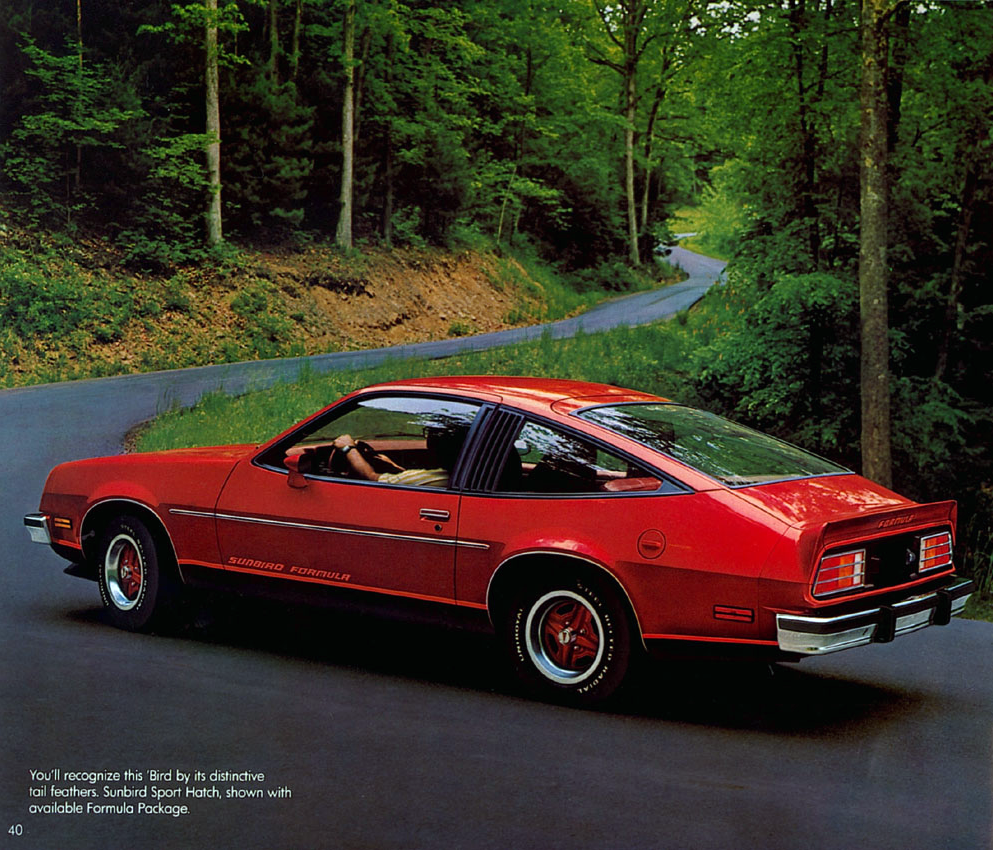
1980 Pontiac Sunbird brochure picture
1980 Sunbird Sport Hatch with the Formula Package

Available only with the sport hatch, the rare (only 1% of production) and expensive ($674, or about $2,900 in today’s dollars) Formula Package added a front air dam and rear spoiler, along with blacked-out grille, and BR70-13 white lettered tires (nearly equivalent 195/70R13 tires are available from BF Goodrich) on 13-inch cast aluminum rally wheels with trim rings. It wasn’t all bark and no bite: the Rally Handling Package was included, with larger front and rear stabilizer bars. Inside, a tachometer and other rally gauges were included. The whole combination meant that a sport hatch with the Formula Package, the V6, and the four-speed manual came to $5,630 (about $24,100 in today’s dollars). The 0-60 time for this top-of-the-line Sunbird was probably around 10 seconds—not far from some versions of the line-leading 1980 Firebird Trans Am.

Individual mechanical options included variable-ratio power steering (the most popular option and required with the V6) and power front disc brakes. Inside, you could add Custom air conditioning ($531), a tilt steering wheel (which required power steering), and an AM/FM stereo cassette player (two different 8-track radios were also still available). A removable sunroof was also available for $193.

The rear wheel drive Sunbird sold well even in its final year, partially because of the extended model year. Almost 188,000 were sold, with over 100,000 being the base coupe, making the Sunbird the best-selling of all the 1980 H-bodies. Pontiac would return partially to the Sunbird name with the 1983 2000 Sunbird convertible version of the J-body—by 1985, the Sunbird name would once again stand alone.

The View From 2025

Badge for 2,500 web hits

Stock Sunbirds of this generation almost never come up for sale in Hemmings Motor News and eBay Motors—they seem to have disappeared entirely despite the fact that Pontiac sold about 480,000 examples over five years. You do occasionally see examples of the “sister” Chevrolet Monza auctioned on Bring a Trailer, but even they are rare.

Make mine Agate Red, please.

Another Sunbird I have written about is the 1984 2000 Sunbird S/E hatchback coupe. I have also written about the 1980 Chevrolet Monza Sport 2+2 hatchback coupe.

Last updated October 2025.

Save

Save

1980 AMC Eagle station wagon

This post was one of the first I wrote for this blog. Substantially revised and updated, it’s now also about twice as long.

“The Eagle has landed … on all fours!”

Essentially (and brilliantly) an AMC Concord with 4-wheel drive, the 1980 Eagle was available in all of the Concord’s body styles, so buyers had a choice between the 2-door sedan, the 4-door sedan, and the 4-door station wagon. The Eagle had a 3-inch taller ride height than the Concord and came with a stone/gravel deflector under the front bumper and 3-inch wide fender flares.

The Eagle came standard with AMC’s 110 bhp 4.2 liter/258 ci inline six with a two-barrel carburetor. A three-speed automatic was the only transmission available to help move the a vehicle with a 3,740-pound curb weight. Car and Driver recorded a 0-60 time of 13.2 seconds. Fuel economy ratings were 16 city/19 highway by the day’s standards. With a 22-gallon gas tank, an Eagle owner could expect a range of 285 to 310 miles with a 10% fuel reserve.

Station wagon page from the 1980 AMC Eagle brochure

The AMC Eagle station wagon’s base price was $7,549—about $32,600 in 2025 dollars or a little over what a 2025 Dodge Hornet GT AWD goes for. Standard exterior and mechanical equipment included pinstriping, power assisted recirculating ball steering, power front disk/rear drum brakes, and P195/75R15 glass belted radial white sidewall tires on 15-inch pressed steel wheels with styled wheel covers. Inside, individual reclining front seats in Sport vinyl, a folding rear seatback, cargo area carpeting and skid strips, and an electronic digital quartz clock were included.

Moving to the Limited trim level (an extra $400 or so) added individual reclining front seats in Chelsea leather or St. Lauren deep plush fabric, a Luxury woodgrain tilt steering wheel, power door locks, an AM radio, and a lockable cargo area storage compartment. The Limited also included Light Group, Visibility Group, Convenience Group, and Protection Group.

One Package, Individual Options, & Production Numbers

Only available with the 2-door sedan and the station wagon, the Sport Package ($299) included high beam halogen headlamps, Sport fog lamps, dual black remote mirrors, and P195/75R15 Goodyear Tiempo steel belted radial black sidewall tires. Inside, Durham Plaid fabric seat trim and a leather-wrapped steering wheel were added. Body pinstriping was deleted, and AMC blacked out everything they could think of—the bumpers (adding nerf strips), the grill, the windshield, the door frames, the lower body moldings (adding 4×4 graphics), the B pillar, the rear liftgate, and the rear taillamp assembly.

Individual options included tinted glass for all windows ($63), air conditioning ($513), cruise control, an electric rear window defroster ($89), and power windows combined with power door locks ($289). Wagon-specific options included woodgrain bodyside panels, a roof rack ($90), and a rear window wiper/washer. An AM/FM multiplex stereo radio was $236.

The Eagle was a significant hit for AMC in 1980, selling over 46,000 units, with the station wagon configuration selling about 56% of that total. AMC would sell them through the 1988 model year for a total of almost 200,000 built.

The View From 2025

AMC Eagles show up with some consistency in the Hemmings Motor News classifieds, on eBay Motors, and on Bring a Trailer. As I update this blog entry in October 2025, there are no 1980 Eagles, but there is a White 1984 station wagon with 141,000 miles for sale on Hemmings, asking $11,900.

Make mine Russet Metallic, please.

Other AMC/Jeep products I have written about include the 1982 Jeep CJ-8 Scrambler pickup truck, the 1983 Jeep Wagoneer Limited SUV, and the 1983 Renault Alliance sedan.

Last updated October 2025