1986 Porsche 944 Turbo hatchback coupe

This post was one of the first I wrote for this blog, and definitely the first on a Porsche. Substantially revised and updated, it’s now also almost 80% lengthier.

“Keeping Up with a Porsche 944 Has Just Gone from Difficult to Impossible”

Porsche released its Turbo version of the 944 for the 1986 model year, marking yet another step in the evolution from the original 95 bhp (!) 924 “nearly a Volkswagen” design, which dated from 1976.

The 944 Turbo featured a turbocharged and intercooled version of the standard 944’s 2.5 liter/151 ci inlin-four that produced 217 bhp. New forged pistons were included, along with a strengthened gearbox and standard external oil coolers for both the engine and transmission.

Despite some major turbo lag, performance was quite good for the mid-1980s: Car and Driver managed to get a 0-60 time of 6.1 seconds and a top speed of 157 mph, though they noted that the base price of almost $30,000 might freeze out some previous 944 customers.

Looks weren’t sharply different from the “civilian” 944, which stayed in production. The nose was somewhat simplified with an integrated front bumper, and the rear had a fairing fitted to clean up the appearance of some underside components. Wheels resembling those on the “big brother” 928 were fitted. The result looked quite good in commercials.

1986 Porsche 944 Turbo print advertisement

Standard exterior and mechanical equipment on the 944 Turbo included fog lights, all around tinted glass, front and rear stabilizer bars, and power steering. Tires were 205/55VR-16 in the front and 225/50VR-16 for the rear, both mounted to 16-inch pressure cast wheels (both tire sizes are still readily available). Inside, a leatherette interior with cloth inlays, a driver seat with electric height adjustment, a 4-spoke leather-covered steering wheel, automatic full climate control, and power windows were included.

Options & Production Numbers

Options included a limited slip differential ($625), 16-inch forged alloy wheels ($516), a central locking system ($263), and a Blaupunkt Monterey digital cassette radio ($657).

The 944 Turbo sold well in 1986—Porsche sold 7,513 in the United States. 1986 would turn out to be the best year for the 944 Turbo—by 1991 the 968 would take over.

The View From 2025

There is excellent club support for the 944 Turbo, as there is for all Porsches. According to Hagerty’s valuation tools, all the money for a 1986 944 Turbo in #1/Concours condition is $70,000, with a more normal #3/Good condition car going for $22,000. I’m seeing 944s at judged car shows, and they maintain a reasonable presence in the Hemmings Motor News classifieds, on eBay Motors, and on Bring a Trailer.

Make mine Guards Red, please.

Other eighties Porsches I have written about include the 1980 911 SC coupe, the 1980 924 hatchback coupe, the 1982 924 Turbo hatchback coupe, the 1982 928 hatchback coupe, the 1985 911 Carrera Cabriolet, the 1986 911 Turbo coupe, the 1987 911 3.2 Carrera coupe, and the 1988 944 hatchback coupe.

Last updated August 2025.

1984 Nissan/Datsun 300 ZX hatchback coupe

“Every move you make, every turn that you make confirms you are in the most technologically advanced Z car ever made.”

This Nissan/Datsun 300 ZX is not the generation with most of the glamor—that 300ZX was the one that followed in the 1990s. For 1984, Nissan moved from the inline 6 of the 280-ZX to a 3.0 liter/181 ci V6 with fuel injection, available either naturally aspirated (160 bhp) or turbocharged (200 bhp). The styling was completely and controversially revised for the first time in the history of the Z car—a massive revision akin to that of the Chevrolet Corvette for the same year.

Car and Driver recorded a 0-60 time of 7.3 seconds in a Turbo with the four-speed automatic. Fuel economy with the same powertrain was 19 city/28 highway by the day’s standards (15/20 by 2025 measures). With an 18.5-gallon gas tank, 300 ZX Turbo owner could expect a range of 295 to 390 miles with a 10% fuel reserve.

1984 Nissan 300 ZX advertisement

Standard exterior and mechanical equipment on the well-equipped $15,800 300 ZX (about $50,700 in 2025 dollars or almost what a 2026 Nissan Z Performance starts at) included blue tinted glass windows, a fully automated motorized antenna, pop-up halogen headlights, ventilated four-wheel power disc brakes, power rack-and-pinion steering, and P215/60R15 tires (a size still readily available) on 15-inch alloy wheels. Inside, an eight-way manually adjustable driver’s seat, power windows, tilt steering column with memory, air conditioning, and a 40-watt AM/FM stereo with electronic digital display, scan tuning, a cassette deck with Dolby noise reduction, and four speakers were standard.

At $18,200, the 300 ZX Turbo added three-way adjustable shock absorbers, headlight washers, an oil temperature gauge, and a turbo boost gauge—in addition to the turbo engine itself. The Turbo also had different wheels, tires, and final drive ratios.

Packages, Options, & Production Numbers

The 300 ZX to have in 1984 was undoubtedly the 50th Anniversary Edition (released to celebrate Nissan’s half-century) which was an absolutely loaded turbocharged model with a Light Pewter Metallic and Thunder Black color scheme. All Anniversary Editions came equipped with flared front and rear fenders, Bodysonic bass speakers in the seats (individually adjustable for driver and passenger from the console), a T-bar sun roof with removable mirrored glass panels and fitted storage pockets, black leather bucket seats, and Pirelli P7 225/50VR16 low-profile tires (a specific tire still available) on 16-inch aluminum alloy wheels. Other equipment included a digital dash with MPG and compass readouts and steering wheel controls for the cruise control and the radio. Nissan even included a fitted car cover.

The only option available on the Anniversary Edition was the choice of a five-speed manual transmission or a four-speed automatic transmission. 5,148 out of the 75,351 (!) 1984 300ZXs produced for the US market were Anniversary Editions at a non-trivial list price of $26,000 (about $83,400 in 2025 dollars).

“Normal” 300 ZX coupes had few individual options beyond a T-bar sun roof with removable glass panels and fitted storage pockets. The Leather Package included leather bucket seats (natch!), an eight-way adjustable power driver’s seat with six power functions, an electronic instrument display, a leather-wrapped two-spoke steering wheel, and an 80-watt AM/FM stereo with electronic digital display, automatic program search display, memory presets, an auto-reverse cassette deck with Dolby noise reduction and metal tape compatibility, and eight speakers.

The View From 2025

According to Hagerty’s valuation tools, a base 1984 300 ZX in #1/Concours condition is $35,700, with a far more typical #3/Good car going for $9,600. Values for the Anniversary Edition are well more—about $58,600 for the very best. 300 ZXs make regular appearances in the Hemmings Motor News classifieds, on eBay Motors, and on Bring a Trailer, though you sometimes have to be careful to check under both Datsun and Nissan. As I update this blog post in December 2025, there’s a 50th Anniversary Edition with 55,000 miles for sale in Hemmings, asking $37,000.

Make mine Wine Metallic, please. Dark Green Metallic tempted me, but it’s believed that only one 300 ZX was painted in that color.

Other Datsuns and Nissans I’ve written about include the 1980 200-SX coupe, the 1980 280-ZX hatchback coupe, the 1981 810 Maxima sedan, and the 1989 Maxima sedan.

Last updated December 2025.

Save

Save

1988 BMW 750iL sedan

“Enter into a new world.”

BMW’s M70 V12, courtesy of Sv650k4 from the Wikimedia Commons.

After a year in production with just the straight 6, the second generation of BMW’s top-of-the-line 7-series sedan got a V12 option in 1988. This engine, designated M70 and BMW’s first production V12, used Bosch Motronic M fuel injection and made a fairly effortless 296 bhp from its 5.0 liter/304 ci size.

The late eighties were back when BMW’s number and letter designations still meant something, so the breakout of the 7-series with the V12 was this:

7 – series
50 – 5.0 liters
i – fuel injected
L – long wheelbase

1988 BMW 750iL advertisement

The 750iL’s eye-popping base price was $69,000—about $193,300 in 2025 dollars, and 55% more than a 2026 760i xDrive sedan goes for. For all that money, the purchaser got almost every piece of equipment BMW could put in the car. Exterior and mechanical features included a ZF four-speed automatic, four-wheel anti-lock disc brakes, traction control, ZF’s Servotronic power steering, a self-leveling rear suspension, and Pirelli P600B 225/60VR-15 tires (a size still somewhat available) on 15-inch wheels. Inside, a driver’s side airbag, a trip computer, dual-zone air conditioning, and leather seats were all standard.

Options, Performance, & Period Reviews

Beyond this, there were a few options available; one was a limited-slip differential. In addition, the buyer of a 750iL was paying the dreaded $1,850 gas guzzler tax—the original EPA estimate was 12 city/17 highway (the modern equivalent would be 11 city/16 highway). With a capacious 27-gallon fuel tank, a 750iL owner could expect a range of 330 to 350 miles with a 10% fuel reserve.

I remember being in one of these cars when it was new, and I felt that it accelerated like a Learjet: weighing in at about 4,235 pounds, it still could do 0-60 mph in about 7.5 seconds and hit 155 mph—respectable sports car numbers in the late 1980s. At the time, Car and Driver called it “the sedan of choice when money is no object.”

The View From 2025

Like many BMWs, the 750iL does attract collector interest, and there is support from BMW car clubs. Maintenance costs can be daunting, and Hagerty does not track the 750iL—perhaps because they rarely trade hands. 750iLs do occasionally appear for sale in the Hemming’s Motor News classifieds, on eBay Motors, and on Bring A Trailer.

Make mine Salmon Silver, please, though Diamond Black also has its attractions.

I have also written about the 1982 733i sedan. Other BMWs I have written about include the 1983 633CSi coupe, the 1984 325e coupe, the 1985 535i sedan, the 1987 L6 coupe, the 1987 M6 coupe, and the 1988 M3 coupe.

Last updated August 2025.

On What Cars Become Collectible

Hemmings Motor News is keeping me busy this week. Today, one of the articles in their Hemmings Daily blog asks “Will some cars never be collectible?” [emphasis added] At the top of the article is a picture of (of course) a car of the 80s—in this case, it is a 1980 Oldsmobile Omega.

It is an interesting thought. I own an eighties car that is at least somewhat of a collector car—a 1985 Corvette. There has always been aftermarket support for my car, and there is increasing restoration support for it, though very little existed ten years ago. At the various times in the Corvette hobby, there has been heated discussion on what defines a collectible Corvette. Once the cutoff year was 1962 because the Sting Rays were “just used cars.” Then, the cutoff year was 1967, because the sharks were “too new to be judged.” After that, the cutoff year was 1982, because the C4s were “late model” Corvettes. You get the idea—rinse, repeat.

Of course, it depends on what you mean by collectible. I wrote last month about seeing a lovingly preserved/restored first generation Chrysler minivan at a fairly serious local judged show. I’m not sure that a minivan is collectible (though I do think they were significant) but I am sure that I like seeing one in beautiful shape and I am happy that the AACA has provision for judging them once they hit 25 years old.

I think one of the things that makes seeing the not easily defined cars really cool is the degree of difficulty. I know that the folks who restored that Chrysler minivan didn’t have access to the wide range of suppliers that I do and I know that there isn’t (for example) a Minivans at Carlisle show for them to search for parts.

So here’s what I’ll say: every older car that is lovingly restored by its owner is collectible (at least to she or he). There may not be a big market for the results, but, in the end, one more car from a particular era has been saved.

By the way, there is an X-car for sale in Hemmings Motor News as I write this, so folks are at least trying to sell them. It is not a 1980 Oldsmobile Omega, but rather a 1983 Buick Skylark T-Type with 112,000 miles going for $5,000.

1982 Pontiac Firebird Trans Am hatchback coupe

“From saber-like nose to rakish tail, the Trans Am is a brilliant orchestration of aerodynamic function.”

It is hard now to remember how new and wildly aerodynamic the 1982 Pontiac Firebird Trans Am looked when it debuted—Car and Driver wrote that its “exterior sculpturing is an absolute knockout.” The Trans Am suddenly made every other American car (and more than a few European ones) look like they were standing still.

The Trans Am didn’t just look aerodynamic, either: the drag coefficient of .323 is still respectable even in 2025. Pontiac’s choice of pop-up headlights (over the Camaro’s open headlights) and careful airflow tuning yielded an impressive result. According to Autopolis’ excellent article on the 1980-1981 Turbo Trans Am, the third-generation Trans Am’s distinctive hood bulge was intended for a turbocharged V8.

Unfortunately, the mechanicals did not come close to backing up the looks. The top-of-the-line engine for the Trans Am was the LU5 Cross-Fire 165 bhp 5.0 liter/305 ci V8 with throttle-body fuel injection—and that was only available with a three-speed automatic transmission, yielding about a nine-second zero to sixty time (Motor Trend managed to do it in 8.89 seconds). If you wanted the four-speed manual transmission, the best engine choice available on the Trans Am was the base LG4 145 bhp 5.0 liter/305 ci V8 with a four-barrel carburetor—and approximately ten seconds from 0 to 60 mph.

These performance challenges, however, did not prevent Pontiac from implying the world in its commercials for the Trans Am—and having Richard Basehart do the narration.

Standard exterior and mechanical equipment on the $9,658 Trans Am (about $33,500 in today’s dollars) included power brakes (front disc/rear drum), hidden electronically-controlled halogen headlamps, dual sport mirrors, an all-glass rear hatch, a rear decklid spoiler, and 205/70R14 steel-belted radial tires (still a readily available size) on 14-inch turbo cast-aluminum wheels. Inside, reclining front bucket seats, a folding rear seat, a Formula steering wheel, and side window defoggers were included.

Options & Production Numbers

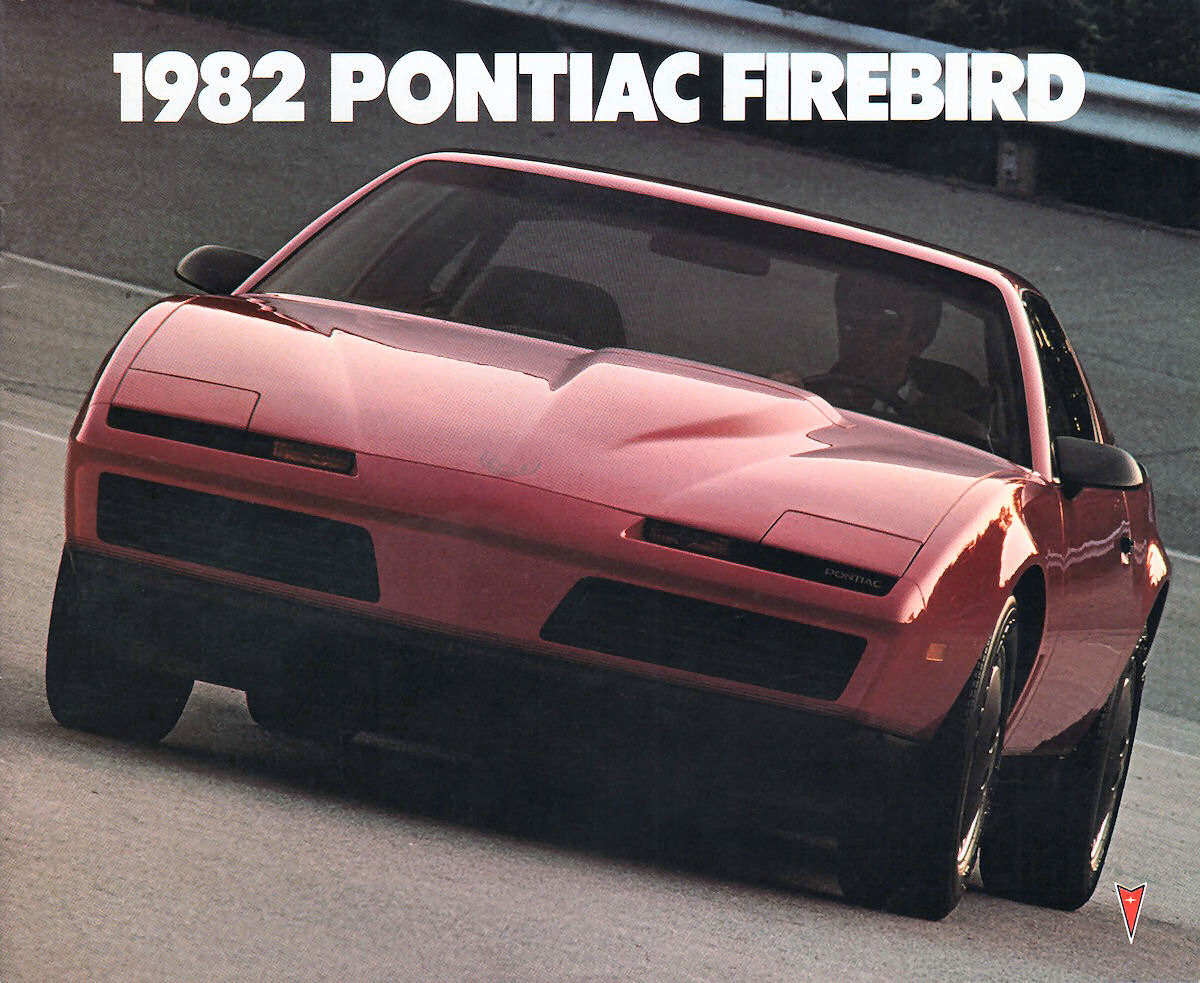
Cover of the 1982 Pontiac Firebird brochure

Options included a special performance package ($387 bought you the special handling package, four-wheel disc brakes, and 215/65R15 blackwall tires on 15 x 7 aluminum wheels), tinted glass, a rear hatch washer/wiper, power windows ($165), power door locks ($106), a tilt steering wheel ($95), and air conditioning ($675).

Pontiac sold 52,962 Trans Ams in the 1982 model year, with 2,000 of those having the Recaro package.

The View From 2025

Third-generation Firebirds have a strong following, and 1982 Trans Ams appear regularly in the Hemming’s Motor News classifieds, on eBay Motors, and on Bring a Trailer. According to Hagerty’s valuation tools, a 1982 Trans Am with the Cross-Fire engine, the Recaro package, and T-tops in #1/Concours condition is $34,600, with a more normal #3/Good base Trans Am going for $9,800.

Please make mine Black, but I think I’d hold out for the 1983 version and its five-speed manual transmission/190 bhp L69 HO engine combination.

I evidently can’t help myself with eighties Trans Ams; I’ve written about the 1981, the 1984, the 1985, and the 1989 Turbo. I have also written about the 1986 SE and the 1987 Formula, but I probably should write about the base car at some point.

Last updated November 2025.

1986 Pontiac Fiero GT coupe

While I was out on the highway in my 1980s car in September 2013, I saw a Pontiac Fiero coming up quickly from behind.

You just didn’t see that many Fieros on the road in 2013—the youngest of them was over 25 years old. This one was red, and I believe it was a 1987 or 1988 base coupe—the dead giveaway is that it did not have the black bumper pads but otherwise had the debut Fiero 2M4 look. I gave the driver of the Fiero a thumbs-up, he gave me a wave, and we went our separate ways.

“One red-hot with everything, to go.”

The Pontiac Fiero came to market in 1984 with ridiculous expectations brought on partially by Pontiac and partly by how the public sees two-seat mid-engine cars. What had initially been designed as a somewhat sporty commuter car became a significant part of Pontiac’s We Build Excitement strategy.

At this point, the painful fact that the Fiero’s mechanical parts were from the low end of the General Motors parts bin became stunningly obvious. Citation and Chevette suspension parts abounded, and the only available engine was the distinctly uninspiring 2.5 liter/151 ci Iron Duke inline four with fuel injection, featuring all of 92 bhp. Predictably, handling and acceleration did not meet expectations.

By 1986, Pontiac had gone a long way toward fixing some of the underlying issues. The L44 2.8 liter/173 ci V6 was made available in 1985, its 140 bhp and multi-port fuel injection both major upgrades. In 1986, the fastback GT body style was added, and a five-speed manual transmission became available for the V6, though only late in the model year. With that powertrain, 0-60 came in a little under eight seconds. Mileage in the 2,500-pound car wasn’t bad, either—18 city/28 highway by the day’s standards (16/26 by today’s measures). With the Fiero’s small 10.2-gallon gas tank, range was between 195 and 210 miles with a 10% fuel reserve.

Pages from the 1986 Pontiac Fiero GT brochure

Standard exterior and mechanical equipment on the $12,875 GT (about $38,200 in 2025 dollars) included retracting halogen headlamps, Soft Ray glass, and P205/60R15 front and P215/60R15 rear tires (both sizes still readily available) on 15-inch diamond-spoke wheels. Inside, reclining bucket seats, a full length console, side window defoggers, and a Delco-GM ETR AM/FM stereo with seek, scan, auto reverse cassette, and clock were included.

The fastback GT was a striking car—the flying buttresses in the rear and aero nose in front substantially changed the look of the Fiero. I liked the base design more at first, but the fastback has grown on me over time.

Options & Production Numbers

Options included air conditioning ($750), power windows, intermittent windshield wipers, tilt steering wheel, and a rear spoiler.

Pontiac sold 17,660 Fiero GTs in the 1986 model year, making it a successful brand extension.

The View From 2025

According to Hagerty’s valuation tools, a 1986 Fiero GT in #1/Concours condition is $20,500, with a more common #3/Good condition car going for $6,800. Fieros have a good club following and a fairly strong presence in Hemming’s Motor News classifieds, on eBay Motors, and on Bring a Trailer. As I update this blog entry in August 2025, there’s a White 1986 Fiero GT with 99,000 miles for sale on Hemmings, asking $18,000.

Make mine Bright Red, please.

Other mid-1980s Pontiacs I have written about include the 1984 Fiero coupe, the 1984 Firebird Trans Am 15th Anniversary Edition hatchback coupe, the 1984 2000 Sunbird S/E hatchback coupe, the 1985 Firebird Trans Am hatchback coupe, the 1985 Grand Am coupe, the 1986 Firebird SE hatchback coupe, and the 1987 Firebird Formula hatchback coupe.

Last updated August 2025.

Save

Save

Save

Save

Save

1985 Ferrari Testarossa coupe

When it debuted for the 1985 model, the Ferrari Testarossa had big shoes to fill—it replaced the undeniably beautiful Berlinetta Boxer, which itself had replaced the undeniably beautiful Daytona.

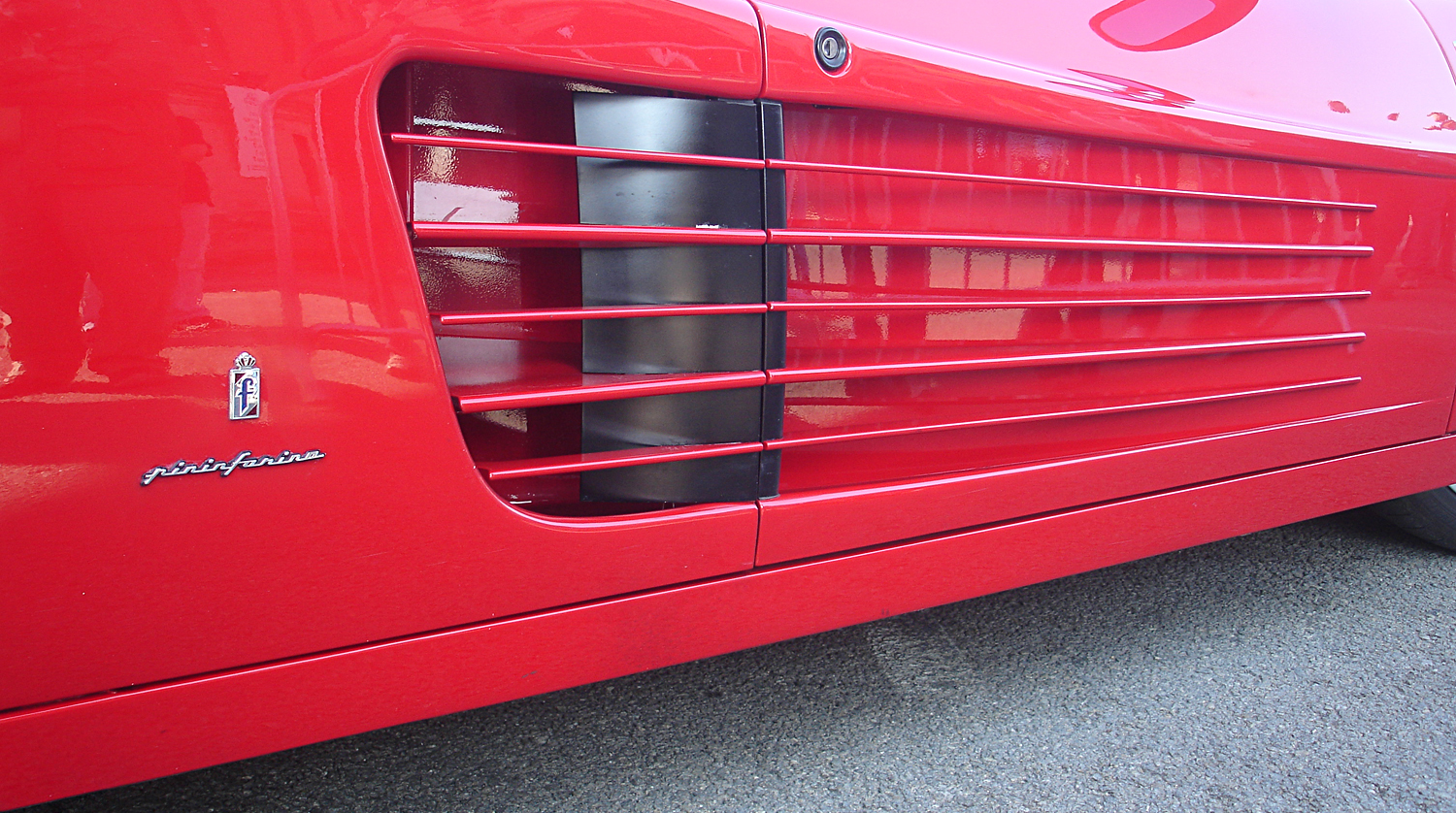
testarossaintake
Close up of the “cheese grater” side strakes on the Ferrari Testarossa.

Sergio Pininfarina’s styling for the Testarossa was not undeniably beautiful, but it definitely was striking. The defining feature was the side strakes covering the radiator intakes, often referred to as “cheese graters.”

The strakes were at least functional, feeding the two side radiators that cooled the Bosch K-Jetronic port fuel-injected 4.9 liter/302 ci 380 bhp flat 12 cylinder engine—crazy power for the mid-1980s. Mileage (not that the target market cared) was flat-out awful10 city/15 highway by the day’s standards (9/14 by today’s standards). At least the 30.4-gallon gas tank meant you could go around 315 to 340 miles before looking for more fuel.

The Testarossa was a Ferrari that reflected the times—it was big (almost six inches wider and 200 pounds heavier than the Berlinetta Boxer it replaced) and flashy. It was also pricey; at $90,000 and up (over $272,000 in 2025 dollars), four times as expensive as a 1985 Corvette (not that too many buyers were cross-shopping the two). You did get at least a little comfort for your money—air conditioning, power seats, and power windows were all standard.

There continues to be disagreement over how good a car—or, more importantly, how good a Ferrari—the Testarossa was. It was undoubtedly fast: 0-60 came in 5.2 seconds, and top speed was about 180 mph.

The View From 2025

There is strong club support for the Testarossa, as there is for all Ferraris. According to Hagerty’s valuation tools, all the money for a 1985 Testarossa in #1/Concours condition is $253,000, with a more “normal” (if any Ferrari can be normal) #3/Good condition car going for $106,000. You see them advertised in the Hemming’s Motor News classifieds, though often it’s a notice of an auction. Bring a Trailer also auctions a reasonable amount of Testarossas.

Make mine that same Rosso Corsa, with the tan interior. My ex-wife prefers the “Miami Vice” white, but I think Testarossas (along with many Ferraris) left our list forever when she found out that you or your very expensive mechanic have to remove the engine from the car to do a “major service” every five years or 30,000 miles.

Other eighties Ferraris I have written about include the 1983 Berlinetta Boxer 512i coupe and the 1985 308 GTB Quattrovalvole coupe.

Updated in March 2025.

Who Saves These Cars?

I was walking around a local auto show in August 2012, and I came across a near-perfect early Chrysler minivan.

Photo of a first-generation Chrysler minivan at a car show in New Hope, PA.
First-generation Chrysler minivan at a car show in New Hope, PA.

The Antique Automobile Club of America (AACA) has what I think is a wonderful rule—if a vehicle is 25 years old, it can be shown and judged. Period. No cut-offs because of importance or beauty or rarity or anything else.

I would argue that the first-generation Chrysler minivans were actually very important—the first of 15 million sold over the last forty years, but that’s not the point here.

What’s interesting is that almost all of these minivans led unglamorous family or corporate lives and got “used up,” and this one looks virtually untouched. It’s a labor of love bringing one of these cars up to show quality: there’s no aftermarket providing restoration parts like there is for Mustangs, Corvettes, or Porsches of the same age. Methinks there’s a lot of chasing around junkyards and perhaps a donor vehicle or two.

Save

A First Post For Yet Another Car Blog …

I grew up in the early 1980s, graduating high school in 1986. Almost all cars from the 1980s are unfashionable right now: they are electronically primitive, squarely styled, and most of them have fallen apart.

I love these cars.

They can be frustrating, but they were markers that things were getting better after the rather frightening 1970s: auto makers were finally learning how to build systems that could yield decent mileage, good emissions, and respectable performance. Aerodynamics were actually becoming more than an afterthought and every year brought some more improvements.

This blog will take a sometimes random look at cars of the 1980s and why they are interesting or notable. I may not publish every day, but I will make an effort to update often.