1987 Chevrolet Caprice Classic coupe

For somewhat unclear reasons, this was my most popular post on this blog for several years. Because of this, I updated it about five years ago to reflect both changes in my posting style and substantial improvements in available data.

“… the personal flair of a distinctive coupe.”

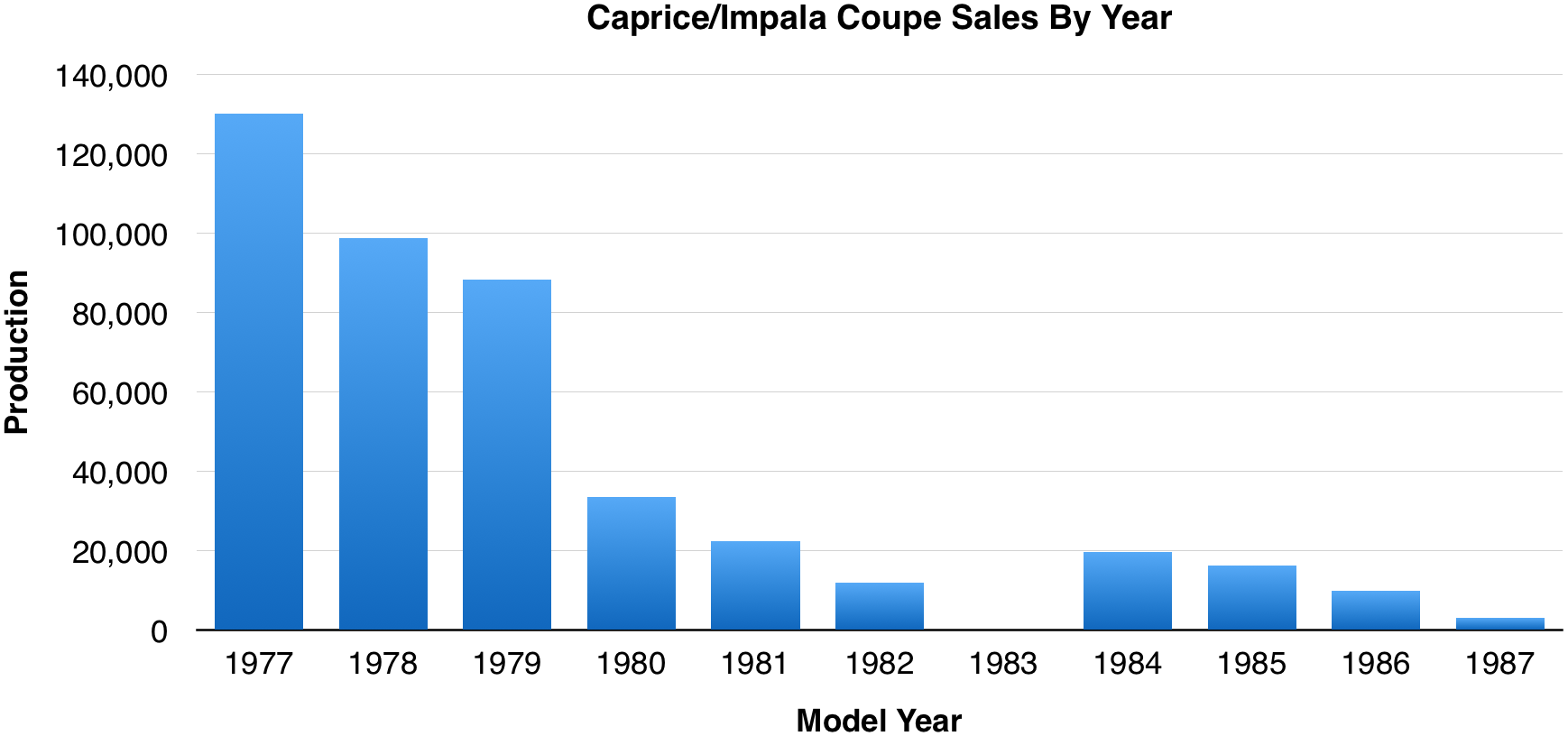
ChevroletCoupeSales

1987 was the final model year for Chevrolet’s Caprice Classic coupe, with only 3,110 made. Beginning in 1988, the Caprice would soldier on with just the sedan and wagon, as the once very popular big American coupes continued to lose favor.

The standard power team on the coupe (and sedan) was the LB4 140 bhp 4.3 liter/262 ci V6 with throttle-body fuel injection and a three-speed automatic transmission. Mileage was rated at 18 city/23 highway by the day’s standards (16/22 by modern measures).

Optional power was the LG4 165 bhp 5.0 liter/305 ci V8 with a four-barrel carburetor paired with a four-speed automatic transmission (I see what you did there, Chevrolet). In 1987, this combination was rated at 18 city/25 highway (16/23 by 2025 standards). With a large 25-gallon fuel tank, you could reasonably expect a comfortable range of about 440 to 480 miles with a 10% fuel reserve—impressive for a 3,600-pound full-size car back then. Even with the V8, these cars were not fast—0-60 came in about 10.5 seconds.

Coupe pages from the 1987 Chevrolet Caprice Classic brochure

Standard equipment for the $11,392 coupe (about $33,000 in today’s dollars) included power steering, power brakes, halogen headlights, and P205/75R15 all-season radial tires (a size still readily available) on 15-inch wheels. Inside, a full-width cloth bench seat, Quiet Sound Group, and an AM radio were standard.

Optional equipment included air conditioning ($775), cruise control ($175), power door locks ($145), power windows ($210), power seats ($240 each), power trunk opener ($50), a 50/50 split-front seat ($195), and AM/FM stereo cassette with graphic equalizer ($435).

Flights of Fancy

I have fun sometimes (often?) building a “unicorn” configuration for these old cars. When I was working at the local Chevrolet dealership in the mid-eighties, I dreamed up a Caprice S. Here’s what optional equipment it would have required, all still available in 1987:

  • F41 Sport Suspension (includes a rear stabilizer bar, 15-inch by 7-inch wheels, and sportier shock absorbers)
  • LG4 5.0 liter/305 ci V8
  • P225/70R-15 tires
  • Sport wheel covers
  • Limited slip differential
  • Performance axle ratio
  • Heavy-duty cooling
  • Dual power Sport mirrors
  • Special instrumentation/gauge package

So, a “John-configured” coupe would have listed for at least $15,096—real money in 1987 and about $43,700 in 2025 dollars. A desperate product planner might have tried to get the leather seats from the Brougham available in the Coupe and maybe scored some black wall tires, but that’s another story …

The View From 2025

Badge for 2,500 web hits

These big and (I think) handsome coupes occasionally appear in the Hemmings Motor News classifieds, on eBay Motors, and on Bring a Trailer. However, Hagerty’s valuation tools do not track Caprice Classic values between 1975 and 1991.

Make mine Silver Metallic, please, though I’m tempted by the Black/Medium Gray Metallic two-tone.

Other B-platform cars I have written about include the 1983 Chevrolet Caprice Classic sedan, the 1985 Chevrolet Caprice Classic station wagon, and the 1982 Oldsmobile Delta 88 Royale coupe.

Last updated April 2025.

1982 Jaguar XJ-S H.E. coupe

“Never has a more exciting car been offered with so much, to so few.”

Significantly changed for 1982 (there was no 1981 XJ-S), the Jaguar XJ-S received a substantially updated H.E. 5.3 liter/326 ci fuel-injected V12 engine with higher compression, upping horsepower to 263 bhp and increasing efficiency. The other end of the powertrain remained a three-speed automatic transmission sourced from General Motors.

Performance was quite respectable for the almost 4,000-pound coupe: 0-60 in about 8.0 seconds. Despite the efficiency upgrades, mileage remained what you might expect from a V12—14 city/22 highway by the day’s standards (13/20 by today’s measures). A 24-gallon gas tank meant that an XJ-S owner could expect a range of between 355 and 385 miles with a 10% fuel reserve.

XJS
Jaguar XJ-S coupe

With its flying buttresses in the rear, the basic XJ-S exterior design from 1976 was nothing if not distinctive. Standard equipment included power-assisted rack and pinion steering and four-wheel power disk brakes. 15-inch five spoke cast aluminum-alloy wheels were paired with Pirelli 215/70VR15 tires (a size still readily available).

Inside, the buyer received air conditioning with automatic temperature control, leather seats, power windows, power mirrors, intermittent windshield wipers, cruise control, and an AM/FM stereo cassette with Dolby and metal tape capability. Burl elm on the dashboard and door panels was a new addition to the still somewhat cramped interior for 1982.

There were no options—probably a good idea in a car that used a six-year-old design and cost $32,100 (about $109,700 in today’s dollars). The approximately 3,100 buyers for the 1982 model year picked their exterior color, and that was it.

The View From 2025

The Jaguar XJ-S has good club support, and there are some restoration parts available. There’s also a free 738-page (!) ebook written by an XJ-S H.E. owner named Kirby Palm which features much hard-earned advice. Keeping an XJ-S at 100% is non-trivial—as it is with so many high-end eighties cars. Current discussions in the XJ-S portion of the Jag-lovers forums are replete with transmission issues, brake system replacements, gas tank challenges, and ECU problems.

Like all Jaguars, the XJ-S H.E. has a following and frequently appears in the Hemming’s Motor News classifieds, on eBay Motors, and on Bring a Trailer. According to Hagerty’s valuation tools, all the money for a 1982 XJ-S H.E. in #1/Concours condition is $54,800, with a far more typical #3/Good car going for $13,900.

Make mine Racing Green Metallic, please.

Two other eighties Jaguars I have written about are the 1983 XJ6 sedan and the 1989 XJ-S convertible.

Last updated March 2025.

1989 Nissan Maxima sedan

Familiar and comfortable with things Japanese at least partially from his time serving in the occupation forces following World War II, my grandfather purchased a couple of first Datsun and then Nissan Maximas over the years. When Nissan announced the new and much sportier third-generation version of the Maxima for the 1989 model year, I (firmly convinced of my twenty-year-old hipness) assumed that he would not purchase one. I was wrong: within a year, my grandfather was driving one of those new Maximas with the “4DSC” logo (an abbreviation for “4-Door Sports Car”) on a side window—an at least somewhat instructive lesson for this young man.

“Big enough to hold a meeting. Fast enough to keep it short.”

New for 1989, the third-generation Nissan Maxima was a significant change toward a more sporty image and reality, with attractive new styling and an independent rear suspension. I remember wondering if they had moved too far away from their previous conservative designs for their market. They hadn’t—the 1989 Maxima got good reviews and sold quite well, despite the elimination of the station wagon version.

The Maxima’s engine, a version of Nissan’s VG30E 3.0 liter/181 ci multi-port fuel-injected V6 (closely related to the standard powerplant in the Nissan 300ZX), was slightly upgraded for 1989 to 160 bhp and 182 lb.ft of torque.

As they had in previous years, Nissan sold two differentiated Maxima models for 1989: the luxury-oriented GXE and the significantly more sporty SE.

Standard exterior and mechanical equipment for the $17,499 (about $47,000 in today’s dollars) GXE included rack and pinion steering, keyless entry (a GXE-only feature), and 205/65R15 tires (a size still readily available) on 15-inch alloy wheels. Inside, you got air conditioning, cruise control, power windows, power door locks, and a rear window defogger. Fuel economy with the standard four-speed automatic transmission was decent at 19 mpg city/26 highway by the day’s standards on premium gasoline (17/24 by today’s measures). With an 18.5-gallon fuel tank, a GXE owner could expect a range of between 340 and 375 miles with a 10% fuel reserve.

Cover of the 1989 Nissan Maxima brochure

Moving to the $18,549 SE added a five-speed manual transmission (the four-speed automatic was optional on the SE), four-wheel disc brakes, wider wheels, and a spoiler, along with stiffer springs and sway bars. Inside, a moonroof, a Bose stereo, a leather steering wheel, and white-faced gauges with black markings were all included. With the five-speed, 0-60 mph came in a little under 9 seconds, and fuel economy (also on premium gasoline) was 20 city/26 highway by the day’s standards (18/24 by 2025 measures).

Options available for the Maxima included a sonar suspension system that adjusted damping based on road conditions, a fairly primitive heads-up display, and anti-lock brakes (SE only).

The View From 2025

People seem to remember these cars with affection, and I (and others) think the exterior styling has aged rather well, but I don’t see a lot of collecting, at least not yet. Third-generation Nissan Maximas only occasionally show up in the Hemming’s Motor News classifieds—you do see them a little more often on eBay Motors and Bring a Trailer.

Make mine my grandfather’s Winter Blue Metallic, please.

I have also written about the ur-Maxima—the 1981 Datsun 810 Maxima sedan.

Last updated August 2025.

1986 Chevrolet Camaro Berlinetta hatchback coupe

“Elegance With a Technical Touch.”

1986 was the last model year for the Berlinetta semi-luxury version of Chevrolet’s Camaro, and they were by far the rarest of the three Camaro types available. With only 4,579 Berlinettas built in 1986, Chevrolet sold more than eleven times as many IROC-Zs alone. There were few changes for the 1986 Berlinetta—among them the appearance of the federally mounted center high-mounted stop lamp, new colors, updated interiors, and a new automatic closure for the large and heavy rear hatch.

The base powertrain for the Berlinetta was the LB8 135 bhp 2.8 liter/173 ci multi-port fuel-injected V6 with a five-speed manual transmission. Optional power was the $450 LG4 155 bhp 5.0 liter/305 ci V8 with a Rochester Quadrajet four-barrel carburetor, which was paired with a $425 four-speed automatic transmission (the five-speed manual was not available with the V8 on the Berlinetta).

Fuel economy with the base powertrain combination was 17 city/26 highway by the day’s standards (15/24 by modern measures). Moving up to the V8 dropped mileage ratings only slightly—to 17/25, and reduced the 0-60 mph time to a respectable 9 seconds in a car that weighed approximately 3,065 pounds. With a 16.2-gallon fuel tank (for some reason 0.7 gallons larger than with the V6), a V8 Berlinetta owner could expect a range of 275 to 305 miles with a 10% fuel reserve.

Your $11,902 base price (about $35,400 in today’s dollars) bought standard mechanical and exterior equipment including power brakes, power steering, dual horns, and P205/70R-14 blackwall steel-belted radial tires (a size still readily available) on 14 x 7 inch wheels with Berlinetta-specific full wheel covers. Inside, custom cloth reclining seats with adjustable headrests, a Berlinetta-only steering wheel, intermittent windshield wipers, a roof console with a removable flashlight, a fold-down rear seat, a locking rear storage cover, Quiet Sound Group, and an AM/FM stereo radio with a clock and four speakers were included.

Chevrolet Camaro Berlinetta print advertisement

Of course, the most notable interior component in the Berlinetta was the “Welcome aboard Starship Camaro.” (yes, that was an actual advertisement) electronic instrument cluster with dual adjustable control pods, a vacuum-fluorescent digital speedometer, and a bar graph tachometer. To an aspiring young audiophile, the killer feature of this interior was the optional (an extra $242) AM/FM stereo on a swivel with a “proper” upright (no slot) cassette deck and a five-band graphic equalizer. For 1986 only, the stereo received substantially improved backlighting.

Options

Among the many exterior and mechanical options were four-wheel disc brakes ($179 and only available with the V8), t-tops ($846—ouch!), a rear spoiler ($69), halogen headlamps ($25), electric rear window defogger ($145), and nice looking Berlinetta-only aluminum finned wheels ($225). Inside, you could add cruise control ($185), Comfortilt steering wheel ($115), power door locks ($145), and Berlinetta-specific electronically-controlled air conditioning ($775). The Berlinetta could get expensive: I had no trouble getting a V8 version up to $15,400—about $45,800 in 2025 dollars.

The View From 2025

Badge for 2,500 web hits

According to Hagerty’s valuation tools, a 1986 Berlinetta with the LG4 in (rare) #1/Concours condition is $21,900, with a more normal #3/Good condition car going for $6,100. Third-generation Camaros generally have good club support and are often available in the Hemmings Motor News classifieds, on eBay Motors, and on Bring a Trailer. However, Berlinettas of any year (Chevrolet first brought them to market in 1979) are relatively rare. As I update this blog post in August 2025, there is a Medium Gray Metallic 1986 Berlinetta with gray cloth seats, the V8, and 29,000 miles available for sale on Hemmings, asking $17,900.

Make mine Black, please.

Thanks to the GM Heritage Center for some really specific information on the 1986 Berlinetta.

Other third-generation Camaro hatchback coupes I have written about include the 1982 Z28 Indy 500 Commemorative Edition, the 1984 Sport Coupe, and the 1985 IROC-Z. I have yet to write about any of the 1987 through 1989 Camaro convertibles.

Last updated August 2025.

Sav

1986 Ford Taurus sedan

“An automobile that evolved from a new way of thinking.”

Front cover of the 1986 Ford Taurus brochure

Ford’s 1986 Taurus marked an almost unbelievable change from the Fox-platform LTD that it replaced. Gone was the rear-wheel-drive and squarish looks, replaced by something front-wheel-drive with Jack Telnack’s completely different design.

The Taurus definitely looked different on the road, especially for a Ford. Getting beyond the looks, the base engine on the Taurus was the central fuel injected (CFI—otherwise known as throttle-body injection) 90 bhp HSC 2.5 liter/152 ci inline four. Optional was the fuel-injected 140 bhp Vulcan 3.0 liter/182 ci V6. Mileage with the base engine and the standard three-speed automatic transmission was 20 city/27 highway by the day’s standards of the day (18/24 by 2025 measures). Mileage with the top-of-the-line V6 and four-speed automatic transmission combination was rated at 20 city/28 highway.

Standard equipment on the $9,645 (about $28,600 in today’s dollars) base Taurus L was … fairly basic. Exterior and mechanical features include halogen headlamps, power steering, and power brakes. Inside, cloth seats (either bench or bucket) were standard, along with a rear window defroster and an AM radio with two speakers.

  • Intended to be the sportiest Taurus, the Taurus MT5 ended up being quite rare. It added a five-speed manual transmission with a floor console but paired that with the base engine. Power mirrors, intermittent wipers, tilt steering wheel, bucket seats, a tachometer, and AM/FM stereo radio with four speakers were also included.
  • The Taurus GL was the usual step up from the L and included the Vulcan V6 and the four-speed automatic as standard equipment. With a GL, you also got power mirrors, intermittent wipers, and an AM/FM stereo radio with four speakers.
  • The top of the line for 1986 was the Taurus LX (there was as yet no SHO). Beyond all the GL features, every LX included lower body cladding (you’ll have to believe me that it was at least a little hip at the time) and front cornering lamps. Inside, the LX came with air conditioning, power windows, and a tilt steering wheel.

Options, Production Numbers, & Period Reviews

Optional exterior and mechanical equipment available for every Taurus included 15-inch aluminum wheels, power antenna, power moonroof, keyless entry system, and an engine block heater. Inside, you could upgrade to six-way power seats, cruise control, and the Premium Sound System. An interesting option was the extended range fuel tank, which added 2.5 gallons to the standard 13.3-gallon tank—perhaps another 55 miles of range in the real world.

Options only available on the upmarket GL and LX models included an electronic air conditioner and leather seating surfaces (LX only).

A car that could have killed (or at least severely wounded) Ford if it had failed, the first-generation Taurus was instead very successful. Over 230,000 were sold in the 1986 model year alone, and the Taurus made Car and Driver‘s “10 Best” in 1986 in addition to being Motor Trend‘s “Car of the Year” (one of the few choices that MT made in the 1980s that hasn’t ended up being embarrassing).

The View From 2025

For such a popular car, you don’t see many “civilian” (non SHO) first-generation Taurus’s that have made it to forty. They’re rarely seen in the Hemmings Motor News classifieds or on eBay Motors. Bring a Trailer has yet to auction a 1986 Taurus.

Make mine Silver Clearcoat Metallic, please. If (as many claimed) the Taurus was imitating the Audi 5000, we might as well go all the way and use a proper German color.

Other aerodynamically styled Ford products I’ve written about include the 1983 Ford Thunderbird Turbo Coupe, the 1984 Ford Mustang SVO hatchback coupe, and the 1984 Lincoln Continental Mark VII LSC coupe.

Last updated August 2025.

1980 Pontiac Sunbird Sport Hatch

“Sunbird offers new thrills for the thrifty.”

1980 was the last model year for the rear wheel drive Pontiac Sunbird, Pontiac’s variant of Chevrolet’s Monza. Initially available in base coupe, sport coupe, and sport hatch (a base hatch was added mid-year, but the wagon was permanently gone), the Sunbird received few changes for 1980.

The standard engine was the LX8 Iron Duke 2.5 liter/151 ci inline four with a Rochester 2SE two-barrel carburetor, making all of 86 bhp. Optional was the LD5 110 bhp 3.8 liter/231 ci V6 with a Rochester M2ME two-barrel carburetor. A four-speed manual was standard, with an optional three-speed automatic available.

Mileage with the inline four and four-speed manual was pretty impressive in 1980: 22 city/35 highway by the day’s standards. Getting decadent by spending $545 for the automatic and the V6 combination took mileage down to 20 city/27 highway. With the V6/automatic transmission pairing and an 18.5-gallon fuel tank, a Sunbird owner could expect a range of 320 to 350 miles with a 10% fuel reserve.

Not much came standard for the $4,371 base price (approximately $18,700 in today’s dollars), especially to our 2025 eyes. Feature highlights for a base Sunbird included a bright grill with park and signal lamps, whitewall tires, Custom wheel covers, and “Sunbird external identification.” Inside, base Sunbirds included tinted windows, vinyl front bucket seats, and a Delco AM radio.

Moving up to the sport coupe ($4,731) or the sport hatch ($4,731) added body color mirrors, “custom” vinyl bucket seats, and various moldings, but was still rather austere. Luxury trim ($195) added cloth seats along with snazzier carpeting and door trim.

A Package, Individual Options & Production Numbers

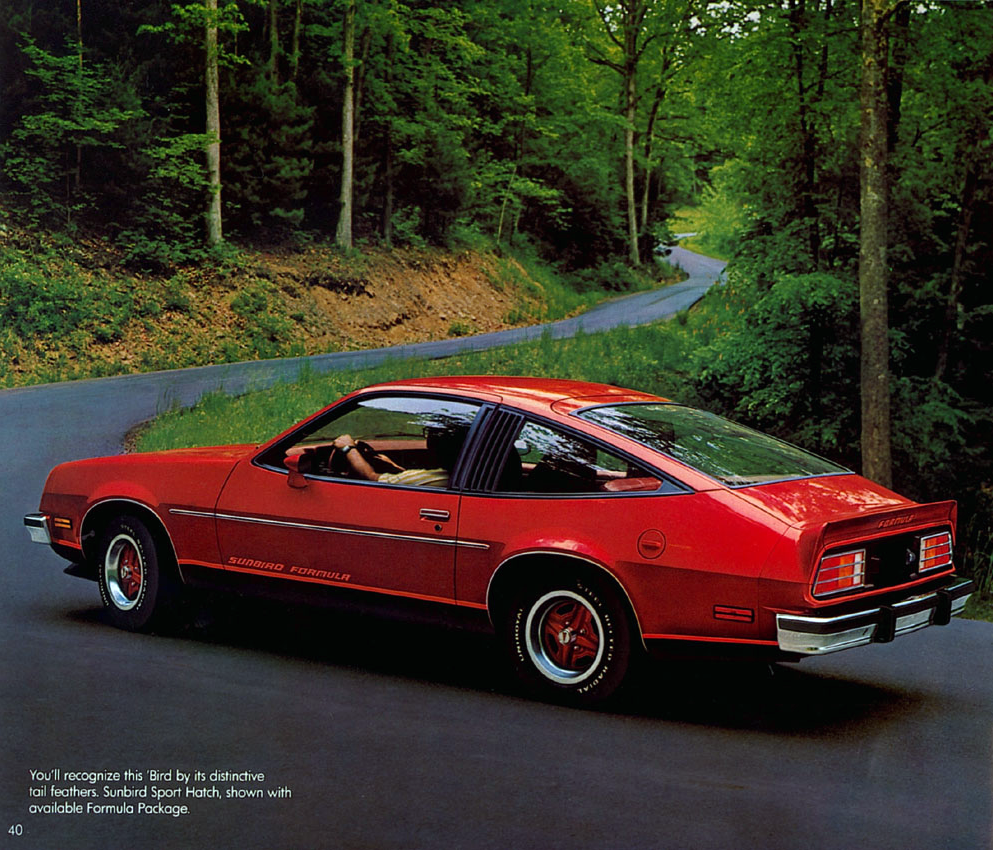
1980 Pontiac Sunbird brochure picture
1980 Sunbird Sport Hatch with the Formula Package

Available only with the sport hatch, the rare (only 1% of production) and expensive ($674, or about $2,900 in today’s dollars) Formula Package added a front air dam and rear spoiler, along with blacked-out grille, and BR70-13 white lettered tires (nearly equivalent 195/70R13 tires are available from BF Goodrich) on 13-inch cast aluminum rally wheels with trim rings. It wasn’t all bark and no bite: the Rally Handling Package was included, with larger front and rear stabilizer bars. Inside, a tachometer and other rally gauges were included. The whole combination meant that a sport hatch with the Formula Package, the V6, and the four-speed manual came to $5,630 (about $24,100 in today’s dollars). The 0-60 time for this top-of-the-line Sunbird was probably around 10 seconds—not far from some versions of the line-leading 1980 Firebird Trans Am.

Individual mechanical options included variable-ratio power steering (the most popular option and required with the V6) and power front disc brakes. Inside, you could add Custom air conditioning ($531), a tilt steering wheel (which required power steering), and an AM/FM stereo cassette player (two different 8-track radios were also still available). A removable sunroof was also available for $193.

The rear wheel drive Sunbird sold well even in its final year, partially because of the extended model year. Almost 188,000 were sold, with over 100,000 being the base coupe, making the Sunbird the best-selling of all the 1980 H-bodies. Pontiac would return partially to the Sunbird name with the 1983 2000 Sunbird convertible version of the J-body—by 1985, the Sunbird name would once again stand alone.

The View From 2025

Badge for 2,500 web hits

Stock Sunbirds of this generation almost never come up for sale in Hemmings Motor News and eBay Motors—they seem to have disappeared entirely despite the fact that Pontiac sold about 480,000 examples over five years. You do occasionally see examples of the “sister” Chevrolet Monza auctioned on Bring a Trailer, but even they are rare.

Make mine Agate Red, please.

Another Sunbird I have written about is the 1984 2000 Sunbird S/E hatchback coupe. I have also written about the 1980 Chevrolet Monza Sport 2+2 hatchback coupe.

Last updated October 2025.

Save

Save

1987 Porsche 911 Carrera coupe

“The Classic Porsche”

For 1987, the Carrera version of Porsche’s evergreen 911 continued with the Bosch fuel-injected 3.2 liter/193 ci flat six in use since 1984, but with a new fuel mapping that increased horsepower slightly to 214 bhp. With the standard Getrag G50 five-speed manual transmission (also new for 1987), you could expect to hit 60 mph in 6.1 seconds, with a top speed of 149 mph in the 2,750-pound Carrera (the 2025 911 Carrera is about 3,350 pounds). Fuel mileage was 18 city/25 highway by the day’s standards (16/23 by today’s measures) with premium gas.

The 911 was certainly not an entry-level Porsche: in 1987 that was left to the 924S (starting at $19,900) and the 944 ($25,500). For your 911’s $40,425 base price—about $116,900 in 2025 dollars and almost exactly what a 2025 911 Carrera costs—you got four-wheel vented disc brakes (but no ABS) and an engine oil cooler. The exterior included forged alloy wheels, heated power mirrors, heated windshield washer nozzles, fog lights, and tinted glass. Inside, power windows, air conditioning, fold-down rear seats, and Blaupunkt’s AM/FM stereo cassette (either Charleston or Portland) with four speakers were all standard.

By 1987, Porsche had figured out that the real money was in the options—a behavior that continues to this day. They included the Turbo-Look 911 Turbo body components ($12,593!), limited slip differential ($741), sport shock absorbers ($247), and front and rear spoilers ($1,604). Inside, you could add cruise control ($365), power door locks ($334), heated seats ($164 each), an alarm system ($240), and Blaupunkt’s upmarket Reno AM/FM stereo cassette ($133).

Things hadn’t gotten that comfortable, though—that would wait for the 1990s. There was as yet no automatic transmission option, and many (including Car and Driver) mentioned that the ergonomics still showed their 1960s origins when compared to the 928 or 944.

The View From 2025

911 Carreras from the 1980s have held their values very well—especially the coupes. According to Hagerty’s valuation tools, all the money for a 1987 Porsche  911 3.2 Carrera coupe in #1/Concours condition is $142,000, with a more normal #3/Good condition car going for $75,000. A cabriolet can fetch up to $100,000 while a targa can get up to $133,000.

Porsche 911 3.2 Carreras have (of course) excellent club support from many sources and are often available in the Hemmings Motor News classifieds, on eBay Motors, and on Bring a Trailer. As I update this blog entry in April 2025, a Grand Prix White 1987 coupe with a black interior is for sale on Hemmings, asking $84,500.

Make mine Silver Metallic, please.

Other eighties Porsches I have written about include the 1980 924 hatchback coupe, the 1982 924 Turbo hatchback coupe, the 1982 928 hatchback coupe, the 1985 911 Carrera Cabriolet, the 1986 944 Turbo hatchback coupe, and the 1988 944 hatchback coupe.

Last updated June 2025.

1985 Buick Somerset Regal coupe

Welcome, Jalopnik and Autoblog readers! We have many meh cars at Eighties Cars—the unloved category covers most of them.

I saw a reasonably original Buick Somerset Regal with Dark Gray Metallic paint on a side road in Philadelphia in March 2104. It was the first one I’d seen in many years.

“There has never been a Buick quite like the Somerset Regal”

Buick’s Somerset Regal was a new model for 1985. Available initially only in coupe form, Buick’s version of the N-body (Oldsmobile had the Calais, and Pontiac had the Grand Am) was designed to at least partially replace the Skylark. It failed miserably, surviving for only three years before being subsumed back into the Skylark product line. Respectable first-year sales of 86,076 declined to 75,620 in 1986 and 46,501 in 1987.

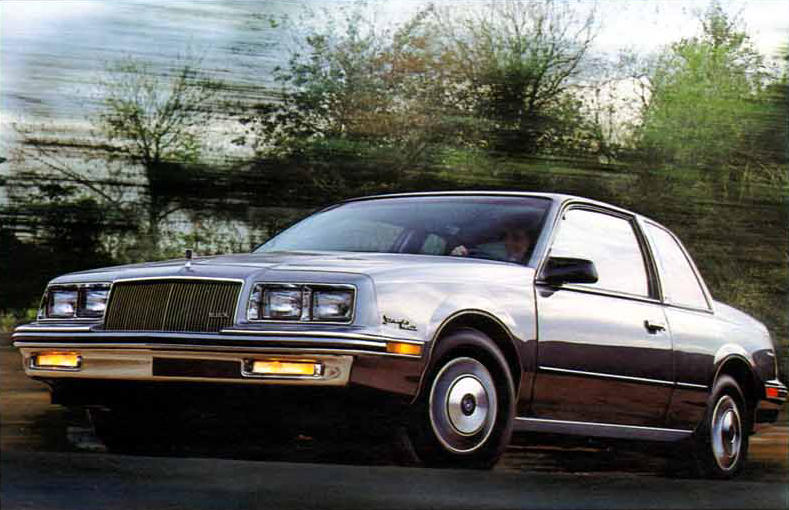
Exterior photo of Somerset Regal from 1985 Buick brochure
Exterior photo of the Somerset Regal from the 1985 Buick brochure

The Somerset Regal was not a big car by today’s standards. With 180 inches of length and a 103.4-inch wheelbase, it is within shouting distance of a 2025 Honda Civic sedan, which is 184.8 inches long and has a 107.7-inch wheelbase. Of course, cars, in general, have gotten a lot bigger in these thirty years—the Somerset Regal was notably more substantial than the 1985 Honda Accord.

The standard powertrain was a Tech IV 92 bhp 2.5 liter/151 ci inline four with throttle body fuel injection (a slightly upgraded Iron Duke) paired with a five-speed manual transmission, but I believe most buyers went with the optional ($425) three-speed automatic instead. The hot set-up (if you could call it that) was the optional ($560) LN7 125 bhp 3.0 liter/181 ci multi-port fuel-injected V6, available only with the automatic. 0-60 times ranged from 11 to 13 seconds.

Mileage for the inline four and five-speed manual combination was an impressive 24 city/34 highway by the day’s standards (21/31 by 2025 measures). Choosing the more realistic three-speed automatic cost two mpg, while upgrading to the V6 dropped you all the way down to 20 city/26 highway. With a 13.6-gallon gas tank, owners of the most profligate powertrain combination could expect a range of between 255 and 280 miles with a 10% fuel reserve.

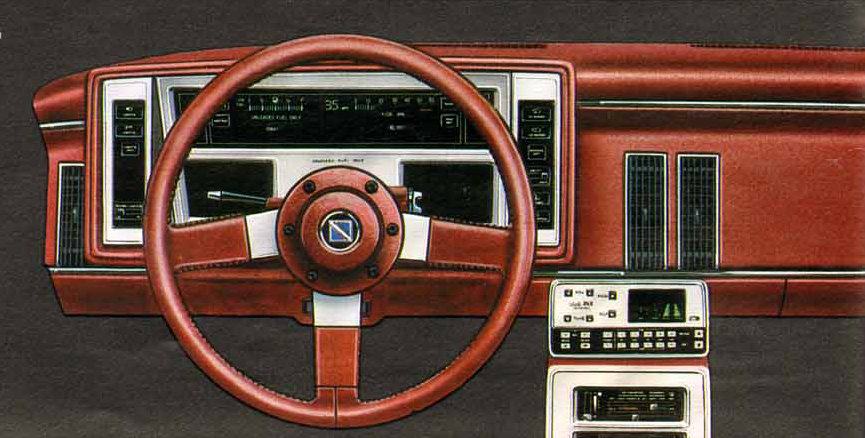
Interior of the Somerset Regal brochure from the 1985 Buick brochure
Interior of the Somerset Regal from the 1985 Buick brochure

For the Somerset Regal’s $8,857 base price (about $27,300 in today’s dollars), standard equipment included power brakes, power steering, tungsten-halogen headlights, and body-colored bumpers. The interior included cloth or vinyl bucket seats, a center console, brushed metal accents, electronic digital instrumentation (somewhat upmarket at the time), and an AM radio. Moving up to the Limited trim added dual horns, chrome bumpers, and courtesy lamps, along with snazzier cloth seats and an upmarket steering wheel.

Standard features that date the Somerset Regal included the Delco Freedom II Plus battery, front and rear ashtrays in the console, and the P185/80R13 tires (now considered a trailer size) on 13-inch wheels.

Options

Options included the $645 air conditioning (in the mid-1980s not yet standard on most cars), cruise control ($175), leather seats ($275 and only available with the Limited), power door locks ($130), power windows ($195), Vista-Vent sunroof, Delco GM/Bose Music System AM/FM stereo cassette ($995!), cast-aluminum wheels ($229), and a Gran Touring suspension ($27).

The View From 2025

Badge for 2,500 web hits

These Somerset Regals are now almost completely gone. Bring a Trailer did sell a very rare 1986 Somerset T-Type (Buick removed the Regal part of the name after only one year) in mid-2023. I haven’t seen one in the Hemmings Motor News classifieds or on eBay Motors in several years.

Make mine Medium Blue Metallic, please.

I have also written about the 1985 Pontiac Grand Am coupe, which had a lot more success. Other smaller front wheel drive Buicks I have written about include the 1983 Skylark T TYPE coupe and the 1984 Skyhawk coupe.

Last updated in January 2026.

Eighties Vehicles at the 2014 Mecum Kissemmee, Part Two

As always, the January auction at Mecum Kissimmee provided much interesting fodder for commentary. I’ll concentrate on the at least fairly stock 1980s cars (and a few trucks) that sold (remember that this is not a no reserve auction) and add some of my opinions. Mecum Kissemmee is a huge event, so I’m going to separate my commentary into two posts—this second covers from Tuesday to Saturday.

Tuesday:

  • 1988 red Chevrolet Corvette convertible—$6,000 hammer price
  • 1982 Silver/Charcoal two-tone Chevrolet Corvette coupe—$10,000
  • 1980 red Chevrolet Camaro Z28 coupeat $13,000 the first car in this part of the auction to meet my criteria for serious 1980s collectability of original cars: selling for equal to or above its original base list price. I’ll mark these cars in bold green
  • 1985 beige Mercedes-Benz 380SL convertible with 82,000 miles—$11,500
  • 1981 black Chevrolet Camaro Z28 coupe—$15,500 (more strong money for the last of the second generation F cars)
  • 1988 white Chevrolet Corvette 35th Anniversary coupe with 34,000 miles—$9,500 (the first of three 35th Anniversary’s sold)
  • 1984 beige Jeep CJ-7 Laredo SUC with 99,000 miles—$10,500
  • 1981 brown Cadillac Fleetwood sedan—$6,000
  • 1980 Silver Chevrolet Corvette coupe—$13,000
  • 1982 Silver Beige Chevrolet Corvette Collector Edition coupe—$20,000
  • 1986 white Mercedes-Benz 560SL convertible—$12,000
  • 1983 blue Jeep CJ-7 SUV—$10,500
  • 1982 orange Jeep Scrambler CJ-8 pickup truck—$24,000

Wednesday:

  • 1984 red/white two-tone Ford Bronco SUV—$6,750
  • 1987 blue/silver two-tone Chevrolet C10 pickup truck—$8,000
  • 1981 black Jeep CJ-7 SUV—$9,000
  • 1982 red Chevrolet Corvette coupe—$15,000
  • 1986 red Jeep CJ-7 SUV—$17,500
  • 1981 black Lincoln Mark VI sedan with 27,000 miles—$7,500
  • 1987 red Ford Mustang convertible with 36,000 miles—$9,500
  • 1989 red Buick Riviera coupe with 10,000 miles—$12,000
  • 1981 silver (of course!) Delorean DMC-12 coupe with 10,000 miles—$29,000
  • 1981 silver Chevrolet Corvette coupe—$9,500
  • 1983 green Jeep CJ-8 Scrambler pickup truck—$20,000
  • 1987 red BMW 635csi coupe—$7,500
  • 1981 red Chevrolet Blazer custom SUV—$21,000
  • 1982 white Chevrolet Corvette coupe with 28,000 miles—$14,500
  • 1987 red Ferrari Testarossa coupe—$39,000

Thursday:

  • 1987 white Zimmer Golden Spirit coupe with 34,000 miles—$20,000
  • 1987 white Porsche 911 Cabriolet convertible with 44,000 miles—$37,000
  • 1980 red Chevrolet Corvette coupe with 31,000 miles—$13,500
  • 1987 blue Ford Mustang custom Saleen hatchback with 25,000 miles—$16,000
  • 1983 red Porsche 911 coupe—$31,000
  • 1981 Red/Dark Claret two-tone Chevrolet Corvette coupe—$15,700
  • 1987 black Buick Grand National coupe with 35,000 miles—$18,000
  • 1984 red Chevrolet Camaro Z28 coupe with 56,000 miles—$5,750
  • 1986 silver/gray two-tone Pontiac Grand Prix 2+2 Aerocoupe coupe with 250 miles—$37,000 (real money for a one year only NASCAR homologation model)
  • 1988 white Chevrolet Corvette 35th Anniversary coupe with 46,000 miles—$16,000
  • 1989 red Chevrolet Corvette convertible with 31,000 miles—$12,000
  • 1987 black Buick GNX coupe with 10,000 miles—$67,000

Friday:

  • 1988 white Chevrolet Corvette 35th Anniversary coupe with 17,000 miles—$19,000
  • 1986 white Chevrolet Corvette convertible—$10,500
  • 1986 white Mercury Cougar convertible with 3,000 miles—$8,000
  • 1986 white Porsche Slant Nose Cabriolet convertible—$34,000
  • 1988 white Porsche 911 Turbo Cabriolet convertible—$60,000
  • 1987 silver Chevrolet Monte Carlo SS coupe—$13,000
  • 1984 white Datsun 300ZX Turbo coupe with 42,000 miles—at $14,000 one of the most interesting 1980s cars in this auction.
  • 1988 white Chevrolet Corvette Callaway convertible with 93,000 miles—$25,000
  • 1985 red Jeep CJ-7 SUV—$22,500

Saturday:

  • 1985 black Porsche 930 Turbo coupe with 36,000 miles—$63,000

What do you think of this year’s results?

1981 Chevrolet Citation X-11 hatchback coupe

I walked past a small junkyard in Philadelphia in February 2014. A Redwood Metallic Citation X-11 was recognizable though definitely not well-preserved, but it encouraged me to publish this blog post. A 1982 X-11 with 10,511 miles being auctioned on Bring a Trailer in mid-2023 prompted me to update and enhance it.

“It gives you goose bumps.”

Chevrolet’s Citation X-car is now known chiefly for being constantly recalled, but there were some positive points. The sporty X-11 version was a definite glimmer of hope.

Chevrolet built the Citation X-11 around a specific engine for all but its first year. For 1981, the $1,498 X-11 package featured the LH7 2.8 liter/172 ci “HO” V6 with a Rochester Varajet II 2SE two-barrel carburetor, making 135 bhp, instead of the 110 bhp that the “generic” LE2 V6 made in other Citations. Upgrades from the LE2 to the LE7 included a higher compression ratio (8.9:1 versus 8.5:1). The standard transmission was the four-speed manual with a three-speed automatic optional. The four-speed, along with the X-11‘s specific axle ratio, was good enough to give a 0-60 time of around 8.5 seconds.

X11 pages from the 1981 Chevrolet Citation brochure
X-11 pages from the 1981 Chevrolet Citation brochure

Other changes for 1981 included the addition of a hood bulge and aluminum alloy wheels. The X-11 also received power brakes and the F41 Sport Suspension, which featured revised shock absorbers, stiffer anti-roll bars, and P215/60R14 tires (a size still available thanks to BFGoodrich and Riken) on 14 x 6.5 aluminum alloy wheels. Inside was an instrument panel with a five-gauge cluster, along with a leather-wrapped sport steering wheel and cloth bucket seats. Exterior X-11 specific appearance items included a black grill and body accents, sport mirrors, and a rear spoiler.

Standard exterior and mechanical equipment on every Citation included front-wheel-drive, rack-and-pinion steering, front disc/rear drum brakes, and a Delco Freedom Battery II. Inside, dual-speed electric windshield wipers, sliding door locks, a locking glove compartment, and a Delco AM push-button radio with two front speakers were all included.

Options available included a sunroof, air conditioning ($585), cruise control ($123), intermittent wipers ($41), electric rear window defogger ($107), power windows, and a tilt steering wheel ($81).

The View From 2025

A few enthusiasts collect the X-11. The sportiest Citations also occasionally appear in the Hemming’s Motor News classifieds and at online auctions such as eBay Motors and Bring a Trailer that cater to the eighties car market.

Make mine Silver Metallic, please.

SaveOther Citations and Citation IIs I’ve written about include the 1980 hatchback sedan and the 1985 hatchback sedan. X-cars from other marques covered in this blog include the 1983 Buick Skylark T TYPE coupe, the 1984 Oldsmobile Omega sedan, and the 1982 Pontiac Phoenix SJ coupe.

Last updated March 2025.

Save