1984 Buick Regal Grand National coupe

On a Sunday morning in July 2015, I saw a Buick Grand National actually being driven. The silhouette was distinctive, even from a quarter of a mile away. Strangely, they look tall and even a little bit fragile nowadays.

“The hottest Buick this side of a banked oval.”

1984 was the first year that Buick offered a Grand National package for the Regal. The Regal T Types had debuted in 1983, but the Grand National definitely kicked things up a notch.

The star was, of course, the engine. For 1984, Buick’s turbocharged LD5 3.8 liter/231 ci V6 gained sequential fuel injection, bumping horsepower up from 180 bhp to an even 200 bhp. Paired with a four-speed automatic transmission, 0-60 came in a little under 8 seconds. Mileage was 18 city/22 highway by the day’s standards (16/20 by 2025 measures). With an 18-gallon fuel tank, the Grand National‘s range was between 290 and 325 miles with a 10% fuel reserve.

1984 Buick Grand National advertisement

Standard mechanical equipment on the $13,400 Grand National (about $42,400 in today’s dollars) included power brakes, power steering, dual exhausts, performance rear axle, Gran Touring suspension, and P215/65R15 blackwall tires (a size still readily available) on black-accented 15-inch aluminum wheels. A Grand National‘s exterior equipment included a turbo “power bulge” on the hood, dual mirrors, dual horns, front air dam, rear decklid spoiler, and that distinctive Black paint with black accents—responsible for the “Darth Buick” nickname. Air conditioning, Lear Siegler cloth/leather seats, a tachometer, a turbo boost gauge, and a leather-wrapped steering wheel were all included inside.

Options

Optional equipment included dual remote sport mirrors ($30), electric rear defogger ($140), touch climate control air conditioning ($150), tilt steering ($110), power windows ($185), Twilight Sentinel ($57), and electronic tuning AM/FM stereo radio with cassette and graphic equalizer ($605).

The View From 2025

Buick Regal Grand Nationals have what can only be called a fanatical following. According to Hagerty’s valuation tools, all the money for a 1984 Grand National in #1/Concours condition is an impressive $45,100, with a more normal #3/Good condition car going for $17,100. Grand Nationals frequently show up for sale in the Hemmings Motor News classifieds, on eBay Motors, and on Bring a Trailer. As I update this blog entry in April 2025, a 1986 Grand National with 1,706 miles is available on Hemmings, asking $78,500.

I don’t have to tell you what color I want mine in.

Other sporty eighties Buicks I have written about include the 1980 Riviera S TYPE coupe, the 1983 Skylark T TYPE coupe, the 1984 Riviera T TYPE coupe, the 1987 GNX coupe (of course!), the 1987 LeSabre T Type coupe, and the 1988 Reatta coupe.

Last updated April 2025.

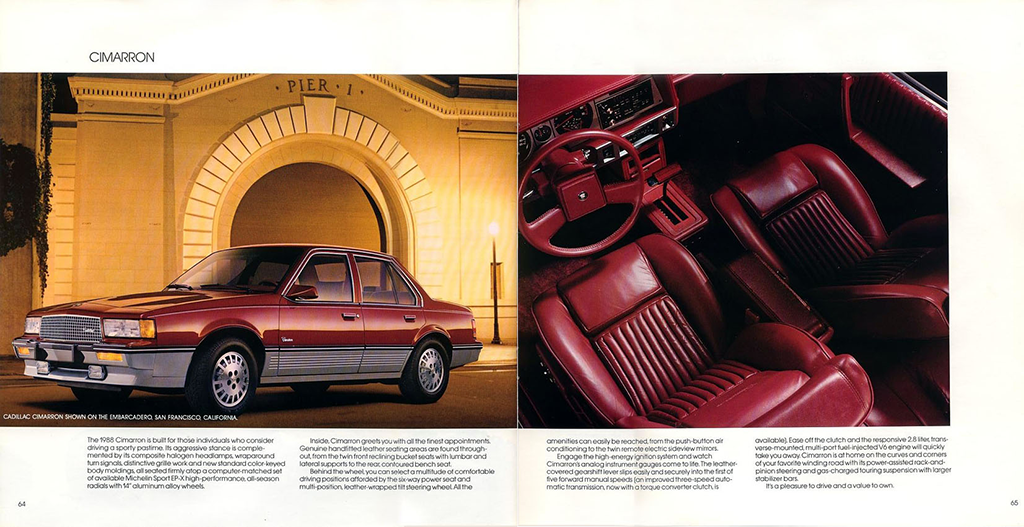
1982 Chrysler LeBaron convertible

“No other car is causing so much excitement.”

The Chrysler LeBaron convertible was a mid-year introduction, becoming available in the spring of 1982. It was the first factory convertible from an American manufacturer available for sale in the United States since the 1976 Cadillac Eldorado.

All LeBarons were all-new for 1982. Based on the more plebeian Dodge Aries/Plymouth Reliant front-wheel-drive K cars that had been on sale for a year, the LeBaron (sometimes described as the Super-K) was a move at least slightly upmarket. Most exterior body panels were the same as the K. Notable styling differences were a waterfall-style grill (somewhat resembling that of the previous year’s rear-wheel-drive LeBaron), quad headlamps, relocation of the parking lamps and turn signals to the front bumper, and a full-width tail-lamp housing.

Chrysler used almost all of the standard K pieces inside the LeBaron. Recessed door handles and rocker type door locks were among the few changes, along with a different style of armrest and door pull. There was less vinyl trim, and the carpeting and other fabrics were of somewhat higher quality. A significant difference was the attention paid to noise, vibration, and harshness: between soundproofing, better parts, and suspension tuning, the LeBaron was upgraded from the base K in 26 separate ways.

Cars & Concepts in Brighton, Michigan heavily modified two-door LeBaron coupes on their way to becoming convertibles—the process included 32 steps. They installed a boxed-in backbone along the center of the car and welded a three-piece windshield header to the A-pillars. Next, Cars & Concepts installed new door glass and added door wedges. Finally, they added a new fiberglass panel to hold the rather small rear seats and mounted the convertible motor on the floor pan behind the rear bulkhead.

The convertible top itself had a plastic rear window and broad rear quarter panels; Car and Driver wrote that this created “a sort of Conestoga-wagon effect.” A button on the console actuated the top, and a padded top boot snapped into place when the top was lowered.

The base engine was a K 2.2 liter/135 ci inline four with a two-barrel Holley carburetor, producing 84 bhp. A two-barrel carburetted Mitsubishi G54B 2.6-liter/156 ci inline four with 92 bhp and 20 additional ft-lbs of torque was available for an added $171. Chrysler paired both engines with the TorqueFlite three-speed automatic transmission. Mileage with the base engine was 25 city/36 highway by the day’s standards. The optional engine was rated at 23 city/31 highway and brought the 0-60 time down from about 17 (aargh!) seconds to about 15 seconds.

1982 Chrysler LeBaron convertible advertisement

The LeBaron convertible’s base price was $11,698 (about $40,100 in today’s dollars and about 44% more than the 1982 LeBaron coupe). Standard exterior and mechanical equipment included dual outside mirrors (borrowed from the Dodge Omni 024), power brakes, power rack-and-pinion steering, and P185/70R14 whitewall tires (a size still readily available, though finding whitewalls might be tricky) on 14-inch wheels. Inside, vinyl front bucket seats with a folding center armrest, a digital clock, and an AM radio were included. 76% of convertible drivers moved up to Medallion trim, which boosted the price to $13,998 (about $48,000 in 2025 dollars) and added halogen headlamps, better gauges, and snazzier wheel covers.

Packages, Options, & Production Numbers

The Mark Cross package cost an additional $861, moved the sticker to a non-trivial $14,859 (about $50,900 in today’s dollars), and added the 2.6-liter engine, air conditioning, power windows, power door locks, and attractive Mark Cross leather/vinyl seats. Other options included cornering lamps ($57), cast aluminum wheels ($344), automatic speed control ($155), and an AM/FM stereo radio with electronic tuning and cassette player ($455).

First-year sales of LeBaron convertible were a respectable 12,825, especially given the shortened year and the relatively high price. In a piece of general eighties trivia, the first commercial cell phone call in history was made from a LeBaron convertible in October 1983.

The View From 2025

These convertibles started Chrysler’s long tradition of making convertibles that might occasionally be sporty but were not sports cars—a market niche they exited in 2014 with the demise of the Chrysler 200 convertible. I still like what Chrysler was trying to do, and I appreciate how these cars look, at least with the top down.

These cars are being collected and shown—I see them often at AACA judging meets. You see them for sale in the Hemming’s Motor News classifieds, on eBay Motors, and on Bring a Trailer: as I update this blog entry in October 2025, there’s a Pearl White 1982 LeBaron with 68,000 miles for sale on Hemmings, asking $6,900.

Make mine Mahogany Metallic, please, with the Mark Cross package.

Other K cars I have written about include the 1981 Plymouth Reliant coupe, the 1985 Dodge 600 Club Coupe, the 1986 Chrysler Town & Country convertible, and the 1987 Dodge Aries LE sedan.

Last updated October 2025.

Save

1985 Chevrolet Caprice Classic Station Wagon

Originally posted on Independence Day 2015, here’s an all-American eighties wagon from forty years ago.

“Big wagon convenience that drives like a Caprice.”

1985 was a year of refinement for Chevrolet’s full-size wagon. The standard engine was Chevrolet’s LG4 5.0 liter/305 ci V8, newly uprated to 165 bhp but still struggling to haul around about two tons and eighteen feet of metal. Paired with a four-speed automatic transmission, fuel economy was 15 city/22 highway by the day’s standards (14/20 by today’s measures). With the 22-gallon gas tank (smaller in the wagon than in the coupe or sedan), the range was from 335 to 365 miles with a 10% reserve.

The full-size Chevrolet interior was also modernized for 1985, with an updated satin finish dash design that allowed for the use of more capable DIN style radios instead of the previous two-knob style.

Station wagon page from the 1985 Caprice Classic brochure

Standard exterior and mechanical equipment on the $10,714 wagon (about $32,500 in today’s dollars) included power steering, power brakes (disk front/drum rear), a three-way tailgate with power window, heavy-duty front and rear suspension, a Delco Freedom II battery, full wheel covers, and white-striped P225/75R-15 all-season radial tires. Inside, Quiet Sound Group, a quartz electric clock, a headlamp-on reminder chime, a lockable glove box with light, a full-width front bench seat with center armrest, a third row seat, and an AM push-button radio with dual front speakers were all part of a base Caprice Classic wagon.

Options & Production Numbers

Exterior and mechanical options included Estate Equipment ($307), a roof carrier ($110), a rear air deflector ($40), a power tailgate lock ($50), a heavy duty battery ($26), heavy duty cooling ($40), an engine block heater ($20), cornering lamps ($55), and high and low beam halogen headlamps ($22).

Inside, buyers could add air conditioning ($730), electronic speed control ($175), a Comfortilt steering wheel ($110), power windows ($185), power door locks ($125), deluxe rear compartment decor ($59), and a GM-Delco ETR AM/FM stereo radio with seek and scan, cassette tape, clock, graphic equalizer and extended range sound system ($394).

Chevrolet sold almost 56,000 Caprice Classic wagons in the 1985 model year, marking about 21% of total full-size Impala/Caprice production.

The View From 2025

I sense that there actually are a few folks preserving these cars, but they certainly aren’t common at shows. You do sometimes see Caprice wagons for sale in the Hemming’s Motor News classifieds, on eBay Motors, and Bring a Trailer. As I update this blog post in August 2025, a Dark Blue Metallic 1989 wagon with dark blue cloth seats is listed for $16,000 on Hemmings.

Make mine that same Dark Blue Metallic, please.

Other B-platform cars I have written about include the 1983 Chevrolet Caprice Classic sedan, the 1987 Chevrolet Caprice Classic coupe, the 1982 Oldsmobile Delta 88 Royale coupe, and the 1983 Pontiac Parisienne sedan.

Last updated August 2025.

1986 Mercedes-Benz 560SEC coupe

Only a couple of blocks from my house at the time, I walked by a black 560SEC with a tan interior in really good condition in July 2015—a good enough reason as any to write this post.

“Bold lines which reflect the latest in motoring refinement.”

For 1986, Mercedes-Benz’s big W126 S-Class coupe gained an upgraded 238 bhp M117 5.5 liter/338 ci Bosch K-Jetronic fuel-injected V8 paired with a four-speed automatic transmission. The mid-cycle refresh also differed cosmetically from previous years with the addition of flush-face halogen headlamps and integral headlight wipers.

0-60 came in a sprightly 7.5 seconds in the 3,900-pound car while mileage was a predictably bad 14 city/16 highway by the day’s standards (12/15 by modern measures), which earned the 560SEC a $1,500 gas guzzler tax. With the relatively large 23.8-gallon fuel tank, range was between 290 and 320 miles with a 10% reserve.

Photo of a 560SEC on the streets of Bryn Mawr, PA
A 560SEC on the streets of Bryn Mawr, PA

The 1986 560SEC’s base price, including distribution and transportation, was an eye-watering $64,900—approximately $193,900 in today’s dollars, or about what a 2026 Mercedes-Benz AMG GT 63 coupe goes for. Standard exterior and mechanical equipment included halogen head lamps with washers and wipers, tinted glass, an electric sliding roof with a pop-up feature, four-wheel anti-lock disc brakes, and 215/65VR15 steel belted radial-ply tires on 15-inch “fifteen slot” light alloy wheels. Interior equipment included dual-stage heated front bucket seats, an electrically adjustable steering wheel, a driver’s side airbag, electronic automatic climate control (said to be less effective than you’d expect), cruise control, and a Becker Grand Prix AM/FM stereo radio with a cassette player and an automatic antenna.

Optional equipment included a power rear sun shade, a front passenger air bag, rear headrests ($245), and California emissions.

The View From 2025

There is decent club support for the 560SEC, as there is for almost all Mercedes-Benzes. According to Hagerty’s valuation tools, all the money for a 1986 Mercedes-Benz 560SEC in #1 condition is $117,000, with a more normal #3 condition car going for $24,900. 560SECs frequently show up for sale in the Hemmings Motor News classifieds, on eBay Motors, and on Bring a Trailer. As I update this post in December 2025, there’s a Black 560SEC with a black interior and 184,000 miles listed on Hemmings for $20,000.

Make mine Black Pearl Metallic, please.

Other Mercedes-Benz models I have written about include the 1980 450SL convertible, the 1981 380 SEL sedan, the 1985 380SL convertible, the 1985 300SD coupe, the 1986 560SL convertible, and the 1989 560SL convertible.

Last updated December 2025.

Eighties Vehicles at the 2015 Mecum Denver

Mecum’s two day June auction in Denver included a few cars and trucks from the 1980s. As always, I’ll concentrate on the cars and trucks that actually sold (remember that this is not a no reserve auction—a 1985 blue Chevrolet Corvette GTP racing replica was bid up to $70,000) and add some of my opinions.

Friday:

  • 1987 red Pontiac Fiero SE coupe with five-speed manual transmission and V6—$3,000 hammer price.
  • 1988 red Chevrolet Silverado pickup truck—$3,000
  • 1982 burgundy Chevrolet Camaro Z28 coupe with 5.0 liter CrossFire V8—an ouch! at $2,750.
  • 1986 white Chevrolet Camaro IROC-Z coupe with 5.0 liter TPI V8 and 62,000 miles—$5,000
  • 1984 red Pontiac Firebird Trans Am coupe with the L69 HO engine and 10,000 miles—at $15,000, the first vehicle to meet my criteria for serious 1980s collectability of original cars or trucks: selling for equal to or above its original base list price. I’ll mark these vehicles in bold green.
  • 1982 white Toyota FJ-62 Land Cruiser SUV—$8,000
  • 1987 blue two-tone GMC Caballero pickup truck with 90,000 miles—$6,000

Saturday:

  • 1987 black Buick Grand National coupe—$19,000
  • 1982 silver beige Chevrolet Corvette Collector Edition coupe with 46,000 miles—$15,000
  • 1989 red Porsche 911 Speedster convertible with 38,000 miles—at $165,000, by far the highest eighties vehicle sale of this auction.
  • 1984 white Porsche 928 coupe with 86,000 miles—$9,500
  • 1981 blue Chevrolet Camaro Z28 coupe with the 5.7 liter V8 and 77,000 miles—$7,500. According to Hagerty’s valuation tools, all the money for a 1981 Z28 in #1 condition is $27,700. The price paid for this car indicates that it is in #4 condition.
  • 1987 white Pontiac Firebird Trans Am GTA coupe with 61,000 miles—$6,500

What do you think of this auction’s results?

1981 Oldsmobile Cutlass Supreme coupe

 “America’s favorite Cutlass for flair, value and price”

For 1981, the exterior of Oldsmobile’s Cutlass Supreme coupe was substantially revised, with a lowered front, a slightly higher decklid, and quad headlamps. With the new styling, aerodynamic drag dropped by about 15%.

The standard engine remained the 110 bhp 3.8 liter/231 ci V6 with a Rochester M2ME two-barrel carburetor. The optional engines, a 4.3 liter/261 ci V8 with a Rochester M2MC two-barrel carburetor ($50) and a 5.7 liter/350 ci diesel V8 ($695!), both had (this makes no sense) five less horsepower than the V6. A three-speed automatic transmission was the only transmission available with any engine. Early eighties Cutlass Supremes were stylish but slow—0-60 came in about 14 seconds with the standard motor. Mileage with the V6 was 21 city/30 highway by the day’s standards (17/22 by today’s measures); with an 18.1-gallon gas tank, a Cutlass Supreme owner could expect a range of 320 to 370 miles with a 10% fuel reserve.

Cutlass Supreme page from the 1981 mid-size Oldsmobile brochure

Standard equipment on the $7,484 Cutlass Supreme (about $28,400 in today’s dollars) included power steering, power front disc brakes, and P195/75R14 steel-belted radial-ply blackwall tires (a size still reasonably available) on 14-inch wheels. Inside, a Custom Sport bench seat with a choice of vinyl or cloth, a Deluxe steering wheel, an instrument panel with simulated butterfly walnut veneer, and Flo-thru ventilation were included.

Moving up to the $7,969 Brougham added snazzier exterior moldings, full wheel discs, and a divided cloth velour tufted bench seat.

The $8,004 Cutlass Calais added special painted wheel discs, halogen high beam headlamps, a ride and handling package, reclining front bucket seats in cloth or vinyl, a Rallye gage instrument cluster, and a Custom Sport steering wheel.

Options & Production Numbers

Optional exterior and mechanical equipment included cast-aluminum wheels, tungsten halogen high beam headlamps, engine block heater, limited-slip differential, power antenna, dual sport mirrors, electric rear window defogger, and removable glass roof panels ($695). Inside, you could add either Four-Season or Tempmatic air conditioning, a Tilt-Away steering wheel, cruise control, power windows, power door locks, bucket seats, a digital or regular electric clock, and a series of radios.

The Cutlass Supreme sure was popular—Oldsmobile sold almost 189,000 of them in the 1981 model year along with another 94,000 Cutlass Supreme Brougham coupes for a total of over a quarter of a million. Olds made it well known that the Cutlass brand overall continued to be the most popular car in the United States.

The View From 2025

5,000 views graphic

A few folks are collecting these cars, but they still aren’t common at shows. You do see fourth-generation Cutlass Supremes for sale in the Hemming’s Motor News classifieds, on eBay Motors, and on Bring a Trailer, though non-Hurst/Olds or 4-4-2 versions are relatively rare.

Make mine Dark Blue Metallic, please.

Among the many rear-wheel-drive G-platform (designated A-platform before 1982) cars I have written about are the 1980 Oldsmobile Cutlass coupe, the 1980 Pontiac Grand Am coupe, the 1980 Pontiac Grand Prix SJ coupe, the 1981 Chevrolet Monte Carlo Sport Coupe, the 1983 Chevrolet Malibu sedan, the 1983 Monte Carlo SS Sport Coupe, the 1984 Buick Regal Grand National coupe, the 1985 Oldsmobile Cutlass Supreme coupe, the 1987 Buick GNX coupe, and the 1987 Pontiac Grand Prix coupe.

Last updated June 2025.

1988 Porsche 944 hatchback coupe

In the summer of 2015, I was out in the Philadelphia suburbs picking up some hoagies (known as subs or heros to a good portion of the rest of the country). A young man parked next to me in a black Porsche 944. As we waited for our sandwiches to be made, he told me that his family had recently picked up the car, that it was quite original, that it had only about 50,000 miles, and that it was a 1988.

“Driving in its finest form”

For the 1988 model year, the 944 stood mostly pat. The engine continued to be the 147 bhp 2.5 liter/151 ci inline four with port fuel injection, paired with either a standard five-speed manual transmission or an optional three-speed automatic transmission.

0-60 with the manual transmission was about 8.5 seconds in the 2,800-pound car, while mileage was 20 city/28 highway by the day’s standards (18/26 by modern measures). With a 21.1-gallon gas tank, range was an impressive 420 to 455 miles with a 10% fuel reserve.

Standard exterior and mechanical equipment on the $31,650 car (about $87,600 in 2025 dollars) included pop-up halogen headlights, an integral front air dam, power rack and pinion steering, vented disc brakes, and 215/60VR15 tires (a size still readily available) on 15-inch cast alloy wheels. Inside, all 944s came with air conditioning, a leather sport steering wheel, a digital quartz clock, power windows, and an electric rear window defroster.

Options included anti-lock brakes, automatic cruise control, a tilting sunroof, sports seats, front heated seats, driver and passenger airbags, and a selection of Blaupunkt digital cassette radios.

The View From 2025

There is good club support for the Porsche 944, as there is for all Porsches. According to Hagerty’s valuation tools, all the money for a 1988 Porsche 944 in #1/Concours condition is $37,500, with a more normal #3/Good condition car going for $11,500. Porsche 944s often appear for sale in the Hemmings Motor News classifieds, on eBay Motors, and on Bring a Trailer. As I update this blog entry in March 2025, a Black 1988 with the manual, black leather seats, and 85,000 miles is available on Hemmings, asking $37,900.

Make mine Zermatt Silver Metallic, please.

Other eighties Porsches I have written about include the 1982 928 hatchback coupe, the 1982 Porsche 924 Turbo hatchback coupe, the 1985 911 Carrera Cabriolet, the 1986 944 Turbo hatchback coupe, and the 1987 911 3.2 Carrera coupe.

Last updated April 2025.

Eighties Vehicles at the 2015 Mecum Seattle

Mecum’s short two day June auction in Seattle included a few cars and trucks from the 1980s. As always, I’ll concentrate on the cars and trucks that actually sold (remember that this is not a no reserve auction—a white 1989 Lamborghini Countach 25th Anniversary Edition coupe with 24,000 miles was bid up to $200,000) and add some of my opinions. Where I have covered the specific year and model of a car in this blog, I link to it.

Friday:

  • 1980 black Pontiac Firebird Trans Am coupe—at a $13,000 hammer price, the first vehicle in this auction is also the first vehicle to meet my criteria for serious 1980s collectability of original cars or trucks: selling for equal to or above its original base list price. I’ll mark these vehicles in bold green.
  • 1984 silver Jeep Scrambler custom pickup truck—$18,500
  • 1987 gray Jaguar XJ6 Vanden Plas sedan—$6,500
  • 1981 yellow Chevrolet K10 custom pickup truck—$19,500
  • 1989 white Chevrolet Silverado pickup truck—an ouch! at $5,500.
  • 1982 silver Porsche-based Alfa Romeo replica roadster with no door handles or windshield wipers—$23,000
  • 1989 blue Ford Bronco SUV—$7,500

Saturday:

  • 1986 white Jeep Grand Wagoneer SUV—$26,000
  • 1980 red Ferrari 308 GTSi coupe—$54,000. According to Hagerty’s valuation tools, all the money for a 1980 GTSi in #1 condition is $63,600.
  • 1988 red Porsche 930 Turbo coupe—at $57,500, the highest eighties vehicle sale of this auction, but not quite covering the original sticker price.

What do you think of this auction’s results?
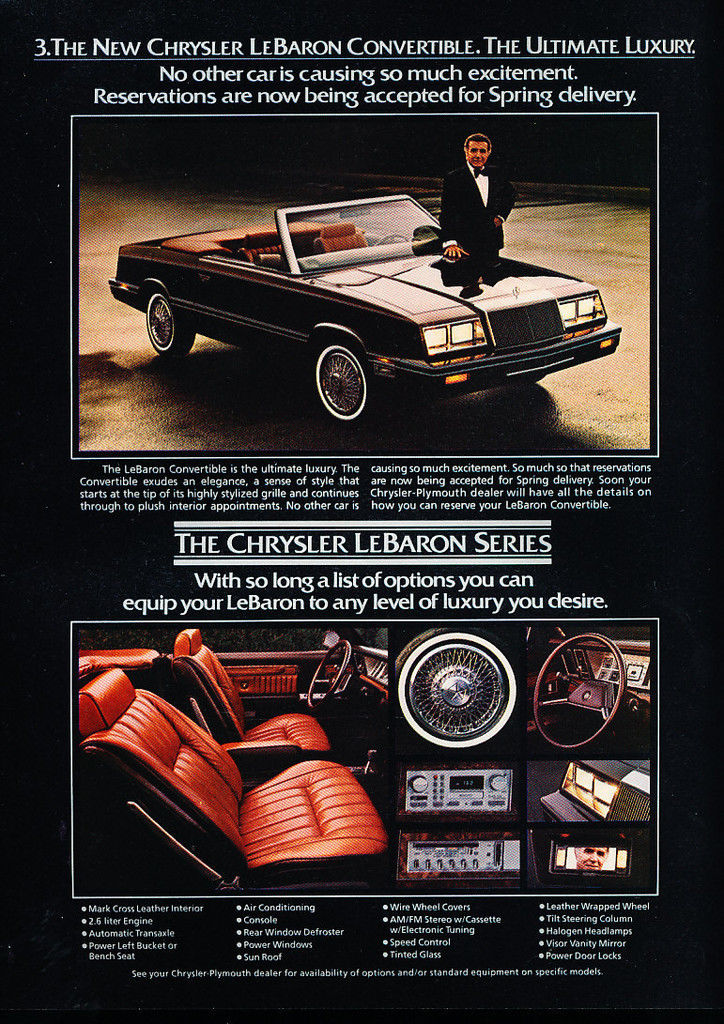
1988 Cadillac Cimarron sedan

On a June afternoon in 2015, I was walking in the University City section of Philadelphia when I saw a later Cadillac Cimarron driving towards me in surprisingly good shape. That was as good a reason as any to finally complete this blog entry.

“… built for those who consider driving a sporty pastime.”

It is an article of faith in the automotive world that General Motors often finally gets a car right just before killing it. Examples that spring to mind are the last Pontiac Fieros and the last Cadillac Allantés. However, in the case of the Cadillac Cimarron, all GM could do was make it less awful and embarrassing.

Exterior styling was at least somewhat more differentiated from the Chevrolet Cavalier sedan than the earliest Cimarrons had been. Cadillac added a more aggressive and distinctive grille in 1984, the front end was lengthened in 1985, and ribbed lower body cladding appeared in 1986.

The only engine available for 1988 was the 125 bhp LB6 2.8 liter/173 ci V6 with multi-port fuel injection. When paired with the standard five-speed manual transmission, mileage was 20 city/29 highway by the standards of the day (18/27 by today’s standards). A three-speed automatic transmission was optional and rated at 20 city/27 highway. 0-60 in the 2,800-pound car came in about 9.5 seconds with the manual transmission and about 10.5 seconds with the automatic transmission.

Cimarron pages from the 1988 Cadillac brochure

The 1988 Cimarron’s base price was $16,071—about $45,300 in today’s dollars, or about what a 2026 Cadillac CT4 Premium Luxury sedan goes for. Standard exterior and mechanical features included power-assisted rack and pinion steering, power front disc/rear drum brakes, and P195/70R14 steel-belted all-seasons radial tires (a size still readily available) on 14-inch aluminum alloy wheels. Inside, leather seating areas, a six-way power driver seat, a leather steering wheel, a tachometer, intermittent windshield wipers, air conditioning, power mirrors, power door locks, power windows, cruise control, a tilt steering wheel, and an AM/FM stereo radio with four speakers were all standard.

Options & Production Numbers

Among the relatively few options were a Vista Vent sunroof, an engine block heater, Twilight Sentinel, and the Delco-GM Bose Symphony Sound System.

By 1988, sales of the Cimarron had completely collapsed. After a first-year peak of almost 26,000 units sold in the 1982 model year, sales dropped to a sad 6,454 in the Cimarron’s final model year.

The View From 2026

I have yet to see a Cimarron at a serious antique car show—they’re treated by Cadillac folks like Ford folks treat the Mustang II from the 1970s—but I’m betting some intrepid soul will save one and bring it back for judging. Hagerty does track them—according to their valuation tools, a 1988 Cimarron with the five-speed manual in #1/Concours condition is $9,200, while a far more typical #3/Good car goes for $3,400. You occasionally see them for sale in the Hemmings Motor News classifieds, on eBay Motors, and on Bring a Trailer.

Make mine Hatteras Blue, please.

I have also written about the first-year 1982 Cimarron sedan. Other eighties Cadillacs I have covered include the 1980 Seville sedan, the 1982 Eldorado Touring Coupe, the 1986 Eldorado coupe, the 1986 Fleetwood Brougham sedan, the 1988 Eldorado coupe, the 1989 Allanté convertible, and the 1989 Sedan deVille.

Last updated February 2026.

1980 Chevrolet Corvette coupe

“How many other cars can you name at a single glance?”

For the 1980 model year, Chevrolet stylists substantially redesigned the Corvette’s long-running “shark” body style for the third time since its debut in the 1968 model year. The front and rear bumper caps were modified with integrated spoilers that decreased the drag coefficient by 14% to 0.443. Chevrolet engineers also managed to remove 167 pounds of curb weight from the Corvette by reducing the thickness of body panels and using aluminum for more parts. For the first time, air conditioning was standard—it had been an option since 1963. Power windows were also newly standard equipment.

There were two engine options for all states but California, both 5.7 liter/350 ci small blocks with four-barrel carburetors: the standard 190 bhp L48 and the optional ($595) 230 bhp L82. The four-speed manual transmission was only available with the L48—the L82 and the California-only 180 bhp 5.0 liter/305 ci LG4 could only be combined with the three-speed automatic transmission. With the relatively rare (about 12% of production) L82 and automatic transmission combination, Car and Driver recorded a 0-60 time of 7.6 seconds and a top speed of 123 mph.

Fuel economy was 14 city/20 highway by the day’s standards with either 350 ci and either transmission. With a 24.1-gallon gas tank, a Corvette’s proud new owner could expect a range of 300 to 330 miles.

1980 Chevrolet Corvette brochure cover
Cover of the 1980 Chevrolet Corvette brochure

The Corvette’s base was $13,140.24 at the beginning of the model year—about $56,400 in 2025 dollars, which is about 20% less than a 2025 Corvette Stingray coupe costs. Corvette buyers got removable roof panels, power-operated retractable headlights, a Delco Freedom battery, four-wheel power disc brakes, power steering, dual remote-control sport mirrors, a choice of transmissions, and P225/70R15 steel-belted radial-ply tires (a size still readily available) on 15-inch wheels. Inside, air conditioning, power windows, a tilt-telescopic steering column, an electric clock, an AM/FM radio, cut-pile carpeting, and a choice of either cloth/vinyl or leather/vinyl bucket seats were all standard.

Options, Production Numbers, & Reviews

Exterior and mechanical options included aluminum wheels ($407), P255/60R15 tires ($426), and a power antenna ($56). Inside, buyers could add power door locks ($140), cruise control ($123), rear window defogger ($109), and dual rear speakers ($52). 1980 would be the last year that the AM/FM stereo radio with 8-track player ($155) would be more popular than the AM/FM stereo radio with cassette player ($173).

The redesign probably kept Corvette sales from dropping as much as they otherwise would have, but they were still off more than 13,000 units from 1979 as the shark aged. The tagline for Car and Driver‘s review of the 1980 Corvette was “America’s only sports car, but that doesn’t excuse everything.”

The View From 2025

There is strong club support for the 1980 Corvette, as there is for all Corvettes. According to Hagerty’s valuation tools, a loaded 1980 Corvette with the L82 engine in #1/Concours condition is $38,100, with a more normal L48-engined car in number #3/Good condition going for $14,900.

1980 Corvettes often appear in the Hemming’s Motor News classifieds (Hemmings currently has twenty for sale), on eBay Motors, and on Bring a Trailer. They are also frequently seen at in-person auctions such as Barrett-Jackson and Mecum. As I update this post in August 2025, a Dark Claret Metallic one with the L82, oyster leather seats, and 28,000 miles is available on Hemmings, asking $19,000.

Make mine White with red leather seats, please—the “heritage” colors.

Other third-generation Corvettes I have written about include the 1981 coupe and the 1982 coupe. 1980 Chevrolet models include the Camaro Rally Sport coupe, the Camaro Z28 coupe, the Citation hatchback sedan, and the Monza Sport 2+2 hatchback coupe.

Last updated August 2025.