1982 Renault Fuego hatchback coupe

A friend of mine mentioned recently that he once owned an early Renault Fuego Turbo. As good a reason as any to finally complete this blog post—one I’ve had “in the hopper” for years.

After some sales success in Europe, Renault’s Fuego hatchback coupe became available for sale in the United States in 1982. Based on the Renault 18 sedan and using its floorpan and drivetrain, the Fuego was a different approach to a sporty coupe from what most manufacturers offered in the early eighties. Designed by Michel Jardin, the Fuego’s exterior looked like nothing else on the market, though some saw faint echos of the Porsche 924 and 928.

Two versions of the Fuego were available on its debut in the USA: the base Fuego coupe and the line-leading Fuego Turbo. The coupe came with an 81 bhp 1.6 liter/101 ci inline four with Bosch L-Jetronic fuel injection mated with a five-speed manual transmission. The Turbo featured an A5L 107 bhp 1.6 liter/96 ci inline four with Bosch L-Jetronic fuel injection and a Garrett T3 turbocharger paired with the same five-speed transmission.

As one might expect, performance was notably different for the two models. With a 2,372-pound curb weight, owners of a new Fuego Turbo could expect a 0-60 time of little over 10 seconds. A base Fuego was about 3.5 seconds slower, putting it in the same category as other slow sporty coupes for 1982, such as Lima-powered Mustangs and Capris and Iron Duke-powered Camaros and Firebirds. Mileage ratings were impressive for either version—the Turbo registered 26 city/39 highway mileage rating by the standards of the day. With a 14.8-gallon fuel, a Fuego Turbo owner could expect a range of 390 to 435 miles with a 10% fuel reserve.
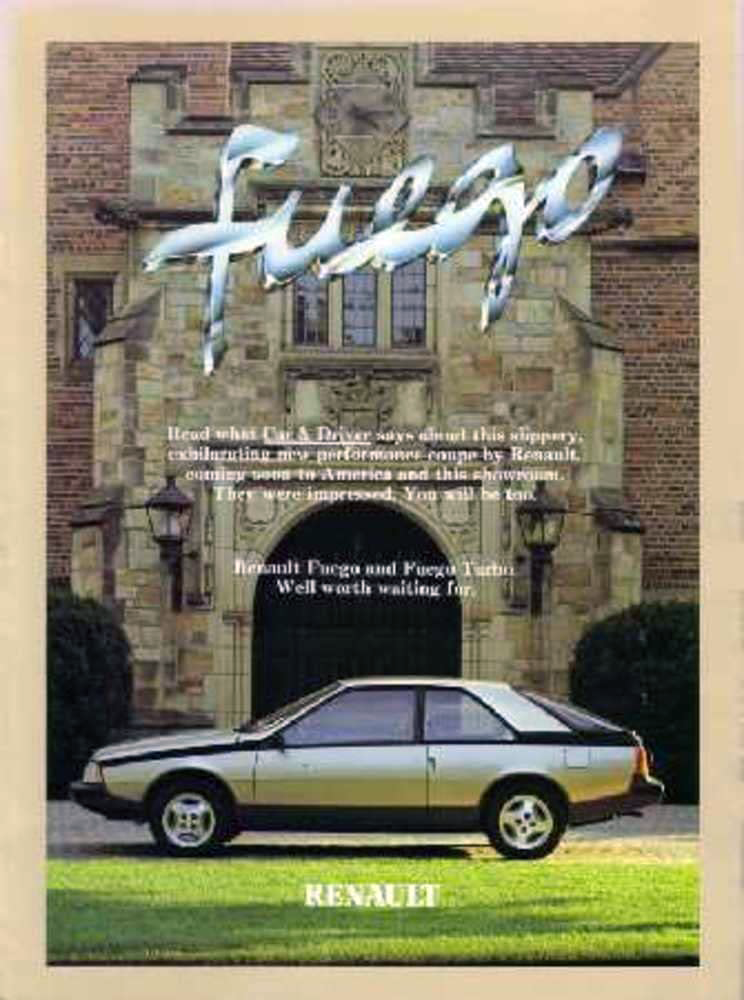
1982 Renault Fuego advertisement

Standard equipment for the $8,654 base Fuego included front-wheel-drive, rack-and-pinion steering, front disc/rear drum brakes, and P185/70R13 tires on 13-inch wheels.

Standard equipment on the $10,704 Fuego Turbo included power rack-and-pinion steering, 190/65 HR 365 (metric) Michelin TRX radial tires on 14.4-inch cast alloy wheels, air conditioning, and an AM/FM stereo. An electric sunroof was a $400 option.

Despite their success in Europe, Fuegos did not sell well in North America, which was Renault’s evident lot in life. Peak sales of 33,229 in 1982 declined every year going forward—by 1986, the Fuego’s last year in the US, they were a mere 4,152.

Those who did buy a Fuego reported that they were generally happy with their choice. A January 1983 Popular Mechanics Owner’s Report found that owners liked the handling and styling, but wanted more power.

According to Hagerty’s valuation tools, all the money for a 1982 Renault Fuego in #1/Concours condition is $5,400, with a more typical #3/Good condition example going for $1,700. For unclear reasons, Hagerty only has values for the base version and not the Turbo. Fuegos rarely show up for sale in the Hemmings Motor News classifieds and on eBay Motors—in fact, they seem to have basically vanished. There was an interesting write-up on the Fuego in OldMotors last year.

Make mine Silver Poly, please.

This post is another first—my first Renault. I should probably cover the Alliance I spent a portion of the early nineties in sometime soon …

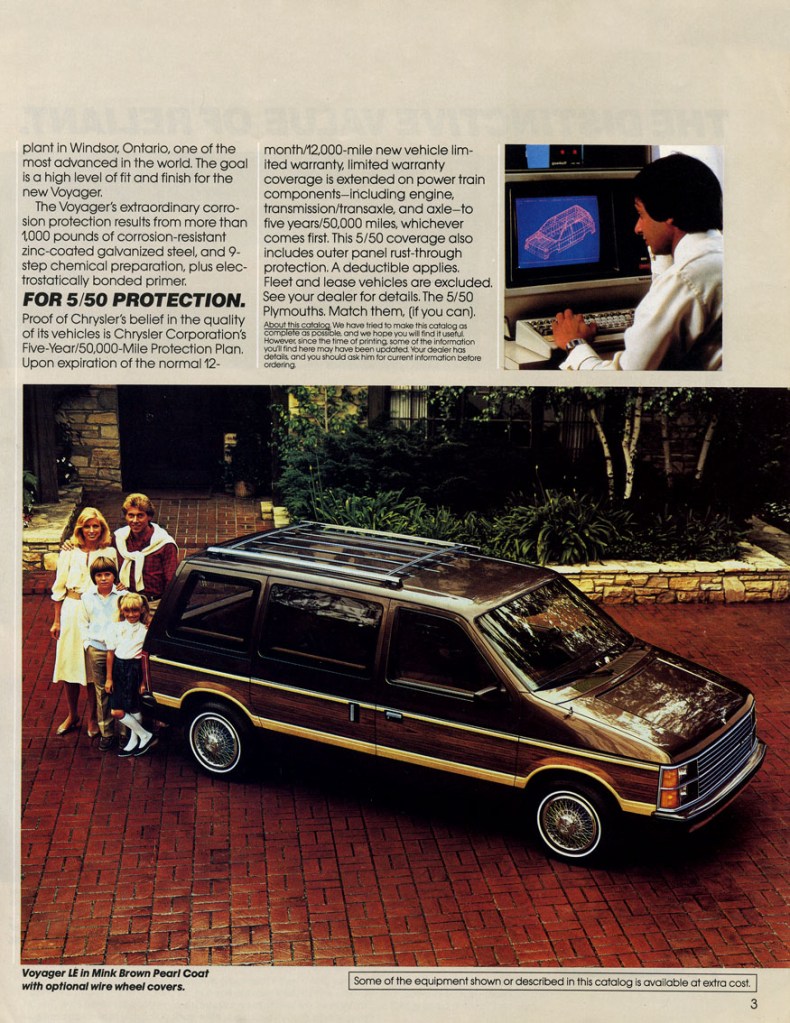
1984 Plymouth Voyager van

1984 Plymouth Voyager on the National Mall
1984 Plymouth Voyager on the National Mall, courtesy of the HVA

In spring 2018, the Historic Vehicle Association placed a series of five notable vehicles in a glass case on the National Mall in Washington, DC. One of those vehicles was a 1984 Plymouth Voyager Limited Edition minivan—highly original, and with a mere 12,000 miles.

“The Magic Wagon.”

Few eighties vehicles changed the world as much as the Dodge Caravan/Plymouth Voyager twins—because few automobiles essentially create a new market segment. The essential glory of K-platform minivans was their splitting of the packaging differences between traditional station wagons and full-size vans, along with their utilization of front-wheel-drive. Astoundingly, Allpar writes that Chrysler had been working on the same basic idea since around 1972. A reason given that those early designs were not brought to market was that General Motors and Ford had not released their own versions. It took Lee Iaccoca’s arrival in late 1978 to finally get upper management support for the T-115 concept.

The Voyager’s standard powertrain was an 84 bhp 2.2 liter/135 ci inline four with a two-barrel carburetor paired with a five-speed manual. Powertrain options included a $439 three-speed automatic and a $259 105 bhp 2.6 liter/156 ci inline four with a two-barrel carburetor (which required the automatic).

For a mainstream vehicle in 1984, the Voyager came respectably equipped. Standard exterior and mechanical equipment ($8,290 or about $26,200 in today’s dollars) included tinted glass for all windows, a right hand sliding door with a vented window, quad halogen headlamps, power rack and pinion steering, and P185/75R14 blackwall tires on 14-inch wheels with bright wheel covers. Inside, a left hand remote control mirror, two-speed windshield wipers, cloth low back front bucket seats, a three-passenger rear seat, full-floor carpeting, and an AM ETR radio with a digital clock were included.

Packages, Options & Production Numbers

Moving up to the S.E./Special Edition package ($227) added black exterior window trim, black lower body paint, road styled wheels with bright centers and trim rings, and Deluxe cloth low back front bucket seats.

Page from the 1984 Plymouth Voyager brochure
L.E. page from the 1984 Plymouth Voyager brochure

The top-of-the-line L.E./Limited Edition package ($815) included everything from the S.E. package and added woodgrain exterior vinyl bodyside panels, dual horns, a Luxury steering wheel, and Luxury cloth high back front bucket seats with recliners.

Individual options included premium wheel covers ($203), a 20-gallon fuel tank ($43), air conditioning ($737), automatic speed control ($179), a rear window defroster ($143), power door locks ($176), and an AM/FM stereo with a cassette player ($389). A Seven-Passenger Seating Package ($336) was available with either the S.E. or the L.E.—that was Chrysler’s nomenclature for adding a third-row seat.

Of course, the Chrysler minivan twins were a huge success, with 209,895 sold in their initial model year. They also received good to great reviews from the automotive press—Car and Driver included them in their 1985 10Best Cars.

Ford and General Motors had notable trouble in responding. Both had competitors (Chevrolet Astro, Ford Aerostar, GMC Safari) in place by the 1986 model year, but the market found them wanting—in part because they were rear-wheel-drive. The first real competition for Chrysler did not come until the mid-nineties when Honda debuted the front-wheel-drive Odyssey.

The View From 2025

Despite their importance, just a few folks out there collect these minivans—though I did spot one at a car show several years ago. Chrysler minivans of this era rarely show up for sale in the Hemmings Motor News classifieds, on eBay Motors, or on Bring a Trailer—in fact, they now are seldom for sale anywhere.

Make mine Gunmetal Blue Pearl Coat, please.

Last updated April 2025.

1982 Jeep CJ-8 Scrambler pickup truck

One of the many Hallmark vehicle ornaments my ex-wife purchased for me over the years is a 1982 Jeep Scrambler—with a Christmas tree in the bed, of course. It’s part of their All-American Trucks collection.

“… America’s first small 4×4 pickup …”

1982 was the second year for Jeep’s CJ-8 Scrambler pickup truck. For 1982, the Scrambler gained a substantially wider front and rear tread but otherwise was little changed from its debut year.

Based on the Jeep CJ-7 SUV, the Scrambler filled a requirement for a reasonably compact truck in the AMC’s Jeep line, as it was more than 16 inches shorter and almost a thousand pounds lighter than the smallest of Jeep’s J10 Pickup offerings. Its wheelbase was 9.5 inches longer than the CJ-7s, which brought a smoother ride. Of course, the Scrambler had that slightly over five-foot-long truck bed, which some found deficient compared to the more common six-foot bed.

The Scrambler’s standard powertrain continued to be an 86 bhp Iron Duke 2.5 liter/151 ci inline four with a two-barrel carburetor paired with a four-speed manual. The Iron Duke was, of course, sourced from General Motors. One optional engine was available—a $145 110 bhp 4.2 liter/258 ci inline six with a two-barrel carburetor. Either engine could be paired with a five-speed manual, which added $199 to the price and was newly available for 1982, while the inline six could also be mated with a $409 Torque-flite automatic. All Scramblers came with Quadra-Trac part-time four-wheel drive.

The performance of Jeep’s small truck wasn’t exactly sparkling—Car and Driver measured a 0-60 time of 17 seconds with the inline four and the four-speed manual. The inline six gave better—though not great—performance, with 0-60 times in the 12 to 14 second range depending on transmission. Fuel economy ratings for the standard powertrain were 23 city/28 highway by the day’s standards. With a 15-gallon gas tank, a Scrambler owner could reasonably expect a range of 245 to 265 miles with a 10% fuel reserve.

The Scrambler’s base price was $7,588—about $26,300 in today’s dollars, which is well under what a base 2025 Jeep Gladiator pickup truck costs. Standard exterior and mechanical equipment included dual outside rearview mirrors, a drop down tailgate, skid plates for the fuel tank and transfer case, front disc/rear drum brakes, and H78 x 15 Suburbanite XG tires on 15-inch wheels. Inside, linen grain vinyl bucket seats and a color-keyed vinyl mat were included.

Sport packages page from the 1982 Jeep Scrambler brochure

Two Sport packages were available. The first, Sport SR ($799), included Scrambler hood lettering available in three different colors, a spare wheel lock, and high back forward pivoting bucket seats trimmed in denim-look vinyl. Goodyear Tracker P/G OWL L78 x 15 tires sat on 15 x 6 inch white styled steel wheels. Convenience Group was part of SR, featuring an 8-inch day/night mirror, an under hood light, and courtesy lights. Finally, the SR include Decor Group, which included rocker panel protection molding, sports steering wheel, front frame panel, and instrument panel overlay.

The second package, Sport SL ($1,999), included everything in the Sport SR package, with various replacements or additions, the most visible of which was a half-cab hardtop or soft-top. Outside, the SL added two-color Scrambler hood lettering, beltline and door inset pin stripes, and additional chrome trim. Mechanical changes in the SL included hood insulation and heavy duty shocks, while P235/75R15 Wrangler OWL tires were mated with 15 x 7 inch chrome plated styled steel wheels. Inside, the SL included Special high back forward pivoting vinyl bucket seats, Special console and trim panels, a black leather-wrapped steering wheel, a clock, and a tachometer.

Individual Options & Production Numbers

Exterior and mechanical options included a polycarbonate top ($695), a soft vinyl top ($280), halogen fog lamps ($90), power brakes ($95), variable-ratio power steering ($229), a Heavy-Duty cooling system ($103), and a 20-gallon fuel tank. Inside, air conditioning ($650), a tilt steering wheel ($90), and an AM/FM stereo radio ($224) were available.

Scrambler sales for 1982 were … okay, with 7,759 produced, making it 12% of overall Jeep production in a down year for the marque where only Cherokee sales increased. The Scrambler did outsell the larger Jeep J10/J20 Pickup for the second straight model year—but that wouldn’t last.

The View From 2025

Scramblers have a devoted fanbase, and their values reflect that. According to Hagerty’s valuation tools, all the money for a 1982 CJ-8 ScramblerSport SL in #1/Concours condition is $53,800, with a more typical #3/Good condition example going for $32,700. Scramblers frequently show up for sale in the Hemmings Motor News classifieds, on eBay Motors, and on Bring a Trailer.

Make mine Deep Maroon Metallic, please.

This post is the first on Eighties Cars to be informed in some way by my recent acquisition of Flory’s American Light Trucks & Utility Vehicles, 1967–1989. Allpar and Hemmings also were valuable sources as I completed this blog entry. Astoundingly, this was the first Jeep I have covered in a specific post, though Jeeps frequently show up in auction coverage and I wrote about the 1980 Eagle early on. A Wagoneer post wasn’t far behind.

Last updated October 2025.

A New Reference Arrives

American Light Trucks book cover
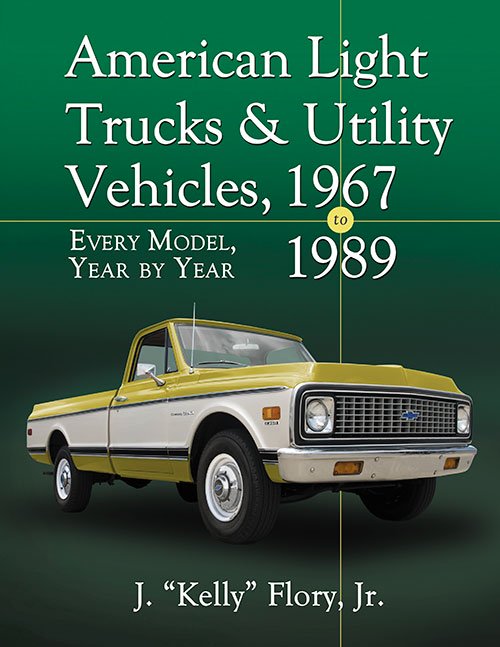
Cover of American Light Trucks & Utility Vehicles

Eighties Cars has been somewhat weak when it comes to the trucks, vans, and SUVs of the decade. Sure, there have been a few posts, including a recent one about the 1985 Chevrolet Suburban, but there certainly isn’t a representative amount.

There are a few reasons for this. One is that I simply don’t feel as familiar with trucks and SUVs as I am with automobiles. Another is that references are sparer for trucks and SUVs than for cars—at least American ones.

That second reason was at least partially ameliorated today with the arrival of J. “Kelly” Flory, Jr.’s latest opus. American Light Trucks & Utility Vehicles, 1967–1989 is exactly what it says—every model of truck, van, and sport utility vehicle, year by year. It’s a weighty tome, running 1,461 pages. I sourced it from Powell’s Books, and it arrived quickly.

Kelly Flory is familiar to folks who use automobile references. I already have his three American Cars volumes—1946 to 1959, 1960 to 1972, and 1973 to 1980, which combine for 2,950 pages. These books give a different view of any particular car model by placing it within the context of the overall marque and the rest of the American automotive industry for each model year. American Light Trucks & Utility Vehicles follows the same format.

For Eighties Cars, this new resource will mean two things. First, there will be more posts about trucks, vans, and SUVs. Second, I will revise previous truck and SUV posts where data was spare or imprecise.

Eighties Vehicles at Two Online Auctions in May 2020

The first completely online auctions from Barrett-Jackson and RM-Sotheby’s in May 2020 included a few vehicles from the 1980s—6% of the (85+193=278) lots offered between the two events. I’ll concentrate on the at least reasonably stock 1980s cars and trucks and add some of my opinions—I’ll leave the automobilia, boats, motorcycles, and tractors to others. Where I have covered the specific year and model of a car in this blog, I link to it.

Barrett-Jackson

  • 1984 Oxford White Ford Mustang GT350 convertible with a white top, canyon red cloth bucket seats, a Windsor 175 bhp 4.9 liter/302 ci V8 with a Holley 4180 four-barrel carburetor, a five-speed manual, and 4,800 miles—did not meet reserve.
  • 1986 Victory Red Chevrolet C10 custom (engine, wheels/suspension, exterior, interior) pickup truck with a black bench seat, a Vortec 4.8 liter/293 ci V8 with fuel injection, and an automatic—did not meet reserve.
  • 1985 Guards Red Porsche 911 Carrera Targa with black leather bucket seats, a 207 bhp 3.2 liter/193 ci flat six with Bosch Motronic fuel injection, a five-speed manual, and 9,900 miles—$45,000 hammer price. That price makes this the first vehicle in this auction review to meet my criteria for serious collectability of 1980s cars or trucks in stock condition: selling for equal to or above its original base list price. I’ll mark these vehicles in bold green.
  • 1984 Blue Gunmetal Dodge Daytona Turbo hatchback coupe with checkered cloth bucket seats, a Turbo I 142 bhp 2.2 liter/135 ci inline four with fuel injection and a turbocharger, a five-speed manual, and 5,200 miles—$18,500. Almost certainly the most unusual eighties vehicle at this auction—who saves these cars?
1984 Dodge Daytona Turbo
1984 Dodge Daytona Turbo, courtesy of Barrett-Jackson
  • 1985 Black Porsche 911 Carrera custom (cabriolet and slant nose conversions) with black bucket seats, a 207 bhp 3.2 liter/193 ci flat six with fuel injection, a five-speed manual, and 35,000 miles—$30,500

RM-Sotheby’s

  • 1985 Midnight Blue Mercedes-Benz 380SL convertible with royal blue leather bucket seats, a 155 bhp 3.8 liter/234 ci V8 with Bosch Jetronic fuel injection, an automatic, and 44,000 miles—$13,500 hammer price.
  • 1986 black Rolls-Royce Silver Spur limousine with gray leather seats, a 6.75 liter/412 ci V8, an automatic, and 40,000 miles—did not meet reserve.
  • 1988 Midnight Blue Metallic Porsche 928 S4 with marine blue leather bucket seats, a 320 bhp 5.0 liter/302 ci V8 with fuel injection, and an automatic—$16,500
  • 1981 Silver Metallic Pontiac Firebird Trans Am coupe with gray cloth bucket seats, a 145 bhp 5.0 liter/305 ci V8, an automatic transmission, and 10,000 miles—$21,000
  • 1985 camouflage AM General Humvee M998 SUV with tan bucket seats, a 6.2 liter diesel V8, and an automatic—$12,000
  • 1987 Signal Red Mercedes-Benz 560SL convertible with a black convertible top, black leather bucket seats, a 227 bhp 5.5 liter/338 ci V8 with Bosch KE-Jetronic fuel injection, an automatic, and 36,000 miles—$33,000
  • 1980 Sky Blue Toyota FJ43 Land Cruiser SUV with gray vinyl bucket seats, a 2F 4.2 liter/258 ci inline six, and a five-speed manual—$26,000
  • 1989 Astral Silver Metallic Mercedes-Benz 560SL convertible with a black convertible top, black leather bucket seats, a 227 bhp 5.5 liter/338 ci V8 with Bosch KE-Jetronic fuel injection, an automatic, and 31,000 miles—$42,000
  • 1989 Guards Red Porsche 911 Speedster convertible with a black top, black leather bucket seats, a 217 bhp 3.2 liter/193 ci flat six with fuel injection, a five-speed manual, and 41 miles—$200,000
  • 1980 beige Toyota FJ40 Land Cruiser custom (mechanical, exterior, interior) SUV with beige leather bucket seats and a five-speed manual—did not meet reserve.
  • 1981 Grigio Alfa-Romeo GTV6 2.5 hatchback coupe with tan bucket seats, a 154 bhp 2.5 liter/152 ci V6 with Bosch L-Jetronic fuel injection, a five-speed manual, and 35,000 miles. This Alfa originally owned by Mario Andretti did not meet reserve.
  • 1985 Rosso Ferrari 288 GTO coupe with black leather bucket seats, a 394 bhp 2.9 liter/175 ci V8 with fuel injection and twin turbochargers, a five-speed manual, and 15,000 miles—$2,100,000
1985 Ferrari 288 GTO, courtesy of RM-Sotheby’s
  • 1989 Grand Prix White Porsche 911 Carrera coupe with blue leather bucket seats, a 207 bhp 3.2 liter/193 ci flat six with Bosch Motronic fuel injection, a five-speed manual, and 47,000 miles—did not meet reserve.

What do you think of these auction results?

1985 Chevrolet C20 Suburban Silverado SUV

For Memorial Day 2020, here’s some truly large American iron.

I was working at the local Chevrolet dealership when a special-ordered Suburban Silverado came in with a 454. It was late in 1984—no passenger car was shipping with anything approaching a big block. But this C20 Suburban had a “rat motor” inside, and you could hear a distinct difference.

For 1985, Chevrolet changed little with the Suburban in the 13th model year of its seventh generation (Suburbans go back to 1935). There was a new grille, but that was about it other than minor trim changes.

The standard powertrain for the C20 Suburban was an LT9 160 bhp 5.7 liter/350 ci V8 with a four-barrel carburetor paired with a floor-mounted four-speed manual transmission. Engine options included an LH6 148 bhp 6.2 liter/379 ci diesel V8 and the aforementioned LE8 230 bhp 7.4 liter/454 ci V8 with a four-barrel carburetor (which required power steering and a heavy-duty battery and was a $700 option). A three-speed automatic was available for all three engines, while a four-speed automatic was for only the 350 ci engine.

The Suburban was a substantial vehicle for 1985, with a 129.5 inch wheelbase and 219.1 inches of overall length. With a 4,705-pound curb weight, C20 Suburbans had a gross vehicle weight rating of 8,600 pounds—high enough not to receive fuel economy ratings, which was likely a good thing. A standard 27-gallon fuel tank kept the range respectable, but filling it was painful to the wallet.

Standard equipment for the base C20 Suburban (which Chevrolet designated the Custom Deluxe) included power front disc/rear drum brakes, 16 x 6.5 inch wheels, a vinyl bench seat, and a heater and defogger. At $10,953, the C20 was approximately $32,200 in today’s dollars or about half of what a base 2025 Suburban costs—SUVs have moved substantially upmarket in the last 35 years. For most of the eighties, Chevrolet offered two upgraded trims:

  • Scottsdale trim ($459 for gasoline-engined Suburbans) included black body-side moldings, dual horns, two dome lamps, a cigarette lighter, and Scottsdale nameplates on the front fenders and instrument panel.
  • Silverado trim ($1,259 for gasoline-engined Suburbans) required Custom cloth or Custom vinyl seats. It included a Deluxe molding package, bright body-side moldings, Deluxe front appearance, dual horns, and Silverado nameplates on the front fenders. Inside, a cigarette lighter, a dome lamp, voltmeter, temperature, and oil pressure gages, and a Silverado nameplate on the instrument panel were included.

Options & Production Numbers

Beyond the trims, the 1985 Suburban’s options list was long and complicated. Suburban buyers first had to choose whether they wanted panel rear doors (standard) or a tailgate with manual drop glass ($36). Next came seating choices: front seat only, front seat and folding center seat, or front seat, folding center seat, and removable rear seat.

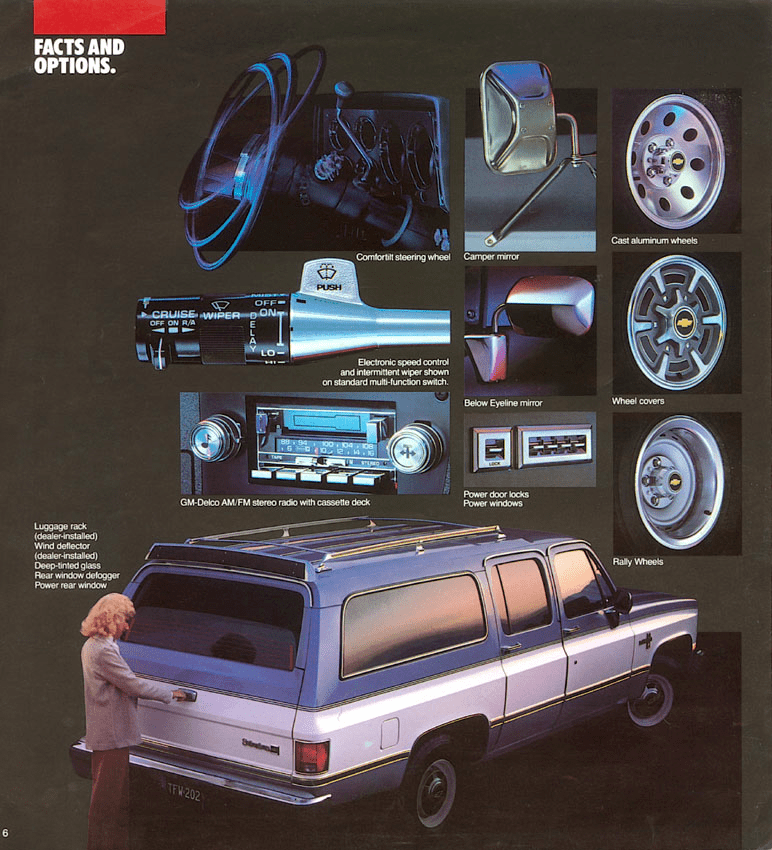
Options page from the 1985 Suburban brochure

Other exterior and mechanical options included deep tinted glass in two different configurations, halogen high beam headlamps, two optional gas tank sizes (31-gallon and 41-gallon), and a wide range of wheels and tires. Inside, air conditioning (front or front and rear), an electric rear window defogger, electronic speed control, power door locks, power windows, a quartz electric clock, Custom reclining bucket seats with a console, and a range of radios up to an AM/FM stereo with a cassette player were all available.

Chevrolet sold 64,470 Suburbans in the 1985 model year—many of them heavily optioned.

The View From 2025

Badge for 2,500 web hits

These seventh-generation Suburbans have their fans. According to Hagerty’s valuation tools, all the money for a 1985 C20 Suburban Silverado in #1/Concours condition is $47,300, with a more typical #3/Good condition example going for $20,300. Suburbans frequently show up for sale in the Hemmings Motor News classifieds, on eBay Motors, and on Bring a Trailer. As I update this post in April 2025, a 1985 Indian Bronze Metallic Silverado with a Burgundy Custom cloth bench seat, a 5.7 liter/350 ci V8, an automatic, and 66,000 miles is available on Hemmings, asking $80,000.

Make mine Apple Red, with Saddle Tan Custom cloth reclining bucket seats, please—just like that 454 all those years ago.

Last updated April 2025.

The Posts That Attract Interest, Part 3

Typewriter icon

Earlier this week, my write-up on the 1987 Chevrolet Caprice Classic coupe went over 1,000 views. This level of interest is relatively rare on Eighties Cars—the two other posts that have proceeded it to greater than 1,000 views are on the 1986 Chevrolet Camaro Berlinetta hatchback coupe and the 1985 Buick Somerset Regal coupe.

I have many theories about what makes a particular post more popular than others, at least on Eighties Cars. One thought is that the key to the popularity of an individual post is generally the rarity of the other coverage available for that particular vehicle. That theory works for the Berlinetta (all of the attention is on the Z28 and IROC-Z versions of the eighties Camaro) and definitely for the Somerset Regal—though most of the interest in that particular post is probably because of a Jalopnik Meh Car Monday write-up that casually referenced this site.

However, the Caprice Classic coupe doesn’t quite fit into the category of the Berlinetta and the Somerset Regal—aside from being a General Motors product. B platform cars were and are well-respected; only a few years prior to 1987, the Caprice had been on Car and Driver‘s inaugural 10Best Cars list. They also have a current following, though many that remain are at least somewhat modified.

So, the short form is I’m not quite sure why this last of the Caprice coupes has garnered so much interest—but I am grateful for the views.

1982 Porsche 924 Turbo hatchback coupe

“… one of the fastest production two-liter cars in the world.”

1982 was the final model year for both the Porsche 924 Turbo and the base 924. The 924 S would return in 1987 and 1988, but the 944 would take over as the entry-level Porsche from 1983 to 1986, with the 944 Turbo coming in 1986.

The 924 Turbo‘s engine was a 154 bhp 2.0 liter/121 ci inline four with a single turbocharger and Bosch K-Jetronic fuel injection. 154 bhp isn’t that impressive over forty years later, but in the early 1980s, it marked a significant upgrade from the base 924’s 110 bhp—enough to drop 0-60 times by about two seconds (Road & Track clocked a 9.3 second 0-60). Fuel economy ratings were 20 city/33 highway by the day’s standards. With a 17.4-gallon gas tank, a 924 Turbo driver could expect a range of 375 to 415 miles with a 10% fuel reserve.

1982 Porsche 924/924 Turbo advertisement

The $21,500 924 Turbo was about $73,500 in today’s dollars or just about exactly what a 2025 718 Cayman costs. Standard exterior and mechanical equipment included tinted glass all around, a rear spoiler, a four-wheel independent suspension, rack and pinion steering, 4-wheel ventilated disc brakes, and 185/70VR15 tires (a size still available thanks to Pirelli and Vredestein) on 15-inch light alloy wheels. Inside, air conditioning, power windows, and an electric rear window defroster were included. Upholstery features included reclining bucket seats, full carpeting, and a leather-covered steering wheel.

Options & Production Numbers

Options for the 924 Turbo included headlamp washers, a limited slip differential, an electric rear window wiper, an alarm system, leather sport seats, a digital cassette radio, and a power antenna.

Porsche sold 876 examples of the 924 Turbo in the United States in 1982. In 1983, the 944 would sell 75% more than the 1982 sales of the 924 and the 924 Turbo combined.

The View From 2025

There is good club support for the Porsche 924, as there is for all Porsches. According to Hagerty’s valuation tools, all the money for a 1982 Porsche 924 Turbo in #1/Concours condition is an astounding $39,000, with a more normal #3/Good condition car going for $12,500. Porsche 924s frequently show up for sale in the Hemmings Motor News classifieds, on eBay Motors, and on Bring a Trailer. As I update this blog post in April 2025, there’s a Black Metallic 1982 924 Turbo with tan leather seats and 46,000 miles for sale on Hemmings, asking $15,000.

Make mine Diamond Silver Metallic, please. The 924 always looked good in silver.

Other eighties Porsches I have written about include the 1982 928 hatchback coupe, the 1985 911 Carrera Cabriolet, the 1986 944 Turbo hatchback coupe, the 1987 911 3.2 Carrera coupe, and the 1988 944 hatchback coupe.

Last updated April 2025.

1984 Maserati Biturbo coupe

After over six years of writing, this is the first Maserati to be featured in Eighties Cars.

“Formula One Performance in a Grand Touring Masterpiece”

After two years of European production, 1984 was the first model year that Maserati’s Pierangelo Andreani-styled Biturbo coupe was available in the United States. The Biturbo was a complete change of pace for Maserati, essentially designed to be an Italian-flavored BMW 3 series competitor.

Of course, the Biturbo was famous for—and named for—it’s engine, the first production twin-turbocharged powerplant in the world. For 1984’s move to the US market, displacement of the V6 was increased to 2.5 liters/152 cubic inches, which resulted in 192 bhp. Unsurprisingly for the era, a Weber two-barrel carburetor fed the fuel/air mixture. The only transmission available for 1984 was a five-speed manual.

page from 1984 maserati Biturbo brochure
Page from the 1984 Maserati Biturbo brochure

Maserati’s four-page brochure claimed a top speed of 130 mph and a 0-60 time of 6.9 seconds in the 2,650-pound Biturbo (quick in 1984), and period road tests came reasonably close to those figures. Fuel economy was less impressive—rated at 15 city/25 highway by the standards of the day (12/18 by today’s standards). With a sizeable 21.2-gallon gas tank, a Biturbo owner could expect a range of between 285 and 380 miles with a 10% fuel reserve.

Standard equipment on the $26,874 Biturbo (about $68,200 in today’s dollars or about what a 2020 Ghibli sedan costs) included a four-wheel independent suspension, rack and pinion steering, four-wheel power disc brakes, and Pirelli P6 195/60HR14 tires (a size still readily available) on 14 x 5.5 inch magnesium alloy wheels. The luxurious interior design was highly acclaimed at the time and remains attractive even to this day.

Initially, the Biturbo sold reasonably well in North America, aided by positive reviews—Popular Mechanics called it “the Clark Kent of cars.” However, a reputation for both engine unreliability (related to the blow-through carburetor/turbo combination) and spotty build quality quickly took its toll, and by 1985 many coupes sat on dealer lots. Decades later, this notoriety would end up landing the 1984 Biturbo on Time magazine’s The 50 Worst Cars of All Time list, where it joined other notably failed cars such as the 1982 Cadillac Cimarron. As always, as with any vehicle, there are different opinions.

According to Hagerty’s valuation tools, all the money for a 1984 Biturbo coupe in #1/Concours condition is currently $8,400, with a more normal #3/Good condition car going for a mere $3,200. These Biturbos sometimes show up for sale in the Hemmings Motor News classifieds and on eBay Motors, but are often in at least somewhat sketchy condition. Make mine Bordeaux, please.

1983 Chevrolet Cavalier CS sedan

The inspiration for this blog entry is a loaded 1983 Chevrolet Cavalier CS sedan that one of my frequent readers owned back in the day.

“… one of today’s most advanced front-wheel-drive cars”

1983 was the second model year for Chevrolet’s Cavalier compact. The biggest news was likely in the powertrain: a 2.0 liter inline four with throttle-body fuel injection was the new standard engine, along with a newly optional five-speed manual transmission. Chevrolet announced a convertible version of the coupe in the middle of the model year.

The only engine available was the LQ5 86 bhp 2.0 liter/122 ci inline four with throttle-body fuel injection. The LQ5 had two fewer horsepower than the previous year’s L46 1.8 liter engine, but notably more grunt—an additional ten lb-ft of torque. The result was a meaningful half-second improvement in 0-60 times, though the Cavalier remained slow (even by 1983 standards). A four-speed manual remained standard, while a five-speed manual ($75) and an automatic ($395) were available. Fuel economy ratings with the five-speed manual were 25 city/41 highway by the day’s standards. With a 13.6-gallon gas tank, a Cavalier driver could expect a range of 330 to 360 miles with a 10% fuel reserve.

Standard equipment on the 1983 Cavalier was far sparer than it had been in 1982, when many potential buyers had blanched at the sedan’s $7,137 base price. Still, exterior and mechanical features on all Cavalier sedans did include front-wheel-drive, a front stabilizer bar, rack and pinion steering, power front disc/rear drum brakes, and P175/80R13 radial tires on 13 x 5 inch steel wheels. Inside, vinyl reclining front bucket seats and side window defoggers were included. For 1983, the sedan started at $5,999—about $19,800 in today’s dollars.

Page from 1983 Chevrolet Cavalier brochure
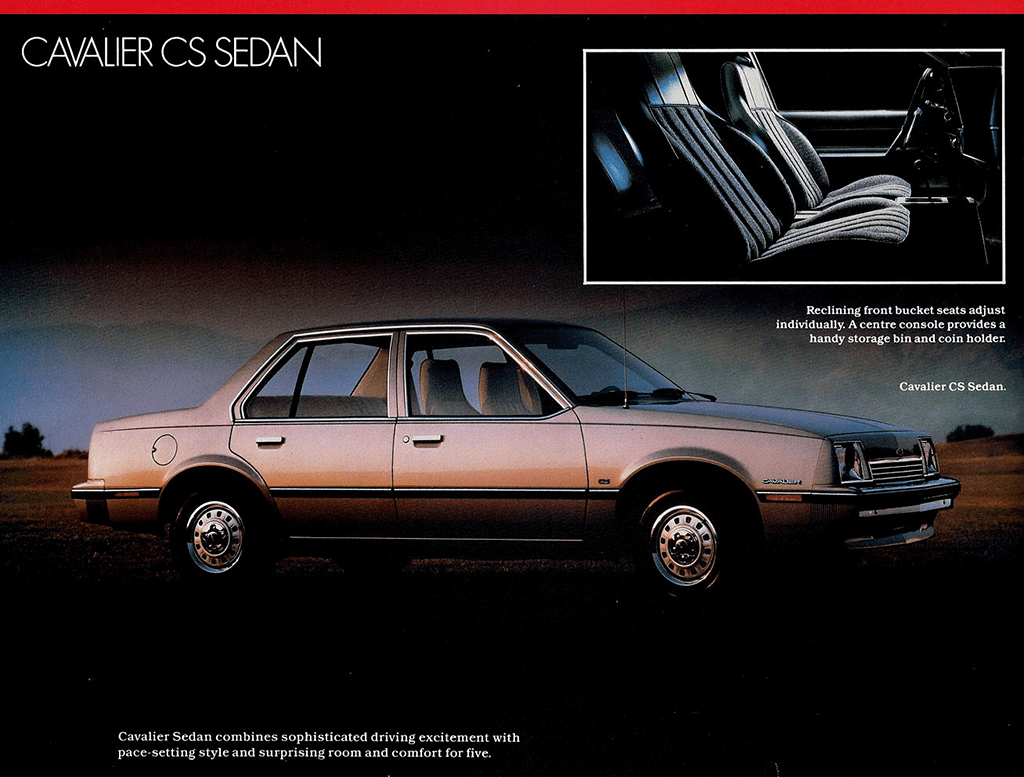
CS sedan page from the 1983 Chevrolet Cavalier brochure

Moving up to the $6,484 CS added a glove compartment lock, a colour-keyed instrument panel, a cigarette lighter, an ashtray light, and an AM push-button radio with dual front speakers.

Only available with the CS, the CL package added Sport mirrors, a Custom interior with Custom reclining seats and adjustable head restraints, a three-spoke steering wheel with a black leather rim, and a right-hand visor vanity mirror.

Options & Production Numbers

Exterior and mechanical options for the CS sedan included tinted glass ($90), a removable sunroof ($295), Custom two-tone paint with pin striping ($176), halogen headlamps ($10), power steering ($195), and an F41 sport suspension ($49). Inside, power door locks ($170), power windows ($255), automatic speed control ($170), a six-way power driver’s seat ($210), a Comfortilt steering wheel ($99), and air conditioning ($625) were among the many options.

The 1983 Cavalier sold well, with 215,585 units exiting Chevrolet showrooms, making it the most popular model in the Chevrolet lineup. Of all Cavalier variants in 1983, the CS sedan was the most popular, accounting for almost a quarter of total sales—the convertible was, of course, the rarest, with a mere 607 sold.

The View From 2025

Despite this popularity when new, Cavaliers of this generation have now almost vanished, except for the convertibles and the higher-performance Z24 versions. “Civilian” Cavaliers do occasionally appear on eBay Motors and Bring a Trailer.

Make mine a Light Briar Brown over Dark Brown two-tone—just like my reader’s car.

The other J platform cars I have written about are the 1982 Cadillac Cimarron sedan, the 1984 Buick Skyhawk coupe, the 1984 Pontiac 2000 Sunbird S/E hatchback coupe, the 1985 Oldsmobile Firenza ES sedan, the 1986 Chevrolet Cavalier Z24 coupe, and the 1988 Cadillac Cimarron sedan. I really should write about a J-body wagon someday.

Last updated October 2025.