1987 Chevrolet Cavalier RS convertible

Recently, a near-perfect low-mileage 1987 Chevrolet Cavalier RS convertible came up for auction on Bring a Trailer. This event made me painfully aware that I’d written about the Cavalier sedan and coupe, but somehow not the convertible—time to fix that.

“Sporty performance”

The Chevrolet Cavalier first came to market for the 1982 model year, initially available as a notchback coupe, a hatchback coupe, a notchback sedan, and a station wagon. In the middle of 1983, Chevrolet introduced a convertible version, initially available as the top-of-the-line CS. In 1984, the convertible transitioned to the sporty Type 10. The RS replaced the Type 10 in the 1986 model year, and the convertible went with it. From 1983 through 1987, Cavalier convertible conversions were done by ASC.

The RS convertible’s standard powertrain was the 90 bhp LL8 2.0 liter/121 ci inline four with electronic fuel injection and a four-speed manual. Optional power was the 125 bhp LB6 2.8 liter/173 ci V6 with multiport fuel injection ($660). Both a new-for-1987 Getrag-designed five-speed manual transmission ($75) and a three-speed automatic transmission ($490) were available.

Road tests of the first-generation Cavalier convertible are hard to come by, but 0-60 likely came in a little over 9 seconds with the five-speed/V6 combination. Fuel economy ratings for the same combination were 20 city/26 highway by the day’s standards. With a 14-gallon gas tank, a Cavalier convertible’s enthusiastic new owner could expect a range of 265 to 285 miles with a 10% fuel reserve.

Front cover of the 1987 Chevrolet full line brochure

The 1987 Cavalier RS convertible’s base price was $13,466—about $39,700 in 2025 dollars. Standard exterior and mechanical equipment included a power operated convertible top, tinted glass, left hand remote and right hand manual Sport mirrors, the F41 sport suspension, a front stabilizer bar, power steering, power front disc/rear drum brakes, and P195/70R13 all season radial ply blackwall tires (a size no longer readily available) on 13-inch Rally wheels with trim rings. Inside, Custom Cloth front bucket seats with recliners, a console, a Sport steering wheel, power windows, and an AM radio with dual front speakers were included.

Options & Production Numbers

Individual options available with the RS convertible included aluminum wheels ($212), air conditioning ($675), the Comfortilt steering wheel ($125), electronic speed control with resume speed ($175), an intermittent windshield wiper system ($55), and a power door lock system ($145). A series of four optional audio systems, ranging up to an ETR AM/FM stereo radio with seek and scan, a cassette player, a graphic equalizer, and a clock ($449), was available.

Chevrolet sold 5,826 Cavalier convertibles in the 1987 model year, making that the best production total for any year of the first-generation Cavalier convertible.

The View From 2025

People do collect these small convertibles. They maintain a reasonable presence in the Hemmings Motor News classifieds, on eBay Motors, and on Bring a Trailer.

Make mine Red—I think.

Other Cavaliers I have written about include the 1983 CS sedan and the 1986 Z24 coupe. The other J platform cars I have written about are the 1982 Cadillac Cimarron sedan, the 1984 Buick Skyhawk coupe, the 1984 Pontiac 2000 Sunbird S/E hatchback coupe, the 1985 Oldsmobile Firenza ES sedan, and the 1988 Cadillac Cimarron sedan.

1986 Mercedes-Benz 560SL convertible

“How is a classic transformed into a legend?”

The 1986 Mercedes-Benz 560SL marked the last significant revision to the R107 generation that had begun way back in 1972 with the 450SL. In addition to a larger and more powerful V8, Mercedes added a new rear suspension, anti-lock brakes (ABS), a limited-slip differential, a driver’s side airbag, and standard leather upholstery. The 560SL also got the federally-required high-mounted third brake light, mounted awkwardly on the trunk.

Motive power was provided by a Bosch fuel-injected 227 bhp 5.5 liter/338 ci V8 connected to a four-speed automatic transmission. Motor Trend recorded a 0-60 time of 6.8 seconds, while Road & Track recorded 7.5 seconds—no matter what, the 560SL was over three seconds faster than the 380SL. Mileage wasn’t exactly a priority in a car with 3,781-pound curb weight—the ratings of the day were 14 city mpg/17 highway (adding a $1,300 gas guzzler tax to every vehicle), by today’s standards that would be 12 city/16 highway. With the 22.5-gallon gas tank, 560SL owners could expect a range of between 280 and 315 miles with a 10% fuel reserve.

The 560SL’s base price at the beginning of the 1986 model year was $48,200—about $143,700 in today’s dollars, which is slightly under what a 2026 AMG SL 55 convertible goes for. By the end of the 1986 model year, the 560SL’s base price had risen to $53,730.

560SL pages from the 1986 Mercedes-Benz brochure

For their money, SL buyers got a plethora of standard equipment. Standard exterior and mechanical features included halogen head and fog lamps, tinted glass, power assisted steering, power assisted four wheel disc brakes, and 205/65R15 steel belted radial-ply tires (a size still readily available) on 15-inch light alloy wheels. Inside, adjustable front bucket seats and head restraints, a leather covered steering wheel and gear selector, cruise control, a central locking system, electric window lifts, fully automatic climate control, an electronic AM and FM stereo radio with a cassette player, and a first aid kit were included.

Options & Production Numbers

The 560SL offered only three factory options: heated seats, electronically adjustable headrests, and California emissions ($30).

About 13,788 well-healed buyers took home the first-year 560SL, up about 69% from the final year 380SL.

The View From 2025

There is solid club and forum support for the 560SL, as there is for almost all Mercedes-Benzes. According to Hagerty’s valuation tools, all the money for a 1986 560SL in #1/Concours condition is an astounding $150,000, while a more normal #3/Good condition car goes for $22,300. 560SLs maintain a substantial presence in the Hemming’s Motor News classifieds, on eBay Motors, and on Bring a Trailer. As I wrote this blog post in September 2025, there were 74 available on Hemmings, including 15 of the 1986 models.

Make mine Nautical Blue Metallic, please.

Other Mercedes-Benz models I have written about included the 1980 450SL convertible, the 1981 380 SEL sedan, the 1985 380SL convertible, the 1985 300SD coupe, the 1986 560SEC coupe, and the 1989 560SL convertible.

1982 Buick Riviera convertible

On my birthday, here’s a big, comfortable eighties convertible.

“A classic in its own time.”

After being considered by Buick since the early 1960s, the 1982 model year’s most significant news for the Riviera was the advent of the first production convertibles—though the division didn’t deliver the first examples until July 1982. Every Riviera convertible began life as a “normal” Riviera coupe built at GM’s Linden, NJ assembly plant. Cars destined to become convertibles were assembled with neither a rear seat nor a headliner and were finished in either White or Red Firemist paint with maple leather interiors.

Buick then shipped these coupes about 675 miles to American Sunroof Corporation (ASC) in Lansing, MI, where the involved process of changing them to convertibles began. This procedure required cutting the top off, strengthening the body, adding a different rear seat (narrower than the one fitted to the coupe), and installing the white diamond-grain vinyl convertible top and the associated electronics for the power top’s operation. This process took more than 300 parts and required a quoted 10 hours of labor per car—both notable additions.
Once completed, new Riviera convertibles underwent two separate leak tests to ensure the top’s integrity before being shipped to Buick dealers. Buick general manager Lloyd Reuss was quoted as saying, “it’s not a hacksaw job,” perhaps comparing it to contemporary efforts from Chrysler and Ford.

Advertisement for the 1982 Buick Riviera convertible

Additional standard equipment packaged with the Riviera convertible included contrasting body-side stripes, four-wheel disc brakes, Custom locking wire wheel covers, deluxe trunk trim, 45/45 leather seats, and the aforementioned Firemist paint (if one went with red). Convertible-specific components included a power-operated convertible top, a cloth headliner, power-operated rear quarter windows, and a “special” radio speaker system. It was a good thing that Riviera convertibles came well-equipped because they were really expensive—with a base price of $24,064, 1982’s droptop Riv was about 66% more expensive than its coupe relation’s barrier to entry. In constant dollars, the sixth-generation convertibles are easily the most costly production Rivieras ever built.

Options & Production Numbers

Exterior and mechanical options for the convertible included door edge guards ($15), an 85-amp Delcotron generator ($35), tungsten-halogen high beam headlamps ($10), and Twilight Sentinel headlamp control ($97). Inside, electric seat back recliners for the driver and front passenger ($139 each), Electronic Touch Climate Control air conditioning ($150), and a tilt and telescoping steering column ($150) were available. Buick offered five optional radios for the Riviera, ranging up to a Delco ETR AM-FM stereo radio with a cassette tape player, CB, and Triband power antenna.

For all its expense—a Riviera convertible started at about $80,200 in today’s dollars—the convertible made and continues to make a distinct impression. A friend of mine who has owned his Riviera convertible since new remembers viewing one at a Buick dealership and thinking it was one of the most beautiful cars he had ever seen.

Buick sold 1,248 Riviera convertibles in the 1982 model year, making the droptop 2.8% of overall production. Approximately sixty were part of Buick’s Select 60 program for top dealers.

The View From 2025

There’s robust discussion and support for the sixth-generation Riviera on the AACA’s Buick Riviera page. According to Hagerty’s valuation tools, a 1982 Riviera convertible in #1/Concours condition is $40,600, with a far more normal #3/Good condition going for $12,900. Riviera convertibles often come up for sale in the Hemmings Motor News classifieds, on eBay Motors, on Bring a Trailer, and at in-person auctions.

Make mine Red Firemist, please.

Other sixth-generation Rivieras I have written about include the 1980 S TYPE and the 1984 T TYPE. I should write about a “civilian” coupe at some point.

Most material in this blog entry was sourced from the unfinished Riviera Project.

Last updated December 2025.

1984 Cadillac Eldorado Biarritz convertible

I originally wrote this post in January 2021. In February 2025, it was substantially updated with much additional amplifying detail—enough to make it a new blog entry.

“… this is one convertible that truly brings luxury out in the open.”

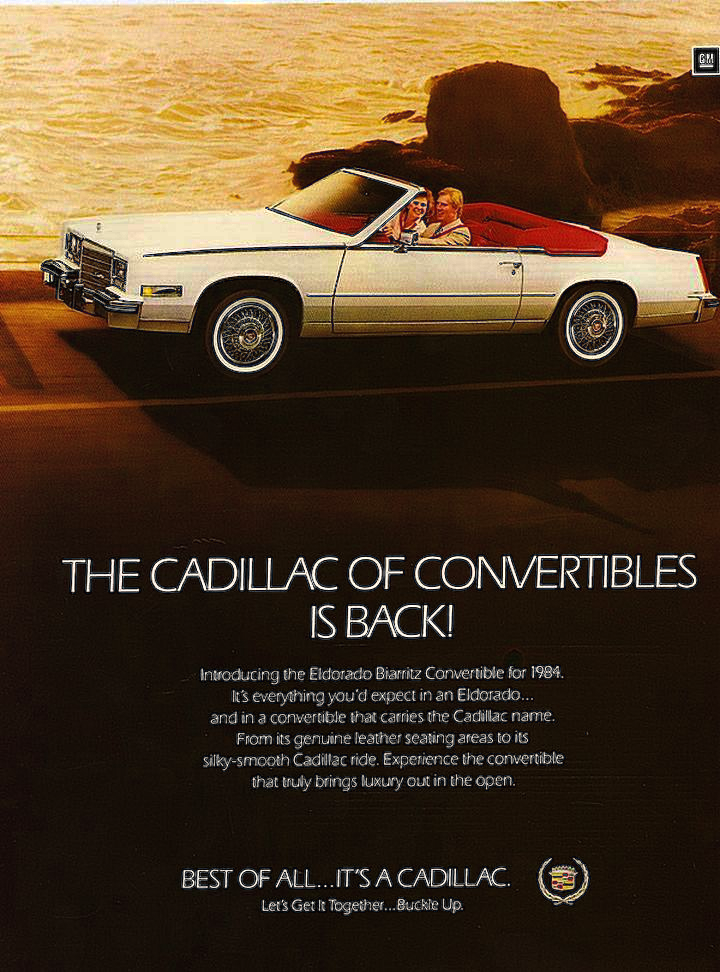
For 1984, Cadillac decided to join the eighties convertible party with a version of the Eldorado Biarritz. With a base price of $31,274 (about $99,900 in today’s dollars), the Eldorado droptop was operating in rarified air. In constant dollars, it was the most costly Eldorado of any type since 1960’s hand-crafted Pininfarina-built Brougham.

The only powertrain available for the 1984 Eldorado convertible was the HT-4100 135 bhp 4.1 liter/249 ci V8 with fuel injection paired with a four-speed automatic. With a curb weight of about 3,900 pounds, 0-60 mph came in around 14 seconds. Fuel economy was rated at 17 city/27 highway by 1984 standards (14/20 by today’s measures). A 20.4-gallon gas tank meant an Eldorado convertible owner could expect a range of between 310 and 360 miles with a 10% fuel reserve.

1984 Cadillac Eldorado convertible advertisement
1984 Cadillac Eldorado Biarritz convertible advertisement

Standard exterior and mechanical equipment on the Biarritz convertible included a power convertible top, power rear quarter windows, car color body side moldings, and P225/70R15 steel-belted radial wide white stripe tires (a size still readily available) on 15-inch wheels with wire wheel discs. Inside, a theft-deterrent system, leather seats, and a leather-trimmed steering wheel rim were standard.

Standard exterior and mechanical equipment on every 1984 Eldorado included Soft Ray tinted glass, front-wheel-drive, a four-wheel independent suspension, power steering, remote mirrors, and four-wheel power disk brakes. Inside, electronic climate control, power door locks, and power windows were all included. Standard audio features included a Delco-GM 2000 stereo with four speakers and a power antenna.

Options & Production Numbers

Options available for the Biarritz convertible included a remote locking fuel filler door ($59), electric power outside rearview mirrors ($101), Twilight Sentinel ($79), cruise control ($185), tilt and telescope steering wheel ($184), a six-way power passenger seat ($380), and a Delco 2000 electronically-tuned AM/FM/cassette stereo radio ($299).

Many significant Eldorado coupe options were not available with the convertible. Some unavailable options included the touring suspension, two-tone paint, the memory seat, and the all-conquering Delco-GM/Bose Symphony Sound System.

Cadillac sold 3,300 Eldorado convertibles in 1984—substantial numbers for such a high-end droptop and well more than the platform-mate Buick Riviera managed to sell in any single year. General Motors ended up having to navigate at least one lawsuit from folks who had purchased the 1976 Eldorado, which Cadillac advertised at the time as “the last convertible.”

There would be no more Eldorado convertibles after the end of tenth-generation Eldorado production in 1985. After a year’s break, the Allanté would debut in 1987 and take convertible Cadillacs into the mid-1990s.

The View From 2025

Badge for 2,500 web hits

Despite their sub-optimal motive power, tenth-generation Eldorados attract collector interest, and there is club support. According to Hagerty’s valuation tools, a 1984 Eldorado convertible in #1/Concours condition is $43,100, with a far more normal #3/Good condition version going for $9,800.

These Eldorados are often available in the Hemmings Motor News classifieds, on eBay Motors, on Bring a Trailer, and at in-person auctions. In January 2025, a Cotillion White 1984 Eldorado convertible with red leather “tufted multi-button” seats sold at Barrett-Jackson Scottsdale for a $11,000 hammer price.

Make mine Autumn Maple Firemist, please.

Other Eldorados I have written about include the 1982 Touring Coupe, the 1986 coupe, and the 1988 coupe. Additional E-body/K-body cars with blog entries include the 1980 Buick Riviera S TYPE coupe, the 1980 Cadillac Seville sedan, the 1982 Oldsmobile Toronado Brougham coupe, and the 1984 Buick Riviera T TYPE coupe.

Last updated August 2025.

1980 Mercedes-Benz 450SL convertible

A 1980 Mercedes-Benz 450SL convertible sold for $27,000 at Mecum’s “Summer Special” auction in August 2020. I’ve previously written about the other two eighties SL versions: the 380SL and the 560SL. Perhaps it’s time to write about the 450SL.

In production since the 1972 model year, the Mercedes-Benz 450SL changed little in its final year, with a few new exterior colors and some new stereo choices. There were also multiple emissions-related changes to the powertrain, with horsepower ratings dropping from 180 bhp to 160 bhp and torque ratings increasing.

The sole powertrain for the 450SL remained a 4.5 liter/276 ci V8 with Bosch Jetronic fuel injection paired to a three-speed automatic. Car and Driver tested a 1980 450SL and recorded an 11.6-second 0-60 time, but raw acceleration likely wasn’t that important to SL buyers. Mileage also wasn’t great in a vehicle with a 3,730-pound curb weight—this SL was no longer anything resembling Sport Light. The 1980 EPA fuel economy rating was 16 mpg, and most owners report that number as somewhat hopeful. At least the sizeable 23.8-gallon gas tank allowed a range of close to 345 miles with a 10% fuel reserve.

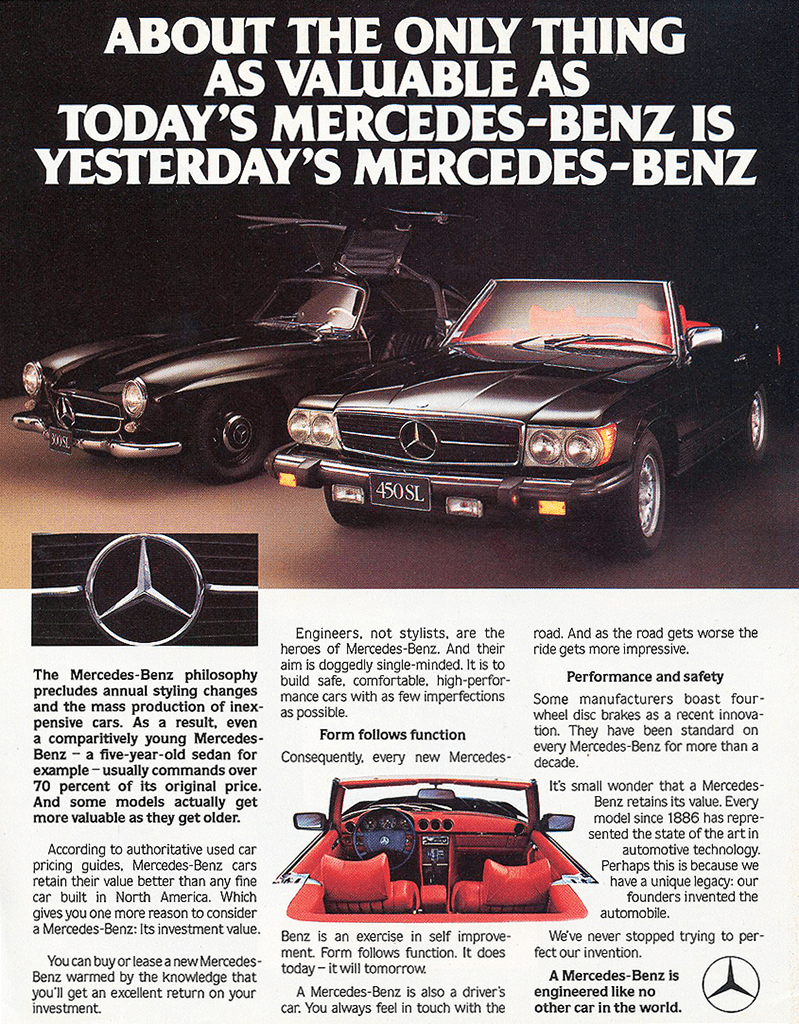
1980 Mercedes-Benz 450SL advertisement

For 1980, the 450SL’s base price was a substantial $35,839—about $152,400 in today’s dollars, which is about 36% more than today’s AMG SL 43 convertible goes for. Standard exterior and mechanical equipment for this expensive car included tinted glass, variable-ratio power steering, power four-wheel disc brakes, and 205/70HR14 tires (a size still available thanks to Vredestein) mounted on 14 x 6 inch light-alloy wheels. Inside, air conditioning, adjustable MB-Tex bucket seats, cruise control, electric windows, and central locking were all included.

Options included a limited-slip differential, 15-inch wheels, leather bucket seats, and an array of Becker stereos. Like many other European cars of the early eighties, the 450SL did not have a standard stereo, though a power antenna was included.

The 450SL was a cultural icon, finding fans among various executives, celebrities, professional athletes, and rock stars when new. It was also a film and television star—famously driven by Richard Gere in American Gigolo, by Stephanie Powers and Robert Wagner on Hart to Hart, and by Patrick Duffy on Dallas.

The View From 2025

450SLs have many adherents to this day, and there is much club support. According to Hagerty’s valuation tools, all the money for a 1980 450SL in #1/Concours condition is $71,900, with a more normal #3/Good condition car going for $14,400. These SLs are always available in the Hemmings Motor News classifieds, on eBay Motors, on Bring a Trailer, and often at in person auctions. As I update this post in April 2025, there are eleven 1980 450SLs available for sale in Hemmings.

Make mine Astral Silver Metallic, please. Sometimes the cliché is correct.

Other eighties Mercedes-Benz models I have written about include the 1985 300CD Turbo coupe and 1986 560SEC coupe.

Last updated April 2025.

1981 Triumph TR8 convertible

“Test drive the incredibly responsive TR8 today”

In its final year, Triumph’s TR8 gained Bosch L-Jetronic fuel injection for all fifty states (in 1980, fuel injection had been California-only). The original “the shape of things to come” TR7 design from 1975 remained, but the internals had come a long way.

Though the TRs had always been the “big” Triumphs since their introduction in 1953, big was a relative term. With a length of 160.1 inches, the TR8 was about six inches longer than today’s Mazda Miata convertible.

The standard powertrain was the Rover 133 bhp 3.5 liter/215 ci aluminum block V8 with Bosch L-Jetronic fuel injection paired with a five-speed manual transmission (a three-speed automatic was optional). That V8, of course, had its basic design dating from the 1961 model year and originally came from Buick.

The TR8’s performance was good compared to many sporty cars in 1981; 0-60 mph came in about 8.5 seconds in the 2,654-pound car. Fuel economy was rated at 16 mpg by the standards of the day. With a smallish 14.6-gallon fuel tank, a TR8 driver could expect a range of about 210 miles with a 10% fuel reserve.

1981 Triumph TR8 convertible advertisement

Standard exterior equipment on the rather dear $13,900 TR8 convertible (about $52,600 in today’s dollars) included a central hood bulge, tinted glass, and TR8 badges to easily differentiate it from the four-cylinder TR7. Mechanical equipment included dual exhausts, power-assisted rack-and-pinion steering, power front disc/ rear drum brakes, and 185/70HR13 steel-belted radial tires (a size still readily available) on 13 x 5.5 inch alloy wheels. Inside, full instrumentation, a heater/defroster with a three-speed fan, fully reclining multi-adjustable bucket seats, and a center console with a storage bin and lockable glovebox were included.

Options, Reviews, & Sales Numbers

Optional equipment included fog lamps, a luggage rack, air conditioning, and three different radios. Of these, only the air conditioning was an option from the factory—all other options were dealer-installed.

Reviews of the TR8 in the automotive press were reasonably complementary, which may have been at least partially because convertibles had become so rare. The V8 drew a lot of positive mentions, as did the roomy cockpit. Observed faults included the steering wheel blocking some gauges, the tiny ashtrays (it was indeed a different age), and the rear-mounted battery’s intrusion into the otherwise reasonably capacious trunk.

The 1981 TR8 was an unusual car even when new—a mere 415 were sold, compared to, say, the 40,408 only slightly more expensive Corvettes that Chevrolet managed to move in that same model year.

The View From 2025

Like all Triumphs, TR8s have a following and regularly appear in the Hemming’s Motor News classifieds and on Bring a Trailer. According to Hagerty’s valuation tools, all the money for a 1981 TR8 convertible in #1/Concours condition is $40,800, with a far more typical #3/Good car going for $12,200.

Many TR8s and TR7s had colors and color names that were very much of their age; examples are Aran Beige, Champagne, French Blue, Mimosa, Topaz, and Vermilion. Make mine the somewhat more conservative Poseidon Green Metallic, please.

Other cars from the UK that I have written about include the 1980 MG MGB convertible, the 1982 Rolls-Royce Silver Spirit MK 1 sedan, the 1982 Jaguar XJ-S H.E. coupe, the 1983 Jaguar XJ6 sedan, the 1987 Sterling 825 sedan, the 1989 Bentley Turbo R sedan, and the 1989 Jaguar XJ-S convertible.

Last updated May 2025.

1986 Chevrolet Corvette convertible

“Yes to wind. Yes to sunshine.”

For 1986, the big news for Corvette was the return of the convertible, gone since 1975. Other improvements included Bosch ABS II anti-lock brakes, a Vehicle Anti-Theft System (VATS), and the mid-year introduction of aluminum cylinder heads.

The standard powertrain was the L98 235 bhp 5.7 liter/350 ci V8 with fuel injection paired with a Turbo-Hydramatic four-speed automatic transmission. Car and Driver recorded a 0-60 time of 6.0 seconds and a top speed of 144 mph. Estimated fuel economy was 17 city/24 highway by the standards of the day (15/22 by today’s standards). With a 20-gallon fuel tank, a Corvette convertible’s proud new owner could expect a range of between 335 and 370 miles with a 10% fuel reserve.

Built in collaboration with ASC, the convertible included a manual top, a rear-hinged deck panel to cover the top, and an X-brace underneath the floor. The newly-required high-mounted rear brake light was integrated into the rear fascia. Even the gas filler cover was different from the coupe—square because there was no rounded rear hatchback glass for it to wrap around.

1986 Chevrolet Corvette convertible brochure page
1986 Chevrolet Corvette brochure page

Standard exterior and mechanical equipment for the $32,032 Corvette convertible (about $93,612 in today’s dollars or about what a well-equipped 2025 Corvette Stingray convertible goes for) included a Delco Freedom Plus II battery, power operated quartz-halogen retractable headlamps, power rack-and-pinion steering, power brakes, and P255/50VR-16 tires on 16 x 9.5 inch cast alloy aluminum wheels. Inside, air conditioning, power windows, Tilt-Telescopic steering wheel, driver information system, cloth bucket seats, and an AM/FM stereo radio with power antenna were all included.

Options & Production Numbers

Optional exterior and mechanical equipment included a performance axle ratio ($22) and Delco-Bilstein shock absorbers ($189)—the Doug Nash 4+3 manual transmission was a no-cost option. Optional interior equipment included cruise control ($185), a power door lock system ($175), electronic control air conditioning ($150), a six-way power driver’s seat ($225), and the Delco-GM/Bose Music System ($895). The Z51 Performance Handling Package was not available with the convertible.

The return of the Corvette convertible was well-received—Chevrolet sold 7,315 in about half a model year, even at $5,000 more than the coupe. Reviews were also good; Car and Driver stated that the convertible was “a mighty hospitable carriage.”

The View From 2025

There is strong club support for the 1986 Corvette, as there is for all Corvettes. According to Hagerty’s valuation tools, all the money for a 1986 Corvette convertible in #1/Concours condition is $31,500, with a more normal number #3/Good condition car going for $10,800. 1986 Corvette convertibles are regularly featured in the Hemming’s Motor News classifieds and on eBay Motors—as I write this in December 2018, there’s a Yellow car with black leather seats and 29,000 miles available on Hemmings for $17,900.

Make mine White, with red leather seats—the “heritage colors” that match the first Corvette back in 1953.

Last updated February 2025.

1989 Jaguar XJ-S convertible

“A car for all seasons …”

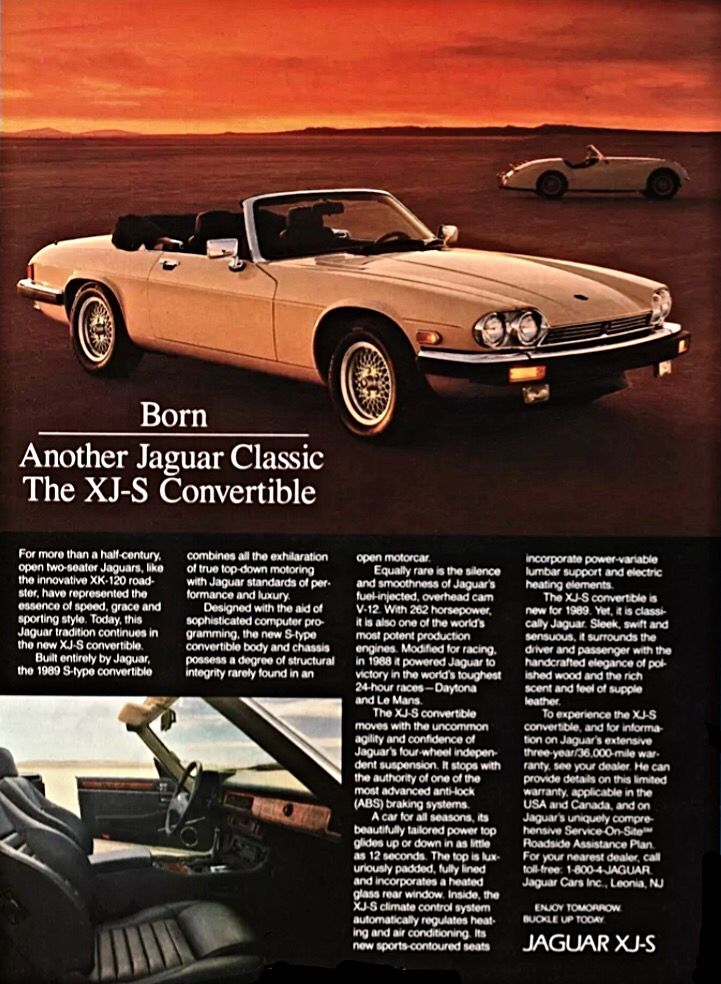
For 1989, a full convertible version of the Jaguar XJ-S finally became available after five years of the little-loved targa convertible. The power top, which could go up and down in as little as 12 seconds, was padded, lined, and included a heated glass rear window.

The only powertrain available for any XJ-S continued to be the 262 bhp H.E. 5.3 liter/326 ci V12 with Lucas-Bosch fuel injection paired with a three-speed automatic transmission sourced from General Motors (a powertrain that had been around since 1982). Performance was respectable for the almost 4,200-pound convertible: 0-60 mph in a little under 9 seconds. Mileage remained what you might expect from a thirsty V12—12 city/16 highway by the standards of the day (11/15 by today’s standards). With a 21.7-gallon fuel tank, an XJ-S owner could expect a range of between 250 and 275 miles, with a 10% fuel reserve.

1989 Jaguar XJ-S convertible advertisement

Standard equipment on the $57,000 car (about $151,300 in today’s dollars) included a four-wheel independent suspension, power steering, and four-wheel anti-lock power disc brakes. 15-inch alloy wheels were paired with Pirelli P600 235/60VR15 tires—which are still available!

Inside, the buyer received air conditioning with automatic temperature control, power windows, heated power mirrors, power door locks, intermittent windshield wipers, cruise control, and an AM/FM stereo cassette with Dolby and metal tape capability. New sport-contoured seats featured power-variable lumbar support and electric heating elements.

The View From 2025

The Jaguar XJ-S has good club support, and there are some restoration parts available. There’s also a free 738-page (!) ebook written by an XJ-S owner named Kirby Palm and featuring much hard-earned advice. Keeping an XJ-S at 100% is non-trivial—as it is with so many high-end eighties cars.

Like all Jaguars, XJ-S convertibles have a following and make frequent appearances in the Hemming’s Motor News classifieds, on eBay Motors, and on Bring a Trailer. According to Hagerty’s valuation tools, all the money for a 1989 XJ-S convertible in #1/Concours condition is $45,000, with a far more typical #3/Good car going for $16,400.

Make mine British Racing Green, please.

Two other eighties Jaguars I have written about are the 1982 XJ-S H.E. coupe and the 1983 XJ6 sedan.

Last updated March 2025.

1980 MG MGB convertible

Writing a blog entry on cars from 1980 that Hagerty considers to be collectible reminded me that I should probably do an entry on the last of the MGBs.

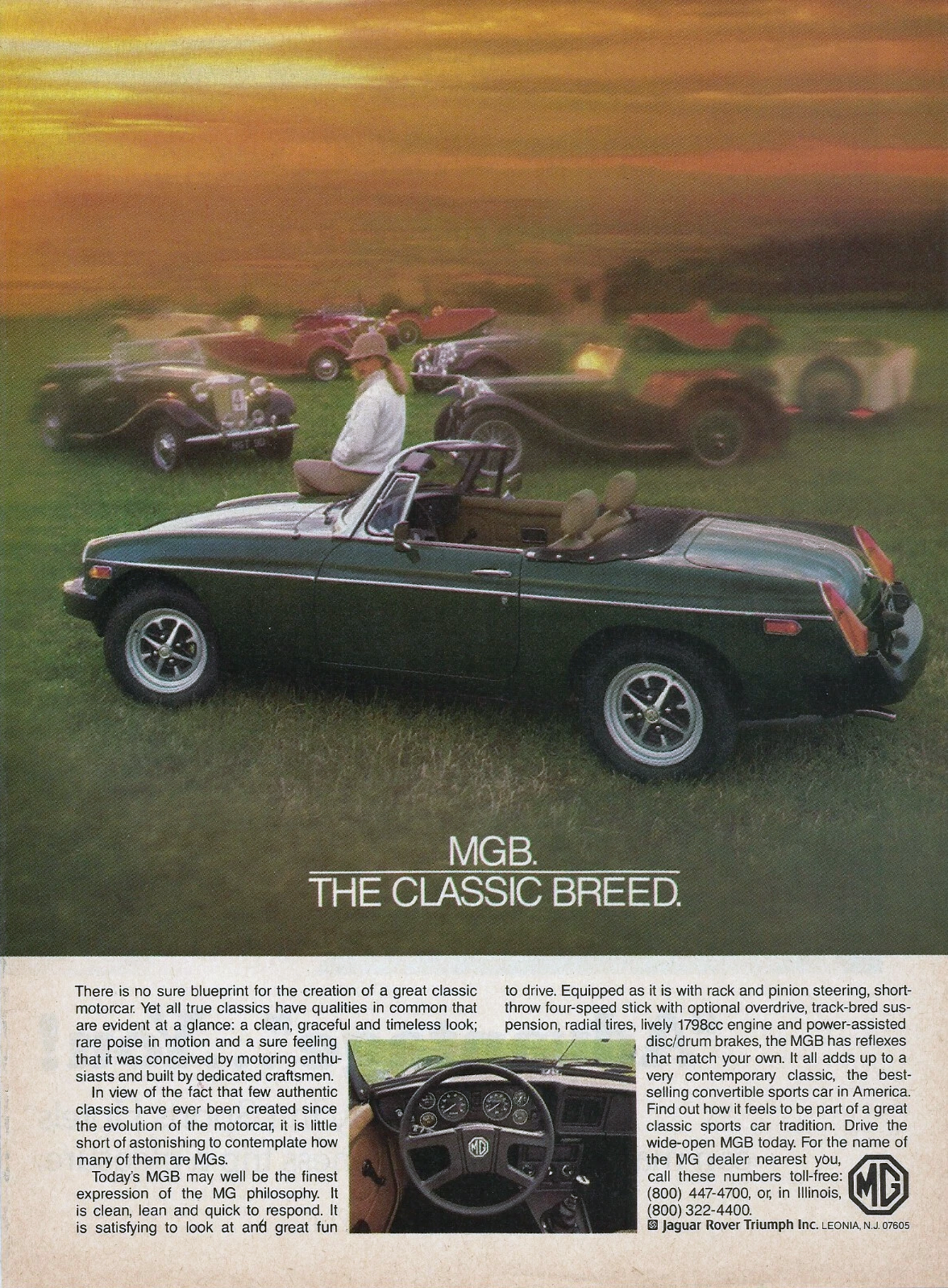
“The Classic Breed”

1980 was the final year for MG’s MGB convertible, which had been in production since 1962.

Changes for 1980 were minimal. The standard and only powertrain remained the 62.5 bhp (not 62 or 63!) 1.8 liter/110 ci inline four with a Zenith-Stromberg 175 CD carburetor paired with a four-speed manual transmission. 0-60 mph came in a leisurely 16 seconds in the 2,400-pound car. Fuel mileage was decent by the day’s standards: rated at 16 city/30 highway. With a 13-gallon gas tank, an MGB driver could expect a range of about 245 to 265 miles with a 10% fuel reserve.

1980 MG MGB print advertisement

Standard exterior and mechanical equipment on the $7,950 MGB (about $33,800 in today’s dollars) included a tonneau cover, a laminated safety glass windshield, rack and pinion steering, power front disc/rear drum brakes, and 165/80-14 radial ply tires (a size still available thanks to Vredestein) on 14-inch Rostyle wheels. Inside, vinyl bucket seats with adjustable head restraints, a center console with a cigarette lighter and heater controls, a lockable glovebox, a map pocket, an electric tachometer, a trip odometer, a map light, and a clock were standard.

Options & One Limited Edition

Optional equipment included an electrically-operated overdrive for the transmission, a luggage rack, “traditional” wire wheels, air conditioning ($653), and various radios with either 8-track or cassette players included.

The Limited Edition that had debuted in 1979 remained available and popular, with 6,668 produced over the two years. In addition to black paint, the Limited Edition included silver body stripes, 5-spoke alloy wheels, an air dam, boot and tonneau covers, chrome luggage rack, a leather padded 3-spoke steering wheel, a Limited Edition dash plaque, and Limited Edition thresholds. All of this cost $600.

The View From 2025

Like all MGs, MGBs have a following and frequently appear in the Hemming’s Motor News classifieds, on eBay Motors, and on Bring a Trailer. According to Hagerty’s valuation tools, a 1980 MGB in #1/Concours condition is $21,500, with a far more typical #3/Good car going for $6,100. A Limited Edition goes for about $1,500 more. As I update this blog entry in September 2025, there is a 1980 MGB Limited Edition with a black interior and 55,000 miles for sale on Hemmings, asking $24,900.

Make mine Brooklands Green, please.

Other sports cars from 1980 I have written about include the Chevrolet Corvette coupe, the Datsun 280-ZX hatchback coupe, the Mercedes-Benz 450SL convertible, the Porsche 911 SC coupe, and the Porsche 924 hatchback coupe.

Last updated September 2025.

1982 Chrysler LeBaron convertible

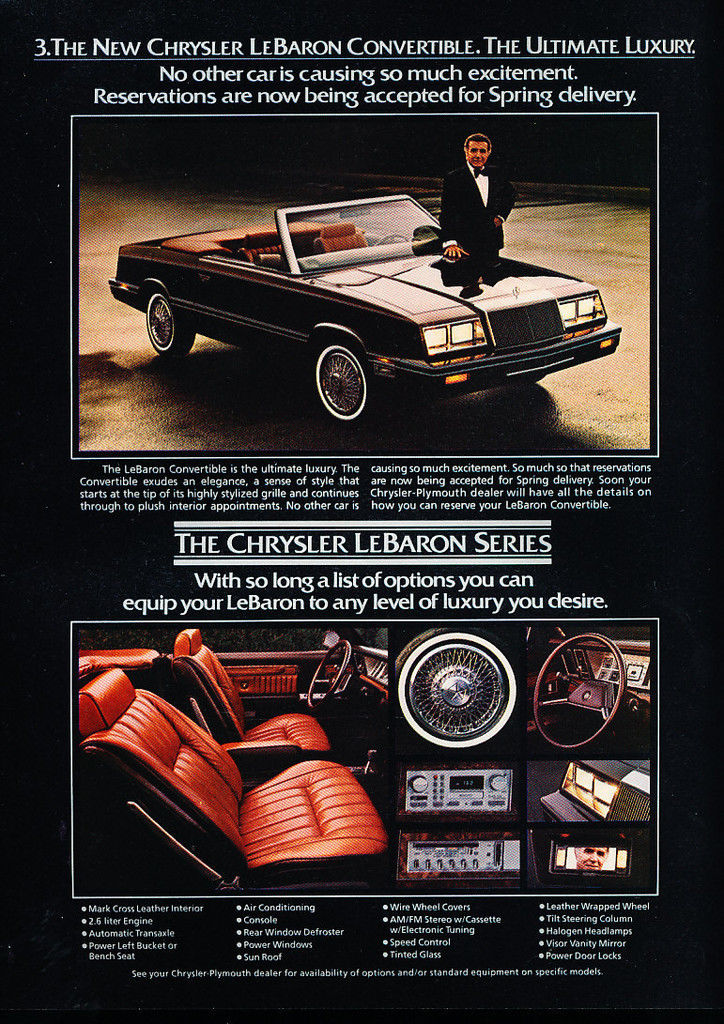
“No other car is causing so much excitement.”

The Chrysler LeBaron convertible was a mid-year introduction, becoming available in the spring of 1982. It was the first factory convertible from an American manufacturer available for sale in the United States since the 1976 Cadillac Eldorado.

All LeBarons were all-new for 1982. Based on the more plebeian Dodge Aries/Plymouth Reliant front-wheel-drive K cars that had been on sale for a year, the LeBaron (sometimes described as the Super-K) was a move at least slightly upmarket. Most exterior body panels were the same as the K. Notable styling differences were a waterfall-style grill (somewhat resembling that of the previous year’s rear-wheel-drive LeBaron), quad headlamps, relocation of the parking lamps and turn signals to the front bumper, and a full-width tail-lamp housing.

Chrysler used almost all of the standard K pieces inside the LeBaron. Recessed door handles and rocker type door locks were among the few changes, along with a different style of armrest and door pull. There was less vinyl trim, and the carpeting and other fabrics were of somewhat higher quality. A significant difference was the attention paid to noise, vibration, and harshness: between soundproofing, better parts, and suspension tuning, the LeBaron was upgraded from the base K in 26 separate ways.

Cars & Concepts in Brighton, Michigan heavily modified two-door LeBaron coupes on their way to becoming convertibles—the process included 32 steps. They installed a boxed-in backbone along the center of the car and welded a three-piece windshield header to the A-pillars. Next, Cars & Concepts installed new door glass and added door wedges. Finally, they added a new fiberglass panel to hold the rather small rear seats and mounted the convertible motor on the floor pan behind the rear bulkhead.

The convertible top itself had a plastic rear window and broad rear quarter panels; Car and Driver wrote that this created “a sort of Conestoga-wagon effect.” A button on the console actuated the top, and a padded top boot snapped into place when the top was lowered.

The base engine was a K 2.2 liter/135 ci inline four with a two-barrel Holley carburetor, producing 84 bhp. A two-barrel carburetted Mitsubishi G54B 2.6-liter/156 ci inline four with 92 bhp and 20 additional ft-lbs of torque was available for an added $171. Chrysler paired both engines with the TorqueFlite three-speed automatic transmission. Mileage with the base engine was 25 city/36 highway by the day’s standards. The optional engine was rated at 23 city/31 highway and brought the 0-60 time down from about 17 (aargh!) seconds to about 15 seconds.

1982 Chrysler LeBaron convertible advertisement

The LeBaron convertible’s base price was $11,698 (about $40,100 in today’s dollars and about 44% more than the 1982 LeBaron coupe). Standard exterior and mechanical equipment included dual outside mirrors (borrowed from the Dodge Omni 024), power brakes, power rack-and-pinion steering, and P185/70R14 whitewall tires (a size still readily available, though finding whitewalls might be tricky) on 14-inch wheels. Inside, vinyl front bucket seats with a folding center armrest, a digital clock, and an AM radio were included. 76% of convertible drivers moved up to Medallion trim, which boosted the price to $13,998 (about $48,000 in 2025 dollars) and added halogen headlamps, better gauges, and snazzier wheel covers.

Packages, Options, & Production Numbers

The Mark Cross package cost an additional $861, moved the sticker to a non-trivial $14,859 (about $50,900 in today’s dollars), and added the 2.6-liter engine, air conditioning, power windows, power door locks, and attractive Mark Cross leather/vinyl seats. Other options included cornering lamps ($57), cast aluminum wheels ($344), automatic speed control ($155), and an AM/FM stereo radio with electronic tuning and cassette player ($455).

First-year sales of LeBaron convertible were a respectable 12,825, especially given the shortened year and the relatively high price. In a piece of general eighties trivia, the first commercial cell phone call in history was made from a LeBaron convertible in October 1983.

The View From 2025

These convertibles started Chrysler’s long tradition of making convertibles that might occasionally be sporty but were not sports cars—a market niche they exited in 2014 with the demise of the Chrysler 200 convertible. I still like what Chrysler was trying to do, and I appreciate how these cars look, at least with the top down.

These cars are being collected and shown—I see them often at AACA judging meets. You see them for sale in the Hemming’s Motor News classifieds, on eBay Motors, and on Bring a Trailer: as I update this blog entry in October 2025, there’s a Pearl White 1982 LeBaron with 68,000 miles for sale on Hemmings, asking $6,900.

Make mine Mahogany Metallic, please, with the Mark Cross package.

Other K cars I have written about include the 1981 Plymouth Reliant coupe, the 1985 Dodge 600 Club Coupe, the 1986 Chrysler Town & Country convertible, and the 1987 Dodge Aries LE sedan.

Last updated October 2025.

Save