1987 Mercury Lynx XR3 hatchback coupe

This post is consistently one of the most popular every year and has been so since the first full year after I originally posted it. It seems to me the key to an individual post’s popularity is often in the rarity of the other coverage available for that particular vehicle.

“… the sporting side of Lynx.”

1987 was the final year for the Lynx—Mercury’s version of Ford’s Escort compact. The Escort would soldier on for many more years (through model year 2002), but from 1988 forward, the smallest American-built Mercury would be the Topaz—still a compact, but larger in almost every dimension. For 1986 and 1987, the top-of-the-line Lynx was the XR3 hatchback coupe.

The XR3 designation was not random, but may not have been obvious to much of the North American market. In Europe, XR3 (and later XR3i) was a sporty trim of the Mark III Ford Escort from 1980 forward. Why Ford’s marketers chose to make XR3 the sportiest Lynx instead of using the name for the stateside Escort (which used GT in the mid-1980s) is a question lost in the mists of time, but may have had something to do with XR-7 designation for the sportiest Mercury Cougar.

The Lynx XR3‘s standard (and only) powertrain was a “High Output” 115 bhp 1.9 liter/113 ci inline four with Bosch multi-port fuel injection paired with a five-speed manual transmission. Mileage was good—25 city/34 highway by the day’s standards (about 22 city/31 highway by 2025 measures). Acceleration was reasonably quick: 0-60 came in about 10 seconds in the approximately 2,400-pound car. With a 13-gallon fuel tank, Lynx XR3 drivers could expect a range of 310 to 345 miles with a 10% fuel reserve.
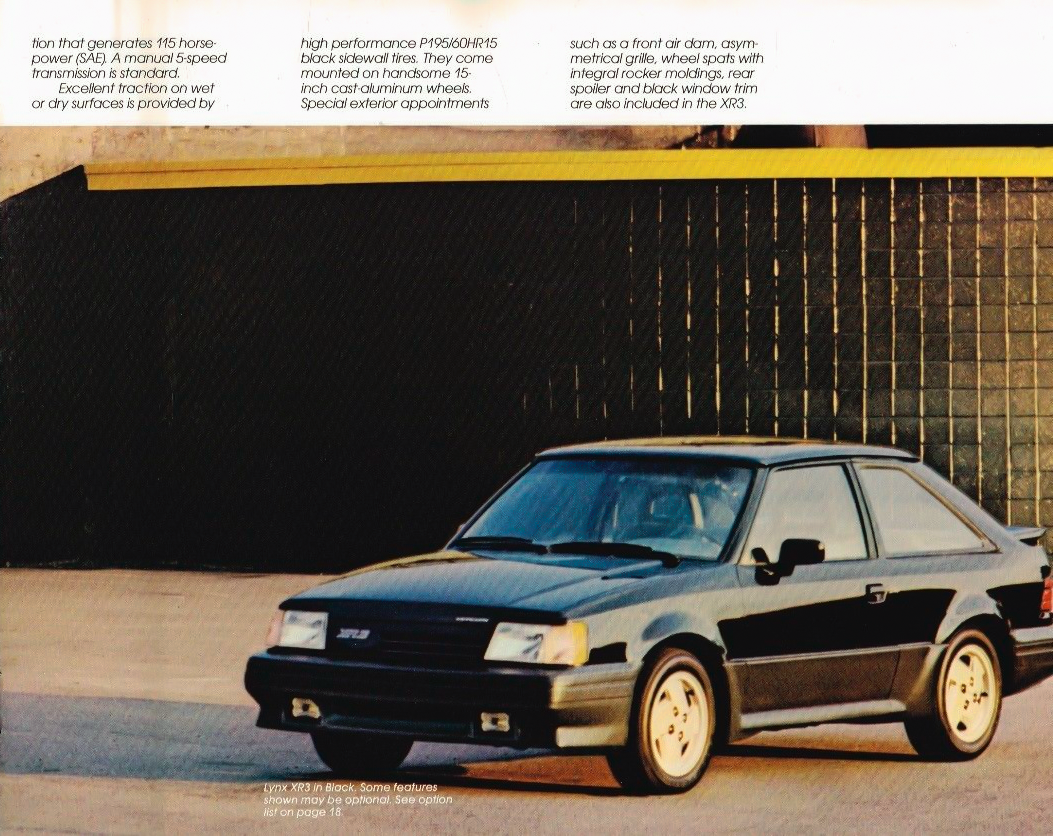
XR3 page from the 1987 Mercury Lynx brochure

Standard exterior and mechanical equipment on the $8,808 Lynx XR3 (about $25,900 in today’s dollars) included an asymmetrical grille, an aerodynamic front air dam with built-in fog lamps, wide wheel flairs, a rear spoiler, dual power mirrors, power steering, and P195/60R15 Goodyear Eagle GT tires (a size still readily available) on 15-inch four-flag cast-aluminum wheels. Inside, cloth sport bucket seats, a full console with a graphic alert display, a split folding rear seat, a leather-wrapped steering wheel, a locking fuel filler door with remote release, and an electronic AM/FM stereo radio with four speakers were included.

Standard exterior and mechanical equipment on every Lynx included aero halogen headlamps, front-wheel-drive, a four-wheel independent suspension, rack-and-pinion steering, and power front disc/rear drum brakes. The Lynx was not a large car—there aren’t many current small coupes remaining to compare it to, but the 2025 Honda Civic hatchback sedan is 5 inches wider and about a foot longer.

Options & Production Numbers

Few options were available since the XR3 came relatively well-equipped for a compact car in the eighties. In fact, seven separate options available for lesser Lynxes were standard on the XR3. Exterior and mechanical options for the XR3 included tinted glass ($105), a rear window wiper/washer ($126), and an engine block heater ($18). Inside, air conditioning ($688), speed control ($176), and a tilt steering wheel ($179) were available.

The final-year Lynx didn’t sell very well: a total of 39,039 in a year when Ford sold 374,765 Escorts. It’s reasonable to say that very few of the 20,930 hatchback coupes were XR3s.

The View From 2025

Badge for 2,500 web hits

First-generation Escorts and Lynxes were once so prevalent on American roads, but have now virtually disappeared. You occasionally see Lynxes for sale in the Hemming’s Motor News classifieds and on eBay Motors. Bring a Trailer has auctioned a grand total of two Lynxes, neither of them XR3s.

Make mine Smoke, please.

Other Mercurys I have written about are the 1980 Cougar XR-7 coupe, the 1983 Grand Marquis sedan, the 1984 Grand Marquis Colony Park LS station wagon, the 1986 Capri hatchback coupe, the 1988 Cougar XR-7 coupe, and the 1988 Grand Marquis Colony Park station wagon. I have also written about the 1981 Ford Escort hatchback coupe.

Last updated December 2025.
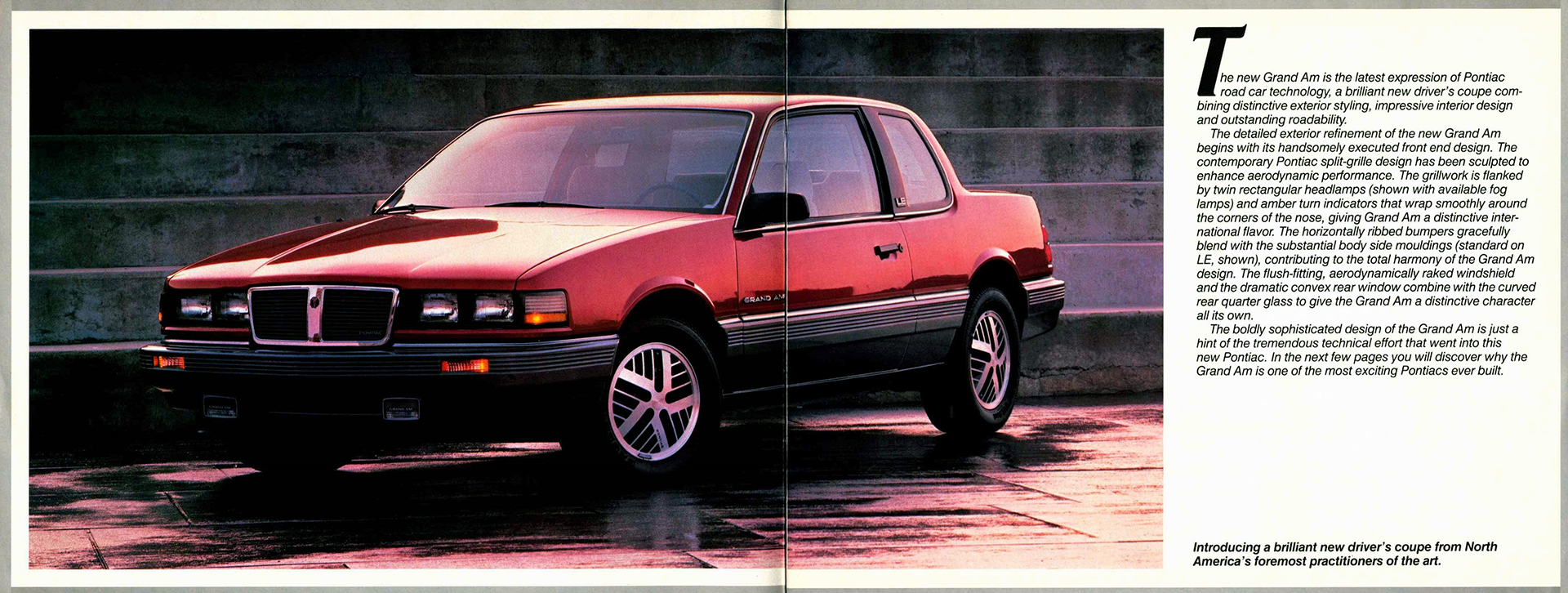
1985 Pontiac Grand Am coupe

“Introducing a brilliant new driver’s coupe”

The Grand Am name returned for the 1985 model year. Instead of the rear-wheel-drive coupe and sedan that it had been in its previous two lives from 1973 to 1980 (with none in 1976 or 1977), it was now a front-wheel-drive coupe, part of GM’s N-body offerings. As such, its first relatives were the Buick Somerset Regal and the Oldsmobile Calais.

The standard powertrain on the Grand Am was GM’s Tech IV 92 bhp 2.5 liter/151 ci inline four with throttle-body fuel injection connected to a five-speed manual. For $560, optional power was the LN7 125 bhp 3.0 liter/181 ci V6 with fuel injection, which required the $425 automatic transmission (also available with the base engine). 0-60 times for early N-body cars are hard to come by, but were likely about 10.5 seconds for the standard powertrain and about 9.0 seconds for the V6/automatic combination—the 2,419-pound shipping weight helped. Mileage with the standard powertrain was rated at 24 city/34 highway by the day’s standards (21/31 by today’s measures). With the 13.6-gallon tank, Grand Am buyers could expect a range of 310 to 350 miles with a 10% fuel reserve.

Standard exterior and mechanical equipment on the $7,995 base coupe (about $24,400 in 2025 dollars) included power rack and pinion steering, power front disc/rear drum brakes, and P185/80R13 tires (now a trailer size) on 13-inch Rally wheels. Inside, reclining bucket seats and an integral floor console were included.

The LE (starting at $8,495 or about $25,900 in today’s dollars) included “substantial body side moldings,” upgraded front bucket seats with adjustable headrests, deluxe door trim, and a fold-down rear seat armrest.

Options included the Rally Tuned suspension ($50) and cruise control ($175). A Driver’s Package was also available, which included 215/60R14 Goodyear Eagle GT radials (a size available thanks to BFGoodrich and Riken) on 14-inch turbo cast aluminum wheels, “sport-tuned” front and rear stabilizers, and a Driver Information Center.

The View From 2025

I think these were handsome cars, especially with those turbo cast aluminum wheels—Pontiac had great wheel designs in the eighties. Like many American cars of the era that aren’t considered to be collectible, they have essentially vanished despite over 82,000 sold in 1985 alone. They’re invisible in the Hemming’s Motor News classifieds and on eBay Motors and are hard to find anywhere—Bring a Trailer has sold two 1990 models, but none from the eighties.

Make mine Red, please.

Last updated June 2025.

1985 Dodge 600 Club Coupe

The crazed folks at The Truth About Cars posted in 2017 about a 1984 Dodge 600 Landau Coupe as part of their Junkyard Find series.

There’s a strong feeling of fulfillment behind the wheel of this striking coupe.

The Dodge 600 was an extended (E-platform) version of the original K-platform cars, with three more inches of wheelbase added to the sedans (coupes and wagons kept the same wheelbase as the first K cars). It debuted in the 1983 model year, two years after the original K cars reached the market. Other E-platform cars were the Chrysler New Yorker, Chrysler E-Class, and (later) the Plymouth Caravelle.

There were three engines available for the Dodge 600. The base engine was Chrysler’s K 99 bhp 2.2 liter/135 ci inline four with fuel injection. The high-performance option was the Turbo I 146 bhp version of the same engine with a Garrett T3 turbocharger and fuel injection. The other option was Mitsubishi’s Astron series 4G54 101 bhp 2.6 liter/153 ci inline four with a two-barrel carburetor.

Fuel economy for the Turbo I and three-speed automatic transmission combination (the five-speed manual was no longer available) was 19 city/24 highway by the day’s standards (it would be 17/22 today). With a 14-gallon gas tank, the new owner of a club coupe could expect a range of between 245 and 270 miles with a 10% fuel reserve.

Club Coupe page from the 1985 Dodge 600 brochure

Standard exterior and mechanical equipment on the $9,060 Club Coupe (about $27,900 in today’s dollars) included halogen headlamps, a Landau padded vinyl roof, power front disc/rear drum brakes, power rack-and-pinion steering, and P185/70R14 steel-belted radial white sidewall tires (a size still readily available) on 14-inch wheels with Luxury wheel covers. Inside, cloth high-back front bucket seats with integral headrests, a full-length console, a Luxury color-keyed two-spoke steering wheel, and an electronically-tuned AM radio were standard. Features listed in the brochure that wouldn’t be considered worth mentioning now included a tethered fuel filler cap and an inside hood release.

Exterior and mechanical options included tinted glass ($115), a sport/handling suspension ($79), and cast aluminum wheels. Inside, air conditioning ($757), automatic speed control ($179), a leather-wrapped steering wheel ($50), and a tilt steering wheel ($110) were available. Three optional radios were available.

The View From 2025

The original K cars and their many variants were once so common on the roads, but have essentially vanished. I haven’t seen a 600 of any type in years, even though Dodge produced over 300,000 of them between 1983 and 1988. You’ll sometimes see the original Dodge Aries/Plymouth Reliant cars at AACA shows along with the top of the line Chrysler LeBaron convertibles. You do occasionally see Dodge 600s for sale in the Hemming’s Motor News classifieds, on eBay Motors, and on Bring a Trailer, but there are no coupes out there as I update this blog post in October 2025.

Make mine Garnet Red Pearl Coat, please.

Other K cars I have written about include the 1981 Plymouth Reliant coupe, the 1982 Chrysler LeBaron convertible, the 1986 Chrysler Town & Country convertible, and the 1987 Dodge Aries LE sedan.

Last updated October 2025.

Save

Save

Sav

Save

Save

Save

Save

Sa

Save

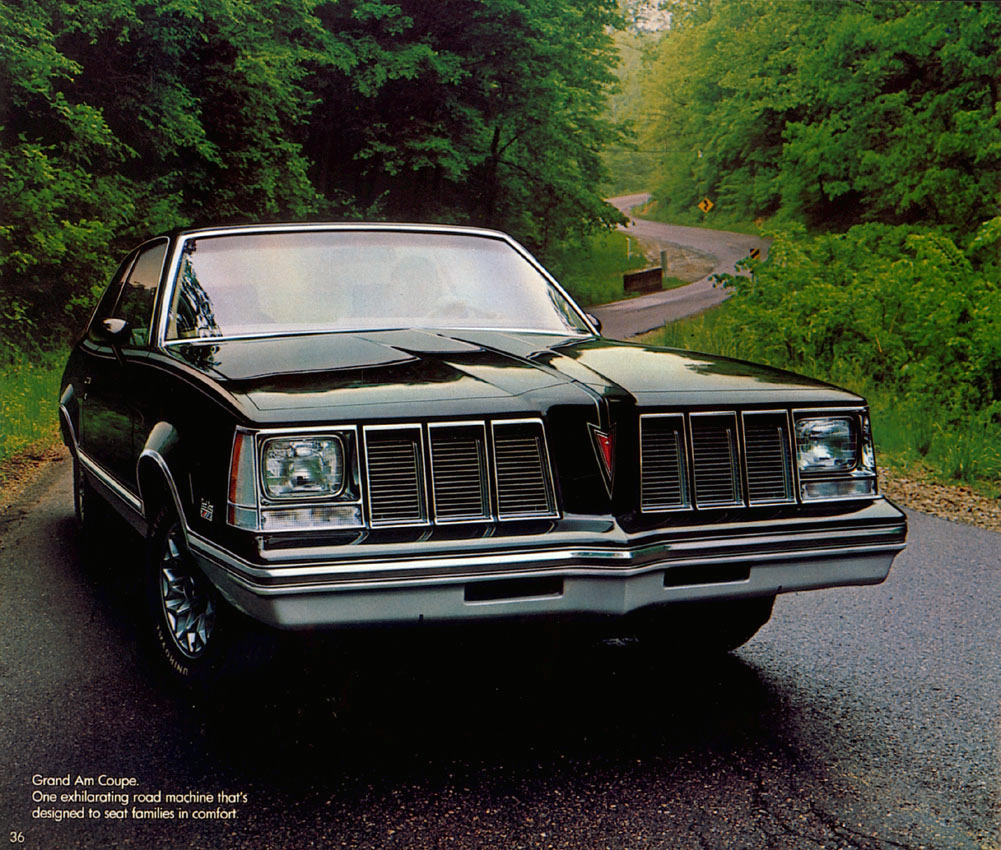
1980 Pontiac Grand Am coupe

“One exhilarating road machine”

The last of the rear-wheel-drive Grand Ams came in 1980. Unlike in 1978 and 1979, the sedan was no longer available—only the coupe remained.

The standard engine in non-California cars was the L37 155 bhp 4.9 liter/301 ci V8 with four-barrel Rochester carburetor and electronic spark control (California cars got the Chevrolet-sourced LG4 150 bhp 5.0 liter/305 ci V8). The only transmission available was a three-speed Turbo-Hydramatic TH200 automatic transmission. Performance was respectable for 1980—Car and Driver recorded a zero to sixty time of 11 seconds. Mileage was 17 city/25 highway by the day’s standards. With an 18.1-gallon gas tank, range was 280 to 305 miles with a 10% fuel reserve.

New features for 1980 included a revised soft-fascia front end with three sections per side, an Ontario Gray lower accent color for the exterior, a silver upper body accent stripe, larger wraparound black-out tail lamps, and larger front and rear stabilizer bars for the optional ($45) Rally RTS handling package.

Grand Am page from the 1980 Pontiac brochure

The Grand Am’s base price was $7,299—about $31,400 in 2025 dollars. Standard exterior and mechanical equipment included dual sport mirrors, dual horns, power steering, power front disc/rear drum brakes, and 205/75R14 black sidewall radial tires (a size still readily available) on 14-inch Rally IV cast aluminum wheels. Inside, Grand Am purchasers could expect cut-pile carpeting, Custom vinyl front bucket seats with center floor console, rally gages with a clock embedded in a brushed aluminum instrument panel, and a Custom sport steering wheel.

Options, Period Reviews, & Production Numbers

Available exterior and mechanical options included a power sunroof—either metal ($561) or glass ($773), dual remote sport mirrors ($73), Soft-Ray tinted glass ($107), and electric rear window defroster ($107). Inside, air conditioning ($601), power door locks ($93), power windows ($143), a six-way power driver’s seat ($175), a tilt steering wheel ($81), automatic cruise control ($112), and an AM/FM stereo radio with a stereo cassette player ($272) were all available. A nicely configured Grand Am could easily push past $9,700—real money in 1980 and about $41,800 in today’s dollars.

Period reviews settled into the “we’re glad they make it, but we’re not sure we’d buy it” category. Car and Driver called the 1980 Grand Am “a noble experiment” and praised its handling.

Grand Ams didn’t sell at all well in 1980—Pontiac moved only 1,647 of them, after selling almost five times as many coupes only two years prior in 1978. Despite this, Pontiac would not give up on the Grand Am name—it would be back in 1985 as a small front-wheel-drive coupe.

The View From 2025

1000 views badge

Most of the Grand Ams being collected are the larger and more powerful first-generation Colonnade versions sold from 1972 to 1975. You do occasionally see second-generation Grand Ams for sale in the Hemming’s Motor News classifieds and on eBay Motors. Bring a Trailer’s only second-generation Grand Am sale so far was a very rare 1979 Grand Am coupe with a four-speed manual in 2024. I haven’t seen a Grand Am from this generation for many years.

Make mine Starlight Black, please.

Other G-bodies covered in this blog include the 1980 Grand Prix SJ coupe, the 1981 Chevrolet Monte Carlo Sport Coupe, the 1981 Oldsmobile Cutlass Supreme coupe, the 1983 Chevrolet Malibu sedan, the 1983 Chevrolet Monte Carlo SS Sport Coupe, the 1984 Buick Regal Grand National coupe, the 1987 Buick GNX coupe, and the 1987 Pontiac Grand Prix coupe. Another 1980 Pontiac I have written about is the Sunbird Sport Hatch.

Last updated October 2025.

Save

Save

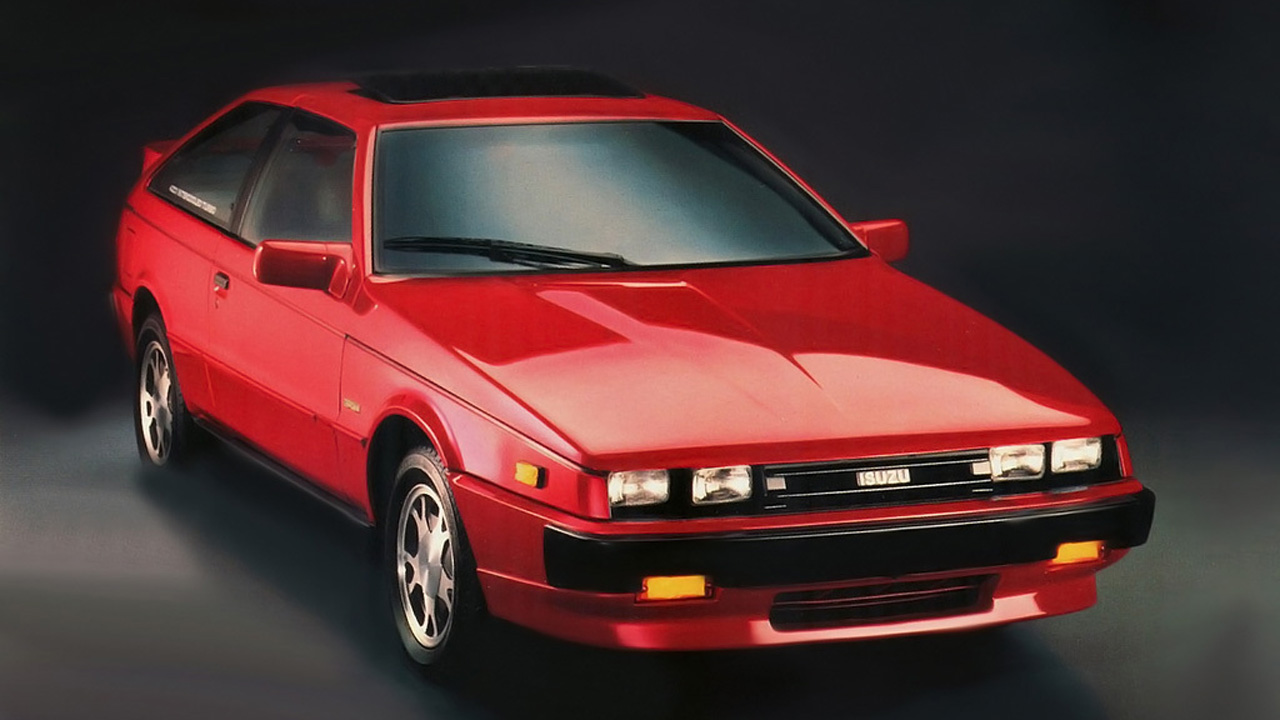
1983 Isuzu Impulse hatchback coupe

“Follow Your Impulse”

1983 was the first model year that Isuzu’s Impulse (known as the Piazza in most other parts of the world) became available in the United States. The first-generation Impulse was built on a variant of the aging rear-drive T-body chassis used by the lowly Chevrolet Chevette but was definitely aimed at a notably different market.

The Impulse came much better equipped than any Chevette: standard mechanical equipment for the $9,998 base price (about $32,300 in 2025 dollars) included four-wheel disc brakes and P195/60R14 tires (a size still readily available) on 14-inch alloy wheels. Inside, power steering, power windows, power door locks, cruise control, air conditioning, tinted glass, a tilt steering wheel, and an AM/FM stereo radio were all included. Optional equipment was spare, with only an improved stereo and turbine wheels available.

For 1983, power for the 2,700-pound Impulse was provided by a 90 bhp 1.9 liter/119 ci SOHC inline four with multi-point fuel injection (a turbocharged engine would not become available until 1985). Transmissions available were a standard five-speed manual and an optional four-speed automatic. Fuel economy with the manual transmission was 22 city/28 highway by the day’s standards (19/26 by 2025 standards). 0-60 took between 12 to 13 seconds, with a top speed of about 110 mph. With a 15.3-gallon fuel tank, you could expect a range of between 310 and 345 miles with a 10% fuel reserve.

Of course, the Impulse’s absolute killer feature was its exterior styling, which was very close to Giorgetto Giugiaro’s 1979 Ace Of Clubs show car. Road & Track put the Impulse on the cover of their June 1983 issue, with the tagline being “Sensuous show car hits the road.”

First-generation Isuzu Impulse, courtesy of Isuzu.

Isuzu must get real credit for messing as little as possible with Giugiaro’s excellent and differentiating design—few automakers were willing to leave as well enough alone as they did. They changed only a few things, adding slightly larger bumpers to meet the five mph DOT requirement, shortening the windshield and lengthening the hood to allow for easier installation of the engine on the assembly line, and enlarging the overall dimensions a few inches to allow for more interior space.

Isuzu also made the interior as close as possible to the original show car. In particular, two pods on either side of the steering wheel included most controls—and they adjusted with the standard tilt steering. All four seats were adjustable—rear seat adjustability was very unusual in subcompact cars in the 1980s.

The View From 2025

Impulses of this generation are rarely seen in the Hemming’s Motor News classifieds or on eBay Motors. They do occasionally appear on Bring a Trailer, with a 1984 Impulse auctioning off in November 2024.

Make mine Black, please.

Last updated in February 2025.

1980 Pontiac Sunbird Sport Hatch

“Sunbird offers new thrills for the thrifty.”

1980 was the last model year for the rear wheel drive Pontiac Sunbird, Pontiac’s variant of Chevrolet’s Monza. Initially available in base coupe, sport coupe, and sport hatch (a base hatch was added mid-year, but the wagon was permanently gone), the Sunbird received few changes for 1980.

The standard engine was the LX8 Iron Duke 2.5 liter/151 ci inline four with a Rochester 2SE two-barrel carburetor, making all of 86 bhp. Optional was the LD5 110 bhp 3.8 liter/231 ci V6 with a Rochester M2ME two-barrel carburetor. A four-speed manual was standard, with an optional three-speed automatic available.

Mileage with the inline four and four-speed manual was pretty impressive in 1980: 22 city/35 highway by the day’s standards. Getting decadent by spending $545 for the automatic and the V6 combination took mileage down to 20 city/27 highway. With the V6/automatic transmission pairing and an 18.5-gallon fuel tank, a Sunbird owner could expect a range of 320 to 350 miles with a 10% fuel reserve.

Not much came standard for the $4,371 base price (approximately $18,700 in today’s dollars), especially to our 2025 eyes. Feature highlights for a base Sunbird included a bright grill with park and signal lamps, whitewall tires, Custom wheel covers, and “Sunbird external identification.” Inside, base Sunbirds included tinted windows, vinyl front bucket seats, and a Delco AM radio.

Moving up to the sport coupe ($4,731) or the sport hatch ($4,731) added body color mirrors, “custom” vinyl bucket seats, and various moldings, but was still rather austere. Luxury trim ($195) added cloth seats along with snazzier carpeting and door trim.

A Package, Individual Options & Production Numbers

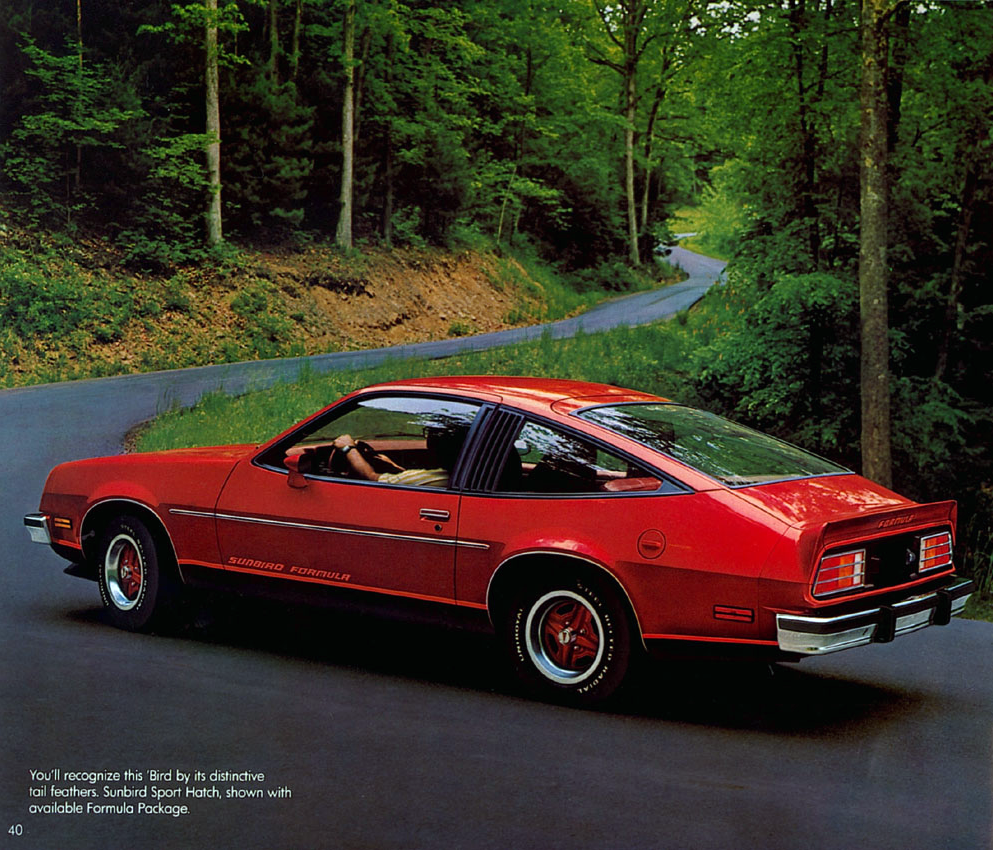
1980 Pontiac Sunbird brochure picture
1980 Sunbird Sport Hatch with the Formula Package

Available only with the sport hatch, the rare (only 1% of production) and expensive ($674, or about $2,900 in today’s dollars) Formula Package added a front air dam and rear spoiler, along with blacked-out grille, and BR70-13 white lettered tires (nearly equivalent 195/70R13 tires are available from BF Goodrich) on 13-inch cast aluminum rally wheels with trim rings. It wasn’t all bark and no bite: the Rally Handling Package was included, with larger front and rear stabilizer bars. Inside, a tachometer and other rally gauges were included. The whole combination meant that a sport hatch with the Formula Package, the V6, and the four-speed manual came to $5,630 (about $24,100 in today’s dollars). The 0-60 time for this top-of-the-line Sunbird was probably around 10 seconds—not far from some versions of the line-leading 1980 Firebird Trans Am.

Individual mechanical options included variable-ratio power steering (the most popular option and required with the V6) and power front disc brakes. Inside, you could add Custom air conditioning ($531), a tilt steering wheel (which required power steering), and an AM/FM stereo cassette player (two different 8-track radios were also still available). A removable sunroof was also available for $193.

The rear wheel drive Sunbird sold well even in its final year, partially because of the extended model year. Almost 188,000 were sold, with over 100,000 being the base coupe, making the Sunbird the best-selling of all the 1980 H-bodies. Pontiac would return partially to the Sunbird name with the 1983 2000 Sunbird convertible version of the J-body—by 1985, the Sunbird name would once again stand alone.

The View From 2025

Badge for 2,500 web hits

Stock Sunbirds of this generation almost never come up for sale in Hemmings Motor News and eBay Motors—they seem to have disappeared entirely despite the fact that Pontiac sold about 480,000 examples over five years. You do occasionally see examples of the “sister” Chevrolet Monza auctioned on Bring a Trailer, but even they are rare.

Make mine Agate Red, please.

Another Sunbird I have written about is the 1984 2000 Sunbird S/E hatchback coupe. I have also written about the 1980 Chevrolet Monza Sport 2+2 hatchback coupe.

Last updated October 2025.

Save

Save

1985 Buick Somerset Regal coupe

Welcome, Jalopnik and Autoblog readers! We have many meh cars at Eighties Cars—the unloved category covers most of them.

I saw a reasonably original Buick Somerset Regal with Dark Gray Metallic paint on a side road in Philadelphia in March 2104. It was the first one I’d seen in many years.

“There has never been a Buick quite like the Somerset Regal”

Buick’s Somerset Regal was a new model for 1985. Available initially in coupe form only, Buick’s version of the N-body (Oldsmobile had the Calais, and Pontiac had the Grand Am) was designed to at least partially replace the Skylark. It failed miserably, only surviving for three years before being subsumed back into the Skylark product line. Respectable first-year sales of 86,076 declined to 75,620 in 1986 and 46,501 in 1987.

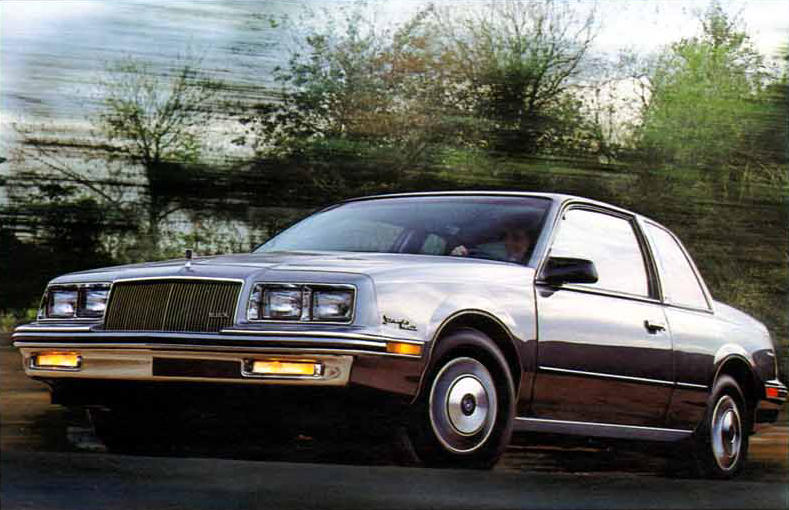
Exterior photo of Somerset Regal from 1985 Buick brochure
Exterior photo of the Somerset Regal from the 1985 Buick brochure

The Somerset Regal was not a big car by today’s standards. With 180 inches of length and a 103.4-inch wheelbase, it is within shouting distance of a 2025 Honda Civic sedan, which is 184.8 inches long and has a 107.7-inch wheelbase. Of course, cars, in general, have gotten a lot bigger in these thirty years—the Somerset Regal was notably more substantial than the 1985 Honda Accord.

The standard powertrain was a Tech IV 92 bhp 2.5 liter/151 ci inline four with throttle body fuel injection (a slightly upgraded Iron Duke) paired with a five-speed manual transmission, but I believe most buyers went with the optional ($425) three-speed automatic instead. The hot set-up (if you could call it that) was the optional ($560) LN7 125 bhp 3.0 liter/181 ci multi-port fuel-injected V6, only available with the automatic. 0-60 times ranged from 11 to 13 seconds.

Mileage for the inline four and five-speed manual combination was an impressive 24 city/34 highway by the day’s standards (21/31 by 2025 measures). Choosing the more realistic three-speed automatic cost two mpg, while upgrading to the V6 dropped you all the way down to 20 city/26 highway. With a 13.6-gallon gas tank, owners of the most profligate powertrain combination could expect a range of between 255 and 280 miles with a 10% fuel reserve.

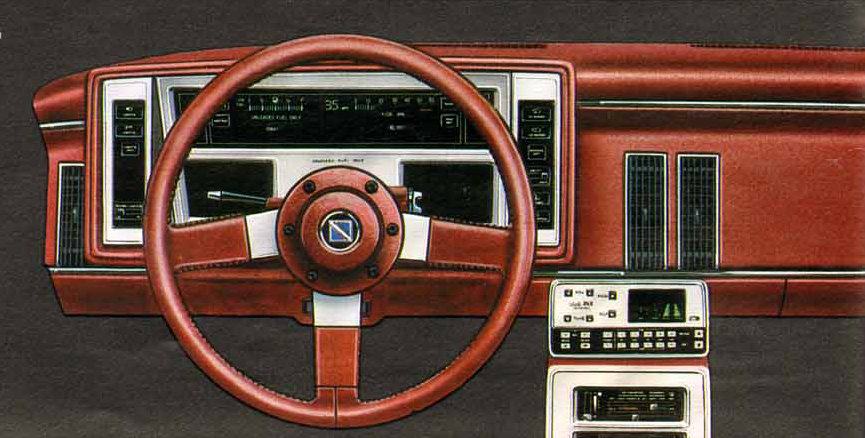
Interior of the Somerset Regal brochure from the 1985 Buick brochure
Interior of the Somerset Regal from the 1985 Buick brochure

For the Somerset Regal’s $8,857 base price (about $27,100 in today’s dollars), standard equipment included power brakes, power steering, tungsten-halogen headlights, and body-colored bumpers. The interior included cloth or vinyl bucket seats, a center console, brushed metal accents, electronic digital instrumentation (somewhat upmarket at the time), and an AM radio. Moving up to the Limited trim added dual horns, chrome bumpers, and courtesy lamps, along with snazzier cloth seats and an upmarket steering wheel.

Standard features that date the Somerset Regal included the Delco Freedom II Plus battery, front and rear ashtrays in the console, and the P185/80R13 tires (now considered a trailer size) on 13-inch wheels.

Options

Options included the $645 air conditioning (in the mid-1980s not yet standard on most cars), cruise control ($175), leather seats ($275 and only available with the Limited), power door locks ($130), power windows ($195), Vista-Vent sunroof, Delco GM/Bose Music System AM/FM stereo cassette ($995!), cast-aluminum wheels ($229), and a Gran Touring suspension ($27).

The View From 2025

Badge for 2,500 web hits

These Somerset Regals are now almost completely gone. Bring a Trailer did sell a very rare 1986 Somerset T-Type (Buick removed the Regal part of the name after only one year) in mid-2023. I haven’t seen one in the Hemming’s Motor News classifieds or on eBay Motors in several years.

Make mine Medium Blue Metallic, please.

I have also written about the 1985 Pontiac Grand Am coupe, which had a lot more success. Other smaller front wheel drive Buicks I have written about include the 1983 Skylark T TYPE coupe and the 1984 Skyhawk coupe.

Last updated in August 2025.