1988 Cadillac Cimarron sedan

On a June afternoon in 2015, I was walking in the University City section of Philadelphia when I saw a later Cadillac Cimarron driving towards me in surprisingly good shape. That was as good a reason as any to finally complete this blog entry.

“… built for those who consider driving a sporty pastime.”

It is an article of faith in the automotive world that General Motors often finally gets a car right just before killing it. Examples that spring to mind are the last Pontiac Fieros and the last Cadillac Allantés. However, in the case of the Cadillac Cimarron, all GM could do was make it less awful and embarrassing.

Exterior styling was at least somewhat more differentiated from the Chevrolet Cavalier sedan than the earliest Cimarrons had been. Cadillac added a more aggressive and distinctive grille in 1984, the front end was lengthened in 1985, and ribbed lower body cladding appeared in 1986.

The only engine available for 1988 was the 125 bhp LB6 2.8 liter/173 ci V6 with multi-port fuel injection. When paired with the standard five-speed manual transmission, mileage was 20 city/29 highway by the standards of the day (18/27 by today’s standards). A three-speed automatic transmission was optional and rated at 20 city/27 highway. 0-60 in the 2,800-pound car came in about 9.5 seconds with the manual transmission and about 10.5 seconds with the automatic transmission.
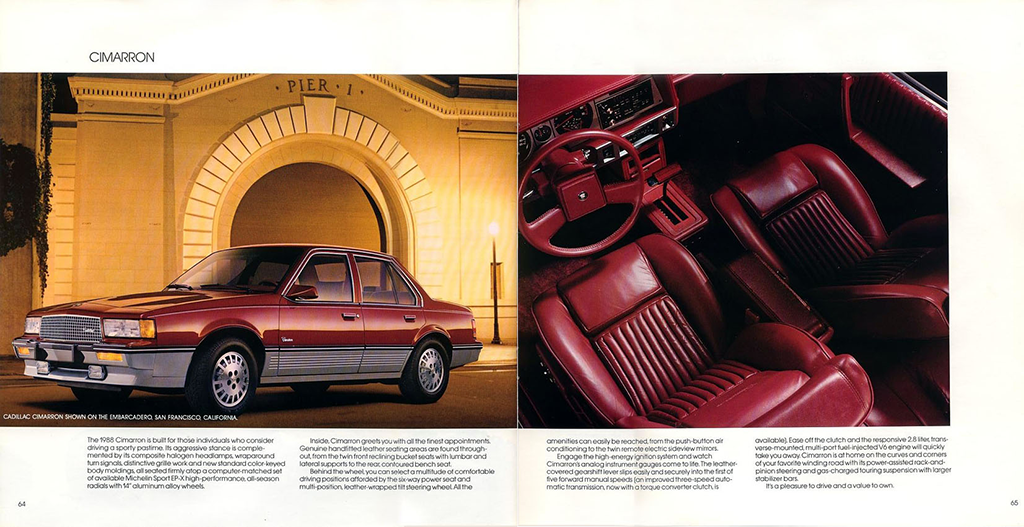
Cimarron pages from the 1988 Cadillac brochure

The 1988 Cimarron’s base price was $16,071—about $45,300 in today’s dollars, or about what a 2026 Cadillac CT4 Premium Luxury sedan goes for. Standard exterior and mechanical features included power-assisted rack and pinion steering, power front disc/rear drum brakes, and P195/70R14 steel-belted all-seasons radial tires (a size still readily available) on 14-inch aluminum alloy wheels. Inside, leather seating areas, a six-way power driver seat, a leather steering wheel, a tachometer, intermittent windshield wipers, air conditioning, power mirrors, power door locks, power windows, cruise control, a tilt steering wheel, and an AM/FM stereo radio with four speakers were all standard.

Options & Production Numbers

Among the relatively few options were a Vista Vent sunroof, an engine block heater, Twilight Sentinel, and the Delco-GM Bose Symphony Sound System.

By 1988, sales of the Cimarron had completely collapsed. After a first-year peak of almost 26,000 units sold in the 1982 model year, sales dropped to a sad 6,454 in the Cimarron’s final model year.

The View From 2026

I have yet to see a Cimarron at a serious antique car show—they’re treated by Cadillac folks like Ford folks treat the Mustang II from the 1970s—but I’m betting some intrepid soul will save one and bring it back for judging. Hagerty does track them—according to their valuation tools, a 1988 Cimarron with the five-speed manual in #1/Concours condition is $9,200, while a far more typical #3/Good car goes for $3,400. You occasionally see them for sale in the Hemmings Motor News classifieds, on eBay Motors, and on Bring a Trailer.

Make mine Hatteras Blue, please.

I have also written about the first-year 1982 Cimarron sedan. Other eighties Cadillacs I have covered include the 1980 Seville sedan, the 1982 Eldorado Touring Coupe, the 1986 Eldorado coupe, the 1986 Fleetwood Brougham sedan, the 1988 Eldorado coupe, the 1989 Allanté convertible, and the 1989 Sedan deVille.

Last updated February 2026.
1987 Chevrolet Chevette CS hatchback sedan

In May 2019, my ex-wife and I were taking a walk early on a Saturday morning and passed a Chevrolet Chevette parked at the end of our street. That was reason enough to finally complete this blog entry.

“… one of America’s best known cars …”

1987 was the final year for the somewhat antiquated rear wheel drive Chevette—in North America, at least. The 1.8-liter diesel engine was no more, but otherwise little was changed from 1986.

The only engine available was the L17 1.6 liter/98 ci inline four with a Holley 6510c two-barrel carburetor and 65 bhp, but you did have a choice of transmission: the standard four-speed manual, an optional three-speed automatic ($450), or an optional five-speed manual ($75). Mileage with the standard transmission was 28 city/34 highway by the day’s standards (24/31 by today’s measures). With a 12.2-gallon gas tank, Chevette owners could expect a 305 to 340 mile range with a 10% fuel reserve. Predictably, 0-60 mph took a little under 16 long seconds.

The Chevette was a small car, classified by the EPA as a sub-compact. Curb weight for the sedan was 2,137 pounds, with a 97.3-inch wheelbase, a 164.9-inch overall length, a 61.8-inch width, and a 52.8-inch height.

The truly “base” Chevette had been gone since 1985, but standard equipment was spare even on the supposedly upmarket CS. For your $5,495 base price (about $15,900 in 2025 dollars), you got four doors, a rear hatch with a single strut, rack and pinion steering, front disc and rear drum brakes, and P155/80R13 tires (a size still available from Kumho) on 13-inch by 5-inch steel wheels. Inside were vinyl front bucket seats, vinyl rear bench seats, and a floor console.

Options & Production Numbers

Because the standard equipment was so spare, there were a lot of options. Optional exterior and mechanical equipment included power brakes ($105), power steering ($225), an engine block heater ($20), and a custom exterior package ($154). Inside, the buyer could add air conditioning ($675), a tilt steering column ($125), custom cloth bucket seats ($130), a rear defogger ($145), and an AM/FM stereo radio ($119).

Despite being on its last legs, Chevrolet still sold a little over 20,000 Chevette sedans in 1987, along with slightly more than 26,000 coupes.

The View From 2025

Chevettes rarely appear in the Hemming’s Motor News classifieds, on eBay Motors, or on Bring a TrailerBaT has sold a grand a total of three over the years. Mecum did auction a nice looking 1987 Chevette CS hatchback sedan with 47 miles early in 2025—for an astounding $30,000.

Make mine Silver Metallic, please. Something inoffensive seems appropriate.

Last updated April 2025.

1982 Chevrolet Corvette coupe

“Cross-Fire injection adds to the Corvette performance equation.”

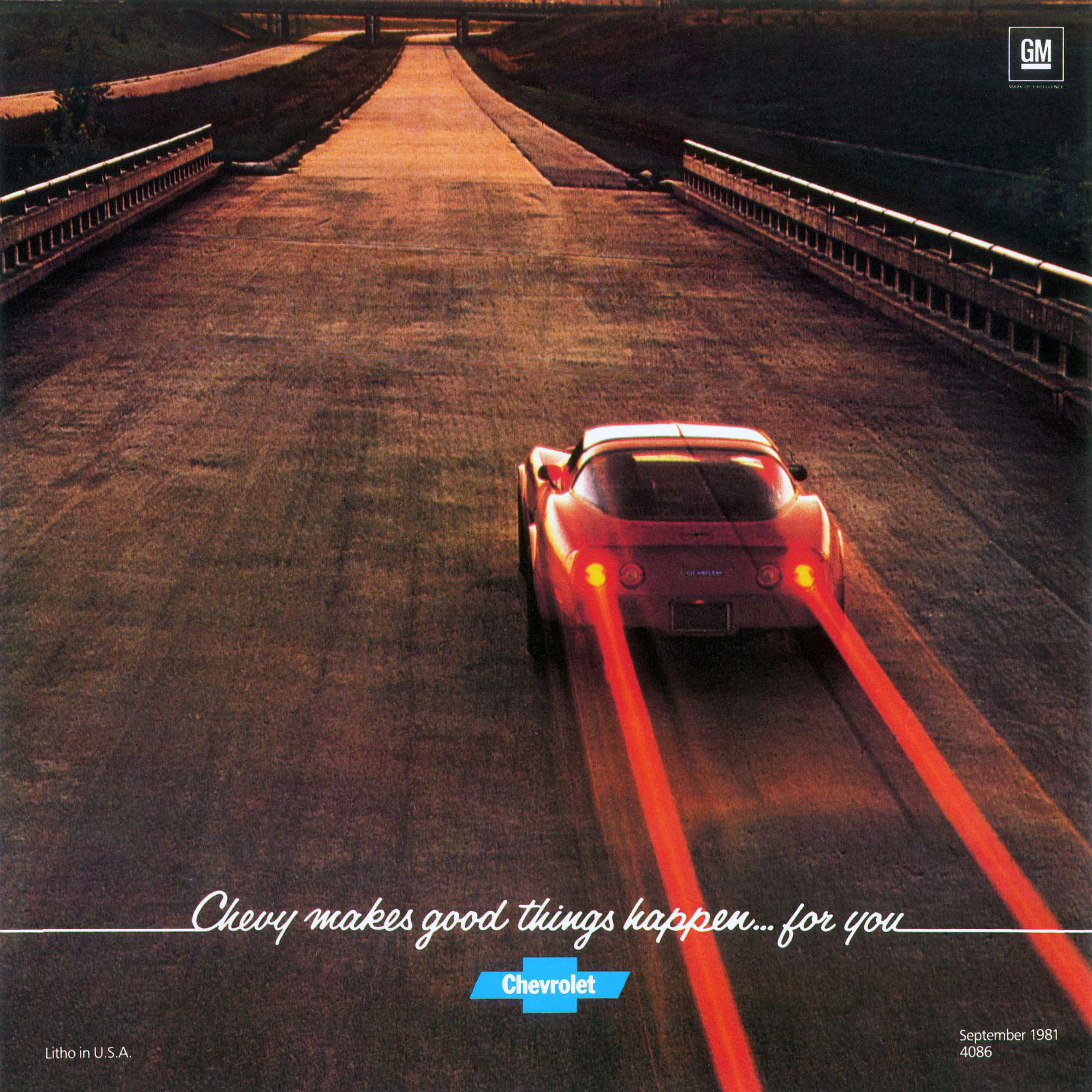
1982 was the final year for the “shark” Corvette, but the first year for the L83 Cross-Fire 5.7 liter/350 ci V8—a throttle body fuel-injected design that put out a respectable for the day 200 bhp and 285 lb-ft of torque. The downside was that it was only available with a four-speed automatic transmission; a manual transmission would not return until the middle of the 1984 model year.

Top speed for the 1982 Corvette was 125 mph, and Road & Track managed a 0-60 time of 7.9 seconds. Estimated fuel economy was 15 city/26 highway by the day’s standards—not bad for a fairly large V8 with primitive engine controls. With a 23.7 gallon gas tank, a 1982 Corvette owner could expect a range of 355 to 390 miles with a 10% fuel reserve—notably better than one year earlier.

The heavily-hyped Cross-Fire was an intermediary step for General Motors on the way to true multi-port electronic fuel injection for Chevrolet’s small-block V8. For Corvette, it brought the best horsepower in a standard engine since 1972, though it was not the relative screamer that the L82 (optional from 1973 to 1980) had been. However, the flat intake manifold design compromised fuel injection’s potential fuel economy gains—real improvements would wait until 1985’s L98.

Other changes for 1982 included the availability of the Collector Edition, as well as many new exterior paint colors and interior color options. Lost in the Cross-Fire publicity was the move from a three-speed automatic to a four-speed automatic transmission.

rear cover of 1982 Chevrolet Corvette brochure
Rear cover of 1982 Chevrolet Corvette brochure

Standard exterior and mechanical equipment in the $18,290 base Corvette (about $63,400 in today’s dollars) included tinted glass for all windows, removable roof panels, a Delco Freedom II battery, power steering, four-wheel power disc brakes, and P225/70R15 tires (a size still readily available) on 15-inch by 8-inch steel rally wheels. Inside, air conditioning, power windows, a Tilt-Telescopic steering wheel with a leather-wrapped rim, a quartz analog clock, and an AM/FM stereo radio with dual front speakers were all included.

The Collector Edition, Individual Options, & Production Numbers

The $22,538 Collector Edition (about $78,200 in 2025 dollars and about what a 2026 Corvette Stingray 2LT coupe goes for) added a functional hatchback (a first for Corvette), P255/60R15 Goodyear Eagle GT tires, aluminum wheels, and specific Silver Beige paint, striping, seats, and interior trim—along with a 23% addition to the base price.

Individual exterior and mechanical options included power sport mirrors ($125), power door locks ($155), cruise control ($165), electric rear window defogger ($129), gymkhana suspension (only $61 for specially tuned shock absorbers, higher-rate rear spring, and a rear stabilizer bar), two-tone paint ($428), aluminum wheels ($458), and  P255/60R15 Goodyear Eagle GT tires ($543). Optional interior equipment included a six-way power driver’s seat ($197) and an AM/FM stereo radio with a cassette player ($423).

Options that date this car include the stereo radio with a cassette player and Citizens Band radio ($755), the stereo radio with an 8-track player ($755), and the radio delete (-$124). Corvette buyers piled on the options in 1982: the average buyer ordered $2,195 worth, raising the sticker to $20,485 (about $71,100 in today’s dollars).

In its final year, the shark still sold decently—but the end for a car that featured many design components from 1963 was in sight. Chevrolet moved 25,407, of which 6,759 (about 27%) were the pricey Collector Edition.

The View From 2025

There is strong club support for the 1982 Corvette, as there is for all Corvettes. According to Hagerty’s valuation tools, a loaded non-Collector Edition 1982 Corvette in #1/Concours condition is $42,700, with a more typical number #3/Good condition car going for $17,200. 1982 Corvettes are regularly featured in the Hemmings Motor News classifieds, eBay Motors, and Bring a Trailer. As I update this blog entry in September 2025, there’s a Silver Metallic over Dark Claret Metallic two-tone Corvette with red cloth seats and 15,000 miles for sale on Hemmings, asking $30,000.

Make mine one of the relatively rare (and absolutely gorgeous) Silver Green Metallic cars, with the silver green leather seats.

Other Corvettes I have written about include the 1980 coupe, the 1981 coupe, the 1984 hatchback coupe, the 1986 convertible, and the 1988 35th Anniversary hatchback coupe.

Last updated September 2025.

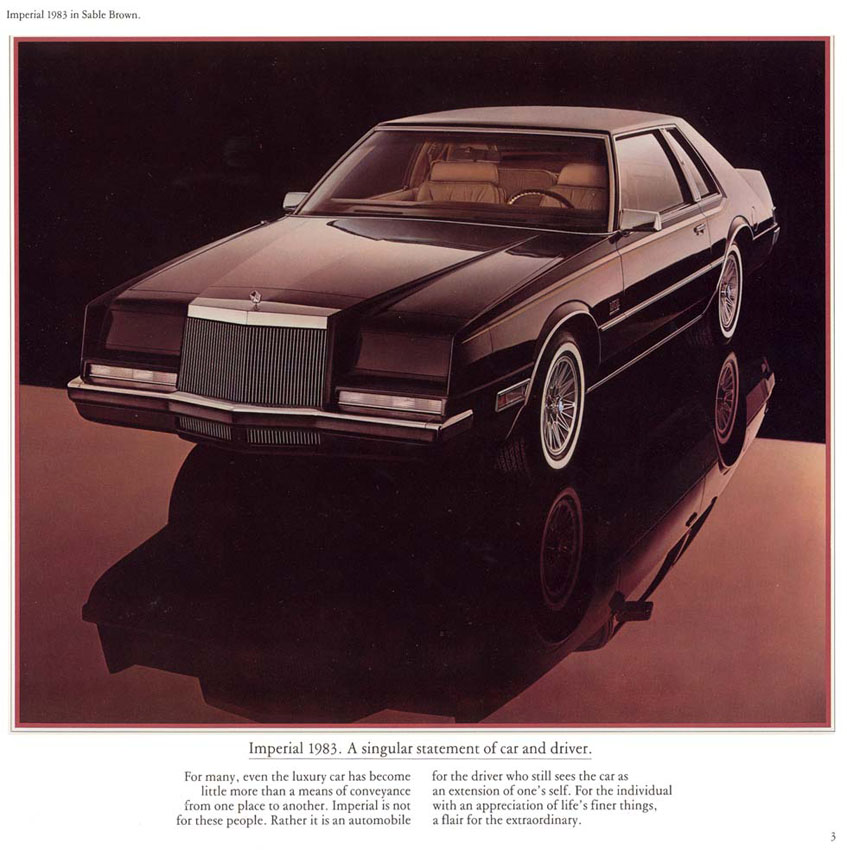
1983 Chrysler Imperial coupe

While out driving late in 2014, I saw an early 1980s Chrysler Imperial aggressively carving the back roads in the Philadelphia suburbs near where I live. The body design remains utterly distinctive: the alacrity with which the Imperial was moving makes me assume that it had the carburetor conversion and/or some other engine upgrade.

“A singular statement of car and driver.”

Chrysler introduced the “bustle back” Imperial for the 1981 model year, bringing it to market partly to reassure potential buyers that the company would remain in business. By 1983, the Cordoba-based luxury coupe was in its final year, selling a mere 1,427 units as all rear-wheel drive Chrysler products continued their decline.

For 1983, the powertrain continued to be the same: the LA 140 bhp electronic throttle-body fuel-injected 5.2 liter/318 ci V8 paired with a TorqueFlite three-speed automatic transmission. Despite notable attempts at increasing quality (each Imperial went on a five-and-a-half-mile test drive and received numerous other checks before shipping from the factory), the bleeding edge fuel injection continued to be stunningly unreliable—Chrysler frequently ended up replacing it with a carburetted system at the cost of $3,500 plus about 50 hours of labor.

Performance for the 3,900-pound coupe wasn’t impressive: 0-60 came in a little under 14 seconds. To be fair, neither the Cadillac Eldorado nor the Lincoln Continental Mark VI (the Imperial’s intended competitors) were notably faster in 1983. Fuel economy was rated at 16 city/26 highway by the day’s standards, giving a range of 305 to 340 miles with the 18-gallon gas tank and a 10% fuel reserve.

Page from the 1983 Chrysler Imperial brochure

Standard mechanical equipment for the quite well-equipped for 1983 $18,688 Imperial (approximately $61,500 in today’s dollars) included halogen headlights, power brakes, power steering, cruise control, and Goodyear Arriva P205/75R15 steel-belted radial whitewall tires (a size still readily available) on cast aluminum wheels. Exterior equipment included power heated mirrors, power windows, intermittent windshield wipers, and a rear window defroster. Interior equipment included “semi-automatic” air conditioning, a tilt steering wheel, leather and vinyl 60/40 power seats, and a 30-watt AM/FM stereo with cassette and power antenna.

Unusual standard equipment for 1983 in any car included an electronic instrument cluster, a garage door opener, and a two-year/30,000-mile warranty (a lot of warranty in those unreliable days). The only extra cost option was high altitude emissions ($75—why did Chrysler cheap out at this point?); no cost options included cloth and vinyl seats, Michelin tires, and wire wheel covers. Unlike in 1981 and 1982, there was no Frank Sinatra edition for 1983.

The View From 2025

Especially from the rear, the Imperial looks a lot like Cadillac’s 1980 Seville redesign, but seems to have been a separate idea—exterior design had begun in 1977. Not surprisingly, allpar.com has an interesting and detailed article on the 1981-1983 Chrysler Imperial—it is here.

According to Hagerty’s valuation tools, a 1983 Chrysler Imperial in #1/Concours condition is $26,100, with a more normal #3/Good condition car fetching $7,600. Imperials appear in the Hemmings Motor News classifieds and very occasionally on Bring a Trailer. When I updated this entry in April 2025, a Goldenrod Crystal Coat 1982 with 111,000 miles was available on Hemmings, asking $19,800.

Make mine Formal Black, please.

Other real-wheel-drive eighties Chryslers I have written about include the 1980 Cordoba coupe, the 1981 New Yorker sedan, the 1983 Cordoba coupe, and the 1987 Fifth Avenue sedan.

Last updated September 2025.

1981 Toyota Celica Sport Coupe

We do requests on Eighties Cars, whether or not they are definitive ones. A friend of mine mentioned his 1981 Celica in one of the automotive forums I frequent, and that was enough inspiration for me. In June 2020, Autopolis also published a typically thoughtful post on the second-generation Celicas.

 “The Ultimate Toyota.”

1981 was the final model year for the second-generation Toyota Celica, which debuted in 1978. Despite this, there were some significant changes, including the introduction of a new engine— the 22R 97 bhp 2.4 liter/144 ci inline four with a two-barrel carburetor.

Paired with the standard five-speed manual transmission, the Celica’s fuel economy was an impressive 25 city/37 highway by the day’s standards. Choosing the optional four-speed automatic transmission dropped the highway mileage rating slightly to 35 mpg. With a curb weight of a little over 2,400 pounds, Consumer Guide recorded a 0-60 time of 12.5 seconds—respectable for 1981.

celicas
1981 Celica and Celica Supra poster, courtesy of Flickr user Alden Jewell.

The Celica Sport Coupe was available in ST and GT trim levels. Standard exterior and mechanical equipment on the Celica ST ($6,699 or about $25,600 in today’s dollars) included tinted glass, electronic ignition, power assisted front disc/rear drum brakes, and 175/SR14 steel-belted radial tires (a size still somewhat available) on 14-inch styled steel wheels. Inside, reclining front bucket seats, “cut pile wall-to-wall carpeting,” a simulated woodgrain instrument panel and console, and an electric rear window defogger were included.

Moving up to the GT ($7,429 or about $28,400 in 2025 dollars) added features such as tungsten halogen hi-beam headlamps, a locking gas cap, 185/70SR14 steel-belted radial tires (a size still readily available), dual outside mirrors with driver’s side remote control, a simulated brushed aluminum instrument panel and console, and an AM/FM/MPX stereo with four speakers.

Optional equipment included a sunroof ($290), power steering ($180), and air conditioning ($610). Raised white letter tires, aluminum alloy wheels, cruise control ($115), and an electronic digital-readout AM/FM/MPX tuner stereo with a cassette player, an equalizer/amplifier, and four speakers were GT-only options for the Sport Coupe.

The View From 2025

1000 views badge

Celicas of this generation sometimes come up for sale in Hemmings Motor News, on eBay Motors, and on Bring a Trailer. As I update this post in September 2025, there’s a Silver Metallic 1981 Celica with grey cloth front bucket seats and 67,000 miles for sale on Hemmings, asking $8,000.

Make mine Dark Blue Metallic, please.

Other Toyotas I’ve written about include the 1980 Corolla Tercel Liftback, the 1982 Celica Supra hatchback coupe, the 1983 Camry sedan, the 1984 Corolla SR5 Sport Coupe, the 1985 MR2 coupe, and the 1988 Supra hatchback coupe.

Last updated September 2025.

1986 Chrysler Town & Country convertible

“Why sit around waiting for a summer breeze to come up when you can create quite a stir yourself?”

1986 was the last model year for Chrysler’s Town & Country convertible. Basically a special version of the LeBaron convertible, the Town & Country was first available in 1983 and was intended to remind potential buyers of the classic (and valuable) Town & Country convertibles in production from 1946 through 1950. The newer Town & Country was not especially successful, selling only 3,721 units in four years, with only 501 sold in 1986.

Like all LeBarons, the Town & Country‘s front and rear fascias, headlights, grilles, and taillights were all updated with a more rounded and aerodynamic look in 1986. The center-mounted brake light mandated for all 1986 vehicles by U.S. federal law was mounted atop the trunk lid. Inside, the standard digital instrument cluster was redesigned for better legibility.

Also for 1986, a throttle-body fuel injected K 2.5 liter/152 ci inline four producing 100 bhp replaced the carburetted 2.6 inline liter four built by Mitsubishi as the base engine. The optional fuel-injected Turbo I 146 bhp 2.2 liter/135 ci turbocharged inline four remained for an additional $628. Both engines were paired with a TorqueFlite three-speed automatic. Mileage with the base engine was 23 city/25 highway by the day’s standards (20/23 by 2025 measures). The Turbo I was rated at 20 city/24 highway—not a big price to pay for a significant percentage of extra horsepower.

1986 Chrysler Town & Country convertible brochure picture
1986 Chrysler Town & Country convertible pages from the LeBaron brochure

The base price for 1986 Town & Country was a non-trivial $17,595 (about $52,600 in today’s dollars). For that money, you got halogen headlights, dual horns, power brakes, wire wheel covers with locks, and the Town & Country’s distinctive white ash moldings and teak appliques on the body sides. Inside, you got a very attractive Mark Cross leather interior along with air conditioning, power mirrors, a power driver’s seat, and the Ultimate Sound System AM/FM stereo cassette with a graphic equalizer and six speakers.

Packages included the $302 Deluxe Convenience Package (cruise control and tilt wheel) and the Power Convenience Discount Package (power windows and power locks).

The View From 2025

A small set of enthusiasts is collecting these eighties Town & Country convertibles, and I have seen nice examples at several AACA-judged shows. You see them for sale in the Hemmings Motor News classifieds, on eBay Motors, and on Bring a Trailer. As I update this blog entry in October 2025, there’s a White 1986 LeBaron Town & Country with almond seats and 178,000 miles for sale on Hemmings, asking $14,000.

Of course, these Super K convertibles also started Chrysler’s long tradition of making convertibles that might occasionally be sporty but were not sports cars—a market niche they finally exited with the demise of the Chrysler 200 convertible at the end of the 2014 model year.

I still like what Chrysler was trying to do, and I appreciate how these cars look. Make mine White, please, with that killer Almond/Cream leather interior.

I have also written about the debut 1982 Chrysler LeBaron convertible.

Last updated October 2025.

1987 Chevrolet Caprice Classic coupe

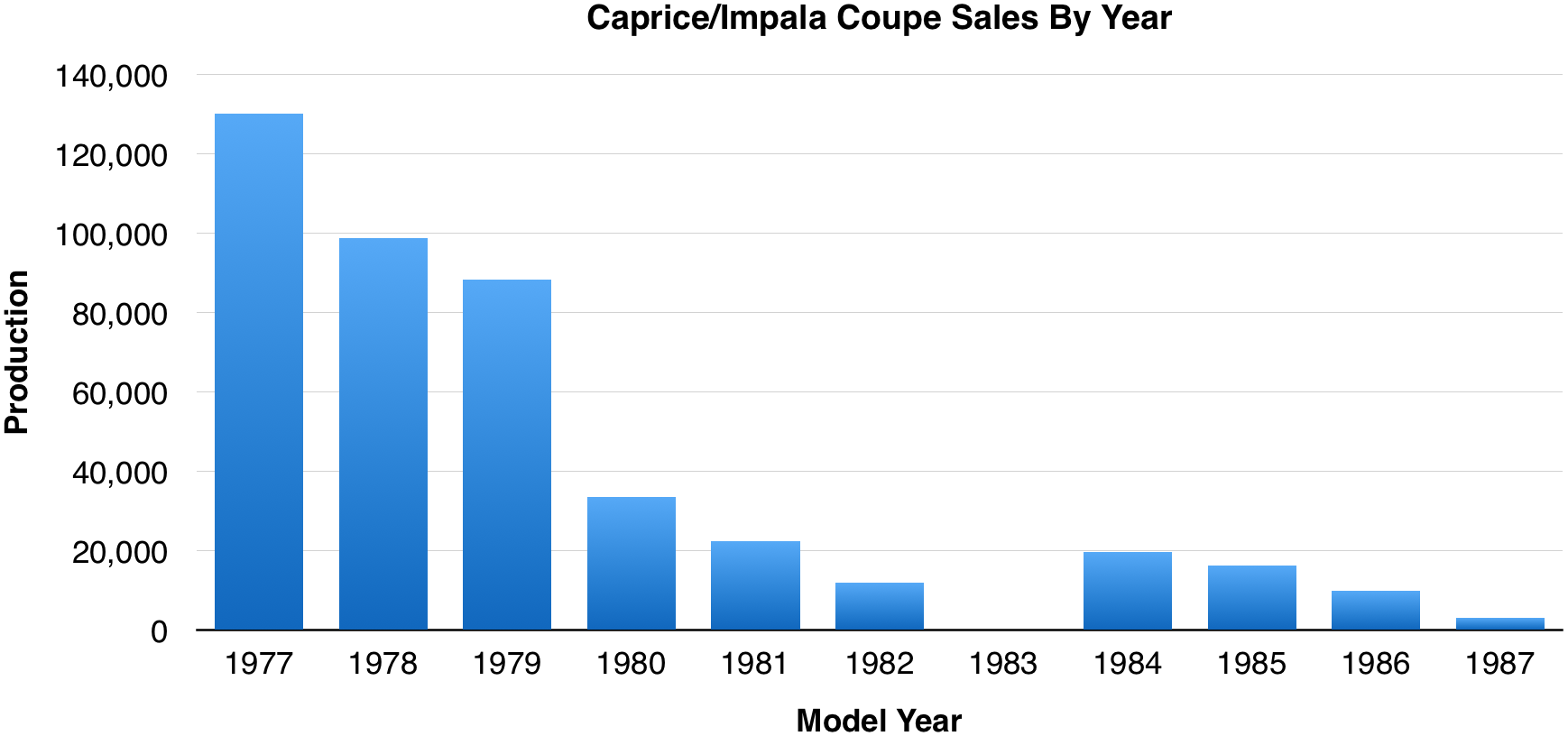
For somewhat unclear reasons, this was my most popular post on this blog for several years. Because of this, I updated it about five years ago to reflect both changes in my posting style and substantial improvements in available data.

“… the personal flair of a distinctive coupe.”

ChevroletCoupeSales

1987 was the final model year for Chevrolet’s Caprice Classic coupe, with only 3,110 made. Beginning in 1988, the Caprice would soldier on with just the sedan and wagon, as the once very popular big American coupes continued to lose favor.

The standard power team on the coupe (and sedan) was the LB4 140 bhp 4.3 liter/262 ci V6 with throttle-body fuel injection and a three-speed automatic transmission. Mileage was rated at 18 city/23 highway by the day’s standards (16/22 by modern measures).

Optional power was the LG4 165 bhp 5.0 liter/305 ci V8 with a four-barrel carburetor paired with a four-speed automatic transmission (I see what you did there, Chevrolet). In 1987, this combination was rated at 18 city/25 highway (16/23 by 2025 standards). With a large 25-gallon fuel tank, you could reasonably expect a comfortable range of about 440 to 480 miles with a 10% fuel reserve—impressive for a 3,600-pound full-size car back then. Even with the V8, these cars were not fast—0-60 came in about 10.5 seconds.

Coupe pages from the 1987 Chevrolet Caprice Classic brochure

Standard equipment for the $11,392 coupe (about $33,000 in today’s dollars) included power steering, power brakes, halogen headlights, and P205/75R15 all-season radial tires (a size still readily available) on 15-inch wheels. Inside, a full-width cloth bench seat, Quiet Sound Group, and an AM radio were standard.

Optional equipment included air conditioning ($775), cruise control ($175), power door locks ($145), power windows ($210), power seats ($240 each), power trunk opener ($50), a 50/50 split-front seat ($195), and AM/FM stereo cassette with graphic equalizer ($435).

Flights of Fancy

I have fun sometimes (often?) building a “unicorn” configuration for these old cars. When I was working at the local Chevrolet dealership in the mid-eighties, I dreamed up a Caprice S. Here’s what optional equipment it would have required, all still available in 1987:

  • F41 Sport Suspension (includes a rear stabilizer bar, 15-inch by 7-inch wheels, and sportier shock absorbers)
  • LG4 5.0 liter/305 ci V8
  • P225/70R-15 tires
  • Sport wheel covers
  • Limited slip differential
  • Performance axle ratio
  • Heavy-duty cooling
  • Dual power Sport mirrors
  • Special instrumentation/gauge package

So, a “John-configured” coupe would have listed for at least $15,096—real money in 1987 and about $43,700 in 2025 dollars. A desperate product planner might have tried to get the leather seats from the Brougham available in the Coupe and maybe scored some black wall tires, but that’s another story …

The View From 2025

Badge for 2,500 web hits

These big and (I think) handsome coupes occasionally appear in the Hemmings Motor News classifieds, on eBay Motors, and on Bring a Trailer. However, Hagerty’s valuation tools do not track Caprice Classic values between 1975 and 1991.

Make mine Silver Metallic, please, though I’m tempted by the Black/Medium Gray Metallic two-tone.

Other B-platform cars I have written about include the 1983 Chevrolet Caprice Classic sedan, the 1985 Chevrolet Caprice Classic station wagon, and the 1982 Oldsmobile Delta 88 Royale coupe.

Last updated April 2025.

1986 Chevrolet Camaro Berlinetta hatchback coupe

“Elegance With a Technical Touch.”

1986 was the last model year for the Berlinetta semi-luxury version of Chevrolet’s Camaro, and they were by far the rarest of the three Camaro types available. With only 4,579 Berlinettas built in 1986, Chevrolet sold more than eleven times as many IROC-Zs alone. There were few changes for the 1986 Berlinetta—among them the appearance of the federally mounted center high-mounted stop lamp, new colors, updated interiors, and a new automatic closure for the large and heavy rear hatch.

The base powertrain for the Berlinetta was the LB8 135 bhp 2.8 liter/173 ci multi-port fuel-injected V6 with a five-speed manual transmission. Optional power was the $450 LG4 155 bhp 5.0 liter/305 ci V8 with a Rochester Quadrajet four-barrel carburetor, which was paired with a $425 four-speed automatic transmission (the five-speed manual was not available with the V8 on the Berlinetta).

Fuel economy with the base powertrain combination was 17 city/26 highway by the day’s standards (15/24 by modern measures). Moving up to the V8 dropped mileage ratings only slightly—to 17/25, and reduced the 0-60 mph time to a respectable 9 seconds in a car that weighed approximately 3,065 pounds. With a 16.2-gallon fuel tank (for some reason 0.7 gallons larger than with the V6), a V8 Berlinetta owner could expect a range of 275 to 305 miles with a 10% fuel reserve.

Your $11,902 base price (about $35,400 in today’s dollars) bought standard mechanical and exterior equipment including power brakes, power steering, dual horns, and P205/70R-14 blackwall steel-belted radial tires (a size still readily available) on 14 x 7 inch wheels with Berlinetta-specific full wheel covers. Inside, custom cloth reclining seats with adjustable headrests, a Berlinetta-only steering wheel, intermittent windshield wipers, a roof console with a removable flashlight, a fold-down rear seat, a locking rear storage cover, Quiet Sound Group, and an AM/FM stereo radio with a clock and four speakers were included.

Chevrolet Camaro Berlinetta print advertisement

Of course, the most notable interior component in the Berlinetta was the “Welcome aboard Starship Camaro.” (yes, that was an actual advertisement) electronic instrument cluster with dual adjustable control pods, a vacuum-fluorescent digital speedometer, and a bar graph tachometer. To an aspiring young audiophile, the killer feature of this interior was the optional (an extra $242) AM/FM stereo on a swivel with a “proper” upright (no slot) cassette deck and a five-band graphic equalizer. For 1986 only, the stereo received substantially improved backlighting.

Options

Among the many exterior and mechanical options were four-wheel disc brakes ($179 and only available with the V8), t-tops ($846—ouch!), a rear spoiler ($69), halogen headlamps ($25), electric rear window defogger ($145), and nice looking Berlinetta-only aluminum finned wheels ($225). Inside, you could add cruise control ($185), Comfortilt steering wheel ($115), power door locks ($145), and Berlinetta-specific electronically-controlled air conditioning ($775). The Berlinetta could get expensive: I had no trouble getting a V8 version up to $15,400—about $45,800 in 2025 dollars.

The View From 2025

Badge for 2,500 web hits

According to Hagerty’s valuation tools, a 1986 Berlinetta with the LG4 in (rare) #1/Concours condition is $21,900, with a more normal #3/Good condition car going for $6,100. Third-generation Camaros generally have good club support and are often available in the Hemmings Motor News classifieds, on eBay Motors, and on Bring a Trailer. However, Berlinettas of any year (Chevrolet first brought them to market in 1979) are relatively rare. As I update this blog post in August 2025, there is a Medium Gray Metallic 1986 Berlinetta with gray cloth seats, the V8, and 29,000 miles available for sale on Hemmings, asking $17,900.

Make mine Black, please.

Thanks to the GM Heritage Center for some really specific information on the 1986 Berlinetta.

Other third-generation Camaro hatchback coupes I have written about include the 1982 Z28 Indy 500 Commemorative Edition, the 1984 Sport Coupe, and the 1985 IROC-Z. I have yet to write about any of the 1987 through 1989 Camaro convertibles.

Last updated August 2025.

Sav

1980 Pontiac Sunbird Sport Hatch

“Sunbird offers new thrills for the thrifty.”

1980 was the last model year for the rear wheel drive Pontiac Sunbird, Pontiac’s variant of Chevrolet’s Monza. Initially available in base coupe, sport coupe, and sport hatch (a base hatch was added mid-year, but the wagon was permanently gone), the Sunbird received few changes for 1980.

The standard engine was the LX8 Iron Duke 2.5 liter/151 ci inline four with a Rochester 2SE two-barrel carburetor, making all of 86 bhp. Optional was the LD5 110 bhp 3.8 liter/231 ci V6 with a Rochester M2ME two-barrel carburetor. A four-speed manual was standard, with an optional three-speed automatic available.

Mileage with the inline four and four-speed manual was pretty impressive in 1980: 22 city/35 highway by the day’s standards. Getting decadent by spending $545 for the automatic and the V6 combination took mileage down to 20 city/27 highway. With the V6/automatic transmission pairing and an 18.5-gallon fuel tank, a Sunbird owner could expect a range of 320 to 350 miles with a 10% fuel reserve.

Not much came standard for the $4,371 base price (approximately $18,700 in today’s dollars), especially to our 2025 eyes. Feature highlights for a base Sunbird included a bright grill with park and signal lamps, whitewall tires, Custom wheel covers, and “Sunbird external identification.” Inside, base Sunbirds included tinted windows, vinyl front bucket seats, and a Delco AM radio.

Moving up to the sport coupe ($4,731) or the sport hatch ($4,731) added body color mirrors, “custom” vinyl bucket seats, and various moldings, but was still rather austere. Luxury trim ($195) added cloth seats along with snazzier carpeting and door trim.

A Package, Individual Options & Production Numbers

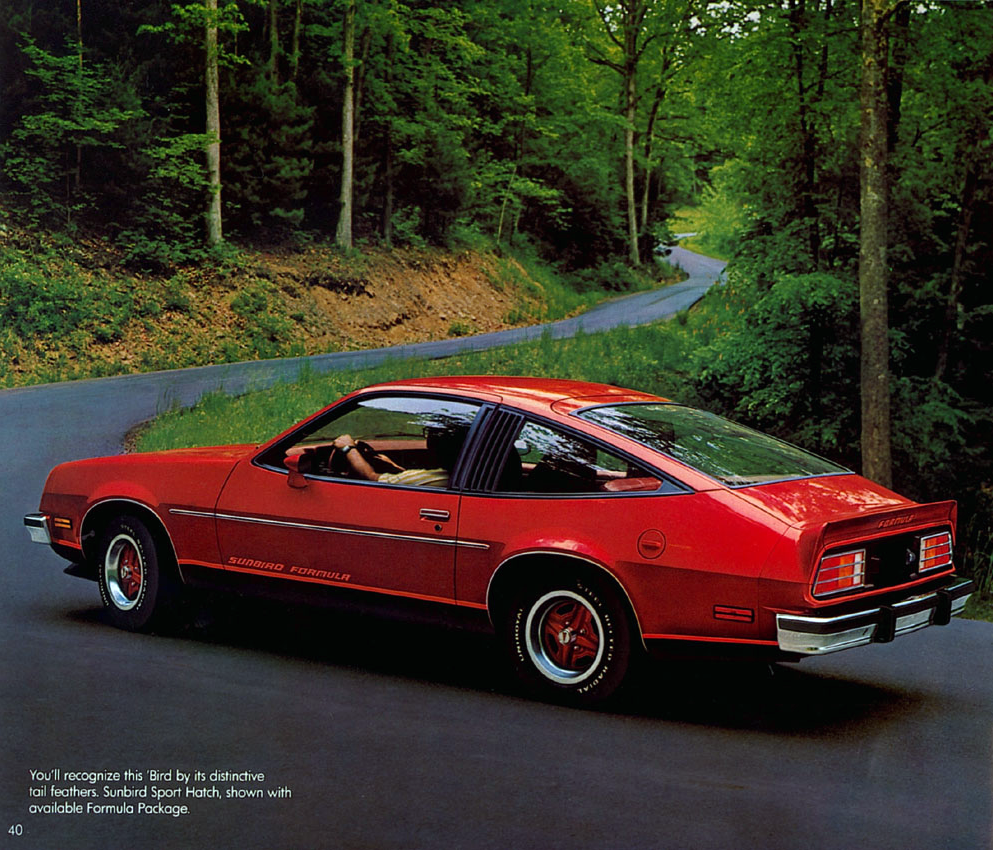
1980 Pontiac Sunbird brochure picture
1980 Sunbird Sport Hatch with the Formula Package

Available only with the sport hatch, the rare (only 1% of production) and expensive ($674, or about $2,900 in today’s dollars) Formula Package added a front air dam and rear spoiler, along with blacked-out grille, and BR70-13 white lettered tires (nearly equivalent 195/70R13 tires are available from BF Goodrich) on 13-inch cast aluminum rally wheels with trim rings. It wasn’t all bark and no bite: the Rally Handling Package was included, with larger front and rear stabilizer bars. Inside, a tachometer and other rally gauges were included. The whole combination meant that a sport hatch with the Formula Package, the V6, and the four-speed manual came to $5,630 (about $24,100 in today’s dollars). The 0-60 time for this top-of-the-line Sunbird was probably around 10 seconds—not far from some versions of the line-leading 1980 Firebird Trans Am.

Individual mechanical options included variable-ratio power steering (the most popular option and required with the V6) and power front disc brakes. Inside, you could add Custom air conditioning ($531), a tilt steering wheel (which required power steering), and an AM/FM stereo cassette player (two different 8-track radios were also still available). A removable sunroof was also available for $193.

The rear wheel drive Sunbird sold well even in its final year, partially because of the extended model year. Almost 188,000 were sold, with over 100,000 being the base coupe, making the Sunbird the best-selling of all the 1980 H-bodies. Pontiac would return partially to the Sunbird name with the 1983 2000 Sunbird convertible version of the J-body—by 1985, the Sunbird name would once again stand alone.

The View From 2025

Badge for 2,500 web hits

Stock Sunbirds of this generation almost never come up for sale in Hemmings Motor News and eBay Motors—they seem to have disappeared entirely despite the fact that Pontiac sold about 480,000 examples over five years. You do occasionally see examples of the “sister” Chevrolet Monza auctioned on Bring a Trailer, but even they are rare.

Make mine Agate Red, please.

Another Sunbird I have written about is the 1984 2000 Sunbird S/E hatchback coupe. I have also written about the 1980 Chevrolet Monza Sport 2+2 hatchback coupe.

Last updated October 2025.

Save

Save

1989 Mercedes-Benz 560SL convertible

560SLs were a notable presence in the January 2014 auctions at Scottsdale and Kissimmee, so I decided to finally post this short entry on the last of third-generation SLs.

“Engineered like no other car in the world”

The 1989 Mercedes-Benz 560SL marked the end of the R107 generation that had begun way back in 1972 with the 450SL. There had been a moderate restyling for 1986, but the basic bones were definitely aged.

Motive power was provided by a Bosch fuel injected 227 bhp 5.5 liter/338 ci V8 connected to a four-speed automatic transmission. Mileage wasn’t exactly great for the 3,700-pound car—the ratings of the day were 14 city mpg/17 highway (adding a $1,300 gas guzzler tax to every vehicle), by today’s standards that would be 12 city/16 highway. With the 22.5-gallon gas tank, 560SL owners could expect a range of between 280 and 315 miles with a 10% fuel reserve. 0-60 did come in about 7 seconds, but the 560SL was closer to a muscle car than to a sports car.

Philips light bulb advertisement featuring 1989 Mercedes-Benz 560SL
Philips light bulb advertisement featuring the 1989 Mercedes-Benz 560SL

The base price for 1989 was $64,230 (about $172,400 in today’s dollars). For your money, you got a plethora of standard equipment. Standard exterior and mechanical features included power assisted steering, anti-lock braking system, and power assisted four wheel disc brakes, and light alloy wheels. Inside, leather upholstery, a driver’s side air bag, cruise control, automatic climate control, central locking, electrically operated windows, an electronic AM and FM stereo radio with cassette player, and (of course) a first aid kit were included. About 8,300 buyers took home this last of the line example.

The View From 2025

There is decent club support for the 560SL, as there is for almost all Mercedes-Benz’s. 560SLs maintain a substantial presence in the Hemming’s Motor News classifieds, on eBay Motors, and on Bring a Trailer. As I updated this blog post in August 2025, there were 83 available on Hemmings, including 22 of the 1989 models. According to Hagerty’s valuation tools, all the money for a 1989 560SL in #1/Concours condition is an astounding $153,000, while a more normal #3/Good condition car goes for $24,400.

Make mine Astral Silver Metallic, please.

Other Mercedes-Benz models I have written about included the 1980 450SL convertible, the 1981 380 SEL sedan, the 1985 380SL convertible, the 1985 300SD coupe, and the 1986 560SEC coupe.

Last updated August 2025.